
Showing 140 items matching "1930 - 1960"
-
 Box Hill Historical Society
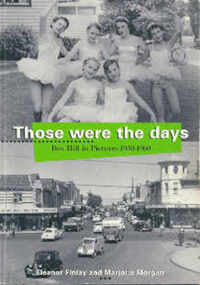
Book, Eleanor Finlay et al, Those were the days: Box Hill in pictures 1930 - 1960, 1994
... Those were the days: Box Hill in pictures 1930 - 1960......1930 - 1960...Includes b&w photos Those were the days: Box Hill in pictures 1930 - 1960 Book Eleanor Finlay Marjorie Morgan Box Hill City Council ...Pictorial history of Box Hill from 1930 to 1960, covering development, government, community services, industry, transport, arts and entertainment, war, sport, schools, churches, people, houses, shops, and centenary of local government.87 pages. Includes b&w photosnon-fictionPictorial history of Box Hill from 1930 to 1960, covering development, government, community services, industry, transport, arts and entertainment, war, sport, schools, churches, people, houses, shops, and centenary of local government.history, box hill, photographs, development, government, community services, industry, transport, arts, entertainment, war, sport, schools, churches, people, houses, shops, centenary, local government, 1930 - 1960 -
 Whitehorse Historical Society Inc.
Book, Those were the days, 1994
... Box Hill in pictures; 1930 - 1960...box hill Book Box Hill in pictures; 1930 - 1960 Box Hill in pictures; 1930 - 1960 Those were the days Book Book ...Box Hill in pictures; 1930 - 1960Box Hill in pictures; 1930 - 1960Box Hill in pictures; 1930 - 1960box hill, book -
Tatura Irrigation & Wartime Camps Museum
Booklet, The Europeans
... Title and Emigre artists in Australia 1930-1960 in white print at the bottom. Back page maroon with white printing....Title and Emigre artists in Australia 1930-1960 in white print at the bottom. Back page maroon with white printing. ...Printed by the National Gallery of Australia it is a programme for an exhibition which travelled Australia depicting life and culture of the many Europeans in Australia.Small booklet with a black and white picture of a man and a flag on the shore line. Title and Emigre artists in Australia 1930-1960 in white print at the bottom. Back page maroon with white printing.national gallery of australia, exhibition programme -
 Royal Australian and New Zealand College of Obstetricians & Gynaecologists (RANZCOG)
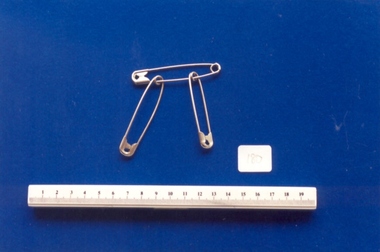
Domestic object - Safety pins used by Dr Mitchell Henry O'Sullivan, c. 1930-1960
... These type of safety pins were commonly used in hospitals between 1930- 1960. Pins such as these were advertised for sale as "Hospital and Sick Room Sundries" and were generally supplied in boxes of 12 dozen (144). ...c. 1930-1960...These type of safety pins were commonly used in hospitals between 1930- 1960. Pins such as these were advertised for sale as "Hospital and Sick Room Sundries" and were generally supplied in boxes of 12 dozen (144). ...These type of safety pins were commonly used in hospitals between 1930- 1960. Pins such as these were advertised for sale as "Hospital and Sick Room Sundries" and were generally supplied in boxes of 12 dozen (144). The pins were supplied in sizes ranging from 0 to 6 - the pins catalogued here are sizes 4,5, and 6. Dr Mitchell Henry O'Sullivan worked in the Victorian country town of Casterton as a general practitioner from 1919 until his death in 1977. He also practiced obstetrics. His son, Dr David More O'Sullivan donated his obstetric bag and its contents to the College in 1999. The bag and contents are a unique time capsule of the type of instruments and pharmaceuticals used in the inter-war period.Three nickel plated safety pins (.1 - .3) of differing sizes. .1 is size 4, .2 is size 5, and .3 is size 6. -
 Mission to Seafarers Victoria
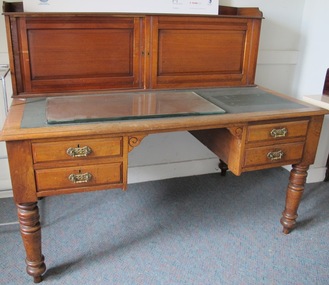
Furniture - Desk, unknown
... This desk was donated to the MTSV in 2017 by a descendant of Padre Oliver, Chaplain from 1930-1960....This desk was donated to the MTSV in 2017 by a descendant of Padre Oliver, Chaplain from 1930-1960. This desk belonged to Rodney Oliver and is believed to have been used by Padre Oliver and his wife while Chaplain, and the family resided at the MTS and thereafter in subsequent parish postings. ...This desk was donated to the MTSV in 2017 by a descendant of Padre Oliver, Chaplain from 1930-1960.This desk belonged to Rodney Oliver and is believed to have been used by Padre Oliver and his wife while Chaplain, and the family resided at the MTS and thereafter in subsequent parish postings. The desk makes a link with one of the longest serving Chaplains who had a significant influence through the intense period of operations early - mid 20th C. The Padre's influence was substantial. The desk is also believed to have been used by son Rodney Oliver who also served the Mission as Chairman in the later 20th C.A four drawer leather topped desk with detachable unit comprising double sliding door lockable cabinet with small bookshelf backed with shallow pediment. Sorting / sectioned pigeonhole interiors to the top cabinets see images. The main table desk appears to be of a different wood with green leather inset to top surface and heavy legs. Drawers with heavily decorated brass handles. The top cabinet features finer cabinetry and darker colour wood or stain which could be cedar.with simple narrow reeded decoration. interior two pigeon holes with labelsfrank leslie oliver, padre oliver, chaplain, desk, mission to seafarers, melbourne, seamen's mission, flinders street, padre frank leslie oliver -
 Mont De Lancey
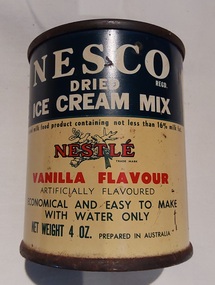
Domestic object - Kitchen Containers, Nestle', 1930's to 1960
... These items contained products for cooking use in the family kitchen in the 1930's - 1960. ...Five vintage tins and one bottle of kitchen products used in the home 1930's - 1960. 1. A small unopened Nestle' Nesco REGD. ...1930's to 1960...These items contained products for cooking use in the family kitchen in the 1930's - 1960. Tins Bottles Kitchen equipment Kitchen ingredients 1. ...These items contained products for cooking use in the family kitchen in the 1930's - 1960. Five vintage tins and one bottle of kitchen products used in the home 1930's - 1960. 1. A small unopened Nestle' Nesco REGD. Dried Ice Cream Mix tin with powder inside. It has a yellow label with red, white and black lettering of the brand and details of product. Net weight 4oz. 2. A small McKenzie's Excelsior Baking Powder tin with a white, and gold printed paper label explaining manfacturer details and instructions for use. 4 ozs. Net. 3. Two large lidded The Colonial Sugar Refining Co. Ltd. treacle tins with red, green and silver lettering. manufacturer details are printed on the front. 2lbs nett. 4. A small tin lidded cylinder of Herb-Ox Bouillon Cubes artificially flavoured. The manufacturer details and directions for use are printed in yellow and red. Net weight 3/4 oz. 5. A small clear glass bottle with a tin screw top lid of Rawleigh's Essence of Peppermint printed on the white and brown paper label. 2 fluid oz.1. 'Nesco Dried Ice Cream Mix Nestle' Vanilla Flavour. 16.11.63' 2. 'McKenzie's Excelsior Baking Powder' 3. 'The Colonial Sugar Refining Co. Ltd.Treacle' is printed in large red print. 4. 'Herb-Ox' printed in red lettering. 5. 'Rawleigh's Essence of Peppermint A delicious Flavour'.tins, bottles, kitchen equipment, kitchen ingredients -
 Mission to Seafarers Victoria
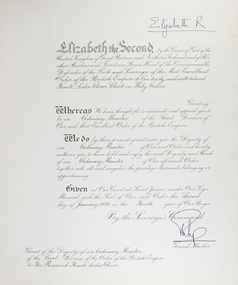
Letter - Letter with envelope, January 1956
... The Reverend Frank Leslie Oliver, Senior Chaplain at the Mission to seamen from 1930-1960, was awarded an OBE in 1956....The Reverend Frank Leslie Oliver, Senior Chaplain at the Mission to seamen from 1930-1960, was awarded an OBE in 1956. Indicative of the recognition of long service at the Mission and reflects early vice regal support for the Mission and services, ongoing Royal patronage by the Princess Royal, and previous interest with visits by HRH Prince of Wales in 1920 and the Governor of Australia Duke and Duchess of Gloucester circa 1945. padre oliver order of the british empire queen elizabeth ii obe padre frank leslie oliver see image Sheet of paper with calligraphic dedication and statement in heavy paper folder. ...The Reverend Frank Leslie Oliver, Senior Chaplain at the Mission to seamen from 1930-1960, was awarded an OBE in 1956.Indicative of the recognition of long service at the Mission and reflects early vice regal support for the Mission and services, ongoing Royal patronage by the Princess Royal, and previous interest with visits by HRH Prince of Wales in 1920 and the Governor of Australia Duke and Duchess of Gloucester circa 1945. Sheet of paper with calligraphic dedication and statement in heavy paper folder.see imagepadre oliver, order of the british empire, queen elizabeth ii, obe, padre frank leslie oliver -
 Bendigo Military Museum
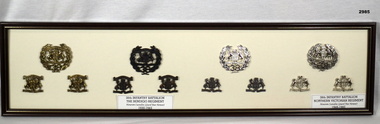
Badge - BADGES, FRAMED, Post 1960
... BADGES OF 38TH INFANTRY BATTALION NORTHERN VICTORIAN REGIMENT 1930 TO 1960. Brown plastic frame of heavy cream cardboard displaying 12 badges....2 labels underneath badges Left side: “38th INFANTRY BATTALION THE BENDIGO REGIMENT 1930 - 1943” Right side: “38TH INFANTRY BATTALION NORTHERN VICTORIAN REGIMENT 1948 - 1960” ...38th Bn framed Passchendaele barracks trust 2 labels underneath badges Left side: “38th INFANTRY BATTALION THE BENDIGO REGIMENT 1930 - 1943” Right side: “38TH INFANTRY BATTALION NORTHERN VICTORIAN REGIMENT 1948 - 1960” BADGES OF 38TH INFANTRY BATTALION NORTHERN VICTORIAN REGIMENT 1930 TO 1960. ...BADGES OF 38TH INFANTRY BATTALION NORTHERN VICTORIAN REGIMENT 1930 TO 1960. Brown plastic frame of heavy cream cardboard displaying 12 badges.2 labels underneath badges Left side: “38th INFANTRY BATTALION THE BENDIGO REGIMENT 1930 - 1943” Right side: “38TH INFANTRY BATTALION NORTHERN VICTORIAN REGIMENT 1948 - 1960” 38th bn, framed, passchendaele barracks trust -
 Mission to Seafarers Victoria
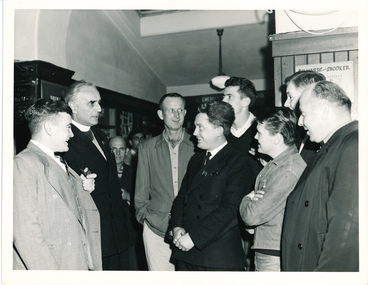
Photograph - Digital copy, Black and white, c. 1950
... Frank Leslie Oliver served as chaplain at the Mission to Seafarers Melbourne for 30 years from 1930 - 1960. He is in this photograph, second from the left....Frank Leslie Oliver served as chaplain at the Mission to Seafarers Melbourne for 30 years from 1930 - 1960. He is in this photograph, second from the left. ...This photograph was taken at the Mission to Seafarers, Melbourne. Frank Leslie Oliver served as chaplain at the Mission to Seafarers Melbourne for 30 years from 1930 - 1960. He is in this photograph, second from the left.Frank Leslie Oliver served as chaplain at the Mission to Seafarers Melbourne for 30 years from 1930 - 1960, including time served as chaplain with the Royal Australia Navy aboard HMAS Australia. He was a live-in chaplain and was supported by his entire family, including wife Moira, for whom a memorial window exists in the chapel.Black and white photograph of a group of eight men at the Mission to Seafarers. Frank Oliver is second on the left and along with the man on his right they are facing the other six men. Robin Kent stands second on the right. Only his face can be seen. Peter Smith is in the middle of the photograph, fourth from the left. There are at least two additional men in the background.On the back of the photograph are three names: Robin, Peter Smith, and 'dad' to signify who some of the men in the photograph are. There is also a number 4 in the top left corner.pipe, mission to seafarers, frank leslie oliver, robin kent, peter smith, billiard, snooker, memorial plaque, flinders street, melbourne, padre oliver, chaplains -
 Mission to Seafarers Victoria
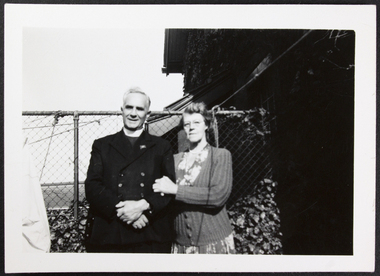
Photograph, Padre Oliver and wife Moira in the mission's garden, circa 1958
... Padre Oliver served at the Seafarers Mission from 1930 to 1960....Padre Oliver served at the Seafarers Mission from 1930 to 1960. One of the longest serving Padre's at the Mission in Melbourne padre oliver frank oliver moira bird Small rectangular (landscape orientation) black and white photograph depicting Padre Oliver and his wife, Moira Padre Oliver and wife Moira in the mission's garden Photograph Photograph ...Padre Oliver served at the Seafarers Mission from 1930 to 1960.One of the longest serving Padre's at the Mission in MelbourneSmall rectangular (landscape orientation) black and white photograph depicting Padre Oliver and his wife, Moirapadre oliver, frank oliver, moira bird -
 Mission to Seafarers Victoria
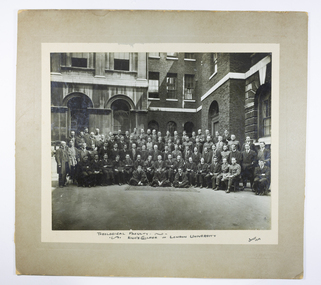
Photograph - Mounted photograph, Black and white, Theological Faculty - King's College - London University - June 1919, 1919
... According to his autobiography Frank Oliver, senior Chaplain from 1930-1960 at MtS, studied primarily at Trinity College, University of Melbourne after war service in the Army Medical Corps. ...According to his autobiography Frank Oliver, senior Chaplain from 1930-1960 at MtS, studied primarily at Trinity College, University of Melbourne after war service in the Army Medical Corps. ...Frank Leslie Oliver is photographed here in King's College, London in June 1919. Second row standing 8th from the left. According to his autobiography Frank Oliver, senior Chaplain from 1930-1960 at MtS, studied primarily at Trinity College, University of Melbourne after war service in the Army Medical Corps. Established in 1829 under the patronage of George IV, King's College is one of the oldest and most distinguished centres for the study of classical languages, literature, thought, religion, art, archaeology and history in the UK.Black and white mounted group photograph. Many in the group are wearing military uniform In black ink along the lower edge of mount: Theological Faculty - King's College - London University - June 1919kings' college, london university, student, theology, padre oliver, padre frank leslie oliver -
 Mission to Seafarers Victoria
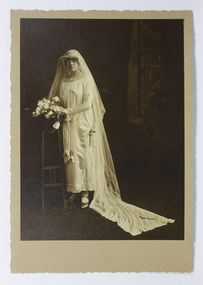
Photograph - Photograph, Sepia, Allan Studio, 18 July 1925
... After various postings the married couple eventually arrived and were appointed to the Chaplaincy to the Mission to Seamen based at 717 Flinders St from 1930-1960. The Olivers weathered many significant issues between 1930 and 1960, a depression, WW2, strikes and waterfront unrest in the 1950s and financial struggles resulting from changed shipping patterns. ...After various postings the married couple eventually arrived and were appointed to the Chaplaincy to the Mission to Seamen based at 717 Flinders St from 1930-1960. The Olivers weathered many significant issues between 1930 and 1960, a depression, WW2, strikes and waterfront unrest in the 1950s and financial struggles resulting from changed shipping patterns. ...Moira Bird Oliver (nee Good) daughter of Rev Good of St Jude's Carlton first met Frank Oliver circa 1915. They were engaged for some 7 years while Frank did wartime service and then on return to Melbourne completed a Theology degree at Trinity College and was then ordained. They married on the 18th of July 1925 at St Jude's Church in Carlton. Frank Oliver was then naval chaplain on the HMAS Platypus. After various postings the married couple eventually arrived and were appointed to the Chaplaincy to the Mission to Seamen based at 717 Flinders St from 1930-1960. The Olivers weathered many significant issues between 1930 and 1960, a depression, WW2, strikes and waterfront unrest in the 1950s and financial struggles resulting from changed shipping patterns. This photograph was gifted by a descendant who told us that Mrs Oliver was a very enthusiastic photographer. Mrs Oliver was a well loved and respected woman and is memorialised by a window in the Mission Chapel. It is possible she is one of the many anonymous photographers who contributed various photographs especially of the 1930s and forties that make up a substantial part of the Mission Heritage Collection. Mrs Oliver died in 1969 see elsewhere this database for memorial plaque and window.Mounted studio b & w photograph portrait of a bride in white dress and trainpadre oliver, reverend good, st. jude's church, reverend frank leslie oliver, moira bird good, moira oliver, hmas platypus, royal australian navy, r.a.n. chaplain -
 Bendigo Historical Society Inc.
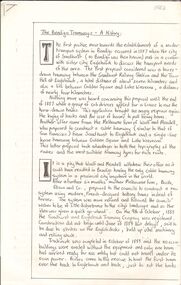
Document - ''THE BENDIGO TRAMWAYS: A HISTORY''
... ; State Electricity Commission of Victoria; list of the major purchases made by the SEC from the MMB to add to the Bendigo fleet (1930 -1960) closure of tramways; Bendigo 'talking' tourist tram (Dec. 1972); Writer's notes - acknowledgement...; State Electricity Commission of Victoria; list of the major purchases made by the SEC from the MMB to add to the Bendigo fleet (1930 -1960) closure of tramways; Bendigo 'talking' tourist tram (Dec. 1972); Writer's notes - acknowledgement Document ''THE BENDIGO TRAMWAYS: A HISTORY'' ...''The Bendigo Tramways - A History'' (author, not named, but last page indicates that writer was 17 years of age). Eight handwritten pages; 4 pages of photo reproductions; loose sheet - broad description of 'Bendigo''; loose sheet showing ''S.E.C. Bendigo Tramways Track Diagram as at closure of system, April 1972''. Early moves to have tramway system in 1880s; battery trams operation; steam tram motors; Bendigo Tramway Company; Electric Supply Company; Route maps (''in the appendices at the end of this report'' ???); State Electricity Commission of Victoria; list of the major purchases made by the SEC from the MMB to add to the Bendigo fleet (1930 -1960) closure of tramways; Bendigo 'talking' tourist tram (Dec. 1972); Writer's notes - acknowledgementtramways, history, bendigotramway history., bendigo tramways, electric supply company, talking tourist tram. tramsways track diagram. battery trams, ellsen and co., the sandhurst and eaglehawke tramways company. mollison street. arnold street. -
 Harcourt Valley Heritage & Tourist Centre
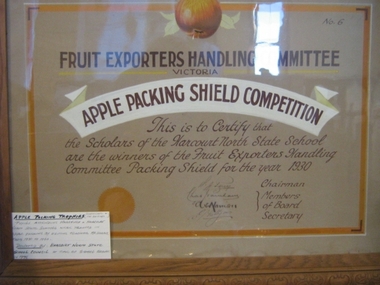
Apple Packing Certificate, Apple Packing Shield Competition, 1930
... Pupil attending Harcourt and Harcourt North State Schools were trained in apple packing by visiting teacher Mr. Harris from 1930 to 1960.The Harcourt district was very prosperous due to its production and export of large volumes of uniform sized 'fancy grade' fruit ...Pupil attending Harcourt and Harcourt North State Schools were trained in apple packing by visiting teacher Mr. Harris from 1930 to 1960.The Harcourt district was very prosperous due to its production and export of large volumes of uniform sized 'fancy grade' fruit Specialist knowledge of packing apples became part of the school syllabus in Harcourt and other fruit-growing districts which relied on horticultural exports. ...Pupil attending Harcourt and Harcourt North State Schools were trained in apple packing by visiting teacher Mr. Harris from 1930 to 1960.The Harcourt district was very prosperous due to its production and export of large volumes of uniform sized 'fancy grade' fruit Specialist knowledge of packing apples became part of the school syllabus in Harcourt and other fruit-growing districts which relied on horticultural exports.Award/certificate describing the winners of the Apple Packing Shield Competition presented by the Fruit Exporters Handling Committee Victoria. The award has two apple illustrations.This is to certify that the scholars of the Harcourt North Primary School are the winners of the Fruit ExportersHandling Committee's Apple Packing Shield for the year 1930. -
 Bendigo Historical Society Inc.
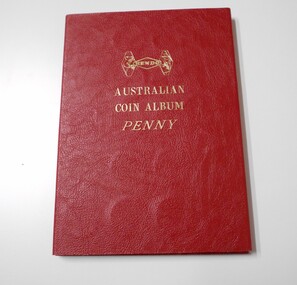
Coin - GRAHAM HOOKEY COLLECTION: COIN ALBUM
... Missing are the 1914, 1925, 1930, 1946, 1953 and 1960. 73 coins in total....Missing are the 1914, 1925, 1930, 1946, 1953 and 1960. 73 coins in total. Coin GRAHAM HOOKEY COLLECTION: COIN ALBUM ...Hendo Australian coin album - penny. The album contains all pennies from 1911 to 1964. Missing are the 1914, 1925, 1930, 1946, 1953 and 1960. 73 coins in total.numismatics, coins-australian, pennies -
 Mission to Seafarers Victoria
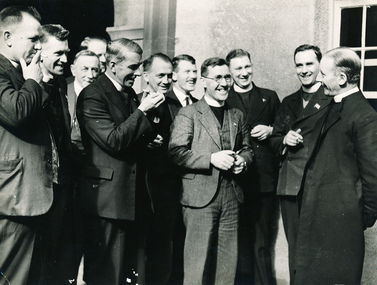
Photograph - Digital copy, Black and white, Herald Weekly Times, September 1936
... Frank Leslie Oliver served as chaplain at the Mission to Seafarers Melbourne for 30 years from 1930 - 1960. He is in this photograph, second from right, with a cigarette in his hand. ...Frank Leslie Oliver served as chaplain at the Mission to Seafarers Melbourne for 30 years from 1930 - 1960. He is in this photograph, second from right, with a cigarette in his hand. ...This photograph was taken at the Triennial Congress, Melbourne. Frank Leslie Oliver served as chaplain at the Mission to Seafarers Melbourne for 30 years from 1930 - 1960. He is in this photograph, second from right, with a cigarette in his hand. Also in this photograph, at the far right, is the Most Reverend F. Head, Archbishop of Melbourne. The photograph is a record of a historic conference of MTS representatives from Australia and New Zealand. , September 1-3 , 1936: Revd Wm Hoog (Brisbane) Revd W.H. Terry (Port Pirie) Revd H.C Cuthbertson (Adelaide) Revd W.R. Tyler (Melbourne) Mr J.W. Neill (Melbourne) Revd. F. J. Evans (Sydney) Revd Frank L. Oliver ( Melbourne MTS) F W Melbourne (Archbishop F W Head 1929- 1942) Mr J.C. Grahame (Hobart) Rev B.J. Williams ((Wellington NZ) Rev J.C. Clift (Fremantle)Frank Leslie Oliver served as chaplain at the Mission to Seafarers Melbourne for 30 years from 1930 - 1960, including time served as chaplain with the Royal Australia Navy aboard HMAS Australia. He was a live-in chaplain and was supported by his entire family, including wife Moira, for whom a memorial window exists in the chapel. The Chaplains' Conference was held in 1936.Black and white photograph of a group of chaplains outside the Mission to Seafarers building in Flinders Street, Melbourne. Frank Oliver is second from right holding a cigarette in his right hand.Top left in blue ink (written by Padre Oliver): Australian MTS, Chaplains gathered in Triennal Congress, with most Rev.J Head, Abp of Melbourne. Top right corner in black ink: prior to 1939 In black and blue ink some names: Archbishop Head, Dad, Bill Tyler Port Melbourne, Padre Williams Wellington, Pat Neil Layreader Faded stamp in pink ink: Herald Feature Service, Melbourne A sticker with: Ret to B Kentroyal australian navy, mission to seafarers, anglican, frank leslie oliver, archbishop head, triennial conference, chaplains, herald newspaper, cigarette, robin kent, beverley kent nee oliver, chaplains conference, padre oliver, new zealand, pat neil, lay reader, bill tyler, port melbourne, reverend william wellington, chaplains group -
 Flagstaff Hill Maritime Museum and Village
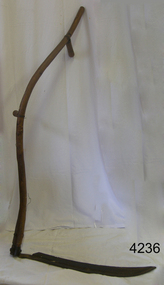
Tool - Scythe, 1930-1960
... 1930-1960 ...A Scythe was one of the most important of all agricultural hand tools, consisting of a curved blade fitted at an angle to a long, curved handle and used for cutting grain. In modern scythes the handle has a projecting peg that is grasped by one hand, facilitating control of the swinging motion by which grass and grain are cut. The exact origin of the scythe is unknown, but it was little used in the ancient world. It came into wide use only with agricultural developments of the Carolingian era (8th century AD) in Europe, when the harvesting and storing of hay became important to support livestock through winters. Scythes can still be found in use today by hobby farmers and permaculturists. ( producing food, by using ways that do not deplete the earth's natural resources) to cut grass in a more eco-friendly way as opposed to using a machine.A hand tool used for the cutting of crops and grain, modern versions are still being produced today in Europe. The subject item gives us a snapshot into agricultural practices in times past.Scythe with long wood Snath (curved handle) with 1 hand holding piece & curved blade. Noneflagstaff hill, warrnambool, shipwrecked-coast, flagstaff-hill, flagstaff-hill-maritime-museum, maritime-museum, shipwreck-coast, flagstaff-hill-maritime-village -
Glenelg Shire Council Cultural Collection
Headwear - Diver's Helmet, 1930-1960
... 1930-1960 ...Port of Portland Collection - ExhibitedFront: Siebe Gorman & Co Ltd / Submarine Engineers, London (PATENT) 18714 (front window) -
 Queenscliffe Maritime Museum
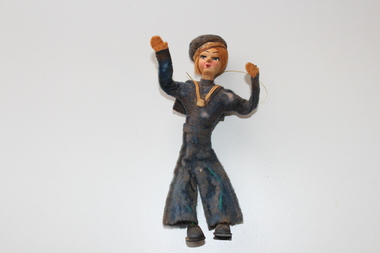
Leisure object - Doll, 1930-1960
... 1930-1960 ...Made from design by Norah WellingsFemale sailor doll in blue felt uniformAURELIA-FLAVIAdoll, norah wellings, sailor -
 Kiewa Valley Historical Society
S.E.C.V. Transmission Cables x3
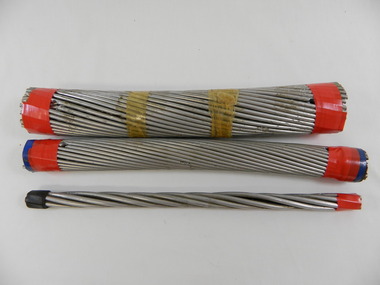
... The State Electricity Commission of Victoria constructed the Kiewa Hydro Electric scheme from the 1930's to 1960's during which time power cables were made to carry power from the Power stations to the switch yards and beyond to the towns and houses....The State Electricity Commission of Victoria constructed the Kiewa Hydro Electric scheme from the 1930's to 1960's during which time power cables were made to carry power from the Power stations to the switch yards and beyond to the towns and houses. ...The State Electricity Commission of Victoria constructed the Kiewa Hydro Electric scheme from the 1930's to 1960's during which time power cables were made to carry power from the Power stations to the switch yards and beyond to the towns and houses.These sample power cables indicate the types of power lines used in the Kiewa Hydro Electric Scheme and the amount of voltage that they carry.3 transmission cables of different width used for transmitting different amounts of power on different size power lines.The thinnest cable consists of a centre piece of wire covered by a layer of twisted wires. The middle sized cable has 4 layers of twisted wires around the centre piece and the thickest cable has 5 layers of twisted wires around the centre piece.The thickest cable has a plastic strip with 330.000 Volt Cable inscribed on it.state electricity commission of victoria. power lines. cables. kiewa hydro electric scheme. electricity. -
 Mont De Lancey
Domestic object, Jas. F. McKenzie & Co Pty Ltd, Container of Ground Cloves, 1930's - 1960's
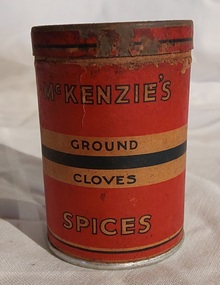
... This ground cloves container was a product for cooking use in the family kitchen in the 1930's - 1960. ...1930's - 1960's...This ground cloves container was a product for cooking use in the family kitchen in the 1930's - 1960. Kitchen equipment Kitchen ingredients Cooking Spices 'McKenzie's Ground Cloves' '2 oz. ...In the 1850s, Galt and McKenzie advertised their roasted and ground coffee alongside ground pepper and pimento, supplying these commodities in bulk to grocers, merchants and store-keepers. By 1861, the range of goods had expanded to include: coffee mixed with chicory; black and white peppers; mixed spice; ground cloves, ginger, pimento and cinnamon; ground rice; maize meal; brosemeal (made from peas); and oatmeal in tins, bags or barrels. This ground cloves container was a product for cooking use in the family kitchen in the 1930's - 1960. A small vintage cardboard cylindrical container of McKenzie's Ground Cloves with a red and navy striped printed paper label with white print explaining the manfacturer details and instructions for use. 2 ozs. Net. There is an aluminium base and removable lid. It has ground cloves powder inside.'McKenzie's Ground Cloves' '2 oz. Nett.'kitchen equipment, kitchen ingredients, cooking, spices -
 Kiewa Valley Historical Society
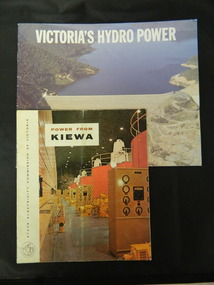
Booklets - Kiewa Hydro Electric Scheme, 1. "Power From Kiewa" and 2. "Victoria's Hydro Power", 1. Made in July 1968 and 2. Made in Aug. 1985
... The State Electricity Commission of Victoria built the Kiewa Hydro Electric Scheme from the 1930's to the 1960's. This booklet was to inform visitors and to promote tourism. 2. ...The State Electricity Commission of Victoria built the Kiewa Hydro Electric Scheme from the 1930's to the 1960's. This booklet was to inform visitors and to promote tourism. 2. ...1. The State Electricity Commission of Victoria built the Kiewa Hydro Electric Scheme from the 1930's to the 1960's. This booklet was to inform visitors and to promote tourism. 2. The State Electricity Commission built several hydro power stations from 1928 - 1981. This booklet names each with a summary and explanation.The State Electricity Commission of Victoria built the Kiewa Hydro Electric Scheme establishing infrastructure such as the Bogong and Mt Beauty townships and the opportunity for tourism in the area.1. Colored soft cover with photo of McKay Creek Power Station on the front and Mt Beauty township on the back. Published by the SECV 2. Colored soft cover with Rocky Valley Dam on the front and inserted photo of a stream and snow on the back. Published by the SEC.state electricity commission of victoria; kiewa hydro electric scheme; victoria's hydro electric power; kiewa; mckay creek power station; clover power station; west kiewa power station -
 Ballarat Tramway Museum
Photograph - Colour slides - Geelong A Power Station, c1970 and April 1971
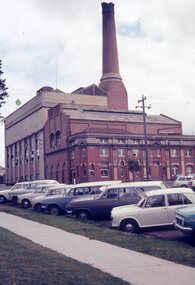
... Operated by the State Electricity Commission from 1930 until the 1960's. Photo taken prior to the demolition of the chimney following its sale in June 1970. ...Operated by the State Electricity Commission from 1930 until the 1960's. Photo taken prior to the demolition of the chimney following its sale in June 1970. ...1 - Colour slide of the former Geelong A Power Station on the corner of Yarra St and Corio Tce (now Brougham St). First portion on the corner built by the Electric Lighting and Traction Co of Australia. The Geelong tram depot, operated by the Melbourne Electric Supply Co was incorporated within the structure during 1912. Operated by the State Electricity Commission from 1930 until the 1960's. Photo taken prior to the demolition of the chimney following its sale in June 1970. See item 10002 for other photographs taken June 1970. 2 - Colour slide dated April 1971, taken after the chimney has been demolished. Yields information about the former Geelong A power station prior to its partial demolition and incorporation into a shopping centre. Portions of the original brick buildings have been retained.1 - Green plastic Fuji Film Plastic slide of Photograph of Geelong A Power Station from Yarra St. 2 - Kodachrome cardboard colour slide, date stamped April 1971. No details of Photographer recorded on slide other than the date stamp.geelong, geelong a, power station, mesco, secv, tramways -
 Wodonga & District Historical Society Inc
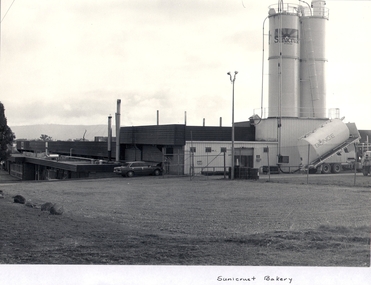
Photograph - Sunicrust Bakery Wodonga, 1970s - 1990s
... Hall's Bakery was established in Wodonga in 1930. In 1960, Bob Hall and Albury bakers Wynne and Thiel joined Bunge's Albury Flour Mills in forming a new company, Southern Border Bakeries. ...Hall's Bakery was established in Wodonga in 1930. In 1960, Bob Hall and Albury bakers Wynne and Thiel joined Bunge's Albury Flour Mills in forming a new company, Southern Border Bakeries. ...Hall's Bakery was established in Wodonga in 1930. In 1960, Bob Hall and Albury bakers Wynne and Thiel joined Bunge's Albury Flour Mills in forming a new company, Southern Border Bakeries. The three bakeries continued to operate separately, but in 1972 Southern Border built the Sunicrust Bakery in Kendall St. A strange anomaly in interstate trade regulations in the 1970s required some innovative thinking. In Victoria, it was illegal to transport bread over 75km, so to get around this, Sunicrust rented a shed in South Albury known as Southern Border Bakeries. Bread from Wodonga was transported to Albury in semi-trailer loads of 10,000 units. It was unloaded and placed in the shed. A docket was written out and the bread was reloaded and was free to be sent back over the border and sent to Melbourne if need be. This manoeuvre complied with Section 92 of the Australian Constitution allowing free trade between States. By 1997, the Sunicrust bakery employed 100 people and produced 200,000 units a week. Goodman Fielder acquired the Sunicrust brand when they purchased Bunge Australia's baking and milling assets in late 1998. Gradually employment fell and Goodman Fielder decided that Wodonga was a small plant and it was no longer economically viable to keep it going. Baking ceased in 2007 with the loss of 44 jobs. Goodman Fielder retained a distribution depot on site.These photos are significant because they document an important manufacturing industry based in Wodonga from the 1970s to 2007,Two photographs of the Sunicrust Bakery in Wodonga. In the coloured photo it has been renamed as Goodman Fielder.wodonga industries, 1970s wodonga, manufacturing industries wodonga -
 Wodonga & District Historical Society Inc
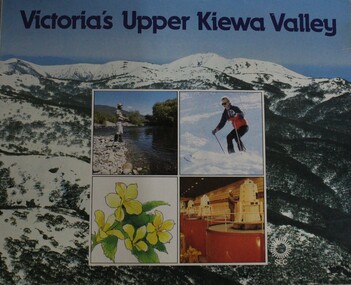
Booklet - Victoria's Upper Kiewa Valley, State Electricity Commission, C. 1984
... It was built over a period of more than 20 years from the late 1930’s and until 1960, with interruptions to construction caused by the Second World War. ...It was built over a period of more than 20 years from the late 1930’s and until 1960, with interruptions to construction caused by the Second World War. ...This booklet is one of several publications from the State Electricity Commission during the period it was responsible for the running of the Kiewa Hydro Electric Scheme. It promotes tourism and depicts key features of the region in the 1980s.non-fictionThis booklet is one of several publications from the State Electricity Commission during the period it was responsible for the running of the Kiewa Hydro Electric Scheme. It promotes tourism and depicts key features of the region in the 1980s.victoria. kiewa valley, kiewa river valley (vic.) -- description and travel., kiewa hydro -
 Federation University Historical Collection
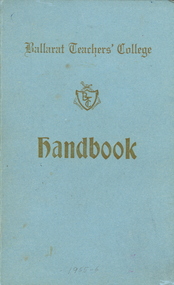
Booklet, Ballarat Teachers' College Handbook and Song Book
... Inside front cover 'Monica Miller' autographs in inside book pages from the reunion on 1. 9. 1960 of BTC 1930...("Ruffians Attempted to Carry of the School Tent: A History of State Education in Ballarat", 1974, p73-4.) ballarat teachers college monica miller extra muros w h ellwood entertainment ellwood ballarat teachers' College music Inside front cover 'Monica Miller' autographs in inside book pages from the reunion on 1. 9. 1960 of BTC 1930 2 blue covered Ballarat Teachers' College Books, 1) Handbook of rules and songs. 2) Songbook. ...Students at the Ballarat Teachers' College would sing the songs in the songbook regularly. The Ballarat Teachers' College was established after the Victorian State Government and the State Education Department decided to establish two provincial teachers' colleges, at Ballarat and Bendigo. On 04 May 1926 W.H. Ellwood (Principal), Miss A. Bouchier, and Mr A.B. Jones, welcomed the first enrolment of 61 students to undertake the one year course. In 1927 the College moved to the former Ballarat East Town Hall in Barkly Street, which was remodelled for their use. It closed in December 1931 due to the Great Depression. In 1946 Ballarat Teachers' College reopened and relocated to the Dana Street State School. The building used by the Teachers' College was the original bluestone building facing Doveton Street South. It was originally planned to open as a women's college, for whom the residence at 130 Victoria Street was purchased, but the decision was made to admit resident men from Ballarat. Mr T.W. Turner was appointed as Principal in 1951 and directed the introduction of a two year course for the Trained Primary Teachers' Certificate. The former one year course was terminated at the end of 1951. In 1958 the College was relocated to a custom built facility at Gillies Street, in close proximity to the Ballarat Botanical Gardens. Numbers increased with the introduction of the Trained Infant Teachers' Certificate course under the guidance of Mary Egan. With the introduction of a three year Diploma Course in 1968 accommodation became cramped. The introduction of the Diploma of Teaching (Primary) led to the Trained Infant Teachers' Certificate being discontinued in 1969, and the end of the Trained Primary Teachers' Certificate in 1969. Secondary Art and Craft students began studies at Ballarat Teachers' College in 1969 under Mr Ted Doney. In 1971 Mr D. Watson was appointed Principal. The State College of Victoria was proclaimed by Order in Council on 24 July 1973, and Ballarat Teachers' College became a constituent college of the State College of Victoria, and was known as State College of Victoria, Ballarat. By 1975 the College moved to Mount Helen as part of the Ballarat College of Advanced Education. Pre service teachers currently undertake their studies on the Mount Helen Campus of Federation University. ("Ruffians Attempted to Carry of the School Tent: A History of State Education in Ballarat", 1974, p73-4.) 2 blue covered Ballarat Teachers' College Books, 1) Handbook of rules and songs. 2) Songbook.Inside front cover 'Monica Miller' autographs in inside book pages from the reunion on 1. 9. 1960 of BTC 1930ballarat teachers college, monica miller, extra muros, w h ellwood, entertainment, ellwood, ballarat teachers' college, music -
 Flagstaff Hill Maritime Museum and Village
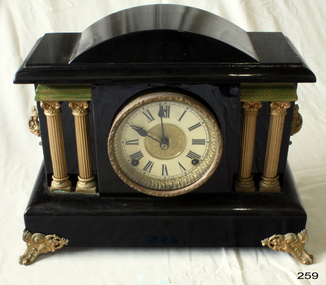
Instrument - Clock, 1920s
... 1930, the company expanded to produce electric clocks and timers for radios, while continuing to produce traditional brass mechanical movements. Beginning at the end of World War II Sessions W Model (electric) was widely used by various casting companies for their clocks. The dial of the W Model read Movement by Sessions. In the early 1950s Sessions begin to produce timers for television. In 1956, Sessions was absorbed by a company interested mainly in their timing devices. In 1959, William K. Sessions, grandson of William E. Sessions left the Sessions Clock Company and formed the New England Clock Company. In 1960...1930, the company expanded to produce electric clocks and timers for radios, while continuing to produce traditional brass mechanical movements. Beginning at the end of World War II Sessions W Model (electric) was widely used by various casting companies for their clocks. The dial of the W Model read Movement by Sessions. In the early 1950s Sessions begin to produce timers for television. In 1956, Sessions was absorbed by a company interested mainly in their timing devices. In 1959, William K. Sessions, grandson of William E. Sessions left the Sessions Clock Company and formed the New England Clock Company. In 1960 ...In 1902, William E Sessions and other family members purchased a controlling interest in the E.N. Welch Company, a clock manufacturer located in Forestville, Connecticut. Sessions' father owned a foundry located in the town of Bristol, Connecticut that produced cases for E.N Welch Co. On January 9, 1903, the company was reorganized and registered as The “Sessions Clock Company”. Within a few years the Sessions Clock Company was producing clock movements, cases, dials, artwork and castings for their line of mechanical clocks. Between 1903 and 1933 Sessions produced 52 models of mechanical clocks, ranging from Advertisers, large and small clocks with logos of various businesses, to wall, or regulator clocks, and shelf or mantel clocks, designed for the home. Many of the Session clocks from this period are prized by collectors. In 1930, the company expanded to produce electric clocks and timers for radios, while continuing to produce traditional brass mechanical movements. Beginning at the end of World War II Sessions W Model (electric) was widely used by various casting companies for their clocks. The dial of the W Model read Movement by Sessions. In the early 1950s Sessions begin to produce timers for television. In 1956, Sessions was absorbed by a company interested mainly in their timing devices. In 1959, William K. Sessions, grandson of William E. Sessions left the Sessions Clock Company and formed the New England Clock Company. In 1960, one of the Sessions Clock buildings was sold to the Bristol Instrument Gears Company. Kept as the Sessions Company, the new owners ran the operation until 1969 when changes in the market forced the Sessions Company into liquidation. In 1970, the remaining buildings were sold to Dabko Industries, a machine parts manufacturer.The item marks a time when clock production in America was at it’s peak producing clocks for sale in many countries, they were keenly priced, mass produced and available to all. The company had a relatively short life span life regards clock manufacture later diversifying into electric timer mechanisms. Yet it was perhaps inevitable with the advent of electricity along with stiff competition from other clock manufactures that would ultimately herald the end in 1935 of the Sessions company's ability to continue manufacturing mechanical clocks. Clock mantle type face set in a painted black case designed to represent a Greek building with gold decorative pillars. Free standing with decorative feet. No markings or inscriptions on clock case or mechanism flagstaff hill, warrnambool, shipwrecked-coast, flagstaff-hill, flagstaff-hill-maritime-museum, maritime-museum, shipwreck-coast, flagstaff-hill-maritime-village, sessions, mantel clock, clock, clock industries -
 Mission to Seafarers Victoria
Plaque - Opus sectile tablet, In grateful Memory of Alfred Michael Nicholas Esq, (1881-1937), 1937
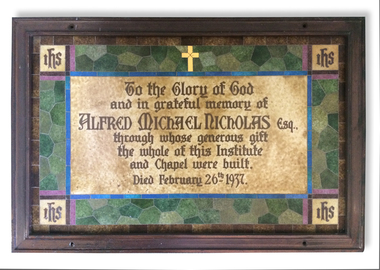
... The story of the donation is told in an unpublished autobiography by the then Rev'd Frank Oliver, based at 717 Flinders st. as senior Mission Chaplain 1930-1960. 1908 plaque alfred m. nicholas memorial alfred michael nicholas port melbourne 1937 aspro in each corner design features initials: "ihs" / IN central lozenge of design text reads: " To the Glory of God/ and in grateful memory of/ ALFRED MICHAEL NICHOLAS Esq / through whose generous gift/ the whole of this Institute / and Chapel were built./ Died February 26th 1937" A heavy ceramic plaque with moulded metal alloy frame, polychrome glazed irregular ceramic tesserae design and memorial text in Gothic script in central lozenge set into a rectangular clay base. ...This plaque was made to commemorate the generous funds donated Mr A.M Nicholas in 1936 almost entirely funding the building of the new Mission to Seamen at Port Melbourne opened in 1937. Mr Nicholas died in Feb 1937. The new building was opened on the 4th of December 1937 by Lord Huntingfield, the plaque was dedicated and unveiled the same by his nephew Mr Nicholas Lightfoot. The plaque was removed from the building which ws demolished in 1995. The plaque is really similar to the memorial plaque made in memory of Ethel Godfrey (see item 2053).Mr Nicholas together with Mr HW Shmith organised rights to produce Aspirin aka ASPRO in Australia in 1915 during WW1. The Nicholas Family were significant philanthropists in Melbourne and Victoria and this plaque commemorates his gift to the Mission for visiting seamen between 1937 and late 20th C. The story of the donation is told in an unpublished autobiography by the then Rev'd Frank Oliver, based at 717 Flinders st. as senior Mission Chaplain 1930-1960.A heavy ceramic plaque with moulded metal alloy frame, polychrome glazed irregular ceramic tesserae design and memorial text in Gothic script in central lozenge set into a rectangular clay base.in each corner design features initials: "ihs" / IN central lozenge of design text reads: " To the Glory of God/ and in grateful memory of/ ALFRED MICHAEL NICHOLAS Esq / through whose generous gift/ the whole of this Institute / and Chapel were built./ Died February 26th 1937"1908, plaque, alfred m. nicholas, memorial, alfred michael nicholas, port melbourne, 1937, aspro -
Federation University Historical Collection
Booklet, Ballarat Teachers' College Song Book, c1947
... Inside front cover 'Monica Miller' autographs in inside book pages from the reunion on 1. 9. 1960 of BTC 1930...("Ruffians Attempted to Carry of the School Tent: A History of State Education in Ballarat", 1974, p73-4.) ballarat teachers college monica miller extra muros w h ellwood entertainment ellwood w.h. ellwood ballarat teachers' college Inside front cover 'Monica Miller' autographs in inside book pages from the reunion on 1. 9. 1960 of BTC 1930 1 blue covered Ballarat Teachers' College Books. ...Students at the Ballarat Teachers' College would sing the songs in the songbook regularly. The Ballarat Teachers' College was established after the Victorian State Government and the State Education Department decided to establish two provincial teachers' colleges, at Ballarat and Bendigo. On 04 May 1926 W.H. Ellwood (Principal), Miss A. Bouchier, and Mr A.B. Jones, welcomed the first enrolment of 61 students to undertake the one year course. In 1927 the College moved to the former Ballarat East Town Hall in Barkly Street, which was remodelled for their use. It closed in December 1931 due to the Great Depression. In 1946 Ballarat Teachers' College reopened and relocated to the Dana Street State School. The building used by the Teachers' College was the original bluestone building facing Doveton Street South. It was originally planned to open as a women's college, for whom the residence at 130 Victoria Street was purchased, but the decision was made to admit resident men from Ballarat. Mr T.W. Turner was appointed as Principal in 1951 and directed the introduction of a two year course for the Trained Primary Teachers' Certificate. The former one year course was terminated at the end of 1951. In 1958 the College was relocated to a custom built facility at Gillies Street, in close proximity to the Ballarat Botanical Gardens. Numbers increased with the introduction of the Trained Infant Teachers' Certificate course under the guidance of Mary Egan. With the introduction of a three year Diploma Course in 1968 accommodation became cramped. The introduction of the Diploma of Teaching (Primary) led to the Trained Infant Teachers' Certificate being discontinued in 1969, and the end of the Trained Primary Teachers' Certificate in 1969. Secondary Art and Craft students began studies at Ballarat Teachers' College in 1969 under Mr Ted Doney. In 1971 Mr D. Watson was appointed Principal. The State College of Victoria was proclaimed by Order in Council on 24 July 1973, and Ballarat Teachers' College became a constituent college of the State College of Victoria, and was known as State College of Victoria, Ballarat. By 1975 the College moved to Mount Helen as part of the Ballarat College of Advanced Education. Pre service teachers currently undertake their studies on the Mount Helen Campus of Federation University. ("Ruffians Attempted to Carry of the School Tent: A History of State Education in Ballarat", 1974, p73-4.) 1 blue covered Ballarat Teachers' College Books. Includes a photograph of Monica Millar in the front inside cover. Inside front cover 'Monica Miller' autographs in inside book pages from the reunion on 1. 9. 1960 of BTC 1930ballarat teachers college, monica miller, extra muros, w h ellwood, entertainment, ellwood, w.h. ellwood, ballarat teachers' college -
 Flagstaff Hill Maritime Museum and Village
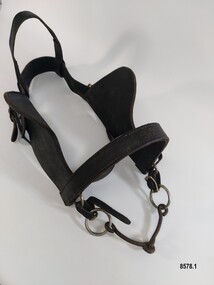
Equipment - Horse Harness, Glenn's Leather Goods, Early to mid-20th century
... A leather and metal horse harness used with a horse and dray circa 1930's to the early 1960's. It is made up of a number of components. 1. ...Flagstaff Hill Maritime Museum and Village Warrnambool Great Ocean Road Sunbury Springvale dray delivery dray harness horse harness horse drawn vehicles working horse Oswald (Jack) Bourke bridle horse collar hames shaft protectors Bridle with blinkers - "M B" Bridle - design showing an elongated X with a dot in each section stamped onto strap holder Shaft Protectors - stamped design of flowers, wings, crosses and arrowheads Strap with chain - "Glenn's leather goods / Pearcedale / Victoria" Leather Strap (with two metal rings) - Maker's stamp - "name indecipherable / SADDLER / ...OURNE" Collar - "B / B" Leather strap - A leather and metal horse harness used with a horse and dray circa 1930's to the early 1960's. It is made up of a number of components. 1. ...The early settlers of Victoria depended on horse drawn vehicles to farm, make roads and railways, deliver produce and transport people. Horse harnesses were an important requisite for all drivers and could be found wherever there were working horses. Horse Harnesses have played an essential role in different cultures throughout history. Simple, utilitarian horse harnesses made of leather straps and iron rings were being used in early China before AD 500 as well as ancient Greece and Rome allowing horses to pull chariots and ploughs. The Greeks and Romans were the first to use a "horse collar" which distributed the weight of the harness evenly across the horse's chest rather than relying on a "throat harness" that could damage a horse's throat or choke them. During the medieval period, European horse harnesses became more elaborate and decorative. Variations of different horse harnesses were also found in Native American and Middle Eastern cultures. Horse Harnesses usually have four basic components which include - 1. Communication - the bridle, bit and reins allows the driver to communicate instructions and commands to the horse, guiding its movement and direction. 2. Draft - the collar, hame straps, hames, traces and chains enables the horse to draw and pull the load efficiently by distributing the weight and transferring the pulling force to the vehicle. 3. Stopping - the breeching band, pole straps and breast strap helps to control or stabilise the horse and vehicle when moving downhill or stopping. 4. Support - the back pad, backband, belly band and back saddle keep the harness in the correct position and proper alignment. This dray harness is a plain, basic harness and reflects its working class origins. It was used by Mr. Oswald (Jack) Bourke with his horse and dray to firstly deliver drygoods from Sunbury to Melbourne in the 1930's and later (through the 1940's and 1950's up to 1961) when he worked on the garbage round for the Springvale City Council. This horse harness is a significant example of the equipment that was needed wherever horses were being used - particularly in the early years of Victoria's settlement by white settlers. Harnesses such as this example were used with drays, farming equipment, delivery carts and personal transportation.A leather and metal horse harness used with a horse and dray circa 1930's to the early 1960's. It is made up of a number of components. 1. A leather bridle with metal buckles and rings, blinkers and a metal single jointed, snaffle bit that has the initials M B stamped onto the leather. 2. A leather bridle with metal buckles and rings and a metal "straight bar" Eggbut snaffle bit. It has an elongated X design (with 4 dots) stamped onto the leather strap holders near each buckle. 3. A blue and white vinyl halter with one leather patched strap. The nose band and a chin strap are covered with woollen padding. 4. A pair of leather shaft protectors. They have lacing holes along each edge and a repeating design of small shapes (flowers, wings, crosses and arrowheads) which run along the front of each protector. 5. A leather strap with a stainless steel chain and catch and a maker's mark for "Glenn's Leather Goods, Pearcedale Victoria" stamped onto the end. 6. A wide leather strap covered with a webbing sleeve. It has two large metal rings and each end and one ring has a rope attached. 7. A leather strap comprised of three separate sections (two shorter and one longer) joined with two metal rings. The longer section has notches along its length and the shorter section at the other end has a buckle. It also had a maker's mark stamped on it but the mark is very worn and the writing is difficult to read. 8. An adjustable leather horse collar with two buckles and straps at the top opening and two "B's" stamped into the leather. The top of the collar is made from treated leather pieces stitched together and the underneath of the collar is untreated leather. It has a padded indentation running all the way around the collar for the hames to sit in. 9. Two pairs of long leather traces - each having a buckle and notched section at one end and each one is made with three lengths of leather spliced together. 10. A leather strap (with one spliced join) belonging to a horse harness with two shorter straps (each ending with a metal clip) attached to a steel D ring at one end. 11. Three assorted short leather straps - the top one has clips at each end and a buckle (for adjusting the length) in the centre, the middle strap has notches and a buckle and the bottom strap is white with notches and a buckle.Bridle with blinkers - "M B" Bridle - design showing an elongated X with a dot in each section stamped onto strap holder Shaft Protectors - stamped design of flowers, wings, crosses and arrowheads Strap with chain - "Glenn's leather goods / Pearcedale / Victoria" Leather Strap (with two metal rings) - Maker's stamp - "name indecipherable / SADDLER / ...OURNE" Collar - "B / B" Leather strap - flagstaff hill maritime museum and village, warrnambool, great ocean road, sunbury, springvale, dray, delivery dray, harness, horse harness, horse drawn vehicles, working horse, oswald (jack) bourke, bridle, horse collar, hames, shaft protectors
