
Showing 271 items matching "1939 fires"
-
 Save the Dandenongs League Inc.
Archive (item), Save the Dandenongs League Incorporated, Ash Regrowth from the 1939 Fires, and Other Papers
... Ash Regrowth from the 1939 Fires, and Other Papers...Ash Regrowth from the 1939 Fires, and Other Papers Archive Save the Dandenongs League Incorporated ... -
 Kiewa Valley Historical Society
Photographs – Set of 9 black and white photographs and photocopies of original photographs depicting the early days of Bogong Village during the 1940’s, circa 1940's
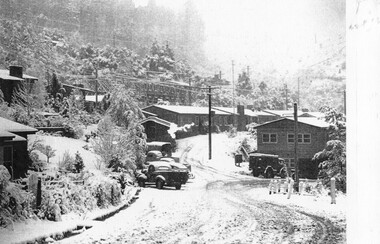
... Bogong Village; 1939 fires; Kiewa Hydro Electric Scheme;...The road to Bogong had reached the lookout spur just beyond Roper’s Spur track just before the 1939 fires. The early forties saw rapid growth of the village, with single and married men’s quarters, workshops, mess huts and administrative offices. ...Tent camp and early buildings following 1939 fires 9. Typical house – Bogong Village ...Bogong Village; 1939 fires; Kiewa Hydro Electric Scheme; 1. Handwritten under photo – August 1948 2. ...Bogong Village, which was known as “The Junction”, is well recorded. The first tent camp was at the junction of Pretty Valley and Rocky Valley streams in the early 40’s. Further downstream were the sawmill, stables and blacksmith’s forge. Horses were the main mode of transport in the early days. The road to Bogong had reached the lookout spur just beyond Roper’s Spur track just before the 1939 fires. The early forties saw rapid growth of the village, with single and married men’s quarters, workshops, mess huts and administrative offices. The facilities necessary for communal living were quickly in place- a post office, police station, co-op store, medical centre, community hall/theatre, tennis courts and school. Much of the temporary accommodation that housed groups such as the Albion Quarrying Company were in the area now under water.Pictorial history of the early years of Bogong Village including one photo taken following the devastating fires of 1939. Photos show the terrain in which Bogong Village was built, the early construction used for the temporary buildings and the housing and the amount of infrastructure required to accommodate the needs of the residents of the area including workers, their families and other support staff. Set of 9 black and white photographs and photocopies of photographs depicting early buildings at Bogong Village . Photos show very early construction buildings as well as the village in various weather conditions, including snowing and after bush fires. (some official SECV photographs) 1. Bogong Village in heavy snow 2. Bogong Township during heavy snow (SECV Official Photo) 3. VIP Lodge at Bogong in the snow 4. Bogong Village - circa 1940’s 5. Bogong Village under street lights 6. Lewis Construction Camp (SECV Official Photo) 7. Albion Quarrying Co. Camp (SECV Official Photo) 8. Tent camp and early buildings following 1939 fires 9. Typical house – Bogong Village 1. Handwritten under photo – August 1948 2. Printed under photo: STATE ELECTRICITY COMMISSION OF VICTORIA Date: 25.8.48 Time: 9am No:K 4680 Kiewa Hydro-Electric Works. Bogong Township 3. Handwritten on back of photo- V.I.P. Lodge, Bogong 4 – 5. No markings 6. Printed under photo: STATE ELECTRICITY COMMISSION OF VICTORIA Date: 28.11.40 Time: 1.40pm No:K284 Kiewa Hydro-Electric Works. Lewis Construction Camp 7. Printed under photo: STATE ELECTRICITY COMMISSION OF VICTORIA Date: 11.1.41 Time: 10.40am No:K294 Kiewa Hydro-Electric Works. Albion Quarrying Co. Camp – Bogong. Handwritten on back of photo: On the floor of the present dam 8. No markings 9. Printed under photo: STATE ELECTRICITY COMMISSION OF VICTORIA Date: 11.1.46 Time: 1.23pm No:K2181 Kiewa Hydro-Electric Works. Bogong – Typical House bogong village; 1939 fires; kiewa hydro electric scheme; -
Bendigo Historical Society Inc.
Document - Forests Commission of Victoria Northern Area Fire Protection Policy, Statement, Future Bush Fire Policy, Plan for Fire Control, 1938-1939
... ...1939 Bush Fires...Fanned by powerful winds, the Black Friday fires (13 January 1939) swept rapidly across large areas of Victoria, causing widespread destruction. ...Four Files Forests Commission of Victoria Northern Area Report on the 1938-39 Fire Season; and the Fire Protection Policy in Respect of Field activities Prior to the Incidence of the 1939 Fires. ...fires in places that had not previously been affected by flames. Almost two million hectares burned across the state. Large areas of state forest, containing giant stands of Mountain Ash and other valuable timbers, were destroyed. As a result, approximately 575,000 hectares of reserved forest and 780,000 hectares of Crown land burned. history bendigo forests commision of victoria 1939 Bush Fires Four Files Forests Commission of Victoria Northern Area Report on the 1938-39 Fire Season; and the Fire Protection Policy in Respect of Field activities Prior to the Incidence of the 1939 Fires. ...Fanned by powerful winds, the Black Friday fires (13 January 1939) swept rapidly across large areas of Victoria, causing widespread destruction. Flames leaped large distances, and giant trees were blown out of the ground by fierce winds. Large pieces of burning bark (embers) were carried for kilometres, starting new fires in places that had not previously been affected by flames. Almost two million hectares burned across the state. Large areas of state forest, containing giant stands of Mountain Ash and other valuable timbers, were destroyed. As a result, approximately 575,000 hectares of reserved forest and 780,000 hectares of Crown land burned.Four Files Forests Commission of Victoria Northern Area Report on the 1938-39 Fire Season; and the Fire Protection Policy in Respect of Field activities Prior to the Incidence of the 1939 Fires. history, bendigo, forests commision of victoria, 1939 bush fires -
 Lakes Entrance Historical Society
Postcard - Golden Age Hotel Omeo- Black Saturday Fires 1939, Bulmer
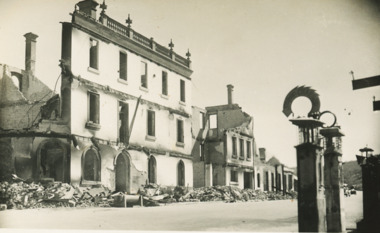
... Golden Age Hotel Omeo- Black Saturday Fires 1939...Friday 13 January 1939 showing ruins of the fires...Also a second postcard with a different view of the ruins of Omeo shops Day St Omeo January 1939 05384.1 8.5 x 14 cm Bushfires Natural Disasters Townships Friday 13 January 1939 showing ruins of the fires Black and white postcard showing remains of Golden Age Hotel after Black Saturday Bush fires Omeo Victoria Postcard Golden Age Hotel Omeo- Black Saturday Fires 1939 Bulmer ...Also a second postcard with a different view of the ruins of Omeo shops Day St Omeo January 1939 05384.1 8.5 x 14 cmBlack and white postcard showing remains of Golden Age Hotel after Black Saturday Bush fires Omeo VictoriaFriday 13 January 1939 showing ruins of the firesbushfires, natural disasters, townships -
 Lakes Entrance Historical Society
Photograph - After the Fires - Omeo 1939, 1/01/1939 12:00:00 AM
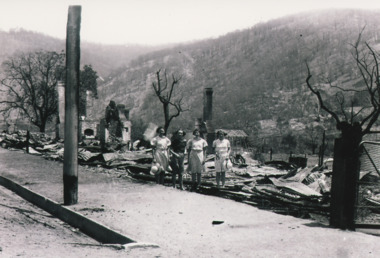
... After the Fires - Omeo 1939...Omeo after big fire 13 /1/ 1939...Also an enlarged copy of same photograph 05383.1 10 x 15 cm Fires Natural Disasters Omeo after big fire 13 /1/ 1939 Black and white photograph of Day Street showing ruins of burnt out shops after Black Saturday bush fires with four women looking at sight Omeo Victoria Photograph After the Fires - Omeo 1939 ...Also an enlarged copy of same photograph 05383.1 10 x 15 cmBlack and white photograph of Day Street showing ruins of burnt out shops after Black Saturday bush fires with four women looking at sight Omeo VictoriaOmeo after big fire 13 /1/ 1939fires, natural disasters -
 Marysville & District Historical Society
Photograph (item) - Black and white photograph, Post 1939 Black Friday bushfires
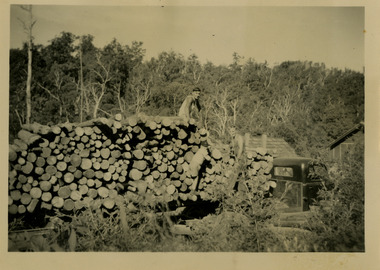
... pulpwood harvest/ post 1939 fires 554...A black and white photograph taken of a pulpwood harvest that was carried out after the 1939 Black Friday bushfires. marysville victoria australia 1939 black friday bushfires pulpwood photograph pulpwood harvest/ post 1939 fires 554 A black and white photograph taken of a pulpwood harvest that was carried out after the 1939 Black Friday bushfires. ...A black and white photograph taken of a pulpwood harvest that was carried out after the 1939 Black Friday bushfires. The Black Friday bushfires on January 13th 1939 were one of the worst natural disasters in Australian history, burning nearly two million hectares across Victoria and claiming 71 lives.A black and white photograph taken of a pulpwood harvest that was carried out after the 1939 Black Friday bushfires.pulpwood harvest/ post 1939 fires 554marysville, victoria, australia, 1939 black friday bushfires, pulpwood, photograph -
Marysville & District Historical Society
THE TRIANGLE NEWS-VOL 42 NO 4-FEBRUARY 6 2015
... recollections from 1939 fires...marysville victoria australia recollections from 1939 fires marysville approaches 6 years since black saturday fires what's on when in february black saturday community gathering the committee of management of the gallipoli park precinct council seeks community feedback on news draft rating strategy murrindindi shire council marysville golf report church news gardeners urged to look out for giant pinescale mayor's chair cr margaret rae councillor comment cr john walsh koriella payment of rates & charges advertisements dept of environment land water & planning delwp tlc for upper murray 4wd tracks traineeship cert iii business buxton bootcamp sophie curran names victorian of the year buxton ridge winery change of opening hours marysville triangle real estate evie gleeson donations free parent information sessions emotions anonymous international meeting sponsor a post trevor harrow oval gallipoli park lake mountain alpine resort proposal assignment of council lease alexandra district health board of management appointments THE TRIANGLE NEWS-VOL 42 NO 4-FEBRUARY 6 2015 ...marysville, victoria, australia, recollections from 1939 fires, marysville approaches 6 years since black saturday fires, what's on when in february, black saturday community gathering, the committee of management of the gallipoli park precinct, council seeks community feedback on news draft rating strategy, murrindindi shire council, marysville golf report, church news, gardeners urged to look out for giant pinescale, mayor's chair cr margaret rae, councillor comment cr john walsh koriella, payment of rates & charges, advertisements, dept of environment land water & planning, delwp, tlc for upper murray 4wd tracks, traineeship cert iii business, buxton bootcamp, sophie curran names victorian of the year, buxton ridge winery change of opening hours, marysville triangle real estate, evie gleeson donations, free parent information sessions, emotions anonymous international meeting, sponsor a post trevor harrow oval, gallipoli park, lake mountain alpine resort, proposal assignment of council lease, alexandra district health, board of management appointments -
 City of Melbourne Libraries
Photograph, Bull, Hugh Jones, 1897-1993, Theatre Royal, Bourke Street
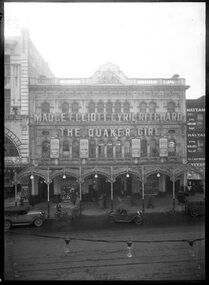
... 1939...fires...Retrieved March 25, 2026, from http://nla.gov.au/nla.news-article205554863 It's smart to be thrifty: the story of Manton's department store, Annette Cooper, https://www.slv.vic.gov.au/sites/default/files/3%20Annette%20Cooper%20-%20It%E2%80%99s%20smart%20to%20be%20thrifty%2C%20the%20story%20of%20Manton%27s%20department%20store.pdf theatres 1930-1939 fires musicals films department stores demolished buildings commemorative plaques incidents concrete Whelan the Wrecker bricks Kmart Bourke Street Melbourne Manton's department store Theatre Royal Coles Target Photographer notations on slide: "Theatre Royale 1933 B4". ...Closing time for the Theatre Royal Melbourne’s Theatre Royal opened 16 July 1855 at 236 Bourke Street, between Swanston and Russell, in the heart of the city’s entertainment district and it was comparable in size to London’s Drury Lane and Covent Garden. It was rebuilt in 1872 following a fire, remodelled in 1904, and demolished in 1933, due in part to the Great Depression, and also to the growing popularity of moving pictures. On the site was erected Manton’s department store, then Coles, Target, and now Kmart. The Quaker Girl, a 1910 Edwardian musical comedy with long running success in London, Paris and Broadway, opened in Melbourne at the Theatre Royal on 22 July 1933. Stars Cyril Ritchard and Madge Elliott were to become husband and wife, their Sydney wedding photograph now an iconic Australian image of that time. The theatre closed 13 November 1933. MCK080 Published: The Age 4 November 1933 Featured in "Newsworthy: Melbourne in photographs 1933-1936" exhibition at East Melbourne Library, October to December 2023. Exhibition caption by project volunteer, Louise McKenzie. THEATRE ROYAL (1933, November 4). The Age (Melbourne, Vic. : 1854 - 1954), p. 5. Retrieved October 16, 2025, from http://nla.gov.au/nla.news-article203364238 Additional research by project volunteer, Fiona Collyer and librarian, Fiona Campbell: The Theatre Royal closed on 13 November 1933. During demolition in December, a worker was pinned by the legs under two tons of collapsing ceiling concrete. Miraculously he escaped with only a broken leg. A commemorative plaque was unveiled in 1937, displayed at the front of Manton's department store. The event was covered in The Age on 20 Dec 1937. It was a beautiful blue enamel and brass with the comedy and tragedy masks, one crying and one laughing, at the top with a timeline of the theatre underneath. Its whereabouts became unknown after the multiple changes with department stores on the site. In 2019 Greg Sampson set out on a mission to find it and in 2021 eventually tracked it down, on a wall behind the door of a staff tea room in Kmart. After much arduous lobbying by Greg it was eventually relocated to the Kmart arcade on the site where the Theatre Royal was originally located. Annette Cooper's history of Manton's and the Bourke Street site described the process of acquisition and demolition of the theatre: "Around 1933, the theatre came on the market – ‘a gift from heaven’ for its enterprising neighbours. Manton’s acquired the theatre and started planning for its demolition to enable the expansion of the store. William Manton and his sons, Jack and Ivor, watched the final production at the theatre, Harold Fraser-Simson’s musical comedy The Maid of the Mountains. 'It was, for the theatre-goers, a nostalgic last appearance, an emotional night, the end of an era. There were those who were mortified at the prospect of a store taking the place of their palace of dreams.' Even Whelan the Wrecker sensed the importance of the occasion and donated four bricks from the theatre to the National Museum of Victoria. They are the oldest bricks in the museum’s collection and form part of its Whelan the Wrecker collection." UNDER BIG FALL OF CONCRETE (1933, December 8). The Herald (Melbourne, Vic. : 1861 - 1954), p. 1. Retrieved April 14, 2026, from http://nla.gov.au/nla.news-article243215969 The Relocation of the Theatre Royal Plaque, Greg Sampson, https://theatreheritage.org.au/on-stage-magazine/news/item/989-the-relocation-of-the-theatre-royal-plaque Photo of theatre interior, Arts Centre Melbourne, https://collections.artscentremelbourne.com.au/#details=ecatalogue.184409 OLD THEATRE ROYAL (1937, December 20). The Age (Melbourne, Vic. : 1854 - 1954), p. 10. Retrieved March 25, 2026, from http://nla.gov.au/nla.news-article205554847 AMATEUR ATHLETICS -- LIFE SAVING DISPLAY MEMORIAL PLAQUE UNVEILED (1937, December 20). The Age (Melbourne, Vic. : 1854 - 1954), p. 15. Retrieved March 25, 2026, from http://nla.gov.au/nla.news-article205554863 It's smart to be thrifty: the story of Manton's department store, Annette Cooper, https://www.slv.vic.gov.au/sites/default/files/3%20Annette%20Cooper%20-%20It%E2%80%99s%20smart%20to%20be%20thrifty%2C%20the%20story%20of%20Manton%27s%20department%20store.pdfPhotographer notations on slide: "Theatre Royale 1933 B4". theatres, 1930-1939, fires, musicals, films, department stores, demolished buildings, commemorative plaques, incidents, concrete, whelan the wrecker, bricks, kmart, bourke street melbourne, manton's department store, theatre royal, coles, target -
Dandenong & District Historical Society
Book, Victoria History as it Happened by Nic Van Oudtshoorn, 26 August 2026
... ...1939 Fires...History as It happened First settlement Hobart Town Cricket: Victoria v NSW Floods & Cyclones 1939 Fires Ryan - The Last Hanging Hotels Picasso Art Grab Articles of interest from 1803-1986 Including Landing of Lt Governor David Collins and 300 convicts in 1803 through to 1986 and the temporary kidnapping of Picasso's Weeping Woman, Title of Book on front Cover along with pictures of interesting articles also on Back Cover 4pp Cover printed Red and Black.Text printed Black only. ...Articles of interest from 1803-1986 Including Landing of Lt Governor David Collins and 300 convicts in 1803 through to 1986 and the temporary kidnapping of Picasso's Weeping Woman,4pp Cover printed Red and Black.Text printed Black only.non-fictionArticles of interest from 1803-1986 Including Landing of Lt Governor David Collins and 300 convicts in 1803 through to 1986 and the temporary kidnapping of Picasso's Weeping Woman,first settlement, hobart town, cricket: victoria v nsw, floods & cyclones, 1939 fires, ryan - the last hanging, hotels, picasso art grab -
 Kiewa Valley Historical Society
Photograph - Bogong Village (7 copies), Approx 1940
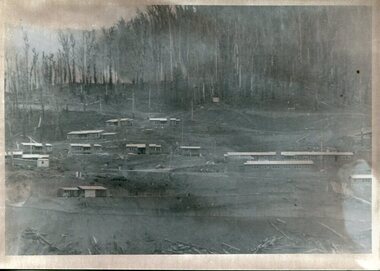
... Set of 7 identical black and white photographs of Bogong Village after 1939 bush fires...Handwritten on the back of one photo - Bogong Village approx. 1940, after 1939 bush fires. Staff residences to left. Kiewa House, General offices and test lab to the right. ...Set of 7 identical black and white photographs of Bogong Village after 1939 bush fires Photograph - Bogong Village (7 copies) ...In 1940 Field Headquarters for the Kiewa Scheme were established at Bogong with office, workshop facilities and accommodation for workmen, staff and some families constructed. (There had been a 'tent camp' on this site in 1939 but was destroyed by bushfires) Construction of accommodation continued until 1947. A total of 40 houses plus a hostel for single staff, post office, police station, medical centre and primary school all with water and sewerage and electricity supply. The staff hostel was known as Kiewa House and is now occupied by the Education Department. Lake Guy was named after Mr. L.T. Guy who was the Resident Engineer in charge of construction work and associated activities on the Kiewa area. He held this position from 1939 to November 1946 when he was transferred to Head Office. The Bogong Township was developed firstly as an accommodation centre (base camp) for construction workers employed under the Kiewa Hydroelectric Scheme. Due to the influx of European workers into the Township the beautification of the immediate surrounds (gardens etc.) had a distinct European flavour. This environment has been very beneficial for tourism in later years. At the completion of the scheme, in the 1960's, the village was opened to public/tourism use. Strict environmental control has not allowed for any extensive redevelopment in tourist accommodation and basically restricted it to the accommodation initially built for the construction workers. Activities such a bike riding, snow skiing, restricted horse riding and bush walking on the Alpine plains and mountains are now a viable part of the Kiewa Valley Tourist Industry. The lake is one of the many water storage reservoirs used to supply the power stations their main power to run the huge turbines generating the final product, electricity. Evidence can be seen of the 1939 bushfires.Set of 7 identical black and white photographs of Bogong Village after 1939 bush firesHandwritten on the back of one photo - Bogong Village approx. 1940, after 1939 bush fires. Staff residences to left. Kiewa House, General offices and test lab to the right. Hand drawn map on the back of one photo.bogong village, secv -
 Marysville & District Historical Society
Ephemera (item) - Calendar page, Unknown
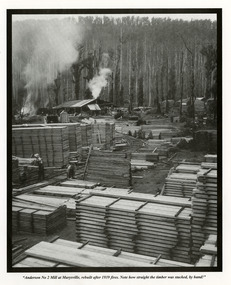
... "Anderson No 2 Mill at Marysville, rebuilt after 1939 fires. Note how straight the timber was stacked, by hand!"...A page from a calendar with a black and white photograph taken at the Anderson No. 2 Mill at Marysville. marysville victoria australia 1939 black friday bushfires calendar photograph andersons no. 1 mill andersons no. 2 mill "Anderson No 2 Mill at Marysville, rebuilt after 1939 fires. Note how straight the timber was stacked, by hand!" ...A page from a calendar with a black and white photograph taken at the Anderson No. 2 Mill at Marysville. The mill was rebuilt after the 1939 Black Friday bushfires.A page from a calendar with a black and white photograph taken at the Anderson No. 2 Mill at Marysville."Anderson No 2 Mill at Marysville, rebuilt after 1939 fires. Note how straight the timber was stacked, by hand!"marysville, victoria, australia, 1939 black friday bushfires, calendar, photograph, andersons no. 1 mill, andersons no. 2 mill -
 City of Melbourne Libraries
Photograph, Bull, Hugh Jones, 1897-1993, Curling at the Glaciarium, South Melbourne
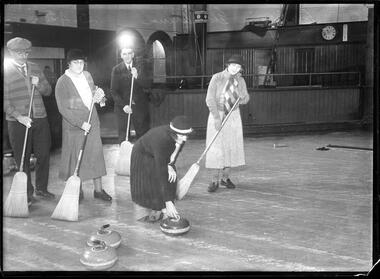
... 1939...glaciarium...fires...fire in 1963. References: WOMAN CURLER RETURNS (1934, April 9). The Herald (Melbourne, Vic. : 1861 - 1954), p. 14. Retrieved September 14, 2023, from http://nla.gov.au/nla.news-article243253779 CURLERS INITIATED (1935, June 24). The Argus (Melbourne, Vic. : 1848 - 1957), p. 4. Retrieved February 2, 2024, from http://nla.gov.au/nla.news-article12251790 Melbourne Glaciarium, Only Melbourne, https://www.onlymelbourne.com.au/melbourne-glaciarium Melbourne Glaciarium, Legends of Australian Ice, https://icelegendsaustralia.com/glaciariums.html curling 1930-1939 glaciarium fires Photographer notations on slide: "Curling - Glaciarium B42". ...Curling at the Glaciarium Mr A G Outhwaite, Mrs Lorna Moffatt-Pender and others, play a game of curling at Melbourne’s Glaciarium, c1933. “Game for Women who are “getting on”!” ran The Herald headline reporting that, “Mrs Moffatt-Pender finds curling a delightful game for the woman who is not quite as young as she was and wants something livelier than croquet. “There is no reason why women should not play up to 50 years of age. And there is always the domestic appeal of the broom which accompanies the curler on ice. Accuracy is the great thing in the game.” Arthur Grenby Outhwaite co-wrote popular “fairy” books, illustrated by his wife, Ida Rentoul Outhwaite. Featured in "Newsworthy: Melbourne in photographs 1933-1936" exhibition at East Melbourne Library, October to December 2023. Exhibition caption by project volunteer, Fiona Collyer. Photographer notations on slide: "Curling - Glaciarium B42" Description: Mr A G Outhwaite, Mrs Lorna Moffatt-Pender, Mrs S J Allen and two unidentified people play a game of curling at Melbourne Glaciarium. Research by project volunteer, Fiona Collyer: Mr Arthur Grenby Outhwaite was married to Ida Rentoul Outhwaite, who was regarded as Australia’s greatest children’s book illustrator and they, along with Ida’s sister Annie, collaborated on many books about fairies, elves and koalas. Ida designed four beautiful stained glass windows at St Marks Fitzroy, which are still there. Mrs Lorna Moffatt-Pender née Smith was married to Captain Iain Moffatt-Pender, a former Scottish Rugby Union international player and Seaforth Highlander in WWI, before he emigrated to Australia and became a wealthy sheep farmer. They were both keen curlers and participated in the NZ v Australia bonspiels at Melbourne Glaciarium in 1935. According to The Herald 9/4/1934, Mrs Moffatt-Pender wore fur-lined suede moccasins on the ice and found curling to be "a delightful game for the woman who is not quite as young as she was and wants something livelier than croquet. “There is no reason why women should not play up to 50 years of age. And there is always the domestic appeal of the broom which accompanies the curler on ice. There is a good sprinkling of women among curlers overseas. Accuracy is the great thing in the game.”" The Curling Club of Australia was formed in Melbourne in 1933 with Wimbledon Singles Champion 1907 and 1914, Sir Norman Brookes, the inaugural president. It disbanded in 1939. Curling was invented in Scotland in 1541, where the tradition is that the laird and the crofter are the same on the ice and after bonspiels (curling tournaments) everybody adjourn for a meal of beef and greens. Rocks of granite are sourced from the Scottish island of Ailsa Craig and weigh 20 kg each. Curling is similar to lawn bowls, but on ice. Two teams of four people each take turns to slide granite stones towards a target known as a house. The team with the most rocks closest to the centre of the house, scores points. Curling stones are delivered with a pre-determent rotation so that they curl as they travel – hence “curling”. Opposition teams can throw guards to block the house or take out the opponent’s stone. The sweeping is to gently warm the surface of the ice where the stone will glide, to extend the path of the stone. In 1934, an Australian team which included the Moffatt-Penders, travelled to New Zealand to compete in a bonspiel on frozen Idaburn Dam near Oturehua, Central Otago. New Zealand won. In June 1935, for the Melbourne Centenary, the New Zealand team came to Melbourne to compete for the Silver Fern Trophy. They voyaged on the M.S. Wanganella and the crew nicknamed the curlers the “Ladies Hairdressers”. Australia won two tests and the third test was a draw. At the conclusion of the bonspiel, a secret, centuries old initiation was held at a “curlers’ court” at Anzac House with seven Australian curlers initiated. Afterwards, a dinner was held at the Occidental Hotel (corner of Exhibition and Collins streets, demolished 1950s), where the haggis was carried in under an archway of curling brooms. The “Ode to the Haggis” was recited by “My Lord of the Court”, Captain Moffatt-Pender before he presented each New Zealand team member with a miniature curling stone as a souvenir of their visit. The Melbourne Glaciarium (also known as "The Glaci" or "The Glassy") opened in 1906 at 16 City Road, South Melbourne and was the third largest ice rink in the world at the time. There was seating for 2000 people which was heated with hot water pipes, and they could hire out 1500 pairs of skates. Up to 5000 people could attend hockey matches and ice sports carnivals at any one time. Patrons could watch films in summer or dance to the Glaciarium’s own orchestra conducted by Frank Bladen, who had played with the Pavlova and the Gilbert and Sullivan orchestras. In 1911 John Sousa, creator of the Sousaphone, and his band played a season of concerts. In 1924, the Glaciarium was turned into a makeshift film studio for filming of the interior scenes of "Jewelled Nights", starring Australian actress Louise Lovely, who had achieved success in Hollywood. The basketball and gymnastic competitions for the 1956 Melbourne Olympic Games were held there. Public skating sessions always finished with “Till we Meet Again”, a popular WWI song about the parting of a soldier and his sweetheart, written by Richard A Whiting and Raymond B Egan. The Glaciarium closed in 1959 and was demolished after a fire in 1963. References: WOMAN CURLER RETURNS (1934, April 9). The Herald (Melbourne, Vic. : 1861 - 1954), p. 14. Retrieved September 14, 2023, from http://nla.gov.au/nla.news-article243253779 CURLERS INITIATED (1935, June 24). The Argus (Melbourne, Vic. : 1848 - 1957), p. 4. Retrieved February 2, 2024, from http://nla.gov.au/nla.news-article12251790 Melbourne Glaciarium, Only Melbourne, https://www.onlymelbourne.com.au/melbourne-glaciarium Melbourne Glaciarium, Legends of Australian Ice, https://icelegendsaustralia.com/glaciariums.htmlPhotographer notations on slide: "Curling - Glaciarium B42".curling, 1930-1939, glaciarium, fires -
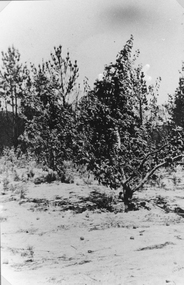 Stawell Historical Society Inc
Photograph, Bushfire Damage at the Apple tree orchard at Pomonal 1939
... Apple tree orchard after 1939 Fires at Pomonal...Apple tree orchard after 1939 Fires at Pomonal stawell Black and white photo of what looks to be an orchard as fruit on the ground. ...Apple tree orchard after 1939 Fires at PomonalBlack and white photo of what looks to be an orchard as fruit on the ground.stawell -
Southern Sherbrooke Historical Society Inc.
Information folder - Ray Tremain
... ...fires 1939...belgrave south state school fires 1939 Information folder pertaining to Ray Tremain. ...Information folder pertaining to Ray Tremain. Contents: -article, "Ray recalls the run of his life", Ferntree Gully Belgrave Mail, 20 January 2009belgrave south state school, fires 1939 -
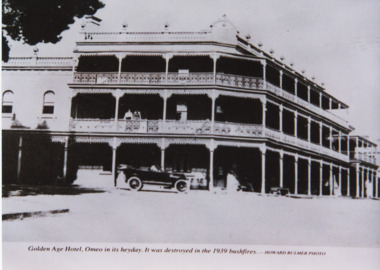 Lakes Entrance Historical Society
Photograph - Golden Age Hotel Omeo 1930, Howard Bulmer photo
... Golden Age Hotel Omeo in its heyday It was destroyed in 1939 bush fires...Image copied from publication Hotels Historic Buildings Golden Age Hotel Omeo in its heyday It was destroyed in 1939 bush fires Black and white photograph of three story hotel Golden Age two upper story verandahs enclosed by lece ironwork balustrades Omeo Victoria Photograph Golden Age Hotel Omeo 1930 Howard Bulmer photo ...Image copied from publicationBlack and white photograph of three story hotel Golden Age two upper story verandahs enclosed by lece ironwork balustrades Omeo VictoriaGolden Age Hotel Omeo in its heyday It was destroyed in 1939 bush fireshotels, historic buildings -
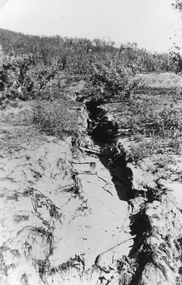 Stawell Historical Society Inc
Photograph, Bushfire damage showing Soil Erosion 1939
... The erosion has resulted from the 1939 bush fire....The erosion has resulted from the 1939 bush fire. Bushfire damage showing Soil Erosion 1939 Photograph ...Scene showing soil erosion after 1939 bushfire. Black and white photograph of a ravine down the side of a hill. The erosion has resulted from the 1939 bush fire.stawell -
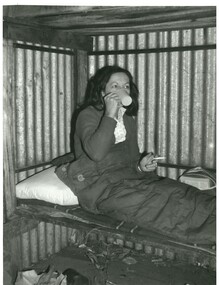 Falls Creek Historical Society
Photograph - Joan Meyer at Diamantina Hut, c1968
... It was rebuilt in about 1968 as the original hut was burnt down in the 1939 fires....It was rebuilt in about 1968 as the original hut was burnt down in the 1939 fires. Joan Meyer at Diamantina Hut Photograph Joan Meyer at Diamantina Hut ...MEYER COLLECTION - FALLS CREEK PHOTOS In 1947 a determined group of like-minded State Electricity Commission (SEC) staff including Ray Meyer, the chief surveyor of the Kiewa Hydro-Electric Scheme, had a common interest that revolved around the skiing potential of the snow-covered high plains which included what is now the resort of Falls Creek. The six SEC employees, Toni St Elmo, Ray Meyer, Jack Minogue, Lloyd Dunn, Adrian Ruffenacht and Dave Gibson (together with their families) banded together to secretly build a 'hut' that was the first ski lodge at Falls Creek. Using a road built in 1930s to gain access to Falls Creek, their hut project was carried out in secret as efforts by other skiers were blocked by H.H.C. Williams – the engineer in charge of the Hydro Scheme. In 1946 Ray Meyer made a trip to the Lands Office in Melbourne. He came away with a 99-year lease on three acres that was ideally suited for a hut designed by Lloyd Dunn. Adrian Ruffenacht (Design Engineer for the KHS) had suggested where the group should build because of easy access to a spring for water. Much of the building material required was scavenged from derelict huts on the high plains. Due to the need for secrecy, the determined group worked on the hut in the evenings and weekends to avoid detection. During the building period the group had met at Echidna Rock (now known as Eagle Rock) where Skippy St Elmo announced, "This is my favourite ‘Skyline’.” And so the first lodge in the area at Falls Creek Ski Resort came into existence. With the development of the International Poma in the 1970s, the Skyline Lodge, which was sited between the ski-lift’s pole one and pole two, was demolished. However, the legacy of Ray Meyer, Toni St Elmo, Jack Minogue, Lloyd Dunn, Adrian Ruffenacht and Dave Gibson and Skyline lives on in the vibrant atmosphere of Falls Creek Resort. The MEYER COLLECTION documents developments on the Kiewa Hydro Scheme and their life at Falls Creek from the mid 1930s to 1960s.This image is significant because it depicts a member of a pioneering family of Falls Creek area, and one of the founders of Skyline Lodge.A black and white image of Joan Meyer in Diamantina Hut. The hut on Mt Hotham, was built originally as a Country Roads Board workers hut in the early 1920s to shelter workers who were building and maintaining the Great Alpine Rd. It was rebuilt in about 1968 as the original hut was burnt down in the 1939 fires.falls creek, victorian snowfields, joan meyer, diamantina hut -
 Orbost & District Historical Society
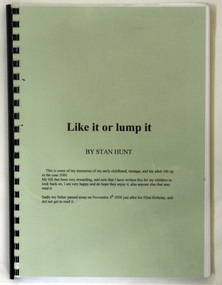
book, Like It Or Lump It, 2001
... It was written by Stan Hunt and tells of his and his family's experience of the 1939 fire in which he was caught as a child as well as the sugar beet industry in Maffra where he worked at as a teenager. ...It was written by Stan Hunt and tells of his and his family's experience of the 1939 fire in which he was caught as a child as well as the sugar beet industry in Maffra where he worked at as a teenager. ...Originally written for children and family between 1998-2000. This book of memoirs provides a personal insight to the history of Maffra in the first half of the 20th century.A 296 pp spiral bound book with a green cover titled Like It Or lump It. It was written by Stan Hunt and tells of his and his family's experience of the 1939 fire in which he was caught as a child as well as the sugar beet industry in Maffra where he worked at as a teenager. The author describes carting the beet and working in the factory where they processed the beet.Inside front cover - autographed by Stan Huntmaffra-history-memoirs hunt-stan -
 Lakes Entrance Historical Society
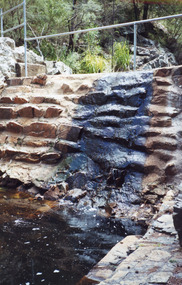
Photograph - Costick's Weir Nowa Nowa 1999
... Built 1942 - 43 to ensure as adequate water supply for fire fighting purposes, after the devastation of the 1939 forest fires. ...Built 1942 - 43 to ensure as adequate water supply for fire fighting purposes, after the devastation of the 1939 forest fires. ...Built 1942 - 43 to ensure as adequate water supply for fire fighting purposes, after the devastation of the 1939 forest fires. Used by locals as a swimming pool until flooding in the 1980's filled the weir with silt.Two Colour photograph of Costicks Weir, Old Colquhoun Road, Colquhoun Forest. Shows manmade dam in bush setting. Constructed by building a weir wall across a small natural gorge. Nowa Nowa Victoriavegetation, weir's, local history -
 Marysville & District Historical Society
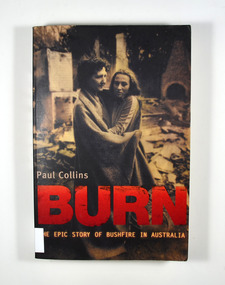
Book, Paul Collins, Burn-The Epic Story of Bushfire in Australia, 2006
... From the 1851 Black Thursday fire and the 1939 Black Friday fires to the Canberra inferno of 2003 this book tells the epic story of bushfire in Australia....From the 1851 Black Thursday fire and the 1939 Black Friday fires to the Canberra inferno of 2003 this book tells the epic story of bushfire in Australia. forest fires bush fires australia history The story of bushfires in Australia Stamp of Marysville & District / Historical Society Inc / P.O. ...The story of bushfires in AustraliaFront cover has a photograph of Sharon Guest and her daughter Patricia in the ruins of their Mt Macedon home, Ash Wednesday.non-fictionThe story of bushfires in Australiaforest fires, bush fires, australia, history -
 Sunshine and District Historical Society Incorporated
Archive - Saint Teresa's (St. Theresa's) Adelaide Street Albion
... Donchi|Photo Old church after 1939 fire|Photo Old Our Ladies Hall|Photo St. ...Donchi|Photo Old church after 1939 fire|Photo Old Our Ladies Hall|Photo St. ...Saint Teresa's (St. Theresa's) Boundaries|Archbishop D. Mannix|Parish Priest Rev. Fr. Murply, Rev. Fr. Walsh|President A. J. Strachan|Team's Chairman L. Donchi|Photo Old church after 1939 fire|Photo Old Our Ladies Hall|Photo St. Teresa's during construction|Photo Parish Hall Committe 1926 T. Fox, M. Martin, J. Donovan Rev. J. P. Carney, P. Cannon, Mr. Maher & Mr. M. Laffan|Photo St. Teresa's at completion|The History Of oue Parish|Photo Fr. Francis Ryder|Photo Fr. James Egan|Photo School Childrenst. theresa's church, church, adelaide street, albion -
 Kiewa Valley Historical Society
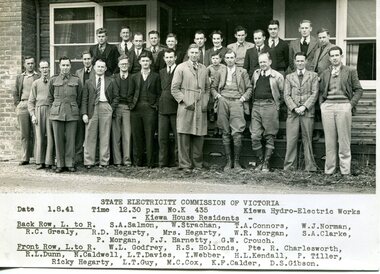
Photographs – Set of 10 black and white photographs and photocopies of original photographs documenting early residents of Bogong Village
... The road to Bogong had reached the lookout spur just beyond Roper’s Spur track just before the 1939 fires. The early forties saw rapid growth of the village, with single and married men’s quarters, workshops, mess huts and administrative offices. ...The road to Bogong had reached the lookout spur just beyond Roper’s Spur track just before the 1939 fires. The early forties saw rapid growth of the village, with single and married men’s quarters, workshops, mess huts and administrative offices. ...Bogong Village, which was known as “The Junction”, is well recorded. The first tent camp was at the junction of Pretty Valley and Rocky Valley streams in the early 40’s. Further downstream were the sawmill, stables and blacksmith’s forge. Horses were the main mode of transport in the early days. The road to Bogong had reached the lookout spur just beyond Roper’s Spur track just before the 1939 fires. The early forties saw rapid growth of the village, with single and married men’s quarters, workshops, mess huts and administrative offices. The facilities necessary for communal living were quickly in place- a post office, police station, co-op store, medical centre, community hall/theatre, tennis courts and school. Much of the temporary accommodation that housed groups such as the Albion Quarrying Company were in the area now under water.This group of photographs are a pictorial record of the early history of the Kiewa Hydro Scheme, the people who worked in the background supplying administrative support and the workers and their families. It also shows a glimpse into how a large group of people from very diverse backgrounds came together to enjoy social activities and share each others companyGroup of 10 black and white photographs and photocopies of original photographs of varying sizes (some official SECV photos) Some Photos are labelled with the date and the names of SECV staff members. Depicting early life at Bogong Village 1. Group photo – Kiewa House Residents 1.8.41 (SECV official photo) 2. Female staff residents 3. Female office staff 4. Kitchen staff – Junction Mess (SECV official photo) 5. Male administration staff Bogong 6. Bogong Social Club fancy dress ball, 1940 7. Wives and children of SECV workers 8. Children in fancy dress 9. Opening of Volunteer Air Observers post 1943 10. Flag raising at opening of Volunteer Air Observers post 1. Printed under photo: STATE ELECTRICITY COMMISSION OF VICTORIA Date: 1.8.41 Time: 12.30pm No:K 435 Kiewa Hydro-Electric Works. Kiewa House Residents Back Row L to R: S.A. Salmon, W. Strachn, T.A Connors, W.J Norman, R.C Grealey, R.D Hegarty, Mrs Hegarty, W.R Morgan, S.A Clarke, P. Morgan, P.J. Harnetty, G.W Crouch. Front Row L to R: W.L Godfrey, R.S Hollands, Pte. R Charlesworth, R.L Dunn, N Caldwell, L.T Davies, I Webber, H.L Kendall, P Tiller, Ricky Hegarty, L.T Guy, M.C Cox, K.F Calder, D.S Gibson 2. Printed on bottom: Staff who lived at Kiewa House and worked in the Administration Office c 1943 Handwritten at bottom Priscilla Johnson (nee Reid) At top of page A GOOD LIFE: WOMEN’S RECOLLECTIONS OF LIFE IN THE UPPER KIEWA VALLEY 3. Printed under photo- Office Staff – Bogong 4. Printed under photo: STATE ELECTRICITY COMMISSION OF VICTORIA Date: 18.5.40 Time: 11.05am No:K 103. Kiewa Hydro-Electric Works. Kitchen Staff- Junction Mess. Opening night of the new staff mess Bogong. 5. Printed under photo -Administration staff Bogong 6. Printed under photo- The social club raised money for patriotic fund from fancy dress nights. (1st Fancy Dress Ball, Bogong 1940) 7. Printed above photo: ---- and family life begins (1942 Bogong) 8. Printed under photo: A favourite photograph 9. Printed under photo: STATE ELECTRICITY COMMISSION OF VICTORIA Date: 24.5.43 Time: 2.8pm No:K 1151 Kiewa Hydro-Electric Works. Bogong- Squadron Leader Leggett speaking at opening of Air Observer’s Post 10. Printed under photo: Raising the flag at the opening of the Volunteer Air Observer’s Post at Bogong - 1943 bogong village; kiewa hydro electric scheme; social activities; community clubs -
 Linton and District Historical Society Inc
Photograph, New Linton Fire Brigade Building, 1939, 1939
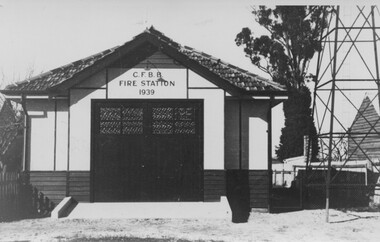
... New Linton Fire Brigade Building, 1939...Black and white photograph printed as a postcard, which shows a building with large front doors standing next to a metal tower. "CFBB / FIRE STATION / 1939" across top of building.... Text: "CFBB / FIRE STATION / 1939"...."CFBB / FIRE STATION / 1939" across top of building. New Linton Fire Brigade Building, 1939 Photograph Photograph ...Black and white photograph printed as a postcard, which shows a building with large front doors standing next to a metal tower. "CFBB / FIRE STATION / 1939" across top of building. Text: "CFBB / FIRE STATION / 1939".linton fire brigade building, buildings -
 Eltham District Historical Society Inc
Photograph, Peter Pidgeon, Killeavey, Laughing Waters Road, Eltham 5 Nov 2016, 5 Nov 2016
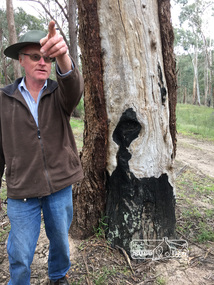
... Cam pointing out the ravages on various trees from the 1939, 1967 and 1969 fires. This tree bares evidence from the 1939 bushfire which raged through the area. ...Cam pointing out the ravages on various trees from the 1939, 1967 and 1969 fires. This tree bares evidence from the 1939 bushfire which raged through the area. ...Cam pointing out the ravages on various trees from the 1939, 1967 and 1969 fires. This tree bares evidence from the 1939 bushfire which raged through the area. Heriitage Excursion - Kileavey Walk and TalkBorn Digitalactivities, eltham district historical society, heritage excursion, kileavey, parks victoria, laughing waters road, eltham, wurundjeri, black friday 1939 -
 Department of Energy, Environment and Climate Action
Dugout sign, Post 1966
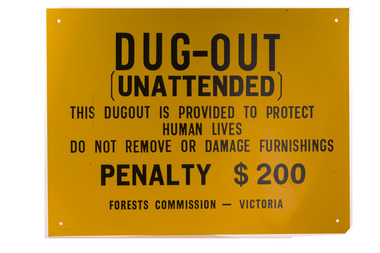
... Dugouts became mandatory for those few sawmills that remained in the forest after the 1939 fires. Many remote logging coupes and FCV roading camps also had dugouts. ...Dugouts became mandatory for those few sawmills that remained in the forest after the 1939 fires. Many remote logging coupes and FCV roading camps also had dugouts. ...Considered in terms of both loss of property and loss of life, the Black Friday bushfires on 13 January 1939 were one of the worst disasters to have occurred in Australia and certainly the worst bushfire up to that time. The fires burnt 2 million hectares, 69 sawmills were destroyed, 71 people died, and several towns and sawmills were entirely obliterated. Among those killed were four men from the Commission The subsequent Royal Commission conducted by Judge Leonard Stretton has been described as one of the most significant inquiries in the history of Victorian public administration. Its recommendations led to sweeping changes. In addition to building dams and water points, the Stretton Royal Commission recommended expanding and controlling the use of bushfire dugouts at forest sawmills. Well-constructed dugouts had saved the lives of many sawmill workers and their families during the 1939 bushfires. But in some locations, they had proved fatal. Dugouts became mandatory for those few sawmills that remained in the forest after the 1939 fires. Many remote logging coupes and FCV roading camps also had dugouts. The local District Forester was required to make annual pre-season inspections of all dugouts on State forests and those within the Fire Protected Area (FPA). Some were built privately on private land. Most were primitive construction with a log or corrugated iron roof covered with earth. A hessian bag often hung at the entrance to keep the heat and smoke out. But they were dark and damp with snakes and other creepy crawlies often lurking inside. By 1940-41 there were 19 new dugouts constructed by the Commission and a further 128 by forest licensees. Ten years later there were 8 new Commission dugouts and 21 new ones built by other interests. By 1960-61 the rate of new builds was declining but the Commission still managed 103 dugouts while 127 were looked after by others. However, as the forest road network improved and gave all-weather access to modern two-wheel-drive vehicles the reliance on dugouts receded.Large metal sign that was positioned near forest dugoutsbushfire, forest signs, forests commission victoria (fcv) -
 Orbost & District Historical Society
biscuit tin, after 1947
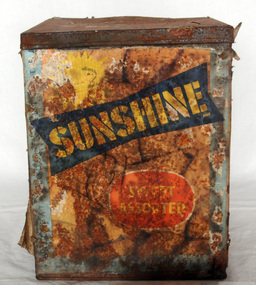
... fire. In 1923 the factory was completely destroyed and was rebuilt as a more modern factory on the same site. In 1939...fire. In 1923 the factory was completely destroyed and was rebuilt as a more modern factory on the same site. In 1939 ...Sunshine biscuits were made in Ballarat from 1921. During WW11 Sunshine biscuits devoted 80 percent of its output to army services. The company was twice devastated by fire. In 1923 the factory was completely destroyed and was rebuilt as a more modern factory on the same site. In 1939, a deliberately lit fire demolished the workshop. Sunshine biscuits continued to be sold until 1991. Biscuits were sold by weight from a large tin in the grocer's shop.This tin seems to be a commercial tin used in a grocery shop. It would have been used in an Orbost grocery store e.g. Dicken's, Baughhaust's or Herbert's.Biscuits were once sold by weight from a large tin in the grocer's shop.This tin seems to be a commercial tin used in a grocery shop. It would have been used in an Orbost grocery store e.g. Dicken's, Baughhaust's or Herbert's.Large rectangular commercial biscuit tin, made from pressed metal, with a lid. There is a paper label on the front which details the contents, and manufacturer details. It has a colourful label which is in poor condition. On label - in a dark blue banner SUNSHINE. Left hand side vertically BALLARAT PRODUCTS LIMITED. Below the SUNSHINE banner - Sweet Assorted, Superior biscuitssunshine-biscuits food biscuits container tin -
 Wodonga & District Historical Society Inc
Equipment - Fire Fighting Knapsack, REGA Products Ltd, c1945
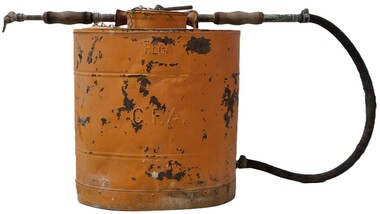
... The Country FIre Authority was established in 1945 following a Royal Commission into the 1939 Black Friday fires which recommended a single firefighting authority for country Victoria, bringing together the Bush Fire Brigades, Country Fire Brigades and Forest Commission. ...The Country FIre Authority was established in 1945 following a Royal Commission into the 1939 Black Friday fires which recommended a single firefighting authority for country Victoria, bringing together the Bush Fire Brigades, Country Fire Brigades and Forest Commission. ...The spraying units were manufactured in Australia by REGA Products. Ltd. in 1926. They established themselves as leaders in the production of agricultural and horticultural spraying machines, including smaller knapsacks. Knapsacks were quickly adapted to a range of applications and were widely used by the C.F.A (Country Fire Authority). They were also widely used for defence during World War II. REGA was later purchased by the Garrard family and still operate as part of Garrads Pty Ltd. This sprayer was one of the units used by the C.F. A. in Wodonga. The Country FIre Authority was established in 1945 following a Royal Commission into the 1939 Black Friday fires which recommended a single firefighting authority for country Victoria, bringing together the Bush Fire Brigades, Country Fire Brigades and Forest Commission. The first fire brigade, the Wodonga Urban Fire Brigade was formed in 1891 and registered in May 1893. Since that time its volunteers have provided ongoing support to the Wodonga and District communities through events such as urban fires, bushfires and other emergency situations. This item is representative of the Wodonga Country Fire Authority and its many volunteers.A knapsack sprayer designed to be used for spraying insects. The unit includes brass fittings, leather straps and a spray arm and nozzle attached. It was also adapted to be widely used by firefighters.On front: REGA / C.F.A. Around lid: REGA SPRAYERSrega sprayers, cfa region 24, cfa volunteers, cfa wodonga, wodonga urban fire brigade, fire fighting equipment -
Moorabbin Air Museum
Document (Item) - Ansett Transport Industries Ltd Company History
... Includes a range of subjects as listed below, The Hangar Fire ..... 1939 Ansett Airways' War Years Pioneer Country Dealership And Road Services Ansett Hotels The Two-Airliner And The Ansett Purchase Of A.N.A The First Road Services 'Going Public" And The First Financial Crisis MacRobertson Miller Airline Services A History Of Aviation Spanning 56 Years Wridgways Ansett General Aviation Television Developments Austarama Television Pty Ltd And Universal Telecasters Qld Ltd The Rose Fight Thomas Nationwide Transport Ltd Take-Over Bid For Ansett Transport Industries Ltd The First Air Services Ansett Airways Ltd The Butler Take-Over ATI Associated Companies Other ATI Subsidiaries The Air Race ...... 1936 Ansair Pty Ltd ...Includes a range of subjects as listed below, The Hangar Fire ..... 1939 Ansett Airways' War Years Pioneer Country Dealership And Road Services Ansett Hotels The Two-Airliner And The Ansett Purchase Of A.N.A The First Road Services 'Going Public" And The First Financial Crisis MacRobertson Miller Airline Services A History Of Aviation Spanning 56 Years Wridgways Ansett General Aviation Television Developments Austarama Television Pty Ltd And Universal Telecasters Qld Ltd The Rose Fight Thomas Nationwide Transport Ltd Take-Over Bid For Ansett Transport Industries Ltd The First Air Services Ansett Airways Ltd The Butler Take-Over ATI Associated Companies Other ATI Subsidiaries The Air Race ...... 1936 Ansair Pty Ltd Ansett Transport Industries Ltd Company History Document Ansett Transport Industries Ltd Company History ...Includes a range of subjects as listed below, The Hangar Fire ..... 1939 Ansett Airways' War Years Pioneer Country Dealership And Road Services Ansett Hotels The Two-Airliner And The Ansett Purchase Of A.N.A The First Road Services 'Going Public" And The First Financial Crisis MacRobertson Miller Airline Services A History Of Aviation Spanning 56 Years Wridgways Ansett General Aviation Television Developments Austarama Television Pty Ltd And Universal Telecasters Qld Ltd The Rose Fight Thomas Nationwide Transport Ltd Take-Over Bid For Ansett Transport Industries Ltd The First Air Services Ansett Airways Ltd The Butler Take-Over ATI Associated Companies Other ATI Subsidiaries The Air Race ...... 1936 Ansair Pty Ltd -
 Kiewa Valley Historical Society
Photographs and copies of photographs of the pack horses and early horsemen who transported supplies to outposts in the Bogong High Plains, via cattle tracks before access roads were made
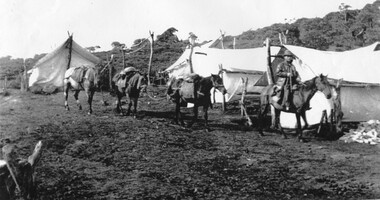
... The tent city at Bogong was destroyed by bush fires in 1939 after which an access road was built from Mt Beauty to transport building materials for more permanent dwellings for workmen. ...The tent city at Bogong was destroyed by bush fires in 1939 after which an access road was built from Mt Beauty to transport building materials for more permanent dwellings for workmen. ...In the mid to late 1930’s survey outposts were established to plot the early stages of the Kiewa Hydro Electric System for the SECV in the Bogong High Plains. Before any roads were built, the old cattleman’s tracks were used with packhorses to deliver supplies, wages and mail and collect timesheets and correspondence from the workmen and dam builders living in canvas tents and at the outlying survey posts. The trip up the mountain was long and hard and dangerous for both horse and man Most of the men of the survey teams were not bush-men and were often ill equipped for the harsh weather and living conditions of bush camping, often arriving in their city clothes ready for work. The tent city at Bogong was destroyed by bush fires in 1939 after which an access road was built from Mt Beauty to transport building materials for more permanent dwellings for workmen. Pack horses continued to be used for transporting goods etc. to workers further up the mountain.Without the work of horsemen and their pack horses providing supplies and communications for outlying outposts, surveying and early planning for the Kiewa Valley Hydro Electric scheme could not have gone ahead and the dams and power stations which support the system could not have been constructed. The Hydro-electric scheme, and the workers who planned and built it play a major part in the early history of the Kiewa Valley and many original families still remain living, or have ties with the local area.: Set of 21 black and white photographs and copies of photographs depicting the pack horses and the men who handled them, transporting supplies and correspondence to the outlying camps and survey posts in the Bogong High Plains, via the rough cattlemen’s tracks. Photographs also show the early tent camps of the workers. Some photos mounted on A4 white paper. Some photos enlarged to A3 poster size for display1. Handwritten on back – Max Lawrence 2. -8 No inscriptions 9. Handwritten on back- Packing in supplies for early workers of the Kiewa Hydro scheme. There were no roads in the early days of the scheme 10. Printed on bottom of photo- Roper’s cattle on road below Howman’s Gap 11. Handwritten on back – Roper’s et al about to leave for the high plains 12. Printed under photo- Syd Ryder at the Pretty Valley Cut-Out (JBR) 13-16. No markings 17. Printed under photo- Gwen Talbot visits the Camp area. 1937 18. Handwritten on back- 14/1 Barbara Talbot 19. No markings 20-21. No markings 22. Printed under photo- STATE ELECTRICITY COMMISSION OF VICTORIA. Date: 15-3-45 Time: 8.0pm No: K 1838 Kiewa Hydro-Electric Works, Investigations 1944-1945 – Survey Camp at Young’s Hut pack horses; bogong high plains; survey posts; supplies delivery -
 Falls Creek Historical Society
Book - The Campaign Fires - North-East/East Gippsland Fires 2003, Lyndel Hunter
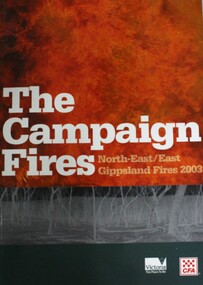
... Eight of these fires were unable to be contained; they joined together to form the largest fire in Victoria since the Black Friday fires in 1939. The majority of the area burnt in Victoria was public land, 1.19 million hectares of parks and forests, including 60 per cent of the Alpine National Park and 81 per cent of the Mt Buffalo National Park. ...Eight of these fires were unable to be contained; they joined together to form the largest fire in Victoria since the Black Friday fires in 1939. The majority of the area burnt in Victoria was public land, 1.19 million hectares of parks and forests, including 60 per cent of the Alpine National Park and 81 per cent of the Mt Buffalo National Park. ...A description of efforts to fight the bushfires in Gippsland in 2003, including maps and illustrations. This volume was published as a tribute to the work of staff and volunteers who put themselves at risk to protect local communities. It shows the impact on those communities in Victoria and the support they gave to those involved in fighting largest bushfires in Victoria for 60 years. The Alpine bushfires started on 8th January 2003, a day of Total Fire Ban. Lightning ignited 87 fires in the North-East and East Gippsland regions. Eight of these fires were unable to be contained; they joined together to form the largest fire in Victoria since the Black Friday fires in 1939. The majority of the area burnt in Victoria was public land, 1.19 million hectares of parks and forests, including 60 per cent of the Alpine National Park and 81 per cent of the Mt Buffalo National Park. Firefighting efforts were made difficult in hard-to-access, remote forest terrain. Approximately 90,000 hectares of private land was burnt.This book is significant because it documents the 2003 Victorian Bushfires and serves as a tribute to the CFA staff and volunteers who fought them.This publication of 119 pages features text, colour images, maps and detailed information related to the 2003 bushfires in Victoria.At bottom of front cover:- CFA Victoria Logo Victorian Government Logovictorian fires 2003, cfa (vic)
