
Showing 231 items matching "1st green"
-
 Heidelberg Golf Club
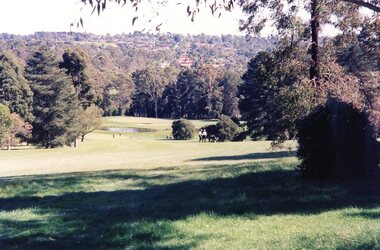
Photograph, Heidelberg Golf Club, Looking down the 15th fairway to dam and 1st green 2001, 2001
... Looking down the 15th fairway to dam and 1st green 2001......1st green...Looking down the 15th fairway to dam and 1st green, Pennant match 2001, Heidelberg Golf Club...Looking down the 15th fairway to dam and 1st green, Pennant match 2001, Heidelberg Golf Club Heidelberg Golf Club Women's Pennant 15th fairway Dams 1st green Colour photograph of a golf course Looking down the 15th fairway to dam and 1st green 2001 Photograph Photograph Heidelberg Golf Club ...Looking down the 15th fairway to dam and 1st green, Pennant match 2001, Heidelberg Golf ClubColour photograph of a golf courseheidelberg golf club, women's pennant, 15th fairway, dams, 1st green -
 Heidelberg Golf Club
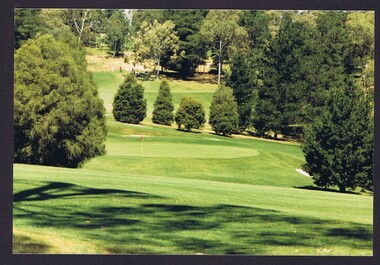
Photograph, 1st fairway, 16th green, 17th green and18th tee: Heidelberg Golf Club, 1990s
... 1st fairway, 16th green, 17th green and18th tee: Heidelberg Golf Club......16th green...1st...1st fairway, 16th green, 17th green and18th tee: Heidelberg Golf Club...Heidelberg Golf Club 8 Main Road Lower Plenty 3093 1st fairway, 16th green, 17th green and18th tee: Heidelberg Golf Club HGC Course 16th green 1st fairway 18th tee 17th green Colour photograph and caption. 1st fairway, 16th green, 17th green and18th tee: Heidelberg Golf Club Photograph Photograph ...1st fairway, 16th green, 17th green and18th tee: Heidelberg Golf ClubColour photograph and caption.hgc course, 16th green, 1st fairway, 18th tee, 17th green -
 Heidelberg Golf Club
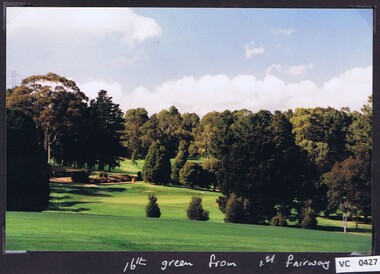
Photograph, 16th green from 1st fairway: Heidelberg Golf Club, 2000c
... 16th green from 1st fairway: Heidelberg Golf Club......16th green...1st...16th green from 1st fairway: Heidelberg Golf Club...Heidelberg Golf Club 8 Main Road Lower Plenty 3093 16th green from 1st fairway: Heidelberg Golf Club HGC Course 16th green 1st fairway Colour photograph and caption. 16th green from 1st fairway: Heidelberg Golf Club Photograph Photograph ...16th green from 1st fairway: Heidelberg Golf ClubColour photograph and caption.hgc course, 16th green, 1st fairway -
 Heidelberg Golf Club
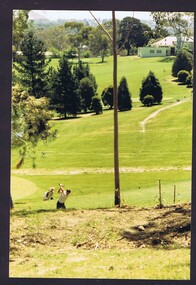
Photograph, 18th tee, 17th fairway,16th green and 1st fairway: Heidelberg Golf Club, 1990s
... 18th tee, 17th fairway,16th green and 1st fairway: Heidelberg Golf Club......16th green...1st...18th tee, 17th fairway,16th green and 1st fairway: Heidelberg Golf Club...Heidelberg Golf Club 8 Main Road Lower Plenty 3093 18th tee, 17th fairway,16th green and 1st fairway: Heidelberg Golf Club HGC Course 16th green 1st fairway 17th fairway 18th tee Colour photograph and caption. 18th tee, 17th fairway,16th green and 1st fairway: Heidelberg Golf Club Photograph Photograph ...18th tee, 17th fairway,16th green and 1st fairway: Heidelberg Golf ClubColour photograph and caption.hgc course, 16th green, 1st fairway, 17th fairway, 18th tee -
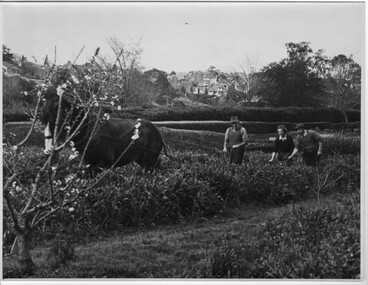 University of Melbourne, Burnley Campus Archives
Photograph - Black and white print, Ploughing in Cover Crop, 1949
... Kneen as, L to R George Manley (Stockman Assistant), Valerie Green (1st Year Student), Harold Marshall (Gardening Instructor- Orchard.)"...Kneen as, L to R George Manley (Stockman Assistant), Valerie Green (1st Year Student), Harold Marshall (Gardening Instructor- Orchard.)" instructors female student horse plough orchard burnley gardens george manley stockman assistant valerie green harold marshall gardening instructor students working outside draughthorse cover crop On reverse,"Burnley Gardens. ...Identified by T.H. Kneen as, L to R George Manley (Stockman Assistant), Valerie Green (1st Year Student), Harold Marshall (Gardening Instructor- Orchard.)"Black and white photograph. 2 Instructors and female student with horse and plough in the Orchard. Well trimmed hedge at far side of field. Draught horse pulling the plough. Houses of Hawthorn on hill in background.On reverse,"Burnley Gardens. Ploughing in Clover Crop-Sept. 1949."instructors, female student, horse, plough, orchard, burnley gardens, george manley, stockman assistant, valerie green, harold marshall, gardening instructor, students working outside, draughthorse, cover crop -
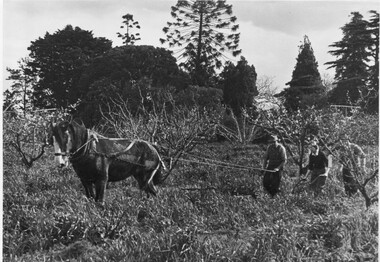 University of Melbourne, Burnley Campus Archives
Photograph - Black and white print, Ploughing in Cover Crop, 1949
... Manley (Stockman Assistant), Valerie Green (1st Year Student), Harold Marshall (Gardening Instructor-Orchard)."...Manley (Stockman Assistant), Valerie Green (1st Year Student), Harold Marshall (Gardening Instructor-Orchard)." ...Black and white photograph. Female student learning how to use plough and horse from 2 male staff members in the Orchard.On reverse, "Burnley Gardens. Sept 1949. Ploughing in Cover Crop. Geo. Manley (Stockman Assistant), Valerie Green (1st Year Student), Harold Marshall (Gardening Instructor-Orchard)."female student, plough, horse, burnley gardens, ploughing, geo. manley, valerie green, harold marshall, gardening instructor, orchard, student working outside, stockman, cover crop -
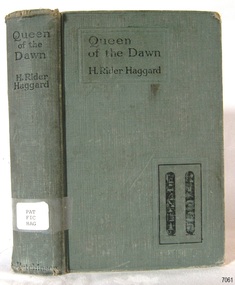 Flagstaff Hill Maritime Museum and Village
Book - Novel, H Rider Haggard, author, Queen of The Dawn, 1925
... Queen of The Dawn: A love tale of old Egypt Author: H Rider Haggard Publisher: Hutchinson & Co 1st Published in 1925 Green hardcover book with hieroglyphics on the cover, inscriptions on the label and stamps. ...Queen of the Dawn Label text: "PAT FIC HAG" Stamp, red ink: "W'bool Public Library" Sticker: "Corangamite Regional Library Service" Handwritten: "1298" Hieroglyphics, two, with translations: "Beautiful ascendress of pyramids" and "Great mistress of the dawn" Queen of The Dawn: A love tale of old Egypt Author: H Rider Haggard Publisher: Hutchinson & Co 1st Published in 1925 Green hardcover book with hieroglyphics on the cover, inscriptions on the label and stamps. ...H. Rider Haggard (1856-1925), a British author, wrote fiction and non-fiction works and had letters and articles published in newspapers and journals. His novel 'Queen of the Dawn' was published in 1935. Thenovel's cover and Fly page display hieroglyphics, which suggest that this story was set in Egypt. The book is part of Flagstaff Hill's Pattison Collection. The book was published by the British firm Hutchinson & Co. operated for almost 100 years 1887-1985, before it underwent several mergers. The book has additional importance for its connection to the Pattison Collection, which, along with other items at Flagstaff Hill Maritime Village, was originally part of the Warrnambool Mechanics' Institutes’ Collection. The Warrnambool Mechanics’ Institute book collection has historical and social significance for its strong association with the Mechanics Institute movement and its important role in people's intellectual, cultural and social development throughout the latter part of the nineteenth century and the early twentieth century. The collection of books is a rare example of an early lending library and its significance is enhanced by the survival of an original collection of many volumes. The Warrnambool Mechanics' Institute’s publication collection is of both local and state significance.Queen of The Dawn: A love tale of old Egypt Author: H Rider Haggard Publisher: Hutchinson & Co 1st Published in 1925 Green hardcover book with hieroglyphics on the cover, inscriptions on the label and stamps. Part of the Pattison Collection. Label text: "PAT FIC HAG" Stamp, red ink: "W'bool Public Library" Sticker: "Corangamite Regional Library Service" Handwritten: "1298" Hieroglyphics, two, with translations: "Beautiful ascendress of pyramids" and "Great mistress of the dawn"flagstaff hill, flagstaff hill maritime museum and village, warrnambool, maritime museum, maritime village, great ocean road, shipwreck coast, pattison collection, ralph eric pattison, warrnambool mechanics’ institute, mechanics’ institute library, warrnambool library, free library, corangamite regional library service, h. rider haggard, 1925, hutchinson & co., queen of the dawn -
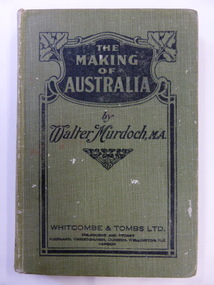 Warrnambool and District Historical Society Inc.
Book, The Making of Australia, Early 20th century
... 1st year’. This is a hard cover book of 242 pages. It has an olive green cover with the titles and author information on the cover and the spine in black print. ...This history book, written by Walter Murdoch, is the third in a series on Australian history. Walter Logie Forbes Murdoch (1874-1970) was a distinguished academic and writer, regarded today as one of Australia’s foremost essayists. He was a household name to two generations of Australians through his radio broadcasts and syndicated newspaper columns in several Australian newspapers. He came to Warrnambool in 1901 as the proprietor of a private school and while in Warrnambool wrote the first of the history series, ‘The Struggle For Freedom’. In 1904 Murdoch became a lecturer in English at Melbourne University and went from there to be the foundation Professor of English at the University of Western Australia and later its Chancellor. Murdoch University in Western Australia is named after him and he was knighted in 1964. He published over 40 books. This book is of interest as it was written by Walter Murdoch, not only because he was important in both literary and academic circles in Australia but also because he has a place in Warrnambool’s history. In 1901 Walter Murdoch came to Warrnambool going into partnership with James Scott, the proprietor of Warrnambool College. They bought out Stanley’s Warrnambool Grammar School and when Scott retired Murdoch became the sole proprietor and Headmaster of Warrnambool College. Whilst in Warrnambool Murdoch continued his writing. He left Warrnambool in 1904.This is a hard cover book of 242 pages. It has an olive green cover with the titles and author information on the cover and the spine in black print. The front cover has the information enclosed in an ornamental black and green border. The book has a Preface, 30 chapters on the early history of Australia, a List of Illustrations, an Index and two pages of advertisements for other history books published by Whitcombe and Tombs. The book contains several black and white photographs and sketches. On first page: ‘Elizabeth Kiddle, St. Hilda’s 1st year’. walter murdoch, history of warrnambool, australian history textbooks -
 Warrnambool and District Historical Society Inc.
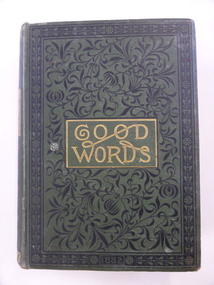
Book, Good Words, 1882
... 1st Prize given by the Rev. W. H. Scott awarded to Annie Egerton, Bible Class, Senior Division, for Bible Knowledge, 21st December 1883, J.E. Jones Head Teacher’. This is a hard cover book of 836 pages. It has a dark green ...This book, edited by Donald MacLeod, was given in 1883 as a prize to Annie Egerton by the Rev. W.H. Scott for Bible Knowledge. Annie Egerton was a pupil at the Allansford State School. John Jones was the Head Master at this school from 1867 to 1891. The school was opened in December 1856 as a National School and is still operating. No other details concerning Annie Egerton have been found.This book is of importance as it is a 19th century book given as a prize to a pupil of the Allansford School in 1883 for her Bible knowledge. It is particularly interesting that a prize for religious knowledge was given in the 1880s to a pupil at a secular State School. It is also interesting to note the type of book given to a primary school girl in the 19th century – a book with strong moral overtones and some heavy instructional articles. This is a hard cover book of 836 pages. It has a dark green and black cover patterned with an ornamental pattern and gold lettering contained within a square box on both the cover and the spine. The inside front and back pages have a mottled green flower pattern. The edges of the pages have a gilt finish. The book has a bookplate on the inside cover and the book contains an Index of Contents, short stories, articles on various topics and an Index of Authors. There are many black and white illustrations and sketches throughout the text. The first illustration has a piece of tissue paper in front of it. The cover is a little frayed at the edges and somewhat blotched. ‘Allansford State School No.3, 1st Prize given by the Rev. W. H. Scott awarded to Annie Egerton, Bible Class, Senior Division, for Bible Knowledge, 21st December 1883, J.E. Jones Head Teacher’. allansford state school, education in the warrnambool area, annie egerton, john jones, rev. w. h. scott -
 Warrnambool and District Historical Society Inc.
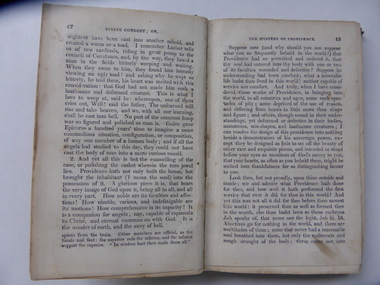
Book, Divine Conduct or the Mystery of Providence, Early to mid 19th century
... It is presumed that at that time there would not have been a great choice of reading material available in Warrnambool to give to children janet mcghie warrnambool sunday school ‘Janet McGhee (or McGhie), 1st Anniversary Warrnambool Sunday School, Decr 3rd 1849’ This is a hard cover book of 252 pages. The dark green ...This is a book, ‘Divine Conduct or the Mystery of Providence’ originally written by the Rev. John Flavel in 1677. This is a later edition with no date listed but it is presumed it was re-published in the 19th century. The book was given to Janet McGhie in 1849, the first anniversary of the Warrnambool Sunday School, just 14 months after the first European settlers arrived in the new settlement of Warrnambool. The first Sunday School in Warrnambool was located in McDowell’s Store and run by Thomas Denney and Richard Osburne. The latter in 1851 commenced Warrnambool’s first newspaper, the Warrnambol Examiner and in 1887 published an important history of Warrnambool. Janet Garden McGhie was the daughter of Matthew and Isabella McGhie who were pioneer settlers in Warrnambool. Janet McGhie married Alfred Coulstock at the age of 17 and died in Warrnambool in 1918 at the age of 80. She was aged 11 when she received this book and one wonders what she made of the ponderous text. This book is very precious as one of the few mementos we have of the very early days of Warrnambool’s settlement. It gives us a date for the establishment of the first Sunday School and the name of one of the award winners. It is also an interesting example of the pious and ponderous writings that young children were expected to read in the mid 19th century. It is presumed that at that time there would not have been a great choice of reading material available in Warrnambool to give to childrenThis is a hard cover book of 252 pages. The dark green cover has gold lettering on the spine which is almost obliterated. The cover is partly detached from its binding and is much stained and blotched. There is an inscription on the inside front cover in black ink and a red stamp of the Warrnambool & District Historical Society on the first page. There are some indecipherable pencil markings on this first page and the last page.‘Janet McGhee (or McGhie), 1st Anniversary Warrnambool Sunday School, Decr 3rd 1849’janet mcghie, warrnambool sunday school -
 Warrnambool and District Historical Society Inc.
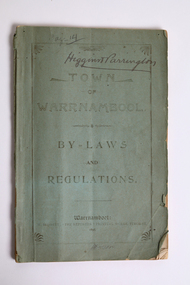
Document - Town of Warrnambool By-laws and Regulations 1898, M Hassett "The Reporter" Printing Works, 1898
... 1st October 1863, proclaimed a Town on 2nd February 1883, and a City on 8th April 1955. This booklet is of significance as it shows the governance of the Town of Warrnambool in 1898, fifteen years after Warrnambool was proclaimed as a town. warrnambool town of warrnambool municipal bylaws and regulations Town of Warrnambool By-Laws and Regulations Warrnambool M Hassett "The Reporter" Printing Works Timor Street 1898 Higgins & Parrington handwritten in ink A 54 page bound paper booklet with a green cover. ...Warrnambool was created as a municipality on 7th December 1855, declared a Borough on 1st October 1863, proclaimed a Town on 2nd February 1883, and a City on 8th April 1955. This booklet is of significance as it shows the governance of the Town of Warrnambool in 1898, fifteen years after Warrnambool was proclaimed as a town.A 54 page bound paper booklet with a green cover. The inside front page has a handwritten Government Gazette reference to the proclamation of Warrnambool as a town.Town of Warrnambool By-Laws and Regulations Warrnambool M Hassett "The Reporter" Printing Works Timor Street 1898 Higgins & Parrington handwritten in inkwarrnambool, town of warrnambool, municipal bylaws and regulations -
 Warrnambool and District Historical Society Inc.
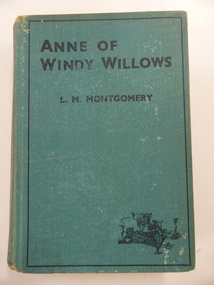
Book, Angus & Robertson, Anne of Windy Willows, 1939
... 1st Sewing, Gift of Mrs J.P. McMeekin, R.W. Andrews, Headmaster.’ This is a hard cover book of 277 pages. The cover is green ...This book was a prize from Warrnambool High School and donated by Mrs J.P. McMeekin. Warrnambool High School was established in 1907 and merged in the 1990s with Warrnambool North Technical School to form Warrnambool College. Roy Andrews was the Head Master of Warrnambool High School from 1940 to 1947. The McMeekins were early settlers in Warrnambool with family members in the 19th century working for the Shire of Warrnambool and operating a produce store in Warrnambool. This book is of minor interest as it is connected to Warrnambool High School, the McMeekin family and Roy Andrews.This is a hard cover book of 277 pages. The cover is green with black printing on the front cover and spine. The cover is a little stained and rubbed. The bookplate on the first page has printed material and the logo of Warrnambool High School and it is pasted in. Other information on the bookplate is handwritten in black ink. ‘Form 1, Warrnambool High School, 1940, Prize awarded to Joyce …. (name obliterated), for 1st Sewing, Gift of Mrs J.P. McMeekin, R.W. Andrews, Headmaster.’ mcmeekin family, warnambool high school, roy andrews, history of warrnambool -
 Warrnambool and District Historical Society Inc.
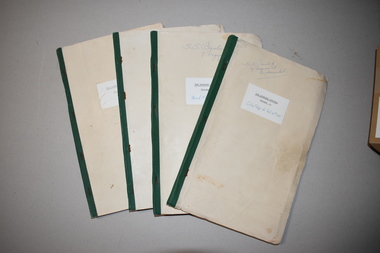
Dunmore Journals (4), Mid 20th century
... Baulch 7 Ferguson St Warrnambool The Dunmore Journal Volume 2 March 1st 1851 to Mar 19th 1860 .3 The Dunmore Journal Volume 3 .4 The Dunmore Journal Volume 4 .1 This is a foolscap-size booklet containing typed material. It has a buff-coloured paper cover with green ...These four booklets contain typed copies of the diaries of Charles Hamilton MacKnight from 1841 to 1873. They mostly concern details of MacKnight’s life and work on Dunmore Station, a property at Broadwater, 20 kilometres from Macarthur and 54 kilometres from Warrnambool. Charles Hamilton MacKnight (1819-1873) came to Australia from Scotland in 1841 and established the property of Dunmore in 1842 with partners William Campbell and James Hamilton Irvine. MacKnight was a prominent breeder of sheep, cattle and horses and his diaries provide a valuable record of early settlement in the Western District of Victoria. The original diaries are in the Latrobe Library in Melbourne. These copies come from the Baulch family who owned part of the original Dunmore property for many years. As these booklets are copies of the original diaries they are of minor significance only but will be useful to local researchers..1 This is a foolscap-size booklet containing typed material. It has a buff-coloured paper cover with green binding containing three staples. It has a handwritten name and address, a handwritten set of dates and a typed label pasted on the front cover. The cover is somewhat creased and stained. .2 as .1 above .3 This is a foolscap-size booklet containing typed material. It has a buff-coloured paper cover with green binding containing three staples. It has a typed label pasted on to the front cover. .4 as .3 above .1 S.S. Baulch 7 Ferguson St Warrnambool The Dunmore Journal Volume 1 Oct 14th 1841 to Feb 28th 1851 .2 S.S. Baulch 7 Ferguson St Warrnambool The Dunmore Journal Volume 2 March 1st 1851 to Mar 19th 1860 .3 The Dunmore Journal Volume 3 .4 The Dunmore Journal Volume 4dunmore station, western victoria, charles hamilton macknight, baulch family, dunmore, history of warrnambool -
 Warrnambool and District Historical Society Inc.
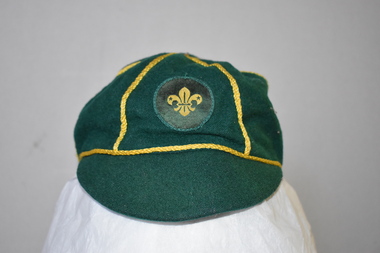
Clothing - Cap, scouts, Circa 1950
... This cap has no known local provenance but is a useful item for display. scouting in australia scout association of australia mark pullen highton geelong fleur de lis fleur de lys Hills Hats Size 7 Name: Mark Pullen Group: 1st Highton Fabric Content all wool Scout Approved Product Made Expressly for the Scout Association of Australia Made in Singapore This is a cap made of dark green wool with narrow gold braid dividing the crown into six sections. ...This cap belonged to Mark Pullen, a cub scout from Highton, Geelong, Victoria. No information is available on Mark Pullen. In Warrnambool there are three scout groups – Allansford, Norfolk (scout hall at the corner of Raglan Parade and Kepler Street) and Tooram (scout halls at the corner of Timor and Banyan Streets and in Otway Road). Cub scouts in Victoria are aged between 8 and 10. This cap has no known local provenance but is a useful item for display.This is a cap made of dark green wool with narrow gold braid dividing the crown into six sections. A button is missing from the top. The badge on the cap is a circular patch with the scout emblem in yellow and green. The cap is lined with black material with a white centre.Hills Hats Size 7 Name: Mark Pullen Group: 1st Highton Fabric Content all wool Scout Approved Product Made Expressly for the Scout Association of Australia Made in Singapore scouting in australia, scout association of australia, mark pullen, highton, geelong, fleur de lis, fleur de lys -
 Warrnambool and District Historical Society Inc.
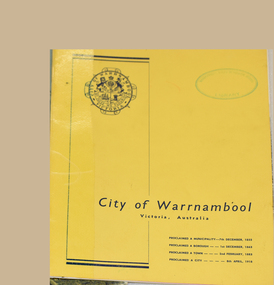
Book, City of Warrnambool
... 1st December 1863, a town on 2 February 1883 and a city on 8th April 1918. This booklet gives a brief overview of the development of the city in the 1960's. city of warrnambool warrnambool promotion and development board In a mauve rectangle on half of the upper edge is printed in black ink "Warrnambool where Australian Hospitality is a reality" The front cover and inside facing page have oval green ink stamp "Warrnambool North Technical School Library" This is a 16 page stapled booklet printed in blank ink on glossy paper with black and white photos. ...This booklet printed for the Warrnambool Promotion and Development Board in the 1960's showcases the city. It includes brief summaries and black and white photographs of major industries and benefits of the city. Warrnambool was proclaimed a municipality on 7th December 1855, a borough on 1st December 1863, a town on 2 February 1883 and a city on 8th April 1918.This booklet gives a brief overview of the development of the city in the 1960's. This is a 16 page stapled booklet printed in blank ink on glossy paper with black and white photos. The cover is yellow card with a Warrnambool City logo printed in black ink on the top left and the words City of Warrnambool Victoria Australia in the lower third and milestone proclamation dates. The inside facing page has an aerial black and white photograph of the city with a mauve banner at the lower edge.In a mauve rectangle on half of the upper edge is printed in black ink "Warrnambool where Australian Hospitality is a reality" The front cover and inside facing page have oval green ink stamp "Warrnambool North Technical School Library"city of warrnambool, warrnambool promotion and development board -
 Warrnambool and District Historical Society Inc.
News Sheet, Newspaper Warrnambool Examiner, 1868,1869
... They are in two bound volumes (October 2nd 1868 to December 29th 1868 and January 1st 1869 to March 30th 1869). The volumes are contained in plain cardboard with green binding and string. ...They are in two bound volumes (October 2nd 1868 to December 29th 1868 and January 1st 1869 to March 30th 1869). The volumes are contained in plain cardboard with green binding and string. ...The Warrnambool Examiner was founded by John Wilkinson and Richard Osburne in 1851. After a gap of a couple of years Richard Osburne resumed publication in October 1853 and continued until 1867. William Fairfax and Henry Laurie then leased the paper (1867 to 1872) before Richard Osburne again became the proprietor from October 1872 to April 1878 and from December 1879 to December 1880 when publication ceased. Richard Osburne was a pioneer settler in Warrnambool, arriving in 1847. He was prominent in community activities in the town and was a most important early historian, publishing his seminal work, ‘The History of Warrnambool’ in 1887, using the Warrnambool Examiner newspapers to assist with this history. Fairfax and Laurie were the proprietors when the papers described herein were printed. William Fairfax was a member of the Fairfax family that was, and still is, associated with the publication of many Australian newspapers. Henry Laurie later became well-known as a Melbourne University Philosophy Professor. These original newspapers are most important because they contain much information on Warrnambool’s early history and are a primary source for historians. These papers are also of importance because some parts of these papers were not filmed and are not currently available on microfilm. These papers were in a Warrnambool City Council storage area and it is surmised that they have come from the old Warrnambool Museum which no longer exists. These are original copies of the Warrnambool Examiner newspapers from October 2nd 1868 to 30th March 1869. They are in two bound volumes (October 2nd 1868 to December 29th 1868 and January 1st 1869 to March 30th 1869). The volumes are contained in plain cardboard with green binding and string. The newspapers are broadsheets of two pages with printing on four sides. The papers are marked with the blue and red pencil markings used by the editor. warrnambool examiner, richard osburne, william fairfax, henry laurie -
 Warrnambool and District Historical Society Inc.
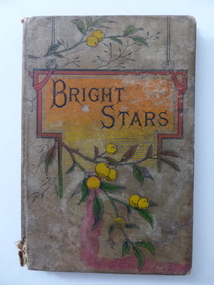
Book, Bright stars, Late 19th century
... George Powell Warrnambool South State School ‘3rd Prize, Upper 1st Class, Won by George Powell, Marks obtainable 200, Marks obtained 120. John Sloss, H.Teacher, 17/12/91.’ This is a hard cover book of 62 pages. The cover, dark green ...This small book, a prize given to George Powell in 1891, is believed to have come from the Warrnambool South State School. The signature in the book is that of John Sloss and he was the first Head Teacher of Warrnambool South State School which opened in 1877 and closed in 1995. The Powell families were in business in Warrnambool in the 1890s and the recipient of the prize may have been George Powell who was born in Warrnambool to George and Kate Powell in 1878. This book is of considerable interest because it appears to have been a prize awarded by Warrnambool South State School in 1891. The book is one of the few items we have connected to the early years of the Warrnambool South School. The book is a mixture of fact and fiction and the stories are meant to be instructive as well as entertaining.This is a hard cover book of 62 pages. The cover, dark green with a coloured floral pattern on the front and back, has been partly detached from its cloth binding. The book has several black and white sketches, with some pages missing at the beginning of the book. There are advertisements for other books on the inside of the covers. The pages and the cover are much stained. The inscription on the first page is handwritten in black and blue ink.‘3rd Prize, Upper 1st Class, Won by George Powell, Marks obtainable 200, Marks obtained 120. John Sloss, H.Teacher, 17/12/91.’ george powell, warrnambool south state school -
 Bendigo Military Museum
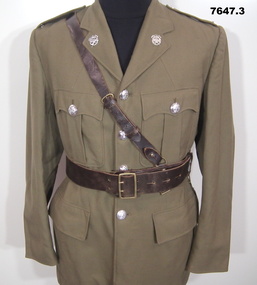
Uniform - JACKET, SERVICE DRESS, SAME BROWNE BELT, ARMY, Australian Defence Industries, 1966
... Collar, shoulder epaulettes with silver "1AR" Metal insignia badge - 1st Armoured Regiment; four front pockets, top two with buttons and two metal press studs on flap, lower with flap. Two lapel badges, metal, Armoured Corps. Green...Collar, shoulder epaulettes with silver "1AR" Metal insignia badge - 1st Armoured Regiment; four front pockets, top two with buttons and two metal press studs on flap, lower with flap. Two lapel badges, metal, Armoured Corps. Green ...3. Sam Browne Belt issued to "V101972 LT. E. HUMPHREYS" - AR AUSTRALIA 31/8 - 1970.1. Jacket - Khaki wool/polyester fabric, Service dress style with belt, silver colour plastic buttons with shank and split pin. Buttons have raised emblem - Armoured Corps. Collar, shoulder epaulettes with silver "1AR" Metal insignia badge - 1st Armoured Regiment; four front pockets, top two with buttons and two metal press studs on flap, lower with flap. Two lapel badges, metal, Armoured Corps. Green colour polyester fabric lining with white cotton manufactureres label - inside right. 2. Belt, Khaki colour wool/polyester fabric, with brass colour metal buckle, brown plastic buttons and leather belt keepers. 3. "Sam Browne" belt, consists of waist belt and shoulder strap, brown colour leather with brass buckle, studs and keepers.1. Manufacturers information on label. Black ink print "E.W. P/LTD/SOUTH AUSTRALIA/1966/ ^/SIZE 42 LONG/ CLASS 8505/66-019-8493/ ARMY NO/ NAME/ DRY CLEAN ONLY/ REPRESS USING IRON AND DAMP/ CLOTH OR MEDIUM TO HOT/ STEAM IRON/ CREASE UPPER HALF OF LAPELS/ ONLY" Handwritten blue ink pen "V101972 LT E. HUMPHREYS/ 1-AR AUSTRALIA/ 31/8 - 1970" uniform, army, service dress, sam browne belt -
 Bendigo Military Museum
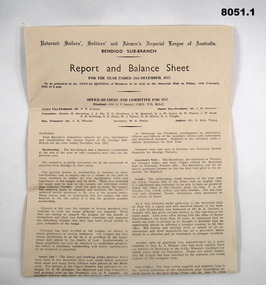
Administrative record - REPORT, ENVELOPE, NOTICE 1947, C. Jan 1948
... .1) Report and Balance sheet Bendigo Sub Branch for the year 1947, all type in black re the finance and activities of this Sub Branch of the "Returned Soldiers, Sailors, Airmen's Imperial League of Australia, 4 pages folding in total. .2) Letter re yearly membership subscription reminder of the Bendigo Branch that membership is due on the 1st January each year. .3) Envelope, light brown, has green stamp, Sub Branch details and addressed to underlined in red....This is Bruce John Bubb VX108474 2nd AIF. brsl smi rsl report balance Main Points, .1) "To be presented at the Annual Meeting of Members to be held at the Memorial Hall on Friday 13th February 1948 at 8pm" .3) "Mr B.J.Bubb White Hills" .1) Report and Balance sheet Bendigo Sub Branch for the year 1947, all type in black re the finance and activities of this Sub Branch of the "Returned Soldiers, Sailors, Airmen's Imperial League of Australia, 4 pages folding in total. .2) Letter re yearly membership subscription reminder of the Bendigo Branch that membership is due on the 1st January each year. .3) Envelope, light brown, has green stamp, Sub Branch details and addressed to underlined in red. ....1) Balance sheet, pages 1 & 2 report by the President cover Membership, ANZAC Day, Remembrance Day, Hospital & Benevolent Home, Govenor's visit, Unit Clubs, 27th District Board, Carnival, Finance, Relief Fund, Building Improvements Fund, Club Building fund, Donations, Appreciations, Obituary, Committee, Pilgrimage to Cross (Mt Macedon), Pages 3 & 4 are detailed Income Expenditure of the 5 Accounts of the Sub Branch. The report also mentions the first Life Membership of the sub Branch to Dr Harold Catford. .3) Letter addressed to B.J. Bubb. This is Bruce John Bubb VX108474 2nd AIF..1) Report and Balance sheet Bendigo Sub Branch for the year 1947, all type in black re the finance and activities of this Sub Branch of the "Returned Soldiers, Sailors, Airmen's Imperial League of Australia, 4 pages folding in total. .2) Letter re yearly membership subscription reminder of the Bendigo Branch that membership is due on the 1st January each year. .3) Envelope, light brown, has green stamp, Sub Branch details and addressed to underlined in red.Main Points, .1) "To be presented at the Annual Meeting of Members to be held at the Memorial Hall on Friday 13th February 1948 at 8pm" .3) "Mr B.J.Bubb White Hills"brsl, smi, rsl, report, balance -
 Bendigo Military Museum
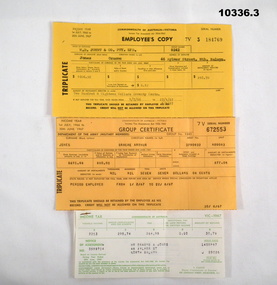
Financial record - TAXATION RETURN 1966 - 1967
... The Military one shows Taxation from 1.2.67 - 22.6.67. financial taxation ga jones .1) "1st July 1966 to 30th June 1967 - Graeme Arthur Jones 3790932 400063" .2) "1st July 1966 to 30th June 1967 - Jones Graeme 46 Aylmer St Nth Balwyn" .3) "Issue date 14 Sept 67" .1) Employee's copy, yellow colour, all print in black, entries in black type, Serial No 184769, W.D Joynt & Co Pty. Ltd. .2) Group Certificate orange colour, all print in in Black, entries in black type, Serial No 672553, Department of Army (Military Members) .3) Notice of Assessment white paper, green print, entries in black type, Assessment No 3589704, File No 25026. ...Collection re G.A. Jones 3790932, refer Cat No 10053.2P for his service details. The Certificates show Graeme's Taxation from 1.7.66 - 21.1.67 with his Civilian Employer. The Military one shows Taxation from 1.2.67 - 22.6.67..1) Employee's copy, yellow colour, all print in black, entries in black type, Serial No 184769, W.D Joynt & Co Pty. Ltd. .2) Group Certificate orange colour, all print in in Black, entries in black type, Serial No 672553, Department of Army (Military Members) .3) Notice of Assessment white paper, green print, entries in black type, Assessment No 3589704, File No 25026. Stapled to is a white paper with an Alteration increase of $40.00..1) "1st July 1966 to 30th June 1967 - Graeme Arthur Jones 3790932 400063" .2) "1st July 1966 to 30th June 1967 - Jones Graeme 46 Aylmer St Nth Balwyn" .3) "Issue date 14 Sept 67"financial, taxation, ga jones -
 Bendigo Military Museum
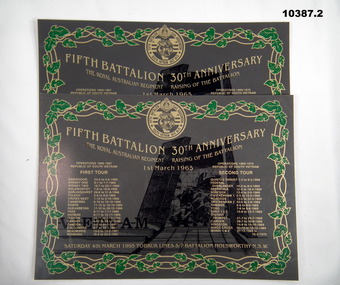
Memorabilia - FIFTH BATTALION, ARMY, The Royal Australian Regiment, 1995
... 1st March 1965". Bottom: "SATURDAY 4th MARCH 1995 TOBRUK LINES 5/7 BATTALION HOLSWORTHY N.S.W.". 1. & 2. Placemats - grey colour hard plastic rectangular shape mat. used as a dinner placemat for an Anniversary event. Gold, green ...1. & 2. Placemats - grey colour hard plastic rectangular shape mat. used as a dinner placemat for an Anniversary event. Gold, green and black colour print on grey background. Illustrated with "FIFTH BATTALION/ R.A.R. ASSOCIATION/ SOUTH VIETNAM 66-67, 69-70" with a tiger motto; border of intertwined vine leaves with silhouette style memorial in background. Extensive information in gold print.Information in large gold print. Top: "FIFTH BATTALION 30th ANNIVERSARY/ THE ROYAL AUSTRALIAN REGIMENT RAISING OF THE BATTALION/ 1st March 1965". Bottom: "SATURDAY 4th MARCH 1995 TOBRUK LINES 5/7 BATTALION HOLSWORTHY N.S.W.".memorabilia, fifth battalion, anniversary -
 Bendigo Military Museum
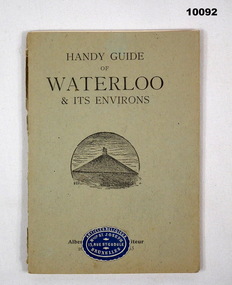
Booklet - TOURIST GUIDE, Albert De Boeck, HANDY GUIDE OF WATERLOO AND ITS ENVIRONS
... 1st page inside. Written inside back cover : “This little booklet gives some very interesting particulars of the Great Battle” Green cover booklet with a picture of a Monument to the Battle on the Front with the book title and a stamp stuck on the bottom. ...Tourist booklet describing the Battle of Waterloo Battlefield and descriptions of what happened. Part of Collection of "V E Giudice" No. 53730 Cat No. 10031P. Part of the overall collection of William (Bill) Thomason. Refer Cat No. 4136P.Green cover booklet with a picture of a Monument to the Battle on the Front with the book title and a stamp stuck on the bottom. Inside is pictures of various monuments. Description of the best way to town, The Battlefield and some descriptions on what happened on the day and where. On the back is the List and Prices of other tour books.Name "VE Giudice" written on 1st page inside. Written inside back cover : “This little booklet gives some very interesting particulars of the Great Battle”collection of william (bill) thomason, v e giudice, tourist guide, ww1 -
 Bendigo Military Museum
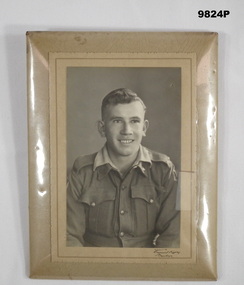
Photograph - PHOTOGRAPH, FRAMED
... 1st Australian Park transport Company Citizens Military Services from 5/11/41 to 6/9/42, then Australian Imperial Forces 7/9/42 to 21/11/45. Discharging 21 Dec 1945 at Royal Park. War Badge RASA216696. Trade Group TG3 - Horse Transport. Australian Army Transport Co. Walter John Broom 1349 Scribbled on back. Black and white Portrait photo of an Australian Soldier from Waist up. Looking into the camera in a posed position in uniform. Photo covered by plastic and centred in a beige cardboard frame. Dark green ...Related to Private "Walter John Broom", VX10043 from 1st Australian Park transport Company Citizens Military Services from 5/11/41 to 6/9/42, then Australian Imperial Forces 7/9/42 to 21/11/45. Discharging 21 Dec 1945 at Royal Park. War Badge RASA216696. Trade Group TG3 - Horse Transport.Black and white Portrait photo of an Australian Soldier from Waist up. Looking into the camera in a posed position in uniform. Photo covered by plastic and centred in a beige cardboard frame. Dark green metal backing with a fold out metal stand.1349 Scribbled on back.australian army, transport co., walter john broom -
 Bendigo Military Museum
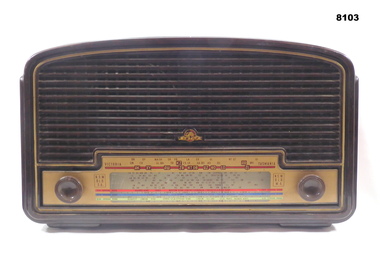
Domestic object - ASTOR RADIO, C.1950's
... This radio was last used in the Office at the Soldiers Memorial Institute most likely pre 1990's. brsl smirsl radio astor 1st sticker on rear, "Selex Decal Pty Ltd - No 5 - 217540", 2nd sticker, "Danger" Radio, ASTOR brand, brown Bakelite frame, the glass face has two control knobs. The top line of stations covers Victoria to Tasmania followed by NSW, QLD & SA. At the bottom is 3 bands in red, blue, light green ...This one appears to be Model 27 from the early 1950's. This radio was last used in the Office at the Soldiers Memorial Institute most likely pre 1990's.Radio, ASTOR brand, brown Bakelite frame, the glass face has two control knobs. The top line of stations covers Victoria to Tasmania followed by NSW, QLD & SA. At the bottom is 3 bands in red, blue, light green which cover Europe, USA. On the rear are two stickers relating to power, patents, use and licencing.1st sticker on rear, "Selex Decal Pty Ltd - No 5 - 217540", 2nd sticker, "Danger"brsl, smirsl, radio, astor -
 Bendigo Military Museum
Letter - LETTERS of SYMPATHY, Dec 1941
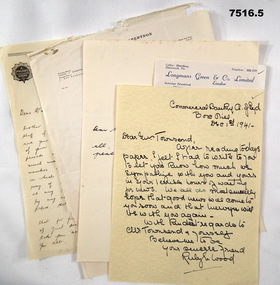
... From Commercial Bank of Sydney on blank white paper and black writing, dated Dec 1st '41. 2. From Longman's Green & Co Ltd, London, on Company letterhead note paper dated Dexc 1st 1941. 3. ...From Commercial Bank of Sydney on blank white paper and black writing, dated Dec 1st '41. 2. From Longman's Green & Co Ltd, London, on Company letterhead note paper dated Dexc 1st 1941. 3. ...Letters of Sympathy from various businesses for the Dental Surgeon "Mervyn Clive Townsend", KIA on sinking of HMAS SYDNEY on 15/11/41. Refer Cat No. 2313P for Townsends service.Various handwritten letters from different businesses to parents of M.C. Townsend. 1. From Commercial Bank of Sydney on blank white paper and black writing, dated Dec 1st '41. 2. From Longman's Green & Co Ltd, London, on Company letterhead note paper dated Dexc 1st 1941. 3. From Royal Standard Hotel - on white blank note paper dated 8th Dec '41. 4. From Hemingway & Robertson, Accountants, typed letter in black. Dated 4th Dec '41. 5. From J.A. Rodgers & Co - Wine Merchants - on white letterhead note paper, dated 1st Dec '41.letters, ww2, hmas sydney, kia, mervyn clive townsend -
 Kiewa Valley Historical Society
Magazine - Nature, Joseph Swanson Wilkinson, Wild Life Australian Nature Magazine, January 1949
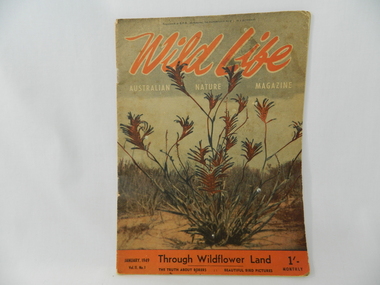
... 1st line: 'Wild Life' in orange with white outline. 2nd line: 'Australian Nature Magazine' in white underneath title. All across top. 3rd written line: 'January, 1949 Through Wildflower Land 1/-' underneath picture of Kangaroo Paw. in black Underneath this writing follows: 4th line: 'Vol.11 No. 1 The Truth About Borers : : Beautiful Bird Pictures' in black Underneath 1/- is 'Monthly' Background behind black writing is orange same as title. 48 page soft covered magazine. Cover with limited colour including orange, black, white and brown with green ...This magazine was part of the Bogong School's library and represents an important aspect of the school's curriculum.Bogong School was noted for having a great interest in nature and conservation. 48 page soft covered magazine. Cover with limited colour including orange, black, white and brown with green. Inside pages in black, brown and grey pictures with black print on off white pages. Page 41 is in cartoon form. 'Registered at G.P.O. Melbourne for transmission by post as a periodical'. written in black in tiny print across the top. 1st line: 'Wild Life' in orange with white outline. 2nd line: 'Australian Nature Magazine' in white underneath title. All across top. 3rd written line: 'January, 1949 Through Wildflower Land 1/-' underneath picture of Kangaroo Paw. in black Underneath this writing follows: 4th line: 'Vol.11 No. 1 The Truth About Borers : : Beautiful Bird Pictures' in black Underneath 1/- is 'Monthly' Background behind black writing is orange same as title.bogong primary school. bogong. wild life. nature. -
 Kiewa Valley Historical Society
Book - Teacher Reference, Oliver and Boyd Ltd, The Psychology and Teaching of Reading, 1952
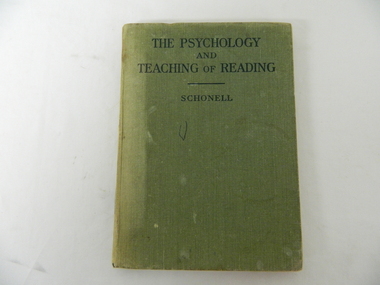
... This book was used by a teacher who worked in the Kiewa Valley in 1954. education school teacher reference reading fred schonell literacy Inside back and front cover - '0231' 'Signature, October '54' - on 1st leaf of book Hardcover green book by Fred J. Schonell. ...This book was used from 1945 to the mid 1950s as a teacher reference book for the teaching of reading in schools.This book was used by a teacher who worked in the Kiewa Valley in 1954.Hardcover green book by Fred J. Schonell. M.A., PH. D., D. Lit..Inside back and front cover - '0231' 'Signature, October '54' - on 1st leaf of bookeducation, school, teacher reference, reading, fred schonell, literacy -
 Kiewa Valley Historical Society
Book - Country Women's Association of Victoria, Country Crafts - CWA, 1950
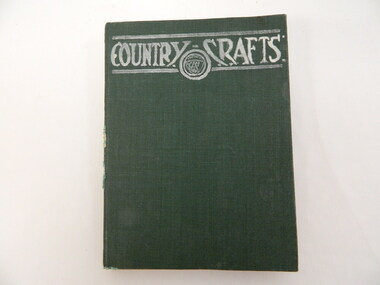
... Hard covered bound green book with 345 slightly yellowing pages. 1949 periodical book Vol. XIX No.1 (- 12) 1st January 1949 - (December) reporting on activities of C.W.A. clubs in Victoria. ...Hard covered bound green book with 345 slightly yellowing pages. 1949 periodical book Vol. XIX No.1 (- 12) 1st January 1949 - (December) reporting on activities of C.W.A. clubs in Victoria. ...This book is a periodical that the Tawonga C.W.A. group received each year with news, hints, ideas etc. of all CWA groups in Victoria. The Tawonga branch of the C.W.A. commenced on the 7th Feb. 1946 and often combined activities with the other branches in the Kiewa Valley. The C.W.A. aimed to improve health, welfare and education for women and children in the country.Women living in Tawonga were mostly on farms and, in 1946, when the branch commenced would have been feeling more remote with WW11 having had an effect on available workers and the well being of the women and children.Hard covered bound green book with 345 slightly yellowing pages. 1949 periodical book Vol. XIX No.1 (- 12) 1st January 1949 - (December) reporting on activities of C.W.A. clubs in Victoria. It is set out month by month but isn't indexed. Subscription: 4/- per annum; 5/- per year, posted; 4d. per Copy, 5 and a half pence postedCover: "Country Crafts with CWA logo."country women's association of victoria. country crafts. tawonga. c.w.a. -
 Kiewa Valley Historical Society
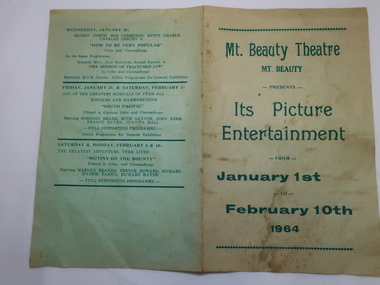
Mt Beauty Theatre Program, Mt Beauty Theatre - Picture Entertainment - January 1st to February 10th 1964
... Thin greenish paper with dark green print folded making 4 pages detailing the schedule of the pictures to be shown. Mt Beauty Theatre - Picture Entertainment - January 1st to February 10th 1964 Mt Beauty Theatre Program ...The Mt Beauty theatre was located in the community hall and gave residents access to the latest movies when television was just beginning to be a popular household entertainment. The Kiewa valley was for a very long time 'out of range' for television reception . Going to the theatre was popular for all age groups.This program shows that most of the films were suitable for the whole family.Mt Beauty entertainment consisted of going to the pictures on a Wednesday or Saturday night. Most films were suitable for the whole family and were up-to-date movies with well known stars. Thin greenish paper with dark green print folded making 4 pages detailing the schedule of the pictures to be shown.2 nights have been ticked.mt beauty theatre, films, pictures -
 Bendigo Military Museum
Book - DIARY WW2
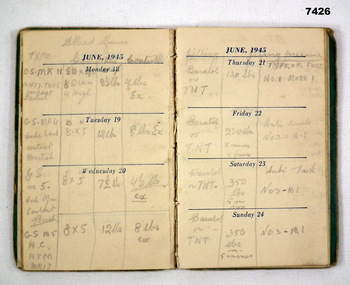
... 1st Aust Recruit Train Batt, 3rd PL, B Com, suggests diary used as a notebook while trainings. Notes seem to be engineering Technical notes. WW2 Training Batt Book Stamped inside "Aust Recruit Training Batt", and dated “21 Mar 1945”. In personal details Identity card No. E98021 RN and SPR C. Coy 1 Batt RAE Trg CT. Wagga. Small green ...In back says 1st ARTB Cowra NSW and 1st Aust Recruit Train Batt, 3rd PL, B Com, suggests diary used as a notebook while trainings. Notes seem to be engineering Technical notes.Small green book. Seems to be used more as a notebook than daily diary entries. Notebook has daily pages but notes start March 1945. Cover torn and multiple pages loose.Stamped inside "Aust Recruit Training Batt", and dated “21 Mar 1945”. In personal details Identity card No. E98021 RN and SPR C. Coy 1 Batt RAE Trg CT. Wagga.ww2, training batt, book
