
Showing 139 items matching "2/2 pioneers"
-
 Waverley RSL Sub Branch
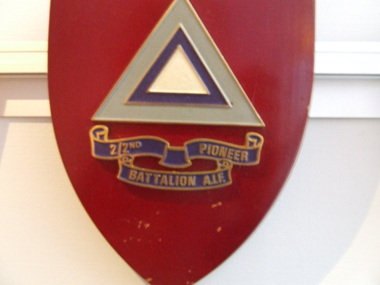
Plaque 2/2 Pioneer Battalion A.I.F, 2/2 Pioneer Battalion A.I.F
... Plaque 2/2 Pioneer Battalion A.I.F. ...2/2 Pioneer Battalion A.I.F. ...Wooden Plaque 15cm x 13cm with insignia of 2/2 Pioneer Battalion A.I.F....2/2 Pioneer Battalion A.I.F....2/2 Pioneer Battalion A.I.F. Wooden Plaque 15cm x 13cm with insignia of 2/2 Pioneer Battalion A.I.F. 2/2 Pioneer Battalion A.I.F. ...Wooden Plaque 15cm x 13cm with insignia of 2/2 Pioneer Battalion A.I.F.2/2 Pioneer Battalion A.I.F. -
 Bendigo Military Museum
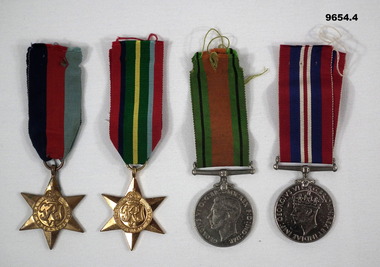
Award - MEDALS WW2, Post 1945
... 2/2 Pioneers...Medals regarding"Thomas Coates" VX18443, Enlisted 29 May 1940 in 2/2 Pioneers. Died 5 March 1942. Other items also refer to "Leonard John Clark Coates" V2791 and possibly brother "John Coates" VX18448....2/2 Pioneers. Died 5 March 1942. Other items also refer to "Leonard John Clark Coates" V2791 and possibly brother "John Coates" VX18448. 2/2 Pioneers War Medals Coates family 1 1. ...Part of the Coates collection covering several members of the family involved in WW2. Medals regarding"Thomas Coates" VX18443, Enlisted 29 May 1940 in 2/2 Pioneers. Died 5 March 1942. Other items also refer to "Leonard John Clark Coates" V2791 and possibly brother "John Coates" VX18448.Four WW2 medals unmounted. 1. The 1939-45 Star. 2. Pacific Star. 3. Defence Medal. 4. War Medal 1939-45.1. On back, “VX18443 T. Coates” 2. On back, “VX18443 T. Coates” 3. 4. Both have the same on the rim as 1. & 2.2/2 pioneers, war medals, coates family 1 -
 Bendigo Military Museum
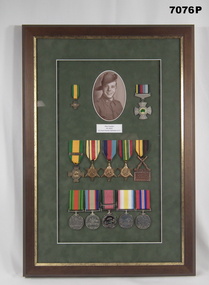
Award - MEDALS & PHOTOGRAPH WW2, Post WW2
... Maxwell Barry Cowden VX19297 enlisted in the 2/nd AIF on 30.5.1940 age 18 years (put his age up to 21) in 2/2 Pioneer Battalion AIF, embarked for the Middle East 8.4.1941, promoted L/Cpl 25.6.1941, promoted Cpl 29.10.1941, took part in the Syrian Campaign. ..."Max Cowden VX19297 2/2 Pioneer Battalion AIF"...Refer also Cat No 7077. award medals Photo POW 2/2 "Max Cowden VX19297 2/2 Pioneer Battalion AIF" Brown wood frame with gold edge, contains a photo and medals on a green background re a WW2 soldier/POW. ...Maxwell Barry Cowden VX19297 enlisted in the 2/nd AIF on 30.5.1940 age 18 years (put his age up to 21) in 2/2 Pioneer Battalion AIF, embarked for the Middle East 8.4.1941, promoted L/Cpl 25.6.1941, promoted Cpl 29.10.1941, took part in the Syrian Campaign. On 31.1.1942 the unit embarked for Australian but were diverted to Java to defend it, disembarked 18.2.1942. Java surrendered and they were taken POW, reported MIA on 30.4.1942 then after as POW. As a POW he worked on the Burma Railway. In December 1944 they were on the Hell Ship AWA Maru and sailed for Japan to work in the Coal Mines arriving mid Jan 1945. He was repatriated back to Australia on the HMS Formidable, discharged on 28.11.1945 with the rank of Cpl. Refer also Cat No 7077.Brown wood frame with gold edge, contains a photo and medals on a green background re a WW2 soldier/POW. The medals are a mixture of official and unofficial not in the correct order. Medals top. 1. Miniature Dutch medal 1942 - 45 official. 2. Prisoner of war medal, commemorative unofficial. Centre row. 1.Dutch medal 1942 - 45 official. 2. Africa star, official. 3. 1939 - 45 Star, official. 4. Pacific Star, official. 5. Front line service medal, unofficial. Bottom. 1. Defence medal, official. 2.Australian Service medal 1939 - 45, official. 3. For Combatant duties in active service, unofficial. 4. Foreign service medal, unofficial. 5. British war medal 1939 - 45, official."Max Cowden VX19297 2/2 Pioneer Battalion AIF"award, medals, photo, pow, 2/2 -
 Bendigo Military Museum
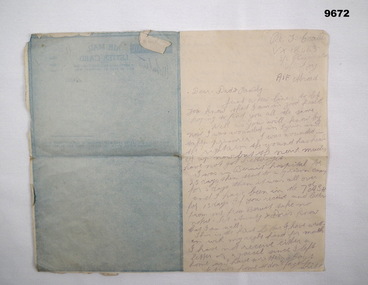
Letter, Tom Coates, C.1941/42
... 2/2 Pioneers...Tom died 5/3/42, refer Cat No 9654.4 for his service details. 2/2 Pioneers Letter Coates family 1 Addressed to “Mr John Coates - 48 Phillipson Street, Albert Park, Melbourne, Victoria, Australia” Letter on single sheet Air Mail Folded into 4 with faded letter scribbled across 2 pages. ...Part of the Coates Family Collection. Letter from Tom Coates to father John Coates. Tom died 5/3/42, refer Cat No 9654.4 for his service details.Letter on single sheet Air Mail Folded into 4 with faded letter scribbled across 2 pages. Cream colour paper and blue writing.Addressed to “Mr John Coates - 48 Phillipson Street, Albert Park, Melbourne, Victoria, Australia”2/2 pioneers, letter, coates family 1 -
 Montmorency–Eltham RSL Sub Branch
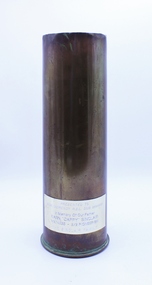
Weapon - Shell case, 18 Pounder Mk II*, Ernest Sinclair, 1917
... ...2/2 pioneer battalion...Ernest served in the 2/2 Pioneer Battalion which was raised in Puckapunyal in Victoria in May 1940. ...Plaque affixed to item: "PRESENTED TO / MONTMORENCEY RSL SUB BRANCH / In Memory Of Our Father / EARN "CAPPY" SINCLAIR / VX74235 - 2/2 PIONEER BN / THE SINCLAIR FAMILY" Engravings from original shell on bottom (see image)...Ernest served in the 2/2 Pioneer Battalion which was raised in Puckapunyal in Victoria in May 1940. After completing training, the battalion sailed for the Middle East aboard the Queen Mary in April 1941. shell 2/2 pioneer battalion ernest sinclair ww2 second world war vx74235 Plaque affixed to item: "PRESENTED TO / MONTMORENCEY RSL SUB BRANCH / In Memory Of Our Father / EARN "CAPPY" SINCLAIR / VX74235 - 2/2 PIONEER BN / THE SINCLAIR FAMILY" Engravings from original shell on bottom (see image) Brass shell casing with in-memorium plaque attached. ...This 1917 dated 18pr shell case has a plaque in memory of Ernest 'Cappy' Sinclair. WW1 18pr guns were all that was available in the early days of WW2 and were used until the arrival of modern 25pr guns. Ernest served in the 2/2 Pioneer Battalion which was raised in Puckapunyal in Victoria in May 1940. After completing training, the battalion sailed for the Middle East aboard the Queen Mary in April 1941. Brass shell casing with in-memorium plaque attached.Plaque affixed to item: "PRESENTED TO / MONTMORENCEY RSL SUB BRANCH / In Memory Of Our Father / EARN "CAPPY" SINCLAIR / VX74235 - 2/2 PIONEER BN / THE SINCLAIR FAMILY" Engravings from original shell on bottom (see image)shell, 2/2 pioneer battalion, ernest sinclair, ww2, second world war, vx74235 -
 Running Rabbits Military Museum operated by the Upwey Belgrave RSL Sub Branch
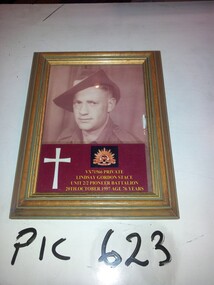
Photo
... Photo of Pvte Lindsay Gordon Stace 2/2/Pioneer Batt. DOD 20/10/1997 age 76 Years...Photo Photo of Pvte Lindsay Gordon Stace 2/2/Pioneer Batt. DOD 20/10/1997 age 76 Years Photo ...Photo of Pvte Lindsay Gordon Stace 2/2/Pioneer Batt. DOD 20/10/1997 age 76 Yearsphoto -
 Bendigo Military Museum
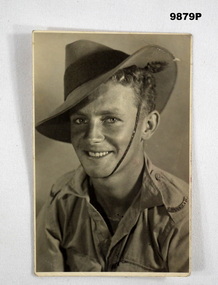
Postcard - PHOTOGRAPHIC POSTCARD, c.WW2
... JUNCK, B Coy, 2/2 PIONEERS, AIF ABROAD"....2/2nd Pioneers on 3.6.1940. Embarked for the Middle East on 7.7.1941. Wounded in Action with GSW to the left foot 9.7.1941. Rejoined unit 4.8.1941. Embarked from the Middle East and disembarked at Batavia Java. Reported missing approx. 7.3.1942 then as POW. Transported to Japan on 15.1.1945, recovered at Omuta, Japan on 13.9.1945. Transferred to Manila then to Sydney and discharged from the AIF on 18.12.1945 with the rank of Private. Part of the Bennetts Collection. Bernard Junck POW Photograph Bennetts Collection Hand written in black ink on back of photograph: "VX212273 Pte B. JUNCK, B Coy, 2/2 ..."Bernard Junck" enlisted No. VX21273 age 21 years in 2/2nd Pioneers on 3.6.1940. Embarked for the Middle East on 7.7.1941. Wounded in Action with GSW to the left foot 9.7.1941. Rejoined unit 4.8.1941. Embarked from the Middle East and disembarked at Batavia Java. Reported missing approx. 7.3.1942 then as POW. Transported to Japan on 15.1.1945, recovered at Omuta, Japan on 13.9.1945. Transferred to Manila then to Sydney and discharged from the AIF on 18.12.1945 with the rank of Private. Part of the Bennetts Collection.sepia toned head and shoulder photograph of an Australian soldier in uniform. Soldier is wearing an open neck shirt. Slouch hat unpinned. Back of photograph has postcard format in black. Handwritten details of soldier in black ink on back.Hand written in black ink on back of photograph: "VX212273 Pte B. JUNCK, B Coy, 2/2 PIONEERS, AIF ABROAD".bernard junck, pow, photograph, bennetts collection -
 Bendigo Military Museum
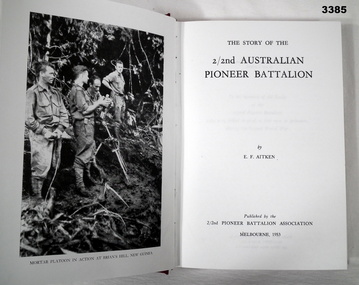
Book - BOOK WW2, 2/2nd Australian Pioneer Battalion, 1953
... From page following title page: "2/2 Pioneer Battalion History. To the memory of All Ranks of the 2/2 Pioneer Battalion who were killed or died, as free men or prisoners during the Second World War" Refer Cat No 4072.2P, John Donald (Jock) VX19003, POW twice. ......2/2 Pioneer Battalion Association...From page following title page: "2/2 Pioneer Battalion History. To the memory of All Ranks of the 2/2 Pioneer Battalion who were killed or died, as free men or prisoners during the Second World War" Refer Cat No 4072.2P, John Donald (Jock) VX19003, POW twice. book 2/2nd pioneer Hard cover, cardboard, buckram, dark red colour, gold print on spine. 228 pages, cut plain white. ...From page following title page: "2/2 Pioneer Battalion History. To the memory of All Ranks of the 2/2 Pioneer Battalion who were killed or died, as free men or prisoners during the Second World War" Refer Cat No 4072.2P, John Donald (Jock) VX19003, POW twice. Hard cover, cardboard, buckram, dark red colour, gold print on spine. 228 pages, cut plain white. Illustrated with black & white photos & maps. Front & back fly leaf & end papers illustrated, grey & white drawing of a scene with trees & soldiers in action. book, 2/2nd, pioneer -
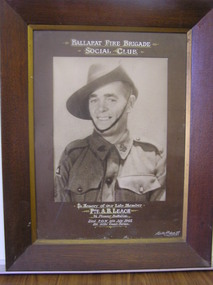 Ballarat Fire Brigade
Photograph, Thornton Richards & Co
... ...2 2 pioneer battalion...Ballarat Fire Brigade / Social Club / In Memory of our Late Member / Pte. A.B. Leach / 2/2 Pioneer Battalion / Died P.O.W. 26th July 1945 / 105 "Killo" camp, Burma / Thorton Richards & Co / Ballarat...ballarat fire brigade p o w burma pte a b leach leach leach a b 1945 ballarat fire brigade social club 2 2 pioneer battalion Ballarat Fire Brigade / Social Club / In Memory of our Late Member / Pte. A.B. Leach / 2 ...Black and white memorial photograph of Pte. A B Leach, a member of the brigade who died as a prisoner of war 26th July 1945. Photgraph is of Pte Leach in uniform and is framed in a dark brown timber frame with painted gold trim on the inner edge of the frameBallarat Fire Brigade / Social Club / In Memory of our Late Member / Pte. A.B. Leach / 2/2 Pioneer Battalion / Died P.O.W. 26th July 1945 / 105 "Killo" camp, Burma / Thorton Richards & Co / Ballaratballarat fire brigade, p o w, burma, pte a b leach, leach, leach a b, 1945, ballarat fire brigade social club, 2 2 pioneer battalion -
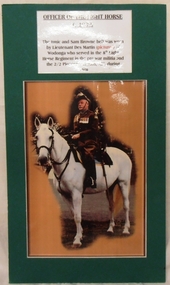 8th/13th Victorian Mounted Rifles Regimental Collection
Photograph, Officer of the Light Horse c.1939
... The tunic and Sam Browne belt was worn by Lieutenant Des Martin ( pictured ) of Wodonga who served in the 8th Light Horse Regiment in the pre-war militia and the 2/2 Pioneer BattalionAIF during WW11...The tunic and Sam Browne belt was worn by Lieutenant Des Martin ( pictured ) of Wodonga who served in the 8th Light Horse Regiment in the pre-war militia and the 2/2 Pioneer BattalionAIF during WW11 Coloured photograph with green fibreboard mount of Lieutenant Des Martin of Wodonga in Light Horse uniform on horseback. ...Lieutenant Des Martin took part in many Anzac Day Marches in Melbourne riding with a small group leading the march.Uncommon post-WWII photograph of a mounted officer of the Light Horse. Has added significance because the uniform is held in the 8th/13th VMR Collection.Coloured photograph with green fibreboard mount of Lieutenant Des Martin of Wodonga in Light Horse uniform on horseback.Officer of the Light Horse c. 1939. The tunic and Sam Browne belt was worn by Lieutenant Des Martin ( pictured ) of Wodonga who served in the 8th Light Horse Regiment in the pre-war militia and the 2/2 Pioneer BattalionAIF during WW11martin des lieutenant, 8th light horse regiment -
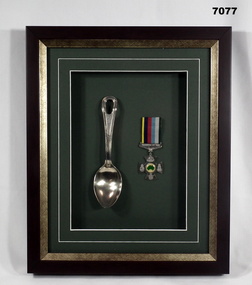 Bendigo Military Museum
Souvenir - SOUVENIR, FRAMED, WW2, Post WW2
... The spoon was given to Maxwell Barry Cowden VX19297 2/2 Pioneer BN by an American POW. He carried the spoon tied to the side of his loin cloth. ...The spoon was given to Maxwell Barry Cowden VX19297 2/2 Pioneer BN by an American POW. He carried the spoon tied to the side of his loin cloth. ...The spoon was given to Maxwell Barry Cowden VX19297 2/2 Pioneer BN by an American POW. He carried the spoon tied to the side of his loin cloth. Max worked on the Burma Railway and in the Coal Mines in Japan, Senryu 24 and Fukuoka camps. After the war he could not sit on a chair for a long time and would just squat on the floor with his back to the wall as he had done as a POW. Refer Cat No 7076P for more service details.Framed brown timber with gold edge, inset background is green, within is a silver spoon and medal displayed. The medal is a Commemorative unofficial Prisoner of War. On the spoon stamped in "U.S"framed, pow, souvenir, u.s -
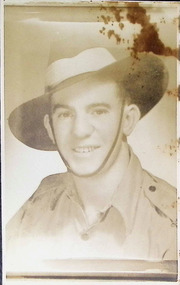 Williamstown Historical Society Inc
Photograph - Private Frank Ball, AIF
... He served in the 2/2 Australian Pioneer Battalion Source: vwma.org.au ...He served in the 2/2 Australian Pioneer Battalion Source: vwma.org.au Photograph Private Frank Ball, AIF ...Private Frank BALL (Service no: NX88372), was born in Williamstown on 29 Dec 1920 and enlisted in the Australian Military Forces on 04 Sep 1939. He served in the 2/2 Australian Pioneer Battalion Source: vwma.org.au australian military forces, private frank ball -
 Bendigo Military Museum
Award - MEDAL SET WW2, Post 1945
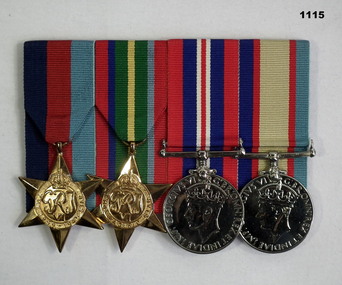
... Posted to Pioneer Wing 23.6.1941, graded Cook Group 2 in 2/2nd Pioneer Bn. ...Posted to Pioneer Wing 23.6.1941, graded Cook Group 2 in 2/2nd Pioneer Bn. ...Merton Charles WILLOUGHBY VX54056 (born or op, enlisted Royal Park) on 24.4.41 in the 2nd AIF aged 37 years. Posted to Pioneer Wing 23.6.1941, graded Cook Group 2 in 2/2nd Pioneer Bn. Embark for the Middle East 2.11.1941 disembarking 4.11.1941, relinquishes Group 2 Cook position, embark for Batavia 18.2.1942, reported Missing in Action Java then Missing POW 7.3.1942, recovered POW Siam 20.8.1945, embark from Singapore 29.9.45 disembarking Australia 17.10.1945, discharged from the Army 1.3.1946. With the entry of Japan into the war the 2/2nd Battalion embarked from the Middle East for Australia but was diverted to defend Java with 7th Division elements under what was called “Blackforce”. Some 800 where taken POW and 258 died in captivity. Medal set, court mounted, set of (4) re M.C Willoughby. 1. 1939-45 Star. 2. The Pacific Star. 3. British War Medal 1939-1945. 4. Australian Service Medal 1939 - 45"VX54056 MC Willoughby"medals, military, history -
 Federation University Historical Collection
Drawing - Rubbing, Rubbing on a plaque relating to the Sky High Restaurant
... Cody & Quinn Pty Ltd Builders .2) (logo) This tablet was erected by the citizens of Ballarat in honour of the pioneers of this city and district. .3) This MEMORIAL TABLET was unveiled on the 3rd May 1961 by F.W. WRAY, Esq in the company of S.C. HENDERSON, Esq. The only remaining members of the Original Pioneers Memorial Committee. A number of rubbings from plaques on buildings. .1) Sky High Restaurant .2 ...This is thought to be the work of Keith Rash of Ballarat.A number of rubbings from plaques on buildings. .1) Sky High Restaurant .2) Pioneers Tablet (Probably relating to the Pioneers Plot at the Ballaarat Old Cemetery. .3) and .4) Plaque relating to the Pioneers tablet.1) This Skyhigh restaurant was officially opened by The Hon. Vance Dickie M.L.C. Minister for Tourism on the 25th March 1971 This building was planned and constructed for The Ministry of Tourism J. Dale Fisher F.R.A.I.A. Architect W.J. Cody & Quinn Pty Ltd Builders .2) (logo) This tablet was erected by the citizens of Ballarat in honour of the pioneers of this city and district. .3) This MEMORIAL TABLET was unveiled on the 3rd May 1961 by F.W. WRAY, Esq in the company of S.C. HENDERSON, Esq. The only remaining members of the Original Pioneers Memorial Committee.architecture, j. dale, w, j, cody & quinn, skyhigh restaurant, frottage, rubbing, ballarat pioneers, keith rash -
 Lara RSL Sub Branch
Photographs, Bob Wilson, Framed Photos and Medals - McIntyre Family, 2016
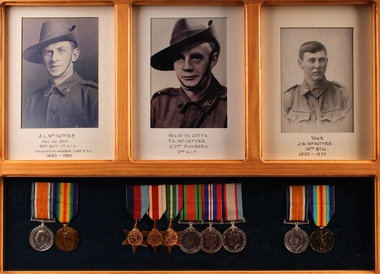
... 2 aif pioneers lara rsl J.L. McIntyre REG. No. 3591 58th. BATT. 1st A.I.F Foundation Member Lara R.S.L 1890 - 1990 REG. NO. VX20754 T.G. MC INTYRE 2 ...These photographs and medals are of the McIntyre family. Three members of Lara's McIntyre family served during the First and Second World Wars, and two were members of the Lara RSL. John Lachlan McIntyre was born at Beeac, Victoria in December 1890. He enlisted in the 1st AIF in July 1915. John fought on the Western Front, taking part in the battles of Fromelles and the 2nd Battle of the Somme. He was severely wounded at Fromelles and spent 12 months in hospital in England before returning to the front. John returned home in 1919 and was granted a soldier settlement block in Lara in 1937. He was a founding member of Lara RSL and is its longest serving member. John died in 1990. Thomas Gordon McIntyre was born at Lara in 1901. Thomas, known as Gordon, was too young to enlist in the First World War with his brothers. At the outbreak of the Second World War he joined the 2/2nd Pioneer Battalion. He fought in the Syrian Campaign, before being recalled to Australia to fight in the pacific campaign. Gordon was wounded in a battle against the Japanese in Java on the 19/02/1942, and taken prisoner. No record of him after this was ever discovered, and he is presumed to have been killed. Jim McIntyre was born in 1893, and grew up in Lara and Geelong. Jim enlisted in the 1st AIF in 1916, and served with the 14th Battalion through the war. He was wounded twice. Jim died in 1976. The McIntyre family were early pioneers in the Lara district, and the brothers were founding members of the Lara RSL. Their medals and photographs represent a significant link to the history of the town and sub-branch. Three photographs and three sets of medals in a pine wood frame with glass covering. Photographs are black and white portraits of soldiers in uniform mounted on cream card. The medals are mounted on black felt. T.G. McIntyre VX20754 - 35-45 Star, Africa Star, Pacific Star, Defence Medal, War Medal and the Australian Service Medal 39-45. J.L. McIntyre 3591 - War Medal and Victory Medal J.W. McIntyre 7049 - War Medal and Victory Medal J.L. McIntyre REG. No. 3591 58th. BATT. 1st A.I.F Foundation Member Lara R.S.L 1890 - 1990 REG. NO. VX20754 T.G. MC INTYRE 2/2nd PIONEERS 2nd A.I.F 7049 J.W. McINTYRE 14th BTN. 1893-1975photograph, mcintyre, medals, wwi, wwii, world war 1, world war 2, aif, pioneers, lara, rsl -
 Flagstaff Hill Maritime Museum and Village
Functional object - Wax Tapers, Price's Candle Company, Early 20th Century
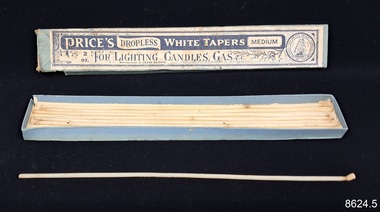
... pioneer in the use of X-rays and in ocular surgery. Flagstaff Hill Maritime Museum and Village Great Ocean Road Shipwreck Coast Wax Tapers Candles Lighting Price's Dropless White Tapers Olympia Wax Tapers gas stoves gas lamps gas fires W.R. Angus Box 1: 'Price's Dropless White Tapers Medium. 2 oz. For Lighting Candles, Gas & C. Manufactured in Great Britain. This label is issued by the Australian Candle Co. 859.' Also on the Price's logo: 'Price's Patent Candle Company Limited. London & Liverpool.' Box 2 ...These wax tapers belonged to Dr.William Roy Angus, Surgeon and Oculist. They were donated to Flagstaff Hill Maritime Village by his daughter, Bernice McDade. They are part of the “W.R. Angus Collection” that includes historical medical equipment, surgical instruments and material once belonging to Dr Edward Ryan and Dr Thomas Francis Ryan, (both of Nhill, Victoria) as well as Dr Angus’ own belongings. The Collection’s history spans the medical practices of the two Doctors Ryan, from 1885-1926 plus that of Dr Angus, up until 1969. ABOUT THE “W.R.ANGUS COLLECTION” Doctor William Roy Angus M.B., B.S., Adel., 1923, F.R.C.S. Edin.,1928 (also known as Dr Roy Angus) was born in Murrumbeena, Victoria in 1901 and lived until 1970. He qualified as a doctor in 1923 at University of Adelaide, was Resident Medical Officer at the Royal Adelaide Hospital in 1924 and for a period was house surgeon to Sir (then Mr.) Henry Simpson Newland. Dr Angus was briefly an Assistant to Dr Riddell of Kapunda, then commenced private practice at Curramulka, Yorke Peninsula, SA, where he was physician, surgeon and chemist. In 1926, he was appointed as new Medical Assistant to Dr Thomas Francis Ryan (T.F. Ryan, or Tom), in Nhill, Victoria, where his experiences included radiology and pharmacy. In 1927 he was Acting House Surgeon in Dr Tom Ryan’s absence. Dr Angus had become engaged to Gladys Forsyth and they decided he would take time to further his studies overseas in the UK in 1927. He studied at London University College Hospital and at Edinburgh Royal Infirmary and in 1928, was awarded FRCS (Fellow from the Royal College of Surgeons), Edinburgh. He worked his passage back to Australia as a Ship’s Surgeon on the on the Australian Commonwealth Line’s T.S.S. Largs Bay. Dr Angus married Gladys in 1929, in Ballarat. (They went on to have one son (Graham 1932, born in SA) and two daughters (Helen (died 12/07/1996) and Berenice (Berry), both born at Mira, Nhill ) Dr Angus was a ‘flying doctor’ for the A.I.M. (Australian Inland Ministry) Aerial Medical Service in 1928 . The organisation began in South Australia through the Presbyterian Church in that year, with its first station being in the remote town of Oodnadatta, where Dr Angus was stationed. He was locum tenens there on North-South Railway at 21 Mile Camp. He took up this ‘flying doctor’ position in response to a call from Dr John Flynn; the organisation was later known as the Flying Doctor Service, then the Royal Flying Doctor Service. A lot of his work during this time involved dental surgery also. Between 1928-1932 he was surgeon at the Curramulka Hospital, Yorke Peninsula, South Australia. In 1933 Dr Angus returned to Nhill where he’d previously worked as Medical Assistant and purchased a share of the Nelson Street practice and Mira hospital from Dr Les Middleton one of the Middleton Brothers, the current owners of what was once Dr Tom Ryan’s practice. Dr L Middleton was House Surgeon to the Nhill Hospital 1926-1933, when he resigned. [Dr Tom Ryan’s practice had originally belonged to his older brother Dr Edward Ryan, who came to Nhill in 1885. Dr Edward saw patients at his rooms, firstly in Victoria Street and in 1886 in Nelson Street, until 1901. The Nelson Street practice also had a 2 bed ward, called Mira Private Hospital ). Dr Edward Ryan was House Surgeon at the Nhill Hospital 1884-1902 . He also had occasions where he successfully performed veterinary surgery for the local farmers too. Dr Tom Ryan then purchased the practice from his brother in 1901. Both Dr Edward and Dr Tom Ryan work as surgeons included eye surgery. Dr Tom Ryan performed many of his operations in the Mira private hospital on his premises. He too was House Surgeon at the Nhill Hospital 1902-1926. Dr Tom Ryan had one of the only two pieces of radiology equipment in Victoria during his practicing years – The Royal Melbourne Hospital had the other one. Over the years Dr Tom Ryan gradually set up what was effectively a training school for country general-practitioner-surgeons. Each patient was carefully examined, including using the X-ray machine, and any surgery was discussed and planned with Dr Ryan’s assistants several days in advance. Dr Angus gained experience in using the X-ray machine there during his time as assistant to Dr Ryan. Dr Tom Ryan moved from Nhill in 1926. He became a Fellow of the Royal Australasian College of Surgeons in 1927, soon after its formation, a rare accolade for a doctor outside any of the major cities. He remained a bachelor and died suddenly on 7th Dec 1955, aged 91, at his home in Ararat. Scholarships and prizes are still awarded to medical students in the honour of Dr T.F. Ryan and his father, Dr Michael Ryan, and brother, John Patrick Ryan. ] When Dr Angus bought into the Nelson Street premises in Nhill he was also appointed as the Nhill Hospital’s Honorary House Surgeon 1933-1938. His practitioner’s plate from his Nhill surgery states “HOURS Daily, except Tuesdays, Fridays and Saturday afternoons, 9-10am, 2-4pm, 7-8pm. Sundays by appointment”. This plate is now mounted on the doorway to the Port Medical Office at Flagstaff Hill Maritime Village, Warrnambool. Dr Edward Ryan and Dr Tom Ryan had an extensive collection of historical medical equipment and materials spanning 1884-1926 and when Dr Angus took up practice in their old premises he obtained this collection, a large part of which is now on display at the Port Medical Office at Flagstaff Hill Maritime Village in Warrnambool. During his time in Nhill Dr Angus was involved in the merging of the Mira Hospital and Nhill Public Hospital into one public hospital and the property titles passed on to Nhill Hospital in 1939. In 1939 Dr Angus and his family moved to Warrnambool where he purchased “Birchwood,” the 1852 home and medical practice of Dr John Hunter Henderson, at 214 Koroit Street. (This property was sold in1965 to the State Government and is now the site of the Warrnambool Police Station. ). The Angus family was able to afford gardeners, cooks and maids; their home was a popular place for visiting dignitaries to stay whilst visiting Warrnambool. Dr Angus had his own silk worm farm at home in a Mulberry tree. His young daughter used his centrifuge for spinning the silk. Dr Angus was appointed on a part-time basis as Port Medical Officer (Health Officer) in Warrnambool and held this position until the 1940’s when the government no longer required the service of a Port Medical Officer in Warrnambool; he was thus Warrnambool’s last serving Port Medical Officer. (The duties of a Port Medical Officer were outlined by the Colonial Secretary on 21st June, 1839 under the terms of the Quarantine Act. Masters of immigrant ships arriving in port reported incidents of diseases, illness and death and the Port Medical Officer made a decision on whether the ship required Quarantine and for how long, in this way preventing contagious illness from spreading from new immigrants to the residents already in the colony.) Dr Angus was a member of the Australian Medical Association, for 35 years and surgeon at the Warrnambool Base Hospital 1939-1942, He served as a Surgeon Captain during WWII1942-45, in Ballarat, Victoria, and in Bonegilla, N.S.W., completing his service just before the end of the war due to suffering from a heart attack. During his convalescence he carved an intricate and ‘most artistic’ chess set from the material that dentures were made from. He then studied ophthalmology at the Royal Melbourne Eye and Ear Hospital and created cosmetically superior artificial eyes by pioneering using the intrascleral cartilage. Angus received accolades from the Ophthalmological Society of Australasia for this work. He returned to Warrnambool to commence practice as an ophthalmologist, pioneering in artificial eye improvements. He was Honorary Consultant Ophthalmologist to Warrnambool Base Hospital for 31 years. He made monthly visits to Portland as a visiting surgeon, to perform eye surgery. He represented the Victorian South-West subdivision of the Australian Medical Association as its secretary between 1949 and 1956 and as chairman from 1956 to 1958. In 1968 Dr Angus was elected member of Spain’s Barraquer Institute of Barcelona after his research work in Intrasclearal cartilage grafting, becoming one of the few Australian ophthalmologists to receive this honour, and in the following year presented his final paper on Living Intrasclearal Cartilage Implants at the Inaugural Meeting of the Australian College of Ophthalmologists in Melbourne In his personal life Dr Angus was a Presbyterian and treated Sunday as a Sabbath, a day of rest. He would visit 3 or 4 country patients on a Sunday, taking his children along ‘for the ride’ and to visit with him. Sunday evenings he would play the pianola and sing Scottish songs to his family. One of Dr Angus’ patients was Margaret MacKenzie, author of a book on local shipwrecks that she’d seen as an eye witness from the late 1880’s in Peterborough, Victoria. In the early 1950’s Dr Angus, painted a picture of a shipwreck for the cover jacket of Margaret’s book, Shipwrecks and More Shipwrecks. She was blind in later life and her daughter wrote the actual book for her. Dr Angus and his wife Gladys were very involved in Warrnambool’s society with a strong interest in civic affairs. Their interests included organisations such as Red Cross, Rostrum, Warrnambool and District Historical Society (founding members), Wine and Food Society, Steering Committee for Tertiary Education in Warrnambool, Local National Trust, Good Neighbour Council, Housing Commission Advisory Board, United Services Institute, Legion of Ex-Servicemen, Olympic Pool Committee, Food for Britain Organisation, Warrnambool Hospital, Anti-Cancer Council, Boys’ Club, Charitable Council, National Fitness Council and Air Raid Precautions Group. He was also a member of the Steam Preservation Society and derived much pleasure from a steam traction engine on his farm. He had an interest in people and the community He and his wife Gladys were both involved in the creation of Flagstaff Hill, including the layout of the gardens. After his death (28th March 1970) his family requested his practitioner’s plate, medical instruments and some personal belongings be displayed in the Port Medical Office surgery at Flagstaff Hill Maritime Village, and be called the “W. R. Angus Collection”.The W.R. Angus Collection is significant for still being located at the site it is connected with, Doctor Angus being the last Port Medical Officer in Warrnambool. The collection of medical instruments and other items and equipment is culturally significant, being an historical example of medicine from late 19th to mid-20th century. Dr Angus assisted Dr Tom Ryan, a pioneer in the use of X-rays and in ocular surgery.Two cardboard boxes of long, white wax tapers that have cotton wicks. Box 1 is blue and Box 2 is red. Both boxes have labels and inscriptions. The object is part of the W.R. Angus Collection. Box 1: 'Price's Dropless White Tapers Medium. 2 oz. For Lighting Candles, Gas & C. Manufactured in Great Britain. This label is issued by the Australian Candle Co. 859.' Also on the Price's logo: 'Price's Patent Candle Company Limited. London & Liverpool.' Box 2: 'Olympia Wax Tapers. Made by Olympia Waxes, Melbourne, Victoria. Two dozen Olympia Wax Tapers.'flagstaff hill maritime museum and village, great ocean road, shipwreck coast, wax tapers, candles, lighting, price's dropless white tapers, olympia wax tapers, gas stoves, gas lamps, gas fires, w.r. angus -
 Flagstaff Hill Maritime Museum and Village
Money Belt, c. 1942
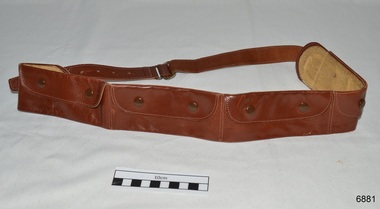
... pioneer in the use of X-rays and in ocular surgery. The collection of Army objects is an example of items issued to Doctors and Surgeons in the Medical Services of the Australian Army in World War 2. flagstaff hill warrnambool shipwrecked coast flagstaff hill maritime museum maritime museum shipwreck coast flagstaff hill maritime village great ocean road dr w r angus dr ryan military money belt surgeon captain royal australian army military service australian army wwii uniform world war 2 Gold embossed “GENUINE CALF” under silver coloured buckle. ...This money belt was issued to Dr W.R. Angus when he served in the Army 1942-1945 as a medical officer at Ballarat, Victoria, and Bonegilla, N.S.W.. (Surgeon Captain A.A.M.C., 108 A.G.H., and 106 A.G.H., Captain A.A.M.C. retired list.) The belt was donated to Flagstaff Hill Maritime Village by the family of Doctor William Roy Angus, Surgeon and Oculist. It is part of the “W.R. Angus Collection” that includes historical medical equipment, surgical instruments and material once belonging to Dr Edward Ryan and Dr Thomas Francis Ryan, (both of Nhill, Victoria) as well as Dr Angus’ own belongings. The Collection’s history spans the medical practices of the two Doctors Ryan, from 1885-1926 plus that of Dr Angus, up until 1969. ABOUT THE “W.R.ANGUS COLLECTION” Doctor William Roy Angus M.B., B.S., Adel., 1923, F.R.C.S. Edin.,1928 (also known as Dr Roy Angus) was born in Murrumbeena, Victoria in 1901 and lived until 1970. He qualified as a doctor in 1923 at University of Adelaide, was Resident Medical Officer at the Royal Adelaide Hospital in 1924 and for a period was house surgeon to Sir (then Mr.) Henry Simpson Newland. Dr Angus was briefly an Assistant to Dr Riddell of Kapunda, then commenced private practice at Curramulka, Yorke Peninsula, SA, where he was physician, surgeon and chemist. In 1926, he was appointed as new Medical Assistant to Dr Thomas Francis Ryan (T.F. Ryan, or Tom), in Nhill, Victoria, where his experiences included radiology and pharmacy. In 1927 he was Acting House Surgeon in Dr Tom Ryan’s absence. Dr Angus had become engaged to Gladys Forsyth and they decided he further his studies overseas in the UK in 1927. He studied at London University College Hospital and at Edinburgh Royal Infirmary and in 1928, was awarded FRCS (Fellow from the Royal College of Surgeons), Edinburgh. He worked his passage back to Australia as a Ship’s Surgeon on the on the Australian Commonwealth Line’s T.S.S. Largs Bay. Dr Angus married Gladys in 1929, in Ballarat. (They went on to have one son (Graham 1932, born in SA) and two daughters (Helen (died 12/07/1996) and Berenice (Berry), both born at Mira, Nhill ) According to Berry, her mother Gladys made a lot of their clothes. She was very talented and did some lovely embroidery including lingerie for her trousseau and beautifully handmade baby clothes. Dr Angus was a ‘flying doctor’ for the A.I.M. (Australian Inland Ministry) Aerial Medical Service in 1928 . Its first station was in the remote town of Oodnadatta, where Dr Angus was stationed. He was locum tenens there on North-South Railway at 21 Mile Camp. He took up this ‘flying doctor’ position in response to a call from Dr John Flynn; the organisation was later known as the Flying Doctor Service, then the Royal Flying Doctor Service. A lot of his work during this time involved dental surgery also. Between 1928-1932 he was surgeon at the Curramulka Hospital, Yorke Peninsula, South Australia. In 1933 Dr Angus returned to Nhill and purchased a share of the Nelson Street practice and Mira hospital (a 2 bed ward at the Nelson Street Practice) from Dr Les Middleton one of the Middleton Brothers, the current owners of what previously once Dr Tom Ryan’s practice. Dr Tom and his brother had worked as surgeons included eye surgery. Dr Tom Ryan performed many of his operations in the Mira private hospital on his premises. He had been House Surgeon at the Nhill Hospital 1902-1926. Dr Tom Ryan had one of the only two pieces of radiology equipment in Victoria during his practicing years – The Royal Melbourne Hospital had the other one. Over the years Dr Tom Ryan had gradually set up what was effectively a training school for country general-practitioner-surgeons. Each patient was carefully examined, including using the X-ray machine, and any surgery was discussed and planned with Dr Ryan’s assistants several days in advance. Dr Angus gained experience in using the X-ray machine there during his time as assistant to Dr Ryan. When Dr Angus bought into the Nelson Street premises in Nhill he was also appointed as the Nhill Hospital’s Honorary House Surgeon 1933-1938. His practitioner’s plate from his Nhill surgery is now mounted on the doorway to the Port Medical Office at Flagstaff Hill Maritime Village, Warrnambool. When Dr Angus took up practice in the Dr Edward and Dr Tom Ryan’s old premises he obtained their extensive collection of historical medical equipment and materials spanning 1884-1926. A large part of this collection is now on display at the Port Medical Office at Flagstaff Hill Maritime Village in Warrnambool. In 1939 Dr Angus and his family moved to Warrnambool where he purchased “Birchwood,” the 1852 home and medical practice of Dr John Hunter Henderson, at 214 Koroit Street. (This property was sold in1965 to the State Government and is now the site of the Warrnambool Police Station. and an ALDI sore is on the land that was once their tennis court). The Angus family was able to afford gardeners, cooks and maids; their home was a popular place for visiting dignitaries to stay whilst visiting Warrnambool. Dr Angus had his own silk worm farm at home in a Mulberry tree. His young daughter used his centrifuge for spinning the silk. Dr Angus was appointed on a part-time basis as Port Medical Officer (Health Officer) in Warrnambool and held this position until the 1940’s when the government no longer required the service of a Port Medical Officer in Warrnambool; he was thus Warrnambool’s last serving Port Medical Officer. (Masters of immigrant ships arriving in port reported incidents of diseases, illness and death and the Port Medical Officer made a decision on whether the ship required Quarantine and for how long, in this way preventing contagious illness from spreading from new immigrants to the residents already in the colony.) Dr Angus was a member of the Australian Medical Association, for 35 years and surgeon at the Warrnambool Base Hospital 1939-1942, He served as a Surgeon Captain during WWII1942-45, in Ballarat, Victoria, and in Bonegilla, N.S.W., completing his service just before the end of the war due to suffering from a heart attack. During his convalescence he carved an intricate and ‘most artistic’ chess set from the material that dentures were made from. He then studied ophthalmology at the Royal Melbourne Eye and Ear Hospital and created cosmetically superior artificial eyes by pioneering using the intrascleral cartilage. Angus received accolades from the Ophthalmological Society of Australasia for this work. He returned to Warrnambool to commence practice as an ophthalmologist, pioneering in artificial eye improvements. He was Honorary Consultant Ophthalmologist to Warrnambool Base Hospital for 31 years. He made monthly visits to Portland as a visiting surgeon, to perform eye surgery. He represented the Victorian South-West subdivision of the Australian Medical Association as its secretary between 1949 and 1956 and as chairman from 1956 to 1958. In 1968 Dr Angus was elected member of Spain’s Barraquer Institute of Barcelona after his research work in Intrasclearal cartilage grafting, becoming one of the few Australian ophthalmologists to receive this honour, and in the following year presented his final paper on Living Intrasclearal Cartilage Implants at the Inaugural Meeting of the Australian College of Ophthalmologists in Melbourne In his personal life Dr Angus was a Presbyterian and treated Sunday as a Sabbath, a day of rest. He would visit 3 or 4 country patients on a Sunday, taking his children along ‘for the ride’ and to visit with him. Sunday evenings he would play the pianola and sing Scottish songs to his family. One of Dr Angus’ patients was Margaret MacKenzie, author of a book on local shipwrecks that she’d seen as an eye witness from the late 1880’s in Peterborough, Victoria. In the early 1950’s Dr Angus, painted a picture of a shipwreck for the cover jacket of Margaret’s book, Shipwrecks and More Shipwrecks. She was blind in later life and her daughter wrote the actual book for her. Dr Angus and his wife Gladys were very involved in Warrnambool’s society with a strong interest in civic affairs. He had an interest in people and the community They were both involved in the creation of Flagstaff Hill, including the layout of the gardens. After his death (28th March 1970) his family requested his practitioner’s plate, medical instruments and some personal belongings be displayed in the Port Medical Office surgery at Flagstaff Hill Maritime Village, and be called the “W. R. Angus Collection”. The W.R. Angus Collection is significant for still being located at the site it is connected with, Doctor Angus being the last Port Medical Officer in Warrnambool. The collection of medical instruments and other equipment is culturally significant, being an historical example of medicine from late 19th to mid-20th century. Dr Angus assisted Dr Tom Ryan, a pioneer in the use of X-rays and in ocular surgery. The collection of Army objects is an example of items issued to Doctors and Surgeons in the Medical Services of the Australian Army in World War 2. Brown leather money belt, genuine calf, lined, 4 pouches with stud closure flaps included. Issued to W.R. Angus in WWII and part of the W.R. Angus Collection. Gold embossed label. Hand written inscription with name and serial number. Gold embossed “GENUINE CALF” under silver coloured buckle. Hand written inside of belt “W.R. ANGUS / 61-3 9803 5228”flagstaff hill, warrnambool, shipwrecked coast, flagstaff hill maritime museum, maritime museum, shipwreck coast, flagstaff hill maritime village, great ocean road, dr w r angus, dr ryan, military money belt, surgeon captain, royal australian army, military service australian army, wwii uniform, world war 2 -
 City of Moorabbin Historical Society (Operating the Box Cottage Museum)
Clothing - Clothing, boy's first underpants, 1907
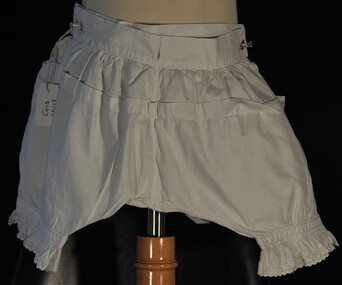
... 2 years old. The Maggs family were early settlers in the Moorabbin Shire The pioneer settlers and market gardeners of Moorabbin Shire had to be self reliant and made their own clothing and utensils. This is one of many items that exhibit the skill and craftsmanship of the women in these families. clothing brighton moorabbin pioneers dendy henry dressmakers market gardners early settlers maggs geoff White, cotton underwear for a 2 year old boy. ...These white cotton underpants were made for Mr Geoff Maggs by his mother in 1907 as his first underwear at age 2 years old. The Maggs family were early settlers in the Moorabbin ShireThe pioneer settlers and market gardeners of Moorabbin Shire had to be self reliant and made their own clothing and utensils. This is one of many items that exhibit the skill and craftsmanship of the women in these families. White, cotton underwear for a 2 year old boy. Made at home on a sewing machine with hand feather stitching and factory-made guipure lace on leg-bands. Buttons at waist, and a tuck pleat to let down as child grows.clothing, brighton, moorabbin, pioneers, dendy henry, dressmakers, market gardners, early settlers, maggs geoff -
 City of Moorabbin Historical Society (Operating the Box Cottage Museum)
Functional object - Education, 3 ink wells, c1800 -1900
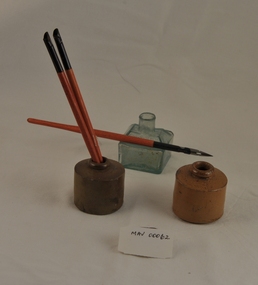
... Cursory grinding smoothed out the sharpness of the rim. b) 2 cylindrical, plain, pottery inkwells These three inkwells were commonly used in homes, schools and Churches by pioneer settlers in Moorabbin Shire c1880 -1900 education inkwells pottery glasswork craftwork moorabbin brighton early settlers pioneers 2 cylindrical pottery inkwells and 1 square, clear glass inkwell with a distinctive groove on 2 sides to rest a pen c 1800 - 1900 Functional object Education, 3 ink wells Unrecorded ...a) 1 common, clear glass ink bottle with 'burst-off' straight finished neck and a groove on two sides upon which a pen would rest. There are variations of this largely English-made style glass inkwell made in cup base moulds. Cursory grinding smoothed out the sharpness of the rim. b) 2 cylindrical, plain, pottery inkwells These three inkwells were commonly used in homes, schools and Churches by pioneer settlers in Moorabbin Shire c1880 -1900 2 cylindrical pottery inkwells and 1 square, clear glass inkwell with a distinctive groove on 2 sides to rest a pen c 1800 - 1900education, inkwells, pottery, glasswork, craftwork, moorabbin, brighton, early settlers, pioneers -
 City of Moorabbin Historical Society (Operating the Box Cottage Museum)
Domestic object - Kitchen Equipment, 'Smoothwell' electric flat iron c1935, c1935
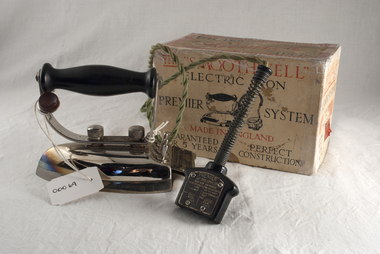
... pioneers early settlers moorabbin bentleigh cheltenham laundry sewing craftwork table ware irons On plate of handle attached to Iron ' HARRODS Ltd. / LONDON On attached plate at rear of iron ' The "SMOOTHWELL" / "Premier System" /......... Plate on cord Plug " PREMIER/ FLAT IRON CONNECTOR/ THIS SIDE OUTWARDS/ (2 columns) 1) FOR 100-125 VOLTS/ USE THREE TERMINALS/ THUS ..... 2 ...c1881 Henry W Seely, of New Jersey, USA, designed and patented an electric sad iron for pressing and smoothing material. He continued to modify and improve his designs, with his partner Richard Dyer, and other electrical appliance firms, e.g Hotpoint, began producing these flat irons that could provide continuous heat by connecting via an electrical flex to a light socket and hence without the need for hot fires, ash, or burning hot handles. Women with access to an electricity supply were delighted and their ironing chore became much less arduous No heat was felt at all from the iron as it is all concentrated on the bottom surface. By the early 20th century enthusiasm was building for the new electric smoothing irons: clean, powerful, adjustable, and labour-saving. This c1935 Premier System 'Smoothwell' flat iron was used by a resident of City of Moorabbin and is an example of the progress made from the sad irons used by the pioneers that are displayed beside it.A "Premier Smoothwell" electric flat iron with switched control lead and original box, c 1935 On plate of handle attached to Iron ' HARRODS Ltd. / LONDON On attached plate at rear of iron ' The "SMOOTHWELL" / "Premier System" /......... Plate on cord Plug " PREMIER/ FLAT IRON CONNECTOR/ THIS SIDE OUTWARDS/ (2 columns) 1) FOR 100-125 VOLTS/ USE THREE TERMINALS/ THUS ..... 2) FOR 200 - 240 VOLTS/ USE TWO RIGHT/ HAND TERMINALS/ ONLY/ THUS......seely henry w., sad irons, electric flat irons, dyer richard, edison thomas, hotpoint pty ltd., premier electric company birmingham england, pioneers, early settlers, moorabbin, bentleigh, cheltenham, laundry, sewing, craftwork, table ware, irons -
 City of Moorabbin Historical Society (Operating the Box Cottage Museum)
Domestic object - Kitchen Equipment, crockery 'Real Old Willow', Early 20th Century
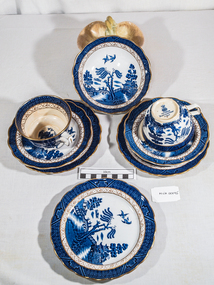
... ornaments earthenware booths pty ltd tunstall england early settlers pioneers moorabbin bentleigh cheltenham ormond market gardeners Pattern Number 8025. Small Willow Pattern cameo at the base inside each cup. Earthenware, 2 teacups, 2 ...Earthenware, 2 teacups, 2 saucers, 2 side plates and 1 cereal bowl with side plate in 'Real Old Willow' pattern. Traditional dark blue Willow Pattern, with hand-painted gold rims. Small Willow Pattern cameo at the base inside each cup.Pattern Number 8025. Small Willow Pattern cameo at the base inside each cup.ornaments, earthenware, booths pty ltd, tunstall, england, early settlers, pioneers, moorabbin, bentleigh, cheltenham, ormond, market gardeners -
 City of Moorabbin Historical Society (Operating the Box Cottage Museum)
Manufactured Glass, milk bottles 600ml, c1970
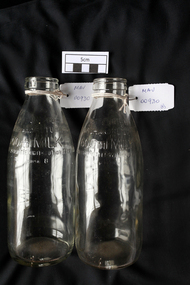
... 2% of milk was still being sold in glass bottles. Glass milk bottles are now rare. Metric measures were introduced throughout Australia with Decimalisation 14/2/1966. melbourne glass bottle works spotswood melbourne milk dairy dairy produce dairy farmers market gardeners pioneers early settlers moorabbin cheltenham pasteur louis pasteurization PASTEURISED / 600 ML MILK 3 x clear glass milk bottles c 1970 600ml ( 2 shown in photograph) Manufactured Glass, milk bottles 600ml Melbourne Glass Bottle Works ...There are two distinct types of milk consumption: a natural source of nutrition for all infant mammals and a food product for humans of all ages that is derived from other animals. Milk is a key contributor to improving nutrition and food security particularly in developing countries. Improvements in livestock and dairy technology offer significant promise in reducing poverty and malnutrition in the world. Pasteurization is used to kill harmful micro-organisms by heating the milk for a short time and then immediately cooling it. In the past, milk was always packaged in glass milk bottles The first glass bottle packaging for milk was used in the 1870s. The first company to do so may have been the New York Dairy Company in 1877 with a small glass lid and a tin clip. Lewis P. Whiteman holds the first patent for a glass milk bottle c1884,which was sealed with a waxed paper disk. The Express Dairy Company in England began glass bottle production in 1880. Melbourne Glass Bottle Works Spotswood 1880 - 1990. Milk cartons first came to Australia in 1958, when the Model Dairy in Melbourne began packaging milk in 150 ml and 500 ml cartons. At the time, 160,000 new glass bottles were needed in Melbourne alone every week to keep up the delivery of 1.3 million bottles of milk a day c1970, the blow-moulded disposable plastic milk bottle was introduced. In 1987, only about 2% of milk was still being sold in glass bottles. Glass milk bottles are now rare. Metric measures were introduced throughout Australia with Decimalisation 14/2/1966.3 x clear glass milk bottles c 1970 600ml ( 2 shown in photograph)PASTEURISED / 600 ML MILKmelbourne glass bottle works, spotswood melbourne, milk, dairy, dairy produce, dairy farmers, market gardeners, pioneers, early settlers, moorabbin, cheltenham, pasteur louis, pasteurization -
 City of Moorabbin Historical Society (Operating the Box Cottage Museum)
Photograph, colour 'Reconstruction Site' Feb. 1984, February 1st 1984
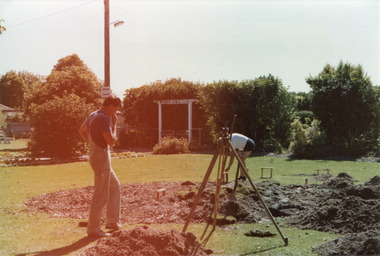
... The Business card of the Builders is now 30years old brighton, moorabbin, cottages, pioneers, ormond, colonial, mckinnon, dendy henry, box william, box elizabeth, reitman william, convicts lewis timber co. ltd., deam h, museums, box alonzo Photographs Back : a) 1-2-84 / Box Cottage / Mr Moody & Mr Smith ; b) 1st Day 1st Feb 1984 / Box Cottage Card Front : Centre ; Moody & Smith / BUILDERS / Left ; 8 Worthing Rd / HIGHETT 3190 / MELBOURNE / TEL 95-1463 / BUS. & PRIVATE Right ; 7 North Ct. / HIGHETT 3190 / MELBOURNE / TEL 95-5310 / BUS. & PRIVATE 2 x colour photographs of work beginning on the reconstruction of Box Cottage in Joyce Park February 1984 and 1 business card of the Builders, Moody & Smith Photograph, colour 'Reconstruction Site' Feb. 1984 Mrs H Deam & Mr A Smith ...The original small, pioneer cottage was built in the late 1840s to early1850s, by an unknown pioneer. It was located on part of a 30 Acre allotment that was originally part of Dendy’s Special Survey granted in 1841. The doors and window sashes, (made of red deal joinery timber), as well as the brass locks and fittings, are from the original cottage, and were imported from England. The fire-place bricks are from the original cottage, and are sun-dried, (not kiln fired), and are hand-made. Convict marks can be seen on two bricks. There is a small display of external cladding shingles from the original pioneer cottage. These shingles were hand-split, and most likely made from locally collected timber The nails included in this display were used to fasten the shingles on the original cottage, and are also hand-made. The cottage was occupied by William Box and family from 1865 until 1914 when it was sold to William Reitman who resided there until 1950. The enamel nameplate, “Colonial”, on the wall of the cottage, was the name chosen for the original pioneer cottage by Mr William Reitman, when he purchased the property in around 1915, for 1200 Pounds approximately. In 1974 Mr Lewis, a timber specialist, found the dilapidated building on property he had recently purchased in Jasper Rd and suggested it be reconstructed and relocated. Moorabbin Council agreed and the cottage was rebuilt just about 250 metres from its original site. The cost of the rebuild was met by 'Victoria's 150th Committee, plus a small grant from the City of Moorabbin, and Mr Laurie Lewis donated much of the timber for the reconstruction. The re-constructed cottage plan has followed faithfully the original dimensions, and plan of the original pioneer cottage, and as many original items from that cottage’s long occupation have been incorporated. The photographs in Album 1 record the progress of the reconstruction from February 1984 to the First Public Open Day November 18th 1984These 2 photographs show the Builders Mr Moody & Mr Smith preparing the site in Joyce Park at the commencement of the 'Reconstruction in February 1984. Mrs H. Deam and Mr A. Smith, CMHS members, took these photographs to record the progress of the 'Reconstruction' from February 1984 to November 1984. Although 'Box Cottage' is a re-construction, it is an unique museum that, being located in the midst of a modern community in Ormond Victoria, can educate and demonstrate many aspects of the early settler’s way of life in Victoria. As such, it is an invaluable resource for students and all kinds of visitors. The Business card of the Builders is now 30years old2 x colour photographs of work beginning on the reconstruction of Box Cottage in Joyce Park February 1984 and 1 business card of the Builders, Moody & SmithPhotographs Back : a) 1-2-84 / Box Cottage / Mr Moody & Mr Smith ; b) 1st Day 1st Feb 1984 / Box Cottage Card Front : Centre ; Moody & Smith / BUILDERS / Left ; 8 Worthing Rd / HIGHETT 3190 / MELBOURNE / TEL 95-1463 / BUS. & PRIVATE Right ; 7 North Ct. / HIGHETT 3190 / MELBOURNE / TEL 95-5310 / BUS. & PRIVATEbrighton, moorabbin, cottages, pioneers, ormond, colonial, mckinnon, dendy henry, box william, box elizabeth, reitman william, convicts lewis timber co. ltd., deam h, museums, box alonzo -
 City of Moorabbin Historical Society (Operating the Box Cottage Museum)
Photographs, 2 x B&W, possibly Anna Box 1849 - 1919, c1880
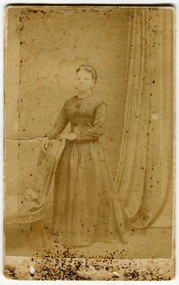
... Anna Box –Pay was the 3rd daughter of George and Mary Box. box anna, pay henry, pay norman, box william, box elizabeth avis, box george, box mary, moorabbin, bentleigh, brighton, ormond, market gardeners, pioneers, early settlers, withyham sussex england, ringwood melbourne, pay beatrice, pay laura, st kilda, melbourne A unreadable B Ferry 49 Elizabeth St . Melbourne 2 black and white photographs that Avis Box Leigh thinks may be Anna Box c1880 Photographs, 2 x B&W, possibly Anna Box 1849 - 1919 Ferry Pty Ltd ...Anna Box 1849- 1919 was born in Withyham, Sussex England had her 7th birthday en route from Liverpool to Australia. George Box 1808-1867 of Sussex England, married Mary Cripps in 1831 and with 3 three of their 4 four sons and 3 three of their 4 four daughters left Liverpool in the Sailing Ship 'Atlanta' in March 1856 to begin a new life in Melbourne, Victoria , Australia. Their baby daughter Cecilia Lydia died a few days later. Caroline Box, the eldest daughter, remained in England working as a cook until she joined the family in Australia in 1863. William Box 1834-1902, the eldest son of George Box, married Elizabeth Avis 1833- 1914 and they resided in Box Cottage 1865 -1914 where they established a market garden and raised 13 children. William and Elizabeth had emigrated in 1854 so George worked on their market garden before setting up in Patterson Road. Sadly Mary drowned in a water hole only 4 months after their arrival in Brighton. It is supposed that Elizabeth helped George raise the children while he established his market garden. George died from Tetanus following an infected broken leg caused by falling from his dray in 1867. Anna was a dressmaker and in 1881 she married Henry Pay , a painter, from London and they had 3 children . In 1907 the family lived on a 30acre property in Ringwood. which Anna bequeathed to her children. – Beatrice, Norman and Laura. In 1911 they moved to Surrey Hills where Anna died in 1919. Henry died in 1935 in Montrose where he was living with his son Norman Henry Pay, a farmer . Box Cottage Museum, a reconstruction of an early settler hut, is named after the Box family who resided there 1865 -1913 . William Box who, with his wife Elizabeth Avis Box and 13 children, lived and farmed on the block of land in Jasper Road, East Brighton ( now McKinnon / Ormond) that was part of the Henry Dendy Special Survey 1841. George Box 1808-1867 migrated in 1856 and worked with his son William Box until he established a market garden in Patterson Rd . East Brighton ( now Bentleigh). Anna Box –Pay was the 3rd daughter of George and Mary Box. 2 black and white photographs that Avis Box Leigh thinks may be Anna Box c1880A unreadable B Ferry 49 Elizabeth St . Melbournebox anna, pay henry, pay norman, box william, box elizabeth avis, box george, box mary, moorabbin, bentleigh, brighton, ormond, market gardeners, pioneers, early settlers, withyham sussex england, ringwood melbourne, pay beatrice, pay laura, st kilda, melbourne -
 City of Moorabbin Historical Society (Operating the Box Cottage Museum)
Clothing - Clothing, menswear 12 x stiffly stached collars in box, 20thC
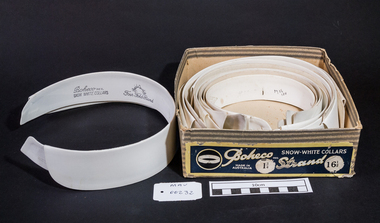
... pioneers Base of Box : Boheco REG. SNOW-WHITE COLLARS / 1 3/4 / Strand / 16 1/2 / MADE IN / AUSTRALIA ( there is no lid ) under box in pencil ; 16 1/2 x 1 3/4 / 1/- each / c/o = Doz. 1 / 3 each 12 detachable, stiffly starched, white collars, from various manufacturers, for a man's shirt. ...In the 19thC and early 20thC men often wore their shirts for a week or more. However the collars were detachable so that they could be changed when they became dirty or for special occasions eg Church on Sundays Collar studs were used to attach the collar to the shirt. The cardboard box was used for storage and when travelling. The collars were very stiffly starched so as to maintain their shape. Some have Laundry instructions printed on the inside of the collar.The Maggs family were pioneer settlers in Moorabbin Shire.12 detachable, stiffly starched, white collars, from various manufacturers, for a man's shirt. Each Collar has 3 buttonholes for attaching to the shirt - 2 at the neck and 1 centre back. They have been stored in a cardboard box marked 'Boheco regd. ' The box has no lid.Base of Box : Boheco REG. SNOW-WHITE COLLARS / 1 3/4 / Strand / 16 1/2 / MADE IN / AUSTRALIA ( there is no lid ) under box in pencil ; 16 1/2 x 1 3/4 / 1/- each / c/o = Doz. 1 / 3 eachmenswear, clothing, shirts, collars, early settlers, fashion, cheltenham, moorabbin, dairy farmers, market gardeners, maggs family, pioneers -
 City of Moorabbin Historical Society (Operating the Box Cottage Museum)
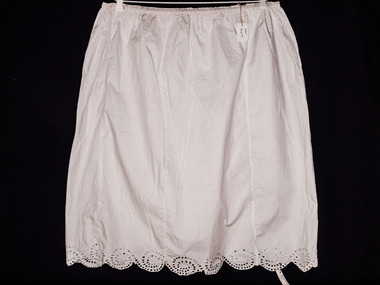
Clothing - Clothing, lady's 1/2 slip cotton cutwork, c1900
... This lady’s hand sewn cotton 1/2 petticoat with cut work is an example of the dressmaking and needlework skills of the women of the early settlers families in Moorabbin Shire in the early 20th C Early settlers and market gardeners established their families in Moorabbin Shire c1900 and this item shows the skill and craftsmanship of the women of these families clothing haberdashery crochet doilies brighton moorabbin pioneers dressmaking market gardeners early settlers craftwork bentleigh lacework moorabbin shire marshall d dairy farms fruit orchards Lady's white cotton 1/2 slip with cutwork front, hand sewn scalloped hem. Clothing Clothing, lady's 1/2 ...This lady’s hand sewn cotton 1/2 petticoat with cut work is an example of the dressmaking and needlework skills of the women of the early settlers families in Moorabbin Shire in the early 20th C Early settlers and market gardeners established their families in Moorabbin Shire c1900 and this item shows the skill and craftsmanship of the women of these families Lady's white cotton 1/2 slip with cutwork front, hand sewn scalloped hem.clothing, haberdashery, crochet, doilies, brighton, moorabbin, pioneers, dressmaking, market gardeners, early settlers, craftwork, bentleigh, lacework, moorabbin shire, marshall d, dairy farms, fruit orchards -
 City of Moorabbin Historical Society (Operating the Box Cottage Museum)
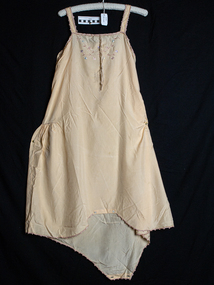
Clothing - Clothing, lady's cream cotton 1/2 petticoat 'teddy', button crotch, c1900
... This lady’s cream fine cotton combination 'teddy' is an example of the dressmaking , lacework and needlework skills of the women of the early settlers families in Moorabbin Shire in the early 20th C Early settlers and market gardeners established their families in Moorabbin Shire c1900 and this item shows the skill and craftsmanship of the women of these families clothing haberdashery crochet doilies brighton moorabbin pioneers dressmaking market gardeners early settlers craftwork bentleigh lacework moorabbin shire hunt ailsa dairy farms fruit orchards Lady's hand sewn fine cream cotton , 'teddy', a combination petticoat with a crotch that fastens with 2 mother of pearl buttons Shoulder straps and neckline are edged with crochet and the yoke has coloured needlework. Hand sewn gathering at hip line of side seams Clothing Clothing, lady's cream cotton 1/2 ...This lady’s cream fine cotton combination 'teddy' is an example of the dressmaking , lacework and needlework skills of the women of the early settlers families in Moorabbin Shire in the early 20th C Early settlers and market gardeners established their families in Moorabbin Shire c1900 and this item shows the skill and craftsmanship of the women of these families Lady's hand sewn fine cream cotton , 'teddy', a combination petticoat with a crotch that fastens with 2 mother of pearl buttons Shoulder straps and neckline are edged with crochet and the yoke has coloured needlework. Hand sewn gathering at hip line of side seams clothing, haberdashery, crochet, doilies, brighton, moorabbin, pioneers, dressmaking, market gardeners, early settlers, craftwork, bentleigh, lacework, moorabbin shire, hunt ailsa, dairy farms, fruit orchards -
 City of Moorabbin Historical Society (Operating the Box Cottage Museum)
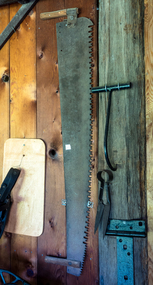
Tools, large Saw, 2 man, c1900
... This is a typical two-man tree felling saw that was necessary to clear the land when the pioneers were establishing their market gardens and farms in Parish of Moorabbin c1850 tools, saws, axes, early settlers, pioneers, market gardeners, dairy farms, orchards, vineyards, timber mills, bullock wagons, tree felling, timber mills, city of moorabbin, county of bourke, moorabbin roads board, parish of moorabbin, shire of moorabbin, henry dendy's special survey 1841, were j.b.; bent thomas, o'shannassy john, king richard, charman stephen, highett william, ormond francis, maynard dennis, A long steel blade saw with 2 wood handles c1900 Tools, large Saw, 2 man ...Early settlers had to clear the land of trees and shrubs to establish and maintain their farms and market gardens. Some settlers worked in the Gippsland region felling timber for transport by bullock wagons to Melbourne. Two-man crosscut saws were primarily important when human power was used. Such a saw would typically be 1 to 4 m (4 to 12 feet) long, and sometimes up to 5 m (16 feet), with a handle at each end. The technique in using a two-man saw involved a sawyer standing at each end and together the sawyers would alternate pulling the saw through the wood. If the kerf -slit- began closing, causing the saw to bind, wedges would be inserted behind the saw blade in order to keep the kerf open.Two-man saws were designed to cut in both directions. Careful tooth design was necessary to clear the sawdust during the cut. This is a typical two-man tree felling saw that was necessary to clear the land when the pioneers were establishing their market gardens and farms in Parish of Moorabbin c1850A long steel blade saw with 2 wood handles c1900tools, saws, axes, early settlers, pioneers, market gardeners, dairy farms, orchards, vineyards, timber mills, bullock wagons, tree felling, timber mills, city of moorabbin, county of bourke, moorabbin roads board, parish of moorabbin, shire of moorabbin, henry dendy's special survey 1841, were j.b.; bent thomas, o'shannassy john, king richard, charman stephen, highett william, ormond francis, maynard dennis, -
 City of Moorabbin Historical Society (Operating the Box Cottage Museum)
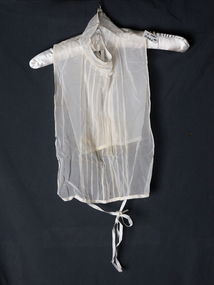
Clothing, Lady's white voile shirt fronts with high collars and ribbon ties x 2 c1900, c1900
... These Lady's voile shirt fronts are examples of the high dressmaking skill of the women of the early settler families in Moorabbin Shire c1900 clothing, dressmaking, haberdashery, crochet, brighton, moorabbin, mckinnon, ormond, pioneers, market gardeners, early settlers, craftwork , bentleigh, lacework, moorabbin shire, hunt ailsa, dairy farms, fruit orchards 2 identical small lady's white voile shirt fronts, with high collar and ribbon waist ties. The front has fine vertical pintucks and the high collar has horizontal pintucks with 4 metal wire stays. Press studs fasten the back seam . Clothing, Lady's white voile shirt fronts with high collars and ribbon ties x 2 ...These Lady's white voile shirt fronts were made for a small woman or child to wear under a suit jacket . The front has fine vertical pintucks and ribbon waist ties The back seam is fastened with press studs. The high collar has horizontal pintucks and 4 metal wire stays. The early settler women were skilled dressmakers and craft workers. These Lady's voile shirt fronts are examples of the high dressmaking skill of the women of the early settler families in Moorabbin Shire c1900 2 identical small lady's white voile shirt fronts, with high collar and ribbon waist ties. The front has fine vertical pintucks and the high collar has horizontal pintucks with 4 metal wire stays. Press studs fasten the back seam . clothing, dressmaking, haberdashery, crochet, brighton, moorabbin, mckinnon, ormond, pioneers, market gardeners, early settlers, craftwork , bentleigh, lacework, moorabbin shire, hunt ailsa, dairy farms, fruit orchards -
 City of Moorabbin Historical Society (Operating the Box Cottage Museum)
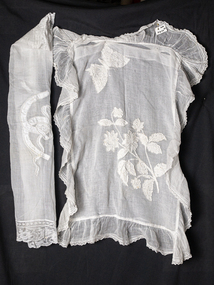
Haberdashery, pillow shams white voile,lace,needlework x 2 c1900, c1900
... 2 pillow shams in white voile,lace and with needlework were made by a woman of an early settler family in Moorabbin Shire c1900. Women made and mended clothes, haberdashery and drapery for their families as the market gardens and farms were established in Moorabbin, East Brighton, Cheltenham. These 2 pillow shams in white voile, lace and with needlework are examples of the dressmaking and needlework skills of the women of the early settler families in Moorabbin Shire c1900 clothing, brighton, moorabbin, pioneers, dressmaking, market gardeners, early settlers, craftwork , bentleigh, lacework, moorabbin shire, dairy farms, fruit orchards 2 Haberdashery, pillow shams in white voile,with lace edging , a) Is an envelope type with bone buttons and has a central needlework floral and butterfly design . b) is single layer with a central needlework ribbon design c1900 Haberdashery, pillow shams white voile,lace,needlework x 2 c1900 Family of Miss Risstrom ...These 2 pillow shams in white voile,lace and with needlework were made by a woman of an early settler family in Moorabbin Shire c1900. Women made and mended clothes, haberdashery and drapery for their families as the market gardens and farms were established in Moorabbin, East Brighton, Cheltenham.These 2 pillow shams in white voile, lace and with needlework are examples of the dressmaking and needlework skills of the women of the early settler families in Moorabbin Shire c1900 2 Haberdashery, pillow shams in white voile,with lace edging , a) Is an envelope type with bone buttons and has a central needlework floral and butterfly design . b) is single layer with a central needlework ribbon design c1900clothing, brighton, moorabbin, pioneers, dressmaking, market gardeners, early settlers, craftwork , bentleigh, lacework, moorabbin shire, dairy farms, fruit orchards
