
Showing 55 items matching "2/29 battalion"
-
 Bendigo Military Museum
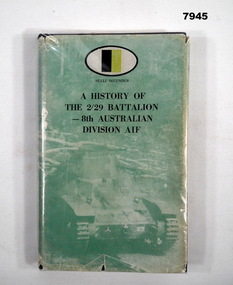
Book - BATTALION HISTORY WW2, 2/29 Battalion AIF Association/1983", "A HISTORY OF THE 2/29 BATTALION - 8th AUSTRALIAN DIVISION AIF", 1983 First Edition
... "A HISTORY OF THE 2/29 BATTALION - 8th AUSTRALIAN DIVISION AIF".......2/29 Battalion...2/29 Battalion AIF Association/1983"....Plublications Book 2/29 Battalion WW2 Arthur E Tranter Page 186 - note on paper, blue ink pen. ...Refer Cat No. 7944. Item in the collection of "Arthur E. Tranter". V50166 - VX52843 2/29th Bn. P.O.W.Hard cover book with dust cover. First Edition Book. Hard cover - cardboard, black colour buckram adhered cover. Dust cover - paper, with black print on front and spine. Cover ilustration - muted green colour tones of a tank and roadblock - "Muar Road Battle". Plastic cover - clear soft plastic - protective cover with adhesive tape. 224 pages, cut, plain white paper. Illustrated with black and white photographs and maps. A number of pages have handwritten notes in grey lead pencil and blue ink pen. P.186 has an added note on paper. Handwritten owner's name front end paper. Page 186 - note on paper, blue ink pen. "P.186/ This section by R.F. Nelson/ describes my experience/ fairly well./ I was with him throughout the whole/ term of imprisonment". Front end paper - handwritten owner's name - blue ink pen "Arthur E. Tranter/ 24-4-83".plublications, book, 2/29 battalion, ww2, arthur e tranter -
 Bendigo Military Museum
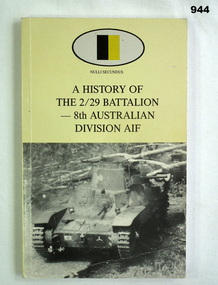
Book, 2/29 Battalion AIF Association, A History of the 2/29th Battalion - 8th Australian 8th Division, AIF, 1991
... Black & white photograph of military tank & 2/29 Battalion colour patch on front cover with light yellow colour background. 224 cut plain pages, illustrated black & white photographs. ...2/29 Battalion AIF Association...A History of the 2/29th Battalion - 8th Australian 8th Division, AIF Book BOOK 2/29 Battalion AIF Association High Country Publishing Enterprise Press Pty Ltd ...Book, soft cover, black print on front, back & spine. Black & white photograph of military tank & 2/29 Battalion colour patch on front cover with light yellow colour background. 224 cut plain pages, illustrated black & white photographs. Handwritten in black in on title page: To Bill Toan Thanks for getting me (nice and pissed in Singapore) Feb 1992 My son Peter joins me in sending best wishes Kind regards Clem Sheppard. Donated by Bgo Y Mens Club In black ink on front page: RSL Stampbooks, military history -
 Monbulk RSL Sub Branch
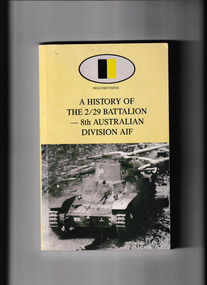
Book, Robert Christie, A history of the 2/29 Battalion - 8th Australian Division AIF, 1985
... A history of the 2/29 Battalion - 8th Australian Division AIF...battalion spent 3 1/2 years as P.O.W.'s of the Japanese and a long period of this working on the infamous Burma-Thailand railway where 260 lost their lives Ill, p.224. A history of the 2/29 ...The unit originally left Australia as a completely Victorian unit but returned with representatives from all Sates in the Commonwealth. The 2/29th Battalion was the fist Victorian unit into action in the Malauan campaign and has the distinction of two set of battle honours, one for the bloody Muar Road battle where the battlion initially and later in association with the 2/19th Battalion held the crack Japanese 5th Division, the Imperial Guards for six days to enable the whole British force to be withdrawn behind Yong Peng, and the second for their part in the battle for Singapore Island. It was during the intial battle with the Japanese Imperial Guards on Sunday, January 18, 1942 that the Battalion with the supporting anti-tank guns of the 2/4th Anti Tank Regiment accounted for 8 Japanese tanks in one morning. Two commanding officers were killed during the Muar Road battle and total casualties for the week were 13 officers and 296 O/R/'s. It was when Lt.-Col. S. A. F. Pond, who took command, set about re-forming the Battalion after Muar that reinforcements from all States joined the unit. The battalion spent 3 1/2 years as P.O.W.'s of the Japanese and a long period of this working on the infamous Burma-Thailand railway where 260 lost their livesIll, p.224.non-fictionThe unit originally left Australia as a completely Victorian unit but returned with representatives from all Sates in the Commonwealth. The 2/29th Battalion was the fist Victorian unit into action in the Malauan campaign and has the distinction of two set of battle honours, one for the bloody Muar Road battle where the battlion initially and later in association with the 2/19th Battalion held the crack Japanese 5th Division, the Imperial Guards for six days to enable the whole British force to be withdrawn behind Yong Peng, and the second for their part in the battle for Singapore Island. It was during the intial battle with the Japanese Imperial Guards on Sunday, January 18, 1942 that the Battalion with the supporting anti-tank guns of the 2/4th Anti Tank Regiment accounted for 8 Japanese tanks in one morning. Two commanding officers were killed during the Muar Road battle and total casualties for the week were 13 officers and 296 O/R/'s. It was when Lt.-Col. S. A. F. Pond, who took command, set about re-forming the Battalion after Muar that reinforcements from all States joined the unit. The battalion spent 3 1/2 years as P.O.W.'s of the Japanese and a long period of this working on the infamous Burma-Thailand railway where 260 lost their livesworld war 1939 – 1945 – campaigns – malaya, australian army - 8th division -
 Merbein District Historical Society
Document, 2/29 Battalion Auxiliary Letter, 5 Dec.1945
... 2/29 Battalion Auxiliary Letter...Roy Leslie Mercer 2/29 Battalion Auxiliary Letter Document ...roy leslie mercer -
Eltham District Historical Society Inc
Document - Folder, Nankervis, Frank
... ...2/29 Battalion Association...Frank Nankervis Heath Brown Simpson Barracks Watsonia Arthurs Creek Rural Fire Brigade Hurstbridge High School Hurstbridge Sewerage Trust Hurstbridge Waterworks Trust Jack Lawson Burma Railway 2/29 Battalion Association John Stamp Bill Penrose Hurstbridge Community Centre Ex-PoW Association of Australia F Force Burma Railway Rotary Greensborough Pension Advisory Panel for Ex-Servicement with Pension Problems Kpucie Nankervis Kate Saunders Newspaper clippings, A4 photocopies, etc Nankervis, Frank Document Folder ...Frank Nankervis was an Eltham Shire president and councillor, and involved in many community organisations. He had been a prisoner of war in Changi and on the Burma railway, later working in the Ex-PoW Association of Australia. Contents Newspaper article: "War and civic hero dies", Diamond Valley Leader, 23 April 2008. Obituary of Frank Nankervis. Newspaper article: "He inspired many in Arthurs Creek", Diamond Valley Leader, 7 May 2008. Obituary of Frank Nankervis.Newspaper clippings, A4 photocopies, etcfrank nankervis, heath brown, simpson barracks watsonia, arthurs creek rural fire brigade, hurstbridge high school, hurstbridge sewerage trust, hurstbridge waterworks trust, jack lawson, burma railway, 2/29 battalion association, john stamp, bill penrose, hurstbridge community centre, ex-pow association of australia, f force burma railway, rotary greensborough, pension advisory panel for ex-servicement with pension problems, kpucie nankervis, kate saunders -
 Bendigo Military Museum
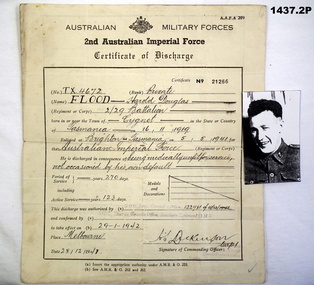
Administrative record - CERTIFICATE OF DISCHARGE WW2, 28.12.1941
... .1) Discharge Certificate No 21266 re TX4672 Pte Flood, Harold Douglas 2/29 Battalion, POB Cygnet Tasmania .2) Poor quality photo of Pte Flood....documents discharge certificate Photos Flood .1) Discharge Certificate No 21266 re TX4672 Pte Flood, Harold Douglas 2/29 Battalion, POB Cygnet Tasmania .2) Poor quality photo of Pte Flood. ....1) Discharge Certificate No 21266 re TX4672 Pte Flood, Harold Douglas 2/29 Battalion, POB Cygnet Tasmania .2) Poor quality photo of Pte Flood.documents, discharge certificate, photos, flood -
 Bendigo Military Museum
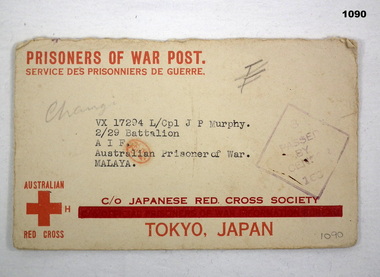
Accessory - ENVELOPE JAPANESE, 1942-45
... Typed “VX17294 L/Cpl J P Murphy 2/29 Battalion AIF Australian Prisoner of War Malaya”. ...Envelopes japanese POW Murphy Typed “VX17294 L/Cpl J P Murphy 2/29 Battalion AIF Australian Prisoner of War Malaya”. ...John Phillip MURPHY No VX17294 enlisted in the 2nd AIF on 15.5.1940 age 30 years 5 months. Posted to the 2/29th Bn 29.11.1940, embarked for Singapore 30.7.1941 disembarking 15.8.1941. Promoted to L/Cpl 2.1.1942, listed as missing 16.2.1942 then POW. A telegram in his records dated 4.8.1945 to his wife Mrs A Murphy of Kirkwood St Eaglehawk states “Alive at Changi Camp”. He disembarked Australia on 8.10.1945 and discharged from the Army on 6.12.1945. Refer also Cat No 1110.Envelope, “Prisoner of War Post” yellowed, red print, stamped “Passed by Censor” re J.P.Murphy.Typed “VX17294 L/Cpl J P Murphy 2/29 Battalion AIF Australian Prisoner of War Malaya”. In pencil “Changi”.envelopes japanese, pow, murphy -
 Geelong RSL Sub Branch
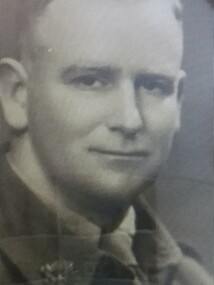
Ross Family Collection, circa 1939
... VX39077 Neil Ross enlisted in to the AIF on 21 November 1940 at Royal Park and was posted to 2/29 Battalion, The Battalion completed training at Bonegilla and Bathurst and then went to Malaya as part of the 27th Brigade, assigned to 8th Division. ...VX39077 Neil Ross enlisted in to the AIF on 21 November 1940 at Royal Park and was posted to 2/29 Battalion, The Battalion completed training at Bonegilla and Bathurst and then went to Malaya as part of the 27th Brigade, assigned to 8th Division. ...VX39077 Neil Ross enlisted in to the AIF on 21 November 1940 at Royal Park and was posted to 2/29 Battalion, The Battalion completed training at Bonegilla and Bathurst and then went to Malaya as part of the 27th Brigade, assigned to 8th Division. This Battalion fought in several actions prior to being captured on 15 February 1942 in Singapore. On return to Australia SSgt spent time in Military Hospital prior to Discharge October 1946.All of the items in this collection are originals as issued to SSgt Ross.A collection of items belonging to the Ross Family. The items belong to VX39077 SSgt Neil Rossross, 2/29th battalion, 27th brigade, 8th division -
 Bendigo Military Museum
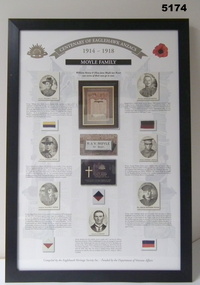
Memorabilia - CENTENARY of EAGLEHAWK ANZACS, FRAMED, Eaglehawk Heritage Society, MOYLE FAMILY
... Battalion, wounded twice while on active service, RTA 23/7/1919. PRIVATE RICHARD JOHN MOYLE, (aka Henry) No. 15152, 14th Australian General Hospital, RTA 29//4/1919. PRIVATE GEORGE THOMAS MOYLE, No. 1836, 5th Infantry Battalion, 58th Battalion, wounded 4 separate occasions, RTA 13/3/1918. PRIVATE EDGAR WALTER MOYLE, No 4028 24th Infantry Battalion, 1st ANZAC Entrenching Battalion, wounded twice, RTA 2...Battalion, wounded twice while on active service, RTA 23/7/1919. PRIVATE RICHARD JOHN MOYLE, (aka Henry) No. 15152, 14th Australian General Hospital, RTA 29//4/1919. PRIVATE GEORGE THOMAS MOYLE, No. 1836, 5th Infantry Battalion, 58th Battalion, wounded 4 separate occasions, RTA 13/3/1918. PRIVATE EDGAR WALTER MOYLE, No 4028 24th Infantry Battalion, 1st ANZAC Entrenching Battalion, wounded twice, RTA 2 ...PRIVATE WILLIAM JOHN MOYLE, NO 6544, 14TH INFANTRY BATTALION, RTA 5/4/1919.. PRIVATE/DRIVER CHARLES MOYLE, No 2400, 7th Battalion, wounded twice while on active service, RTA 23/7/1919. PRIVATE RICHARD JOHN MOYLE, (aka Henry) No. 15152, 14th Australian General Hospital, RTA 29//4/1919. PRIVATE GEORGE THOMAS MOYLE, No. 1836, 5th Infantry Battalion, 58th Battalion, wounded 4 separate occasions, RTA 13/3/1918. PRIVATE EDGAR WALTER MOYLE, No 4028 24th Infantry Battalion, 1st ANZAC Entrenching Battalion, wounded twice, RTA 2/3/1919. PRIVATE REUBEN IVOR MOYLE, No 4477, 21st Infantry Battalion, invalided home 8/4/1917. PRIVATE LESLIE MAFEKING MOYLE, No. 5439, 6th Infantry Battalion, 21st Battalion RTA 14/1/1917. Memorabilia - framed story of seven brothers, soldier, in colour, using memorabilia of soldiers and their lives Printed on paper. Frame - black extruded plastic, glass front, cardboard backing.MOYLE FAMILYframed item, anzacs, eaglehawk -
 Bendigo Military Museum
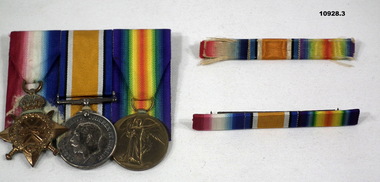
Award - MEDAL SET & RIBBON BARS, Unknown
... Battalion, aged 22. Embarked for Egypt 2/2/1915 and for Gallipoli on 12/4/1915. He was WIA 29/8/1915 with GSW to left leg and transferred to England where his left leg was amputated. ...Battalion, aged 22. Embarked for Egypt 2/2/1915 and for Gallipoli on 12/4/1915. He was WIA 29/8/1915 with GSW to left leg and transferred to England where his left leg was amputated. ...Medal set and ribbon bars belonging to Pte "Robert Raymond O'Donahoo" (No. 1399). Born Epsom. Enlisted in Bendigo on 19/10/1914 in 2nd Reinforcements of 14th Battalion, aged 22. Embarked for Egypt 2/2/1915 and for Gallipoli on 12/4/1915. He was WIA 29/8/1915 with GSW to left leg and transferred to England where his left leg was amputated. RTA 19/6/1916 and discharged 25/12/1916. Note: Part of O'Donahoo's record on National Archives lists his service number as 1496. His medals are marked with the number 1399. Part of the O'Donahoo Collection.1. Court mounted trio of WW1 Medals consisting of 1914-15 Star, British War Medal, Victory Medal. Ribbons on medals are new. Pin and clasp on back. 2. Ribbon bar with original trio ribbons. Pin and clasp on back. 3. Ribbon bar with new ribbons. Two pins and clips on back.1. Stamped on back of 1914-15 Star: 1399 Pte R.R. O'DONAHOO 14 BN, A.I.F.' Stamped on rim of British War Medal and Victory Medal: '1399 Pte R.R. O'DONAHOO, 14 BN, A.I.F.'o'donahoo collection, robert raymond o'donahoo, gallipoli, 14th battalion, ww1 -
 Bendigo Military Museum
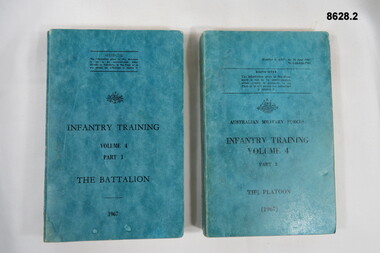
Manual - INFANTRY TRAINING, Australian Military Forces, 1967
... Passchendaele Barracks Trust PBT 28 29 Infantry Training 1. INFANTRY TRAINING Volume 4, Part 1 (1967) The Battalion. 2. ...1. Medium sized manual of 313 pages, the manual contains doctrine at Battalion level, it covers the handling of the Battalion in Tropical areas. 2. Medium size manual of 259 pages, the manual contains doctrine at Platoon and section level, it covers the handling of these sub-sections in Tropical areas.1. INFANTRY TRAINING Volume 4, Part 1 (1967) The Battalion. 2. INFANTRY TRAINING Volume 4 Part 2 (1967)passchendaele barracks trust, pbt 28 29, infantry, training -
 Bendigo Military Museum
Administrative record - COMPENDIUM WW1 - WW2, 4) A H Pettifer, Government Printer et al, 2) 14.2.1946; .3) 1.3.1919; .4) 30.11.1954 .5) 24.11.19? - WWI; .6) 31.10.1917; .7) 12.6.1917; .8) Page 1: 20.12.1915, Page 2: 10.12.1915, Page 6: 19.1915; .9) 10.9.1918; .10) 18.4.1919; .11) c.2.3.19?; .12) 18.9.1920; .14) post WWI; .15) 24.4.1920; .17) 18.4.1942; .18) 19.6.1943; .19) 18.3.1947; .20) 1944; .21) 1944; .23) 22.10.1941; .26) 13.9.1944; .27) 1.1944; .30) 7.3.1950; .31) 31.7.1944; .32) 16.4.1942; .33) 13.6.1946; .34) 6.5.1946; .36) a) & b) 3.11.1947; .37) 24.10.1951; .38) 24.9.1957; .39) 9.10.1957; .40) 19.2.1958; .41) 26.2.1958; .42) 1.3.1958; .43) & .44) 7.3.1958; .45) 25.2.1958; .46) 3.1.1948; .47) 26.2.1948; .48) 22.4.1958; .49) 24.2.1958; .50) 12.3.1958; .51) 6.1958; .52) c.Mar/Apr 1958; .53) 5.4.1958; .54) c.end WWII; .55) a.b. 13.6.1967; .56) 26.5.1967; .57) 18.2.1954
... 2/17 Australian Infantry Battalion & appointment to command 5 Aust Base Sub Area. .27) Application for Africa Star with Eighth Army Clasp signed by H T ALLAN & approved by Lt Colonel of 2/17 Australian Infantry Battalion. H T ALLAN held the rank of Major (substantive) at the time of qualification, 1.3.1942 - 11.1942. He held the rank of Lt Colonel at the time of application in 2.1944. .28) Detailing changes in command & promotions including that of Lt Col H T ALLAN, dated 1.4.19? .29...2/17 Battalion colour patch that is black over green diamond shape. Inside a list of Toasts & Dinner Menu printed in black. Back page for autographs. .25) Cream invitation card. Black cursive script printing below gold crown on front. .26) Typed letter on cream paper. .27) Typed foolscap application form to claim the Africa Star. .28) & .29) Message form filled with typed orders. .30) Typed letter acknowledging an application for campaign medals & listing eligible awards. .31) Typed letter on bond paper. .32) Certificate on cream parchment. ...2/13 Battalion AIF....22) Australian Anti-Tank Regt AIF....23) 20th Infantry Brigade ....24) 2/17 Australian Infantry Battalion ...26) Major W A JENNER, New Guinea Force Headquarters....28) & .29...2/17 Australian Infantry Battalion & appointment to command 5 Aust Base Sub Area. .27) Application for Africa Star with Eighth Army Clasp signed by H T ALLAN & approved by Lt Colonel of 2/17 Australian Infantry Battalion. H T ALLAN held the rank of Major (substantive) at the time of qualification, 1.3.1942 - 11.1942. He held the rank of Lt Colonel at the time of application in 2.1944. .28) Detailing changes in command & promotions including that of Lt Col H T ALLAN, dated 1.4.19? .29 ...Herbert Trangmar Allan, refer 2755.4 for his extensive service history and wards. .2) Details gifting of a pair of Japanese binoculars to Col H T ALLAN by Pacific Island Regiment. .3) Certificate issued by Winston Churchill, Secretary of State for War (The War of 1914-1918), awarded to Capt H T ALLAN MC. .4) Herbert Trangman ALLAN born 5.1.1895 at Woolwich, NSW. Middle name misspelled, should be Trangmar not Trangman. .6) Congratulating H T ALLAN on receiving the Military Cross award for leading 2 companies which had lost officers during action on Passchendaele Ridge on 9.10.1917. .7) Describes life behind the lines whilst H T ALLAN's battalion has been resting for a month. Daily life consisted of training drills, sport & entertainment. Writer takes time to describe the countryside & weather. .8) Relate to H T ALLAN's military exam results & his promotion to 2nd Lieutenant in 1915. .9) To Herbert Allan's father, Mr P Allan detailing the citation for awarding of the Military Cross to Herbert ALLAN. Original citation appeared in the London Gazette,5.4.1918. .10) Form addressed to Capt H ALLAN MC, 17th Battalion stating his period of enlistment in the 1st AIF was to expire 26.5.1919. .11) Letter from Lord BIRDWOOD (General) to Herbert ALLAN in response to a letter received 19.11.19?. General BIRDWOOD expresses his opinions on difficulties the allied troops face in their fight against the Japanese. .12) Letter to Capt H T ALLAN advising of MID oak leaves sent to him. Details guidelines for attaching oak leaves to both the larger Victory Medal & the small service dress medal. .13) Form details H T ALLAN's WWII Army No, Rank, Unit & Decorations & Medals held. The form has not been signed & dated. .14) Details service record of Lt Col H T ALLAN NX12229. Includes military service from 1912 - 1944, schools & courses attended, decorations, promotions & overseas service. .16) Form issued to H T ALLAN on 15.12.1939 granting permission to leave New Guinea for Australia & return within a period of 12 months. Issued by Customs Office in Salamaua. Lists H T ALLAN's age as 44, height 5' 10" & occupation. .17) Letter from Major General MORSHEAD GOC, AIF (ME) to Major H T ALLAN, OBE, MC congratulating him on being awarded the OBE for outstanding service at Tobruch. .18) Letter from Major General MORSHEAD to Major H T ALLAN, OBE, MC replying to ALLAN's letter of 15.6.1943. MORSHEAD is congratulating ALLAN on his appointment to New Guinea Force, also acknowledges his excellent service record. .19) Letter acknowledges H T ALLAN's resignation from the Office of Production Member of the Australian New Guinea Production Control Board, effective from 28.8.1946. .20) Major General WINDEYER commanded the 20th Brigade from 1942-1946. .22) Card sent from the CO of the 3rd Australian Anti-Tank Regiment. .23) Menu for Farewell Dinner held in the Officer's Mess of the 20th Infantry Brigade, Tobruch on 22.10.1941. .24) Menu & Toast list for Farewell Dinner to Brigadier J J MURRAY DSO MC VD. Attended by H T ALLAN & held in the Officers Mess, 2/17 Australian Infantry Battalion on 22.12.1941. .25) Invitation to Col H T ALLAN by Lady Gowrie (wife of Governor General Baron Gowrie) to attend a Luncheon at Government House, Canberra, ACT. .26) Letter to Major (T/Lt Col) H T ALLAN from Major W A JENNER advising him of his secondment to 2/17 Australian Infantry Battalion & appointment to command 5 Aust Base Sub Area. .27) Application for Africa Star with Eighth Army Clasp signed by H T ALLAN & approved by Lt Colonel of 2/17 Australian Infantry Battalion. H T ALLAN held the rank of Major (substantive) at the time of qualification, 1.3.1942 - 11.1942. He held the rank of Lt Colonel at the time of application in 2.1944. .28) Detailing changes in command & promotions including that of Lt Col H T ALLAN, dated 1.4.19? .29) For Lt Col H T ALLAN detailing movements required by First Australian Army command. .30) Acknowledgement & confirmation of Col H T ALLAN's application for campaign awards for WWII. .31) Letter addressed to Lt Col H T ALLAN from Lt Gen Stanley Sauige requesting information on New Britain for a forthcoming visit. .32) Certificate was presented to H T ALLAN on 16.4.1942 when he was awarded an OBE by King George VI. .33) Document details H T ALLAN's relinguishing of Command of the HQ of Pacific Islands Regiment. ALLAN also relinguished the rank of temporary Colonel & was transferred to the Reserve of Officers with rank of substantive Lt Colonel. .35) Official letter to Colonel H T ALLAN from Joseph Francis, Minister for the Army. The letter acknowledges Col ALLAN's long & distinguished career during both peace & wartime. .36) a) & b) From H T ALLAN (assumed) to Prime Minister J B CHIFFLEY referring to the production of copra in New Guinea, the actions of the Commonwealth Bank in relation to planters & the collaboration of New Guinea natives with the Japanese. Assumed to be a copy of original. .37) Letter to H T ALLAN indicating he had been placed on the Retired List with the rank of Honorary Colonel. .38) Letter invites H T ALLAN to officially open the State Conference in Lae in late March or early April 1958. Invitation was extended due to H T ALLAN for distinguished service in PNG. .39) Letter to H T ALLAN thanking him for accepting the invitation to open the Papua & New Guinea State Conference in late March or early April 1958. .40) Letter from H T ALLAN to Lt Gen Sir Henry WELLS, Chief of the General Staff, Victoria Barracks, Melbourne. ALLAN requests permission to wear his uniform for official engagements during his upcoming visit to New Guinea. ALLAN also offers advice on how to deal with native troops including serving time with them, learning their language & studying their customs. He suggests that this would help quell & dissent & revolt. .41) Reply from Major General DALY to HT ALLAN thanking him for his offer to spend time with the CO of the Pacific Island Regiment to address concerns with that unit. This meeting would coincide with ALLAN's upcoming visit to PNG. .42) HT ALLAN's reply to Major General T J DALY's letter of 26.2.1958. ALLAN requests an opportunity to discuss PIR issues with Major General DALY prior to his visit to PNG. .43) Major General T J DALY's reply to HT ALLAN's request for a meeting to discuss ongoing issues with the Pacific Island Regiment. .44) Letter from HT ALLAN to Brigadier D M CLELAND notifying him that he will be staying in Port Moresby on his way to the RSS&AILA Congress in Lae. .45) Lieutenant Colonel MCGUINN writes to invite Colonel ALLAN to visit the PIR during his visit to New Guinea at the end of March of the beginning of April 1959. .46) Letter of appreciation to H T ALLAN thanking him for his efforts in presenting the case for the Territory of New Guinea during the post WWII transition period. .47) Letter to H T ALLAN from New Guinea Citizens Association, Lae Branch, thanking him for his service on behalf of the people of the Territory of New Guinea. The association offered to send ALLAN a suitable present in recognition of his service. .48) Major General T J DALY's reply to HT ALLAN's suggestions for handling disquiet amongst the native troops in the Pacific Island Regiment. .49) Reply from Lieutenant General WELLS to H T ALLAN granting him permission to wear his uniform on his forthcoming visit to New Guinea. WELLS also notes that he has passed other requests made by ALLAN to Major General DALY. .50) Copy of H T ALLAN's reply to Lieutenant General WELL's letter of 24.2.1958 [.49)]. .51) A written account of Colonel H T Blue ALLAN's visit to New Guinea in 3.1958. Article appeared on p.65 & 67 of the 6.1958 edition of Pacific Islands Monthly. .52) Newspaper account of Colonel H T Blue ALLAN's opening of the Rabaul Branch of the Native Ex Servicemen's Association. Colonel ALLAN spoke of the involvement of the Pacific Islands Regiment during WWII. .53) The Rabaul Times account of Colonel H T Blue ALLAN's opening of the Rabaul Branch of Native Ex Servicemen's Club. Featured on p1, concluded p3. .54) Biographical account of Colonel H T ALLAN's service in WWI & WWII. In addition an account of his success in New Guinea between the wars is included. .55) a.b. Biography of Colonel H T ALLAN written by R W Robson who was the founder of the Pacific Islands Monthly. Article was written following ALLAN's death on 23.5.1967 aged 72. This item is a pre publication copy of Robson's article which appeared in the Pacific Islands Monthly. .56) Text of a valedictory given at the funeral of Colonel Herbert Trangmar ALLAN OBE, MC, ED, NX12229 held 26.5.1967 following his death on 23.5.1967. The speech summarized his life in both wars & civilian life. 57) Invitation issued to Colonel H T & Mrs ALLAN to attend a Garden Party at Government House on 18.2.1954. At this function Colonel H T & Mrs ALLAN were to be presented to her Majesty Queen Elizabeth II.Herbert T ALLAN Collection. The contents are all of various size, the Album is the size documented. .1) Large teal green album containing 16 plastic pockets each with white card insert. Various documents & photos contained in each pocket. .2) Typed letter, black type on cream paper. .3) Certificate mounted on fawn card backed with dark brown veneer. Presented to Capt H T ALLAN MC for being mentioned in despatches on 7.11.1917. .4) New South Wales Birth Certificate extract, printed on pink paper with watermark. .5) Telegram on tissue paper to a sheet of cream paper. Pin located top L corner. Requests the attendance of Lt Herbert ALLAN, Russell Hotel, Russell Square. .6) Typed letter mounted on grey cardboard. .7) 2 page letter on foolscap paper, secured by pin top L corner. Written from France by Herbert (Bert) ALLAN & addressed to his father. .8) 11 pages secured with a clip top L corner. 1st document typed, 2nd handwritten, remainder printed. Relate to H T ALLAN's military exam results. .9) Typed letter from Department of Defence Base Records Office to P ALLAN. .10) Document, printed form to inform the recipient that their period of enlistment in the 1st AIF had expired. .11) 4 page handwritten letter on 2 sheets of paper. 1st page has a printed letterhead. .12) BR Form No 20. Typed formal letter from AIF Base Records Office to accompany Mentioned in Despatches oak leaves sent to the recipient. .13) Form AAFA36 used for recommending the awarding of an Efficiency Decoration. Form details service record & details of a serving soldier. .14) 1 large / 1 small page, numbered, detailing the service record of Lt Col H T ALLAN. Black type on cream paper. 2 pages are loose but evidence of attachment visible. .15) Bachelor of Arts Degree Certificate (testamur) granted by the University of Sydney, awarded to Herbert Trangmar ALLAN. Printed on cream parchment. .16) Proforma document issued by the Territory of New Guinea permitting leave & return to the Territory. Printed 2 sides, black type on cream paper. .17) Letter on Australian Imperial Force letterhead from Major General MORSHEAD to Major H T ALLAN. .18 Letter on HQ2 Aust Corps letterhead from Major General MORSHEAD to Major H T ALLAN. .19) Typed letter on External Territories letterhead from J R Halligan to H T ALLAN. .20) Cream Christmas card folded in 2, sent to H T ALLAN. On front in black lettering is HQ 20th Australian Infantry Brigade below black Rising Sun emblem. Inside in black lettering is With Best Wishes for Christmas and New Year. Christmas 1944. .21) Cream card folded in 2. Front illustration depicts a devil figure riding a platypus & carrying a pennant with 2/13 on it. The devil is depicted attacking a German & Japanese soldier. Below the devil is a boomerang with Greetings Xmas 1944 printed on it. Illustration is in green & black. Inside on LHS is a message from 2/13 Battalion. On RHS is a list of 2/13 battle honours from 1940-1943. On back in black print is 1944-1945 New Guinea Australia. .22) Cream Christmas card folded in 2. Front illustration in brown with word Greetings in green. RHS inside printing in green & brown letters. Artillery badge on back in brown. .23) Cream card folded in 2. Typed menu on cream paper attached inside. Front cover illustrated with 20th Infantry Brigade colour patch & a rat over a scroll with words - So What? .24) Cream card folded in 2. On front black printing accompanied by 2/17 Battalion colour patch that is black over green diamond shape. Inside a list of Toasts & Dinner Menu printed in black. Back page for autographs. .25) Cream invitation card. Black cursive script printing below gold crown on front. .26) Typed letter on cream paper. .27) Typed foolscap application form to claim the Africa Star. .28) & .29) Message form filled with typed orders. .30) Typed letter acknowledging an application for campaign medals & listing eligible awards. .31) Typed letter on bond paper. .32) Certificate on cream parchment. Black print in cursive script. Text details the awarding of an OBE to the recipient. .33) Typed text on Australian Military Forces letterhead. Cream paper. .34) Typed text. Temporary note for H T ALLAN's discharge from AMF. .35) Typed letter on Commonwealth of Australia, Minister for the Army letterhead. .36) a) & b) 2 page letter in black type on cream paper. Pages are loose, letter unsigned. .37) 1 page typed letter on Australian Military Forces letterhead. .38) & .39) 1 page typed letter on Return Sailors, Soldiers & Airmen's Imperial League of Australia, Papua & New Guinea Branch letterhead. .40) 1 page typed letter, unsigned. .41) Single sided typed letter on Australian Military Forces letterhead on cream paper. .42) 1 page typed letter, unsigned on cream paper. .43) Single sided typed letter on Australian Military Forces, Northern Command, Victoria Barracks, Brisbane letterhead on cream paper. .44) Single sided typed letter on cream paper. .45) 2 page typed letter on folded cream paper bearing the letterhead of the Pacific Islands Regiment. .46) 1 page typed letter on cream, lined paper. .47) 1 page typed letter on cream paper. .48) 1 page typed letter on Australian Military Forces, Northern Command Headquarters, Victoria Barracks, Brisbane letterhead on cream paper. .49) 1 page typed letter on Chief of General Staff, Australian Military Forces, Army Headquarters, Victoria Barracks, Melbourne letterhead on cream paper. .50) 1 page copy of an unsigned letter on cream paper. .51) Magazine article: Building a New Nation in New Guinea : Some advice from Colonel Blue ALLAN. Black & white article with a 2nd small section stapled to the main page. Large page features a black & white captioned photo of a group listening to a uniformed Officer deliver a speech. Also features advertising front & back. .52) Newspaper article: Official Opening of Native Ex Servicemen's Club. Black & white typed newspaper article featuring a captioned black & white photo of a uniformed Australian Officer & a group of New Guinea Ex Servicemen. .53) a. b. c. Newspaper article: Master Blue Came Back to the Islands: 4000 Attend Club Opening. 3 Section article cut from a newspaper. One part is the banner of the newspaper with date published. Other sections contain the text of the article. The larger section features a black & white photo of an Australian Army Officer in uniform. .54) Newspaper article, untitled. Black & white typed newspaper article with black & white caricature of an Australian Army Officer featured. .55) a. b. Magazine article: The Story of a Big Man who Loved Soldiering. 2 page black & white typed article with sub headings. .56) Text of a Speech. 2 page typed text written for a valedictory given at a funeral. Pages connected with a staple in the top L corner. .57) Printed, cream card invitation to a Garden Party for the recipient to meet Queen Elizabeth II & The Duke of Edinburgh. Text is in cursive script under the Coat of Arms of Her Majesty. .2) Signature ? Capt S C PIR. .4) Date of issue typed: 30.11.1954 Name of recipient: Herbert Trangman Allan Stamped: T Wells, Registrar General NSW .5) Handwritten: To Lt Herbert Allan, Russell Hotel, Russell Square. Typed: Buckingham Palace OHS. Your attendance is required at Buckingham Palace on Wednesday next the Twentyeighth inst (28.11.19?) at ten o'clock am service dress please telegraph acknowledgement Lord Chamberlain London. Stamped: Central District 24 NO 19. .6) Signed in pencil: W Birdwood. In pencil on back: 15 x 12. .8) p1: Handwritten signature. Copy dated 29.12.1915. p2 Handwritten in ink: P Allan Esq, Mount Hunter Hill. Military Examination. Copy dated 29.12.1915. Handwritten in pencil: Results: H T Allan. Tactics - Distinction 92% HE Barff p3 Underlined in ink: 38th Infantry Herbert Trangmar Allan to be 2nd Lieutenant (provisionally). Dated 16 June 1914. p5 Handwritten: Total 139. Lieut Allan tied with 15 others for 20 place. p7, 9, 10 & 11underlined in ink: H T Allan. p8 Underlined in ink: Allan HT. .9) & .10) Signature in black ink. .12) Handwritten signature in black ink: On back handwritten signature in black ink: Clive Wilkinson, Buddong, Robinson St, Chatswood. Also ? Rd, Cremorne Pt. .13) Handwritten in black ink: Details of HT Allan's Commission Service from 16.6.1914 - 18.2.1946. .15) Handwritten signature of the University Chancellor, Dean of Faculty of Arts & Registrar. Handwritten name of recipient. Seal of the University of Sydney imprinted bottom LHS. .16) Handwritten in black ink: Details of recipient. Stamped in red ink: New Guinea Customs. Stamped in blue ink: H M Customs, Cooktown, dated 17.12.1939. Handwritten on reverse: Signature. Stamped on reverse in red ink: New Guinea Customs, dated 15.12.1939. .17) & .18) Handwritten signature: Major General Morshead. .19) Handwritten signature in black ink: J R Halligan. .20) Handwritten inside in blue ink: Lt Col Allan. Good wishes from your many friends here. Signed by Major General Windeyer. .21) Inside LHS handwritten in blue ink: Lt Col Allan & an indecipherable signature. .22) Inside RHS handwritten: To Major (Blue) Allan OBE MC from Lt Col? .23) On front handwritten in blue ink: H T Allan?. Inside in black ink & pencil are 19 signatures. .24) On front: 3 signatures in black ink & pencil. On back: 36 signatures in black & blue ink & pencil. .25) On back handwritten in black ink: Colonel H T Allan OBE MC, with 3 ink lines below name. .26) Handwritten in blue/black ink: Signature. Handwritten in blue pencil top R corner: A32/3477. Handwritten in black ink bottom L corner: Cond (?) 15/9A. Handwritten in black ink: Signature. .27) Stamped top R corner: 2/17 Bn Received 9.2.1944. Signature in black ink: H T Allan. Signature in black ink: ? Lt Col 2/17 Aust Inf Bn 10.2.1944 Page bottom in pencil: Blue will keep 1 1/4 for you? .30) Handwritten: Details of eligible medals. Handwritten signature: J C K Miller Capt 7.3.50. Handwritten bottom L corner: Col H T Allan Bottom R corner: OBE, MC, 1914-19, Victory, ED, MID 1914-18, MID 1939-45 On back: Steak & Kidney Morris ) Clark ) Vowood ) 10/- 70215 Maughan ) Allan ) .31) Top of page: Imprinted Coat of Arms Top LHS in black ink: TOP SECRET AND PERSONAL Handwritten signature: Stanley Sauige .32) Embossed top L corner: Seal of the Most Excellent Order of the British Empire. Handwritten: Mary R. .32) Signed: Queen Mary, mother of George VI. .33) Handwritten signature. .34) Handwritten in blue ink: HERBERT TRANGMAR ALLAN 6 MAY 46 Handwritten signature. .35) Handwritten signature in blue ink: Joseph Francis, Minister for the Army. .37) Handwritten signature. .38) & .39) Handwritten signature: J W Knight. .41), .43) & .45) Handwritten signature in blue ink. .46) & .47) Handwritten signature in black ink: Henry G Eckhoff. .48) Handwritten signature in blue ink: With best wishes Yours sincerely T J Daly. .49) Handwritten signature in black ink: Yours sincerely H Wells. .57) Handwritten in black ink: Colonel & Mrs H T Allan.certificates, records, awards, administrative, compendium -
 Bendigo Military Museum
Photograph - FRED CARLETON 2/23RD ALBUM, Alamein and the Western Desert
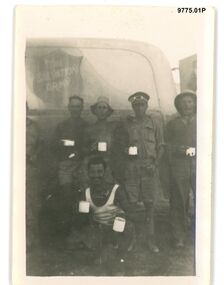
... Gilbert Ferguson Urquhart VX48258 enlisted 25.7.1940 age 29, KIA 22.7.1942, hel held the rank of Major. He had pre War service in the CMF from 9.1.1939 - 24.7.1940. 2/23rd Battalion Tobruk El Alamein Western Desert Campain Fred Carleton Cpt Ferguson Urquhart VX42858 Some photographs have inscriptions on the verso, and this information is included in the title information displayed when the images are clicked on. ...Frederick Lloyd Carleton VX1555 served in the 2/23rd Battalion, 9th Division in the Middle East and in the Pacific. The images detail his day to day life at the front and on leave. He served during the siege of Tobruk and at El Alamein, and was a lifelong member of the Bendigo sub-branch of the Rats of Tobruk Association. Refer Cat No 142.7 for his full service history. .07P) CSM Lee. Believed to be Leslie Douglas Lee VX69519, enlisted 23.12.1941, Middle East service listed as 28.2.1942 - 25.2.1943, discharged 27.11.1945. Lt Fallon. Believed to be John Francis Fallon VX48644. Enlisted 31.7.1940, embarked for the Middle East 16.11.1940, WIA Blast perforation injury 30.10.1942, RTA 9.1.1943 Discharged 20.5.1943 with the rank of Capt. Rupert Rattray VX38937, enlisted 21.10.1940, Middle East service listed as 6.11.1940? - 8.8.1942, New Guinea service 21.2.1943 - 14.9.1943, discharged on 4.4.1946 with the rank of Major. Awarded the MC on April 22 when leading a raiding Party in Tobruk 1941, also awarded C In C’s card in 1941. Graham Grantham Anderson VX48780, enlisted 5.8.1940 age 21, DOW’s on 13.7.1942, he held the rank of Captain. Gilbert Ferguson Urquhart VX48258 enlisted 25.7.1940 age 29, KIA 22.7.1942, hel held the rank of Major. He had pre War service in the CMF from 9.1.1939 - 24.7.1940.Collection of 76 photographs taken during service in 2/23rd in Middle East.Some photographs have inscriptions on the verso, and this information is included in the title information displayed when the images are clicked on.2/23rd battalion, tobruk, el alamein, western desert campain, fred carleton, cpt ferguson urquhart vx42858 -
 Bendigo Military Museum
Photograph - FRED CARLETON 2/23RD ALBUM, Lebanon
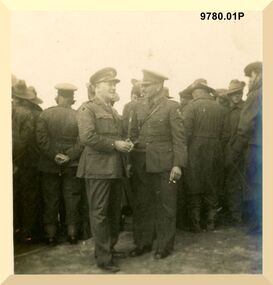
... 2/23rd Battalion, 9th Division in the Middle East and in the Pacific. The images detail his day to day life at the front and on leave. He served during the siege of Tobruk and at El Alamein, and was a lifelong member of the Bendigo sub-branch of the Rats of Tobruk Association. Refer Cat No 142.7 for his full service history. .01P) Brigadier R.W. Tovell, CBE, DSO & Bar, ED - MID 5 times. He had 5.5 years pre WW1 service in the Cadets, on discharge he held the rank of Lieutenant. Enlisted in the AIF 28.4.1915 age 29...2/23rd Battalion, 9th Division in the Middle East and in the Pacific. The images detail his day to day life at the front and on leave. He served during the siege of Tobruk and at El Alamein, and was a lifelong member of the Bendigo sub-branch of the Rats of Tobruk Association. Refer Cat No 142.7 for his full service history. .01P) Brigadier R.W. Tovell, CBE, DSO & Bar, ED - MID 5 times. He had 5.5 years pre WW1 service in the Cadets, on discharge he held the rank of Lieutenant. Enlisted in the AIF 28.4.1915 age 29 ...Frederick Lloyd Carleton VX1555 served in the 2/23rd Battalion, 9th Division in the Middle East and in the Pacific. The images detail his day to day life at the front and on leave. He served during the siege of Tobruk and at El Alamein, and was a lifelong member of the Bendigo sub-branch of the Rats of Tobruk Association. Refer Cat No 142.7 for his full service history. .01P) Brigadier R.W. Tovell, CBE, DSO & Bar, ED - MID 5 times. He had 5.5 years pre WW1 service in the Cadets, on discharge he held the rank of Lieutenant. Enlisted in the AIF 28.4.1915 age 29 years, appointed Lt 6.7.1915 in 2nd Reinforcements 29th BN. Embark for Eygpt 29.12.1915, embark for France 4.6.1916. He rose through the Ranks in various Commands to Brigade Major by 19.2.1918. Awarded MID24.10.1918, DSO & MID on 23.5.1919, MID on 30.10.1919. Appointment terminated in the AIF on 12.12.1920. Stayed on in the full time Army to be T/Brigader on 14.10.1939 to Command the 10th INF Brigade. Transfers to the 2nd AIF 1.7.1940 No VX46983and appointed to Command the 26th Brigade. Overseas service listed as Middle East 16.11.1940 - 10.11.1942. New Guinea 17.2.19144 - 21.3.1944 & 10.3.1945 - 23.3.1945, Darwin area 8.9.1944 - 19.9.1944. Awarded Bar to the DSO 30.12.1941, MID 26.6.1942 & 15.12.1942, CBE 15.4.1943. Appointed Deputy Adjutant General 3.5.1944, appointment terminated in the 2nd AIF on 20.12.1945, placed on the Reserve list of Officers with the rank of Colonel & Honorary Brigadier. Lt Col Evans VX478119. Bernard Evans had service going back to 1924. Enlisted in the 2nd AIF on 22.7.1940. His overseas service is listed as Middle East 16.11.1940 - 30.3.1943 - New Guinea 20.7.1943 - 10.11.1943, discharged fro m the AIF on 22.10.1945 with the rank of Colonel, awarded the DSO. .02P) Believed to be Benjamin Thomas Shiels VX58180, enlisted 24.6.1941, embarked for the Middle East 3.9.1941, KIA 29.10.1942. Joe Harrison is not yet identified. Collection of 76 photographs taken during service in 2/23rd in Middle EastSome photographs have inscriptions on the verso, and this information is included in the title information displayed when the image is clicked on.2/23rd battalion, tobruk, el alamein, western desert campain, fred carleton -
 Bendigo Military Museum
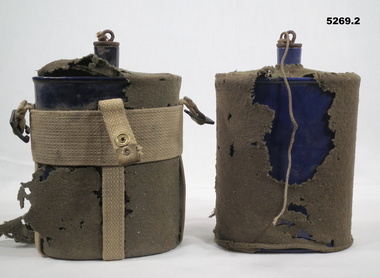
Equipment - WATER BOTTLES
... 29 March 1943 age 26 years, discharged 17 July 1946 with the rank of Captain in 2nd New Guinea Infantry Battalion. Infantry Water bottle 2ND NEW GUINEA INFANTRY BATTALION .1) One litre water bottle with cork lid, insulating felt cover. Cork attaches by string to the felt cover. And also in a cotton webbing carrier. Made up of vertical and horizontal straps wth a brass studs, 2 ...Equipment issued to all Army Soldiers as part of original kit. Kit belong to CAPTAIN Brian CLEREHAN VX91862. Enlisted 29 March 1943 age 26 years, discharged 17 July 1946 with the rank of Captain in 2nd New Guinea Infantry Battalion..1) One litre water bottle with cork lid, insulating felt cover. Cork attaches by string to the felt cover. And also in a cotton webbing carrier. Made up of vertical and horizontal straps wth a brass studs, 2 brass buckles to attach to shoulder straps .2) One litre blue enamelled bottle with attached cork lid and insulating felt cover. No webbing included .infantry, water bottle, 2nd new guinea infantry battalion -
 Bendigo Military Museum
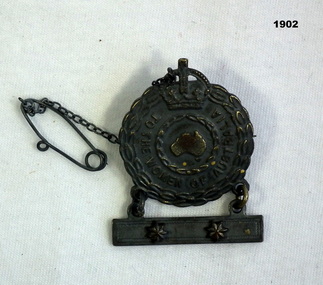
Badge - FEMALE RELATIVE BADGE WW2, G&E Rodd, 1940
... 29/46th Aust Infantry Battalion. Robert is believed to be Walter Robert BALDWIN No VX55835. He enlisted in the 2nd AIF on 14.5.1941 age 20 years. He was in the 2...29/46th Aust Infantry Battalion. Robert is believed to be Walter Robert BALDWIN No VX55835. He enlisted in the 2nd AIF on 14.5.1941 age 20 years. He was in the 2 ...The badge belonged to Mrs May BALDWIN. Two stars on the badge showed she had two sons in the 2nd A.I.F, Ted & Robert. Ted (short for Edward) is believed to be George Edward BALDWIN No VX120046. He enlisted in the 2nd AIF on 10.7.1942 age 20 years. On discharge from the Army on 2.4.1946 he was a Pte in the 29/46th Aust Infantry Battalion. Robert is believed to be Walter Robert BALDWIN No VX55835. He enlisted in the 2nd AIF on 14.5.1941 age 20 years. He was in the 2/29th Batt and is listed in their history as being in D Coy. He was taken POW and is listed as died while a POW on 27.5.1943. Refer 1895.Badge, metal, "To the Women of Australia". Centre section is round with a crown over two circular wreaths with a map of Australia Centre. Attached by 2 rings is a clasp with 2 stars. A fine chain and pin attached at the top. Rear has 2 lugs and pin."ISSUED BY THE C'WLTH GOVT A77484"numismatics - badges, metalcraft -
 Bendigo Military Museum
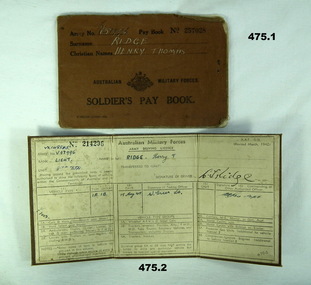
Financial record - PAY BOOKS, ADMINISTRATIVE, DOCUMENTS WW2, 1) 1941 - 1942 .2) 1915-1944 .3) 26.2.1941 .4)20.10.1944 ? .5) 10.3.1944? .6) 2.5.1942? .7)? .8) 30.4.1942 .9) 7.5.1942
... Battalion CMF. He rose to Sergeant then qualified as a Lieutenant on 8.10.41. He was stationed in Darwin during the bombing 19th Feb 1941. He was discharged and the re enlisted as VX148845 AIF on 9.3.44. He served overseas and was discharged 29.7.46 in 8MD Papua. Refer 473P documents - licences / letters communication - telegraphic photography - photographs .1) Pay book No 257028, brown covers re H.T Ridge. .2) Drivers Licence No 214206, Army issue, brown fabric covers, folds in three re H.T. Ridge Lieut. .3) Drivers Licence No 592440,civilian, yellowish paper, red, blue, black writing re H.T. Ridge. Feb 29 ...Henry Thomas Ridge initially (born Stawell, enlisted Bathurst) in September 1934 No V57996, 8th Australian Infantry Battalion CMF. He rose to Sergeant then qualified as a Lieutenant on 8.10.41. He was stationed in Darwin during the bombing 19th Feb 1941. He was discharged and the re enlisted as VX148845 AIF on 9.3.44. He served overseas and was discharged 29.7.46 in 8MD Papua. Refer 473P.1) Pay book No 257028, brown covers re H.T Ridge. .2) Drivers Licence No 214206, Army issue, brown fabric covers, folds in three re H.T. Ridge Lieut. .3) Drivers Licence No 592440,civilian, yellowish paper, red, blue, black writing re H.T. Ridge. Feb 29-1941. .4) Army "Final Statement account," form W.F.88 re VX149945 Ridge HT, 20.10.44. Paper, black and white, stamped 21 october 1944. .5) Typed note re Lieut H. Ridge, yellowed paper dated 10.3.44, red lettering at top of page " CUTSA New South Wales". .6) Letter, dated 2.5.1942 to Mrs E. Ridge re H. Ridge "Seriously ill with appendicectomy.", letter yellowed. .7) Cardboard , yellowed, typed and hand written re brief description V57996 and VX148845 H.T. Ridge, military and medical history. .8) Telegram Re " V57996 H.T. Ridge seriously ill 30th April." Double sided, front Blue with message, rear red, stamped 1 May 1942. .9) Telegram re " V57996 H.T Ridge removed from ill list 7th May 1942, double sided, front blue with message, rear red, stamped 18th may 1942. .10) Pay book No 195734, yellow covers re H.T Ridge.documents - licences / letters, communication - telegraphic, photography - photographs -
 Colac RSL Sub Branch
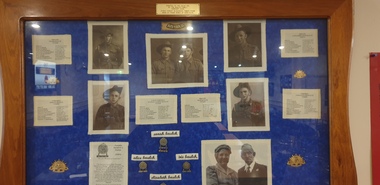
Decorative object - Baulch Brothers. Their Service - Our Heritage. Photo/Badge Collection, Baulch Family, 2008
... 29/4/1942 at Seymour, Vic. Discharged 13/3/1946. H.Q. AMF School of Mechanization. Centre. Lance Corporal Stanley Baulch VX72233. Born 8/12/1914 at Gellibrand, Vic. Enlisted 19/1/1942 in Caulfield, Vic. Discharged 5/12/1945. 2nd/2nd Pioneer Battalion. Private Jack Baulch VX72232. Born 18/5/1917 at Colac, Vic. Enlisted 15/1/1942 in Colac, Vic. Discharged 29/1/1946. ? Battalion Lower Centre. Female Relatives Badges and Information sheet. Badges:- Sarah, Alice, Iris and Elizabeth Baulch. Photo Sarah and Fred Baulch. Upper Right. Alexander Baulch VX56771 + small Rising Sun Badge. Born 21/2...29/4/1942 at Seymour, Vic. Discharged 13/3/1946. H.Q. AMF School of Mechanization. Centre. Lance Corporal Stanley Baulch VX72233. Born 8/12/1914 at Gellibrand, Vic. Enlisted 19/1/1942 in Caulfield, Vic. Discharged 5/12/1945. 2nd/2nd Pioneer Battalion. Private Jack Baulch VX72232. Born 18/5/1917 at Colac, Vic. Enlisted 15/1/1942 in Colac, Vic. Discharged 29/1/1946. ? Battalion Lower Centre. Female Relatives Badges and Information sheet. Badges:- Sarah, Alice, Iris and Elizabeth Baulch. Photo Sarah and Fred Baulch. Upper Right. Alexander Baulch VX56771 + small Rising Sun Badge. Born 21/2 ...Item donated to Colac RSL by the Baulch Family February 2008. Constructed of Otway Forest Blackwood. Made by Frank Nemec of Eden N.S.W High SignificanceBlackwood Timber Frame. Blue material cloth background, with photos and military badges. Banner - Blue material with gold writingPhoto Frame:- Upper Left. Private Frank Baulch. VX72238 + small Rising Sun Badge. Born 15/11/1911 at Glen Aire, Vic. Enlisted 15/2/1942 in Caulfield, Vic. Discharged 3/12/1945. 2nd/2nd Pioneer Battalion. Lower Left. Corporal Horace Baulch. VX869036 + Large Rising Sun Badge. Born 29/4/1942 at Colac, Vic. Enlisted 29/4/1942 at Seymour, Vic. Discharged 13/3/1946. H.Q. AMF School of Mechanization. Centre. Lance Corporal Stanley Baulch VX72233. Born 8/12/1914 at Gellibrand, Vic. Enlisted 19/1/1942 in Caulfield, Vic. Discharged 5/12/1945. 2nd/2nd Pioneer Battalion. Private Jack Baulch VX72232. Born 18/5/1917 at Colac, Vic. Enlisted 15/1/1942 in Colac, Vic. Discharged 29/1/1946. ? Battalion Lower Centre. Female Relatives Badges and Information sheet. Badges:- Sarah, Alice, Iris and Elizabeth Baulch. Photo Sarah and Fred Baulch. Upper Right. Alexander Baulch VX56771 + small Rising Sun Badge. Born 21/2/1919 at Collingwood, Vic. Enlisted 28/5/1942 at Royal Park, Vic. Discharged 20/11/1945. ? Batt. Lower Right. Norman Baulch. VX86902 + large Rising Sun Badge. Enlisted 28/5/1942 at Royal Park, Vic. Born 5/12/1921 at Colac, Vic. Enlisted 29/7/1942 in Seymour, Vic. Discharged 28/2/1945. ?Batt. -
 Waverley RSL Sub Branch
RSL Photo Album, RSL Photo Album Section 3
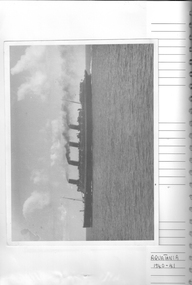
... BATTALION AND 29/46 INFANTRY BATTALION, BOTH OF 4 BRIGADE, WAS HELD ON WUNUNG AIRSTRIP. THIS PARADE WAS TO PREPARE TROOPS FOR A PARADE TO BE HELD ON 1945-09-03. SHOWN, 37/52 INFANTRY BATTALION PRESENTING ARMS." Airstrip was maintained by 1 ACS new britain wwii japanese surrender pow rms aquitania ss nieuw amsterdam rms mauritania rabaul wunung airfield jaquinot bay 1 acs Photo Album 360 Pocket "Photo Safe" divided for cataloguing purposes into 4 sections. Section 1 Recent Colour Photos of RSL and commemoration services Section 2 ...During World War II the Japanese attacked New Britain soon after the outbreak of hostilities in the Pacific Ocean. During January 1942, Japanese heavily bombed Rabaul. On 23 January, Japanese marines landed by the thousands, starting the Battle of Rabaul. The Japanese used Rabaul as a heavy base until 1944; it served as the key point for the failed invasion of Port Moresby (May to November, 1942) Note: these photos are incorrectly labelled as Nth. Britain Photograph of "OIRE LUNG " airfield is in fact "WUNUNG, JACQUINOT BAY, NEW BRITAIN, 1945-08-28. A FULL PARADE OF 37/52 INFANTRY BATTALION AND 29/46 INFANTRY BATTALION, BOTH OF 4 BRIGADE, WAS HELD ON WUNUNG AIRSTRIP. THIS PARADE WAS TO PREPARE TROOPS FOR A PARADE TO BE HELD ON 1945-09-03. SHOWN, 37/52 INFANTRY BATTALION PRESENTING ARMS." Airstrip was maintained by 1 ACSPhoto Album 360 Pocket "Photo Safe" divided for cataloguing purposes into 4 sections. Section 1 Recent Colour Photos of RSL and commemoration services Section 2 Black and white photos of earlier commemoration services, Section 3 WWII photos mainly of New Britain 1945, Section 4 Early photos of Memorabilia display.new britain, wwii, japanese surrender, pow, rms aquitania, ss nieuw amsterdam, rms mauritania, rabaul, wunung airfield, jaquinot bay, 1 acs -
 Bendigo Military Museum
Photograph - PHOTOGRAPHS 38TH BN, C 1916
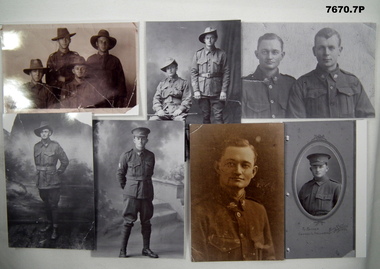
... All photos include George Ballinger, No. 828 Enlisted 8/3/1916, Age 24 in C Company 38th Battalion. 7670.1P includes Charles Barkell, No. 811, enlisted 29/2/1916, age 22 to same unit (top RHS), Walter Montieth No. 936 enlisted 14.3.1916, age 18, KIA 4/10/1917 (Bottom LHS). and Charles Christian Snell who enlisted as John Lewis No. 925, enlisted 11/3/1916, age 21....All photos include George Ballinger, No. 828 Enlisted 8/3/1916, Age 24 in C Company 38th Battalion. 7670.1P includes Charles Barkell, No. 811, enlisted 29/2/1916, age 22 to same unit (top RHS), Walter Montieth No. 936 enlisted 14.3.1916, age 18, KIA 4/10/1917 (Bottom LHS). and Charles Christian Snell who enlisted as John Lewis No. 925, enlisted 11/3/1916, age 21. 38th Battalion WW1 Photographs 2. ...All photos include George Ballinger, No. 828 Enlisted 8/3/1916, Age 24 in C Company 38th Battalion. 7670.1P includes Charles Barkell, No. 811, enlisted 29/2/1916, age 22 to same unit (top RHS), Walter Montieth No. 936 enlisted 14.3.1916, age 18, KIA 4/10/1917 (Bottom LHS). and Charles Christian Snell who enlisted as John Lewis No. 925, enlisted 11/3/1916, age 21.Various black and white/sepia photos of WW1 soldiers. 1. Landscape photo of 4 WW1 Aust. soldiers posed in two rows (Charles Barkell, Walter Montieth, George Ballinger, Charles Snell). 2. Portrait photo of George Ballinger & Charles Snell (seated). 3. Landscape photo of two soldiers (George Ballinger & unknown). 4. Posed photo of George Edward Ballinger in front of photo board. 5. Portrait photo of George Edward Ballinger. 6. Portrait photo of George Ballinger. 7. Portrait photo of George Ballinger with his image within an oval and an inscription below it.2. On back written "Snell (seated) & Ballinger” 3. On back written "Unknown & Ballinger” 4.- 6. “Ballinger”on back. 7. “Ballinger”on back & "My father George E. Ballinger", "Home studio, A. Power, Brunswick”38th battalion, ww1, photographs -
 Warrnambool and District Historical Society Inc.
Plaque - Certificate, WWI, In Memoriam, BEA Henderson
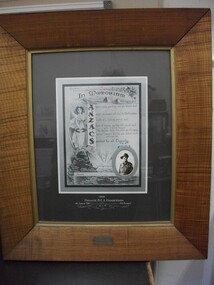
... Battalion, 5th Division of the AIF. He died of wounds In France on 29/5/1918 or 1/6/1918. His burial place is Crouy British Cemetery, Crouy-sur-Somme. The framed 'In Memoriam' has been in the custody of family members until presented to W&DHS in 2013 by Mrs Beris Porter. Pte BEA Henderson, 1866, 3 Pioneer Battalion(2 ...Private Bertie Ernest Alfred Henderson served in the 5th Pioneer Battalion, 5th Division of the AIF. He died of wounds In France on 29/5/1918 or 1/6/1918. His burial place is Crouy British Cemetery, Crouy-sur-Somme. The framed 'In Memoriam' has been in the custody of family members until presented to W&DHS in 2013 by Mrs Beris Porter. Pte BEA Henderson, 1866, 3 Pioneer Battalion(2 Reinforcement Group) was a farmer and single. His father was Mr HH Henderson of Naringal. He enlisted on 27/5/1916 then sailed on the Themistocles on 28/7/1916 and transferred to the 5 Pioneer Battalion. His name is recorded on the War Memorial, Artillery Crescent, Warrnambool as having made the supreme sacrifice.Mass produced Memorial page with a sepia original half portrait photograph of a soldier surrounded with two mounts,narrow white and dark/grey brown, and a thin gold gilt surround next to an inward angled plain, wooden frame with clear glass. Hand white painted name, rank, number, battalion, division with decorative flourishes. A. tarnished plaque is on the mid lower frame Front- White hand painted dedication: 1866/PRIVATE B.E.A. HENDERSON/5th Pioneer Batt 5Division/A.I.F. The mass produced decorative mount has battle place names and a bird's eye view of battlefields in France. In sepia 'Glory' stand atop a rock and cross with a laurel wreath in her right hand and a scroll with ANZACS falling from her left hand. A verse is written Anzacs, you've graved your name upon Immortal Scroll/Naught can compare with what the World a claims/Zenith of a fighting patriotic soul./A host of heroes, you have but echoed back with Clarion tongue/the Spartan Sires from who you fitly sprung Coo-ee! Comrades, 'Kia-Ora' you didn't ant couch will ever be./Sacred to all Eternity. An oval cut-out holds a half portrait of the soldier in uniform. Plaque on lower wooden frame FRANCE/29.5.18 Reverse- in pencil handwriting: ? o/c/... ... A. Henderson/of ...T/Yar..galin memoriam, wwi, 5th pioneer battalion, 5th division, aif, private bea henderson, warrnambool, anzac -
 Bendigo Historical Society Inc.
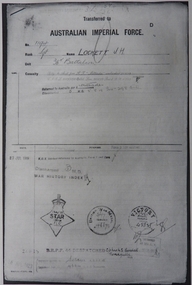
Document - Jack Lockett Collection: Army Certificate of Discharge
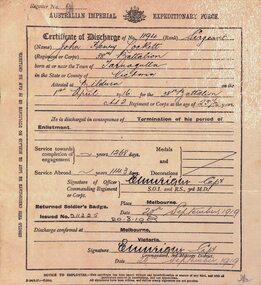
... Belgium remained the focus of the 38th Battalion's activities for the next five months, until it was rushed south to France in late March 1918 to meet the German Army's Spring Offensive. The 38th participated in its last major action of the war between 29 September and 2 October 1918 as part of the Australian-American operation that breached the formidable defences of the Hindenburg Line along the St Quentin Canal. ...Belgium remained the focus of the 38th Battalion's activities for the next five months, until it was rushed south to France in late March 1918 to meet the German Army's Spring Offensive. The 38th participated in its last major action of the war between 29 September and 2 October 1918 as part of the Australian-American operation that breached the formidable defences of the Hindenburg Line along the St Quentin Canal. ...John Henry Lockett OAM (22 January 1891 – 25 May 2002) was the oldest man ever in Australia when he died aged 111 years, 123 days. As one of the last surviving veterans of World War I, he was acclaimed as a national hero during the last decade of his life. Lockett was born in the small Victorian town of Waanyarra, near Bendigo. He left school aged nine to work on a local farm. Later, he worked for his uncles in the Mallee. On 24 March 1916, he travelled to Mildura to enlist in the Australian Imperial Force. He served in France with the 38th Battalion, earning promotion to sergeant and was discharged on 20 September 1919. https://en.wikipedia.org/wiki/Jack_Lockett The 38th Battalion was formed on 1 March 1916 at a camp established on the Epsom Racecourse at Bendigo in Victoria. After training in both Australia and Britain, the 38th Battalion crossed to France in late November 1916 and moved into the trenches of the Western Front for the first time on 1 December.The 38th fought in its first major battle at Messines, in Belgium, between 7-9 June 1917. It fought in another two major attacks in this sector - the battle of Broodseinde on 4 October, and the battle of Passchendaele on 12 October. Belgium remained the focus of the 38th Battalion's activities for the next five months, until it was rushed south to France in late March 1918 to meet the German Army's Spring Offensive. The 38th participated in its last major action of the war between 29 September and 2 October 1918 as part of the Australian-American operation that breached the formidable defences of the Hindenburg Line along the St Quentin Canal. It was disbanded in April 1919. Source, Australian War Memorial https://www.awm.gov.au/collection/U51478 After the war, Jack returned to The Mallee and selected a 640 acres (260 ha) block of land in Linga, Victoria, deciding to make his living as a farmer. In 1923, he married Maybell Ingwerson and they had four children together. In 1963, the couple retired to Bendigo, leaving the farmland (which now covered more than 130,000 acres (53,000 ha), in the care of their children and grandchildren. An off-white coulored document with black print and black handwriting headed AUSTRALIAN IMPERIAL EXPEDITIONARY FORCE Certificate of Discharge No 1194 Sergeant John Henry Lockett 38th Battalion, born Tarnagulla Victoria Attested at Mildura 1st April 1916for the 38th Battalion at the age of 25 1/2 years Total service 1268 days Service abroad 1143 days Discharge confirmed at Melbourne Victoria 20th September 1919 On the reverse V/B 60883 No 177770 Description of the above named Soldier on discharge Age 28 1/2 years Height 5' 10", complexion Medium, Eyes Blue, Hair Brown, Trade Farmer, Intended place of Residence Ouyen P.O. Victoria Singed J H Lockett jack lockett, mabel ingwersen, 38th australian infantry battalion, w.w.1, mallee farming -
 Bendigo Historical Society Inc.
Document - Jack Lockett Collection: Copies of Army Service documents
... Belgium remained the focus of the 38th Battalion's activities for the next five months, until it was rushed south to France in late March 1918 to meet the German Army's Spring Offensive. The 38th participated in its last major action of the war between 29 September and 2 October 1918 as part of the Australian-American operation that breached the formidable defences of the Hindenburg Line along the St Quentin Canal. ...Belgium remained the focus of the 38th Battalion's activities for the next five months, until it was rushed south to France in late March 1918 to meet the German Army's Spring Offensive. The 38th participated in its last major action of the war between 29 September and 2 October 1918 as part of the Australian-American operation that breached the formidable defences of the Hindenburg Line along the St Quentin Canal. ...John Henry Lockett OAM (22 January 1891 – 25 May 2002) was the oldest man ever in Australia when he died aged 111 years, 123 days. As one of the last surviving veterans of World War I, he was acclaimed as a national hero during the last decade of his life. Lockett was born in the small Victorian town of Waanyarra, near Bendigo. He left school aged nine to work on a local farm. Later, he worked for his uncles in the Mallee. On 24 March 1916, he travelled to Mildura to enlist in the Australian Imperial Force. He served in France with the 38th Battalion, earning promotion to sergeant and was discharged on 20 September 1919. https://en.wikipedia.org/wiki/Jack_Lockett The 38th Battalion was formed on 1 March 1916 at a camp established on the Epsom Racecourse at Bendigo in Victoria. After training in both Australia and Britain, the 38th Battalion crossed to France in late November 1916 and moved into the trenches of the Western Front for the first time on 1 December.The 38th fought in its first major battle at Messines, in Belgium, between 7-9 June 1917. It fought in another two major attacks in this sector - the battle of Broodseinde on 4 October, and the battle of Passchendaele on 12 October. Belgium remained the focus of the 38th Battalion's activities for the next five months, until it was rushed south to France in late March 1918 to meet the German Army's Spring Offensive. The 38th participated in its last major action of the war between 29 September and 2 October 1918 as part of the Australian-American operation that breached the formidable defences of the Hindenburg Line along the St Quentin Canal. It was disbanded in April 1919. Source, Australian War Memorial https://www.awm.gov.au/collection/U51478 After the war, Jack returned to The Mallee and selected a 640 acres (260 ha) block of land in Linga, Victoria, deciding to make his living as a farmer. In 1923, he married Maybell Ingwerson and they had four children together. In 1963, the couple retired to Bendigo, leaving the farmland (which now covered more than 130,000 acres (53,000 ha), in the care of their children and grandchildren. Thirteen photocopies relating to Jack Lockett's service in the Australian Imperial Force jack lockett, mabel ingwersen, 38th australian infantry battalion, w.w.1, mallee farming -
 Bendigo Historical Society Inc.
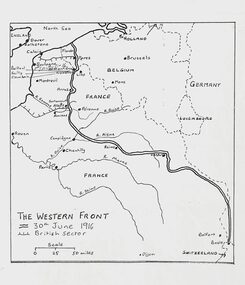
Map - Jack Lockett Collection: Copies of two maps of WW1 Battles
... Belgium remained the focus of the 38th Battalion's activities for the next five months, until it was rushed south to France in late March 1918 to meet the German Army's Spring Offensive. The 38th participated in its last major action of the war between 29 September and 2 October 1918 as part of the Australian-American operation that breached the formidable defences of the Hindenburg Line along the St Quentin Canal. ...Belgium remained the focus of the 38th Battalion's activities for the next five months, until it was rushed south to France in late March 1918 to meet the German Army's Spring Offensive. The 38th participated in its last major action of the war between 29 September and 2 October 1918 as part of the Australian-American operation that breached the formidable defences of the Hindenburg Line along the St Quentin Canal. ...John Henry Lockett OAM (22 January 1891 – 25 May 2002) was the oldest man ever in Australia when he died aged 111 years, 123 days. As one of the last surviving veterans of World War I, he was acclaimed as a national hero during the last decade of his life. Lockett was born in the small Victorian town of Waanyarra, near Bendigo. He left school aged nine to work on a local farm. Later, he worked for his uncles in the Mallee. On 24 March 1916, he travelled to Mildura to enlist in the Australian Imperial Force. He served in France with the 38th Battalion, earning promotion to sergeant and was discharged on 20 September 1919. https://en.wikipedia.org/wiki/Jack_Lockett The 38th Battalion was formed on 1 March 1916 at a camp established on the Epsom Racecourse at Bendigo in Victoria. After training in both Australia and Britain, the 38th Battalion crossed to France in late November 1916 and moved into the trenches of the Western Front for the first time on 1 December.The 38th fought in its first major battle at Messines, in Belgium, between 7-9 June 1917. It fought in another two major attacks in this sector - the battle of Broodseinde on 4 October, and the battle of Passchendaele on 12 October. Belgium remained the focus of the 38th Battalion's activities for the next five months, until it was rushed south to France in late March 1918 to meet the German Army's Spring Offensive. The 38th participated in its last major action of the war between 29 September and 2 October 1918 as part of the Australian-American operation that breached the formidable defences of the Hindenburg Line along the St Quentin Canal. It was disbanded in April 1919. Source, Australian War Memorial https://www.awm.gov.au/collection/U51478 After the war, Jack returned to The Mallee and selected a 640 acres (260 ha) block of land in Linga, Victoria, deciding to make his living as a farmer. In 1923, he married Maybell Ingwerson and they had four children together. In 1963, the couple retired to Bendigo, leaving the farmland (which now covered more than 130,000 acres (53,000 ha), in the care of their children and grandchildren. Two photocopies of hand drawn maps on one A4 sheet of paper. One side labeled THE WESTERN FRONT 30th June 1916 British Sector Scale 1 inch to 50 miles. The Western Front spans from the North Sea to Switzerland. The other side is labeled POZIERES scale 1 inch to 500 yards. July to September 1916. There are numerous roads and trench lines. jack lockett, mabel ingwersen, 38th australian infantry battalion, w.w.1, mallee farming, pozieres 1916, the western front 1916 -
 Bendigo Historical Society Inc.
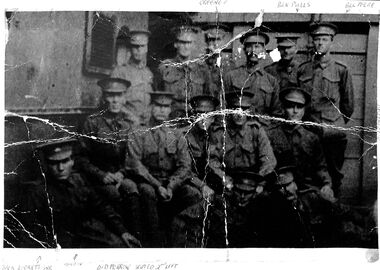
Postcard - Jack Lockett Collection:
... Belgium remained the focus of the 38th Battalion's activities for the next five months, until it was rushed south to France in late March 1918 to meet the German Army's Spring Offensive. The 38th participated in its last major action of the war between 29 September and 2 October 1918 as part of the Australian-American operation that breached the formidable defences of the Hindenburg Line along the St Quentin Canal. ...Belgium remained the focus of the 38th Battalion's activities for the next five months, until it was rushed south to France in late March 1918 to meet the German Army's Spring Offensive. The 38th participated in its last major action of the war between 29 September and 2 October 1918 as part of the Australian-American operation that breached the formidable defences of the Hindenburg Line along the St Quentin Canal. ...John Henry Lockett OAM (22 January 1891 – 25 May 2002) was the oldest man ever in Australia when he died aged 111 years, 123 days. As one of the last surviving veterans of World War I, he was acclaimed as a national hero during the last decade of his life. Lockett was born in the small Victorian town of Waanyarra, near Bendigo. He left school aged nine to work on a local farm. Later, he worked for his uncles in the Mallee. On 24 March 1916, he travelled to Mildura to enlist in the Australian Imperial Force. He served in France with the 38th Battalion, earning promotion to sergeant and was discharged on 20 September 1919. https://en.wikipedia.org/wiki/Jack_Lockett The 38th Battalion was formed on 1 March 1916 at a camp established on the Epsom Racecourse at Bendigo in Victoria. After training in both Australia and Britain, the 38th Battalion crossed to France in late November 1916 and moved into the trenches of the Western Front for the first time on 1 December.The 38th fought in its first major battle at Messines, in Belgium, between 7-9 June 1917. It fought in another two major attacks in this sector - the battle of Broodseinde on 4 October, and the battle of Passchendaele on 12 October. Belgium remained the focus of the 38th Battalion's activities for the next five months, until it was rushed south to France in late March 1918 to meet the German Army's Spring Offensive. The 38th participated in its last major action of the war between 29 September and 2 October 1918 as part of the Australian-American operation that breached the formidable defences of the Hindenburg Line along the St Quentin Canal. It was disbanded in April 1919. Source, Australian War Memorial https://www.awm.gov.au/collection/U51478 After the war, Jack returned to The Mallee and selected a 640 acres (260 ha) block of land in Linga, Victoria, deciding to make his living as a farmer. In 1923, he married Maybell Ingwerson and they had four children together. In 1963, the couple retired to Bendigo, leaving the farmland (which now covered more than 130,000 acres (53,000 ha), in the care of their children and grandchildren. An A4 size copy of a postcard with a black and white photograph of 14 men in army uniforms with some men identified - Greeno, Ben Pulls, Bill McCae, Jack Lockett Snr, Maldon, Dad Morrow. On the back there is a copy of the back of the postcard with handwriting - Dear Boys this a group of my cobbers No 1 section ............Dont loose it, Jack jack lockett, mabel ingwersen, 38th australian infantry battalion, w.w.1, mallee farming -
 Bendigo Historical Society Inc.
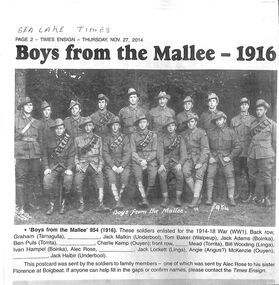
Memorabilia - Jack Lockett Collection: Boys from the Mallee 1916
... Belgium remained the focus of the 38th Battalion's activities for the next five months, until it was rushed south to France in late March 1918 to meet the German Army's Spring Offensive. The 38th participated in its last major action of the war between 29 September and 2 October 1918 as part of the Australian-American operation that breached the formidable defences of the Hindenburg Line along the St Quentin Canal. ...Belgium remained the focus of the 38th Battalion's activities for the next five months, until it was rushed south to France in late March 1918 to meet the German Army's Spring Offensive. The 38th participated in its last major action of the war between 29 September and 2 October 1918 as part of the Australian-American operation that breached the formidable defences of the Hindenburg Line along the St Quentin Canal. ...John Henry Lockett OAM (22 January 1891 – 25 May 2002) was the oldest man ever in Australia when he died aged 111 years, 123 days. As one of the last surviving veterans of World War I, he was acclaimed as a national hero during the last decade of his life. Lockett was born in the small Victorian town of Waanyarra, near Bendigo. He left school aged nine to work on a local farm. Later, he worked for his uncles in the Mallee. On 24 March 1916, he travelled to Mildura to enlist in the Australian Imperial Force. He served in France with the 38th Battalion, earning promotion to sergeant and was discharged on 20 September 1919. https://en.wikipedia.org/wiki/Jack_Lockett The 38th Battalion was formed on 1 March 1916 at a camp established on the Epsom Racecourse at Bendigo in Victoria. After training in both Australia and Britain, the 38th Battalion crossed to France in late November 1916 and moved into the trenches of the Western Front for the first time on 1 December.The 38th fought in its first major battle at Messines, in Belgium, between 7-9 June 1917. It fought in another two major attacks in this sector - the battle of Broodseinde on 4 October, and the battle of Passchendaele on 12 October. Belgium remained the focus of the 38th Battalion's activities for the next five months, until it was rushed south to France in late March 1918 to meet the German Army's Spring Offensive. The 38th participated in its last major action of the war between 29 September and 2 October 1918 as part of the Australian-American operation that breached the formidable defences of the Hindenburg Line along the St Quentin Canal. It was disbanded in April 1919. Source, Australian War Memorial https://www.awm.gov.au/collection/U51478 After the war, Jack returned to The Mallee and selected a 640 acres (260 ha) block of land in Linga, Victoria, deciding to make his living as a farmer. In 1923, he married Maybell Ingwerson and they had four children together. In 1963, the couple retired to Bendigo, leaving the farmland (which now covered more than 130,000 acres (53,000 ha), in the care of their children and grandchildren. A photocopy of an article and photograph headed - PAGE 2 TIMES ENSIGN - THURSDAY, NOV. 2014 (Sea Lake Times?) Boys from the Mallee- 1916. A photograph of a postcard of17 men in Australian Army Uniforms, 10 standing and seven sitting. Names listed Graham (Tarnagulla), Jack Malkin (Underbol), Tom Baker (Walpeup), Jack Adams (Binka), Ben Puls Torria), Charlie Kemp (Ouyen), Mead (Torrita), Bill Wooding (Linga), Ivan Hampel (Boinka), Alec Rose, Jack Locket (Linga) Angus McKenzie (Ouyen), Jack Halbir (Underbool) This postcard was sent by Alec Rose to his sister Florence. dge and Rheola. jack lockett, mabel ingwersen, 38th australian infantry battalion, w.w.1, mallee farming -
 Bendigo Historical Society Inc.
Photograph - Jack Lockett Collection: Five W.W.1 photographs
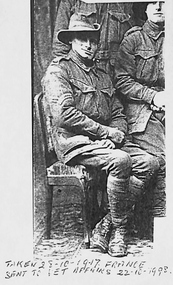
... Belgium remained the focus of the 38th Battalion's activities for the next five months, until it was rushed south to France in late March 1918 to meet the German Army's Spring Offensive. The 38th participated in its last major action of the war between 29 September and 2 October 1918 as part of the Australian-American operation that breached the formidable defences of the Hindenburg Line along the St Quentin Canal. ...Belgium remained the focus of the 38th Battalion's activities for the next five months, until it was rushed south to France in late March 1918 to meet the German Army's Spring Offensive. The 38th participated in its last major action of the war between 29 September and 2 October 1918 as part of the Australian-American operation that breached the formidable defences of the Hindenburg Line along the St Quentin Canal. ...John Henry Lockett OAM (22 January 1891 – 25 May 2002) was the oldest man ever in Australia when he died aged 111 years, 123 days. As one of the last surviving veterans of World War I, he was acclaimed as a national hero during the last decade of his life. Lockett was born in the small Victorian town of Waanyarra, near Bendigo. He left school aged nine to work on a local farm. Later, he worked for his uncles in the Mallee. On 24 March 1916, he travelled to Mildura to enlist in the Australian Imperial Force. He served in France with the 38th Battalion, earning promotion to sergeant and was discharged on 20 September 1919. https://en.wikipedia.org/wiki/Jack_Lockett The 38th Battalion was formed on 1 March 1916 at a camp established on the Epsom Racecourse at Bendigo in Victoria. After training in both Australia and Britain, the 38th Battalion crossed to France in late November 1916 and moved into the trenches of the Western Front for the first time on 1 December.The 38th fought in its first major battle at Messines, in Belgium, between 7-9 June 1917. It fought in another two major attacks in this sector - the battle of Broodseinde on 4 October, and the battle of Passchendaele on 12 October. Belgium remained the focus of the 38th Battalion's activities for the next five months, until it was rushed south to France in late March 1918 to meet the German Army's Spring Offensive. The 38th participated in its last major action of the war between 29 September and 2 October 1918 as part of the Australian-American operation that breached the formidable defences of the Hindenburg Line along the St Quentin Canal. It was disbanded in April 1919. Source, Australian War Memorial https://www.awm.gov.au/collection/U51478 After the war, Jack returned to The Mallee and selected a 640 acres (260 ha) block of land in Linga, Victoria, deciding to make his living as a farmer. In 1923, he married Maybell Ingwerson and they had four children together. In 1963, the couple retired to Bendigo, leaving the farmland (which now covered more than 130,000 acres (53,000 ha), in the care of their children and grandchildren. Five photographs including Jack Lockett a. A photocopy of part of a group photograph, Jack sitting on a chair wearing an Australian Army Uniform. Written underneath - Teken 25-10-1917 France sent to Vet affairs 22-10-1998 b. A black and white photograph of a ship crowed with people on deck with printing - H.M.A.T. "RUNIC" (copyright) 20/6/16 written on the back in blue ink - Private Jack Locket No 1194 D Company 38th Battalion A.I.F. left Port Melbourne pier on Tues 20 June 1916 aboard H.M.A.T. RUNIC bound for England via South Africa. He was below deck peering out of a porthole when the boat pulled away from the pier, as he had the job of guarding some supplies. the arrived in England on (sic) Returning to Australia on Miltides on Mon 17th Feb 1919 as a Sargent Discharged 20 SEPT 1919 c. A very faded sepia tone photograph of four men in Army Uniforms without hats. three sitting and Jack Lockett lying on the man in the middle. Written on the back - JACK LOCKETT LYING ON ONE of His 3 MATES NAMES UNKNOWN FIRST AIF 1914 -1918 GREAT WAR d. A black and white postcard of Jack Lockett in an Australian Army Uniform sitting cross legged in a chair with an image of a forest behind him. Written on the back J H LOCKETT D COY 38 BATT 3DIV NO1194 1stAIF FRANCE e. c. A very faded sepia tone photograph of nine men in Army Uniforms wearing gas masks, six men standing, four men Kneeling in front. Behind them there is a corrugated-iron building. Written on the back - FIRST GAS MASKS W.W. 1 JACK LOCKET 2nd RIGHT STANDING jack lockett, mabel ingwersen, 38th australian infantry battalion, w.w.1, mallee farming, h.m.a.t. runic, gas masks -
 Bendigo Historical Society Inc.
Journal - Jack Lockett Collection: Brief handwritten 38th Battalion Histroy
... Belgium remained the focus of the 38th Battalion's activities for the next five months, until it was rushed south to France in late March 1918 to meet the German Army's Spring Offensive. The 38th participated in its last major action of the war between 29 September and 2 October 1918 as part of the Australian-American operation that breached the formidable defences of the Hindenburg Line along the St Quentin Canal. ...Belgium remained the focus of the 38th Battalion's activities for the next five months, until it was rushed south to France in late March 1918 to meet the German Army's Spring Offensive. The 38th participated in its last major action of the war between 29 September and 2 October 1918 as part of the Australian-American operation that breached the formidable defences of the Hindenburg Line along the St Quentin Canal. ...John Henry Lockett OAM (22 January 1891 – 25 May 2002) was the oldest man ever in Australia when he died aged 111 years, 123 days. As one of the last surviving veterans of World War I, he was acclaimed as a national hero during the last decade of his life. Lockett was born in the small Victorian town of Waanyarra, near Bendigo. He left school aged nine to work on a local farm. Later, he worked for his uncles in the Mallee. On 24 March 1916, he travelled to Mildura to enlist in the Australian Imperial Force. He served in France with the 38th Battalion, earning promotion to sergeant and was discharged on 20 September 1919. https://en.wikipedia.org/wiki/Jack_Lockett The 38th Battalion was formed on 1 March 1916 at a camp established on the Epsom Racecourse at Bendigo in Victoria. After training in both Australia and Britain, the 38th Battalion crossed to France in late November 1916 and moved into the trenches of the Western Front for the first time on 1 December.The 38th fought in its first major battle at Messines, in Belgium, between 7-9 June 1917. It fought in another two major attacks in this sector - the battle of Broodseinde on 4 October, and the battle of Passchendaele on 12 October. Belgium remained the focus of the 38th Battalion's activities for the next five months, until it was rushed south to France in late March 1918 to meet the German Army's Spring Offensive. The 38th participated in its last major action of the war between 29 September and 2 October 1918 as part of the Australian-American operation that breached the formidable defences of the Hindenburg Line along the St Quentin Canal. It was disbanded in April 1919. Source, Australian War Memorial https://www.awm.gov.au/collection/U51478 After the war, Jack returned to The Mallee and selected a 640 acres (260 ha) block of land in Linga, Victoria, deciding to make his living as a farmer. In 1923, he married Maybell Ingwerson and they had four children together. In 1963, the couple retired to Bendigo, leaving the farmland (which now covered more than 130,000 acres (53,000 ha), in the care of their children and grandchildren. An A blue-lined A4 page with black ink handwriting. A brief history of the 38th Battalion A.I.F. from when it was formed 1st March 1916 until returning home on 17th February 1919. A decorated circle is drawn with pencil over the handwriting jack lockett, mabel ingwersen, 38th australian infantry battalion, w.w.1, mallee farming, h.m.a.t. runic, gas masks -
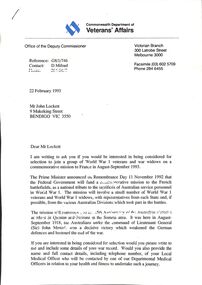 Bendigo Historical Society Inc.
Letter - Jack Lockett Collection: Letter Re Mission to France 1993
... Belgium remained the focus of the 38th Battalion's activities for the next five months, until it was rushed south to France in late March 1918 to meet the German Army's Spring Offensive. The 38th participated in its last major action of the war between 29 September and 2 October 1918 as part of the Australian-American operation that breached the formidable defences of the Hindenburg Line along the St Quentin Canal. ...Belgium remained the focus of the 38th Battalion's activities for the next five months, until it was rushed south to France in late March 1918 to meet the German Army's Spring Offensive. The 38th participated in its last major action of the war between 29 September and 2 October 1918 as part of the Australian-American operation that breached the formidable defences of the Hindenburg Line along the St Quentin Canal. ...John Henry Lockett OAM (22 January 1891 – 25 May 2002) was the oldest man ever in Australia when he died aged 111 years, 123 days. As one of the last surviving veterans of World War I, he was acclaimed as a national hero during the last decade of his life. Lockett was born in the small Victorian town of Waanyarra, near Bendigo. He left school aged nine to work on a local farm. Later, he worked for his uncles in the Mallee. On 24 March 1916, he travelled to Mildura to enlist in the Australian Imperial Force. He served in France with the 38th Battalion, earning promotion to sergeant and was discharged on 20 September 1919. https://en.wikipedia.org/wiki/Jack_Lockett The 38th Battalion was formed on 1 March 1916 at a camp established on the Epsom Racecourse at Bendigo in Victoria. After training in both Australia and Britain, the 38th Battalion crossed to France in late November 1916 and moved into the trenches of the Western Front for the first time on 1 December.The 38th fought in its first major battle at Messines, in Belgium, between 7-9 June 1917. It fought in another two major attacks in this sector - the battle of Broodseinde on 4 October, and the battle of Passchendaele on 12 October. Belgium remained the focus of the 38th Battalion's activities for the next five months, until it was rushed south to France in late March 1918 to meet the German Army's Spring Offensive. The 38th participated in its last major action of the war between 29 September and 2 October 1918 as part of the Australian-American operation that breached the formidable defences of the Hindenburg Line along the St Quentin Canal. It was disbanded in April 1919. Source, Australian War Memorial https://www.awm.gov.au/collection/U51478 After the war, Jack returned to The Mallee and selected a 640 acres (260 ha) block of land in Linga, Victoria, deciding to make his living as a farmer. In 1923, he married Maybell Ingwerson and they had four children together. In 1963, the couple retired to Bendigo, leaving the farmland (which now covered more than 130,000 acres (53,000 ha), in the care of their children and grandchildren. A typed letter on two A4 pages to Jack Lockett Sent from the Commonwealth Department of Veterans Affairs, Office of the Deputy Commissioner, 22 February asking Jack if he wished to be considered for selection to join a commemorative mission to France in August - September 1993. Signed Brian Flynn DEPUTY COMMISSIONER jack lockett, mabel ingwersen, 38th australian infantry battalion, w.w.1, mallee farming, commemorative mission to france 1993, brian flynn -
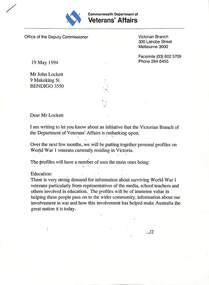 Bendigo Historical Society Inc.
Letter - Jack Lockett Collection: Letter Re Person profiles of W.W.1 veterans
... Belgium remained the focus of the 38th Battalion's activities for the next five months, until it was rushed south to France in late March 1918 to meet the German Army's Spring Offensive. The 38th participated in its last major action of the war between 29 September and 2 October 1918 as part of the Australian-American operation that breached the formidable defences of the Hindenburg Line along the St Quentin Canal. ...Belgium remained the focus of the 38th Battalion's activities for the next five months, until it was rushed south to France in late March 1918 to meet the German Army's Spring Offensive. The 38th participated in its last major action of the war between 29 September and 2 October 1918 as part of the Australian-American operation that breached the formidable defences of the Hindenburg Line along the St Quentin Canal. ...John Henry Lockett OAM (22 January 1891 – 25 May 2002) was the oldest man ever in Australia when he died aged 111 years, 123 days. As one of the last surviving veterans of World War I, he was acclaimed as a national hero during the last decade of his life. Lockett was born in the small Victorian town of Waanyarra, near Bendigo. He left school aged nine to work on a local farm. Later, he worked for his uncles in the Mallee. On 24 March 1916, he travelled to Mildura to enlist in the Australian Imperial Force. He served in France with the 38th Battalion, earning promotion to sergeant and was discharged on 20 September 1919. https://en.wikipedia.org/wiki/Jack_Lockett The 38th Battalion was formed on 1 March 1916 at a camp established on the Epsom Racecourse at Bendigo in Victoria. After training in both Australia and Britain, the 38th Battalion crossed to France in late November 1916 and moved into the trenches of the Western Front for the first time on 1 December.The 38th fought in its first major battle at Messines, in Belgium, between 7-9 June 1917. It fought in another two major attacks in this sector - the battle of Broodseinde on 4 October, and the battle of Passchendaele on 12 October. Belgium remained the focus of the 38th Battalion's activities for the next five months, until it was rushed south to France in late March 1918 to meet the German Army's Spring Offensive. The 38th participated in its last major action of the war between 29 September and 2 October 1918 as part of the Australian-American operation that breached the formidable defences of the Hindenburg Line along the St Quentin Canal. It was disbanded in April 1919. Source, Australian War Memorial https://www.awm.gov.au/collection/U51478 After the war, Jack returned to The Mallee and selected a 640 acres (260 ha) block of land in Linga, Victoria, deciding to make his living as a farmer. In 1923, he married Maybell Ingwerson and they had four children together. In 1963, the couple retired to Bendigo, leaving the farmland (which now covered more than 130,000 acres (53,000 ha), in the care of their children and grandchildren. A typed letter on two A4 pages to Jack Lockett sent from the Commonwealth Department of Veterans Affairs, Office of the Deputy Commissioner, 19 May 1994. It's asking if he would be part of program putting together personal profiles on World War 1 veterans currently residing in Victoria. Signed Brian Flynn, DEPUTY COMMISSIONER jack lockett, mabel ingwersen, 38th australian infantry battalion, w.w.1, mallee farming, profile of w.w.1 veterans, brian flynn
