
Showing 55 items matching "35mm camera"
-
 Lakes Entrance Historical Society
Equipment - Minolta AF Zoom 35mm Camera, Minolta, 1980s
... Minolta AF Zoom 35mm Camera...Silver 35mm camera in black vinyl case...Previous ownener Marie Fish who sold it to Marion Holding in 1990s Photography Minolta on case Silver 35mm camera in black vinyl case Equipment Minolta AF Zoom 35mm Camera Minolta ...Previous ownener Marie Fish who sold it to Marion Holding in 1990sSilver 35mm camera in black vinyl caseMinolta on casephotography -
 National Vietnam Veterans Museum (NVVM)
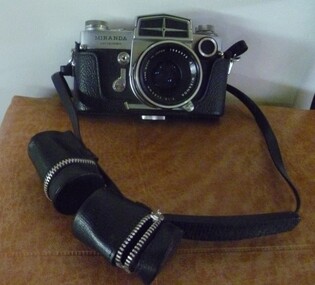
Functional Object - Miranda Sensorex Camera, 35mm, 1969
... Miranda Sensorex Camera, 35mm...Camera...35mm...Black and silver metal and plastic 35mm camera with two empty 35mm cannister holders on strap. ...Functional Object Miranda Sensorex Camera, 35mm Miranda ...Photographic equipment belonging to Pte Garry David Martin (2793230) was a National Serviceman with the Royal Australian Infantry Corps and served in Vietnam with 1 Australian Reinforcement Unit in March 1970, 6th Battalion, The Royal Australian Regiment from April 1970 to May 1970 and the 7th Battalion from May 1970 to March 1971. In an unusual twist of fate, being in Vietnam gave many young Diggers the chance to own the most up-to-date technology, things they could neither get nor afford in Australia. The American PX (Post Exchange) operated like a duty-free department store, stocking everything from toiletries, stationery and snack foods to radios, cameras and small electrical appliances. As a result, servicemen routinely photographed and filmed their activities. Many captured their tours of duty with Kodak’s newest creation – the handheld Super 8 movie camera, released in April 1965. Families in Australia often received these films by post for developing at home. So, they saw exactly the conditions in which their relatives and friends were living and fighting. Compact tape-recorders made it possible for those serving to send news home in talking letters, or to keep their diaries as voice recordings. Black and silver metal and plastic 35mm camera with two empty 35mm cannister holders on strap. Also has a detached zoom lens in case.Miranda Sensorex Ccamera, 35mm, miranda, pte garry david martin, 2793230, australian national serviceman, royal australian infantry corps, 1 australian reinforcement unit, 6th battalion, 7th battalion, the royal australian regiment -
Lakes Entrance Historical Society
Equipment - Nikon 35mm Camera, Nikon, 1970
... Nikon 35mm Camera...Black Nikon camera 35mm and accessories in black vinyl padded camera case with instruction booklet....Equipment Nikon 35mm Camera Nikon ...Camera was purchased by Gladys Scarce prior to departure from Australia for trip around the world in 1970Black Nikon camera 35mm and accessories in black vinyl padded camera case with instruction booklet.Nikonphotography, social history -
Lakes Entrance Historical Society
Functional object - Agfa Silette 35mm Camera, Agfa, c1950
... Agfa Silette 35mm Camera...Photography Agfa Silette Type 3 35 mm camera with brown case and National flash unit with retractable reflector Functional object Agfa Silette 35mm Camera Agfa ...Agfa Silette Type 3 35 mm camera with brown case and National flash unit with retractable reflectorphotography -
 Mont De Lancey
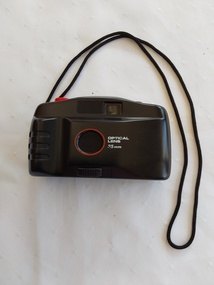
Domestic object - Camera, 1990's
... ...35mm camera...A "no brand" or unbranded 1990s 35mm Optical Lens camera is a generic, mass-produced plastic point-and-shoot. ...A black plastic lightweight no brand 35mm Optical Lens automatic focus camera with a black woven cotton neck cord attached with a black vinyl carry case. ...A "no brand" or unbranded 1990s 35mm Optical Lens camera is a generic, mass-produced plastic point-and-shoot. ...A "no brand" or unbranded 1990s 35mm Optical Lens camera is a generic, mass-produced plastic point-and-shoot. These budget-friendly souvenirs and novelty items were made by contract manufacturers in East Asia and sold or given away under various retail storefront names, promotional campaigns, or blank labels.A black plastic lightweight no brand 35mm Optical Lens automatic focus camera with a black woven cotton neck cord attached with a black vinyl carry case. It has a red line around the covered lens at the front with Optical Lens 35mm printed in white lettering to the right. There is a small lined lever to push to open the lens cover. To use, at the top right is a red push down shutter button. The film winder is at the top left. There is a silver metal fixture next to this for a flash to be attached. The lined lever at the side slides up to open the back to reveal internally where to insert the film spool is inserted and wound onto a spool. The lens is seen from inside. It has a black plastic fold over cover which is closed with black velcro tabs.A sticker on the bottom says 'Made in China' Inside the back cover is printed 'UK Reg. 2007256 Copyright 1990'film cameras, autofocus cameras, pocket cameras, 35mm camera -
 Mont De Lancey
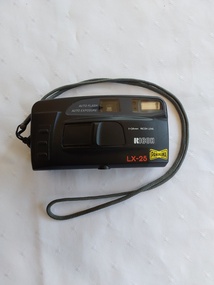
Domestic object - Camera, Ricoh, 1993
... ...35mm camera...Ricoh is a Japanese company founded in Tokyo in 1936 that historically manufactured many iconic cameras, watches, and office equipment in Japan. The Ricoh LX-25 is a fixed-focus 35mm compact point-and-shoot film camera released in August 1993. ...Film cameras Autofocus cameras Pocket cameras 35mm camera On the top front of the camera is printed: 'Auto Flash Auto Exposure' On the main body is printed: 'f=34mm Ricoh lens RICOH LX-25 Panorama' The top of the camera has printed: 'P' (for the Panorama setting.) ...Ricoh is a Japanese company founded in Tokyo in 1936 that historically manufactured many iconic cameras, watches, and office equipment in Japan. The Ricoh LX-25 is a fixed-focus 35mm compact point-and-shoot film camera released in August 1993. It features a 34mm f/4.5 lens, a switchable panorama mode, and an automatic flash. It has a switchable format that masks the top and bottom of the frame to create a panoramic aspect ratio.A RICOH LX-25 Panorama camera made from black plastic with silver metal parts inside. The brand is printed at the bottom right at the front, with Panorama in a yellow shape. The viewfinder is on the back with a grey button on the top right which is pressed to take the picture. The flash on the front is protected by a clear plastic lined cover. A grey cotton cord holder is connected to a black vinyl carry case.On the top front of the camera is printed: 'Auto Flash Auto Exposure' On the main body is printed: 'f=34mm Ricoh lens RICOH LX-25 Panorama' The top of the camera has printed: 'P' (for the Panorama setting.) On the bottom is printed; ' 'LX-25' D D 130279 RICOH Company, Ltd. Taiwan R.O.C.'film cameras, autofocus cameras, pocket cameras, 35mm camera -
 National Vietnam Veterans Museum (NVVM)
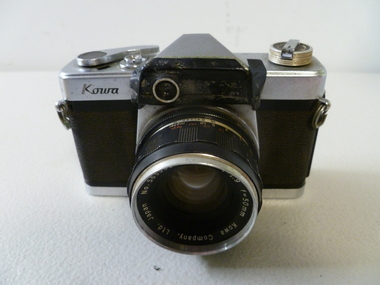
Functional Object - Camera, 35mm
... Camera, 35mm...Camera...Denis Gibbons...35mm...Functional Object Camera, 35mm Kowa Company Ltd ...This camera was used by Denis Gibbons, who photographed the Vietnam tours of nine Australian infantry battalions for Fairfax press and United Press International between 1966 and 1970.Black and silver Kowa camera. No straps. Black duct tape on back.Kowa 1:1:9 =50mmcamera, denis gibbons, 35mm, war photographer, gibbons -
 National Vietnam Veterans Museum (NVVM)
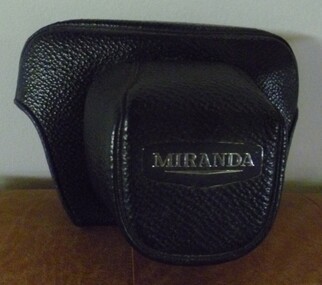
Functional Object - Miranda Leather Camera Case
... ...Camera...35mm...Compact tape-recorders made it possible for those serving to send news home in talking letters, or to keep their diaries as voice recordings. Miranda Camera 35mm Pte Garry David Martin 2793230 Australian National Serviceman Royal Australian Infantry Corps 1 Australian Reinforcement Unit 6th Battalion 7th Battalion The Royal Australian Regiment Miranda Black leather look, vinyl case with burgundy velvet lining Functional Object Miranda Leather Camera Case ...Photographic equipment belonging to Pte Garry David Martin (2793230) was a National Serviceman with the Royal Australian Infantry Corps and served in Vietnam with 1 Australian Reinforcement Unit in March 1970, 6th Battalion, The Royal Australian Regiment from April 1970 to May 1970 and the 7th Battalion from May 1970 to March 1971. In an unusual twist of fate, being in Vietnam gave many young Diggers the chance to own the most up-to-date technology, things they could neither get nor afford in Australia. The American PX (Post Exchange) operated like a duty-free department store, stocking everything from toiletries, stationery and snack foods to radios, cameras and small electrical appliances. As a result, servicemen routinely photographed and filmed their activities. Many captured their tours of duty with Kodak’s newest creation – the handheld Super 8 movie camera, released in April 1965. Families in Australia often received these films by post for developing at home. So, they saw exactly the conditions in which their relatives and friends were living and fighting. Compact tape-recorders made it possible for those serving to send news home in talking letters, or to keep their diaries as voice recordings.Black leather look, vinyl case with burgundy velvet liningMirandamiranda, camera, 35mm, pte garry david martin, 2793230, australian national serviceman, royal australian infantry corps, 1 australian reinforcement unit, 6th battalion, 7th battalion, the royal australian regiment -
 Whitehorse Historical Society Inc.
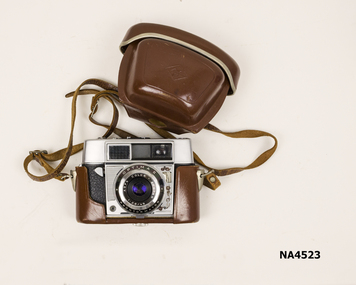
Equipment - Camera
... AGFA OPTIMA II PRONTORMATOR 35mm camera|Lens AGFA COLOR - APOTAR 1:2.8/45 2. ...AGFA OPTIMA II PRONTORMATOR 35mm camera|Lens AGFA COLOR - APOTAR 1:2.8/45 2. ...The camera was used by donor's late Auntie Hazel Porter on some overseas holidays notably Women's Weekly World Discovery Tour in February-June 1974, which included Japan, United Kingdom, Europe and South Africa. This was a voyage on the P&O liner Himalaya. Also a trip to China in 1979 and Germany in 1980. The camera was mainly used for slides.1. AGFA OPTIMA II PRONTORMATOR 35mm camera|Lens AGFA COLOR - APOTAR 1:2.8/45 2. The camera has a brown leather case also an illustrated manual.photography, cameras -
 Anglesea and District Historical Society
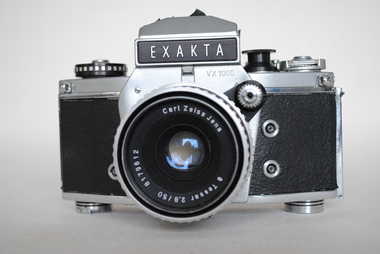
Camera "Exakta VX 1000", Ihagee Kamerawerk Steenbergen Co, Estimated 1967-70
... Black and silver film (35mm) camera including bottom of case (leather). ...camera film exakta EXAKTA VX1000 aus Dresden Black and silver film (35mm) camera including bottom of case (leather). ...Black and silver film (35mm) camera including bottom of case (leather). The lens is Carl Zeiss Jena - Tessar. 2.8/50. The EXAKTA camera is from Dresden and is a pioneer brand camera produced by Ihagee Kamerawerk. This camera is a small format 135 EXAKTA VX1000 camera.EXAKTA VX1000 aus Dresdencamera, film, exakta -
 Anglesea and District Historical Society
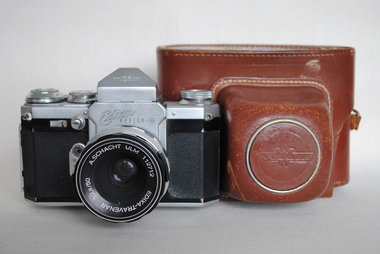
Edixa Reflex "B" Camera, 1959
... camera...film...35mm...It is a standard lens for 35mm cameras in the M42 mount and built for the Wirgin-Edixa cameras during 1950-1970's by Albert Schact in Ulm, W. ...camera film 35mm slr Front: WIRGIN / EDIXA REFLEX - B. ...Edixa Reflex camera's introduced in 1954 were West Germany's most popular own series of S.L.R. (single lens reflex) with focal plane shutter. Type "B" with aperture release mechanics. The lens is a.Schacht Ulm 112712, with manual focus. Focal length = 50mm. Maximum. aperture = f/2.8, minimum aperture = f/22. Minimum focus 0.5m. It is a standard lens for 35mm cameras in the M42 mount and built for the Wirgin-Edixa cameras during 1950-1970's by Albert Schact in Ulm, W. Germany. A brown case in included.Front: WIRGIN / EDIXA REFLEX - B. Lens: A.SCHACHT ULM. 112712 / EXIDA-TRAVENAR 1:2,8/50 Bottom: WIRGIN WIESBADEN WEST-GERMANYcamera, film, 35mm slr -
 Whitehorse Historical Society Inc.
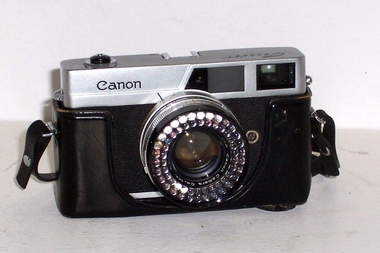
Functional object - Camera, 1961
... Canon Canonet 35mm camera with light meter around and Cannon Lens SE,45mm,1.19. ...Coronet was first popular- class camera released in 1961 as distinct from the high and expensive class. photography cameras Canon Canonet, Canon Camera Co Inc made in Japan Canon Canonet 35mm camera with light meter around and Cannon Lens SE,45mm,1.19. ...Coronet was first popular- class camera released in 1961 as distinct from the high and expensive class.Canon Canonet 35mm camera with light meter around and Cannon Lens SE,45mm,1.19. Made by Canon Camera co Inc. speed B(bulb) to one 500th for a second (11 settings), auto made and 'f' setting from 1.9 to 16. Self timer. Camera has a steel base with a satin chrome finish and a leatherette band around camera. Rewind lever and film forward lever on back.Camera has leather carry case in two pieces and strap. Provision for a flash to be fitted. Three items in the set.Canon Canonet, Canon Camera Co Inc made in Japanphotography, cameras -
 Department of Energy, Environment and Climate Action
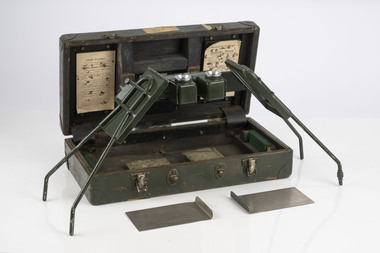
Stereoscope
... Simple, cheap and rapid methods of obtaining photographs using 70mm and 35mm cameras were developed...Simple, cheap and rapid methods of obtaining photographs using 70mm and 35mm cameras were developed Forests Commission Victoria (FCV) Surveying Forest measurement Foldable metal stereoscope in wooden box with mirror covers Ex Dept of Defence Stereoscope ...This stereoscope was used to view a pair of separate and overlapping aerial photos as a single three-dimensional image. Smaller units and could be easily used in the field but this larger, mirror stereoscope was used in offices. The aerial images were used to map forest types, timber stands, new roads and tracks, firebreaks, boundaries of timber harvesting, plantations, bushfires, insect and disease attack and so on In 1928, the Forests Commission undertook its first major aerial photography project over 15,000 acres of forest which is said to be the first of its kind in Australia. During the Second World War, large areas of Victoria were photographed by the RAAF and used to produce orthophoto maps. By 1945 aerial photography of 13,000 square miles (3.4 M ha) was completed, including much of the inaccessible eastern forests. The Forests Commission started developing its own small format photography in the early 1970s. Simple, cheap and rapid methods of obtaining photographs using 70mm and 35mm cameras were developedFoldable metal stereoscope in wooden box with mirror covers Ex Dept of Defenceforests commission victoria (fcv), surveying, forest measurement -
 Department of Energy, Environment and Climate Action
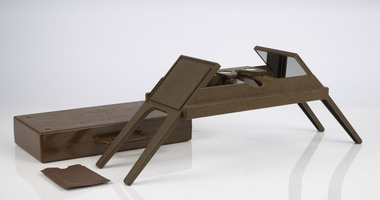
Foldable Stereoscope
... Simple, cheap and rapid methods of obtaining photographs using 70mm and 35mm cameras were developed...Simple, cheap and rapid methods of obtaining photographs using 70mm and 35mm cameras were developed Forests Commission Victoria (FCV) Surveying Forest measurement Benalla Foldable plastic stereoscope in box Foldable Stereoscope ...This stereoscope was used to view a pair of separate and overlapping aerial photos as a single three-dimensional image. This smaller foldable unit could be easily used in the field but larger, mirror stereoscope was used in offices. The aerial images were used to map forest types, timber stands, new roads and tracks, firebreaks, boundaries of timber harvesting, plantations, bushfires, insect and disease attack and so on In 1928, the Forests Commission undertook its first major aerial photography project over 15,000 acres of forest which is said to be the first of its kind in Australia. During the Second World War, large areas of Victoria were photographed by RAAF and used to produce orthophoto maps. By 1945 aerial photography of 13,000 square miles (3.4 M ha) was completed, including much of the inaccessible eastern forests. The Forests Commission started developing its own small format photography in the early 1970s. Simple, cheap and rapid methods of obtaining photographs using 70mm and 35mm cameras were developedFoldable plastic stereoscope in box Benallaforests commission victoria (fcv), surveying, forest measurement -
 Department of Energy, Environment and Climate Action
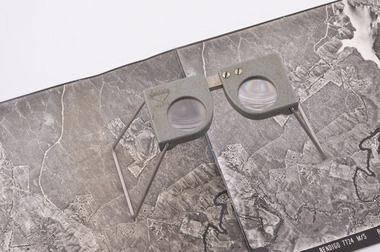
Pocket Stereoscope
... Simple, cheap and rapid methods of obtaining photographs using 70mm and 35mm cameras were developed ...Simple, cheap and rapid methods of obtaining photographs using 70mm and 35mm cameras were developed Forest measurement Surveying Forests Commission Victoria (FCV) Sokkisha Tokyo Small pocket stereoscope to interprete aerial photographs in the field Adjustable lenses on foldaway wire legs Pocket Stereoscope ...This pocket stereoscope was used to view a pair of separate and overlapping aerial photos as a single three-dimensional image. It was small and could be easily used in the field. Larger, mirror stereoscope were also available in some offices. The aerial images were used to map forest types, timber stands, new roads and tracks, firebreaks, boundaries of timber harvesting, plantations, bushfires, insect and disease attack and so on In 1928, the Forests Commission undertook its first major aerial photography project over 15,000 acres of forest which is said to be the first of its kind in Australia. During the Second World War, large areas of Victoria were photographed by RAAF and used to produce orthophoto maps. By 1945 aerial photography of 13,000 square miles (3.4 M ha) was completed, including much of the inaccessible eastern forests. The Forests Commission started developing its own small format photography in the early 1970s. Simple, cheap and rapid methods of obtaining photographs using 70mm and 35mm cameras were developed Small pocket stereoscope to interprete aerial photographs in the field Adjustable lenses on foldaway wire legsSokkisha Tokyoforest measurement, surveying, forests commission victoria (fcv) -
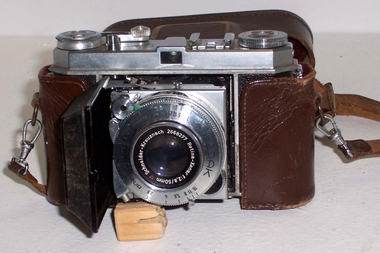 Whitehorse Historical Society Inc.
Equipment - Camera, 1951-1954
... Kodak Retina 1a 35mm bellows camera with extending bellows, in a leather case (.02) and an Instruction book (in German .03). ...photography cameras Kodak Retina Camera|Retina 1a|Kodak Kodak Retina 1a 35mm bellows camera with extending bellows, in a leather case (.02) and an Instruction book (in German .03). ...Kodak Retina 1a 35mm bellows camera with extending bellows, in a leather case (.02) and an Instruction book (in German .03). The camera has a chrome trim with leatherette over the rest of the steel forming the body of the camera. It has a Retina Xenar F 2.8/50mm, Schneider - Kreuznach 2668277 lens covering speeds from B (bulb) to 1/500th of a second and an aperture opening of f2.8 to f16. Provision for a hot flash and various film speeds. Film advance lever with indicator showing number of photos taken. An old cartridge (.04) is loaded in the camera. Four pieces make the set.Kodak Retina Camera|Retina 1a|Kodakphotography, cameras -
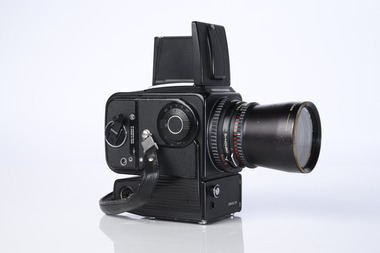 Department of Energy, Environment and Climate Action
Hasselblad aerial camera
... From the mid-1960s Victorian foresters began experimenting with small format 70mm and 35mm cameras which proved simple, practical, cheap and flexible. ...From the mid-1960s Victorian foresters began experimenting with small format 70mm and 35mm cameras which proved simple, practical, cheap and flexible. ...Aerial photos were used to make maps of forest types, timber resources, to survey logging areas and regeneration, to mark boundaries of public land and new plantations, to identify new roads and tracks, as well as for fire suppression. Infrared film was sometimes used to monitor insect and disease attack. The images needed to sharp, with high contrast, and in a large format (most were printed in B&W on 9-inch by 9-inch glossy photographic paper) with at least a 60% overlap to enable stereoscopic viewing and with a 20-30% side lap to allow for aircraft drift. Preferably, the photo scale was close to the final map scale avoid to problems when enlarging and to reduce distortion. Something was needed to supplement the very expensive and infrequent large-area photography programs. From the mid-1960s Victorian foresters began experimenting with small format 70mm and 35mm cameras which proved simple, practical, cheap and flexible. It was found that any SLR camera could be used provided it had a good quality lens and fast shutter speed (preferably down to 1/1000 second). Motorised cameras with a large film capacity had obvious advantages and were essential when access to the camera was not possible during flight. It is also essential for the shutter to operate at low temperatures and those lubricated with silicones were recommended. Components of a typical FCV Divisional Office system included – A Hasselblad or Vinten 70 mm format aerial camera with a focal plane shutter which could be electrically operated. Interchangeable lenses to allow for different photo scales and flying heights. Several large film magazines, which were loaded in a darkroom, each with a capacity of 100 feet or approximately 500 frames. A remote control for the camera in single-shot mode or automatic firing at selected intervals of 2 to 50 seconds. It also needed a frame counter. A light aircraft was modified with an internal mounting for the camera to keep it level and steady. Often a hole was cut through the floor for the lens. The aircraft also needed an inbuilt 12 Volt DC battery to operate the motorised camera shutter. The front passenger seat was generally removed to improve access to the camera. An Aldis drift sight was also fitted. This might be likened to an inverted periscope and is used to determine drift, to facilitate accurate navigation along flight lines and to determine the exposure interval for stereoscopic overlap. This item is kept at Traralgon.Hasselblad 500 ELM camera with 70mm lens, film pack, motor drive and battery In 1964 Hasselblad started production of a motorized camera, the 500 EL The EL/M is a modified version of the EL, "M" means modified, "EL" electric. Perhaps the most famous use of the Hasselblad camera was during the Apollo program missions when man first landed on the Moon. Almost all of the still photographs taken during these missions used modified Hasselblad cameras. forests commission victoria (fcv), forest measurement, surveying, mapping -
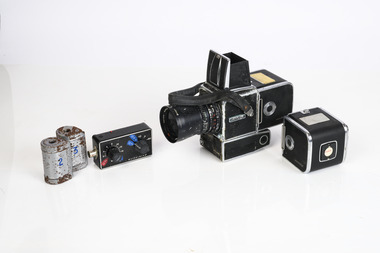 Department of Energy, Environment and Climate Action
Hasselblad aerial camera with carry case, spare batteries, and film cases (overall poor condtion)
... From the mid-1960s Victorian foresters began experimenting with small format 70mm and 35mm cameras which proved simple, practical, cheap and flexible. ...From the mid-1960s Victorian foresters began experimenting with small format 70mm and 35mm cameras which proved simple, practical, cheap and flexible. ...Aerial photos were used to make maps of forest types, timber resources, to survey logging areas and regeneration, to mark boundaries of public land and new plantations, to identify new roads and tracks, as well as for fire suppression. Infrared film was sometimes used to monitor insect and disease attack. The images needed to sharp, with high contrast, and in a large format (most were printed in B&W on 9-inch by 9-inch glossy photographic paper) with at least a 60% overlap to enable stereoscopic viewing and with a 20-30% side lap to allow for aircraft drift. Preferably, the photo scale was close to the final map scale avoid to problems when enlarging and to reduce distortion. Something was needed to supplement the very expensive and infrequent large-area photography programs. From the mid-1960s Victorian foresters began experimenting with small format 70mm and 35mm cameras which proved simple, practical, cheap and flexible. It was found that any SLR camera could be used provided it had a good quality lens and fast shutter speed (preferably down to 1/1000 second). Motorised cameras with a large film capacity had obvious advantages and were essential when access to the camera was not possible during flight. It is also essential for the shutter to operate at low temperatures and those lubricated with silicones were recommended. Components of a typical FCV Divisional Office system included – A Hasselblad or Vinten 70 mm format aerial camera with a focal plane shutter which could be electrically operated. Interchangeable lenses to allow for different photo scales and flying heights. Several large film magazines, which were loaded in a darkroom, each with a capacity of 100 feet or approximately 500 frames. A remote control for the camera in single-shot mode or automatic firing at selected intervals of 2 to 50 seconds. It also needed a frame counter. A light aircraft was modified with an internal mounting for the camera to keep it level and steady. Often a hole was cut through the floor for the lens. The aircraft also needed an inbuilt 12 Volt DC battery to operate the motorised camera shutter. The front passenger seat was generally removed to improve access to the camera. An Aldis drift sight was also fitted. This might be likened to an inverted periscope and is used to determine drift, to facilitate accurate navigation along flight lines and to determine the exposure interval for stereoscopic overlap. This item was found in storage at the Beechworth museum and its in poor condtionHasselblad 500 ELM camera with 70mm lens, film pack, motor drive and battery In 1964 Hasselblad started production of a motorized camera, the 500 EL The EL/M is a modified version of the EL, "M" means modified, "EL" electric. Perhaps the most famous use of the Hasselblad camera was during the Apollo program missions when man first landed on the Moon. Almost all of the still photographs taken during these missions used modified Hasselblad cameras. forests commission victoria (fcv), forest measurement, surveying, mapping -
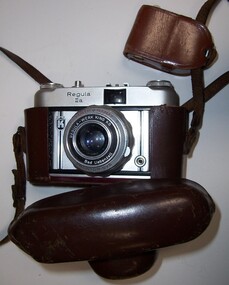 Glenelg Shire Council Cultural Collection
Functional object - Regula IIIa Camera with Case and Light Reader, Regula, Germany, 1956-1959
... The King Regula III series were a range of 35mm viewfinder and rangefinder cameras made by King between 1956-1959. ...The King Regula III series were a range of 35mm viewfinder and rangefinder cameras made by King between 1956-1959. ...Displayed in History House. The King Regula III series were a range of 35mm viewfinder and rangefinder cameras made by King between 1956-1959. The Regula III series models all have a similar look and have a characteristic front plate. This is a flat rectangular Eloxal (ELectrolytic OXidation of ALuminum) plate, with distinctive chrome-black-chrome stripes each side. The King logo is at the top of the left-hand stripe, and a PC flash sync connector on the bottom right stripe. The other common things across the range are the film advance/film counter lever, a "cold" accessory shoe, rewind knob, 1/4" tripod socket, textured leatherette and having the model name engraved on the front of the camera. The film counter on all models is on the film advance lever but has a reliability issue, it relies on a tiny rod in the film advance lever, and a fixed rod on the camera body pushing against each other every time the lever is advanced; the problem is the rods are so small that they wear down with repeated use until the film counter stops working.Regula IIIa Camera Regula IIIa is a basic viewfinder camera with a Prontor-SVS shutter, but no focus aids, light meter, frame lines in the viewfinder or strap lugs on the body. 367.1 - Single lens reflex camera. 367.2 - Light metre in leather case. 367.3 - Brown leather case.Front: Regula-werk king KG/Bad Liebenzell/Prontor - SVS (on lens) Regula/IIIa (on body)camera, photography -
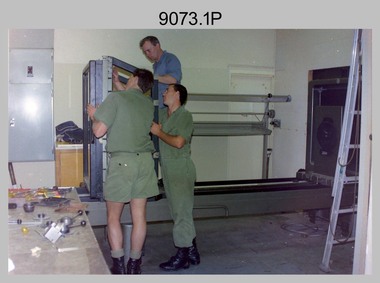 Bendigo Military Museum
Photograph - Personnel dismantling the Consolidation Camera at the Army Survey Regiment, Fortuna, Bendigo, 1989
... This is a set of four photograph of Lithographic Squadron personnel dismantling the Consolidation Camera at the Army Survey Regiment, Fortuna, Bendigo, in December 1989. The photographs are on 35mm negative film and scanned at 96 dpi. ...King addressed to the Unit Historian CPL Ian Nelson at para 1a: describes the item: ‘frames 12 to 16 – dismantling of the Consolidation Camera during Dec 89’ This is a set of four photograph of Lithographic Squadron personnel dismantling the Consolidation Camera at the Army Survey Regiment, Fortuna, Bendigo, in December 1989. The photographs are on 35mm negative film and scanned at 96 dpi. ...These four photographs of Photo Troop personnel dismantling the Consolidation Camera was taken in December 1989. The camera was removed from Lithographic Squadron’s BARCRO work area. Analogue large format cameras had become obsolete with the introduction of digital generation large format digital scanners and computer-based post processing of photography.This is a set of four photograph of Lithographic Squadron personnel dismantling the Consolidation Camera at the Army Survey Regiment, Fortuna, Bendigo, in December 1989. The photographs are on 35mm negative film and scanned at 96 dpi. They are part of the Army Survey Regiment’s Collection. .1) - Photo, colour, 1989, L to R: Doug Whiteside, John Bragg and Andrew ‘Morrie’ Morrison-Evans dismantling the Consolidation Camera. .2) - Photo, colour, 1989, Consolidation Camera. .3) - Photo, colour, 1989, L to R: Andrew ‘Morrie’ Morrison-Evans, Doug Whiteside, John Bragg and Greg Howell dismantling the Consolidation Camera. .4) - Photo, colour, 1989, L to R: Terry King, John Bragg, Andrew ‘Morrie’ Morrison-Evans and Doug Whiteside dismantling the Consolidation Camera.No personnel are identified. A Minute written by CPL T. King addressed to the Unit Historian CPL Ian Nelson at para 1a: describes the item: ‘frames 12 to 16 – dismantling of the Consolidation Camera during Dec 89’royal australian survey corps, rasvy, army survey regiment, army svy regt, fortuna, litho -
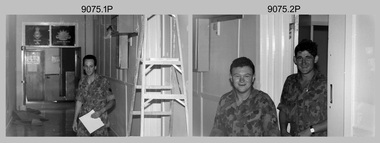 Bendigo Military Museum
Photograph - Lithographic Squadron Personnel and Equipment, Army Survey Regiment, Fortuna, Bendigo, 1991
... 35mm negative film and scanned at 96 dpi. They are part of the Army Survey Regiment’s Collection. .1) - Photo, black & white, 1991, SGT Stuart Ridge. .2) - Photo, black & white, 1991, L to R: CPL Gavin Craggs, SPR Shane ‘Smiley’ Campbell. .3) - Photo, black & white, 1991, CPL Penny Knott. .4) & .5) - Photo, black & white, 1991, L to R: WO1 Peter Barrett, WO2 Jeff Willey, WO1 Peter Coombes. .6) - Photo, black & white, 1991, L to R: WO1 Peter Coombes, CPL Peter Swandale. .7) - Photo, black & white, 1991, CPL Terry King operating the large format KLIMSCH Commodore camera. .8) - Photo, black & white, 1991, map proof output on the large format Focus colour film/paper processor. .9) - Photo, black & white, 1991, SPR Ross Anza operating the large format Gemini 1250 Large Format Platemaking Processor. .10) - Photo, black & white, 1991, SPR Ross Anza operating the large format platemaking contact frame....Camera, Contacting, Printing and Production Control work areas, as well as outside Litho’s buildings. Although these photos are not annotated most personnel are positively identified. Royal Australian Survey Corps RASvy Army Survey Regiment Army Svy Regt Fortuna Litho No personnel are identified. This is a set of 10 photographs of Lithographic Squadron personnel and equipment at the Army Survey Regiment, Fortuna, Bendigo, 1991. The black & white photographs are on 35mm ...This collection of 10 photos of Lithographic Squadron ‘Litho’ personnel and equipment was taken at the Army Survey Regiment, Fortuna, Bendigo, in 1991. The photos were mainly taken in the Camera, Contacting, Printing and Production Control work areas, as well as outside Litho’s buildings. Although these photos are not annotated most personnel are positively identified.This is a set of 10 photographs of Lithographic Squadron personnel and equipment at the Army Survey Regiment, Fortuna, Bendigo, 1991. The black & white photographs are on 35mm negative film and scanned at 96 dpi. They are part of the Army Survey Regiment’s Collection. .1) - Photo, black & white, 1991, SGT Stuart Ridge. .2) - Photo, black & white, 1991, L to R: CPL Gavin Craggs, SPR Shane ‘Smiley’ Campbell. .3) - Photo, black & white, 1991, CPL Penny Knott. .4) & .5) - Photo, black & white, 1991, L to R: WO1 Peter Barrett, WO2 Jeff Willey, WO1 Peter Coombes. .6) - Photo, black & white, 1991, L to R: WO1 Peter Coombes, CPL Peter Swandale. .7) - Photo, black & white, 1991, CPL Terry King operating the large format KLIMSCH Commodore camera. .8) - Photo, black & white, 1991, map proof output on the large format Focus colour film/paper processor. .9) - Photo, black & white, 1991, SPR Ross Anza operating the large format Gemini 1250 Large Format Platemaking Processor. .10) - Photo, black & white, 1991, SPR Ross Anza operating the large format platemaking contact frame.No personnel are identified.royal australian survey corps, rasvy, army survey regiment, army svy regt, fortuna, litho -
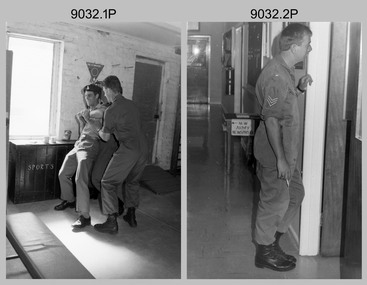 Bendigo Military Museum
Photograph - Staff Activities – Lithographic Squadron, Army Survey Regiment, Fortuna, Bendigo, Staff Activities – Lithographic Squadron, Army Survey Regiment, Fortuna, Bendigo, c1990
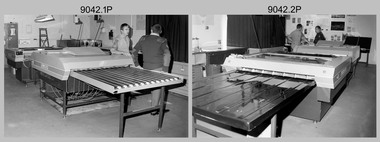
... Camera, Contacting Printing BARCRO, Print Room and Production Control work areas, as well as outside the buildings. Although these photos are not annotated most personnel are positively identified. Photo 6032.23 is an enlargement of 6072.5P. See item 9042.12P for more photos of Lithographic Squadron staff activities. Royal Australian Survey Corps RASvy Fortuna Army Survey Regiment Litho No personnel are identified This is a set of 32 photographs of Lithographic Squadron and staff from other squadrons undertaking various tasks at the Army Survey Regiment, Fortuna, Bendigo, 1990. The photographs are on 35mm ...This collection of 32 photos was most likely taken in Lithographic Squadron at the Army Survey Regiment, Fortuna, Bendigo, circa 1990. The photos were taken in the Camera, Contacting Printing BARCRO, Print Room and Production Control work areas, as well as outside the buildings. Although these photos are not annotated most personnel are positively identified. Photo 6032.23 is an enlargement of 6072.5P. See item 9042.12P for more photos of Lithographic Squadron staff activities.This is a set of 32 photographs of Lithographic Squadron and staff from other squadrons undertaking various tasks at the Army Survey Regiment, Fortuna, Bendigo, 1990. The photographs are on 35mm negative film and scanned at 96 dpi. They are part of the Army Survey Regiment’s Collection. .1) - Photo, black & white, c1990, L to R: SGT Frank Lenane, SPR Shane ‘Soupy’ Campbell. .2) - Photo, black & white, c1990, SGT Dale Hudson. .3) - Photo, black & white, c1990, L to R: SGT Paul Baker, SSGT Peter Imeson, SSGT Allan Virtue. .4) - Photo, black & white, c1990, L to R: SGT SGT Bob Garritty, WO2 Bill Jones. .5)- Photo, black & white, c1990, CPL Pat Drury submitting a work request. .6) - Photo, black & white, c1990, SGT Steve Burke. .7) - Photo, black & white, c1990, WO2 Rob Bogumil. .8) - Photo, black & white, c1990, L to R: SPR Nick van der Zwan, SPR Damien Cole, in foreground – SPR Andrew Morrison-Evans, SPR Greg Howell. .9) - Photo, black & white, c1990, L to R: WO2 Rob Bogumil, SGT Paul Baker, SPR Damien Cole, CPL Chad Hardwick. .10) - Photo, black & white, c1990, L to R: SGT Paul Baker, SGT Brian Fauth. .11) - Photo, black & white, c1990, SSGT Ian Nichols. .12) - Photo, black & white, c1990, Unidentified. .13) - Photo, black & white, c1990, L to R: CPL Lance Strudwick, SGT Steve Burke, unidentified, SGT Gary Kerr, SSGT Ian Nichols. .14) - Photo, black & white, c1990, SPR Andrew Morrison-Evans. .15) - Photo, black & white, c1990, CPL Warren ‘Waldo’ Shirley. .16) - Photo, black & white, c1990, L to R: SGT Steve Burke, WO2 Bill Jones, unidentified. .17) - Photo, black & white, c1990, SSGT Peter Imeson. .18) - Photo, black & white, c1990, SGT Frank Lenane. .19) - Photo, black & white, c1990, SGT Brian Fauth. .20) - Photo, black & white, c1990, LT Craig Hersant. .21)- Photo, black & white, c1990, CPL Pat Drury submitting another work request. .22) - Photo, black & white, c1990, SPR Greg Howell. .23) - Photo, black & white, c1980s, L to R: SPR Colin Yeats, SPR Graeme Spong, CPL Peter Dillon, duplicate of 6072.5P. .24) - Photo, black & white, c1990, SGT Bob Garritty. .25) - Photo, black & white, c1990, WO2 Rob Bogumil. .26) - Photo, black & white, c1990, L to R: SGT Steve Burke and SPR Darren ‘Barney’ Maher’s novel technical solution to a jammed laminator. .27) - Photo, black & white, c1990, Newly promoted CAPT Colin Cuskelly epaulettes in readiness to receive his Captain’s rank. .28) to .30) - Photo, black & white, c1990, L to R: CPL Warren ‘Waldo’ Shirley, SGT Graham Hales. .31) - Photo, black & white, c1990, LCPL Nicole Midgley. .32) - Photo, black & white, c1990, L to R: unidentified (x2).No personnel are identifiedroyal australian survey corps, rasvy, fortuna, army survey regiment, litho -
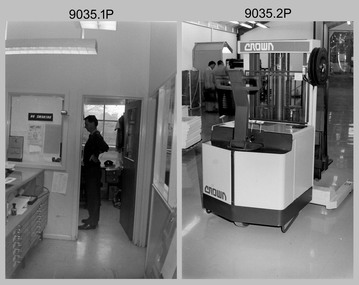 Bendigo Military Museum
Photograph - Staff Activities – Lithographic Squadron, Army Survey Regiment, Fortuna, Bendigo, Staff Activities – Lithographic Squadron, Army Survey Regiment, Fortuna, Bendigo, 1989
... Camera, Contacting Printing BARCRO, Print Room and Production Control work areas, as well as outside the buildings. Although these photos are not annotated most personnel are positively identified. Royal Australian Survey Corps RASvy Fortuna Army Survey Regiment Litho No personnel are identified This is a set of 12 photographs of Lithographic Squadron and staff from other squadrons undertaking various tasks at the Army Survey Regiment, Fortuna, Bendigo, 1989. The photographs are on 35mm ...This collection of 12 photos was most likely taken in Lithographic Squadron at the Army Survey Regiment, Fortuna, Bendigo, in 1989. The photos were taken in the Camera, Contacting Printing BARCRO, Print Room and Production Control work areas, as well as outside the buildings. Although these photos are not annotated most personnel are positively identified.This is a set of 12 photographs of Lithographic Squadron and staff from other squadrons undertaking various tasks at the Army Survey Regiment, Fortuna, Bendigo, 1989. The photographs are on 35mm negative film and scanned at 96 dpi. They are part of the Army Survey Regiment’s Collection. .1) - Photo, black & white, 1989, WO2 Bill Jones. .2) - Photo, black & white, 1989, Crown forklift. Unidentified visitors in background. .3) & .4) - Photo, black & white, 1989, LT Craig Hersant. .5)- Photo, black & white, 1989, SPR Geoff Webb. .6) - Photo, black & white, 1989, L to R: SGT Jeff Willey, SGT Steve Egan, unidentified, CPL John ‘Flash’ Anderson, CPL Dale Hudson. .7) - Photo, black & white, 1989, L to R: WO2 Dave Miles, WO2 Peter Barrett. .8) - Photo, black & white, 1989, SGT Brian Fauth. .9) - Photo, black & white, 1989, LT Colin Davidson. .10) - Photo, black & white, 1989, SGT Steve Burke. .11) - Photo, black & white, 1989, SPR John Bragg. .12) - Photo, black & white, 1989, SGT Brian Paul.No personnel are identifiedroyal australian survey corps, rasvy, fortuna, army survey regiment, litho -
 Bendigo Military Museum
Photograph - Staff Activities – Lithographic Squadron, Army Survey Regiment, Fortuna, Bendigo, Staff Activities – Lithographic Squadron, Army Survey Regiment, Fortuna, Bendigo, c1990
... Camera, Contacting Printing BARCRO, Print Room and Production Control work areas. Although these photos are not annotated most personnel are positively identified. See item 9032.32P for more photos of Lithographic Squadron staff activities. Royal Australian Survey Corps RASvy Fortuna Army Survey Regiment Litho No personnel are identified This is a set of 12 photographs of Lithographic Squadron and staff from other squadrons undertaking various tasks at the Army Survey Regiment, Fortuna, Bendigo, c1990. The photographs are on 35mm ...This collection of 12 photos was most likely taken in Lithographic Squadron at the Army Survey Regiment, Fortuna, Bendigo, circa 1990. The photos were taken in the Camera, Contacting Printing BARCRO, Print Room and Production Control work areas. Although these photos are not annotated most personnel are positively identified. See item 9032.32P for more photos of Lithographic Squadron staff activities.This is a set of 12 photographs of Lithographic Squadron and staff from other squadrons undertaking various tasks at the Army Survey Regiment, Fortuna, Bendigo, c1990. The photographs are on 35mm negative film and scanned at 96 dpi. They are part of the Army Survey Regiment’s Collection. .1) & .2) - Photo, black & white, c1990, Gemini 1250 Large Format Platemaking Processor. L to R: SGT Dale Hudson, SGT Kim Reynolds. .3) - Photo, black & white, c1990, L to R: WO1 Trevor Osborne, SSGT Peter Imeson, WO2 Rob Bogumil. .4) - Photo, black & white, c1990, Unidentified member of Lithographic Squadron. .5) & .6) - Photo, black & white, c1990, SGT Gary Kerr. .7) - Photo, black & white, c1990, CPL Penny Knott. .8) - Photo, black & white, c1990, SPR Andrew Morrison-Evan. .9) - Photo, black & white, c1990, SGT Dale Hudson. .10) - Photo, black & white, c1990, CPL Roy Hicks. .11) - Photo, black & white, c1990, SGT Frank Lenane, WO2 Steve Egan. .12) - Photo, black & white, c1990, SPR Colin Yeats. No personnel are identifiedroyal australian survey corps, rasvy, fortuna, army survey regiment, litho -
 Bendigo Military Museum
Photograph - Photo Troop, Lithographic Squadron – Army Survey Regiment, Fortuna, Bendigo, 1988
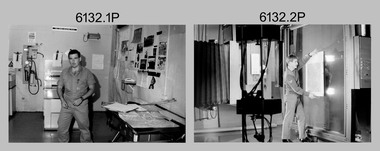
... 35mm negative film and were scanned at 96 dpi. They are part of the Army Survey Regiment’s Collection. .1) - Photo, black & white, 1988, BARCRO work area, SPR Gary Sievers. .2) - Photo, black & white, 1988, KLIMSCH Commodore camera, CPL Mick Gillham. .3) - Photo, black & white, 1988, KLIMSCH Commodore camera, CPL Mick Gillham. .4) - Photo, black & white, 1988, WILD U4A Diapositive Camera, SPR Rob Jones. .5) - Photo, black & white, 1988, WILD U4A Diapositive Camera, SPR Rob Jones. .6) - Photo, black & white, 1988, WILD U4A Diapositive Camera, SPR Rob Jones. .7) - Photo, black & white, 1988, WILD U4A Diapositive Camera, SPR Rob Jones. .8) - Photo, black & white, 1988, WILD U4A Diapositive Camera, SPR Rob Jones. .9) - Photo, black & white, 1988, Photographic camera enlarger, unidentified technician. .10) - Photo, black & white, 1988, SUPER CHROMEGA F Photographic camera enlarger. ...35mm negative film and were scanned at 96 dpi. They are part of the Army Survey Regiment’s Collection. .1) - Photo, black & white, 1988, BARCRO work area, SPR Gary Sievers. .2) - Photo, black & white, 1988, KLIMSCH Commodore camera, CPL Mick Gillham. .3) - Photo, black & white, 1988, KLIMSCH Commodore camera, CPL Mick Gillham. .4) - Photo, black & white, 1988, WILD U4A Diapositive Camera, SPR Rob Jones. .5) - Photo, black & white, 1988, WILD U4A Diapositive Camera, SPR Rob Jones. .6) - Photo, black & white, 1988, WILD U4A Diapositive Camera, SPR Rob Jones. .7) - Photo, black & white, 1988, WILD U4A Diapositive Camera, SPR Rob Jones. .8) - Photo, black & white, 1988, WILD U4A Diapositive Camera, SPR Rob Jones. .9) - Photo, black & white, 1988, Photographic camera enlarger, unidentified technician. .10) - Photo, black & white, 1988, SUPER CHROMEGA F Photographic camera enlarger. ...This collection of 10 photos was most likely taken at Lithographic Squadron, Army Survey Regiment, Fortuna, Bendigo in 1988. The main tasks undertaken by technicians in Photo Troop were most likely enlargements, reductions and duplication of map reproduction material, and processing of aerial photography.This is a set of 10 photographs of Photo Troop personnel and equipment from Lithographic Squadron at the Army Survey Regiment, Fortuna, Bendigo, 1988. The photographs were on 35mm negative film and were scanned at 96 dpi. They are part of the Army Survey Regiment’s Collection. .1) - Photo, black & white, 1988, BARCRO work area, SPR Gary Sievers. .2) - Photo, black & white, 1988, KLIMSCH Commodore camera, CPL Mick Gillham. .3) - Photo, black & white, 1988, KLIMSCH Commodore camera, CPL Mick Gillham. .4) - Photo, black & white, 1988, WILD U4A Diapositive Camera, SPR Rob Jones. .5) - Photo, black & white, 1988, WILD U4A Diapositive Camera, SPR Rob Jones. .6) - Photo, black & white, 1988, WILD U4A Diapositive Camera, SPR Rob Jones. .7) - Photo, black & white, 1988, WILD U4A Diapositive Camera, SPR Rob Jones. .8) - Photo, black & white, 1988, WILD U4A Diapositive Camera, SPR Rob Jones. .9) - Photo, black & white, 1988, Photographic camera enlarger, unidentified technician. .10) - Photo, black & white, 1988, SUPER CHROMEGA F Photographic camera enlarger. No personnel are identifiedroyal australian survey corps, rasvy, army survey regiment, army svy regt, fortuna, asr, litho -
 Bendigo Military Museum
Photograph - Staff Activities – Lithographic Squadron, Army Survey Regiment, Fortuna, Bendigo, 1989
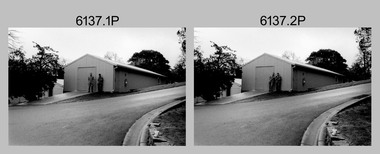
... Camera, Contacting Printing BARCRO and Production Control work areas, as well as outside the buildings. Although these photos are not annotated most personnel are positively identified. Royal Australian Survey Corps RASvy Army Survey Regiment Army Svy Regt Fortuna ASR litho No personnel are identified This is a set of 20 photographs of Lithographic Squadron and staff from other squadrons undertaking various tasks at the Army Survey Regiment, Fortuna, Bendigo, 1989. The photographs were on 35mm ...This collection of 20 photos was most likely taken in Lithographic Squadron at the Army Survey Regiment, Fortuna, Bendigo, in 1989. The photos were mainly taken in the Camera, Contacting Printing BARCRO and Production Control work areas, as well as outside the buildings. Although these photos are not annotated most personnel are positively identified. This is a set of 20 photographs of Lithographic Squadron and staff from other squadrons undertaking various tasks at the Army Survey Regiment, Fortuna, Bendigo, 1989. The photographs were on 35mm negative film and were scanned at 96 dpi. They are part of the Army Survey Regiment’s Collection. .1) and .2P - Photo, black & white, 1989, L to R: WO1 Peter Coombes, WO2 Steve Egan. .3) - Photo, black & white, 1989, L to R: WO2 Rob Bogumil, unidentified, SGT Frank Lenane, SGT Gary Kerr. .4) - Photo, black & white, 1989, L/CPL Darren Maher. .5) - Photo, black & white, 1989, L to R: WO2 Peter Imeson, Terry King, unidentified. .6)- Photo, black & white, 1989, CPL Kevin Berry. .7) - Photo, black & white, 1989, WO2 Steve Egan. .8) - Photo, black & white, 1989, L to R: WO2 Rob Bogumil, SGT Gary Kerr, CPL Peter Swandale, SGT Dale Hudson. .9) to .12) - Photo, black & white, 1989, SPR Dave Scott. .13) - Photo, black & white, 1989, unidentified. .14) to .15) - Photo, black & white, 1989, L to R: WO2 Steve Egan, CPL Stuart Ridge. .16) - Photo, black & white, 1989, L to R: SSGT Russ Mollenhauer, SGT Laurie Justin. .17) - Photo, black & white, 1989, L to R: CPL Jeff Webb, SPR Syd Anstee. .18) - Photo, black & white, 1989, CPL Darren Maher. .19) - Photo, black & white, 1989, SPR Joyce Gray. .20) - Photo, black & white, 1989, L/CPL Mark McCullough.No personnel are identifiedroyal australian survey corps, rasvy, army survey regiment, army svy regt, fortuna, asr, litho -
 Bendigo Military Museum
Photograph - Staff Activities – Lithographic Squadron, Army Survey Regiment, Fortuna, Bendigo, 1990
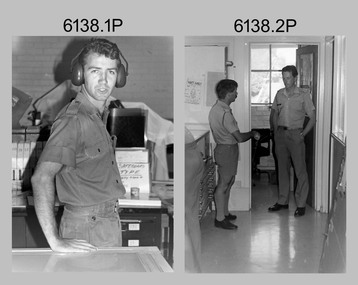
... Camera, Contacting Printing BARCRO and Production Control work areas, as well as outside the buildings. Although these photos are not annotated most personnel are positively identified. Royal Australian Survey Corps RASvy Army Survey Regiment Army Svy Regt Fortuna ASR litho No personnel are identified This is a set of 14 photographs of Lithographic Squadron and staff from other squadrons undertaking various tasks at the Army Survey Regiment, Fortuna, Bendigo, 1990. The photographs were on 35mm ...This collection of 14 photos was most likely taken in Lithographic Squadron at the Army Survey Regiment, Fortuna, Bendigo, in 1990. The photos were mainly taken in the Camera, Contacting Printing BARCRO and Production Control work areas, as well as outside the buildings. Although these photos are not annotated most personnel are positively identified. This is a set of 14 photographs of Lithographic Squadron and staff from other squadrons undertaking various tasks at the Army Survey Regiment, Fortuna, Bendigo, 1990. The photographs were on 35mm negative film and were scanned at 96 dpi. They are part of the Army Survey Regiment’s Collection. .1) - Photo, black & white, 1990, Damien Cole .2) - Photo, black & white, 1990, L to R: SGT Keith Quinton, CAPT Bill Jones. .3) - Photo, black & white, 1990, Andrew Morrison-Evans. .4) - Photo, black & white, 1990, John Bragg. .5)- Photo, black & white, 1990, CPL Stuart Ridge. .6) - Photo, black & white, 1990, Ken Delmenico. .7) - Photo, black & white, 1990, Ken Labouchardiere. .8) - Photo, black & white, 1990, CPL Peter Dillon. .9) - Photo, black & white, 1990, L to R: WO1 Ralph Chant, SSGT Rhys De Laine. .10) - Photo, black & white, 1990, CPL Darren Maher. .11) - Photo, black & white, 1990, CPL John ‘Flash’ Anderson. .12) - Photo, black & white, 1990, L to R: CPL SGT Gary Kerr, CPL Lance Strudwick, SGT Dale Hudson. .13) - Photo, black & white, 1990, LT Craig Hersant and Alf. .14) - Photo, black & white, 1990, MAJ Bob Coote.No personnel are identifiedroyal australian survey corps, rasvy, army survey regiment, army svy regt, fortuna, asr, litho -
 Bendigo Military Museum
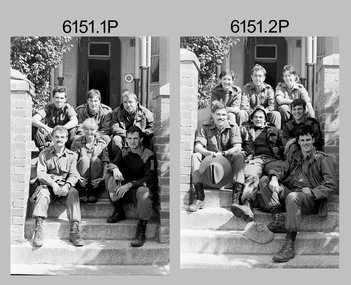
Photograph - Lithographic Squadron Personnel and Equipment, Army Survey Regiment, Fortuna, Bendigo, 1992
... Camera, Contacting, Printing, BARCRO and Production Control work areas, as well as outside Fortuna’s buildings. Although these photos are not annotated most personnel are positively identified. Royal Australian Survey Corps RASvy Army Survey Regiment Army Svy Regt Fortuna ASR litho No personnel are identified. This is a set of 35 photographs of Lithographic Squadron personnel and equipment at the Army Survey Regiment, Fortuna, Bendigo, 1992. Photographs .1P to .32P are on 35mm ...This collection of 35 photos of Lithographic Squadron personnel and equipment was taken at the Army Survey Regiment, Fortuna, Bendigo, in 1992. The photos were mainly taken in the Camera, Contacting, Printing, BARCRO and Production Control work areas, as well as outside Fortuna’s buildings. Although these photos are not annotated most personnel are positively identified. This is a set of 35 photographs of Lithographic Squadron personnel and equipment at the Army Survey Regiment, Fortuna, Bendigo, 1992. Photographs .1P to .32P are on 35mm negative film and scanned at 96 dpi. Colour photos .33P and .34P are on photographic paper scanned at 300 dpi. Photos .33P to .35P are on 35mm negative film and scanned at 2400 dpi. They are part of the Army Survey Regiment’s Collection. .1) - Photo, black & white, 1992, back row L to R: Andrew Arman, unidentified Mark McCulloch, Dale Hudson, front row L to R: Daryl South, unidentified (x2). Janet Murray, LT Dave Weston. .2) - Photo, black & white, 1992, back row L to R: unidentified, CPL Paul Baker, Shona Hastie, front row L to R: LT Craig Hersant, Darren Maher, Chad Hardwick, Rob Jones. .3) - Photo, black & white, 1992, WO2 Steve Egan. .4) - Photo, black & white, 1992, LT Craig Hersant. .5)- Photo, black & white, 1992, CPL Warren Shirley, Jeff Willey, Gary Kerr. .6) - Photo, black & white, 1992, L to R: CPL Penny Knott, Janet Murray, Shona Hastie. .7) - Photo, black & white, 1992, L to R: MAJ Terry Edwards, LT David Weston. .8) - Photo, black & white, 1992, Frank Lenane, WO1 Trevor Osborne. .9) - Photo, black & white, 1992, L to R: WO2 Rob Bogumil, WO2 Steve Egan. .10) - Photo, black & white, 1992, back row L to R: Terry Winzar, Roy Hicks Marty Stradbrook, Janet Murray, Nick Vanderzwan, Mark Bird, front row L to R: SGT Dale Hudson, SSGT Russ Mollenhauer, Ross Anza, SGT Kim Reynolds, SGT Stuart Ridge, WO2 Jeff Willey, Peter Hamilton, Garry Lord, Gavin McLean, unidentified. .11) - Photo, black & white, 1992, Janet Murray, Mick Muzeen. .12) and .13) - Photo, black & white, 1992, Janet Murray. .14) to.16) - Photo, black & white, 1992, SPR Scott Cameron, CPL Warren Shirley. .17) - Photo, black & white, 1992, L to R: SPR Shane Campbell, SGT Brian Paul. .18) - Photo, black & white, 1992, LCPL John Bragg. .19) - Photo, black & white, 1992, SPR Allison (Ottaway) Wooldrage. .20) - Photo, black & white, 1992, map inspection station, LT Colin Davidson. .21) - Photo, black & white, 1992, map inspection station. .22) - Photo, black & white, 1992, map inspection station, LT Colin Davidson. .23) and .24) - Photo, black & white, 1992, map inspection station, SPR Nicole Midgley. .25) - Photo, black & white, 1992, map inspection station. .26) - Photo, black & white, 1992, map inspection station, unidentified. .27) - Photo, black & white, 1992, CPL Penny Knott. .28) - Photo, black & white, 1992, CPL Ken Peters. .29) - Photo, black & white, 1992, WO2 Rob Bogumil. .30) - Photo, black & white, 1992, L to R: WO2 Peter Imeson, WO2 Rob Bogumil. .31) and .32) - Photo, black & white, 1992, L to R: SGT Brian Fauth. .33) - Photo, colour, 1992, Klimch Camera, CPL Damien Cole. .34) - Photo, colour, 1992, Speedmaster Printing Press, L to R: SGT Gary Kerr, unidentified, SGT Kim Reynolds, SPR Shane Campbell. .35) - Photo, colour, 1992, L to R: CPL Le-Anne (Smallshaw) Shirley, CPL Rob Jones, SPR Gary Sievers, SPR John Bragg.No personnel are identified.royal australian survey corps, rasvy, army survey regiment, army svy regt, fortuna, asr, litho -
 Eltham District Historical Society Inc
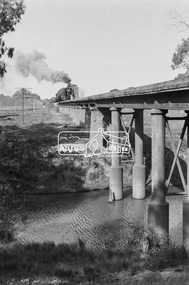
Photograph, Steam locomotive K-158 crossing the railway bridge over the Campaspe River at Rochester, Victoria, c.November 1963, 1963
... camera settings, hence the slightly soft focus etc. The train would eventually continue over the Echuca Iron Bridge into NSW. I think its ultimate destination was Deniliquin but not sure. george coop collection, k-158, k-class steam locomotive (vr newport workshops), railway bridge, Campaspe River, Rochester Digital TIFF file Scan of 35mm Ilford FP3 black and white negative transparency Steam locomotive K-158 crossing the railway bridge over the Campaspe River at Rochester, Victoria, c.November 1963 Photograph George Coop George Coop ...It is the railway bridge over the Campaspe River at Rochester, Vic. original to the construction of the line. It was taken late on a Saturday morning and shows the regular goods train of that period approaching, then crossing the bridge. I originally planned to take just one view. The approaching train was first then it was a rapid run back along the raised river bank to get the broadside shot. I had little time to steady myself or properly check camera settings, hence the slightly soft focus etc. The train would eventually continue over the Echuca Iron Bridge into NSW. I think its ultimate destination was Deniliquin but not sure.Digital TIFF file Scan of 35mm Ilford FP3 black and white negative transparencygeorge coop collection, k-158, k-class steam locomotive (vr newport workshops), railway bridge, campaspe river, rochester -
 Eltham District Historical Society Inc
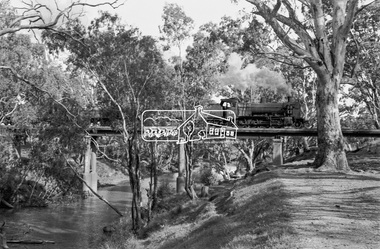
Photograph, Steam locomotive K-158 crossing the railway bridge over the Campaspe River at Rochester, Victoria, c.November 1963, 1963
... camera settings, hence the slightly soft focus etc. The train would eventually continue over the Echuca Iron Bridge into NSW. I think its ultimate destination was Deniliquin but not sure. george coop collection, k-158, k-class steam locomotive (vr newport workshops), railway bridge, Campaspe River, Rochester Digital TIFF file Scan of 35mm Ilford FP3 black and white negative transparency Steam locomotive K-158 crossing the railway bridge over the Campaspe River at Rochester, Victoria, c.November 1963 Photograph George Coop George Coop ...It is the railway bridge over the Campaspe River at Rochester, Vic. original to the construction of the line. It was taken late on a Saturday morning and shows the regular goods train of that period approaching, then crossing the bridge. I originally planned to take just one view. The approaching train was first then it was a rapid run back along the raised river bank to get the broadside shot. I had little time to steady myself or properly check camera settings, hence the slightly soft focus etc. The train would eventually continue over the Echuca Iron Bridge into NSW. I think its ultimate destination was Deniliquin but not sure.Digital TIFF file Scan of 35mm Ilford FP3 black and white negative transparencygeorge coop collection, k-158, k-class steam locomotive (vr newport workshops), railway bridge, campaspe river, rochester
