
Showing 141 items matching "7 division"
-
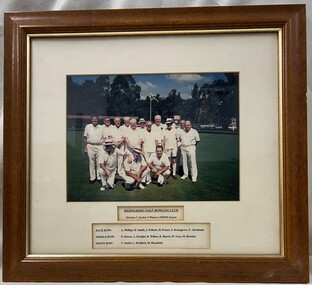 Heidelberg Golf Club
Photograph - Framed Team Photograph, Heidelberg Golf Club Bowling Club, Heidelberg Golf Club Bowling Club: Division 7, Section 5 winners 1988-1989, 1989
... Heidelberg Golf Club Bowling Club: Division 7, Section 5 winners 1988-1989...Heidelberg Golf Club Bowling Club: Division 7, Section 5 winners 1988-1989. ...Heidelberg Golf Club Bowling Club: Division 7, Section 5 winners 1988-1989 Photograph Framed Team Photograph Heidelberg Golf Club Bowling Club ...Heidelberg Golf Club Bowling Club: Division 7, Section 5 winners 1988-1989. Colour team photograph with caption in timber frame under glass. heidelberg golf club, heidelberg golf club bowling club, pennant (bowls) -
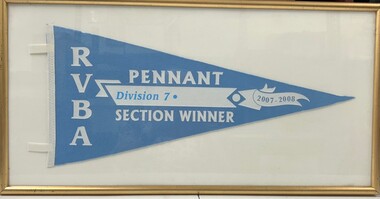 Heidelberg Golf Club
Memorabilia - Framed Pennant Flag, Heidelberg Golf Club Bowling Club: R.V.B.A. Pennant. Division 7, section winner, 2007-2008, 2008
... Heidelberg Golf Club Bowling Club: R.V.B.A. Pennant. Division 7, section winner, 2007-2008...Heidelberg Golf Club Bowling Club: R.V.B.A. Pennant. Division 7, section winner, 2007-2008...Heidelberg Golf Club Bowling Club: R.V.B.A. Pennant. Division 7, section winner, 2007-2008 Memorabilia Framed Pennant Flag ...Heidelberg Golf Club Bowling Club: R.V.B.A. Pennant. Division 7, section winner, 2007-2008Light blue felt flag with white lettering, mounted on cardboard in metal frame under glass.heidelberg golf club, heidelberg golf club bowling club, bowls victoria, pennant (bowls), royal victorian bowling association -
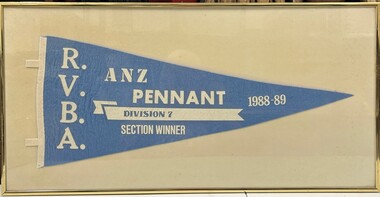 Heidelberg Golf Club
Memorabilia - Framed Pennant Flag, Heidelberg Golf Club Bowling Club: R.V.B.A. - ANZ Pennant. Division 7, section winner, 1988-89, 1989
... . - ANZ Pennant. Division 7, section winner, 1988-89.... - ANZ Pennant. Division 7, section winner, 1988-89...Heidelberg Golf Club Bowling Club: R.V.B.A. - ANZ Pennant. Division 7, section winner, 1988-89 Memorabilia Framed Pennant Flag ...Heidelberg Golf Club Bowling Club: R.V.B.A. - ANZ Pennant. Division 7, section winner, 1988-89Light blue felt flag with white lettering, mounted on cardboard in metal frame under glass.heidelberg golf club, heidelberg golf club bowling club, bowls victoria, pennant (bowls), royal victorian bowling association -
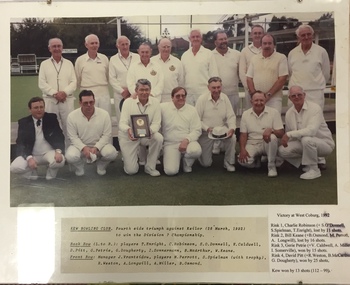 Kew Historical Society Inc
Photograph, Kew Bowling Club Division 7 Championship Team, 1992, 1992
... Kew Bowling Club Division 7 Championship Team, 1992...Glazed photograph of the Division 7 Championship Team, 1992, [The item is part of the large historic Kew Bowling Club collection (1880-1988) gifted to the Kew Historical Society in 2020]....Kew Bowling Club Division 7 Championship Team, 1992 Photograph Photograph Kew Bowling Club ...Sports Clubs in Kew in the final decades of the 19th century and in the early 20th century were often umbrella organisations with facilities for a number of sports. Typically in Kew, this included teams in lawn bowls, tennis and croquet. The Kew Bowling Club was formed in 1880 while the privately owned Auburn Heights Recreation Club was opened in 1904. By 1998, the two Clubs decided to amalgamate at the Auburn Heights site in Barkers Road, forming the Kew Heights Sports Club. The combined club was itself taken over by the Melbourne Cricket Club in 2012 becoming MCC Kew Sports Club. In 2017 MCC Kew closed and its landholding was subsequently sold to Carey Baptist Grammar School. Both the Kew and Auburn Heights Clubs assembled important collections. These historically significant and large collections were donated to the Society in 2020. The collections include manuscripts, pictures, trophies, plans, honour boards etc. References Barnard FGA 1910, 'Sports and Pastimes' in Jubilee History of Kew Victoria: Its origin & progress 1803-1910. Nixon NV 1980, The History of the Kew Bowling Club 1880-1980. Reeve S 2012, City of Boroondara: Thematic Environmental History, p.216.The combined collections of the four sporting clubs making up the collection number hundreds of items that are historically significant locally. They are also significant to the sporting history of the greater Melbourne area and to the sports of lawn bowls and tennis in Australia in the 19th and 20th centuries. The collection illuminates two of the Victorian historic themes - 'Building community life' through forming community organisations and 'Shaping cultural and creative life' by participating in sport and recreation.Glazed photograph of the Division 7 Championship Team, 1992, [The item is part of the large historic Kew Bowling Club collection (1880-1988) gifted to the Kew Historical Society in 2020].kew bowling club - wellington street - kew (vic), clubs - lawn bowls - kew (vic) -
 Kew Historical Society Inc
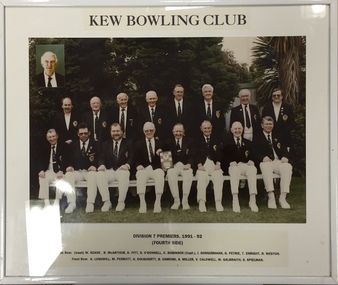
Photograph - Framed Photograph, Kew Bowling Club Division 7 Premiers (Fourth side), 1991-92, 1991-1992
... Kew Bowling Club Division 7 Premiers (Fourth side), 1991-92...Framed and glazed photograph of Division 7 Premiers (Fourth side), 1991-92. [The item is part of the large historic Kew Bowling Club collection (1880-1988) gifted to the Kew Historical Society in 2020]....Kew Bowling Club Division 7 Premiers (Fourth side), 1991-92 Photograph Framed Photograph Kew Bowling Club ...Sports Clubs in Kew in the final decades of the 19th century and in the early 20th century were often umbrella organisations with facilities for a number of sports. Typically in Kew, this included teams in lawn bowls, tennis and croquet. The Kew Bowling Club was formed in 1880 while the privately owned Auburn Heights Recreation Club was opened in 1904. By 1998, the two Clubs decided to amalgamate at the Auburn Heights site in Barkers Road, forming the Kew Heights Sports Club. The combined club was itself taken over by the Melbourne Cricket Club in 2012 becoming MCC Kew Sports Club. In 2017 MCC Kew closed and its landholding was subsequently sold to Carey Baptist Grammar School. Both the Kew and Auburn Heights Clubs assembled important collections. These historically significant and large collections were donated to the Society in 2020. The collections include manuscripts, pictures, trophies, plans, honour boards etc. References Barnard FGA 1910, 'Sports and Pastimes' in Jubilee History of Kew Victoria: Its origin & progress 1803-1910. Nixon NV 1980, The History of the Kew Bowling Club 1880-1980. Reeve S 2012, City of Boroondara: Thematic Environmental History, p.216.The combined collections of the four sporting clubs making up the collection number hundreds of items that are historically significant locally. They are also significant to the sporting history of the greater Melbourne area and to the sports of lawn bowls and tennis in Australia in the 19th and 20th centuries. The collection illuminates two of the Victorian historic themes - 'Building community life' through forming community organisations and 'Shaping cultural and creative life' by participating in sport and recreation.Framed and glazed photograph of Division 7 Premiers (Fourth side), 1991-92. [The item is part of the large historic Kew Bowling Club collection (1880-1988) gifted to the Kew Historical Society in 2020].kew bowling club - wellington street - kew (vic), clubs - lawn bowls - kew (vic) -
 Kew Historical Society Inc
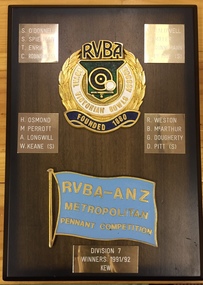
Award, RVBA, RVBA-ANZ Metropolitan Pennant Competition, Division 7 Winners, 1991-92
... RVBA-ANZ Metropolitan Pennant Competition, Division 7 Winners...Wood, metal and enamel trophy plaque for RVBA-ANZ Metropolitan Pennant Competition, Division 7 Winners, 1991-92. [The item is part of the large historic Kew Bowling Club collection (1880-1988) gifted to the Kew Historical Society in 2020]....RVBA-ANZ Metropolitan Pennant Competition, Division 7 Winners Award Award RVBA ...Sports Clubs in Kew in the final decades of the 19th century and in the early 20th century were often umbrella organisations with facilities for a number of sports. Typically in Kew, this included teams in lawn bowls, tennis and croquet. The Kew Bowling Club was formed in 1880 while the privately owned Auburn Heights Recreation Club was opened in 1904. By 1998, the two Clubs decided to amalgamate at the Auburn Heights site in Barkers Road, forming the Kew Heights Sports Club. The combined club was itself taken over by the Melbourne Cricket Club in 2012 becoming MCC Kew Sports Club. In 2017 MCC Kew closed and its landholding was subsequently sold to Carey Baptist Grammar School. Both the Kew and Auburn Heights Clubs assembled important collections. These historically significant and large collections were donated to the Society in 2020. The collections include manuscripts, pictures, trophies, plans, honour boards etc. References Barnard FGA 1910, 'Sports and Pastimes' in Jubilee History of Kew Victoria: Its origin & progress 1803-1910. Nixon NV 1980, The History of the Kew Bowling Club 1880-1980. Reeve S 2012, City of Boroondara: Thematic Environmental History, p.216.The combined collections of the four sporting clubs making up the collection number hundreds of items that are historically significant locally. They are also significant to the sporting history of the greater Melbourne area and to the sports of lawn bowls and tennis in Australia in the 19th and 20th centuries. The collection illuminates two of the Victorian historic themes - 'Building community life' through forming community organisations and 'Shaping cultural and creative life' by participating in sport and recreation.Wood, metal and enamel trophy plaque for RVBA-ANZ Metropolitan Pennant Competition, Division 7 Winners, 1991-92. [The item is part of the large historic Kew Bowling Club collection (1880-1988) gifted to the Kew Historical Society in 2020].kew bowling club - wellington street - kew (vic), clubs - lawn bowls - kew (vic), kew bowling club - trophies -
 Lara RSL Sub Branch
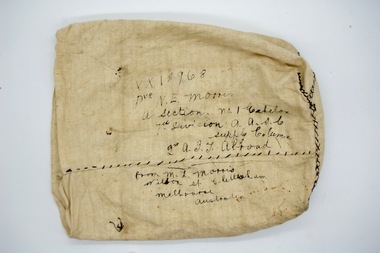
Service Gear, Hand Made, Canvas Present Pacel Bag, World War 2
... parcel present cotton bag vx 18968 morris 2aif 7 division cheltenham...Overseas address was simply made out to "Abroad" Food, personal items and presents were sent by the family or friends to serving troops overseas. parcel present cotton bag vx 18968 morris 2aif 7 division cheltenham VX 18968 Dvr N.E. Morris A Section no1 Echelon 7th Division A A S C Supply Column 2nd AIF Abroad From M. ...Food/Personal items sent by family to troops serving overseas. Hand made cotton bags were completely sealed. Overseas address was simply made out to "Abroad"Food, personal items and presents were sent by the family or friends to serving troops overseas. Canvas/Cotton bag hand sown together with black cotton.VX 18968 Dvr N.E. Morris A Section no1 Echelon 7th Division A A S C Supply Column 2nd AIF Abroad From M. L. Morris Wilson St Cheltenham Melbourne Australia (Identical information Written on both sides of the bag.parcel present cotton bag vx 18968 morris 2aif 7 division cheltenham -
 Bendigo Military Museum
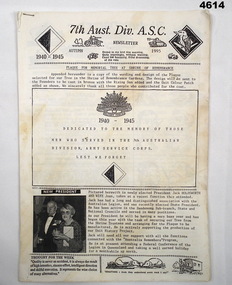
Newspaper - NEWSLETTER, 7th AUSTRALIAN DIVISION ASSOCIATION, 7 Div ASC Association, 7 Aust DIV ASC Newsletter 1995 Edition, 1995
... 7 Division...There is a Äustralia Remembers page 1945 - 1995". 7 Division WW2 Army Service Corp Nil This newsletter is composed of 7 sheets of A4 paper. ...In the newsletter are numerous subects. Vale section from WW2 incudes Ron Barassi, There are plans for the ANZAC March and VP Day. There is a Äustralia Remembers page 1945 - 1995".This newsletter is composed of 7 sheets of A4 paper. They are printed on both sides. It has texts, photos, cartoons and Unit symbols. The news letter was for the 1995 time. The sheets are stapled in top left corner.Nil7 division, ww2, army service corp -
 Lara RSL Sub Branch
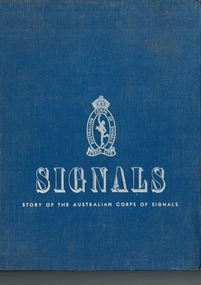
Book, Signals - Story of the Australian Corps of Signals, 1953
... ...signals 7 australian division...A tribute to the corps that stayed on duty every hour of every day providing and maintaining vital communication channels. signal corps wwii c.h.simpson motorcycle couriers signals 7 australian division lt.commander b.t.r chadd palestine spark plug semiphore morse code field radio a.i.f british signals corps pieter mersk breconshire corp signals new guinea malaysa singapore switchboard carrier pigeons linesmen gaza signal office Signals - Story of the Australian Corps of Signals. ...Little has been written previously about this technical group of men and women and that their duties were under insurmountable difficulties which they faced and overcome in conditions that were encountered in the desert and jungle warfare. Without their constant and never ending services, the task of the force in bringing to a close this fight for freedom would have been greatly handicapped.An outline of the Australian Signals Corps over the years from the campaign in the Middle East to the present day of the victories in New Guinea. A tribute to the corps that stayed on duty every hour of every day providing and maintaining vital communication channels.Signals - Story of the Australian Corps of Signals. Green front and back hardcover with black text and insignia. Photographs, cartoons, illustrations and poems. The inside front and back covers have a photograph montage in green sepia.signal corps, wwii, c.h.simpson, motorcycle couriers, signals 7 australian division, lt.commander b.t.r chadd, palestine, spark plug, semiphore, morse code, field radio, a.i.f, british signals corps, pieter mersk, breconshire corp signals, new guinea, malaysa, singapore, switchboard, carrier pigeons, linesmen, gaza signal office -
 Anglesea and District Historical Society
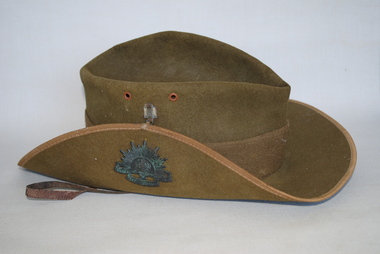
WW 2 Slouch Hat, 1940
... Slouch hat with Rising Sun Badge and 2/22nd Battalion colour patch (8th Division). Size 7 with leather chin strap....slouch hat WW2 Slouch hat with Rising Sun Badge and 2/22nd Battalion colour patch (8th Division). Size 7 with leather chin strap. WW 2 Slouch Hat ...Slouch hat with Rising Sun Badge and 2/22nd Battalion colour patch (8th Division). Size 7 with leather chin strap.slouch hat, ww2 -
 Emerald Museum & Nobelius Heritage Park
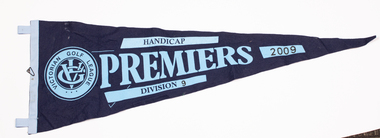
Flag - 3 x Victorian Golf League Premiers Handicap Division - various years & Divisions - Emerald Golf Club, C2009 - 2016
... 1) Victorian Golf League (Emblem)/Handicap Division 9/Premiers/2009 2) Victorian Golf League (Emblem)/Handicap Division 8/Premiers/2010 3) Victorian Gold League (Emblem)/Handicap Division 7/Premiers 2016/Emerald...Emerald Country Club Emerald Golf Club 1) Victorian Golf League (Emblem)/Handicap Division 9/Premiers/2009 2) Victorian Golf League (Emblem)/Handicap Division 8/Premiers/2010 3) Victorian Gold League (Emblem)/Handicap Division 7/Premiers 2016/Emerald 3 x blue coloured flags for premiers of Victorian Golf League Handicap Divisions - Emerald Golf Club Flag 3 x Victorian Golf League Premiers Handicap Division - various years & Divisions - Emerald Golf Club ...The Emerald Golf Club began as the iconic Emerald Country Club which was set up as a country resort for the wealthy in the late 1920s. Following a period of financial difficulties and change of ownership it was renamed the Emerald Golf and Country Resort in the 1990s. It then operated for several years before winding up. Former members and a new manager re-established the club as the Emerald Golf Club in 2001, but that finally closed in 2017. These pennant flags relate to the club's success in Victorian Golf League competitions in 2009, 2010 and 2016.The Emerald Golf Club has been an integral part of Emerald's sporting and social history. 3 x blue coloured flags for premiers of Victorian Golf League Handicap Divisions - Emerald Golf Club1) Victorian Golf League (Emblem)/Handicap Division 9/Premiers/2009 2) Victorian Golf League (Emblem)/Handicap Division 8/Premiers/2010 3) Victorian Gold League (Emblem)/Handicap Division 7/Premiers 2016/Emeraldemerald country club, emerald golf club -
 8th/13th Victorian Mounted Rifles Regimental Collection
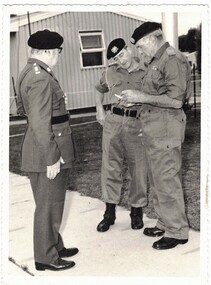
Photograph - Coleman, Neale & Whitehead
... Later in the war he was attached to British 7 Armoured Division in Western Europe during and shortly after the invasion of Normandy. ...Later in the war he was attached to British 7 Armoured Division in Western Europe during and shortly after the invasion of Normandy. ...Colonel Leslie Coleman was the Honorary Colonel of 8/13 VMR. Colonel Coleman graduated to the RAAC from the Royal Military College in 1939 and transferred to the 2nd AIF in 1941. He was adjutant of the 2/10 Armoured Regiment when the unit was raised in 1941. Later in the war he was attached to British 7 Armoured Division in Western Europe during and shortly after the invasion of Normandy. Lieutenant Colonel John Neale served in the Royal Australian Navy in World War Two. Following the war he returned to Albury and joined the 8/13 VMR in 1948. He rose through the ranks and became the Commanding Officer in 1974. He too was the Honorary Colonel 1990-92. Major Norman Whitehead MC served with the 21 Light Horse prior to World War Two. He joined the AIF and served with 2/6th Armoured Regiment. He was wounded during the capture of Buna New Guinea 1942 and awarded the Military Cross. Following the war he was one of the original officers of the 8/13 VMR when it was raised in 1948. He was squadron Commander of 'A' Squadron. He maintained close contact with the regiment after his retirement and frequently visited annual camp.Black and white photograph of Colonel Coleman, Lieutenant Colonel John Neale and Major Norman Whitehead taken during 8/13 Victorian Mounted Rifles Annual Camp at Puckapunyal 1974.Ink stamp on reverse "Mikainis Photo Studio / 23 Jun 1974 / 61 Goulburn St., Seymour / Telephone 92-2141 Vic"military, world war two, vmr, camp, coleman, neal, whitehead -
 Sunshine and District Historical Society Incorporated
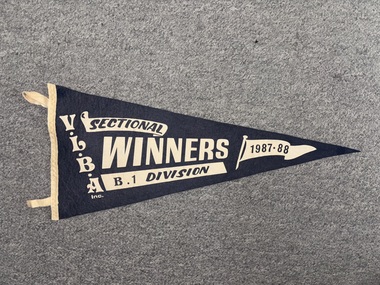
Memorabilia - Sunshine Ladies Bowling Club Pennants
... 1735.01 - Sunshine Ladies Bowling Club - Sectional Winners Division B1 1987 - 88 Pennant.jpg 1735.02 - Sunshine Ladies Bowling Club - Sectional Winners Division B1 1985 - 86 Pennant.jpg 1735.03 - Sunshine Ladies Bowling Club - Section Winner Division 4 1987 - 88 Pennant.jpg 1735.04 - Sunshine Ladies Bowling Club - Section Winner Division 5 1987 - 88 Pennant.jpg 1735.05 - Sunshine Ladies Bowling Club - Section Runner Up Division 5 1987 - 88 Pennant.jpg 1735.06 - Sunshine Ladies Bowling Club - Section Winner Division 6 1984 - 85 Pennant.jpg 1735.07 - Sunshine Ladies Bowling Club - Section Runner Up Division 5 1984 - 85 Pennant.jpg 1735.08 - Sunshine Ladies Bowling Club - Section Winner Division B7 1978 - 79 Pennant.jpg 1735.09 - Sunshine Ladies Bowling Club - Section Winner Division B1 1978 - 79 Pennant.jpg 1735.10 - Sunshine Ladies Bowling Club - Runners Up B1 Division 1978 - 79 Pennant.jpg 1735.11 - Sunshine Ladies Bowling Club - Section Winner Division 8 1981 - 82 Pennant.jpg 1735.12 - Sunshine Ladies Bowling Club - Section Winner Division C2 1982 - 83 Pennant.jpg 1735.13 - Sunshine Ladies Bowling Club - Section Winner Division 2 1981 - 82 Pennant.jpg 1735.14 - Sunshine Ladies Bowling Club - Section Winner Division C1 1957 - 58 Pennant.jpg 1735.15 - Sunshine Ladies Bowling Club - Section Winner Division D1 1960 - 61 Pennant.jpg 1735.16 - Sunshine Ladies Bowling Club - Section Winner Division 7 1953 - 54 Pennant.jpg 1735.17 - Sunshine Ladies Bowling Club - Section Winner Division 3 1954 - 55 Pennant.jpg 1735.18 - Sunshine Ladies Bowling Club - Section Winner Division B3 1955 - 56 Pennant.jpg ...Sunshine Ladies Bowling Club Lawn Bowls 1735.01 - Sunshine Ladies Bowling Club - Sectional Winners Division B1 1987 - 88 Pennant.jpg 1735.02 - Sunshine Ladies Bowling Club - Sectional Winners Division B1 1985 - 86 Pennant.jpg 1735.03 - Sunshine Ladies Bowling Club - Section Winner Division 4 1987 - 88 Pennant.jpg 1735.04 - Sunshine Ladies Bowling Club - Section Winner Division 5 1987 - 88 Pennant.jpg 1735.05 - Sunshine Ladies Bowling Club - Section Runner Up Division 5 1987 - 88 Pennant.jpg 1735.06 - Sunshine Ladies Bowling Club - Section Winner Division 6 1984 - 85 Pennant.jpg 1735.07 - Sunshine Ladies Bowling Club - Section Runner Up Division 5 1984 - 85 Pennant.jpg 1735.08 - Sunshine Ladies Bowling Club - Section Winner Division B7 1978 - 79 Pennant.jpg 1735.09 - Sunshine Ladies Bowling Club - Section Winner Division B1 1978 - 79 Pennant.jpg 1735.10 - Sunshine Ladies Bowling Club - Runners Up B1 Division 1978 - 79 Pennant.jpg 1735.11 - Sunshine Ladies Bowling Club - Section Winner Division 8 1981 - 82 Pennant.jpg 1735.12 - Sunshine Ladies Bowling Club - Section Winner Division C2 1982 - 83 Pennant.jpg 1735.13 - Sunshine Ladies Bowling Club - Section Winner Division 2 1981 - 82 Pennant.jpg 1735.14 - Sunshine Ladies Bowling Club - Section Winner Division C1 1957 - 58 Pennant.jpg 1735.15 - Sunshine Ladies Bowling Club - Section Winner Division D1 1960 - 61 Pennant.jpg 1735.16 - Sunshine Ladies Bowling Club - Section Winner Division 7 1953 - 54 Pennant.jpg 1735.17 - Sunshine Ladies Bowling Club - Section Winner Division 3 1954 - 55 Pennant.jpg 1735.18 - Sunshine Ladies Bowling Club - Section Winner Division B3 1955 - 56 Pennant.jpg Collection of pennants won by the Sunshine Ladies Bowling Club Memorabilia Sunshine Ladies Bowling Club Pennants ...The Sunshine Ladies Bowling Club was a key part of Sunshine’s community sporting life, founded to give local women their own space in the traditionally male-dominated world of bowls. It operated alongside the Sunshine Bowling Club and other local associations, reflecting the growth of women’s sport in Victoria during the mid‑20th century. The club was successful in winning many pennants throughout the years. The club was formed in 1926 and folded in the early 1990's, and these pennants were donated alongside with many of the club's business records to the Sunshine and District Historical Society.Collection of pennants won by the Sunshine Ladies Bowling Club1735.01 - Sunshine Ladies Bowling Club - Sectional Winners Division B1 1987 - 88 Pennant.jpg 1735.02 - Sunshine Ladies Bowling Club - Sectional Winners Division B1 1985 - 86 Pennant.jpg 1735.03 - Sunshine Ladies Bowling Club - Section Winner Division 4 1987 - 88 Pennant.jpg 1735.04 - Sunshine Ladies Bowling Club - Section Winner Division 5 1987 - 88 Pennant.jpg 1735.05 - Sunshine Ladies Bowling Club - Section Runner Up Division 5 1987 - 88 Pennant.jpg 1735.06 - Sunshine Ladies Bowling Club - Section Winner Division 6 1984 - 85 Pennant.jpg 1735.07 - Sunshine Ladies Bowling Club - Section Runner Up Division 5 1984 - 85 Pennant.jpg 1735.08 - Sunshine Ladies Bowling Club - Section Winner Division B7 1978 - 79 Pennant.jpg 1735.09 - Sunshine Ladies Bowling Club - Section Winner Division B1 1978 - 79 Pennant.jpg 1735.10 - Sunshine Ladies Bowling Club - Runners Up B1 Division 1978 - 79 Pennant.jpg 1735.11 - Sunshine Ladies Bowling Club - Section Winner Division 8 1981 - 82 Pennant.jpg 1735.12 - Sunshine Ladies Bowling Club - Section Winner Division C2 1982 - 83 Pennant.jpg 1735.13 - Sunshine Ladies Bowling Club - Section Winner Division 2 1981 - 82 Pennant.jpg 1735.14 - Sunshine Ladies Bowling Club - Section Winner Division C1 1957 - 58 Pennant.jpg 1735.15 - Sunshine Ladies Bowling Club - Section Winner Division D1 1960 - 61 Pennant.jpg 1735.16 - Sunshine Ladies Bowling Club - Section Winner Division 7 1953 - 54 Pennant.jpg 1735.17 - Sunshine Ladies Bowling Club - Section Winner Division 3 1954 - 55 Pennant.jpg 1735.18 - Sunshine Ladies Bowling Club - Section Winner Division B3 1955 - 56 Pennant.jpg sunshine ladies bowling club, lawn bowls -
 Federation University Historical Collection
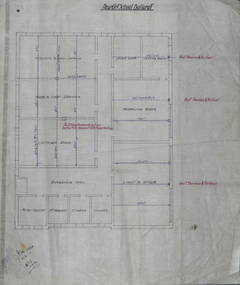
Plan, Ballarat Technical Art School Plan of Proposed Fittings, 1914, 05/03/2014
... division of the Ballarat School of Mines. A custom built building was opened in 1915. ballarat technical art school buildings ballarat school of mines plan Sheet 7 W.J.G. 5.3.14 A plan on linen showing the proposed fittings for the new Ballarat Technical Art School Building built in the grounds of the Ballarat School of Mines. ...The Ballarat Technical Art School was a division of the Ballarat School of Mines. A custom built building was opened in 1915. A plan on linen showing the proposed fittings for the new Ballarat Technical Art School Building built in the grounds of the Ballarat School of Mines. The plan has been hand coloured and designates rooms for freehand and plant drawing, model and cast drawing, Modelling Room, Light and Shade Room, Lecture room, Head Master's Office, attendant's office, cloakroom, storeroom, Castings Room, Sheet 7 W.J.G. 5.3.14ballarat technical art school, buildings, ballarat school of mines, plan -
 Federation University Historical Collection
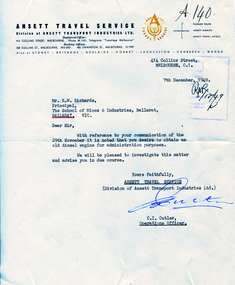
Correspondence, C.I. Cutler, Ansett Travel Service Correspondence letter to the School of Mines & Industries, Ballarat, 1949, 07/12/1949
... 7/12/49 in top left hand corner in pen, RMR in pencil. Signed Culter. A letter of correspondence from C.I. Cutler, Operations office of Ansett Travel Service (Division of Ansett Transport Industries Ltd.), 414 Collins Street, Melbourne, C.1. towards Mr. ...C.I. Cutler is responding to Richard Walter Richards' request to obtain a old diesel engine for administration purposes at the Ballarat School of Mines. Culter states that the company is pleased to investigate this matter and advise the School of Mines in due course.A letter of correspondence from C.I. Cutler, Operations office of Ansett Travel Service (Division of Ansett Transport Industries Ltd.), 414 Collins Street, Melbourne, C.1. towards Mr. Richard Walter Richards, The Principal of the School of Mines & Industries, Ballarat.Ansett Travel Service. Handwritten A.140, and 7/12/49 in top left hand corner in pen, RMR in pencil. Signed Culter.ansett, ansett motors, ansett travel service, ballarat school of mines, c.i. culter, r.w. richards, dick richards,pioneer tours, ansett airways, ansett travel hotels -
 Federation University Historical Collection
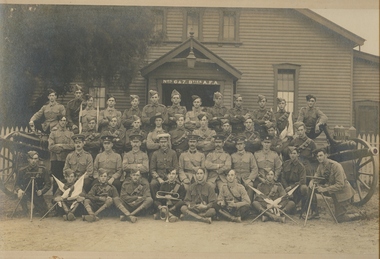
Photograph, Nos 6 & 7 Battalions A.F.A
... armed services music john monash .1) General Sir John Monash, G.C.M.G., K.C.B., V.D., C.B., D.C.L., LL.D., stands in a garden setting in his dress uniform. .2) Major-General John Monash, G.O.C. 3rd Australian Division, photographed at his headquarters at Glisy, in the Villers-Bretonneux Division. Nos 6 & 7 Battalions A.F.A. Photograph ....1) General Sir John Monash, G.C.M.G., K.C.B., V.D., C.B., D.C.L., LL.D., stands in a garden setting in his dress uniform. .2) Major-General John Monash, G.O.C. 3rd Australian Division, photographed at his headquarters at Glisy, in the Villers-Bretonneux Division.armed services, music, john monash -
 Lara RSL Sub Branch
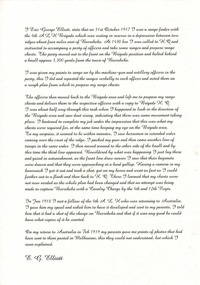
Statement By Eric George Elliott on the Light Horse Brigade charge at Beersheba
... 7 November and advance into Palestine. Decisive victory at Beersheba fell to one of the last great charges of mounted troops in history. As Australian Light Horse Divisions ...This statement by Eric George Elliott tells how The battle of Beersheba took place on 31 October 1917 as part of the wider British offensive collectively known as the third Battle of Gaza. The final phase of this all day battle was the famous mounted charge of the 4th Light Horse Brigade. Commencing at dusk, members of the brigade stormed through the Turkish defences and seized the strategic town of Beersheba. The capture of Beersheba enabled British Empire forces to break the Ottoman line near Gaza on 7 November and advance into Palestine.Decisive victory at Beersheba fell to one of the last great charges of mounted troops in history. As Australian Light Horse Divisions captured the town and secured crucial water wells, their success also marked the beginning of the end of the war in the Middle East. This end came exactly a year to the day after success at Beersheba.Rectangular shaped glass covered picture frame with a photocopy of his statement on the charge of Beersheba.ww!, beersheba, statement, photocopy, australian light horse brigade. -
 Lara RSL Sub Branch
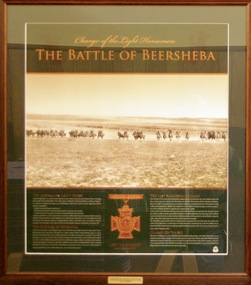
Photograph, Battle of Beersheba - Limited Edition of 1917, Rememberance Day 2008
... 7 November and advance into Palestine. Decisive victory at Beersheba fell to one of the last great charges of mounted troops in history. As Australian Light Horse Divisions ...The battle of Beersheba took place on 31 October 1917 as part of the wider British offensive collectively known as the third Battle of Gaza. The final phase of this all day battle was the famous mounted charge of the 4th Light Horse Brigade. Commencing at dusk, members of the brigade stormed through the Turkish defences and seized the strategic town of Beersheba. The capture of Beersheba enabled British Empire forces to break the Ottoman line near Gaza on 7 November and advance into Palestine.Decisive victory at Beersheba fell to one of the last great charges of mounted troops in history. As Australian Light Horse Divisions captured the town and secured crucial water wells, their success also marked the beginning of the end of the war in the Middle East. This end came exactly a year to the day after success at Beersheba.Rectangular shaped glass covered picture frame showing the Light Horsemen.Charge of the Light Horsemen The Battle of Beershebabeersheba, the light horse, lara r.s.l.,world war one, battle of beersheba, ww1 -
 Federation University Historical Collection
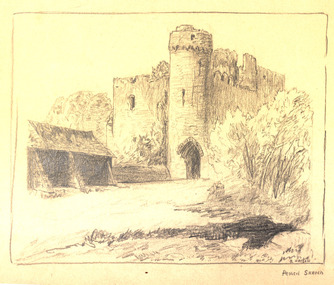
Drawing - Artwork, Architectural Drawings by Alice Watson, c1930
... division of the Ballarat School of Mines. Her complete folio is held by Federation University Australia. ballarat technical art school ballarat technical art school number 10 ballarat school of mines alice watson edith alice watson artwork architecture alumni pencil sketches sketches of buildings .3 lrs "A. Watson Pencil Sketch" .4 ink sketch tr "New Door" .5 lrs "Pencil Sketches A. Watson" .6 lrs "Pencil Sketches A. Watson" .7 ...Alice Watson completed a course of work at the Ballarat Technical Art School, a division of the Ballarat School of Mines. Her complete folio is held by Federation University Australia. Nine works were undertaken at the Ballarat Technical Art School by Edith Alice (Alice) Watson. Seven pencil sketches on paper. Two black ink drawings on paper .1 has sketches on both sides; .2 pen and ink table and chair design; .3 pencil sketch of a castle; .4 sketches on both sides - pen and ink doorway and on reverse pencil and water colour (partly coloured) wallpaper border design; .5 pencil sketch of a well and a church; .6 two pencil sketches of bridges; .7 three pencil sketches - two of partial rooves and one of a bridge drawn from a photo; .8 three pencil sketches - a window, a doorway and a thatched roof cottage; .9 pencil sketches on both sides - a village scene with gateway, church and cottages on one side and trees on the reverse. .3 lrs "A. Watson Pencil Sketch" .4 ink sketch tr "New Door" .5 lrs "Pencil Sketches A. Watson" .6 lrs "Pencil Sketches A. Watson" .7 rs" Pencil Sketch", under bridge drawing "Pencil Sketch from Photo", lrs "A. WATSON" .8 lrs "Pencil Sketches A. Watson .9 Village scene - lrs" A.Watson Pencil Sketch" ballarat technical art school, ballarat technical art school number 10, ballarat school of mines, alice watson, edith alice watson, artwork, architecture, alumni, pencil sketches, sketches of buildings -
 Federation University Historical Collection
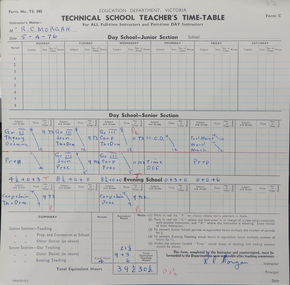
Books, Ballarat Junior Technical School Teacher's Timetable, 1976, 1976
... division of the Ballarat School of Mines, and a predecessor institution of Federation University Australia. ballarat junior technical school timetable george brosnan pyke robert charles morgan james bell trades building Ballarat Junior Technical School Teacher's Timetable .1) G.B. Pyke (Carpentry, Joniery, Building Construction .2) G.B. Pyke (Carpentry, Joniery, Building Construction .3) R.C. Morgan (Joining, handrailing, building construction, building Technical Maths) .4) James Bell (Toolmaking, Milling and Gear Cutting, Maths, Engine Drawing, Applied Mechanics, Metallurgy) .5) James Bell (Toolmaking, Milling and Gear Cutting, Maths, Engine Drawing, Applied Mechanics, Metallurgy, Electrical Welding) .6) R.C. Morgan (joinery, building construction, buillding Maths) .7 ...The Ballarat Junior Technical School was a division of the Ballarat School of Mines, and a predecessor institution of Federation University Australia.Ballarat Junior Technical School Teacher's Timetable .1) G.B. Pyke (Carpentry, Joniery, Building Construction .2) G.B. Pyke (Carpentry, Joniery, Building Construction .3) R.C. Morgan (Joining, handrailing, building construction, building Technical Maths) .4) James Bell (Toolmaking, Milling and Gear Cutting, Maths, Engine Drawing, Applied Mechanics, Metallurgy) .5) James Bell (Toolmaking, Milling and Gear Cutting, Maths, Engine Drawing, Applied Mechanics, Metallurgy, Electrical Welding) .6) R.C. Morgan (joinery, building construction, buillding Maths) .7) R.C. Morgan (joinery, building construction, buillding Maths)ballarat junior technical school, timetable, george brosnan pyke, robert charles morgan, james bell, trades, building -
 Federation University Historical Collection
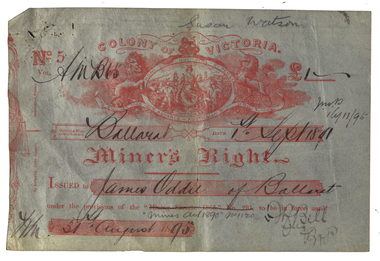
Document - Miner's Right, Colony of Victoria, Miner's Right for the Ballarat Observatory Land in Magpie Street, 1890-1899
... Division is Central D Ballarat. The red Miners' Right includes the Magpie Ste Address and "Dana Street allot 3 Sec 52 40 feet and 140 feet in Ballarat Central D". In red ink over the address in written (Ressarell) transferred in favor of Susan Watson 7/1/95 C.H. ...Division is Central D Ballarat. The red Miners' Right includes the Magpie Ste Address and "Dana Street allot 3 Sec 52 40 feet and 140 feet in Ballarat Central D". In red ink over the address in written (Ressarell) transferred in favor of Susan Watson 7/1/95 C.H. ...The Ballarat Observatory was established by James Oddie. It was later given to the Ballarat School of Mines, then the City of Ballarat.A number of Miners' Rights made out to James Oddie of Ballarat, for a block of land in Magpie Street, Mount Pleasant, used as the Ballarat Observatory. The red 1995 Miners' Right includes land at Dana Street with red writing over it regarding its transferal. The Observatory Registration in No 19578 with the situation of residence area being 'Magpie Street Mount Pleasant 209 feet x 52 feet" The District and Division is Central D Ballarat. The red Miners' Right includes the Magpie Ste Address and "Dana Street allot 3 Sec 52 40 feet and 140 feet in Ballarat Central D". In red ink over the address in written (Ressarell) transferred in favor of Susan Watson 7/1/95 C.H. Stevenson Asst M.R. miner's right, james oddie, ballarat observatory, magpie st, mount pleasant, f. bell, w.a. christy, dana street -
 Flagstaff Hill Maritime Museum and Village
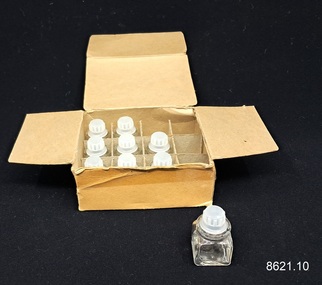
Container - Sample Bottles & Box, E.R. Squibb & Sons, Unknown
... 7, 8, 11, 13 identifying which mould the bottle was made in. The cardboard box has the following label: 'Physicians' Samples. List 42311E. 12 bottles. 6 tablets each. ENGRAN. Protect from direct sunlight. Control 1A63264. E.R. Squibb & Sons, New York. Division...7, 8, 11, 13 identifying which mould the bottle was made in. The cardboard box has the following label: 'Physicians' Samples. List 42311E. 12 bottles. 6 tablets each. ENGRAN. Protect from direct sunlight. Control 1A63264. E.R. Squibb & Sons, New York. Division ...These specimen bottles belonged to Dr.William Roy Angus, Surgeon and Oculist. They were donated to Flagstaff Hill Maritime Village by his daughter, Bernice McDade. They are part of the “W.R. Angus Collection” that includes historical medical equipment, surgical instruments and material once belonging to Dr Edward Ryan and Dr Thomas Francis Ryan, (both of Nhill, Victoria) as well as Dr Angus’ own belongings. The Collection’s history spans the medical practices of the two Doctors Ryan, from 1885-1926 plus that of Dr Angus, up until 1969. ABOUT THE “W.R.ANGUS COLLECTION” Doctor William Roy Angus M.B., B.S., Adel., 1923, F.R.C.S. Edin.,1928 (also known as Dr Roy Angus) was born in Murrumbeena, Victoria in 1901 and lived until 1970. He qualified as a doctor in 1923 at University of Adelaide, was Resident Medical Officer at the Royal Adelaide Hospital in 1924 and for a period was house surgeon to Sir (then Mr.) Henry Simpson Newland. Dr Angus was briefly an Assistant to Dr Riddell of Kapunda, then commenced private practice at Curramulka, Yorke Peninsula, SA, where he was physician, surgeon and chemist. In 1926, he was appointed as new Medical Assistant to Dr Thomas Francis Ryan (T.F. Ryan, or Tom), in Nhill, Victoria, where his experiences included radiology and pharmacy. In 1927 he was Acting House Surgeon in Dr Tom Ryan’s absence. Dr Angus had become engaged to Gladys Forsyth and they decided he would take time to further his studies overseas in the UK in 1927. He studied at London University College Hospital and at Edinburgh Royal Infirmary and in 1928, was awarded FRCS (Fellow from the Royal College of Surgeons), Edinburgh. He worked his passage back to Australia as a Ship’s Surgeon on the on the Australian Commonwealth Line’s T.S.S. Largs Bay. Dr Angus married Gladys in 1929, in Ballarat. (They went on to have one son (Graham 1932, born in SA) and two daughters (Helen (died 12/07/1996) and Berenice (Berry), both born at Mira, Nhill ) Dr Angus was a ‘flying doctor’ for the A.I.M. (Australian Inland Ministry) Aerial Medical Service in 1928 . The organisation began in South Australia through the Presbyterian Church in that year, with its first station being in the remote town of Oodnadatta, where Dr Angus was stationed. He was locum tenens there on North-South Railway at 21 Mile Camp. He took up this ‘flying doctor’ position in response to a call from Dr John Flynn; the organisation was later known as the Flying Doctor Service, then the Royal Flying Doctor Service. A lot of his work during this time involved dental surgery also. Between 1928-1932 he was surgeon at the Curramulka Hospital, Yorke Peninsula, South Australia. In 1933 Dr Angus returned to Nhill where he’d previously worked as Medical Assistant and purchased a share of the Nelson Street practice and Mira hospital from Dr Les Middleton one of the Middleton Brothers, the current owners of what was once Dr Tom Ryan’s practice. Dr L Middleton was House Surgeon to the Nhill Hospital 1926-1933, when he resigned. [Dr Tom Ryan’s practice had originally belonged to his older brother Dr Edward Ryan, who came to Nhill in 1885. Dr Edward saw patients at his rooms, firstly in Victoria Street and in 1886 in Nelson Street, until 1901. The Nelson Street practice also had a 2 bed ward, called Mira Private Hospital ). Dr Edward Ryan was House Surgeon at the Nhill Hospital 1884-1902 . He also had occasions where he successfully performed veterinary surgery for the local farmers too. Dr Tom Ryan then purchased the practice from his brother in 1901. Both Dr Edward and Dr Tom Ryan work as surgeons included eye surgery. Dr Tom Ryan performed many of his operations in the Mira private hospital on his premises. He too was House Surgeon at the Nhill Hospital 1902-1926. Dr Tom Ryan had one of the only two pieces of radiology equipment in Victoria during his practicing years – The Royal Melbourne Hospital had the other one. Over the years Dr Tom Ryan gradually set up what was effectively a training school for country general-practitioner-surgeons. Each patient was carefully examined, including using the X-ray machine, and any surgery was discussed and planned with Dr Ryan’s assistants several days in advance. Dr Angus gained experience in using the X-ray machine there during his time as assistant to Dr Ryan. Dr Tom Ryan moved from Nhill in 1926. He became a Fellow of the Royal Australasian College of Surgeons in 1927, soon after its formation, a rare accolade for a doctor outside any of the major cities. He remained a bachelor and died suddenly on 7th Dec 1955, aged 91, at his home in Ararat. Scholarships and prizes are still awarded to medical students in the honour of Dr T.F. Ryan and his father, Dr Michael Ryan, and brother, John Patrick Ryan. ] When Dr Angus bought into the Nelson Street premises in Nhill he was also appointed as the Nhill Hospital’s Honorary House Surgeon 1933-1938. His practitioner’s plate from his Nhill surgery states “HOURS Daily, except Tuesdays, Fridays and Saturday afternoons, 9-10am, 2-4pm, 7-8pm. Sundays by appointment”. This plate is now mounted on the doorway to the Port Medical Office at Flagstaff Hill Maritime Village, Warrnambool. Dr Edward Ryan and Dr Tom Ryan had an extensive collection of historical medical equipment and materials spanning 1884-1926 and when Dr Angus took up practice in their old premises he obtained this collection, a large part of which is now on display at the Port Medical Office at Flagstaff Hill Maritime Village in Warrnambool. During his time in Nhill Dr Angus was involved in the merging of the Mira Hospital and Nhill Public Hospital into one public hospital and the property titles passed on to Nhill Hospital in 1939. In 1939 Dr Angus and his family moved to Warrnambool where he purchased “Birchwood,” the 1852 home and medical practice of Dr John Hunter Henderson, at 214 Koroit Street. (This property was sold in1965 to the State Government and is now the site of the Warrnambool Police Station. ). The Angus family was able to afford gardeners, cooks and maids; their home was a popular place for visiting dignitaries to stay whilst visiting Warrnambool. Dr Angus had his own silk worm farm at home in a Mulberry tree. His young daughter used his centrifuge for spinning the silk. Dr Angus was appointed on a part-time basis as Port Medical Officer (Health Officer) in Warrnambool and held this position until the 1940’s when the government no longer required the service of a Port Medical Officer in Warrnambool; he was thus Warrnambool’s last serving Port Medical Officer. (The duties of a Port Medical Officer were outlined by the Colonial Secretary on 21st June, 1839 under the terms of the Quarantine Act. Masters of immigrant ships arriving in port reported incidents of diseases, illness and death and the Port Medical Officer made a decision on whether the ship required Quarantine and for how long, in this way preventing contagious illness from spreading from new immigrants to the residents already in the colony.) Dr Angus was a member of the Australian Medical Association, for 35 years and surgeon at the Warrnambool Base Hospital 1939-1942, He served as a Surgeon Captain during WWII1942-45, in Ballarat, Victoria, and in Bonegilla, N.S.W., completing his service just before the end of the war due to suffering from a heart attack. During his convalescence he carved an intricate and ‘most artistic’ chess set from the material that dentures were made from. He then studied ophthalmology at the Royal Melbourne Eye and Ear Hospital and created cosmetically superior artificial eyes by pioneering using the intrascleral cartilage. Angus received accolades from the Ophthalmological Society of Australasia for this work. He returned to Warrnambool to commence practice as an ophthalmologist, pioneering in artificial eye improvements. He was Honorary Consultant Ophthalmologist to Warrnambool Base Hospital for 31 years. He made monthly visits to Portland as a visiting surgeon, to perform eye surgery. He represented the Victorian South-West subdivision of the Australian Medical Association as its secretary between 1949 and 1956 and as chairman from 1956 to 1958. In 1968 Dr Angus was elected member of Spain’s Barraquer Institute of Barcelona after his research work in Intrasclearal cartilage grafting, becoming one of the few Australian ophthalmologists to receive this honour, and in the following year presented his final paper on Living Intrasclearal Cartilage Implants at the Inaugural Meeting of the Australian College of Ophthalmologists in Melbourne In his personal life Dr Angus was a Presbyterian and treated Sunday as a Sabbath, a day of rest. He would visit 3 or 4 country patients on a Sunday, taking his children along ‘for the ride’ and to visit with him. Sunday evenings he would play the pianola and sing Scottish songs to his family. One of Dr Angus’ patients was Margaret MacKenzie, author of a book on local shipwrecks that she’d seen as an eye witness from the late 1880’s in Peterborough, Victoria. In the early 1950’s Dr Angus, painted a picture of a shipwreck for the cover jacket of Margaret’s book, Shipwrecks and More Shipwrecks. She was blind in later life and her daughter wrote the actual book for her. Dr Angus and his wife Gladys were very involved in Warrnambool’s society with a strong interest in civic affairs. Their interests included organisations such as Red Cross, Rostrum, Warrnambool and District Historical Society (founding members), Wine and Food Society, Steering Committee for Tertiary Education in Warrnambool, Local National Trust, Good Neighbour Council, Housing Commission Advisory Board, United Services Institute, Legion of Ex-Servicemen, Olympic Pool Committee, Food for Britain Organisation, Warrnambool Hospital, Anti-Cancer Council, Boys’ Club, Charitable Council, National Fitness Council and Air Raid Precautions Group. He was also a member of the Steam Preservation Society and derived much pleasure from a steam traction engine on his farm. He had an interest in people and the community He and his wife Gladys were both involved in the creation of Flagstaff Hill, including the layout of the gardens. After his death (28th March 1970) his family requested his practitioner’s plate, medical instruments and some personal belongings be displayed in the Port Medical Office surgery at Flagstaff Hill Maritime Village, and be called the “W. R. Angus Collection”.The W.R. Angus Collection is significant for still being located at the site it is connected with, Doctor Angus being the last Port Medical Officer in Warrnambool. The collection of medical instruments and other items and equipment is culturally significant, being an historical example of medicine from late 19th to mid-20th century. Dr Angus assisted Dr Tom Ryan, a pioneer in the use of X-rays and in ocular surgery.Ten glass specimen bottles with lids and a rectangular cardboard storage box with partitions designed to fit twelve bottles. The moulded bottles have inscriptions. The label shows that the bottles would have been physicians' samples, with six tablets in each. They were made in U.S.A. by E.R. Squibb & Sons, New York. The objects are part of the W.R. Angus Collection. 'W'. Each bottle also has a number, viz: 4, 7, 8, 11, 13 identifying which mould the bottle was made in. The cardboard box has the following label: 'Physicians' Samples. List 42311E. 12 bottles. 6 tablets each. ENGRAN. Protect from direct sunlight. Control 1A63264. E.R. Squibb & Sons, New York. Division of Olin Mathieson Chemical Corporation. Made in U.S.A.flagstaff hill maritime museum and village, great ocean road, shipwreck coast, specimen bottles, medicine, diagnosis, w.r. angus -
 Ringwood and District Historical Society
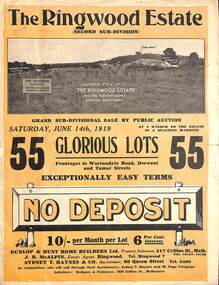
Pamphlet - Land Auction Brochure, The Ringwood Estate - Second Sub-Division, Ringwood, Victoria - 1919
... 7. Auctioneers - Sydney T. Haynes & Co., 60 Queen Street, Melbourne, Tel. 3400. Solicitors - Hodgson & Finlayson, 360 Collins Street, Melbourne. Inset photographs of local views including existing 4-roomed bungalow on Lot 37 Tamar Street. Double sided bi-fold leaflet advertising subdivision site, layout of streets and allotments, summary of local features and services and terms of sale. The Ringwood Estate - Second Sub-Division ...Double sided bi-fold leaflet advertising subdivision site, layout of streets and allotments, summary of local features and services and terms of sale. Auction Saturday June 14th, 1919. 55 Lots. Subdivision includes Warrandyte Road, Tamar Street, Mersey Street and Derwent Street. Property Sales - Dunlop & Hunt Home Builders Ltd., 317 Collins Street, Melbourne, Tels 10104-10105. Agents - J.B. McAlpin, Tel. Ringwood 7. Auctioneers - Sydney T. Haynes & Co., 60 Queen Street, Melbourne, Tel. 3400. Solicitors - Hodgson & Finlayson, 360 Collins Street, Melbourne. Inset photographs of local views including existing 4-roomed bungalow on Lot 37 Tamar Street. -
 Ringwood and District Historical Society
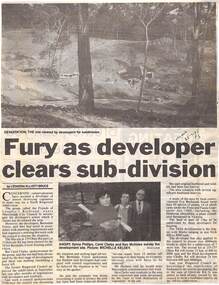
Newspaper, Scrapbook Clipping, Library Collection, Ringwood, Victoria
... Newspaper Clipping from "The Mail", 25-7-95. P3. Fury as developer clears sub-division. By Leonora Elliot-Bruce...The developers are Barnsdale Forest Newspaper Clipping from "The Mail", 25-7-95. P3. Fury as developer clears sub-division. By Leonora Elliot-Bruce Scrapbook Clipping, Library Collection, Ringwood, Victoria,. ...Newspaper Clipping from "The Mail", 25-7-95. P3. Fury as developer clears sub-division. By Leonora Elliot-BruceConcerned conservationists have accused a developer of almost destroying vegetation to make way for a North Ringwood subdivision. The group, Friends of Loughie's Bushland, wants Maroondah City Council to investigate the developer's action which it claims has devastated the area. The developers are Barnsdale Forest -
 Montmorency–Eltham RSL Sub Branch
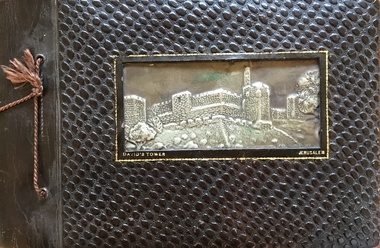
Album - Nicholson Photo Album
... His photo album shows pictures of him demonstrating skills in that area in various deployments overseas; his enlistment documents refer to his unit being the 8th Division Petrol Company, while for much of his service he was assigned to Nursing Duties in the 2/7 Australian General Hospital. ...His photo album shows pictures of him demonstrating skills in that area in various deployments overseas; his enlistment documents refer to his unit being the 8th Division Petrol Company, while for much of his service he was assigned to Nursing Duties in the 2/7 Australian General Hospital. ...Photographic record of overseas places visited by local resident who was a member of armed service during WW2. Des Nicholson was born in Northcote in 1909. He enlisted in the military in mid 1940, having already served 2 years in the Citizens’ Forces. Before he signed up, he lived in Kew with his mother, Isabella. His enlistment documents indicate that he was employed as a transport driver, although his discharge papers state that he was a hairdresser. His photo album shows pictures of him demonstrating skills in that area in various deployments overseas; his enlistment documents refer to his unit being the 8th Division Petrol Company, while for much of his service he was assigned to Nursing Duties in the 2/7 Australian General Hospital. His overseas postings included travels through India to the Middle East, Egypt and Greece. While fulfilling these duties, he was an interested photographer, keeping records of the sights he saw in many of the places he visited, as well as photos of the military living conditions and the people he worked with on a day-to-day basis. The ‘tourist’ photos Des took would be of particular interest as a current-day comparison for those folk who might be familiar with the locations he passed through. After the war, Des again lived with his mother but eventually, in 1953, he married Kathleen Watson who lived in Eltham. The wider Watson family was well-known in the area, and the sisters Kathleen and Ruby were residents in the Glen Park area in Eltham North. After Des and Kath married they continued to live in Kath and Ruby’s house near where the current soccer and cricket sporting complex is now located. Ruby never married and they evidently stayed in the same place until, one by one, they each died in the early 2000s. Photos taken by a resident of Eltham while on active service overseasPhoto AlbumOn Front Cover: DAVID'S TOWER JERUSALEMphotographs, ww2, overseas, india, middle east -
 Red Cliffs Military Museum
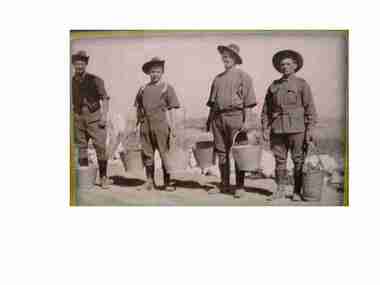
Collage, Collage of WW1 photos of E. H. Rowe, 1st April, 2001 (exact)
... Photos from left-top to bottom: (.1) 1 Australian Divisional Headquarters- Orderlies, Grooms & Police- Derna Camp - Egypt 1914/ (.2) Two Pals and Ernie Rowe -Pyramids, Egypt, 1914/ (.3) Morning fatigues- Derna Camp- Egypt, 1914/ Main Photo: (.4) Officer Cadet Ernest Henry Rowe/ Queens College, Oxford, England/ October 1917./ Top right to bottom: (.5) Recovering at Al Hayat Hospital- Egypt after being wounded at Lone Pine Battle, Gallipoli, in August 1915./ (.6) The boy from the Bush- heading to France with Engineers- 1916./ (.7) The Sphynx and Pyramids - Egypt - 1914/ Plaque: To The Red Cliffs R.S.L. / from/ The Rowe Family of Red Cliffs/ 1st April, 2001. ...Rowe Collection. camp australian ww1 1 gallipoli henry egypt ernest rowe derna divisional headquarters queens college oxford lone pine Photos from left-top to bottom: (.1) 1 Australian Divisional Headquarters- Orderlies, Grooms & Police- Derna Camp - Egypt 1914/ (.2) Two Pals and Ernie Rowe -Pyramids, Egypt, 1914/ (.3) Morning fatigues- Derna Camp- Egypt, 1914/ Main Photo: (.4) Officer Cadet Ernest Henry Rowe/ Queens College, Oxford, England/ October 1917./ Top right to bottom: (.5) Recovering at Al Hayat Hospital- Egypt after being wounded at Lone Pine Battle, Gallipoli, in August 1915./ (.6) The boy from the Bush- heading to France with Engineers- 1916./ (.7) The Sphynx and Pyramids - Egypt - 1914/ Plaque: To The Red Cliffs R.S.L. / from/ The Rowe Family of Red Cliffs/ 1st April, 2001. ...This is part of the E.H. Rowe Collection.A brown wooden frame, containing 7 photos and a history of Ernest Henry Rowe. The frame has a small plaque on the bottom front.Photos from left-top to bottom: (.1) 1 Australian Divisional Headquarters- Orderlies, Grooms & Police- Derna Camp - Egypt 1914/ (.2) Two Pals and Ernie Rowe -Pyramids, Egypt, 1914/ (.3) Morning fatigues- Derna Camp- Egypt, 1914/ Main Photo: (.4) Officer Cadet Ernest Henry Rowe/ Queens College, Oxford, England/ October 1917./ Top right to bottom: (.5) Recovering at Al Hayat Hospital- Egypt after being wounded at Lone Pine Battle, Gallipoli, in August 1915./ (.6) The boy from the Bush- heading to France with Engineers- 1916./ (.7) The Sphynx and Pyramids - Egypt - 1914/ Plaque: To The Red Cliffs R.S.L. / from/ The Rowe Family of Red Cliffs/ 1st April, 2001. camp, australian, ww1, 1, gallipoli, henry, egypt, ernest, rowe, derna, divisional, headquarters, queens, college, oxford, lone, pine -
 Australian Commando Association - Victoria
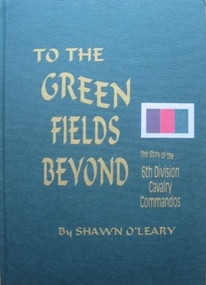
Book - 6th Div, Shawn OLeary, To The Green Fields Beyond:The story of the 6th Division Cavalry Commandos
... Division for the imminent invasion of Syria. The regiment experienced its heaviest fighting during the Syrian campaign, which began on 7 June. ...The comprehensive history of the 6th Australian Division Cavalry Commandos – a (now out of print) reprint of one of the rarer Armoured unit history books. This is the story of one of Australia’s most famous fighting regiments during World War II. As an armoured cavalry unit it fought the Italians and Germans in the sands of the African desert and the Vichy French in the mountains of Syria. Later as a dismounted commando unit it fought the Japanese in the terrifying jungles of New Guinea. The heroism of the men in its ranks and the actions in which they engaged are portrayed in a way which makes battle deeds leap realistically from the pages. “To The Green Fields Beyond” is a documented and detailed book which is of value to everyone who is interested in Australia’s story. Seldom before has such a contribution been made to record of our national history. The book has been approved and sponsored by the Australian War Memorial. The 6th Division Cavalry Regiment was formed in November 1939 and, just two months later, was sent overseas to the Middle East in January 1940. Arriving in Egypt, the regiment immediately went to Palestine, where it joined the rest of the 6th Division and trained using machine-gun carriers and, from October, six old Vickers light tanks. At the end of the year the regiment moved into the Western Desert, where it joined British forces ready for the major offensive to commence on 9 December. Two days later the regiment became the first unit of the 2nd Australian Imperial Force (AIF) to go into action when one of its squadron fought a sharp action against the Italians holding Garn el Grein and Fort Maddalina on 11 and 12 December. By 21 December British forces had captured Sidi Barrrani and the desert was now open for the 6th Division’s advance along the Libyan coast. On 3 January 1941 the division attacked and captured the Italian fort of Bardia. The regiment’s A Squadron, under the command of Major Denzil Macarthur-Onslow, who went on to command the 4th Armoured Brigade, supported the attack. Tobruk was the next Italian fort to be captured, with the regiment again in support and covering the 19th Brigade’s advance. The regiment, though, was under-equipped and without its full compliment of vehicles, using only machine gun carriers. To compensate for this, A Squadron was parity re-equipped with captured Italian light tanks, which had large kangaroos painted on the hulls and turrets to distinguish them from enemy vehicles. After Tobruk, the regiment was used as part of the advance guard in the capture of Derna and then Benghazi. In April the unit moved to Helwan, where it was equipped with Vickers light tanks and machine-gun carriers, and operated with British troops in capturing Sollum. Towards the end of May the regiment moved to Palestine, where it came under the command of the 7th Division for the imminent invasion of Syria. The regiment experienced its heaviest fighting during the Syrian campaign, which began on 7 June. A Squadron was attached to the 21st Brigade and advanced along the coast, where the rugged hills made it difficult to manoeuvre the tanks and carriers. The squadron was relieved by one of the 9th Division Cavalry Regiment’s squadrons on 13 and 14 June. C Squadron, meanwhile, was with the 25th Brigade, and advanced along the Rosh Pinna road, engaging strong enemy defences at Fort Khirbe. C Squadron was relieved by B Squadron, which was later attacked by Vichy French tanks that were supported by heavy artillery and machine-gun fire, which forced the Australians to withdrawal. Always willing or needing to improvise during the campaign, A and B Squadrons both operated three captured French R35 Renault light tanks, while C Squadron provided personnel for a horse troop, quickly nicknamed the “Kelly Gang”, to patrol the high, rugged hills near the Mardjayoun–Banis Road. The regiment remained in Syria as part of the occupation force and returned to Australia in March 1942. It was sent to the Adelaide River, in the Northern Territory, and then later to Murgon, in Queensland. In 1943 and 1944 divisional cavalry regiments were reorganised into cavalry (commando) regiments. In January 1944 the 6th Division Cavalry Regiment became the 2/6th Cavalry (Commando) Regiment. The regiment lost its vehicles and became the administrative headquarters for the 2/7th, 2/9th, and 2/10th Commando Squadrons. The regiment remained with the 6th Division and participated in the Aitpae–Wewak campaign, in New Guinea, during 1945. Includes Nominal Rollnon-fictionThe comprehensive history of the 6th Australian Division Cavalry Commandos – a (now out of print) reprint of one of the rarer Armoured unit history books. This is the story of one of Australia’s most famous fighting regiments during World War II. As an armoured cavalry unit it fought the Italians and Germans in the sands of the African desert and the Vichy French in the mountains of Syria. Later as a dismounted commando unit it fought the Japanese in the terrifying jungles of New Guinea. The heroism of the men in its ranks and the actions in which they engaged are portrayed in a way which makes battle deeds leap realistically from the pages. “To The Green Fields Beyond” is a documented and detailed book which is of value to everyone who is interested in Australia’s story. Seldom before has such a contribution been made to record of our national history. The book has been approved and sponsored by the Australian War Memorial. The 6th Division Cavalry Regiment was formed in November 1939 and, just two months later, was sent overseas to the Middle East in January 1940. Arriving in Egypt, the regiment immediately went to Palestine, where it joined the rest of the 6th Division and trained using machine-gun carriers and, from October, six old Vickers light tanks. At the end of the year the regiment moved into the Western Desert, where it joined British forces ready for the major offensive to commence on 9 December. Two days later the regiment became the first unit of the 2nd Australian Imperial Force (AIF) to go into action when one of its squadron fought a sharp action against the Italians holding Garn el Grein and Fort Maddalina on 11 and 12 December. By 21 December British forces had captured Sidi Barrrani and the desert was now open for the 6th Division’s advance along the Libyan coast. On 3 January 1941 the division attacked and captured the Italian fort of Bardia. The regiment’s A Squadron, under the command of Major Denzil Macarthur-Onslow, who went on to command the 4th Armoured Brigade, supported the attack. Tobruk was the next Italian fort to be captured, with the regiment again in support and covering the 19th Brigade’s advance. The regiment, though, was under-equipped and without its full compliment of vehicles, using only machine gun carriers. To compensate for this, A Squadron was parity re-equipped with captured Italian light tanks, which had large kangaroos painted on the hulls and turrets to distinguish them from enemy vehicles. After Tobruk, the regiment was used as part of the advance guard in the capture of Derna and then Benghazi. In April the unit moved to Helwan, where it was equipped with Vickers light tanks and machine-gun carriers, and operated with British troops in capturing Sollum. Towards the end of May the regiment moved to Palestine, where it came under the command of the 7th Division for the imminent invasion of Syria. The regiment experienced its heaviest fighting during the Syrian campaign, which began on 7 June. A Squadron was attached to the 21st Brigade and advanced along the coast, where the rugged hills made it difficult to manoeuvre the tanks and carriers. The squadron was relieved by one of the 9th Division Cavalry Regiment’s squadrons on 13 and 14 June. C Squadron, meanwhile, was with the 25th Brigade, and advanced along the Rosh Pinna road, engaging strong enemy defences at Fort Khirbe. C Squadron was relieved by B Squadron, which was later attacked by Vichy French tanks that were supported by heavy artillery and machine-gun fire, which forced the Australians to withdrawal. Always willing or needing to improvise during the campaign, A and B Squadrons both operated three captured French R35 Renault light tanks, while C Squadron provided personnel for a horse troop, quickly nicknamed the “Kelly Gang”, to patrol the high, rugged hills near the Mardjayoun–Banis Road. The regiment remained in Syria as part of the occupation force and returned to Australia in March 1942. It was sent to the Adelaide River, in the Northern Territory, and then later to Murgon, in Queensland. In 1943 and 1944 divisional cavalry regiments were reorganised into cavalry (commando) regiments. In January 1944 the 6th Division Cavalry Regiment became the 2/6th Cavalry (Commando) Regiment. The regiment lost its vehicles and became the administrative headquarters for the 2/7th, 2/9th, and 2/10th Commando Squadrons. The regiment remained with the 6th Division and participated in the Aitpae–Wewak campaign, in New Guinea, during 1945. Includes Nominal Rollww2, australian commandos, australian special forces, world war 2 -
 Phillip Island and District Historical Society Inc.
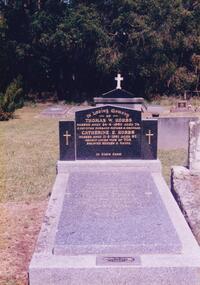
Photograph Album, Kodak, Phillip Island Cemetery, c 1990
... Division, for services to Phillip Island. Thomas died 1980 aged 75. His wife Catherine died 1991 aged 87. 466-43: Matilda Richardson. Matilda was born at Kyneton on 12th July 1865 and came to Cowes with her parents in 1869. She attended Cowes Primary School with her brothers and sisters. She became ill in November 1872 and died on 10th February 1873 aged 8 years and 7...Division, for services to Phillip Island. Thomas died 1980 aged 75. His wife Catherine died 1991 aged 87. 466-43: Matilda Richardson. Matilda was born at Kyneton on 12th July 1865 and came to Cowes with her parents in 1869. She attended Cowes Primary School with her brothers and sisters. She became ill in November 1872 and died on 10th February 1873 aged 8 years and 7 ...The Album was compiled by Nancy McHaffie late 1990's, with the assistance of Edith Jeffery's, with her book "Garden of Memories" and extensive knowledge of Phillip Island. The Cemetery lies back from the road and is surrounded by Manna Gums, rare Peppermint Gums, Blackwoods and other native trees. In all 25 acres of land were set aside as Crown Land in the land settlement of 1868. There are 6.2 acres of wetlands near the cemetery entrance.466-42: Thomas William Hobbs BEM. Thomas was born in England and came to the Island in the 1920's to work for the Chicory Farmers. He later owned his own farm at Ventnor and won the Better Farming Competition conducted by the Phillip Island Council. He was always an active community worker. Thomas was a Councillor and served two terms as President. He was the only resident to be awarded the British Empire Medal, Civil Division, for services to Phillip Island. Thomas died 1980 aged 75. His wife Catherine died 1991 aged 87. 466-43: Matilda Richardson. Matilda was born at Kyneton on 12th July 1865 and came to Cowes with her parents in 1869. She attended Cowes Primary School with her brothers and sisters. She became ill in November 1872 and died on 10th February 1873 aged 8 years and 7 months, from a severe bout of Quinsy. It was a great sadness to the family and they went to a lot of trouble to secure Matilda a fine grave in the cemetery. It is the oldest grave in the cemetery and a lasting memorial for her short life.phillip island cemetery, cr. hobbs, matilda richardson grave, nancy mchaffie, edith jeffery -
 Ringwood and District Historical Society
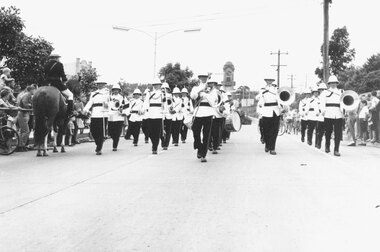
Photograph, Freedom of the City of Ringwood to 3 Div Engineers 7/3/1965 - The Royal Australian Engineers Corps Band from Kapooka (N.S.W.)
... 7/3/65. "Freedom" 3rd Div. Eng.' Two photographs and two extra slightly cropped versions. Handwritten on the back of 11168-4 "The Royal Australian Engineers Corps Band from Kapooka (NSW) moved into position near four Mounted Troopers during a march through Ringwood on March 27. The troopers supported Police Inspector A. Angus, who acted as Town Marshall to challenge 200 Members of the Royal Australian Engineers, 3rd Division...7/3/65. "Freedom" 3rd Div. Eng.' Two photographs and two extra slightly cropped versions. Handwritten on the back of 11168-4 "The Royal Australian Engineers Corps Band from Kapooka (NSW) moved into position near four Mounted Troopers during a march through Ringwood on March 27. The troopers supported Police Inspector A. Angus, who acted as Town Marshall to challenge 200 Members of the Royal Australian Engineers, 3rd Division ...Black and White photographs of RAE band from Kapooka, N.S.W.Catalogue card reads, 'R.A.E. Band. "Freedom of City". 34d Div. Engineers'. Written on backing of photograph, 'RAE band from Kapooka, N.S.W. 7/3/65. "Freedom" 3rd Div. Eng.' Two photographs and two extra slightly cropped versions. Handwritten on the back of 11168-4 "The Royal Australian Engineers Corps Band from Kapooka (NSW) moved into position near four Mounted Troopers during a march through Ringwood on March 27. The troopers supported Police Inspector A. Angus, who acted as Town Marshall to challenge 200 Members of the Royal Australian Engineers, 3rd Division. The Regiment gained entry to the City by the production of a Freedom of the City Scroll presented by the Mayor of Ringwood (Cr. B.J. Hubbard)." -
 Ringwood and District Historical Society
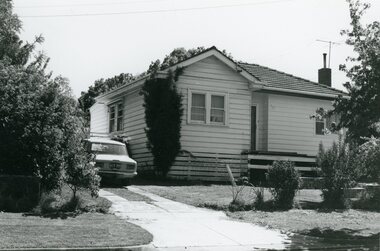
Photograph, House at 7 David Street, Ringwood circa 1970
... See https://csiropedia.csiro.au/manufacturing-technology-1980-97/ Black and white photograph taken by CSIRO Division of Building Research House at 7 David Street, Ringwood circa 1970 Photograph ...Black and white photograph taken by CSIRO Division of Building Research The Building Material Research Section was established in 1945 and operated for five years, before becoming the Division of Building Research in 1950 whose purpose was to conduct research and development in many aspects of the building industry in order to increase efficiency and effectiveness. In 1988, following the McKinsey-assisted restructuring of CSIRO, the Division of Building Research merged with the Highett-based Division of Energy Technology (mark I) to form the Division of Building, Construction and Engineering. Its goal was to work towards improving and supporting industries related to the built environment. See https://csiropedia.csiro.au/manufacturing-technology-1980-97/
