
Showing 71 items matching "a legacy of design"
-
 Federation University Historical Collection
Book - Book - Scrapbook, Ballarat School of MInes: Scrapbook of Newspaper Cuttings, Book 74, June 1996 to August 1996
... ...a legacy of design...The papers concerned are The Courier, Ballarat, The Australian, The Age ad other region papers over the period of 1 June 1996 to 6 August 1996. teaching positions advertised pre-employment courses courses available enrolment for smb courses counselling course may be lost myma rance father son graduate phil allender steve allender building apprentices non payment proposed changes to industrialrelations laws brenda huggins winner of award education is lifelong quest smb graduation night her majesty's 121st food fit for a king tony leonard cuts fall on regional takes administration students placed in workforce art appreciation through theatre tenders exceed funding ray borner to olympic games shane everard inspiration to all network caters for chefs judith beaton and jennifer martin business studies master painters' association innovative businesses building course for women deanne jakiel's win a boon for kooris dr ron wild bright future for smb young workers test their skills melissa cameron michael ronaldson mhr peter morey work skill angela cox geoffrey richards a legacy of design jocelynne scutt - barrister paralympians at smb barry jones - alp tafe cuts hit farmers smb and red lion hotel - hospitality course Book with yellow cover, front, spiral bound. ...Collection of newspaper articles related to Ballarat School Of Mines.They cover activities and advertisements for staff. The papers concerned are The Courier, Ballarat, The Australian, The Age ad other region papers over the period of 1 June 1996 to 6 August 1996.Book with yellow cover, front, spiral bound. teaching positions advertised, pre-employment courses, courses available, enrolment for smb courses, counselling course may be lost, myma rance, father son graduate, phil allender, steve allender, building apprentices non payment, proposed changes to industrialrelations laws, brenda huggins winner of award, education is lifelong quest, smb graduation night, her majesty's 121st, food fit for a king, tony leonard, cuts fall on regional takes, administration students placed in workforce, art appreciation through theatre, tenders exceed funding, ray borner to olympic games, shane everard inspiration to all, network caters for chefs, judith beaton and jennifer martin, business studies, master painters' association, innovative businesses, building course for women, deanne jakiel's win a boon for kooris, dr ron wild, bright future for smb, young workers test their skills, melissa cameron, michael ronaldson mhr, peter morey work skill, angela cox, geoffrey richards, a legacy of design, jocelynne scutt - barrister, paralympians at smb, barry jones - alp, tafe cuts hit farmers, smb and red lion hotel - hospitality course -
 Brighton Historical Society
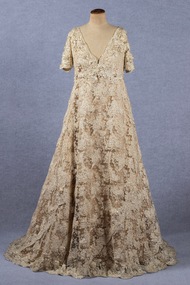
Dress, Evening dress, 1963
... This gown was the winning entry in the Mannequins and Models Guild's Gown of the Year competition, held at the Chevron Hilton Hotel, Melbourne in November 1963 in aid of the Torch Bearers for Legacy. Designed by Lorna White for Hartnell of Melbourne and modelled by Marien Brindley, the dress’s construction is reputed to have consumed 300 hours, with the finished dress weighing 6 kilograms and costing around 3000 pounds. ...This gown was the winning entry in the Mannequins and Models Guild's Gown of the Year competition, held at the Chevron Hilton Hotel, Melbourne in November 1963 in aid of the Torch Bearers for Legacy. Designed by Lorna White for Hartnell of Melbourne and modelled by Marien Brindley, the dress’s construction is reputed to have consumed 300 hours, with the finished dress weighing 6 kilograms and costing around 3000 pounds. gown of the year hartnell of melbourne lace beading ralph samuel lorna white marien brindley Evening gown made of cream ribbon lace and a rich latte-colured satin; applied beading. ...This gown was the winning entry in the Mannequins and Models Guild's Gown of the Year competition, held at the Chevron Hilton Hotel, Melbourne in November 1963 in aid of the Torch Bearers for Legacy. Designed by Lorna White for Hartnell of Melbourne and modelled by Marien Brindley, the dress’s construction is reputed to have consumed 300 hours, with the finished dress weighing 6 kilograms and costing around 3000 pounds. Evening gown made of cream ribbon lace and a rich latte-colured satin; applied beading. Cut with a high waist, short sleeves and deep V at centre back. Boned interior bodice. Centre back zip and train. gown of the year, hartnell of melbourne, lace, beading, ralph samuel, lorna white, marien brindley -
 Waverley RSL Sub Branch
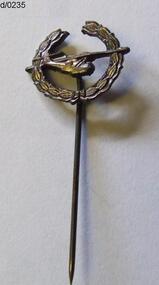
Tie Pin Catalina
... The Lapel badge / tie pin is unique in as much as it depicts the only ex-services organisation granted the privilege of incorporating the Legacy Laural Wreath in it's design. This privilege was granted to our association in recognition of the establishment of an educational trust fund devised and funded by our members in order to educate to tertiary standards the children of personnel who lost their lives in the extreme sacrifice. ...The Lapel badge / tie pin is unique in as much as it depicts the only ex-services organisation granted the privilege of incorporating the Legacy Laural Wreath in it's design. This privilege was granted to our association in recognition of the establishment of an educational trust fund devised and funded by our members in order to educate to tertiary standards the children of personnel who lost their lives in the extreme sacrifice. ...The Catalina Club "The enclosed item of military memorabillia is presented to the Waverley Sub-branch of the returned services league by W.F. Lewton, President of the Metropolitan Division of the Piscatorial Council, in appreciation of the services by the sub-branch's anging section. The Lapel badge / tie pin is unique in as much as it depicts the only ex-services organisation granted the privilege of incorporating the Legacy Laural Wreath in it's design. This privilege was granted to our association in recognition of the establishment of an educational trust fund devised and funded by our members in order to educate to tertiary standards the children of personnel who lost their lives in the extreme sacrifice. When the functions of administring the program became too onerous for our members, then, and only then, Legacy undertook to carry the program through to its conclusion. May this Pin find a place of honour in your excellent display of military memorabillia (Accompanying letter when donated) The Lapel badge / tie pin is unique in as much as it depicts the only ex-services organisation granted the privilege of incorporating the Legacy Laural Wreath in it's design. This privilege was granted to our association in recognition of the establishment of an educational trust fund devised and funded by our members in order to educate to tertiary standards the children of personnel who lost their lives in the extreme sacrifice.Bronze tie pin / lapel badge depicting a Catalina Aircraft airbourne surrounded by the (Legacy) laurel wreath -
 Melbourne Legacy
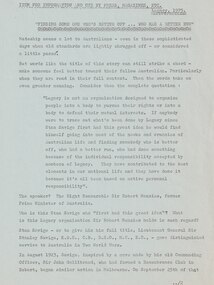
Document - Press Release 1975, Melbourne Legacy, Finding some one who's better off . . . who had a better run, 1975
... 'Legacy is not an organisation designed to organise people into a body to pursue their rights or into a body to defend their mutual interests. ...'Legacy is not an organisation designed to organise people into a body to pursue their rights or into a body to defend their mutual interests. ...A press release from Melbourne Legacy in 1975 which relates a story of how Legacy works. The information was intended to be used by press and magazines etc. The title 'Finding some one who's better off . . . who had a better run' and discusses mateship being important to Australians. It starts with a quote from Sir Robert Menzies, former prime minister of Australia. 'Legacy is not an organisation designed to organise people into a body to pursue their rights or into a body to defend their mutual interests. If anybody were to trace out what's been done by Legacy since Stan Savige first had this great idea he would find himself going into most of the nooks and crannies of Australian life and finding somebody who is better off, who had a better run, who had done something because of the individual responsibility accepted by members of Legacy. They have contributed to the best elements in our national life and they have done it because it's all been based on active personal responsibility'. The article goes on to describe the origins of Legacy and the work done. "Each member of Legacy is responsible for helping about five families. He gives of his time unstintingly; his only reward is to see these families secure, receiving all the advantages to which they are entitled. He sees, with pride, the family grow and for the widow there are social activities organised so that she, too, feels herself to be a useful member of the community. As she grows older, her care is assured as Legacy maintains gradually increasing hostel and/or Nursing Home type accomodation for frail, aged widows in its care.'A record of how Legacy promoted their work in the 1970s.Blue foolscap page x 3 with black type of a press release in 1975.Title 'Finding some one who's better off . . . who had a better run'press release, promotion, robert menzies -
 Flagstaff Hill Maritime Museum and Village
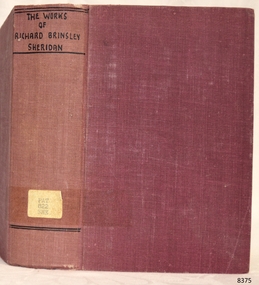
Book - Compalation of Plays, Prologues, Sociatal Observations, Richard Brinsley Sheridan, The Works of Richard Brinsley Sheridan, 1874
... It was designed to bring together the complete literary, political, and personal legacy of one of the Georgian era's most brilliant figures and, as such, is a first edition of this compilation. ...It was designed to bring together the complete literary, political, and personal legacy of one of the Georgian era's most brilliant figures and, as such, is a first edition of this compilation. ...Richard Brinsley Sheridan (1751–1816) was an Irish-born playwright, impresario, wit, and prominent Whig politician. He was a dazzling figure in late 18th-century London high society. The book, The Works of Richard Brinsley Sheridan, edited by Francis Stainforth, is an omnibus collection showcasing the full breadth of his career. The volume opens with a substantial biographical introduction (the "memoir"). It traces Sheridan's meteoric rise from an impoverished Irish theater family to the heights of Parliament and Westminster Abbey, balanced against his chaotic personal finances and battles with alcoholism. Rather than just printing his famous plays, this single-volume edition compiles his complete theatrical catalog (The Rivals, The School for Scandal, The Duenna, The Critic, Pizarro, etc.). Also included are his lesser-known verse, prologues written for the theater, classical translations, a selection of his most famous parliamentary orations, and fragments of plays and essays he never completed. The addition of a collection on “ANA,” noted on the book's flyleaf, refers to a 19th-century publishing term for a collection of anecdotes, memorable sayings, table-talk, and biographical trivia regarding a famous person. The "Sheridaniana" section in this book compiles the sharp-witted jokes, pranks, and clever remarks Sheridan made throughout his life.The Works of Richard Brinsley Sheridan Author: Richard Brinsley Sheridan Publisher: Chatto and Windus Date: 1874 Editor: Francis Edward StainforthfictionRichard Brinsley Sheridan (1751–1816) was an Irish-born playwright, impresario, wit, and prominent Whig politician. He was a dazzling figure in late 18th-century London high society. The book, The Works of Richard Brinsley Sheridan, edited by Francis Stainforth, is an omnibus collection showcasing the full breadth of his career. The volume opens with a substantial biographical introduction (the "memoir"). It traces Sheridan's meteoric rise from an impoverished Irish theater family to the heights of Parliament and Westminster Abbey, balanced against his chaotic personal finances and battles with alcoholism. Rather than just printing his famous plays, this single-volume edition compiles his complete theatrical catalog (The Rivals, The School for Scandal, The Duenna, The Critic, Pizarro, etc.). Also included are his lesser-known verse, prologues written for the theater, classical translations, a selection of his most famous parliamentary orations, and fragments of plays and essays he never completed. The addition of a collection on “ANA,” noted on the book's flyleaf, refers to a 19th-century publishing term for a collection of anecdotes, memorable sayings, table-talk, and biographical trivia regarding a famous person. The "Sheridaniana" section in this book compiles the sharp-witted jokes, pranks, and clever remarks Sheridan made throughout his life.flagstaff hil, warrnambool, flagstaff hill maritime museum, maritime museum, shipwreck coast, great ocean road, book, pattison collection, warrnambool library, warrnambool mechanics’ institute, ralph eric pattison, corangamite regional library service, warrnambool city librarian, mechanics’ institute library, victorian library board, warrnambool books and records, warrnambool children’s library, the works of richard brinsley sheridan, richard brinsley sheridan, f stainforth, plays, drama -
Glenelg Shire Council Cultural Collection
Functional object - Foot Warmer, Hecla Electrics Pty Ltd, c. 1920
... This object also highlights the legacy of high quality design and metal construction work that Clarence and James established for the company, stemming from their early work as talented art metal workers. ...From Museum Victoria: Made in about 1927 by Hecla Electrics Pty Ltd and sold under the model name 'Foot Warma'. The foot warmer was made from the late 1920s until the 1950s and did not change substantially in design during this time. The Hecla brand name and logo was registered in 1918 by Clarence Marriott. It was inspired by the recent eruption of Iceland's volcano Mt Heckla. Clarence and his father James were metal workers who had made Australia's first carbon filament electric radiators in 1899, and also built an early steam car. As electricity use exploded in the 1920s and 1930s, 'Hecla' became a household name in Melbourne. They made a wide range of appliances for the home, and supplied commercial appliances to cafés, hospitals and offices. In 1927, the company shifted from small premises in the city to a bigger, electric-powered factory in South Yarra. Hecla had no retail stores of its own - instead it sold products through wholesalers and retailers, including the State Electricity Commission (SEC). The company promoted its goods through advertisements in home magazines and displays in shop windows, home shows and the 1935 All-Electricity Exhibition. A popular advertising slogan in the 1930s was 'Hecla household helps make happy healthy housewives!'. Hecla ceased manufacturing in Melbourne in the 1980s.Documentation of how people lived and is an example of early domestic electrical appliances. From Museum Victoria: Hecla Electrics Pty Ltd were a significant Melbourne manufacturing company, who became a household name in the 1920s making small electric appliances such as heaters and kettles. They also made a variety of other electrical appliances for domestic, commercial and military use. The company manufactured electric appliances in Melbourne from about 1922 until the 1980s, although Clarence Marriott, who formed the company, had begun making radiators with his father James in 1899. The company had a reputation for quality products. The company also played an important role within the Australian domestic and commercial appliance industry, both as a leading innovator and through its role in training skilled staff, many of whom went on to work for competitors such as Kambrook, Electrolux and Sunbeam. This electric coffee percolator represents the typical small domestic appliance that the Hecla company was famous for. Along with other items in the Hecla Collection, it highlights the diversity of electric appliances that the company made. This object also highlights the legacy of high quality design and metal construction work that Clarence and James established for the company, stemming from their early work as talented art metal workers. It also represents the first major period of the take-up of electricity use in the home. This take-up began in the 1920s and 1930s with the use of small appliances, and by the 1950s electricity had become commonplace in the home, and large appliances such as refrigerators and stoves became standard.Square metal object. The top surface is heavy cast iron and patterned with floral motifs. In the centre is a circle with the words ' Hecla Foot Warma' inside. Under the top is a black metal base with two feet at either end which extend the length of the base. The back foot is higher than the front foot. There is a circular disk from which extends the electrical cord. The cord is brown and white checks. At the end of the cord is a plug on which is printed 250V AMP S.2 EARTH 5. The plug is brown and made from Bakelite. On the base is a rectangular label which has words printed - HECLA Australia.Top: HECLA/-FOOT-/WARMA Base: Volts / 230/250 / WATTS / 80 / HECLA / Australia / CAT. NO. F26domestic, city of portland, glenelg shire council, electrical, foot warmer, heating, hecla, manufacture -
 Greensborough Historical Society
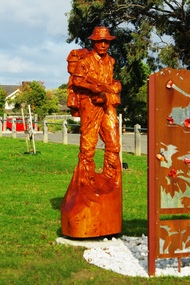
Photograph - Digital Image, Homefront: Vietnam, 11/07/2018
... designed by Amanda Gibson, carved by Hikaru Kodama and Leigh Conkie. In this sculpture "Vietnam", the soldier is based on veteran Bill Cantwell’s experience in the Vietnam War. The young soldier wears an eye patch – Bill’s legacy...designed by Amanda Gibson, carved by Hikaru Kodama and Leigh Conkie. In this sculpture "Vietnam", the soldier is based on veteran Bill Cantwell’s experience in the Vietnam War. The young soldier wears an eye patch – Bill’s legacy ..."Homefront" is the name of the group of chainsaw statues in Greensborough's War Memorial Park. Banyule Council initiated the project. The sculptures were designed by Amanda Gibson, carved by Hikaru Kodama and Leigh Conkie. In this sculpture "Vietnam", the soldier is based on veteran Bill Cantwell’s experience in the Vietnam War. The young soldier wears an eye patch – Bill’s legacy of his wartime injury. The base of the statue represents being held down – you can see the hands reaching up the soldier’s legs. Carved by Hikaru. The laser-cut steel shield has a pattern of Huey helicopters flying over rubber trees, Bill’s memory of being evacuated after being shot in the eye. The Homefront project replaces Leigh Conkie's original chainsaw sculptures in War Memorial Park.Digital copy of colour photographsgreensborough war memorial park, war memorials, homefront project -
Bendigo Historical Society Inc.
Newspaper - Bendigo Advertiser Collection: Schools Searching for a Future - Timor Primary School 1207, Sept 18 1993
... designed for large numbers of students (up to 490 at one time). The local Grand Duke mine, which operated until 1896, played a significant role in the town's history and left a physical legacy near the school.In 1983, the school began managing a four-hectare block of land opposite the school, previously damaged by mining, as an 'environment block.' ...designed for large numbers of students (up to 490 at one time). The local Grand Duke mine, which operated until 1896, played a significant role in the town's history and left a physical legacy near the school.In 1983, the school began managing a four-hectare block of land opposite the school, previously damaged by mining, as an 'environment block.' ...Timor Primary School (No. 1207) was established in 1873 in a former gold-mining town in Victoria. The area once had a population of around 7,000 during the gold rush, but is now sparsely populated. The original schoolhouse, built in 1879-80, was a grand structure designed for large numbers of students (up to 490 at one time). The local Grand Duke mine, which operated until 1896, played a significant role in the town's history and left a physical legacy near the school.In 1983, the school began managing a four-hectare block of land opposite the school, previously damaged by mining, as an 'environment block.' By 1988, the school was officially appointed custodian of this land, now called the Timor Primary School and Community Education and Environment Reserve. The school and community have improved the reserve by installing rabbit-proof fencing, building a bridge, creating paths, adding water, installing a fitness track, and planting many trees. The reserve has become a focal point for both the school’s 26 pupils and the wider community. Timor Primary School won the Australia Trust for Conservation Volunteers-ANZ Bank Environment Improvement Competition in 1986 and received praise for its achievements and community pride. The school has also received two ANA awards for its well-maintained garden. The school has faced challenges related to its small size and has been involved in a taskforce with neighboring schools to address these issues. The local community is strongly opposed to the possible closure of the school, with visible signs of protest throughout the town. Residents, including business owners like Chris Frahn, emphasize the school's importance to the town's vitality and express concerns that closure could lead to families moving away. The school's future is uncertain, with 28 pupils expected next year. If two more students enroll, the school would qualify for a second teacher. Enrollment is projected to increase over the next five years, suggesting potential for growth. The school has gained support from larger schools and the broader community. The final decision on the school's fate will be announced by the Education Minister on October 4, following a taskforce review. The school has a 120-year history in Timor. There is mention of possible renewed gold-mining activity in the area, which could impact the town's future and potentially increase the school-age population.Schools searching for a Future. Series of photos and information about Timor Primary School No. 1207. Pictures by Lisa Honeychurch. Written by Owen Davies. This item contains the following documents and Photos: 8091.607a Part of Page 11, the Bendigo Advertiser Friday Sept 10 1993 8091.607b Part of Page 11, the Bendigo Advertiser Friday Sept 10 1993 8091.607c Black and White Photo of Prep pupils - Contact BHS for details 8091.607d Black and White Photo of Hilda (Teacher) - Contact BHS for details 8091.607e Black and White Photo - front is Bev Walker - Contact BHS for details 8091.607f Black and White Photo - Students playing on fallen down tree - Contact BHS for details 8091.607g Black and White Photo - School Steeple - Contact BHS for details 8091.607h Black and White Photo -Timor School Sign - Contact BHS for details 8091.607i Black and White Photo - Students playing on fallen down tree - Contact BHS for details 8091.607j Black and White Photo - School from the front - Contact BHS for details 8091.607k Black and White Photo - Part of School and three kids playing basketball - Contact BHS for detailsnewspaper, bendigo advertiser, primary school, timor primary school -
 Alfred Hospital Nurses League - Nursing History Collection
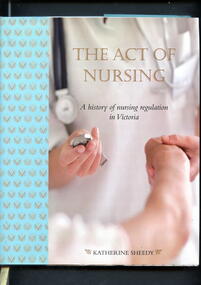
Book - Illustrated book, Katherine Sheedy, The act of nursing: A history of nursing regulation in Victoria, 2012
... Legacy Limited...Green Poles Design Pty Ltd...The act of nursing: A history of nursing regulation in Victoria Book Illustrated book Katherine Sheedy Nurses Board of Victoria Legacy Limited Green Poles Design Pty Ltd BPA Print Group ...This book documents an important part of the story of nursing and midwifery in Victoria. the role of registration, training accreditation and monitoring of nurses and midwives has been fulfilled by three bodies in Victoria: the Nurses Board (1923-1957), the Victorian Nursing Council (1957-1994) and the Nurses Board of Victoria (1994-2010).Illustrated book with dust jacket. Book has abbreviated title and authors surname printed on spine in white ink on pale blue background. This pale blue binding extends for 55mm on front and back covers. The remainder of the covers have repeated images of various Victorian Nurses board Badges on a white background. Dust jacket has similar images on pale blue background on spine and extending 55mm on front and back, remainder of back is pale blue. On the front is an image of one person (torso only) holding another's wrist and holding a watch in their other hand and part of a stethoscope is also visible. Title and author's name are printed on front and spine. There is a 9mm wide attached gold satin ribbon bookmark.non-fictionThis book documents an important part of the story of nursing and midwifery in Victoria. the role of registration, training accreditation and monitoring of nurses and midwives has been fulfilled by three bodies in Victoria: the Nurses Board (1923-1957), the Victorian Nursing Council (1957-1994) and the Nurses Board of Victoria (1994-2010).nursing-history, nursing-law and legislation-victoria-history -
 Alfred Hospital Nurses League - Nursing History Collection
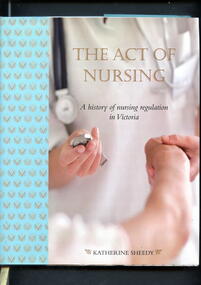
Book - Illustrated Book, Katherine Sheedy, The act of nursing: a history of nursing regulation in Victoria, 2011
... Legacy Limited...Green Poles Design Pty Ltd...The act of nursing: a history of nursing regulation in Victoria Book Illustrated Book Katherine Sheedy Nurses Board of Victoria Legacy Limited Green Poles Design Pty Ltd BPA Print Group ...This book documents an important part of the story of nursing and midwifery in Victoria. the role of registration, training accreditation and monitoring of nurses and midwives has been fulfilled by three bodies in Victoria: the Nurses Board (1923-1957), the Victorian Nursing Council (1957-1994) and the Nurses Board of Victoria (1994-2010).Illustrated book with dust jacket. Book has abbreviated title and authors surname printed on spine in white ink on pale blue background. This pale blue binding extends for 55mm on front and back covers. The remainder of the covers have repeated images of various Victorian Nurses board Badges on a white background . Dust jacket has similar images on pale blue background on spine and extending 55mm on front and back, remainder of back is pale blue. On the front is an image of one person (torso only) holding another's wrist and holding a watch in their other hand and part of a stethoscope is also visible. Title and author's name are printed on front and spine. There is a 9mm wide attached gold satin ribbon bookmark.non-fictionThis book documents an important part of the story of nursing and midwifery in Victoria. the role of registration, training accreditation and monitoring of nurses and midwives has been fulfilled by three bodies in Victoria: the Nurses Board (1923-1957), the Victorian Nursing Council (1957-1994) and the Nurses Board of Victoria (1994-2010).nursing-history, nursing-law and legislation-victoria-history, nursing trainng -
Glen Eira Historical Society
Article - Webb Family
... Two pages torn from Melbourne Weekly Bayside, April 14, 2010 entitled A Manor of Magnificence from Windsor Hotel to Winston Manor Charles Webb’s legacy remains unmatched by Kay Keighery on buildings designed by Charles Webb. ...Two pages torn from Melbourne Weekly Bayside, April 14, 2010 entitled A Manor of Magnificence from Windsor Hotel to Winston Manor Charles Webb’s legacy remains unmatched by Kay Keighery on buildings designed by Charles Webb. ...There are six items in this file. A photocopy from 500 Victorians 1934 edition of Percy Barrett Webb, engineer, manufacturer, of Webb Brothers, City Road South Melbourne. Includes carton illustration and personal details. Handwritten biographical information about Charles Webb, architect. Includes list of properties designed and two pages of references. Handwritten lists of two properties associated with George Octavius Webb, 1871 and 1887. Handwritten list of one property associated with Walter E. Webb, 1891. Two original photographs and one photocopy of statue of Isabella Webb, daughter of Justice Webb d.1891 located in Glen Eira City Hall as of 2000. One photograph taken in 1981 includes Mrs. Marie Langton, left, and Mrs. Margaret Moscham. Verso is handwritten description of photographs and photocopy. These were donated by Mrs. Langton March 2000. Two pages torn from Melbourne Weekly Bayside, April 14, 2010 entitled A Manor of Magnificence from Windsor Hotel to Winston Manor Charles Webb’s legacy remains unmatched by Kay Keighery on buildings designed by Charles Webb. The record page comprises description of 2 Manor Street, Brighton, designed by Webb, for sale at five million dollars.webb percy barrett, webb charles, webb george octavius, webb isabella, webb justice, langton mrs. marie, moscham margaret, glen eira city hall, orrong road, caulfield, st. mary’s caulfield, glenhuntly road, glenhuntly, duffy f.g., hopetoun street, korang street, glen tana, glentana, bambra road, currall road, ballantyne k., architetcts, architectural features, architectural styles, architecture, churches, mansion houses, sculpture, statues -
 National Wool Museum
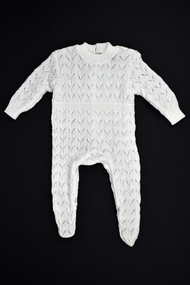
Textile - Baby Romper Suit, Kathryn Knitwear, c.1970
... Their legacy forms an integral part of both Australian social and manufacturing history. children's knitwear children's clothing baby clothing baby knitwear clothing knitwear Romper Jumpsuit Manufacturing Fashion Textile Production machine knitting Machine lace baby clothes .2 [Retail Swing Tag] [Obverse] KATHRYN Children’s Knitwear STYLE PRICE [handwritten] $18 SIZE [handwritten] 00 [Reverse] WASHING INSTRUCTIONS Refer to label sewn in Garment Designed and manufactured by ROBERT BLAKE PTY. ...Kathryn Knitwear, founded by Robert Blake, manufactured high quality children’s knitwear in Melbourne from the 1940s – 1980s. Robert Blake began manufacturing children’s knitwear in his bedroom in Strathmore using a hand powered machine in the late 1940s. The operation moved to Ascot Vale and Essendon, before eventually establishing a factory in Moonee Ponds in the early 1950s. The business continued to expand, necessitating a move to a new factory in Broadmeadows. By 1962, the Broadmeadows factory was producing an average of 20,000 garments per month, which increased to 24,000 by 1964. Robert Blake’s Son, Brendan recalls that “The Kathryn brand was famous around Australia, anywhere children needed to keep warm and dress smartly. It also won a number of wool fashion awards”, including the 1969 Wool Awards, which was held by the Australian Wool Bureau and published in Women’s Weekly. The Kathryn range was designed for durability, comfort and care, without sacrificing style. They used patterning techniques that increase stretchiness, comfort and fit, as well as integrating decorative elements into the fabric to prevent them from being bulky, uncomfortable or tight. Making longevity of style a priority, Brendan Blake remembers that “there was one particular garment that was in the range for at least thirty years”. He also recalls “In the past, when women have found out that I was associated with Kathryn Knitwear, they would often relate to me the story of a garment they had purchased or received as a gift and, when their child had grown out of it, they would hand it on to another child. Several ladies have told me of purchasing garments for their daughters’ glory box, or saving a particular garment after their daughter had grown out of it. Brendan Blake: “At the peak of their operation they employed approximately two hundred people, mainly women and girls. A family would often seek to send their daughter to work in this company because they knew they would be looked after and safe. One lady wrote to me telling me that working at the Moonee Ponds Factory prior to getting married was the happiest time of her life.” In 1963, workers at the Kathryn factory earned £13 per week, which was 8 shillings and 8 pence higher than the minimum weekly wage for female workers in the textile manufacturing industry (£12 11s 4d). By 1970, the Kathryn Knitwear brand expanded from children’s knitwear into womenswear under the brand name ‘Lady Kathryn’, and for boys and men under ‘Robert Blake’. Continuing to diversify their distribution, they also began exporting ‘Kathryn’ garments to New Zealand, the Pacific Islands, and Japan. ‘Kathryn Knitwear’ was well-known for their early adoption of modern materials and techniques that had broad appeal to their customer base. This is shown in their early use of the acrylic fibre ‘Orlon’ in the 50s and 60s and ‘Superwash’ wool in the 1970s. Many of Kathryn Knitwear’s styles, particularly those that were long running staples of the brand, were available in both wool and Orlon to suit the consumer’s preference. Orlon was developed by DuPont in the 1940s and became the first commercially successful acrylic fibre in the 1950s and 1960s. The development of Orlon coincided with an increase in availability of washing machines in everyday Australian homes. The great appeal of Orlon was that while wool garments still had to be hand-washed, Orlon’s shrink-resistant nature made it machine washable and dryable. This was a very appealing prospect, especially for the seemingly unending task of cleaning active children’s clothing. Machine washable wool would not be available until the development of the ‘Superwash’ treatment by the Australian Wool Board and CSIRO in 1970. Far from the humble origins of one man in his bedroom with a hand-cranked machine; at its closure in 1980, the Broadmeadows factory of ‘Kathryn’ housed more than 100 machines, including 53 sewing machines and 45 knitting machines. Robert Blake was “a passionate advocate for wool and Australian Made” throughout his whole life. A strong thread that ties through the lifespan of Robert Blake and Kathryn Knitwear is a balance between adopting new innovations without sacrificing the core values of durability, comfort, care and style that had made the brand so well known. Their legacy forms an integral part of both Australian social and manufacturing history.White lacework baby romper suit with long sleeves and legs, and enclosed feet. Closes at centre back with two plastic buttons. Zips open around leg inseam. Size 00 .2 is a retail tag marked with the price and size, and refers to the label sewn into the garment for washing instructions..2 [Retail Swing Tag] [Obverse] KATHRYN Children’s Knitwear STYLE PRICE [handwritten] $18 SIZE [handwritten] 00 [Reverse] WASHING INSTRUCTIONS Refer to label sewn in Garment Designed and manufactured by ROBERT BLAKE PTY. LTD., Melb., Aust.children's knitwear, children's clothing, baby clothing, baby knitwear, clothing, knitwear, romper, jumpsuit, manufacturing, fashion textile production, machine knitting, machine lace, baby clothes -
 National Wool Museum
Textile - Diaper Set, Kathryn Knitwear, c.1960
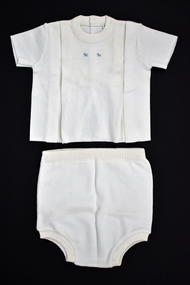
... Their legacy forms an integral part of both Australian social and manufacturing history. children's knitwear children's clothing knitwear clothing manufacturing Fashion Textile Production embroidery embroiderer hand embroidery dog embroidery animal embroidery animal motif dog motif dog animal baby clothes baby knitwear baby clothing .1 [label at back neck of top] Kathryn Reg’d / All Cotton / 18 .3 [sample label] [Obverse] STYLE: 314. Diaper Sat [sic] – Emb top. Combed Cotton. SIZE: 18” PRICE: 26/- COLOR: BLUE. LEMON. WHITE. [reverse] KATHRYN Garments are •PRE-SHRUNK •STANDARD MEASUREMENTS •FIT EXACTLY •LAUNDER PERFECTLY Designed ...Kathryn Knitwear, founded by Robert Blake, manufactured high quality children’s knitwear in Melbourne from the 1940s – 1980s. Robert Blake began manufacturing children’s knitwear in his bedroom in Strathmore using a hand powered machine in the late 1940s. The operation moved to Ascot Vale and Essendon, before eventually establishing a factory in Moonee Ponds in the early 1950s. The business continued to expand, necessitating a move to a new factory in Broadmeadows. By 1962, the Broadmeadows factory was producing an average of 20,000 garments per month, which increased to 24,000 by 1964. Robert Blake’s Son, Brendan recalls that “The Kathryn brand was famous around Australia, anywhere children needed to keep warm and dress smartly. It also won a number of wool fashion awards”, including the 1969 Wool Awards, which was held by the Australian Wool Bureau and published in Women’s Weekly. The Kathryn range was designed for durability, comfort and care, without sacrificing style. They used patterning techniques that increase stretchiness, comfort and fit, as well as integrating decorative elements into the fabric to prevent them from being bulky, uncomfortable or tight. Making longevity of style a priority, Brendan Blake remembers that “there was one particular garment that was in the range for at least thirty years”. He also recalls “In the past, when women have found out that I was associated with Kathryn Knitwear, they would often relate to me the story of a garment they had purchased or received as a gift and, when their child had grown out of it, they would hand it on to another child. Several ladies have told me of purchasing garments for their daughters’ glory box, or saving a particular garment after their daughter had grown out of it. Brendan Blake: “At the peak of their operation they employed approximately two hundred people, mainly women and girls. A family would often seek to send their daughter to work in this company because they knew they would be looked after and safe. One lady wrote to me telling me that working at the Moonee Ponds Factory prior to getting married was the happiest time of her life.” In 1963, workers at the Kathryn factory earned £13 per week, which was 8 shillings and 8 pence higher than the minimum weekly wage for female workers in the textile manufacturing industry (£12 11s 4d). By 1970, the Kathryn Knitwear brand expanded from children’s knitwear into womenswear under the brand name ‘Lady Kathryn’, and for boys and men under ‘Robert Blake’. Continuing to diversify their distribution, they also began exporting ‘Kathryn’ garments to New Zealand, the Pacific Islands, and Japan. ‘Kathryn Knitwear’ was well-known for their early adoption of modern materials and techniques that had broad appeal to their customer base. This is shown in their early use of the acrylic fibre ‘Orlon’ in the 50s and 60s and ‘Superwash’ wool in the 1970s. Many of Kathryn Knitwear’s styles, particularly those that were long running staples of the brand, were available in both wool and Orlon to suit the consumer’s preference. Cotton is a common material for knitwear worn in the warmer months, as it is very breathable and absorbs moisture easily. While we mostly associate knitwear with keeping us warm in the cold, the market for Australian knitwear would be very limited without options to wear all year round. The decoration on this garment was embroidered by hand by a skilled worker at the Kathryn Knitwear factory. Far from the humble origins of one man in his bedroom with a hand-cranked machine; at its closure in 1980, the Broadmeadows factory of ‘Kathryn’ housed more than 100 machines, including 53 sewing machines and 45 knitting machines. Robert Blake was “a passionate advocate for wool and Australian Made” throughout his whole life. A strong thread that ties through the lifespan of Robert Blake and Kathryn Knitwear is a balance between adopting new innovations without sacrificing the core values of durability, comfort, care and style that had made the brand so well known. Their legacy forms an integral part of both Australian social and manufacturing history.White diaper set. Short sleeved white top with two inverted box pleats along whole length, stitched at shoulder and mid chest. Embroidered in half cross stitch with two blue dogs on front. Closes in centre back with three plastic pearlescent buttons. White baby diaper shorts with ribbing at waist and leg holes .3 is a sample tag with manufacturing information, including price, size and colours available .4 is a swing tag with manufacturer care instructions.1 [label at back neck of top] Kathryn Reg’d / All Cotton / 18 .3 [sample label] [Obverse] STYLE: 314. Diaper Sat [sic] – Emb top. Combed Cotton. SIZE: 18” PRICE: 26/- COLOR: BLUE. LEMON. WHITE. [reverse] KATHRYN Garments are •PRE-SHRUNK •STANDARD MEASUREMENTS •FIT EXACTLY •LAUNDER PERFECTLY Designed and Manufactured by ROBERT BLAKE, MELBOURNE .4 [retail label] [obverse] Kathryn PRE-SHRUNK KNITWEAR Style: 314 [handwritten] DESIGNED & MANUFACTURED BY Robert Blake MELBOURNE [reverse] IMPORTANT. Special care should be taken with white and pastel shades. Rinse thoroughly. Do NOT dry in sunlight. WASHING INSTRUCTIONS 1.Wash frequently to AVOID HEAVY SOILING 2.Wash garment BY HAND, in lukewarm Velvet Soap suds. ON NO ACCOUNT RUB SOAP ON GARMENT. 3.Squeeze suds gently through garment but DO NOT RUB. Rubbing will cause garment to thicken. 4.RINSE AT LEAST TWICE IN CLEAN WATER TO REMOVE ALL SOAP. 5.To dry, roll garment in a towel to remove excess moisture, turn garment inside out and pull it lengthwise, then safety-pin to line through shoulder tape. 6.To keep Brushed Wool garments like new brush frequently with nylon brush.children's knitwear, children's clothing, knitwear, clothing, manufacturing, fashion textile production, embroidery, embroiderer, hand embroidery, dog embroidery, animal embroidery, animal motif, dog motif, dog, animal, baby clothes, baby knitwear, baby clothing -
 National Wool Museum
Textile - Children's Clothing Set, Kathryn Knitwear, c.1962-1964
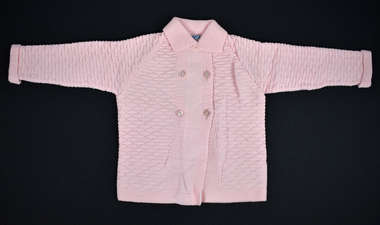
... legacy forms an integral part of both Australian social and manufacturing history. Knitwear Clothing Children's Knitwear Children's clothing Manufacturing Fashion Textile Production Machine Knitting clothing set pom poms 1) [Label at back neck with blue lettering woven into label] KATHRYN REGD ORLON / 20 /CREATED BY ROBERT BLAKE [sample label] [OBVERSE] STYLE LS/PWO – 3 PCS – LEGGING SUIT – PEARL PATT. – 80% ORLON 20% WOOL SIZE 18” 20” PRICE 48/6 51/6 COLOR BLUE. LEMON. PINK. WHITE. [REVERSE] KATHRYN Garments are • PRE-SHRUNK • STANDARD MEASUREMENTS • FIT EXACTLY • LAUNDER PERFECTLY Designed ...Kathryn Knitwear, founded by Robert Blake, manufactured high quality children’s knitwear in Melbourne from the 1940s – 1980s. Robert Blake began manufacturing children’s knitwear in his bedroom in Strathmore using a hand powered machine in the late 1940s. The operation moved to Ascot Vale and Essendon, before eventually establishing a factory in Moonee Ponds in the early 1950s. The business continued to expand, necessitating a move to a new factory in Broadmeadows. By 1962, the Broadmeadows factory was producing an average of 20,000 garments per month, which increased to 24,000 by 1964. Robert Blake’s Son, Brendan recalls that “The Kathryn brand was famous around Australia, anywhere children needed to keep warm and dress smartly. It also won a number of wool fashion awards”, including the 1969 Wool Awards, which was held by the Australian Wool Bureau and published in Women’s Weekly. The Kathryn range was designed for durability, comfort and care, without sacrificing style. They used patterning techniques that increase stretchiness, comfort and fit, as well as integrating decorative elements into the fabric to prevent them from being bulky, uncomfortable or tight. Making longevity of style a priority, Brendan Blake remembers that “there was one particular garment that was in the range for at least thirty years”. He also recalls “In the past, when women have found out that I was associated with Kathryn Knitwear, they would often relate to me the story of a garment they had purchased or received as a gift and, when their child had grown out of it, they would hand it on to another child. Several ladies have told me of purchasing garments for their daughters’ glory box, or saving a particular garment after their daughter had grown out of it. Brendan Blake: “At the peak of their operation they employed approximately two hundred people, mainly women and girls. A family would often seek to send their daughter to work in this company because they knew they would be looked after and safe. One lady wrote to me telling me that working at the Moonee Ponds Factory prior to getting married was the happiest time of her life.” In 1963, workers at the Kathryn factory earned £13 per week, which was 8 shillings and 8 pence higher than the minimum weekly wage for female workers in the textile manufacturing industry (£12 11s 4d). By 1970, the Kathryn Knitwear brand expanded from children’s knitwear into womenswear under the brand name ‘Lady Kathryn’, and for boys and men under ‘Robert Blake’. Continuing to diversify their distribution, they also began exporting ‘Kathryn’ garments to New Zealand, the Pacific Islands, and Japan. ‘Kathryn Knitwear’ was well-known for their early adoption of modern materials and techniques that had broad appeal to their customer base. This is shown in their early use of the acrylic fibre ‘Orlon’ in the 50s and 60s and ‘Superwash’ wool in the 1970s. Many of Kathryn Knitwear’s styles, particularly those that were long running staples of the brand, were available in both wool and Orlon to suit the consumer’s preference. Orlon was developed by DuPont in the 1940s and became the first commercially successful acrylic fibre in the 1950s and 1960s. The development of Orlon coincided with an increase in availability of washing machines in everyday Australian homes. The great appeal of Orlon was that while wool garments still had to be hand-washed, Orlon’s shrink-resistant nature made it machine washable and dryable. This was a very appealing prospect, especially for the seemingly unending task of cleaning active children’s clothing. Machine washable wool would not be available until the development of the ‘Superwash’ treatment by the Australian Wool Board and CSIRO in 1970. Far from the humble origins of one man in his bedroom with a hand-cranked machine; at its closure in 1980, the Broadmeadows factory of ‘Kathryn’ housed more than 100 machines, including 53 sewing machines and 45 knitting machines. Robert Blake was “a passionate advocate for wool and Australian Made” throughout his whole life. A strong thread that ties through the lifespan of Robert Blake and Kathryn Knitwear is a balance between adopting new innovations without sacrificing the core values of durability, comfort, care and style that had made the brand so well known. Their legacy forms an integral part of both Australian social and manufacturing history.Pink three piece legging suit, consisting of cardigan, lettings and beanie. Cardigan is knitted with textured stitch and has stocking stitch panel bordered with garter stitch at centre front. Two rows of buttons on garter stitch tab, with a fifth button under left collar. Leggings are plain garter stitch with an elastic waistband and a flap that extends onto the top of the foot with elastic to keep it held under the sole. Hat is in same patterned stitch as cardigan, has ear flaps with ties and a white pompom.1) [Label at back neck with blue lettering woven into label] KATHRYN REGD ORLON / 20 /CREATED BY ROBERT BLAKE [sample label] [OBVERSE] STYLE LS/PWO – 3 PCS – LEGGING SUIT – PEARL PATT. – 80% ORLON 20% WOOL SIZE 18” 20” PRICE 48/6 51/6 COLOR BLUE. LEMON. PINK. WHITE. [REVERSE] KATHRYN Garments are • PRE-SHRUNK • STANDARD MEASUREMENTS • FIT EXACTLY • LAUNDER PERFECTLY Designed and Manufactured by ROBERT BLAKE, MELBOURNEknitwear, clothing, children's knitwear, children's clothing, manufacturing, fashion textile production, machine knitting, clothing set, pom poms -
 National Wool Museum
Textile - Children's Cardigan, Kathryn Knitwear, c.1960
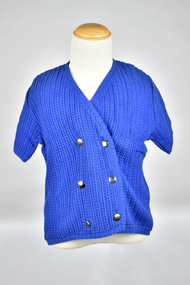
... Their legacy forms an integral part of both Australian social and manufacturing history. knitwear children's knitwear clothing children's clothing cardigan manufacturing Fashion Textile Production Machine Knitting Fashion Cotton .1) [white label at back neck with blue stitching] KATHRYN REGD. CREATED BY ALL COTTON / 24 / ROBERT BLAKE .2) [sample label] [OBVERSE] STYLE: 319/J – Reefer Jacket – Combed Cot. SIZE: 22” 24” 26” 28” 30” 32” PRICE: 20/- 21/- 22/6 24/- 26/- 27/6 COLOR: NAVY ONLY. [REVERSE] KATHRYN Garments are • PRE-SHRUNK • STANDARD MEASUREMENTS • FIT EXACTLY • LAUNDER PERFECTLY Designed ...Kathryn Knitwear, founded by Robert Blake, manufactured high quality children’s knitwear in Melbourne from the 1940s – 1980s. Robert Blake began manufacturing children’s knitwear in his bedroom in Strathmore using a hand powered machine in the late 1940s. The operation moved to Ascot Vale and Essendon, before eventually establishing a factory in Moonee Ponds in the early 1950s. The business continued to expand, necessitating a move to a new factory in Broadmeadows. By 1962, the Broadmeadows factory was producing an average of 20,000 garments per month, which increased to 24,000 by 1964. Robert Blake’s Son, Brendan recalls that “The Kathryn brand was famous around Australia, anywhere children needed to keep warm and dress smartly. It also won a number of wool fashion awards”, including the 1969 Wool Awards, which was held by the Australian Wool Bureau and published in Women’s Weekly. The Kathryn range was designed for durability, comfort and care, without sacrificing style. They used patterning techniques that increase stretchiness, comfort and fit, as well as integrating decorative elements into the fabric to prevent them from being bulky, uncomfortable or tight. Making longevity of style a priority, Brendan Blake remembers that “there was one particular garment that was in the range for at least thirty years”. He also recalls “In the past, when women have found out that I was associated with Kathryn Knitwear, they would often relate to me the story of a garment they had purchased or received as a gift and, when their child had grown out of it, they would hand it on to another child. Several ladies have told me of purchasing garments for their daughters’ glory box, or saving a particular garment after their daughter had grown out of it. Brendan Blake: “At the peak of their operation they employed approximately two hundred people, mainly women and girls. A family would often seek to send their daughter to work in this company because they knew they would be looked after and safe. One lady wrote to me telling me that working at the Moonee Ponds Factory prior to getting married was the happiest time of her life.” In 1963, workers at the Kathryn factory earned £13 per week, which was 8 shillings and 8 pence higher than the minimum weekly wage for female workers in the textile manufacturing industry (£12 11s 4d). By 1970, the Kathryn Knitwear brand expanded from children’s knitwear into womenswear under the brand name ‘Lady Kathryn’, and for boys and men under ‘Robert Blake’. Continuing to diversify their distribution, they also began exporting ‘Kathryn’ garments to New Zealand, the Pacific Islands, and Japan. ‘Kathryn Knitwear’ was well-known for their early adoption of modern materials and techniques that had broad appeal to their customer base. This is shown in their early use of the acrylic fibre ‘Orlon’ in the 50s and 60s and ‘Superwash’ wool in the 1970s. Many of Kathryn Knitwear’s styles, particularly those that were long running staples of the brand, were available in both wool and Orlon to suit the consumer’s preference. Cotton is a common material for knitwear worn in the warmer months, as it is very breathable and absorbs moisture easily. While we mostly associate knitwear with keeping us warm in the cold, the market for Australian knitwear would be very limited without options to wear all year round. Far from the humble origins of one man in his bedroom with a hand-cranked machine; at its closure in 1980, the Broadmeadows factory of ‘Kathryn’ housed more than 100 machines, including 53 sewing machines and 45 knitting machines. Robert Blake was “a passionate advocate for wool and Australian Made” throughout his whole life. A strong thread that ties through the lifespan of Robert Blake and Kathryn Knitwear is a balance between adopting new innovations without sacrificing the core values of durability, comfort, care and style that had made the brand so well known. Their legacy forms an integral part of both Australian social and manufacturing history.Royal blue double breasted cardigan 'Reefer Jacket' with short sleeves in a textured rib stitch with six chrome metal buttons in two rows down centre front. Style 319/J .2 is sample tag with manufacturing information, including sizes and colours available.1) [white label at back neck with blue stitching] KATHRYN REGD. CREATED BY ALL COTTON / 24 / ROBERT BLAKE .2) [sample label] [OBVERSE] STYLE: 319/J – Reefer Jacket – Combed Cot. SIZE: 22” 24” 26” 28” 30” 32” PRICE: 20/- 21/- 22/6 24/- 26/- 27/6 COLOR: NAVY ONLY. [REVERSE] KATHRYN Garments are • PRE-SHRUNK • STANDARD MEASUREMENTS • FIT EXACTLY • LAUNDER PERFECTLY Designed and Manufactured by ROBERT BLAKE, MELBOURNEknitwear, children's knitwear, clothing, children's clothing, cardigan, manufacturing, fashion textile production, machine knitting, fashion cotton -
 National Wool Museum
Textile - Children's Cardigan, Kathryn Knitwear, c.1965
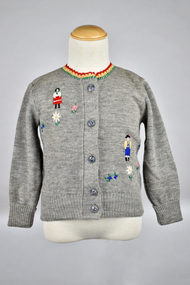
... legacy forms an integral part of both Australian social and manufacturing history. Children's knitwear knitwear clothing children's clothing Cardigan manufacturing fashion textile production machine knitting embroidery embroiderer Folk Art folk embroidery [Label at back neck with blue lettering woven into label] KATHRYN REGD / 22 ALL WOOL CREATED BY ROBERT BLAKE Grey children’s cardigan with embroidered flowers and human figures in folk costume, and crocheted design around neck in green, yellow and red. ...Kathryn Knitwear, founded by Robert Blake, manufactured high quality children’s knitwear in Melbourne from the 1940s – 1980s. Robert Blake began manufacturing children’s knitwear in his bedroom in Strathmore using a hand powered machine in the late 1940s. The operation moved to Ascot Vale and Essendon, before eventually establishing a factory in Moonee Ponds in the early 1950s. The business continued to expand, necessitating a move to a new factory in Broadmeadows. By 1962, the Broadmeadows factory was producing an average of 20,000 garments per month, which increased to 24,000 by 1964. Robert Blake’s Son, Brendan recalls that “The Kathryn brand was famous around Australia, anywhere children needed to keep warm and dress smartly. It also won a number of wool fashion awards”, including the 1969 Wool Awards, which was held by the Australian Wool Bureau and published in Women’s Weekly. The Kathryn range was designed for durability, comfort and care, without sacrificing style. They used patterning techniques that increase stretchiness, comfort and fit, as well as integrating decorative elements into the fabric to prevent them from being bulky, uncomfortable or tight. Making longevity of style a priority, Brendan Blake remembers that “there was one particular garment that was in the range for at least thirty years”. He also recalls “In the past, when women have found out that I was associated with Kathryn Knitwear, they would often relate to me the story of a garment they had purchased or received as a gift and, when their child had grown out of it, they would hand it on to another child. Several ladies have told me of purchasing garments for their daughters’ glory box, or saving a particular garment after their daughter had grown out of it. Brendan Blake: “At the peak of their operation they employed approximately two hundred people, mainly women and girls. A family would often seek to send their daughter to work in this company because they knew they would be looked after and safe. One lady wrote to me telling me that working at the Moonee Ponds Factory prior to getting married was the happiest time of her life.” In 1963, workers at the Kathryn factory earned £13 per week, which was 8 shillings and 8 pence higher than the minimum weekly wage for female workers in the textile manufacturing industry (£12 11s 4d). By 1970, the Kathryn Knitwear brand expanded from children’s knitwear into womenswear under the brand name ‘Lady Kathryn’, and for boys and men under ‘Robert Blake’. Continuing to diversify their distribution, they also began exporting ‘Kathryn’ garments to New Zealand, the Pacific Islands, and Japan. The decoration on this garment was embroidered by hand by a skilled worker at the Kathryn Knitwear factory. ‘Kathryn Knitwear’ was well-known for their early adoption of modern materials and techniques that had broad appeal to their customer base. This is shown in their early use of the acrylic fibre ‘Orlon’ in the 50s and 60s and ‘Superwash’ wool in the 1970s. Many of Kathryn Knitwear’s styles, particularly those that were long running staples of the brand, were available in both wool and Orlon to suit the consumer’s preference. Wool has been renowned for its excellent properties for thousands of years, by people from all over the world. Not only good for thick winter woollens, it can help keep you cool in summer, as well as being durable and resistant to water, fire, ultraviolet light, stains and odour. Far from the humble origins of one man in his bedroom with a hand-cranked machine; at its closure in 1980, the Broadmeadows factory of ‘Kathryn’ housed more than 100 machines, including 53 sewing machines and 45 knitting machines. Robert Blake was “a passionate advocate for wool and Australian Made” throughout his whole life. A strong thread that ties through the lifespan of Robert Blake and Kathryn Knitwear is a balance between adopting new innovations without sacrificing the core values of durability, comfort, care and style that had made the brand so well known. Their legacy forms an integral part of both Australian social and manufacturing history.Grey children’s cardigan with embroidered flowers and human figures in folk costume, and crocheted design around neck in green, yellow and red. Left panel has embroidered figure of man with blue lederhosen and yellow shirt, black shoes and hat, hat has red accent. Right front panel depicts woman wearing red skirt with white stripe, white shirt, and green headscarf with black stockings and shoes. Flowers are embroidered in pink, white and blue with green and yellow accents for stems and flower centres. Cardigan closes in front with five marbled grey plastic buttons[Label at back neck with blue lettering woven into label] KATHRYN REGD / 22 ALL WOOL CREATED BY ROBERT BLAKEchildren's knitwear, knitwear, clothing, children's clothing, cardigan, manufacturing, fashion textile production, machine knitting, embroidery, embroiderer, folk art, folk embroidery -
 National Wool Museum
Textile - Children's Lace Jumper, Kathryn Knitwear, c.1970
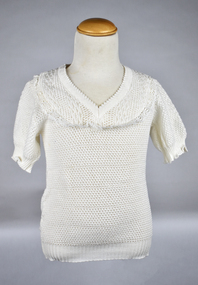
... legacy forms an integral part of both Australian social and manufacturing history. Children's knitwear children's clothing knitwear clothing manufacturing Fashion Textile Production Machine Knitting Machine lace .1) [white tag back neck, printed blue letters] KATHRYN REGD POLYESTER/VISCOSE MADE IN AUSTRALIA .2 [retail swing tag, numbers handwritten in blue ink] KATHRYN Children’s Knitwear STYLE [handwritten] 363 PRICE SIZE [handwritten] 6 Cream short sleeved jumper with overall open lace design, front yoke with accent lacework and applied lace ruffle edging .2 is a retail tag with style code and size, reverse has washing instructions for acrylic and cotton Textile Children's Lace Jumper Kathryn Knitwear ...Kathryn Knitwear, founded by Robert Blake, manufactured high quality children’s knitwear in Melbourne from the 1940s – 1980s. Robert Blake began manufacturing children’s knitwear in his bedroom in Strathmore using a hand powered machine in the late 1940s. The operation moved to Ascot Vale and Essendon, before eventually establishing a factory in Moonee Ponds in the early 1950s. The business continued to expand, necessitating a move to a new factory in Broadmeadows. By 1962, the Broadmeadows factory was producing an average of 20,000 garments per month, which increased to 24,000 by 1964. Robert Blake’s Son, Brendan recalls that “The Kathryn brand was famous around Australia, anywhere children needed to keep warm and dress smartly. It also won a number of wool fashion awards”, including the 1969 Wool Awards, which was held by the Australian Wool Bureau and published in Women’s Weekly. The Kathryn range was designed for durability, comfort and care, without sacrificing style. They used patterning techniques that increase stretchiness, comfort and fit, as well as integrating decorative elements into the fabric to prevent them from being bulky, uncomfortable or tight. Making longevity of style a priority, Brendan Blake remembers that “there was one particular garment that was in the range for at least thirty years”. He also recalls “In the past, when women have found out that I was associated with Kathryn Knitwear, they would often relate to me the story of a garment they had purchased or received as a gift and, when their child had grown out of it, they would hand it on to another child. Several ladies have told me of purchasing garments for their daughters’ glory box, or saving a particular garment after their daughter had grown out of it. Brendan Blake: “At the peak of their operation they employed approximately two hundred people, mainly women and girls. A family would often seek to send their daughter to work in this company because they knew they would be looked after and safe. One lady wrote to me telling me that working at the Moonee Ponds Factory prior to getting married was the happiest time of her life.” In 1963, workers at the Kathryn factory earned £13 per week, which was 8 shillings and 8 pence higher than the minimum weekly wage for female workers in the textile manufacturing industry (£12 11s 4d). By 1970, the Kathryn Knitwear brand expanded from children’s knitwear into womenswear under the brand name ‘Lady Kathryn’, and for boys and men under ‘Robert Blake’. Continuing to diversify their distribution, they also began exporting ‘Kathryn’ garments to New Zealand, the Pacific Islands, and Japan. ‘Kathryn Knitwear’ was well-known for their early adoption of modern materials and techniques that had broad appeal to their customer base. This is shown in their early use of the acrylic fibre ‘Orlon’ in the 50s and 60s and ‘Superwash’ wool in the 1970s. Many of Kathryn Knitwear’s styles, particularly those that were long running staples of the brand, were available in both wool and Orlon to suit the consumer’s preference. Orlon was developed by DuPont in the 1940s and became the first commercially successful acrylic fibre in the 1950s and 1960s. The development of Orlon coincided with an increase in availability of washing machines in everyday Australian homes. The great appeal of Orlon was that while wool garments still had to be hand-washed, Orlon’s shrink-resistant nature made it machine washable and dryable. This was a very appealing prospect, especially for the seemingly unending task of cleaning active children’s clothing. Machine washable wool would not be available until the development of the ‘Superwash’ treatment by the Australian Wool Board and CSIRO in 1970. Far from the humble origins of one man in his bedroom with a hand-cranked machine; at its closure in 1980, the Broadmeadows factory of ‘Kathryn’ housed more than 100 machines, including 53 sewing machines and 45 knitting machines. Robert Blake was “a passionate advocate for wool and Australian Made” throughout his whole life. A strong thread that ties through the lifespan of Robert Blake and Kathryn Knitwear is a balance between adopting new innovations without sacrificing the core values of durability, comfort, care and style that had made the brand so well known. Their legacy forms an integral part of both Australian social and manufacturing history.Cream short sleeved jumper with overall open lace design, front yoke with accent lacework and applied lace ruffle edging .2 is a retail tag with style code and size, reverse has washing instructions for acrylic and cotton.1) [white tag back neck, printed blue letters] KATHRYN REGD POLYESTER/VISCOSE MADE IN AUSTRALIA .2 [retail swing tag, numbers handwritten in blue ink] KATHRYN Children’s Knitwear STYLE [handwritten] 363 PRICE SIZE [handwritten] 6children's knitwear, children's clothing, knitwear, clothing, manufacturing, fashion textile production, machine knitting, machine lace -
 Sunshine and District Historical Society Incorporated
Domestic object - Sunshine Electrix Toaster
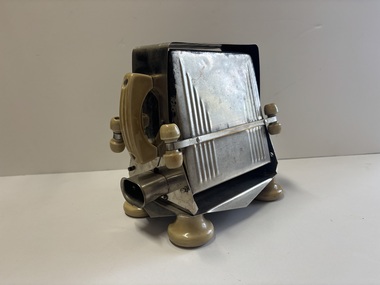
... design, manufactured in Sunshine, Victoria, during the mid-20th century. This toaster was manufactured C1930. These toasters are not just appliances—they’re artifacts of Sunshine’s manufacturing legacy. ...design, manufactured in Sunshine, Victoria, during the mid-20th century. This toaster was manufactured C1930. These toasters are not just appliances—they’re artifacts of Sunshine’s manufacturing legacy. ...The Sunshine Electrix toaster is a classic piece of Australian industrial design, manufactured in Sunshine, Victoria, during the mid-20th century. This toaster was manufactured C1930. These toasters are not just appliances—they’re artifacts of Sunshine’s manufacturing legacy. Nickel plated toaster with porcelain handles and feet with hinged metal flaps. Electric cord is missingSunshine Electrix Sunshine Vic Cat No ST1 240V 600Wsunshine pottery, sunshine electrix toaster -
 Sunshine and District Historical Society Incorporated
Film - A Blast From The Past Albion Explosive Factory DVD
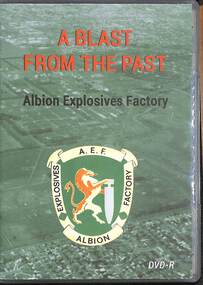
... legacy includes the Black Powder Mill, now a heritage landmark. War Time History - Established in 1939–40 in response to the looming threat of war in Europe. - Located in North Albion, opposite the ICIANZ chemical plant, which also helped design and operate the facility. - Initially known as Munitions Annexe No. 5, it became the Albion Explosives Factory, producing cordite, TNT, nitroglycerine, nitric acid, and other propellants for small arms and artillery. - By 1942–45, it was one of Australia’s three primary military explosives factories, employing thousands and contributing significantly to the war effort. ...legacy includes the Black Powder Mill, now a heritage landmark. War Time History - Established in 1939–40 in response to the looming threat of war in Europe. - Located in North Albion, opposite the ICIANZ chemical plant, which also helped design and operate the facility. - Initially known as Munitions Annexe No. 5, it became the Albion Explosives Factory, producing cordite, TNT, nitroglycerine, nitric acid, and other propellants for small arms and artillery. - By 1942–45, it was one of Australia’s three primary military explosives factories, employing thousands and contributing significantly to the war effort. ...The Albion Explosives Factory was a major WWII-era munitions site in Sunshine, Victoria, operating from 1939 to 1986. Its legacy includes the Black Powder Mill, now a heritage landmark. War Time History - Established in 1939–40 in response to the looming threat of war in Europe. - Located in North Albion, opposite the ICIANZ chemical plant, which also helped design and operate the facility. - Initially known as Munitions Annexe No. 5, it became the Albion Explosives Factory, producing cordite, TNT, nitroglycerine, nitric acid, and other propellants for small arms and artillery. - By 1942–45, it was one of Australia’s three primary military explosives factories, employing thousands and contributing significantly to the war effort. Post War Time History - Continued production of explosives and fertilizers for commercial use after WWII. - Expanded in 1947–49 with the addition of the RDX plant north of Furlong Road. - Introduced new technologies like synthetic ammonia, DNT, and continuous TNT production through the 1950s–60s. Closure and Environmental Remediation - Closed in 1986, followed by extensive decontamination and cleanup. - The site was heavily contaminated with TNT, DNT, nitrates, ammonia, and metals, requiring years of environmental audits and remediation. - Eventually redeveloped into a housing estate and shopping complex, transforming the industrial site into a suburban community. A Blast from the Past Albion Explosive Factoryalbion explosive factory, deer park, cairnlea -
 Sunshine and District Historical Society Incorporated
Film - A Blast From The Past Albion Explosive Factory Video
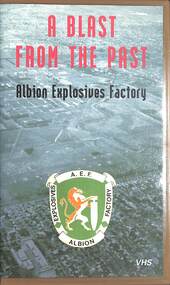
... legacy includes the Black Powder Mill, now a heritage landmark. War Time History - Established in 1939–40 in response to the looming threat of war in Europe. - Located in North Albion, opposite the ICIANZ chemical plant, which also helped design and operate the facility. - Initially known as Munitions Annexe No. 5, it became the Albion Explosives Factory, producing cordite, TNT, nitroglycerine, nitric acid, and other propellants for small arms and artillery. - By 1942–45, it was one of Australia’s three primary military explosives factories, employing thousands and contributing significantly to the war effort. ...legacy includes the Black Powder Mill, now a heritage landmark. War Time History - Established in 1939–40 in response to the looming threat of war in Europe. - Located in North Albion, opposite the ICIANZ chemical plant, which also helped design and operate the facility. - Initially known as Munitions Annexe No. 5, it became the Albion Explosives Factory, producing cordite, TNT, nitroglycerine, nitric acid, and other propellants for small arms and artillery. - By 1942–45, it was one of Australia’s three primary military explosives factories, employing thousands and contributing significantly to the war effort. ...The Albion Explosives Factory was a major WWII-era munitions site in Sunshine, Victoria, operating from 1939 to 1986. Its legacy includes the Black Powder Mill, now a heritage landmark. War Time History - Established in 1939–40 in response to the looming threat of war in Europe. - Located in North Albion, opposite the ICIANZ chemical plant, which also helped design and operate the facility. - Initially known as Munitions Annexe No. 5, it became the Albion Explosives Factory, producing cordite, TNT, nitroglycerine, nitric acid, and other propellants for small arms and artillery. - By 1942–45, it was one of Australia’s three primary military explosives factories, employing thousands and contributing significantly to the war effort. Post War Time History - Continued production of explosives and fertilizers for commercial use after WWII. - Expanded in 1947–49 with the addition of the RDX plant north of Furlong Road. - Introduced new technologies like synthetic ammonia, DNT, and continuous TNT production through the 1950s–60s. Closure and Environmental Remediation - Closed in 1986, followed by extensive decontamination and cleanup. - The site was heavily contaminated with TNT, DNT, nitrates, ammonia, and metals, requiring years of environmental audits and remediation. - Eventually redeveloped into a housing estate and shopping complex, transforming the industrial site into a suburban community. A Blast from the Past Albion Explosive Factoryalbion explosive factory, deer park, cairnlea -
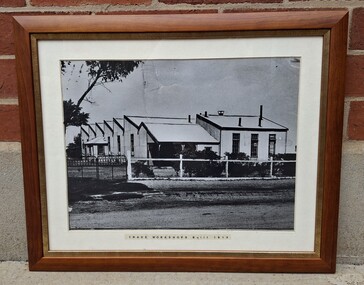 Sunshine and District Historical Society Incorporated
Photograph - Sunshine Technical School Trade Workshops Built 1913 Photograph
... legacy of H.V. McKay’s Harvester Works. - Opened: 7 July 1913, following H.V. McKay’s donation of £2,000 and 4.5 acres on Derby Road. - Facilities: The school featured a timber administration building with six classrooms and a large, galvanized iron workshop specifically built for trade apprentices. - Purpose: Designed to train apprentices for McKay’s Sunshine Harvester Works, reflecting the industrial needs of the time. - Initial Enrollment: 70 students, including 44 apprentices from the Harvester Works....legacy of H.V. McKay’s Harvester Works. - Opened: 7 July 1913, following H.V. McKay’s donation of £2,000 and 4.5 acres on Derby Road. - Facilities: The school featured a timber administration building with six classrooms and a large, galvanized iron workshop specifically built for trade apprentices. - Purpose: Designed to train apprentices for McKay’s Sunshine Harvester Works, reflecting the industrial needs of the time. - Initial Enrollment: 70 students, including 44 apprentices from the Harvester Works. ...The Sunshine Technical School trade workshop was constructed in 1913. It was a foundational part of Victoria’s early technical education system and was closely tied to the industrial growth of Sunshine and the legacy of H.V. McKay’s Harvester Works. - Opened: 7 July 1913, following H.V. McKay’s donation of £2,000 and 4.5 acres on Derby Road. - Facilities: The school featured a timber administration building with six classrooms and a large, galvanized iron workshop specifically built for trade apprentices. - Purpose: Designed to train apprentices for McKay’s Sunshine Harvester Works, reflecting the industrial needs of the time. - Initial Enrollment: 70 students, including 44 apprentices from the Harvester Works.Workshop Significance - The workshop was central to the school’s mission: “mente et manibus” — “with mind and with hands.” - It provided hands-on training in mechanical and industrial trades, aligning with the Education Act 1910’s push for secondary technical education. - This made Sunshine one of the first three technical schools established under the Act, and the longest-running of them, operating until 1991. Trade Workshop Built 1913sunshine technical school, h.v. mckay, sunshine harvester works -
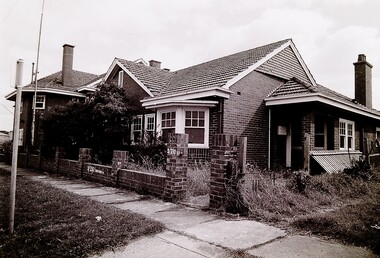 Sunshine and District Historical Society Incorporated
Photograph - Sunshine Fire Station Hampshire Road 1991 Photographs, Sharon Cavanagh, 27th March 1991
... Designed by noted architect Cedric Ballantyne, it is one of the suburb’s most ornate public buildings and a key symbol of Sunshine’s rapid expansion during the inter‑war period. It closed around 1990 and was later restored and repurposed as the Tobin Brothers “Legacy...Designed by noted architect Cedric Ballantyne, it is one of the suburb’s most ornate public buildings and a key symbol of Sunshine’s rapid expansion during the inter‑war period. It closed around 1990 and was later restored and repurposed as the Tobin Brothers “Legacy ...The Sunshine Metropolitan Fire Station, built in 1927 at the corner of Hampshire Road and Hertford Street, served as Sunshine’s main fire station for decades. Designed by noted architect Cedric Ballantyne, it is one of the suburb’s most ornate public buildings and a key symbol of Sunshine’s rapid expansion during the inter‑war period. It closed around 1990 and was later restored and repurposed as the Tobin Brothers “Legacy of Life” Chapel.”The Sunshine Fire Station on Hampshire Road is one of Sunshine’s most historically significant civic buildings, a landmark of the suburb’s inter‑war growth, its industrial identity, and its long relationship with the Metropolitan Fire Brigade. These photographs were taken after the fire station closed and relocated to McIntyre Road in Sunshine North, but before the building was restored and repurposed for use by Tobin Brothers. The residential part of the fire station, the adjoining house in Berkshire Road has been demolished.State Of Fire Station Hampshire Rd Sunshinesunshine fire station, hampshire road, berkshire road, sunshine -
Tatura Irrigation & Wartime Camps Museum
Book, The Bauhaus legacy, 2008
... Works designed, inspired or created by Ludwig Hirschfield Mack, Ex Dunera, Art Master at Geelong Grammar School, Corio 1942-1957. the bauhauslegacy Ludwig Hirschfeld-Mack Camp 2 Tatura Geelong Grammar School Felicity Renowden Resi Schwarzbauer Cream covered soft cover book, light and dark grey text, watercolour, calsomine and tempera on cardboard. 32 pages. The Bauhaus legacy ...Works designed, inspired or created by Ludwig Hirschfield Mack, Ex Dunera, Art Master at Geelong Grammar School, Corio 1942-1957.Cream covered soft cover book, light and dark grey text, watercolour, calsomine and tempera on cardboard. 32 pages.the bauhauslegacy, ludwig hirschfeld-mack, camp 2 tatura, geelong grammar school, felicity renowden, resi schwarzbauer -
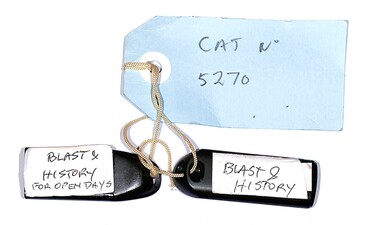 Sunshine and District Historical Society Incorporated
Film - A Blast From The Past Albion Explosive Factory USB Stick
... legacy includes the Black Powder Mill, now a heritage landmark. War Time History - Established in 1939–40 in response to the looming threat of war in Europe. - Located in North Albion, opposite the ICIANZ chemical plant, which also helped design and operate the facility. - Initially known as Munitions Annexe No. 5, it became the Albion Explosives Factory, producing cordite, TNT, nitroglycerine, nitric acid, and other propellants for small arms and artillery. - By 1942–45, it was one of Australia’s three primary military explosives factories, employing thousands and contributing significantly to the war effort. ...legacy includes the Black Powder Mill, now a heritage landmark. War Time History - Established in 1939–40 in response to the looming threat of war in Europe. - Located in North Albion, opposite the ICIANZ chemical plant, which also helped design and operate the facility. - Initially known as Munitions Annexe No. 5, it became the Albion Explosives Factory, producing cordite, TNT, nitroglycerine, nitric acid, and other propellants for small arms and artillery. - By 1942–45, it was one of Australia’s three primary military explosives factories, employing thousands and contributing significantly to the war effort. ...The Albion Explosives Factory was a major WWII-era munitions site in Sunshine, Victoria, operating from 1939 to 1986. Its legacy includes the Black Powder Mill, now a heritage landmark. War Time History - Established in 1939–40 in response to the looming threat of war in Europe. - Located in North Albion, opposite the ICIANZ chemical plant, which also helped design and operate the facility. - Initially known as Munitions Annexe No. 5, it became the Albion Explosives Factory, producing cordite, TNT, nitroglycerine, nitric acid, and other propellants for small arms and artillery. - By 1942–45, it was one of Australia’s three primary military explosives factories, employing thousands and contributing significantly to the war effort. Post War Time History - Continued production of explosives and fertilizers for commercial use after WWII. - Expanded in 1947–49 with the addition of the RDX plant north of Furlong Road. - Introduced new technologies like synthetic ammonia, DNT, and continuous TNT production through the 1950s–60s. Closure and Environmental Remediation - Closed in 1986, followed by extensive decontamination and cleanup. - The site was heavily contaminated with TNT, DNT, nitrates, ammonia, and metals, requiring years of environmental audits and remediation. - Eventually redeveloped into a housing estate and shopping complex, transforming the industrial site into a suburban community. A Blast from the Past Albion Explosive Factoryalbion explosive factory, deer park, cairnlea -
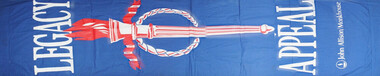 Melbourne Legacy
Banner, Legacy Appeal
... Legacy used banners to identify themselves at public events. The colour and design changed over the years, this is one example. legacy promotion legacy week Legacy, with the torch underneath, APPEAL and the sponsor's name John Allison Monkhouse. ...Sponsors banner used during Legacy Week. Period of manufacture and use not known.Legacy used banners to identify themselves at public events. The colour and design changed over the years, this is one example.Banner of blue material with print marking in white and red.Legacy, with the torch underneath, APPEAL and the sponsor's name John Allison Monkhouse.legacy promotion, legacy week -
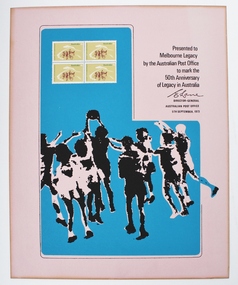 Melbourne Legacy
Certificate, Legacy Stamp, 1973
... The stamp was produced in recognition of the outstanding work that Legacy has done in helping war widows and their families. The design of children playing within the silhouette of a hand, was done by George Hamori, an Australian graphic design artist (born 1918)....The stamp was produced in recognition of the outstanding work that Legacy has done in helping war widows and their families. The design of children playing within the silhouette of a hand, was done by George Hamori, an Australian graphic design artist (born 1918). ...A certificate presented as an anniversary gift to Melbourne Legacy, recognising 50 years as commemorated on a postage stamp. Australia Post issued this postage stamp in 1973, on the 50th anniversary of the founding of Melbourne Legacy, September 1923. The stamp was produced in recognition of the outstanding work that Legacy has done in helping war widows and their families. The design of children playing within the silhouette of a hand, was done by George Hamori, an Australian graphic design artist (born 1918).The stamp was a reminder to all the people of Australia of the helping hand of kindness of Legacy, and the generosity of the people of Australia who have donated to fund the work that Legacy does.Pink and blue cardboard certificate with four 7c stamps affixed in top left corner. Each stamp bears an image of 8 children playing football over a ghosted hand. The image of the chilren also appears in a larger format in the central region of the card.Presented to / Melbourne Legacy / by the Australian Post Office / to mark the / 50th Anniversary / of Legacy in Australia Director-General / Australian Post Office / 5th September, 1973legacy promotion, golden jubilee -
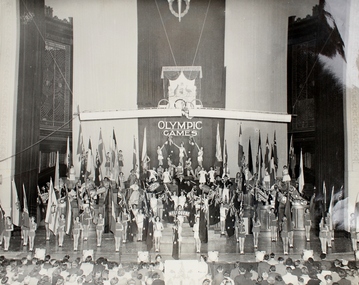 Melbourne Legacy
Photograph, Annual Demonstration 1956, 1956
... Part of the set design were the Olympic Rings and sign saying Olympic Games. Throughout the year Melbourne Legacy provided classes for Junior Legatees such as dancing, gymnastics and eurythmics, the Demonstration was an annual event to showcase their skills. ...Part of the set design were the Olympic Rings and sign saying Olympic Games. Throughout the year Melbourne Legacy provided classes for Junior Legatees such as dancing, gymnastics and eurythmics, the Demonstration was an annual event to showcase their skills. ...Black and white photo of a finale of an Annual Demonstration at the Melbourne Town Hall. Part of the set design were the Olympic Rings and sign saying Olympic Games. Throughout the year Melbourne Legacy provided classes for Junior Legatees such as dancing, gymnastics and eurythmics, the Demonstration was an annual event to showcase their skills. Melbourne Legacy conducted Annual Demonstrations / Parades from 1928 through to the late 1970's, usually held at Melbourne Town Hall or Olympic Pool Stadium. The beautiful costumes were made by members of the Junior Legacy Mothers' Club and the Melbourne Legacy Wives' Association. A record of a Junior Legacy Demonstration.Black and white photo from the 1956 Melbourne Junior Legatees Annual Demonstration at the Melbourne Town Hall.junior legatee, annual demonstration -
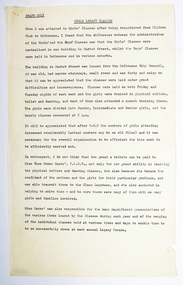 Melbourne Legacy
Document, Girls Legacy Classes, 1976
... Legacy Parade. Miss Carre also organised the Mothers, Legatees' wives and friends into sewing groups to provide the thousands of costumes required for the items presented, and naturally she had to design these costumes - all of this work was carried out, as previously mentioned, under the extreme difficulties they were working under in the Market Street building. ...Legacy Parade. Miss Carre also organised the Mothers, Legatees' wives and friends into sewing groups to provide the thousands of costumes required for the items presented, and naturally she had to design these costumes - all of this work was carried out, as previously mentioned, under the extreme difficulties they were working under in the Market Street building. ...A recollection of information about Girls Legacy Club and its primary instructor Miss Enez Domec Carre. It was written by C.E. Chancellor in June 1976. "Draft only. Girls Legacy Classes When I was attached to Girls' Classes after being transferred from Mildura Club to Melbourne, I found that the difference between the administration of the Girls' and the Boys' Classes was that the Girls' Classes were centralised in one building in Market Street, whilst the Boys' Classes were held in Melbourne and in various suburbs. The building in Market Street was leased from the Melbourne City Council, it was old, had narrow stairways, small rooms and was dusty and noisy so that is can be appreciated that the classes were held under great difficulties and inconvenience. Classes were held on both Friday and Tuesday nights of each week and the girls were trained in physical culture, ballet and dancing, and most of them also attended a speech training class. The girls were divided into Junior, Intermediate and Senior girls, and the hourly classes commenced at 5 p.m. It will be appreciated that after WW2 the numbers of girls attending increased considerably (actual numbers may be on old files) and it was necessary for the overall organisation to be efficient for this work to be efficiently carried out. In retrospect I do not think that too great a tribute can be paid to Miss Enez Domec Carre, F.P.C.V., not only for her great ability in teaching the physical culture and dancing classes, but also because she became the confidant of the mothers and the girls for their particular problems, and was able to transmit these to the Class Legatees, and she also assisted in helping to solve them - and be sure there were many of them with so many girls and families involved. Miss Carre was also responsible for the many magnificent presentations of the various items learnt by the Classes during each year and of the merging of individual classes held at various times and days to enable them to be so successfully shown at the each annual Legacy Parade. Miss Carre also organised the Mothers, Legatees' wives and friends into sewing groups to provide the thousands of costumes required for the items presented, and naturally she had to design these costumes - all of this work was carried out, as previously mentioned, under the extreme difficulties they were working under in the Market Street building. The purchase of Legacy House and the transfer of classes to this building was of immense help and importance in the carrying on of these classes which have proved so valuable to Legacy work. Many of the girls - now Mothers and Grandmothers still help in Legacy work and still appreciate the value of the Girls' Classes were to them. C.E. Chancellor cc. to Legatees A.R. Beattie / Larkin / Gibsey"A nice summary of the work done by Miss Enez Domec Carre for Legacy and the conditions the classes were held in prior to moving to Legacy House.White foolscap paper with black type x 2 pages recollecting the contribution Miss Enez Domec Carre to the Girls Physical Culture Classes as well as details of location of classes.girls' classes, girls' club, junior legatee -
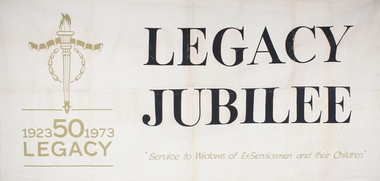 Melbourne Legacy
Banner, Legacy Jubilee
... LEGACY JUBILLEE. In gold underneath ‘Service to widows of ex servicemen and their children.’ Designed...LEGACY JUBILLEE. In gold underneath ‘Service to widows of ex servicemen and their children.’ Designed ...A banner promoting Legacy that was used at the ANZAC Day March 1973. 1973 was the Golden Jubilee of Legacy's creation in 1923. Many celebrations were held and this banner was proudly displayed as the Legatees marched together in the Anzac Day March instead of marching in their individual battalions.A banner that was used in a significant celebration of the golden jubilee of Legacy.Canvas printed banner with nylon cord at each corner. White background with Legacy logo and text printed on surface. Left hand side printed in gold is the Legacy logo with 1923/50/1973/ Legacy. Centre and RHS in black LEGACY JUBILLEE. In gold underneath ‘Service to widows of ex servicemen and their children.’ Designed to be carried in a march.legacy promotion, anzac day, golden jubilee, 50th anniversary -
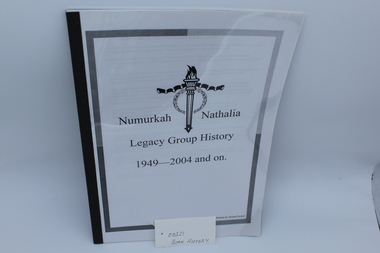 Melbourne Legacy
Book, Numurkah Nathalia Legacy Group History 1949- 2004 and on, 2004
... Legacy logo in black, title in black print, grey border. Clear front cover showing title underneath in black lettering. Spine and back thin cardboard, black pattern design. ...A detailed history of the Numurkah/Nathalia Legacy. Part of Melbourne Legacy. This publication gives an account of the people involved, fund raising activities, camps and holidays, wood drives and much more. A fascinating account of a small group of Legatees and their endeavours to help Legacy widows and families.Significant in that the story of this Legacy group was typical of many small country legacy groups.Clear front cover showing title underneath in black lettering. Spine and back thin cardboard, black pattern design. Pages white A4.Legacy logo in black, title in black print, grey border.branches, history
