
Showing 171 items matching "a white roof-tree"
-
 Flagstaff Hill Maritime Museum and Village
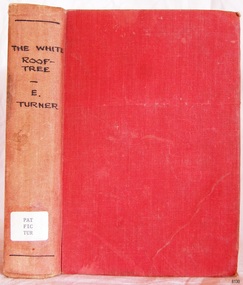
Book, A White Roof-Tree
... A White Roof-Tree......a white roof-tree...A White Roof-Tree Author: Ethel Turner Publisher: Ward, Lock & Co Date: 1905...The Warrnambool Mechanics' Institute’s publication collection is of both local and state significance. warrnambool shipwrecked-coast flagstaff-hill flagstaff-hill-maritime-museum maritime-museum shipwreck-coast flagstaff-hill-maritime-village shipwrecked-artefact book pattison collection warrnambool library warrnambool mechanics’ institute ralph eric pattison corangamite regional library service warrnambool city librarian mechanics’ institute library victorian library board warrnambool books and records warrnambool children’s library great ocean road a white roof-tree ethel turner Label on spine cover with typed text PAT FIC TUR Pastedown front endpaper has sticker from Warrnambool Children’s Library covered by a sticker from Corangamite Regional Library Service A White Roof-Tree Author: Ethel Turner Publisher: Ward, Lock & Co Date: 1905 A White Roof-Tree Book ...This item is from the ‘Pattison Collection’, a collection of books and records that was originally owned by the Warrnambool Mechanics’ Institute, which was founded in Warrnambool in 1853. By 1886 the Warrnambool Mechanics’ Institute (WMI) had grown to have a Library, Museum and Fine Arts Gallery, with a collection of “… choice productions of art, and valuable specimens in almost every branch and many wonderful national curiosities are now to be seen there, including historic relics of the town and district.” It later included a School of Design. Although it was very well patronised, the lack of financial support led the WMI in 1911 to ask the City Council to take it over. In 1935 Ralph Pattison was appointed as City Librarian to establish and organise the Warrnambool Library as it was then called. When the WMI building was pulled down in 1963 a new civic building was erected on the site and the new Warrnambool Library, on behalf of the City Council, took over all the holdings of the WMI. At this time some of the items were separated and identified as the ‘Pattison Collection’, named after Ralph Pattison. Eventually the components of the WMI were distributed from the Warrnambool Library to various places, including the Art Gallery, Historical Society and Flagstaff Hill. Later some were even distributed to other regional branches of Corangamite Regional Library and passed to and fro. It is difficult now to trace just where all of the items have ended up. The books at Flagstaff Hill Maritime Village generally display stamps and markings from Pattison as well as a variety of other institutions including the Mechanics’ Institute itself. RALPH ERIC PATTISON Ralph Eric Pattison was born in Rockhampton, Queensland, in 1891. He married Maude Swan from Warrnambool in 1920 and they set up home in Warrnambool. In 1935 Pattison accepted a position as City Librarian for the Warrnambool City Council. His huge challenge was to make a functional library within two rooms of the Mechanics’ Institute. He tirelessly cleaned, cleared and sorted a disarrayed collection of old books, jars of preserved specimens and other items reserved for exhibition in the city’s museum. He developed and updated the library with a wide variety of books for all tastes, including reference books for students; a difficult task to fulfil during the years following the Depression. He converted all of the lower area of the building into a library, reference room and reading room for members and the public. The books were sorted and stored using a cataloguing and card index system that he had developed himself. He also prepared the upper floor of the building and established the Art Gallery and later the Museum, a place to exhibit the many old relics that had been stored for years for this purpose. One of the treasures he found was a beautiful ancient clock, which he repaired, restored and enjoyed using in his office during the years of his service there. Ralph Pattison was described as “a meticulous gentleman whose punctuality, floorless courtesy and distinctive neat dress were hallmarks of his character, and ‘his’ clock controlled his daily routine, and his opening and closing of the library’s large heavy doors to the minute.” Pattison took leave during 1942 to 1945 to serve in the Royal Australian Navy, Volunteer Reserve as Lieutenant. A few years later he converted one of the Museum’s rooms into a Children’s Library, stocking it with suitable books for the younger generation. This was an instant success. In the 1950’s he had the honour of being appointed to the Victorian Library Board and received more inspiration from the monthly conferences in Melbourne. He was sadly retired in 1959 after over 23 years of service, due to the fact that he had gone over the working age of council officers. However he continued to take a very keen interest in the continual development of the Library until his death in 1969. Ethel Mary Turner Ethel Turner (25th January 1872 – 8th April 1958) was an English-born Australian novelist and children's literature writer. She was born Ethel Mary Burwell in Doncaster in England. Her father died when she was two, leaving her mother Sarah Jane Burwell with two daughters (Ethel and Lillian). A year later, Ethel’s mother married Henry Turner, who was 20 years older and had six children of his own. Sarah Jane and Henry had a daughter, Rose. Henry Turner died suddenly, leaving Sarah Jane with nine children and little income. In 1879 Sarah Jane moved to Australia with Ethel, Lillian, and Rose; within the next two years she married Charles Cope and gave birth to his son Rex. Ethel Turner was educated at Paddington, New South Wales Public School and Sydney Girls High School she was one of the school's original thirty-seven pupils. Ethel started her writing career at eighteen, founding the Parthenon, a journal for young people, with her sister Lillian. Writing as “Dame Durden”, she wrote children's columns for the Illustrated Sydney News and later for the Australian Town and Country Journal. In 1891 the family moved to Woodlands, a large house in Lindfield, now Killara, which was then out in the country. Woodlands still stands today in Werona Avenue and is where she wrote “Seven Little Australians”. In 1896 Ethel married Herbert Curlewis, a lawyer. After living in Mosman, they built their own house overlooking Middle Harbour. The house, Avenel, is where Ethel Turner spent the rest of her years. She survived her daughter Jean Curlewis, who died of tuberculosis, by 28 years. Jean was also a writer of children's books, although not as popular as her mother. Jean's works include “The Ship That Never Set Sail”, “Drowning Maze”, and “Beach Beyond (1923)”. Her son Adrian, was a Barrister, Captain in WW2 and a Changi and Thai-Burma Railway POW and later a Judge. Ethel Turner died at Mosman on 8 April 1958 at 85. She is buried at Macquarie Park Her best-known work is her first novel, Seven Little Australians (1894), which is widely considered a classic of Australian children's literature and was an instant hit both in Australia and overseas. It is about a family of seven children growing up in Australia. The book, together with its sequels “The Family at Misrule” (1895) and “Little Mother Meg” (1902) that deal with the lives of the Wolcott family, particularly with its seven mischievous children in 1880s Australia. A companion to "Seven Little Australians", “Judy and Punch” was published in 1928. Like her stepfather, the character of Captain Woollcott was a widower with six children. The book was made into a feature film in Australia in 1939 and a UK television series in 1953. A 10-episode television series was made in 1973 by the Australian Broadcasting Corporation. Turner published a number of other books for children, short stories and poems. “Three Little Maids” (1900) is a strongly autobiographical novel about her family's migration from England to Sydney, Australia. Turner wrote more than forty novels. Some were about the mischievous Wolcott’s. Others were serialized, like her books on "the Cub", and some were stand-alone. The children she wrote about were all adventurous and independent. They frequently got themselves into sticky situations and got themselves out of them with very little to no adult help. Turner was awarded a number of prestigious literary awards and could be considered one of Australia's best-loved authors. She is listed on The Australian Women's Register. The Ethel Turner Prize for Young People's Literature is given annually under the auspices of the New South Wales Premier's Literary Awards. Ref Ethel Mary Turner, Biography: https://en.wikipedia.org/wiki/Ethel_Turner The Pattison Collection, along with other items at Flagstaff Hill Maritime Village, was originally part of the Warrnambool Mechanics' Institute’s collection. The Warrnambool Mechanics’ Institute Collection is primarily significant in its totality, rather than for the individual objects it contains. Its contents are highly representative of the development of Mechanics' Institute libraries across Australia, particularly Victoria. A diversity of publications and themes has been amassed, and these provide clues to our understanding of the nature of and changes in the reading habits of Victorians from the 1850s to the middle of the 20th century. The collection also highlights the Warrnambool community’s commitment to the Mechanics’ Institute, reading, literacy and learning in the regions, and proves that access to knowledge was not impeded by distance. These items help to provide a more complete picture of our community’s ideals and aspirations. The Warrnambool Mechanics Institute book collection has historical and social significance for its strong association with the Mechanics Institute movement and the important role it played in the intellectual, cultural and social development of people throughout the latter part of the nineteenth century and the early twentieth century. The collection of books is a rare example of an early lending library and its significance is enhanced by the survival of an original collection of many volumes. The Warrnambool Mechanics' Institute’s publication collection is of both local and state significance. A White Roof-Tree Author: Ethel Turner Publisher: Ward, Lock & Co Date: 1905Label on spine cover with typed text PAT FIC TUR Pastedown front endpaper has sticker from Warrnambool Children’s Library covered by a sticker from Corangamite Regional Library Servicewarrnambool, shipwrecked-coast, flagstaff-hill, flagstaff-hill-maritime-museum, maritime-museum, shipwreck-coast, flagstaff-hill-maritime-village, shipwrecked-artefact, book, pattison collection, warrnambool library, warrnambool mechanics’ institute, ralph eric pattison, corangamite regional library service, warrnambool city librarian, mechanics’ institute library, victorian library board, warrnambool books and records, warrnambool children’s library, great ocean road, a white roof-tree, ethel turner -
 Federation University Historical Collection
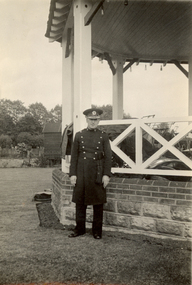
Photograph - Photograph - Black and White, Frank Wright standing in front of a bandstand at Staines, Middlesex, 22/5/1934
... The bandstand has a stone and brick base, a white railed balustrade, white timber support columns and a roof. In the back ground is a garden, timber building and trees. ...The bandstand has a stone and brick base, a white railed balustrade, white timber support columns and a roof. In the back ground is a garden, timber building and trees. ...Frank Wright was a renown resident of Smeaton, where he was born on 2 August 1901. He lived at Laura Villa, and attended Smeaton State School. His father William was a gold miner and his mother's name was Sarah. Their family won many singing and instrumental awards. Frank was tutored by Percy Code and was awarded a gold medal for the highest marks in the ALCM examinations in the British Colonies at the age of seventeen years. He became the Australian Open Cornet Champion by the age of eighteen. A year later, Frank conducted the City of Ballarat Band, and later the Ballarat Soldiers’ Memorial Band. He formed the Frank Wright Frisco Band and Frank Wright and his Coliseum Orchestra. These bands won many South Street awards, and Frank as conductor won many awards in the Australian Band Championship contest. In 1933 Frank Wright sailed to England to conduct the famous St Hilda’s Band and was later appointed Musical Director of the London County Council, where he organized many amazing concerts in parks, in and around the London district. He was made Professor of Brass and Military Band Scoring and conducted at the Guildhall of Music and Drama. Frank was often invited to adjudicate Brass Band Championships around Europe, in Australia, including South Street and in New Zealand. The Frank Wright Medal at the Royal South Street competition is awarded to an individual recognized as making an outstanding contribution to brass music in Australia.Black and white photograph of a man dressed in a band uniform standing on the grass in front of a raised bandstand. The bandstand has a stone and brick base, a white railed balustrade, white timber support columns and a roof. In the back ground is a garden, timber building and trees. The man is Frank Wright and he is dressed is the St. Hilda's band uniform.Written in pencil on the back - Frank Wright 32, Conductor St Hilda's, Staines, 22/5/34frank wright, brass band, conductor, bandstand, staines -
 Federation University Historical Collection
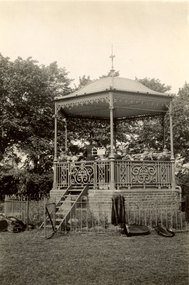
Photograph - Black and White, St Hilda's Band at Windsor, 24/5/1934
... white photograph of an ornate bandstand built on a grassed area and set high with seven wooden steps leading up to the platform. Under the domed roof, wrought iron lacework extends between the six supporting columns and an ornate, waist-high lacework balustrade encloses the space. At ground level, the bandstand is enclosed by a fence and in the background are leafy trees...white photograph of an ornate bandstand built on a grassed area and set high with seven wooden steps leading up to the platform. Under the domed roof, wrought iron lacework extends between the six supporting columns and an ornate, waist-high lacework balustrade encloses the space. At ground level, the bandstand is enclosed by a fence and in the background are leafy trees ...Frank Wright was a renown resident of Smeaton, where he was born on 2 August 1901. He lived at Laura Villa, and attended Smeaton State School. His father William was a gold miner and his mother's name was Sarah. Their family won many singing and instrumental awards. Frank was tutored by Percy Code and was awarded a gold medal for the highest marks in the ALCM examinations in the British Colonies at the age of seventeen years. He became the Australian Open Cornet Champion by the age of eighteen. A year later, Frank conducted the City of Ballarat Band, and later the Ballarat Soldiers’ Memorial Band. He formed the Frank Wright Frisco Band and Frank Wright and his Coliseum Orchestra. These bands won many South Street awards, and Frank as conductor won many awards in the Australian Band Championship contest. In 1933 Frank Wright sailed to England to conduct the famous St Hilda’s Band and was later appointed Musical Director of the London County Council, where he organized many amazing concerts in parks, in and around the London district. He was made Professor of Brass and Military Band Scoring and conducted at the Guildhall of Music and Drama. Frank was often invited to adjudicate Brass Band Championships around Europe, in Australia, including South Street and in New Zealand. The Frank Wright Medal at the Royal South Street competition is awarded to an individual recognized as making an outstanding contribution to brass music in Australia.Black and white photograph of an ornate bandstand built on a grassed area and set high with seven wooden steps leading up to the platform. Under the domed roof, wrought iron lacework extends between the six supporting columns and an ornate, waist-high lacework balustrade encloses the space. At ground level, the bandstand is enclosed by a fence and in the background are leafy trees. Within the bandstand a brass band can be seen performing. The band is the St. Hilda's Band with Frank Wright as its conductor. The place is Windsor.Written in pencil on the back - St. Hilda's, Frank Wright Conductor, Windsor, 24/5/34frank wright, conductor, brass band, st hilda's band, windsor, bandstand, wrought iron lacework -
 Marysville & District Historical Society
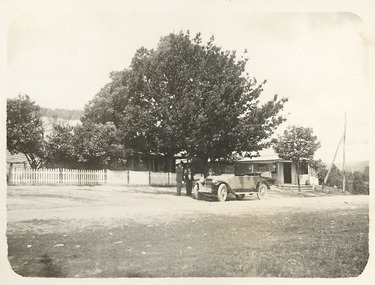
Photograph (Item) - Black and white photograph, Unknown
... white photograph of the Buxton Hotel in Buxton. The Buxton Hotel was built by William Burchall, probably in the late 1870s. The first owner, who also had land locally, was Frederick Nichols (1833-1904). The Buxton Hotel is located directly opposite the General Store. It was fronted with two huge oak trees and bordered and backed by large pine trees. It was a weatherboard structure with a painted corrugated iron roof...white photograph of the Buxton Hotel in Buxton. The Buxton Hotel was built by William Burchall, probably in the late 1870s. The first owner, who also had land locally, was Frederick Nichols (1833-1904). The Buxton Hotel is located directly opposite the General Store. It was fronted with two huge oak trees and bordered and backed by large pine trees. It was a weatherboard structure with a painted corrugated iron roof ...A digital copy of a black and white photograph of the Buxton Hotel in Buxton. The Buxton Hotel was built by William Burchall, probably in the late 1870s. The first owner, who also had land locally, was Frederick Nichols (1833-1904). The Buxton Hotel is located directly opposite the General Store. It was fronted with two huge oak trees and bordered and backed by large pine trees. It was a weatherboard structure with a painted corrugated iron roof. Old split wood shingles were covered by corrugated iron, which overlaid the shingles to make the roof watertight. The wooden shingles date back to the 1850s.A digital copy of a black and white photograph of the Buxton Hotel in Buxton.buxton, victoria, australia, buxton hotel, photograph, william burchall, frederick nichols -
 Marysville & District Historical Society
Photograph (Item) - Black and white photograph, Mark James Daniel, 1904
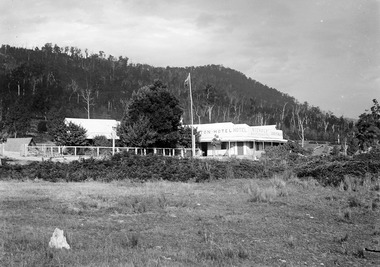
... white photograph of Nichol's Buxton Hotel in Buxton. The Nichol's Buxton Hotel was built by William Burchall, probably in the late 1870s. The first owner, who also had land locally, was Frederick Nichols (1833-1904). The Buxton Hotel is located directly opposite the General Store. It was fronted with two huge oak trees and bordered and backed by large pine trees. It was a weatherboard structure with a painted corrugated iron roof...white photograph of Nichol's Buxton Hotel in Buxton. The Nichol's Buxton Hotel was built by William Burchall, probably in the late 1870s. The first owner, who also had land locally, was Frederick Nichols (1833-1904). The Buxton Hotel is located directly opposite the General Store. It was fronted with two huge oak trees and bordered and backed by large pine trees. It was a weatherboard structure with a painted corrugated iron roof ...A digital copy of a black and white photograph of Nichol's Buxton Hotel in Buxton. The Nichol's Buxton Hotel was built by William Burchall, probably in the late 1870s. The first owner, who also had land locally, was Frederick Nichols (1833-1904). The Buxton Hotel is located directly opposite the General Store. It was fronted with two huge oak trees and bordered and backed by large pine trees. It was a weatherboard structure with a painted corrugated iron roof. Old split wood shingles were covered by corrugated iron, which overlaid the shingles to make the roof watertight. The wooden shingles date back to the 1850s.A digital copy of a black and white photograph of Nichol's Buxton Hotel in Buxton.buxton, victoria, australia, buxton hotel, nichol's buxton hotel, photograph, william burchall, frederick nichols -
 Marysville & District Historical Society
Photograph (Item) - Black and white photograph, Unknown
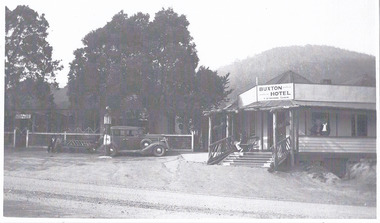
... white photograph of the Buxton Hotel in Buxton. Thomas David Robb (1886-1967), was the licensee at the time of the photograph. He, and his wife Alice May Evans, ran the Buxton Hotel for 25 years. The Buxton Hotel was built by William Burchall, probably in the late 1870s. The first owner, who also had land locally, was Frederick Nichols (1833-1904). The Buxton Hotel is located directly opposite the General Store. It was fronted with two huge oak trees and bordered and backed by large pine trees. It was a weatherboard structure with a painted corrugated iron roof...white photograph of the Buxton Hotel in Buxton. Thomas David Robb (1886-1967), was the licensee at the time of the photograph. He, and his wife Alice May Evans, ran the Buxton Hotel for 25 years. The Buxton Hotel was built by William Burchall, probably in the late 1870s. The first owner, who also had land locally, was Frederick Nichols (1833-1904). The Buxton Hotel is located directly opposite the General Store. It was fronted with two huge oak trees and bordered and backed by large pine trees. It was a weatherboard structure with a painted corrugated iron roof ...A black and white photograph of the Buxton Hotel in Buxton. Thomas David Robb (1886-1967), was the licensee at the time of the photograph. He, and his wife Alice May Evans, ran the Buxton Hotel for 25 years. The Buxton Hotel was built by William Burchall, probably in the late 1870s. The first owner, who also had land locally, was Frederick Nichols (1833-1904). The Buxton Hotel is located directly opposite the General Store. It was fronted with two huge oak trees and bordered and backed by large pine trees. It was a weatherboard structure with a painted corrugated iron roof. Old split wood shingles were covered by corrugated iron, which overlaid the shingles to make the roof watertight. The wooden shingles date back to the 1850s.A black and white photograph of the Buxton Hotel in Buxton.buxton, victoria, australia, buxton hotel, accommodation, photograph, william burchall, frederick nichols, alice may evans, thomas david robb -
 Marysville & District Historical Society
Postcard (Item) - Black and white postcard, Rose Stereograph Company, BUXTON HOTEL, BUXTON, VIC, 1913-1967
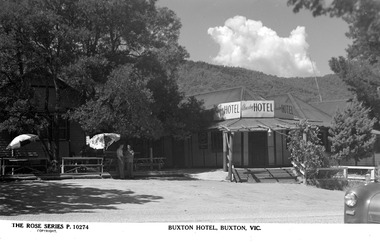
... white postcard of the Buxton Hotel in Buxton. The Buxton Hotel was built by William Burchall, probably in the late 1870s. The first owner, who also had land locally, was Frederick Nichols (1833-1904). The Buxton Hotel is located directly opposite the General Store. It was fronted with two huge oak trees and bordered and backed by large pine trees. It was a weatherboard structure with a painted corrugated iron roof...white postcard of the Buxton Hotel in Buxton. The Buxton Hotel was built by William Burchall, probably in the late 1870s. The first owner, who also had land locally, was Frederick Nichols (1833-1904). The Buxton Hotel is located directly opposite the General Store. It was fronted with two huge oak trees and bordered and backed by large pine trees. It was a weatherboard structure with a painted corrugated iron roof ...A black and white postcard of the Buxton Hotel in Buxton. The Buxton Hotel was built by William Burchall, probably in the late 1870s. The first owner, who also had land locally, was Frederick Nichols (1833-1904). The Buxton Hotel is located directly opposite the General Store. It was fronted with two huge oak trees and bordered and backed by large pine trees. It was a weatherboard structure with a painted corrugated iron roof. Old split wood shingles were covered by corrugated iron, which overlaid the shingles to make the roof watertight. The wooden shingles date back to the 1850s. This postcard was produced by the Rose Stereograph Company as a souvenir of Buxton.A black and white postcard of the Buxton Hotel in Buxton.THE ROSE SERIES P. 10274/ COPYRIGHT BUXTON HOTEL, BUXTON, VIC.buxton, victoria, australia, buxton hotel, rose stereograph company, rose series, p. 10274, postcard, souvenir, william burchall, frederick nichols -
 Federation University Historical Collection
Photograph - Photograph - Black and White, Chatham-Holmes Collection: Gordon Spittle's farm
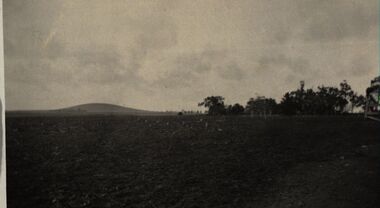
... trees and roof of Gordon's house can be seen in the distance. Photograph taken from outside "Sauchieburn" stable. Gordon Spittle was M Elizabeth Chatham's ( nee Holmes) uncle. The "Sachieburn" stable was on his cousin's William Holmes' property chatham-holmes collection sauchieburn gordon spittle mount cameron farm agriculture A farm with a hill in the background Chatham-Holmes Collection: Gordon Spittle's farm Photograph Photograph - Black and White ...Photographs show Gordon Spittle's property. .1 Looking towards Mount Cameron. The trees and roof of Gordon's house can be seen in the distance. Photograph taken from outside "Sauchieburn" stable.Gordon Spittle was M Elizabeth Chatham's ( nee Holmes) uncle. The "Sachieburn" stable was on his cousin's William Holmes' property A farm with a hill in the backgroundchatham-holmes collection, sauchieburn, gordon spittle, mount cameron, farm, agriculture -
 Federation University Historical Collection
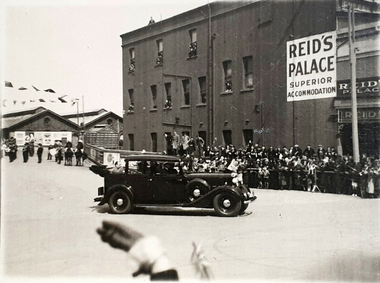
Photograph, Reid's Coffee Palace, Lydiard Street, Ballarat, c1930s ?
... trees in the Ballarat Avenue of Honour? There is a band in the background. Note the folded back roof which allows the passenger to be seen by the public. https://architectureau.com/articles/heritage-listed-gold-rush-era-ballarat-coffee-palace-receives-700000-conservation-grant/ reid's coffee palace ballarat railway station visitor bunting celebration Ballarat Verso - Post (Correspondence) Black and white photos of a car leaving the Ballarat Station (possibly carrying William Birdwood?). ...The special guest in the car appears to have arrived in Ballarat by train. Could it be William Birdwood to plant trees in the Ballarat Avenue of Honour? There is a band in the background. Note the folded back roof which allows the passenger to be seen by the public. https://architectureau.com/articles/heritage-listed-gold-rush-era-ballarat-coffee-palace-receives-700000-conservation-grant/Black and white photos of a car leaving the Ballarat Station (possibly carrying William Birdwood?). Reid's Coffee Palace is in the background Verso - Post (Correspondence)reid's coffee palace, ballarat railway station, visitor, bunting, celebration, ballarat -
 Flagstaff Hill Maritime Museum and Village
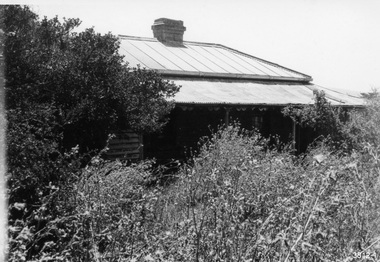
Photograph - Set of Photographs, John Chance, late 1960s to early 1970s
... white photographs is a set of images of Glenample Homestead circa late 1960s to early 1970s. They were taken by John Chance and are part of the John Chance Collection. The Colonial Georgian style Glenample Homestead was built from 1866 to 1869 from locally quarried sandstone. In is built on the top of a hill amongst trees. There are paddocks below and around the building. The building is basically a rectangular shape with a recessed room on the right side of the front. The pitched roof...white photographs is a set of images of Glenample Homestead circa late 1960s to early 1970s. They were taken by John Chance and are part of the John Chance Collection. The Colonial Georgian style Glenample Homestead was built from 1866 to 1869 from locally quarried sandstone. In is built on the top of a hill amongst trees. There are paddocks below and around the building. The building is basically a rectangular shape with a recessed room on the right side of the front. The pitched roof ...This set of glossy black and white photographs is a set of images of Glenample Homestead circa late 1960s to early 1970s. They were taken by John Chance and are part of the John Chance Collection. The Colonial Georgian style Glenample Homestead was built from 1866 to 1869 from locally quarried sandstone. In is built on the top of a hill amongst trees. There are paddocks below and around the building. The building is basically a rectangular shape with a recessed room on the right side of the front. The pitched roof is covered in corrugated iron. The veranda, added in 1886, also has a corrugated iron room and is supported by square posts with decorative tops. It shelters three sides of the building. The edge of the veranda is decorated with scalloped shapes along the front and left side of the building. On the right is a brick wall incorporating a chimney. Another chimney on the left is contained within the building. The four-panelled outside doors are visible in some of the photos, as are the 12-paned glass windows, which are framed in contrasting stone. The veranda is trimmed with scalloped metal work on two sides and had some enclosed corners. There appears to be a cubical water tank on the roof line. Out-buildings include a toilet built against the house's brick wall. Another building appears to have two rooms with outside doors, perhaps for workers. There is the remains of a two-wheeled cart under a shelter. GLENAMPLE & the LOCH ARD Glenample Homestead became famous after the disastrous wreck of the sailing ship Loch Ard on June 1, 1878. The owners, Hugh Hamilton Gibson and Peter McArthur, were involved in the rescue and recovery of the only two survivors, as well as overseeing the salvage of items from the shipwreck and the burial of those who lost their lives. Glenample Homestead is on the Great Ocean Road at Princetown. Originally the land was part of Kennan’s Station lease, one of the district’s early settlements, circa 1847. James Murray bought Kerman’s land in 1856-57, combined it with nearby land, and named it Glenample Homestead. The ruins of huts Murray built on the property were still there until recently. Glenample was sold in 1866 to the partnership of Gibson and McArthur, who built a Georgian style house there using local sandstone, completing it by 1869. On 1st June 1878 the Loch Ard was wrecked at what is now called Loch Ard Gorge. Apprentice crewman Tom Pearce and eighteen year old passenger Eva Carmichael were the only survivors. Pearce had brought Eva ashore and sheltered her in a cave, reviving her with whiskey found amongst items washed up from the wreck. He climbed the cliffs and came across two riders from Glenample. No other survivors were found and sadly, Eva’s family members were amongst those who drowned. Hugh and Lavinia Gibson cared for Pearce and Eva at Glenample and extended their hospitality to Eva, who stayed on for about six weeks as she recovered from the ordeal physically and emotionally. Mrs Gibson introduced Eva to Jane Shields and the young ladies became lifelong friends. Years after Eva had returned to England, Jane’s daughter visited her. Eva handed her a blue china tea set to pass onto her mother as a gift. A descendant of Jane’s donated part of the tea set to Flagstaff Hill Maritime Village while another descendant donated her inherited share of the tea set to the Warrnambool and District Historical Society. In 1886 Glenample Homestead was updated to include a veranda on three sides. In 1887 Gibson sold his share to partner Peter McArthur. McArthur’s son Ernest inherited the property in 1897. Ernest established the Glenample Cheese Factory in around 1911. It was closed due to the World War and reopened in 1929 by McArthur’s sons, Robert and Colin, when they took control. In 1945 they sold Glenample and several owners followed but it was left unoccupied and became dilapidated. It was during this time that John Chance visited the property and photographed the buildings. In the 1980s the National Parks Service acquired the Glenample Homestead and began a restoration program. Work began in 1989 by Cathedral Stone, which was established in 1989 by James Charlwood, a specialist stonemason and son of maritime author Don Charlwood. This set of photographs are significant as a record of Glenample Homestead as it was from around the late 1860s to the late 1960s. The photographs are also significant as they were taken by John Chance, a diver from the wreck of the Loch Ard in the 1960s-70s. Items that come from several wrecks along Victoria's coast have since been donated to the Flagstaff Hill Maritime Village’s museum collection by his family, illustrating this item’s level of historical value. The photographs are significant as a link between Glenample, the vessel Loch Ard, and the only survivors of the Loch Ard. Glenample Homestead is of historical, social and architectural significance to the State of Victoria and is listed on the Victorian Heritage Register (VHR H0392). It is a historical example of early settlement and development of a run in the coastal land of South West Victoria, and it is constructed from locally quarried sandstone but doesn’t take away from its Georgian design. Glenample Homestead is of State significance through its unique connection with the wreck of the ship Loch Ard and the connection to its owners, Hugh and Lavinia Gibson and Peter McArthur, played a historically and socially significant role in the rescue and care of the survivors, the salvage of goods and the burial of those who lost their lives. The shipwreck of the Loch Ard itself is of significance for Victoria and is registered on the Victorian Heritage Register (S417). The set of ten rectangular black and white photographs of the Glenample Homestead, taken in the late 1960s or early 1970s, give san overview of the Glenample property. The views include the front, back and one side of the building, three outbuildings, and the situation of the homestead on the property. The details on the photographs show the materials used and the Colonial Georgian style. The photographs are also a record of the deterioration of the property over the years it was unoccupied.flagstaff hill, warrnambool, flagstaff hill maritime museum, maritime museum, shipwreck coast, flagstaff hill maritime village, great ocean road, kennans station, glenample homestead, georgian homestead, loch ard, princetown, victoria, james murray, hugh hamilton gibson, lavinia gibson, jane shields, eva carmichael, tom pearce, blue china tea set, peter mcarthur, ernest mcarthur, robert mcarthur, colin mcarthur, glenample cheese factory, cathedral stone, don charlwood, james charlwood, antique door key, glenample photographs, john chance, victorian heritage database 392 -
 Glenelg Shire Council Cultural Collection
Photograph - Photograph - Cape Bridgewater School, n.d
... Black and white photo, ruins of Cape Bridgewater school; stone walls, tin roof, half missing, no glass in windows, trees growing over and through the ruins. ...Cape Bridgewater school ruin building Front: 'Cape Bridgewater School - ruins still there' - handwritten, black biro, across top of photo Back: '13' - top left corner, blue biro Black and white photo, ruins of Cape Bridgewater school; stone walls, tin roof, half missing, no glass in windows, trees growing over and through the ruins. ...Black and white photo, ruins of Cape Bridgewater school; stone walls, tin roof, half missing, no glass in windows, trees growing over and through the ruins. Barbed wire fence around it.Front: 'Cape Bridgewater School - ruins still there' - handwritten, black biro, across top of photo Back: '13' - top left corner, blue birocape bridgewater, school, ruin, building -
 Glenelg Shire Council Cultural Collection
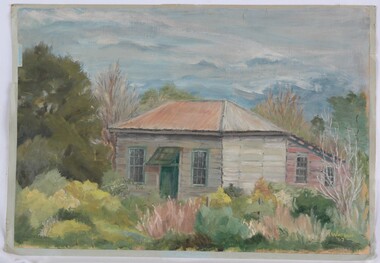
Painting, Ina Watson, Miss Beauvaise's Cottage, 1967
... trees and shrubs. The building is completed in shades of white and grey with green window frames and door, and a pink/orange roof. ...trees and shrubs. The building is completed in shades of white and grey with green window frames and door, and a pink/orange roof. ...CEMA Art Collection Previously located in History HouseThe painting depicts a small building surrounded by trees and shrubs. The building is completed in shades of white and grey with green window frames and door, and a pink/orange roof. Behind this is a partial view of another small building depicted in shades of pink. Surrounding the buildings are shrubs and trees of various shapes and sizes. The shrubs in the foreground are completed in various shades of green, yellow and pink. The work is unframed and glued to a piece of faded blue cardboard.Front: I. Watson '67 (yellow paint, bottom right corner) Back: Green label: Artist: Ina Watson 3 Palmer Street Portland Vic 3305 Title: Miss Beauvaise's Cottage (where Darby & Joan flat's now stand) Yellow Sticker: 3021 Yellow Sticker: 8 1999 written in pencilcema, female artists, female, women -
 Glenelg Shire Council Cultural Collection
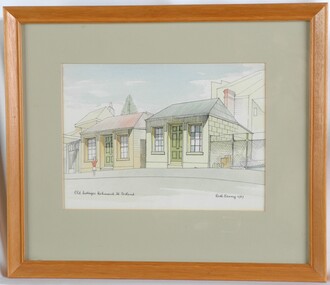
Painting, Ruth Denny, Old Cottages Richmond St. Portland, 1967
... roof and green door. Standing in front of the house is a female figure with red shirt and white skirt. The building to the right is pale yellow with green roof, red chimney and green door. There is a Norfolk Pine tree...roof and green door. Standing in front of the house is a female figure with red shirt and white skirt. The building to the right is pale yellow with green roof, red chimney and green door. There is a Norfolk Pine tree ...CEMA Art collectionStreet scene with three buildings and a fenced area. The centre focus of the work is two small buildings. The building on the left is yellow with red roof and green door. Standing in front of the house is a female figure with red shirt and white skirt. The building to the right is pale yellow with green roof, red chimney and green door. There is a Norfolk Pine tree behind the middle house. The image is depicted using straight lines in pen for the outline of the buildings and for some of the details.The work has plain wooden frame with a mount and glass.Front: Old Cottages Richmond St.Portland Ruth Denny 1967(black, handwritten) Back: Sticker:DEAN'S MU 8291 FOR FRAMING 346 LT.COLLINS ST., MELB. NO. 20438 Yellow sticker: 3034female artists, female artist, women, portland street scene, portland, richmond street -
 Glenelg Shire Council Cultural Collection
Print, One Farm's History, 1984
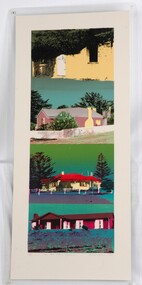
... The next image shows a pink house with purple and yellow details, a white picket fence and several large trees. The third image is of a yellow house with a red roof, white wire fence and trees. ...The next image shows a pink house with purple and yellow details, a white picket fence and several large trees. The third image is of a yellow house with a red roof, white wire fence and trees. ...CEMA Art Collection. Part of "A Community View" 150 years in Portland Screenprint Exhibition. Part of Angela Gee Residency 1983 and 1984.Laminated screenprint of four images of houses displayed in a vertical layout. The top image is a close view of a yellow wall, white door and green foliage. The next image shows a pink house with purple and yellow details, a white picket fence and several large trees. The third image is of a yellow house with a red roof, white wire fence and trees. The bottom image shows a pink brick house with brown roof.Front: 20/22 One Farm's History, Tyrendarra. Carmel Wallace 1984 Back: 48 -
 Glenelg Shire Council Cultural Collection
Painting, Jack Freeman, Landscape Dandenong, c. 1961
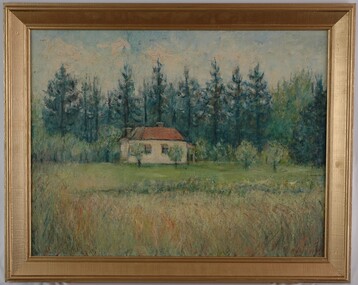
... CEMA Art Collection Winner of Portland Artist's Society Prize 1961 Front: (No inscriptions) Back: Jack Freeman 1961 Landscape Dandenong (top right, black handwriting) 18 (white sticker) The painting depicts a small building set amongst tall trees and grasses. The building is situated in the centre of the work and is cream with a red roof and red awnings. ...CEMA Art Collection Winner of Portland Artist's Society Prize 1961The painting depicts a small building set amongst tall trees and grasses. The building is situated in the centre of the work and is cream with a red roof and red awnings. In the foreground is a large area of long grass which leads into the shorter maintained grass that surrounds the building. Behind the building are numerous tall dark green trees. The work has a wide gilded frame and exposed canvas.Front: (No inscriptions) Back: Jack Freeman 1961 Landscape Dandenong (top right, black handwriting) 18 (white sticker) -
Glenelg Shire Council Cultural Collection
Photograph - Photograph - Reconstructed Historic Sawpit, Mt Clay, n.d
... white photo mounted on strong cardboard. Lots of trees. Car on left side. Log barriers. Large log over sawpit. Information area - roofed...white photo mounted on strong cardboard. Lots of trees. Car on left side. Log barriers. Large log over sawpit. Information area - roofed ...Black and white photo mounted on strong cardboard. Lots of trees. Car on left side. Log barriers. Large log over sawpit. Information area - roofed.Front: Green label - Reconstructed historic Saw Pit Mt. Clay. Back: -mount clay -
 Glenelg Shire Council Cultural Collection
Photograph - Photograph - St. Stephens Church, Portland, 1934
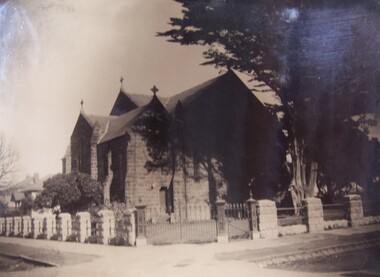
... Black and white photograph showing stone building (church) in shade of tree with stone fence and iron gate in foreground. Crosses attached to roof...Black and white photograph showing stone building (church) in shade of tree with stone fence and iron gate in foreground. Crosses attached to roof ...Photographs taken by Esther Winifred Hall (nee Smallpage) - great grand-daughter of Stephen George Henty. Taken in 1934 Centenary Celebrations in Portland.Black and white photograph showing stone building (church) in shade of tree with stone fence and iron gate in foreground. Crosses attached to roof of building.Front: (no inscriptions) Back: St. Stephens Church Portland. New fence erected for Centenary 1934.esther winifred hall, portland centenary, 1934, henty -
 Orbost & District Historical Society
black and white photograph, 1920s -1930s
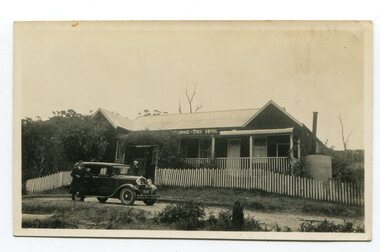
... A small black / white photograph of a single storey timber building. On a sign below the roof is "Cabbage Tree Hotel". ...It shows a building that no longer exists. cabbage-tree-hotel on back - on label - Cabbage Tree Hotel A small black / white photograph of a single storey timber building. On a sign below the roof is "Cabbage Tree Hotel". ...The Cabbage Tree Creek township was originally established to support the booming timber industry of the mid 20th century. Five timber mills worked full time supporting the families that were drawn to the area's wealth of natural resources. The settlement of Cabbage Tree Creek is located on the Princes Highway, 27 km east of Orbost in East Gippsland. The first white settler arrived in the valley in 1887 cutting a dray track from Marlo to the south-west. Several families cleared the alluvial flats, growing maize, peas and beans and raising pigs, cattle and sheep. Later the farmers milked cows, sending cream to Orbost. In the late 1890s, small quantities of alluvial gold were found in the creek. A school commenced classes in 1913, but enrolment was small and at times the school operated part time with several other small schools in the area. The school building served as a hall for the district. From the 1920s the Cabbage Tree Hotel catered to drivers on the improved Princes Highway. (info. from Victorian Places)This is a pictorial record of Cabbage Tree, East Gippsland in the late 20th century. It shows a building that no longer exists.A small black / white photograph of a single storey timber building. On a sign below the roof is "Cabbage Tree Hotel". The hotel is surrounded by a wooden picket fence. A man and woman are standing on either side of a motor car parked on the roadway in front of the building.on back - on label - Cabbage Tree Hotelcabbage-tree-hotel -
 City of Moorabbin Historical Society (Operating the Box Cottage Museum)
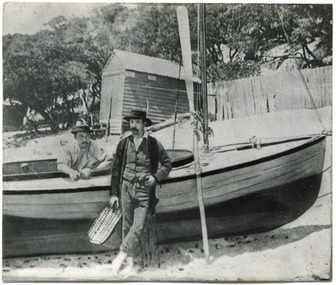
Photograph, 2 B&W, 1898 The O'Maras', Sandringham Fishermen : Date Unknown, Mud Brick House, 1898 The O'Maras', Sandringham Fishermen Date Unknown, Mud Brick House, 1898
... White Photographs. (i) An 1898 photograph showing two men with a fishing boat on the beach. A beach house / shed , paling fence and tall tea-trees are seen in the background. (ii) A large early mud brick house with a tin roof...White Photographs. (i) An 1898 photograph showing two men with a fishing boat on the beach. A beach house / shed , paling fence and tall tea-trees are seen in the background. (ii) A large early mud brick house with a tin roof ...The O'Maras, of Sandringham fishermen. Early mud brick house. Located in Moorabbin and was still there in 1940. The house was situated in Reserve Road, almost opposite Wangara Road, (formerly Cemetery Road). About twelve years ago, (* the writer states no year), there was a vacant block where the house used to be - it was next to a electrical factory. 2x Black and White Photographs. (i) An 1898 photograph showing two men with a fishing boat on the beach. A beach house / shed , paling fence and tall tea-trees are seen in the background. (ii) A large early mud brick house with a tin roof, chimney and a water tank sitting on a block of grassed landWritten on back (i) The O'Maras / Sandringham / fishermen 1898 (ii) Mud brick house at Moorabbin ( house was there in 1940) / Situated in Reserve Road almost opposite Wangara Road / ( formerly Cemetery Road ). About 12 years ago there was a vacant block where the house used to be and it was next to an electrical factory. unsigned undatedthe o'maras, sandringham fisherman, 1898, mud brick house, moorabbin, wangara road, reserve road, electrical factory, early settlers, pioneers, shire of moorabbin, sandringham, beaumaris, mentone, fishermen, dairy farmaers, poultry farmers, market gardeners, -
 Phillip Island and District Historical Society Inc.
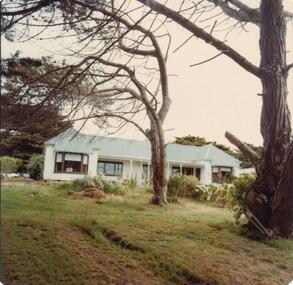
Photograph, 1978/79
... Ranch style white painted home with blue roof. Set to back of property - garden - drive and two tall trees in the foreground. ...Ranch style white painted home with blue roof. Set to back of property - garden - drive and two tall trees in the foreground. ..."Tallawalla" once named "Everton". Built by Joseph Richardson about 1870 and lived in by several generations of the Richardsons for many years. Bought by Mr & Mrs Ed Rayner. Ranch style white painted home with blue roof. Set to back of property - garden - drive and two tall trees in the foreground. A large tree on left side of home."Talawalla" once named "Everton". Built by Joseph Richardson - 1870.local history, photographs, buildings, historic, buildings - historical, coloured photograph, john cook, phillip island, talawalla homestead -
 Phillip Island and District Historical Society Inc.
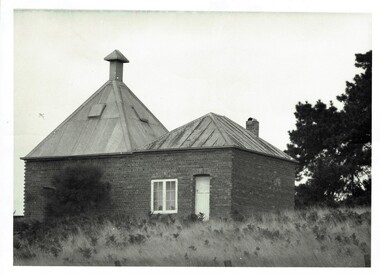
Photograph, Richardson's chicory kiln 1077-01
... Large black & white photo of a brick chicory kiln with a metal roof,door and window. In a paddock with large trees nearby....Large black & white photo of a brick chicory kiln with a metal roof,door and window. In a paddock with large trees nearby. ...In 1878, the first chicory kiln was built by Mr. John and Solomon West, in Thompson Avenue, Cowes, near the Esplanade and the second kiln was built in 1880 by Mr Joseph Richardson.HistoricalLarge black & white photo of a brick chicory kiln with a metal roof,door and window. In a paddock with large trees nearby.2nd chicory kiln on Phillip Island, now turned into a holiday house.chicory, chicory kilns, joseph richardson, -
 Cheese World Museum
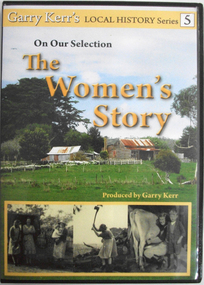
DVD, On our selection: the women's story
... roof is rusty. To the left is an outbuilding. Picket and wire fencing is in the foreground, background has large cypress tree to left and gum to right. At the bottom is a series of three black and white...roof is rusty. To the left is an outbuilding. Picket and wire fencing is in the foreground, background has large cypress tree to left and gum to right. At the bottom is a series of three black and white ...This is the story of the women of the bush, women who performed more than the traditional duties of wife and mother. They worked alongside their men, through good/times and bad and they were rare to complain. Six former country women of the Portland/Heywood district provide us with a snapshot of life as it was from the 1920's through to the 1960's. They speak about their own and their mother's lives, lives which have experienced the greatest material and personal changes in history. The story of the 'Remarkable Mary Stuchbery' details the struggles of a wife and family whose husband/father contracted polio shortly after returning from WWII service. Garry Kerr has produced a series of local history stories, initially for the Heywood [history group] and more recent items privately.The material contained in these interviews provides a first-hand insight into the experiences of women who were involved in carving farms from virgin bush. Their recollections of work, social activities and opportunities for their children are an invaluable primary source.Full colour DVD cover featuring image of old hip-roof weatherboard house with front verandah and skillion roof to rear with stone chimney attached to outside. Corrugated iron roof is rusty. To the left is an outbuilding. Picket and wire fencing is in the foreground, background has large cypress tree to left and gum to right. At the bottom is a series of three black and white images showing (L-R) three women in working clothes and a woman holding a baby; woman chopping wood; woman milking cow with young boy standing beside her. The back cover is yellow with images of the seven women featured showing coloured images of the interviewees beside black and white images of the interviewees when young. DVD features the same images as the front cover.Garry Kerr's LOCAL HISTORY Series 5/On Our Selection/The/Women's/Story/Produced by Garry Kerr (front) WOMEN WERE THE UNSUNG HEROES OF THE BUSH/This is the story of the women of the bush [see historical information] ... Running time 74 minutes/Plus an additional 30 minutes of/'The Remarkable Mary Stuchbery' -
 Ringwood and District Historical Society
Photograph, View of East Ringwood from roof of Civic Centre 1973
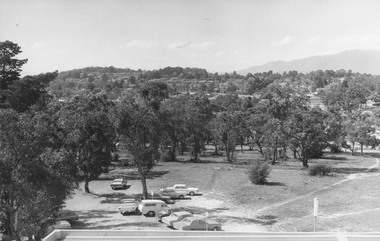
... trees. Black and white photograph View of East Ringwood from roof of Civic Centre 1973. ...Black and white photograph East Ringwood sports ground and tennis courts hidden by trees. -
 Orbost & District Historical Society
black and photograph, Brookes' Photographic Union, 1880s - 1890s
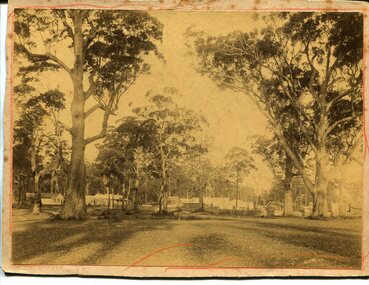
... white photograph mounted on crean card. There are trees in the foreground, buildings in the background. The buildings are wooden construction, some with shingle roofs and some bark....white photograph mounted on crean card. There are trees in the foreground, buildings in the background. The buildings are wooden construction, some with shingle roofs and some bark. black and photograph Brookes' Photographic Union ...This is an early photograph of Orbost C1880 - 1890s. The photograph is part of the Mary Gilbert collection.This is a pictorial record of Orbost in the late 19th century.A black / white photograph mounted on crean card. There are trees in the foreground, buildings in the background. The buildings are wooden construction, some with shingle roofs and some bark.There are some red pencil marks around frame of photograph.orbost-1880s main-street-orbost -
 Orbost & District Historical Society
black and white photograph, January 1934
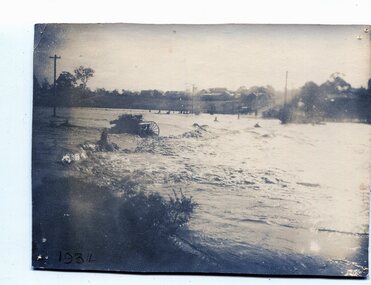
... roofs of houses or in trees, surrounded by deep, rushing flood waters." This 1934 flood was devastating, destroying a section of the 1922 Orbost bridge - the centre span was washed away -. wrecking fences, bridges and roads, dumping silt and debris on the rich river flats and drowning cattle. This is a pictorial record of the 1934 flood, a significant event in the history of Orbost. orbost-flood-1934 flood-orbost on back - "near Hilyer's garage at foot of hill Main Street Caravan Park on right" on front at bottom left - "1934" A black / white photograph of floodwaters. ...From The Argus (Melbourne) on January 10 1934 "Damage estimated at £500,000 has been caused by the floods in the Orbost district. No loss of life occurred, largely owing to the heroic efforts of rescue parties. Many families spent Monday night on the roofs of houses or in trees, surrounded by deep, rushing flood waters." This 1934 flood was devastating, destroying a section of the 1922 Orbost bridge - the centre span was washed away -. wrecking fences, bridges and roads, dumping silt and debris on the rich river flats and drowning cattle. This is a pictorial record of the 1934 flood, a significant event in the history of Orbost.A black / white photograph of floodwaters. In the middle of the water can be see debris including a large spoked wheel. In the background are houses and fences.on back - "near Hilyer's garage at foot of hill Main Street Caravan Park on right" on front at bottom left - "1934"orbost-flood-1934 flood-orbost -
 Bendigo Military Museum
Photograph - TAMBI ISLAND, FINSCHHAFEN, PNG PHOTOGRAPHS, Post WW2 c.1947
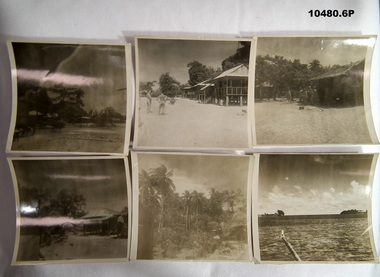
... white photographs. 1. Photo of buildings in a compound. Buildings are raised above ground level. 2. Photo of two men in shorts standing in front of buildings. Two small children standing next to closest building. Each building has a verandah and is raised above ground level. 3. Photo of a group of men in shorts in front of a building. Building is raised above ground level and has a thatched roof. 4. Photo of buildings in a compound. 5. Photo of a raised building surrounded by palm trees...white photographs. 1. Photo of buildings in a compound. Buildings are raised above ground level. 2. Photo of two men in shorts standing in front of buildings. Two small children standing next to closest building. Each building has a verandah and is raised above ground level. 3. Photo of a group of men in shorts in front of a building. Building is raised above ground level and has a thatched roof. 4. Photo of buildings in a compound. 5. Photo of a raised building surrounded by palm trees ...Photographs of Tambi Island, Finschhafen, PNG, collected by Alva Marie Bennetts whilst in transit to posting in BCOF. Part of the Bennetts Collection. See Cat No.9726P for details of Alva Bennetts (VFX 128835) service.Series of black and white photographs. 1. Photo of buildings in a compound. Buildings are raised above ground level. 2. Photo of two men in shorts standing in front of buildings. Two small children standing next to closest building. Each building has a verandah and is raised above ground level. 3. Photo of a group of men in shorts in front of a building. Building is raised above ground level and has a thatched roof. 4. Photo of buildings in a compound. 5. Photo of a raised building surrounded by palm trees. 6. Photo of an ocean scene with two islands visible on the horizon.1. to 3. Handwritten on back in black ink: ”TAMBI ISLAND” 4. Handwritten on back in black ink: “TAMBI ISLAND, FINSCHHAFEN, N.G.” 5. Handwritten on back in black ink: “TAMBI ISLAND” 6. Handwritten on back in black ink: “ENTRANCE TO DREGER HARBOUR, FINSCHHAFEN”alva bennetts, bcof, tambi island, png, photographs -
 Eltham District Historical Society Inc
Photograph - Digital Photograph, Alan King, Pigeon Bank, Kangaroo Ground-Warrandyte Road, Kangaroo Ground, 6 February 2008
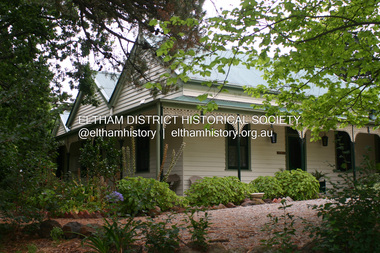
... white weatherboard Victorian farmhouse is ensured privacy by the trees and hedges around it. On 4.8 hectares of farmland, Pigeon Bank is surrounded by rolling hills, farmland and bush, the peace of which is punctuated by an occasional birdcall. Pigeon Bank’s first owner was Francis Rogerson, from Dumfriesshire, Scotland, who bought 80 acres (32.4ha) of land in 1848 on which he built a two-roomed bark hut. Today this is the centre piece of the 14-room home.1 Rogerson lined the rooms with tongue-and-groove boards and roofed...white weatherboard Victorian farmhouse is ensured privacy by the trees and hedges around it. On 4.8 hectares of farmland, Pigeon Bank is surrounded by rolling hills, farmland and bush, the peace of which is punctuated by an occasional birdcall. Pigeon Bank’s first owner was Francis Rogerson, from Dumfriesshire, Scotland, who bought 80 acres (32.4ha) of land in 1848 on which he built a two-roomed bark hut. Today this is the centre piece of the 14-room home.1 Rogerson lined the rooms with tongue-and-groove boards and roofed ...In 1848, Francis Rogerson form Dumfriesshire, Scotland purchased 80 acres of land at Kangaroo Ground on which he built a two-roomed bark hut. He named the property afterr the many Bronzewings and Wonga Pigeons in the area. Ewen Hugh Cameron moved to Pigeon Bank the same year he was elected to Parliament as the Member for Evelyn. At the time he moved in, Pigeon Bank had six rooms and the present water well. He made further extensive additions and lived there until his death in 1915. Covered under Heritage Overlay, Nillumbik Planning Scheme. Published: Nillumbik Now and Then / Marguerite Marshall 2008; photographs Alan King with Marguerite Marshall.; p27 Pigeon Bank, on the Kangaroo Ground – Warrandyte Road, Kangaroo Ground, is one of the Shire’s oldest farm dwellings, and has been home to some of the district’s earliest and most distinguished families. Although close to the road, the white weatherboard Victorian farmhouse is ensured privacy by the trees and hedges around it. On 4.8 hectares of farmland, Pigeon Bank is surrounded by rolling hills, farmland and bush, the peace of which is punctuated by an occasional birdcall. Pigeon Bank’s first owner was Francis Rogerson, from Dumfriesshire, Scotland, who bought 80 acres (32.4ha) of land in 1848 on which he built a two-roomed bark hut. Today this is the centre piece of the 14-room home.1 Rogerson lined the rooms with tongue-and-groove boards and roofed them with wooden shingles and sapling frames, which remain under the present green corrugated iron roof. He named Pigeon Bank after the many forest bronzewing and Wonga Pigeons in the area at the time, and the name Bank was commonly used in Scotland. Rogerson was united with one of the oldest families in the area when his sister Janet married John Bell, son of William, the original Bell settler. When Ewen Cameron moved to Pigeon Bank in 1874 it had six rooms and the present water well. He made extensive additions to the house and farm buildings and lived at Pigeon Bank until his death in 1915. Cameron, who had arrived in Melbourne from Scotland in 1853, contributed an enormous amount to the community. He worked as a builder, as a miner at Andersons Creek, a storekeeper at Queenstown2 and as the first postmaster at Warrandyte. In 1867 he married Agnes Bell, daughter of local farmer, John Bell. Cameron was a member of the Eltham Road Board (which preceded the Shire Council) and for more than 50 years, from 1863, he was an Eltham Shire Councillor, being President three times. Cameron was the Member for Evelyn for 40 years from 1874. In the 1880s he became the Government Whip, in 1902 the Minister for Mines and Water Supply, and in 1904, the Minister for Health, Cameron was also an outstanding farmer, whose farm won the Agricultural Department prize for the finest in the district, three consecutive times. Not surprisingly Pigeon Bank became the centre of district life. Every New Year’s Eve, Cameron hired a highland piper, who marched from the Kangaroo Ground school house to Pigeon Bank playing his pipes.3 Distinguished visitors included opera singer, Dame Nellie Melba, Victorian Premier, Thomas Bent, Governor, Lord Hopetoun and artist, Longstaff. Following Cameron’s death, the property changed hands several times, then returned to the family in 1919 when bought by Gordon Cameron. As the car took over from the horse, Pigeon Bank entered difficult times because the farm had produced chaff and oats and bred Clydesdales and harness ponies. In 1926 Mr Matthews bought the property and made many alterations including pulling down the kitchen, which had been separate from the main house. The property again changed hands several times. One owner was Senator James F Guthrie, who added a sunroom. In 1968 the house again returned to the Cameron family, when Vera Jackson, a grand-daughter of Ewen Cameron, and her husband, bought the property. The Bishop family, who were sixth and seventh generation Bells and also descended from the Camerons, restored the house in the 1980s. Today tongue-and-groove boards still line part of the hall (which retains two fine arches), the breakfast room, and Ewen Cameron’s former room. Five original fireplaces in the bed and living rooms are still in working order. The wide veranda with a curved iron roof and ornate iron lace work bounds three sides of the house, and nearby a windmill stands beside the water well. Sue and Ron James, who bought the property in 2001, made extensive improvements to the homestead and meticulously restored the grounds to their original state.This collection of almost 130 photos about places and people within the Shire of Nillumbik, an urban and rural municipality in Melbourne's north, contributes to an understanding of the history of the Shire. Published in 2008 immediately prior to the Black Saturday bushfires of February 7, 2009, it documents sites that were impacted, and in some cases destroyed by the fires. It includes photographs taken especially for the publication, creating a unique time capsule representing the Shire in the early 21st century. It remains the most recent comprehenesive publication devoted to the Shire's history connecting local residents to the past. nillumbik now and then (marshall-king) collection, ewen hugh cameron, francis rogerson, kangaroo ground, kangaroo ground-warrandyte road, pigeon bank -
 Bendigo Military Museum
Photograph - PHOTOGRAPHS, WW2
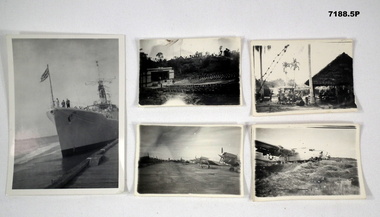
... white photos of various sizes. 1. Photo of Allied Navy ship at dock. Union Jack flag and Navy Personnel at bow. 2. Photo of temporary stage set up with seating set in a small rural valley. 3. Photo of Airfield with town in background and at least 12 fighter planes lined up in formation. 4. Photo of Allied soldiers resting under thatched roof and palm trees...white photos of various sizes. 1. Photo of Allied Navy ship at dock. Union Jack flag and Navy Personnel at bow. 2. Photo of temporary stage set up with seating set in a small rural valley. 3. Photo of Airfield with town in background and at least 12 fighter planes lined up in formation. 4. Photo of Allied soldiers resting under thatched roof and palm trees ...The photo with the stage is most likely for the "Gracie Fields" show for the troops in Borneo in 1945. It is unclear where the other photos were taken.WW2 Asian Theatre five photos.Black and white photos of various sizes. 1. Photo of Allied Navy ship at dock. Union Jack flag and Navy Personnel at bow. 2. Photo of temporary stage set up with seating set in a small rural valley. 3. Photo of Airfield with town in background and at least 12 fighter planes lined up in formation. 4. Photo of Allied soldiers resting under thatched roof and palm trees in a casual setting. 5. Photo of crashed Bomber or Transport US Aircraft, partially stripped of parts.airfield operations, ww2, photos -
 Bendigo Historical Society Inc.
Photograph - HILDA HILL COLLECTION: BLACK AND WHITE PHOTOS, 1922
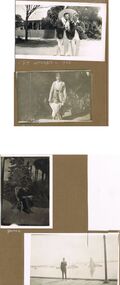
... Two males dressed in white trousers and shirts with dark jackets, one holds a parasol, the other two tennis racquets, gable roofed house in left background, lace work edging on the veranda, tree on nature strip, bushes and trees to right background, promenading Point Lonsdale Victoria Australia 1922. ...Two males dressed in white trousers and shirts with dark jackets, one holds a parasol, the other two tennis racquets, gable roofed house in left background, lace work edging on the veranda, tree on nature strip, bushes and trees to right background, promenading Point Lonsdale Victoria Australia 1922. ...Series of Black & White Photos Hill Family & Friends Post War Australia 4 in Total. Two males dressed in white trousers and shirts with dark jackets, one holds a parasol, the other two tennis racquets, gable roofed house in left background, lace work edging on the veranda, tree on nature strip, bushes and trees to right background, promenading Point Lonsdale Victoria Australia 1922. Jonah and child. Jonah wears a dark skirt and white blouse with light coloured coat, child wears full length body suit and is holding Jonah hands, garden setting. Doreen reading in garden, she wears dark clothing, sitting in a cane chair, corner of house veranda and garden in background. Herb, dressed in dark suit with white shirt and dark tie, standing on pier, moored yachts and one under full sail in background, St Kilda Pier Victoria Australia.Hilda Hill Personal Collectionaustralia, history, post war life -
 Bendigo Historical Society Inc.
Photograph - HILDA HILL COLLECTION: BLACK AND WHITE PHOTOS, 1918-1920
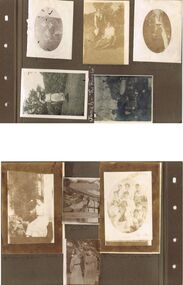
... Jonah wearing a hat and white dress with colourful hemline standing before a large hedge holding a parasol, large tree background left, 'The Ranche'. Three boys and two dogs All boys dressed in dark coats and shorts long socks two of the boys are on their haunches, Background is a gabled roof and 2 chimneys, white fence, between two of the boys is a water tap on a medium height pipe, Durvol December 1919. ...Jonah wearing a hat and white dress with colourful hemline standing before a large hedge holding a parasol, large tree background left, 'The Ranche'. Three boys and two dogs All boys dressed in dark coats and shorts long socks two of the boys are on their haunches, Background is a gabled roof and 2 chimneys, white fence, between two of the boys is a water tap on a medium height pipe, Durvol December 1919. ...Hilda Hill Collection. Black & White Photos of Hill Family Total 9. Three girls at SHLC 1918 with white sashes and medallions, dark clothing with white collars, background is garden scene , photo has over exposure problem which gives a lighter print, 24 September 1918, could it be a ladies college of education? Al standing wearing white blouse and dark dress holding a white hat standing and Gert sitting and holding a white hat in front of a bush wearing a white blouse and a light coloured skirt, background is forested area, 'The Pines' January 9th 1919. Claire dressed in dark dress and wearing a white hat with her hands together, oval photo, 'The Ranche', October 23 1918. Jonah wearing a hat and white dress with colourful hemline standing before a large hedge holding a parasol, large tree background left, 'The Ranche'. Three boys and two dogs All boys dressed in dark coats and shorts long socks two of the boys are on their haunches, Background is a gabled roof and 2 chimneys, white fence, between two of the boys is a water tap on a medium height pipe, Durvol December 1919. Moll Noonan seated on a round backed chair wearing a white dress, right background shows the side of a building, at knee level sis a broad leafed plant, other shrubbery in the background, 'The Ranche' November 1918. Ettie seated on a staircase and holding a dog, lady is wearing a broad brimmed hat, One Tree Hill April 18 1920. Two ladies in lightly coloured dresses standing in a garden setting, lady on left has a black sash waistband, Durvol December 1919 . Group of seven girls and 4 boys, all of the girls are dressed in white, front girl has black neck accessory, 'The Pines' January 9 1919 No. 7 Reservoir.Hilda Hill Personal Collectionaustralia, history, post war life
