
Showing 40 items matching "adornments"
-
 Harcourt Valley Heritage & Tourist Centre
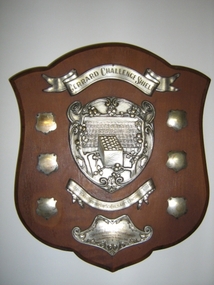
Gerrard Challenge Shield, Apple Packing Competion, 1934
... A wooden shield with metal adornments. ...A wooden shield with metal adornments. Apple Packing Competion Gerrard Challenge Shield ...State school children in the famous orchard district of Harcourt were expected to learn apple packing to a high standard, with instruction given by Dept of Agriculture specialist teachers, Classes were conducted at Harcourt Cooperative Coolstores during school hours.The pupils were expected to (and did) travel between school and packing shed by their own means without supervision..Pupils participated in state wide competitions .Shows the extent to which vocational training in a specialized subject could be taken to support the Apple Industry of Harcourt. The decoration/artwork of the shield is to a very high standard A wooden shield with metal adornments. A banner is at the top with "Gerrard Challenge Shield", a central metal shield shaped plaque shows a box of apples surrounded by trees and many boxed apples in the background. Below that is a banner with " District Championship for Schools Apple Packing Classes. Below that (at the bottom) is a smaller plaque with "Competitors to be pupils & attending school children's Apple Packing Classes." "Conducted by the Department of Agriculture." On the left side are three smaller shields for the years 1934 to 1936 awarded to Castlemaine the three shields on the right are blank. -
 Linton and District Historical Society Inc
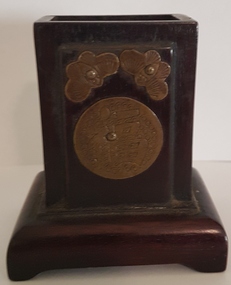
Container, Match Box Container
... Match-box container, dark wood with metal adornments....Containers Matches Kerr family Match-box container, dark wood with metal adornments. Match Box Container Container ...Used by Colin Kerr and family at Linton.Match-box container, dark wood with metal adornments.containers, matches, kerr family -
 Flagstaff Hill Maritime Museum and Village
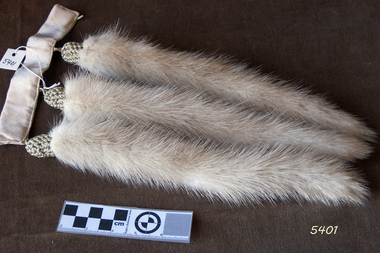
Fur
... Probably used as an adornment....Probably used as an adornment. Fur ...3 mink tails sewn into a band with press studs. Probably used as an adornment.flagstaff hill, warrnambool, shipwrecked-coast, flagstaff-hill, flagstaff-hill-maritime-museum, maritime-museum, shipwreck-coast, flagstaff-hill-maritime-village, mink, mink tail, mink tails -
 Tatura Irrigation & Wartime Camps Museum
Book, Kialla East Hero Joseph Hillier, 1989
... Fawn cover with title, uniform adornments and sword. The back cover shows the Rising Sun badge....Joseph Hillier was Tony Fords great uncle. joseph hillier Boer War local volunteers Boer War Fawn cover with title, uniform adornments and sword. The back cover shows the Rising Sun badge. ...The book is the story of the Boer War incorporated in the life story of Joseph Hillier. The back cover shows the Rising Sun badge, other local volunteers to the Boer War are listed and some studied. Joseph Hillier was Tony Fords great uncle.Fawn cover with title, uniform adornments and sword. The back cover shows the Rising Sun badge.joseph hillier, boer war, local volunteers boer war -
 Bendigo Historical Society Inc.
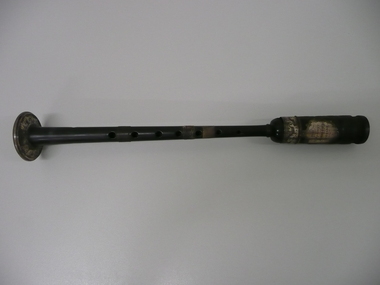
Instrument - CALEDONIAN SOCIETY BAGPIPES CHANTER, 1859
... Ebonised wooden bagpipes chanter with silver plate adornments engraved with Scottish thistles and wording Bendigo Caledonian Society 1859...MUSICAL INSTRUMENTS Wind Bagpipes Ebonised wooden bagpipes chanter with silver plate adornments engraved with Scottish thistles and wording Bendigo Caledonian Society 1859 Instrument CALEDONIAN SOCIETY BAGPIPES CHANTER ...Ebonised wooden bagpipes chanter with silver plate adornments engraved with Scottish thistles and wording Bendigo Caledonian Society 1859musical instruments, wind, bagpipes -
 Kew Historical Society Inc
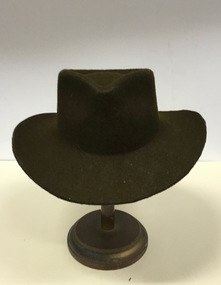
Headwear - Brown Felt Fedora, 1970s
... It is otherwise with adornment....It is otherwise with adornment. Headwear Brown Felt Fedora ...Hat styles have sometimes changed little over the last 100 years. The 'fedora' style used for the manufacture of this 1970s hat dates from the 1890s. Originally a style favoured by women, it became primarily used for men's hats in the early 20th century, being popularised by the Prince of Wales, later Edward VIII. At one stage the fedora style became a symbol of the women's rights movement.The Kew Historical Society’s fashion and design collection is comprised of costumes, hats, shoes and personal accessories. Many of these items were purchased or handmade in Victoria; some locally in Kew. The extensive hat collection comprises items dating from the 1860s to the 1970s. Most of the hats in the collection were created by milliners for women. There are however a number of early and important men’s hats in the collection. The headwear collection is particularly significant in that it includes the work of notable Australian and international milliners.A small unadorned dark brown felt fedora, assumed to be designed for a child. The hat has an indented crown and a soft brim. It is otherwise with adornment.Nilchildren's hats, headwear, fedoras -
 Bendigo Historical Society Inc.
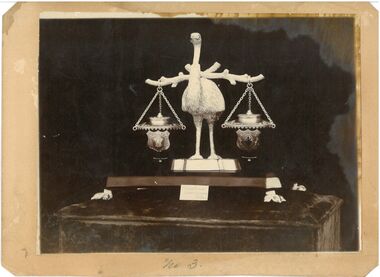
Photograph - Decorative ornament on a box
... Photograph of an ornamental adornment on top of a box. The ornament is an emu with a piece of timber across its back acting as a balance beam for two pans supported by chains. ...Bendigo" Photograph of an ornamental adornment on top of a box. The ornament is an emu with a piece of timber across its back acting as a balance beam for two pans supported by chains. ...Photograph of an ornamental adornment on top of a box. The ornament is an emu with a piece of timber across its back acting as a balance beam for two pans supported by chains. "No 3" written below the photograph. A small plaque on t e front reads "Napoli Prescott. Jeweller and Optician. Bendigo"jewellery, feather -
 National Vietnam Veterans Museum (NVVM)
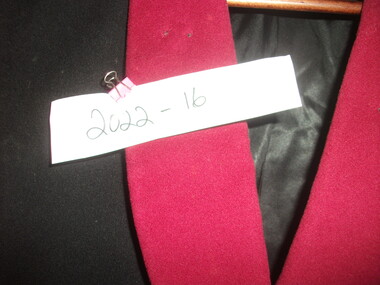
Uniform - Uniform, Army, Short Dress Jacket
... No buttons or other adornments other than two shoulder tabs with silver buttons:laurel leaves, crown,snake...No buttons or other adornments other than two shoulder tabs with silver buttons:laurel leaves, crown,snake Short Dress Jacket Uniform Uniform, Army ...Black Material with red lapels and cuffs. Silky material lined. No buttons or other adornments other than two shoulder tabs with silver buttons:laurel leaves, crown,snakedress uniform, jacket -
 Bendigo Historical Society Inc.
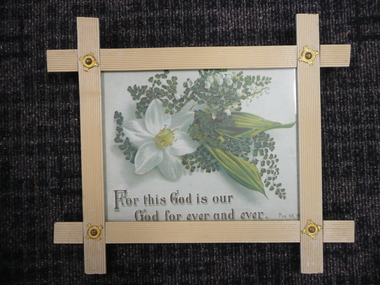
Painting - RELIGIOUS PRINT
... Religious print of white flowers and fern, framed in a cream wooden frame with brass adornments in corners, under glass with wording, for this God is our God for ever and ever, Psa 48.14...ARTWORK Print religious Religious print of white flowers and fern, framed in a cream wooden frame with brass adornments in corners, under glass with wording, for this God is our God for ever and ever, Psa 48.14 Painting RELIGIOUS PRINT ...Religious print of white flowers and fern, framed in a cream wooden frame with brass adornments in corners, under glass with wording, for this God is our God for ever and ever, Psa 48.14artwork, print, religious -
 Mont De Lancey
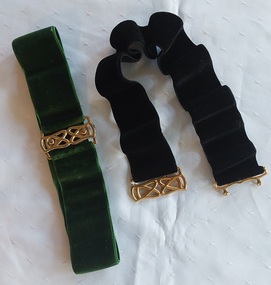
Clothing - Velvet Belts, Unknown
... ...Adornments...Belts Clothing accessories Clothing Adornments A homemade pair of wide elasticised velvet belts, one dark green and one black with ornate gold clip buckles. ...Belts such as these would have been worn on special occasions as they are quite stylish.A homemade pair of wide elasticised velvet belts, one dark green and one black with ornate gold clip buckles.belts, clothing accessories, clothing, adornments -
 Kew Historical Society Inc
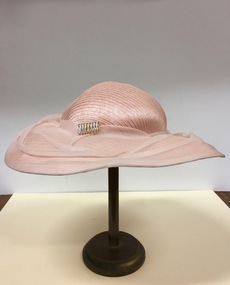
Headwear - Pink Straw Cartwheel Hat, 1950s
... The latter is covered with silk chiffon of the same colour. A metallic adornment comprised of concentric rings is attached to the base of the crown. ...The latter is covered with silk chiffon of the same colour. A metallic adornment comprised of concentric rings is attached to the base of the crown. ...The Kew Historical Society’s fashion and design collection is comprised of costumes, hats, shoes and personal accessories. Many of these items were purchased or handmade in Victoria; some locally in Kew. The extensive hat collection comprises items dating from the 1860s to the 1970s. While most of the hats in the collection were created by milliners for women, there are a number of early and important men’s hats in the collection. The headwear collection is particularly significant in that it includes the work of notable Australian and international milliners.Pale pink coloured straw woman’s hat featuring a low crown and a wide brim. The latter is covered with silk chiffon of the same colour. A metallic adornment comprised of concentric rings is attached to the base of the crown. Nilstraw hats, sun hats, cartwheel shape hats, women's clothing -- hats, headwear -
 Tennis Australia
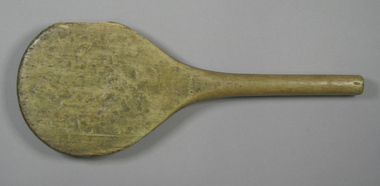
Bat, Circa 1850
... Nails projecting from the base suggest adornment with an end wrap.The flat face is heavily indented, meaning the bat was used to strike a hard ball. ...Nails projecting from the base suggest adornment with an end wrap.The flat face is heavily indented, meaning the bat was used to strike a hard ball. ...A solid wood bat with a wedged back. Nails projecting from the base suggest adornment with an end wrap.The flat face is heavily indented, meaning the bat was used to strike a hard ball. Materials: Wood, Metaltennis -
 Bendigo Historical Society Inc.
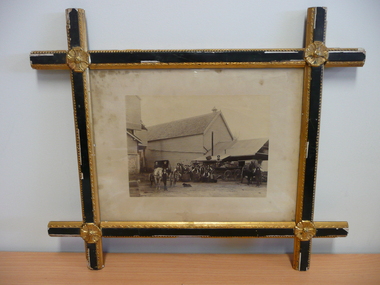
Photograph - COHN BROTHERS COLLECTION: PHOTOGRAPH OF WORKERS
... Framed photograph of group of Cohn Bros workers outside factory with horse drawn vehicles and a dog, under glass in a black and gold timber frame with gold coloured adornments on each corner. Pencil notation on back reads Cohn Bros about 1900....PHOTOGRAPH Portrait group Framed photograph of group of Cohn Bros workers outside factory with horse drawn vehicles and a dog, under glass in a black and gold timber frame with gold coloured adornments on each corner. Pencil notation on back reads Cohn Bros about 1900. ...Framed photograph of group of Cohn Bros workers outside factory with horse drawn vehicles and a dog, under glass in a black and gold timber frame with gold coloured adornments on each corner. Pencil notation on back reads Cohn Bros about 1900.photograph, portrait, group -
Clunes Museum
Ceremonial object - SASH
... .1 BLUE FABRIC SASH WITH METAL ADORNMENTS. ONE METAL CROSS SEWN TO THE SASH, ONE METAL INSCRIBED WITH THE IMAGE OF A BURNING BUSH, ONE HANGING METAL CROSS OVERLAID WITH BURNING BUSH IMAGE .2 14 SASHES AS ABOVE.SOME WITH ONE OR BOTH BADGES MISSING...ANDREWS CHURCH PRESBYTERIAN CHURCH STAMPED ON REVERSE OF BURNING BUSH CROSS: P J KING .1 BLUE FABRIC SASH WITH METAL ADORNMENTS. ONE METAL CROSS SEWN TO THE SASH, ONE METAL INSCRIBED WITH THE IMAGE OF A BURNING BUSH, ONE HANGING METAL CROSS OVERLAID WITH BURNING BUSH IMAGE .2 14 SASHES AS ABOVE.SOME WITH ONE OR BOTH BADGES MISSING Ceremonial object SASH ...SASH WORN AT MEETINGS AND GATHERINGS FOR THE ORDER OF THE BURNING BUSH .1 BLUE FABRIC SASH WITH METAL ADORNMENTS. ONE METAL CROSS SEWN TO THE SASH, ONE METAL INSCRIBED WITH THE IMAGE OF A BURNING BUSH, ONE HANGING METAL CROSS OVERLAID WITH BURNING BUSH IMAGE .2 14 SASHES AS ABOVE.SOME WITH ONE OR BOTH BADGES MISSINGSTAMPED ON REVERSE OF BURNING BUSH CROSS: P J KINGst. andrews church, presbyterian church -
 Bendigo Historical Society Inc.
Photograph - COHN BROTHERS COLLECTION: PHOTOGRAPH OF COHN BROTHERS WORKERS
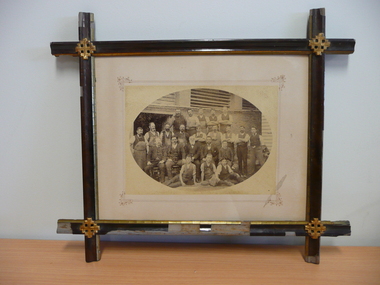
... Framed photograph of a group of male Cohns Bros workers with Jacob Cohn seated in middle with white beard, framed in a wooden frame with gold trim and gold coloured adornments on each corner. Pencil notation on back reads Cohn Bros about 1900 from R N Levy 3/1/87...PHOTOGRAPH Portrait group Framed photograph of a group of male Cohns Bros workers with Jacob Cohn seated in middle with white beard, framed in a wooden frame with gold trim and gold coloured adornments on each corner. Pencil notation on back reads Cohn Bros about 1900 from R N Levy 3/1/87 Photograph COHN BROTHERS COLLECTION: PHOTOGRAPH OF COHN BROTHERS WORKERS ...Framed photograph of a group of male Cohns Bros workers with Jacob Cohn seated in middle with white beard, framed in a wooden frame with gold trim and gold coloured adornments on each corner. Pencil notation on back reads Cohn Bros about 1900 from R N Levy 3/1/87photograph, portrait, group -
 Lakes Entrance Historical Society
Photograph - Surf Life Saving Club. Lakes Entrance 1938
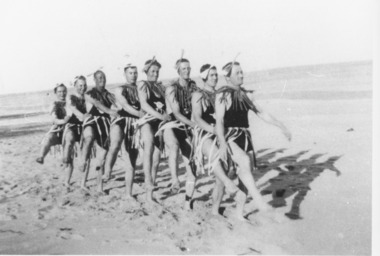
... Black and white photograph of Bert Henning, Jack Harbeck, Tom Todd, Arthur Henning, Jack Mitchelson, Eric Carstairs, Harry Bennett, Frank Duggan members of Surf Life Saving Club wearing ribbon skirts, neck adornments and headdress bows, dancing a conga inline type dance on beach. ...Volunteering Community Services Surf Lifesaving Black and white photograph of Bert Henning, Jack Harbeck, Tom Todd, Arthur Henning, Jack Mitchelson, Eric Carstairs, Harry Bennett, Frank Duggan members of Surf Life Saving Club wearing ribbon skirts, neck adornments and headdress bows, dancing a conga inline type dance on beach. ...Black and white photograph of Bert Henning, Jack Harbeck, Tom Todd, Arthur Henning, Jack Mitchelson, Eric Carstairs, Harry Bennett, Frank Duggan members of Surf Life Saving Club wearing ribbon skirts, neck adornments and headdress bows, dancing a conga inline type dance on beach. Lakes Entrance Victoriavolunteering, community services, surf lifesaving -
 Warrnambool and District Historical Society Inc.
Artefact, Textile: Beaded mourning collar, Circa late 19th century
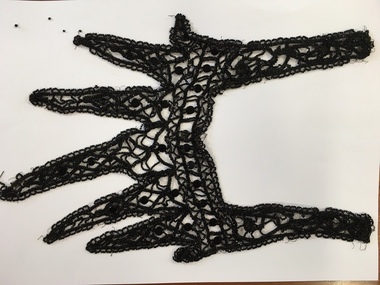
... There were different stages of mourning from the severe plain black clothing of the first period to items of decoration or adornment such as this collar with other items such as brooches, hair and dress adornments which were used at the later stages of mourning. ...There were different stages of mourning from the severe plain black clothing of the first period to items of decoration or adornment such as this collar with other items such as brooches, hair and dress adornments which were used at the later stages of mourning. ...Black has for centuries been associated with mourning but it rose to new heights during the Victorian times with Queen Victoria wearing black from the time of her husband’s death in 1861 until her death in 1901. There were different stages of mourning from the severe plain black clothing of the first period to items of decoration or adornment such as this collar with other items such as brooches, hair and dress adornments which were used at the later stages of mourning. This second stage often went for extended periods especially for widows who often remained in mourning until or if they remarried. Other colours such as dark greys and purples were also acceptable as mourning clothes. Such was the practice in England that jet from Whitby was used extensively by the more well to do. Later on black glass was used which was cheaper.An item which relates to customs which were prevalent in the late 19th and early 20th centuryBlack beaded collar with seven lengths of beads coming from a section which joins at the back with a hook and eye. The seed beads are stitched to a dark cotton backing. The neckline is square. It also has a number of larger flatter beads across the yoke and down the centre of each of the seven lengths of beads.warrnambool, mourning collar, black beaded mourning collar, beaded mourning collar, -
 Orbost & District Historical Society
cruet set, early 20th century
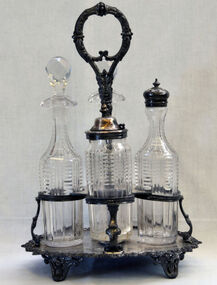
... A cruet also known as a caster, is a small container to hold condiments such as oil, vinegar, mustard, pepper. Its shape and adornments will depend on the specific condiment for which it is designed. ...A cruet also known as a caster, is a small container to hold condiments such as oil, vinegar, mustard, pepper. Its shape and adornments will depend on the specific condiment for which it is designed. ...A cruet also known as a caster, is a small container to hold condiments such as oil, vinegar, mustard, pepper. Its shape and adornments will depend on the specific condiment for which it is designed. Cruets were made in silver, silver plate, ceramic and glass, and sometimes a combination of two materials, usually as a glass body with a silver or silver plated top.This item is an example of domestic tableware commonly used in the early t0 mid 20th century.An early Sheffield plate stand with four glass decanters. Two with silver lids and two with glass stoppers. Tray has very ornate design.cruet domestic table-setting sheffiels ashberry-philip -
 Phillip Island and District Historical Society Inc.
Photograph, Harmony Bells
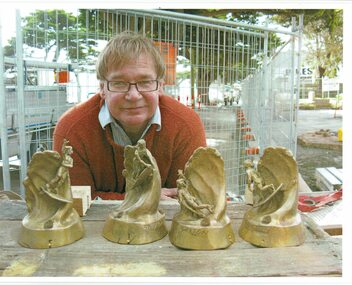
... They had been stripped of their gold and adornments. They have been restored and were reinstalled at Berninneet in 2024....They had been stripped of their gold and adornments. They have been restored and were reinstalled at Berninneet in 2024. ...The Harmony Bells were created by internationally renowned artist Dr Anton Hasell. Originally installed in 2012 at the Phillip Island Cultural Centre, costing $60,000, they weigh about 100 kilograms each. These unique sculptures were unfortunately stolen, only to be miraculously recovered from a ship in 2021, where they were destined for scrap metal. They had been stripped of their gold and adornments. They have been restored and were reinstalled at Berninneet in 2024.Historical2 laminated A4 sheets. One is a coloured photograph of Dr. Anton Hasell with the individual scultured cast tops of the brass bells. The other is a typed explanation of the meaning of the bells.sculpture, harmony bells, dr. anton hasell, berninneet -
 Kew Historical Society Inc
Clothing - Blue Silk Jacket & Skirt, 1868-1872
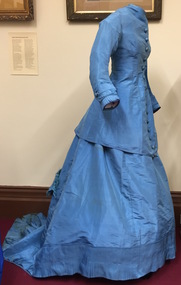
... Its cut and lack of adornment emphasises the tailored effect....Its cut and lack of adornment emphasises the tailored effect. Clothing Blue Silk Jacket & Skirt ...Joseph Butterworth COOMBS (1842-1901), was an accountant who founded a successful mercantile trading company. At the time of his marriage to Caroline Mary MICHEL in 1869, Coombs had already purchased ten acres of Studley Park. The acreage included land on the west of Fenwick Street that extended along lower Stawell Street to the corner of Yarra Street, all of it connected directly to the Yarra environs. A right of way to Studley Park Road was on the title, though Coombs went on to purchase more land, some of which faced Studley Park Road. In addition to owning the Studley Park acreage, Coombs later acquired 1,201 acres of land abutting the Acheron River. While retaining the Kew property he became a Taggerty Councillor and was Shire President for a time. J.B. Coombs died at Acheron Station in 1901 (aged 59 years). A few months after, tenders were called to repair the Kew dwelling, the Fenwick Street property now appearing in records with the name ‘Hope Mansell’. Caroline Coombs remained at Hope Mansell until she died in 1924, survived by three sons and five daughters. Not long after her death, advertisements appeared for the sale of the Studley Park land. The sale seems to have been a mechanism for distribution of the Estate, as the following year the original ten acre holding was transferred to members of the family. The eldest daughter Mabel married William Younger who, with his brother Alexander, developed Younger and Mackie Courts, both south of Studley Park Road. [Research: Kerry Fairbank]In 1961, the granddaughter of Joseph and Caroline Coombs, Mabel Isola (Younger) Grattan, donated ten 19th century dresses and parasols to the Kew Historical Society. The costumes, now known as the 'Coombs Collection', are the earliest recorded items of clothing to enter the Society's collection. Each of the items in the Coombs Collection, of which this item forms a part, is historically, aesthetically and socially significant. As a collection, the costumes includes outstanding examples of morning wear, day dresses, wedding dresses, and clothing accessories, providing evidence of outstanding dressmaker skills in Victoria during the mid to late Victorian period. Blue silk, floor length day dress comprised of a tightly fitted, long, waisted jacket joined by hooks and eyes at centre front. The bodice features large ornamental buttons from neck to waist, covered in a figured silk fabric of the same colour as the dress. The gown has extensive pin tucking on the sleeves, on the flounce of the skirt, and on the long train. The line of the outfit is emphasised by the flattened front, which is typical of the period. Its cut and lack of adornment emphasises the tailored effect.australian fashion, fashion & design, costumes, dresses, women's clothing, fashion - 1860s, fashion - 1870s -
 Mont De Lancey
Booklet, W. L. Mitchell, Sho' Card Lay-Outs, Unknown
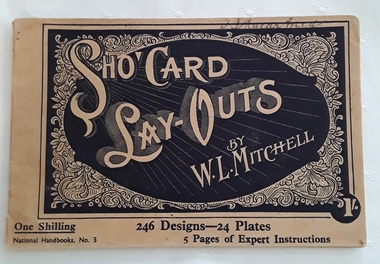
... On the back cover are five Beauty in Adornments designs with a monogram of the title in the middle. ...On the back cover are five Beauty in Adornments designs with a monogram of the title in the middle. ...The booklet is the fruit of 40 years first-class practical experience by one of Australia's leading Show Card Writers, W.L. Mitchell to assist retailers to effectively improve displays for the promotion of their products. There were costly books available for showcard writing, but there were very few publications which devoted much attention to the art of the lay-out of the showcard.A light tan small rectangular paperback handbook: Sho' card Lay-outs. The front cover has decorative writing of the title and author with a highly patterned lined and black background. 246 designs - 24 plates, 5 pages of Expert Instructions is written at the bottom in black lettering with the price 1/- in a black circle at the bottom. One Shilling is underlined. National Handbooks No. 3. On the back cover are five Beauty in Adornments designs with a monogram of the title in the middle. Pp.32non-fictionThe booklet is the fruit of 40 years first-class practical experience by one of Australia's leading Show Card Writers, W.L. Mitchell to assist retailers to effectively improve displays for the promotion of their products. There were costly books available for showcard writing, but there were very few publications which devoted much attention to the art of the lay-out of the showcard. advertising material, advertising booklets, advertisements, designs -
 Wodonga & District Historical Society Inc
Domestic object - Silver Filigree Thimble
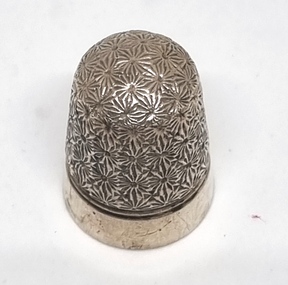
... Puritans that colonized in early America did not believe in adornment. A common practice among these early Americans was for a man to present a thimble to his fiancée which was symbolic of his wish to marry her. ...Puritans that colonized in early America did not believe in adornment. A common practice among these early Americans was for a man to present a thimble to his fiancée which was symbolic of his wish to marry her. ...This item is from a collection donated by descendants of John Francis Turner of Wodonga. Thimbles were used for both practical and decorative purposes and were created in a range of styles. Popular history also suggests that roots of the modern-day wedding ring in America had an interesting tie to a thimble. Puritans that colonized in early America did not believe in adornment. A common practice among these early Americans was for a man to present a thimble to his fiancée which was symbolic of his wish to marry her. These brides began to cut off the rim on these thimbles and making a simple band they would wear on their finger. Thus, the practice of wedding rings for women started.This item comes from a collection used by a prominent citizen of Wodonga. It is also representative of a domestic item common in the 1930s.A silver thimble decorated with filigree work above a solid bottom section.domestic items, filigree thimble, womens social history, women's work -
 Federation University Historical Collection
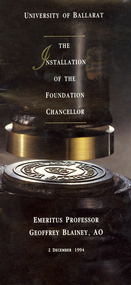
Photograph - Documents, Installation of Emeritus Professor Geoffrey Blainey as the Foundation Chancellor of the University of Ballarat, 1994
... It is made after the style of an English Queen's Counsel gown, with appropriate traditional adornment (chevrons) on the sleeves and edges. ...It is made after the style of an English Queen's Counsel gown, with appropriate traditional adornment (chevrons) on the sleeves and edges. ...The Chancellor is the head of the university and presides over meetings of Council. The Chancellor is also an ex officio member of all other bodies of the University. As well as being the traditional colour of embellishment on a Chancellor's gown, gold also provides a tangible link between the new university and its Ballarat ancestry. Academic gowns distinguish between the university's senior office holders, The design of the Chancellor's gown at the University of Ballarat is based on an Oxford and Cambridge tradition for university Chancellors' robes. It is made after the style of an English Queen's Counsel gown, with appropriate traditional adornment (chevrons) on the sleeves and edges. The decorative braiding is in gold oak-leaf braid. The velvet trencher with gold tassel is the traditional headwear for a Chancellor. Black and white 16 page booklet with a primarily black cover. The booklet is the programme for the installation of Emeritus Professor Geoffrey Blainey as the foundation Chancellor of the University of Ballarat. The contents include an order of proceedings, history, Geoffrey Blainey, the role of Chancellor, the chancellor's regalia, University of Ballarat logo.university of ballarat, chancellor, geoffrey blainey, blainey, governor of victoria, richard mcgarvie, bill pryor, nina valentine, david james, vern robson, lee francis, david fitzgerald, redmond barry, ballarat school of mines -
 Ararat Gallery TAMA
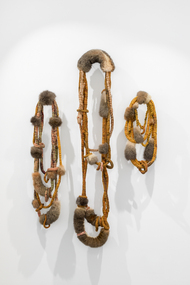
Juanita McLauchlan, guuma-li / Gathering, 2023
... Juanita McLauchlan draws upon her Gamilaraay identity, history, and language to explore family connections, personal belongings, and body adornment. McLauchlan employs both printmaking and fibre-based practices to reflect her spiritual connection to Country and her cultural identity as an Aboriginal woman with English lineage. ...Juanita McLauchlan draws upon her Gamilaraay identity, history, and language to explore family connections, personal belongings, and body adornment. McLauchlan employs both printmaking and fibre-based practices to reflect her spiritual connection to Country and her cultural identity as an Aboriginal woman with English lineage. ...Juanita McLauchlan draws upon her Gamilaraay identity, history, and language to explore family connections, personal belongings, and body adornment. McLauchlan employs both printmaking and fibre-based practices to reflect her spiritual connection to Country and her cultural identity as an Aboriginal woman with English lineage. Her work considers how gathering and sharing ancestral knowledge preserves intergenerational ties, bridging past, present, and future. McLauchlan creates contact prints on blankets, capturing impressions of Wiradjuri Country in Wagga Wagga, NSW, where she currently lives and works. McLauchlan was born on her Grandmother’s Country, Gamilaraay Country, and has lived in many places across Australia before spending the last 20 years with her family in Wagga Wagga. McLauchlan says of this artwork: By compulsion to make and move my hands I combine my mixed crossed cultural heritage, using woollen blankets and possum skin to create necklaces that are soft and beautiful, begging to be worn and handled as a way to recognise and pay homage to those who have come before me. These body adornments/necklaces are the embodiment of the history that I carry on my shoulders, of who I am and finding the comfort of where I fit into this forever changing life. They are like a generational hug of confidence and warmth once they are placed over your head. Stories of my childhood come to mind when making each necklace. Guuma-li / gathering, is a time when my sister and I were staying with my grandmother, and she was called to deal with a snake next door. Even though the snake was longer than she was tall, it was no match for our grandmother. The snake is in the main necklace as an ode to our grandmother and the strengths she has passed to us. The woollen blankets have been contact printed with bush dyes and bound in red thread creating links that form an ethereal shape wrapped and held together with the possum skin.” -
 National Wool Museum
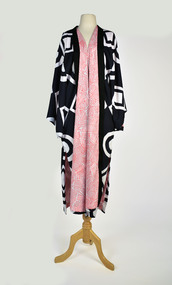
Textile - Cloak, Dr Deanne Gilson, Campfire Gathering, Meeting Place Cloak, 2022
... The diamond pattern was a strong design used by men on shields and women on baskets and adornments. Shields were taken from the tree in the colder months when the tree was cold as the wood came off cleaner. ...The diamond pattern was a strong design used by men on shields and women on baskets and adornments. Shields were taken from the tree in the colder months when the tree was cold as the wood came off cleaner. ...Standing proud, still here, the spirit of ten ancestral matriarchs adorned in contemporary ceremonial cloaks. Representing our women past, present and future, her Spirit, our culture, our Country (spelt with a capital for its importance and this is part of First Peoples protocols on acknowledging Country, our strength, our resilience and healing towards a sustainable future). The circle and diamond pattern are ancient symbols used by Wadawurrung people dating pre-colonisation on possum skin and kangaroo skin cloaks, other artefacts like spear heads (carved), wooden shields, stone tools and caves were painted with blood, ochre and bound with grass tree sap, black wattle tree sap and kangaroo fats. The diamond pattern was a strong design used by men on shields and women on baskets and adornments. Shields were taken from the tree in the colder months when the tree was cold as the wood came off cleaner. Ochre colours of red, white, yellow and charcoal were often used to colour in and decorate the skin side of possum skin cloaks, wooden shields, spear heads, baskets and some coolamon bowls.The design for this cloak has been simplified from the original artefact design.Cloak with black and white diamond and circle design on outer cloak and coral and white line pattern within lining. Trimming is solid black. Cloak is machine sewn and handstitched with hand stitching on shoulder seam.deanne gilson, wadawurrung, first nations, cloak -
 Friends of Westgarthtown
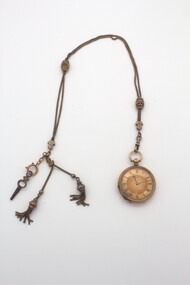
Accessory - Fobwatch, Chain and Key, c.1856-1890
... Donated to Ziebell’s Farmhouse Museum in 2025 by Kristina Colic (née Ziebell) and her father Mervyn Turner Ziebell, the watch holds strong familial and interpretive value, enriching the museum’s representation of women’s heritage, adornment and craftsmanship within the Ziebell family. ...Donated to Ziebell’s Farmhouse Museum in 2025 by Kristina Colic (née Ziebell) and her father Mervyn Turner Ziebell, the watch holds strong familial and interpretive value, enriching the museum’s representation of women’s heritage, adornment and craftsmanship within the Ziebell family. ...This finely crafted women’s gold fob watch, made by Robert Stauffer & Fils of La Chaux-de-Fonds, Switzerland, is an elegant example of mid-19th-century Swiss watchmaking. Its engraved floral motifs, protected beneath glass and repeated on the reverse, reflect the refinement and skill associated with one of Europe’s foremost horological centers. Believed to have belonged to either Elizabeth Ziebell (née Sprenger, 1836–1892) wife of Carl Chrsitian Ziebell or Amelia Alice Ziebell (née Bodycoat 1870-1948) wife of Albert Heinrich Ziebell, the watch provides a personal link to the women of the early Ziebell family and to domestic and social life within Westgarthtown’s German settler community. Women’s watches of this era were both functional and fashionable, commonly worn on a long necklace chain, suspended from a chatelaine at the waist, or attached to a decorative bodice brooch. Such pieces served as markers of refinement, femininity and social standing. The tiny winding key is central to the object’s significance. Before stem-winding mechanisms became standard in the 1870s, watches were wound and set by inserting a small key into an arbor at the back of the case. The survival of both the watch and its original key strengthens their historical integrity and deepens understanding of 19th-century personal technology. Donated to Ziebell’s Farmhouse Museum in 2025 by Kristina Colic (née Ziebell) and her father Mervyn Turner Ziebell, the watch holds strong familial and interpretive value, enriching the museum’s representation of women’s heritage, adornment and craftsmanship within the Ziebell family. Robert Stauffer & Fils of La Chaux-de-Fonds, Switzerland -
 National Wool Museum
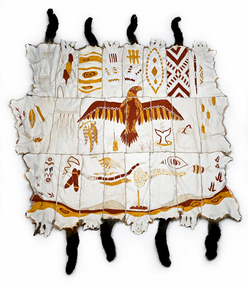
Textile - walert walert, Tammy Gilson, 2025
... Wadawurrung kinkinbil people relied on possum fur to create cloaks to wear for warmth, ceremony, adornments and medicine. Possum fur was used widely amongst neighbouring First Peoples particularly from colder parts of Victoria given the harshness of climate and particularly in Gordon where the elevation is 650m above sea level. ...Wadawurrung kinkinbil people relied on possum fur to create cloaks to wear for warmth, ceremony, adornments and medicine. Possum fur was used widely amongst neighbouring First Peoples particularly from colder parts of Victoria given the harshness of climate and particularly in Gordon where the elevation is 650m above sea level. ...My name is Tammy Gilson and I am a descendant of Wadawurrung people on Mums side, Marlene Gilson and my dear Nan, Rita Fagan from the Dalton line of our apical ancestor, John Robinson. For that I pay my respects and acknowledge my ancestors and all Elders. In Wadawurrung wurru, meaning language, the wurru name of a cloak walert walert signifies the reclaiming of language that hasn’t been spoken fluently since colonisation. Wadawurrung kinkinbil people relied on possum fur to create cloaks to wear for warmth, ceremony, adornments and medicine. Possum fur was used widely amongst neighbouring First Peoples particularly from colder parts of Victoria given the harshness of climate and particularly in Gordon where the elevation is 650m above sea level. The walert walert denotes a continuum of cultural practice and identity, can be viewed as secret and sacred and today viewed as contemporised practice of history acknowledging transfer of knowledge, practice and kinship. My experience of possum skin cloak revival was in 2014 through Traditional Ceremony, Tanderrum, where I was chosen to make several cloaks to be worn by the Elders including my Mum. This is where I learnt technique and design elements that remain present and relevant to lived experience. My work is an example of how culture and connection gives purpose and embeds a beautiful sense of belonging. Each design panel holds a visual voice, a narrative that speaks to identity and kinship. Symbols and line work are found on old artefacts that indicate belonging to Wadawurrung people. The water marks and mountain patterns were passed on to me from Mum and her grandma. Continuing this practice is for future generations as the walert walert holds significant healing properties. Making them and sharing knowledge aims to strengthen our Culture and bring family together. There is nothing like a good yarn while sewing or weaving and this is what the Elders do, and my ancestors always did together, sitting around sharing their way and teaching. Possum skin cloak consisting of twenty four pelts, stitched together with thread. Cloak features Wadawurrung designs in red, orange, white and black ochre.possum skin cloak, wadawurrung, first peoples, culture, tammy gilson, identity, tradition, design, walert walert -
 National Wool Museum
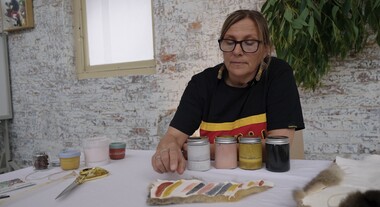
Film - walert walert, Tammy Gilson, 2026
... Wadawurrung kinkinbil people relied on possum fur to create cloaks to wear for warmth, ceremony, adornments and medicine. Possum fur was used widely amongst neighbouring First Peoples particularly from colder parts of Victoria given the harshness of climate and particularly in Gordon where the elevation is 650m above sea level. ...Wadawurrung kinkinbil people relied on possum fur to create cloaks to wear for warmth, ceremony, adornments and medicine. Possum fur was used widely amongst neighbouring First Peoples particularly from colder parts of Victoria given the harshness of climate and particularly in Gordon where the elevation is 650m above sea level. ...My name is Tammy Gilson and I am a descendant of Wadawurrung people on Mums side, Marlene Gilson and my dear Nan, Rita Fagan from the Dalton line of our apical ancestor, John Robinson. For that I pay my respects and acknowledge my ancestors and all Elders. In Wadawurrung wurru, meaning language, the wurru name of a cloak walert walert signifies the reclaiming of language that hasn’t been spoken fluently since colonisation. Wadawurrung kinkinbil people relied on possum fur to create cloaks to wear for warmth, ceremony, adornments and medicine. Possum fur was used widely amongst neighbouring First Peoples particularly from colder parts of Victoria given the harshness of climate and particularly in Gordon where the elevation is 650m above sea level. The walert walert denotes a continuum of cultural practice and identity, can be viewed as secret and sacred and today viewed as contemporised practice of history acknowledging transfer of knowledge, practice and kinship. My experience of possum skin cloak revival was in 2014 through Traditional Ceremony, Tanderrum, where I was chosen to make several cloaks to be worn by the Elders including my Mum. This is where I learnt technique and design elements that remain present and relevant to lived experience. My work is an example of how culture and connection gives purpose and embeds a beautiful sense of belonging. Each design panel holds a visual voice, a narrative that speaks to identity and kinship. Symbols and line work are found on old artefacts that indicate belonging to Wadawurrung people. The water marks and mountain patterns were passed on to me from Mum and her grandma. Continuing this practice is for future generations as the walert walert holds significant healing properties. Making them and sharing knowledge aims to strengthen our Culture and bring family together. There is nothing like a good yarn while sewing or weaving and this is what the Elders do, and my ancestors always did together, sitting around sharing their way and teaching. 9144.1 - Digital colour film featuring Wadawurrung woman Tammy Gilson speaking about the walert walert (possum skins cloak) she made for the National Wool Museum Collection, and the cultural practice of making cloaks. Film is 7 minutes and 3 seconds in length. 9144.2 - Digital colour film featuring Wadawurrung woman Tammy Gilson speaking about the designs which feature on the walert walert she made for the National Wool Museum Collection. Film is 14 minutes in length.possum skin cloak, wadawurrung, first peoples, culture, tammy gilson, identity, tradition, design, walert walert -
 Brighton Historical Society
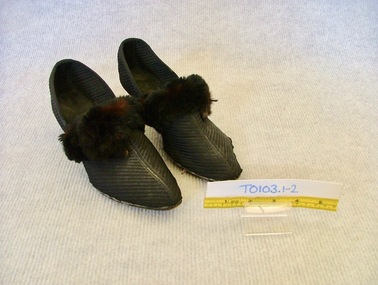
Shoes, c1890s
... The decorative preserved mink pelt with head featured on the vamps of these shoes is typical of Victorian era interest in and prevalent use of preserved animals for decorative purposes in clothing, millinery and household adornment. This fashion reflected social positioning of oneself as being affluent, educated and worldly. ...The decorative preserved mink pelt with head featured on the vamps of these shoes is typical of Victorian era interest in and prevalent use of preserved animals for decorative purposes in clothing, millinery and household adornment. This fashion reflected social positioning of oneself as being affluent, educated and worldly. ...This item is part of the Di Reidie collection. Diane Reidie was a much loved volunteer and President of Brighton Historical Society from 1999 until 2016. Originally from New Zealand, Di and her family lived in Male Street, Brighton for many years. A vibrant and energetic person with a zest for life and a gift for bringing people together, Di was a friend to many in the Bayside community and active in local community organisations. Her tireless work as President of BHS saw her named Bayside Citizen of the Year in 2008. As a seller and collector of vintage clothing, she was passionate about fashion history; one of her many enduring contributions to BHS was her extensive work in preserving, developing and promoting the Society's costume collection. In 2018-19, Di donated more than one hundred items from her personal vintage clothing collection to the Society. The collection, which includes clothing, hats, handbags and shoes from local and international designers, is representative of Di's wide-ranging interests, colourful personality, creativity, humour and love of fashion and travel. Di purchased these 1890s shoes around 1990 and recalled wearing them to approximately three events before she donated them to BHS in 2019. Di enjoyed the novelty and conversation they would inspire due to their unusual appearance by modern standards. The shoes are indicative of Di's playful approach to clothing and life. The decorative preserved mink pelt with head featured on the vamps of these shoes is typical of Victorian era interest in and prevalent use of preserved animals for decorative purposes in clothing, millinery and household adornment. This fashion reflected social positioning of oneself as being affluent, educated and worldly. Following the death of Queen Victoria's husband Prince Albert in 1861, the Queen's approach to mourning his death influenced social conventions for the public, with the wearing of black becoming a significant aspect of Victorian fashions. The shoes were made by Kendal Milne & Co, a large department store on Deansgate, Manchester. It has traded under various names and owners since it opened in 1832; it traded as Kendal Milne & Co from 1862-1919, and continued to be known by this name for many years after. The store is currently owned by the House of Fraser department store chain and is known as House of Fraser Manchester.Black silk linear quilted uppers of single piece construction with feature centre front vamp seam. Horsehair wadding can be seen along the side of the forefoot where the upper is coming away from the leather soles. Approx 4.5 cm plain black silk covered heel with leather top piece missing from right shoe. Both shoes feature the head of a small preserved mink with glass eyes. The toppling of the vamp features a decorative strip of mink fur. Inside of both shoes is a gold printed manufacturers label on the black silk insole.Manufacturers label - Made expressly for Kendall Milne and Co, Manchester.victoriana, mink pelt, taxidermy, 1890s, fur, di reidie, vintage clothing -
 Kew Historical Society Inc
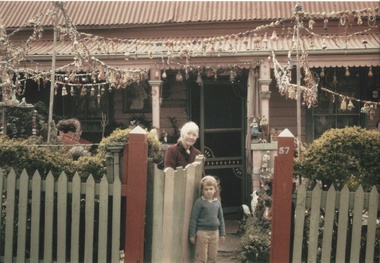
Photograph - Grace Tabulo, 'Fairyland', 57 Malmsbury Street, c.1963
... Tabulo’s death, the garden and content of the house was cleared of its previous adornments. Grace Tabulo died in 1965. "CHILDREN LIVING IN THE ONE STREET soon find out which house will welcome them and which house to avoid. ...Tabulo’s death, the garden and content of the house was cleared of its previous adornments. Grace Tabulo died in 1965. "CHILDREN LIVING IN THE ONE STREET soon find out which house will welcome them and which house to avoid. ...Mr. and Mrs. Tabulo, who owned the house between 1945 and 1965, created Fairyland in the 1940s. Fairyland was open to the public, especially children, who were invited to write their names in visitors’ books. These are now in the possession of the Kew Historical Society. Following the sale of the house after Mrs. Tabulo’s death, the garden and content of the house was cleared of its previous adornments. Grace Tabulo died in 1965. "CHILDREN LIVING IN THE ONE STREET soon find out which house will welcome them and which house to avoid. Few children in few streets have ever had such a find as those who live in Malmsbury st, Kew. At 56 Malmsbury st they all belong. It is their house. There are no young children who are actual residents, but they are to be found there all day long. Mrs J. Tabulo is chatelaine of 56, but few children know her by this name. To them she she is the Fairyland Lady. In her pocket handkerchief front garden there are few flowers; there isn't room, for it has been turned into a children's dream. Cement, tiles, old broken pieces of priceless china, miniature bottles, leadlights, and strange and beautiful little statues have been welded into a grotto which Mrs Tabulo says is only appreciated and understandable to children. It started off in a small way three years ago with a few odd statuettes, but with a street full of children ready and eager to build, it now has hardly room for even a miniature. Like the children, the Fairyland Lady knows and values each mosaic-like piece. Many a wedding present, succumbed at last to the ravages of time, holds a vantage spot in the grotto. The children bring along their broken bits and each is found a spot and cemented into the fairy story picture. In the cottage itself the children are also welcome. There is no spot, from skirting board to ceiling, that is not crowned with some gem or another. Fans, plaques, and china, some of it more than 300 years old, is handled daily by tiny but careful hands. "Children," said Mrs Tabulo, "should be allowed to love and handle beautiful things. They are much more careful than adults. Bless them!" -H.S (The Argus, 22 January 1949)A photograph of Mrs. Grace Tabulo in the garden of ‘Fairyland’ in 57 Malmsbury Street, Kew. fairyland, malmsbury street, kew, tabulo, grace tabulo
