
Showing 167 items matching "after-care home"
-
 Royal District Nursing Service (now known as Bolton Clarke)
Photograph - Digital image, c.1926
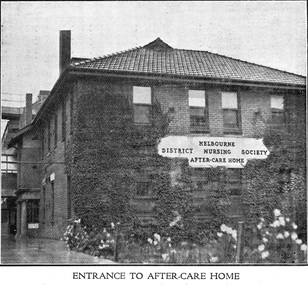
... after- care hospital...after-care home...The first After-Care Home in Melbourne was built by the Melbourne District Nursing Society (MDNS) in 1926 for patients of the Society who needed more nursing care than could be given at home but did not need hospitalization. ...Digital image of a front, and part of the left side view, of the Melbourne District Nursing Society After-Care Home and shows the entrance. The white plaque, attached in the centre of the brickwork between the two storeys in the front of the building reads 'Melbourne District Nursing Society After-Care Home' in black capital letters. ...Many patients from Melbourne hospitals who needed further care following discharge from hospital were nursed at the After-Care before going home. The Melbourne District Nursing Society, (MDNS), built the After-Care Home in 1926. ...The first After-Care Home in Melbourne was built by the Melbourne District Nursing Society (MDNS) in 1926 for patients of the Society who needed more nursing care than could be given at home but did not need hospitalization. Many patients from Melbourne hospitals who needed further care following discharge from hospital were nursed at the After-Care before going home. The Melbourne District Nursing Society, (MDNS), built the After-Care Home in 1926. The Home was extended and the name changed to Melbourne District Nursing Society and After-Care Hospital in 1934. It was situated at 45 Victoria Parade, Collingwood. Patients of the Society who needed more care than could be given at home, but did not need hospitalization were nursed there, along with many patients from Melbourne hospitals who needed further care before going home. Many children were nursed in the hospital, some long term, during the Polio epidemic and schooling was given to them in the hospital. In September 1930 an Ante-Natal Clinic was established. In October 1934 a Women's Welfare Clinic was opened to educate women on birth control. This was the first of its kind in Melbourne. The MDNS After Care Hospital was under District's banner until 1956. In 1957 the MDNS and the After-Care separated with the Government taking over the running of the After-Care. Melbourne District Nursing Society then became the Melbourne District Nursing Service and in 1966 was given Royal patronage and renamed Royal District Nursing Service (RDNS). Digital image of a front, and part of the left side view, of the Melbourne District Nursing Society After-Care Home and shows the entrance. The white plaque, attached in the centre of the brickwork between the two storeys in the front of the building reads 'Melbourne District Nursing Society After-Care Home' in black capital letters. It is a two story brick building with a tiled pitched roof, and shows two chimneys. There are four long windows running along both storeys of the front and side views. Near the rear left hand side of the building a portico can be seen and behind this part of a brick building with window runs to the left. Greenery is against part of the building and white flowers are seen in the foreground of the photograph. after- care hospital, after-care home, melbourne district nursing society, melbourne district nursing service, mdns, rdns, royal district nursing service -
 Royal District Nursing Service (now known as Bolton Clarke)
Photograph - Digital image, c.1930
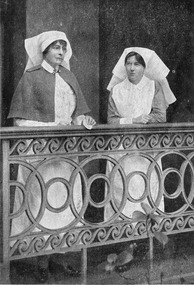
... ...after- care hospital...after-care home...This image shows two of the 'Melbourne District Nursing Society After Care Home' Sisters who worked in the After Care section of the Society during the 1930s. ...Digital image of two Sisters from the Melbourne District Nursing Society (MDNS) After-Care Home standing on the balcony of their building. ...This image shows two of the 'Melbourne District Nursing Society After Care Home' Sisters who worked in the After Care section of the Society during the 1930s. ...This image shows two of the 'Melbourne District Nursing Society After Care Home' Sisters who worked in the After Care section of the Society during the 1930s. The image was taken on the balcony of the After Care Home at 39 Victoria Parade, Collingwood. It depicts the style of uniforms worn by trained nurses (Sisters) in that era. The Society were pioneers in recognizing the need for premises where patients too ill to be in their own home, but not ill enough to go to hospital, was needed, and the Melbourne District Nursing Society (MDNS) built, then opened, the After-Care Home in 1926, (from 1934 called After-Care Hospital), for these patients, and patients from Melbourne Hospitals who required recuperation before returning to their home. Many children were nursed there, some long term during the Polio epidemic, and the Society employed two School Teachers. The Society now ran two divisions, the After-Care with its own nursing staff and the District division. The Society were the first in Melbourne, in early 1928, to recognize some patients leaving the After-Care, and many at home, needed further social care and they set up ‘Almoners’ from their committee to visit these patients and be intermediaries in getting them social assistance. It was late the following year before the first training of Almoners took place in Melbourne. In 1930 the Society employed a full time kindergarten teacher to visit poor children in their homes. That year the Society were pioneers in opening an Ante-Natal Clinic at the After-Care, setting a high standard with equipment, keeping records and providing leaflets with instructions in how to keep healthy during pregnancy, what complications to look for and what to do when labour commenced. In 1934 the Society were pioneers again when they opened the first Women’s Welfare Clinic in Melbourne giving advice on birth-control, at first attended by their own patients, but then accepting patients from public hospitals until their own clinics were opened. A trained Almoner was employed in 1934 but only stayed twelve months due to the amount of work required. Due to shortage of trained Almoners, a Social Service Officer was employed at the After-Care who successfully gained better housing from the Housing Commission for families living under unsuitable conditions. In the 1950s the Hospital and Charities Commission decided to take over the After-Care Hospital, so the Melbourne District Nursing Society and After-Care Hospital separated and the Melbourne District Nursing Service was formed, setting up Headquarters at 452 St. Kilda Road. With Royal patronage the name changed in 1966 to Royal District Nursing Service (RDNS).Digital image of two Sisters from the Melbourne District Nursing Society (MDNS) After-Care Home standing on the balcony of their building. The Sister on the left hand side is wearing a dark cape over her white uniform; she wears a white veil over her dark hair. The Sister on the right hand side is wearing a long white apron over her grey uniform which has white cuffs on the sleeves. She is wearing a white veil over her dark hair. They are leaning on the scrolled metal rail of the balcony which runs along the grey building; part of which can be seen behind them.mdns, melbourne district nursing society, after- care hospital, after-care home, rdns, royal district nursing service, nurses uniforms -
 Royal District Nursing Service (now known as Bolton Clarke)
Photograph - Photograph, black and white, c.1930
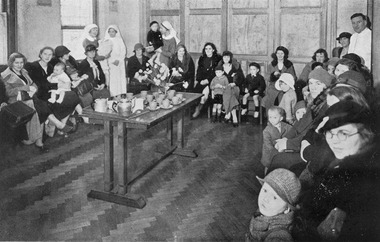
... after-care home... The photograph is taken in the Waiting room of the Ante-natal Clinic at the Melbourne District Nursing Society After-Care Home at 45 Victoria Parade, Collingwood. ...Black and white photograph showing seventeen seated ladies, some partly hidden, six small children, and the Matron and two Sisters of the Melbourne District Nursing Society After Care Home. The Matron is wearing a white uniform and veil, and the two Sisters are wearing grey uniforms with white collars and veils, one is holding a baby and the other a small child dressed in dark clothing, they are on the far left and rear of the photograph. ...The photograph is taken in the Waiting room of the Ante-natal Clinic at the Melbourne District Nursing Society After-Care Home at 45 Victoria Parade, Collingwood. ...The photograph is taken in the Waiting room of the Ante-natal Clinic at the Melbourne District Nursing Society After-Care Home at 45 Victoria Parade, Collingwood. On the 23rd of September 1930 the Ante-Natal Clinic opened at the MDNS After- Care Home. This photograph also shows Matron and Sister's uniforms in the 1930sThe Melbourne District Nursing Society (MDNS) were pioneers in recognizing the need for premises where patients too ill to be in their own home, but not ill enough to go to hospital, was needed, and the Society built, then opened, the After-Care Home, (later called After-Care Hospital), in 1926, for these patients, and patients from Hospitals. Many children were nursed there, some long term during the Polio epidemic and the Society employed two School Teachers. The Society now ran two divisions, the After-Care with its own Trained nurses and the District division. The Society were the first in Melbourne, in early 1928, to recognize some patients leaving the After-Care, and many at home, needed further social care and they set up ‘Almoners’ from their committee to visit these patients and be intermediaries in getting them social assistance. It was late the following year before the first training of Almoners took place in Melbourne. In 1930 the Society employed a full time kindergarten teacher to visit poor children in their homes. That year the Society were pioneers in opening an Ante-Natal Clinic at the After-Care, setting a high standard with equipment, keeping records and providing leaflets with instructions in how to keep healthy during pregnancy, what complications to look for and what to do when labour commenced. In 1934 the Society were pioneers again when they opened the first Women’s Welfare Clinic in Melbourne giving advice on birth-control, at first attended by their own patients, but then accepting patients from public hospitals until their own clinics were opened. A Social Service Officer was employed at the After-Care who successfully gained better housing from the Housing Commission for families living under unsuitable conditions. In 1957 the Hospital and Charities Commission decided to take over the After-Care Hospital, so the Melbourne District Nursing Society and After-Care Hospital separated and the Melbourne District Nursing Service was formed, setting up Headquarters at 452 St. Kilda Road, Melbourne. On the 5th of October 1966 the name changed to Royal District Nursing Service (RDNS) after being granted Royal patronage. Black and white photograph showing seventeen seated ladies, some partly hidden, six small children, and the Matron and two Sisters of the Melbourne District Nursing Society After Care Home. The Matron is wearing a white uniform and veil, and the two Sisters are wearing grey uniforms with white collars and veils, one is holding a baby and the other a small child dressed in dark clothing, they are on the far left and rear of the photograph. The ladies are wearing either grey or black clothing, several are wearing hats and some are wearing berets. They have short or shoulder length dark or lighter coloured hair. A Doctor, with short dark hair and wearing a white coat, is standing at the far right on the photograph. On the left, a window can be seen behind one of the Sisters. The wall at the rear of the room is paneled. after-care home, mdns, melbourne district nursing society, ante-natal clinic -
 Royal District Nursing Service (now known as Bolton Clarke)
Photograph - Digital image, c.1930
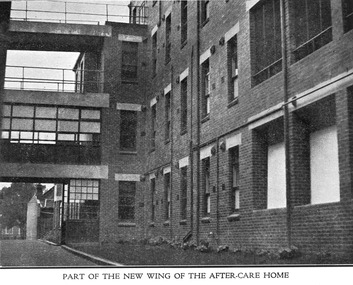
... ...after- care hospital...after care home...The name of the Melbourne District Nursing Society (MDNS) After-Care 'Home', changed to 'Hospital' in 1934 and major extensions occurred in 1936....Black and white digital image taken of the rear of the Melbourne District Nursing Society (MDNS) After-Care Home showing, on the right, part of a three story section of the brick built new wing. ...The name of the Melbourne District Nursing Society (MDNS) After-Care 'Home', changed to 'Hospital' in 1934 and major extensions occurred in 1936. ...The name of the Melbourne District Nursing Society (MDNS) After-Care 'Home', changed to 'Hospital' in 1934 and major extensions occurred in 1936.Melbourne District Nursing society (MDNS) opened the After-Care Home, situated at 39 Victoria Parade Collingwood in 1926 following a public appeal for funds. The name changed from MDNS 'Home' to 'Hospital' in 1934. The After-Care Home was originally established to provide nurse-managed convalescent care to poor and underprivileged people who could not look after themselves at home due to illness or on release from hospital. Opening in 1926, at a cost of £27,000, the Home included maternity, children’s and adult wards as well as accommodation for Matron, twelve nurses and four domestic staff. In 1930 an ante-natal clinic was opened at the home. During 1934 the Women’s Welfare Clinic including, at the time, a very controversial Family Planning Clinic, the first of its kind in Australia, was opened to support women at risk following multiple and difficult pregnancies. Major extensions occurred in 1936. Following Government intervention, the After-Care Hospital was separated from the Melbourne District Nursing Society in 1957 and the District division of Melbourne District Nursing Society became the Melbourne District Nursing Service and relocated to 452 St Kilda Road, Melbourne. Following Royal patronage in 1966 this became the Royal District Nursing Service (RDNS). The After-care Hospital continued to operate at the same address in Collingwood until 1985 when it became the Melbourne Geriatric Centre. Black and white digital image taken of the rear of the Melbourne District Nursing Society (MDNS) After-Care Home showing, on the right, part of a three story section of the brick built new wing. Long windows are seen along each storey separated by brick work. Above each window is a wide light strip. Attached to this wing is a narrow three storey section with one long window, with light top strip, shown on each storey. Attached to the left of this are three walkways running to the left of the image. Tall metal handrails run along each walkway. In the background beyond the lowest walkway, part of a hip roof building and a leafy tree can be seen.melbourne district nursing society, after- care hospital, after care home, rdns, royal district nursing service -
 Royal District Nursing Service (now known as Bolton Clarke)
Photograph - Digital image, c.1930
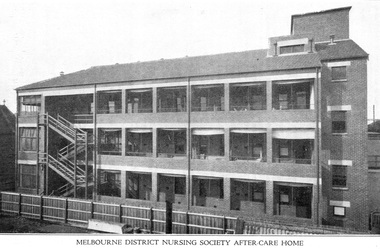
... melbourne district nursing society and after-care home...The Melbourne District Nursing Society After-Care Home was built in 1926 to give short term care to MDNS patients who were too ill to remain in their home, but not ill enough to go to hospital. ...Digital image of the rear of the extended Melbourne District Nursing Society After-Care Home 45 Victoria Parade, Collingwood. ...The Melbourne District Nursing Society After-Care Home was built in 1926 to give short term care to MDNS patients who were too ill to remain in their home, but not ill enough to go to hospital. ...The Melbourne District Nursing Society After-Care Home was built in 1926 to give short term care to MDNS patients who were too ill to remain in their home, but not ill enough to go to hospital. Melbourne hospitals also sent patients there who required further care after discharge from hospital. After convalescence they returned to their homes. Many children were nursed there, particularly during the Polio epidemic.The Society were pioneers in recognizing the need for premises where patients too ill to be in their own home, but not ill enough to go to hospital, was needed, and the Society built, then opened, the After-Care Home in 1926, (from 1934 called After-Care Hospital), for these patients, and patients from Hospitals. Many children were nursed there, some long term, during the Polio epidemic and the Society employed two School Teachers. The Society now ran two divisions, the After-Care with its own Trained nurses and the District division. The Society were the first in Melbourne, in early 1928, to recognize some patients leaving the After-Care, and many at home, needed further social care and they set up ‘Almoners’ from their Committee to visit these patients and be intermediaries in getting them social assistance. It was late the following year before the first training of Almoners took place in Melbourne. In 1930 the Society employed a full time kindergarten teacher to visit poor children in their homes. That year the Society were pioneers in opening an Ante-Natal Clinic at the After-Care, setting a high standard with equipment, keeping records and providing leaflets with instructions in how to keep healthy during pregnancy, what complications to look for, and what to do when labour commenced. In 1934 the Society were pioneers again when they opened the first Women’s Welfare Clinic in Melbourne giving advice on birth-control, at first attended by their own patients, but then accepting patients from public hospitals until their own clinics were opened. A trained Almoner was employed, but left after twelve months due to the amount of work required. Trained Almoners were in short supply so a Social Service Officer was employed at the After-Care who successfully gained better housing from the Housing Commission for families living under unsuitable conditions. In the 1950s the Hospital and Charities Commission decided to take over the After-Care Hospital, so the Melbourne District Nursing Society and After-Care Hospital separated and the Melbourne District Nursing Service was formed, setting up Headquarters at 452 St. Kilda Road. In 1966 Royal patronage was given and the name changed to Royal District Nursing Service (RDNS).Digital image of the rear of the extended Melbourne District Nursing Society After-Care Home 45 Victoria Parade, Collingwood. It shows a three story brick building with a tiled hip roof and open verandas running along each story with windows seen behind. A zigzag stair case runs down the left hand side of the building and on the right hand side of the image you can see a section set back with one window on each floor. Behind this section, part of another multi story building is seen. A wooden paling fence is seen in the foreground of the photograph. On the far right, part of another brick building with hip roof can be seen melbourne district nursing society, mdns, melbourne district nursing society and after-care home, rdns, royal district nursing service -
 Royal District Nursing Service (now known as Bolton Clarke)
Photograph - Digital image, 1931
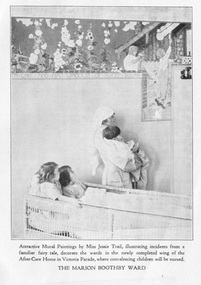
... ...after-care home... The Marion Boothby Ward in the 'MDNS After Care Home' opened in 1930 and was named in honour of Mrs Noel (Marion) Boothby, Life Governor and generous supporter of the Melbourne District Nursing Society who passed away in 1929. ...Black and white digital image of a Trained nurse (Sister) and 3 children in the Marion Boothby Ward in the Melbourne District Nursing Society After Care Home. The photograph portrays a Sister in her white uniform and white veil over her short curled hair. ...The Marion Boothby Ward in the 'MDNS After Care Home' opened in 1930 and was named in honour of Mrs Noel (Marion) Boothby, Life Governor and generous supporter of the Melbourne District Nursing Society who passed away in 1929. ...The Marion Boothby Ward in the 'MDNS After Care Home' opened in 1930 and was named in honour of Mrs Noel (Marion) Boothby, Life Governor and generous supporter of the Melbourne District Nursing Society who passed away in 1929. The photograph portrays a Trained nurse (Sister) holding a young child viewing the newly completed mural by Miss Jessie Traill. Two young children in a cane wicker trolley look on.Miss Jessie Traill 29/7/1881 - 15/5/1967 is today considered one of Australia's most remarkable printmakers. She studied painting and drawing at the National Gallery of Victoria. She spent over 3 years as a VAD nurse based in Rouen, France during World War 1. https://nga.gov.au/Traill/Chronology2.cfm The Melbourne District Nursing The Society (MDNS) were pioneers in recognizing the need for premises where patients too ill to be in their own home, but not ill enough to go to hospital, was needed. The MDNS had purchased its first premises, 'Floriston' at 39 Victoria Parade, Collingwood in 1914 and were able to purchase land next to No. 39, where the Society built the After-Care Home, it became No. 45 Victoria Parade, for these patients, and for patients from Hospitals. It was opened in July 1926 and the name of the Society then became ‘Melbourne District Nursing Society and After-Care Home’ (‘Hospital’ from 1934), Many children were nursed there, some long term during the Polio epidemic and two School Teachers were employed. The Society now ran two divisions, the After-Care with its own Sisters and nurses, and the District division which only employed Sisters. Black and white digital image of a Trained nurse (Sister) and 3 children in the Marion Boothby Ward in the Melbourne District Nursing Society After Care Home. The photograph portrays a Sister in her white uniform and white veil over her short curled hair. She is holding a young boy who has short dark hair, in her arms. He has a blanket around him. They are viewing the newly completed mural on the wall by Miss Jessie Traill. Two young girls, one with dark straight hair and the other with lighter coloured curled hair are sitting up together in a cane wicker trolley look up at the mural. The mural depicts flowers and children.melbourne district nursing society, after-care home, mdns, mrs noel (marion) boothby, miss jessie traill -
 Royal District Nursing Service (now known as Bolton Clarke)
Photograph - Photograph, black and white, c.1930
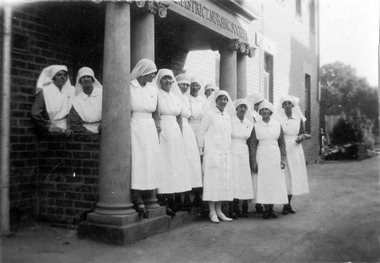
... after care hospital...uniforms...after-care home...The Matron and Sisters in this photograph worked in the Melbourne District Nursing Society After Care Home, (later called Hospital) full time and administered nursing care to patients who ranged in age from babes to adults. ...A black and white photograph of Matron and twelve Trained nurses (Sisters) standing at the front entrance of the Melbourne District Nursing Society After Care Home, In the front of the portico is the Matron and four Sisters. ...The Matron and Sisters in this photograph worked in the Melbourne District Nursing Society After Care Home, (later called Hospital) full time and administered nursing care to patients who ranged in age from babes to adults. ...The Matron and Sisters in this photograph worked in the Melbourne District Nursing Society After Care Home, (later called Hospital) full time and administered nursing care to patients who ranged in age from babes to adults. The Society also had a District Nursing division and these Sisters only worked in the community giving nursing care to patients in their homes.The Melbourne District Nursing Society were pioneers in recognizing the need for premises where patients too ill to be in their own home, but not ill enough to go to hospital, was needed, and the Society built, then opened, the After-Care Home in 1926, (from 1934 called After-Care Hospital), for these patients, and patients from Hospitals. Many children were nursed there, some long term during the Polio epidemic and the Society employed two School Teachers. The Society now ran two divisions, the After-Care with its own Sisters and nurses, and the District division. The Society were the first in Melbourne, in early 1928, to recognize some patients leaving the After-Care, and many at home, needed further social care and they set up ‘Almoners’ from their committee to visit these patients and be intermediaries in getting them social assistance. It was late the following year before the first training of Almoners took place in Melbourne. In 1930 the Society employed a full time kindergarten teacher to visit poor children in their homes. That year the Society were pioneers in opening an Ante-Natal Clinic at the After-Care, setting a high standard with equipment, keeping records, and providing leaflets with instructions in how to keep healthy during pregnancy, what complications to look for and what to do when labour commenced. In 1934 the Society were pioneers again when they opened the first Women’s Welfare Clinic in Melbourne giving advice on birth-control, at first attended by their own patients, but then accepting patients from public hospitals until their own clinics were opened. A trained Almoner was employed by the Society in 1934, doing a great deal of work with Midwifery patients, but she resigned after twelve months due to the amount of work. Due to a lack of trained Almoners, the Society employed a Social Service Officer at the After-Care who successfully gained better housing from the Housing Commission for families living under unsuitable conditions.A black and white photograph of Matron and twelve Trained nurses (Sisters) standing at the front entrance of the Melbourne District Nursing Society After Care Home, In the front of the portico is the Matron and four Sisters. Matron is dressed in a white long uniform dress and white veil over her short dark hair, and is wearing white stockings and white shores. To her right are four Sisters. Behind them are five Sisters, one standing between the left pair of round columns of the portico and the others to her right finishing just before the second set of columns. Two Sisters are to the left of the left hand column in front of the brick wall of the building. A short brick wall runs from the column to the building and hides the lower half of these Sisters. All the Sisters are dressed with white long aprons with white belts, which are covering their uniforms, only their dark grey sleeves and white collars can be seen. They are wearing white veils covering most of their short dark hair, grey stockings and black shoes. At the top of the portico can be seen the words 'District Nursing Society'. Part of the two story brick building can be seen behind the group; two long windows are visible on the upper and lower sections. To the right of the building some shrubs and a tree can be seen.nurses, after care hospital, uniforms, after-care home, melbourne district nursing society, mdns, rdns, royal district nursing service -
 Royal District Nursing Service (now known as Bolton Clarke)
Photograph - Digital image, c.1934
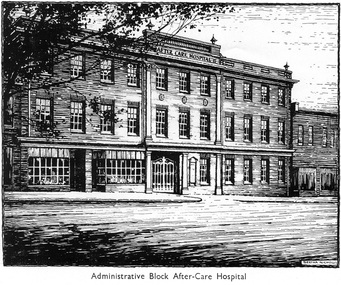
... ...after- care hospital...after-care home...The Melbourne District Nursing Society After-Care Home was extended and the name changed from 'Home' to 'Hospital' in 1934. ...The Melbourne District Nursing Society After-Care Home was extended and the name changed from 'Home' to 'Hospital' in 1934. ...The Melbourne District Nursing Society After-Care Home was extended and the name changed from 'Home' to 'Hospital' in 1934. This is a sketch of the Administrative building and shows the style of Hospital Architecture of the 1930sThe Melbourne District Nursing Society, (MDNS), built the After-Care Home in 1926. The Home was extended and the name changed to Melbourne District Nursing Society and After-Care Hospital in 1934. It was situated at 45 Victoria Parade, Collingwood. Patients of the Society who needed more care than could be given at home, but did not need hospitalization, were nursed there along with many patients from Melbourne hospitals who needed further care before going home. Many children were nursed in the hospital, some long term, during the Polio epidemic and schooling was given to them in the hospital. In September 1930 an Ante-Natal Clinic was established. In October 1934 a Women's Welfare Clinic was opened to educate women on birth control. This was the first of its kind in Melbourne. The After Care Hospital was under the Society's banner until 1956. In 1957 the MDNS and the After-Care separated with the Government taking over the running of the After-Care Hospital. Melbourne District Nursing Society then became the Melbourne District Nursing Service, later Royal District Nursing Service (RDNS) after Royal patronage in 1966..A digital image of a sketch of the front view of the After-Care Hospital. It shows a three storey building, and on the left of the ground floor are two large windows, each with a grid of approximately twenty-one small panes of glass; divided with sash bars holding the glass. To the right of this is a double scroll door, then the building divided with five, nine pane long windows along it. There is a column portico in front of the door. The second and third storeys have eleven rows of long small pane windows with the central brick section between the floors having three roundels attached. A flat roof section runs along the the top of the third storey with the words 'After Care Hospital' written in black capital letters in the centre. Above this central section is some balustrade with finials either end. To the right of this building; part of a two storey building with the same style windows can be seen. mdns, melbourne district nursing society, after- care hospital, after-care home, melbourne district nursing service -
 Royal District Nursing Service (now known as Bolton Clarke)
Photograph - Photograph, Portrait black and white, c.1930
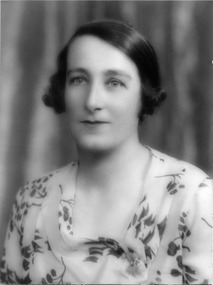
... ...after-care home...Major, then Miss Beatrice Williams was appointed Matron of the District Nursing Division of the Melbourne District Nursing Society (MDNS) After Care Home in April 1929 until 1933 when she resigned to marry Mr. ...Major, then Miss Beatrice Williams was appointed Matron of the District Nursing Division of the Melbourne District Nursing Society (MDNS) After Care Home in April 1929 until 1933 when she resigned to marry Mr. ...This photograph is a visual record of Mrs. Major, then Miss Beatrice Williams was appointed Matron of the District Nursing Division of the Melbourne District Nursing Society (MDNS) After Care Home in April 1929 until 1933 when she resigned to marry Mr. J.P. Major. Following her marriage she was invited to become a member of the Society's Committee. In 1957 she was the first President of the Melbourne District Nursing Service.Mrs. Major, then Miss Beatrice Williams worked as a Sister with the Melbourne District Nursing Society in the early 1920s, before sailing tor England where she studied Midwifery and Community nursing. On her return her leadership qualities were recognized and she was appointed Matron of the District Nursing Division of the Melbourne District Nursing Society After-Care Home in April 1929, being considered 'capable, sympathetic, a good organizer and administrator and with understanding of the problems of the under-privileged, the aged and the sick'.. She was instrumental in convincing the Committee of Management of the need for an Ante-Natal Clinic which then opened at the After-Care Home in September 1930. Matron Williams tendered her resignation in 1933 as she was to marry Mr. J.P. Major. Following her marriage she was invited to become a member of the Society's Committee, and at the time of the dissolution of the Society and After-Care in 1957, was the first President of the now Melbourne District Nursing Service, a role she held until her death on 15th of February 1958.Black and white photograph of the head and shoulder view of Mrs. J.P. Major, nee Beatrice Mary Williams, who has short dark hair curled at the ends. She is wearing a light coloured floral frock with a square neckline.. She is sitting in front of a closed curtain.melbourne district nursing society, melbourne district nursing service, mdns, after-care home, rdns, royal district nursing service, matron, beatrice mary williams, mrs j.p. major -
 Royal District Nursing Service (now known as Bolton Clarke)
Photograph - Digital image, Barry Sutton, c.1930
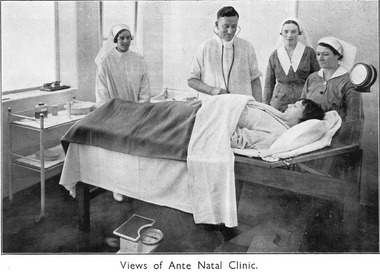
... after- care hospital...45 victoria parade collingwood...melbourne district nursing society (1885-1957)...ante-natal clinic...after-care home...In 1930 the Society were pioneers in opening an Ante-Natal Clinic at the Melbourne District Nursing Society (MDNS) After-Care Home, setting a high standard with equipment, keeping records and providing leaflets with instructions in how to keep healthy during pregnancy, what complications to look for, and what to do when labour commenced. ...Land was procured next to No. 39, and the Society built the After-Care Home at 45 Victoria Parade, for these patients, and for patients from Hospitals. ...In 1930 the Society were pioneers in opening an Ante-Natal Clinic at the Melbourne District Nursing Society (MDNS) After-Care Home, setting a high standard with equipment, keeping records and providing leaflets with instructions in how to keep healthy during pregnancy, what complications to look for, and what to do when labour commenced. This image was taken in the Ante-Natal Clinic and shows some of the equipment used at that time and the uniforms worn by Trained nurses (Sisters) in the 1930s. Melbourne District Nursing Society (MDNS) was founded in 1885 and only nurses who had trained in a Hospital Training School and were fully qualified were employed by the Society. It commenced with one Trained nurse (Nurse), and another employed six months later; both walking amid the slums of inner Melbourne administering nursing care to the sick poor. The Society decided to commence a Midwifery Service and Nurse Fowler, who had previously worked for the Society, was re-employed as their first Trained Midwife. She began home births in August 1893 giving some Ante Natal care, taking midwifery bundles and providing clothes for the babe and mother as needed. Following birth, she gave Post-natal care to the mother and babe twice a day for three days and then daily for a week, and longer if required. She resigned after twelve months and Nurse Wilkie was appointed to the position. As well as walking, the Nurses used Public transport in the limited areas it ran, though a taxi was used by the Nurses and Midwife in emergencies and at night. As the Society expanded it rented premises until it was able to purchase it's own Nurses Home at 39 Victoria Parade, Collingwood in 1914. The Society were pioneers in recognizing the need for premises where patients too ill to be in their own home, but not ill enough to go to hospital, was needed. Land was procured next to No. 39, and the Society built the After-Care Home at 45 Victoria Parade, for these patients, and for patients from Hospitals. It was opened in July 1926 and the name of the Society then became ‘Melbourne District Nursing Society and After-Care Home’ (‘Hospital’ from 1934) The Ante-Natal Clinic at the Melbourne District Nursing Society After-Care Home was opened on the 23rd of September 1930 and MDNS Midwifery patients were encouraged to attend. Prior to the opening of the clinic Ante-natal care was not considered important, but within a short time 100 percent of MDNS Midwifery patients were attending. During 1934 the Women’s Welfare Clinic, including at the time a very controversial Family Planning Clinic, the first of its kind in Australia, was opened to support women at risk following multiple and difficult pregnancies. The Clinic gave advice on birth-control and was attended by their own patients at first, but then accepted patients from Melbourne public hospitals until their own clinics were opened.Digital image showing a Doctor and three Melbourne District Nursing Society (MDNS) Sisters attending a patient in the Ante-Natal Clinic at the After Care Hospital. In the forefront is a set of scales standing on the floor, behind which is the lady lying on a wooden framed bed with the base slightly raised at the top end supporting a white pillow and the lady's head. The lady has short dark hair and her frock can be seen to her waist; the rest of her body is covered by a white sheet and dark coloured blanket. Behind her and to the right of the image, are two Sisters wearing dark coloured long sleeved uniforms which have a belt and white collar; they are both wearing white veils over their short dart hair. To their left is a Doctor who has short dart wavy hair and is looking down at the lady. He is wearing a long white gown and has a stethoscope in his ears with the other end held in his right hand. To his left is another Sister who is wearing a white veil over her dark curled hair, and is wearing a long white gown. In the rear between the Doctor and Sister a hand basin can be seen. On the far left of the picture a trolley with two cloth covered shelves can be seen; a basin and squat bottle sits on the top shelf and kidney dish on the lower one. Behind this, part of a window can be seen.after- care hospital, 45 victoria parade collingwood, melbourne district nursing society (1885-1957), ante-natal clinic, after-care home, mdns midwifery, rdns, royal district nursing service -
 Royal District Nursing Service (now known as Bolton Clarke)
Photograph - Digital image, c.1922
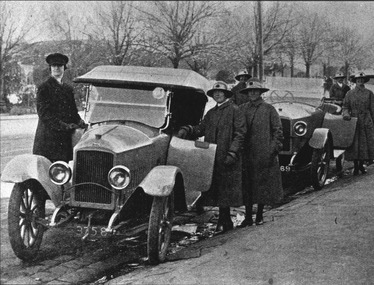
... ...after-care home...I melbourne district nursing society after-care home rdns royal district nursing service mdns motor auxiliary mdns uniforms miss sword female chauffeur A black and white digital image showing, in the left foreground, the frontal view of an early model, 1920s, soft hooded car parked on the road next to the gutter. ...The MDNS Trained nurses (Sisters) are about to board two motor vehicles outside their Nurses home, at 39 Victoria Parade, Collingwood, to be driven to give nursing care to their patients who lived a distance away. The lady Chauffeur is probably Miss Sword who was employed by MDNS in 1922-23; she was also in charge of the garage. This enabled the Sisters to do more visits in a day than when using Public transport all the time. This image also shows the style of cars driven in that era. The Sisters uniforms are grey and their hats have a red Maltese cross attached to the centre front of the hatband. Royal District Nursing Service (RDNS) has had various modes of transport over the last 130 plus years. At first, from 1885 as Melbourne District Nursing Society (MDNS), their Trained nurses (Nurses) walked the streets and lane ways amid the slums of central Melbourne. As the Society expanded public transport was used, and bicycles were bought by the Society in 1903 and used in inner areas until 1945. During the Spanish flu epidemic, in 1919, MDNS appealed for assistance to procure Motor vehicles so the Nurses could visit an influx of cases. Through trusts, grants and donations four 'Ford T Model' cars were procured which enabled the Nurses to triple their visits. Through constant use the cars were in such a poor state two were sold in 1922 and the others later. In 1922-23 three Peugeot cars were purchased and a female Chauffeur, 'Miss Sword', was employed who lived in the Home and was also in charge of the garage. MDNS was expanding, and In 1929 Melbourne District Nursing Society (MDNS) formed a volunteer Motor Auxiliary to transport their Trained Nurses (Sisters) to make visits more patients who lived a distance away. At first wealthy people offered their car and chauffeur, but then the general public supplied their own vehicles. They operated on week days when able and could take up to three Sisters at a time, collecting them from the Nurses Home, 39 Victoria Parade, Collingwood, at 9 a.m; dropping each Sister at a patient then picking them up and taking them to the next patient before completing the morning round and returning to the Nurses Home at 1 p.m.. The Sisters were able to double the number of visits they did each morning and did their afternoon visits on public transport. At its peak there were 60 volunteers but this fell off during World War 11. In 1944 the Red Cross were assisting, and by 1953 were taking out 16 MDNS Sisters. Appeals for volunteers occurred over the years, particularly during the Tram and Tramway Bus strike in the 1950s, and when the Royal Women's Hospital had an influx of births and wanted to send the mothers and babies home on day four but could not do so if M.D.N.S. could not visit. During 1962 the Motor Auxiliary transported 34 Sisters who preferred not to drive themselves, but as the MDNS fleet of cars grew there was less need for their service and the Auxiliary was disbanded in 1971. Some Sisters used their own cars; even a motorcycle was used by one Sister in 1933. All these forms of transport were intermingled and in the early 1950s, and now as Melbourne District Nursing Service, seven Ford Prefect cars were bought followed by twelve Ford Anglia cars 1955. Having received Royal patronage; the now Royal District Nursing Service (RDNS) had its own fleet of Holden vehicles by the mid 1960s and the Motor Auxiliary ceased operating in 1971 as by then all staff employed were required to have a driving licence. Seat-belts had been introduced to Victoria in 1959 and District fitted them to their cars from 1962, even though they did not become compulsory until 1970. The Holden vehicles were replaced with grey Holden Torana vehicles. After several years the fleet was changed to white Toyota Corolla vehicles. The Melways Directory of maps was introduced in 1966, which was a boon to the Sisters, though it was a few years before it went beyond Seville, so a large paper map was used by the Sisters visiting patients in the areas passed Seville. By 2009 there were 598 cars in the fleet and the Sisters travelled 9 million 200,000 kilometres – this is equivalent to 12 trips to the moon and back. IA black and white digital image showing, in the left foreground, the frontal view of an early model, 1920s, soft hooded car parked on the road next to the gutter. Two front spoked wheels are seen, and headlights sit either side of the radiator at the front of the nose shaped bonnet.. '3758' is written in white on the black number plate below the radiator. The female Chauffeur is dressed in a dark coat and peaked hat and is standing by the partly open driver's door. The passenger door is open and a Melbourne District Nursing Society (MDNS) Sister is standing on the footpath behind the door. Another Sister stands behind her. There is another similar car parked behind the first one. It is partly obscured, its hood is down; it has spoked wheels and one of its headlights can be seen beside the partially obscured radiator. Part of the black number plate can be seen with two of its numbers, '69', written in white. A partly obscured Sister is standing by the driver's door and another behind the open passenger door. Another Sister is standing at the rear of this car..The five MDNS Sisters are wearing their uniform grey coats and felt brimmed grey hats with a Maltese cross applied to the centre hatband, Leafless trees and some buildings can be seen in the background.melbourne district nursing society, after-care home, rdns, royal district nursing service, mdns motor auxiliary, mdns uniforms, miss sword, female chauffeur -
 Royal District Nursing Service (now known as Bolton Clarke)
Document, black and white, c.1957
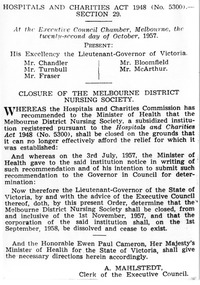
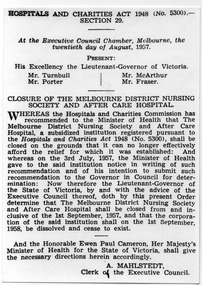
... ...after-care home...The Melbourne District Nursing Society (MDNS) was founded in February 1885 and in 1926 opened the After-Care Home. The name of the Society then became the Melbourne District Nursing Society and After-Care Home until 1935 when the word 'Home' was replaced with the word 'Hospital'. ...In 1957 the 'Incorporation of the Melbourne District Nursing Service' (MDNS) was authorized on the 5th of March 1957. On the 22nd of October 1957 the 'Closure of the Melbourne District Nursing Society' was authorized. The Melbourne District Nursing Society (MDNS) was founded in February 1885 and in 1926 opened the After-Care Home. The name of the Society then became the Melbourne District Nursing Society and After-Care Home until 1935 when the word 'Home' was replaced with the word 'Hospital'. In 1957 the two bodies separated and the 'Incorporation of the Melbourne District Nursing Service' (MDNS) was authorized on the 5th of March 1957. On the 22nd of October 1957 the 'Closure of the Melbourne District Nursing Society' was authorized. The name Melbourne District Nursing Service continued to be used until 1966 when Royal patronage was granted and it became the Royal District Nursing Service (RDNS).Black and white document - 'Closure of the Melbourne District Nursing Society'. The document commences 'Hospital and Charities Act 1948 (No. 5300); then follows the names of those present being the Lieutenant Governor of Victoria and five other men. The body of the document contains twenty-three lines and finishes with 'A. Mahlstedt Clerk of the Executive Council'melbourne district nursing society, mdns, after-care home, after- care hospital, melbourne district nursing service, royal district nursing service, closure of mdn society, rdns -
 Royal District Nursing Service (now known as Bolton Clarke)
Document, black and white, c.1957
... ...after-care home...After Care Hospital. The Melbourne District Nursing Society was founded in February 1885. It built the After-Care Home in 1926, and the Society became the 'Melbourne District Nursing Society and After-Care Home' until 1935 when the word 'Home' was replaced by the word 'Hospital'. ...This document tells of the separation of Melbourne District Nursing Society and After Care Hospital.The Melbourne District Nursing Society was founded in February 1885. It built the After-Care Home in 1926, and the Society became the 'Melbourne District Nursing Society and After-Care Home' until 1935 when the word 'Home' was replaced by the word 'Hospital'. In 1957 the two bodies separated, with one becoming the 'Melbourne District Nursing Service', and the other the 'After-Care Hospital'. This document from the Lieutenant-Governor of Victoria shows the 'Closure of the Melbourne District Nursing Society and After Care Hospital' which took affect with dissolution on the 1st of September 1958.Black and white document: 'Closure of the Melbourne District Nursing Society and After Care Hospital' The document is bold black printing on a white background. It commences 'Hospital and Charities Act 1948 (No. 5300); follows are the names of those present being the Lieutenant Governor of Victoria and four other men. The body of the document contains twenty-four lines and finishes with ‘A. Mahlstedt Clerk of the Executive Council’.melbourne district nursing society, after-care home, after- care hospital, melbourne district nursing service, mdns, rdns, royal district nursing service -
 Royal District Nursing Service (now known as Bolton Clarke)
Photograph - Digital image, c.1934
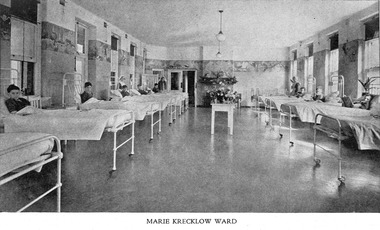
... ...after- care hospital...after-care home...After-Care Hospital in the memory of Mrs. Marie Krecklow. This image shows the furnishings in the Ward of the Hospital at 45 Victoria Parade, Collingwood. The boys in this image are receiving nursing care before returning home...The Society were pioneers in recognizing the need for premises where patients too ill to be in their own home, but not ill enough to go to hospital, was needed, and the Society built, then opened, the Melbourne District Nursing Society After-Care Home in 1926, (from 1934 called After-Care Hospital), for these patients, and patients from Melbourne Hospitals who required recuperation before returning home. ...In 1934 the Trustees of the Marie Krecklow Estate donated 500 pounds to furnish and equip an empty Ward in the Melbourne District Nursing Society After-Care Hospital in the memory of Mrs. Marie Krecklow. This image shows the furnishings in the Ward of the Hospital at 45 Victoria Parade, Collingwood. The boys in this image are receiving nursing care before returning home following their recuperation. Many children were nursed at the hospital, some long term during the Polio epidemic. The Society were pioneers in recognizing the need for premises where patients too ill to be in their own home, but not ill enough to go to hospital, was needed, and the Society built, then opened, the Melbourne District Nursing Society After-Care Home in 1926, (from 1934 called After-Care Hospital), for these patients, and patients from Melbourne Hospitals who required recuperation before returning home. Many children were nursed there, some long term during the Polio epidemic and the Society employed two School Teachers. The Society now ran two divisions, the After-Care with its own Trained nurses and the District division. The Society were the first in Melbourne, in early 1928, to recognize some patients leaving the After-Care, and many at home, needed further social care and they set up ‘Almoners’ from their committee to visit these patients and be intermediaries in getting them social assistance. It was late the following year before the first training of Almoners took place in Melbourne. In 1930 the Society employed a full time kindergarten teacher to visit poor children in their homes. That year the Society were pioneers in opening an Ante-Natal Clinic at the After-Care, setting a high standard with equipment, keeping records and providing leaflets with instructions in how to keep healthy during pregnancy, what complications to look for and what to do when labour commenced. In 1934 the Society were pioneers again when they opened the first Women’s Welfare Clinic in Melbourne giving advice on birth-control, at first attended by their own patients, but then accepting patients from public hospitals until their own clinics were opened.A trained Almoner was employed at the hospital but left after twelve months due to the volume of work. Unable to employ another trained Almoner due to a shortage of them, a Social Service Officer was employed at the After-Care who successfully gained better housing from the Housing Commission for families living under unsuitable conditions. In the 1950s the Hospital and Charities Commission decided to take over the After-Care Hospital, so the Melbourne District Nursing Society and After-Care Hospital separated and the Melbourne District Nursing Service was formed, setting up Headquarters at 452 St. Kilda Road. In 1966, following Royal patronage the name was changed to Royal District Nursing Service (RDNS).Digital mage showing the 'Marie Krecklow Ward' in the Melbourne District Nursing Society After-Care Hospital. The image shows five iron hospital beds along the left hand side and five iron hospital beds along the right hand side of the ward. Eight young boys, most with short dark hair and one with short blonde hair, are leaning against pillows sitting up in the beds. Some pillows are propped against an iron support which slopes from the headrest. Three sets of windows can be seen on either side of the ward which is painted grey and a wide floral border to the picture rails, then white paint above the picture rail which continues over the ceiling. A white table with vases of flowers is in the centre rear of the image. A Sister, wearing a white uniform and veil and a dark cape stands at the rear left hand side of the image, and two nurses wearing white aprons over dark uniforms and white caps stand half way down the ward, one on either side. mdns, melbourne district nursing society, after- care hospital, after-care home, rdns, royal district nursing service, mrs marie krecklow -
 Royal District Nursing Service (now known as Bolton Clarke)
Photograph - Photograph, black and white, c.1929
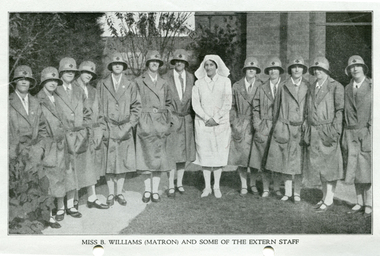
... Black and white photograph of Matron Beatrice Williams wearing a white uniform and veil, with a group of twelve Melbourne District Nursing Society (MDNS) trained nurses (Sisters) wearing their calf length uniforms of grey coats, and grey brimmed hats with pale grey hat band with central Maltese cross, standing in the garden of the MDNS After-Care home....This uniform was worn until changed to a corporate style in the mid 1980s, melbourne district nursing society mdns mdns uniforms rdns royal district nursing service mdns matron miss beatrice mary williams No. 8526 on rear of photograph Black and white photograph of Matron Beatrice Williams wearing a white uniform and veil, with a group of twelve Melbourne District Nursing Society (MDNS) trained nurses (Sisters) wearing their calf length uniforms of grey coats, and grey brimmed hats with pale grey hat band with central Maltese cross, standing in the garden of the MDNS After-Care home. Photograph Photograph, black and white ...This is a photographic record of Matron Beatrice Williams and the Trained nurses, (Sisters), of the District Nursing division of the Melbourne District Nursing Society who worked in the community give nursing care to patient's in their homes. Their uniforms are grey and the Maltese cross on the Sisters hats is red.From its earliest years when Melbourne District Nursing Society (MDNS) began to wear uniforms the chosen colour was grey, though the style changed throughout the years as fashions changed from the late 1800s through to the 1970s. The Trained nurses (Nurses), firstly wore long grey frocks and a white cap with a long white tail hanging from the centre back. When bicycles were introduced in 1903 the headgear changed to a white pith helmet adorned with a red Maltese cross in the centre front. This was held on with a veil going over the hat and tied under the chin. Over the years there were complaints that the veils became wet in the rain and they asked for a change of uniform, but this did not happen until 1921. Later the Nurses complained their skirts became wet when riding their bicycles in the rain and asked, when raining, to be able to wear breeches and gaiters. This was granted provided they wore aprons when attending patients. It was not long before the uniform changed to a shorter length grey frock, red cardigan, grey coat and grey brimmed hat; later changed to a peaked grey hat. In 1966 MDNS were granted Royal patronage. Now as Royal District Nursing Service, RDNS, the uniform was redesigned and colour changed in 1971. By 1972 the Trained nurses (Sisters) were wearing the new winter uniform of a blue/grey skivvie under a V neck tunic style frock made of blue/grey herringbone winter material with the RDNS insignia on the upper left, and a beret of the same material. In summer the uniform became a royal blue V neck tunic style frock, with the RDNS insignia on the upper left, worn over a short sleeve white blouse. A royal blue peaked hat with the RDNS insignia in the centre front was worn at first and then only worn on official occasions. This uniform was worn until changed to a corporate style in the mid 1980s,Black and white photograph of Matron Beatrice Williams wearing a white uniform and veil, with a group of twelve Melbourne District Nursing Society (MDNS) trained nurses (Sisters) wearing their calf length uniforms of grey coats, and grey brimmed hats with pale grey hat band with central Maltese cross, standing in the garden of the MDNS After-Care home.No. 8526 on rear of photographmelbourne district nursing society, mdns, mdns uniforms, rdns, royal district nursing service, mdns matron, miss beatrice mary williams -
 Royal District Nursing Service (now known as Bolton Clarke)
Photograph - Digital image, c.1935
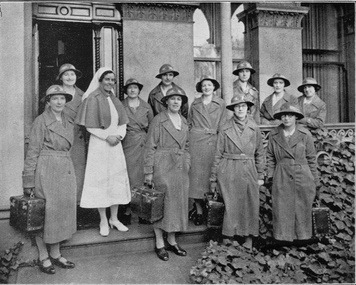
... The Nurses lived in this residence from 1914-1953. In 1926 the After-Care Home was built next door. This image was taken twelve months after the name of the Society changed from 'Melbourne District Nursing Society After Care 'Home' to 'Hospital'. ...The Nurses lived in this residence from 1914-1953. In 1926 the After-Care Home was built next door. This image was taken twelve months after the name of the Society changed from 'Melbourne District Nursing Society After Care 'Home' to 'Hospital'. ...Matron F. L. Gordon and the Sisters are standing in front of the Melbourne District Nursing Society (MDNS) Nurses Home at 39 Victoria Parade, Collingwood. The Nurses lived in this residence from 1914-1953. In 1926 the After-Care Home was built next door. This image was taken twelve months after the name of the Society changed from 'Melbourne District Nursing Society After Care 'Home' to 'Hospital'. The photograph shows the uniform of the District Division of the Melbourne District Nursing Society in the 1930s, with the uniform dress made of grey cotton. Their brimmed hat was made of felt with a cotton hat band with a red Maltese cross in the centre front. From its founding in 1885 until 1891 the Trained nurses, called 'Nurse' in those days, of the Melbourne District Nursing Society (MDNS) worked from their own homes which were located in the vicinity of their areas (districts). In November 1891 MDNS was able to rent a two story terraced house at 66 Cardigan Street, Carlton, at £65 a year, which contained accommodation for three Nurses and one pupil nurse as well as being used as their Headquarters. They left from their Nurses Home each morning and returned at the end of their shift to write up their book work before retiring for the day. Three years later, in 1894, they moved into a larger terraced house at 49 Drummond Street Carlton which was rented at ‘a very moderate rental’. There was a Board room, apartments for the Nurses and pupil nurse, a large dispensary which patients could attend each evening to have prescriptions signed and bottles refilled with ‘homely remedies’ and elixirs, which were administered for e.g. Consumptive cases. Doctor’s prescriptions were filled at the Pharmacy. Cupboards containing donated blankets and bedclothes for needy patients were kept in this room, and it was here where the Nurses kept their nursing bags which were refilled at the end of each shift ready for any emergency and for the next day. A list of Doctors the Nurses could call was kept by the telephone. The Home also had a kitchen where nourishing soup was made and distributed twice a week to the needy. Milk was also distributed when needed. In 1902 they moved into rented premises at 188 Leicester Street, Carlton and two years later, in 1904, to premises at 5 Royal Terrace, Nicholson Street, Fitzroy. They remained there for ten years and an Auction of furniture was held before their next move giving an idea of some of the contents: - Carpets, linoleum, walnut and oak sideboards, dining tables, walnut dining suite, Vienna chairs, walnut bedroom suite, cedar wardrobes, chests of drawers, duchess chests, bedsteads and bedding and general furnishings were for sale. In June 1914 at last the Society had sufficient funding to purchase their own terraced premises, ‘Floraston’ 39 Victoria Parade, Collingwood which became their Headquarters and Nurses Home. In 1926 the After-Care Home for recovering patients, (later called After-Care Hospital) was built by the Society next door, running from 41-47 Victoria Parade (became No. 45); the District Sisters continued to live at No. 39. In November 1953 the District Nursing Division moved into their new Headquarters and Nurses Home at 452 St. Kilda Road, Melbourne, with a change of name to Melbourne District Nursing Service in 1957. With Royal patronage, this changed to Royal District Nursing Service (RDNS) in 1966. As District expanded, and now with outlying districts to service and with a full fleet of District cars, Sisters lived in their own homes and visited their District Centre each morning to collect their work for the day and returned there at the end of their days work in the community to carry out their administrative work. The digital image shows Matron, Miss F.L. Gordon, wearing a white uniform and veil and a dark coloured cape standing amid a group of eleven District Trained nurses (Sisters), from the Melbourne District Nursing Society (MDNS). Two Sisters are to her left and the others to her right. They are standing in front of a grey building. The Sisters are wearing their uniforms of grey long coats with lapels; the coat is secured with a belt around the waist. This is worn over their grey uniforms, with white collars. Each Sister is wearing their uniform grey brimmed hat with a Maltese cross attached to the light hatband, and are carrying a square shaped nursing case. They are standing in two rows, with some on the veranda of the building and some in front on the path; two Sisters are just off the path amid the shrubs. Part of the grey concrete building can be seen behind the Sisters with the open door to the left and part of three long windows seen to its right. One Sister has her lower left arm resting on the veranda rail.'Miss F.L. Gordon, Matron, and some of the District Sisters'mdns, melbourne district nursing society, 39 victoria parade, collingwood, rdns, royal district nursing service, nurses home, miss f.l. gordon, mdns uniforms, mdns matron -
 Royal District Nursing Service (now known as Bolton Clarke)
Photograph - Photograph, black and white, 09.1944
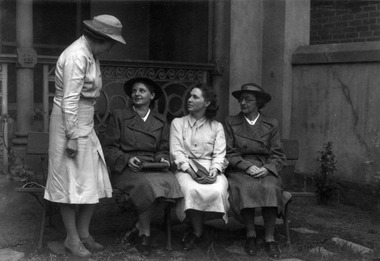
... The 'Melbourne District Nursing Society After Care Home' was built by MDNS in 1926 and the name changed from 'Care' to 'Hospital' in 1934. ...The 'Melbourne District Nursing Society After Care Home' was built by MDNS in 1926 and the name changed from 'Care' to 'Hospital' in 1934. ...The 'Melbourne District Nursing Society After Care Home' was built by MDNS in 1926 and the name changed from 'Care' to 'Hospital' in 1934. It was located at 45 Victoria Parade, Collingwood. This photograph is taken three years after Miss Dorothy Tupper was appointed Matron of the District Nursing Division of the Society in 1941. The Sisters in this Division worked in the community giving nursing care to people in their own homes.From its foundation in 1885 the Melbourne District Nursing Society (MDNS, were instrumental in giving care to their patients, and to assist them if they had financial problems or resided in poor living conditions. Miss Dorothy Tupper, who as a Trained nurse, had undertaken a course in hospital housekeeping at London Prince of Wales Hospital, was contacted by MDNS in 1939 and, possessing both business and humanitarian qualities, was asked to organize their newly established Social Service Department. As the MDNS Social Service Sister, she assessed the living conditions in patient's homes. She continued in this role until being appointed Matron of the Society's District Nursing division in 1941. Matron Dorothy Tupper announced her retirement in December 1962. As Matron for 22 years she played a major role in the employment and management of an ever increasing nursing workforce as well as help oversee the expansion of the service. Matron Tupper was known for her keen sense of duty, her high professional standards and never-failing concern for patients. The photograph was taken by Sun Newspaper photographer and appeared in an article about the MDNS in September 1944Black and white photograph showing Melbourne District Nursing Society (MDNS) Matron, Dorothy Tupper, standing side on, and to the left, of three District Trained nurses (Sisters) who are seated in the grounds of the After-Care Hospital. Matron Tupper is wearing a light coloured uniform which has a belt and a centre box pleat on the lower part of the skirt; a grey brimmed hat with a darker grey hat band sits over her short dark hair. She is looking down at the first Sister on the seat who is looking up at her. The Sisters at either end of the seat are wearing dark grey double breasted coats with lapels; the collars of their light colour uniforms can be seen. Both are wearing grey brimmed hats over their short dark hair. The Sister at the far end is wearing glasses and the Sister near Matron Tupper is holding a book. The centre Sister has shoulder length dark hair and is wearing a light coloured long sleeve uniform. She is also holding a book. Both these Sisters are looking toward Matron Tupper. The seat is made of wood and is against the concrete veranda of the building behind. Scrolled metal lace work is directly behind them with a round thin concrete post to the left of Matron Tupper and the other end of the lace work is fixed to the concrete square corner columns. One turns to the right and the concrete wall of the veranda attached can be seen running in front of part of the brick wall of the building.after- care hospital, melbourne district nursing society, mdns, nurses, matron, mdns social service department, rdns, royal district nursing service, matron dorothy tupper -
 Royal District Nursing Service (now known as Bolton Clarke)
Photograph - Photograph, Portrait black and white, c.1930
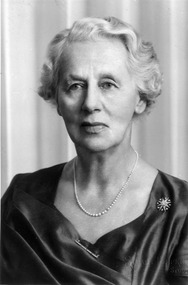
... This portrait photograph of Dame Mary Herring is a visual record of her taken during the time she was offering advice to Melbourne District Nursing Society After-Care Home (later Hospital)' as a member of their Committee from 1931. ...This portrait photograph of Dame Mary Herring is a visual record of her taken during the time she was offering advice to Melbourne District Nursing Society After-Care Home (later Hospital)' as a member of their Committee from 1931. ...This portrait photograph of Dame Mary Herring is a visual record of her taken during the time she was offering advice to Melbourne District Nursing Society After-Care Home (later Hospital)' as a member of their Committee from 1931. She was a Vice-president from 1943-1957 and acted as President in 1953. As a Medical practitioner she was involved with the formation of the MDNS After-Care Ante-Natal clinic in 1930 and the establishment of the Women's Welfare Clinic at the MDNS After-Care in 1934. Dame Mary Herring was born in Carlton on the 31st of March 1895. She graduated as a Bachelor of Medicine and Surgery (MB. BS) at the University of Melbourne in March 1921. During her training she went out with the Melbourne District Nursing Society (MDNS), where she visited many in poor circumstances and through this decided she wanted to improve the lives of women and children. She married Edmund Herring on the 6th of April 1922 and he supported her to continue her Medical career. She established an Ante-Natal Clinic at the Prahran Health Centre in 1926 and assisted MDNS After-Care Home in the establishment of its Ante-Natal clinic in September 1930. In 1931, as Dr. Mary Herring she became a member of the Committee of the now named ‘Melbourne District Nursing Society After-Care Home’ (later Hospital), and as Lady Herring became a Vice-president from 1943 until 1957 and acted as President in 1953. In 1934, along with Dr. George Simpson and Dr. Victor Wallace, she established the Women’s Welfare Clinic at the MDNS After-Care Hospital for patients of the Society; the first of its kind in Melbourne. After its opening in October 1934 she was the Hon Secretary of the Welfare Clinic, which operated from a room in the Ante-Natal Clinic of the After-Care. Dr. Herring pioneered family planning services. The clinic ran until 1940 when women could now obtain this advice from other establishments. In 1953, as Acting President, Lady Herring was involved with the discussions of the District Division of MDNS relocating to ‘Airlie’, 452 St. Kilda Road, Melbourne and the separation of Melbourne District Nursing Society and After Care Hospital, with the District Division now a separate entity, known as Melbourne District Nursing Service with its Headquarters at 452 St. Kilda Road, Melbourne. In 1966 with Royal patronage, this became the Royal District Nursing Service (RDNS). Though asked to be President of the Hospital division of the MDNS Society, she declined due to her many activities. In 1940 Dr. Mary Herring was a founder of the A.I.F Women’s Association and served on the Women’s Welfare Subcommittee to assist the families of soldiers and now as Lady Herring, she became President from 1943-1946. She was a a founding member and first president of the Victorian Council of Social Service 1946, chairman of the Vera Scantlebury Brown Memorial Trust 1946-1979, Deputy-president of Victorian division of the Australian Red Cross 1944-1963, and of the Victoria League 1945-1972 and the Australian council of the Save the Children Fund from 1962-1967. Lady Herring was a tireless worker for many charities particularly charities for children. On the 10th of July 1953 she was made Commander of the Order of St. John in recognition of her charity work and on the 11th of June 1960 was made Dame Commander of the Order of the British Empire for “services to nursing in Victoria” In 1949 the Argus Newspaper (https://trove.nla.gov.au/newspaper/article/22776603) described her as “one of the finest examples of Australian women in our State, with a record of selfless devotion to the service of others. Calm, kindly, clear-minded, and intensely logical”,..... “she has taken all this in her stride without once stopping out of her aura of cool, unruffled efficiency, an efficiency which is tempered by her warmth and understanding, her approachability, and her human sympathy.” Dame Mary Ranken Herring died in Camberwell on the 26th of October 1981. This black and white photograph is a portrait view of Dame Mary Herring. She has curled light coloured hair. Only a portion of her scooped neck dark coloured frock which falls in soft folds can be seen. There is a light colour brooch attached on the left hand side of her frock near the shoulder. She is wearing a string of pearls around her neck. A curtain can be seen in the background of the photograph.Stuart Tompkin Studiomelbourne district nursing society, ante-natal clinic, women's welfare clinic, rdns, royal district nursing service, dame mary herring -
 Royal District Nursing Service (now known as Bolton Clarke)
Photograph - Photograph, black and white, 1933
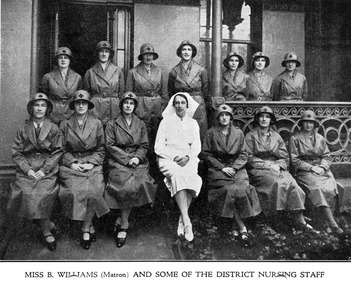
... This photograph is a record of Matron Beatrice Williams with some of the Trained nurses (Sisters) who worked in the District division of Melbourne District Nursing Society After Care Home in 1933, just prior to Matron Williams resigning to be married. ...This photograph is a record of Matron Beatrice Williams with some of the Trained nurses (Sisters) who worked in the District division of Melbourne District Nursing Society After Care Home in 1933, just prior to Matron Williams resigning to be married. ...This photograph is a record of Matron Beatrice Williams with some of the Trained nurses (Sisters) who worked in the District division of Melbourne District Nursing Society After Care Home in 1933, just prior to Matron Williams resigning to be married. It was taken in front of the Nurses Home at 39 Victoria Parade, Collingwood and shows part of the District nursing uniform worn by the MDNS Sisters in the 1930s. At that time their uniform dresses, worn under their coats, were grey cotton and their brimmed hats were made of felt and had a red Maltese cross applied to the centre front of the hatband.Miss Beatrice Williams worked as a Trained Nurse (Sister) with the Melbourne District Nursing Society (MDNS) before going to England to gain her Midwifery certificate. After qualifying, she worked as a Tutor sister and a District Superintendent at the University College Hospital in London. On returning to Australia she was appointed, in April 1929, Matron of the District division of the MDNS After-Care Home (Hospital from 1934). She convinced the Committee of the need for Ante Natal care and in 1930 the Ante Natal Clinic was opened at the After-Care. She continued as Matron until 1933 when she married Dr. J.P Major, and was invited to join the Committee of Management. In the early 1950s when the Government requested the Society separate and it take over the After Care Hospital, she became President of the now named Melbourne District Nursing Service with its Headquarters and Nursing Home moving to 452 St. Kilda Road, Melbourne. Beatrice had an understanding of the poor, the sick and the aged, and was known for her kindness and sympathy. Her foresight, leadership and enthusiasm brought forth the expansion of District nursing. She died on the 15th of August 1958. The Trained nurses of the Melbourne District Nursing Society (MDNS), later known as Royal District Nursing Service (RDNS), visited patients in their home and gave best practice care in many fields of nursing, and to people of many cultures, throughout its 130 years of expansion. Initial visits not only assessed the specific nursing situation but the situation as a whole. Their patients ranged in age from babes, children, adults to the elderly and referrals were taken from Hospitals, General Practitioners and allied Health facilities. Some of the care the Sisters provided is as follows: – Post-Natal care given to mother and babe, Wound Care following various types of surgery, accidents, burns, cancer, leg ulcers etc. Supervising and teaching Diabetic Care, including teaching and supervising people with Diabetes to administer their own Insulin, and administering Insulin to those unable to give their own injections. Administering other injections and setting up weekly medication boxes. The Sisters performed Catheterizations on adults suffering from conditions such as Quadriplegia, Paraplegia, Multiple Sclerosis (MS), Motor Neurone Disease (MND) and Guillan-Barre Syndrome, and when required at school on children for e.g. those with Spina Bifida. The Sisters visited those requiring Cystic Fibrosis support and care; those requiring Haemo-Oncology care, including visiting children at school; those requiring Home Enteral Feeding care, and those requiring IV therapy at home and home Dialysis. Palliative Care was given including pain relief with the use of syringe drivers, personal care as needed, and advice and support to both patient and family. The Sisters provided Stoma management to those needing Urostomy, Ileostomy and Colostomy care and those requiring Continence care. HIV/AIDS nursing care was provided; visits to Homeless Persons were made. Personal care was given to patients ranging in age and with varying mobility problems, such as those with MS, MND, Guillan-Barre Syndrome, Quadriplegia, Paraplegia, Acquired Brain Injury, to those following a Cerebrovascular Accident (Stroke), those with severe Arthritis and those with a form of Dementia. When necessary the elderly were assisted with personal care and advice given on safety factors with the use of hand rails, bath or shower seats, and hand showers. Rehabilitation with an aim towards independence remained at the forefront of the Sister’s minds and when possible using aids and instruction on safe techniques enabled the person to become fully independent. All care included giving advice and support to the patient and their Carers. The Sisters liaised with the persons Doctor, Hospital and allied Health personal when necessary.Black and white photograph showing Matron, Miss Beatrice Williams, wearing a white uniform and veil over her short dark hair, and a group of thirteen Melbourne District Nursing Society Trained nurses (Sisters) outside the front of their Nurses Home. The Sisters are wearing grey coats over their grey uniforms and grey brimmed hats with a Maltese cross applied to the white headband. Matron is sitting in the centre of six Sisters and there are seven Sisters standing behind them on the veranda; a round column is seen to the right between the 4th and 5th Sisters. Part of the grey building behind shows an open door to the left and a long window to the right. A scrolled metal safety rail, running from the round column, is seen in front of the three nurses on the right. The seated Sisters and Matron have their legs crossed at the ankles, melbourne district nursing society, mdns nurses, mdns, rdns, royal district nursing service, mdns uniforms, matron beatrice mary williams -
 Returned Nurses RSL Sub-branch
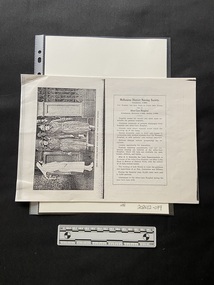
Document - Photocopied pages of part of an annual report, Melbourne District Nursing Society, 1935
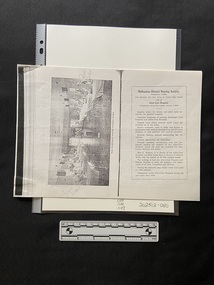
... 'Melbourne District Nursing society opened the After-Care Home, situated at 39 Victoria Parade Collingwood in 1926 following a public appeal for funds. ...'Melbourne District Nursing society opened the After-Care Home, situated at 39 Victoria Parade Collingwood in 1926 following a public appeal for funds. ...'Melbourne District Nursing society opened the After-Care Home, situated at 39 Victoria Parade Collingwood in 1926 following a public appeal for funds. The name changed from 'Home' to 'Hospital' in 1934. The After-Care Home was originally established to provide nurse-managed convalescent care to poor and underprivileged people who could not look after themselves at home due to illness or on release from hospital. Opening in 1926, at a cost of £27,000, the home included maternity, children’s and adult wards as well as accommodation for Matron, twelve nurses and four domestic staff. In 1930 an ante-natal clinic was opened at the home. During 1934 the Women’s Welfare Clinic including, at the time, a very controversial Family Planning Clinic, the first of its kind in Australia, was opened to support women at risk following multiple and difficult pregnancies. Major extensions occurred in 1936. Each Ward in the After-Care Hospital at 45 Victoria Parade, Collingwood, had a Sun Room which was well lit by its many windows. Several donors gave money to furnish some of the Wards. Following Government intervention, the After-Care Hospital was separated from the Melbourne District Nursing Society in 1957. The District division of Melbourne District Nursing Society became the Melbourne District Nursing Service and moved to 452 St Kilda Road; later, in 1966, with Royal patronage this became Royal District Nursing Service (RDNS). The After-care hospital continued to operate at the same address in Collingwood until 1985 when it became the Melbourne Geriatric Centre. ' - taken from The Royal District Nursing Service. This document is part of the MDNS annual report, possibly the 50th, 1934-35. Photopcopied pages from an annual report taken in landscape position so two pages show to a sheet. Typed black print on white paper with pages divided by a solid black line down the middle. Paragraphs are separated by headings and subheadings, as well as two black and white images and a list of names divided into three columns.'Jean / Brown ' 'Hester Cutler[?]' [Handwritten in pencil on either side of the first image]australian army nursing service, australian military nurses, melbourne district nursing service, after-care hospital, c. wishart, edith lydia shaw, jean brown -
 Returned Nurses RSL Sub-branch
Document - Photocopied pages of an annual report, Melbourne District Nursing Society, Melbourne Diistrict Nursing Society Forty-ninth annual report, 1933-34, 1934
... 'Melbourne District Nursing society opened the After-Care Home, situated at 39 Victoria Parade Collingwood in 1926 following a public appeal for funds. ...'Melbourne District Nursing society opened the After-Care Home, situated at 39 Victoria Parade Collingwood in 1926 following a public appeal for funds. ...The 49th annual report for the Melbourne District Nursing Society. 'Melbourne District Nursing society opened the After-Care Home, situated at 39 Victoria Parade Collingwood in 1926 following a public appeal for funds. The name changed from 'Home' to 'Hospital' in 1934. The After-Care Home was originally established to provide nurse-managed convalescent care to poor and underprivileged people who could not look after themselves at home due to illness or on release from hospital. Opening in 1926, at a cost of £27,000, the home included maternity, children’s and adult wards as well as accommodation for Matron, twelve nurses and four domestic staff. In 1930 an ante-natal clinic was opened at the home. During 1934 the Women’s Welfare Clinic including, at the time, a very controversial Family Planning Clinic, the first of its kind in Australia, was opened to support women at risk following multiple and difficult pregnancies. Major extensions occurred in 1936. Each Ward in the After-Care Hospital at 45 Victoria Parade, Collingwood, had a Sun Room which was well lit by its many windows. Several donors gave money to furnish some of the Wards. Following Government intervention, the After-Care Hospital was separated from the Melbourne District Nursing Society in 1957. The District division of Melbourne District Nursing Society became the Melbourne District Nursing Service and moved to 452 St Kilda Road; later, in 1966, with Royal patronage this became Royal District Nursing Service (RDNS). The After-care hospital continued to operate at the same address in Collingwood until 1985 when it became the Melbourne Geriatric Centre. ' - taken from The Royal District Nursing Service.Photopcopied pages from an annual report taken in landscape position so two pages show to a sheet. Typed black print on white paper with pages divided by a solid black line down the middle. Paragraphs are separated by headings and subheadings, as well as two black and white images and a list of names divided into three columns.melbourne district nursing service, after-care hospital, edith lydia shaw, nurses -
 Flagstaff Hill Maritime Museum and Village
Decorative object - Bookends, ca. 1930s
... after printed books became available. At that time books were expensive and treasured possessions, treated with much respect. Even in the early nineteenth century, a Bible was often the only book in the home. It was included among the limited items brought by many immigrants to Australia. Books became more available and affordable to the public by the end of the nineteenth century and households and businesses were able to build their own libraries. Bookends were used then, and are still used now, to keep books organised, cared ...The pair of ornamental white resin owl bookends was likely made around the 1930s when epoxy resin became available. Bookends modelled on owls have been a popular ornament for many years, possibly because of the association between owls, books and wisdom. They are used and displayed in places where books are appreciated and valued, such as homes, libraries, educational buildings, business offices, legal institutions and banks. Bookends hold a row of upright books in place by supporting the beginning and end of the row. The books are more likely to keep their integrity when stored vertically. The first patent for a metal bookend was placed by William Stebbins Barnard in 1877. Bookends became useful and decorative items around the middle of the sixteenth century after printed books became available. At that time books were expensive and treasured possessions, treated with much respect. Even in the early nineteenth century, a Bible was often the only book in the home. It was included among the limited items brought by many immigrants to Australia. Books became more available and affordable to the public by the end of the nineteenth century and households and businesses were able to build their own libraries. Bookends were used then, and are still used now, to keep books organised, cared for, and readily accessible. Bookends, a pair of two (2) small white resin owls with clear bright red eyes standing on a stack of books, their bodies facing towards each other, chests on an upright book, heads turned towards the viewer. The ends are left and right-handed.flagstaff hill, flagstaff hill maritime museum and village, warrnambool, maritime museum, maritime village, great ocean road, shipwreck coast, ornament, bookend, bookends, pair of bookends, library, book storage, book display, room decoration, resin ornament, white bookends, owl bookends, owl ornament, white owls, resin owls, book support, bookend patent, william stebbins barnard -
 The Beechworth Burke Museum
Audio - Oral History, Jennifer Williams, Evelyn Jensen, 13th April 2000
... care of the children and run the house. This included looking after a few months old baby. Her father was away at work most days so all of the responsibility fell on her. Her grandmother was present but she was too old to help Miss Jensen. Miss Jensen and her family lived a very long way from the main town and often had to carry kerosene tins full of water half a mile to their house. This was because they have no access to water at their home...care of the children and run the house. This included looking after a few months old baby. Her father was away at work most days so all of the responsibility fell on her. Her grandmother was present but she was too old to help Miss Jensen. Miss Jensen and her family lived a very long way from the main town and often had to carry kerosene tins full of water half a mile to their house. This was because they have no access to water at their home ...Miss Evelyn Jensen was born in 1908 near Mytleford Road in Beechworth. Miss Jensen was a twin but she also had twelve brothers and sisters. Miss Jensen went to school when she was nine years old but did not enjoy it. Her father was a nozzleman and had a role in finding and collecting gold. More specifically, a nozzleman operated a steel barrel with an interchangeable brass nozzle that sprayed high pressure water onto rock and similar surfaces. This broke down the surface for gold to be found. Unfortunately, when he began most of the gold was already gone. Miss Jensen's mother died when Miss Jensen was sixteen. As a result, Miss Jensen had to take care of the children and run the house. This included looking after a few months old baby. Her father was away at work most days so all of the responsibility fell on her. Her grandmother was present but she was too old to help Miss Jensen. Miss Jensen and her family lived a very long way from the main town and often had to carry kerosene tins full of water half a mile to their house. This was because they have no access to water at their home. This lack of water also meant they had to either bathe in the creek or carry the water back home for a bath. On wash day, they washed their clothes in the creek too. Miss Jensen never married but continued to provide for her family. She spent her days gardening and cooking. They did not have much money so gardening was a way that they provided food for themselves. This oral history recording was part of a project conducted by Jennifer Williams in the year 2000 to capture the everyday life and struggles in Beechworth during the twentieth century. This project involved recording seventy oral histories on cassette tapes of local Beechworth residents which were then published in a book titled: Listen to what they say: voices of twentieth century Beechworth. These cassette tapes were digitised in July 2021 with funds made available by the Friends of the Burke.Miss Jensen's oral history is significant because it demonstrates the struggles of living remotely during this early part of the twentieth century. When Miss Jensen's mother died, she had to take on a lot of responsibility and did not have much support. This history sheds light on these struggles of being a young caregiver but it also gives details on how large families lived in isolated places. An example of this is the way that Miss Jensen often had to do the washing in the creek because that was the only place there was running water. In addition, Miss Jensen's story is significant because her father was a nozzleman. It indicates one of the processes was used to find gold. This oral history account is socially and historically significant as it is a part of a broader collection of interviews conducted by Jennifer Williams which were published in the book 'Listen to what they say: voices of twentieth-century Beechworth.' While the township of Beechworth is known for its history as a gold rush town, these accounts provide a unique insight into the day-to-day life of the town's residents during the 20th century, many of which will have now been lost if they had not been preserved.This is a digital copy of a recording that was originally captured on a cassette tape. The cassette tape is black with a horizontal white strip and is currently stored in a clear flat plastic rectangular container. It holds up 40 minutes of recordings on each sideEvelyn Jensen /mytleford road, beechworth, three mile creek, three mile beechworth, twin, nozzleman, goldrush, gold rush, work, mother, young mother, children, siblings, baby, grandmother, father, isolation, bush, water, watertanks, kerosene tins, wash day, bath day, creek, gardening, provide, poor, money, oral history, twentieth century, recording, story -
 Federation University Historical Collection
Document - Document - Research Paper, University of Ballarat: Applied Social and Political Research; "What has been the History of Lisa Lodge-Haveslee from 1970 - 1980?" Beverlee Leith, 1994
... care for eight adolescent girls at a time. Lisa Lodge was located in a number of different properties around Ballarat. The Hostel closed in 1994. Some time after this, Hayeslee House (another home...care for eight adolescent girls at a time. Lisa Lodge was located in a number of different properties around Ballarat. The Hostel closed in 1994. Some time after this, Hayeslee House (another home ...Lisa Lodge Girls' Hostel, Ballarat, was established in 1970 and was run by a committee of women. All the women were Honorary Probation Officers. It provided residential care for eight adolescent girls at a time. Lisa Lodge was located in a number of different properties around Ballarat. The Hostel closed in 1994. Some time after this, Hayeslee House (another home in Ballarat, run by the same committee) became known as Lisa Lodge. This Committee managed a number of institutions in the Ballarat region. Another institution to start in 1994 was Berry Street Incorporated that amalgamated with Sutherland Child, Youth and Family Services. In 2009 Berry Street was the largest independent child and family welfare organisation in Victoria. In 2012 Lisa Lodge merged with Berry Street to strengthen Berry Street's services provided in the Grampians Region of Victoria. This research paper explores the first ten years of Lisa Lodge. Of note is Lisa Lodge was set up by a group of women for a group of women. It depended on donations to continue operating. Data was collected through interviews and analysing minutes of meetings. Correspondence and newspaper clipping were also used. This is a historical report so there are no recommendations. Before proceeding with this project, Beverlee Leith had to seek approval from the Human Research Ethics Committee, University of Ballarat. This was granted at their meeting on Thursday, 11 August 1994. Dr John McDonald, School of Humanities and Social Sciences was supervisor.Booklet of 51 pages. Blue paper cover front and back. Pages are glued together and have black binding. Name John McDonald written in biro - top right corner of front cover. Date of item is 1994honorary probation officers, ballarat, adolescent girls, hayeslee house, minutes of meetings, correspondence, berry street, interviews, beverlee leith, human research ethics committee, school of humanities & social sciences, dr john mcdonald, lisa lodge girls' hostel, residential care -
 Marysville & District Historical Society
Photograph (Item) - Black and white photograph, c1900
... Their first home was 'The Chestnuts', which included the store, and was situated on the town side next to the Steavenson River. Sadly, in 1876 Selina died of complications after giving birth to their sixth child. Thomas was in need of a nanny to care ...A copy of an early black and white photograph of the building which was the forerunner to Barton's Store in Marysville in Victoria.A copy of an early black and white photograph of the building which was the forerunner to Barton's Store in Marysville in Victoria. Thomas John Barton was born in 1836 in Gloucestershire and after his father died in 1850 arrived in Melbourne in 1852 along with his mother, adult sisters, younger brothers, his uncle, his uncle's wife Suzanna and their family. Thomas tried gold mining at Woods Point but found it too difficult. He then partnered with Ewen Hugh Cameron to provide the miners with meat. In 1864 they purchased a plot of land in Marysville and set up a butchers/abattoirs and from there began their business of taking supplies to the miners at the nearby Woods Point and Jamieson goldfields. In 1865 the business was firmly established and Thomas married Selina Croker at Heidelberg and brought her back to Marysville. Their first home was 'The Chestnuts', which included the store, and was situated on the town side next to the Steavenson River. Sadly, in 1876 Selina died of complications after giving birth to their sixth child. Thomas was in need of a nanny to care for his six children, including the newborn baby, and so he employed Emily Ada Sparke, who is the eldest daughter of the local school teacher. Thomas and Emily subsequently marry in 1878 and they go on to have a further 10 children over the next several years. Thomas assisted in the establishment of the first school in Marysville in 1870 and remained a very active member of the community including as a Councillor for the Shire of Healesville, Shire President and he was also appointed as a Justice of the Peace. Thomas died in Carlton in 1911. After their father's death, his sons Fred and Frank took over the family business, which was then known as Barton Bros Store which continued to operate until sometime in the 1970's.marysville, victoria, barton's store, thomas john barton, ewen hugh cameron, woods point, jamieson, gold mining, goldfields, selina croker, the chestnuts, emily ada sparke, shire of healesville, fred barton, frank barton, barton bros store, francis adam barton, frederick john barton, photograph -
 Marysville & District Historical Society
Photograph (Item) - Black and white photograph, 1910
... Their first home was 'The Chestnuts', which included the store, and was situated on the town side next to the Steavenson River. Sadly, in 1876 Selina died of complications after giving birth to their sixth child. Thomas was in need of a nanny to care ...A copy of an early black and white photograph of Francis Adam Barton taken in Marysville in Victoria.A copy of an early black and white photograph of Francis Adam Barton taken in Marysville in Victoria. Man in photograph has been incorrectly identified as Frederick John Barton. Francis Adam Barton was the son of Thomas John Barton. Thomas John Barton was born in 1836 in Gloucestershire and after his father died in 1850 arrived in Melbourne in 1852 along with his mother, adult sisters, younger brothers, his uncle, his uncle's wife Suzanna and their family. Thomas tried gold mining at Woods Point but found it too difficult. He then partnered with Ewen Hugh Cameron to provide the miners with meat. In 1864 they purchased a plot of land in Marysville and set up a butchers/abattoirs and from there began their business of taking supplies to the miners at the nearby Woods Point and Jamieson goldfields. In 1865 the business was firmly established and Thomas married Selina Croker at Heidelberg and brought her back to Marysville. Their first home was 'The Chestnuts', which included the store, and was situated on the town side next to the Steavenson River. Sadly, in 1876 Selina died of complications after giving birth to their sixth child. Thomas was in need of a nanny to care for his six children, including the newborn baby, and so he employed Emily Ada Sparke, who is the eldest daughter of the local school teacher. Thomas and Emily subsequently marry in 1878 and they go on to have a further 10 children over the next several years. Thomas assisted in the establishment of the first school in Marysville in 1870 and remained a very active member of the community including as a Councillor for the Shire of Healesville, Shire President and he was also appointed as a Justice of the Peace. Thomas died in Carlton in 1911. After their father's death, his sons Fred and Frank took over the family business, which was then known as Barton Bros Store which continued to operate until sometime in the 1970's.Mr F.J. Barton 1910marysville, victoria, barton's store, thomas john barton, ewen hugh cameron, woods point, jamieson, gold mining, goldfields, selina croker, the chestnuts, emily ada sparke, shire of healesville, fred barton, frank barton, barton bros store, frederick john barton, francis adam barton, photograph -
 Marysville & District Historical Society
Photograph (Item) - Black and white photograph, 1927
... Their first home was 'The Chestnuts', which included the store, and was situated on the town side next to the Steavenson River. Sadly, in 1876 Selina died of complications after giving birth to their sixth child. Thomas was in need of a nanny to care ...An early black and white photograph of the Barton's Store in Marysville in Victoria.An early black and white photograph of the Barton's Store in Marysville in Victoria. Barton's Store was established by Thomas John Barton in 1864. Thomas John Barton was born in 1836 in Gloucestershire and after his father died in 1850 arrived in Melbourne in 1852 along with his mother, adult sisters, younger brothers, his uncle, his uncle's wife Suzanna and their family. Thomas tried gold mining at Woods Point but found it too difficult. He then partnered with Ewen Hugh Cameron to provide the miners with meat. In 1864 they purchased a plot of land in Marysville and set up a butchers/abattoirs and from there began their business of taking supplies to the miners at the nearby Woods Point and Jamieson goldfields. In 1865 the business was firmly established and Thomas married Selina Croker at Heidelberg and brought her back to Marysville. Their first home was 'The Chestnuts', which included the store, and was situated on the town side next to the Steavenson River. Sadly, in 1876 Selina died of complications after giving birth to their sixth child. Thomas was in need of a nanny to care for his six children, including the newborn baby, and so he employed Emily Ada Sparke, who is the eldest daughter of the local school teacher. Thomas and Emily subsequently marry in 1878 and they go on to have a further 10 children over the next several years. Thomas assisted in the establishment of the first school in Marysville in 1870 and remained a very active member of the community including as a Councillor for the Shire of Healesville, Shire President and he was also appointed as a Justice of the Peace. Thomas died in Carlton in 1911. After their father's death, his sons Fred and Frank took over the family business, which was then known as Barton Bros Store which continued to operate until sometime in the 1970's.marysville, victoria, barton's store, thomas john barton, ewen hugh cameron, woods point, jamieson, gold mining, goldfields, selina croker, the chestnuts, emily ada sparke, shire of healesville, fred barton, frank barton, barton bros store, francis adam barton, frederick john barton, photograph -
 Marysville & District Historical Society
Photograph (Item) - Black and white photograph, 1953
... Their first home was 'The Chestnuts', which included the store, and was situated on the town side next to the Steavenson River. Sadly, in 1876 Selina died of complications after giving birth to their sixth child. Thomas was in need of a nanny to care ...A black and white photograph of the water wheel which provided power to the Barton Bros Store in Marysville in Victoria.A black and white photograph of the water wheel which provided power to the Barton Bros Store in Marysville in Victoria. This water wheel was located on the Steavenson River in Marysville. Barton's Store was established by Thomas John Barton in 1864. Thomas John Barton was born in 1836 in Gloucestershire and after his father died in 1850 arrived in Melbourne in 1852 along with his mother, adult sisters, younger brothers, his uncle, his uncle's wife Suzanna and their family. Thomas tried gold mining at Woods Point but found it too difficult. He then partnered with Ewen Hugh Cameron to provide the miners with meat. In 1864 they purchased a plot of land in Marysville and set up a butchers/abattoirs and from there began their business of taking supplies to the miners at the nearby Woods Point and Jamieson goldfields. In 1865 the business was firmly established and Thomas married Selina Croker at Heidelberg and brought her back to Marysville. Their first home was 'The Chestnuts', which included the store, and was situated on the town side next to the Steavenson River. Sadly, in 1876 Selina died of complications after giving birth to their sixth child. Thomas was in need of a nanny to care for his six children, including the newborn baby, and so he employed Emily Ada Sparke, who is the eldest daughter of the local school teacher. Thomas and Emily subsequently marry in 1878 and they go on to have a further 10 children over the next several years. Thomas assisted in the establishment of the first school in Marysville in 1870 and remained a very active member of the community including as a Councillor for the Shire of Healesville, Shire President and he was also appointed as a Justice of the Peace. Thomas died in Carlton in 1911. After their father's death, his sons Fred and Frank took over the family business, which was then known as Barton Bros Store which continued to operate until sometime in the 1970's.WATER WHEEL./ MARYSVILLE '53marysville, victoria, barton's store, thomas john barton, ewen hugh cameron, woods point, jamieson, gold mining, goldfields, selina croker, the chestnuts, emily ada sparke, shire of healesville, fred barton, frank barton, barton bros store, francis adam barton, frederick john barton, water wheel, steavenson river, photograph -
 Marysville & District Historical Society
Photograph (Item) - Black and white photograph, Sun-Herald, 1953
... Their first home was 'The Chestnuts', which included the store, and was situated on the town side next to the Steavenson River. Sadly, in 1876 Selina died of complications after giving birth to their sixth child. Thomas was in need of a nanny to care ...A digital copy of a black and white photograph of the water wheel that used to provide power to the Barton Bros Store in Marysville in Victoria.A digital copy of a black and white photograph of the water wheel that used to provide power to the Barton Bros Store in Marysville in Victoria. This water wheel was located on the Steavenson River in Marysville. Barton's Store was established by Thomas John Barton in 1864. Thomas John Barton was born in 1836 in Gloucestershire and after his father died in 1850 arrived in Melbourne in 1852 along with his mother, adult sisters, younger brothers, his uncle, his uncle's wife Suzanna and their family. Thomas tried gold mining at Woods Point but found it too difficult. He then partnered with Ewen Hugh Cameron to provide the miners with meat. In 1864 they purchased a plot of land in Marysville and set up a butchers/abattoirs and from there began their business of taking supplies to the miners at the nearby Woods Point and Jamieson goldfields. In 1865 the business was firmly established and Thomas married Selina Croker at Heidelberg and brought her back to Marysville. Their first home was 'The Chestnuts', which included the store, and was situated on the town side next to the Steavenson River. Sadly, in 1876 Selina died of complications after giving birth to their sixth child. Thomas was in need of a nanny to care for his six children, including the newborn baby, and so he employed Emily Ada Sparke, who is the eldest daughter of the local school teacher. Thomas and Emily subsequently marry in 1878 and they go on to have a further 10 children over the next several years. Thomas assisted in the establishment of the first school in Marysville in 1870 and remained a very active member of the community including as a Councillor for the Shire of Healesville, Shire President and he was also appointed as a Justice of the Peace. Thomas died in Carlton in 1911. After their father's death, his sons Fred and Frank took over the family business, which was then known as Barton Bros Store which continued to operate until sometime in the 1970's.marysville, victoria, barton's store, thomas john barton, ewen hugh cameron, woods point, jamieson, gold mining, goldfields, selina croker, the chestnuts, emily ada sparke, shire of healesville, fred barton, frank barton, barton bros store, francis adam barton, frederick john barton, water wheel, steavenson river, photograph -
 Marysville & District Historical Society
Postcard (Item) - Colour tinted postcard, Murray Views, Murray Views No. 51. The Water Wheel, Marysville, Vic, 1950
... Their first home was 'The Chestnuts', which included the store, and was situated on the town side next to the Steavenson River. Sadly, in 1876 Selina died of complications after giving birth to their sixth child. Thomas was in need of a nanny to care ...A digital copy of a colour tinted postcard of the water wheel that powered the Barton's Store in Marysville in Victoria.A digital copy of a colour tinted postcard of the water wheel that powered the Barton's Store in Marysville in Victoria. This water wheel was located on the Steavenson River in Marysville. Barton's Store was established by Thomas John Barton in 1864. Thomas John Barton was born in 1836 in Gloucestershire and after his father died in 1850 arrived in Melbourne in 1852 along with his mother, adult sisters, younger brothers, his uncle, his uncle's wife Suzanna and their family. Thomas tried gold mining at Woods Point but found it too difficult. He then partnered with Ewen Hugh Cameron to provide the miners with meat. In 1864 they purchased a plot of land in Marysville and set up a butchers/abattoirs and from there began their business of taking supplies to the miners at the nearby Woods Point and Jamieson goldfields. In 1865 the business was firmly established and Thomas married Selina Croker at Heidelberg and brought her back to Marysville. Their first home was 'The Chestnuts', which included the store, and was situated on the town side next to the Steavenson River. Sadly, in 1876 Selina died of complications after giving birth to their sixth child. Thomas was in need of a nanny to care for his six children, including the newborn baby, and so he employed Emily Ada Sparke, who is the eldest daughter of the local school teacher. Thomas and Emily subsequently marry in 1878 and they go on to have a further 10 children over the next several years. Thomas assisted in the establishment of the first school in Marysville in 1870 and remained a very active member of the community including as a Councillor for the Shire of Healesville, Shire President and he was also appointed as a Justice of the Peace. Thomas died in Carlton in 1911. After their father's death, his sons Fred and Frank took over the family business, which was then known as Barton Bros Store which continued to operate until sometime in the 1970's. This postcard was produced by Murray Views in 1950 as a souvenir of Marysville.marysville, victoria, barton's store, thomas john barton, ewen hugh cameron, woods point, jamieson, gold mining, goldfields, selina croker, the chestnuts, emily ada sparke, shire of healesville, fred barton, frank barton, barton bros store, francis adam barton, frederick john barton, water wheel, steavenson river, murray views, murray views no. 51, postcard, souvenir
