
Showing 123 items matching "air born"
-
 Moorabbin Air Museum
Book - General aviation, Earlybird The Story of Phil Lightband
... ...Air born...General aviation The child bird Air born The helmet speaks Solo Old enough Dancing Discipline Crossroads War bird Grounded Sea gulls The silver blue bird First leg Bogged Foreign skies Winged Jail birds Wings clipped Bikes & prams Phoenix Between two worids Amphibians Rainmakers Biography of NZ pilot Phil Lightbrand & his involvement in NZ general aviation, circa 1996 Earlybird The Story of Phil Lightband Book General aviation ...Biography of NZ pilot Phil Lightbrand & his involvement in NZ general aviation, circa 1996non-fictionBiography of NZ pilot Phil Lightbrand & his involvement in NZ general aviation, circa 1996the child bird, air born, the helmet speaks, solo, old enough, dancing, discipline, crossroads, war bird, grounded, sea gulls, the silver blue bird, first leg, bogged, foreign skies, winged, jail birds, wings clipped, bikes & prams, phoenix, between two worids, amphibians, rainmakers -
 Orbost & District Historical Society
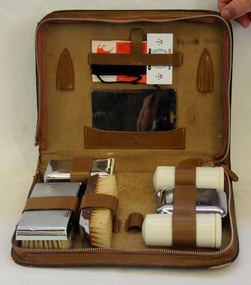
toiletry kit
... Roy was an instrument maker in the air force. He was born on 14 Aug 1907 at Korumburra, Victoria, Australia and died in 1985 at Orbost. ...Roy was an instrument maker in the air force. He was born on 14 Aug 1907 at Korumburra, Victoria, Australia and died in 1985 at Orbost. ...This kit belonged to Roy Basil Cope an Orbost jeweller. He was in the Air Force. Roy was an instrument maker in the air force. He was born on 14 Aug 1907 at Korumburra, Victoria, Australia and died in 1985 at Orbost. He was married to Emily Ruth Powell who was born in Orbost in 1907. . An every-day toiletry kit issued by the Air Force . It is a brown leather zippered case. It contains a mirror, shoelaces, a razor blade, an oblong container, a clothes brush, a hair brush, two cylindrical containers and a metal soap container with rounded corners.On the fornt of the brown leather zippered case is R.B.C. 41738 made in Englandpersonal-effects cope-roy toiletry-kit -
 Bendigo Military Museum
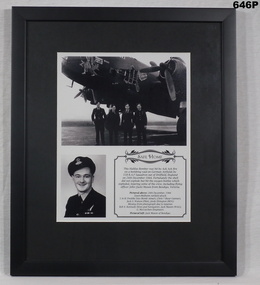
Photograph - PHOTOGRAPHS FRAMED RAAF, SAFE HOME, C.1944 - 45
... John Joseph MASON No 418670 Wireless Air Gunner (WAG) (born Bendigo, enlisted Melbourne) in the RAAF on 29.5.1942 age 19 years. ...John Joseph MASON No 418670 Wireless Air Gunner (WAG) (born Bendigo, enlisted Melbourne) in the RAAF on 29.5.1942 age 19 years. ...John Joseph MASON No 418670 Wireless Air Gunner (WAG) (born Bendigo, enlisted Melbourne) in the RAAF on 29.5.1942 age 19 years. After 5 Training postings he embarked for Canada on 15.1.1943 arriving 31.1.1943. He then did Training in Edmonton, Calgary and Mossank before embarking to England 21.10.1943 arriving 30.6.1943. After more Training at several postings he was finally posted to No 158 SQD RAF flying Halifax Bombers and commenced operational flying on 5.11.1944. He rose through the ranks to Flt Sgt on 31.12.1944 and then granted a Commission as F/O on 12.3.1945. He transferred to 466 SQD RAAF on 26.5.1945. His records are a bit sketchy but it appears he flew 11 Operational Sorties. His Commission was terminated on 19.3.1946. His brother Hugh who was also in the RAAF and home at the time told the story that when the aircraft was hit his mother new something had happened to Jack.Photograph, framed. Safe home. The frame is black smooth wooden type. A montage of 2 black and white photos and a description. Large photo shows 4 crew members standing in front of a damaged Halifax bomber. Small photo is of air crewman flying officer JACK MASON (WAG) of Bendigo. The story covers the raid that aircraft was on, how the side exploded out, and the crew members names.Rear has "From HUGH MASON and the MASON family"photography - photographs, raaf ww2, 158 sqd -
 Flagstaff Hill Maritime Museum and Village
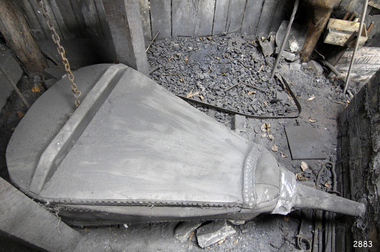
Functional object - Bellows, 1862-1875
... air both in and out of the chambers in the one movement of the long handle. The bellows was manufactured by John C. Onions of Birmingham, England, between 1862 and 1875. The stamp with the text, Gold Medal 1862, was also used on the business’ advertising. In 1875 the company was registered and began using the name John C. Onions Limited. JOHN C. ONIONS - John C. (Collingwood) Onions (1841-1904) was the son of a bellows maker of the same name. Onions (born...air both in and out of the chambers in the one movement of the long handle. The bellows was manufactured by John C. Onions of Birmingham, England, between 1862 and 1875. The stamp with the text, Gold Medal 1862, was also used on the business’ advertising. In 1875 the company was registered and began using the name John C. Onions Limited. JOHN C. ONIONS - John C. (Collingwood) Onions (1841-1904) was the son of a bellows maker of the same name. Onions (born ...This bellows was used at the Warrnambool Racecourse by Master Farrier, Brian Chapman (1931-2017), during the 1970s but its history before then is still being investigated. The bellows have continued to be used from 1978 at Flagstaff Hill's blacksmith's workshop. Even today, in 2021, this same bellows are used by a volunteer blacksmith as he demonstrate the skills and tells of the importance of the blacksmith trade to colonial Australia. This 1860s double-action bellows is a typical form of blacksmith's or shipsmith's bellows. The end is forge-fitted with an iron nozzle or tube, called a tuyere or Tue iron, which concentrates the air to fan the fire or furnace. Tuyeres were traditionally made of cow horn. The double-action design of this bellows efficiently moves air both in and out of the chambers in the one movement of the long handle. The bellows was manufactured by John C. Onions of Birmingham, England, between 1862 and 1875. The stamp with the text, Gold Medal 1862, was also used on the business’ advertising. In 1875 the company was registered and began using the name John C. Onions Limited. JOHN C. ONIONS - John C. (Collingwood) Onions (1841-1904) was the son of a bellows maker of the same name. Onions (born 1841) and his wife Helen married in 1867 and they named one of their children John Collingwood Onions (1868-1913), as was the family tradition. He was well known as a Birmingham manufacturer of patented bellows and other forge-related equipment. He sold to the wholesale and retail markets for both local and overseas customers, including the British colonies. An 1862 advertisement points out that John C. Onions was a “Bellows manufacturer and contractor to Her Majesty’s Honourable Board of Ordinance” and His Imperial Majesty the Emperor of the French [Napoleon Bonaparte]”. The advertisement includes a sketched portrait of the Emperor Napoleon III, and an Imperial Autograph Letter dated May 23, 1854, from Napoleon, Palace of the Tulleries to Mr J C Onions of Bradford Street, Birmingham. In 1863 the company registered a patent on portable forges. In 1871 there were eight employees. John C. Onions Limited became a registered company in 1875. In 1876 an advertisements included that the company were smiths for hearths and tools in general and showed a row of six medallions including one with “Napoleon III, Emperor” and his portrait, and another “ _ _ _ 1862 MEDAL”. Their advertising motto was “For Excellence of Quality”. In 1885 the company merged with William Allday and Sons to become Allday and Onions. This mid-19th century bellows has local historical significance as it were once used by blacksmiths at the Warrnambool Racecourse in the annual racing event that continues today. This bellows is significant as a working example of equipment used in the 1800 and 1900s in the trace of blacksmiths and other metal working smiths. The bellows is technologically significant as it shows the progress from simple bellows to the double-action bellows, a time saving and efficient improvement. The manufacturer John C. Onions is historically significant as a family business that began in the 1600s and continued up until the 1980s.Bellows; large, oval, mechanical double-action smith’s bellows, manually operated, in working condition. The paddles of wood that form the top, middle sections and base of the bellows have flexible leather pieces attached firmly between them, forming airtight double lungs. Cut-outs in the panels allow the bellows to fill with air then force it out. A long handle is connected to pump the bellows and control the quantity and force of the air. The blasts of air are forced through the metal nozzle or tuyere at the end of the bellows and into the forge’s fire. Inscriptions are impressed into the wood on the upper paddle or board of the bellows. There are three circular stamps containing text. Text impressed in the wooden upper paddle of the bellows has been assumed to read “JOHN C. ONIONS, PATENTEES & MANUFACTURERS, BIRMINGHAM””?” “EXTRA” “AWARDED FOR EXCELLENCE OF QUALITY”, made from the following readable text :- “JOHN C ONIONS“ “PATENT - - - & MAN - - - - - - - - -“, “BIR - - - - HAM“, “ _ ERA - - - - “- XTRA-“, “- - - - - - - FOR EXCELL-“ “OF - - - - ITY” Text in the stamp “ - - ECE - - “, “ - - - - - / 1862 / MEDAL”, “- ITY” flagstaff hill, warrnambool, shipwrecked-coast, flagstaff-hill, flagstaff-hill-maritime-museum, maritime-museum, shipwreck-coast, flagstaff-hill-maritime-village, john collingwood onions, john c onions, allday and onions, bellows, smith’s bellows, 19th century bellows, double-action bellows, double-acting bellows, double lung bellows, double chamber bellows, blacksmith tools, blacksmith trade, blacksmith craft, blacksmith equipment, forging equipment, john c onions patented double-action bellows, brian chapman, warrnambool racecourse, blacksmith, shipsmith, iron smith, mechanical bellows -
 Federation University Historical Collection
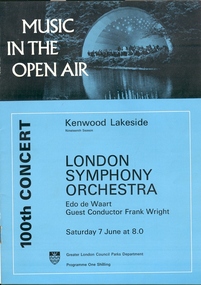
Programme, Greater London Council Parks Department, Music in the open air, 1968-1970
... Music in the Open Air was an initiative of Frank Wright, the Musical Director of the Greater London Council Parks Department. Frank Wright was a renown resident of Smeaton, where he was born in 1901. ...Music in the Open Air was an initiative of Frank Wright, the Musical Director of the Greater London Council Parks Department. Frank Wright was a renown resident of Smeaton, where he was born in 1901. ...Music in the Open Air was an initiative of Frank Wright, the Musical Director of the Greater London Council Parks Department. Frank Wright was a renown resident of Smeaton, where he was born in 1901. He lived at Laura Villa, and attended Smeaton State School. His father William was a gold miner and his mother's name was Sarah. He was the youngest of eleven children. Their family won many singing and instrumental awards. Frank was tutored by Percy Code and was awarded a gold medal for the highest marks in the ALCM examinations in the British Colonies at the age of seventeen years. He became the Australian Open Cornet Champion by the age of eighteen. A year later, Frank conducted the City of Ballarat Band, and later the Ballarat Soldiers’ Memorial Band. He formed the Frank Wright Frisco Band and Frank Wright and his Coliseum Orchestra. These bands won many South Street awards, and Frank as conductor won many awards in the Australian Band Championship contest. In 1933 Frank Wright sailed to England to conduct the famous St Hilda’s Band and was appointed in 1934 as the Musical Director of the London County Council (the GLC or Greater London Council), where he organized many amazing concerts in most of the 150 parks, in and around the London district. He was also responsible for some of London’s major concerts at Kenwood, the Crystal Palace and Holland Park. He was made Professor of Brass and Military Band Scoring and Conducting and was a Fellow of the Guildhall School of Music and Drama. Frank was often invited to adjudicate Brass Band Championships around Europe, in Australia, including South Street and in New Zealand. Frank was awarded an M.B.E. in 1967 and he died in November 1970. The Frank Wright Medal at the Royal South Street competition is awarded to an individual recognized as making an outstanding contribution to brass music in Australia.Two tone rectangular paper pamphlet of 4 double sided pages, with photo of an orchestra in a sound dome in top right hand corner. Held at Kenwood Lakeside for the Greater London Council Parks Department 11017.1 - Music in the open air: New Philharmonia Orchestra. Conducted by Norman del Mar, 11017.2 & .4 - London Symphony Orchestra. Conducted by Edo de Waart and Frank Wright 11017.3 - Royal Liverpool Philharmonic Orchestra. Conducted by Charles Groves. 11017.5 - Royal Liverpool Philharmonic Orchestra. Conducted by Charles Groves 11017.6 - Royal Philharmonic Orchestra - Conducted by Stanley Pope 11017.7 - New Philharmonic Orchestra - Conducted by Norman Del MarDesigned by GLC Supplies Department and printed by Staples Printers Limitedfrank wright, music in the open air, kenwood lakeside -
 Federation University Historical Collection
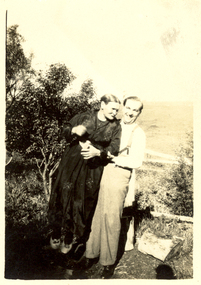
Photograph - Black and White, Scott's, Sarah and Alex? Wright (at Sewell's?), circa 1930
... air raid in the Hippodrome Birmingham in 1940. Alex was the brother of Frank Wright who was a renown resident of Smeaton, where he was born. ...air raid in the Hippodrome Birmingham in 1940. Alex was the brother of Frank Wright who was a renown resident of Smeaton, where he was born. ...Alex Wright travelled to England in 1930 and was known as the Prince of Mimic although his stage name was Navarre. He died in an air raid in the Hippodrome Birmingham in 1940. Alex was the brother of Frank Wright who was a renown resident of Smeaton, where he was born. He lived at Laura Villa, and attended Smeaton State School. His father William was a gold miner and his mother's name was Sarah. Their family won many singing and instrumental awards. Frank was tutored by Percy Code and was awarded a gold medal for the highest marks in the ALCM examinations in the British Colonies at the age of seventeen years. He became the Australian Open Cornet Champion by the age of eighteen. A year later, Frank conducted the City of Ballarat Band, and later the Ballarat Soldiers’ Memorial Band. He formed the Frank Wright Frisco Band and Frank Wright and his Coliseum Orchestra. These bands won many South Street awards, and Frank as conductor won many awards in the Australian Band Championship contest. In 1933 Frank Wright sailed to England to conduct the famous St Hilda’s Band and was later appointed Musical Director of the London County Council, where he organized many amazing concerts in parks, in and around the London district. He was made Professor of Brass and Military Band Scoring and conducted at the Guildhall of Music and Drama. Frank was often invited to adjudicate Brass Band Championships around Europe, in Australia, including South Street and in New Zealand. The Frank Wright Medal at the Royal South Street competition is awarded to an individual recognized as making an outstanding contribution to brass music in Australia.Black and white photograph of a man in shirt, trousers and braces hugging a woman in a dark frock. They are standing in front of a fence with trees and a paddock in the background. They are Sarah Wright and her son Alex?.Printed on back - Printed at Scott's, Veloxsarah wright, alex wright, frank wright, navarre, smeaton, ballarat -
 Federation University Historical Collection
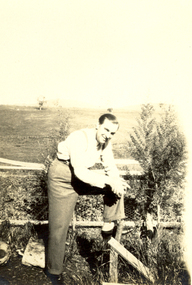
Photograph - Black and White, Scott's, Alex Wright?, circa 1930
... air raid in the Hippodrome Birmingham in 1940. Alex was the brother of Frank Wright who was a renown resident of Smeaton, where he was born. ...air raid in the Hippodrome Birmingham in 1940. Alex was the brother of Frank Wright who was a renown resident of Smeaton, where he was born. ...Alex Wright travelled to England in 1930 and was known as the Prince of Mimic although his stage name was Navarre. He died in an air raid in the Hippodrome Birmingham in 1940. Alex was the brother of Frank Wright who was a renown resident of Smeaton, where he was born. He lived at Laura Villa, and attended Smeaton State School. His father William was a gold miner and his mother's name was Sarah. Their family won many singing and instrumental awards. Frank was tutored by Percy Code and was awarded a gold medal for the highest marks in the ALCM examinations in the British Colonies at the age of seventeen years. He became the Australian Open Cornet Champion by the age of eighteen. A year later, Frank conducted the City of Ballarat Band, and later the Ballarat Soldiers’ Memorial Band. He formed the Frank Wright Frisco Band and Frank Wright and his Coliseum Orchestra. These bands won many South Street awards, and Frank as conductor won many awards in the Australian Band Championship contest. In 1933 Frank Wright sailed to England to conduct the famous St Hilda’s Band and was later appointed Musical Director of the London County Council, where he organized many amazing concerts in parks, in and around the London district. He was made Professor of Brass and Military Band Scoring and conducted at the Guildhall of Music and Drama. Frank was often invited to adjudicate Brass Band Championships around Europe, in Australia, including South Street and in New Zealand. The Frank Wright Medal at the Royal South Street competition is awarded to an individual recognized as making an outstanding contribution to brass music in Australia.Black and white photograph of a standing man, leaning his elbow onto his leg which is resting on a fence rail. He is dressed in shirt, trousers and braces. In the background is a grassy paddock. He is most probably Alex Wright.Printed on back - Printed at Scott's, Veloxalex wright. frank wright, navarre, smeaton, ballarat -
 Federation University Historical Collection
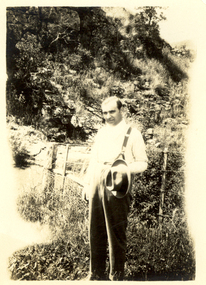
Photograph - Black and White, Scott's, Alex Wright?, circa 1930
... air raid in the Hippodrome Birmingham in 1940. Alex was the brother of Frank Wright who was a renown resident of Smeaton, where he was born. ...air raid in the Hippodrome Birmingham in 1940. Alex was the brother of Frank Wright who was a renown resident of Smeaton, where he was born. ...Alex Wright travelled to England in 1930 and was known as the Prince of Mimic although his stage name was Navarre. He died in an air raid in the Hippodrome Birmingham in 1940. Alex was the brother of Frank Wright who was a renown resident of Smeaton, where he was born. He lived at Laura Villa, and attended Smeaton State School. His father William was a gold miner and his mother's name was Sarah. Their family won many singing and instrumental awards. Frank was tutored by Percy Code and was awarded a gold medal for the highest marks in the ALCM examinations in the British Colonies at the age of seventeen years. He became the Australian Open Cornet Champion by the age of eighteen. A year later, Frank conducted the City of Ballarat Band, and later the Ballarat Soldiers’ Memorial Band. He formed the Frank Wright Frisco Band and Frank Wright and his Coliseum Orchestra. These bands won many South Street awards, and Frank as conductor won many awards in the Australian Band Championship contest. In 1933 Frank Wright sailed to England to conduct the famous St Hilda’s Band and was later appointed Musical Director of the London County Council, where he organized many amazing concerts in parks, in and around the London district. He was made Professor of Brass and Military Band Scoring and conducted at the Guildhall of Music and Drama. Frank was often invited to adjudicate Brass Band Championships around Europe, in Australia, including South Street and in New Zealand. The Frank Wright Medal at the Royal South Street competition is awarded to an individual recognized as making an outstanding contribution to brass music in Australia.Black and white photograph of a man in shirt, trousers and braces, holding a hat. He is standing beside a fence with a rocky, scrubby hillside pictured behind. The man is most probably Alex Wright.Printed of back - Printed at Scott's, Veloxalex wright. frank wright, navarre, smeaton, ballarat -
 Federation University Historical Collection
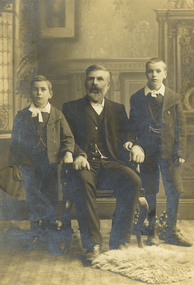
Photograph, Frank Wright (left) with father William and brother Alex Wright
... air raid in a Midland . town. His broth-er, Frank Wright, is musical director for the London County council."(Border Morning Mail, 22 Oct 1940) Frank Wright was a renown resident of Smeaton, where he was born. ...air raid in a Midland . town. His broth-er, Frank Wright, is musical director for the London County council."(Border Morning Mail, 22 Oct 1940) Frank Wright was a renown resident of Smeaton, where he was born. ...Alexander Wright was killed whilst performing at the Birmingham Empire as the result of a German air Attack in October 1940. The theatre had a direct hit. The stage name of Alex Wright was 'Navarre' "Prince of Mimics". According to Frank Wright Alex was a great impersonator with a unique range Bass - tenor with many accents (not unlike Peter Dawson) "AUSTRALIAN KILLED An Australian, Alexander Wright, radio variety star, who toured Europe and Australia under the pseudonym of Navarre, was killed during a recent air raid in a Midland . town. His broth-er, Frank Wright, is musical director for the London County council."(Border Morning Mail, 22 Oct 1940) Frank Wright was a renown resident of Smeaton, where he was born. He lived at Laura Villa, and attended Smeaton State School. His father William was a gold miner and his mother's name was Sarah. Their family won many singing and instrumental awards. Frank was tutored by Percy Code and became the Australian Open Cornet Champion by the age of eighteen. Sepia formal photograph of a seated man with two boys, one standing on either side of him. They are posed in front of a backdrop showing one side of a window and its curtain, panelling and a painting. The boys are dressed in shoes, socks, knee pants, vests with a chain, white shirts and a jacket. The man is similarly dressed although with long trousers.frank wright, alex wright, navarre, alexander wright, william wright -
 Federation University Historical Collection
Photograph, Alex Wright at Smeaton, 10/09/1923
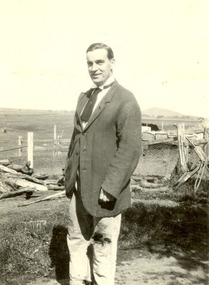
... air-raid in the Hippodrome Birmingham in 1940. He was the brother of Frank Wright who was a renown resident of Smeaton, where he was born. ...air-raid in the Hippodrome Birmingham in 1940. He was the brother of Frank Wright who was a renown resident of Smeaton, where he was born. ...Alex Wright travelled to England in 1930 and was known as the Prince of Mimic. His stage name was Navarre. He died in an air-raid in the Hippodrome Birmingham in 1940. He was the brother of Frank Wright who was a renown resident of Smeaton, where he was born. He lived at Laura Villa, and attended Smeaton State School. His father William was a gold miner and his mother's name was Sarah. Their family won many singing and instrumental awards. Frank was tutored by Percy Code and became the Australian Open Cornet Champion by the age of eighteen. A year later, Frank conducted the City of Ballarat Band, and later the Ballarat Soldiers’ Memorial Band. He formed the Frank Wright Frisco Band and Frank Wright and his Coliseum Orchestra. These bands won many South Street awards, and Frank as conductor won many awards in the Australian Band Championship contest. In 1933 Frank Wright sailed to England to conduct the famous St Hilda’s Band and was later appointed Musical Director of the London County Council, where he organized many amazing concerts in parks, in and around the London district. He was made Professor of Brass and Military Band Scoring and conducted at the Guildhall of Music and Drama. Frank was often invited to adjudicate Brass Band Championships around Europe, in Australia, including South Street and in New Zealand. The Frank Wright Medal at the Royal South Street competition is awarded to an individual recognized as making an outstanding contribution to brass music in Australia.A black and white photograph of a man wearing work pants and a tie and jacket standing in a paddock near a fence and with timber lying on the ground. on back - Alex Wright 25, Taken at Smeaton, 19.9.23, F.W. (Au)alex wright, frank wright, smeaton, navarre -
 Federation University Historical Collection
Photograph - Colour, Memorial to Francis Davis in the grounds of Federation University, SMB Campus, 2012, 20/09/2012
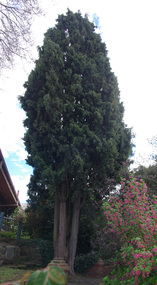
... born in Ballarat on 09 August 1899. He is the only former student of the Ballarat Junior Technical School who was killed on service during World War One. Davis enlisted into the Australian Flying Corps, Laverton, on 12 April 1918 at which time he was 18 and 8 months and served as a second class Air Mechanic. ...born in Ballarat on 09 August 1899. He is the only former student of the Ballarat Junior Technical School who was killed on service during World War One. Davis enlisted into the Australian Flying Corps, Laverton, on 12 April 1918 at which time he was 18 and 8 months and served as a second class Air Mechanic. ...Francis Gordon Davis was born in Ballarat on 09 August 1899. He is the only former student of the Ballarat Junior Technical School who was killed on service during World War One. Davis enlisted into the Australian Flying Corps, Laverton, on 12 April 1918 at which time he was 18 and 8 months and served as a second class Air Mechanic. His service number was 3310. He died accidentally from shock resulting from an accident resulting from skidding a Leyland Motor Lorry at Leighterton, Tetbury, Gloucester, England on 28 January 1919 and is buried in Grave 6 in the Soldiers Corner of the Leighterton Cemetery. Francis Davis was accorded a full military funeral, firing party, bugler and pallbearers. The coffin was draped in the Union Jack and surmounted in several beautiful wreathes sent from his brother 2/A.M. E.H. Davis (A.F.C Leighterton), officer of the A.F.C. Leighterton, Gloucester, Cadets of A.F.C. and many other personal friends of the deceased. The "Last Post" was sounded at the graveside, and the Rev. Major K.D. Norman C. of E. A.I.F. officiated. The grave was to be turfed and an oak cross erected by the A.I.F. London. Administrative Headquarters A.I.F. London were represented at the funeral. (http://bih/index.php/Francis_G._Davis) In June 1922 Alfred Davis, the father of Francis Davis, planted a tree in the grounds of the Ballarat Junior Technical School in honour of hos son. It was the first tree of six planted in the grounds of the Ballarat School of Mines on Arbor Day 1922. Speaking of the planting of the tree by Mr Davis the Chief Secretary (Mr M. Baird M.L.A.), said he trusted the memory would ever remain green at the school. Had he and others not given their lives nothing that we could have done to-day could have retrieved the time. Australians had indeed done splendidly, but they should take a wider outlook than Australia, and reading the history of the Genoa Conference he had been struck by what had been done ... We should honor such men as he in whose memory that tree was planted, and the schools that sent them out to fight for us. He hoped the empire would always be able to produce such men, so that the Empire would always be able to lead the World's struggle for the benefit of humanity. The last post was then sounded by Mr. H. Green. ... (Ballarat Courier, 19 June 1922)A number of photographs of a tree and marble plaque in the grounds of the Ballarat School of Mines. It was a memorial to Francis Davis, a former student of the Ballarat Junior Technical School, who died on active service during World War One.ballarat school of mines, ballarat junior secondary school, world war one, memorial, marble plaque, marble memorial, tree, memorial tree, davis, francis davis -
 Federation University Historical Collection
Photograph - Black and White, 'Navarre', Alex Wright ?, 1930's
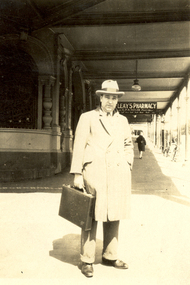
... born. He lived at Laura Villa, and attended Smeaton State School. Alex his brother, who's stage name was 'Navarre', also known as The Prince of Mimic, was killed in an air-raid in the Hippodrome Birmingham in 1940. ...born. He lived at Laura Villa, and attended Smeaton State School. Alex his brother, who's stage name was 'Navarre', also known as The Prince of Mimic, was killed in an air-raid in the Hippodrome Birmingham in 1940. ...Frank Wright was a renown resident of Smeaton, where he was born. He lived at Laura Villa, and attended Smeaton State School. Alex his brother, who's stage name was 'Navarre', also known as The Prince of Mimic, was killed in an air-raid in the Hippodrome Birmingham in 1940. Their father William was a gold miner and his mother's name was Sarah. Their family won many singing and instrumental awards. Frank was tutored by Percy Code and was awarded a gold medal for the highest marks in the ALCM examinations in the British Colonies at the age of seventeen years. He became the Australian Open Cornet Champion by the age of eighteen. A year later, Frank conducted the City of Ballarat Band, and later the Ballarat Soldiers’ Memorial Band. He formed the Frank Wright Frisco Band and Frank Wright and his Coliseum Orchestra. These bands won many South Street awards, and Frank as conductor won many awards in the Australian Band Championship contest. In 1933 Frank Wright sailed to England to conduct the famous St Hilda’s Band and was later appointed Musical Director of the London County Council, where he organized many amazing concerts in parks, in and around the London district. He was made Professor of Brass and Military Band Scoring and conducted at the Guildhall of Music and Drama. Frank was often invited to adjudicate Brass Band Championships around Europe, in Australia, including South Street and in New Zealand. The Frank Wright Medal at the Royal South Street competition is awarded to an individual recognized as making an outstanding contribution to brass music in Australia.Black and white photograph of a man dressed in an overcoat and hat and carrying a briefcase. He is standing on the street corner. A row of shops with large overhanging awnings slope upwards behind him. The man is possibly 'Navarre', Alex Wright.alex wright, navarre, the prince of mimic, frank wright -
 The Beechworth Burke Museum
Audio - Oral History, Jennifer Williams, Mr Braz Borschman, 3-1-2000
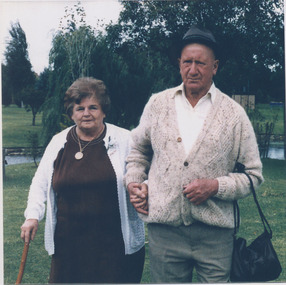
... born in Beechworth on the 1st of July 1914 at his parents home. He played for many years in the Towns volunteer Brass Band, a popular local band of about 30 members. Braz played the coronet and later the trombone. His first job was for the post office, but he spend most of his working life at the Beechworth Tannery. His interview contains lots of information about the tanning processes, including the story of 'Young Thomas', who lost his arm in a tannery accident. Braz recalls the open-air...born in Beechworth on the 1st of July 1914 at his parents home. He played for many years in the Towns volunteer Brass Band, a popular local band of about 30 members. Braz played the coronet and later the trombone. His first job was for the post office, but he spend most of his working life at the Beechworth Tannery. His interview contains lots of information about the tanning processes, including the story of 'Young Thomas', who lost his arm in a tannery accident. Braz recalls the open-air ...Mr. Braz Borschman was born in Beechworth on the 1st of July 1914 at his parents home. He played for many years in the Towns volunteer Brass Band, a popular local band of about 30 members. Braz played the coronet and later the trombone. His first job was for the post office, but he spend most of his working life at the Beechworth Tannery. His interview contains lots of information about the tanning processes, including the story of 'Young Thomas', who lost his arm in a tannery accident. Braz recalls the open-air picture theatres of Beechworth, the many dances and balls, and distinct lack of cars. His testimony is rich with detail and filled with many other side-stories, including 'Blind Tommy', a self-sufficient, opium-smoking blind man of Chinese descent. This oral history recording was part of a project conducted by Jennifer Williams in the year 2000 to capture the everyday life and struggles in Beechworth during the twentieth century. This project involved recording seventy oral histories on cassette tapes of local Beechworth residents which were then published in a book titled: Listen to what they say: voices of twentieth century Beechworth. These cassette tapes were digitised in July 2021 with funds made available by the Friends of the Burke.Braz' interview is significant for the many historical details it provides about life, work, and leisure in Beechworth, particularly in relation to the period of the depression and after, which is the context which Braz' interview focuses on. His detail about the Beechworth tannery and the many open-air picture gardens is particularly rare and insightful to any social history of Beechworth. The oral history project more broadly is significant for its capture of the lives of ordinary Beechworth residents from incredibly divergent backgrounds, which has led to a rich, nuanced and diverse range of accounts of Beechworth.This is a digital copy of a recording that was originally captured on a cassette tape. The cassette tape is black with a horizontal white strip and is currently stored in a clear flat plastic rectangular container. It holds up 40 minutes of recordings on each side.listen to what they say, beechworth, oral history, braz borschman, brass band -
 Lara RSL Sub Branch
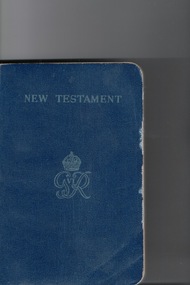
Book, British and Foreign Bible Society, NEW TESTAMENT POCKET BIBLE, 1939
... Born 5th August 1921, he enlisted on the 7th March 1939, and served on the HMAS Kuttabul II. He was discharged in 1948. The bible forms part of a collection of Ronald Leslie's belongings that were donated to the Lara RSL in 2006. world war 2 ww2 wwii hmas australia Presented by 'The British and Foreign Bible Society'. New South Wales Auxillary. To members of the Navy and Air ...Ronald Leslie Gregory (R/22961) served in the Australian Royal Navy. Born 5th August 1921, he enlisted on the 7th March 1939, and served on the HMAS Kuttabul II. He was discharged in 1948. The bible forms part of a collection of Ronald Leslie's belongings that were donated to the Lara RSL in 2006.Royal blue New Testament pocket sized. Presented by 'The British and Foreign Bible Society'. New South Wales Auxillary. To members of the Navy and Air Force volunteering for Active Service in defence of the British Empire. Name: Ronald L. Gregory REverand A. W. Stuart B. A. General Secretary Sydney 1940 [name: unable to be read] Chaplain H.M.A.S. Australia world war 2, ww2, wwii, hmas australia -
 Federation University Historical Collection
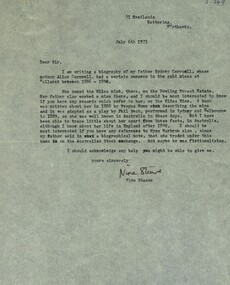
Correspondence, Letters to and from Nina Steane - 1973, 1973
... born George Frederick Carl Whiteman (1877-1958). Sydney was heavily involved with the theatre and was manager of a number of London theatres. He founded the Open Air...born George Frederick Carl Whiteman (1877-1958). Sydney was heavily involved with the theatre and was manager of a number of London theatres. He founded the Open Air ...Nina Steane was the daughter of Sydney Carroll. He was the son of John Whiteman and Alice Cornwall, born in Melbourne in 1877. After a short marriage his parents separated and he chose to live with his father. Alice resumed her maiden name and became successful in the Mining Industry in Ballarat. She owned the Midas Mine on the Dowling Forest Estate, Victoria. She was known as Madame Midas. Returning to London her business thrived and her company the 'British Australasian Mining Investment Company' was floated in London in July 1889. It is said she became a millionaire at 30. Sydney Carroll was born George Frederick Carl Whiteman (1877-1958). Sydney was heavily involved with the theatre and was manager of a number of London theatres. He founded the Open Air Theatre in 1933. A new complex was been built on the site in 1975. He was part-author of several plays, published a book on dramatic criticism as well as being a drama critic. Nina Steane (Carroll) was born in 1932 and studied Art at the Cheltenham School of Art. She then went to Oxford University where she studied Literature. After Oxford she married John M Steane and they had three children. They lived in Southport, Kettering where she exhibited her art until the mid 1970s. In 1976 John became Oxfordshire's County Archaeologist and so moved to live in the area. Here Nina showed her art as well as in London and other parts of the country as well as abroad Nina died in 1990, aged 57. .1 Type written letter on white paper. Addressed "Dear Sir" and signed "Nina Steane" (copy) .2 Type written letter on white paper. Addressed "Mrs Steane" and signed by "E J Barker" Principal of Ballarat School of Mines and later Director of Ballarat College of Advanced Education. (copy) .3 Type written letter on white paper. Addressed "Dear Mr Barker" and signed "Nina Steane" (copy) .4a Copy of hand written information on The Midas Mine .4b continuation of information.1 Signature of Nina Steane. Dated July 6th 1973 .2 Signature "EJB". Dated 20th July 1973 .3 Signature of Nina Steane. Dated July 26th 1973midas mine, nina steane, sydney carroll, alice cornwall, john whiteman, melbourne, madame midas, british australasian mining investment company, millionaire, london, drama, open air theatre, cheltenham school of art, oxford university, literature, john m steane, oxfordshire county, archaeologist, exhibition -
 Federation University Historical Collection
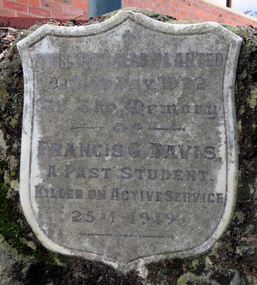
Photograph, Clare Gervasoni, Memorial to Francis Davis in the grounds of Federation University, SMB Campus, 2019, 20/01/2019
... born in Ballarat on 09 August 1899. He is the only former student of the Ballarat Junior Technical School who was killed on service during World War One. Davis enlisted into the Australian Flying Corps, Laverton, on 12 April 1918 at which time he was 18 and 8 months and served as a second class Air Mechanic. ...born in Ballarat on 09 August 1899. He is the only former student of the Ballarat Junior Technical School who was killed on service during World War One. Davis enlisted into the Australian Flying Corps, Laverton, on 12 April 1918 at which time he was 18 and 8 months and served as a second class Air Mechanic. ...Francis Gordon Davis was born in Ballarat on 09 August 1899. He is the only former student of the Ballarat Junior Technical School who was killed on service during World War One. Davis enlisted into the Australian Flying Corps, Laverton, on 12 April 1918 at which time he was 18 and 8 months and served as a second class Air Mechanic. His service number was 3310. He died accidentally from shock resulting from an accident resulting from skidding a Leyland Motor Lorry at Leighterton, Tetbury, Gloucester, England on 28 January 1919 and is buried in Grave 6 in the Soldiers Corner of the Leighterton Cemetery. Francis Davis was accorded a full military funeral, firing party, bugler and pallbearers. The coffin was draped in the Union Jack and surmounted in several beautiful wreathes sent from his brother 2/A.M. E.H. Davis (A.F.C Leighterton), officer of the A.F.C. Leighterton, Gloucester, Cadets of A.F.C. and many other personal friends of the deceased. The "Last Post" was sounded at the graveside, and the Rev. Major K.D. Norman C. of E. A.I.F. officiated. The grave was to be turfed and an oak cross erected by the A.I.F. London. Administrative Headquarters A.I.F. London were represented at the funeral. (http://bih/index.php/Francis_G._Davis) In June 1922 Alfred Davis, the father of Francis Davis, planted a tree in the grounds of the Ballarat Junior Technical School in honour of hos son. It was the first tree of six planted in the grounds of the Ballarat School of Mines on Arbor Day 1922. Speaking of the planting of the tree by Mr Davis the Chief Secretary (Mr M. Baird M.L.A.), said he trusted the memory would ever remain green at the school. Had he and others not given their lives nothing that we could have done to-day could have retrieved the time. Australians had indeed done splendidly, but they should take a wider outlook than Australia, and reading the history of the Genoa Conference he had been struck by what had been done ... We should honor such men as he in whose memory that tree was planted, and the schools that sent them out to fight for us. He hoped the empire would always be able to produce such men, so that the Empire would always be able to lead the World's struggle for the benefit of humanity. The last post was then sounded by Mr. H. Green. ... (Ballarat Courier, 19 June 1922)A number of photographs of a tree and marble plaque in the grounds of the Ballarat School of Mines. It was a memorial to Francis Davis, a former student of the Ballarat Junior Technical School, who died on active service during World War One.ballarat school of mines, ballarat junior secondary school, world war one, memorial, marble plaque, marble memorial, tree, memorial tree, davis, francis davis, centenary -
 Greensborough Historical Society
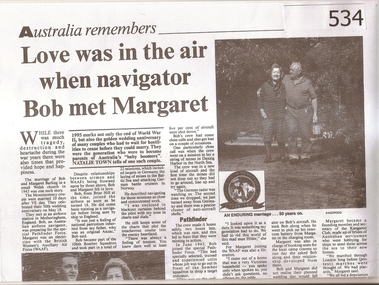
Newspaper clipping, Diamond Valley Leader, Love was in the air when navigator Bob met Margaret, 18/05/1945
... born in Briar Hill and returned there with his bride after the war. They later moved to Montmorency. ww2 australia remembers 1945 - 1995 waaf raaf pathfinder squadron ve day war brides barling family Nil An A3 article written as part of the Australia Remembers 1945 - 1995 Commemoration. Love was in the air ...The article is one of series published as part of the Australia Remembers 1945 - 1995 program.This article tells the tale of how Bob and Margaret Barling met in England during WW2. Bob was born in Briar Hill and returned there with his bride after the war. They later moved to Montmorency.An A3 article written as part of the Australia Remembers 1945 - 1995 Commemoration.Nilww2, australia remembers 1945 - 1995, waaf, raaf, pathfinder squadron, ve day, war brides, barling family -
 City of Moorabbin Historical Society (Operating the Box Cottage Museum)
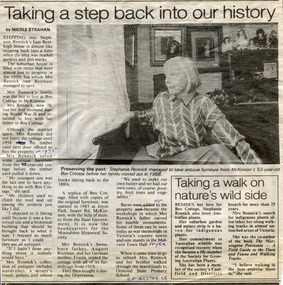
Photograph, B/W Stefanie Rennick nee Rietman c1999; Newspaper clipping 1996, 1996, 1999
... Stefanie married Alan Francis 1941 but he was killed in WW2 Air operations over Germany 1944. Two sons were born 1942, 1944. Stefanie returned to live at the cottage until 1958. ...Stefanie married Alan Francis 1941 but he was killed in WW2 Air operations over Germany 1944. Two sons were born 1942, 1944. Stefanie returned to live at the cottage until 1958. ...August Rietmann (1877-1951) of Lustdorf ,Switzerland, married Maria Frieda Oesschlager (1878-1942) of Baden Baden, in Germany on 6/8/1910 8/8/1915 August and his wife Frieda migrated to Melbourne, Victoria, Australia sailing on the Steam Ship ‘Osterley’ from Marseilles to Melbourne They leased Box Cottage, Ormond in 1917 and raised two children, Stefanie (1918 -2006) and William (1920- 1997). 1935 August purchased the property and the family used the Cottage during the day and slept in the Front House. August was a monumental mason, potter and sculptor, and was employed at Corbens Ltd Clifton Hill, to carve war memorials in Victoria post WW1 c 1915-1922. During the 1920's August set up his own business in pressed cement making pot plants, columns,paving slabs and lampstands. His son William joined the business and and the family continued to use the site after August died in 1951. Rietmann Landscaping Ltd moved to Bay Road Highett in 1953 and later to Carrum. The land, containing the Box Cottage, was sold to Lewis Timber Pty Ltd in 1970 and Mr Lewis proposed that Moorabbin City Council should preserve the heritage Cottage. Stefanie Rietman, grew up living in Box Cottage until 1935 when she began a Teaching career. Stefanie married Alan Francis 1941 but he was killed in WW2 Air operations over Germany 1944. Two sons were born 1942, 1944. Stefanie returned to live at the cottage until 1958. She married Herbert Rennick 1946 and two sons were born 1947, 1952. Stefanie also established a native grasses garden in Joyce Park, and designed and made resin jewellery. Stefanie died 2006 In 1984 the Cottage was dismantled and reconstructed in the adjacent Joyce Park. The Rietman family is an example of the diverse nationalities that lived and worked productively in Moorabbin Shire 1871–1933 , the City of Moorabbin 1934-1994 and continues today in the Cities of Glen Eira, Kingston, Bayside, and Monash. Stefanie was a talented artist , school teacher, and jewellery designer and raised 4 sons. August, a sculptor and stone mason, was employed by Corben Pty Ltd Clifton Hill to carve WW1 Memorials before establishing his own successful masonry business in the Box Cottage during the latter 1920s. After becoming interested in pressed cement casting, he took on apprentices (1930s Depression) and among his products were garden furniture, pots and also street lamp standards, some of which were installed in St Kilda Road. After August’s death in 1951, his family continued the business ‘Rietman’s Landscaping Ltd.’, at Highett and a) Newspaper clipping, Moorabbin Standard 17/9/1996 Stefanie Rennick ( nee Rietman) by N. Strahan b) Photograph Black & White, Stefanie Rennick ( nee Rietman) 1999a) printed article b) handwritten informationresin jewellery, australian native grasses, schools, education, craftwork, pottery, ceramics, ormond state school, rietmann august, rietman august, rietmann frieda, rietman frieda, stonnington city town hall, war memorials, world war 1 1914-1918, rietman stefanie, rennick stefanie, francis stefanie, rietman william, rietman ray, montford paul, malvern city town hall, box cottage museum ormond, box william, box elizabeth, joyce park ormond, rietman's landscaping pty ltd, bay road highett, macrobertson pty ltd, coleraine soldier memorial 1921, box cottage ormond -
Glenelg Shire Council Cultural Collection
Souvenir - Tea Towel - Maretimo, Portland, n.d
... born gentleman parliamentarian, pastoralist and former Van Deimen's Land settler, J H McLeod, is now notable for the disciplined facade and elegantly crafted interiors. Maretimo has been meticulously maintained and is presented in near perfect original condition. The interiors have been sensitively enhanced and redecorated. historic building historic homestead Maretimo Henty souvenir Linen souvenir tea towel 'Maretimo'. Green and black on cream. 'MARETIMO' at top, front view of Maretimo beneath, then map of locaion, then view from air ...From the National Trust register: Statement of Significance Maretimo, a 22 room single storey Australian Colonial Georgian style mansion set on a prominent bluff overlooking Portland harbour, was erected c. 1854 for John Norman McLeod. The design of Maretimo, which is constructed of basalt ashlar with fine-axed parapet entablature, delicate open timber work verandah and Regency interior, has been tenuously attributed to Adelaide architect James Barrow. Maretimo is rivalled only by the stylistically similar Henty residence, Burwsood of 1853 by James Barrow, as perhaps the finest Australian Colonial Georgian style residence erected within the first twenty years of settlement in Victoria. The residence, which was occupied for twenty years by distinguished English-born gentleman parliamentarian, pastoralist and former Van Deimen's Land settler, J H McLeod, is now notable for the disciplined facade and elegantly crafted interiors. Maretimo has been meticulously maintained and is presented in near perfect original condition. The interiors have been sensitively enhanced and redecorated.Linen souvenir tea towel 'Maretimo'. Green and black on cream. 'MARETIMO' at top, front view of Maretimo beneath, then map of locaion, then view from air. 'HISTORIC HOME PORTLAND, VICTORIA' beneath 'Pure Linen', bottom right.historic building, historic homestead, maretimo, henty, souvenir -
 Orbost & District Historical Society
Album - Florence M Taylor album, Florence M Taylor, c. 1910-1920s
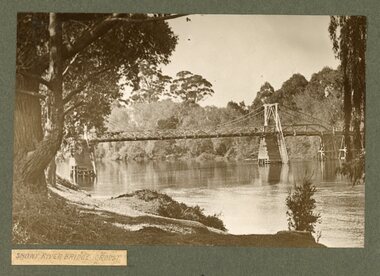
... born in 1879 and died in 1969. Wikipedia: Florence Mary Taylor CBE (née Parsons; 29 December 1879 – 13 February 1969) was the first qualified female architect in Australia.[1] She was also the first woman in Australia to fly in a heavier-than-air craft in 1909[2] and the first female member of the UK's Institution of Structural Engineers in 1926.[3] However, she is best known for her role as publisher, editor and writer for the influential building industry trade journals established in 1907 with her husband George, which she ran and expanded after his death in 1928 until her retirement in 1961.[4] All photographs in this Album are attributed to J H Harvey (b1855, d1938), who was a well-known photographer, land surveyor and engineer. ...born in 1879 and died in 1969. Wikipedia: Florence Mary Taylor CBE (née Parsons; 29 December 1879 – 13 February 1969) was the first qualified female architect in Australia.[1] She was also the first woman in Australia to fly in a heavier-than-air craft in 1909[2] and the first female member of the UK's Institution of Structural Engineers in 1926.[3] However, she is best known for her role as publisher, editor and writer for the influential building industry trade journals established in 1907 with her husband George, which she ran and expanded after his death in 1928 until her retirement in 1961.[4] All photographs in this Album are attributed to J H Harvey (b1855, d1938), who was a well-known photographer, land surveyor and engineer. ...This album was compiled by Florence M. Taylor who was the first women in Australia to be an architect, structural and civil engineer, town planner, and publisher. Florence was born in 1879 and died in 1969. Wikipedia: Florence Mary Taylor CBE (née Parsons; 29 December 1879 – 13 February 1969) was the first qualified female architect in Australia.[1] She was also the first woman in Australia to fly in a heavier-than-air craft in 1909[2] and the first female member of the UK's Institution of Structural Engineers in 1926.[3] However, she is best known for her role as publisher, editor and writer for the influential building industry trade journals established in 1907 with her husband George, which she ran and expanded after his death in 1928 until her retirement in 1961.[4] All photographs in this Album are attributed to J H Harvey (b1855, d1938), who was a well-known photographer, land surveyor and engineer. This album is significant because it contains photographs of East Gippsland, from Orbost to the NSW border. All photos were taken by J H Harvey in the early 20th century, and collected into this Album by Florence M Taylor who was Australia's first woman to be qualified as an architect and engineer. A grey covered album with gold lettering on the front and tied with cord along the spine. 8 pages with b/w photos. Some photos have been cut from the Album. All photos are labelled.on front cover: Through the county of Croagingolong, Victoria. Mrs F. M. Taylor.east gippsland, orbost, genoa, cann river, bellbird hotel, aboriginal camp, mallacoota, florence m taylor, snowy river bridge -
 Orbost & District Historical Society
knitted jumper, Burton, Marjorie, 1938 - 1940
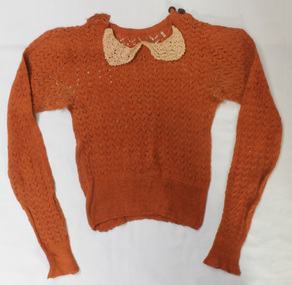
... She used to knit while in an air raid shelter escaping the bombing with her young daughter. Marjorie Burton ( nee Whiteman), born 12 June, in Birmingham, England came to Orbost in 1995. ...She used to knit while in an air raid shelter escaping the bombing with her young daughter. Marjorie Burton ( nee Whiteman), born 12 June, in Birmingham, England came to Orbost in 1995. ...This was knitted by Marjorie Burton during WW11 in England. She used to knit while in an air raid shelter escaping the bombing with her young daughter. Marjorie Burton ( nee Whiteman), born 12 June, in Birmingham, England came to Orbost in 1995. In England she did office work – typing, shorthand and secretarial work - in accountants’ offices and also trained as a comptometrist with Burroughs in London. She came from middle-class working church-going family. Her mother was a milliner who mad all of Marjorie’s clothes, hats and outfits. Marjorie married in 1938 to a salesman who later became a mechanic in the R.A.F. during WW11. Her father served in Civil Defence during the war. Marjorie was in Birmingham during the war and remembered sheltering with her young daughter, Anne (Quaadgras) in the air raid shelter during bombing. This was knitted by Marjorie Burton during WW11 in England. She used to knit while in an air raid shelter escaping the bombing with her young daughter. This item is an example of a handcrafted item and reflects the handcraft skills of women necessary during WW11 when clothing became scarce. Clothes rationing began on June 1, 1941, two years after food rationing started. Clothes rationing ended on 15 March 1949.A brown cotton hand-knitted lacy jumper. it is a long-sleeved lady'e jumper with a tea-coloured crocheted collar sewn on. On each shoulder are two brown buttons.knitting jumper handcraft ww11 burton-marjorie -
 Orbost & District Historical Society
knitted vests/singlets, Burton, Marjorie, WW11
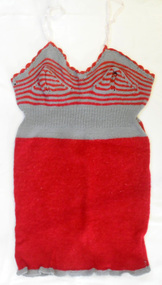
... She used to knit while in an air raid shelter escaping the bombing with her young daughter. Marjorie Burton ( nee Whiteman), born 12 June, in Birmingham, England came to Orbost in 1995. ...She used to knit while in an air raid shelter escaping the bombing with her young daughter. Marjorie Burton ( nee Whiteman), born 12 June, in Birmingham, England came to Orbost in 1995. ...This was knitted by Marjorie Burton during WW11 in England. She used to knit while in an air raid shelter escaping the bombing with her young daughter. Marjorie Burton ( nee Whiteman), born 12 June, in Birmingham, England came to Orbost in 1995. In England she did office work – typing, shorthand and secretarial work - in accountants’ offices and also trained as a comptometrist with Burroughs in London. She came from middle-class working church-going family. Her mother was a milliner who made most of Marjorie’s clothes, hats and outfits. Marjorie married in 1938 to a salesman who later became a mechanic in the R.A.F. during WW11. Her father served in Civil Defence during the war. Marjorie was in Birmingham during the war and remembered sheltering with her young daughter, Anne (Quaadgras) in the air raid shelter during bombing. This item is an example of a handcrafted item and reflects the handcraft skills of women necessary during WW11 when clothing became scarce. Clothes rationing began on June 1, 1941, two years after food rationing started. Clothes rationing ended on 15 March 1949.Two hand-knitted lady's vests(singlets). Both have been knitted from left over wools. Both have crocheted necklines and ribbon straps and are fitted styles. 2483.12 is red and grey with a V neck. 2483.13 is pink, grey and blue with a V neck.ww11 knitwear handcraft nightgown sleepwear burton-marjorie -
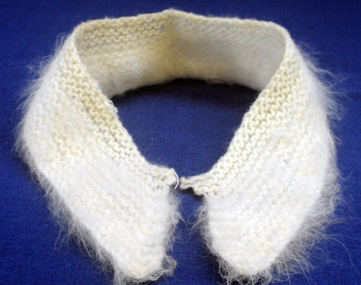 Orbost & District Historical Society
knitted collar, Burton, Marjorie, 1940's
... She used to knit while in an air raid shelter escaping the bombing with her young daughter. Marjorie Burton ( nee Whiteman), born 12 June, in Birmingham, England came to Orbost in 1995. ...She used to knit while in an air raid shelter escaping the bombing with her young daughter. Marjorie Burton ( nee Whiteman), born 12 June, in Birmingham, England came to Orbost in 1995. ...This was knitted by Marjorie Burton during WW11 in England. She used to knit while in an air raid shelter escaping the bombing with her young daughter. Marjorie Burton ( nee Whiteman), born 12 June, in Birmingham, England came to Orbost in 1995. In England she did office work – typing, shorthand and secretarial work - in accountants’ offices and also trained as a comptometrist with Burroughs in London. She came from a middle-class, working, church-going family. Her mother was a milliner who mademany of Marjorie’s clothes, hats and outfits. Marjorie married in 1938 to a salesman who later became a mechanic in the R.A.F. during WW11. Her father served in Civil Defence during the war. Marjorie was in Birmingham during the war and remembered sheltering with her young daughter, Anne (Quaadgras) in the air raid shelter during bombing. This item is an example of a handcrafted item and reflects the handcraft skills of women necessary during WW11 when clothing became scarce. Clothes rationing began on June 1, 1941, two years after food rationing started. Clothes rationing ended on 15 March 1949.A narrow, detachable hand-knitted lady's collar. It is hand-knitted in white brushed wool.women's -clothing accessory burton-marjorie -
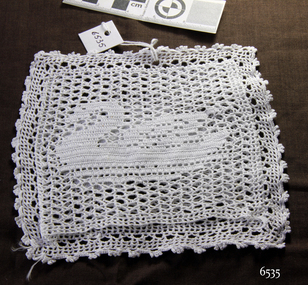 Flagstaff Hill Maritime Museum and Village
Textile - Lavender Bag, ca 1910
... air in rooms and even as a deodorant inside special pockets in ladies' undergarments. In the Words of donor, Betty Stone, … “These crocheted and embroidered articles cover a period of three generations- ie. Sarah (nee Chamberlain) Lees, Ann (nee Lees) Dale, and Daisy Elvena (nee Dale) Welsh. All three were accomplished needlewomen; also, both Sarah Lees (born...air in rooms and even as a deodorant inside special pockets in ladies' undergarments. In the Words of donor, Betty Stone, … “These crocheted and embroidered articles cover a period of three generations- ie. Sarah (nee Chamberlain) Lees, Ann (nee Lees) Dale, and Daisy Elvena (nee Dale) Welsh. All three were accomplished needlewomen; also, both Sarah Lees (born ...Small decorative bags containing dried lavender, rose petals and other fragrant flowers and leaves were used to add fragrance to linen and clothing. They were also used to repel insects and help preserve the textile pieces. Fragrant bags were used to freshen the air in rooms and even as a deodorant inside special pockets in ladies' undergarments. In the Words of donor, Betty Stone, … “These crocheted and embroidered articles cover a period of three generations- ie. Sarah (nee Chamberlain) Lees, Ann (nee Lees) Dale, and Daisy Elvena (nee Dale) Welsh. All three were accomplished needlewomen; also, both Sarah Lees (born 1844) and her daughter, Ann (b 1865) crocheted a wide variety of articles for use in their homes. A few examples of these items have survived the years.” It was a tradition for brides to have a 'glory box' containing linen and embroidered articles to take to their new home. Many of the items were made by Daisy, a skilled dressmaker. Daisy began her apprenticeship at two shillings and sixpence per week at Miss A. E. Emery's dressmaking establishment at 150-152 Liebig Street, Warrnambool. Considered to be the leading house of fashion in Warrnambool, Miss Emery employed about eight young women who worked long hours to sew elaborate gowns for clients, including wives of graziers who would attend the race carnivals and social functions in Warrnambool. (NOTE: For additional information please refer to my book Pioneer and Places- A History of Three Warrnambool Pioneering Families ie. Chamberlain, Dale and Lees families)This item is associated with the Warrnambool pioneer families of Chamberlain, Dale and Lees. These families are listed in the Pioneers' Register for Warrnambool Township and Shire, 1835-1900, published by A.I.G.S. Warrnambool Branch. The item is significant for its association with a ‘glory box’ or hope chest’, a tradition of single ladies making and collecting a range of linen and other domestic items in preparation for their future marriage. The item is a fine example of early 20th-century needlework and handmade domestic items.Lavender bag, white crocheted squares, back to back, with a border and a swan design incorporated in crochet. Part of the Chamberlain Dale Lees Collection.flagstaff hill, warrnambool, flagstaff hill maritime museum and village, great ocean road, chamberlain family, dale family, lees family, betty stone, warrnambool pioneer, warrnambool genealogy, wangoom, chamberlain dale lees collection, glory box, handmade, craft, manchester, linen, haberdashery, needlework, crochet, lavender bag, fragrant bag, insect repellant -
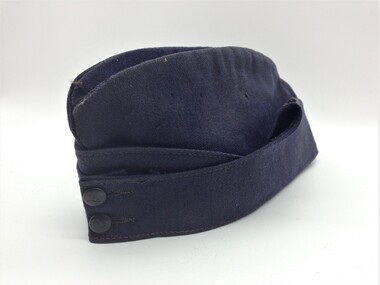 Montmorency–Eltham RSL Sub Branch
Uniform - Forage Cap, RAAF WW2
... Cap owned by Warrant Officer William Alexander SUMMERS, RAAF., (10814) born at Surrey Hills Vic., 26 APR 1918, enlisted 02 JUL 1940, discharged 24 MAY 1946. Last Posting: Air Force Headquarters ...Cap owned by Warrant Officer William Alexander SUMMERS, RAAF., (10814) born at Surrey Hills Vic., 26 APR 1918, enlisted 02 JUL 1940, discharged 24 MAY 1946. Last Posting: Air Force Headquarters This Item directly linked to a World War serviceman. ...Cap owned by Warrant Officer William Alexander SUMMERS, RAAF., (10814) born at Surrey Hills Vic., 26 APR 1918, enlisted 02 JUL 1940, discharged 24 MAY 1946. Last Posting: Air Force Headquarters This Item directly linked to a World War serviceman. Typical uniform item. Dark blue forage cap with two 13mm diameter plastic RAAF buttons on front. Black Cotton liner with off-white label attached. Missing cap badge (eagle and crown) evidenced by mounting plate indentations in liner. Label black stamped with 'LEWIS', 'F arrow S', and ' 7', and handwritten service number '10814' black/blue inkheadgear -
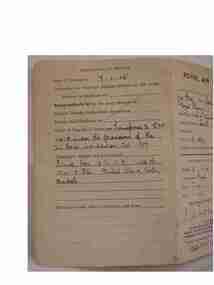 Red Cliffs Military Museum
Discharge Paper WW1, Copy of WW1 Discharge Paper in cover, (estimated); 1921
... .// Front of Paper: Top right: Form 2067/ Royal Air Force/ Serial No/ Character Certificate of No 133458/ Rank Pte2 Name Roddy James/ Royal Flying Corp (Regiment (crossed out))/ Born in the Parish of / near the Town of South in the / County of ......... on the / Date 11.7.1897/ Trade as stated by him on Enlistment Postman/ 2 parallel lines/ * Description on Leaving the Colours/ Heoght 5ft 6in. ....// Front of Paper: Top right: Form 2067/ Royal Air Force/ Serial No/ Character Certificate of No 133458/ Rank Pte2 Name Roddy James/ Royal Flying Corp (Regiment (crossed out))/ Born in the Parish of / near the Town of South in the / County of ......... on the / Date 11.7.1897/ Trade as stated by him on Enlistment Postman/ 2 parallel lines/ * Description on Leaving the Colours/ Heoght 5ft 6in. ...This is a part of the A.J. Roddy Collection. The Family have glued a piece on the envelope which says, "Dad's Discharge Paper/ Royal Irish Rifles & Royal Flying Corps./ 7-1-1915 to Dec 1921. Copy a the Discharge paper of Pte2 James Roddy, Royal Irish Rifles & Royal Flying Corps RAF 7-1-1915 to Dec 1921 and CoverCover: Cover for Certificates/ and other Documents of a/ soldier on Demobilization or Transfer to the Reseve/ or Discharge.// Front of Paper: Top right: Form 2067/ Royal Air Force/ Serial No/ Character Certificate of No 133458/ Rank Pte2 Name Roddy James/ Royal Flying Corp (Regiment (crossed out))/ Born in the Parish of / near the Town of South in the / County of ......... on the / Date 11.7.1897/ Trade as stated by him on Enlistment Postman/ 2 parallel lines/ * Description on Leaving the Colours/ Heoght 5ft 6in. Identification Marks:-/ Complexion Fresh Scar above 1st Lumbar/ Eyes Grey. Vertibrae/ Hair Brown/ Signature of Soldier/ (was signed J. Roddy/ * To prevent impersonation/ In the event of any doubt arising as to the bona fidis of the/ bearer, the above description and signature should be carefully compared with present appearance and hand writing. (16:957) WT 3183C/1875 5m.17/18. P&P Ltd/ Photostat copy of Original Opening the paper inside: The character here given is based on continous records of the holder's conduct and / employment throughout his Military Career./ This is to Certify that No 133458 Rank Pte2 Name Roddy James/ has served with the colours in the Royal Irish Rifles & Royal Flying Corps for 3 83/365 years. 1915-18/ Serving in the Royal Flying Corps as a Batman, and during/ the whole of this period carrying out his duites in a/ satisfactory manner/ There is no record of him having incurred any service/ entries on his conduct sheet during this period./ for service in the R.A.F. see form 280/ Signature ..... Squadron Leader/ Date December 1921 Commanding R.A.F. Records Ruislip/ If further particulars as to his character and record of service are required within three years of above date, apply to/ where he is registered for Civil Employment,/ afterwards to the Officer in Charge of Records./ * This space is intended to be filled in by any organisation which has registered the man's name and is prepared to/ supply further information.// Back of paper: Particulars of Service/ Date of Enlistement 7.1.15/ Preceeded on Furlough pending Transfer to the Army/ Reserve, or Discharge on... passed medically fit for the Army Reserve on/ Due for Final Discharge on../ Cause of Transfer or Discharge - Transferred to R.A.F. 1-4-18. under the provisions of the/ Air Force (Constitution) Act Oct. 1917./ Campaigns, Medals and Decorations/ France from 15.6.15 to 3.12.16/ 1914-15 Star, British War & Victory/ Medals. /Education and other Certificates and dates/corps, ww1, collection, royal, a j, roddy, flying, irish, rifles, pte2, james, 1915 -
 The Beechworth Burke Museum
Photograph, Walter William McLean Thwaites, c.1870
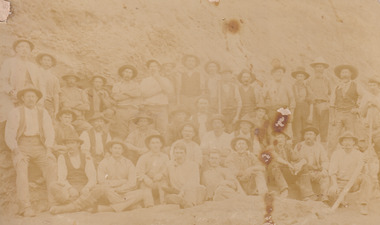
... They have an air of independence and share social equality in their stance and clothing. Walter William McLean Thwaites (1840-1908) was a professional photographer born in Sydney, Australia. ...They have an air of independence and share social equality in their stance and clothing. Walter William McLean Thwaites (1840-1908) was a professional photographer born in Sydney, Australia. ...This photograph depicts a large group of men in their work clothing situated in front of a large bank of earth. They are identified as miners working in an unidentified location in Australia. This photograph was taken by photographer Walter Thwaites sometime during the period of 1865-1908, likely c.1870. It is unsure where this image was taken since Thwaites travelled a lot over his photography career and the photograph is not annotated with this information. In addition, the identities of the men in the photograph are also unknown. These men are photographed in front of a large bank of earth where they had presumably been mining for gold or other precious metals. The men, with the exception of four, are wearing wide brimmed hats to protect their faces from the sun. They are also wearing loose fitting white shirts which are often worn beneath a darker coloured vest. They wear pale coloured work pants and boots. The men are mostly clean shaven with the exception of the moustache and a couple of beards. Two of the men have pipes in their mouth. Their clothing is basic and much less dramatic than the outfits worn by the gold diggers of the 1852 gold rush. These men, by wearing similar outfits, are expressing a sense of comradery or equality between them. It is likely that they are from the same, or similar, social status. They have an air of independence and share social equality in their stance and clothing. Walter William McLean Thwaites (1840-1908) was a professional photographer born in Sydney, Australia. He learnt the craft in his father's Hobart studio, but later embarked on his own solo career and toured every existing Australian colony between 1860 to 1888. The Thwaites family were a long line of photographers and artists with Thwaites' father Walter WIlliam Thwaites Sr working as an artist and photographer in Australia after moving from England in 1834. Walter Thwaites Sr's father, also named Walter Thwaites, was a British miniature portrait artist.Images, like this one, of Australian gold rush history can reveal important information about the social and environmental impact of this period. This image depicts over 30 diggers standing in front of a bank of earth and therefore, this image has the capacity to reveal or support significant information for researchers studying the fashion and social status of diggers in Australia in approximately 1870. It can also provide information on the landscape of Australia in this period and the impact of mining for gold on both society and the Australian landscape. The Burke Museum is home to a substantial collection of Australian mining photographs which can be used to gain a deeper understanding into life on the gold fields, technology used in mining, the miners themselves and the impact of the gold digging on the environment.Sepia toned rectangular photograph printed on matte photographic paper and mounted on board.Reverse: 1997.208 / MINERS. / W. Thwaites / Photography /australia, australian photography, photography, miners, gold rush, australian landscape, diggers, walter thwaites, thwaites photography, w. thwaites photography, social history -
 Bendigo Military Museum
Letter - THANKYOU LETTER, WW2, R.A.A.F, Jun 1946
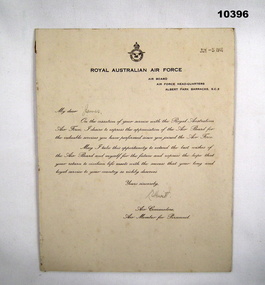
... born Sydney, enlisted Melbourne) enlisted No 52834 in the RAAF on 30.3.1942, appointed to a Commission 2.5.1942 No 265088 as a Pilot Officer, Flying Officer 2.11.1942, FLT Lieut 1.1.1945. He had postings in QLD, NSW, VIC and New Guinea. New Guinea postings were Fall River, Gurney, Pt Moresby, Milne Bay, Berri between June 1942 - 8.10.1943. Appointment terminated 22.3.1946. Part of the collection of William (Bill) Thomason. Refer Cat No. 4136P. Collection of William (Bill) Thomason Letter of Thanks G.J. Ottoway. Dated "Jun 5 1946" Letter on white paper with heading from Royal Australian Airforce from the Air ...George James Ottoway, (born Sydney, enlisted Melbourne) enlisted No 52834 in the RAAF on 30.3.1942, appointed to a Commission 2.5.1942 No 265088 as a Pilot Officer, Flying Officer 2.11.1942, FLT Lieut 1.1.1945. He had postings in QLD, NSW, VIC and New Guinea. New Guinea postings were Fall River, Gurney, Pt Moresby, Milne Bay, Berri between June 1942 - 8.10.1943. Appointment terminated 22.3.1946. Part of the collection of William (Bill) Thomason. Refer Cat No. 4136P.Letter on white paper with heading from Royal Australian Airforce from the Air Board thanking F.L.T. Ottoway James for his service to the RAAF during WW2 after his discharge in June 1946. Letter is attached to cardboard and signed by Air Commodore.Dated "Jun 5 1946"collection of william (bill) thomason, letter of thanks, g.j. ottoway. -
 Bendigo Military Museum
Instrument - BUGLE, C. 1940
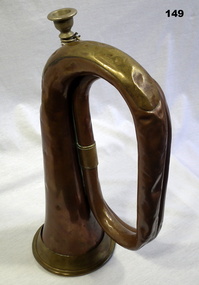
... air raids in the Middle East. When a new electronic siren was installed Bill Nicholls souvenired it and carried it in his haversack until he reached home. William Bona Nicholls No VX36468 2/24 Batt 9th Div. (Born...air raids in the Middle East. When a new electronic siren was installed Bill Nicholls souvenired it and carried it in his haversack until he reached home. William Bona Nicholls No VX36468 2/24 Batt 9th Div. (Born ...The Bugle was played by the British over 2000 times to warn of impending air raids in the Middle East. When a new electronic siren was installed Bill Nicholls souvenired it and carried it in his haversack until he reached home. William Bona Nicholls No VX36468 2/24 Batt 9th Div. (Born Bendigo, enlisted Royal Park) on 12.8.40, embarked 16.11.1940 for the Middle East, promoted L/Cpl 8.5.1941, served in the Seige of Tobruk, El Alamein and Middle East Campaigns. He was taken POW at Derna and escaped after 8 hours. Embarked for Australia 1.2.1943 and disembarked Melbourne 25.2.1943. Embarked for New Guinea 1.8.1943, hospital 5.12.1943 with Degue Fever, rejoin unit 9.12.1943, served in the Lae and Finschafen campaigns. Promoted Sgt 11.2.1944, embark for Australia from Finschafen 28.2.1944 and disembark Brisbane 7.3.1944. Evacuated to hospital 16.3.1945, appears to be Anxiety State. Discharged from the Army 3.9.1945 with the rank of S/Sgt.Copper & brass army bugle with nozzle & holding chain.Main section of bugle has: a lettered crest, & Besson & Co, London, 1940musical instruments - wind, military history, bugle, tobruk -
 Eltham District Historical Society Inc
Photograph, Peter Pidgeon, Dalton Street, Eltham, 2 Aug. 2022
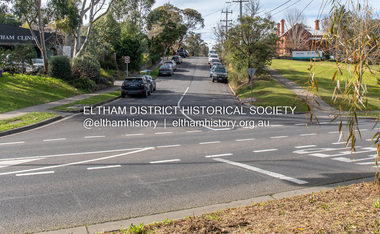
... air into the drained pond suffering a broken arm and shock. She was rescued unconscious by John and taken into Mrs Jarrold’s for first aid. This was not the only instance of young girls losing control of bicycles down the hill. Part of a presentation by Peter Pidgeon to the Society, 13 August 2022 showcasing a series of photographs taken by John Henry Clark over the period 1895 to 1930. John Henry Clark was the youngest of three boys born...air into the drained pond suffering a broken arm and shock. She was rescued unconscious by John and taken into Mrs Jarrold’s for first aid. This was not the only instance of young girls losing control of bicycles down the hill. Part of a presentation by Peter Pidgeon to the Society, 13 August 2022 showcasing a series of photographs taken by John Henry Clark over the period 1895 to 1930. John Henry Clark was the youngest of three boys born ...View looking up Dalton Street from near Main Road where the former pond was situated. The pond was drained by Council in 1932 due to concerns of mosquitoes, etc against the wishes of long standing residents such as Thekla Jarrold (39 years) and John Clark (22 years). On the right is the Eltham Primary Schoool No. 209 with the former Headmaster's residence and to the left is Eltham Clinic once the site of the Grant home. Comparison photo: SEPP_0643 In April 1935 the local paper reported on a story where a schoolgirl was talking whilst on her bicycle and it started moving off, flying down Dalton Street and across the main road missing cars and the guy wires for the telephone pole and hurtled 21 feet through the air into the drained pond suffering a broken arm and shock. She was rescued unconscious by John and taken into Mrs Jarrold’s for first aid. This was not the only instance of young girls losing control of bicycles down the hill. Part of a presentation by Peter Pidgeon to the Society, 13 August 2022 showcasing a series of photographs taken by John Henry Clark over the period 1895 to 1930. John Henry Clark was the youngest of three boys born to William Henry Clark (1823-1877) and Maria White (1843-1914). He and his brothers, William Charles Clark (1872-1945), Clement Kent Clark (1874-1912) operated a photography business (Clark Bros.) from 25 Thomas Street, Windsor near Prahran during the period c.1894 to 1914. Following death of Clement in September 1912 and their mother in 1914, the Clark Bros business appears to have dissolved, the premises demolished, and a new house was under construction in 1915. John set up business independently in 1914 operating out of 29 Moor Street, Fitzroy where he is registered in the 1914 and 1915 Electoral Rolls. By 1916 John had relocated to Eltham where he continued his practice as a photographer and took many of the early images around the district of Little Eltham. Around 1930 John changed professions and opened a small cobbler's shop in 1931 near the pond opposite Dalton Street adjacent to the Jarrold family cottage. He never married and continued his profession as a bootmaker from this little shop, maintaining a close relationship with Mrs Jarrold for the rest of their lives. His bootmaker shop remains today beside the Whitecloud cottage and is one of only three remaining shops in the area from the early 20th century.Comparative photo taken 2022 with one taken from same location over 100 years earlier by noted local photographer J.H. ClarkBorn Digitaleltham, j.h. clark photo (2022), dalton street, main road, eltham clinic, eltham primary school, headmaster's residence, state school no. 209
