
Showing 62 items matching "air dropping"
-
 Lara RSL Sub Branch
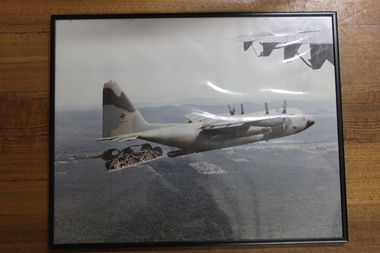
Picture Hercules Aircraft, Australian Hercules Aircraft with cargo air drop in progress
... Australian Hercules Aircraft with cargo air drop in progress.......air drop of cargo over bush area....Hercules transport aircraft air-dropping a cargo....Color photograph of Australian Hercules transport aircraft with air drop in progress....Lara RSL Sub Branch McClelland Ave Lara Hercules transport aircraft air-dropping a cargo. hercules aircraft air drop of cargo over bush area. ...Hercules transport aircraft air-dropping a cargo.Color photograph of Australian Hercules transport aircraft with air drop in progress.No marking or inscriptions on the picture. Aircraft tail was marked with Black Horse rampant and numbers underneath of A97-010hercules aircraft, air drop of cargo over bush area. -
 Bendigo Military Museum
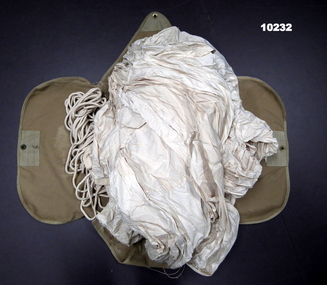
Equipment - PARACHUTE, CARGO, 16 Sep 1943
... ...Air dropping...Air Cargo Parachute Air dropping WW2 Inside one side flap, handwritten is “158”. ...Provenance is not really clear WW2.White cotton parachute. It has a few 'risers' of 7mm diameter. The risers are cotton and the bag has a ply board backing. The bag is made out of canvas with four flaps. Each flap has and eyelet. On the bottom extension is a inch webbing strap in two halves. One half has a heavy brass buckle.Inside one side flap, handwritten is “158”. Also a small cotton patch with manufacturers notes.air cargo, parachute, air dropping, ww2 -
 Bendigo Military Museum
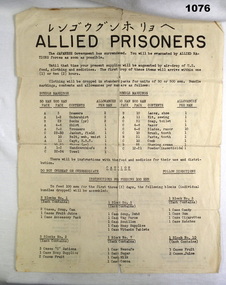
Flyer - DOCUMENT, August 1945
... Alfred Robert Maskell VX25221 was a POW in Japan at the time of the air drop, he souvenired the document. Refer 2485 for medals and service history also 1100.2, 2489P....Bendigo Military Museum 37 - 39 Pall Mall Bendigo goldfields Alfred Robert Maskell VX25221 was a POW in Japan at the time of the air drop, he souvenired the document. Refer 2485 for medals and service history also 1100.2, 2489P. ...Alfred Robert Maskell VX25221 was a POW in Japan at the time of the air drop, he souvenired the document. Refer 2485 for medals and service history also 1100.2, 2489P.Document on yellowed paper with black printing on both sides. Heading is "Allied Prisoners". One side is in English the other in Dutch. Document explains that Japan has surrendered and that air drops will begin to POW's. Details re bundles, contents, rations, allowances, clothing and instructions on food consumption.documents, pow -
 City of Moorabbin Historical Society (Operating the Box Cottage Museum)
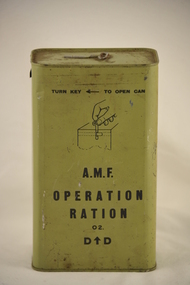
Container - World War 1939-45 Ration pack, c1940
... Hicks altered the basis of the allowance for military rations from a monetary to a nutrient entitlement, improved the pay and promotion opportunities of cooks, established schools of cooking and catering, devised new methods for preparing food, supported the service's adoption of the Wiles steam-cooker, and designed jungle-patrol, emergency and air-drop rations. His 'Who Called the Cook a Bastard?' ...Hicks altered the basis of the allowance for military rations from a monetary to a nutrient entitlement, improved the pay and promotion opportunities of cooks, established schools of cooking and catering, devised new methods for preparing food, supported the service's adoption of the Wiles steam-cooker, and designed jungle-patrol, emergency and air-drop rations. His 'Who Called the Cook a Bastard?' ...AMF Operational Ration This ration pack was developed by Sir Stanton Hicks. It contained three meals, each waterproofed (a vital consideration for the tropics), which offered a balanced selection of meat, vegetables, fruit and vitamin supplements. Before the development of this ration pack, Australian soldiers were supplied with quantities of preserved food that were difficult for a man to carry and divide, and which often did not provide a nourishing diet. Sir Cedric Stanton Hicks (1892-1976), university professor and army catering officer, was born on 2 June 1892 at Mosgiel, New Zealand. University of Otago (B.Sc., N.Z., 1914; M.Sc. Hons, 1915; M.B., Ch.B., 1923) 1916-18 Hicks served as a non-commissioned officer in the New Zealand Expeditionary Force and he assisted Professor J. K. H. Inglis in the synthesis and production of Chloramine-T for use against meningitis among the troops. Hicks was appointed government analyst in 1918. On a Fellowship 1923, he travelled to England and studied at Trinity College, Cambridge (Ph.D., 1926) and caried out research in Switzerland, Germany and the United States of America. 1927 he was appointed to the new chair of physiology and pharmacology at Adelaide University, which he was to hold until 1957. During the Depression he studied the dietary patterns of five hundred families receiving relief. 1940 Hicks was appointed temporary captain, Australian Military Forces, and performed part-time duty as catering supervisor. Moved to Melbourne as chief inspector of catering, he began a campaign for applying scientific principles to the feeding of troops. 1943 the Australian Army Catering Corps was formed. Hicks altered the basis of the allowance for military rations from a monetary to a nutrient entitlement, improved the pay and promotion opportunities of cooks, established schools of cooking and catering, devised new methods for preparing food, supported the service's adoption of the Wiles steam-cooker, and designed jungle-patrol, emergency and air-drop rations. His 'Who Called the Cook a Bastard?' (Sydney, 1972) gave an account of his experiences in military catering.Men from most families in the City of Moorabbin area served in the Australian Military Forces during World War 2.A tin container , khaki colour, used for the storage of a food ration item for a soldier serving in the Australian Military Forces World War 11.TURN KEY ← TO OPEN CAN / diagram of key / A.M.F. / OPERATION/ RATION/ 02 / D↑Dworld war 11, australian military forces, sir cedric stanton hicks, army catering corps, soldier rations, food supplys, australian diggers, food preservation -
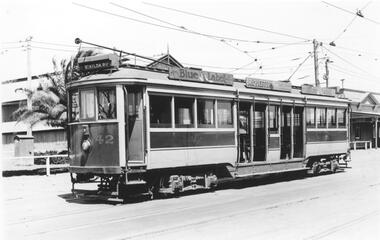 Melbourne Tram Museum
Photograph - Black & White Photograph/s, Lee A Ratten, late 1920's?
... VR tramcar 42 built at VR Newport Workshops as one of 4 air brake equipped bogie drop centre trams (40-43) and entered service at Elwood Depot in 1923. ...VR tramcar 42 built at VR Newport Workshops as one of 4 air brake equipped bogie drop centre trams (40-43) and entered service at Elwood Depot in 1923. ...Black and white photograph of VR tramcar 42 at Elwood Depot in St Kilda St. VR tramcar 42 built at VR Newport Workshops as one of 4 air brake equipped bogie drop centre trams (40-43) and entered service at Elwood Depot in 1923. Operated by VR on the St Kilda to Brighton broad-gauge line until it was scrapped in 1957. Tramcar 42 operated the last service on the Brighton Beach to Park Street Middle Brighton, on 1 January 1956. Tram has the destination of St Kilda Station. Advertising includes "Blue Label" and "Briquettes"trams, tramways, elwood depot, vr class tramcars, vr photos, vr trams, st kilda brighton, tram 42 -
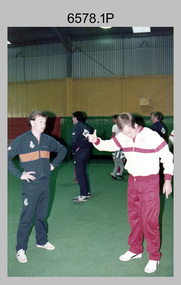 Bendigo Military Museum
Photograph - Continuous Indoor Cricket World Record Attempt, Seymour, Victoria, 1986
... The event was held at the Seymour Indoor Cricket Centre, an iron-roofed building with no air-conditioning, and all players had to battle the effect of the stifling heat in addition to fatigue. One player dropped...The event was held at the Seymour Indoor Cricket Centre, an iron-roofed building with no air-conditioning, and all players had to battle the effect of the stifling heat in addition to fatigue. One player dropped ...This is a set of 12 photographs of Army teams from the Army Survey Regiment, Bendigo and the Army School of Transport, Puckapunyal attempting a world record playing indoor cricket, at Seymour Victoria from the 31st of January to the 5th of February 1986. The following article appeared on the back page of the ARMY Newspaper on Thursday 6th of March 1986. 'INDOOR CRICKET RECORD SMASHED. ARMY TEAMS from Puckapunyal and Bendigo recently played indoor cricket for 124 hours to set a new world record. The two eight-man teams, from Army School of Transport and Army Survey Regiment, broke the 120 hour record set by Corrimal High School, NSW earlier this year. Organiser of the event, Capt Marty Alsford of AST told ARMY the teams had played 107 games, scoring 15,000 runs in their chase for the record. "The rules allowed a five-minute rest break every hour which could be accrued, so we played for 64 hours straight then had a five hour sleep. "When everybody got up and went straight back into the game with no grumbling, I knew we had the record," Capt Alsford said. The event was held at the Seymour Indoor Cricket Centre, an iron-roofed building with no air-conditioning, and all players had to battle the effect of the stifling heat in addition to fatigue. One player dropped out through exhaustion, but this did not prejudice the record attempt as the rules permitted each team to lose a player who cannot return to the game nor be replaced. The Army teams' effort are now awaiting recognition by the Guinness Book of Records. During the marathon event, the soldiers raised money for Legacy, through sponsorships and a raffle. At the time ARMY went to press, the final figure was not available.’ Army Survey Regiment Routine Orders Part 1 Issue No 16/86 Notices on Page 7 stated: ‘World Record Indoor Cricket. 1. Congratulations to the following members for their successful attempt on the Guinness Book of Records, Record for continuous playing of indoor cricket: John Whaling, Peter Ball, Brenton McDonald, Per Andersen, John Anderson, Brian Fauth, Brett McAllister and Daryl South. 2. Our team, playing a team from Army School of Transport at Seymour played continuous Indoor Cricket for 124 hours, beating the existing record by 4 hours. During that time the two teams amassed a total in excess of 16,000 runs. 3. Congratulations also to Peter Ball for picking up the Trophy for the most outstanding player during the record attempt.’This is a set of 12 photographs of Army teams from Bendigo and Puckapunyal attempting a world record playing indoor cricket, at Seymour Victoria in February 1986. The photographs were printed on photographic paper and are part of the Army Survey Regiment’s Collection. The colour photographs were scanned at 300 dpi. .1) - Photo, colour, 1986, L to R: John ‘Junior’ Whaling, Marty Alsford. Background L to R: Peter Ball, unidentified, John ‘Flash’ Anderson. .2) - Photo, colour, 1986, L to R: John ‘Junior’ Whaling, unidentified, Peter Ball. .3) to .7) - Photo, colour, 1986, unidentified participants. .8) - Photo, colour, 1986, L to R: unidentified, Peter Ball, Brett McAllister, John ‘Junior’ Whaling. .9) - Photo, colour, 1986, L to R: unidentified, John ‘Flash’ Anderson, Brian Fauth, unidentified, Peter Ball, unidentified (x2). .10) - Photo, colour, 1986, Army School of Transport (red & white uniform) - back row L to R: unidentified (x4), front row L to R: unidentified (x3), Marty Alsford. Army Survey Regiment (dark green uniform) - back row L to R: Brett McAllister, John ‘Flash’ Anderson, Brian Fauth, Per Andersen, front row L to R: John ‘Junior’ Whaling, Daryl South, Brenton McDonald, Peter Ball. .11) & .12) - Photo, colour, 1986, Army Survey Regiment (dark green uniform) - back row L to R: Peter Ball, Per Andersen, Brett McAllister, Brian Fauth, front row L to R: Brenton McDonald, John ‘Flash’ Anderson, Daryl South, John ‘Junior’ Whaling..1P to .12P –No personnel are identified. ‘Attempt at World Record for Indoor Cricket 31 Jan - 5 Feb 1986’ annotated on cover sleeve.royal australian survey corps, rasvy, army survey regiment, army svy regt, fortuna -
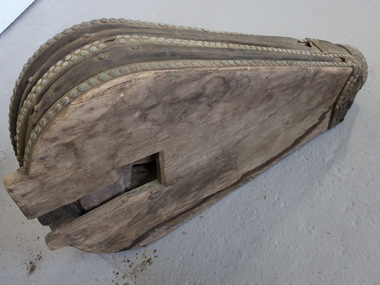 Kiewa Valley Historical Society
Blacksmith's Bellows
... drop' - narrow at one end and broad at the other. The wood is held by strips of wood and leather bound and placed around the perimeter. The wood on the top side has inscriptions (illegible). The wood on the bottom side has a rectangular hole. The narrow end feeds into a pipe to enable the fire to receive a hot blast of air...air blast. 2. burning charcoal (not wood). Bellows were used to make tools, fix equipment including machinery, drays, carriages, harnesses etc. Farmers in the Kiewa Valley often had their blacksmith forge. They made their own tools, were able to mend equipment, drays etc., gates, and most items that were made of iron and steel. blackmiths bellows double acting bellow Illegible Large Double Acting bellow with wooden top and bottom, shaped like a 'water drop' - narrow at one end and broad at the other. ...In the Middle Ages double-acting bellows was introduced. It had 2 parts, one operated by hand or foot, the other took air from it and was weighted so it forced air out while the part was filling. Blacksmithing is the shaping of hot iron and steel, usually by hammering. Very hot fires were produced by 1.a hot air blast. 2. burning charcoal (not wood). Bellows were used to make tools, fix equipment including machinery, drays, carriages, harnesses etc. Farmers in the Kiewa Valley often had their blacksmith forge. They made their own tools, were able to mend equipment, drays etc., gates, and most items that were made of iron and steel.Large Double Acting bellow with wooden top and bottom, shaped like a 'water drop' - narrow at one end and broad at the other. The wood is held by strips of wood and leather bound and placed around the perimeter. The wood on the top side has inscriptions (illegible). The wood on the bottom side has a rectangular hole. The narrow end feeds into a pipe to enable the fire to receive a hot blast of air. When the bellow is squeezed it allows both pieces of wood to be pushed together.Illegibleblackmiths, bellows, double acting bellow -
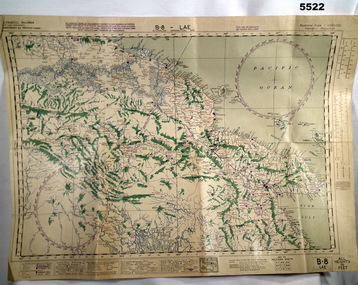 Bendigo Military Museum
Map - AERONAUTICAL MAP of LAE AREA, RAAF et al, Aug 1944
... dropped at Nadzab. the enemy track heading NW up to Dumpu. Then movements around Astrolab Bay This map is on heavy paper. it is coloured and on one side only. Scale 1:1,000,000. The top centre is the Ramu Valley. Right side is Finchafen, bottom town is south of Salamaw. Map AERONAUTICAL MAP of LAE AREA RAAF US Army/ Air ...Refer to Cat 5547 for Matheson.This map is on heavy paper. it is coloured and on one side only. Scale 1:1,000,000. The top centre is the Ramu Valley. Right side is Finchafen, bottom town is south of Salamaw.It shows in pencil where ...were dropped at Nadzab. the enemy track heading NW up to Dumpu. Then movements around Astrolab Bayww2, new guinea, map -
 Lara RSL Sub Branch
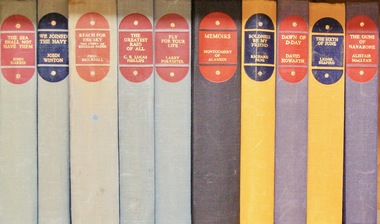
Book, Dawn of D Day, 1959
... ...air drop...Historical recount of D-Day landings and subsequent battles wwii d day battle of normandy air drop american air drop canadian troops french civilians invasion fleet paratroopers juno beach invasion beaches dropping zones utah beach omaha beach Hardcover - dark blue Front Back and spine. ...This book was issued in 1960 and is an impression of the experience of the men who landed in the light of dawn on D Day. An impression of what it was like to be dropped from the sky at morning or ship to shore from a landing craft under fire.Historical recount of D-Day landings and subsequent battlesHardcover - dark blue Front Back and spine. The spine has the title printed. Inside front and back cover have illustrated maps by Charles Green. Photographs, maps and illustrations.wwii, d day, battle of normandy, air drop, american air drop, canadian troops, french civilians, invasion fleet, paratroopers, juno beach, invasion beaches, dropping zones, utah beach, omaha beach -
 Frankston RSL Sub Branch
Drift Recorder, W & G, A M Drift Recorder MKII, 1930 - 1939
... "Air resistance acting on a bomb after release caused it to lag behind the drop point and hit somewhere behind the bomber. ..."Air resistance acting on a bomb after release caused it to lag behind the drop point and hit somewhere behind the bomber. ...Purpose built mechanical calculation machine for determining the drift of aircraft when operating in crosswind conditions. This device has an eyepiece and a prismatic periscope for viewing a distant feature being tracked. This device has calibrated rotary scales for height, speed (in KNOTS and MPH), and an adjustment to preset the 'crab angle' of the aircaft for cross wind compensation. The device can be opened for cleaning or maintenance purposes. Refer to the following extracts for information about bomb drift: "Crosswinds brought into the bombing problem a new factor, "drift" In order to fly a given ground track in a crosswind, an aircraft had to "crab" into the wind; the angle formed between the aircraft's true heading and its ground track was called the "drift angle" In a crosswind, the bomb would impact directly behind the aircraft and along its longitudinal axis at the moment of release. But this meant that the bomb would strike the ground at some point downwind of the aircraft's ground track. Thus, in order to score a hit, the bomber had to fly a ground track that ran upwind of the target." "Air resistance acting on a bomb after release caused it to lag behind the drop point and hit somewhere behind the bomber. The distance from a point beneath the aircraft at the instant of bomb impact to the point of bomb impact was called "trail." Trail increased as the bomber's airspeed increased or as its altitude increased. Furthermore, since different bombs encountered different resistance in the air, trail was also a factor of bomb shape."A. M. Drift Recorder MKII REF. No 6B/190 No 2668/41 X/ 3606 3E4H28 -
 Montmorency–Eltham RSL Sub Branch
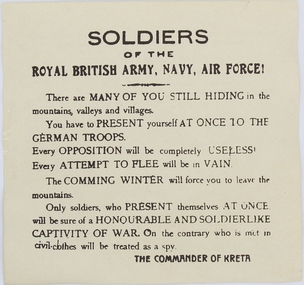
Pamphlet - German Propaganda Leaflet dropped on Crete, May 1941, World War 2. 1941
... world war two, leaflet, propaganda, air drop...Montmorency–Eltham RSL Sub Branch Petrie Park 16 Mountain View Road Montmorency melbourne Leaflet dropped from German aircraft on to troops of the Royal army in Crete in May - June 1941 The propaganda leaflets were designed to lower moral of defending troops. world war two, leaflet, propaganda, air drop Printed on leaflet “Soldiers of the ROYAL BRITISH ARMY, NAVY, AIR FORCE! ...Leaflet dropped from German aircraft on to troops of the Royal army in Crete in May - June 1941 The propaganda leaflets were designed to lower moral of defending troops.Printed LeafletPrinted on leaflet “Soldiers of the ROYAL BRITISH ARMY, NAVY, AIR FORCE! There are MANY OF YOU STILL HIDING in the mountains, valleys and villages. You have to PRESENT yourself AT ONCE TO THE GERMAN TROOPS. Every opposition will be completely USELESS. Every ATTEMPT TO FLEE will be in vain. The COMING WINTER will force you to leave the mountains. Only soldiers, who present themselves AT ONCE will be sure of a HONOURABLE AND SOLDIERLIKE CAPTIVITY OF WAR. On the cntrary who is met in civil-clothes will be treated as a spy. THE COMMANDER OF CRETE On the reverse side of the leaflet is writing in the Greek language and also writing in English indicating that the leaflet was issued by the “GERMAN HIGH COMMAND OF CRETE”, MAY - JUNE 1941world war two, leaflet, propaganda, air drop -
 Running Rabbits Military Museum operated by the Upwey Belgrave RSL Sub Branch
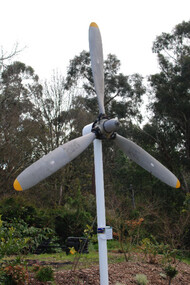
Propeller for a DHC-4 Caribou light transport
... It was the last piston-engined aircraft in the Air Force and was our only aircraft to employ the Low Altitude Parachute Extraction System (LAPES), where up to 2000kg of sled-mounted cargo is extracted from the aircraft by a parachute from a metre above the ground. The Caribou is equipped with GPS satellite navigation and night-vision equipment, giving it the capability to operate in any weather, day or night, to either land or drop soldiers and equipment by parachute with pinpoint accuracy. ...DHC-4 Caribou light transport The Royal Australian Air Force DHC-4 Caribou was a versatile tactical light transport aircraft . Its main operational role was tactical air transport in support of the Australian Army. The Caribou was last operated by No 38 Squadron from RAAF Base Townsville in December 2009. The Caribou is a twin-engined high-wing monoplane with full-span double-slotted Fowler flaps and fully-reversible propellers, which allow it to achieve its trademark steep approach with very short take-offs and landings on unprepared runways. The high wing and distinctive high placement of the tail provide easy access to a large cargo compartment, while the low-pressure tyres permit operation on unprepared runways. It was the last piston-engined aircraft in the Air Force and was our only aircraft to employ the Low Altitude Parachute Extraction System (LAPES), where up to 2000kg of sled-mounted cargo is extracted from the aircraft by a parachute from a metre above the ground. The Caribou is equipped with GPS satellite navigation and night-vision equipment, giving it the capability to operate in any weather, day or night, to either land or drop soldiers and equipment by parachute with pinpoint accuracy. The Caribou is not pressurised and is not fitted with auto-pilot or weather radar. The first Caribou arrived in Australia in April 1964 and they were deployed to Vietnam from July 1964 to February 1972 and carried over 600,000 passengers and a huge quantity of cargo while they were there. Since 1997 the Caribou participated in famine-relief operations in Papua New Guinea and Irian Jaya during Operations SIERRA, PLES DRAI and AUSINDO JAYA, as well as the tsunami-relief operation in PNG in 1999 and operations in East Timor and the Solomon Islands since 1999. Their service life was over 40 years. raaf caribou aircraft -
 Monbulk RSL Sub Branch
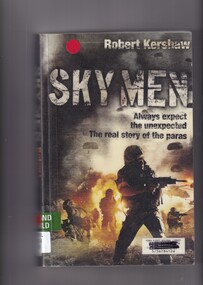
Book, Robert Kershaw, Sky men: The real story of the paras, 2010
... Monbulk RSL Sub Branch 48 Main Road Monbulk yarra-valley-and-the-dandenong-ranges great britain - history - military great britain - parachute regiment From the 1930s through WWII to Afghanistan today, from total war to counterinsurgency, this history unravels and defines the intangible qualities that differentiate the "Sky Men" from other soldiers Seventy years ago the Parachute Regiment was formed - the army's elite air assault force was tough, well-trained, and designed to fight hazardous operations behind enemy lines with little or no backup. Dropping ...From the 1930s through WWII to Afghanistan today, from total war to counterinsurgency, this history unravels and defines the intangible qualities that differentiate the "Sky Men" from other soldiers Seventy years ago the Parachute Regiment was formed - the army's elite air assault force was tough, well-trained, and designed to fight hazardous operations behind enemy lines with little or no backup. Dropping into the middle of enemy territory, these "Sky Men"- British, American, German, and Russian soldiers - engage in gruelling combat in the most dangerous conflict zones around the world. Ex-Parachute Regiment officer Robert Kershaw reveals the history of these airborne forces and their role during the most dramatic battles of the 20th century. He finds out what drives a "Sky Man" to take these extraordinary risks, and what marks these sky warriors out from ordinary soldiers. How do military paratroopers conquer the fear of jumping from aircraft at low level, by night, and frequently under fire? Has the helicopter replaced the need for parachutists in the 21st Century? Has the increasing lethality of anti-aircraft weapons made the airborne option redundant? These issues are examined alongside the personal experiences of the Soviet "Locust Warriors," German Fallschirmjäger, British Red Devils, American "devils in baggy-pants," and Les Paras. Based on letters, diaries, and exclusive interviews with soldiers from around the world, this book is full of vivid personalities and nail-biting action.Index, bibliography, notes, ill (b/w), p.348.From the 1930s through WWII to Afghanistan today, from total war to counterinsurgency, this history unravels and defines the intangible qualities that differentiate the "Sky Men" from other soldiers Seventy years ago the Parachute Regiment was formed - the army's elite air assault force was tough, well-trained, and designed to fight hazardous operations behind enemy lines with little or no backup. Dropping into the middle of enemy territory, these "Sky Men"- British, American, German, and Russian soldiers - engage in gruelling combat in the most dangerous conflict zones around the world. Ex-Parachute Regiment officer Robert Kershaw reveals the history of these airborne forces and their role during the most dramatic battles of the 20th century. He finds out what drives a "Sky Man" to take these extraordinary risks, and what marks these sky warriors out from ordinary soldiers. How do military paratroopers conquer the fear of jumping from aircraft at low level, by night, and frequently under fire? Has the helicopter replaced the need for parachutists in the 21st Century? Has the increasing lethality of anti-aircraft weapons made the airborne option redundant? These issues are examined alongside the personal experiences of the Soviet "Locust Warriors," German Fallschirmjäger, British Red Devils, American "devils in baggy-pants," and Les Paras. Based on letters, diaries, and exclusive interviews with soldiers from around the world, this book is full of vivid personalities and nail-biting action.great britain - history - military, great britain - parachute regiment -
 Monbulk RSL Sub Branch
Book, Penguin, The Berlin raids : RAF Bomber Command winter 1943-44, 1990
... Monbulk RSL Sub Branch 48 Main Road Monbulk yarra-valley-and-the-dandenong-ranges World war 1939 – 1945 – Aerial operations - Britain Royal Air Force - Bomber Command Between August 1943 and March 1944 the RAF dropped over 30,000 tons of bombs on Belin in an attempt to end the war by flattening Germany's capital. ...Between August 1943 and March 1944 the RAF dropped over 30,000 tons of bombs on Belin in an attempt to end the war by flattening Germany's capital.Index, bibliography, ill, maps, p.407.non-fictionBetween August 1943 and March 1944 the RAF dropped over 30,000 tons of bombs on Belin in an attempt to end the war by flattening Germany's capital.world war 1939 – 1945 – aerial operations - britain, royal air force - bomber command -
 Bendigo Historical Society Inc.
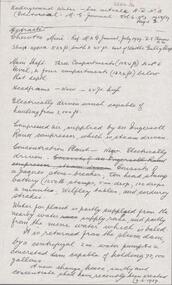
Document - ALBERT RICHARDSON COLLECTION: CHEWTON MINE
... Chewton Mine shaft approx 523 feet, south and 45 feet east of Wattle Gully shaft. .Extract includes detail of the main shaft, headframe, winch, compressed air, concentration plant, water for plant. Ten head stamp battery, 1250 lb stamps 5 in drop, 100 drops a minute, Wilfley tables and corduroy strakes. ...Chewton Mine shaft approx 523 feet, south and 45 feet east of Wattle Gully shaft. .Extract includes detail of the main shaft, headframe, winch, compressed air, concentration plant, water for plant. Ten head stamp battery, 1250 lb stamps 5 in drop, 100 drops a minute, Wilfley tables and corduroy strakes. ...One page document, extracts from M.G. Journal Vol 6, No. 3, 1958/59, Page 3 and M.G. Journal 1939. Chewton Mine shaft approx 523 feet, south and 45 feet east of Wattle Gully shaft. .Extract includes detail of the main shaft, headframe, winch, compressed air, concentration plant, water for plant. Ten head stamp battery, 1250 lb stamps 5 in drop, 100 drops a minute, Wilfley tables and corduroy strakes. A new change house, smithy and concentrate shed have recently been erected (9.6.1939)bendigo, mining, chewton gold mine -
 Flagstaff Hill Maritime Museum and Village
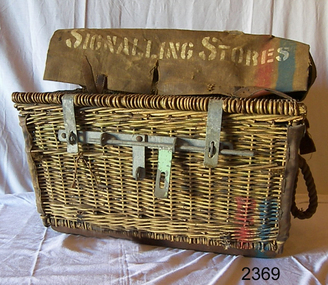
Equipment - Wicker Basket
... dropped from aircraft, fired from rocket or artillery, or deployed by flare guns or hand held percussive tubes. Signalling flares have been in use by all branches of the military services since the 1920s also by the maritime services to signal other ships or for distress purposes. The earliest recorded use of gunpowder for signalling purposes was the 'signal bomb' used by the Chinese Song Dynasty as the Mongol-led Yuan Dynasty besieged Yangzhou in 1276. These soft-shelled bombs, timed to explode in mid-air...dropped from aircraft, fired from rocket or artillery, or deployed by flare guns or hand held percussive tubes. Signalling flares have been in use by all branches of the military services since the 1920s also by the maritime services to signal other ships or for distress purposes. The earliest recorded use of gunpowder for signalling purposes was the 'signal bomb' used by the Chinese Song Dynasty as the Mongol-led Yuan Dynasty besieged Yangzhou in 1276. These soft-shelled bombs, timed to explode in mid-air ...A flare, also sometimes called a fusee, is a type of pyrotechnic that produces a bright light or intense heat without an explosion. Flares are used for distress signalling, illumination, communication or defensive countermeasures in civilian and military applications. Flares may be ground pyrotechnics, projectile pyrotechnics, or parachute-suspended to provide maximum illumination time over a large area. Projectile pyrotechnics may be dropped from aircraft, fired from rocket or artillery, or deployed by flare guns or hand held percussive tubes. Signalling flares have been in use by all branches of the military services since the 1920s also by the maritime services to signal other ships or for distress purposes. The earliest recorded use of gunpowder for signalling purposes was the 'signal bomb' used by the Chinese Song Dynasty as the Mongol-led Yuan Dynasty besieged Yangzhou in 1276. These soft-shelled bombs, timed to explode in mid-air, were used to send messages to a detachment of troops far in the distance. Another mention of the signal bomb appears in a text dating from 1293 requesting their collection from those still stored in Zhejiang. A signal gun appears in Korea by 1600. The (Wu I Thu Phu Thung Chih or Illustrated Military Encyclopedia) written in 1791 depicts a signal gun in an illustration. The item was used to carry and store flares for signalling use as the inscription on the canvas cover suggests. Given the method of storing flares is in a wicker basket that is non conducting of an electrical charge that may accidentally set of explosive materials. The writer assumes the basket was used from the early 20th century and most likely by maritime or military services to store it's flares.Basket cane square with metal locks & rope handles each end. Canvas reinforced on vertical sides with a canvas cover on top. Canvas cover has leather straps. Stencilled on canvas in white paint "SIGNALLING STORES" flagstaff hill, warrnambool, shipwrecked-coast, flagstaff-hill, flagstaff-hill-maritime-museum, maritime-museum, shipwreck-coast, flagstaff-hill-maritime-village, basket, cane basket, signalling stores -
 Ballarat Tramway Museum
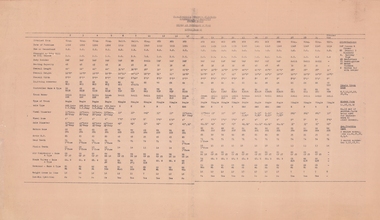
Document - List, State Electricity Commission of Victoria (SECV), "Numbers and Particulars of Trams" - Bendigo, c1964
... Gives details for each tram at that time, where from, date of purchase, New or second hand (all ), Straight or drop sill or drop centre, Body builder, Seating capacity, overall length, overall height, overall width, Lightning arrester, controller make and type, Truck Maker and type, type of truck, axle type, wheel diameters, wheel base, axle diameter, motors type and maker, Motor horsepower, Gear Teeth, Air compressor make and type, Brake Valves make and type, Governor make and type, Weight in tons and whether suitable for one man operation. ...Ballarat Tramway Museum South Gardens Reserve Wendouree Parade Ballarat Ballarat goldfields Gives details for each tram at that time, where from, date of purchase, New or second hand (all ), Straight or drop sill or drop centre, Body builder, Seating capacity, overall length, overall height, overall width, Lightning arrester, controller make and type, Truck Maker and type, type of truck, axle type, wheel diameters, wheel base, axle diameter, motors type and maker, Motor horsepower, Gear Teeth, Air compressor make and type, Brake Valves make and type, Governor make and type, Weight in tons and whether suitable for one man operation. ...Gives details for each tram at that time, where from, date of purchase, New or second hand (all ), Straight or drop sill or drop centre, Body builder, Seating capacity, overall length, overall height, overall width, Lightning arrester, controller make and type, Truck Maker and type, type of truck, axle type, wheel diameters, wheel base, axle diameter, motors type and maker, Motor horsepower, Gear Teeth, Air compressor make and type, Brake Valves make and type, Governor make and type, Weight in tons and whether suitable for one man operation. Side list gives details of abbreviations, list of tram types and note on Birney 15. List of trams include "Cleaner Car". Undated. See item 3430 for Ballarat version and 8721 and 8722.Yields detailed information about Bendigo trams -c1964Dyeline print from a typed list.2nd copy has in ink "BTPS 613" in the top right hand corner.tramcars, bendigo, equipment, lists, data -
 City of Melbourne Libraries
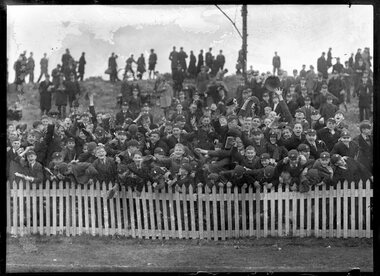
Photograph, Bull, Hugh Jones, 1897-1993, Scotch College v. Xavier College football match
... air. The player that catches the ball then gets to kick it. The ball was made from possum skin, filled with pounded charcoal and tied with kangaroo sinews. Protector of Aborigines in Victoria, William Thomas (1794-1867) observed in 1841- “The men and boys joyfully assemble when this game is to be played. One makes a ball of possum skin, somewhat elastic, but firm and strong… The players of this game do not throw the ball as a white man might do, but drop...air. The player that catches the ball then gets to kick it. The ball was made from possum skin, filled with pounded charcoal and tied with kangaroo sinews. Protector of Aborigines in Victoria, William Thomas (1794-1867) observed in 1841- “The men and boys joyfully assemble when this game is to be played. One makes a ball of possum skin, somewhat elastic, but firm and strong… The players of this game do not throw the ball as a white man might do, but drop ...Published: 29 June 1934 Published title: PUBLIC SCHOOLS FOOTBALL BEGINS WITH SCOTCH--XAVIER MATCH. Published caption: “The Public Schools 1934 Football season began yesterday when Scotch met Xavier on the Olympic Park ground, and after a wonderful recovery in the third term, Scotch registered a narrow win. Pictured above is the crowd of Scotch boys who congregated behind the goal after the addition of another goal to their score.” Description: Scotch College pupils exuberantly cheer their team’s goal at the first football match of the Public Schools Premiership and Championship for 1934 between Scotch College and Xavier College at Olympic Park, Melbourne (where AAMI Park is now). Research by project volunteer, Fiona Collyer: The Public Schools Premiership and Championship was an Australian Rules football tournament held every winter, over five weeks between six schools- Scotch College, Xavier College, Melbourne Grammar, Wesley College and traditional rivals Geelong Grammar and Geelong College. The school that won the most games out of the five played, won the competition. As the 1933 Premiers, Xavier College had the honour of playing the opening match of the season on 28 June against runners-up Scotch College at Olympic Park (where AAMI Park is now). The Public Schools Premiership matches were widely reported in Melbourne’s daily newspapers with photographs and commentary of every game. Weekly society magazine “Table Talk” featured reports and seven photographs of the first games of the season. Australian Broadcasting Commission (ABC) wireless station 3AR interspersed their afternoon program of reproduced music with detailed descriptions of the matches. Also reporting the matches was “Forty-Years-On”, presumably a student in the 1890s, whose regular column in The Herald newspaper “Activities In The Public Schools” published all the latest news on Victoria’s public (private) schools. In his column for The Australasian 7 July 1934, “Old Boy” writes about the Scotch versus Xavier match- “For more than half the game last week, Scotch was outplayed, but took the lead early in the last term and kept it. Scotch surprised even its own supporters by its dash in the last 25 minutes. Xavier, who became over confident by the prospects of victory, could not withstand the final onslaught. In the last quarter Scotch was the better side and won by seven points.” The final score was Scotch 11.11 (77 points) and Xavier 10.10 (70 points). At the end of this exciting match the overjoyed Scotch boys swarmed over the Olympic Park fences to chair their captain, Stanley Steele and carry him shoulder high, to the pavilion. The first documented game of a variation of Australian Rules football was played at Richmond Paddock (now Yarra Park) from 7 August 1858. Australian Rules football writer Hugh Buggy of The Argus 16 April 1952 explains- “It began when boys and masters of Scotch College and Melbourne Grammar School decided to play a 40-a-side game, with the first team to score two goals to be the winner. Goal posts were pitched more than a mile apart, one set on the Jolimont Hill and the other at Punt road Richmond. Nobody defined the boundary, and the play swung over the broad acres of the park and around the gum trees. It went on and on like a Test match, from noon till dusk. After 15 hours of play on three Saturdays the score was one goal all, and the game was abandoned for that season.” Rules of the game hadn’t been decided at this time - the earliest known rules were codified a year later in 1859. A sculpture and plaque located outside the Melbourne Cricket Ground (MCG), created by sculptor Louis Laumen in 2001, commemorates this game. It depicts two school boys chasing a ball along with umpire Tom Wills, a co-writer of the rules and promoter of Australian Rules football. A medley of Gaelic football, an Aboriginal game called marngrook as well as football played in English public (that is private) schools have been cited as inspiration for Australian Rules football. The word “Marngrook” meaning “game ball”, comes from the language of the Gunditjmara, First Nations people of southwestern Victoria. Marngrook was played at gatherings and celebrations and involved players competing to jump and catch the ball after it is kicked high into the air. The player that catches the ball then gets to kick it. The ball was made from possum skin, filled with pounded charcoal and tied with kangaroo sinews. Protector of Aborigines in Victoria, William Thomas (1794-1867) observed in 1841- “The men and boys joyfully assemble when this game is to be played. One makes a ball of possum skin, somewhat elastic, but firm and strong… The players of this game do not throw the ball as a white man might do, but drop it and at the same time kick it with their feet, using the instep for that purpose. The tallest men have the best chances in this game. Some of them will leap as high as five feet from the ground to catch the ball. The person who secures the ball kicks it. This continues for hours and the natives never seem to tire of the exercise.” The Victorian Football League (VFL), was founded in 1897 with eight teams playing Australian Rules football and held its first Grand Final at the MCG in 1902. From the start the games attracted large enthusiastic crowds, which included women. “Viva” writing in the Supplement to The Weekly Times-3 July 1886- LADIES COLUMN (By Viva) FOOTBALL. A Social Sketch. “…Of the popularity of football and footballers among women, there can be no doubt. Young, soft hearted girls, who would not “tread upon a worm," avow that football matches are "awfully jolly," and seem to regard accidents as a necessary part of the amusement…a great proportion of the spectators were ladies.” “Minetta” writing for Punch Magazine - “Ladies Letter, Holmby House, Toorak” 22 June 1905 “The "Football Girl" is a feminine genus at present much to the fore in Melbourne. Not that she plays football—at least not beyond a kick in the backyard or paddock—oh, dear, no! Her interest in the game is purely from a spectacular point of view. "Football Girls" usually hunt in couples, with two male barrackers attached. They know all about So-and-So's form, and whether he is a trier or has been bought. They go to each match of their particular club, and watch the play intently, their faces wearing a decidedly strained expression when their club is getting the worst of it. They are not ashamed to barrack either, when matters are progressing successfully… Yours ever, MINETTA.” The Herald 2 July 1909 published a cartoon by Ambrose Dyson depicting women football fans, which asked- “THE QUESTION OF THE DAY. Should Girls Go To Football Matches? Should they? The sex made up their mind about the matter very early on.” The resounding answer was- “Well, I’d like to see the man that would stop me!” At the final match of the 1934 tournament on August 2, Melbourne Grammar finished the season unbeaten, winning their tenth Public Schools premiership in 16 years. The Weekly Times 11 August 1934 reported-“Melbourne Grammar…had a rather lucky escape against Xavier…Had a Xavier player not touched a shot, kicked by a team-mate, as it was going through goal Grammar would have been beaten.” Final score - Melbourne Grammar 13.7 (85 points) defeated Xavier College 12.9 (81 points). Ladder for the 1934 Season- Melbourne Grammar-5 wins Wesley College- 4 wins Scotch College- 3 wins Xavier College- 2 wins Geelong Grammar- 1 win Geelong College- 0 wins The Associated Public Schools of Victoria (APS) exists today where eleven member (private) schools, including co-educational schools, participate in 21 sporting competitions throughout the year. (The descriptor “Public School” references the historical usage of the term and the model of the British public school). PUBLIC SCHOOLS FOOTBALL BEGINS WITH SCOTCH--XAVIER MATCH. (1934, June 29). The Age (Melbourne, Vic. : 1854 - 1954), p. 11. Retrieved June 18, 2025, from http://nla.gov.au/nla.news-article204824484 PUBLIC SCHOOLS FOOTBALL AT OLYMPIC PARK (1934, July 5). Table Talk (Melbourne, Vic. : 1885 - 1939), p. 5. Retrieved June 18, 2025, from http://nla.gov.au/nla.news-article149682433 PUBLIC SCHOOLS. (1934, June 29). The Age (Melbourne, Vic. : 1854 - 1954), p. 5. Retrieved June 3, 2025, from http://nla.gov.au/nla.news-article204824486 PUBLIC SCHOOLS FOOTBALL. (1936, July 3). The Argus (Melbourne, Vic. : 1848 - 1957), p. 18. Retrieved August 6, 2025, from http://nla.gov.au/nla.news-article11888301 https://en.m.wikipedia.org/wiki/History_of_Australian_rules_football COLLEGE SPORTS (1934, July 7). The Australasian (Melbourne, Vic. : 1864 - 1946), p. 48 (METROPOLITAN EDITION). Retrieved May 30, 2025, from http://nla.gov.au/nla.news-article145238393 GRAMMAR CHAMPIONS (1934, August 11). Weekly Times (Melbourne, Vic. : 1869 - 1954), p. 72. Retrieved June 1, 2025, from http://nla.gov.au/nla.news-article224562842 LETS LOOK AT FOOTBALL with HUGH BUGGY (1952, April 16). The Argus (Melbourne, Vic. : 1848 - 1957), p. 9. Retrieved June 15, 2025, from http://nla.gov.au/nla.news-article23174340 FOR YOUNG PEOPLE AMONG THE SCHOOLS. (1934, August 7). The Age (Melbourne, Vic. : 1854 - 1954), p. 4. Retrieved June 14, 2025, from http://nla.gov.au/nla.news-article205521661 https://www.nma.gov.au/defining-moments/resources/australian-rules-football#:~:text=In%20the%20winter%20of%201858,games%20of%20Australian%20Rules%20football. https://apssport.org.au/about/ http://lindsaymagazine.co/from-marngrook-to-australian-rules-football/ https://collection.australiansportsmuseum.org.au/objects/70993/possum-skin-ball FOOTBALL. (1886, July 3). Weekly Times (Melbourne, Vic. : 1869 - 1954), p. 6 (SUPPLEMENT TO THE STORY TELLER). Retrieved September 7, 2025, from http://nla.gov.au/nla.news-article221741193 Ladies' Letter. (1905, June 22). Punch (Melbourne, Vic. : 1900 - 1918; 1925), p. 28. Retrieved September 11, 2025, from http://nla.gov.au/nla.news-article175410975 THE QUESTION OF THE DAY. (1909, July 2). The Herald (Melbourne, Vic. : 1861 - 1954), p. 9. Retrieved September 17, 2025, from http://nla.gov.au/nla.news-article242062970 Photographer notations on slide: "Scotch v Xavier - Olympic Park B42".schools, football -
 City of Melbourne Libraries
Photograph, Bull, Hugh Jones, 1897-1993, Photograph, Scotch College v. Xavier College football match, 1934
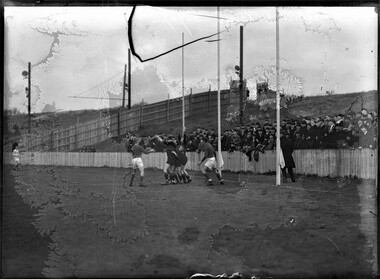
... air. The player that catches the ball then gets to kick it. The ball was made from possum skin, filled with pounded charcoal and tied with kangaroo sinews. Protector of Aborigines in Victoria, William Thomas (1794-1867) observed in 1841- “The men and boys joyfully assemble when this game is to be played. One makes a ball of possum skin, somewhat elastic, but firm and strong… The players of this game do not throw the ball as a white man might do, but drop...air. The player that catches the ball then gets to kick it. The ball was made from possum skin, filled with pounded charcoal and tied with kangaroo sinews. Protector of Aborigines in Victoria, William Thomas (1794-1867) observed in 1841- “The men and boys joyfully assemble when this game is to be played. One makes a ball of possum skin, somewhat elastic, but firm and strong… The players of this game do not throw the ball as a white man might do, but drop ...At the first match of the 1934 Public Schools Premiership and Championships at Olympic Park (where AAMI Park is now) between Scotch College (white shorts) and Xavier College, (black shorts) a mark is missed by Xavier players and then taken by a Scotch player. Research by project volunteer, Fiona Collyer: A crowd of schoolboys standing behind a picket fence, watch with anticipation as two teams contest a football at the goalposts. The Public Schools Premiership and Championship was an Australian Rules football tournament held every winter over five weeks between six schools- Scotch College, Xavier College, Melbourne Grammar, Wesley College and traditional rivals Geelong Grammar and Geelong College. The school that won the most games out of the five played, won the competition. As the 1933 Premiers, Xavier College had the honour of playing the opening match of the season on 28 June against runners-up Scotch College at Olympic Park (where AAMI Park is now). The Public Schools Premiership matches were widely reported in Melbourne’s daily newspapers with photographs and commentary of every game. Weekly society magazine “Table Talk” featured reports and seven photographs of the first games of the season. Australian Broadcasting Commission (ABC) wireless station 3AR interspersed their afternoon program of reproduced music with detailed descriptions of the matches. Also reporting the matches was “Forty-Years-On”, presumably a student in the 1890s, whose regular column in The Herald newspaper “Activities In The Public Schools” published all the latest news on Victoria’s public (private) schools. In his column for The Australasian 7 July 1934, “Old Boy” writes about the Scotch versus Xavier match: “For more than half the game last week, Scotch was outplayed, but took the lead early in the last term and kept it. Scotch surprised even its own supporters by its dash in the last 25 minutes. Xavier, who became over confident by the prospects of victory, could not withstand the final onslaught. In the last quarter Scotch was the better side and won by seven points.” The final score was Scotch 11.11 (77 points) and Xavier 10.10 (70 points). At the end of this exciting match the overjoyed Scotch boys swarmed over the Olympic Park fences to chair their captain, Stanley Steele and carry him shoulder high, to the pavilion. The first documented game of a variation of Australian Rules football was played at Richmond Paddock (now Yarra Park) from 7 August 1858. Australian Rules football writer Hugh Buggy of The Argus 16 April 1952 explains: “It began when boys and masters of Scotch College and Melbourne Grammar School decided to play a 40-a-side game, with the first team to score two goals to be the winner. Goal posts were pitched more than a mile apart, one set on the Jolimont Hill and the other at Punt road Richmond. Nobody defined the boundary, and the play swung over the broad acres of the park and around the gum trees. It went on and on like a Test match, from noon till dusk. After 15 hours of play on three Saturdays the score was one goal all, and the game was abandoned for that season.” Rules of the game hadn’t been decided at this time - the earliest known rules were codified a year later in 1859. A sculpture and plaque located outside the Melbourne Cricket Ground (MCG), created by sculptor Louis Laumen in 2001, commemorates this game. It depicts two school boys chasing a ball along with umpire Tom Wills, a co-writer of the rules and promoter of Australian Rules football. A medley of Gaelic football, an Aboriginal game called marngrook as well as football played in English public (that is private) schools have been cited as inspiration for Australian Rules football. The word “Marngrook” meaning “game ball”, comes from the language of the Gunditjmara, First Nations people of southwestern Victoria. Marngrook was played at gatherings and celebrations and involved players competing to jump and catch the ball after it was kicked high into the air. The player that catches the ball then gets to kick it. The ball was made from possum skin, filled with pounded charcoal and tied with kangaroo sinews. Protector of Aborigines in Victoria, William Thomas (1794-1867) observed in 1841- “The men and boys joyfully assemble when this game is to be played. One makes a ball of possum skin, somewhat elastic, but firm and strong… The players of this game do not throw the ball as a white man might do, but drop it and at the same time kick it with their feet, using the instep for that purpose. The tallest men have the best chances in this game. Some of them will leap as high as five feet from the ground to catch the ball. The person who secures the ball kicks it. This continues for hours and the natives never seem to tire of the exercise.” The Victorian Football League (VFL), was founded in 1897 with eight teams playing Australian Rules football and held its first Grand Final at the MCG in 1902. From the start the games attracted large enthusiastic crowds, which included women. “Viva” writing in the Supplement to The Weekly Times - 3 July 1886 LADIES COLUMN (By Viva) FOOTBALL. A Social Sketch. “…Of the popularity of football and footballers among women, there can be no doubt. Young, soft hearted girls, who would not “tread upon a worm," avow that football matches are "awfully jolly," and seem to regard accidents as a necessary part of the amusement…a great proportion of the spectators were ladies.” “Minetta” writing for Punch Magazine - “Ladies Letter, Holmby House, Toorak” 22 June 1905 “The "Football Girl" is a feminine genus at present much to the fore in Melbourne. Not that she plays football—at least not beyond a kick in the backyard or paddock—oh, dear, no! Her interest in the game is purely from a spectacular point of view. "Football Girls" usually hunt in couples, with two male barrackers attached. They know all about So-and-So's form, and whether he is a trier or has been bought. They go to each match of their particular club, and watch the play intently, their faces wearing a decidedly strained expression when their club is getting the worst of it. They are not ashamed to barrack either, when matters are progressing successfully… Yours ever, MINETTA.” The Herald 2 July 1909 published a cartoon by Ambrose Dyson depicting women football fans, which asked- “THE QUESTION OF THE DAY. Should Girls Go To Football Matches? Should they? The sex made up their mind about the matter very early on.” The resounding answer was- “Well, I’d like to see the man that would stop me!” At the final match of the 1934 tournament on August 2, Melbourne Grammar finished the season unbeaten, winning their tenth Public Schools premiership in 16 years. The Weekly Times 11 August 1934 reported-“Melbourne Grammar…had a rather lucky escape against Xavier…Had a Xavier player not touched a shot, kicked by a team-mate, as it was going through goal Grammar would have been beaten.” Final score - Melbourne Grammar 13.7 (85 points) defeated Xavier College 12.9 (81 points). Ladder for the 1934 Season- Melbourne Grammar-5 wins Wesley College- 4 wins Scotch College- 3 wins Xavier College- 2 wins Geelong Grammar- 1 win Geelong College- 0 wins The Associated Public Schools of Victoria (APS) exists today where eleven member (private) schools, including co-educational schools, participate in 21 sporting competitions throughout the year. (The descriptor “Public School” references the historical usage of the term and the model of the British public). PUBLIC SCHOOLS FOOTBALL BEGINS WITH SCOTCH--XAVIER MATCH. (1934, June 29). The Age (Melbourne, Vic. : 1854 - 1954), p. 11. Retrieved June 23, 2025, from http://nla.gov.au/nla.news-article204824484 PUBLIC SCHOOLS FOOTBALL AT OLYMPIC PARK (1934, July 5). Table Talk (Melbourne, Vic. : 1885 - 1939), p. 5. Retrieved May 30, 2025, from http://nla.gov.au/nla.news-article149682433 PUBLIC SCHOOLS FOOTBALL. (1936, July 3). The Argus (Melbourne, Vic. : 1848 - 1957), p. 18. Retrieved May 30, 2025, from http://nla.gov.au/nla.news-article11888301 PUBLIC SCHOOLS. (1934, June 29). The Age (Melbourne, Vic. : 1854 - 1954), p. 5. Retrieved August 6, 2025, from http://nla.gov.au/nla.news-article204824486 https://en.m.wikipedia.org/wiki/History_of_Australian_rules_football COLLEGE SPORTS (1934, July 7). The Australasian (Melbourne, Vic. : 1864 - 1946), p. 48 (METROPOLITAN EDITION). Retrieved August 6, 2025, from http://nla.gov.au/nla.news-article145238393 GRAMMAR CHAMPIONS (1934, August 11). Weekly Times (Melbourne, Vic. : 1869 - 1954), p. 72. Retrieved August 6, 2025, from http://nla.gov.au/nla.news-article224562842 LETS LOOK AT FOOTBALL with HUGH BUGGY (1952, April 16). The Argus (Melbourne, Vic. : 1848 - 1957), p. 9. Retrieved August 6, 2025, from http://nla.gov.au/nla.news-article23174340 FOR YOUNG PEOPLE AMONG THE SCHOOLS. (1934, August 7). The Age (Melbourne, Vic. : 1854 - 1954), p. 4. Retrieved August 6, 2025, from http://nla.gov.au/nla.news-article205521661 https://www.nma.gov.au/defining-moments/resources/australian-rules-football#:~:text=In%20the%20winter%20of%201858,games%20of%20Australian%20Rules%20football. https://apssport.org.au/about/ http://lindsaymagazine.co/from-marngrook-to-australian-rules-football/ https://collection.australiansportsmuseum.org.au/objects/70993/possum-skin-ball FOOTBALL. (1886, July 3). Weekly Times (Melbourne, Vic. : 1869 - 1954), p. 6 (SUPPLEMENT TO THE STORY TELLER). Retrieved September 7, 2025, from http://nla.gov.au/nla.news-article221741193 Ladies' Letter. (1905, June 22). Punch (Melbourne, Vic. : 1900 - 1918; 1925), p. 28. Retrieved September 22, 2025, from http://nla.gov.au/nla.news-article175410975 THE QUESTION OF THE DAY. (1909, July 2). The Herald (Melbourne, Vic. : 1861 - 1954), p. 9. Retrieved September 22, 2025, from http://nla.gov.au/nla.news-article242062970Photographer notations on slide: "Scotch v. Xavier - Olympic Park B42".football, schools -
 Bendigo Military Museum
Equipment - CARGO PARACHUTE, Unknown
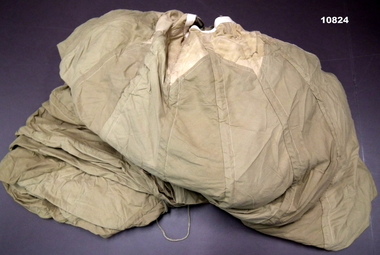
... Air Drop supplies...Air Drop supplies Parachute Equipment This parachute is made out of a cotton like material, colour khaki. ...This parachute is made out of a cotton like material, colour khaki. It has risers made from a natural fibre that has a soft texture. Riser diameter is about 5mm. The top circular hole is about 76 cm diameter. That hole has 24 short cross cords - 5mm cord. The parachute diameter, when laid out is about 6.1 metres.air drop supplies, parachute, equipment -
 Geoffrey Kaye Museum of Anaesthetic History
Equipment - Mask, Yankauer, c. 1904
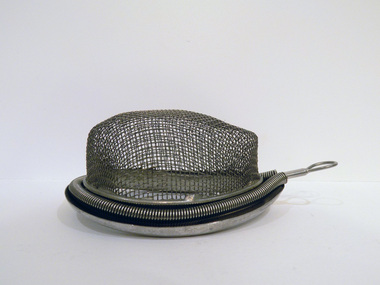
... drop method involved placing the mask over the patient’s nose and mouth, and then placing gauze over the mesh of the mask. Next, liquid anaesthetic, such as ether or chloroform, was applied in drops or lightly poured onto the gauze so that the patient breathed in evaporated anesthetic as well as air. ...drop method involved placing the mask over the patient’s nose and mouth, and then placing gauze over the mesh of the mask. Next, liquid anaesthetic, such as ether or chloroform, was applied in drops or lightly poured onto the gauze so that the patient breathed in evaporated anesthetic as well as air. ...Sidney Yankauer, M.D. (1872-1932), an ear, nose and throat specialist and pioneer in bronchoscopy, practiced at the Mount Sinai Hospital in New York. Dr. Yankauer, a prolific inventor of medical equipment, might best be known for the tube he designed for suctioning the mouth and throat. Yankauer introduced the wire-mesh anaesthesia mask around 1904. The drop method involved placing the mask over the patient’s nose and mouth, and then placing gauze over the mesh of the mask. Next, liquid anaesthetic, such as ether or chloroform, was applied in drops or lightly poured onto the gauze so that the patient breathed in evaporated anesthetic as well as air. The gutter around the base of the mask was designed to catch any residue of the harmful anaesthetic. (The Wood Library Museum, 2016; Museum of Healthcare Kingston, 2016)A metal tear-shaped mask with gauze wire dome, gutter around the base and detachable spring piece with open circular handle to secure cloth over gauze. Found inside medical carry box #899Stamped underneath neck of circular handle: HATRICKdr [e.s.] holloway, hatrick, yankauer, drop method, mask, gauze -
 National Vietnam Veterans Museum (NVVM)
Photograph, Gibbons, Denis, Paradrop Explosion
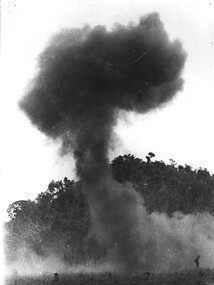
... Air Force U.S. Forces Denis Gibbons A black and white photograph of a pallet load of 105mm artillery amunition explodes on impact with the ground after being dropped from an RAAF 35 Squadron Caribou aircraft. ...Denis Gibbons (1937 – 2011) Trained with the Australian Army, before travelling to Vietnam in January 1966, Denis stayed with the 1st Australian Task Force in Nui Dat working as a photographer. For almost five years Gibbons toured with nine Australian infantry battalions, posting compelling war images from within many combat zones before being flown out in late November 1970 after sustaining injuries. The images held within the National Vietnam Veterans Museum make up the Gibbons Collection.A black and white photograph of a pallet load of 105mm artillery amunition explodes on impact with the ground after being dropped from an RAAF 35 Squadron Caribou aircraft. All the pallets exploded when their U.S. Forces parachutes failed to open.photograph, caribou, raaf, 35 squadron, gibbons collection catalogue, 105mm artillery, paradrop, royal australian air force, u.s. forces, denis gibbons -
 National Vietnam Veterans Museum (NVVM)
Photograph, Air Power
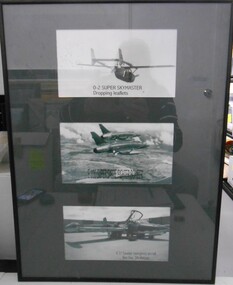
... Three black and white Photograph of US Air Force Aircraft. Top - 0-2 Super Skymaster dropping leaflets Middle - F100 Super Sabre Fighter Bombers Bottom - A 37 Counter Insurgency Aircraft on the ground at Ben Hoa...Air Force Ben Hoa F-100 Three black and white Photograph of US Air Force Aircraft. Top - 0-2 Super Skymaster dropping leaflets Middle - F100 Super Sabre Fighter Bombers Bottom - A 37 Counter Insurgency Aircraft on the ground at Ben Hoa Air Power Photograph Photograph ...Three black and white Photograph of US Air Force Aircraft. Top - 0-2 Super Skymaster dropping leaflets Middle - F100 Super Sabre Fighter Bombers Bottom - A 37 Counter Insurgency Aircraft on the ground at Ben Hoaphotograph, planes, united states. air force, ben hoa, f-100 -
 Wangaratta RSL Sub Branch
Work on paper - Envelope Art
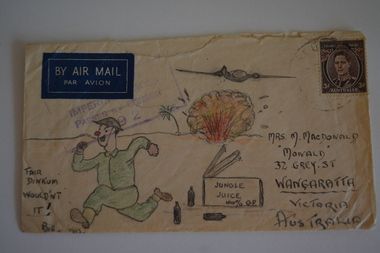
... Even though the Battation was disbanded in 1946 members and their families return each year, in November, for a commemorative service at the 2/24th Battalion Memorial Wall at the Wangaratta Cemetery. ww2 envelope art Top left - AIR MAIL Top right - postage stamp Left side - AIF Censor stamp Right side Mrs M MacDonald "Monald" 32 Grey Street Wangaratta Victoria Australia Bottom left- "Fair Dinkum Wouldn't it!" Box - "Jungle Juice 100% OP' Cream paper envelope with coloured sketch of soldier running away from aircraft dropping bombs. ...One of several illustrated envelopes, without letter, sketched by soldier/s during the second world war and sent to Mrs MacDonald of WangarattaVictoria's 2/24th Infantry Battalion was raised in Wangaratta in July 1940. They were welcomed with open arms by the local community as they rapidly built up their numbers. The people of Wangaratta adopted the Battalion and they became known as "Wangaratta's Own" because of the time the battalion spent in the town during its formative period prior to deployment overseas. Many of the soldiers maintained life long friendships with the people of Wangaratta. Even though the Battation was disbanded in 1946 members and their families return each year, in November, for a commemorative service at the 2/24th Battalion Memorial Wall at the Wangaratta Cemetery.Cream paper envelope with coloured sketch of soldier running away from aircraft dropping bombs. Box and bottles in foreground.Top left - AIR MAIL Top right - postage stamp Left side - AIF Censor stamp Right side Mrs M MacDonald "Monald" 32 Grey Street Wangaratta Victoria Australia Bottom left- "Fair Dinkum Wouldn't it!" Box - "Jungle Juice 100% OP' ww2, envelope art -
 Diamond Valley Vietnam Veterans Sub-Branch
Print - TBA, n//a, c2002
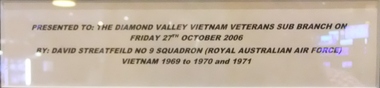
... drop off by the helicopters; in this case it is a pickup ('dustoff') of xxx section, yyy platoon, mmm Company. Especially for infantry, the picture captures the moment of accepting a dustoff at the end of, or during, an operation. vietnam vietnam war diamond valley vietnam veterans sub branch Presented to: The Diamond Valley Vietnam Veterans Sub Branch on Friday 27th October 2006. By: David Streatfeild No. 9 Squadron (Royal Australian Airforce); Vietnam 1969 1970 and 1971. Centrally below the picture and columned vertically: Dustoff (CASEVAC Vietnam), by Brian Wood; Royal Australian Air ...Picture depicts a frequent activity of infantry in Vietnam - either waiting for pickup by Huey helicopters or having a drop off by the helicopters; in this case it is a pickup ('dustoff') of xxx section, yyy platoon, mmm Company.Especially for infantry, the picture captures the moment of accepting a dustoff at the end of, or during, an operation.Rectangular print 'Dustoff' in a wooden frame; this is an iconic picture out of the Vietnam war Presented to: The Diamond Valley Vietnam Veterans Sub Branch on Friday 27th October 2006. By: David Streatfeild No. 9 Squadron (Royal Australian Airforce); Vietnam 1969 1970 and 1971. Centrally below the picture and columned vertically: Dustoff (CASEVAC Vietnam), by Brian Wood; Royal Australian Air Force insignia; Rising Sun insignia with scroll: The Australian Army. Signatures by: The Hon. Graham Edwards, Member of Parliament; The Hon. Tim Fischer, Member of Parliament; W.B. "Digger" Jam,es AC, MBE, MC, Major General (ret'd); Keith Payne VC, Warrant Officer Class 2 (ret'd); Brian Wood 4 RAR 70/71vietnam, vietnam war, diamond valley vietnam veterans sub branch -
 Melbourne Tram Museum
Photograph - Set of 2 Black & White Photograph/s, LWR, c1920
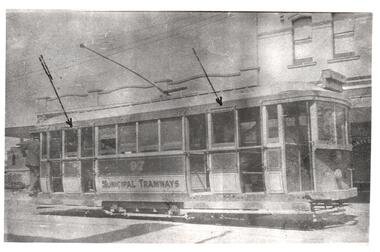
... drop bar latches appear. These were apparently unique to this class of tram. .1 - K class No. 100 - probably about 1920. Note the twin trolley poles on this single truck car when new. This car also apparently entered service with air...drop bar latches appear. These were apparently unique to this class of tram. .1 - K class No. 100 - probably about 1920. Note the twin trolley poles on this single truck car when new. This car also apparently entered service with air ...Set of two copy photographs. Photograph, Black and White of MMTB trams. Both photographs have arrows drawn on them pointing to the top of the cross bench seating windows where the unique drop bar latches appear. These were apparently unique to this class of tram. .1 - K class No. 100 - probably about 1920. Note the twin trolley poles on this single truck car when new. This car also apparently entered service with air brakes. .2 - K class No. 97 - probably about 1920. Photo taken in Glenferrie Road Malvern at High Street. Keith has noted on both prints the in-service dates, though the MMTB had taken over around that time, both painted with "Municipal Tramways" lettering.In ink on the rear: .1 -" Melbourne K97 - probably about 1920 - In service 3.3.1920, with "Municipal Tramways" lettering though M&MTB formed 1.11.1919. No magnetic track brakes." .2 - "as above except for K100 and in service date of 25.12.1919. Has KSK number LWR8 and LWR9 respectively into right hand corner.trams, tramways, k class, pmtt, livery, tram 97, tram 100, trolley poles, mmtb, malvern, glenferrie road -
 Trafalgar Holden Museum
Vehicle - Chevrolet YGM Concept, 1999
... Air scoop on bonnet matt chrome roof racks, Fog lights, 5 spoke steel wheels, tear drop headlight cluster. ...Air scoop on bonnet matt chrome roof racks, Fog lights, 5 spoke steel wheels, tear drop headlight cluster. ...Designed by a team of engineers in the GM Australian branch, Holden, under the leadership of Peter Hughes. The YGM=1 was built by a GM alliance partner, Suzuki, and was badged a Holden Cruze in AustraliaDesigned in Australia at the design department of Holden.Burgundy coloured 5 door mini SUV. Air scoop on bonnet matt chrome roof racks, Fog lights, 5 spoke steel wheels, tear drop headlight cluster. Rear window cluster holding all rear facing lights.Chevrolet badge front grille centreholden, chevrolet, s.u.v -
 National Vietnam Veterans Museum (NVVM)
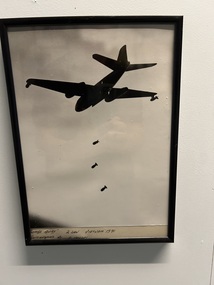
Photograph - A Framed Black and White Photograph of, Bombs Away - 2 Sqn Vietnam 1970, 1970
... 2 Squadron RAAF Bombs RAAF Royal Australian Air Force Photograph 2 Sqn, Vietnam 1970. Black and white photograph in a black frame of an aircraft dropping three bombs. ...Black and white photograph in a black frame of an aircraft dropping three bombs. The name of the photographer is not readable.2 Sqn, Vietnam 1970.2 squadron raaf, bombs, raaf, royal australian air force, photograph -
Moorabbin Air Museum
Photograph (Item) - Boomerang CAC A46 - photos, drawings & magazine articles & Plywood drop tanks
... Moorabbin Air Museum Moorabbin Airport 12 First Street Moorabbin melbourne Boomerang CAC A46 - photos, drawings & magazine articles & Plywood drop tanks Photograph Boomerang CAC A46 - photos, drawings & magazine articles & Plywood drop tanks ... -
 Moorabbin Air Museum
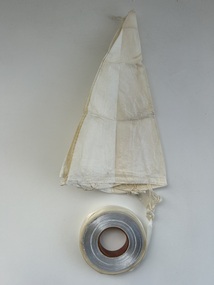
Weapon (Item) - WW2 R.A.F Chaff (Window) Radar Jamming Foil With Parachute And Original Box
... Moorabbin Air Museum Moorabbin Airport 12 First Street Moorabbin melbourne WW2 R.A.F Chaff (Window) Radar Jamming Foil With Parachute And Original Box, dropped from Lancaster and Halifax Bombers to confuse German radar systems that guided flak and night fighters to the bomber stream. ...
