
Showing 64 items matching "air speed "
-
 Wangaratta RSL Sub Branch
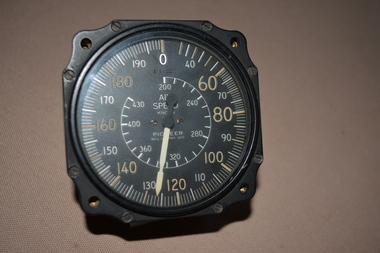
Instrument - Aircraft Air Speed Indicator
... Aircraft Air Speed Indicator...Aircraft air speed indicator made by Pioneer Instrument Company which specialised in aeronautical instruments.... Air Speed Pioneer...Instrument Aircraft Air Speed Indicator ...Aircraft air speed indicator made by Pioneer Instrument Company which specialised in aeronautical instruments. Black painted cylindrical instrument with glass face . There is a side cutout containing metal parts . Air Speed Pioneerraaf, aircraft, airspeed indicator, ww2, pioneer instrument co -
 Moorabbin Air Museum
Manual (item) - Principles of Air Speed Indicators, Basic Principles of Air Speed Indicators
... Principles of Air Speed Indicators...Basic Principles of Air Speed Indicators...Basic Principles of Air Speed Indicators Manual Principles of Air Speed Indicators ... -
 B-24 Liberator Memorial Restoration Australia Inc
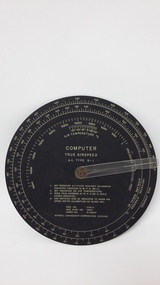
Computer True Air Speed, General Luminiscent Corporation
... Computer True Air Speed...2 black discs printed with luminous paint with plastic indicator, used for calculating true air speed....No. 42D531, Order No.42-18049-P GENERAL LUMINESCENT CORPORATION, CHICAGO 2 black discs printed with luminous paint with plastic indicator, used for calculating true air speed. Computer True Air Speed General Luminiscent Corporation ...Standard crew issue for pilots and flight engineersEquipment supplied crew with a computer to calculate true airspeed.2 black discs printed with luminous paint with plastic indicator, used for calculating true air speed.COMPUTER. TRUE AIRSPEED. A.C. TYPE G-1 A list of 4 instructions for use. Spec. No. 27367-A, MFG.DWG. No. 42D531, Order No.42-18049-P GENERAL LUMINESCENT CORPORATION, CHICAGO -
 Running Rabbits Military Museum operated by the Upwey Belgrave RSL Sub Branch
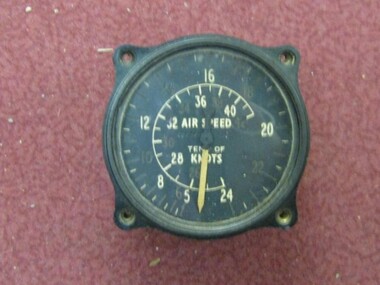
Air Speed Indicator
... Air Speed Indicator...Equipment WW2 RAAF Beaufort bomber equipment, Air Speed Indicator ...Beaufort bomber equipment,equipment, ww2, raaf -
Moorabbin Air Museum
Memorabilia (item) - Articles from interesting events in Melbourne and across the world mainly in 1934 include airships Melbourne shrine land and air speed records england to australia record flights Mt Everest, Various newspaper clippings including Sydney harbour bridge
... Articles from interesting events in Melbourne and across the world mainly in 1934 include airships Melbourne shrine land and air speed records england to australia record flights Mt Everest ...Various newspaper clippings including Sydney harbour bridge Memorabilia Articles from interesting events in Melbourne and across the world mainly in 1934 include airships Melbourne shrine land and air speed records england to australia record flights Mt Everest ... -
 Moorabbin Air Museum
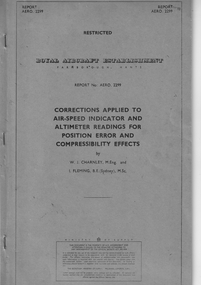
Document (item) - CAC History RAE Corrections for air speed and position errors and compressibility
... CAC History RAE Corrections for air speed and position errors and compressibility...Document CAC History RAE Corrections for air speed and position errors and compressibility ... -
 Bendigo Military Museum
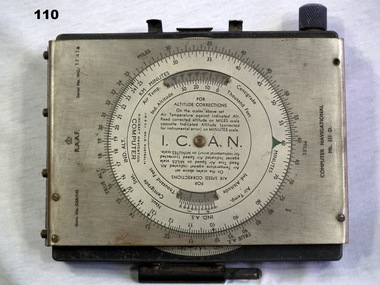
Accessory - INSTRUMENT - NAVIGATIONAL AID
... Instrument for altitudes & air speed corrections. Notebook with spiral binding attached inside....Nunawading Instrument for altitudes & air speed corrections. Notebook with spiral binding attached inside. ...Navigational aid used during WW11Instrument for altitudes & air speed corrections. Notebook with spiral binding attached inside.Scratched on inside of stainless steel surface of cover: A G Culvenor 46 Station St. Nunawading instruments, military history - airforce, aviation, mechanics -
Moorabbin Air Museum
Book - Flight training, Let's Learn to Fly
... ...Air speed & ground speed...Flight training The sea of air The four forces Turning Climbing & descending Straight & level flight Stalling Air speed & ground speed Take off & landing Control of the approach path Spinning Forced landings The first solo flight Overview of the principles of flight for pupils, circa 1956 Let's Learn to Fly Book Flight training ...Overview of the principles of flight for pupils, circa 1956non-fictionOverview of the principles of flight for pupils, circa 1956the sea of air, the four forces, turning, climbing & descending, straight & level flight, stalling, air speed & ground speed, take off & landing, control of the approach path, spinning, forced landings, the first solo flight -
 National Vietnam Veterans Museum (NVVM)
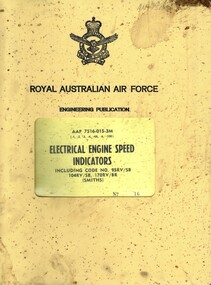
Manual, Royal Australian Air Force, Royal Australian Air Force: Electrical Engine Speed Indicators
... Royal Australian Air Force: Electrical Engine Speed Indicators...Royal Australian Air Force: Electrical Engine Speed Indicators Manual Royal Australian Air Force ...A badly stained yellow plastic cover with a clear window. Top of the cover is the RAAF insignia and uder this reads Royal Australian Air Force and Engineering Publication. Through the window on yellow paper are the details of the manual. The manual is held together by a large metal slide which is inside the cover.royal australian airforce - manuals, engineering publication, electrical engine speed indicators -
 B-24 Liberator Memorial Restoration Australia Inc
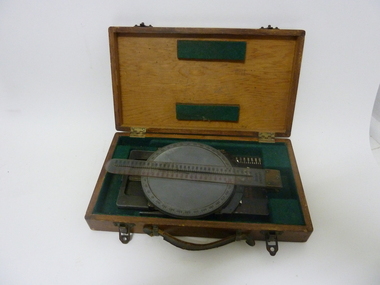
Course and Speed Calculator MKIIA, Stanley Manufacturing Co Ltd, Course and Speed Calculator, 1942-45
... Course and Speed Calculator MKII - Air speed in MPH and Knots. Wind Speed and direction. ...GB/120 Course and Speed Calculator MKII - Air speed in MPH and Knots. Wind Speed and direction. ...Course and Speed Calculator MKII - Air speed in MPH and Knots. Wind Speed and direction. In original wooden box. Used on aircraft.RAF Ref. No. 6B/125 - RCAF Ref. No. 6B/52 No. ST2473/40 Anson/Oxford Serial No. 3441S/40 Box Ref. No. GB/120a8 -
 Nhill Aviation Heritage Centre
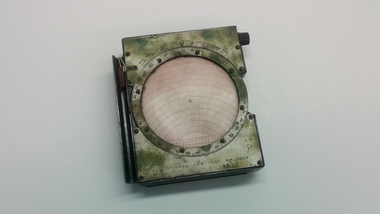
Navigational Computer
... Calibration, height correction, air speed correction...Calibration, height correction, air speed correction Metal slide rule type calculator, with scrolling graph. ...Metal slide rule type calculator, with scrolling graph. Has pencil/pen saddle and clip on left sideNavigational Computer Mk. IIIH Reg No. 68/250 Front. True Course, drift port Drift stbd Rear. I.C.A.N. Calibration, height correction, air speed correction -
 Nhill Aviation Heritage Centre
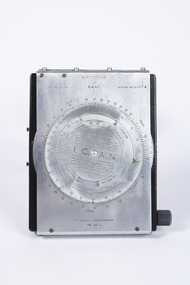
Navigation Computer
... This type of instrument typically used by pilots and navigators for quick calculations of Air Speed and Wind Drift....This type of instrument typically used by pilots and navigators for quick calculations of Air Speed and Wind Drift. Indent No. G6B/145 RAAF Serial No. ...This type of instrument typically used by pilots and navigators for quick calculations of Air Speed and Wind Drift.hand operated navigation computer. Rotating scale on the front panel and a scroll type scale on the inner panel with a winder knob on the right side. Front panel is hinged at the top and bottom has two curved thigh pads.Indent No. G6B/145 RAAF Serial No. WG/2967* I.C.A.N. in center of front dial COMPUTER NAVIGATIONAL Ml. III D. -
 Bendigo Military Museum
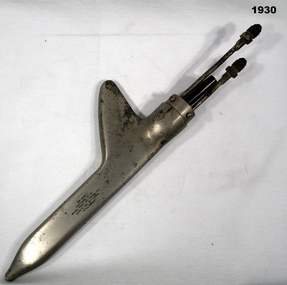
Equipment - AIRCRAFT INSTRUMENT, 1940 (exact)
... The 'Pilot Head' worked 3 flight instruments,air speed, altimeter & rate of climb....The 'Pilot Head' worked 3 flight instruments,air speed, altimeter & rate of climb. aircraft equipment pilot head "PAT NOS 2.2.04.367 Des 114.332 Pat Canada 1940 Made in USA 'Pilot Head' from an aircraft, metal & Bakelite construction, long rectangular shape rounded on edges with a fin. ...Item belonged to Maxwell Lennox MATHESON No 418447 RAAF. Refer 1959 for his service history. The 'Pilot Head' worked 3 flight instruments,air speed, altimeter & rate of climb.'Pilot Head' from an aircraft, metal & Bakelite construction, long rectangular shape rounded on edges with a fin. At rear are 3 connectors one for electrical."PAT NOS 2.2.04.367 Des 114.332 Pat Canada 1940 Made in USAaircraft, equipment, pilot head -
Frankston RSL Sub Branch
Computer, Navigation
... Mk 1 Made in Australia by White & Gillespie Front Scale: Distance Naut Miles, True Air Speed (Time Min, Hrs, Density Altitude, Air Temp ) Back Scale: Wind Correction Angle( True Heading ) ...Mk 1 Made in Australia by White & Gillespie Front Scale: Distance Naut Miles, True Air Speed (Time Min, Hrs, Density Altitude, Air Temp ) Back Scale: Wind Correction Angle( True Heading ) Computer, Navigation ...Aerial Dead Reckoning Computer in leather pouch. This device was used as a navigational aid by aircraft pilots and crew. W&G Aerial Dead Reckoning Computer R.A.A.F. Mk 1 Made in Australia by White & Gillespie Front Scale: Distance Naut Miles, True Air Speed (Time Min, Hrs, Density Altitude, Air Temp ) Back Scale: Wind Correction Angle( True Heading ) The leather pouch has the following printed on the outside "W&G Aerial Dead Reckoning Computer R.A.A.F. Mk 1" -
 Wangaratta RSL Sub Branch
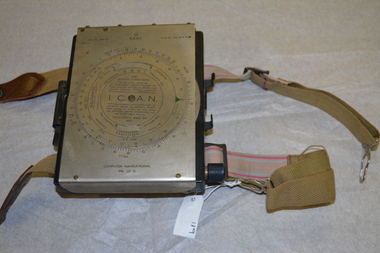
Instrument - Aircraft Navigation Computer
... The navigational computer was a circular slide rule used for calculating height and air speed corrections when flying an aircraft. ...The navigational computer was a circular slide rule used for calculating height and air speed corrections when flying an aircraft. ...The navigational computer was a circular slide rule used for calculating height and air speed corrections when flying an aircraft. The front cover lifts to reveal a further calculator used to solve vector triangles and plot course alterations. The device was intended to be strapped to a pilot's leg. The instrument was made by White and Gillespie (Melbourne) Pty Ltd c 1940 for the RAAF and used during WW2.Black metal box with silver metal flap top cover affixed with rotating circular rule . Two adjustable belts are affixed to the base of black box. A small spiral bound note book is contained beneath the flap top. RAAF Computer Navigational system MK. III. D. Serial No WG 2833navigation, raaf, computer, aircraft, ww2, 1940 -
 Parks Victoria - Wilsons Promontory Lightstation
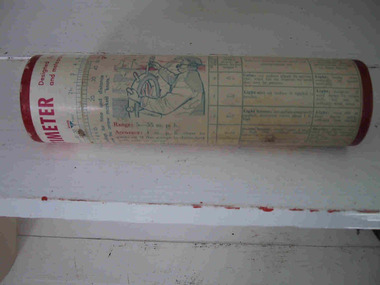
Container, Ventometer
... Ventometers were common devices that have since been replaced by more sophisticated measuring equipment, such as digital air speed meters. Further information on this particular example, including perhaps the name of the manufacturer, may survive on the container but this has not been recorded. ...Ventometers were common devices that have since been replaced by more sophisticated measuring equipment, such as digital air speed meters. Further information on this particular example, including perhaps the name of the manufacturer, may survive on the container but this has not been recorded. ...The cylindrical cardboard container with lid formerly contained a ventometer, a small simple tool for measuring wind speed. It consisted of a clear tube containing a small diaphragm which had a hole in the bottom for wind to enter. Once the wind entered the tube it pushed up the diaphragm, indicating the rate of velocity. Ventometers were common devices that have since been replaced by more sophisticated measuring equipment, such as digital air speed meters. Further information on this particular example, including perhaps the name of the manufacturer, may survive on the container but this has not been recorded. The small simple tool for measuring wind speed pre-dates the electronic devices at Gabo Island.Tubed shaped cardboard container with lid to house instrument for measuring. (instrument is missing) Inscriptions and illustrations on exterior. -
 Lara RSL Sub Branch
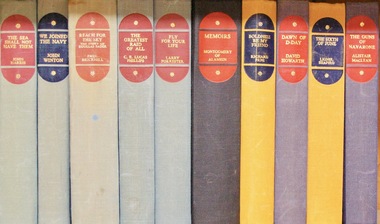
Book, The Sea shall not have them Author John Harris, N/A
... The Sea will not have them' was the motto of Air Sea Rescue High Speed Launch Flotillas. This book was made into a Movie with the same title in 1954...The Sea will not have them' was the motto of Air Sea Rescue High Speed Launch Flotillas. This book was made into a Movie with the same title in 1954 Recount of Air Sea rescue in WWII air sea rescue wwii lancasters flotilla sea operation The Sea shall not have them Author John Harris Book ...During the war 13,269 lives were saved from the sea by Air-Sea Rescue - 13,269 lives were saved from the sea often under the enemy's guns. Of these 8,604 were air crew. The Sea will not have them' was the motto of Air Sea Rescue High Speed Launch Flotillas. This book was made into a Movie with the same title in 1954Recount of Air Sea rescue in WWIIair sea rescue, wwii, lancasters, flotilla, sea operation -
 Flagstaff Hill Maritime Museum and Village
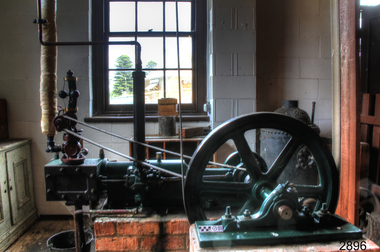
Machine - Steam Engine, Tangyes engineering, Mid-1880s
... It could drive virtually any type of machinery, such as water and sewerage pumps, mine elevators, winches, cranes, metal forges, air blowers, and marine machinery. This engine features a mechanical governor, which controls the speed of the engine regardless of whether it is under load. ...It could drive virtually any type of machinery, such as water and sewerage pumps, mine elevators, winches, cranes, metal forges, air blowers, and marine machinery. This engine features a mechanical governor, which controls the speed of the engine regardless of whether it is under load. ...This Tangye B-size, single-cylinder, horizontal steam engine was likely manufactured in England around the mid-1880s. It was distributed by Melbourne machinery merchants Cameron & Sutherland, which also operated in Bendigo and Ballarat. A local cheese maker once used the engine to drive factory equipment. It was later donated to the Warrnambool Technical School, which then donated it to Flagstaff Hill to add to its historical steam engine collection. Between its manufacture and its donation to Flagstaff Hill, the governor had been replaced by the current Pickering governor. This engine design was very popular in the late 19th and early 20th centuries. When connected and powered up, the engine could drive an overhead line shaft via a flat belt off its flywheel. The line shaft would then drive the machinery via flat belts. It could drive virtually any type of machinery, such as water and sewerage pumps, mine elevators, winches, cranes, metal forges, air blowers, and marine machinery. This engine features a mechanical governor, which controls the speed of the engine regardless of whether it is under load. It also has a water pump built into the valve rod, which is used to supply the boiler with water. Steam enters the cylinder via a slide valve and applies pressure to the piston; it is like a modern internal combustion engine, but in the case of the steam engine, the pressure is exerted in turn on either side of the piston. In other words, the connecting rod is pushed by steam via the piston and piston rod and then pulled back again by steam pushing on the opposite side of the piston. Thus, power is exerted almost continuously, except at the end of each piston stroke, when it reverses direction. In the 1880s, many local butter and cheese manufacturers installed Tangye steam engines to power their machinery. A comprehensive article in the Gippsland Mercury in September 1889 extolled the magnificence of the Farnham Butter Factory in Dennington, Warrnambool, and described how one Tangye engine was used to drive several machines in the cheese- and butter-making processes. A report in the Warragul Guardian in December 1890 notes that the newly opened Warrnambool Butter Factory used a Tangye steam engine to pump water from a 60-foot well. Tangye: Richard Tangye (1833–1906) and four of his brothers—James, Joseph, Edward, and George—were the sons of Joseph Tangye, a Quaker Cornish miner. In 1857, they founded the engineering firm Richard Tangye & Brothers in Birmingham, UK. In 1860, the firm became Tangye Brothers and moved to Cornwall Works in Birmingham. The business encouraged inventors to join the company and develop their patents there, as happened with Weston’s differential pulley block, invented by the Englishman Thomas Aldridge Weston in 1854. Tangye bought the patent in 1858, giving the firm the sole right to manufacture it. The design received a medal for “original application, practical utility and success” at the 1862 International Exhibition in London. Also in 1858, the Tangye firm was commissioned by Brunel’s shipping company to manufacture hydraulic lifting jacks, or rams, to launch the steamship SS Great Eastern. The success of this project brought favourable attention to the firm, and it became involved in other notable projects, including the erection of Cleopatra’s Needle in London in 1878 and work on the Forth Road Bridge in Scotland. The firm underwent several name changes over the years, including James Tangye and Brothers (1857), Tangye Brothers and Price (1859), Tangye Brothers (1860), Tangye Brothers & Holman (1876), Tangye Brothers (by 1878), Tangye Ltd. (1881), and then simply Tangye. Its machinery and equipment were exported worldwide. In 1884, a branch with showrooms, offices, and a warehouse was opened in Melbourne at Cornwall House, Collins Street West. The firm was well known for producing high-quality machinery for agriculture and industry. Even today, new Tangye machinery is available for a subsidiary of Allspeeds. An extensive account of the firm’s history, names, inventions, and further references is available in Grace’s Guide, which also includes references to and diagrams of the Tangye horizontal steam engine. The horizontal steam engine was made by the well-known engineering firm Tangye, known for its high quality of manufacture. It was an important development in machinery because it helped improve productivity. Engines of this type are still used in some parts of the world today. This engine is a good example of a late 19th-century steam engine used in industry and agriculture and adapted for many different purposes. It is also important locally because it was connected to a local cheese making business and part of the thriving western district dairy industry. It may have been one of the Tangyes engines used at the Farnham butter factory or the Warrnambool Butter Factory, which was reported to be one of the most important in the Colony. It is also connected to the Warrnambool Technical School, established in 1968. Steam engine: stationary Tangye Size B, single-cylinder, horizontal Mill type steam engine. It has a 4-inch diameter cylinder with an 8-inch stroke. The body is painted green, and the Pickering governor is red. It was manufactured in Birmingham, England, in accordance with Tangye's Patent 238930, and distributed by Cameron and Sunderland, Melbourne, in the mid-1880s. TANGEYS PATENT BIRMINGHAM B SIZE 238930 CAMERON & SUTHERLAND MELBOURNE THE PICKERING PORTLAND . GOVERNOR . CONN. U.S.A.flagstaff hill, warrnambool, maritime village, maritime museum, flagstaff hill maritime museum and village, shipwreck coast, great ocean road, machine, invention, engine, steam, steam engine, horizontal steam engine, tangyes horizontal steam engine, stationary steam engine, single cylinder steam engine, manufacturing, farming, pumps, lifting equipment, engines, machine tools, hydraulic rams, hydraulic pumps, steam pumps, differential pulleys, mill type steam engine, 4 inch cylinder, weston’s differential pulley, thomas aldridge weston, 1862 international exhibition in london, brunel, ss great eastern, cleopatra’s needle, forth road bridge, cornwall house, collins street melbourne, agricultural machinery, industrial machinery, allspeeds, dairy, pump, richard tangye & brothers, james tangye and brothers, tangye brothers and price, tangye brothers, tangye brothers & holman, tangyes ltd., tangye, richard tangye, james tangye, joseph tangye, edward tangye, george tangye, cornwall works, birmingham, pickering governor, pickering portland connecticut usa, 19th century, dairy plant, steam power, tangye's patent 238930, tangye b size engine, cameron & sutherland, machine merchants, 1880s, mid-1880s, cheese manufacturer, butter manufacturer, diary industry, warrnambool technical school, belt driven machinery, agriculture, mechanical governor, farnham butter factory, warrnambool butter factory -
 Flagstaff Hill Maritime Museum and Village
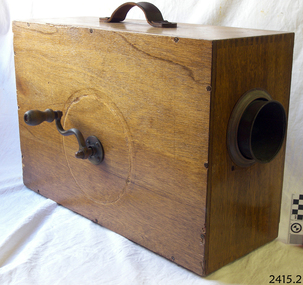
Foghorn
... air across a fine reed, similar to a clarinet reed, which makes the sound. The sound is amplified by the round horn inserted into one end of the box. Different warning signals are made by turning the handle at different speeds and by stopping and starting the handle....air across a fine reed, similar to a clarinet reed, which makes the sound. The sound is amplified by the round horn inserted into one end of the box. Different warning signals are made by turning the handle at different speeds and by stopping and starting the handle. flagstaff hill warrnambool shipwrecked coast flagstaff hill maritime museum maritime museum shipwreck coast flagstaff hill maritime village great ocean road foghorn portable foghorn ship's signal rotary foghorn Foghorn, portable, in rectangular wood box with handle on side with horn inside. ...Portable foghorn with workings in wooden box. Foghorn sound is made by turning the handle on the outside of the box. The rotational movement pumps bellows inside the box, forcing air across a fine reed, similar to a clarinet reed, which makes the sound. The sound is amplified by the round horn inserted into one end of the box. Different warning signals are made by turning the handle at different speeds and by stopping and starting the handle.Foghorn, portable, in rectangular wood box with handle on side with horn inside. There is a leather strap attached to the top of the box as a carrying handle. This type of foghorn is sometimes referred to a s a Rotary Type foghorn (Norwegian Pattern) flagstaff hill, warrnambool, shipwrecked coast, flagstaff hill maritime museum, maritime museum, shipwreck coast, flagstaff hill maritime village, great ocean road, foghorn, portable foghorn, ship's signal, rotary foghorn -
Frankston RSL Sub Branch
Calculator, Course & Speed, E.R Watts & Son London Pty Ltd
... Course and Speed calculator used as a navigational aid by Air Force pilots to calculate aircraft relative groundspeed whilst allowing for wind speed and direction. ...Course and Speed calculator used as a navigational aid by Air Force pilots to calculate aircraft relative groundspeed whilst allowing for wind speed and direction. ...Course and Speed calculator used as a navigational aid by Air Force pilots to calculate aircraft relative groundspeed whilst allowing for wind speed and direction. A similar example (MKIIA version) can be seen at the following Imperial War Museum web page: Inscribed "COURSE & SPEED CALCULATOR MKII", "E.R.WATTS & Son No 757/35", "A.M. REF No 6B/119".raaf, navigation, calculator, ww2, raf, aircraft, course, speed, wind drift -
 Nhill Aviation Heritage Centre
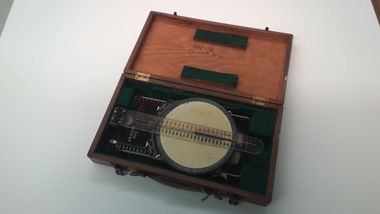
Instrument - Course and Speed calculator in box, c1940
... Air Crew, Pilot, Navigator Geoff Bryan Callahan Box Ref No. GB/120 408104, CALLAHAN Sgt Instrument Various scales on the face. Serial No. 52510, W.G.PYE & Co. Ltd Course & Speed ...Original instrument issued to Air Crew, Pilot, Navigator Geoff Bryan CallahanInstrument mounted in wooden carry box with felt lining. Description printed on one end and owner written on lidBox Ref No. GB/120 408104, CALLAHAN Sgt Instrument Various scales on the face. Serial No. 52510, W.G.PYE & Co. Ltd Course & Speed Calculator Ref No. GB/125 MK.IIA -
 Flagstaff Hill Maritime Museum and Village
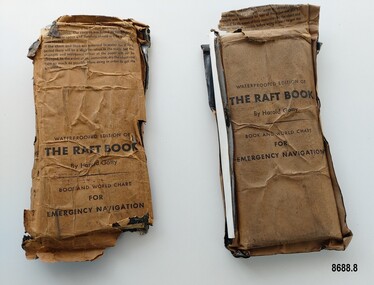
Booklet - Book and World Chart for Emergency Navigation, George Grady Press, The Raft Book, 1943
... Two early inventions of his were his air sextant and a ground speed and drift indicator which formed the basis of the automatic pilot which later came to be standard equipment on most aircraft. ...Two early inventions of his were his air sextant and a ground speed and drift indicator which formed the basis of the automatic pilot which later came to be standard equipment on most aircraft. ...Harold Gatty was born on January 5th, 1903 in Campbell Town, Tasmania. He was a navigator and aviation pioneer. He began his career learning navigation at the age of 14 as a midshipman at the Royal Australian Naval College but withdrew after three years and became an apprenticed ship's officer with the Patrick Steamship Company of Sydney. After W. W. 1 he joined the Australian Merchant Navy where he learned the constellations while standing night watch and became an expert in celestial navigation while serving on many ships sailing between Australia and California. In 1927 he moved to California and opened a navigation school and also a laboratory repairing navigational equipment. At this time he became very interested in air navigation and was aware of the limitations of existing methods and instruments for aerial navigation. He began researching ways of improving aerial navigation. Two early inventions of his were his air sextant and a ground speed and drift indicator which formed the basis of the automatic pilot which later came to be standard equipment on most aircraft. He worked with several record breaking pilots including Ann Morrow Lindbergh (who went on to serve as a navigator for her husband Charles Lindbergh), helped Wiley Post break the world record circumnavigating the Earth, invented a new method of "dead reckoning" that revolutionised the ability to fly safely through cloudy conditions without drifting off course and famously navigated a small plane (whilst trying to cross the Pacific) over 1900 km through fog (with no radio) and using only his dead reckoning techniques, back to their starting point in Japan after they developed fuel problems. In 1932 Gatty received the Distinguished Flying Cross from President Hoover. In 1934 Gatty formed the South Seas Commercial Company with Donald Douglas with the aim to deliver air services to the islands of the South Pacific. The Company was sold to Pan Am but he continued to work for them. In 1935 he went on a sailing expedition investigating several small islands in the South Pacific and was briefly marooned on Baker Island. He was able to use his extensive knowledge of seabird habits to save the crew. He was also very interested in the ability of the Polynesians to navigate using the stars. During the Second World War Gatty was given the honorary rank of Group Captain in the Royal Australian Air Force (RAAF) and worked for the U. S. Army Air Forces (USAAF) in the South Pacific. In 1943 he moved to Washington where he developed a survival book (The Raft Book) specifically for boat crews or air crews flying over the Pacific to help them survive and navigate their life rafts in remote areas of the ocean. The original book was 152 pages long however a condensed version was made which consisted of a 64 page booklet, combined map and star chart and calendar strip enclosed in a waterproof slipcase, to be placed in life rafts for emergency use. The booklet included navigational advice and ideas such as ocean currents, estimation of distance, using a compass, measurement of angles, recognising and steering by the stars, land indications from sea birds, migration of sea birds and insects, sounds from the land, the scent of the land and ocean currents and the colour of the sea etc. After W.W.2 Gatty moved to Fiji and formed Fiji Airways (which later became Air Pacific). Harold Gatty died in August 1957.The two copies of "The Raft Book" are significant as they are a written summary of the many methods of sea navigation (both modern and historical) that existed in the 1940's. They are also a record of Harold Gatty, who played a significant role in the development of modern day aerial navigation using his understanding of different sea navigational techniques.Two rectangular brown packets with waterproof coverings (oiled paper) titled "The Raft Book" by Harold Gatty. Each packet contains a folded 64 page paper booklet with detailed instructions for navigating a small craft in open seas, a folded chart (with a map of the world and oceans, well known constellations, latitude and longitude charts, Greenwich time and a scale for string lengths and Harp scale) and a long folded paper calendar strip.Front of package - "WATERPROOFED EDITION OF/ THE RAFT BOOK / By Harold Gatty / BOOK AND WORLD CHART / FOR / EMERGENCY NAVIGATION / To open envelope tear along above line. If the envelope is used again fold the flap to keep contents dry. 1. This envelope contains a book, chart and tape for emergency navigation. The contents are folded to take up the least possible space and therefore should not be removed until needed. 2. if the chart and tape are immersed in water for a long period, there will be a slight variation in the scale but the strength and resistence to tear of the paper will not be changed. In the event of long immersion, dry the chart and tape as much as possible before using in order to in order to get the greatest accuracy in scale. Front of booklet - THE RAFT BOOK / LORE OF THE SEA AND SKY /By Harold Gatty IMPORTANT FOR YOUR SECURITY/Upon abandoning ship you may have to be your own navigator. Take the following pre/cautions for your own safety:/ Carry a good type of pocket watch / keep it wound and have it running on Greenwich (England) / Time, which you can get from the navigating officer. / Keep track of the date at Greenwich; and on a 24-hour basis, / know whether the time is, say, 6 hours (6 A.M.) showing on / your watch, or 18 hours (6P.M.) Greenwich. / PROECT YOUR WATCH. GET A RUBBER SACK FOR IT (OBTAIN FROM PHARMACIST) AND KEEP IT DRY / KEEP A PENCIL IN YOUR POCKET/ POSITION OF SHIP WHEN ABANDONED PRINTED IN UNITED STATES OF AMERICA GEORGE GRADY PRESS, NEW YORK/COPYRIGHT, 1943, BY HAROLD AND FENNA GATTYflagstaff hill maritime museum and village, shipwreck coast, warrnambool, the raft book, harold gatty, book and world chart for emergency navigation, ww 2, ww ii, navigation, air navigation, aerial navigation, lindbergh, wiley post, dead reckoning, south seas commercial company, u.s. army airforce, usaaf, survival book, life rafts, sea navigation, emergency navigation, fiji airways, harp scale -
 Bendigo Military Museum
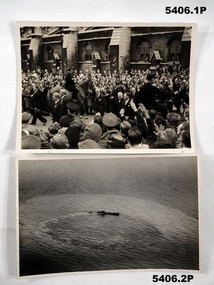
Photograph - PHOTOGRAPHS, 1939-1945
... speed, unsuccessfully attempting to evade the Sunderland's attack, which ultimately "killed" it.". Photograph Sir Winston Churchill U Boats second world war. U 459. .1) Photograph- black and white, crowd, horse and Sir Winston Churchill .2) Photograph- black and white photo of a submarine circling and damaged after air attack ..3) photograph- black and white white photo, submarine under air attack from Australian Sunderland aircraft. ...Donated by W.G. Selwyn 421514 RAAF .1) Sir Winston Churchill in centre of a crowd. .2 This photo is the same as the Imperial War Museum photo, item C3780. U 459 was scuttled after being severely damaged by the RAF. 24 JULY 1943. .3 This photo is the same as the Imperial War Museum photo, item C3543. Its caption is titled "TWO AUSTRALIAN SUNDERLANDS DESTROY A U BOAT". caption reads..."Original wartime caption: Depth charges from Sunderland "P" straddling U-boat which had been apparently partially disabled by "F"'s attack and unable to crash dive. Wake shows U-boat still capable of considerable surface speed, unsuccessfully attempting to evade the Sunderland's attack, which ultimately "killed" it."..1) Photograph- black and white, crowd, horse and Sir Winston Churchill .2) Photograph- black and white photo of a submarine circling and damaged after air attack ..3) photograph- black and white white photo, submarine under air attack from Australian Sunderland aircraft.photograph, sir winston churchill, u boats second world war., u 459. -
 Bendigo Historical Society Inc.
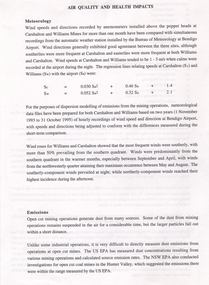
Document - Kangaroo Flat Gold Mine Collection: Air Quality and Health Impacts, Unknown
... air quality and health impacts. Presumably produced by Bendigo Mining N.L. in preparation for mining operations at both sites. Wind speeds...air quality and health impacts. Presumably produced by Bendigo Mining N.L. in preparation for mining operations at both sites. Wind speeds ...Bendigo Mining 1993 to present In the 1980s Bendigo Mining listed on the ASX with ownership of leases along the Deborah line of reef. In 1993, the Company consolidated ownership of the entire Goldfield when it purchased WMC’s interests. A detailed account of the recent history of Bendigo Mining N.L. is provided in the Company history on Bendigo Mining N.L website: https://www.bmnl.com.au/goldfield-history One page, double sided, report on Carshalton and Williams mines regarding air quality and health impacts. Presumably produced by Bendigo Mining N.L. in preparation for mining operations at both sites. Wind speeds and directions at both mines were recorded and implications for dust control discussed. Stages in the mining process that generate dust are listed on the second page. bendigo mining n.l., bendigo, mining, gold, mining proposal, dust supression, carshalton mine, williams united mine, metereology -
 Bendigo Historical Society Inc.
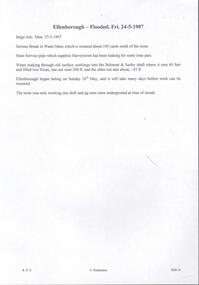
Document - DRAINAGE PROBLEMS - ELLENBOROUGH FLOODED
... air-compressor. It can be driven at full power with a pressure of 351bs of steam, with the engine wheel moving at the rate of 220 revolutions per minute; the battery wheel makes 850 revolutions. The plant occupies very little space. The battery is a to-light machine; that is, it can supply sufficient electricity for 35 lights. Whether there is only one light burning or 35, there is no necessity to alter the machine or the speed...air-compressor. It can be driven at full power with a pressure of 351bs of steam, with the engine wheel moving at the rate of 220 revolutions per minute; the battery wheel makes 850 revolutions. The plant occupies very little space. The battery is a to-light machine; that is, it can supply sufficient electricity for 35 lights. Whether there is only one light burning or 35, there is no necessity to alter the machine or the speed ...The Ellenborough mine was located on Snob's Hill in Eaglehawk, near Bendigo, Victoria, Australia. It was a notable mine operating on the New Chum line of reef in the Eaglehawk District. The Ellenborough Mine was the first mine in the world to use electricity to light above and underground. On 12th October 1882, the installation of the lighting system was completed by the Australian Electric Light Company. 'The whole of the levels and back have been lighted so that candles have been dispensed with ....the engine house, blacksmith''s shop and brace are also lighted at night' (Bendigo Advertiser, 13th October, 1882). 'The electricity is generated in an ordinary electric battery placed in the engine-house, and driven by a three horse power " Soho" engine. This engine is supplied with steam by a pipe leading from the steam pipe used to supply the air-compressor. It can be driven at full power with a pressure of 351bs of steam, with the engine wheel moving at the rate of 220 revolutions per minute; the battery wheel makes 850 revolutions. The plant occupies very little space. The battery is a to-light machine; that is, it can supply sufficient electricity for 35 lights. Whether there is only one light burning or 35, there is no necessity to alter the machine or the speed, and there is no danger of one light becoming too powerful because all the rest are put out. There is no danger, as many people suppose, in taking hold of the wires, even if uncovered, for the engineer last evening plainly demonstrated that where the shock was greatest it was very mild, and could hardly be felt'.Handwritten copy of a report in the Bendigo Advertiser 24/5/1907. ''Serious break in Water Main which is situated about 100 yards south of the mine. Main service pipe which supplies Harvey town has been leaking for some time past. Water soaking through old surface workings into the Belmont and Saxby shaft where it rose 60 feet and filled two x-cuts, one out west 208 ft, and the other out east about 45 ft. Ellenborough began baling on Sunday 26th May, and it will take many days before work can be resumed. The mine was only working one shift and no men were underground at time of in rush''. Document from Albert Richardson Collection of mining history.document, gold, drainage problems, ellenborough flooded, bendigo advertiser, 27/5/1907, harveytown, belmont & saxby, ellenborough, albert richardson, electricity -
 Bendigo Historical Society Inc.
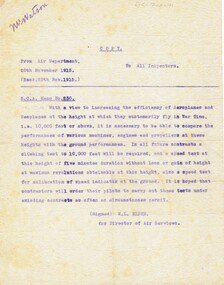
Document - BASIL WATSON COLLECTION: LETTER FROM AIR DEPARTMENT (ENGLAND) TO 'ALL INSPECTORS', 1915
... Single paged typed letter (carbon copy) from Air Department (England) 25th November, 1915, to 'All Inspectors' requesting that pilots carry out certain aircraft flying tests (climb, speed) with a view to increasing the efficiency of aircraft. ...PERSON Individual basil watson Single paged typed letter (carbon copy) from Air Department (England) 25th November, 1915, to 'All Inspectors' requesting that pilots carry out certain aircraft flying tests (climb, speed) with a view to increasing the efficiency of aircraft. ...Single paged typed letter (carbon copy) from Air Department (England) 25th November, 1915, to 'All Inspectors' requesting that pilots carry out certain aircraft flying tests (climb, speed) with a view to increasing the efficiency of aircraft. 'Mr Watson' is handwritten in purple pencil, top left of page.person, individual, basil watson -
 National Vietnam Veterans Museum (NVVM)
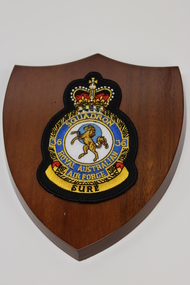
Plaque - Shield, 36 Squadron
... speed, mobility and dependability. Squadron 36 RAAF Squadron 36 Royal Australian Airforce. SURE. A wooden shield with a cloth insignia reading "Squadron 36/ 36 Royal Australian Air Force" with the word SURE at the bottom in black. ...RAAF No. 36 Squadron's official crest, approved in May 1966, depicts a horse, which symbolises strength, speed, mobility and dependability. A wooden shield with a cloth insignia reading "Squadron 36/ 36 Royal Australian Air Force" with the word SURE at the bottom in black. There is a horse in the middle of the insignia.Squadron 36 Royal Australian Airforce. SURE. squadron 36, raaf -
 National Vietnam Veterans Museum (NVVM)
Book, Ethell, Jeffrey,Price, Alfred, One Day In A Long War: May 10, 1972, Air War, North Vietnam (hardcover) (Copy 2)
... Vietnam War 1961-1975 - Aerial operations American Hanoi Afterburner belching flame as it screams past Hanoi going faster that the speed of sound. One Day In A Long War: May 10, 1972, Air War, North Vietnam (hardcover) (Copy 2) Book Book Ethell, Jeffrey,Price, Alfred ...Afterburner belching flame as it screams past Hanoi going faster that the speed of sound.Afterburner belching flame as it screams past Hanoi going faster that the speed of sound.vietnam war, 1961-1975 - aerial operations, american, hanoi -
 National Vietnam Veterans Museum (NVVM)
Book, One Day In A Long War: May 10, 1972, Air War, North Vietnam (softcover) (Copy 1)
... Vietnam War 1961-1975 - Aerial operations American Hanoi Afterburners belching flame as it screams past Hanoi going faster that the speed of sound. One Day In A Long War: May 10, 1972, Air War, North Vietnam (softcover) (Copy 1) Book Book Ethell, Jeffrey & Price, Alfred ...Afterburners belching flame as it screams past Hanoi going faster that the speed of sound.Afterburners belching flame as it screams past Hanoi going faster that the speed of sound.vietnam war, 1961-1975 - aerial operations, american, hanoi -
 National Vietnam Veterans Museum (NVVM)
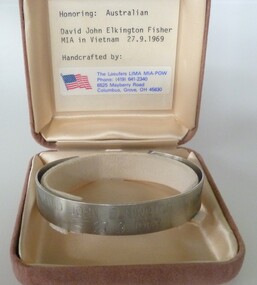
Ceremorial Object - MIA Bracelet - Trooper David John Fisher, The Laeufers LIMA MIA-POW
... speed and helicopter gunships moved in to fire on the enemy on the ground, the patrol members suddenly noticed that Private Fisher was missing. He had fallen from his rope from a height of about 30 metres above the tree canopy. It was later suggested that, under pressure, Fisher may have attached his karabiner to the wrong loop on the rope. An air...speed and helicopter gunships moved in to fire on the enemy on the ground, the patrol members suddenly noticed that Private Fisher was missing. He had fallen from his rope from a height of about 30 metres above the tree canopy. It was later suggested that, under pressure, Fisher may have attached his karabiner to the wrong loop on the rope. An air ...In 1969 Private David Fisher, a national serviceman serving with 3 Squadron SAS, became the next soldier declared missing in action. In September 1969 Fisher was second-in-command of a five-man, long range SAS patrol searching for signs of enemy activity near the Nui May Tao massif in south-eastern Long Khanh province. After patrolling for seven days in persistent rain, on 27 September the Australians had a series of sharp contacts with strong groups of Viet Cong. Outnumbered and pursued through the jungle, they called for a helicopter extraction. The helicopters arrived within half an hour, just as the enemy were closing in on the SAS soldiers. During the hectic moments of the "hot" extraction, while under fire and surrounded by the enemy, the members of the patrol clipped on their karabiners and attached themselves to ropes dangling from a helicopter and were lifted clear of the jungle. As the helicopter gathered speed and helicopter gunships moved in to fire on the enemy on the ground, the patrol members suddenly noticed that Private Fisher was missing. He had fallen from his rope from a height of about 30 metres above the tree canopy. It was later suggested that, under pressure, Fisher may have attached his karabiner to the wrong loop on the rope. An air search began within ten minutes of the incident and a ground search began within five hours. A ten-man SAS patrol searched the jungle around the site, joined the following day by rifle companies who searched for the next six days. Fisher's body was never found, and he was declared missing in action, presumed dead. He had only two months remaining of his tour of duty.Stainless steel open-ended bracelet engraved with missing serviceman's full name and date missing. In a buff square velvet satin-lined box.David John Elkington Fisher 27/09/69mia, david john elkington fisher, trooper david john fisher, 2787344, australian national serviceman, royal australian infantry corps, 2nd special air service squadon, 3rd special air service squadron, sas
