
Showing 20 items matching "all the rivers run"
-
 Port of Echuca
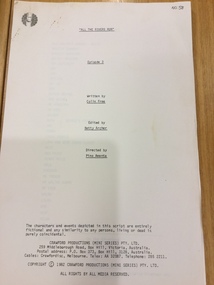
Document - Television script, Crawford Productions, All the Rivers Run Episode 3, 1982
... All the Rivers Run Episode 3...This original script was from a television mini series titled 'All The Rivers Run' that was filmed in Echuca in 1982. ...70 page printed script of Episode 3 All the Rivers Run mini series ...'All the Rivers Run' Episode 3 Written by Colin Free, Edited by Betty Archer, Directed by Pino Amenta. ...This original script was from a television mini series titled 'All The Rivers Run' that was filmed in Echuca in 1982. ...This original script was from a television mini series titled 'All The Rivers Run' that was filmed in Echuca in 1982. The production took over the township for many months and was often filmed on board the Port of Echuca's paddle steamers.This original script from the mini series 'All the Rivers Run' is of social significance as it was filmed on location at the Port of Echuca and surrounding Echuca township. There are very few remaining scripts in existence. 70 page printed script of Episode 3 All the Rivers Run mini series 'All the Rivers Run' Episode 3 Written by Colin Free, Edited by Betty Archer, Directed by Pino Amenta. Copyright 1982 Crawford Productions Pty Ltd script, paper, miniseries, echuca, river, crawford productions, port of echuca -
 Port of Echuca
Rectangular coloured photograph, 03/04/1984
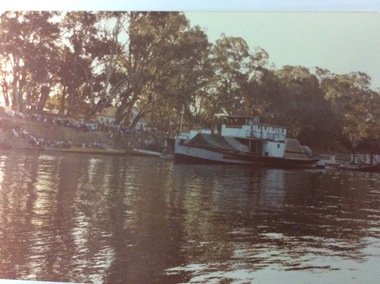
... ...All The Rivers Run...The P.S Pevensy was still bearing the name P.S Philadelphia from it's role in the TV Mini series "All The Rivers Run". In this photo the P.S Philadelphia is welcoming the P.S Adelaide back into the river....P.S Pevensy played the part of P.S Philadelphia in the TV mini series 'All The Rivers Run' in 1984. There is a crowd of spectators on the bank. ...The P.S Pevensy was still bearing the name P.S Philadelphia from it's role in the TV Mini series "All The Rivers Run". In this photo the P.S Philadelphia is welcoming the P.S Adelaide back into the river. ...The P.S Adelaide was re-launched back into the Murray River from the Hopwood Gardens where it had been on display from 1960 in April 1984. The re-launch attracted a lot of attention and took several weeks to achieve. A slipway had to be dug into the bank near Paddlewheel Park. Crowds attended each day. The P.S Pevensy was still bearing the name P.S Philadelphia from it's role in the TV Mini series "All The Rivers Run". In this photo the P.S Philadelphia is welcoming the P.S Adelaide back into the river.This photograph is significant because it shows the re-launch of the P.S Adelaide back into the Murray river. The P.S Adelaide is the second oldest wooden hulled paddle steamer still operating I the world. It also shows the role that P.S Pevensy played in the TV mini series, 'All The Rivers Run." This photograph and negative are related to images P000059.3, P000060.3, P000061.3, P000062.2, P000063.3, P000070.2, P000071.Colour photograph and negative of the P.S Adelaide re-floating in the river, obscured by the P.S Pevensey (with the name Philadelphia written across the wheel house). P.S Pevensy played the part of P.S Philadelphia in the TV mini series 'All The Rivers Run' in 1984. There is a crowd of spectators on the bank. A spectator boat and possibly a pontoon flank the boats.The names of the boats; Adelaide and Philadelphia can be seen written on the boats.p.s philadelphia, p.s pevensey, hopwood gardens, p.s adelaide, all the rivers run -
 Port of Echuca
Photograph - Coloured photograph, March 1984
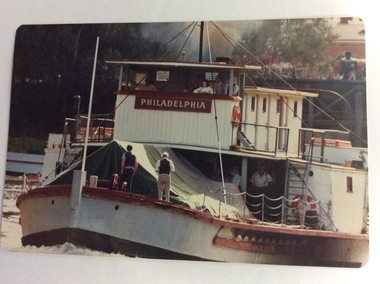
... river...echuca...la grue, bill...cossen's visit to echuca....all the rivers run...S Philadelphia in the movie "All The Rivers Run" which was filmed in Echuca in late 1982 and a sequel was filmed in Echuca early in 1989....S Philadelphia in the movie "All The Rivers Run" which was filmed in Echuca in late 1982 and a sequel was filmed in Echuca early in 1989. ...This photograph was taken in February 1984 on the occasion of Cossen's visit to Echuca. It is a close up of the wheelhouse of the P.S Pevensey with the name Philadelphia written across the wheelhouse. This is significant because the P.S Pevensey played the role of the P. S Philadelphia in the movie "All The Rivers Run" which was filmed in Echuca in late 1982 and a sequel was filmed in Echuca early in 1989.This photograph is significant because it shows the P.S. Pevensey showing the name P.S Philadelphia. The P.S Pevensey was used as the P.S Philadelphia in the TV Series "All The Rivers Run" based on the novel written by Nancy Cato. The TV series was a huge success and still draws tourists to the Port of Echuca. The fact that the P.S Pevensey was showing the Philadelphia name in 1984 is a bit of a mystery, but it has been known that she was dressed up again as the P.S Philadelphia sometimes for special occasions. The Cossen's visit to Echuca might have been such an occasion. It also shows the Echuca Wharf with a train parked there, and the Customs House can be seen in the background as well.A close-up image of the P.S. Pevensey travelling upstream away from the Echuca Wharf. There are five people in the wheelhouse; a dark haired young woman and a man in a suit and tie, two crew and there are two men standing with their backs to the photographer, on the lower deck. Three people can be seen near the fire box underneath the wheelhouse. The Echuca Wharf can be seen in the background. p.s pevensey, greenspot photography, murray river, echuca, la grue, bill, cossen's visit to echuca., all the rivers run, p. s philadelphia, cossen family, echuca wharf -
 Port of Echuca
Photograph - Coloured, March 1984
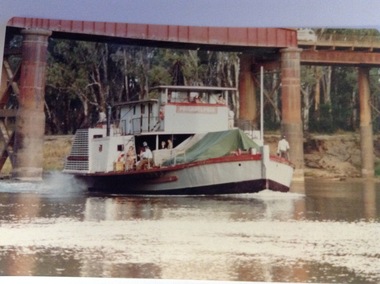
... river...echuca...la grue, bill...cossen's visit to echuca....all the rivers run...S Philadelphia in the movie "All The Rivers Run" which was filmed in Echuca in late 1982 and a sequel was filmed in Echuca early in 1989. ...S Philadelphia in the movie "All The Rivers Run" which was filmed in Echuca in late 1982 and a sequel was filmed in Echuca early in 1989. ...This photograph was taken in February 1984 on the occasion of Cossen's visit to Echuca. P.S Pevensey with the name Philadelphia written across the wheelhouse can be seen steaming upstream under the bridge. This is significant because the P.S Pevensey played the role of the P. S Philadelphia in the movie "All The Rivers Run" which was filmed in Echuca in late 1982 and a sequel was filmed in Echuca early in 1989. Councillor Bob Snow can also be seen on the side deck. This is significant as the Cossen's visit to Echuca may have warranted this sort of attention The photograph also shows the state of the Echuca Moama bridge in the early 1980's.This photograph is significant because it shows the P.S. Pevensey showing the name P.S Philadelphia. The P.S Pevensey was used as the P.S Philadelphia in the TV Series "All The Rivers Run" based on the novel written by Nancy Cato. The TV series was filmed in Echuca in 1982. The TV series was a huge success and still draws tourists to the Port of Echuca. The fact that the P.S Pevensey was showing the Philadelphia name in 1984 is a bit of a mystery, but it has been known that she was dressed up again as the P.S Philadelphia sometimes for special occasions. The Cossen's visit to Echuca might have been such an occasion. It is also a good picture of the pylons under the Echuca Moama bridge and the actual bridge itself. The P.S Pevensey travelling upstream under the Echuca Moama bridge. There is a group of people on the lower side deck. People can also be seen in the wheelhouse and there is a man standing on the back deck as well as one standing next to the wheelhouse. The name Philadelphia can be seen written across the front of the wheelhouse. The river is low and shows the waterline at the Moama Beach. Four bridge pylons can be seen as well as the bridge itself.greenspot photography, p.s pevensey, murray river, echuca, la grue, bill, cossen's visit to echuca., all the rivers run, p. s philadelphia, echuca moama bridge, cossen family, cato, nancy -
 Port of Echuca
Photograph - Coloured rectangular photograph, 03/04/1984
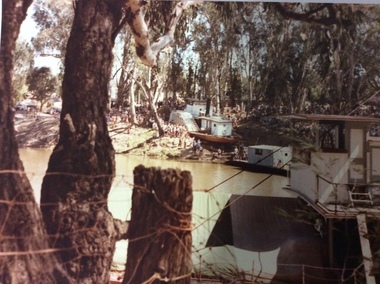
... ...all the rivers run...The P.S Pevensey was used in the TV Series 'All The Rivers Run', as the P.S Philadelphia. Relates to a series of images Reg. nos. ...The P.S Pevensey was used in the TV Series 'All The Rivers Run', as the P.S Philadelphia. Relates to a series of images Reg. nos. ...The P.S Adelaide had been displayed in the Hopwood Gardens from 1960. In 1984 The City of Echuca decided to put the paddle steamer back in the river. This happened over several weeks and involved digging a boat ramp into the bank in front of the Hopwood Gardens. This involved a lot of skill and people. It also attracted a lot of attention. Crowds gathered every day to watch the task. In this photograph the P.S Pevensey in the foreground still has the name P.S Philadelphia writing on its name plate. The P.S Pevensey was used in the TV Series 'All The Rivers Run', as the P.S Philadelphia. Relates to a series of images Reg. nos. P000059.3, P000061.3, P000062.2, P000063.3, P000070.2, P000071.The re-floating of the P.S Adelaide is significant because it occurred at a time when the Tourist Industry was gathering momentum in Echuca. The City of Echuca made the decision to add another paddle steamer to its fleet to carry passengers on the Murray River. The P.S Adelaide is one of the oldest, still operative wooden hulled paddle steamers in the world. It celebrated it's 150th birthday in July 2016. The re-floating of the P.S Adelaide created a lot of attention locally and regionally.A rectangular coloured photograph, and enlargement photograph, of the P.S. Adelaide being re-launched into the Murray River , on the 3rd April, 1984. The photograph is taken from the N.S.W bank with the P.S Pevensey in the foreground right corner of the photograph. The word Philadelphia can be seen faintly on the P.S Pevensey. There is a large crowd of people on the Victorian bank watching. There is a floating pontoon on the river immediately in front of the P.S Adelaide.On near boat obscured are the words Philadelphia.p.s adelaide, p.s pevensey, all the rivers run, p.s philadelphia, hopwood gardens, re-floating of the p.s adelaide. -
 Port of Echuca
A coloured rectangular photograph, 03/04/1984
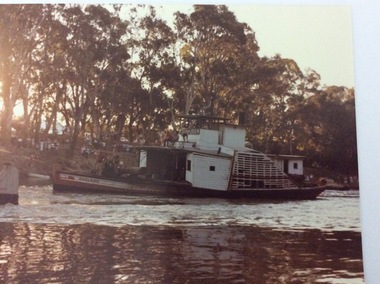
... ...all the rivers run...The P.S Pevensey was used in the TV Series 'All The Rivers Run', as the P.S Philadelphia. Relates to a series of images Reg. nos. ...The P.S Pevensey was used in the TV Series 'All The Rivers Run', as the P.S Philadelphia. Relates to a series of images Reg. nos. ...Adelaide had been displayed in the Hopwood Gardens from 1960. In 1984 The City of Echuca decided to put the paddle steamer back in the river. This happened over several weeks and involved digging a boat ramp into the bank in front of the Hopwood Gardens. This involved a lot of skill and people. It also attracted a lot of attention. Crowds gathered every day to watch the task. In this photograph the P.S Pevensey in the foreground still has the name P.S Philadelphia writing on its name plate. The P.S Pevensey was used in the TV Series 'All The Rivers Run', as the P.S Philadelphia. Relates to a series of images Reg. nos. P000059.3, P000061.3, P000062.2, P000063.3, P000070.2, P000071. Statement of Significance The re-floating of the P.S Adelaide is significant because it occurred at a time when the Tourist Industry was gathering momentum in Echuca. The City of Echuca made the decision to add another paddle steamer to its fleet to carry passengers on the Murray River. The P.S Adelaide is one of the oldest, still operative wooden hulled paddle steamers in the world. It celebrated it's 150th birthday in July 2016. The re-floating of the P.S Adelaide created a lot of attention locally and regionally.A colour negative, photograph and enlargement of the re-launching of the P.S Adelaide in 1984. In the photograph the P.S Adelaide is situated in the river after just being launched down the slipway from Hopwood Gardens. There is a crowd of people standing on the bank behind the paddle steamer, bathed in late afternoon sunlight.The paddle steamer has the word Adelaide written across the wheelhouse, and on the front port side of it's hull.p.s adelaide, p.s pevensey, all the rivers run, p.s philadelphia, hopwood gardens, re-launch of the p.s adelaide -
 Port of Echuca
Functional object - Paddlesteamer, Permewan,Wright Co Ltd, P.S. Pevensey, 1910
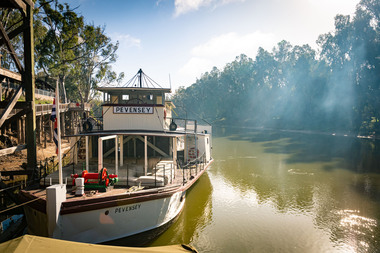
... River...All The Rivers Run...In 1982, it was temporarily renamed The Philadelphia, and starred in the TV mini series " All The River's Run" based on the books by Nancy Cato. ...In 1982, it was temporarily renamed The Philadelphia, and starred in the TV mini series " All The River's Run" based on the books by Nancy Cato. ...PS Pevensey was the last vessel to be built on the Moama slipway in 1910. it was originally built as the barge Mascotte a year earlier. It is powered by a 20hp Marshall and Sons steam engine and was first used on the Murrumbidgee River where it collected wool bales and brought them back to Echuca where they were loaded onto trains and taken to Melbourne for shipping overseas. The PS Pevensey was named after the Pevensey Station on the Murrumbidgee River. In the 1950's it travelled to South Australia where it survived being burnt and sunk but continued to keep working in the agricultural industry. It was sold to the Port of Echuca in 1973 where it was restored over 3 years and is still the largest vessel operating from the Echuca Wharf. In 1982, it was temporarily renamed The Philadelphia, and starred in the TV mini series " All The River's Run" based on the books by Nancy Cato. In 1985 Prince Charles and Lady Diana visited Echuca and cruised on the PS Pevensey, although it was labelled PS Philadelphia for the occasion. It is the largest vessel operating from the Echuca wharf as it can carry 90 passengers or 120 tons of cargo. PS Pevensey is a Murray River paddle steamer from 1910 and was built at Moama in NSW opposite the Port of Echuca. It was one of the largest towing and cargo paddle steamers on the river and was known as "the great Clydesdale" of the river. PS Pevensey remained operating on the river until 1958 after a number of years lying dormant it was purchased in 1973 and restored at Echuca. It began operating again in 1976 and it is still taking trips. it is one of a small number that still operates in its cargo carrying layout and with its original reconditioned engine. Coming back to Echuca PS Pevensey brought Kevin Hutchinson OAM to work at the Port of Echuca for the rest of his life.A side wheeled paddle steamer. Originally built as a barge the barge Mascot in 1910. Rebuilt as the PS Pevensey a year later in 1911.Pevensey sign on the wheelhouse.wool bales, murrumbidgee river, all the rivers run, pevensey station, port of echuca wharf, prince charles and lady diana, the barge mascotte, kevin hutchinson. -
 Flagstaff Hill Maritime Museum and Village
Domestic object - Dinner plate, circa 1878
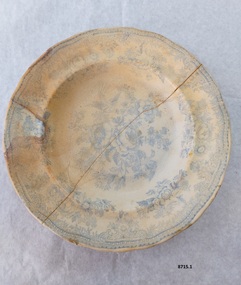
... all be without the “ENGLAND” stamp, confusing the matter. Over time the body shape of the pieces changed, the feathered, curved and fluted edges giving way to simpler, cheaper oblong shapes The ship Loch Ard was built on the River Clyde in Scotland in 1873 for the prestigious Loch Line of colonial clipper ships, designed for the Australian run. ...all be without the “ENGLAND” stamp, confusing the matter. Over time the body shape of the pieces changed, the feathered, curved and fluted edges giving way to simpler, cheaper oblong shapes The ship Loch Ard was built on the River Clyde in Scotland in 1873 for the prestigious Loch Line of colonial clipper ships, designed for the Australian run. ...These earthenware dinner plates were recovered from the wreck of the Loch Ard, on the southwest coast of Victoria and donated by a friend of the diver. The plates are very similar to other plates recovered from the wreck of the Loch Ard - some of which are already on display at Flagstaff Hill Museum and Village in Warrnambool. It is uncertain whether the plates were personal belongings or part of the cargo. The Asiatic Pheasant pattern is a transfer design and was the most popular design of the 19th-century Victorian era. It is still being produced today. The design was produced as high-quality, decorative dinnerware by the potters in the Staffordshire, England, area from the late 1830s, but no one is sure exactly who the original designer was. The industrial age made the production of this design more affordable to the ordinary person who purchased and proudly displayed settings in their homes. The high demand for production resulted in the loss of quality in both potting and design, particularly between 1860-1914 when the design reached its height of popularity, and the results were often a poor match for the earlier pieces’ quality and detail. Some engravers would make copies of the Asiatic Pheasant design (and other designs) onto copper plates and sell them to more than one pottery producer (the Copyright Act of 1842 was intended to control this very thing). Consequently, the list of Makers’ Marks associated with the Asiatic Pheasant is well over 100. A single pottery factory could have several owners, all with their own Marks. The makers mark on these two plates are also difficult to read but appear to include the letters "O H E ?' over "L". These factors all make the dating of pieces difficult. Also, after 1891, pieces produced for export were required to be stamped with “ENGLAND”, but pieces produced for the domestic market in England did not need this stamp, so early pieces and pieces produced for the domestic market would all be without the “ENGLAND” stamp, confusing the matter. Over time the body shape of the pieces changed, the feathered, curved and fluted edges giving way to simpler, cheaper oblong shapes The ship Loch Ard was built on the River Clyde in Scotland in 1873 for the prestigious Loch Line of colonial clipper ships, designed for the Australian run. It sailed from England on 1st March 1878 carrying 37 crew, 17 passengers and a load of cargo. The general cargo reflected the affluence of Melbourne at the time. On board were straw hats, umbrellas, perfumes, clay pipes, pianos, clocks, confectionary, linen and candles, as well as a heavier load of railway irons, cement, lead and copper. There were items included that were intended for display in the Melbourne International Exhibition in 1880 - a diverse general cargo ranging from luxury items to bulk railway iron. On 1 June 1878, emerging from fog and hearing too late the sound of breakers against the tall limestone cliffs, the vessel struck the southern foot of Mutton Bird Island and sank in 23 metres of water. Of the fifty-four people on board only two survived, one young male crewman, Tom Pearce, and one young female passenger, Eva Carmichael. Ten days after the Loch Ard tragedy, salvage rights to the wreck were sold at auction for £2,120. Cargo valued at £3,000 was salvaged and placed on the beach, but most washed back into the sea when another storm developed. The wreck of Loch Ard still lies at the base of Mutton Bird Island. Much of the cargo has now been salvaged and some was washed up into what is now known as Loch Ard Gorge. Cargo and artefacts have also been illegally salvaged over many years before protective legislation was introduced. One of the most unlikely pieces of cargo to have survived the shipwreck was a Minton porcelain peacock - one of only seven in the world. The peacock was destined for the Melbourne International Exhibition in 1880. It had been well packed, which gave it adequate protection during the violent storm. Today, the Minton peacock can be seen at the Flagstaff Hill Maritime Museum in Warrnambool. From Australia's most dramatic shipwreck it has now become Australia's most valuable shipwreck artefact and is one of very few 'objects' on the Victorian State Heritage Register.Flagstaff Hill’s collection of artefacts from LOCH ARD is significant for being one of the largest collections of artefacts from this shipwreck in Victoria. It is significant for its association with the shipwreck, which is on the Victorian Heritage Register (VHR S417). The collection is significant because of the relationship between the objects, as together they have a high potential to interpret the story of the LOCH ARD. The LOCH ARD collection is archaeologically significant as the remains of a large international passenger and cargo ship. The LOCH ARD collection is historically significant for representing aspects of Victoria’s shipping history and its potential to interpret sub-theme 1.5 of Victoria’s Framework of Historical Themes (living with natural processes). The collection is also historically significant for its association with the LOCH ARD, which was one of the worst and best known shipwrecks in Victoria’s history.Two plates recovered from the wreck of the Loch Ard. Earthenware dinner plates with blue and white transfer design (Asiatic Pheasant) with a clear over-glaze. The outer rim is scalloped. Plate 8715.1 has substantial brown stain over a large part of it and a large crack across the plate from rim to rim. The back of the plate shows evidence of the glue used to repair it. Plate 8715.2 has minor brown staining and is in better condition.Floral makers mark on the back featuring a scroll inscribed with "Asiatic Pheasant" and underneath the letters "O H E ?" over "L".flagstaff hill maritime museum and village, great ocean road, shipwreck coast, warrnambool, loch ard, lock ard wreck, plates, crockery, asiatic pheasant design, salvage, loch ard gorge, dinner plates -
 Orbost & District Historical Society
black and white photograph, Green, O. S, April 1897
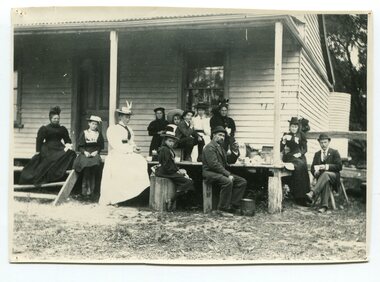
... run paddle steamer "Curlip"as engineer. Captain McNeil was an always cheerful Marlo identity and local children had many times sailing with him on the river. Captain McNeil with tug went out through the entrance and brought in the schooners. This item is associated with the Richardson family, early settlers of the Orbost district. richardson-family-orbost-marlo mcneil-captain on back - " The Richardson family picnic at Marlo" A black / white photograph of a group of people having afternoon tea on the end of a verandah of a wooden house. All ...This photograph shows the Richardson family having a picnic on the verandah of Captain McNeil' house at Marlo - April 1897. Snowy River Shipping Company formed in 1880. They were soon shipping produce (mainly vegetables) from the area to Melbourne. The Snowy River Shipping Company was formed by Mr Henry James during the 1880s, with Captain McNeil as master. Captain Hegarty was the shipping agent at Marlo. Towing a line of small barges these paddle steamers plied their trade between the port of Marlo, and the farms along the river banks, churning their way almost twenty miles upstream to a landing beside what is now Frank Richardson’s property. On these trips, the barges carried mail and supplies to the townspeople and farmers, loading their produce, mostly maize, on the return trip to the coast. The coming of the railway in 1915 spelt the end for the little river boats. ( ref. F. W. RODWELL in the “Snowy Review”) Frank Richardson 1877-1950 was a sawmiller at Tabbara and helped build and run paddle steamer "Curlip"as engineer. Captain McNeil was an always cheerful Marlo identity and local children had many times sailing with him on the river. Captain McNeil with tug went out through the entrance and brought in the schooners.This item is associated with the Richardson family, early settlers of the Orbost district.A black / white photograph of a group of people having afternoon tea on the end of a verandah of a wooden house. All are seated.on back - " The Richardson family picnic at Marlo"richardson-family-orbost-marlo mcneil-captain -
 Eltham District Historical Society Inc
Document - Folder, McLean, 1984-1999
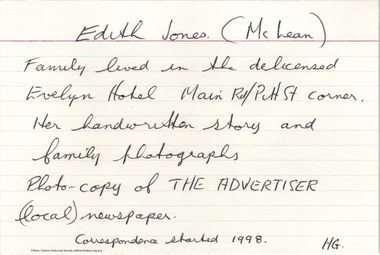
... river and cooked in the open. Eventually managed to rent a house in Eltham again, Isherwood’s house on Cemetery Road. The Fordhams were behind them and Mrs Bremner would sometimes call on the girls to run errands with homemade ice cream the reward. References to picnics and motor cycle races at Bremner’s Flats (Wingrove Park) and a mention of an old cable tram lodged in the park. All...river and cooked in the open. Eventually managed to rent a house in Eltham again, Isherwood’s house on Cemetery Road. The Fordhams were behind them and Mrs Bremner would sometimes call on the girls to run errands with homemade ice cream the reward. References to picnics and motor cycle races at Bremner’s Flats (Wingrove Park) and a mention of an old cable tram lodged in the park. All ...References to McLean family, Hector John McLean and Louisa Frances (nee Green) and six daughters who lived in Eltham during the period 1930 to 1934 inclusive. Lived in the former Evelyn Hotel at the time it was destroyed by fire and being part of the Centenary Parade in 1934 where the family won the Group Section for their entry “Pioneers of Eltham” Reminiscences provided by Edith Jones (nee M1934 flood, ballroom, baptism, barber shop, bittern, boy scouts, bremner's flat, burgoyne's shop, cable tram, cemetery road, centenary celebrations, centenary parade, christening, coach house, collis grocery, dalton street, depression, dole, dorothy jean mclean, edith jones (nee mclean), eltham fire brigade, eltham high school, eltham higher elementary school, eltham lower park, eltham railway station, eltham state school no. 209, evelyn hotel, fire damage - buildings, flinders naval depot, fordham, gladys evelyn mclean, gold mining, gwenneth mae mclean, gwladys evelyn mclean, headmistress, hector john mclean, isherwood house and shop, louisa frances mclean (nee green), metery road, methodist church, miss finnin, miss grant cottage, motor bike races, mrs barrett, mrs bremner, mrs hurley, olive isabel mclean, parade, phoebe lillian mclean, picnic, pioneers of eltham, pitt street, research fire brigade, rev. r.g. arthur, shed, shops, st margarets church hall, st margaret's church, stables, state savings bank of victoria, susso books, todaro, vinnie willet, warrandyte bridge, warrandyte, wingrove park, yarra river -
 Eltham District Historical Society Inc
Photograph, David Potts (Latrobe University), Koornong School collection, c.1940-c.1945
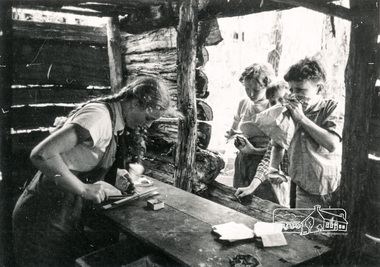
... all staff (whatever their jobs in the school) met regularly, made the rules and dealt out punishment for breaking them. The few rules set down by staff related to health and safety, for instance, no pupils were allowed to go into the river without supervision. The school could not have been started at a worse time. Food rationing and coupons, petrol shortages and men at war limiting teaching staff made difficulties. It was an expensive school to run...all staff (whatever their jobs in the school) met regularly, made the rules and dealt out punishment for breaking them. The few rules set down by staff related to health and safety, for instance, no pupils were allowed to go into the river without supervision. The school could not have been started at a worse time. Food rationing and coupons, petrol shortages and men at war limiting teaching staff made difficulties. It was an expensive school to run ...Photos include: Log building which the students constructed and used as a co-operative shop, Primary Class, Science class outside their classroom, Government meeting held in the outdoor theatre, Janet and Lawrence Nield. "Koornung School, Warrandyte was established by Clive and Janet Blake Nield in 1939, after they had visited progressive schools in Europe and America. They believed children should be given freedom to grow while learning to accept responsibility; that school should be a miniature democracy and education not a preparation for life but experience of life itself. A government of children and all staff (whatever their jobs in the school) met regularly, made the rules and dealt out punishment for breaking them. The few rules set down by staff related to health and safety, for instance, no pupils were allowed to go into the river without supervision. The school could not have been started at a worse time. Food rationing and coupons, petrol shortages and men at war limiting teaching staff made difficulties. It was an expensive school to run. Financial difficulties became more serious and eventually the school had to close in 1946. Efforts by the children and a Board of Management of notable people failed to save it. Janet Nield (M.A., Dip Ed.) was an inspired teacher of history. She was one of the few women at Melbourne University at that time to gain a Masters degree in history. The Nields left Melbourne to live in Sydney, Clive to work at Sydney University in lecturing in Education and particularly interested in Colombo Plan students. Janet devoted herself to children as a Lay Analyst. She was awarded the title of Training Analyst by a meeting of international psychoanalysts in Europe. - Pat Scott (Mrs Wynne Scott), a former member of staff at Koornung School Collection of five black and white photographs a, letter and descriptive material relating to Koornong School, Warrandyte showing various teachers and students and Connie and Alec Smith's studio.schools, koornong, warrandyte, danila vassilieff, lorna carter, adrian rawlins, teachers, janet nield, clive nield -
 Port of Echuca
Colour Photograph, Approx.1979
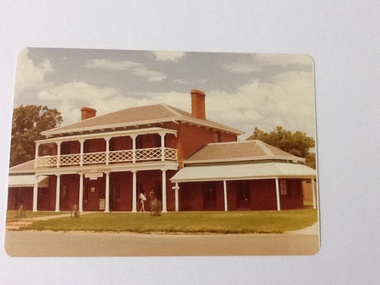
... The Bridge hotel played an important role in the TV series "All the Rivers Run". bridge hotel, echuca port of echuca echuca, victoria -history henry hopwood On front of building : Bridge Hotel / Restaurant Printed on reverse:"This paper manufactured by Kodak" Colour photograph of the Bridge Hotel, Echuca, after restorations (c.1979) Colour Photograph ...The Bridge Hotel was built by Henry Hopwood, founder of Echuca. The building was in disrepair until it was bought by the Port of Echuca and renovated to be turned into part of the Port of Echuca tourist exhibits and was leased out to be run as a restaurant.The Bridge Hotel is of historical and social significance to Echuca as it was built be Echuca's founder Henry Hopwood. The hotel was situated between the 2 rivers, Murray and Campaspe, where Hopwood ran his punt business, charging people and animals to cross the rivers. The hotel accommodated a variety of paying guest from wealthy squatters to salesmen and general workers. The building was purchased by the Port of Echuca to be part of the tourist attraction. It was extensively renovated to bring it back to its former glory. The Bridge hotel played an important role in the TV series "All the Rivers Run". Colour photograph of the Bridge Hotel, Echuca, after restorations (c.1979)On front of building : Bridge Hotel / Restaurant Printed on reverse:"This paper manufactured by Kodak"bridge hotel, echuca, port of echuca, echuca, victoria -history, henry hopwood -
 Port of Echuca
Colour Photograph, Approx.1979
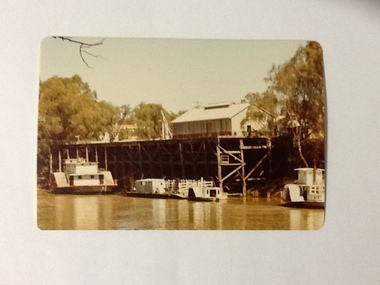
... The PEVENSEY was renamed for the TV series All the Rivers Run, to P. S. Philadelphia , playing a staring role in the program, which has resulted in the PEVENSEY becoming a tourist attraction and has increased tourism to the Port of Echuca. ...P. S. PEVENSEY: Dimensions: 111ft 5 ins X 23 ft X 6ft 8 ins. Tonnage:130 tons Built: 1910 at Moama, N. S. W. References : Book: Murray river Paddle Steamers by D. Wardle Permewan , Wright & Co. : pp. 72, 129, 157 The P. S. PEVENSEY holds historical and social significance for the Port of Echuca, being the cornerstone of their paddlesteamer fleet. The PEVENSEY was renamed for the TV series All the Rivers Run, to P. S. Philadelphia , playing a staring role in the program, which has resulted in the PEVENSEY becoming a tourist attraction and has increased tourism to the Port of Echuca. The PEVENSEY was originally designed for use on the Murrumbidgee river, named after Pevensey station on that river. It was then owned by Permewan Wright & co operating out of Echuca for many years. She returned to Echuca in 1975 to begin another life as part of the Port of Echuca tourism operation.Colour photograph of the wharf and the back of the P. S. Pevensey, moored at the Port of Echuca wharf , c.1979. In front of her is a punt , a small paddle boat and to the right of the photograph part of the back of the P. S. Etona. The Cargo shed and the cranes can be seen on the wharf. Photograph taken looking south along the river.. Printed on reverse: This paper manufactured by Kodakriverboats, p.s.pevensey, echuca, port of, paddle steamers, echuca wharf -
 Port of Echuca
Colour Photograph, 1977
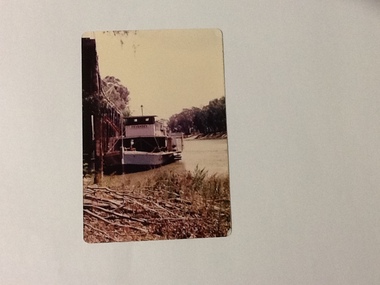
... The PEVENSEY was renamed for the TV series All the Rivers Run, to P. S. Philadelphia , playing a staring role in the program, which has resulted in the PEVENSEY becoming a tourist attraction and has increased tourism to the Port of Echuca. ...P. S. PEVENSEY: Dimensions: 111ft 5 ins X 23 ft X 6ft 8 ins. Tonnage:130 tons Built: 1910 at Moama, N. S. W. References : Book: Murray river Paddle Steamers by D. Wardle Permewan , Wright & Co. : pp. 72, 129, 157 The P. S. PEVENSEY holds historical and social significance for the Port of Echuca, being the cornerstone of their paddlesteamer fleet. The PEVENSEY was renamed for the TV series All the Rivers Run, to P. S. Philadelphia , playing a staring role in the program, which has resulted in the PEVENSEY becoming a tourist attraction and has increased tourism to the Port of Echuca. The PEVENSEY was originally designed for use on the Murrumbidgee river, named after Pevensey station on that river. It was then owned by Permewan Wright & co operating out of Echuca for many years. She returned to Echuca in 1975 to begin another life as part of the Port of Echuca tourism operation.Colour photograph of the P. S. Pevensey, moored at the Port of Echuca wharf . Photograph taken looking north along the river, from the river bank.On the front:PEVENSEY on the wheelhouse of the boat. Printed on reverse: This paper manufactured by Kodak: Print made by Kodak: Dec.77-Mriverboats, p.s.pevensey, echuca, port of, paddle steamers, echuca wharf -
 Port of Echuca
Colour Photograph, 1978
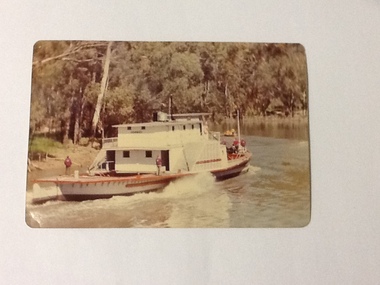
... The PEVENSEY was renamed for the TV series All the Rivers Run, to P. S. Philadelphia , playing a staring role in the program, which has resulted in the PEVENSEY becoming a tourist attraction and has increased tourism to the Port of Echuca. ...P. S. PEVENSEY: Dimensions: 111ft 5 ins X 23 ft X 6ft 8 ins. Tonnage:130 tons Built: 1910 at Moama, N. S. W. References : Book: Murray river Paddle Steamers by D. Wardle Permewan , Wright & Co. : pp. 72, 129, 157 The P. S. PEVENSEY holds historical and social significance for the Port of Echuca, being the cornerstone of their paddlesteamer fleet. The PEVENSEY was renamed for the TV series All the Rivers Run, to P. S. Philadelphia , playing a staring role in the program, which has resulted in the PEVENSEY becoming a tourist attraction and has increased tourism to the Port of Echuca. The PEVENSEY was originally designed for use on the Murrumbidgee river, named after Pevensey station on that river. It was then owned by Permewan Wright & co operating out of Echuca for many years. She returned to Echuca in 1975 to begin another life as part of the Port of Echuca tourism operation.Colour photograph of the P. S. Pevensey, taken from the water, looking at the rear of the boat. There are people (all in red jackets with a logo on the back-Port of Echuca workers?), some on the bow and 2 on the stern of the boat as it steams along the river. In front of the PEVENSEY is a small row boat with a group of people in it.On the front:PEVENSEY on the back of the boat. Printed on reverse: This paper manufactured by Kodak: Print made by Kodak: KODAK: OCT.78-Mriverboats, p.s.pevensey, echuca, port of, paddle steamers, echuca wharf -
 Port of Echuca
Colour Photograph, 1978
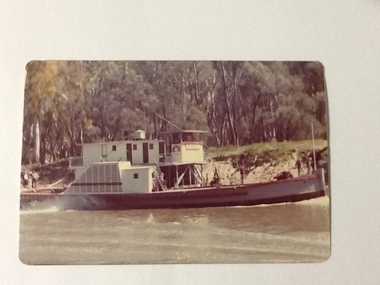
... The PEVENSEY was renamed for the TV series All the Rivers Run, to P. S. Philadelphia , playing a staring role in the program, which has resulted in the PEVENSEY becoming a tourist attraction and has increased tourism to the Port of Echuca. ...P. S. PEVENSEY: Dimensions: 111ft 5 ins X 23 ft X 6ft 8 ins. Tonnage:130 tons Built: 1910 at Moama, N. S. W. References : Book: Murray river Paddle Steamers by D. Wardle Permewan , Wright & Co. : pp. 72, 129, 157 The P. S. PEVENSEY holds historical and social significance for the Port of Echuca, being the cornerstone of their paddlesteamer fleet. The PEVENSEY was renamed for the TV series All the Rivers Run, to P. S. Philadelphia , playing a staring role in the program, which has resulted in the PEVENSEY becoming a tourist attraction and has increased tourism to the Port of Echuca. The PEVENSEY was originally designed for use on the Murrumbidgee river, named after Pevensey station on that river. It was then owned by Permewan Wright & co operating out of Echuca for many years. She returned to Echuca in 1975 to begin another life as part of the Port of Echuca tourism operation.Colour photograph of the P. S. Pevensey, in side view, moving through the water. There are people, 2 on the bow and 3 on the stern of the boat as it steams along the river. In the background is the river bank and the bush landscape.On the front:PEVENSEY on the wheelhouse of the boat. Printed on reverse: This paper manufactured by Kodak: Print made by Kodak: KODAK: OCT.78-Mriverboats, p.s.pevensey, echuca, port of, paddle steamers -
 Port of Echuca
Colour photograph, Approx 1982
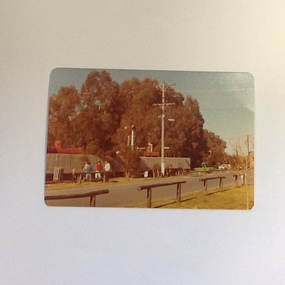
... Interview with Helen Coulson, 27.09.1984 The power lines were put under ground for the filming of "All the Rivers Run" which began in October 1982. The Port area was returned to look like it would have been in the 1870s. ...Undergrounding of the power lines took place in September 1982. Relates to "before" shots P000159, P000161, P000163 and "after" shots P000160, P000162, P000164. Interview with Helen Coulson, 27.09.1984The power lines were put under ground for the filming of "All the Rivers Run" which began in October 1982. The Port area was returned to look like it would have been in the 1870s. The roads were covered in gravel, signage was removed in an endeavour to create the appropriate era.Colour photograph featuring power poles and power lines on the Murray esplanade, Port of Echuca. Picket fence and locomotive stand behind the pole. View from across the road looking east.On the reverse:This paper manufactured by Kodakport of echuca - power lines, power lines, coulson, helen -
 Vision Australia
Audio - Sound recording, Tony Porter, 25th Annual River Run/Walk radio advertisement, 1996
... The River Run/Walk event was held by the Association for the Blind (later Vision Australia Foundation) along the banks of the Yarra River. Contestants were invited to run or walk courses of 5 or 10 km, with all funds raised going to AFB. ...The River Run/Walk event was held by the Association for the Blind (later Vision Australia Foundation) along the banks of the Yarra River. Contestants were invited to run or walk courses of 5 or 10 km, with all funds raised going to AFB. ...The River Run/Walk event was held by the Association for the Blind (later Vision Australia Foundation) along the banks of the Yarra River. Contestants were invited to run or walk courses of 5 or 10 km, with all funds raised going to AFB. In 1996, the event comprised of 2500 entrants and was sponsored by Priceline. This audio advertisement for the event was made for the 25th anniversary.1 audio file (30 seconds) in CD-DA formatassociation for the blind, fundraising, vision australia foundation -
 Vision Australia
Certificate - Text, Association for the Blind: Bicentennial River Run 1988, 1987
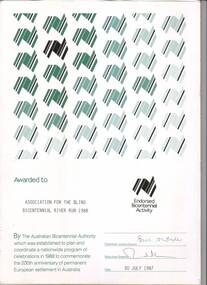
... River Run 1988. By the Australian Bicentennial Authority which was established to plan and coordinate a nationwide program of celebrations in 1988 to commemorate the 200th anniversary of permanent European settlement in Australia" Signed by the Chairman: Victoria Council (illegible) and Executive Director (illegible), dated 30th July 1987. All...River Run 1988. By the Australian Bicentennial Authority which was established to plan and coordinate a nationwide program of celebrations in 1988 to commemorate the 200th anniversary of permanent European settlement in Australia" Signed by the Chairman: Victoria Council (illegible) and Executive Director (illegible), dated 30th July 1987. All ...Certificate reads "Awarded to Association for the Blind Bicentennial River Run 1988. By the Australian Bicentennial Authority which was established to plan and coordinate a nationwide program of celebrations in 1988 to commemorate the 200th anniversary of permanent European settlement in Australia" Signed by the Chairman: Victoria Council (illegible) and Executive Director (illegible), dated 30th July 1987. All text on this certificate is located on the bottom half of the document. The top half is populated by a repeated stylised graphic of a map of Australia, in various shades of green and gold. There is also a gold version of the same logo, labelled with "Endorsed Bicentennial Activity" , situated above the official signatures. 1 certificate with Australia imageryassociation for the blind, awards -
 Wodonga & District Historical Society Inc
Album - Ringer's River by Des Martin - Finis
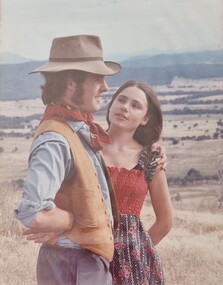
... run, but I can find all my happiness in running a home for you!" FINIS. The album and images are significant because they document literature written by a prominent member of the Wodonga community. The presentation of this precis was supported by several significant district families and individuals. Des Martin Many A Mile RInger's RIver ...Time heals all wounds. Federation is now a fact, and Sean O'Day, managing partner in Gooloora Station can look far across the rolling country in which his children will grow up as individual members of a single nation. There is still much to be done, and the miles, and the years, and the future are calling him to the task, while the Mona Lisa-like expression of his young bride seems to say, "Yes, you have your dreams of a world to run, but I can find all my happiness in running a home for you!" FINIS.The album and images are significant because they document literature written by a prominent member of the Wodonga community. The presentation of this precis was supported by several significant district families and individuals.Ringer's River Album Coloured photo - Final Scene.des martin, many a mile, ringer's river, northeast victoria stories
