
Showing 13 items matching "altar lectern"
-
 Hymettus Cottage & Garden Ballarat
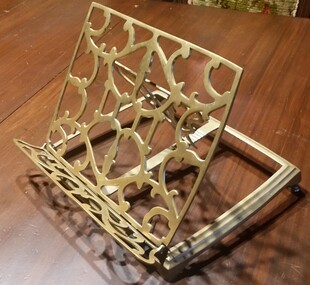
Functional object - Table book-rest/lectern, Table bookstand
... Brass, bookstand, book-rest, altar lectern, reading, library, display, 19th century. church....Nineteenth century brass bookstand or table lectern used to hold book for reading or display purpose often deemed an essential item for the nineteenth and early twentieth century library. Also used as altar lectern in church items. This example was purchased to enhance reading in a household private library and also used to display books when on loan in the public domain in libraries and other repositories....Brass, bookstand, book-rest, altar lectern, reading, library, display, 19th century. church. ...Nineteenth century brass bookstand or table lectern used to hold book for reading or display purpose often deemed an essential item for the nineteenth and early twentieth century library. Also used as altar lectern in church items. This example was purchased to enhance reading in a household private library and also used to display books when on loan in the public domain in libraries and other repositories.brass, bookstand, book-rest, altar lectern, reading, library, display, 19th century. church. -
 Mission to Seafarers Victoria
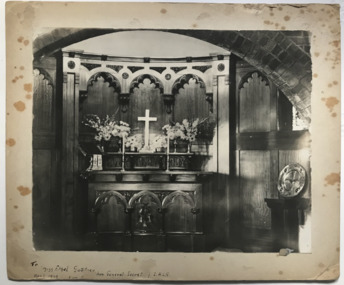
Photograph - Mounted photograph, Black and white, c. 1929
... ...altar lectern...st peter chapel cross altar alm's dish sanctuary altar lectern ethel augusta godfrey Written in black ink at he bottom of the mount: To Miss Ethel Godfrey/ Hon. ...photograph of the St Peter chapel sanctuaryWritten in black ink at he bottom of the mount: To Miss Ethel Godfrey/ Hon. General Secretary L.H.L.G. / April 1929 / From A [missing] Written at the back in black ink: Mission to Seamen / Flinders Street Extensionst peter chapel, cross, altar, alm's dish, sanctuary, altar lectern, ethel augusta godfrey -
 Mission to Seafarers Victoria
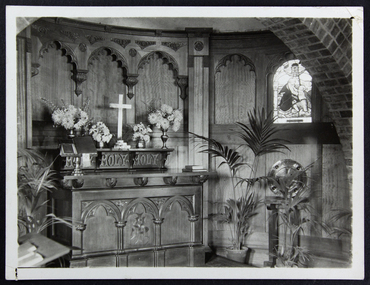
Photograph
... ...altar lectern...Altar decorated for a Palm Sunday. st peter chapel altar cross vases palm trees stained glass window palm sunday credence alm's dish altar lectern Photograph Photograph ...Altar decorated for a Palm Sunday.st peter chapel, altar, cross, vases, palm trees, stained glass window, palm sunday, credence, alm's dish, altar lectern -
 Mission to Seafarers Victoria
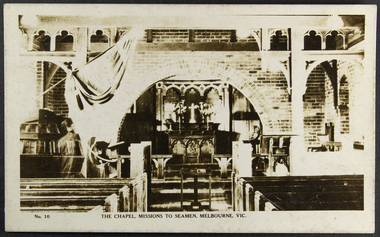
Postcard, A Real Photograph, The Chapel, Missions to Seamen Melbourne, Vic, c. 1917
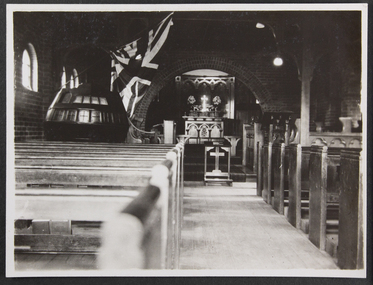
... altar...lectern...Early photograph of the St Peter Chapel. st peter chapel seamen mission mission to seamen mission to seafarers flinders street melbourne pulpit prayer desk altar lectern cross credence alm's dish Printed on verso: Postcard / A Real Photograph / Produced in Australia Glossy sepia tone postcard depicting the interior of the St Peter chapel. ...The postcard depicts the St Peter chapel with its furnitshing and furniture gifted by suppoerters.Early photograph of the St Peter Chapel.Glossy sepia tone postcard depicting the interior of the St Peter chapel.Printed on verso: Postcard / A Real Photograph / Produced in Australiast peter chapel, seamen mission, mission to seamen, mission to seafarers, flinders street, melbourne, pulpit, prayer desk, altar, lectern, cross, credence, alm's dish -
 Mission to Seafarers Victoria
Photograph - Photograph, Black and white, Reverend John Reginald Weller, The Chapel, c. 1925
... altar...altarn lectern...This photograph is detached from the 1925-1927 photographic album depicting the Weller years. st peter chapel reverend john reginald weller (1880-1969) pulpit pews mission to seamen weller album altar altarn lectern cross lectern prayer desk alm's dish Stamps on verso: in blue ink "384" / in purple ink: Herschell's Print Pathe Agents Handwritten in black in and in pencil "5" Black and white with thin white frame, photograph depicting the pews, pulpit in the St Peter chapel The Chapel Photograph Photograph, Black and white Reverend John Reginald Weller ...This photograph is detached from the 1925-1927 photographic album depicting the Weller years.Black and white with thin white frame, photograph depicting the pews, pulpit in the St Peter chapel Stamps on verso: in blue ink "384" / in purple ink: Herschell's Print Pathe Agents Handwritten in black in and in pencil "5"st peter chapel, reverend john reginald weller (1880-1969), pulpit, pews, mission to seamen, weller album, altar, altarn lectern, cross, lectern, prayer desk, alm's dish -
 Mission to Seafarers Victoria
Photograph - Photograph, Sepia, 1907-1909
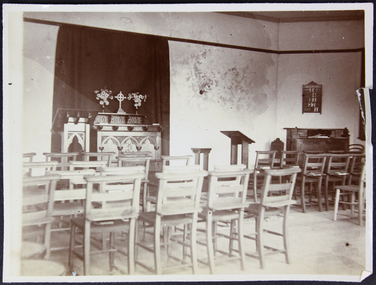
... ...lectern...altar...Amongst the furniture are the lectern donated by Lady Northcote, the altar donated by Mrs Charles Shuter in December 1907. ...The pictures shows the enduring use of the religious furniture which is still in the St Peter the Mariner chapel in the Flinders Street mission. siddeley street institute chapel lectern altar chairs lady northcote amelia shuter nee lord communion table in pencil: 137 Small monochrome photograph of interior of the temporary chapel at Siddeley Street Institute with pews, communion table (gifted by Mrs Charles Shuter in December 1907), and the lectern (gifted by Lady Northcote in December 1907). ...Temporary chapel at the Central Institute, Siddeley Street. The Institute designed by Walter Butler was inaugurated in November 1907 by Governor Northcote. Amongst the furniture are the lectern donated by Lady Northcote, the altar donated by Mrs Charles Shuter in December 1907. Both are still in use in the St Peter chapel. The Siddeley Street chapel was finished in 1909 and dedicated on the 26 January 1910.The pictures shows the enduring use of the religious furniture which is still in the St Peter the Mariner chapel in the Flinders Street mission.Small monochrome photograph of interior of the temporary chapel at Siddeley Street Institute with pews, communion table (gifted by Mrs Charles Shuter in December 1907), and the lectern (gifted by Lady Northcote in December 1907).in pencil: 137siddeley street institute, chapel, lectern, altar, chairs, lady northcote, amelia shuter nee lord, communion table -
 Mission to Seafarers Victoria
Flyer - List, Gifts, Chapel of St Peter, 1917
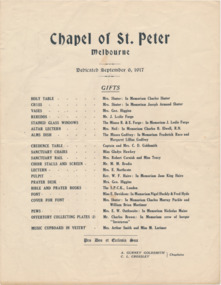
... Leslie Forge - Altar Lectern - Alms Dish: donated by the Godfrey sisters in Memoriam of their parents - Credence Table: donated by - Sanctuary Chairs: donated by Miss Gladys Hawkey - Sanctuary Rail - Choir Stalls and Chancel Screen - Lectern (donated in 1909) - Pulpit (donated in 1907) - Prayer Desk (a plaque to Goldsmith) - Bible and Prayer Books - Font - Cover for Font - Pews - Offertory Collection Plates (lost) - Music Cupboard in Vestry (lost) ...Leslie Forge - Altar Lectern - Alms Dish: donated by the Godfrey sisters in Memoriam of their parents - Credence Table: donated by - Sanctuary Chairs: donated by Miss Gladys Hawkey - Sanctuary Rail - Choir Stalls and Chancel Screen - Lectern (donated in 1909) - Pulpit (donated in 1907) - Prayer Desk (a plaque to Goldsmith) - Bible and Prayer Books - Font - Cover for Font - Pews - Offertory Collection Plates (lost) - Music Cupboard in Vestry (lost) The document lists all the gifts donated by generous supporters of the Mission in 1917. ...The St Peter chapel was furnished thanks to donations of supporters of the Mission. Some were donated for the previous temporary chapel at the Sidney Street site and some are lost. - Holy Table (altar): donated by Mrs Shuter, in Memoriam of Charles Shuter - Cross: - Vases (lost) - Stained Glass Windows: donated by Misses Edith and Ruby Forge, in Memoriam J. Leslie Forge - Altar Lectern - Alms Dish: donated by the Godfrey sisters in Memoriam of their parents - Credence Table: donated by - Sanctuary Chairs: donated by Miss Gladys Hawkey - Sanctuary Rail - Choir Stalls and Chancel Screen - Lectern (donated in 1909) - Pulpit (donated in 1907) - Prayer Desk (a plaque to Goldsmith) - Bible and Prayer Books - Font - Cover for Font - Pews - Offertory Collection Plates (lost) - Music Cupboard in Vestry (lost) The document lists all the gifts donated by generous supporters of the Mission in 1917. The chapel was built during World War 1 as. memorial to the merchant seamen lost during the war. These items are still in the chapel today.A4 document on cream colour paper, wording in black ink.gifts, chapel of st peter, flinders street, mission to seafarers, mission to seamen, gladys amy hawkey (1886-1974), reverend alfred gurney goldsmith, gifts-1917, amelia shuter nee lord, beatrice elizabeth higgins (nee shuter), charles shuter -
 Mission to Seafarers Victoria
Article, A Woman's Melbourne Letter
... Already this chapel holds memorials of peculiar historical interest. The altar lectern was given in memory of Commander Elwell, who, it will be remembered, was killed at Rabaul, in the early part of the war. ...Already this chapel holds memorials of peculiar historical interest. The altar lectern was given in memory of Commander Elwell, who, it will be remembered, was killed at Rabaul, in the early part of the war. ...A detailed description of the Mission and its activities written by a woman: Western Mail (Perth, WA : 1885 - 1954), Friday 13 December 1918, page 34 A WOMAN'S MELBOURNE LETTER. Melbourne, Dec. 4. There is an idea abroad, which as regards Melbourne, at any rate, is quite erroneous, that our sailors are not as well looked after as our soldiers, and that the noble men of the Mercantile Marine are much neglected ! For once, perhaps, my readers will pardon a letter dealing with only one subject, but the steady, unostentatious work done by the Ladies' Harbour Light Guild, in connection with the mission to seamen in Melbourne could not be adequately explained if dismissed in the usual short paragraph. Some of the most prominent names in Melbourne are associated with this guild and with the Mission Chaplain, and Mrs. Gurney Goldsmith, the members have made the Seamen's Institute a real home for those sailors of the Mercantile Marine, who touch our port. What we as a community owe to those men by their heroism in recent hostilities is certainly more understood by this band of enthusiastic workers than by the community generally. By using their unflagging energies, and influence on the sailor's behalf they endeavour to discharge a debt to which in some way or other we could and should all contribute. Even the most casual person can, if he thinks at all, sum up a few of the things our sailors - other than those belonging to our glorious navy - have done for us. On the spur of the moment we remember that those of the Mercantile Marine, are the men who manned our transports, who carried our wheat and wool, to oversea markets; who kept us in touch with our loved ones abroad; who kept the fires going in the furnaces of the great leviathans, bringing our wounded soldiers home again; who never flinched when self-sacrifice was demanded; who cared, with that tenderness, innate in all sailors, for the women and children, when the passenger ships were struck a dastardly blow by the wicked enemy; who, mocking death, gave up life with a heroism all the more heroic because it was always taken as a matter of course! Is it any wonder, then, that the members of the Ladies' Harbour Light Guild make it their business to provide a bright, homelike, spot in Melbourne, where the sailors are always certain of a cherry welcome ashore? The members of the guild are admirably drafted! The 360 non-workers each pay £1 1s. per annum. The workers, of whom there are between 700 and 800, donate 2s. 6d. and school members - it is confidently hoped that gradually all the schools will take an active interest in the mission - 1s. a year. The knights of the guild - as the men members are designated - are responsible for any sum they wish to name, from 5s. a year upwards. Everything is paid for out of these revenues, with the exception of a small grant from the Home Mission Fund - and such is the organisation, and management, that the entire concern is quite free from debt. The Seamen's Church and Institute, where the "Harbour Lights" gleam so brightly, is situated right in the midst of all the bustle and turmoil of the wharves, at the end of Flinders-street. The building, comprising chapel, and institute under the one red tiled roof, is grey stuccoed, with a small tower, from which flaunts the flag of 'The Flying Angel" - the badge of the guild. A visit to the institute makes one fully appreciate the boon the place must be to the voyage worn, weary, sailor. The atmosphere is eminently social in its best sense. While the architecture imparts an elegance, and quiet dignity which soothes by the very subtlety of its charm. With its comfortable furniture, its wealth of flowers, and the happy, wholesome, feminine influence which prevails everywhere, the quality which stands for the magic word "home" abounds. The Chaplain in the course of conversation said: -"We try to make this really a free club for sailors." But the habitues would probably tell you it was far more than that to them. The Institute is excellently appointed, and every little corner seems to have its particular history. It was built after the model of one of the old mission churches in California, and retains something of the old world attraction, while yet it combines all the advantages of modern, practical, conveniences. On entering the door the first thing, one notices is a huge compass, inlaid upon the floor, evidently to indicate one's proper bearings for it points due north - to the chapel! Only one other seamen's mission in the world boasts such a compass. As the sailor swings through the entrance he finds the office on his right, and there is, here, always a smiling face to welcome the shy, or timid, new comer. Quite a real post office is staffed by members of the guild, and all the letters received are listed alphabetically. Therefore, the expectant sailor has just to run his eye down the list, and he can immediately see whether there is a letter for him or not. If he is fortunate, he comes up to the member in charge, who unlocks the box, and produces the longed for missive. The boys are always encouraged to answer letters - and to write them. Often a few words about their mother, and their own home, will provoke a sleeping memory into activity. The writing room is well stocked with paper, envelopes, pens, and ink. The tables are so divided to ensure the utmost privacy, and through a calculated chain of circumstances, many an anxious mother receives a letter from her sailor lad, who, perhaps, might not have written but for these kindly inducements. The central hall - where social evenings are held every other night besides two special concerts a week - is inviting in the extreme. A handsome piano affords opportunity for those musically inclined. The tables are strewn with papers. The walls are bright with pictures, and here, and there, is a carved model, of a ship. One, of especial interest, is a model of "The Roon" carved, and presented by a French sailor. This German vessel will always be remembered in Australia. For it was across her bows that the first hostile shot was ever fired in Australian waters. In the corner is the canteen. It was fitted up entirely from the proceeds of a quotation calendar compiled by one of the members. The sailors may at any time, get a teapot of tea, or a tray of eatables, at a nominal cost. Before the canteen was in existence they had to go out for refreshments! - and sometimes they did not come back! Groups of sailors sit chatting at the tables. Half a dozen Swedes laugh and talk among themselves, for the simple reason they know no other language than their own. Several British sailors cluster about a dark-eyed Welsh lad - a perfect Celtic type - who, although only about twenty years of age, has been the victim of the Hun five times. Mines and torpedoes sank the ships he was in, either in the Channel or off the English coast, four times; and it is to his fifth experience, when the Inverness was wrecked, that everyone is eagerly listening. "We were in the boats eight days," he was saying, "I was pretty well mangled when they picked me up. The sufferings we endured were awful. At last we managed to reach Rapa, a Hawaiian island. The natives thought we were Germans, and came at us with spears. When they found we were British, they were awfully good to us. They even cried when we left, and the day before the rescue boat arrived they begged us to go into the hills and hide." At another table a Canadian lad - once a sailor - then a soldier, who trained at the Broadmeadows camp - was telling his experiences : - "The voyage which will always stick in my memory," he said, "was to a place which must be nameless. We left the United States not knowing whether we were bound, or what we were going to do. After some weeks we sighted a group of wonderfully beautiful islands, and we headed for the most remote and most lovely of them all. Then, and only then, we learned our mission from the skipper. We were taking their year's supply to a leprosy station! Oh no! I don't blame the skipper for not telling us ! Someone has to do these things, you know. A naval guard saw they didn't come near - and we all got sixty dollars extra. When the job was over we were quarantined on another island for two months, and one little chap - the baby of the crew, not eighteen - developed leprosy, and died before we left. Yes! I'll never forget that voyage, mates! Sometimes, I seem to see Leper's Island yet, with its lavish tropical vegetation and the gorgeous sunsets which stained all the water with blood. Then, too" - here the voice deepened - "there was an English girl - a leper - there. We heard she used to be an actress, and she contracted the disease somehow or other. She was always alone, and always watching us. In the distance we could see her come to the water's edge, and from there she would watch. Just watch . .. . watch . . .watch. ..." "Here come a couple of North Sea chaps," broke in an elderly man after pause. "One of them wounded, too, poor lad." It is not strange that all the sailors flock to the Institute. It is so comfortable, and essentially inviting, besides being full of human interest. The men's quarters comprise reading, writing and dressing rooms - hot and cold baths are always available - billiard room, and a special baggage room, where any sailor may leave his kit for as long as he likes. The payment of 3d. covers its complete insurance. Upstairs are the officers' quarters. These also have their own billiard room, writing and reading rooms, bath and dressing rooms. Just close are the apprentices' quarters - "The Half Deck," as popular parlance has it! The lads also have a billiard room of their own, and indulge in an easy armchair - amongst others - which was a donation from the Milverton School branch of the Guild. It is hoped by the committee to some day utilise the huge empty rooms, which run the length of the whole building. Their ultimate intention is to fit them up as cubicles, or "cabins," as they are to be called. They trust these "cabins" will be donated, either in memory, or in honour, of someone dear to the donor. Another forward movement soon to be put in hand, now that materials are available, is the establishment of "Norla Gymnasium." In a sailors' club such facility for exercise is absolutely essential. The men both need, and miss, exertion. As one boy, who had been backsliding, once said pathetically : -"If only there was something to do to get me into a good sweat, I would be all right." Soon such an one will be helped to swing from the trapese of the Norla Gymnasium into the right track! Sunday is always a fete day at the Institute, for 40 or 50 sailors generally come into tea. The up-to-date kitchen, which is fitted with every labour-saving appliance - all paid for out of working members' half crowns - is then a hive of animation, and methodical order. A formidable row of teapots await filling. Mrs. Goldsmith -, the chaplain's wife - rightly thinks it is far more homely to pour out the tea from a pot, than to serve it straight from the urns. So tea is poured out by a member, who sits at the head of a table gay with flowers, and chats to the guests. These latter are of all nationalities. But the French, the Spanish, Scandinavian, Norwegian - or any other sailor is equally welcome with the British. Two enthusiasts belonging to the Guild actually learnt Norwegian, so that men of this nation would have someone to talk to, and so be less lonely when they reached this, to them, foreign port ! The members of the Guild have their own private suite where they arrange the flow-err and do other necessary odds and ends undisturbed. No one appreciates flowers like a sailor, and the earliest and most beautiful may always be seen adorning the tables and rooms. Teas are served and lectures are held in the "Celia Little Hall," one of the most beautiful portions of the institute. It was erected by the chaplain in memory of his aunt from whom the hall takes its name. The Gothic windows open upon the cloisters, where, in the hot weather, the sailors enjoy their meals out of doors. The cloisters, indeed, form an exquisite spot. They are between a series of sweeping arches which lead to the chapel, and are sheltered by the open balcony of the chaplain's quarters. Grace of contour marks the architecture on every turn. Just around the corner is the chaplain's garden - a patch of green and colour, transformed from a desert waste, by a well-known woman horticulturist. The book room is a department especially valued by the sailors. There are two secretaries, one for home and the other for foreign literature. Books in French, English, Spanish, Scandinavian, Norwegian, and German may be found on the shelves. Each week about 36 convenient parcels of reading stuff are made up. These contain illustrated papers, books in various languages, and magazines. These parcels are eagerly accepted by the sailor with a long monotonous voyage before him. But complete as is every corner of the institute, no part is so well equipped as the memorial chapel erected by the Ladies' Harbour Light Guild, in memory of the officers and men, who have lost their lives during the war. St Peter's - for it is called after the sailor's patron saint - with its hallowed gentle dignity is a veritable sanctuary of peace, perhaps all the more so because it sprang out of war. The fittings are entirely of Australian wood. The pews, given in memory of some loved one by one of the members, are of Tasmanian hardwood. The reredos and altar chairs of carved blackwood. The rich carpet was provided by the members' magical half-crowns. Already this chapel holds memorials of peculiar historical interest. The altar lectern was given in memory of Commander Elwell, who, it will be remembered, was killed at Rabaul, in the early part of the war. The font commemorates two heroes - Nigel Hockley and Fred Hyde, who lost their lives at the hands of the Germans, although they survived the actual torpedoing of their ships, the Galgorn Castle off the coast of Ireland. The mother of one of them wrote out that her son had died as an Englishman should - fighting for the right. This noble sentiment is suitably paraphrased upon the inscription engraved upon the font. Practically every-hing enshrined in the chapel has its own sentimental value. The alms salver of beaten copper, studded with agate, is fragrant with the memory of a saintly woman.The eye of the sailor is caught and held by the pulpit, which is fashioned like a ship's hull and only a twist of rope guides the chaplain up the steps. For the last 13 years the Rev. A. Gurney Goldsmith, M.A., has acted as chaplain to the Seamen's Mission in Melbourne. Before that he and his wife worked in China. Mr Goldsmith visits all the boats and gets in touch personally with the sailor, over whom he has great influence. He is not only their chaplain and friend, but, amongst a wide range of other things, their banker besides. An exchange system exists between the various Missions, and the sailor who has "banked" his money with the chaplain, upon going away, receives a cheque which is cashed - minus exchange - by the chaplain of the next port. Mr. Goldsmith will tell you he has a soft spot in his heart for on old sailor he calls "Paddy." This ancient mariner has been wrecked ten times. It was a long time before the chaplain prevailed upon "Paddy" to partake of the spiritual and secular advantages afforded by the institute. He would not come, he said, until he could do so "with a good heart." Finally he frankly admitted that he had no "friends like those of 'the Flying Angel,' " and that he eventually proved his own "good heart" will be shown in this story. One day he came in to the chaplain and said bluffly, "Well, sir, I've been payin' off some old scores up Carlton way, an' I tells yer, plain, sir, not one of 'em would have seen a penny of their money but for the Mission." The Ladies' Harbour Light Guild has over thirty working suburban branches, and the excellent results achieved at the Institute now will no doubt be considerably augmented in the future. The practical actions of the members do more than anything else to convey the subtle meaning of the name of the Guild. To the visiting sailors the word "ladies" signifies the bread givers; "harbour" safety ; "lights" welcome; "guild" the welding of fraternity, and they one and all tell you the ideals thus embodied are unselfishly carried out by all the ladies who have banded together to care for the sailors' welfare.The article describes the Mission and the use of several spaces a year after its opening and gives details about the daily activities.Digital copy of an article published in the Western Mail on the 13th of December 1918. 717 flinders street, seamen's mission, norla dome, lhlg, reverend alfred gurney goldsmith, celia little room, garden, frederica godfrey -
 Flagstaff Hill Maritime Museum and Village
Furniture - Book Rest, circa 1930
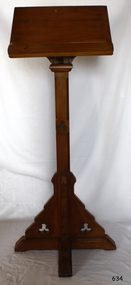
... lectern...book rest...bible rest...preaching accessory...Flagstaff Hill...Warrnambool...Shipwrecked coast...Flagstaff Hill Maritime Museum...Maritime Museum...Shipwreck coast...Flagstaff Hill Maritime Village...Great Ocean Road...Religion...Sailors Rest...Bethel Sailors’ Church...Bethel Floating Church...Ladies Harbour Light Guild...Harbor Lights Guild...Joy Club for Fighters...Ladies Lightkeepers’ Auxiliary...Mission to Seafarers...Flying Angel’s Club...St Nicholas Seamen’s Church Williamstown...St Nicholas Mission to Seamen Church Williamstown...Mission to Seamen Williamstown...St Nicholas Seamen’s Church Flagstaff Hill...139 Nelson Place Williamstown...Religious furniture...Anglican Church...altar...This altar book rest, also called a lectern, was part of the original furnishings of the St Nicholas' Mission to Seamen's Church at 139 Nelson Place, Williamstown, Victoria, operated by the Mission to Seamen organisation. ...This altar book rest, also called a lectern, was part of the original furnishings of the St Nicholas' Mission to Seamen's Church at 139 Nelson Place, Williamstown, Victoria, operated by the Mission to Seamen organisation. ...This altar book rest, also called a lectern, was part of the original furnishings of the St Nicholas' Mission to Seamen's Church at 139 Nelson Place, Williamstown, Victoria, operated by the Mission to Seamen organisation. THE MISSIONS TO SEAMEN (Brief History): - The Missions to Seamen was an Anglican charity in Great Britain that has served the world's seafarers since 1856. Its symbol is a Flying Angel, inspired by a Bible verse. Today, there are centres in over 200 ports worldwide where seamen of all backgrounds are offered a warm welcome and provided with a wide range of facilities. In Victoria, the organisation began in Williamstown in 1857 as a Sailors’ Church, also known as ‘Bethel’ or the ‘Floating Church’ in an old hulk floating in Hobson’s Bay, Port of Melbourne. It soon became part of the Missions to Seamen, Victoria. In 2000, the organisation, now named Mission to Seafarers, still operated locally in Melbourne, Portland, Geelong and Hastings. The Ladies’ Harbour Lights Guild was formed in 1906 to support the Missions to Seamen in Melbourne and other centres, such as Williamstown. Two of the most significant ladies of the Guild were founder Ethel Augusta Godfrey and foundation member Alice Sibthorpe Tracy (who established a branch of the Guild in Warrnambool in 1920). The Guild continued its work until the 1960s. In 1943, a former Williamstown bank was purchased for the Missions to Seamen Club. The chapel was named St Nicholas’ Seamen’s Church and was supported by the Ladies’ Harbour Lights Guild, the Williamstown Lightkeepers’ Auxiliary and the League of Soldiers’ and Sailors’ Friends. It ceased operation in 1966. A Missions to Seamen Chapel and Recreation Room was a significant feature of ports during the late 1800s and 1900s. It seemed appropriate for Flagstaff Hill to include such a representation within the new Maritime Village, and the Melbourne Board of Management of Missions to Seamen Victoria gave its permission on 21st May 1979 for the entire furnishings of the Williamstown chapel to be transferred to Flagstaff Hill. The St Nicholas Seamen’s Church was officially opened on October 11, 1981, and resembles the Williamstown chapel. This altar book rest is significant historically for its origin in the St Nicholas Mission to Seamen's Church in Williamstown, established in 1857 to cater for the physical, social, and spiritual needs of seafarers. It originated in Bristol, England when a Seamen's Mission was formed in 1837. The lectern is historically significant for its connection to the Ladies Lightkeepers’ Auxiliary, an organisation of women, formed to support seafarers. The connection of this item to the Mission to Seamen and to the Ladies Lightkeepers’ Auxiliary highlights the strong community awareness of the life of people at sea, their dangers and hardships, and their need for physical, financial, spiritual and moral support. Book rest, or lectern: This is a traditional book rest made of kauri pine with column support. The top section, designed to support a Bible, has an angled backrest and shelf. The item has some decorative cutaway relief. This book restis part of the St. Nicholas Seamen's Church Collection. religious service, missions to seamen victoria, church furniture, religious worship, lectern, book rest, bible rest, preaching accessory, flagstaff hill, warrnambool, shipwrecked coast, flagstaff hill maritime museum, maritime museum, shipwreck coast, flagstaff hill maritime village, great ocean road, religion, sailors rest, bethel sailors’ church, bethel floating church, ladies harbour light guild, harbor lights guild, joy club for fighters, ladies lightkeepers’ auxiliary, mission to seafarers, flying angel’s club, st nicholas seamen’s church williamstown, st nicholas mission to seamen church williamstown, mission to seamen williamstown, st nicholas seamen’s church flagstaff hill, 139 nelson place williamstown, religious furniture, anglican church, altar book rest -
 Mission to Seafarers Victoria
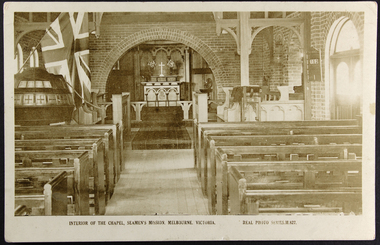
Postcard - Postcard, Sepia, Valentines Real Photo Series, Memorial Chapel of St Peter, c. 1917
... The postcard depicts the original, untouched look of the chapel with the fleur-de lys carpet, pews, lectern, choir stalls, pulpit, altar, altar lectern, credence and alm's dish. flinders street pews altar st peter chapel flag chapel pulpit choir stalls credence table alm's dish vases flowers carpet fleur de lys At the back in blue ink: With love from Dad/ This was taken some time ago/ They now have candles on the altar. ...The postcard depicts the St Peter chapel in its early years with all the gifts for donors and the original carpet in the sanctuary.The postcard depicts the original, untouched look of the chapel with the fleur-de lys carpet, pews, lectern, choir stalls, pulpit, altar, altar lectern, credence and alm's dish.Postcard depicting the interior of the St Peter chapel of the Centre Seamen's Institute shot in the centre of the have and focusing on the sanctuary.At the back in blue ink: With love from Dad/ This was taken some time ago/ They now have candles on the altar. Top corner in the stamp area in pencil: 2flinders street, pews, altar, st peter chapel, flag, chapel, pulpit, choir stalls, credence table, alm's dish, vases, flowers, carpet, fleur de lys -
 Mission to Seafarers Victoria
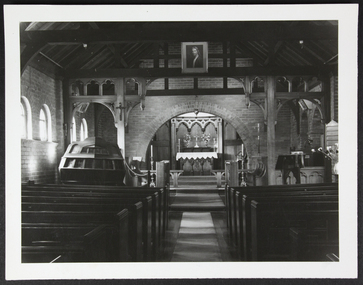
Photograph - Photograph, Black and white, Memorial Chapel of Peter
... altar...pulpit...pews...choir-stalls...reverend w.f. haire...walter richmond butler...jesus...st peter chapel...lectern...Although melbourne mission-to-seafarers altar pulpit pews choir-stalls reverend w.f. haire walter richmond butler jesus st peter chapel lectern hymn board Black and white photograph with a white border, of the interior of Saint Peter the Mariner's Chapel. ...The St Peter Chapel opened in 1917. Funding came primarily from the Ladies Harbour Lights Guild. The artwork "And the Lord turned and looked upon Peter" was donated by Mr R. Stewart Murray in 1940. The procession cross was donated by the Ballarat Branch of the Harbour Lights Guild in 1958 helping dating the photograph to post 1958.St Peter the Mariner's Chapel is ..... by the relationship with the Anglican Church. Although Black and white photograph with a white border, of the interior of Saint Peter the Mariner's Chapel. Central is the aisle with pews on either side. Midground and on the left side is the pulpit and an altar in the background. melbourne, mission-to-seafarers, altar, pulpit, pews, choir-stalls, reverend w.f. haire, walter richmond butler, jesus, st peter chapel, lectern, hymn board -
 Bendigo Historical Society Inc.
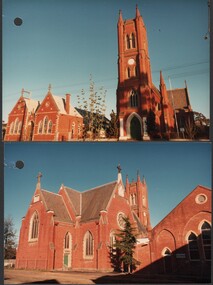
Photograph - National Trust Collection: St Paul's Church of England, Bendigo, 23/06/2025
... The cathedral also features a number of important movable objects such as the finely carved eagle lectern in oak, the ornately carved timber chair in the sanctuary, the two baptismal fonts, the ornately carved canons' stalls with eagle motifs in the sanctuary and the two large candle holders. Important works of art include the opus sectile reredos in mosaic; the sculpture of Madonna and Child in Queensland birch by sculptress Leopoldine Mimovich; and the carved figures of St Peter and St Paul at the high altar by the sculptress Ola Cohn. ...The cathedral also features a number of important movable objects such as the finely carved eagle lectern in oak, the ornately carved timber chair in the sanctuary, the two baptismal fonts, the ornately carved canons' stalls with eagle motifs in the sanctuary and the two large candle holders. Important works of art include the opus sectile reredos in mosaic; the sculpture of Madonna and Child in Queensland birch by sculptress Leopoldine Mimovich; and the carved figures of St Peter and St Paul at the high altar by the sculptress Ola Cohn. ...Victorian Heritage Database: St Paul's Cathedral, Bendigo was built in stages. The nave was built in 1868, the tower in 1872-73 and the transepts and sanctuary in 1926-27. Robert Love was the architect, although the final stage was supervised by architects Gawler and Drummond. Cathedral status was transferred from the original cathedral All Saints to St Paul's in 1981. The Gothic style cathedral is constructed of red brick with stone dressings. It has a simple cruciform plan comprising a six bay nave, transepts and sanctuary. A tall tower centrally located at the west end dominates the exterior. The peal of eight bells was cast by Meares and Co of London and installed in 1873. The interior features elaborately cusped roof principals; an organ by Alfred Fuller built in 1883 with a console and pipes added later from St Andrew's Cathedral, Sydney; and notable stained glass by Ferguson, Urie and Lyon. St Paul's Rectory was built in 1885 to a design by the architect WC Vahland. The Parish Office and Hall was built as a Sunday School in 1898 to a design by FW Lehmann. St Paul's Cathedral is of architectural, aesthetic and historical significance to the state of Victoria. The cathedral is a significant example of the Early English Gothic style. The tower, with its distinctively detailed pinnacles, its spiral staircase and carillon of eight bells, is a notable feature and a town landmark. The interior is aesthetically important for its decorative detail. The roof structure, rising some 18.3 metres from the 11 metre walls in suspended semi-circles from the pillarless nave, is highly significant for both its considerable technical achievement and its aesthetic appeal. The interior features fine examples of carved timber fixtures and fittings. The interior is also noteworthy for the high quality of its stained glass, especially the twelve apostle windows by Ferguson, Urie and Lyon. The cathedral also features a number of important movable objects such as the finely carved eagle lectern in oak, the ornately carved timber chair in the sanctuary, the two baptismal fonts, the ornately carved canons' stalls with eagle motifs in the sanctuary and the two large candle holders. Important works of art include the opus sectile reredos in mosaic; the sculpture of Madonna and Child in Queensland birch by sculptress Leopoldine Mimovich; and the carved figures of St Peter and St Paul at the high altar by the sculptress Ola Cohn. St Paul's Cathedral complex has historical associations with the Anglican church in Bendigo, particularly the rivalry between St Paul's and the original cathedral, All Saints, and the long and controversial debate about 'High Church versus Low Church'. It has associations with individuals important to the history of the Anglican church in Bendigo including John Christian MacCullagh, the first Dean of Bendigo, after whom the MacCullagh Chapel was named, and Canon David Anthony, a former rector of the church. https://vhd.heritagecouncil.vic.gov.au/places/3695National Trust Collection: St Paul's Church of England, Bendigo Church constructed of red brick with contrasting brick features. Church entry/ bell tower is a feature of Bendigo skyline. 3084.102A frontage of the Church and Church Hall onto Myers Street, Bendigo 3084.102B St Paul's C of E, rear of Church and Church Hall facing Bush's Lane, Bendigost paul's church of england -
 Kiewa Valley Historical Society
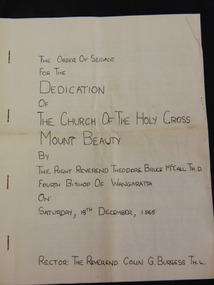
Booklet - The Church of the Holy Cross Mount Beauty, The Order of Service for the Dedication of the Church of the Holy Cross Mount Beauty, December 1965
... The book includes the Order of Service, The Procession to the Altar, The dedication of the Church, The dedication of the Furniture, At the Prayer Desk, At the Lectern At the Pulpit, At the Chancel Step, At the Altar, The Dedication Mass, The Collect, The Epistle, The Gospel, Proper Preface and is written by the Right Reverend Theodore Bruce McCall, Fourth Bishop Of Wangaratta on Saturday, 18th Dec., 1965...The book includes the Order of Service, The Procession to the Altar, The dedication of the Church, The dedication of the Furniture, At the Prayer Desk, At the Lectern At the Pulpit, At the Chancel Step, At the Altar, The Dedication Mass, The Collect, The Epistle, The Gospel, Proper Preface and is written by the Right Reverend Theodore Bruce McCall, Fourth Bishop Of Wangaratta on Saturday, 18th Dec., 1965 The Order of Service for the Dedication of the Church of the Holy Cross Mount Beauty Booklet - The Church of the Holy Cross Mount Beauty ...The Anglican Church of the Holy Cross was situated in Maddison St., Mt Beauty. It was dedicated on Saturday 18th December 1965. The Rector was The Reverend Colin G. Burgess Th.L.Mt Beauty was created by the State Electricity Commission of Victoria during the construction of the Kiewa Hydro Electric Scheme. During the late 1960's the town was handed over to the Bright Shire and its building sold. A plaque was unveiled in the porch to commemorate the Dedication of the Church by Mr H. H .Williams, the chief engineer of the Kiewa Scheme.5 page hand made book with white pages and black typing stapled together with 4 staples. The book includes the Order of Service, The Procession to the Altar, The dedication of the Church, The dedication of the Furniture, At the Prayer Desk, At the Lectern At the Pulpit, At the Chancel Step, At the Altar, The Dedication Mass, The Collect, The Epistle, The Gospel, Proper Preface and is written by the Right Reverend Theodore Bruce McCall, Fourth Bishop Of Wangaratta on Saturday, 18th Dec., 1965mt beauty; anglican church; religion;
