
Showing 284 items matching "anderson property"
-
 Phillip Island and District Historical Society Inc.
Photograph, c 1900
... ...anderson property netherwood...Butter churns in foreground. Anderson property - "Netherwood"...Butter churns in foreground. Anderson property - "Netherwood" local history photography photographs slides film picnic gathering sepia photograph miss elms san remo anderson property netherwood Picnic gathering beneath large trees - rural setting at Anderson' home "Netherwood" Photograph ...Rural scene in San Remo area. Cows grazing with cart horses in background. Beautiful trees, large gathering of people of all ages in their Sunday-best clothing, hats and umbrellas as protection from the sun. Butter churns in foreground. Anderson property - "Netherwood"Picnic gathering beneath large trees - rural setting at Anderson' home "Netherwood"local history, photography, photographs, slides, film, picnic gathering, sepia photograph, miss elms, san remo, anderson property netherwood -
 Phillip Island and District Historical Society Inc.
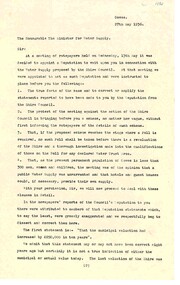
Letter, Letter to Minister for Water Supply 1936, 27 May 1936
... ...Anderson property...Historical Water supply Shire of phillip Island agriculture Isle of Wight Anderson property valuations Charmadene Bonnie Doon Guest House population tourism primary produce D H Robb R A Grayden H V Johnston J Thornborrow E R Scott The Honourable The Minister for Water Supply. ...Early attempts to have a water supply connected to Cowes. It includes figures on tourism, valuations of local properties, local primary produce and what water they require.HistoricalFoolscap size carbon copy of typed letter. 7pagesThe Honourable The Minister for Water Supply. Suggested motions to be put to the meeting of ratepayers, 13 May 1936water supply, shire of phillip island, agriculture, isle of wight, anderson property, valuations, charmadene, bonnie doon guest house, population, tourism, primary produce, d h robb, r a grayden, h v johnston, j thornborrow, e r scott -
 Ringwood and District Historical Society
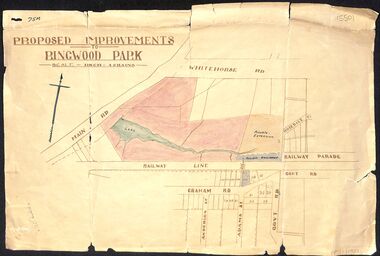
Map, Proposed Improvements to Ringwood Park (Ringwood Lake) dated 14 January 1927
... On the bottom of the map, south of the railway line, showing proposed streets - Graham Road, Anderson Street and Adams Street - in preparation for the sale of the Theo Anderson property. That area is now Bedford Park....On the bottom of the map, south of the railway line, showing proposed streets - Graham Road, Anderson Street and Adams Street - in preparation for the sale of the Theo Anderson property. That area is now Bedford Park. ...Proposed Improvements to Ringwood Park (Ringwood Lake) dated 14 January 1927, signed Cr McCaskill. Main Road is Whitehorse Road (Maroondah Highway), and Mt Dandenong Road is incorrectly labelled Whitehorse Road. The map shows Rosedale Crescent and Railway Parade, both of which exist in 2024. On the bottom of the map, south of the railway line, showing proposed streets - Graham Road, Anderson Street and Adams Street - in preparation for the sale of the Theo Anderson property. That area is now Bedford Park. -
 Port Fairy Historical Society Museum and Archives
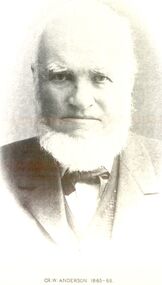
Photograph, Cr W Anderson 1865-1866, 1850’s
... Councillor William Anderson lived at his property “Rosemount” Yangery. he’s was elected to the Legislative Council and represented this district for a number of years....Councillor William Anderson lived at his property “Rosemount” Yangery. he’s was elected to the Legislative Council and represented this district for a number of years. president belfast portrait council shire government municipal local-government rosemount yangery Councillor W Anderson 1865-1866 Black and white portrait of a male with white beard Cr W Anderson 1865-1866 Photograph Photograph ...Councillor William Anderson lived at his property “Rosemount” Yangery. he’s was elected to the Legislative Council and represented this district for a number of years.Black and white portrait of a male with white beardCouncillor W Anderson 1865-1866president, belfast, portrait, council, shire, government, municipal, local-government, rosemount, yangery -
 Ballarat Tramway Museum
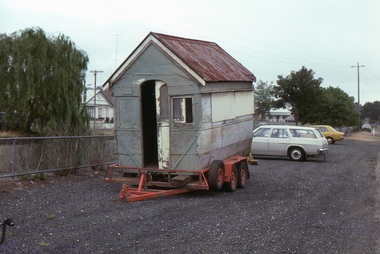
Photograph - Digital images of Ballarat Horse Tram No. 1 being recovered, Peter Winspur, 13-12-1985
... Shows the state of the body of that the Ballarat Tramway Preservation Society recovered of the 1887 Horse Tram from the rear of a property in Anderson St Balllarat. The body was built by Duncan and Fraser in Adelaide. ...Shows the state of the body of that the Ballarat Tramway Preservation Society recovered of the 1887 Horse Tram from the rear of a property in Anderson St Balllarat. The body was built by Duncan and Fraser in Adelaide. ...Shows the state of the body of that the Ballarat Tramway Preservation Society recovered of the 1887 Horse Tram from the rear of a property in Anderson St Balllarat. The body was built by Duncan and Fraser in Adelaide. The tram body was reconstructed by the BTPS and made operable by the Museum in 1992Yields information about the condition of the body of Ballaarat Tramway Co. Horse Tram No. 1 of 1887. Set of two digital images of the recovery of Ballaarat Tramway Co. Horse Tram No. 1 on 13-12-1985 .1 - Body placed on a tandem trailer in Anderson St, Ballarat .2 - Body of Ballarat Horse tram No. 1 on a set of wheels at the depothorse tram, btps, ballarat, tram no. 1, tram recovery -
 Kew Historical Society Inc
Photograph - 'Prague House' (formerly 'Dunboe'), 52 Sackville Street, 1988
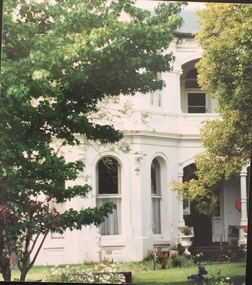
... Documentary evidence records that the first occupier of this substantial two-storey residence was Harry Karlbaum, a sharebroker and although the owner's name is not listed in the Rate Books for this first year, it appears in 1893 as Robert Crawford Anderson, a merchant, The property was given an initial N.A.V. of £150 in 1892 while by 1900 it was listed as having eleven rooms. ...Documentary evidence records that the first occupier of this substantial two-storey residence was Harry Karlbaum, a sharebroker and although the owner's name is not listed in the Rate Books for this first year, it appears in 1893 as Robert Crawford Anderson, a merchant, The property was given an initial N.A.V. of £150 in 1892 while by 1900 it was listed as having eleven rooms. ...Documentary evidence records that the first occupier of this substantial two-storey residence was Harry Karlbaum, a sharebroker and although the owner's name is not listed in the Rate Books for this first year, it appears in 1893 as Robert Crawford Anderson, a merchant, The property was given an initial N.A.V. of £150 in 1892 while by 1900 it was listed as having eleven rooms. (Kew Conservation Study, 1988)Colour photographic positive of one of 'Prague House'. The house is clad in render and is typical of the late Victorian period with an asymmetrical composition that has a loggia of stilted segmental arches at both levels that turns the corner of the house, and a polygonal bay window on one side of the front facade. The application of colonettes across the facade, the square piers to the loggia. and the lift in the eave to form a gable unit are less typical. (Kew Conservation Study, 1988)prague house -- sackville street -- kew (vic.), dunboe -- sackville street -- kew (vic.) -
 Kew Historical Society Inc
Photograph - 'Prague House' (formerly 'Dunboe'), 52 Sackville Street, 1988
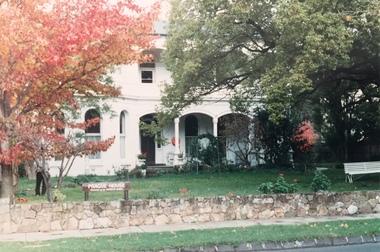
... Documentary evidence records that the first occupier of this substantial two-storey residence was Harry Karlbaum, a sharebroker and although the owner's name is not listed in the Rate Books for this first year, it appears in 1893 as Robert Crawford Anderson, a merchant, The property was given an initial N.A.V. of £150 in 1892 while by 1900 it was listed as having eleven rooms. ...Documentary evidence records that the first occupier of this substantial two-storey residence was Harry Karlbaum, a sharebroker and although the owner's name is not listed in the Rate Books for this first year, it appears in 1893 as Robert Crawford Anderson, a merchant, The property was given an initial N.A.V. of £150 in 1892 while by 1900 it was listed as having eleven rooms. ...Documentary evidence records that the first occupier of this substantial two-storey residence was Harry Karlbaum, a sharebroker and although the owner's name is not listed in the Rate Books for this first year, it appears in 1893 as Robert Crawford Anderson, a merchant, The property was given an initial N.A.V. of £150 in 1892 while by 1900 it was listed as having eleven rooms. (Kew Conservation Study, 1988)Colour photographic positive of one of 'Prague House'. The house is clad in render and is typical of the late Victorian period with an asymmetrical composition that has a loggia of stilted segmental arches at both levels that turns the corner of the house, and a polygonal bay window on one side of the front facade. The application of colonettes across the facade, the square piers to the loggia. and the lift in the eave to form a gable unit are less typical. (Kew Conservation Study, 1988)prague house -- sackville street -- kew (vic.), dunboe -- sackville street -- kew (vic.) -
 Federation University Historical Collection
Photograph - Black and White, "Laura Villa" Smeaton taken from the site of Anderson's Mill
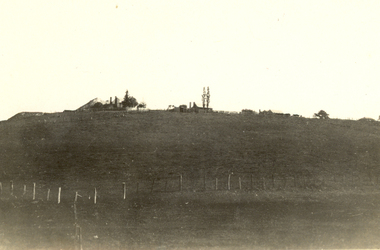
... The property on the left hand side of the photo is "Laura Villa" at Smeaton. "Laura Villa" Smeaton taken from the site of Anderson's Mill Photograph - Black and White ...Frank Wright was a renown resident of Smeaton, where he was born. He lived at Laura Villa, and attended Smeaton State School. His father William was a gold miner and his mother's name was Sarah. Their family won many singing and instrumental awards. Frank was tutored by Percy Code and was awarded a gold medal for the highest marks in the ALCM examinations in the British Colonies at the age of seventeen years. He became the Australian Open Cornet Champion by the age of eighteen. A year later, Frank conducted the City of Ballarat Band, and later the Ballarat Soldiers’ Memorial Band. He formed the Frank Wright Frisco Band and Frank Wright and his Coliseum Orchestra. These bands won many South Street awards, and Frank as conductor won many awards in the Australian Band Championship contest. In 1933 Frank Wright sailed to England to conduct the famous St Hilda’s Band and was later appointed Musical Director of the London County Council, where he organized many amazing concerts in parks, in and around the London district. He was made Professor of Brass and Military Band Scoring and conducted at the Guildhall of Music and Drama. Frank was often invited to adjudicate Brass Band Championships around Europe, in Australia, including South Street and in New Zealand. The Frank Wright Medal at the Royal South Street competition is awarded to an individual recognized as making an outstanding contribution to brass music in Australia.Black and white photograph of house in the far distance on the top of a hill with some trees behind. In the foreground at the base of the hill is a fence. The property on the left hand side of the photo is "Laura Villa" at Smeaton.frank wright, laura villa, smeaton -
Federation University Historical Collection
Plan, Plan of Mount Helen, 7/7/1964
... property in Mount Helen. Chatham Ave midland highway gear avenue eddy avenue shire avenue boak avenue moss avenue rathkeale avenue ingliston avenue chatham avenue mardango drive nyora grove yarana drive shakespeare avenue marina avenue landale avenue lylia avenue recreation road olympic avenue the gums heather avenue dallas avenue jones avenue sebastopol mount clear road Plan of Subdivisions to Mount Helen, Shire of Buninyong, Sheet 1 and Sheet 2 Scale 200 feet to one inch Plan of Mount Helen Plan Plan K. R. Anderson ...John [Jack] and Jessie Imogene[ Gene] Chatham purchased a subdivided property in Mount Helen. Chatham Ave Plan of Subdivisions to Mount Helen, Shire of Buninyong, Sheet 1 and Sheet 2 Scale 200 feet to one inchmidland highway, gear avenue, eddy avenue, shire avenue, boak avenue, moss avenue, rathkeale avenue, ingliston avenue, chatham avenue, mardango drive, nyora grove, yarana drive, shakespeare avenue, marina avenue, landale avenue, lylia avenue, recreation road, olympic avenue, the gums, heather avenue, dallas avenue, jones avenue, sebastopol mount clear road -
 Marysville & District Historical Society
Photograph (Item) - Black and white photograph, Phyllis Bromby, 1934
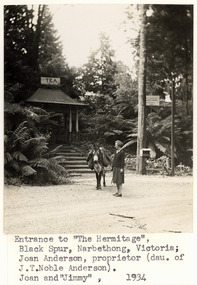
... property and the surrounding forest of towering mountain ash. Aged 81 Lindt died of heart failure during disastrous bushfires on 19 February 1926 at the Hermitage. He was survived by his wife Catherine who continued to run ‘The Hermitage’ guest house before she retired to the city. In the early 1930s, Joan Anderson ...A digital copy of a black and white photograph taken at the entrance to "The Hermitage" at Narbethong in Victoria.A digital copy of a black and white photograph taken at the entrance to "The Hermitage" at Narbethong in Victoria. "The Hermitage" was built by photographer John William Lindt as a home and guesthouse in 1894. John Lindt had previously photographed the mountain scenery of the Black Spur and purchased 71 acres and subseqently built his home and guesthouse from where he continued his career. "The Hermitage had a garden designed by John Lindt's friend, Ferdinand von Mueller, who was at one stage the Director of the Melbourne Botanic Gardens. The garden featured New Guinea tree houses from which John Lindt made frequent panoramas of his property and the surrounding forest of towering mountain ash. Aged 81 Lindt died of heart failure during disastrous bushfires on 19 February 1926 at the Hermitage. He was survived by his wife Catherine who continued to run ‘The Hermitage’ guest house before she retired to the city. In the early 1930s, Joan Anderson purchased the property, maintaining it as a guesthouse.Entrance to "The Hermitage",/ Black Spur, Narbethong, Victoria;/ Joan Anderson, proprietor (dau of/ J.T. Noble Anderson)./ Joan and "Jimmy", 1934the hermitage, john william lindt, narbethong, victoria, black spur, ferdinand von mueller, melbourne botanic gardens, new guinea, catherine lindt, joan anderson -
 Marysville & District Historical Society
Book, The Scenic Shire-Marysville-Alexandra-Eildon, 1987
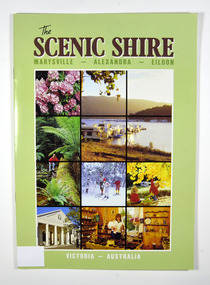
... Property of Blackwood Cottages / available for sale at Office @ $3.00 per copy Stamp of Marysville & District / Historical Society Inc / P.O. Box 22 / Marysville 3779 Paperback. Front cover has a series of colour photographs depicting flora, places to visit and activities in the areas named in the title. Back cover has a photograph of houseboats at Eildon Boat Club at Anderson ...A book outlining recreational activities available in the towns of Marysville, Alexandra and Eildon and their surrounds Paperback. Front cover has a series of colour photographs depicting flora, places to visit and activities in the areas named in the title. Back cover has a photograph of houseboats at Eildon Boat Club at Anderson Harbour on Lake Eildon.Property of Blackwood Cottages / available for sale at Office @ $3.00 per copy Stamp of Marysville & District / Historical Society Inc / P.O. Box 22 / Marysville 3779marysville, alexandra, eildon, recreation -
 Marysville & District Historical Society
Book, The Scenic Shire-Marysville-Alexandra-Eildon, 1987
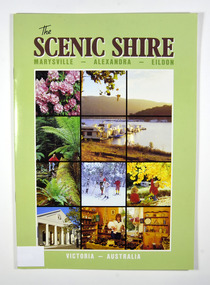
... Property of Blackwood Cottages / available for sale at Office @ $3.00 per copy Stamp of Marysville & District / Historical Society Inc / P.O. Box 22 / Marysville 3779 Paperback. Front cover has a series of colour photographs depicting flora, places to visit and activities in the areas named in the title. Back cover has a photograph of houseboats at Eildon Boat Club at Anderson ...A book outlining recreational activities available in the towns of Marysville, Alexandra and Eildon and their surrounds Paperback. Front cover has a series of colour photographs depicting flora, places to visit and activities in the areas named in the title. Back cover has a photograph of houseboats at Eildon Boat Club at Anderson Harbour on Lake Eildon.Property of Blackwood Cottages / available for sale at Office @ $3.00 per copy Stamp of Marysville & District / Historical Society Inc / P.O. Box 22 / Marysville 3779marysville, alexandra, eildon, recreation -
 Federation University Historical Collection
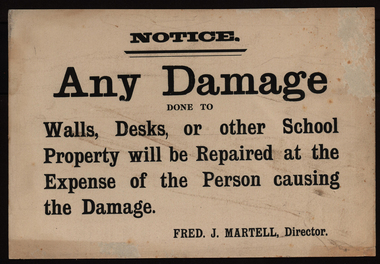
Sign, Frederick J Martell, School of Mines notice, c1895-1912
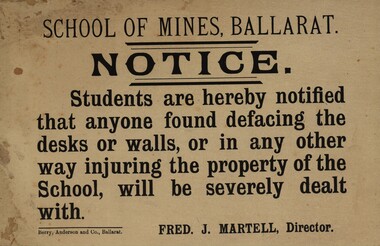
... anderson & co...notice...poster...defacing property...frederick martell ballarat school of mines berry anderson & co notice poster defacing property Printed card with writing asking students not to deface property School of Mines notice Sign Frederick J Martell Berry Anderson & Co. ...Printed card with writing asking students not to deface propertyfrederick martell, ballarat school of mines, berry anderson & co, notice, poster, defacing property -
 Federation University Historical Collection
Magazine - Magazine of 24 pages, Baxter & Stubbs, Print, Ballarat School of Mines, Student Magazine, Second Term, 1912, 1912
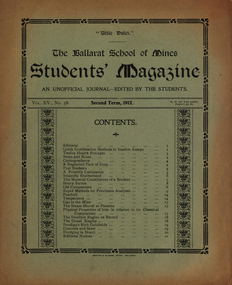
... Table of Contents: Editorial, Quick combination methods in smelter assays, Twelve health precepts, News and notes, Correspondence, A neglected path of duty, Past students, A friendly castigation, Scientific brotherhood, The material constituents of a student, Henry Sutton, Old companions, Rapid methods for proximate analyses, Football, Temperance, Gas in the mine, The steam shovel at Panama, Physical properties of iron in relation to its chemical composition, The smallest engine on record, The diesel engine, Bendigo's rich goldfields, Concrete and steel, Dredging in Brazil, Editorial notes. editorial, quick combination methods in smelter assays, twelve health precepts, news and notes, correspondence, a neglected path of duty, past students, a friendly castigation, scientific brotherhood, the material constituents of a student, henry sutton, old companions, rapid methods for proximate analyses, football, temperance, gas in the mine, the steam shovel at panama, physical properties of iron in relation to its chemical composition, the smallest engine on record, the diesel engine, bendigo's rich goldfields, concrete and steel, dredging in brazil, editorial notes. alumni f. brindsren b .h. bennets e. bleske j. r. booth a. s. coyte h. b. cooke t. a. couper t. e. copeland l. j. coulter j. dickinson g. h. davenport w. e. eyres e. fraser a. a. gibson g. govet j. a. grant e. c. hurdsfield h. a. krause w. kingston h. r. kofoed f. a. marriot h. s. martin d. m'dougall c. w. nash j. a. reid j. sutherland g. sides e. trend r. m. vaughan s. b. vial c. h. vale o. c. witherden e. m. weston l. a. westcott j. watson j. worthington j. adam wilfred avery h. baxter h. caulfield a. cropper e. b. crossley w. currie dave don hilary dowling chas. fraser a. d. galloway w. geldard hubert hall g. s. hart w. b. hirt h. e. hawksworth carl janssen w. t. lakeland l. j. lambert c. lund k. bryon moore f. a. moss jack orr d. a. bunting l. seward h. s. sheppard c. e. sands n. stuckey r. vale r. watts reg. williamson wm. blythe l. w. g. buchner thos. davis w. e. figgis e. o. gregory jack grieves a. s. leathes dave lilley wm. macartney guy ramsay carl. moore vic. nicholls garnet nightingale g. m. roberts r. r. robin len. seal h. valentine r. g. walker n. buley a. campbell h. cornell a. guy h. hull o. e. jaeger m. mitchell r. i. moore j. r. sides h. j. whittingham c. s. whykes colin c. corrie h. miles vic. milington r. a. j. roberts john r. booth w. l. allen f. c. hall v. m. booth e. s. anderson r. blight b. serjeant m. williamson fred j. martell editorial quick combination methods in smelter assays twelve health precepts news and notes correspondence a neglected path of duty past students a friendly castigation scientific brotherhood the material constituents of a student henry sutton old companions rapid methods for proximate analyses football temperance gas in the mine the steam shovel at panama physical properties of iron in relation to its chemical composition Green booklet of 24 pages Ballarat School of Mines, Student Magazine, Second Term, 1912 Magazine Magazine of 24 pages Baxter & Stubbs, Print ...Table of Contents: Editorial, Quick combination methods in smelter assays, Twelve health precepts, News and notes, Correspondence, A neglected path of duty, Past students, A friendly castigation, Scientific brotherhood, The material constituents of a student, Henry Sutton, Old companions, Rapid methods for proximate analyses, Football, Temperance, Gas in the mine, The steam shovel at Panama, Physical properties of iron in relation to its chemical composition, The smallest engine on record, The diesel engine, Bendigo's rich goldfields, Concrete and steel, Dredging in Brazil, Editorial notes.Green booklet of 24 pageseditorial, quick combination methods in smelter assays, twelve health precepts, news and notes, correspondence, a neglected path of duty, past students, a friendly castigation, scientific brotherhood, the material constituents of a student, henry sutton, old companions, rapid methods for proximate analyses, football, temperance, gas in the mine, the steam shovel at panama, physical properties of iron in relation to its chemical composition, the smallest engine on record, the diesel engine, bendigo's rich goldfields, concrete and steel, dredging in brazil, editorial notes., alumni, f. brindsren, b .h. bennets, e. bleske, j. r. booth, a. s. coyte, h. b. cooke, t. a. couper, t. e. copeland, l. j. coulter, j. dickinson, g. h. davenport, w. e. eyres, e. fraser, a. a. gibson, g. govet, j. a. grant, e. c. hurdsfield, h. a. krause, w. kingston, h. r. kofoed, f. a. marriot, h. s. martin, d. m'dougall, c. w. nash, j. a. reid, j. sutherland, g. sides, e. trend, r. m. vaughan, s. b. vial, c. h. vale, o. c. witherden, e. m. weston, l. a. westcott, j. watson, j. worthington, j. adam, wilfred avery, h. baxter, h. caulfield, a. cropper, e. b. crossley, w. currie, dave don, hilary dowling, chas. fraser, a. d. galloway, w. geldard, hubert hall, g. s. hart, w. b. hirt, h. e. hawksworth, carl janssen, w. t. lakeland, l. j. lambert, c. lund, k. bryon moore, f. a. moss, jack orr, d. a. bunting, l. seward, h. s. sheppard, c. e. sands, n. stuckey, r. vale, r. watts, reg. williamson, wm. blythe, l. w. g. buchner, thos. davis, w. e. figgis, e. o. gregory, jack grieves, a. s. leathes, dave lilley, wm. macartney, guy ramsay, carl. moore, vic. nicholls, garnet nightingale, g. m. roberts, r. r. robin, len. seal, h. valentine, r. g. walker, n. buley, a. campbell, h. cornell, a. guy, h. hull, o. e. jaeger, m. mitchell, r. i. moore, j. r. sides, h. j. whittingham, c. s. whykes, colin c. corrie, h. miles, vic. milington, r. a. j. roberts, john r. booth, w. l. allen, f. c. hall, v. m. booth, e. s. anderson, r. blight, b. serjeant, m. williamson, fred j. martell, editorial, quick combination methods in smelter assays, twelve health precepts, news and notes, correspondence, a neglected path of duty, past students, a friendly castigation, scientific brotherhood, the material constituents of a student, henry sutton, old companions, rapid methods for proximate analyses, football, temperance, gas in the mine, the steam shovel at panama, physical properties of iron in relation to its chemical composition -
 Federation University Historical Collection
Sign, Berry, Anderson and Co, Ballarat School of Mines Notice Relating to Damage
... ballarat school of mines laboratory frederick martell notice damage school property repair Sign printed on white card on black ink. Ballarat School of Mines Notice Relating to Damage Sign Berry, Anderson and Co. ...Sign printed on white card on black ink.ballarat school of mines, laboratory, frederick martell, notice, damage, school property, repair -
 Flagstaff Hill Maritime Museum and Village
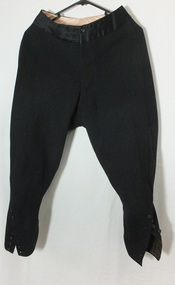
Clothing - Riding Habit, Jodhpurs, 1920s
... Anderson. Beatrice was Edward Manifold’s cousin once removed whom he married in 1900. Edward, the son of John Manifold, was born on 15 November 1868 and educated at Geelong and Melbourne Grammar schools and at Trinity Hall, Cambridge (B.A., 1891). He chose the Danedite portion of land at Purrumbete, and on the death of his bachelor brother Thomas Peter (1863-1895), after a hunting accident, he took over his allocation, Wiridgil. He also owned Boortkoi, near Hexham and on these properties...Anderson. Beatrice was Edward Manifold’s cousin once removed whom he married in 1900. Edward, the son of John Manifold, was born on 15 November 1868 and educated at Geelong and Melbourne Grammar schools and at Trinity Hall, Cambridge (B.A., 1891). He chose the Danedite portion of land at Purrumbete, and on the death of his bachelor brother Thomas Peter (1863-1895), after a hunting accident, he took over his allocation, Wiridgil. He also owned Boortkoi, near Hexham and on these properties ...The Manifolds were a significant pioneering pastoral family in Western Victoria. The donated riding jodhpurs originally belonged to Mrs Edward Manifold, formally Beatrice Mary Synnot Anderson. Beatrice was Edward Manifold’s cousin once removed whom he married in 1900. Edward, the son of John Manifold, was born on 15 November 1868 and educated at Geelong and Melbourne Grammar schools and at Trinity Hall, Cambridge (B.A., 1891). He chose the Danedite portion of land at Purrumbete, and on the death of his bachelor brother Thomas Peter (1863-1895), after a hunting accident, he took over his allocation, Wiridgil. He also owned Boortkoi, near Hexham and on these properties, he ran merino sheep, a Lincoln stud which dated back to 1870, and Shorthorn cattle. 3000 acres were also leased to dairy farmers. Edward was a member of Hampden Shire Council in 1909-31 and three times president at Camperdown. The town was largely bordered by Manifold land and partly dependent upon the local pastoral dynasties, which benefited the local area from the families’ various business interests. Though an offer to build public baths to commemorate the Queen Victoria Jubilee in 1897 was not proceeded with, the town acquired a hospital, a reserve on Mount Leura, a clock tower and a cricket pavilion, as well as notable donations from the Manifolds to St Paul's Church and the grammar school. Edward was a keen polo player and racing man. He was also a successful owner of steeplechasers and a committeeman of the Victoria Racing Club for many years. He was also a member of many Western District racing clubs. On the 16 July 1900, Edward had married his sixteen-year-old cousin Beatrice Mary Synnot Anderson by whom he had three sons Thomas Peter, Andrew and Robert Edward Manifold. Edwards's estate at his death was valued for probate at nearly £500,000. Edward died following an operation on 14 February 1931 at a private hospital in Yarra Vale Melbourne. Beatrice passed away in 1954, aged 79 in Ballarat where she was born in 1874. Contextual historic Family background: The Manifold brothers Thomas (1809-1875), John (1811-1877) and Peter (1817-1885) were the fourth, fifth and sixth sons of William Manifold and Mary, nee Barnes, of Courthouse Farm, Bromborough, Cheshire, England. The family had decided to emigrate to Van Diemen's Land. Thomas was sent ahead, arriving in Hobart Town on 23rd January 1828 with £1500 and a letter of recommendation from the Colonial Office. Thomas acquired 1280 acres on the west bank of the Tamar River. John and Peter, with their parents and three sisters, arrived on 8th July 1831. Land grants by then had finished but William brought ninety acres next to his son Thomas’ land and on the combined properties the family built Kelso House. The Manifolds’ properties were comparatively poor and when news of the Port Phillip District, in Victoria reached Thomas, he lost no time in coming to see for himself in February 1836. He was impressed with what he saw and hurried back to Tasmania to buy lambs and ewes. With one of his brothers, on July 9th he landed his stores at Point Henry and proceeded to occupy both sides of the Moorabool River. Thomas, at the end of the year, returned to Tasmania and left Peter and John to run the new property. Thomas, however, returned to Victoria for several visits and on one of these visits he, along with his brothers, examined the country near Ballarat. In December 1838 they managed to penetrate the Stony Rises, and Peter and John reached Lake Purrumbete and the Mount Leura country. During this time, on 4th July 1838, Thomas married Jane Elizabeth, eldest daughter of Captain Walter Synnot, formerly of Ballinate, County Armagh, Ireland, and then of Van Diemen's Land. Thomas joined his brothers, and they occupied the Purrumbete run in January 1839. On the journey to Purrumbete they could not take their stock and drays through the Stony Rises, so went north of Lake Corangamite, to the neck of land between it and Lake Gnarpurt. By April the move from Moorabool area was complete. As yet they had no hut and were working day and night, but their delight in their new run was unbounded. John wrote to his mother: “We are at last got to the land we wished for it is a beautiful place, and cannot be surpassed by any I have ever seen”. The three brothers occupied Purrumbete together, breeding both sheep and cattle until Thomas went to Grassmere run on the Merri River near Warrnambool in 1844. John and Peter soon gave up breeding sheep but retained the well-known '3M' brand for the cattle. These were Shorthorns, derived from four bulls originally imported by the Boldon brothers and later improved by further importations, and were renowned for size and quality. By the time of the gold rush in 1851, John and Peter were breeding over 1000 head a year, as well as fattening stores. The diggings at this time had disorganised Grassmere by drawing away Thomas's men, and his wife decided to take her two sons and two daughters to Europe for their education. Thomas gave up the property next year, went to England to join his family, and eventually brought the family back to live in Melbourne. At Purrumbete things were different. The brothers, John and Peter, preferred black stockmen to white, so the discovery of gold upset them very little while providing the very market they required. John was on his second visit to England when the rush started, and Peter went in his turn soon after John returned. On 2 September 1856 John married Marion Thomson, at Cormiston, Van Diemen's Land. They had four daughters and five sons, from three of whom, William Thomson, James Chester and Edward, the later generations of the family descend. Through the years the brothers had to contend with the scab, fluke and footrot, depression, rabbits, bush fires and pleuro-pneumonia. In 1861 they appointed as manager Henry Manifold Matson, their nephew, who had already been with them for five years. Thomas died in Melbourne on 7 November 1875, John at Purrumbete on 3 January 1877 and Peter at Purrumbete on 31 July 1885. Devout members of the Church of England, John and Peter, during their lives, gave generously towards building St Paul's Church, Camperdown, and guaranteed part of the vicar's stipend. Peter was a member of the Hampden and Heytesbury Roads Board from 1859 and carried on into the Hampden Shire Council when it was formed in 1864. However, it was not for public works that they were known, but for their personal example. In a new land where speculators and adventurers were all too common, the Manifold brothers were among those who intended it to be their home and their children's home. Industrious, unpretentious and hospitable, they were respected in their community as men of the highest integrity. This riding habit is a characteristic example of the type and style of riding clothes that well-dressed ladies wore in the 1920s. It highlights the changes that were beginning in society for women. Prior to 1918 ladies still had to ride side-saddle with skirts over Jodhpurs. Society of the time regarded women riding astride as unseemly and just not done. This riding habit is particularly significant on a number of levels, it shows the beginnings of change in society's attitudes through women's fashion after the First World War. A change that was to bring a start to a more liberating societal attitude towards women after the successful establishment of the Representation of People Act 1918 that gave women the right to vote. This garments provenance is linked to one of Victoria's important pioneering families the Manifolds, one of the first families that came from Van Diemen's land to settle the Western District of Victoria in 1844. Originally the garment belonged to the wife of the great-grandson of pioneer William Manifold, Edward Manifold who married Beatrice May Synnot Anderson, Edwards Cousin in 1900. The garment was made by the Mayfair tailors J. Busvine & Co. in the early to mid-1920s (estimate) who at the turn of the century were tailors to the Courts of Europe. Their clothing is highly collectible today and examples can be found in a number of significant museum collections around the world, notably the Metropolitan Museum of Art in New York and the FIDM in Los Angeles. Jodhpurs, part of a three-piece, side saddle riding habit tailored for Mrs Edward Manifold, with four buttons to the front material black woolen twill the legs are cuffed below the knee with 8 buttons holes which are reinforced to the inside with fabric. Cream Satin waistband and removable chamois lining to the seat makers label Busvines Co. tailored for Mrs Edward Manifold.Embroidered in blue on a Satin Cream label to Jodhpurs "Busvine Ltd / 4, Brook St, London. W. No." Hand written in black ink script "523/ Mrs Edward Manifold"flagstaff hill, warrnambool, shipwrecked coast, flagstaff hill maritime museum, maritime museum, side saddle riding habit, side saddle riding outfit, breeches, mrs edward manifold, beatrice manifold, shipwreck coast, flagstaff hill maritime village, great ocean road -
 Flagstaff Hill Maritime Museum and Village
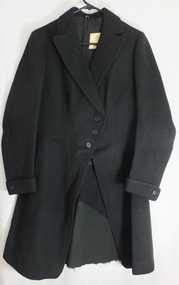
Clothing - Riding Habit, jacket, Early 20th Century
... Anderson. Beatrice was Edward Manifold’s cousin once removed whom he married in 1900. Edward, the son of John Manifold, was born on 15 November 1868 and educated at Geelong and Melbourne Grammar schools and at Trinity Hall, Cambridge (B.A., 1891). He chose the Danedite portion of land at Purrumbete, and on the death of his bachelor brother Thomas Peter (1863-1895), after a hunting accident, he took over his allocation, Wiridgil. He also owned Boortkoi, near Hexham and on these properties...Anderson. Beatrice was Edward Manifold’s cousin once removed whom he married in 1900. Edward, the son of John Manifold, was born on 15 November 1868 and educated at Geelong and Melbourne Grammar schools and at Trinity Hall, Cambridge (B.A., 1891). He chose the Danedite portion of land at Purrumbete, and on the death of his bachelor brother Thomas Peter (1863-1895), after a hunting accident, he took over his allocation, Wiridgil. He also owned Boortkoi, near Hexham and on these properties ...The Manifolds were a significant pioneering pastoral family in Western Victoria. The donated riding jacket originally belonged to Mrs Edward Manifold, formally Beatrice Mary Synnot Anderson. Beatrice was Edward Manifold’s cousin once removed whom he married in 1900. Edward, the son of John Manifold, was born on 15 November 1868 and educated at Geelong and Melbourne Grammar schools and at Trinity Hall, Cambridge (B.A., 1891). He chose the Danedite portion of land at Purrumbete, and on the death of his bachelor brother Thomas Peter (1863-1895), after a hunting accident, he took over his allocation, Wiridgil. He also owned Boortkoi, near Hexham and on these properties, he ran merino sheep, a Lincoln stud which dated back to 1870, and Shorthorn cattle. 3000 acres were also leased to dairy farmers. Edward was a member of Hampden Shire Council in 1909-31 and three times president at Camperdown. The town was largely bordered by Manifold land and partly dependent upon the local pastoral dynasties, which benefited the local area from the families’ various business interests. Though an offer to build public baths to commemorate the Queen Victoria Jubilee in 1897 was not proceeded with, the town acquired a hospital, a reserve on Mount Leura, a clock tower and a cricket pavilion, as well as notable donations from the Manifolds to St Paul's Church and the grammar school. Edward was a keen polo player and racing man. He was also a successful owner of steeplechasers and a committeeman of the Victoria Racing Club for many years. He was also a member of many Western District racing clubs. On the 16 July 1900, Edward had married his sixteen-year-old cousin Beatrice Mary Synnot Anderson by whom he had three sons Thomas Peter, Andrew and Robert Edward Manifold. Edwards's estate at his death was valued for probate at nearly £500,000. Edward died following an operation on 14 February 1931 at a private hospital in Yarra Vale Melbourne. Beatrice passed away in 1954, aged 79 in Ballarat where she was born in 1874. Contextual historic Family background: The Manifold brothers Thomas (1809-1875), John (1811-1877) and Peter (1817-1885) were the fourth, fifth and sixth sons of William Manifold and Mary, nee Barnes, of Courthouse Farm, Bromborough, Cheshire, England. The family had decided to emigrate to Van Diemen's Land. Thomas was sent ahead, arriving in Hobart Town on 23rd January 1828 with £1500 and a letter of recommendation from the Colonial Office. Thomas acquired 1280 acres on the west bank of the Tamar River. John and Peter, with their parents and three sisters, arrived on 8th July 1831. Land grants by then had finished but William brought ninety acres next to his son Thomas’ land and on the combined properties the family built Kelso House. The Manifolds’ properties were comparatively poor and when news of the Port Phillip District, in Victoria reached Thomas, he lost no time in coming to see for himself in February 1836. He was impressed with what he saw and hurried back to Tasmania to buy lambs and ewes. With one of his brothers, on July 9th he landed his stores at Point Henry and proceeded to occupy both sides of the Moorabool River. Thomas, at the end of the year, returned to Tasmania and left Peter and John to run the new property. Thomas, however, returned to Victoria for several visits and on one of these visits he, along with his brothers, examined the country near Ballarat. In December 1838 they managed to penetrate the Stony Rises, and Peter and John reached Lake Purrumbete and the Mount Leura country. During this time, on 4th July 1838, Thomas married Jane Elizabeth, eldest daughter of Captain Walter Synnot, formerly of Ballinate, County Armagh, Ireland, and then of Van Diemen's Land. Thomas joined his brothers, and they occupied the Purrumbete run in January 1839. On the journey to Purrumbete they could not take their stock and drays through the Stony Rises, so went north of Lake Corangamite, to the neck of land between it and Lake Gnarpurt. By April the move from Moorabool area was complete. As yet they had no hut and were working day and night, but their delight in their new run was unbounded. John wrote to his mother: “We are at last got to the land we wished for it is a beautiful place, and cannot be surpassed by any I have ever seen”. The three brothers occupied Purrumbete together, breeding both sheep and cattle until Thomas went to Grassmere run on the Merri River near Warrnambool in 1844. John and Peter soon gave up breeding sheep but retained the well-known '3M' brand for the cattle. These were Shorthorns, derived from four bulls originally imported by the Boldon brothers and later improved by further importations, and were renowned for size and quality. By the time of the gold rush in 1851, John and Peter were breeding over 1000 head a year, as well as fattening stores. The diggings at this time had disorganised Grassmere by drawing away Thomas's men, and his wife decided to take her two sons and two daughters to Europe for their education. Thomas gave up the property next year, went to England to join his family, and eventually brought the family back to live in Melbourne. At Purrumbete things were different. The brothers, John and Peter, preferred black stockmen to white, so the discovery of gold upset them very little while providing the very market they required. John was on his second visit to England when the rush started, and Peter went in his turn soon after John returned. On 2 September 1856 John married Marion Thomson, at Cormiston, Van Diemen's Land. They had four daughters and five sons, from three of whom, William Thomson, James Chester and Edward, the later generations of the family descend. Through the years the brothers had to contend with the scab, fluke and footrot, depression, rabbits, bush fires and pleuro-pneumonia. In 1861 they appointed as manager Henry Manifold Matson, their nephew, who had already been with them for five years. Thomas died in Melbourne on 7 November 1875, John at Purrumbete on 3 January 1877 and Peter at Purrumbete on 31 July 1885. Devout members of the Church of England, John and Peter, during their lives, gave generously towards building St Paul's Church, Camperdown, and guaranteed part of the vicar's stipend. Peter was a member of the Hampden and Heytesbury Roads Board from 1859 and carried on into the Hampden Shire Council when it was formed in 1864. However, it was not for public works that they were known, but for their personal example. In a new land where speculators and adventurers were all too common, the Manifold brothers were among those who intended it to be their home and their children's home. Industrious, unpretentious and hospitable, they were respected in their community as men of the highest integrity. This riding habit is a characteristic example of the type and style of riding clothes that well-dressed ladies wore in the 1920s. It highlights the changes that were beginning in society for women. Prior to 1918 ladies still had to ride side-saddle with skirts over Jodhpurs. Society of the time regarded women riding astride as unseemly and just not done. This riding habit is particularly significant on a number of levels, it shows the beginnings of change in society's attitudes through women's fashion after the First World War. A change that was to bring a start to a more liberating societal attitude towards women after the successful establishment of the Representation of People Act 1918 that gave women the right to vote. This garments provenance is linked to one of Victoria's important pioneering families the Manifolds, one of the first families that came from Van Diemen's land to settle the Western District of Victoria in 1844. Originally the garment belonged to the wife of the great-grandson of pioneer William Manifold, Edward Manifold who married Beatrice May Synnot Anderson, Edwards Cousin in 1900. The garment was made by the Mayfair tailors J. Busvine & Co. in the early to mid-1920s (estimate) who at the turn of the century were tailors to the Courts of Europe. Their clothing is highly collectible today and examples can be found in a number of significant museum collections around the world, notably the Metropolitan Museum of Art in New York and the FIDM in Los Angeles. A riding jacket, part of a three-piece, side saddle riding habit tailored for Mrs Edward Manifold. Knee length English woolen jacket black in colour, seamed and fitted to the female client's figure, fastening from the waist with three bone buttons to rather high lapels. The sleeves are long with closely fitted cuffs and one button and lined with cream satin. The jacket is fitted to the waist and flared to below the hips with a 35 cm vent to the back. Lower back to the jacket is reinforced with removable fabric and the jacket is lined with black twill cotton, there is a cream satin label, with makers' emblem Busvine. Circa 1920s Label to Jacket Embroidered in gold with a Royal logo on a Cream Satin label “By Special /Appointment” “To Her Majesty/The Queen”, “Busvine / Ltd / London 4 Brook St. W. / No” “hand written in purple ink 315 / Mrs Edward Manifold”flagstaff hill, warrnambool, shipwrecked coast, flagstaff hill maritime museum, maritime museum, side saddle riding habit, mrs edward manifold, edward manifold, busvines, shipwreck coast, flagstaff hill maritime village, great ocean road -
 Flagstaff Hill Maritime Museum and Village
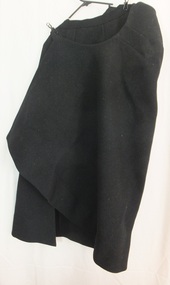
Clothing - Riding Habit, Skirt, 1920s
... Anderson. Beatrice was Edward Manifold’s cousin once removed whom he married in 1900. Edward, the son of John Manifold, was born on 15 November 1868 and educated at Geelong and Melbourne Grammar schools and at Trinity Hall, Cambridge (B.A., 1891). He chose the Danedite portion of land at Purrumbete, and on the death of his bachelor brother Thomas Peter (1863-1895), after a hunting accident, he took over his allocation, Wiridgil. He also owned Boortkoi, near Hexham and on these properties...Anderson. Beatrice was Edward Manifold’s cousin once removed whom he married in 1900. Edward, the son of John Manifold, was born on 15 November 1868 and educated at Geelong and Melbourne Grammar schools and at Trinity Hall, Cambridge (B.A., 1891). He chose the Danedite portion of land at Purrumbete, and on the death of his bachelor brother Thomas Peter (1863-1895), after a hunting accident, he took over his allocation, Wiridgil. He also owned Boortkoi, near Hexham and on these properties ...The Manifolds were a significant pioneering pastoral family in Western Victoria. The donated riding skirt originally belonged to Mrs Edward Manifold, formally Beatrice Mary Synnot Anderson. Beatrice was Edward Manifold’s cousin once removed whom he married in 1900. Edward, the son of John Manifold, was born on 15 November 1868 and educated at Geelong and Melbourne Grammar schools and at Trinity Hall, Cambridge (B.A., 1891). He chose the Danedite portion of land at Purrumbete, and on the death of his bachelor brother Thomas Peter (1863-1895), after a hunting accident, he took over his allocation, Wiridgil. He also owned Boortkoi, near Hexham and on these properties, he ran merino sheep, a Lincoln stud which dated back to 1870, and Shorthorn cattle. 3000 acres were also leased to dairy farmers. Edward was a member of Hampden Shire Council in 1909-31 and three times president at Camperdown. The town was largely bordered by Manifold land and partly dependent upon the local pastoral dynasties, which benefited the local area from the families’ various business interests. Though an offer to build public baths to commemorate the Queen Victoria Jubilee in 1897 was not proceeded with, the town acquired a hospital, a reserve on Mount Leura, a clock tower and a cricket pavilion, as well as notable donations from the Manifolds to St Paul's Church and the grammar school. Edward was a keen polo player and racing man. He was also a successful owner of steeplechasers and a committeeman of the Victoria Racing Club for many years. He was also a member of many Western District racing clubs. On the 16 July 1900, Edward had married his sixteen-year-old cousin Beatrice Mary Synnot Anderson by whom he had three sons Thomas Peter, Andrew and Robert Edward Manifold. Edwards's estate at his death was valued for probate at nearly £500,000. Edward died following an operation on 14 February 1931 at a private hospital in Yarra Vale Melbourne. Beatrice passed away in 1954, aged 79 in Ballarat where she was born in 1874. Contextual historic Family background: The Manifold brothers Thomas (1809-1875), John (1811-1877) and Peter (1817-1885) were the fourth, fifth and sixth sons of William Manifold and Mary, nee Barnes, of Courthouse Farm, Bromborough, Cheshire, England. The family had decided to emigrate to Van Diemen's Land. Thomas was sent ahead, arriving in Hobart Town on 23rd January 1828 with £1500 and a letter of recommendation from the Colonial Office. Thomas acquired 1280 acres on the west bank of the Tamar River. John and Peter, with their parents and three sisters, arrived on 8th July 1831. Land grants by then had finished but William brought ninety acres next to his son Thomas’ land and on the combined properties the family built Kelso House. The Manifolds’ properties were comparatively poor and when news of the Port Phillip District, in Victoria reached Thomas, he lost no time in coming to see for himself in February 1836. He was impressed with what he saw and hurried back to Tasmania to buy lambs and ewes. With one of his brothers, on July 9th he landed his stores at Point Henry and proceeded to occupy both sides of the Moorabool River. Thomas, at the end of the year, returned to Tasmania and left Peter and John to run the new property. Thomas, however, returned to Victoria for several visits and on one of these visits he, along with his brothers, examined the country near Ballarat. In December 1838 they managed to penetrate the Stony Rises, and Peter and John reached Lake Purrumbete and the Mount Leura country. During this time, on 4th July 1838, Thomas married Jane Elizabeth, eldest daughter of Captain Walter Synnot, formerly of Ballinate, County Armagh, Ireland, and then of Van Diemen's Land. Thomas joined his brothers, and they occupied the Purrumbete run in January 1839. On the journey to Purrumbete they could not take their stock and drays through the Stony Rises, so went north of Lake Corangamite, to the neck of land between it and Lake Gnarpurt. By April the move from Moorabool area was complete. As yet they had no hut and were working day and night, but their delight in their new run was unbounded. John wrote to his mother: “We are at last got to the land we wished for it is a beautiful place, and cannot be surpassed by any I have ever seen”. The three brothers occupied Purrumbete together, breeding both sheep and cattle until Thomas went to Grassmere run on the Merri River near Warrnambool in 1844. John and Peter soon gave up breeding sheep but retained the well-known '3M' brand for the cattle. These were Shorthorns, derived from four bulls originally imported by the Boldon brothers and later improved by further importations, and were renowned for size and quality. By the time of the gold rush in 1851, John and Peter were breeding over 1000 head a year, as well as fattening stores. The diggings at this time had disorganised Grassmere by drawing away Thomas's men, and his wife decided to take her two sons and two daughters to Europe for their education. Thomas gave up the property next year, went to England to join his family, and eventually brought the family back to live in Melbourne. At Purrumbete things were different. The brothers, John and Peter, preferred black stockmen to white, so the discovery of gold upset them very little while providing the very market they required. John was on his second visit to England when the rush started, and Peter went in his turn soon after John returned. On 2 September 1856 John married Marion Thomson, at Cormiston, Van Diemen's Land. They had four daughters and five sons, from three of whom, William Thomson, James Chester and Edward, the later generations of the family descend. Through the years the brothers had to contend with the scab, fluke and footrot, depression, rabbits, bush fires and pleuro-pneumonia. In 1861 they appointed as manager Henry Manifold Matson, their nephew, who had already been with them for five years. Thomas died in Melbourne on 7 November 1875, John at Purrumbete on 3 January 1877 and Peter at Purrumbete on 31 July 1885. Devout members of the Church of England, John and Peter, during their lives, gave generously towards building St Paul's Church, Camperdown, and guaranteed part of the vicar's stipend. Peter was a member of the Hampden and Heytesbury Roads Board from 1859 and carried on into the Hampden Shire Council when it was formed in 1864. However, it was not for public works that they were known, but for their personal example. In a new land where speculators and adventurers were all too common, the Manifold brothers were among those who intended it to be their home and their children's home. Industrious, unpretentious and hospitable, they were respected in their community as men of the highest integrity. This riding habit is a characteristic example of the type and style of riding clothes that well-dressed ladies wore in the 1920s. It highlights the changes that were beginning in society for women. Prior to 1918 ladies still had to ride side-saddle with skirts over Jodhpurs. Society of the time regarded women riding astride as unseemly and just not done. This riding habit is particularly significant on a number of levels, it shows the beginnings of change in society's attitudes through women's fashion after the First World War. A change that was to bring a start to a more liberating societal attitude towards women after the successful establishment of the Representation of People Act 1918 that gave women the right to vote. This garments provenance is linked to one of Victoria's important pioneering families the Manifolds, one of the first families that came from Van Diemen's land to settle the Western District of Victoria in 1844. Originally the garment belonged to the wife of the great-grandson of pioneer William Manifold, Edward Manifold who married Beatrice May Synnot Anderson, Edwards Cousin in 1900. The garment was made by the Mayfair tailors J. Busvine & Co. in the early to mid-1920s (estimate) who at the turn of the century were tailors to the Courts of Europe. Their clothing is highly collectible today and examples can be found in a number of significant museum collections around the world, notably the Metropolitan Museum of Art in New York and the FIDM in Los Angeles. Safety skirt/apron, part of a three-piece, side saddle riding habit tailored for Mrs Edward Manifold. This side saddle skirt is made from black woolen material fixing at the waist with two metal hooks and three buttons to the front opening. One internal concealed pocket lining to the top part of the apron made of cotton the seat is shaped for side saddle riding and the skirt wraps around the body the longer side draped over the leg that is in the stirrup. flagstaff hill, warrnambool, shipwrecked coast, flagstaff hill maritime museum, maritime museum, side saddle riding habit, side saddle safety skirt, side saddle apron, mrs edward manifold, beatrice manifold, female riding habit 1920s, shipwreck coast, flagstaff hill maritime village, great ocean road -
Glenelg Shire Council Cultural Collection
Document - K. S. Anderson Collection - Acquisition of 'Blainslie', Mar-73
... Richmond House became Richmond Henty Hotel, acquisition of 'Blainslie', next door property to Richmond Henty Hotel, built by W.P. Anderson to make motel. b) Statement of account from Nicol, Silvester & Culhane Solicitors to K.S. ...Anderson Collection K S Anderson Collection Stephen Henty Richmond Henty Hotel accounts Blainslie a) Handwritten history of building of Richmond House by Stephen Henty. Richmond House became Richmond Henty Hotel, acquisition of 'Blainslie', next door property to Richmond Henty Hotel, built by W.P. ...K.S. Anderson Collectiona) Handwritten history of building of Richmond House by Stephen Henty. Richmond House became Richmond Henty Hotel, acquisition of 'Blainslie', next door property to Richmond Henty Hotel, built by W.P. Anderson to make motel. b) Statement of account from Nicol, Silvester & Culhane Solicitors to K.S. Anderson, detailing amount owed to him for selling 'Blainslie'.k s anderson collection, stephen henty, richmond henty hotel, accounts, blainslie -
 Ringwood and District Historical Society
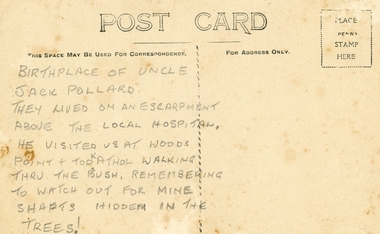
Photographs, Collection of Pollard Photographs, Ringwood (Undated -probably early 1900's). Also Woods Point 1900, circa 1900
... Anderson Creek Road Road, and now Warrandyte Road).; 2. One bushel net apples, J Pollard, Victoria, Australia.; 3. Joseph and Emma Pollard and Family. Emma is nursing baby Ethyl.; 4. Ringwood PS photograph. Jack Pollard is second from the RHS in the back row.; 5. Woods Point with arrow indicating mine manager's house: that of Joseph Pollard. Circa 1900. The Pollard family had a 20 acre orcharding property...Anderson Creek Road Road, and now Warrandyte Road).; 2. One bushel net apples, J Pollard, Victoria, Australia.; 3. Joseph and Emma Pollard and Family. Emma is nursing baby Ethyl.; 4. Ringwood PS photograph. Jack Pollard is second from the RHS in the back row.; 5. Woods Point with arrow indicating mine manager's house: that of Joseph Pollard. Circa 1900. The Pollard family had a 20 acre orcharding property ...Pollard Photographs:; 1. Back of postcard of the Pollard home in Wonga Road (also called Anderson Creek Road Road, and now Warrandyte Road).; 2. One bushel net apples, J Pollard, Victoria, Australia.; 3. Joseph and Emma Pollard and Family. Emma is nursing baby Ethyl.; 4. Ringwood PS photograph. Jack Pollard is second from the RHS in the back row.; 5. Woods Point with arrow indicating mine manager's house: that of Joseph Pollard. Circa 1900. The Pollard family had a 20 acre orcharding property between Mullum Mullum Road and Wonga Road. Given on 4th September 2010 by Arthur Lunt from his cousin. The Pollard family. School photo at Ringwood State School. Jack�s father was Joseph � land (orchard) between Mullum and Wonga Roads +Additional Keywords: Pollard -
 Ringwood and District Historical Society
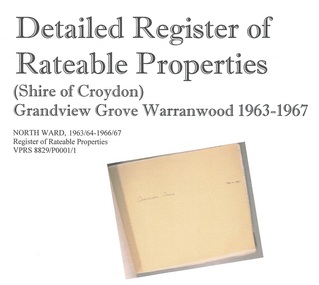
Document - Extracts - Register of Rateable Properties, Shire of Croydon, Victoria, Grandview Grove, Warranwood - 1963-1967
... Property owners and occupiers include Alexander George Ashmore and Ruby May Ashmore Dulcie Ellen Mau and Darcy Mau Francesco Mirabella. Graham Brooke and Joyce Brooke Theodorous Hendricus Wysman. Wesley Horace Blackmore and Doreen Isobel Blackmore Lucy Elaine Winter Lenos Leslie Hanscombe William Ray Crossman and Marjorie Edith Crossman Edward Martin Grose David Roger Allan and Emily Helen Allan Lavinia Maud Stewart and Frederick William Stewart Kevin Collins Alexander William Brown. Oliver Burgess Evelyn Goudie Philip George Morris and Vera Doris Morris Ellen Margeret Dalgleish. Donald Charles Anderson...Anderson Christopher Simmonds and Pam Edith Simmonds. Dennis Bernard Griggs and Julianne Roma Griggs Emmanuel John Poulianakis and Georgette Poulianakis Harold Francis Webber and Grace Webber William George Carter Marjorie Eleanor Davies and Lionel Rothery Davies. Leslie James Scouller and Margaret Denise Scouller Adele Mary Young and Kyrie Anthony Young Photocopied Shire of Croydon council rates records showing owners, acreages, valuations and rates payable for properties in Grandview Grove Warranwood over financial years 1963/64 to 1966/67. ...Photocopied Shire of Croydon council rates records showing owners, acreages, valuations and rates payable for properties in Grandview Grove Warranwood over financial years 1963/64 to 1966/67. With amalgamation of Croydon and Ringwood councils to form Maroondah City Council in 1970s, Grandview Grove was renamed to Bemboka Road Warranwood (western side) and Bemboka Road Croydon Hills (eastern side). Property owners and occupiers include Alexander George Ashmore and Ruby May Ashmore Dulcie Ellen Mau and Darcy Mau Francesco Mirabella. Graham Brooke and Joyce Brooke Theodorous Hendricus Wysman. Wesley Horace Blackmore and Doreen Isobel Blackmore Lucy Elaine Winter Lenos Leslie Hanscombe William Ray Crossman and Marjorie Edith Crossman Edward Martin Grose David Roger Allan and Emily Helen Allan Lavinia Maud Stewart and Frederick William Stewart Kevin Collins Alexander William Brown. Oliver Burgess Evelyn Goudie Philip George Morris and Vera Doris Morris Ellen Margeret Dalgleish. Donald Charles Anderson and Margaret Anne Anderson Christopher Simmonds and Pam Edith Simmonds. Dennis Bernard Griggs and Julianne Roma Griggs Emmanuel John Poulianakis and Georgette Poulianakis Harold Francis Webber and Grace Webber William George Carter Marjorie Eleanor Davies and Lionel Rothery Davies. Leslie James Scouller and Margaret Denise Scouller Adele Mary Young and Kyrie Anthony Young -
Ringwood and District Historical Society
Legal record - Conditions of Sale (C.E.Carter), Ringwood - Part of Lot 12 , Plan of Subdivision No 6753, O Anderson to G Smith, 1924
... Particulars and Conditions of Sale of Property , from O Anderson to G Smith...Particulars and Conditions of Sale of Property , from O Anderson to G Smith Ringwood - Part of Lot 12 , Plan of Subdivision No 6753, O Anderson to G Smith, 1924 Legal record Conditions of Sale (C.E.Carter) ...Particulars and Conditions of Sale of Property , from O Anderson to G Smith -
 City of Moorabbin Historical Society (Operating the Box Cottage Museum)
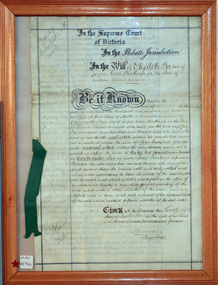
Document - Will of Elizabeth Avis-Box 1914, 1914
... property with the pioneer cottage 1868 & 1869. William & Elizabeth established a market garden and raised 13 children. 1888 they built a larger 2nd house in front of the original cottage. William died in 1902 and Mary sold 9 acres in 1908 to W. .Snowden Anderson...property with the pioneer cottage 1868 & 1869. William & Elizabeth established a market garden and raised 13 children. 1888 they built a larger 2nd house in front of the original cottage. William died in 1902 and Mary sold 9 acres in 1908 to W. .Snowden Anderson ...Elizabeth Avis- Box 1835-1913 was born in Sussex, married William Box in 1854 and arrived in Melbourne in 1855. William’s parents George and Mary Box and his siblings sailed with them. William & Mary at first leased land in the area of the ‘Dendy Special Survey Brighton 1841’ and then purchased the property with the pioneer cottage 1868 & 1869. William & Elizabeth established a market garden and raised 13 children. 1888 they built a larger 2nd house in front of the original cottage. William died in 1902 and Mary sold 9 acres in 1908 to W. .Snowden Anderson – it later became Joyce Park where the reconstructed Box Cottage Museum now stands. After Elizabeth died her daughters Ada and Violet lived on the 1 acre property until 1917 when August Reitman, a potter and monumental mason, leased the house and land. He established his pottery business and purchased the property in 1935. The business moved in 1953 but continued to use the cottage as a workshop/ storeroom until it was sold to Lewis Timber P/L in 1970. Elizabeth & William Box settled in the pioneer Cottage in Jasper Road East Brighton 1868 and established a market garden whilst raising their 13 children. This Cottage was reconstructed in Joyce Park, Ormond 1984 and is the home of City of Moorabbin Historical Society. In 1960 many local residents responded to a call for the donation of historical artefacts and the Box Cottage Museum now preserves this eclectic collection for the community.The original Last Will & Testament of Elizabeth Avis Box September 1914In the Supreme Court / of Victoria / In the Probate Jurisdiction / In the Will of Elizabeth Box late of / Jasper Road Bentleigh in the State of / Victoria Widow deceased. Be it known ............. Given at Melbourne this ( 21st September 1914) Signed A Carter / Registrar top left corner 79637 / Snowball ( X232) Bottom left corner 10/9/...box elizabeth, box william, moorabbin, bentleigh, brighton, ormond, pioneers, market gardeners, box george, box mary cripps, reitman august, anderson w. snowden, joyce park ormond, box cottage museum dendy’s special survey brighton 1841, -
 City of Moorabbin Historical Society (Operating the Box Cottage Museum)
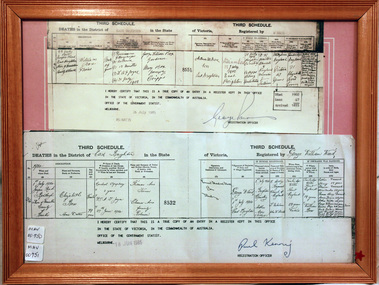
Document - Copy of Death Certificate Elizabeth Box 1914, 1914
... property with the pioneer cottage 1868 & 1869. William & Elizabeth established a market garden and raised 13 children. 1888 they built a larger 2nd house in front of the original cottage. William died in 1902 and Mary sold 9acres in 1908 to W. .Snowden Anderson...property with the pioneer cottage 1868 & 1869. William & Elizabeth established a market garden and raised 13 children. 1888 they built a larger 2nd house in front of the original cottage. William died in 1902 and Mary sold 9acres in 1908 to W. .Snowden Anderson ...Elizabeth Avis- Box 1835-1914 was born in Sussex, married William Box in 1854 and arrived in Melbourne in 1855. William’s parents George and Mary Box and his siblings sailed with them. William & Elizabeth at first leased land in the area of the ‘Dendy Special Survey Brighton 1841’ and then purchased the property with the pioneer cottage 1868 & 1869. William & Elizabeth established a market garden and raised 13 children. 1888 they built a larger 2nd house in front of the original cottage. William died in 1902 and Mary sold 9acres in 1908 to W. .Snowden Anderson – it later became Joyce Park where the reconstructed Box Cottage Museum now stands. After Elizabeth died her daughters Ada and Violet lived on the 1acre property until 1917 when August Reitman, a potter and monumental mason, leased the house and land. He established his pottery business and purchased the property in 1935. The business moved in 1953 but continued to use the cottage as a workshop/ storeroom until it was sold to Lewis Timber P/L in 1970 Elizabeth & William Box settled in the pioneer Cottage in Jasper Road East Brighton 1868 and established a market garden whilst raising their 13 children. This Cottage was reconstructed in Joyce Park, Ormond 1984 and is the home of City of Moorabbin Historical Society. In 1960 many local residents responded to a call for the donation of historical artefacts and the Box Cottage Museum now preserves this eclectic collection for the community. A certified true copy of the Death Certificate of Elizabeth Avis- Box 1835 -1914 in a wooden picture frame, obtained from The Births, Deaths and Marriages Office Melbourne Victoria 18/6/1985 THIRD SCHEDULE / DEATHS in the District of East Brighton in the State of Victoria Registered by George William Ward / Dated 1914 / 1st July 1914 Jasper Rd Bentleigh Shire of Moorabbin County of Bourke / Elizabeth Box / Home duties/ …… Dr A T Joyce Certified ‘true copy of an entry in a register’……… Signed by Paul Kenny Registration Officer 18 June 1985 box elizabeth avis, box william, moorabbin, bentleigh, brighton, ormond, pioneers, market gardeners, brighton cemetery, box george, box mary cripps, reitman august, anderson w. snowden, joyce park ormond, box cottage museum dendy’s special survey brighton 1841, -
 Phillip Island and District Historical Society Inc.
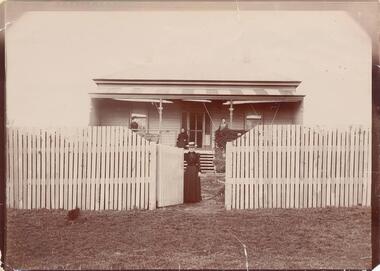
Photograph, Delamore, San Remo, 1896
... property San Remo. Ladies on verandah from left to right: Miss Small, Mrs Mary Bonwick, Miss Small. Standing at front gate Miss Elsie Bonwick. House located at the corner of Panorama Drive and Anderson...Corner Panorama Dve and Anderson St." Sepia Photograph of "Delamore" property San Remo. Ladies on verandah from left to right: Miss Small, Mrs Mary Bonwick, Miss Small. ...Donated by Jessie SmithSepia Photograph of "Delamore" property San Remo. Ladies on verandah from left to right: Miss Small, Mrs Mary Bonwick, Miss Small. Standing at front gate Miss Elsie Bonwick. House located at the corner of Panorama Drive and Anderson Street, San Remo. Double fronted weatherboard with rolled blinds.On back: "Delamore San Remo 1896?" "L - R Miss Small, Mrs Mary Bonwick, Miss Small, Miss Elsie Bonwick. Corner Panorama Dve and Anderson St.""delamore" san remo, bonwick family, small family, jessie smith -
 Phillip Island and District Historical Society Inc.
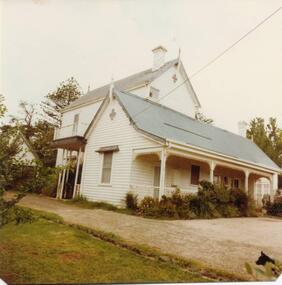
Photograph, 1978/79
... Anderson family lived there for many years. Purchased by Mr & Mrs Lunn in 1971. A single fronted weatherboard white painted with blue roof. A large two story building behind. Mr & Mrs Baker bought Glen Isla early 2000s and run as an Accommodation property...Anderson family lived there for many years. Purchased by Mr & Mrs Lunn in 1971. A single fronted weatherboard white painted with blue roof. A large two story building behind. Mr & Mrs Baker bought Glen Isla early 2000s and run as an Accommodation property ...Glen Isla built by Bob Anderson about 1870. The Anderson family lived there for many years. Purchased by Mr & Mrs Lunn in 1971. A single fronted weatherboard white painted with blue roof. A large two story building behind. Mr & Mrs Baker bought Glen Isla early 2000s and run as an Accommodation property.Glen Isla built by Bob Anderson about 1870.local history, photographs, buildings, historic, buildings - historical, coloured photograph, john cook, phillip island, glen isla homestead -
 Phillip Island and District Historical Society Inc.
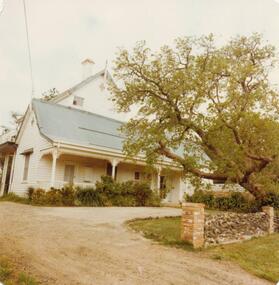
Photograph, 1978/79
... Anderson family lived there for many years. Mr & Mrs Lunn bought Glen Isla in 1971. A single fronted white weatherboard cottage, large 2 story building behind seemingly attached. Sprawling tree across right front of photograph behind a rock fence with brick pillars - a wide yellow gravel drive. Bought by Mr & Mrs Baker early 2000s and run as an accommodation property...Anderson family lived there for many years. Mr & Mrs Lunn bought Glen Isla in 1971. A single fronted white weatherboard cottage, large 2 story building behind seemingly attached. Sprawling tree across right front of photograph behind a rock fence with brick pillars - a wide yellow gravel drive. Bought by Mr & Mrs Baker early 2000s and run as an accommodation property ...Glen Isla built by Bob Anderson about 1870. The Anderson family lived there for many years. Mr & Mrs Lunn bought Glen Isla in 1971. A single fronted white weatherboard cottage, large 2 story building behind seemingly attached. Sprawling tree across right front of photograph behind a rock fence with brick pillars - a wide yellow gravel drive. Bought by Mr & Mrs Baker early 2000s and run as an accommodation property.Glen Isla built by Bob Anderson about 1870local history, photographs, buildings, historic, buildings - historical, coloured photograph, john cook, phillip island, glen isla homestead -
 Phillip Island and District Historical Society Inc.
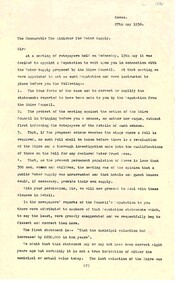
Letter, Letter to the Minister for Minister Supply
... properties and what is required for water supply. Also the history of local guesthouses. Historical Water supply Shire of Phillip Island Island Agriculture population Cowes Isle of Wight Hotel Bonnie Doon Guest House D.H.Robb R.A. Grayden H.V. Johnston J. Thornborrow Charmandene Guesthouse Mrs A. Anderson ...This illustrates the early attempts to have a water supply connected to Cowes. Shows figures on local properties and what is required for water supply. Also the history of local guesthouses.HistoricalFoolscap carbon copy of letter to the Minister of Water Supply. Seven pages of typewritten letter. water supply, shire of phillip island island, agriculture, population, cowes, isle of wight hotel, bonnie doon guest house, d.h.robb, r.a. grayden, h.v. johnston, j. thornborrow, charmandene guesthouse, mrs a. anderson -
 Phillip Island and District Historical Society Inc.
Album, Photo album, 1870s
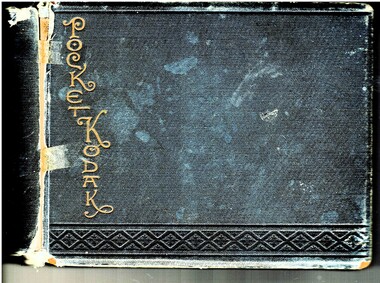
... Oak Hill was the Bonwick family home and the Hoddinott property was at Anderson. The Jos Hoddinott in the photo was probably the father of William Hoddinott, who married Mary Bonwick....Oak Hill was the Bonwick family home and the Hoddinott property was at Anderson. The Jos Hoddinott in the photo was probably the father of William Hoddinott, who married Mary Bonwick. ...Shetland Heights was the Small family property. It was later purchased by the Maclellans and is now Shetland Heights Road area. Jessie Smith was the daughter of the Small family. Oak Hill was the Bonwick family home and the Hoddinott property was at Anderson. The Jos Hoddinott in the photo was probably the father of William Hoddinott, who married Mary Bonwick.HistoricalSmall dark green leather covered photo album containing small [5.5x4cm] black and white photos. Multiple photos on each page. Also 2 large photos at front and back.Pocket Kodak. Lent Mrs Weir, R. Miller 1875 "above Rubies" & Charles X11, Hugh Andersonphotographs, small family, bonwick family, maclellan family, jessie smith, hoddinott family, shetland heights, oak hill, jean tabbart, bert grayden, sunday school picnic, coal pier, bergins hotel, san remo history, anderson -
 Halls Gap & Grampians Historical Society
Photograph - B/W, C 1918
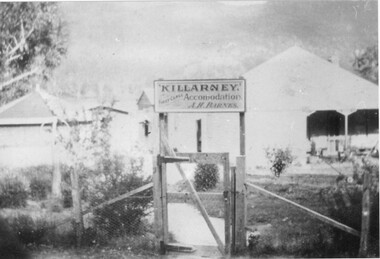
... Kept by A H Barnes, 1922-1924 name changed to Grampians House kept by Miss Allison and Miss Porter 1924-1925 kept by Mrs Anderson Grampians House - The earliest record of Grampians House was recorded in 1918 when the property was known as "Killarney" listed in the Country, Hotel and Boarding House Guide and Tourists handbook. ...Kept by A H Barnes, 1922-1924 name changed to Grampians House kept by Miss Allison and Miss Porter 1924-1925 kept by Mrs Anderson Grampians House - The earliest record of Grampians House was recorded in 1918 when the property was known as "Killarney" listed in the Country, Hotel and Boarding House Guide and Tourists handbook. ...Kept by A H Barnes, 1922-1924 name changed to Grampians House kept by Miss Allison and Miss Porter 1924-1925 kept by Mrs Anderson Grampians House - The earliest record of Grampians House was recorded in 1918 when the property was known as "Killarney" listed in the Country, Hotel and Boarding House Guide and Tourists handbook. The listing notes it as being kept my Mr A H Barnes The property consisted of 29 acres, the house of 8 rooms, kitchen, bathroom, vestibule, front and side passages, with verandah on front and side of building, also 3 roomed cottage with bathroom, 5 chalets containing 7 bedrooms, storeroom,wash house, water and gas laid on throughout. 4 stall stables and feed house, buggy shed for three buggies, motor shed for 4 cars, cow shed, and yards and pens. Local resident Mrs E Watson who attended school in the nearby public hall remembers going to a side window of the house and being able to purchase biscuits, sweets and drinks. The 1922-24 Handbook the listing was changed to "Grampians House" kept by Misses Allison and Porter. The 1924-25 Handbook listed "Grampians House" being kept by Mrs Anderson.Photo of original building of 8 rooms Proprietor A H BarnesFuji Film Pictor Paperaccommodation, guesthouses, killarney, grampian hosue
