
Showing 8 items matching "andover"
-
 Robin Boyd Foundation
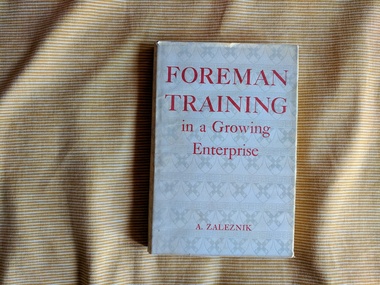
Book, A. Zaleznik, Foreman Training : in a Growing Enterprise, 1951
... ...The Andover Press...Building Construction Walsh St library Folded slip of Graduate School of Business Administration Memorandum inside Hardcover w/Dust Jacket, Abstract is detached from the book and placed at the front, Foreman Training : in a Growing Enterprise Book A. Zaleznik The Andover Press ...Hardcover w/Dust Jacket, Abstract is detached from the book and placed at the front,Folded slip of Graduate School of Business Administration Memorandum insidebuilding, construction, walsh st library -
 Lilydale RSL Sub Branch
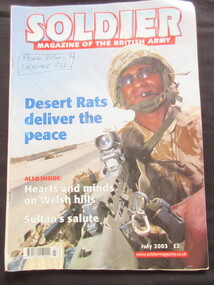
Magazine - paperback/magazine, Ministry of Defence, Soldier - Magazine of the British Army, July 2003
... ...St Ives (Andover) Ltd...Magazine Soldier - Magazine of the British Army Magazine paperback/magazine Ministry of Defence St Ives (Andover) Ltd ...Magazine -
 Orbost & District Historical Society
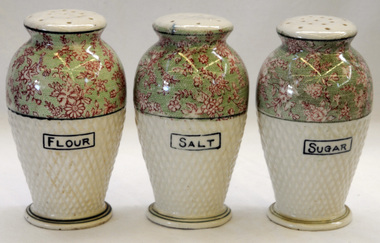
shakers, after WW11 (?)
... On the base : ANDOVER Made in Japan...Maccie Pow was a member of the Orbost Bowling Club, Red Cross and Orbost Golf Club. china tableware shakers pow-maccie mcwilliam-alice On the base : ANDOVER Made in Japan Three vase shaped pottery shakers. ...These items were owned and used by Alice Pow (nee McWilliam), known as Maccie. Maccie was a nurse who came to Orbost in 1936. She was highly respected in Orbost for her nursing skills particularly during the 1938 outbreak of polio, Most patients were cared for in their homes and Miss McWilliam was sent out to care for them. Over 14 months she travelled 9560 miles supervising their treatments. She eventually married Mr Hec Pow who had been left to bring up his three daughters after his wife died.. The Pows lived in Orbost where Hec Pow was worked with his father Fred at the saw mill in Cabbage Tree. Maccie Pow was a member of the Orbost Bowling Club, Red Cross and Orbost Golf Club.Three vase shaped pottery shakers. Each has a cork stopper i n the base and sprinkle holes on the top. They are pale green coloured to half way and the rest is pale green with pink flowers. The surface is dimpled. On the base : ANDOVER Made in Japanchina tableware shakers pow-maccie mcwilliam-alice -
 Federation University Historical Collection
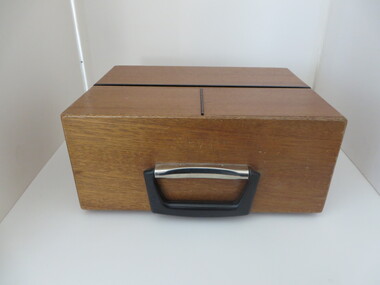
Equipment - Electrical Instrument, Moore Reed "Universal" Acoustic Coupler: Type TC301, c1980
... Andover, Great Britain ...The Universal Acoustic Coupler was made and would have been used to connect a telephone to dial a computer remotely. The control panel is under the wooden flap. There is a power switch, full duplex switch, 500 Ma Fuse, CCITT Port. When not in use it can be folded up into a small timber carry case with handle.Wooden box with two sections that open. Top section hinged and folds back. inside are controls and cables for connecting to a computer. Instructions for use are on the lid. Front section has clips and folds down to a phone to placed in "speakers". English maker's plate and Melbourne supplier's plate with A.P.O. Permit No. C74/8/903 Serial No. 775326 moore reed, universal acoustic coupler, telephone, remote connection, computer connection -
 Ballarat Heritage Services
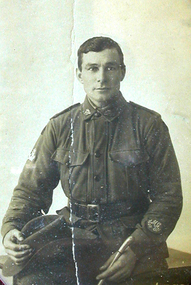
Photograph - Photograph - Black and White, John Joseph Gervasoni, c1916
... John Joseph Gervasoni (4202), 2nd Training Battalion Band, No 3 Camp, Perham Downs, Andover Kants England. ...John Joseph Gervasoni (4202), 2nd Training Battalion Band, No 3 Camp, Perham Downs, Andover Kants England. world war one military band 2nd training battalion john joseph gervasoni Yandoit Creek Black and white image of John Joseph Gervasoni of Yandoit Creek, Victoria John Joseph Gervasoni Photograph Photograph - Black and White ...John Joseph Gervasoni (4202), 2nd Training Battalion Band, No 3 Camp, Perham Downs, Andover Kants England. Black and white image of John Joseph Gervasoni of Yandoit Creek, Victoriaworld war one, military band, 2nd training battalion, john joseph gervasoni, yandoit creek -
 Glen Eira Historical Society
Document - Lord Lodge, Booran Rd 30 – Andover (1899) Moidart (1910)
... ... Andover...This document details the history of the property, including its 3 names Andover (1899), Moidart (1910) and Lord Lodge and lists previous owners. ...This document details the history of the property, including its 3 names Andover (1899), Moidart (1910) and Lord Lodge and lists previous owners. ...A photocopy of a 4 page extract from the Caulfield Conservation Study of the house and stables at 30 Booran Rd, conducted January 1995 by Andrew Ward. This document details the history of the property, including its 3 names Andover (1899), Moidart (1910) and Lord Lodge and lists previous owners. It also describes in detail the architectural features of Lord Lodge. Three photocopies of photographs are included. The front view of the house, the external view of the stables and an internal view of the stables.leek john, merrill alfred, macdonald leslie, arthur john, robertson john, ward andrew, ingliston, sobar, havelock, proud, future, lord, andover, moidart, lord lodge, grace darling, caulfield east, booran rd, glen eura rd, neerim rd, caulfield racecourse reserve, victorian amateur turf club, historic buildings register, national estate register, caulfield cup, horses, stables, horse racing, racehorses, outbuildings, racehorse trainers, depression 1890s, brick houses, mansions, towers, verandahs, stained glass, italianate style, victorian style, architectural features, architectural styles -
 Glen Eira Historical Society
Album - Album page, Booran Road, 30, Circa 1972
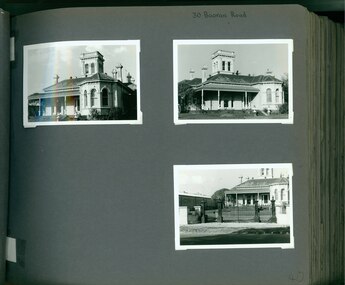
... ...andover...By 1899, the property was owned and occupied by Alfred Merrill, a dentist and was known as "Andover". NA V had decreased to £ll0. By 1910, Leslie Macdonald, a gentleman had purchased the property and renamed it "Moidart". ...By 1899, the property was owned and occupied by Alfred Merrill, a dentist and was known as "Andover". NA V had decreased to £ll0. By 1910, Leslie Macdonald, a gentleman had purchased the property and renamed it "Moidart". ...This photograph is part of the Caulfield Historical Album 1972. This album was created in approximately 1972 as part of a project by the Caulfield Historical Society to assist in identifying buildings worthy of preservation. The album is related to a Survey the Caulfield Historical Society developed in collaboration with the National Trust of Australia (Victoria) and Caulfield City Council to identify historic buildings within the City of Caulfield that warranted the protection of a National Trust Classification. Principal photographer thought to be Trevor Hart, member of Caulfield Historical Society. Most photographs were taken between 1966-1972 with a small number of photographs being older and from unknown sources. All photographs are black and white except where stated, with 386 photographs over 198 pages. From Glen Eira Heritage Management Plan 1996 by Andrew Ward: In 1888, John Leek, a trainer, owned Lot 15, measuring one and three quarter acres, in Booran Road, north side between Glen Eira and Neerim Roads. The land backed onto the Caulfield Racecourse Reserve. NAV was £45. In 1890 Leek built for his residence, a ten roomed brick house on the site. NAV was £200. Leek was the owner/trainer of "Ingliston" who won the Caulfield Cup in 1900. Upon the horse's death in 1901, Leek is understood to have defied tradition by spending £20 on boots for the "ragged urchins in Bourke Street" instead of "shouting" at the bar. By 1899, the property was owned and occupied by Alfred Merrill, a dentist and was known as "Andover". NA V had decreased to £ll0. By 1910, Leslie Macdonald, a gentleman had purchased the property and renamed it "Moidart". In 1910-11 Macdonald sold it to John Robertson. The property had extensive wood stables on its north-east boundary and several other outbuildings. The house continued to be described as "Brick, ten rooms" as it was in 1926 when it was owned and occupied by John Arthur, a managing director. The land measured la.2r.31p. and had a NAV of £235. Nine people lived there. In 1926, Arthur also owned the adjoining Lot 16. Other racehorses of note, known to have been stabled here include Sobar, Havelock, Proud, Future and Lord.Victorian Heritage Register https://vhd.heritagecouncil.vic.gov.au/places/13532 What is significant? Lord Lodge is a thoroughbred racehorse training complex adjacent to Caulfield Racecourse, established in 1890. The area immediately around the racecourse has been associated with horse racing activities and businesses servicing the industry since the development of the racecourse in late the 19th century. Lord Lodge was named by the present occupants after the champion racehorse Lord who was stabled there in the 1950s. In the early 20th century the property was known as 'Andover' and subsequently 'Moidart'. The site consists of a single storey brick Italianate villa, jockeys' quarters, stables and open day yards with direct access to Caulfield racecourse from the rear of the property. The villa of 10 rooms on bluestone foundations was constructed in 1890 by John Leek, a horse trainer who purchased the newly subdivided land in 1888. The house has many Victorian Italianate or Boom Style features although it is more modest than many villas of its style. It has an asymmetrical facade with a faceted bay window and a prominent central tower with low pitch pyramidal roof that provides a clear view of the racecourse. Other characteristic features include stilted segmented arches, bracketed eaves, stucco wall finish and cast cement ornamentation. A room has been added on the north-facing verandah in sympathetic style and finish. Internally the rooms are substantially intact with original marble fireplaces and intricate ceiling roses and cornices. An entrance toward the rear of the southern side of the house is said to be where the stable hands, jockeys and other staff lined up for their meals. In the southeast corner of the property, backing directly on to Caulfield racecourse, is a substantial late Victorian timber stable, probably constructed in the 1890s but first appearing on the property title in 1910. The stable has 12 stalls, a loft and brick pavement and jerkin head roof form with varnished pine-lined ceiling carried on a chamfered timber frame. It has an original roof lantern. The doors of the stalls are not the original sliding doors but swing doors obtained from a barn at Epsom Racecourse in Mordialloc prior to demolition. Outside the gambrel roof has fretted barges but the building is otherwise utilitarian. Timber throughout the stalls has been worn by chewing and rubbing of horses over the century of its use. In the southern half of the property are open day yards where the racehorses are kept during the day. The red brick, single storey jockeys' quarters to the rear of the villa were probably built around 1950. A small brick, possibly late Victorian structure on the eastern boundary thought to have originally been a gardening shed, has been converted to a stable of two stalls. Modern concrete brick stables fill the northeast portion of the property. At the front of the property two Moreton Bay Figs (Ficus macrophylla), probably planted in the late 19th century, provide shade for horses in the day yards. In the 1890s John Leek sold the property, relocating his training facility to one of the newly established racecourses at Mentone or Mordialloc (Epsom). By 1899, the property was owned and occupied by Alfred Merrill, a dentist, who named the property 'Andover'. In 1910 it was purchased by Leslie McDonald, a gentleman, and renamed 'Moidart'; sold in 1910-1911 to John Robertson; and again in 1926 to John Arthur, a racehorse owner. The Victorian Amateur Turf Club purchased the property in the late 1930s and since this time has been leased to racehorse trainers. It is unclear whether the property operated as a training facility between 1899 - 1926. Several notable trainers and jockeys are associated with Lord Lodge. The best known is Arthur 'Scobie' Breasley, Australia's most successful jockey who was apprenticed to trainer Pat Quinlan at Lord Lodge (then 'Moidart') from 1928 - 1935. Breasley rode winners of the Caulfield Cup in four successive years 1942-45 and again in 1952. John Leek, the original owner of Lord Lodge trained Ingliston, the 1900 Caulfield Cup winner. Along with 'Lord' a number of well known racehorses including Sobar, Havelock, Proud and Future were trained at Lord Lodge .....Page 40 of Photograph Album with three landscape photographs of the exterior of this house.Handwritten: 30 Booran Road [top right hand corner] / 40 [bottom right]trevor hart, jenny o'donnell, booran road, mansion, caulfield east, ingliston, sobar, havelock, proud, future, lord, andover, moidart, lord lodge, grace darling, caulfield racecourse reserve, victorian amateur turf club, historic buildings register, national estate register, caulfield cup, horses, stables, horse racing, racehorses, outbuildings, racehorse trainers, depression, 1890s, brick houses, mansions, towers, verandahs, stained glass, italianate style, victorian style, architectural features, architectural styles, john leek, leslie macdonald, john arthur, john robertson, alfred merrill, jenny odonnell -
 City of Moorabbin Historical Society (Operating the Box Cottage Museum)
Containers, tin, 'Cellona' Plaster of Paris, mid 20thC
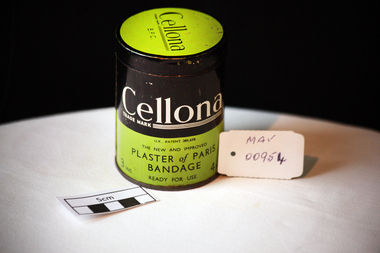
... Endoscopy: products for minimally invasive surgery, based in Andover, Massachusetts. ...Endoscopy: products for minimally invasive surgery, based in Andover, Massachusetts. Orthopaedics: hip and knee implants and trauma products, based in Memphis, Tennessee. ...Thomas James Smith opened a small pharmacy in Hull, England in 1856. On his death in 1896, his nephew Horatio Nelson Smith took over the management of the business. Smith & Nephew plc is a British-based multinational medical equipment manufacturing company headquartered in London, United Kingdom. It is the world's largest producer of arthroscopy products, second-largest producer of advanced wound management products, third-largest producer of trauma and clinical therapy products and fourth-largest producer of orthopaedic reconstruction products. Its products are sold in over 90 countries with 11,000 employees. In 1928 the company developed the wound management product Elastoplast, recorded in Medical Journals worldwide. Since 1998 Smith & Nephew operates in three market segments through separate "global business units" under the Smith & Nephew brand name: Advanced wound management: advanced treatments for difficult wounds. Endoscopy: products for minimally invasive surgery, based in Andover, Massachusetts. Orthopaedics: hip and knee implants and trauma products, based in Memphis, Tennessee. Smith & Nephew was incorporated and listed on the London Stock Exchange in 1937 and in 1999 the Group was also listed on the New York Stock Exchange. In 2001, Smith & Nephew became a constituent member of the FTSE-100 index in the UK. This means that Smith & Nephew is included in the top 100 companies traded on the London Stock Exchange measured in terms of market capitalisation. .Today, Smith & Nephew is a public limited company incorporated and headquartered in the UK and doing business in 90 countries around the world. A tin cylinder with a lift off lid for ‘Cellona’ Plaster of Paris bandage, 3 inches wide x 4 yards long, made by Smith & Nephew Ltd, Hull, England mid 20thCLid - CELLONA / BPC Front - CELLONA / TRADE MARK / U.K. PATENT 385,658 / THE NEW AND IMPROVED / PLASTER of PARIS / BANDAGE / READY FOR USE / 3INS. 4 YDS. Back - ADVANTAGES …….. / DIRECTIONS………/ Made in England by T.J.SMITH & NEPHEW LTD. / LONDON, HULL, MANCHESTER, GLASGOW/ MAKERS OF ELASTOPLAST.* pharmacy, medicines, smith & nephew pty ltd, hull england, london england, plaster of paris, elastoplast, hospitals, nursing, wound dressings, orthopaedics, glassware, bottles, moorabbin, bentleigh, cheltenham
