
Showing 199 items matching "australian abstract"
-
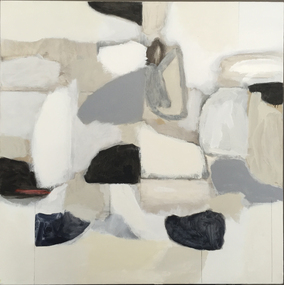 Wyndham Art Gallery (Wyndham City Council)
Painting, Michael Cusack, Era, 2008
... ...Australian abstract...Painter Abstract Australian abstract Abstract painting Era Painting Michael Cusack ...Born in Dublin, Ireland, Michael Cusack emigrated to Australia in 1982 and currently lives and works in Byron Bay, Australia. He holds a Master of Visual Arts from Queensland College of Art, Griffith University, Brisbane. His work is widely admired and features in several major public and corporate collections including Artbank; BHP Billiton; Macquarie Bank; and Newcastle Region Art Gallery in addition to various private collections in Australia, Hong Kong, United Kingdom and Ireland.painter, abstract, australian abstract, abstract painting -
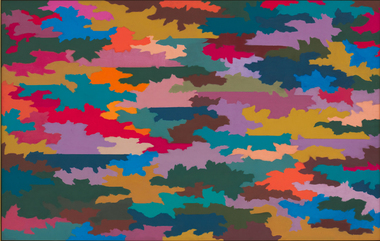 Bendigo Art Gallery
Painting, David ASPDEN, Untitled (Norfolk Series), 1970-1971
... ... australian artist... abstract...painting australian artist abstract camouflage rainbow Untitled (Norfolk Series) Painting David ASPDEN ...painting, australian artist, abstract, camouflage, rainbow -
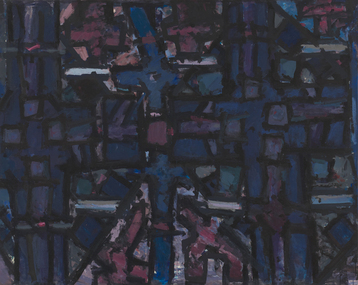 Bendigo Art Gallery
Painting, Roger KEMP, Concept, c.1980
... ... australian artist... abstract...painting australian artist abstract Not signed Not dated (Dated c.1980 by Donor) Concept Painting Roger KEMP ...Not signed Not dated (Dated c.1980 by Donor)painting, australian artist, abstract -
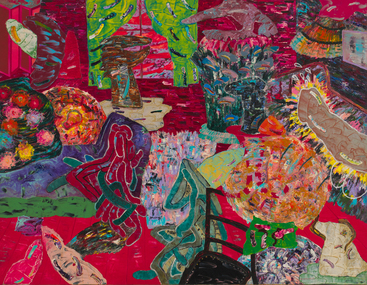 Bendigo Art Gallery
Painting, Victor MAJZNER, Modern Room, 1983
... ... australian artist... abstract...painting australian artist abstract surreal interior window chair colourful l.r; V MAJZNER 83 Modern Room Painting Victor MAJZNER ...l.r; V MAJZNER 83painting, australian artist, abstract, surreal, interior, window, chair, colourful -
 Bendigo Art Gallery
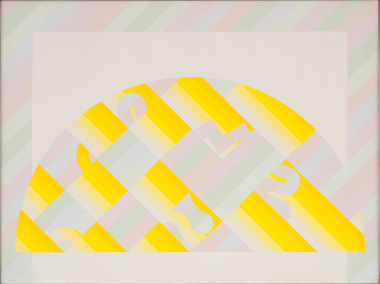
Painting, Col JORDAN, Weaver 6, 1978
... ... australian artist... abstract...painting australian artist abstract pastel colourful (verso) stretcher bar: col Jordan/(illeg.) ...(verso) stretcher bar: col Jordan/(illeg.) Yarran RD/OATLEY N.S.W, (verso) u.l; Jordan/7/78/WEAVER 6painting, australian artist, abstract, pastel, colourful -
 Bendigo Art Gallery
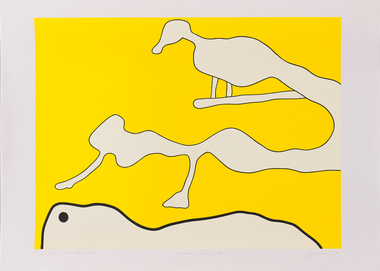
Print - Work on paper, Brent HARRIS, On Becoming (Yellow) (No.1), 1998
... ... australian artist... abstract...print printmaker printmaking australian artist abstract screenprint yellow l.l; 21/35 MOGGS CREEK EDITION, c; 'On Becoming' (Yellow) (No.1), l.r; Brent Harris 98 On Becoming (Yellow) (No.1) Print Work on paper Brent HARRIS ...l.l; 21/35 MOGGS CREEK EDITION, c; 'On Becoming' (Yellow) (No.1), l.r; Brent Harris 98print, printmaker, printmaking, australian artist, abstract, screenprint, yellow -
 Bendigo Art Gallery
Painting, Robert JACKS, Red rose sank and rose, 2005
... australian artist... abstract...australian artist abstract central victorian artist rose square rectangle Red rose sank and rose Painting Robert JACKS ...australian artist, abstract, central victorian artist, rose, square, rectangle -
 Bendigo Art Gallery
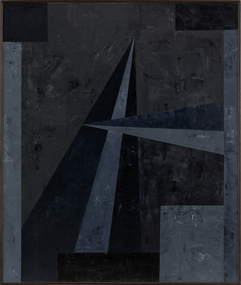
Painting, Robert JACKS, Metropolis #13, 1985
... australian artist... painting... abstract...australian artist painting abstract triangles Jacks (verso) Metropolis #13, R .JACKS 1985 Metropolis #13 Painting Robert JACKS ...(verso) Metropolis #13, R .JACKS 1985australian artist, painting, abstract, triangles, jacks -
 Bendigo Art Gallery
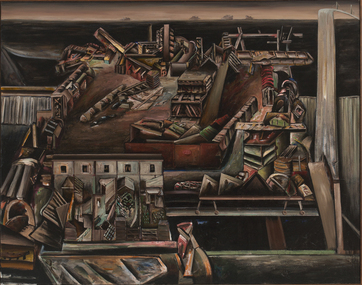
Painting, Jan SENBERGS, Port Liardet 4, 1982
... australian artist... painting... abstract...australian artist painting abstract port port Liardet Port Melbourne Not signed Not dated Port Liardet 4 Painting Jan SENBERGS ...Not signed Not datedaustralian artist, painting, abstract, port, port liardet, port melbourne -
 Bendigo Art Gallery
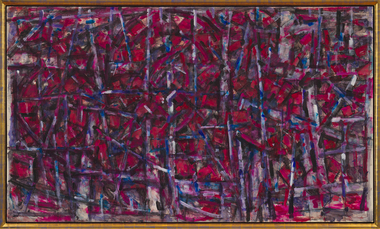
Painting, Roger KEMP, Untitled Abstract, 1975
... abstract... australian artist...painting abstract australian artist c.l; the (illeg.)/(illeg.) ...c.l; the (illeg.)/(illeg.)painting, abstract, australian artist -
 Federation University Historical Collection
Photograph - Photograph - Colour, Churchill Service Memorial, 2015, 2015
... Colour photograph on an abstract Australia-shaped sculpture by Boolarra artist Paul Jesse. ...The abstract Australia-shaped sculpture is in stark contrast to the bronze-cast "fallen mate" or concrete cenotaph seen in many country towns. ...In recognition of its fallen soldiers and Churchill's 50th birthday a service memorial was erected on a concrete plinth at the Churchill town plaza and used for the first time to mark the ANZAC centenary on Anzac Day 2015. Churchill never had a war memorial and received a grant from the Department of Veterans' Affairs six years ago to commission a sculpture with Latrobe City Council's support. It was decided the sculpture needed to recognise more than just the war effort, but service and volunteerism, considering Churchill was only founded in 1965. (http://www.latrobevalleyexpress.com.au/story/2816903/churchills-new-memorial/, accessed 01 may 2015) Sculptor Paul Jesse discussed the work in Churchill and District Community news, 18 December 2014: Some time ago CDCA commissioned a sculpture to be used as a Service Memorial to commemorate the fallen that have died in service of our community and country. Traditional memorials usually commemorate Armed Services personnel, but CDCA was of the opinion that a more inclusive view which included Emergency Services personnel, such as CFA, SES and Police, could be incorporated into the Churchill Memorial. Boolarra artist, Paul Jesse, who is accomplished in Ferro-Cement sculpture techniques, was commissioned to create a memorial that would cause people to reflect on the meaning of ‘service’ and ‘sacrifice’. The following is a description of the Churchill Service Memorial Sculpture written by the sculptor, Paul Jesse. “My sculpture is different from most War Memorial sculptures because it uses as its basis the reasons why people go into service or to war. One side of the sculpture is colourful and optimistic; its theme is home, family, community and the future. These themes are crafted by flow lines which are connected to the other side of the sculpture through the round hole and the Crosspiece. These lines can be seen as a multi-layered connection between the sides. On the “dark” side of the sculpture, the lines begin with a spiral of coloured mosaics. This spiral is representative of our service people. Its beginning can be seen on one level as their soul. The spiralling mosaics of them flow to the other side of the sculpture where they create the landscape and figures. These lines can also be seen as a range of connectors between the two sides, representing a flow of thoughts, love, fear, concern and dreams. They also represent physical communication such as letters and phone calls.” This ‘Service Memorial’ is located in the Churchill Plaza (adjacent to the Town Hall), along with four flagpoles, seating and garden beds. The Churchill Service Memorial has deliberately been designed as a thought-provoking public art work. It will complement the Art and Culture Pathway which links Switchback Gallery at the Federation University Campus to the Town Centre. We hope Churchill citizens will pause to view the Memorial, ponder its meaning, reflect on the service of others and commemorate the fallen. Colour photograph on an abstract Australia-shaped sculpture by Boolarra artist Paul Jesse. The abstract Australia-shaped sculpture is in stark contrast to the bronze-cast "fallen mate" or concrete cenotaph seen in many country towns. The photograph includes wreaths from the ANZAC centenary service on ANZAC Day 2015. churchill, churchill war memorial, paul jessie, anzac centenary, federation university, gippsland, art and culture pathway, world war -
 Federation University Art Collection
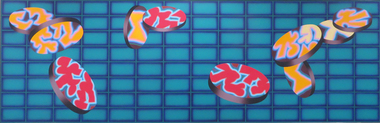
Painting - Oil on canvas, Leach-Jones Alun, 'Vaironcana – A Variation on Theme 45' by Alun Leach-Jones, 1974
... Alun LEACH-JONES (1937- 24 December 2017) Born Maghull, Lancashire, United Kingdom Arrived Australia 1960 Alun Leach-Jones is recognised as one of Australia's leading abstract colour painters. He spent his childhood in the Welsh village of Glasfryn, Denbighshire. ...Alun LEACH-JONES (1937- 24 December 2017) Born Maghull, Lancashire, United Kingdom Arrived Australia 1960 Alun Leach-Jones is recognised as one of Australia's leading abstract colour painters. He spent his childhood in the Welsh village of Glasfryn, Denbighshire. ...Alun LEACH-JONES (1937- 24 December 2017) Born Maghull, Lancashire, United Kingdom Arrived Australia 1960 Alun Leach-Jones is recognised as one of Australia's leading abstract colour painters. He spent his childhood in the Welsh village of Glasfryn, Denbighshire. At the age of 14 he started a three year apprenticeship with the Solicitors Law Society, Liverpool illuminating manuscripts and hand copying legal documents. While working with the law society Leach-Jones studied painting and drawing in the evenings at the Liverpool College of Art between the years 1955-57. He immigrated to Australia in 1960, settling in Adelaide and attending the South Australian School of Art, after which he travelled and exhibited throughout Australia and abroad. In 1966 Leach-Jones celebrated Noumenon series was shown with Australian Galleries in Melbourne and he was immediately recognised as being part of what was then labelled as ‘the New Abstraction’ in Australian art. Later in 1968 his work was included in the influential exhibition "The Field" held at the National Gallery of Victoria. This item is part of the Federation University Art Collection. The Art Collection features over 2000 works and was listed as a 'Ballarat Treasure' in 2007. Purchased by the Council of State College of Victoria, Ballarat, 1974art, artwork, leach-jones, alun leach-jones, abstract -
 Federation University Art Collection
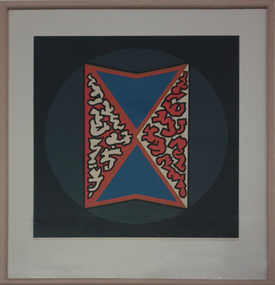
Work on paper, Alun Leach-Junes, 'Untitled' by Alun Leach Jones, 1970
... Alun LEACH-JONES (1937- 24 December 2017) Born Maghull, Lancashire, United Kingdom Arrived Australia 1960 Alun Leach-Jones is recognised as one of Australia's leading abstract colour painters. He spent his childhood in the Welsh village of Glasfryn, Denbighshire. ...Alun LEACH-JONES (1937- 24 December 2017) Born Maghull, Lancashire, United Kingdom Arrived Australia 1960 Alun Leach-Jones is recognised as one of Australia's leading abstract colour painters. He spent his childhood in the Welsh village of Glasfryn, Denbighshire. ...Alun LEACH-JONES (1937- 24 December 2017) Born Maghull, Lancashire, United Kingdom Arrived Australia 1960 Alun Leach-Jones is recognised as one of Australia's leading abstract colour painters. He spent his childhood in the Welsh village of Glasfryn, Denbighshire. At the age of 14 he started a three year apprenticeship with the Solicitors Law Society, Liverpool illuminating manuscripts and hand copying legal documents. While working with the law society Leach-Jones studied painting and drawing in the evenings at the Liverpool College of Art between the years 1955-57. He immigrated to Australia in 1960, settling in Adelaide and attending the South Australian School of Art, after which he travelled and exhibited throughout Australia and abroad. In 1966 Leach-Jones celebrated Noumenon series was shown with Australian Galleries in Melbourne and he was immediately recognised as being part of what was then labelled as ‘the New Abstraction’ in Australian art. Later in 1968 his work was included in the influential exhibition "The Field" held at the National Gallery of Victoria. This item is part of the Federation University Art Collection. The Art Collection features over 1000 works and was listed as a 'Ballarat Treasure' in 2007.art, artwork, alun leach-jones, leach-jones, printmaking, screenprint -
 Federation University Art Collection
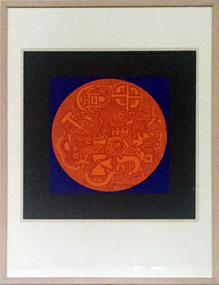
Work on paper - Printmaking - Screenprint, Leach-Jones Alun, 'No 2 Untitled' by Alun-Leach Jones, 1967
... Alun LEACH-JONES (1937 - 24 December 2017) Born Maghull, Lancashire, United Kingdom Arrived Australia 1960 Alun Leach-Jones is recognised as one of Australia's leading abstract colour painters. He spent his childhood in the Welsh village of Glasfryn, Denbighshire. ...Alun LEACH-JONES (1937 - 24 December 2017) Born Maghull, Lancashire, United Kingdom Arrived Australia 1960 Alun Leach-Jones is recognised as one of Australia's leading abstract colour painters. He spent his childhood in the Welsh village of Glasfryn, Denbighshire. ...Alun LEACH-JONES (1937 - 24 December 2017) Born Maghull, Lancashire, United Kingdom Arrived Australia 1960 Alun Leach-Jones is recognised as one of Australia's leading abstract colour painters. He spent his childhood in the Welsh village of Glasfryn, Denbighshire. At the age of 14 he started a three year apprenticeship with the Solicitors Law Society, Liverpool illuminating manuscripts and hand copying legal documents. While working with the law society Leach-Jones studied painting and drawing in the evenings at the Liverpool College of Art between the years 1955-57. He immigrated to Australia in 1960, settling in Adelaide and attending the South Australian School of Art, after which he travelled and exhibited throughout Australia and abroad. In 1966 Leach-Jones celebrated Noumenon series was shown with Australian Galleries in Melbourne and he was immediately recognised as being part of what was then labelled as ‘the New Abstraction’ in Australian art. Later in 1968 his work was included in the influential exhibition "The Field" held at the National Gallery of Victoria. This item is part of the Federation University Art Collection. The Art Collection features over 1000 works and was listed as a 'Ballarat Treasure' in 2007.Framed screenprint.art, artwork, printmaking, alun leach-jones, abstract colour, south australian school of art -
 Federation University Art Collection
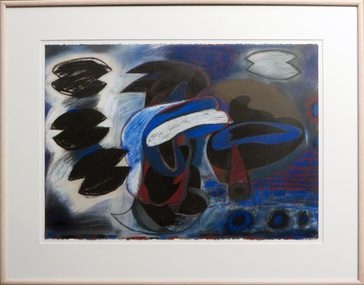
Drawing, Alun Leach-Junes, 'Sea Wall at Night (The Mumbles)' by Alun Leach-Jones, 1994
... Alun LEACH-JONES (1937-24 December 2017) Born Maghull, Lancashire, United Kingdom Arrived Australia 1960 Alun Leach-Jones is recognised as one of Australia's leading abstract colour painters. He spent his childhood in the Welsh village of Glasfryn, Denbighshire. ...Alun LEACH-JONES (1937-24 December 2017) Born Maghull, Lancashire, United Kingdom Arrived Australia 1960 Alun Leach-Jones is recognised as one of Australia's leading abstract colour painters. He spent his childhood in the Welsh village of Glasfryn, Denbighshire. ...Alun LEACH-JONES (1937-24 December 2017) Born Maghull, Lancashire, United Kingdom Arrived Australia 1960 Alun Leach-Jones is recognised as one of Australia's leading abstract colour painters. He spent his childhood in the Welsh village of Glasfryn, Denbighshire. At the age of 14 he started a three year apprenticeship with the Solicitors Law Society, Liverpool illuminating manuscripts and hand copying legal documents. While working with the law society Leach-Jones studied painting and drawing in the evenings at the Liverpool College of Art between the years 1955-57. He immigrated to Australia in 1960, settling in Adelaide and attending the South Australian School of Art, after which he travelled and exhibited throughout Australia and abroad. In 1966 Leach-Jones celebrated Noumenon series was shown with Australian Galleries in Melbourne and he was immediately recognised as being part of what was then labelled as ‘the New Abstraction’ in Australian art. Later in 1968 his work was included in the influential exhibition "The Field" held at the National Gallery of Victoria. This item is part of the Federation University Art Collection. The Art Collection features over 2000 works and was listed as a 'Ballarat Treasure' in 2007.Pastel drawing on Stonehenge paper. Donated through the Australian Government's Cultural Gifts Program by David Thomas and Brenda Martin, 2011Signed verso lower left 'A. Leach-Jones'art, artwork, leach-jones, alun leach-jones, cultural gifts program, new abstraction, the field -
 Mission to Seafarers Victoria
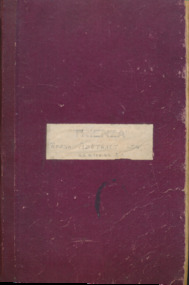
Book (Item) - Logbook, Captain George Garrett Kitching (1926 - 2005), Trienza, Rough Abstract Log, G.G. Kitching 2/0, 1946
... Australian at War Film Archive in 2003. He served on these ships: SS Corinda SS Macumba SS Mildura SS Nellor SS Ormiston SS Reynella anne rennie collection wal harbord merchant navy seamen seafarers ww2 battle of the atlantic walter harbord navigation m.v. trienza s.s. titan captain s.g. ellams bpc ship log captain g.g. kitching m.v. orestes m.v gorgon m.v. astyanax denis ryan dinny ryan dennis william ryan Large ledger cover in burgundy leather recording Trienza, Rough Abstract Log, G.G. ...The British Phosphate Commissioners (BPC) was a board of Australian, British, and New Zealand representatives who managed extraction of phosphate from Christmas Island, Nauru, and Banaba (Ocean Island) from 1920 until 1981. Captain S.G. Ellams Walter Harbord (Wal or Wally) (b.1923 in Brisbane-d.), master mariner in the Merchant Navy on British Phosphate Commission ships. George Garrett Kitching (1926 - 2005) was second mate on the following ships onboard which he records the events: MV Gorgon : 5-12-46 to16-1-48 SS Titan: 25-1-49 to 16-6-49 MV Orestes: 5-8-49 to 22-9-50 MV Astyanax: 28-4-51 to 7-5-51 (Coasting) MV Trienza: 8-4-53 to 9-10-53Walter was interviewed by the Australian at War Film Archive in 2003. He served on these ships: SS Corinda SS Macumba SS Mildura SS Nellor SS Ormiston SS Reynellaanne rennie collection, wal harbord, merchant navy, seamen, seafarers, ww2, battle of the atlantic, walter harbord, navigation, m.v. trienza, s.s. titan, captain s.g. ellams, bpc, ship log, captain g.g. kitching, m.v. orestes, m.v gorgon, m.v. astyanax, denis ryan, dinny ryan, dennis william ryan -
 Federation University Historical Collection
Book, Sivaprasad Das Gupta, Abstract of Papers: 21st International Geographical Congress, 1968, 1968
... Smith was Chancellor of University of Ballarat (later Federation University Australia). robert h.t. smith geography geomorphology climatology mapping migration population urban planning cartography Soft covered white and orange book. Abstract ...Soft covered white and orange book.non-fictionrobert h.t. smith, geography, geomorphology, climatology, mapping, migration, population, urban planning, cartography -
 Federation University Historical Collection
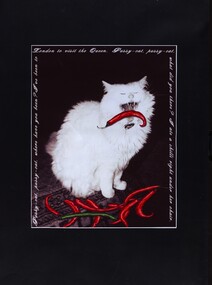
Print, 1 Pussy-cat, pussy-cat where have you been? .2 Abstract Print - Open
... Australia's outdoor landscapes. Lisa was involved in management, designing of props, costumes and production of these performances. .1 Pussy-cat, pussy-cat where have you been? I've been to London to see the Queen. Pussy-cat, pussy-cat what did you there? I ate a chili right under her chair. Coloured prints on black backgrounds .1 Pussy-cat, pussy-cat where have you been? .2 Abstract ...Lisa Widdop (16/07/1971-18/01/2024) was an "artist, painter, creator of many things, connoisseur of small and precious things" Quote from her memorial card. Lisa was an alumni of Federation University. Lisa was also a passionate member of OZACT - a touring theatre company dedicated to making Shakespeare accessible to con temporary Australian audiences with performances in Southern Australia's outdoor landscapes. Lisa was involved in management, designing of props, costumes and production of these performances.Coloured prints on black backgrounds.1 Pussy-cat, pussy-cat where have you been? I've been to London to see the Queen. Pussy-cat, pussy-cat what did you there? I ate a chili right under her chair. -
 Glenelg Shire Council Cultural Collection
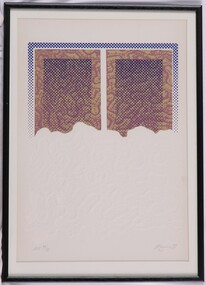
Print, Rod Ewins, (Brain coral), 1977
... Australia Members' Print Commission, 1977. Front: A. P. VIII/X (lower left) Ewins 77 (lower right) (pencil) Back: 1978 (upper left, pencil) Screenprint and embossed print. Screenprinted image is in upper 1/2 of print. Two rectangular prints in gold and mauve in abstract ...Print Council of Australia Members' Print Commission, 1977.Screenprint and embossed print. Screenprinted image is in upper 1/2 of print. Two rectangular prints in gold and mauve in abstract pattern. Overlaying these is a royal blue dotted print, framing top and sides of gold and mauve print. Over centres of gold and mauve prints are rectangles of royal blue dots, giving appearance of Benday dots, or mesh screen. The density of this mesh fades gradually from top to bottom. The bottom edge of the screenprints are undulating, meeting the upper edge of the embossing that occupies remaining lower area of the print. The embossing is the same pattern as in the mauve and gold screenprint above. Mounted in pale cream matt. In black painted wodden frame, with glass.Front: A. P. VIII/X (lower left) Ewins 77 (lower right) (pencil) Back: 1978 (upper left, pencil) -
 Glenelg Shire Council Cultural Collection
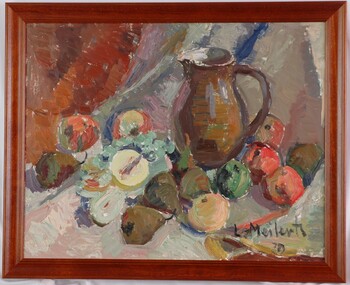
Painting, Ludmilla Meilerts, Still Life, 1970
... Australia as well as several regional Galleries. Still Life Female Artists Women Women Artists Front: L Meilerts 70 (lower right, black paint) Still life of fruit and a jog. Painted in thick impasto paint, creating a very textured surface. Fruit is depicted in green, brown, apricot, pink and red. Background is abstract ...Ludmilla Meilerts, Oil On Board, Botanical Gardens, Circa 1970 Ludmilla Meilerts (1908 - 1997), Botanical Gardens, Melbourne, an impressive work painted with bold brushstrokes and a vivid colourful palette which typifies the artists work. Born in Riga,Latvia in 1908 - After displaying an early talent for art she studied at The Latvian Academy Of Fine Arts graduating in 1940. Later that year she married Otto Meilerts, an Economist, and they moved to Stuttgart, Germany to avoid living under Soviet occupation and then emigrated to Australia in 1948 settling in Melbourne. She worked as a nurse's aid and in a clothing factory to fund the further development of her artistic career achieving considerable early success with her colourful work encompassing portraiture, florals and city and landscapes. She particularly like painting dockland scenes. She was a member of The Victorian Artists Society (VAS) and The Melbourne Society Of Woman Painters And Sculptors. Major prizes include The Dunlop Prize in 1952, Gosford Art prize 1971, Camberwell 1973, VAS Purstitz Gold Medal 1982. She is represented in The State Galleries of Victoria, NSW, Tasmania and Western Australia as well as several regional Galleries. Still life of fruit and a jog. Painted in thick impasto paint, creating a very textured surface. Fruit is depicted in green, brown, apricot, pink and red. Background is abstract. Upper left background is brown, upper centre and right background is in shades of grey, blue and green, with some white. Brown wooden frame.Front: L Meilerts 70 (lower right, black paint)still life, female artists, women, women artists -
 Glenelg Shire Council Cultural Collection
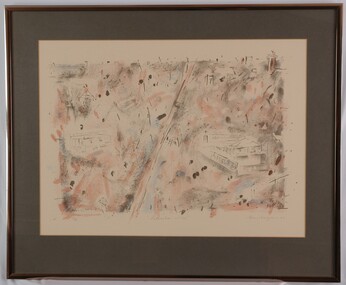
Print, Mary Macqueen, Nullabor 1-1-83, 1983
... Print Council of Australia Members' Print Commission, 1983 Nullabor Desert Scene Female Artists Female Artist abstract Front: Nullarbor (lower left of image) (ink) 35/100 (lower left) Nullarbor 1-1-83 (lower centre) Mary Macqueen 83 (lower right) (pencil) Back: (no inscriptions) Abstracted views of a desert scene. ...Print Council of Australia Members' Print Commission, 1983Abstracted views of a desert scene. A central road intersects image at a vertical diagonal. Faint outlines of houses and a WaterTower are scattered throughout the image. To the lefthand side a building can be seen with a veranda and several seating areas. To the righthand side there is another building and the numerals '1983' can be seen to the side of it. A railway crossing sign is positioned lower centre, at beginning of road. Kangaroos and trees can also be seen in the image. Dominant colour is a pinky red, with blue accents and grey shadows. Mounted in grey matt, in wooden frame. Front: Nullarbor (lower left of image) (ink) 35/100 (lower left) Nullarbor 1-1-83 (lower centre) Mary Macqueen 83 (lower right) (pencil) Back: (no inscriptions)nullabor, desert scene, female artists, female artist, abstract -
 Eltham District Historical Society Inc
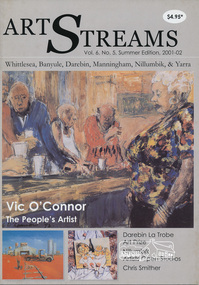
Journal, Peter Doughtery, ArtStreams: Whittlesea, Banyule, Darebin, Manningham, Nillumbik & Yarra; Vol. 6, No. 5, Summer Edition 2001-02, 2001
... Abstract Art and a Good Drop to Boot! 16 Book Review 19 Gwen Ford on Peter Timms Chris Smither at The East 20 CD Review 22 Elizabeth Scarlett on Australian music Artin' About 24 A Tribute to Dunmoochin and Clifton Pugh 28 Return of the Pottery Expo 29 Wining and Dining 30 Poetry 32 Myron Lysenko ...Abstract Art and a Good Drop to Boot! 16 Book Review 19 Gwen Ford on Peter Timms Chris Smither at The East 20 CD Review 22 Elizabeth Scarlett on Australian music Artin' About 24 A Tribute to Dunmoochin and Clifton Pugh 28 Return of the Pottery Expo 29 Wining and Dining 30 Poetry 32 Myron Lysenko "Peter Dougherty has been involved in the local art scene for many years. ...Vol. 6, No. 5, Summer Edition 2001-02 CONTENTS Vic O'Connor 3 The people's artist Noella Clohesy 6 Painting out the pain Darebin La Trobe Art Prize 8 An art form comes into its own 10 Printmaking at Heide Short story 11 Breathe Nillumbik Artists Open Studios 12 Photography by Eltham High School students 14 Creative Food, Abstract Art and a Good Drop to Boot! 16 Book Review 19 Gwen Ford on Peter Timms Chris Smither at The East 20 CD Review 22 Elizabeth Scarlett on Australian music Artin' About 24 A Tribute to Dunmoochin and Clifton Pugh 28 Return of the Pottery Expo 29 Wining and Dining 30 Poetry 32 Myron Lysenko "Peter Dougherty has been involved in the local art scene for many years. As publisher and editor of the arts magazine Artstreams, his comments on the various branches of the arts are widely respected. His "The Arts" column in the Diamond Valley Leader presents a brief summary for a much wider cross section of the local community. Peter also operates his own gallery and the Artstreams Cafe at the St Andrews market. Peter has a wealth of knowledge about present day and historical aspects of local art and artists." - Eltham District Historical Society Newsletter No. 161, March 2005Colour front and back cover with feature articles and literary pieces with photographs and advertisements printed in black and white. 36 pages, 30 cm. Vol. 1, no. 1 (Nov. 1996) - Vol. 10, no. 5 (summer ed. 2005/06) art streams, piers bateman, vic o'connor, willy wonka's ice cream gourmet food, banyule city council cultural services, dynamic vegies, eltham wiregrass gallery, noella clohesy, plenty views golf park, montsalvat, darebin latrobe art prize, yarra valley arts council, printmaking, michelle napolitano, nillumbik artists' open studios, jenni mitchell, eltham high school, evelyn county estate black paddock restaurant, thompsons pharmacy, city of whittlesea community festival, whittlesea country music festival, chris smither, leigh conke, dunmoochin, clifton pugh, mandy hayley, warrandyte pottery expo, drew gregory, michael buxton -
 Eltham District Historical Society Inc
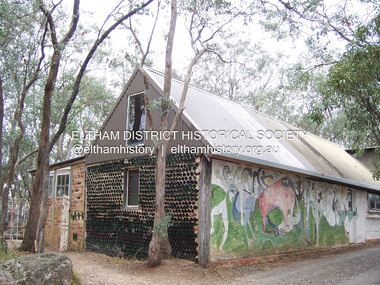
Photograph - Digital Photograph, Marguerite Marshall, Art Gallery at Clifton Pugh's Artists' Colony, Dunmoochin, Barreenong Road, Cottles Bridge, 5 February 2008
... Australia, is very large with adjoining interconnected ovens of different sizes, providing different temperatures and firing conditions. Frank Werther, who befriended Pugh as a fellow student at the National Gallery Art School in Melbourne, built his house off Barreenong Road in 1954. Werther is a painter of the abstract...Australia, is very large with adjoining interconnected ovens of different sizes, providing different temperatures and firing conditions. Frank Werther, who befriended Pugh as a fellow student at the National Gallery Art School in Melbourne, built his house off Barreenong Road in 1954. Werther is a painter of the abstract ...Art Gallery with mural painted by Clifton Pugh (1924-1990) at his Artists' Colony, Dunmoochin, Barreenong Road, Cottles Bridge. Following military service in the second world war, Clifton Pugh studied under artist Sir William Dargie at the National Gallery School in Melbourne as well as Justus Jorgensen, founder of Montsalvat. For a while he lived on the dole but also worked packing eggs for the Belot family saving sufficient to purchase six acres (2.4 ha) of land at Barreenong Road, Cottles Bridge. He accumulated more land and persuaded several other artists and friends to buy land nearby, resulting in a property of approximately 200 acres, stablishing it as one of the first artistic communes in Australia alongside Montsalvat in Eltham. It was around 1951 that Pugh felt he had '"done moochin' around" and so the name of the property evolved. He bought timber from Alistair Knox to build his house on the crest of a hill. Inspired by local goldminer's huts, it was a one room wattle-and-daub structure with dirt floor. Over the years it expanded with thick adobe walls made from local clay, high ceilings and stone floors. All materials other than the local earth were sourced from second hand materials, most found at wreckers' yards. Artists from across the nation were drawn to Dunmoochin, with several setting up houses and shacks on the property, maintaining their independence but sharing their artistic zeal. Artists who worked or resided at Dunmoochin included Mirka Mora, John Perceval, Albert Tucker, Fred Williams, Charles Blackman, Arthur Boyd and John Olsen. In 2002, Pugh's house along with its treasure trove of art and a library of some 20,000 books was destroyed by fire. Traces of Pugh's home remain with the presence of the Victorian doorframe archway with leadlight of intricate design, procured from a demolished Melbourne mansion; and two bronze life-sized female statues created by Pugh and cast by Matcham Skipper. In place of Pugh's house rose two double-storey mud-brick artists' studios topped with corrugated iron rooves curved like the wings of a bird with accommodation for seven. The original studios, gallery and other buildings survived the fire. Covered under Heritage Overlay, Nillumbik Planning Scheme. Published: Nillumbik Now and Then / Marguerite Marshall 2008; photographs Alan King with Marguerite Marshall.; p153 It’s not surprising that artist Clifton Pugh was drawn to Cottles Bridge to establish his artists’ colony Dunmoochin. Undisturbed by the clamour of modern life at Barreenong Road, Pugh was surrounded by the Australian bush he loved, and where his ashes were later scattered. The 200 acres (81ha) of bushland, broken by glimpses of rolling hills, has more than 50 species of orchids and Pugh shared his property with native animals including kangaroos, emus, phascogales, wombats, and diverse bird life. Pugh encouraged these creatures to join him in the bush by creating, with Monash University, a holding station where the animals were raised. Dunmoochin inspired Pugh for such paintings as in a book on orchids and the Death of a Wombat series.1 But his love for the bush was accompanied by the fear that Europeans were destroying it and much of his painting illustrated this fear and his plea for its conservation.2 However it was his house rather than the surrounding bush that was to be destroyed. Tragically in 2002 Pugh’s house, with its treasure of art and library of 20,000 art books, was destroyed by fire. Traces of the beauty of Pugh’s home still remain, however, in the magnificent Victorian doorframe archway with leadlight of intricate design procured from a demolished Melbourne mansion; and two bronze life-sized female statues created by Pugh and cast by Matcham Skipper. Now in place of Pugh’s house, are two double-storey mud-brick artists’ studios topped with corrugated roofs curved like birds’ wings, with accommodation for seven. The original studios, gallery and other buildings remain.3 Pugh grew up on his parents’ hobby farm at Briar Hill and attended the Briar Hill Primary School, then Eltham High School and later Ivanhoe Grammar. At 15 he became a copy boy for the Radio Times newspaper, then worked as a junior in a drafting office. Pugh was to have three wives and two sons. After serving in World War Two in New Guinea and Japan, Pugh studied under artist Sir William Dargie, at the National Gallery School in Melbourne.4 Another of his teachers was Justus Jörgensen, founder of Montsalvat the Eltham Artists’ Colony. Pugh lived on the dole for a while and paid for his first six acres (2.4ha) at Barreenong Road by working as an egg packer for the Belot family. Pugh accumulated more land and persuaded several other artists and friends to buy land nearby, resulting in the 200 acre property. They, too, purchased their land from the Belot family by working with their chickens. Around 1951 Pugh felt he had ‘Done moochin’ around’ and so the name of his property was born. Pugh bought some used timber from architect Alistair Knox to build his house on the crest of a hill. Inspired by local goldminers’ huts it was a one-room wattle-and-daub structure with a dirt floor. It was so small that the only room he could find for his telephone was on the fork of a tree nearby.5 Over the years the mud-brick house grew to 120 squares in the style now synonymous with Eltham. It had thick adobe walls (sun-dried bricks) made from local clay, high ceilings and stone floors with the entire structure made of second-hand materials – most found at wreckers’ yards. Pugh’s first major show in Melbourne in 1957, established him as a distinctive new painter, breaking away from the European tradition ‘yet not closely allied to any particular school of Australian painting’.6 Pugh became internationally known and was awarded the Order of Australia. He won the Archibald Prize for portraiture three times, although he preferred painting the bush and native animals. In 1990 not long before he died, Pugh was named the Australian War Memorial’s official artist at the 75th anniversary of the landing at Gallipoli. Today one of Pugh’s legacies is the Dunmoochin Foundation, which gives seven individual artists or couples and environmental researchers the chance to work in beautiful and peaceful surroundings, usually for a year. By November 2007, more than 80 people had taken part, and the first disabled artist had been chosen to reside in a new studio with disabled access.1 In 1989, not long before Pugh died in 1990 of a heart attack at age 65, he established the Foundation with La Trobe University and the Victorian Conservation Trust now the Trust for Nature. Pugh’s gift to the Australian people – of around 14 hectares of bushland and buildings and about 550 art works – is run by a voluntary board of directors, headed by one of his sons, Shane Pugh. La Trobe University in Victoria stores and curates the art collection and organises its exhibition around Australia.2 The Foundation aims to protect and foster the natural environment and to provide residences, studios and community art facilities at a minimal cost for artists and environmental researchers. They reside at the non-profit organisation for a year at minimal cost. The buildings, some decorated with murals painted by Pugh and including a gallery, were constructed by Pugh, family and friends, with recycled as well as new materials and mud-bricks. The Foundation is inspired by the tradition begun by the Dunmoochin Artists’ Cooperative which formed in the late 1950s as one of the first artistic communes in Australia. Members bought the land collaboratively and built the seven dwellings so that none could overlook another. But, in the late 1960s, the land was split into private land holdings, which ended the cooperative. Dunmoochin attracted visits from the famous artists of the day including guitarists John Williams and Segovia; singer and comedian Rolf Harris; comedian Barry Humphries; and artists Charles Blackman, Arthur Boyd and Mirka Mora. A potters’ community, started by Peter and Helen Laycock with Alma Shanahan, held monthly exhibitions in the 1960s, attracting local, interstate and international visitors – with up to 500 attending at a time.3 Most artists sold their properties and moved away. But two of the original artists remained into the new millennium as did relative newcomer Heja Chong who built on Pugh’s property (now owned by the Dunmoochin Foundation). In 1984 Chong brought the 1000-year-old Japanese Bizan pottery method to Dunmoochin. She helped build (with potters from all over Australia) the distinctive Bizan-style kiln, which fires pottery from eight to 14 days in pine timber, to produce the Bizan unglazed and simple subdued style. The kiln, which is rare in Australia, is very large with adjoining interconnected ovens of different sizes, providing different temperatures and firing conditions. Frank Werther, who befriended Pugh as a fellow student at the National Gallery Art School in Melbourne, built his house off Barreenong Road in 1954. Werther is a painter of the abstract and colourist style and taught art for about 30 years. Like so many in the post-war years in Eltham Shire, as it was called then, Werther built his home in stages using mud-brick and second-hand materials. The L-shaped house is single-storey but two-storey in parts with a corrugated-iron pitched roof. The waterhole used by the Werthers for their water supply is thought to be a former goldmining shaft.4 Alma Shanahan at Barreenong Road was the first to join Pugh around 1953. They also met at the National Gallery Art School and Shanahan at first visited each weekend to work, mainly making mud-bricks. She shared Pugh’s love for the bush, but when their love affair ended, she designed and built her own house a few hundred yards (metres) away. The mud-brick and timber residence, made in stages with local materials, is rectangular, single-storey with a corrugated-iron roof. As a potter, Shanahan did not originally qualify as an official Cooperative member.This collection of almost 130 photos about places and people within the Shire of Nillumbik, an urban and rural municipality in Melbourne's north, contributes to an understanding of the history of the Shire. Published in 2008 immediately prior to the Black Saturday bushfires of February 7, 2009, it documents sites that were impacted, and in some cases destroyed by the fires. It includes photographs taken especially for the publication, creating a unique time capsule representing the Shire in the early 21st century. It remains the most recent comprehenesive publication devoted to the Shire's history connecting local residents to the past. nillumbik now and then (marshall-king) collection, art gallery, clifton pugh, dunmoochin, cottlesbridge, cottles bridge, barreenong road -
 Eltham District Historical Society Inc
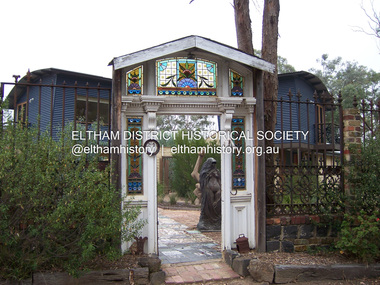
Photograph - Digital Photograph, Marguerite Marshall, Doorway of Clifton Pugh's former house at Dunmoochin, Barreenong Road, Cottles Bridge, 5 February 2008
... Australia, is very large with adjoining interconnected ovens of different sizes, providing different temperatures and firing conditions. Frank Werther, who befriended Pugh as a fellow student at the National Gallery Art School in Melbourne, built his house off Barreenong Road in 1954. Werther is a painter of the abstract...Australia, is very large with adjoining interconnected ovens of different sizes, providing different temperatures and firing conditions. Frank Werther, who befriended Pugh as a fellow student at the National Gallery Art School in Melbourne, built his house off Barreenong Road in 1954. Werther is a painter of the abstract ...Following military service in the second world war, Clifton Pugh studied under artist Sir William Dargie at the National Gallery School in Melbourne as well as Justus Jorgensen, founder of Montsalvat. For a while he lived on the dole but also worked packing eggs for the Belot family saving sufficient to purchase six acres (2.4 ha) of land at Barreenong Road, Cottles Bridge. He accumulated more land and persuaded several other artists and friends to buy land nearby, resulting in a property of approximately 200 acres, stablishing it as one of the first artistic communes in Australia alongside Montsalvat in Eltham. It was around 1951 that Pugh felt he had '"done moochin' around" and so the name of the property evolved. He bought timber from Alistair Knox to build his house on the crest of a hill. Inspired by local goldminer's huts, it was a one room wattle-and-daub structure with dirt floor. Over the years it expanded with thick adobe walls made from local clay, high ceilings and stone floors. All materials other than the local earth were sourced from second hand materials, most found at wreckers' yards. Artists from across the nation were drawn to Dunmoochin, with several setting up houses and shacks on the property, maintaining their independence but sharing their artistic zeal. Artists who worked or resided at Dunmoochin included Mirka Mora, John Perceval, Albert Tucker, Fred Williams, Charles Blackman, Arthur Boyd and John Olsen. In 2002, Pugh's house along with its treasure trove of art and a library of some 20,000 books was destroyed by fire. Traces of Pugh's home remain with the presence of the Victorian doorframe archway with leadlight of intricate design, procured from a demolished Melbourne mansion; and two bronze life-sized female statues created by Pugh and cast by Matcham Skipper. In place of Pugh's house rose two double-storey mud-brick artists' studios topped with corrugated iron rooves curved like the wings of a bird with accommodation for seven. The original studios, gallery and other buildings survived the fire. Covered under Heritage Overlay, Nillumbik Planning Scheme. Published: Nillumbik Now and Then / Marguerite Marshall 2008; photographs Alan King with Marguerite Marshall.; p155 It’s not surprising that artist Clifton Pugh was drawn to Cottles Bridge to establish his artists’ colony Dunmoochin. Undisturbed by the clamour of modern life at Barreenong Road, Pugh was surrounded by the Australian bush he loved, and where his ashes were later scattered. The 200 acres (81ha) of bushland, broken by glimpses of rolling hills, has more than 50 species of orchids and Pugh shared his property with native animals including kangaroos, emus, phascogales, wombats, and diverse bird life. Pugh encouraged these creatures to join him in the bush by creating, with Monash University, a holding station where the animals were raised. Dunmoochin inspired Pugh for such paintings as in a book on orchids and the Death of a Wombat series.1 But his love for the bush was accompanied by the fear that Europeans were destroying it and much of his painting illustrated this fear and his plea for its conservation.2 However it was his house rather than the surrounding bush that was to be destroyed. Tragically in 2002 Pugh’s house, with its treasure of art and library of 20,000 art books, was destroyed by fire. Traces of the beauty of Pugh’s home still remain, however, in the magnificent Victorian doorframe archway with leadlight of intricate design procured from a demolished Melbourne mansion; and two bronze life-sized female statues created by Pugh and cast by Matcham Skipper. Now in place of Pugh’s house, are two double-storey mud-brick artists’ studios topped with corrugated roofs curved like birds’ wings, with accommodation for seven. The original studios, gallery and other buildings remain.3 Pugh grew up on his parents’ hobby farm at Briar Hill and attended the Briar Hill Primary School, then Eltham High School and later Ivanhoe Grammar. At 15 he became a copy boy for the Radio Times newspaper, then worked as a junior in a drafting office. Pugh was to have three wives and two sons. After serving in World War Two in New Guinea and Japan, Pugh studied under artist Sir William Dargie, at the National Gallery School in Melbourne.4 Another of his teachers was Justus Jörgensen, founder of Montsalvat the Eltham Artists’ Colony. Pugh lived on the dole for a while and paid for his first six acres (2.4ha) at Barreenong Road by working as an egg packer for the Belot family. Pugh accumulated more land and persuaded several other artists and friends to buy land nearby, resulting in the 200 acre property. They, too, purchased their land from the Belot family by working with their chickens. Around 1951 Pugh felt he had ‘Done moochin’ around’ and so the name of his property was born. Pugh bought some used timber from architect Alistair Knox to build his house on the crest of a hill. Inspired by local goldminers’ huts it was a one-room wattle-and-daub structure with a dirt floor. It was so small that the only room he could find for his telephone was on the fork of a tree nearby.5 Over the years the mud-brick house grew to 120 squares in the style now synonymous with Eltham. It had thick adobe walls (sun-dried bricks) made from local clay, high ceilings and stone floors with the entire structure made of second-hand materials – most found at wreckers’ yards. Pugh’s first major show in Melbourne in 1957, established him as a distinctive new painter, breaking away from the European tradition ‘yet not closely allied to any particular school of Australian painting’.6 Pugh became internationally known and was awarded the Order of Australia. He won the Archibald Prize for portraiture three times, although he preferred painting the bush and native animals. In 1990 not long before he died, Pugh was named the Australian War Memorial’s official artist at the 75th anniversary of the landing at Gallipoli. Today one of Pugh’s legacies is the Dunmoochin Foundation, which gives seven individual artists or couples and environmental researchers the chance to work in beautiful and peaceful surroundings, usually for a year. By November 2007, more than 80 people had taken part, and the first disabled artist had been chosen to reside in a new studio with disabled access.1 In 1989, not long before Pugh died in 1990 of a heart attack at age 65, he established the Foundation with La Trobe University and the Victorian Conservation Trust now the Trust for Nature. Pugh’s gift to the Australian people – of around 14 hectares of bushland and buildings and about 550 art works – is run by a voluntary board of directors, headed by one of his sons, Shane Pugh. La Trobe University in Victoria stores and curates the art collection and organises its exhibition around Australia.2 The Foundation aims to protect and foster the natural environment and to provide residences, studios and community art facilities at a minimal cost for artists and environmental researchers. They reside at the non-profit organisation for a year at minimal cost. The buildings, some decorated with murals painted by Pugh and including a gallery, were constructed by Pugh, family and friends, with recycled as well as new materials and mud-bricks. The Foundation is inspired by the tradition begun by the Dunmoochin Artists’ Cooperative which formed in the late 1950s as one of the first artistic communes in Australia. Members bought the land collaboratively and built the seven dwellings so that none could overlook another. But, in the late 1960s, the land was split into private land holdings, which ended the cooperative. Dunmoochin attracted visits from the famous artists of the day including guitarists John Williams and Segovia; singer and comedian Rolf Harris; comedian Barry Humphries; and artists Charles Blackman, Arthur Boyd and Mirka Mora. A potters’ community, started by Peter and Helen Laycock with Alma Shanahan, held monthly exhibitions in the 1960s, attracting local, interstate and international visitors – with up to 500 attending at a time.3 Most artists sold their properties and moved away. But two of the original artists remained into the new millennium as did relative newcomer Heja Chong who built on Pugh’s property (now owned by the Dunmoochin Foundation). In 1984 Chong brought the 1000-year-old Japanese Bizan pottery method to Dunmoochin. She helped build (with potters from all over Australia) the distinctive Bizan-style kiln, which fires pottery from eight to 14 days in pine timber, to produce the Bizan unglazed and simple subdued style. The kiln, which is rare in Australia, is very large with adjoining interconnected ovens of different sizes, providing different temperatures and firing conditions. Frank Werther, who befriended Pugh as a fellow student at the National Gallery Art School in Melbourne, built his house off Barreenong Road in 1954. Werther is a painter of the abstract and colourist style and taught art for about 30 years. Like so many in the post-war years in Eltham Shire, as it was called then, Werther built his home in stages using mud-brick and second-hand materials. The L-shaped house is single-storey but two-storey in parts with a corrugated-iron pitched roof. The waterhole used by the Werthers for their water supply is thought to be a former goldmining shaft.4 Alma Shanahan at Barreenong Road was the first to join Pugh around 1953. They also met at the National Gallery Art School and Shanahan at first visited each weekend to work, mainly making mud-bricks. She shared Pugh’s love for the bush, but when their love affair ended, she designed and built her own house a few hundred yards (metres) away. The mud-brick and timber residence, made in stages with local materials, is rectangular, single-storey with a corrugated-iron roof. As a potter, Shanahan did not originally qualify as an official Cooperative member.This collection of almost 130 photos about places and people within the Shire of Nillumbik, an urban and rural municipality in Melbourne's north, contributes to an understanding of the history of the Shire. Published in 2008 immediately prior to the Black Saturday bushfires of February 7, 2009, it documents sites that were impacted, and in some cases destroyed by the fires. It includes photographs taken especially for the publication, creating a unique time capsule representing the Shire in the early 21st century. It remains the most recent comprehenesive publication devoted to the Shire's history connecting local residents to the past. nillumbik now and then (marshall-king) collection, art gallery, clifton pugh, dunmoochin, cottlesbridge, cottles bridge, barreenong road -
 Kiewa Valley Historical Society
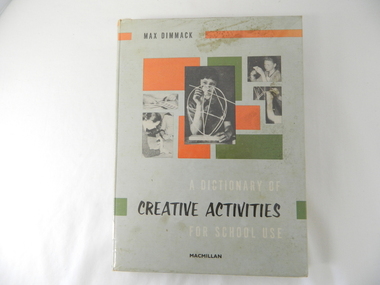
Book - Reference Teaching, Circa 1963
... abstract mental abilities. These abilities prompted the mental processes to "think outside of the square" and is one of the major factors behind the development of "new inventions". This ability has produced many "Australian ...This teacher's aid publication targets the creative and imaginative areas of primary school children's development. It is in a time period at the beginning of television(home intrusion) broadcasts and concentrates on the mental and physical tasks that produce tangible(physical) outcomes. The book concentrates on furthering the students abstract regions of their imagination. This was in a period where physical not electronic flexibility were the target of development. The increase in visual communications both at home and outside the home through social media means has intruded into the fundamentals that is presented in this teacher's aid publication.This publication is significant to both the Alpine and the Kiewa Valley regions because it demonstrates the Victorian State's Educational objectives of this period in time (1960's - 70's). The primary school's educational objectives were to enhance the development of school children's abstract mental abilities. These abilities prompted the mental processes to "think outside of the square" and is one of the major factors behind the development of "new inventions". This ability has produced many "Australian" inventions that have had worldwide applications. This book has a hard cover with photographs of "school" children constructing various "simple" items.Inside cover has a sticker "HALL'S BOOK STORE" and underneath in smaller print "New, Used and Rare Books" underneath this "371 Bourke Street, Melbourne' underneath "262 Chapel Street, Prahran". On the fly leaf is stamped "STATE SCHOOL 4590 BOGONG Vic" and written below "1769" 680 DIM"book, school, mental and physical stimulation, school activities -
 Bendigo Military Museum
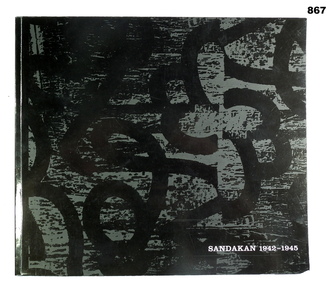
Book, Dr Richard Reid et al, Sandakan 1942 - 1945, 2008
... books military history Book, black & grey soft paper cover, no dust cover, abstract design. 867 cut edge pages, black & white photos. Sandakan 1942 - 1945 Book BOOK Dr Richard Reid Commonwealth of Australia ...Book, black & grey soft paper cover, no dust cover, abstract design. 867 cut edge pages, black & white photos.books, military, history -
 Geoffrey Kaye Museum of Anaesthetic History
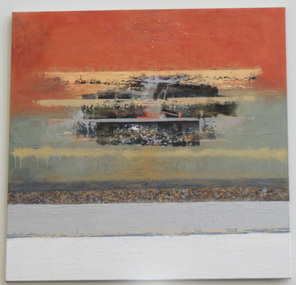
Painting, Trevor McNamara, Return to Forever, 2002
... Australian and New Zealand College of Anaesthetists (ANZCA) began as a faculty at the Royal Australasian College of Surgeons (RACS). Separation was achieved in 1992, when the faculty became a college in its own right. The relationship between ANZCA and RACS has been strong ever since, and on opening the new building at the rear of the property in 2002, RACS gifted this painting to ANZCA. mixed media abstract art art Handwritten in blue permanent marker on reverse: -RETURN TO FOREVER- / T MCNAMARAHandwritten on white sticker adhered to frame: TREVOR MCNAMARA / "RETURN TO FOREVER" / 160 X 160 / MIXED MEDIA / W: 3862 BTY ZAW Mixed media abstract on square canvas. ...The Australian and New Zealand College of Anaesthetists (ANZCA) began as a faculty at the Royal Australasian College of Surgeons (RACS). Separation was achieved in 1992, when the faculty became a college in its own right. The relationship between ANZCA and RACS has been strong ever since, and on opening the new building at the rear of the property in 2002, RACS gifted this painting to ANZCA.Mixed media abstract on square canvas. The painting is an orange, grey, green and white background, with an abstracted landscape in black to the centre.Handwritten in blue permanent marker on reverse: -RETURN TO FOREVER- / T MCNAMARAHandwritten on white sticker adhered to frame: TREVOR MCNAMARA / "RETURN TO FOREVER" / 160 X 160 / MIXED MEDIA / W: 3862 BTY ZAWmixed media, abstract art, art -
 Deaf Children Australia
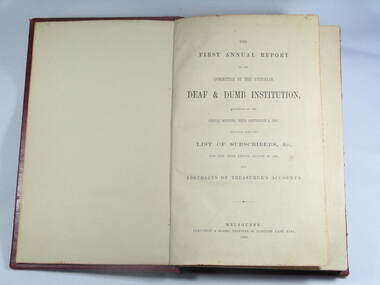
Book, Reports V.D.& D.I. 1863 to 1872
... australia deaf education annual report Front Cover: "VICTORIAN DEAF AND DUMB INSTITUTION" in gold stamping. Spine: "REPORTS V.D.& D.I." "1863 TO 1872" in gold stamping. Decorative stamping around edge of front cover and back cover Red leather bound volume with gold stamping containing the Annual Reports of the Victorian Deaf and Dumb Institution (V.D.&D.I.) starting with the First Annual report presented at the Annual meeting held September 4, 1863. Reports included are the Annual Report, List of Subscribers and abstract ...Deaf Children Australia have a complete set of Annual reports from 1863 to the present date. Annual reports document the activities of the organisation, including educational issues, finance, staffing and students. Annual Reports are created each year.This represents part of the complete official history of Deaf Children Australia from 1863 to the present date, covering the subject of deaf education and related issues.Red leather bound volume with gold stamping containing the Annual Reports of the Victorian Deaf and Dumb Institution (V.D.&D.I.) starting with the First Annual report presented at the Annual meeting held September 4, 1863. Reports included are the Annual Report, List of Subscribers and abstract of Treasurer's Accounts. Last Annual report in volume: 10th Annual Report presented to Annual meeting held 12th September, 1872. Front Cover: "VICTORIAN DEAF AND DUMB INSTITUTION" in gold stamping. Spine: "REPORTS V.D.& D.I." "1863 TO 1872" in gold stamping. Decorative stamping around edge of front cover and back coverdeaf children australia, deaf education, annual report -
 Deaf Children Australia
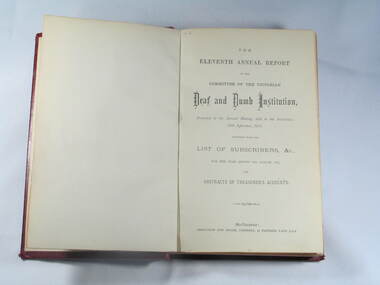
Book, Reports V.D.& D.I. 1873 to 1882
... australia deaf education annual report Front Cover: "VICTORIAN DEAF AND DUMB INSTITUTION" in gold stamping. Spine: "REPORTS V.D.& D.I." "1873 TO 1882" in gold stamping. Decorative stamping around edge of front cover and back cover Red leather bound volume with gold stamping containing the Annual Reports of the Victorian Deaf and Dumb Institution (V.D.&D.I. ) First Report: 11th Annual Report presented at the Annual meeting held 18th September, 1763. Last Report: 20th Annual Report presented at the Annual meeting held 17th July 1882. Reports included are the Annual Report, List of Subscribers and abstract ...Deaf Children Australia have a complete set of Annual reports from 1863 to the present date. Annual reports document the activities of the organisation, including educational issues, finance, staffing and students. Annual Reports are created each year.This represents part of the complete official history of Deaf Children Australia from 1863 to the present date, covering the subject of deaf education and related issues.Red leather bound volume with gold stamping containing the Annual Reports of the Victorian Deaf and Dumb Institution (V.D.&D.I. ) First Report: 11th Annual Report presented at the Annual meeting held 18th September, 1763. Last Report: 20th Annual Report presented at the Annual meeting held 17th July 1882. Reports included are the Annual Report, List of Subscribers and abstract of Treasurer's Accounts. Front Cover: "VICTORIAN DEAF AND DUMB INSTITUTION" in gold stamping. Spine: "REPORTS V.D.& D.I." "1873 TO 1882" in gold stamping. Decorative stamping around edge of front cover and back coverdeaf children australia, deaf education, annual report -
 Deaf Children Australia
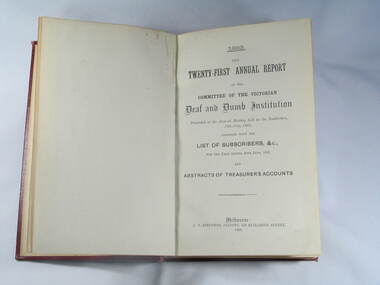
Book, Reports V.D.& D.I. 1883 to 1892
... australia deaf education annual report Front Cover: "VICTORIAN DEAF AND DUMB INSTITUTION" in gold stamping. Spine: "REPORTS V.D.& D.I." "1883 TO 1892" in gold stamping. Decorative stamping around edge of front cover and back cover Red leather bound volume with gold stamping containing the Annual Reports of the Victorian Deaf and Dumb Institution (V.D.&D.I. ) First Report: 21st Annual Report presented at the Annual meeting held 16th July, 1883. Last Report: 30th Annual Report presented at the Annual meeting held 28th July 1892. Reports included are the Annual Report, List of Subscribers and abstract ...Deaf Children Australia have a complete set of Annual reports from 1863 to the present date. Annual reports document the activities of the organisation, including educational issues, finance, staffing and students. Annual Reports are created each year.This represents part of the complete official history of Deaf Children Australia from 1863 to the present date, covering the subject of deaf education and related issues.Red leather bound volume with gold stamping containing the Annual Reports of the Victorian Deaf and Dumb Institution (V.D.&D.I. ) First Report: 21st Annual Report presented at the Annual meeting held 16th July, 1883. Last Report: 30th Annual Report presented at the Annual meeting held 28th July 1892. Reports included are the Annual Report, List of Subscribers and abstract of Treasurer's Accounts. Front Cover: "VICTORIAN DEAF AND DUMB INSTITUTION" in gold stamping. Spine: "REPORTS V.D.& D.I." "1883 TO 1892" in gold stamping. Decorative stamping around edge of front cover and back coverdeaf children australia, deaf education, annual report
