
Showing 75 items matching "australian army - signal corps"
-
 Ringwood RSL Sub-Branch
Plaque - Signal Corp Plague
... Australian army signal corps plague QE2...Wooden base plastic fittings Australian army signal corps plague QE2 Plaque Signal Corp Plague ...Australian army signal corps plague QE2Wooden base plastic fittings -
 Monbulk RSL Sub Branch
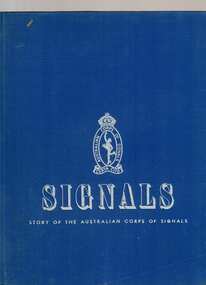
Book, Australian War Memorial, Signals: Story of the Australian Corps of Signals, 1949
... Australian army - Signal Corps...Australian army - Signal Corps Australian Army - Anecdotes Anecdotal stories of life and action of the Australian army in the Middle East during World war two Ill, p.200. ...Anecdotal stories of life and action of the Australian army in the Middle East during World war twoIll, p.200.non-fictionAnecdotal stories of life and action of the Australian army in the Middle East during World war twoaustralian army - signal corps, australian army - anecdotes -
 The Beechworth Burke Museum
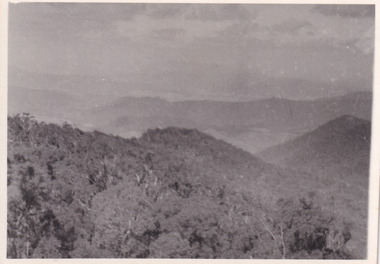
Photograph, 1944
... ...royal australian signal army corps...The historic context of this record can provide insight into Australia's history, military, technological innovation and advancements, as well as national economic, defence and foreign policies after 1945. military album army album wwii world war ii army signal detachment unit royal australian signal army corps war beechworth victoria mt. stanley Reverse: BMM5095.2 / 32 / Black and white rectangular photograph printed on matte photographic paper. ...Taken in 1944, the photograph depicts the view of surrounding hills from Mt. Stanley. A secret experimental micro-wave radio station was established and tested at this site by the Army Signal Detachment Unit during World War II. It was part of an experimental Ultra High Frequency (UHF) link between Melbourne and Sydney. At the time, it was highly classified. It intended to enquire into the hitherto unexplored transmission of micro-waves; that is, a radio signal which could only be transmitted by line of sight, and thus required hill-top to hill-top location.The photograph is historically significant as it pertains to World War II; the largest global conflict in history. This significance is enhanced by Australia's prominent involvement in campaigns across the Pacific, particularly on land in New Guinea and across the Huon Peninsula. It was also the first time that the Australian mainland came under direct attack by the Axis, with Japanese forces targeting north-west Australia and Sydney Harbour. These battles became Australia's largest and most complex offensives during the war. The record is also historically significant as it relates to the Royal Australian Corps of Signals, or "RA Sigs". This significance is strengthened by Australia's unique distinction of having the first established signal unit under the British Empire. This unit provides electronic warfare. They enable commanders to implement highly dynamic battle control against opposing forces by using a number of methods including radio, fibre optic, micro-wave, information systems and satellite links. The record has strong research potential. This is due to the ongoing scholarly and public interest in war, military history, the ANZAC legend, and the ongoing existence of the RA Sigs. The historic context of this record can provide insight into Australia's history, military, technological innovation and advancements, as well as national economic, defence and foreign policies after 1945.Black and white rectangular photograph printed on matte photographic paper.Reverse: BMM5095.2 / 32 /military album, army album, wwii, world war ii, army signal detachment unit, royal australian signal army corps, war, beechworth, victoria, mt. stanley -
 Lara RSL Sub Branch
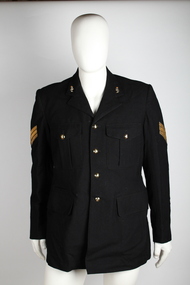
Uniform, Commonwealth Government Clothing Company, Sergeant Black dress jacket Army, 1969
... Australian army personal. Black Dress Jacket with sergeant stripes on the sleeves.Has a signal corps badge on each lapel.Also six brass buttons on front of Jacket. ...Jacket made in 1969 for use by Australian army personal.Black Dress Jacket with sergeant stripes on the sleeves.Has a signal corps badge on each lapel.Also six brass buttons on front of Jacket. -
 Lara RSL Sub Branch
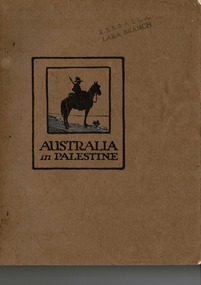
Book, Australia in Palestine, 1919
... His fearlessness, initiative and endurance, and his adaptability to almost any task, are due to the adventurous life he leads in his own country where he has been accustomed to long hours in the saddle, day and night, and to facing danger of all sorts from his earliest youth. battle of beersheba battle of richon ze zion battle of bir er abd camel corps lighthorse slush light sir h.g. chauvel mounted division at kantara medical services signal engineers katia oasis new zealand mounted troops sir edmund h allenby walers story 5th lighthorse romani WW1 World War 1 Australian Army To the memory of fallen comrades. ...A soldier's book produced almost entirely by soldiers in the field under active service conditions to send to their friends in Australia and abroad. Australian Lighthorse men is a type peculiar his own and has no counterpart in h is NZ brother. His fearlessness, initiative and endurance, and his adaptability to almost any task, are due to the adventurous life he leads in his own country where he has been accustomed to long hours in the saddle, day and night, and to facing danger of all sorts from his earliest youth.Brown front and back hardcover with dark brown text 'Australia in Palestine' with a light horseman framed in centre of front cover. The spine is green with text Australia in Palestine, Angus and Robertson bottom of spine. Evidence of water on front cover. Silverfish have eaten top right hand corner of first two pages. Farm scene in four boxes with AR in the lower corner of each square. Inside front and back covers are illustrations of a camel train and came corps in the desert with the rising sun in the background with a mountain. There is a grave and white cross in their foreground right lower corner Illustrations, photographs, poems, short stories, Centre foldout of the Battle for Richon Le Zion and Battle of Beersheba and after the Battle of Bir El Abed To the memory of fallen comrades. Pen mark inside W. Mathews Larabattle of beersheba, battle of richon ze zion, battle of bir er abd, camel corps, lighthorse, slush light, sir h.g. chauvel, mounted division at kantara, medical services, signal engineers, katia oasis, new zealand mounted troops, sir edmund h allenby, walers story, 5th lighthorse, romani, ww1, world war 1, australian army -
 Montmorency–Eltham RSL Sub Branch
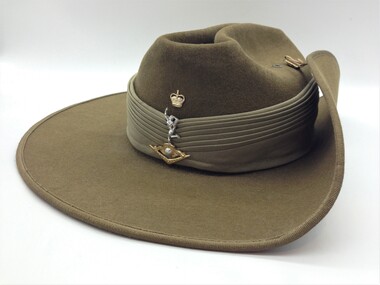
Slouch hat, Hat, khaki, fur felt, 1986, 1986
... Australian Army slouch hat (fur felt) with khaki cloth puggaree. White above blue with purple square superimposed 42 mm square colour patch (142nd Signal Squadron) on right hand side of puggaree. Royal Australian Corps...Standard issue slouch hat Standard issue slouch hat individualised by Corps badge and unit colour patch headgear slouch Latiners 1986 55 (size) gold stamped on sweatband Khaki Australian Army slouch hat (fur felt) with khaki cloth puggaree. White above blue with purple square superimposed 42 mm square colour patch (142nd Signal ...Standard issue slouch hatStandard issue slouch hat individualised by Corps badge and unit colour patch Khaki Australian Army slouch hat (fur felt) with khaki cloth puggaree. White above blue with purple square superimposed 42 mm square colour patch (142nd Signal Squadron) on right hand side of puggaree. Royal Australian Corps of Signals cap badge on front of puggaree. Brown sweatband. Brown leather chinstrap. Mounted on plywood mounting board.Latiners 1986 55 (size) gold stamped on sweatbandheadgear, slouch -
 Red Cliffs Military Museum
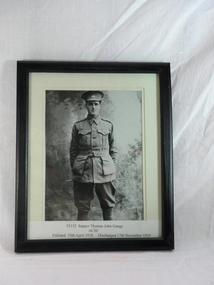
Framed Photograph, Portrait Sapper Thomas John Gange, World War One
... Australian Corps of Signals. He enlisted 10th April 1918 and was discharged 17th November 1919. More information found at http://mappingouranzacs.naa.gov.au/list-enlist.aspx?enlist=Warracknabeal,%20VIC,%20Australia This a reprint of an original photo, low significance of world war one australian sapper studio portrait uniform world war one thomas john gange signals army australia 1918 1919 corps signals swagger stick "Typed information on paper strip at bottom of frame this information is also written on back of photograph.'55152 Sapper Thomas John Gange/ ACSC/ Enlisted 10th April 1918 Discharged 17th November 1919" Reprint of original black and white studio portrait of man in Australian World War One Army uniform standing with swagger stick set against landscape background, photograph mounted in modern wood frame.Typed information on paper strip at bottom of frame, this information is written on back of photograph. ...Sapper Thomas John Gange served in the Australian Corps of Signals. He enlisted 10th April 1918 and was discharged 17th November 1919. More information found at http://mappingouranzacs.naa.gov.au/list-enlist.aspx?enlist=Warracknabeal,%20VIC,%20AustraliaThis a reprint of an original photo, low significanceReprint of original black and white studio portrait of man in Australian World War One Army uniform standing with swagger stick set against landscape background, photograph mounted in modern wood frame.Typed information on paper strip at bottom of frame, this information is written on back of photograph."Typed information on paper strip at bottom of frame this information is also written on back of photograph.'55152 Sapper Thomas John Gange/ ACSC/ Enlisted 10th April 1918 Discharged 17th November 1919"of, world war one, australian, sapper, studio portrait, uniform world war one, thomas john gange, signals army australia, 1918, 1919, corps, signals, swagger stick -
 Greensborough Historical Society
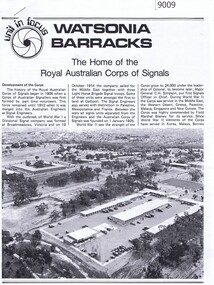
Article - Article, Newsletter, Watsonia Barracks: the home of the Royal Australian Corp of Signals
... A short history of the Royal Australian Corps of Signals at Watsonia Barracks, including background history of the land. Watsonia army barracks simpson army barracks Printed article with black and white photos, 3 pages Watsonia Barracks: the home of the Royal Australian Corp of Signals Article Article, Newsletter ...A short history of the Royal Australian Corps of Signals at Watsonia Barracks, including background history of the land.Printed article with black and white photos, 3 pageswatsonia army barracks, simpson army barracks -
 Bendigo Military Museum
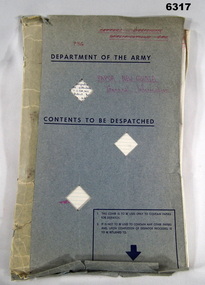
Letter - Mapping correspondence about Papua New Guinea 1970-77, Dept of Natural Resources, Army Survey Regiment, Director of Survey - Army, 1 May 1970 - 8 Aug 1977
... Signals and Documents pertaining to Papua New Guinea (PNG) Mapping during the period 1970-77. These documents were important authoritative documents affecting the production of PNG mapping being produced at the Army Survey Regiment at that time. Royal Australian Survey Corps ...20 x Letters, Signals and Documents pertaining to Papua New Guinea (PNG) Mapping during the period 1970-77. These documents were important authoritative documents affecting the production of PNG mapping being produced at the Army Survey Regiment at that time.Foolscap size folder containing 20 x letters/signals pertaining to Papua New Guinea mapping. Several documents both have been numbered #15.Each letter/Signal is numbered 1-20. Document 1- has "recieved" stamp, Document 2- has a note and signature MM Knight WO2, Document 3 - has 788-2-18 ad "Recieved" , Document 5 - has "Sergeant RN Sargeant" annotated, Document -11 has two file numbers and "received" stamp, Document -12 (telephone record) has recipients stamp, date and initials and file ' R750-5-1, Document -13 "received" stamp and initials, Document -15 has "received" stamp and a note "apply after TALASEA", Document -16 includes a diagram, Document -17 "Distribution List" hand written, Document -18 "received" stamp, Document 19 has note and initials, Document -20 "recipients" stamp, note and initials and "Army Survey Regiment" document stamp. royal australian survey corps, rasvy, fortuna, army survey regiment, army svy regt, asr -
 Bendigo Military Museum
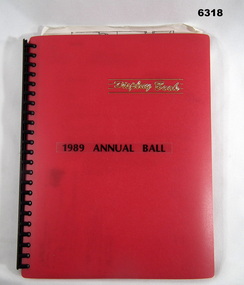
Administrative record - Army Survey Regiment Officers Mess Ball 1989, Army Survey Regiment, 25 Feb 1989
... Army Survey Regiment held Annual Balls at Fortuna Villa. This folder contains the documentation for the Logistics and activities associated with the planning and running of the Ball in 1989. Royal Australian Survey Corps RASvy Fortuna Army Survey Regiment Army Svy Regt ASR A4 Plastic bound Red Display Folder containing documentation for the 1989 Annual Ball, Letters, signals and photos Army Survey Regiment Officers Mess Ball 1989 Administrative record Army Survey Regiment Officers Mess Ball 1989 Army Survey Regiment ...The Army Survey Regiment held Annual Balls at Fortuna Villa. This folder contains the documentation for the Logistics and activities associated with the planning and running of the Ball in 1989.A4 Plastic bound Red Display Folder containing documentation for the 1989 Annual Ball, Letters, signals and photosroyal australian survey corps, rasvy, fortuna, army survey regiment, army svy regt, asr -
 Bendigo Military Museum
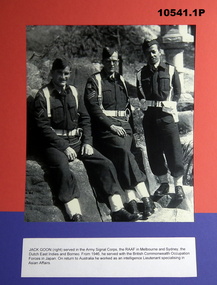
Photograph - AUSTRALIAN CHINESE SERVICEMEN, WW2, Bendigo & District RSL Club, WW2
... "JACK GOON - Served in the Army Signal Corps, the RAAF in Melbourne and Sydney, the Dutch East Indies and Borneo. from 1946, he served with the British Commonwealth Occupation Forces in Japan. On return to Australia...Australian Chinese Servicemen from WW2 photographs. Exhibition held at the Bendigo & District R.S...L. post 2010. Photographs' Chinese WW2 Printed information - black ink print. 1. "JACK GOON - Served in the Army Signal Corps ...Australian Chinese Servicemen from WW2 photographs. Exhibition held at the Bendigo & District R.S...L. post 2010.1.2.3. Photographs - on photographic paper, enlarged black and white portraits. Mount - red and blue colour cardboard, double mount with top area containing the photograph, lower area printed information. 1. Three servicemen wearing RAAF uniform - group photograph. 2. Two servicemen wearing AIF uniforms. 3. Serviceman wearing AIF uniform.Printed information - black ink print. 1. "JACK GOON - Served in the Army Signal Corps, the RAAF in Melbourne and Sydney, the Dutch East Indies and Borneo. from 1946, he served with the British Commonwealth Occupation Forces in Japan. On return to Australia he worked as an intelligence Lieutenant specialising in Asian Affairs. 2. "HIAH" Family - The Hiah Family served in both World Wars. HAROLD VICTOR HIAH (right) served with the first AIF in WW1. His son, HAROLD KEITH HIAH, joined the signal Corps of the second AIF in World War 2. His brother VICTOR and GEORGE also served. 3. Early 1940's portrait of GEORGE HIAH, brother of HAROLD VICTOR HIAH.photographs', chinese, ww2 -
 Bendigo Military Museum
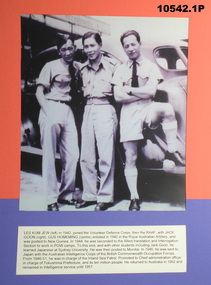
Photograph - AUSTRALIAN CHINESE SERVICEMEN/WOMEN, WW2, Bendigo & District RSL Club, Unknown
... Australian Intelligence Corps of the British Commonwealth Occupation Forces. From 1946-51, he was in charge of the Inland Sea Patrol. Promoted to Chief Administration Officer in charge of Tokushima Prefecture and its ten million people. He returned to Australia in 1952 and remained in Intelligence service until 1957. 2. EUNICE LEONG (top left) worked from 1940 as a wireless operator for the Army in Melbourne, Sydney and Alice Springs, and as a signals...Australian Intelligence Corps of the British Commonwealth Occupation Forces. From 1946-51, he was in charge of the Inland Sea Patrol. Promoted to Chief Administration Officer in charge of Tokushima Prefecture and its ten million people. He returned to Australia in 1952 and remained in Intelligence service until 1957. 2. EUNICE LEONG (top left) worked from 1940 as a wireless operator for the Army in Melbourne, Sydney and Alice Springs, and as a signals ...Australian Chinese Servicemen from WW2 photographs - Exhibition held at the Bendigo & District RSL, post 2010.1.2.3. Photographs on photographic paper, enlarged black and white portraits. Mount - red and blue colour cardboard, double mount with top area containing the photograph, lower area printed information. 1. Three servicemen in informal group. 2. Two servicewomen, one serviceman and a civilian - group portrait. 3. Five servicemen and one service woman in uniform - collection of small portraits.Printed information - black ink print. 1. LES KUM JEW (left)- in 1942, joined the Volunteer Defence Corps, then the RAAF, with JACK GOON (right). GUS HOMEMING (centre) enlisted in 1942 in the Royal Australian Artillery, and was posted to New Guinea. In 1944, he was seconded to the Allied translation and Interrogation Section to work in POW camps. To this end, and with other students including Jack Goon, he learned Japanese at Sydney University. He was then posted to Morotai. In 1946, he was sent to Japan with the Australian Intelligence Corps of the British Commonwealth Occupation Forces. From 1946-51, he was in charge of the Inland Sea Patrol. Promoted to Chief Administration Officer in charge of Tokushima Prefecture and its ten million people. He returned to Australia in 1952 and remained in Intelligence service until 1957. 2. EUNICE LEONG (top left) worked from 1940 as a wireless operator for the Army in Melbourne, Sydney and Alice Springs, and as a signals instructor at Bonegilla. Her sister, VALDA (top right) worked as a radar plotter with the WAAAF, and her brother MAX (bottom right) went with the British Commonwealth Occupation Forces to Japan after the War. 3. PETER MOO (top right) served with the Australian Army in the Northern Territory, his brother FRANK MOO (top centre) served with the Australian Imperial Force in Rabaul and Bougainville, Frank's children CLARENCE MOO (top right) served with the Royal Australian Engineers and then transferred to the Royal Australian Air Force HARRY MOO (bottom left) served with the Royal Australian Air Force's 31 Beaufighter Squadron in Darwin and Morotai, MAVIS MOO (bottom centre) served with the Australian Army Medical Women's Service and ARTHUR MOO (bottom right) served with the Australian Army and later the Royal Australian Air Force. photographs, chinese/australians, ww2 -
 Bendigo Military Museum
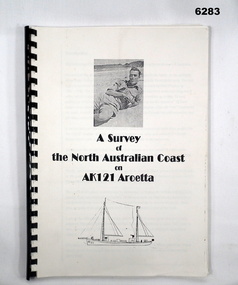
Booklet - A survey of the North Australian Coast on AK121 Aroetta, NT Force, NT Coastal Recce Unit RAE, 6 Aust Army Topo Survey Corps, AKA121 Aroetta, 28 Mar 1945
... Signals), Spr Laurie Rament (Ass. Engineer), Spr McKenzie (Mac) (Cook). The complete history is not available after July 31 1945. The remainder of the notes are very badly water-damaged and in some places unreadable. Royal Australian Survey Corps RASvy Fortuna Army ...The work of the Australian Survey Corps is to make maps for the Army. At the outbreak of war very little of the mainland had been mapped, especially the northern parts. The best maps in existence of the N.T. coast in Dec "41 were those made by Matt Flinders in 1801 -1802. The Army soon got out new maps of all important areas including much of the inland. Later it was decided to bring the complete coastline up to date. Several parties put in between them six months on the coast during the dry season of "45 but a couple more months would be needed to complete the program when the "wet" interrupted the work. A small section from Buckingham Bay - Groote Eylandt was still untouched and this diary covers that section of the N.T. Coast. A survey party of four men was chosen who were to be transported from place to place by the AK121 Aroetta - a ketch of 25 tons belonging to an army unit called N.T. Coastal Recce whose work it was to patrol the coast and as well do air - sea rescue. The survey party: Lieut Jack Worsley (the Loot) Sgt Jack Love, Spr Jack Cook, Spr Pat Hede. Crew of Aroetta: Liet Ralph Warne (Skipper), Sgt Buckley (Buck) (First Mate and Orderly Rm), Sgt Jim Terjesen (Jumbo) Bosun, WO2 Tom Davis (Engineer), Cpl Kevin Monk (Artificer), L/Cpl Jack Cox (Deck Hand), Spr Jack Andrews (Signals), Spr Laurie Rament (Ass. Engineer), Spr McKenzie (Mac) (Cook). The complete history is not available after July 31 1945. The remainder of the notes are very badly water-damaged and in some places unreadable.A4 Booklet, plain paper with text and diagrams and half tone photograph of Lt Jack Worsley with plastic binderSigned by George Barton Maj. for LtCol GS. NT Forceroyal australian survey corps, rasvy, fortuna, army survey regiment, army svy regt, asr -
 Bendigo Military Museum
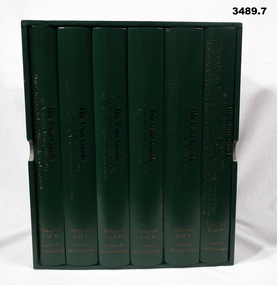
Book - BOOKS, BOXED SET, Graham R McKenzie - Smith, The Unit Guide, 2018
... Signal Units. Box of 6 books. The Unit Guide / The Australian Army / 1939 - 1945. 654 pages .6) Volume 5 of 6. Aust Army Service Corps...Signal Units. Box of 6 books. The Unit Guide / The Australian Army / 1939 - 1945. 654 pages .6) Volume 5 of 6. Aust Army Service Corps ....1) Box open, cardboard, dark green buckram, white paper lining, gold print on sides. .2) - .7) Hard cover book, cardboard, dark green buckram with gold print on front cover & spine. Pages are plain, cut, white, black print, black & white illustrations. .2) Volume 1 of 6. Unit & Location Indexes / Bibliography, Orders of Battle. 483 pages. .3) Volume 2 of 6. Headquarters, Infantry, Cavalry / Armoured & Intelligence Units. 605 pages. .4) Volume 3 of 6. Artillery, Air Defence and Engineer Units. 626 pages. .5) Volume 4 of 6. Medical and Signal Units. Box of 6 books. The Unit Guide / The Australian Army / 1939 - 1945. 654 pages .6) Volume 5 of 6. Aust Army Service Corps, Aust Army Ordnance Corps and Aust Electrical & Mechanical Engineer Units. 706 pages. .7) Volume 6 of 6. Womens Services / Volunteer Defence Corps / War Graves, Survey, Labour, Salvage / Military Policing / Recruiting & Training / Dental, Bath & Laundry / Veterinary & Animal / Movements & Transit / Pay, Records & Printing, Postal / Amenities & Canteens Units. 568 pages. books- military history, unit guide -
 Bendigo Military Museum
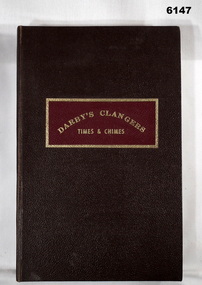
Book - Darbys Clangers, Times and Chimes, WO2 Graham Squire, 1978
... signaling that money was put over the bar for those present. Events such as promotions, departures, birthdays, birth of children and grandchildren were celebrated in this way and hence recorded in this book. The Bell itself was presented by WO1 Alex "Darby" Munro and that is the reason for the naming of the book "Darby's Clangers, Times and Chimes". the first entry in the book is 30 Nov 1978 and the last entry is 29 Nov1996 to celebrate the departure of the last serving members of the unit. Royal Australian Survey Corps RASvy Fortuna Army ...This book was hand made in Bendigo and presented to the Army Survey Regiment Sergeants Mess by WO2 Graham Squire (Later WO1 RSM RASvy). The book is to record events when the Sgts Mess Bell was rung, signaling that money was put over the bar for those present. Events such as promotions, departures, birthdays, birth of children and grandchildren were celebrated in this way and hence recorded in this book. The Bell itself was presented by WO1 Alex "Darby" Munro and that is the reason for the naming of the book "Darby's Clangers, Times and Chimes". the first entry in the book is 30 Nov 1978 and the last entry is 29 Nov1996 to celebrate the departure of the last serving members of the unit.Large handmade book with many unused pages, book is housed in a vinyl covered cardboard box.Page 1 Top - " Please leave first entry space vacant for WO2 G Squire (Fishing Warden), Thank you, Max Neil WO2 for PMC" Page 1 Bottom - "The one that got away!" Last entry "Three cheers for Litho!" signed by LTCOL Duncan Burns Commanding Officer Army Survey Regiment 29 Nov 1996.royal australian survey corps, rasvy, fortuna, army survey regiment, army svy regt, asr -
 Bendigo Military Museum
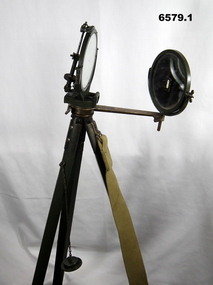
Instrument - Duplex Heliograph Mk V - 1940 with Tripod, LUCO Art Metal Coy Ltd, London, 1940
... signaling by reflecting sunlight with a mirror to send coded messages over long distances. This method was primarily useful in remote areas where other forms of communication were not available. The MkV model, specifically, was widely used by the British Army and other military forces from around 1906 until the mid 1960s. It remained in use with the Australian Army Survey Corps...signaling by reflecting sunlight with a mirror to send coded messages over long distances. This method was primarily useful in remote areas where other forms of communication were not available. The MkV model, specifically, was widely used by the British Army and other military forces from around 1906 until the mid 1960s. It remained in use with the Australian Army Survey Corps ...The Heliograph MkV is a fascinating piece of historical surveying and communications equipment. It was primarily used for visual signaling by reflecting sunlight with a mirror to send coded messages over long distances. This method was primarily useful in remote areas where other forms of communication were not available. The MkV model, specifically, was widely used by the British Army and other military forces from around 1906 until the mid 1960s. It remained in use with the Australian Army Survey Corps until the mid 1980s. The device typically included a 5 - inch mirror and was often mounted on a tripod for stability. Initially the instrument was used to communicate between survey stations using Morse code to coordinate their activities. Later when better forms of communication were available, they were used for precise angle alignment where the sunlight reflection from the mirror was targeted between the survey stations to give very accurate results. The MkV was relatively light weight and portable, making it ideal for use in the field. It could be setup and adjusted quickly. The heliograph had an adjustable mirror that could be tilted to reflect sunlight towards a distant receiver. Surveyors could align the mirror using a sighting device. Whilst it was primarily used by the Military it was also used in civil surveying particularly in the remote areas of Australia. The British Army Mark V version uses a flat round mirror with a small unsilvered spot in the centre. The sender aligned the heliograph to the target by looking at the reflected target in the mirror and moving their head until the target was hidden by the unsilvered spot. Keeping their head still, they then adjusted the aiming rod so its cross wires bisected the target, they then turned up the sighting vane, which covered the cross wires with a diagram of a cross, and aligned the mirror with the tangent and elevation screws, so the small shadow that was a reflection of the unsilvered spot hole was on the cross target. This indicated that the sunbeam was pointing at the target. If the sun was in front of the sender, its rays were reflected directly from this mirror to the receiving station. If the sun was behind the sender, the sighting rod was replaced by a second mirror, to capture the sunlight and direct it onto the main mirror to reflect it to the receiving station.. 1 Brish Army "Mance" Mk V A253 Heliograph has two 125mm diameter mirrors on a brass arm with targeting attachments. The Instrument is mounted on a three-legged tripod of brass and mahogany with spiked feet, approximately 1.2 metres high. The instrument was made by LUCO Art Metal Co Ltd, London in 1940. .2 A military green metal carrying safety storage case with khaki shoulder strap.A253 stamped on instrumentroyal australian survey corps, rasvy, fortuna, army survey regiment, army svy regt, asr -
 Bendigo Military Museum
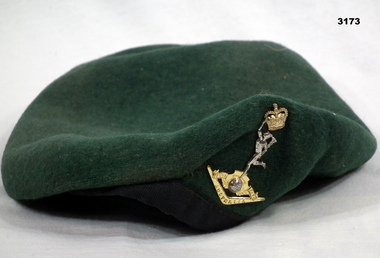
Headwear - BERET, Christies, Post WW2
... military history-uniforms/army costume - male headwear Beret signals Front: “Royal Australian Corps of Signals (RASigs) badge” Stamped inside: “Kent Pure Wool Large” Green woollen beret, black corduroy rim, small black ribbon at rear. ...Green woollen beret, black corduroy rim, small black ribbon at rear.Front: “Royal Australian Corps of Signals (RASigs) badge” Stamped inside: “Kent Pure Wool Large”military history-uniforms/army, costume - male headwear, beret, signals -
 Bendigo Military Museum
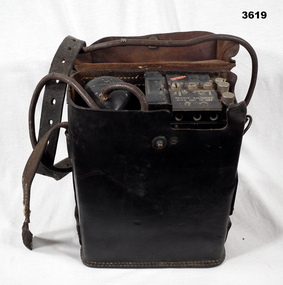
Equipment - FIELD TELEPHONE, c,1939 - 1945
... Discharged on 22.5.1946 with the rank of Signalman in 19 Australian Lines of Communications, Signals. Equipment telephone field US “SIGNAL CORPS US ARMY, TELEPHONE EE-8-A” Brown, leather case with leather straps containing black metal telephone mechanics & bakerlite hand piece. ...Item souvenired by of Robert Clarence DERBY VX148150, enlisted in the 2nd AIF on 9.1.1944 age 21 years. Discharged on 22.5.1946 with the rank of Signalman in 19 Australian Lines of Communications, Signals.Brown, leather case with leather straps containing black metal telephone mechanics & bakerlite hand piece.“SIGNAL CORPS US ARMY, TELEPHONE EE-8-A”equipment, telephone, field, us -
 Running Rabbits Military Museum operated by the Upwey Belgrave RSL Sub Branch
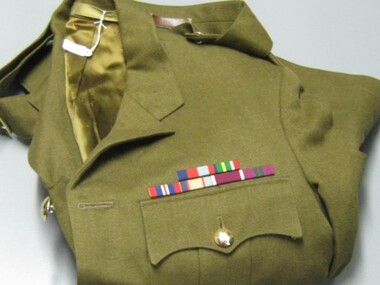
Uniform Complete
... Army Jacket service dress with trousers U226 Warrant Officer. With ribbons & belt Royal Australian Corps of Signals...Uniform 1965 Army Army Jacket service dress with trousers U226 Warrant Officer. With ribbons & belt Royal Australian Corps of Signals Uniform Complete ...Army Jacket service dress with trousers U226 Warrant Officer. With ribbons & belt Royal Australian Corps of Signalsuniform, 1965, army -
 Bendigo Military Museum
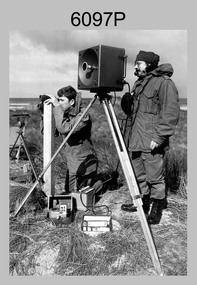
Photograph - Army Survey Regiment Personnel – Mahogany Ship Survey, Warrnambool, VIC, 1985
... Army Survey Regiment personnel undertaking surveying measurements during a search for the ‘Mahogany Ship’ Warrnambool, VIC on 3rd September1985. CPL Mark Lander and SGT Don Williams were taking electronic distance measurements using an MRA-301 tellurometer. To measure the distance, personnel at another site operating another MRA-301 tellurometer would have exchanged the signal emission. A ‘Hilga Watts’ light appears in the background and a barometer in the foreground. Royal Australian Survey Corps ...This is a photograph of Army Survey Regiment personnel undertaking surveying measurements during a search for the ‘Mahogany Ship’ Warrnambool, VIC on 3rd September1985. CPL Mark Lander and SGT Don Williams were taking electronic distance measurements using an MRA-301 tellurometer. To measure the distance, personnel at another site operating another MRA-301 tellurometer would have exchanged the signal emission. A ‘Hilga Watts’ light appears in the background and a barometer in the foreground.This is a photograph of Army Survey Regiment personnel undertaking surveying measurements during a search for the ‘Mahogany Ship’ Warrnambool, VIC on 3rd September1985. The photograph was printed on photographic paper and is part of the Army Survey Regiment’s Collection. The photograph was scanned at 300 dpi. L to R: CPL Mark Lander, SGT Don Williams‘R.S. 3/9/1985 CPL Mark Lander, SGT Don Williams PIC BY COURTESY OF THE WARRNAMBOOL STANDARD’ annotated on back of photoroyal australian survey corps, rasvy, army survey regiment, army svy regt, fortuna, asr, surveying -
 Bendigo Military Museum
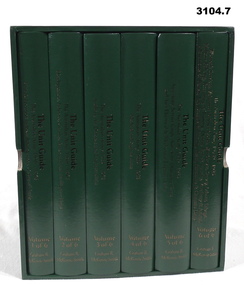
Book - BOOKS, BOXED SET OF 6, Graham R McKenzie - Smith, The Unit Guide, 2018
... Signals Units. .6) Volume 5 of 6. Aust Army Service Corp, Aust Army Ordnance Corp & Aust Electrical & Mechanical Engineer Units. .7) Volume 6 of 6. Women's Services, Volunteer Defence Corps, War Graves Survey, Labour Salvage, Military Policing, Recruiting & Training, Dental, Bath & Laundry, Veterinary & Animal, Movements & Transit, Pay, Records & Printing & Postal, Amenities & Canteens Units. Boxed set of 6 books. The Unit Guide, The Australian ...Boxed set of 6 books. The Unit Guide, The Australian Army 1939 - 1945. .1) Box, open, cardboard, dark green buckram, white paper lining, gold print on sides. .2) - .7) Hard cover book, cardboard, dark green buckram with gold print on front cover & spine. Pages plain cut, black print, black & white illustrations. .2) 483 pages. .3) 605 pages. .4) 626 pages. .5) 654 pages. .6) 706 pages. .7) 568 pages..2) Volume 1 of 6. Unit & Location Indexes, Bibliography, Orders of Battle .3) Volume 2 of 6. Headquarters, Infantry, Cavalry, Armoured & Intelligence Units. .4) Volume 3 of 6. Artillery, Air Defence & Engineer Units. .5) Volume 4 of 6. Medical & Signals Units. .6) Volume 5 of 6. Aust Army Service Corp, Aust Army Ordnance Corp & Aust Electrical & Mechanical Engineer Units. .7) Volume 6 of 6. Women's Services, Volunteer Defence Corps, War Graves Survey, Labour Salvage, Military Policing, Recruiting & Training, Dental, Bath & Laundry, Veterinary & Animal, Movements & Transit, Pay, Records & Printing & Postal, Amenities & Canteens Units.books-military-history, units, 1939 - 45 -
4th/19th Prince of Wales's Light Horse Regiment Unit History Room
Pamphlet, Signal Training Pamphlet No 6 Communication Security, 1971
... Training manual used by Regiment radio training armoured corps DSN 7610-66-039-4906 Soft covered book, detailing communications security in the Australian Army Signal Training Pamphlet No 6 Communication Security Pamphlet Pamphlet ...Training manual used by RegimentSoft covered book, detailing communications security in the Australian ArmyDSN 7610-66-039-4906radio training, armoured corps -
4th/19th Prince of Wales's Light Horse Regiment Unit History Room
Manual - Folder, loose leaf, Royal Australian Armoured Corps Signal Training 1985, 1985
... australian armoured corps RAAC Signal Training 1985. RAAC Extract from Manual of Land Warfare Part 2. Signal Training Volume 2, Pamphlet No 3. Radio Telephone Procedure (All Corps) 1983 Soft covered loose leaf book. The RAAC extract from Manual of Land Warfare Part 2 Signal Training Volume 2, detailing procedure to be used for radiotelephone communications throughout the Army. ...Used by the RegimentSoft covered loose leaf book. The RAAC extract from Manual of Land Warfare Part 2 Signal Training Volume 2, detailing procedure to be used for radiotelephone communications throughout the Army. Includes Amendment list No 1.RAAC Signal Training 1985. RAAC Extract from Manual of Land Warfare Part 2. Signal Training Volume 2, Pamphlet No 3. Radio Telephone Procedure (All Corps) 1983hand book, radio training, royal australian armoured corps -
 Bendigo Military Museum
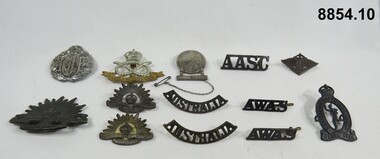
Badge - VARIOUS MILITARY BADGES, Unknown
... Australian Army Service Corps Insignia anodised. 5. Returned from Active Service. 6. Australian Commonwealth Rising Sun Hat 1925. 7. Australian Commonwealth Rising Sun Collar x 2. 8. Curved Australian Shoulder x 2 (circa WW2). 9. AWAS Shoulder WW2 x 2. 10. Australian Signals...Australian Army Service Corps Insignia anodised. 5. Returned from Active Service. 6. Australian Commonwealth Rising Sun Hat 1925. 7. Australian Commonwealth Rising Sun Collar x 2. 8. Curved Australian Shoulder x 2 (circa WW2). 9. AWAS Shoulder WW2 x 2. 10. Australian Signals ...Military badges either gold, silver or brass colour with or without a backing mounting plate, pins. Sizes vary. 1. RAAF Hat (circa WW2) silver. 2. South Staffordshire Regiment Hat (Circa 1910). 3. WW2 Mothers & Widows and Bar with one star. 4. Australian Army Service Corps Insignia anodised. 5. Returned from Active Service. 6. Australian Commonwealth Rising Sun Hat 1925. 7. Australian Commonwealth Rising Sun Collar x 2. 8. Curved Australian Shoulder x 2 (circa WW2). 9. AWAS Shoulder WW2 x 2. 10. Australian Signals Corps Hat. 5, No. AF65366.passchendaele barracks trust, pbt111to120, badges -
 Bendigo Military Museum
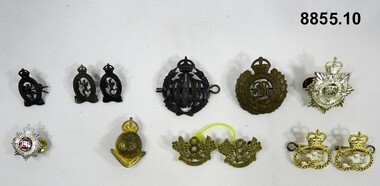
Badge - VARIOUS MILITARY BADGES, Unknown
... Australian Corps of Signals, collar 2. 2. Australian Corps of signals Collar Circa 1940's. 3. RAAF Hat (Circa WW2) anodised. 4. Australian Engineers Hat (Circa 1920-1942) 5. Royal Australian Army...Australian Corps of Signals, collar 2. 2. Australian Corps of signals Collar Circa 1940's. 3. RAAF Hat (Circa WW2) anodised. 4. Australian Engineers Hat (Circa 1920-1942) 5. Royal Australian Army ...Military badges either gold, silver or brass colour with or without a backing mounting plate, pins. Sizes vary. 1. Australian Corps of Signals, collar 2. 2. Australian Corps of signals Collar Circa 1940's. 3. RAAF Hat (Circa WW2) anodised. 4. Australian Engineers Hat (Circa 1920-1942) 5. Royal Australian Army Service Corps Hat (Circa 1960's) 6. Royal Australian Army Service Corps Officers Collar. 7. RACT Hat (see current location), 8. Royal Australian Survey Corps Hat (circa 1940's). 9. 8th Australian Infantry Regiment Collar x 2, 10. Mercian Regiment Collar x 2 (circa 2007). passchendaele barracks trust, pbt121to130, badges -
 Bendigo Military Museum
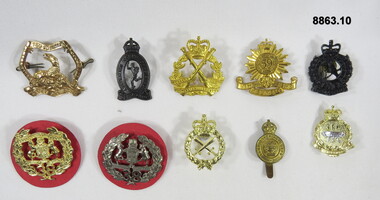
Badge - VARIOUS MILITARY BADGES, Unknown
... Australian Corps of Signals hat. 3. Royal Australian Infantry Corps hat. 4. 59th Battalion, The Hume Regiment hat. 5. 51st Battalion hat. 6. 38th Battalion hat. 7. 38th Battalion hat (Silver). 8. Royal Australian Corps of Military Police hat. 9. Army...Australian Corps of Signals hat. 3. Royal Australian Infantry Corps hat. 4. 59th Battalion, The Hume Regiment hat. 5. 51st Battalion hat. 6. 38th Battalion hat. 7. 38th Battalion hat (Silver). 8. Royal Australian Corps of Military Police hat. 9. Army ...Military badges either gold, silver or brass colour with or without a backing mounting plate, pins. Sizes vary. 1. 70th Infantry Regt. (Ballarat) hat. 2. Australian Corps of Signals hat. 3. Royal Australian Infantry Corps hat. 4. 59th Battalion, The Hume Regiment hat. 5. 51st Battalion hat. 6. 38th Battalion hat. 7. 38th Battalion hat (Silver). 8. Royal Australian Corps of Military Police hat. 9. Army Catering Corps hat. 10. Australian Army Catering Corps hat. passchendaele barracks trust, pbt201to210, badges -
 Bendigo Military Museum
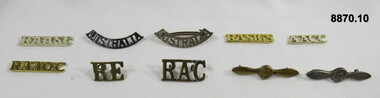
Badge - VARIOUS MILITARY BADGES, Unknown
... Australian Army Service Corps. 2. Curved Australia shoulder. 3. Curved Australia shoulder. 4. Royal Australian Signals shoulder. 5. ...Australian Army Service Corps. 2. Curved Australia shoulder. 3. Curved Australia shoulder. 4. Royal Australian Signals shoulder. 5. ...Military badges either gold, silver or brass colour with or without a backing mounting plate, pins. Sizes vary. 1. Royal Australian Army Service Corps. 2. Curved Australia shoulder. 3. Curved Australia shoulder. 4. Royal Australian Signals shoulder. 5. Australian Army Catering Corps - shoulder. 6. Royal Australian Army Ordnance Corps - shoulder. 7. Brass Royal Engineers shoulder (circa WW1). 8. British Brass WW1 Royal Armoured Corps shoulder. 9. Brass Leading Aircraft Badge of Rank. 10. Silver Leading Aircraft Badge of Rank. passchendaele barracks trust, pbt271to280, badges -
 Bendigo Military Museum
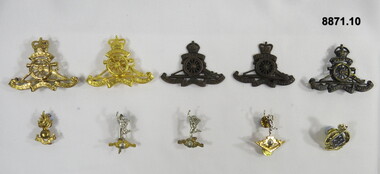
Badge - VARIOUS MILITARY BADGES, Unknown
... Australian Artillery Hat Badge. 3. Royal Artillery Hat Badge (anodised) Circa WWII. 4. Royal Artillery Hat Badge (anodised) ERII. 5. Royal Artillery Hat Badge WW1. 6. Royal Artillery Collar Badge. 7. Royal Corps of Signals, hat badge. 8. Royal Corps of Signals hat badge. 9. Royal Australian Corps of Signals Hat Badge. 10. Women's Royal Australian Army...Australian Artillery Hat Badge. 3. Royal Artillery Hat Badge (anodised) Circa WWII. 4. Royal Artillery Hat Badge (anodised) ERII. 5. Royal Artillery Hat Badge WW1. 6. Royal Artillery Collar Badge. 7. Royal Corps of Signals, hat badge. 8. Royal Corps of Signals hat badge. 9. Royal Australian Corps of Signals Hat Badge. 10. Women's Royal Australian Army ...Military badges either gold, silver or brass colour with or without a backing mounting plate, pins. Sizes vary. 1. Royal Artillery Hat Badge ERII (Gilt). 2. Royal Australian Artillery Hat Badge. 3. Royal Artillery Hat Badge (anodised) Circa WWII. 4. Royal Artillery Hat Badge (anodised) ERII. 5. Royal Artillery Hat Badge WW1. 6. Royal Artillery Collar Badge. 7. Royal Corps of Signals, hat badge. 8. Royal Corps of Signals hat badge. 9. Royal Australian Corps of Signals Hat Badge. 10. Women's Royal Australian Army Corps Collar Badge.passchendaele barracks trust, pbt281to290, badges -
 Running Rabbits Military Museum operated by the Upwey Belgrave RSL Sub Branch
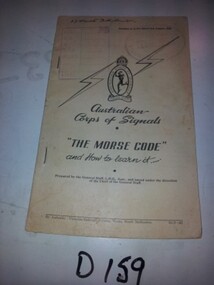
Booklet
... Documents 1942 Army Booklet "The Morse Code and how to learn it" by Australian Corps of Signals (part of COL049) Booklet ...Booklet "The Morse Code and how to learn it" by Australian Corps of Signals (part of COL049)documents, 1942, army -
 Running Rabbits Military Museum operated by the Upwey Belgrave RSL Sub Branch
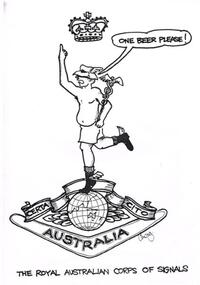
Cartoon
... Picture 1970's Army Royal Australian Corps of Signals Cartoon ...Royal Australian Corps of Signalspicture, 1970's, army
