
Showing 175 items matching "australian army medical service"
-
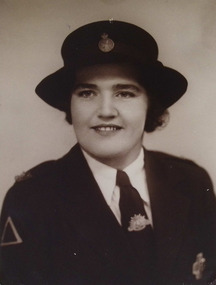 Williamstown Historical Society Inc
Photograph - Pte. R Peterson, Australian Army Medical Women's Service
... R Peterson, Australian Army Medical Women's Service......Australian Army Medical Womens' Service...R Peterson Australian Army Medical Womens' Service WW2 Photograph Pte. ...pte. r peterson, australian army medical womens' service, ww2 -
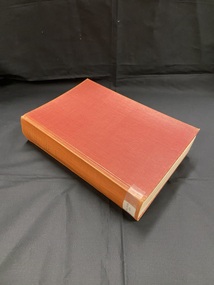 Returned Nurses RSL Sub-branch
Book - Hardcover book, Australian War Memorial, Canberra, Clinical problems of war, 1952
... ...Australian Army medical service...Medical services of the RAN and RAAF, with a section on women in the army medical services. WW2 WWII World War 1939-1945 World War 1939-1945 medical care Australian Army medical service Military medicine Armed conflict Military - sanitation The first volume in series 5 (medical) of the 'Australia in the War of 1939-1945' series. ...The first volume in series 5 (medical) of the 'Australia in the War of 1939-1945' series. This volume is divided into sections on: infectious diseases, systematic and constitutional affections, and disturbances due to nutritional and physical causes. It also looks at medicine and surgery in captivity, dental, rehabilitation, psychiatry, pathology, etc.Worn, red hard-cover book. Title printed in gold across the spine. Spine label taped to base of spine.non-fictionThe first volume in series 5 (medical) of the 'Australia in the War of 1939-1945' series. This volume is divided into sections on: infectious diseases, systematic and constitutional affections, and disturbances due to nutritional and physical causes. It also looks at medicine and surgery in captivity, dental, rehabilitation, psychiatry, pathology, etc.ww2, wwii, world war 1939-1945, world war 1939-1945 medical care, australian army medical service, military medicine, armed conflict, military - sanitation -
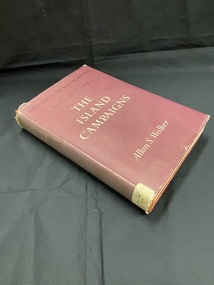 Returned Nurses RSL Sub-branch
Book - Hardcover book, Australian War Memorial, Canberra, The Island Campaigns, 1957
... ...Australian Army medical service...WW2 WWII World War 1939-1945 World War 1939-1945 medical care Australian Army medical service Military medicine Military - sanitation Borneo New Guinea Solomon Islands tropical disease Kokoda The third volume in series 5 (medical) of the 'Australia in the War of 1939-1945' series. ...The third volume in series 5 (medical) of the 'Australia in the War of 1939-1945' series. This volume focuses on medical problems that arose in the second half of World war II; as well as the struggles dealing with tropical diseases whilst fighting on the wet coasts and mountain regions in New Guinea, the Solomon islands and Borneo.Worn, maroon hard-cover book with maroon dust-jacket Title printed in cream across the spine. Spine label taped to base of spine. Series title printed in black at the top of front cover, title and author printed beneath in cream text.non-fictionThe third volume in series 5 (medical) of the 'Australia in the War of 1939-1945' series. This volume focuses on medical problems that arose in the second half of World war II; as well as the struggles dealing with tropical diseases whilst fighting on the wet coasts and mountain regions in New Guinea, the Solomon islands and Borneo.ww2, wwii, world war 1939-1945, world war 1939-1945 medical care, australian army medical service, military medicine, military - sanitation, borneo, new guinea, solomon islands, tropical disease, kokoda -
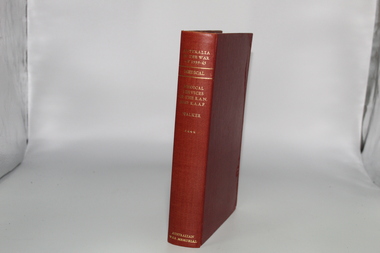 Lara RSL Sub Branch
Book, Australia in the War of 1939-1945 MEDICAL SERVICES of the RAN and RAAF Author Allan.S. Walker MD. Ch.M F.R.A.C.P, First published in 1961
... the australian army medical women's service...Medical services of the RAN Part 2 - Medical Services of the RAAF. Part 3 - Women in the Army Medical Services. Women in the Medical Services ran raaf medical building the naval medical service medical stores and eqipment living conditions in ships prisoners of war burns infectious diseases diseases of the skin affections of the ear, nose and throat dental branch medical units in base areas and in the field milne bay to noemfoor morotai to philippines and borneo aviation medical medical aspects of survival raaf nursing service physiotherapists occupational therapists the australian army medical women's service Australian War Memorial Australia in the War of 1939-1945 - Medical Services of the RAN and RAAF Australia in the War of 1939-1945 MEDICAL SERVICES of the RAN and RAAF Author Allan.S. ...Part One - Medical services of the RAN Part 2 - Medical Services of the RAAF. Part 3 - Women in the Army Medical Services.Women in the Medical ServicesAustralia in the War of 1939-1945 - Medical Services of the RAN and RAAFAustralian War Memorialran raaf medical, building the naval medical service, medical stores and eqipment, living conditions in ships, prisoners of war, burns, infectious diseases, diseases of the skin, affections of the ear, nose and throat, dental branch, medical units in base areas and in the field, milne bay to noemfoor, morotai to philippines and borneo, aviation medical, medical aspects of survival, raaf nursing service, physiotherapists, occupational therapists, the australian army medical women's service -
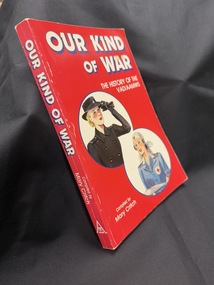 Returned Nurses RSL Sub-branch
Book, Mary Critch, Our kind of war : The history of the VAD/AAMWS, 1981
... ...Australian Army Medical Women's Service...Australian Army Voluntary Aid Detachments Australian Army Medical Women's Service Mary Critch History of VAD History of AAMWS Australia 'War memorabilia with a difference. ...'War memorabilia with a difference. The spirit of pariotism and self sacrifice which gave birth to an organisation such as the V.A.D. and allowed it to function, initially as a vouluntary unit in the early years of the war and later, through integration, as the Australian Army Medical Women's Service, is recorded for all time in this beautifully presented book. Accounts of service throughout Australia, in the Middle East and the S.W. Pacific, exhibit the particular brand of good humour and comradeship which was so much a part of service life. These personal experiences have been skilfully combined by Mary Critch (who herself saw service in Australia and the Islands) with photographs and official documents to create an absorbing story of both historical and human interest. The foreword is by Miss May Douglas, M.B.E.' From back cover 'Contents: Who Were the V.A.D.'s? Suitable Capable Women of the A.M.F. V.A.D Service Overseas 1941-1943 The Australian Continent Finding Our Bearings 1941-1942 The Australian Connection Reorganisation of the Service of the V.A.D. Training the A.A.M.W.S As Nurses The South West Pacific 1943-1946 Service With Occupational Forces and Demobilisation'Red paperback book with colour drawings on cover and white and blue text on cover and spinenon-fiction'War memorabilia with a difference. The spirit of pariotism and self sacrifice which gave birth to an organisation such as the V.A.D. and allowed it to function, initially as a vouluntary unit in the early years of the war and later, through integration, as the Australian Army Medical Women's Service, is recorded for all time in this beautifully presented book. Accounts of service throughout Australia, in the Middle East and the S.W. Pacific, exhibit the particular brand of good humour and comradeship which was so much a part of service life. These personal experiences have been skilfully combined by Mary Critch (who herself saw service in Australia and the Islands) with photographs and official documents to create an absorbing story of both historical and human interest. The foreword is by Miss May Douglas, M.B.E.' From back cover 'Contents: Who Were the V.A.D.'s? Suitable Capable Women of the A.M.F. V.A.D Service Overseas 1941-1943 The Australian Continent Finding Our Bearings 1941-1942 The Australian Connection Reorganisation of the Service of the V.A.D. Training the A.A.M.W.S As Nurses The South West Pacific 1943-1946 Service With Occupational Forces and Demobilisation'australian army voluntary aid detachments, australian army medical women's service, mary critch, history of vad, history of aamws, australia -
 Returned Nurses RSL Sub-branch
Book - Illustrated paperback book, Warracknabeal and District Historical Society, Servicewomen of Warracknabeal and District, 1999
... ...Australian Army Medical Women's Service...Women from Boer War, World War One and World War Two - 68 women Australian Nurses Australian Army Nursing Service Australian Army Medical Women's Service Women's Auxiliary Australian Air Force Australian Women's Army Service Royal Australian Air Force Nursing Service Royal Australian Naval Nursing Service Book printed to coincide with unveiling of an honour board recognising servicewomen from the Warracknabeal and district area from the Boer, First and Second World Wars. ...Book printed to coincide with unveiling of an honour board recognising servicewomen from the Warracknabeal and district area from the Boer, First and Second World Wars. Book contains a brief biography and photo of as many of the 68 women listed on the honour board as possible.Tape and glue bound paperback book with cover in poor condition with stains and corners curling. Tape on spine is light brown and text on cover is black. Tucked amongst the pages is the 'Servicewomen of Warracknabeal and District, Unveiling of Honour Board, Saturday, March 6th, 1999, Programme'non-fictionBook printed to coincide with unveiling of an honour board recognising servicewomen from the Warracknabeal and district area from the Boer, First and Second World Wars. Book contains a brief biography and photo of as many of the 68 women listed on the honour board as possible.australian nurses, australian army nursing service, australian army medical women's service, women's auxiliary australian air force, australian women's army service, royal australian air force nursing service, royal australian naval nursing service -
 Returned Nurses RSL Sub-branch
Book - Illustrated paperback book, Warracknabeal and District Historical Society, Servicewomen of Warracknabeal and District, 1999
... ...Australian Army Medical Women's Service...Women from Boer War, World War One and World War Two - 68 women Australian Nurses Australian Army Nursing Service Australian Army Medical Women's Service Women's Auxiliary Australian Air Force Australian Women's Army Service Royal Australian Air Force Nursing Service Royal Australian Naval Nursing Service Book printed to coincide with unveiling of an honour board recognising servicewomen from the Warracknabeal and district area from the Boer, First and Second World Wars. ...Book printed to coincide with unveiling of an honour board recognising servicewomen from the Warracknabeal and district area from the Boer, First and Second World Wars. Book contains a brief biography and photo of as many of the 68 women listed on the honour board as possible.Tape and glue bound paperback book. Tape on spine is light brown and text on cover is black. non-fictionBook printed to coincide with unveiling of an honour board recognising servicewomen from the Warracknabeal and district area from the Boer, First and Second World Wars. Book contains a brief biography and photo of as many of the 68 women listed on the honour board as possible.australian nurses, australian army nursing service, australian army medical women's service, women's auxiliary australian air force, australian women's army service, royal australian air force nursing service, royal australian naval nursing service -
 Returned Nurses RSL Sub-branch
Book - Illustrated paperback book, Warracknabeal and District Historical Society, Servicewomen of Warracknabeal and District, 1999
... ...Australian Army Medical Women's Service...Women from Boer War, World War One and World War Two - 68 women Australian Nurses Australian Army Nursing Service Australian Army Medical Women's Service Women's Auxiliary Australian Air Force Australian Women's Army Service Royal Australian Air Force Nursing Service Royal Australian Naval Nursing Service Book printed to coincide with unveiling of an honour board recognising servicewomen from the Warracknabeal and district area from the Boer, First and Second World Wars. ...Book printed to coincide with unveiling of an honour board recognising servicewomen from the Warracknabeal and district area from the Boer, First and Second World Wars. Book contains a brief biography and photo of as many of the 68 women listed on the honour board as possible.Tape and glue bound paperback book. Tape on spine is light brown and text on cover is black. non-fictionBook printed to coincide with unveiling of an honour board recognising servicewomen from the Warracknabeal and district area from the Boer, First and Second World Wars. Book contains a brief biography and photo of as many of the 68 women listed on the honour board as possible.australian nurses, australian army nursing service, australian army medical women's service, women's auxiliary australian air force, australian women's army service, royal australian air force nursing service, royal australian naval nursing service -
 Returned Nurses RSL Sub-branch
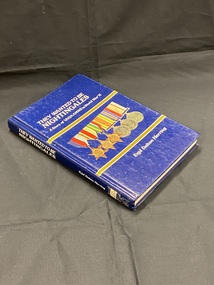
Book - Hardcover book, Investigator Press, They wanted to be Nightingales: a story of VAD/AAMWS in World War II, 1982
... Australian Army Medical Women's Service...Signed by author. Australian Army Medical Women's Service AAMWS Australian Army Voluntary Aid Detachments Voluntary Aid Detachments VAD World War 1939-1945 WW2 WWII World War 1939-1945 medical care Military nursing A record of experiences in the Australian Army Medical Women's Service during and after World War II. ...A record of experiences in the Australian Army Medical Women's Service during and after World War II.Blue hardback book. Title printed down the spine. Cover has two gold lines across the front, above the top line is the title in white; below the bottom line is the author's name, between the two lines in the middle are a row of six military ribbons and medals.non-fictionA record of experiences in the Australian Army Medical Women's Service during and after World War II.australian army medical women's service, aamws, australian army voluntary aid detachments, voluntary aid detachments, vad, world war 1939-1945, ww2, wwii, world war 1939-1945 medical care, military nursing -
 8th/13th Victorian Mounted Rifles Regimental Collection
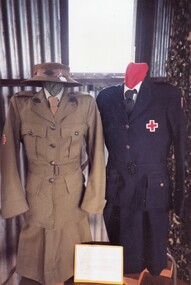
Photograph - AAMWS uniforms
... Colour photograph of two uniforms of Mrs Shirley May ( Steele ) who served with Australian Army Medical Women's Service ( AAMWS) ion World War Two....AAMWS Steele Albury Colour photograph of two uniforms of Mrs Shirley May ( Steele ) who served with Australian Army Medical Women's Service ( AAMWS) ion World War Two. ...Uniforms were part of Women in War Exhibition, Albury May 1993 in which VMR Museum collaborated with Albury Regional Museum.Colour photograph of two uniforms of Mrs Shirley May ( Steele ) who served with Australian Army Medical Women's Service ( AAMWS) ion World War Two.aamws, steele, albury -
 Bendigo Military Museum
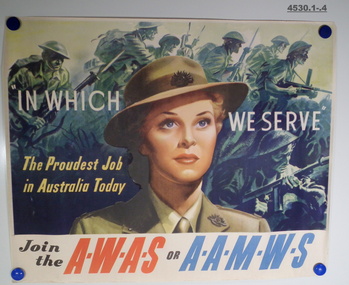
Poster - RECRUITMENT POSTER WW2
... AAMWS - Australian Army Medical Women's Service See also, Cat. No. 4529.2...AAMWS - Australian Army Medical Women's Service See also, Cat. No. 4529.2 AWAS WWII AAMWS .1 - .4 Are all the same. ...AAMWS - Australian Army Medical Women's Service See also, Cat. No. 4529.2.1 - .4 Are all the same. Graphic Artworks with coloured ink. Paper. In the center is the image of a woman in uniform. In the background in green ink are images of soldiers in helmets with rifles with fixed bayonets, a Tommy gun and an Owen gun. Writing on the Poster includes: "IN WHICH WE SERVE" "The Proudest Job in Australia Today" "Join the A.W.A.S or A.A.M.W.S" awas, wwii, aamws -
 Returned Nurses RSL Sub-branch
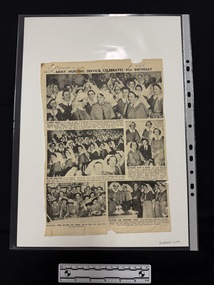
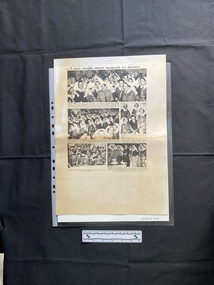
Newspaper - Newspaper clipping, The Australasian, Army Nursing Service Celebrates 41st Birthday, July 10, 1943
... Newspaper page with headline, and four black and white photographs of women in Australian Army Nursing Service uniforms and one black and white photograph of women in Australian Army Medical Womens Service uniforms. ...Australian Army Nursing Service. Including a representative of the US Army Nursing Service. WWII World War Two WW2 Australian Army Nursing Service Annie Moriah Sage Grace Wilson Charlotte Joan McAllister Blanche Sagner US Army Nursing Service Ethel Jessie Bowe Margaret Alison Tisdale Jean Evelyn Headberry Mary Dorothy Fahle 'NC14' [blue ink, top left hand corner] 'WWII' [blue ink, top right hand corner] Newspaper page with headline, and four black and white photographs of women in Australian Army Nursing Service uniforms and one black and white photograph of women in Australian Army Medical Womens Service uniforms. ...Part of a two page spread with the articles on the event on the missing page. The photographs on this page give insight into the ages and number of women who were present at the celebration of the 41st birthday of the Australian Army Nursing Service. Including a representative of the US Army Nursing Service.Newspaper page with headline, and four black and white photographs of women in Australian Army Nursing Service uniforms and one black and white photograph of women in Australian Army Medical Womens Service uniforms. All photos have captions.'NC14' [blue ink, top left hand corner] 'WWII' [blue ink, top right hand corner]wwii, world war two, ww2, australian army nursing service, annie moriah sage, grace wilson, charlotte joan mcallister, blanche sagner, us army nursing service, ethel jessie bowe, margaret alison tisdale, jean evelyn headberry, mary dorothy fahle -
 Returned Nurses RSL Sub-branch
Newspaper - Photocopy of a newspaper clipping, The Australasian, Army Nursing Service Celebrates 41st Birthday, 19430710 (original)
... Newspaper page with headline, and four black and white photographs of women in Australian Army Nursing Service uniforms and one black and white photograph of women in Australian Army Medical Womens Service uniforms. ...Australian Army Nursing Service. Including a representative of the US Army Nursing Service. WWII World War Two WW2 Australian Army Nursing Service 'NC14' [photocopied ink, top left hand corner] '9'[over the top of 14, to make 'NC9', pencil, top left hand corner] 'WWII' [blue ink, top right hand corner] Newspaper page with headline, and four black and white photographs of women in Australian Army Nursing Service uniforms and one black and white photograph of women in Australian Army Medical Womens Service uniforms. ...Part of a two page spread with the articles on the event on the missing page. The photographs on this page give insight into the ages and number of women who were present at the celebration of the 41st birthday of the Australian Army Nursing Service. Including a representative of the US Army Nursing Service.Newspaper page with headline, and four black and white photographs of women in Australian Army Nursing Service uniforms and one black and white photograph of women in Australian Army Medical Womens Service uniforms. All photos have captions.'NC14' [photocopied ink, top left hand corner] '9'[over the top of 14, to make 'NC9', pencil, top left hand corner] 'WWII' [blue ink, top right hand corner]wwii, world war two, ww2, australian army nursing service -
 Bendigo Military Museum
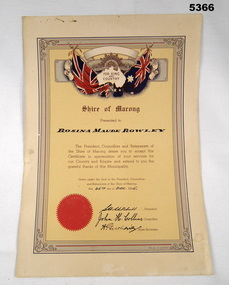
Certificate - SHIRE OF MARONG, 25.12.1946
... Rosina enlisted on 1.6.1945 age 27 years No VFX97605, discharged fro the services on 21.4.1946 with the rank of Pte in the Australian Army medical Women’s Service....Rosina enlisted on 1.6.1945 age 27 years No VFX97605, discharged fro the services on 21.4.1946 with the rank of Pte in the Australian Army medical Women’s Service. ...Rosina enlisted on 1.6.1945 age 27 years No VFX97605, discharged fro the services on 21.4.1946 with the rank of Pte in the Australian Army medical Women’s Service.Certificate from the Marong Shire to R.M.Rowley, top has rising sun and flags with Shire name under followed by hand drawn name in black, text relates to thanks from the Shire and Ratepayers with date hand written on, at bottom a red seal and signed by the President, a Councillor and the Secretary.“Rosina Maude Rowley”, “25th Dec 45”, “S.V. Mitchell, John H Collins, A Guthrie”certificates, shire -
 Bendigo Historical Society Inc.
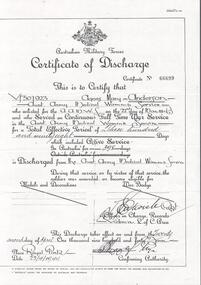
Certificate - THE BROOK AND ANDERSON FORTUNA COLLECTION: CERTIFICATE OF DISCHARGE
... Photocopy of certificate of discharge No.66699 issued by the Australian Military Forces to VF507923 Agnes Mary Anderson, Australia army medical women's service who enlisted on the 22nd day of May 1943, who served for three hundred and ninety-eight days. ...MILITARY World war 2 Photocopy of certificate of discharge No.66699 issued by the Australian Military Forces to VF507923 Agnes Mary Anderson, Australia army medical women's service who enlisted on the 22nd day of May 1943, who served for three hundred and ninety-eight days. ...Photocopy of certificate of discharge No.66699 issued by the Australian Military Forces to VF507923 Agnes Mary Anderson, Australia army medical women's service who enlisted on the 22nd day of May 1943, who served for three hundred and ninety-eight days. Dated 22/04/1944military, world war 2 -
 Returned Nurses RSL Sub-branch
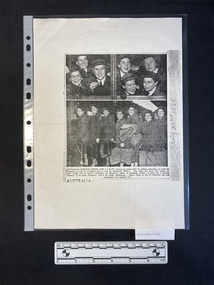
Newspaper - Photocopy of newspaper clipping, The Argus, untitled, Aug 23 1945
... The clipping features photos of Australian nursing sisters and Australian Army Medical Women's Service (AAMWS) leaving by troop train to Sydney and then Singapore to care for Australian POWs. ...The clipping features photos of Australian nursing sisters and Australian Army Medical Women's Service (AAMWS) leaving by troop train to Sydney and then Singapore to care for Australian POWs. ...The clipping features photos of Australian nursing sisters and Australian Army Medical Women's Service (AAMWS) leaving by troop train to Sydney and then Singapore to care for Australian POWs. A photocopy of a newspaper clipping consisting of two large black and white photos and a caption beneath'Aug 23rd 1945' [written on original and appears here photocopied, down right hand side]ww2, wwii, world war two, m lloyd, wm marrie, m stockwell, b brooking, wf beckett, en doig, em jones -
 Wangaratta RSL Sub Branch
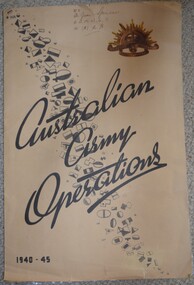
Map, Australian Army Operations 1940-45
... Large fold out map and chronology of Australian Army Operations between 1940-1945 that belonged to Private Joan Spencer VFX12932 (VF507134) born 12/11/1924 at Albury. The family moved to Wangaratta and Joan was educated at Wangaratta High School before joining the Australian Army Medical Women's Service at 115 (Heidelberg) Military Hospital. ...Large fold out map and chronology of Australian Army Operations between 1940-1945 that belonged to Private Joan Spencer VFX12932 (VF507134) born 12/11/1924 at Albury. The family moved to Wangaratta and Joan was educated at Wangaratta High School before joining the Australian Army Medical Women's Service at 115 (Heidelberg) Military Hospital. ...Large fold out map and chronology of Australian Army Operations between 1940-1945 that belonged to Private Joan Spencer VFX12932 (VF507134) born 12/11/1924 at Albury. The family moved to Wangaratta and Joan was educated at Wangaratta High School before joining the Australian Army Medical Women's Service at 115 (Heidelberg) Military Hospital. She served with the 130 Australia General Hospital and was deployed overseas to Japan on 17/6/1947 and returned on 26/1/1949Large cream coloured cardboard folded in three, inside is a coloured map of the Middle East 1940-1942, New Guinea Theatre 1942-1944, Pacific Islands 1944-1945 and Malay and Islands 1942-1945. Front cover has Unit patches from top left to bottom right corner , at top right corner is the rising sun badge and bottom left corner 1940-45 Back cover is a listed Chronology.Hand written at top - VFX Pte Joan Spencer AAMWS 115 (H) M.H.australian army operations, private joan spencer, aamws, 130 agh -
 Returned Nurses RSL Sub-branch
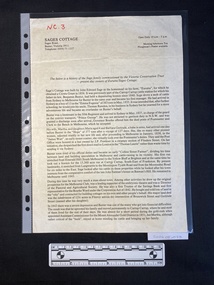
Document - Printed document, Victorian Conservation Trust, Sages Cottage : The below is a history of the Sage fanily commisioned by the Victoria Conservathin Trust - present day owners of Eurutta/Sages Cottage, [2004]
... Australian Army Nursing Service (AANS), Australian Imperial Force (AIF). During WWII Annie served as matron for the 2nd/2nd Australian General Hospital in the Middle East. She was made matron-in-chief, AIF (Middle East) in 1940, and was appointed a member of the Red Cross in 1942. Returning to Australia in 1942, she was elevated to deputy matron-in-chief, AMF in February 1943, and sub-sequentially promoted to colonel in March. Her duties included organising the AANS for duty in the South-West Pacific Area and oversaw the training scheme for the Australian Army Medical...Australian Army Nursing Service (AANS), Australian Imperial Force (AIF). During WWII Annie served as matron for the 2nd/2nd Australian General Hospital in the Middle East. She was made matron-in-chief, AIF (Middle East) in 1940, and was appointed a member of the Red Cross in 1942. Returning to Australia in 1942, she was elevated to deputy matron-in-chief, AMF in February 1943, and sub-sequentially promoted to colonel in March. Her duties included organising the AANS for duty in the South-West Pacific Area and oversaw the training scheme for the Australian Army Medical ...Information page detailing the history of Sages Cottage from building in 1853/56 as a homestead, to being purchased in 1976 by the Victoria Conservation Trust. John Edward Sage built the cottage as the homestead for his farm "Eurutta" in 1856. John lived in the cottage with his wife and children up until his death in 1908 with his wife, Maria Sage (nee Baxter) continuing to live there until her death in 1927. Their youngest son, Thomas Holden Sage, and three daughters, Fanny Martha, Annie Agususta and Ellen Amynta continued to live there until their deaths. Thomas died in 1960 but gifted the remaining block of land with the cottage to his [niece?] Annie Moriah Sage a year before his death. Annie was Matron of the Australian Military Forces (AMF) in WW2. [Annie was born in 1895 as the fifth child to Edward Arthur and Mary Anne Sage. She trained in nursing, obtaining her nursing certificate in 1926. 1940 saw Annie join the Australian Army Nursing Service (AANS), Australian Imperial Force (AIF). During WWII Annie served as matron for the 2nd/2nd Australian General Hospital in the Middle East. She was made matron-in-chief, AIF (Middle East) in 1940, and was appointed a member of the Red Cross in 1942. Returning to Australia in 1942, she was elevated to deputy matron-in-chief, AMF in February 1943, and sub-sequentially promoted to colonel in March. Her duties included organising the AANS for duty in the South-West Pacific Area and oversaw the training scheme for the Australian Army Medical Women's Service (AAMWS). In September 1945 Annie flew to Sumatra to assist with the repatriation of the twenty four Australian nurses imprisoned by the Japanese. For her war service she was awarded the Florence Nightingale medal (1947) by the International Red Cross. In 1951 she was appointed Commander of the Most Excellent Order of the British Empire (CBE).] After Annie's death in 1969 the cottage and land went to a nephew and two nieces, before being purchased in 1976 by the Victoria Conservation Trust as an example of early settlement history.A printed information document in black ink on white paper, with an address in the upper left and opening times and refreshments available in the upper right. Below and over the page is full width text.'NC.3' [red ink top left hand corner of front page] '059 7111 3577 [?] Alastair Herbert / & / [?] Camilla [Hapfor]' [blue ink, top if second page]wwii, world war 2 -
 Bendigo Military Museum
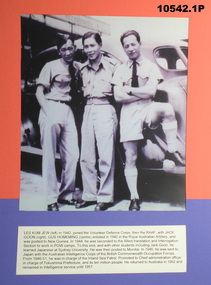
Photograph - AUSTRALIAN CHINESE SERVICEMEN/WOMEN, WW2, Bendigo & District RSL Club, Unknown
... PETER MOO (top right) served with the Australian Army in the Northern Territory, his brother FRANK MOO (top centre) served with the Australian Imperial Force in Rabaul and Bougainville, Frank's children CLARENCE MOO (top right) served with the Royal Australian Engineers and then transferred to the Royal Australian Air Force HARRY MOO (bottom left) served with the Royal Australian Air Force's 31 Beaufighter Squadron in Darwin and Morotai, MAVIS MOO (bottom centre) served with the Australian Army Medical Women's Service and ARTHUR MOO (bottom right) served with the Australian Army and later the Royal Australian Air Force. ...PETER MOO (top right) served with the Australian Army in the Northern Territory, his brother FRANK MOO (top centre) served with the Australian Imperial Force in Rabaul and Bougainville, Frank's children CLARENCE MOO (top right) served with the Royal Australian Engineers and then transferred to the Royal Australian Air Force HARRY MOO (bottom left) served with the Royal Australian Air Force's 31 Beaufighter Squadron in Darwin and Morotai, MAVIS MOO (bottom centre) served with the Australian Army Medical Women's Service and ARTHUR MOO (bottom right) served with the Australian Army and later the Royal Australian Air Force. 1.2.3. ...Australian Chinese Servicemen from WW2 photographs - Exhibition held at the Bendigo & District RSL, post 2010.1.2.3. Photographs on photographic paper, enlarged black and white portraits. Mount - red and blue colour cardboard, double mount with top area containing the photograph, lower area printed information. 1. Three servicemen in informal group. 2. Two servicewomen, one serviceman and a civilian - group portrait. 3. Five servicemen and one service woman in uniform - collection of small portraits.Printed information - black ink print. 1. LES KUM JEW (left)- in 1942, joined the Volunteer Defence Corps, then the RAAF, with JACK GOON (right). GUS HOMEMING (centre) enlisted in 1942 in the Royal Australian Artillery, and was posted to New Guinea. In 1944, he was seconded to the Allied translation and Interrogation Section to work in POW camps. To this end, and with other students including Jack Goon, he learned Japanese at Sydney University. He was then posted to Morotai. In 1946, he was sent to Japan with the Australian Intelligence Corps of the British Commonwealth Occupation Forces. From 1946-51, he was in charge of the Inland Sea Patrol. Promoted to Chief Administration Officer in charge of Tokushima Prefecture and its ten million people. He returned to Australia in 1952 and remained in Intelligence service until 1957. 2. EUNICE LEONG (top left) worked from 1940 as a wireless operator for the Army in Melbourne, Sydney and Alice Springs, and as a signals instructor at Bonegilla. Her sister, VALDA (top right) worked as a radar plotter with the WAAAF, and her brother MAX (bottom right) went with the British Commonwealth Occupation Forces to Japan after the War. 3. PETER MOO (top right) served with the Australian Army in the Northern Territory, his brother FRANK MOO (top centre) served with the Australian Imperial Force in Rabaul and Bougainville, Frank's children CLARENCE MOO (top right) served with the Royal Australian Engineers and then transferred to the Royal Australian Air Force HARRY MOO (bottom left) served with the Royal Australian Air Force's 31 Beaufighter Squadron in Darwin and Morotai, MAVIS MOO (bottom centre) served with the Australian Army Medical Women's Service and ARTHUR MOO (bottom right) served with the Australian Army and later the Royal Australian Air Force. photographs, chinese/australians, ww2 -
 Flagstaff Hill Maritime Museum and Village
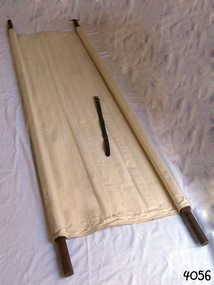
Equipment - Field Stretcher, Australian Defence Force, 1939-1942
... service just before the end of the war due to suffering from a heart attack. During his convalescence, he carved an intricate and ‘most artistic’ chess set from the material used for making dentures. The stretcher is an example of portable medical and emergency equipment used by the military and emergency services in the 19th and early 20th centuries. It is significant for its connection to Dr W R Abgus, who practised medicine in the community, the Australian Army ...This field stretcher was the property of Dr. William Roy Angus. It was donated to Flagstaff Hill Maritime Village by the family of Doctor William Roy Angus, Surgeon and Oculist. It is part of the “W.R. Angus Collection” that includes historical medical equipment, surgical instruments, and material once belonging to Dr Edward Ryan and Dr Thomas Francis Ryan (both of Nhill, Victoria), as well as Dr Angus’ belongings. The Collection’s history spans the medical practices of the two Doctors Ryan, from 1885-1926, plus that of Dr Angus, up until 1969. W R Angus served with the Australian Department of Defence as a Surgeon Captain during World War II from 1942 to 1945, in Ballarat, Victoria, and Bonegilla, N.S.W., completing his service just before the end of the war due to suffering from a heart attack. During his convalescence, he carved an intricate and ‘most artistic’ chess set from the material used for making dentures.The stretcher is an example of portable medical and emergency equipment used by the military and emergency services in the 19th and early 20th centuries. It is significant for its connection to Dr W R Abgus, who practised medicine in the community, the Australian Army and the Flying Doctor service from the 1920s to 1960s. He was also Warrnambool's last Port Medical Officer.Medical Field Stretcher: cream coloured canvas with wooden poles through side hems and a leather strap with buckle to keep parts together when folded or rolled up. This stretcher is part of the W.R. Angus Collection.flagstaff hill, flagstaff hill maritime museum and village, warrnambool, maritime museum, maritime village, great ocean road, shipwreck coast, stretcher, field stretcher, first aid, military equipment, medical equipment, emergency equipment, dr w r angus, canvas stretcher, patient transport, world war ii, ww2, australian department of defence, military doctor, medic, military stretcher, field gear, army stretcher, litter, adf, folding stretcher, w.r. angus -
 Lara RSL Sub Branch
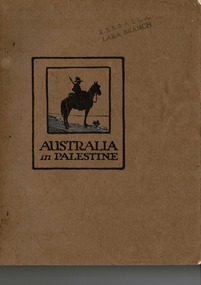
Book, Australia in Palestine, 1919
... His fearlessness, initiative and endurance, and his adaptability to almost any task, are due to the adventurous life he leads in his own country where he has been accustomed to long hours in the saddle, day and night, and to facing danger of all sorts from his earliest youth. battle of beersheba battle of richon ze zion battle of bir er abd camel corps lighthorse slush light sir h.g. chauvel mounted division at kantara medical services signal engineers katia oasis new zealand mounted troops sir edmund h allenby walers story 5th lighthorse romani WW1 World War 1 Australian Army To the memory of fallen comrades. ...A soldier's book produced almost entirely by soldiers in the field under active service conditions to send to their friends in Australia and abroad. Australian Lighthorse men is a type peculiar his own and has no counterpart in h is NZ brother. His fearlessness, initiative and endurance, and his adaptability to almost any task, are due to the adventurous life he leads in his own country where he has been accustomed to long hours in the saddle, day and night, and to facing danger of all sorts from his earliest youth.Brown front and back hardcover with dark brown text 'Australia in Palestine' with a light horseman framed in centre of front cover. The spine is green with text Australia in Palestine, Angus and Robertson bottom of spine. Evidence of water on front cover. Silverfish have eaten top right hand corner of first two pages. Farm scene in four boxes with AR in the lower corner of each square. Inside front and back covers are illustrations of a camel train and came corps in the desert with the rising sun in the background with a mountain. There is a grave and white cross in their foreground right lower corner Illustrations, photographs, poems, short stories, Centre foldout of the Battle for Richon Le Zion and Battle of Beersheba and after the Battle of Bir El Abed To the memory of fallen comrades. Pen mark inside W. Mathews Larabattle of beersheba, battle of richon ze zion, battle of bir er abd, camel corps, lighthorse, slush light, sir h.g. chauvel, mounted division at kantara, medical services, signal engineers, katia oasis, new zealand mounted troops, sir edmund h allenby, walers story, 5th lighthorse, romani, ww1, world war 1, australian army -
 Lara RSL Sub Branch
Book, Stand Easy - After the Defeat of Japan 1945 Published for The Australian Military Forces by Australian War Memorial, 1945
... Army service personnel, after the Japanese surrender. The title 'Stand Easy' meaning that whilst there was a surrender the Army's task still continued. Contributors to this publication can be identified by their service number. blamey nerve war medical evacuation 2nd australian corps surrender of japan bougainville borneo 5th australian division 6th australian division 7th australian division 9th australian division tarakan Green hardcover with light green text and picture of soldier. ...A collection of personal stories which extended from the collection of Khaki and Green. The service numbers have been used to identify those who have contributed to the content.Personal recounts and reminiscing of service by Army service personnel, after the Japanese surrender. The title 'Stand Easy' meaning that whilst there was a surrender the Army's task still continued. Contributors to this publication can be identified by their service number.Green hardcover with light green text and picture of soldier. The spine also has light green text of title. The inside front and back covers have green art geometric patterns. Illustrations, photographs, cartoons, blamey, nerve war, medical evacuation, 2nd australian corps, surrender of japan, bougainville, borneo, 5th australian division, 6th australian division, 7th australian division, 9th australian division, tarakan -
 Flagstaff Hill Maritime Museum and Village
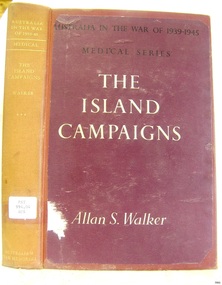
Book, Australia in the War of 1939-1945 The Island Campaigns
... The Warrnambool Mechanics' Institute’s publication collection is of both local and state significance. warrnambool shipwrecked-coast flagstaff-hill flagstaff-hill-maritime-museum maritime-museum shipwreck-coast flagstaff-hill-maritime-village shipwrecked-artefact book pattison collection warrnambool library warrnambool mechanics’ institute ralph eric pattison corangamite regional library service warrnambool city librarian mechanics’ institute library victorian library board warrnambool books and records warrnambool children’s library great ocean road Australia in the War of 1939-1945 The Island Campaigns Australia in the War of 1939-1945 Allan S Walker Australian War Memorial Label on spine cover with typed text PAT 994.04 AUS Pastedown front endpaper has sticker from Warrnambool Public Library Front loose endpaper has a sticker from Corangamite Regional Library Service Australia in the War of 1939-1945 The Island Campaigns This volume of the medical series of the offical history of Australia in the war of 1939-1945 covers the operational experiences of the Australian Army Medical Corps. ...This item is from the ‘Pattison Collection’, a collection of books and records that was originally owned by the Warrnambool Mechanics’ Institute, which was founded in Warrnambool in 1853. By 1886 the Warrnambool Mechanics’ Institute (WMI) had grown to have a Library, Museum and Fine Arts Gallery, with a collection of “… choice productions of art, and valuable specimens in almost every branch and many wonderful national curiosities are now to be seen there, including historic relics of the town and district.” It later included a School of Design. Although it was very well patronised, the lack of financial support led the WMI in 1911 to ask the City Council to take it over. In 1935 Ralph Pattison was appointed as City Librarian to establish and organise the Warrnambool Library as it was then called. When the WMI building was pulled down in 1963 a new civic building was erected on the site and the new Warrnambool Library, on behalf of the City Council, took over all the holdings of the WMI. At this time some of the items were separated and identified as the ‘Pattison Collection’, named after Ralph Pattison. Eventually the components of the WMI were distributed from the Warrnambool Library to various places, including the Art Gallery, Historical Society and Flagstaff Hill. Later some were even distributed to other regional branches of Corangamite Regional Library and passed to and fro. It is difficult now to trace just where all of the items have ended up. The books at Flagstaff Hill Maritime Village generally display stamps and markings from Pattison as well as a variety of other institutions including the Mechanics’ Institute itself. RALPH ERIC PATTISON Ralph Eric Pattison was born in Rockhampton, Queensland, in 1891. He married Maude Swan from Warrnambool in 1920 and they set up home in Warrnambool. In 1935 Pattison accepted a position as City Librarian for the Warrnambool City Council. His huge challenge was to make a functional library within two rooms of the Mechanics’ Institute. He tirelessly cleaned, cleared and sorted a disarrayed collection of old books, jars of preserved specimens and other items reserved for exhibition in the city’s museum. He developed and updated the library with a wide variety of books for all tastes, including reference books for students; a difficult task to fulfil during the years following the Depression. He converted all of the lower area of the building into a library, reference room and reading room for members and the public. The books were sorted and stored using a cataloguing and card index system that he had developed himself. He also prepared the upper floor of the building and established the Art Gallery and later the Museum, a place to exhibit the many old relics that had been stored for years for this purpose. One of the treasures he found was a beautiful ancient clock, which he repaired, restored and enjoyed using in his office during the years of his service there. Ralph Pattison was described as “a meticulous gentleman whose punctuality, floorless courtesy and distinctive neat dress were hallmarks of his character, and ‘his’ clock controlled his daily routine, and his opening and closing of the library’s large heavy doors to the minute.” Pattison took leave during 1942 to 1945 to serve in the Royal Australian Navy, Volunteer Reserve as Lieutenant. A few years later he converted one of the Museum’s rooms into a Children’s Library, stocking it with suitable books for the younger generation. This was an instant success. In the 1950’s he had the honour of being appointed to the Victorian Library Board and received more inspiration from the monthly conferences in Melbourne. He was sadly retired in 1959 after over 23 years of service, due to the fact that he had gone over the working age of council officers. However he continued to take a very keen interest in the continual development of the Library until his death in 1969. The Pattison Collection, along with other items at Flagstaff Hill Maritime Village, was originally part of the Warrnambool Mechanics' Institute’s collection. The Warrnambool Mechanics’ Institute Collection is primarily significant in its totality, rather than for the individual objects it contains. Its contents are highly representative of the development of Mechanics' Institute libraries across Australia, particularly Victoria. A diversity of publications and themes has been amassed, and these provide clues to our understanding of the nature of and changes in the reading habits of Victorians from the 1850s to the middle of the 20th century. The collection also highlights the Warrnambool community’s commitment to the Mechanics’ Institute, reading, literacy and learning in the regions, and proves that access to knowledge was not impeded by distance. These items help to provide a more complete picture of our community’s ideals and aspirations. The Warrnambool Mechanics Institute book collection has historical and social significance for its strong association with the Mechanics Institute movement and the important role it played in the intellectual, cultural and social development of people throughout the latter part of the nineteenth century and the early twentieth century. The collection of books is a rare example of an early lending library and its significance is enhanced by the survival of an original collection of many volumes. The Warrnambool Mechanics' Institute’s publication collection is of both local and state significance. Australia in the War of 1939-1945 The Island Campaigns This volume of the medical series of the offical history of Australia in the war of 1939-1945 covers the operational experiences of the Australian Army Medical Corps. Author: Allan S Walker Publisher: Australian War Memorial Date: 1957Label on spine cover with typed text PAT 994.04 AUS Pastedown front endpaper has sticker from Warrnambool Public Library Front loose endpaper has a sticker from Corangamite Regional Library Service warrnambool, shipwrecked-coast, flagstaff-hill, flagstaff-hill-maritime-museum, maritime-museum, shipwreck-coast, flagstaff-hill-maritime-village, shipwrecked-artefact, book, pattison collection, warrnambool library, warrnambool mechanics’ institute, ralph eric pattison, corangamite regional library service, warrnambool city librarian, mechanics’ institute library, victorian library board, warrnambool books and records, warrnambool children’s library, great ocean road, australia in the war of 1939-1945 the island campaigns, australia in the war of 1939-1945, allan s walker, australian war memorial -
 Flagstaff Hill Maritime Museum and Village
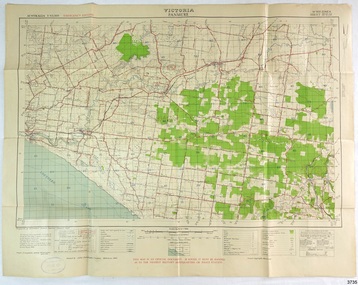
Document - Map, Department of Lands & Survey, Victoria / Panmure, 1942
... medical instruments and other equipment is culturally significant, being an historical example of medicine, administration, household equipment and clothing from late 19th to mid-20th century. Dr Angus assisted Dr Tom Ryan, a pioneer in the use of X-rays and in ocular surgery. The collection includes Dr Angus’s Army objects and is significant as an example of items issued to Doctors and Surgeons in the Medical Services of the Australian ...This Emergency Edition of the map of Panmure, Victoria, is part of the W.R. Angus Collection. It was printed in 1942 during World War II. It is one of two maps donated to Flagstaff Hill Maritime Village by the family of Doctor William Roy Angus, who served as Surgeon Captain in the Australian Defence Department. The map was compiled for the Dept. of Army by the Dept. of Lands and Survey in Melbourne, prepared by the Australian Section of the Imperial General Staff, which was a British Government body created in 1907 to co-ordinate the defence of Britain and its Empire. It was printed by A.H.Q. Cartographic Company, Survey Corps, which was formed in 1941. The Corp changed its name to L.H.Q. Cartographic Company of Bendigo. In 1947 the name reverted back to the A.H.Q. Cartographic Company until 1955 when it became the A.H.Q. Survey Regiment. The W.R. Angus Collection includes historical medical equipment, surgical instruments and material once belonging to Dr Edward Ryan and Dr Thomas Francis Ryan, (both of Nhill, Victoria) as well as Dr Angus’ own belongings. The Collection’s history spans the medical practices of the two Doctors Ryan, from 1885-1926 plus that of Dr Angus who began practice in 1924. Dr. Angus served with the Australian Department of Defence as a Surgeon Captain during the Second World Was from 1942 to 1945. He served in Ballarat, Victoria, and in Bonegilla, N.S.W. until he suffering from a heart attack just before the war ended. ABOUT THE “W.R.ANGUS COLLECTION” - Doctor William Roy Angus M.B., B.S., Adel., 1923, F.R.C.S. Edin.,1928, was generally known as Dr Roy Angus. His working life included a position as a doctor with the Flying Doctor Service in Australia’s rural and remote areas. After many varied experiences Dr Angus and his family moved to Warrnambool in 1939 where he purchased “Birchwood,” the 1852 home and medical practice of Dr John Hunter Henderson. He was appointed on a part-time basis as Port Medical Officer in Warrnambool and held this position until the 1940’s when the government no longer required the service of a Port Medical Officer. Dr Angus was a surgeon at the Warrnambool Base Hospital 1939-1942. After further studies he commenced practice as an ophthalmologist in Warrnambool, pioneering in artificial eye improvements. He was Honorary Consultant Ophthalmologist to Warrnambool Base Hospital for 31 years and made monthly visits to Portland to perform eye surgery. Dr Angus and his wife Gladys were very involved in Warrnambool’s community with a strong interest in civic affairs. They were both involved in the creation of Flagstaff Hill Maritime Village, including the layout of the gardens. After his death on 28th March 1970 his family requested his practitioner’s plate, medical instruments and some personal belongings be displayed in the Port Medical Office surgery at Flagstaff Hill Maritime Village, and be called the “W. R. Angus Collection”. This Emergency Edition of the Map of Panmure is significant as an example of the documents prepared for the defence of Australia in World War 2. The Map is also significant for its connection between the Australian Army and the involvement of Dr WR Angus as a Surgeon in the Medical Services during World War II. The W.R. Angus Collection is significant for still being located at the site it is connected with, Doctor Angus being the last Port Medical Officer in Warrnambool. The collection of medical instruments and other equipment is culturally significant, being an historical example of medicine, administration, household equipment and clothing from late 19th to mid-20th century. Dr Angus assisted Dr Tom Ryan, a pioneer in the use of X-rays and in ocular surgery. The collection includes Dr Angus’s Army objects and is significant as an example of items issued to Doctors and Surgeons in the Medical Services of the Australian Army in World War IIMilitary map of Panmure, Victoria, Australia; part of the W.R. Angus Collection. Rectangular coloured map on cream paper for the Australian Army. Details include sea, waterways and land, contour lines, grid lines, names of districts, towns and roads, bridges, swamps, rail lines, cuttings, tracks, buildings (including blacksmiths), pumps, lighthouses, telegraph, telephones and electric transmission lines, and fire stations. The map has margin notes that include distances in miles to nearby towns. The map was compiled for the Dept. of Army by the Dept. of Lands and Survey in Melbourne, prepared by the Australian Section, Imperial General Staff and printed by A.H.Q. Cartographic Company, Melbourne in 1942. Crown Copyright Reserved. Inscriptions in red print state that it is and Emergency Edition and an Official document. An oval purple stamp includes the price.Printed in black; 'Victoria / Panmure", "No. 930 / Zone 6" Printed in red; “EMERGENCY EDITION”, “THIS MAP IS AN OFFICIAL DOCUMENT. IF FOUND, IT MUST BE HANDED / IN TO THE NEAREST MILITARY HEADQUARTERS OR POLICE STATION” Stamped: within concentric ovals (“- - - FOR SALE / PRICE 2/- / - - - - - OF THE ARMY”)flagstaff hill, warrnambool, flagstaff hill maritime museum, maritime museum, shipwreck coast, flagstaff hill maritime village, great ocean road, dr w r angus, dr ryan, warrnambool base hospital, flying doctor, surgeon captain, australian department of defence, royal australian army, world war 2, map panmure 1942, roy angus, port medical officer, nhill base hospital, military map, emergency map, military service australian army, department of army, department of lands and survey, a.h.q. cartographic company melbourne, panmure 1942, australian section, imperial general staff -
 Flagstaff Hill Maritime Museum and Village
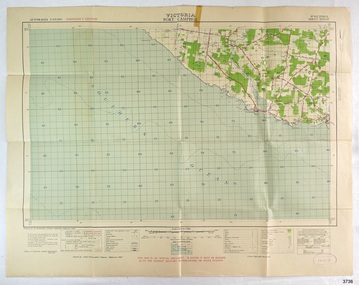
Document - Map, Department of Lands & Survey, Victoria / Port Campbell, 1942
... medical instruments and other equipment is culturally significant, being an historical example of medicine, administration, household equipment and clothing from late 19th to mid-20th century. Dr Angus assisted Dr Tom Ryan, a pioneer in the use of X-rays and in ocular surgery. The collection includes Dr Angus’s Army objects and is significant as an example of items issued to Doctors and Surgeons in the Medical Services of the Australian ...This Emergency Edition of the map of Port Campbell, Victoria, is part of the W.R. Angus Collection. It was printed in 1942 during World War II. It is one of two maps donated to Flagstaff Hill Maritime Village by the family of Doctor William Roy Angus, who served as Surgeon Captain in the Australian Defence Department. The map was compiled for the Dept. of Army by the Dept. of Lands and Survey in Melbourne, prepared by the Australian Section of the Imperial General Staff, which was a British Government body created in 1907 to co-ordinate the defence of Britain and its Empire. It was printed by A.H.Q. Cartographic Company, Survey Corps, which was formed in 1941. The Corp changed its name to L.H.Q. Cartographic Company of Bendigo. In 1947 the name reverted back to the A.H.Q. Cartographic Company until 1955 when it became the A.H.Q. Survey Regiment. The W.R. Angus Collection includes historical medical equipment, surgical instruments and material once belonging to Dr Edward Ryan and Dr Thomas Francis Ryan, (both of Nhill, Victoria) as well as Dr Angus’ own belongings. The Collection’s history spans the medical practices of the two Doctors Ryan, from 1885-1926 plus that of Dr Angus who began practice in 1924. Dr Angus served with the Australian Department of Defence as a Surgeon Captain during the Second World Was from 1942 to 1945. He served in Ballarat, Victoria, and in Bonegilla, N.S.W. until he suffering from a heart attack just before the war ended. ABOUT THE “W.R.ANGUS COLLECTION” - Doctor William Roy Angus M.B., B.S., Adel., 1923, F.R.C.S. Edin.,1928, was generally known as Dr Roy Angus. His working life included a position as a doctor with the Flying Doctor Service in Australia’s rural and remote areas. After many varied experiences Dr Angus and his family moved to Warrnambool in 1939 where he purchased “Birchwood,” the 1852 home and medical practice of Dr John Hunter Henderson. He was appointed on a part-time basis as Port Medical Officer in Warrnambool and held this position until the 1940’s when the government no longer required the service of a Port Medical Officer. Dr Angus was a surgeon at the Warrnambool Base Hospital 1939-1942. After further studies he commenced practice as an ophthalmologist in Warrnambool, pioneering in artificial eye improvements. He was Honorary Consultant Ophthalmologist to Warrnambool Base Hospital for 31 years and made monthly visits to Portland to perform eye surgery. Dr Angus and his wife Gladys were very involved in Warrnambool’s community with a strong interest in civic affairs. They were both involved in the creation of Flagstaff Hill Maritime Village, including the layout of the gardens. After his death on 28th March 1970 his family requested his practitioner’s plate, medical instruments and some personal belongings be displayed in the Port Medical Office surgery at Flagstaff Hill Maritime Village, and be called the “W. R. Angus Collection”. This Emergency Edition of the Map of Port Campbell is significant as an example of the documents prepared for the defence of Australia in World War 2. The Map is also significant for its connection between the Australian Army and the involvement of Dr WR Angus as a Surgeon in the Medical Services during World War II. The W.R. Angus Collection is significant for still being located at the site it is connected with, Doctor Angus being the last Port Medical Officer in Warrnambool. The collection of medical instruments and other equipment is culturally significant, being an historical example of medicine, administration, household equipment and clothing from late 19th to mid-20th century. Dr Angus assisted Dr Tom Ryan, a pioneer in the use of X-rays and in ocular surgery. The collection includes Dr Angus’s Army objects and is significant as an example of items issued to Doctors and Surgeons in the Medical Services of the Australian Army in World War IIMilitary map of Port Campbell, Victoria, Australia; part of the W.R. Angus Collection. Rectangular coloured map on cream paper for the Australian Army. Details include sea, waterways and land, contour lines, grid lines, names of districts, towns and roads, bridges, swamps, rail lines, cuttings, tracks, buildings (including blacksmiths), pumps, lighthouses, telegraph, telephones and electric transmission lines, and fire stations. The map has margin notes that include distances in miles to nearby towns. The map was compiled for the Dept. of Army by the Dept. of Lands and Survey in Melbourne, prepared by the Australian Section, Imperial General Staff and printed by A.H.Q. Cartographic Company, Melbourne in 1942. Crown Copyright Reserved. Inscriptions in red print state that it is and Emergency Edition and an Official document. An oval purple stamp includes the price.Printed in black; 'Victoria / Port Campbell", "No. 932 / Zone 6" Printed in red; “EMERGENCY EDITION”, “THIS MAP IS AN OFFICIAL DOCUMENT. IF FOUND, IT MUST BE HANDED / IN TO THE NEAREST MILITARY HEADQUARTERS OR POLICE STATION” Stamped: within concentric ovals (“- - - FOR SALE / PRICE 2/- / - - - - - OF THE ARMY”)flagstaff hill, warrnambool, flagstaff hill maritime museum, maritime museum, shipwreck coast, flagstaff hill maritime village, great ocean road, dr w r angus, dr ryan, warrnambool base hospital, nhill base hospital, flying doctor, surgeon captain, map port campbell 1942, roy angus, port medical officer, military map, emergency map, australian department of defence, royal australian army, military service australian army, department of army, department of lands and survey, world war 2, a.h.q. cartographic company melbourne, australian section, imperial general staff, port campbell 1942 -
 Flagstaff Hill Maritime Museum and Village
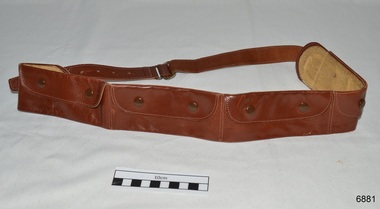
Money Belt, c. 1942
... medical instruments and other equipment is culturally significant, being an historical example of medicine from late 19th to mid-20th century. Dr Angus assisted Dr Tom Ryan, a pioneer in the use of X-rays and in ocular surgery. The collection of Army objects is an example of items issued to Doctors and Surgeons in the Medical Services of the Australian ...This money belt was issued to Dr W.R. Angus when he served in the Army 1942-1945 as a medical officer at Ballarat, Victoria, and Bonegilla, N.S.W.. (Surgeon Captain A.A.M.C., 108 A.G.H., and 106 A.G.H., Captain A.A.M.C. retired list.) The belt was donated to Flagstaff Hill Maritime Village by the family of Doctor William Roy Angus, Surgeon and Oculist. It is part of the “W.R. Angus Collection” that includes historical medical equipment, surgical instruments and material once belonging to Dr Edward Ryan and Dr Thomas Francis Ryan, (both of Nhill, Victoria) as well as Dr Angus’ own belongings. The Collection’s history spans the medical practices of the two Doctors Ryan, from 1885-1926 plus that of Dr Angus, up until 1969. ABOUT THE “W.R.ANGUS COLLECTION” Doctor William Roy Angus M.B., B.S., Adel., 1923, F.R.C.S. Edin.,1928 (also known as Dr Roy Angus) was born in Murrumbeena, Victoria in 1901 and lived until 1970. He qualified as a doctor in 1923 at University of Adelaide, was Resident Medical Officer at the Royal Adelaide Hospital in 1924 and for a period was house surgeon to Sir (then Mr.) Henry Simpson Newland. Dr Angus was briefly an Assistant to Dr Riddell of Kapunda, then commenced private practice at Curramulka, Yorke Peninsula, SA, where he was physician, surgeon and chemist. In 1926, he was appointed as new Medical Assistant to Dr Thomas Francis Ryan (T.F. Ryan, or Tom), in Nhill, Victoria, where his experiences included radiology and pharmacy. In 1927 he was Acting House Surgeon in Dr Tom Ryan’s absence. Dr Angus had become engaged to Gladys Forsyth and they decided he further his studies overseas in the UK in 1927. He studied at London University College Hospital and at Edinburgh Royal Infirmary and in 1928, was awarded FRCS (Fellow from the Royal College of Surgeons), Edinburgh. He worked his passage back to Australia as a Ship’s Surgeon on the on the Australian Commonwealth Line’s T.S.S. Largs Bay. Dr Angus married Gladys in 1929, in Ballarat. (They went on to have one son (Graham 1932, born in SA) and two daughters (Helen (died 12/07/1996) and Berenice (Berry), both born at Mira, Nhill ) According to Berry, her mother Gladys made a lot of their clothes. She was very talented and did some lovely embroidery including lingerie for her trousseau and beautifully handmade baby clothes. Dr Angus was a ‘flying doctor’ for the A.I.M. (Australian Inland Ministry) Aerial Medical Service in 1928 . Its first station was in the remote town of Oodnadatta, where Dr Angus was stationed. He was locum tenens there on North-South Railway at 21 Mile Camp. He took up this ‘flying doctor’ position in response to a call from Dr John Flynn; the organisation was later known as the Flying Doctor Service, then the Royal Flying Doctor Service. A lot of his work during this time involved dental surgery also. Between 1928-1932 he was surgeon at the Curramulka Hospital, Yorke Peninsula, South Australia. In 1933 Dr Angus returned to Nhill and purchased a share of the Nelson Street practice and Mira hospital (a 2 bed ward at the Nelson Street Practice) from Dr Les Middleton one of the Middleton Brothers, the current owners of what previously once Dr Tom Ryan’s practice. Dr Tom and his brother had worked as surgeons included eye surgery. Dr Tom Ryan performed many of his operations in the Mira private hospital on his premises. He had been House Surgeon at the Nhill Hospital 1902-1926. Dr Tom Ryan had one of the only two pieces of radiology equipment in Victoria during his practicing years – The Royal Melbourne Hospital had the other one. Over the years Dr Tom Ryan had gradually set up what was effectively a training school for country general-practitioner-surgeons. Each patient was carefully examined, including using the X-ray machine, and any surgery was discussed and planned with Dr Ryan’s assistants several days in advance. Dr Angus gained experience in using the X-ray machine there during his time as assistant to Dr Ryan. When Dr Angus bought into the Nelson Street premises in Nhill he was also appointed as the Nhill Hospital’s Honorary House Surgeon 1933-1938. His practitioner’s plate from his Nhill surgery is now mounted on the doorway to the Port Medical Office at Flagstaff Hill Maritime Village, Warrnambool. When Dr Angus took up practice in the Dr Edward and Dr Tom Ryan’s old premises he obtained their extensive collection of historical medical equipment and materials spanning 1884-1926. A large part of this collection is now on display at the Port Medical Office at Flagstaff Hill Maritime Village in Warrnambool. In 1939 Dr Angus and his family moved to Warrnambool where he purchased “Birchwood,” the 1852 home and medical practice of Dr John Hunter Henderson, at 214 Koroit Street. (This property was sold in1965 to the State Government and is now the site of the Warrnambool Police Station. and an ALDI sore is on the land that was once their tennis court). The Angus family was able to afford gardeners, cooks and maids; their home was a popular place for visiting dignitaries to stay whilst visiting Warrnambool. Dr Angus had his own silk worm farm at home in a Mulberry tree. His young daughter used his centrifuge for spinning the silk. Dr Angus was appointed on a part-time basis as Port Medical Officer (Health Officer) in Warrnambool and held this position until the 1940’s when the government no longer required the service of a Port Medical Officer in Warrnambool; he was thus Warrnambool’s last serving Port Medical Officer. (Masters of immigrant ships arriving in port reported incidents of diseases, illness and death and the Port Medical Officer made a decision on whether the ship required Quarantine and for how long, in this way preventing contagious illness from spreading from new immigrants to the residents already in the colony.) Dr Angus was a member of the Australian Medical Association, for 35 years and surgeon at the Warrnambool Base Hospital 1939-1942, He served as a Surgeon Captain during WWII1942-45, in Ballarat, Victoria, and in Bonegilla, N.S.W., completing his service just before the end of the war due to suffering from a heart attack. During his convalescence he carved an intricate and ‘most artistic’ chess set from the material that dentures were made from. He then studied ophthalmology at the Royal Melbourne Eye and Ear Hospital and created cosmetically superior artificial eyes by pioneering using the intrascleral cartilage. Angus received accolades from the Ophthalmological Society of Australasia for this work. He returned to Warrnambool to commence practice as an ophthalmologist, pioneering in artificial eye improvements. He was Honorary Consultant Ophthalmologist to Warrnambool Base Hospital for 31 years. He made monthly visits to Portland as a visiting surgeon, to perform eye surgery. He represented the Victorian South-West subdivision of the Australian Medical Association as its secretary between 1949 and 1956 and as chairman from 1956 to 1958. In 1968 Dr Angus was elected member of Spain’s Barraquer Institute of Barcelona after his research work in Intrasclearal cartilage grafting, becoming one of the few Australian ophthalmologists to receive this honour, and in the following year presented his final paper on Living Intrasclearal Cartilage Implants at the Inaugural Meeting of the Australian College of Ophthalmologists in Melbourne In his personal life Dr Angus was a Presbyterian and treated Sunday as a Sabbath, a day of rest. He would visit 3 or 4 country patients on a Sunday, taking his children along ‘for the ride’ and to visit with him. Sunday evenings he would play the pianola and sing Scottish songs to his family. One of Dr Angus’ patients was Margaret MacKenzie, author of a book on local shipwrecks that she’d seen as an eye witness from the late 1880’s in Peterborough, Victoria. In the early 1950’s Dr Angus, painted a picture of a shipwreck for the cover jacket of Margaret’s book, Shipwrecks and More Shipwrecks. She was blind in later life and her daughter wrote the actual book for her. Dr Angus and his wife Gladys were very involved in Warrnambool’s society with a strong interest in civic affairs. He had an interest in people and the community They were both involved in the creation of Flagstaff Hill, including the layout of the gardens. After his death (28th March 1970) his family requested his practitioner’s plate, medical instruments and some personal belongings be displayed in the Port Medical Office surgery at Flagstaff Hill Maritime Village, and be called the “W. R. Angus Collection”. The W.R. Angus Collection is significant for still being located at the site it is connected with, Doctor Angus being the last Port Medical Officer in Warrnambool. The collection of medical instruments and other equipment is culturally significant, being an historical example of medicine from late 19th to mid-20th century. Dr Angus assisted Dr Tom Ryan, a pioneer in the use of X-rays and in ocular surgery. The collection of Army objects is an example of items issued to Doctors and Surgeons in the Medical Services of the Australian Army in World War 2. Brown leather money belt, genuine calf, lined, 4 pouches with stud closure flaps included. Issued to W.R. Angus in WWII and part of the W.R. Angus Collection. Gold embossed label. Hand written inscription with name and serial number. Gold embossed “GENUINE CALF” under silver coloured buckle. Hand written inside of belt “W.R. ANGUS / 61-3 9803 5228”flagstaff hill, warrnambool, shipwrecked coast, flagstaff hill maritime museum, maritime museum, shipwreck coast, flagstaff hill maritime village, great ocean road, dr w r angus, dr ryan, military money belt, surgeon captain, royal australian army, military service australian army, wwii uniform, world war 2 -
 Flagstaff Hill Maritime Museum and Village
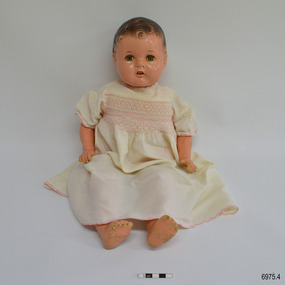
Leisure object - Doll, Reliable Toy Company Ltd, 1930s to 1940s
... medical practice of the late 19th to the mid-20th century. Other items in the collection relate to Dr Angus’ service in the Flying Doctor Service and the Army. The doll is also significant as an example of toys imported into Australia ...This dressed doll was owned by the daughter of Dr William Roy Angus and his wife Gladys when the family came to Warrnambool in the late 1930s. It is part of the W.R. Angus collection, donated by the family of Dr W R Angus, surgeon and oculist. The doll was donated with another dress and a blanket. The doll has features similar to, but an earlier model than, Reliable's 1940s model Cuddlekins doll, which has an entirely composite body. ReliableToy Company was founded in Toronto, Canada, by Solomon Samuels in 1920. Samuels was later joined by his two brothers. The company had a reputation for products of good quality. In 1922 the company began making their own dolls from composition, where previously the parts were made elsewhere and assembled by Reliable. The company stopped making Reliable dolls in 1995. The W R Angus Collection spans from 1885 to the mid-1900s and includes historical medical and surgical equipment and instruments from the doctors Edward and Thomas Ryan of Nhill, Victoria. Dr Angus married Gladys in 1927 at Ballarat, the nearest big city to Nhill where he began as a Medical Assistant. He was also Acting House surgeon at the Nhill hospital where their two daughters were born. Dr Angus and his family moved to Warrnambool in 1939, where Dr Angus operated his own medical practice. He later added the part-time Port Medical Officer responsibility and was the last person appointed to that position. Dr Angus and his wife were very involved in the local community, including the planning stages of the new Flagstaff Hill and the layout of the gardens there. Dr Angus passed away in March 1970.This doll is connected to the history of Warrnambool, as it was owned by the daughter of Dr W. R. Angus and his wife Gladys, and is part of the W.R. Angus Collection, which is important for still being located at the site connected to Doctor Angus, Warrnambool’s last Port Medical Officer. Dr Angus and his wife brought their young family to Warrnambool in 1939 and he remained a resident until his death in 1970. Early in his profession in the town of Nhill, Dr Angus assisted Dr Tom Ryan in his pioneering use of X-rays and in ocular surgery, and Dr Angus later inherited these items. The W.R. Angus Collection includes these medical instruments and other related equipment and is culturally and historically significant as an example of the medical practice of the late 19th to the mid-20th century. Other items in the collection relate to Dr Angus’ service in the Flying Doctor Service and the Army. The doll is also significant as an example of toys imported into Australia in the 1930s and 1940s and used by children in the Warrnambool community.Doll with moulded composition head, neck, arms and legs, all attached to a fabric body. The doll’s head has brown moulded curls. The facial features include an open mouth showing two top teeth, green eyes, and sleeping, closing eyelids with eyelashes. The doll has a crier inside that makes a sound when the doll is turned over. It is clothed in a knitted pink singlet, modern pink underwear, and a cream flannel short-sleeved dress with pink smocking and embroidery, and ties at the rear. There is a moulded inscription on the back of the doll’s head. The doll was made by Reliable Toy Company Ltd, Canada. The doll is part of the W.R. Angus Collection.On the back of the head “RELIABLE / CANADA”flagstaff hill, warrnambool, maritime village, maritime museum, shipwreck coast, great ocean road, dr w r angus, dr roy angus, dr ryan, warrnambool oculist, port medical officer, mira hospital nhill, toy, nhill hospital, doll, baby doll, composition doll, reliable toy company, canada, solomon samuels, child's toy, w.r. angus collection -
 Flagstaff Hill Maritime Museum and Village
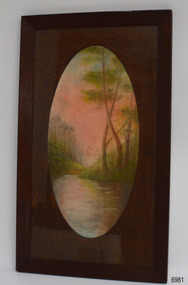
Drawing - Pastel Picture, W.R. Angus (Dr. William Roy Angus), 1925
... The collection of medical instruments and other equipment is culturally significant, being a historical example of medicine, administration, household equipment and clothing from late 19th to mid-20th century. Dr Angus assisted Dr Tom Ryan, a pioneer in the use of X-rays and in ocular surgery. The collection includes Army objects, which are examples of items issued to Doctors and Surgeons in the Medical Services of the Australian ...This large pastel drawing was created by Dr W.R. Angus in 1925, the year after he graduated as a doctor in South Australia. In 1926 Dr Angus was appointed as Medical Assistant to Dr Thomas Francis Ryan, in Nhill, Victoria, where he extended his experiences in radiology and pharmacy. Eventually, in 1939, he and his wife Gladys moved to Warrnambool, Victoria, with their children. The drawing is part of the W.R. Angus Collection, which includes another of the doctor’s pastel drawings and a box of used pastels. The picture was framed by W.H. Rogers & Co. of North Terrace, Adelaide. The business also framed maps and plans. This pastel drawing is locally significant for being the work of Warrnambool doctor, W.R. Angus. It is part of the W.R. Angus Collection, which is significant for still being located at the site it is connected with, Doctor Angus being the last Port Medical Officer in Warrnambool. The collection of medical instruments and other equipment is culturally significant, being a historical example of medicine, administration, household equipment and clothing from late 19th to mid-20th century. Dr Angus assisted Dr Tom Ryan, a pioneer in the use of X-rays and in ocular surgery. The collection includes Army objects, which are examples of items issued to Doctors and Surgeons in the Medical Services of the Australian Army in World War 2. It also includes household items used by Dr Angus and his family from the 1920s in various locations including Warrnambool, together creating an understanding of the furnishing of an early to mid-20th century home.Pastel drawing behind glass in a rectangular wooden frame with an unusual oval wooden matt. The subject is a scene with a pink-tinted sky reflected in a river running between the foot of two hills with trees. The picture was created and signed by W R Angus in 1925. The back is covered in brown paper and has a mounting wire. Inscriptions are on the picture and the back. A remnant of the framer’s label is attached. The picture is part of the W.R. Angus Collection. Signature and date; “W.R.A. / 1925” Printed on label remnant; “—Rogers & Co. / - ORIA STREET / - way Station, North Terrace / “THE CORRECT FRAMERS” / -lise in Map and Plan Mounting / PHONE 5437”flagstaff hill, warrnambool, maritime village, maritime museum, shipwreck coast, great ocean road, drawing, pastel drawing, pastel drawing by w.r. angus 1925, rogers & co., w.h. rogers & co., correct framers, w.r. angus collection -
 Flagstaff Hill Maritime Museum and Village
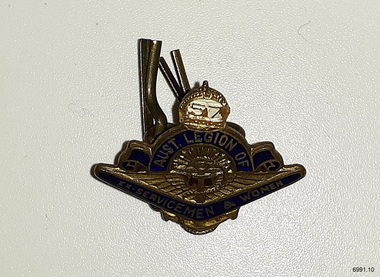
Badge - Australian Legion of Ex-Servicemen and Women, Stokes, Membership badge, 1957
... Medical Officer and was the last person appointed to that position. Both Dr Angus and his wife were very involved in the local community, including the planning stages of the new Flagstaff Hill and the layout of the gardens there. Dr Angus passed away in March 1970. This Badge of Unity, or Tri-Service badge, is significant for connecting Doctor Angus with organisations that support men and women who performed military service for Australia. The badge was for membership with the organisation, which supports ex-servicemen and women of the three military forces; Army ...The badge was issued by the Victorian branch (indicated by the 'V' on the reverse) of the Australian Legion of Ex-Servicemen and Women and is referred to as The Badge of Unity or Tri-Services badge, uniting the armed services of Australia; the Army (rising sun), the Navy (anchor) and the Air Force (pair of wings). The number '57' on the crown represents the year of paid membership; 1957. The badge belonged to Dr W R Angus, who served in the Australian Army as a military doctor during WWII. It was made in Melbourne by Stokes in 1957, around 100 years after the firm was established by Thomas Stokes in Mincing Lane, Melbourne. The firm was operating from Caledonian Lane/Post Office Place in the 1950s. The badge is one of a set of badges collected by Dr W R Angus from the organisations in which he was involved. They are now part of Flagstaff Hill’s comprehensive W.R. Angus Collection, donated by the family of Dr W R Angus, surgeon and oculist. Australian Legion of Ex-Servicemen and Women was formed in 1944 to "entourage fellowship and assist those who have served". The organisation is open to members from Australia, British Commonwealth and Allied ex-service personnel. The W.R. Angus Collection: - The W.R. Angus Collection includes historical medical equipment, surgical instruments and material once belonging to Dr Edward Ryan and Dr Thomas Francis Ryan, (both of Nhill, Victoria) as well as Dr Angus’ own belongings. The Collection’s history spans the medical practices of the two Doctors Ryan, from 1885-1926 plus that of Dr Angus, up until 1969. It includes historical medical and surgical equipment and instruments from the doctors Edward and Thomas Ryan of Nhill, Victoria. Dr Angus married Gladys in 1927 at Ballarat, the nearest big city to Nhill where he began as a Medical Assistant. He was also Acting House surgeon at the Nhill hospital where their two daughters were born. During World War II He served as a Military Doctor in the Australian Defence Force. Dr Angus and his family moved to Warrnambool in 1939, where Dr Angus operated his own medical practice. He later added the responsibility of part-time Port Medical Officer and was the last person appointed to that position. Both Dr Angus and his wife were very involved in the local community, including the planning stages of the new Flagstaff Hill and the layout of the gardens there. Dr Angus passed away in March 1970.This Badge of Unity, or Tri-Service badge, is significant for connecting Doctor Angus with organisations that support men and women who performed military service for Australia. The badge was for membership with the organisation, which supports ex-servicemen and women of the three military forces; Army, Navy and Air Force. The W.R. Angus Collection is significant for still being located at the site it is connected with, Doctor Angus being the last Port Medical Officer in Warrnambool. The Collection includes historical medical objects that date back to the late 1800s.Badge; a gold-coloured metal and enamel badge. The blue boomerang-shaped band is below an arch of blue, below a crown with a number and coloured red, white and blue. There are symbols in the centre; a rising sun, above a pair of wings, with an anchor in the centre of both. There is red and blue scrollwork behind the symbols. Inscriptions are on the front and back of the badge. There are two loops and pins on the back of the badge. It is a membership badge of the Victorian branch of the Australian Legion of Ex-Servicemen and Women and was made by Stokes in 1957. The badge has a Serial Number. This badge is part of a set of badges collected by Dr Angus and is part of the W.R. Angus Collection.FRONT; “AUST. LEGION OF / EX-SERVICEMEN & WOMEN” On crown “57” REVERSE; “V” “13156" "STOKES” flagstaff hill, warrnambool, maritime museum, maritime village, great ocean road, shipwreck coast, w.r. angus, badge, ladies’ badge, military service, stokes, melbourne, australian legion of ex-servicemen and women, membership badge, 1957 membership badge, ex=service personnel, heraldry, world war ii, second world war, tri-services symbol, badge of unity, rising sun, anchor, pair of wings -
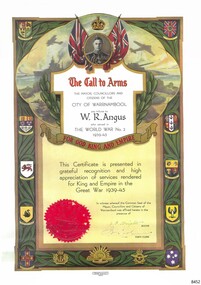 Flagstaff Hill Maritime Museum and Village
Certificate - Call to Arms, Osboldstone & Co. Pty. Ltd, W.R. Angus, ca. 1945
... service as Surgeon Captain in Australia during World War II. The W.R. Angus Collection is significant for still being located at the site it is connected with, Doctor Angus being the last Port Medical Officer in Warrnambool. The Collection includes historical medical objects that date back to the late 1800s. Flagstaff Hill Warrnambool Maritime Village Maritime Museum Shipwreck coast Great Ocean Road Flagstaff Hill Maritime Museum and Village Dr W R Angus Dr Ryan Warrnambool Base Hospital Nhill Base Hospital Mira hospital Flying Doctor W.R. Angus Collection Australian Department of Defence Australian Army ...This copy of the Certificate of Call to Arms was presented to Dr William Roy Angus at the completion of World War II by the May, Councillors and Citizens of Warrnambool in appreciation for his service. It is now part of Flagstaff Hill’s comprehensive W.R. Angus Collection, donated by the family of Dr W R Angus, 1901-1970, surgeon and oculist. During World War II between 1942-45, Dr Angus served with the Australian Department of Defence as a Surgeon Captain in Ballarat, Victoria, and in Bonegilla, N.S.W., completing his service just before the end of the war due to suffering from a heart attack. The Certificate is headed by a crown above the portrait of King George VI, the reigning British monarch at the time of WWII and afterwards. King George was King of the United Kingdom and the Dominions of the British Commonwealth, which is illustrated by the emblems of the Commonwealth countries and of the states of Australia. It also has symbols for the three Australian Military Forces; Navy, Army and Air Vorce. The Certificate also carries the Common Seal of the Mayor, Councillors and Citizens of the City of Warrnambool, and the signatures of the Mayor and Town Clerk. The W.R. Angus Collection: - The W.R. Angus Collection includes historical medical equipment, surgical instruments and material belonging to Dr Edward Ryan and Dr Thomas Francis Ryan, (both of Nhill, Victoria) and Dr Angus’ own belongings. The Collection’s history spans the medical practices of the two Doctors Ryan, from 1885-1926 plus that of Dr Angus, up until 1969. It includes historical medical and surgical equipment and instruments from the doctors Edward and Thomas Ryan of Nhill, Victoria. Dr Angus married Gladys in 1927 at Ballarat, the nearest big city to Nhill where he began as a Medical Assistant. He was also Acting House surgeon at the Nhill hospital where their two daughters were born. During World War II He served as a Military Doctor in the Australian Defence Force. Dr Angus and his family moved to Warrnambool in 1939, where Dr Angus operated his own medical practice. He later added the part-time Port Medical Officer responsibility and was the last person appointed to that position. Both Dr Angus and his wife were very involved in the local community, including the planning stages of the new Flagstaff Hill and the layout of the gardens there. Dr Angus passed away in March 1970.This is an example of objects used by or issued to Doctor Angus during and after his military service as Surgeon Captain in Australia during World War II. The W.R. Angus Collection is significant for still being located at the site it is connected with, Doctor Angus being the last Port Medical Officer in Warrnambool. The Collection includes historical medical objects that date back to the late 1800s.Call to Arms; certificate of service awarded as a tribute to W. R. Angus by the Mayor, Councillors and Citizens of the City of Warrnambool and sealed with Common Seal and the signatures of the Mayor and the Town Clerk. The top of the certificate has a portrait of King George VI below a crown emblem. The border has logos for countries of the British Commonwealth - Canada, South Africa, Inda and New Zealand - and the Australian States of Queensland, South Australia, Victoria, West Australia and Tasmania. The bottom has the badges of the Royal Australian Navy, the Australian Commonwealth Military Forces and the Royal Australian Air Force. The Certificate was printed by Osboldstone & Co. of Melbourne, with the registered serial number 55319. This copy of the original certificate is part of the W. R. Angus Collection.Printed; "The Mayor, Councillors and citizens of the City of Warrnambool pay tribute to W.R. Angus who served in The World War No. 2 1939-45, for God, King and Empire" "This Certificate is presented in grateful recognition and high appreciation of services rendered for King and Empire in the Great War 1939-45." "In witness whereof, the Common Seal of the Mayor, Councillors and Citizens of Warrnambool was affixed hereto in the presence of " (Signatures of "J.F. Knights" [Mayor] "H.J. Worland" [Town Clerk]) Printed under the certificate: "Osboldstone & Co. Pty. Ltd. Printers, Melbourne" and "55319"flagstaff hill, warrnambool, maritime village, maritime museum, shipwreck coast, great ocean road, flagstaff hill maritime museum and village, dr w r angus, dr ryan, warrnambool base hospital, nhill base hospital, mira hospital, flying doctor, w.r. angus collection, australian department of defence, australian army, world war ii, wwii, surgeon captain, ballarat, bonegilla, certificate, call to arms, warrnambool mayor, j.f. knights, warrnambool town clerk, h.j. worland", city of warrnambool, world war no. 2', 1939-45, great war 1939-45, common seal of city of warrnambool, osboldstone & co. pty ltd., 55319, king george vi, british commonwealth, canada, south aftrica, india, new zealand, australian commonwealth military forces
