
Showing 834 items matching "australian art work"
-
 Flagstaff Hill Maritime Museum and Village
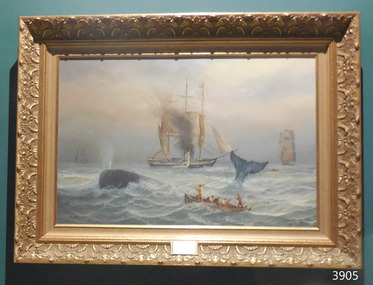
Painting - Oil painting, John Dollery, The Chase, c. 1980s
... art work...australian art work...work by artist John Dollery. Its subject of whaling shows an early Australian industry and shows the scale of man to whale. The decorative frame is appropriate for the era in which the scene would have taken place. flagstaff hill warrnambool shipwrecked coast flagstaff hill maritime museum maritime museum shipwreck coast flagstaff hill maritime village great ocean road whales whaling industry whale oil blubber John Dollery the chase Corinella historic art work australian art work australian historic artwork Stamped on the sticker “John Dollery / ARTIST / Crown Lot 16 The Esplanade Corinella, Victoria 3984 / Telephone: (056) 78 0644 “ Hand written on sticker “THE CHASE $xxx” Embossed in the wooden frame “30 / ART / Specturm” Signed “J DOLLERY” Painting in oil on canvas, in gilt carved timber frame. ...This painting shows a historic depiction of Australian whalers in action at sea, and shows the scale of man to whale. Whaling was one of the first industries in early Victoria. John Dollery was born in London in 1933. As a child he loved to draw and was a frequent visitor to the National and Tate Galleries. In 1957 Dollery came to Australia, settling in Queensland in 1965. After receiving a prize in a drawing exhibition, he began painting in oils, and is entirely self-taught. Whilst in Queensland he painted most of his canvases strictly from life and in 1977 he moved to Melbourne where he established himself as a full-time artist. John was very interested in Australia’s history, and most of his work represents this theme. Many of his pieces are in collections both in Australia and overseas. Dollery’s daughter is also an artist and has exhibited both her father's and her own works together in an exhibition 'Now and Then, Father and Daughter'.The painting is a significant work by artist John Dollery. Its subject of whaling shows an early Australian industry and shows the scale of man to whale. The decorative frame is appropriate for the era in which the scene would have taken place.Painting in oil on canvas, in gilt carved timber frame. Seascape, depicting a whale hunt. A spouting whale is behind a whale boat with six whalers aboard. A tall ship with seamen aboard is behind the whale. Two other tall ships and another whale boat are in background. An embossed plaque in bottom centre of lower frame has inscription.. Artist is J. Dollery. Stamped on the sticker “John Dollery / ARTIST / Crown Lot 16 The Esplanade Corinella, Victoria 3984 / Telephone: (056) 78 0644 “ Hand written on sticker “THE CHASE $xxx” Embossed in the wooden frame “30 / ART / Specturm” Signed “J DOLLERY”flagstaff hill, warrnambool, shipwrecked coast, flagstaff hill maritime museum, maritime museum, shipwreck coast, flagstaff hill maritime village, great ocean road, whales, whaling, industry, whale oil, blubber, john dollery, the chase, corinella, historic art work, australian art work, australian historic artwork -
 Bendigo Historical Society Inc.
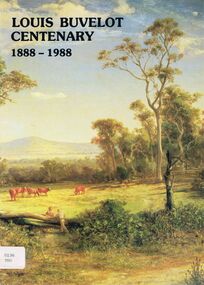
Book - LOUIS BUVELOT CENTENARY
... ... Australian art work...ARTWORK landscape book books Louis Buvelot artist person male landscapes paintings Australian painters Australian art work art David Thomas Jocelyn Gray exhibition catalogue colonial art.Bottom left corner of the front cover has a number sticker 0136 THO. ...A book titled ' Louis Buvelot. The Father of Australian Landscape Painting.' Bendigo Art Gallery, 31 March - 30 May, 1988. This exhibition is assisted by the Ministry for the Arts under the Victorian Government Exhibitions Indemnification Scheme. Bottom left corner of the front cover has a number sticker, 0136 THO.artwork, landscape, book, books, louis buvelot, artist, person, male, landscapes, paintings, australian painters, australian art work, art, david thomas, jocelyn gray, exhibition, catalogue, colonial art.bottom left corner of the front cover has a number sticker, 0136 tho. -
 Bendigo Historical Society Inc.
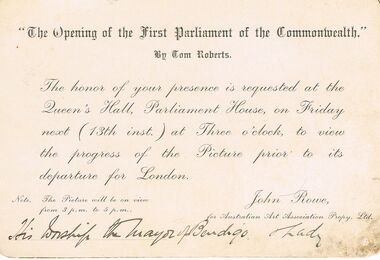
Document - LYDIA CHANCELLOR COLLECTION; INVITATION TO VIEWING OF TOM ROBERT'S PAINTING OF PARLIAMENTARY OPENING
... ... Australian art... art work...EVENT Official painting Lydia Chancellor collection Australian art art work Australian history history painting Tom Roberts politics Australian politics Australian parliament event An invitation in the form of a card with black print. ' The Opening of the First Parliament of the Commonwealth.' ...An invitation in the form of a card with black print. ' The Opening of the First Parliament of the Commonwealth.' 'By Tom Roberts. The honor of your presence is requested at the Queen's Hall, Parliament House, on Friday next (13th inst.) at Three o'clock, to view the progress of the Picture prior to its departure for London. John Rowe for Australian Art Association Pty. Ltd.' Handwritten in black ink are the words 'His Worship the Mayor of Bendigo & Lady.'event, official, painting, lydia chancellor, collection, australian art, art work, australian history, history, painting, tom roberts, politics, australian politics, australian parliament, event -
 Warrnambool and District Historical Society Inc.
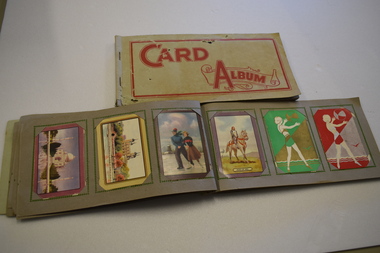
Work on paper - Swap Card Albums (2), Swap card albums, Mid 20th century
... There are many of birds and animals, some of great artwork reproductions, some of famous places and buildings, a couple of V.F.L. footballers, two from the Melbourne Olympic Games, some matching pairs and a couple of Australian aboriginal art work. They are all of high quality and many are very beautiful. ...There are many of birds and animals, some of great artwork reproductions, some of famous places and buildings, a couple of V.F.L. footballers, two from the Melbourne Olympic Games, some matching pairs and a couple of Australian aboriginal art work. They are all of high quality and many are very beautiful. ...The 120 cards in these two albums are very varied in content. There are many of birds and animals, some of great artwork reproductions, some of famous places and buildings, a couple of V.F.L. footballers, two from the Melbourne Olympic Games, some matching pairs and a couple of Australian aboriginal art work. They are all of high quality and many are very beautiful. Swap card collecting was a popular activity for young girls throughout the 20th century and cards were swapped with friends and sometimes sold. Usually the cards, bought from newsagents and fancy goods shops, were kept loose in a school bag or pocket and so the number of cards and the type varied from week to week. Boys also often saved cards of a particular nature – sports cards, nature cards etc though the idea of ‘swapping’ was not so prevalent among the boys. Card collecting, usually promoted by a business concern or a toy company, is still a pastime for young people today. The cards in these two albums are of considerable interest as they are of good quality and are aesthetically pleasing. They also are good examples of a popular hobby of girls in the 20th century. .1 & .2 These two albums are similar in size and design. Both have grey/pale green covers with red printing on the front cover. Both are bound with two staples and both contain 10 pages with inserts to hold three cards each side of the page. The inserts are edged with a green decoration. Both albums contain 60 coloured cards. There is evidence of silverfish damage on the front covers of both albums. hobbies of the past, history of warrnambool, swap cards, trading cards, albums, card collection -
 Federation University Art Collection
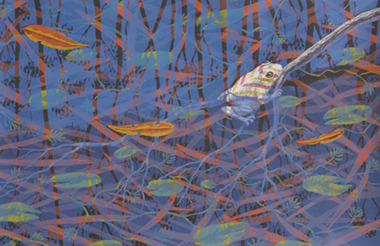
Work on paper - Printmaking - Screenprint, Lin Onus, 'Garkman' by Lin Onus, 1991
... Lin ONUS (1948-1996)
Lin Onus was integral to the recognition of Aboriginal art in the contemporary Australian art landscape. His work expresses the dynamism of living culture; Onus was a prominent figure in renegotiating the history of colonial and Aboriginal Australian. ...Lin ONUS (1948-1996)
Lin Onus was integral to the recognition of Aboriginal art in the contemporary Australian art landscape. His work expresses the dynamism of living culture; Onus was a prominent figure in renegotiating the history of colonial and Aboriginal Australian. ...Lin ONUS (1948-1996) Lin Onus was integral to the recognition of Aboriginal art in the contemporary Australian art landscape. His work expresses the dynamism of living culture; Onus was a prominent figure in renegotiating the history of colonial and Aboriginal Australian. An early influence of this dedication was his father, who was the founder of the Aboriginal Advancement League in Victoria and a maker of artefacts. As a young boy Onus was subsequently exposed to visiting Aboriginal artists and assisted his father in decorating artefacts. His painting Barmah Forest won the Aboriginal Heritage Award in 1994; Onus also received a Member of the Order of Australia “for service to the arts as a painter and sculptor and the other promotion of Aboriginal artists and their work.” (https://www.portjacksonpress.com.au/artists/lin-onus)Unframed colour screenprint with a limited edition of 60.lin onus, frogs, aboriginal, screenprint, printmaking, gippsland campus, print council australia -
 Federation University Historical Collection
Painting - Ballarat Technical Art School Folio, Ivy Wilson, Artwork by Ivy Wilson, c1920-1922, 1920 - 22 (originals)
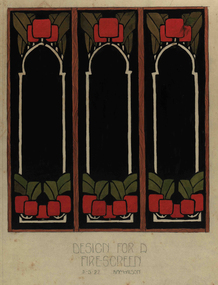
... Australia Ivy Wilson lived at 17 Mair Street with her parents while she studied at the Ballarat Technical Art School. Her student folio contains several stencils hand-cut from paper and card. Among them are stylised graphics of correa, waratah, gum, and kangaroo apple as well as kookaburras, cockatoos and a koala. One example of a wreath was subsequently translated into embroidered needlework. Wilson’s folio possibly consists of mostly junior technical work...Alternatively, given her focus on textile-based arts, she may have been an evening trade student. ballarat school of mines wilson ballarat technical art school dressmaking art Ivy Wilson Stencilling stencil embroidery Australian flora Australian birds A number of digitised images taken from a folder of works by Ivy Wilson undertaken at the Ballarat School of Mines Technical Art School between 1920 and 1922. The folio of work ...Ivy WILSON (1907-1998) Ballarat | Australia Ivy Wilson lived at 17 Mair Street with her parents while she studied at the Ballarat Technical Art School. Her student folio contains several stencils hand-cut from paper and card. Among them are stylised graphics of correa, waratah, gum, and kangaroo apple as well as kookaburras, cockatoos and a koala. One example of a wreath was subsequently translated into embroidered needlework. Wilson’s folio possibly consists of mostly junior technical work, as she appears to only have sat a single senior Education Department examination, Drawing Plant Forms from Nature. Alternatively, given her focus on textile-based arts, she may have been an evening trade student. A number of digitised images taken from a folder of works by Ivy Wilson undertaken at the Ballarat School of Mines Technical Art School between 1920 and 1922. The folio of work was later donated 'In memory of my mother Ivy Wilson'.ballarat school of mines, wilson, ballarat technical art school, dressmaking, art, ivy wilson, stencilling, stencil, embroidery, australian flora, australian birds -
 Federation University Historical Collection
Work on paper - Artwork - Poster, Past and Present Ballarat of Forty Years of Progress from an Uninhabited Wilderness, 22/10/1892 - 17/03/1898
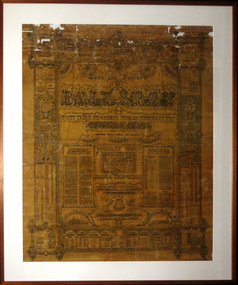
... Australia 1838 James Meek was an artist who built the first house at Ballarat. He wrote 'designed, composed and written with pen and ink by James Meek (founder of the City). When this work was completed the in 1893 the Ballarat Star described the work: - "An Industrial Inmate. At the conclusion of Monday's meeting of the Ballarat Benevolent Asylum Committee one of the inmates, named James McBain Meek, having been introduced, laid upon the table a magnificently executed work of art, bearing the following inscription: - The past and present of Ballarat, or 40 years' progress from an uninhabited wilderness, 1852 to 1892, during which time it has become the grandest inland city of the Southern World. ...Australia 1838 James Meek was an artist who built the first house at Ballarat. He wrote 'designed, composed and written with pen and ink by James Meek (founder of the City). When this work was completed the in 1893 the Ballarat Star described the work: - "An Industrial Inmate. At the conclusion of Monday's meeting of the Ballarat Benevolent Asylum Committee one of the inmates, named James McBain Meek, having been introduced, laid upon the table a magnificently executed work of art, bearing the following inscription: - The past and present of Ballarat, or 40 years' progress from an uninhabited wilderness, 1852 to 1892, during which time it has become the grandest inland city of the Southern World. ...James McKain MEEK (1815-1899) Born England Arrived Australia 1838 James Meek was an artist who built the first house at Ballarat. He wrote 'designed, composed and written with pen and ink by James Meek (founder of the City). When this work was completed the in 1893 the Ballarat Star described the work: - "An Industrial Inmate. At the conclusion of Monday's meeting of the Ballarat Benevolent Asylum Committee one of the inmates, named James McBain Meek, having been introduced, laid upon the table a magnificently executed work of art, bearing the following inscription: - The past and present of Ballarat, or 40 years' progress from an uninhabited wilderness, 1852 to 1892, during which time it has become the grandest inland city of the Southern World. It stands unrivaled by that of any city in her Britannic Majesty's extensive domain over which the sun never sets, and o'er which Albion's beloved sovereign sways her benign sceptre." The work conveys by words and pictorial representations a complete history of Ballarat from its inception up to the 17th March inst. The various pillars and scrolls by which the many incidents that are related are surrounded are marvelously executed, the plain and ornamental lettering is exquisite; while the language used in the narrative is of the most eloquent and refined description. Sketches of the Ballarat Hospital and Benevolent Asylum, equal to any photographic picture, are shown at either end of the word " Ballarat," which occupies the most central position of the chart. The work, which is worthy of a position in any public library or private residence, has been designed and composed by Mr. Meek, who is 78 years of age, at the Asylum. It is done entirely with pen and ink, and was commenced on the 22nd October, 1892, and completed on 17th March, 1893. (Ballarat Star, 27 March 1893)Although 'Past and Present Ballarat of Forty Years of Progress from an Uninhabited Wilderness' was printed it appears that few have survived the ravages of time. Another copy of this works survives in the collection of the Australiana Room at the Central Highlands Regional Library Corp. No others have been located to date. (2012)Large black and white poster (now brown with age) with the hand drawn work of James Meek reproduced by the Ballarat printers Rider & Mercer. Many, but one includes 'Most respectfully dedicated to the native born children of European parents in the Ballarat Mining District by the author.'ballarat, james meek, meek, ballarat benevolent asylum, nazareth house, ballarat mayors, james bury, james oddie, la poer trench, welfare -
 Federation University Historical Collection
Book, Cloud Pool Fire Veil Shield, 1996 (exact)
... Born in Scotland, Allan Mann studied at the Glasgow School of Art, and worked in many tertiary institutions in Great Britain and Australia. ...Born in Scotland, Allan Mann studied at the Glasgow School of Art, and worked in many tertiary institutions in Great Britain and Australia. Allan Mann arrived in Australia in 1987, lecturing at the Darling Downs Institute of Advanced Education, Queensland, then the Riverina-Murray Institute of Higher Education Wagga Wagga, NSW, in 1981. ...Born in Scotland, Allan Mann studied at the Glasgow School of Art, and worked in many tertiary institutions in Great Britain and Australia. Allan Mann arrived in Australia in 1987, lecturing at the Darling Downs Institute of Advanced Education, Queensland, then the Riverina-Murray Institute of Higher Education Wagga Wagga, NSW, in 1981. He returned to the Duncan of Jordanstone College of Art, Dundee, Scotland between 1984 and 1985. Allan Mann was appointed to the University of Ballarat (then Ballarat College of Advanced Education) in 1987. He retired as an Associate Professor of the University of Ballarat Arts Academy in 2010.Black, hard-covered artist's book produced in a limited edition of 22 (of which this one is number number 6). The images contained in the book were first created in pastel then scanned and computer manipulated before being Laser copied and Intron transferred onto Indian Khadi Hot Press Natural Off-white 210 gsm paper, in an edition of 22.Signed an numbered by the artist on the ISBN page.allan mann, jeff zilles, artist's book, cpfvs -
 Federation University Historical Collection
Book, Birds of Australia, early 1890s
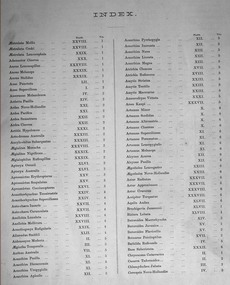
... work with Hamel & Ferguson (print sellers and publishers). 'The Birds of Australia' was finalised in 1891 with 303 full page illustrations lithographed in colour with notes on over 700 species. Limited to 1000 copies the edition sold out quickly. Bronowski died in 1913 at Mosmon NSW, aged 76. He was survived by his wife, a daughter and 6 sons. birds gracius j. broinowski fauna ballarat technical art ...Not Gould although on spine. Minutes of the SMB council 14 April 1891 "6, A requisition from Professor Krause for a new work on the birds of Australia was referred to the Education committee. Broinowski was commisioned by the Department of Public Instruction in New South Wales to supply them with pictures of Australian birds which he published in 6 volumes from 1887 - 1891. Gracius Broinowski was born in Poland in 1837. To avoid conscription with the Russian army he roamed Europe in poverty,his possessions having been stolen earlier in Germany. Hearing tales of the Australian gold fields, he borderd the 'Windjammer' bound for Victoria as a deckhand. Broinowski swam ashore at Portland, Victoria in 1857 age twenty. For seven years he walked from one rural settlement to another working as a shepherd, stockman and independent farmer. In 1864 Bronoiwski married in Melbourne and found work with Hamel & Ferguson (print sellers and publishers). 'The Birds of Australia' was finalised in 1891 with 303 full page illustrations lithographed in colour with notes on over 700 species. Limited to 1000 copies the edition sold out quickly. Bronowski died in 1913 at Mosmon NSW, aged 76. He was survived by his wife, a daughter and 6 sons.Green hard cover book, black leather spine and corners. Title on spine written in gold letters, gold decorations on spine. Pages not numbered. Coloured plates (lithographs). Vol. 1 - 6. Printed and bound.Stamped throughout the book "School of Mines Ballarat Library".birds, gracius j. broinowski, fauna, ballarat technical art school library -
 Federation University Historical Collection
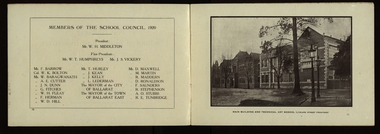
Booklet, The Ballarat School of Mines and Industries 1870-1920 Jubilee Booklet, 1920 (estimated)
... Art Metal Work, Woodcarving, Needlework, and Leather work. The Trade Classes give instruction in Telephone Mechanics, telegraphy, Carpentry, Cabinet Making, Plumbing, Blacksmithing, Fitting, Electric Wiring, and Printing. Numerous Scholarships are offered every year, and altogether students will find few places to equal the Ballarat School of Mines and Industries as a training place for their life's work. One of the first in the continent to be established, its Jubilee finds it still in the front rank, keeping pace with the times, and offering to the youths of this country the means of taking advantage of Australia's...Art Metal Work, Woodcarving, Needlework, and Leather work. The Trade Classes give instruction in Telephone Mechanics, telegraphy, Carpentry, Cabinet Making, Plumbing, Blacksmithing, Fitting, Electric Wiring, and Printing. Numerous Scholarships are offered every year, and altogether students will find few places to equal the Ballarat School of Mines and Industries as a training place for their life's work. One of the first in the continent to be established, its Jubilee finds it still in the front rank, keeping pace with the times, and offering to the youths of this country the means of taking advantage of Australia's ...The first school of Mines in Australia was established at Ballarat in 1870. At the time of its jubilee (1930) the following people were members of the School Council: W.H. Middleton (President), W.T. Humphreys (VP), J.S. Vickery (VP), F. Barrow, Col. W.K. Bolton, William Baragwanath, A.E. Cutter, J.N. Dunn, G. Fitches, W.H. Fleay, F. Herman. W.D. Hill, T. Hurley, K. Kean. J. Kelly, L. Lederman, Mayor of Ballarat, Mayour of Ballarat East, D. Maxwell, M. Martin, R. Maddern, D. Ronaldson, F. Saunders, R. Stephenson, A.O. Stubbs, R.E. Tunbridge. The School Staff in 1920 comprised: Herbert H. Smith, Walter Rowbotham, Reginald L. Cutter, M.C. Young, Hilda Wardle, M. Wiliamson, P.S. Richards, L.H. Archibald, J. Woods, Ken Moss, W. Kenneth, Mrs McIlvena. B. Robinson, S. Rowe, E. Hope-Jones, Miss Abrams, L.St.G.P. Austin, Alfred Mica Smith, J.R. Pound, Herbert R. Murphy, N.H. Junner, Maurice Copland, L.H. Archibald, E.J.A. McConnon, Newton King, D.m. Hull, T.R. Gordon, John M. Sutherland, T.K. Jebb, Dick Richards, C. Tonkin, A.W. Steane, J. Paterson, H.W. Malin, R.V. Maddison, S.M. Mayo, F.A. King, W.H. Steane, T.R. Gordon, T.A. Williams, H. Waldron, G. Black, E.J. McConnon, R.V. Duncan. R. Cutter, E.G. Vawdrey, Hilda WardleWhite stapled booklet - landscape format - 20pp + soft covers with blue writing. Includes an historical sketch of the Ballarat School of Mines. Contains images of the school from around 1920. The history outlined in the booklet follows: 'Ballarat has helped to influence the life and destinies of Australia in many ways, the recital of which would perhaps prove tedious to the citizens of less favoured localities! However, it can be said, without much fear of contradiction, that only less known thought Australia than its fame as a gold field is the reputation won for it by its school of Mines, ... Ballarat was still quite a new place when the School was founded, but a very propserous and popular place all the same, with a go-ahead lot of citizens brim full of the spirit of enterprise which seemsto animate mining populations generally. Money was plentiful, and they launched out into ventures, which later, were to develop and take the place of the gold mines, while what is more to the point, they understood the value of education. the old digging days were passing away. So far as Ballarat itself was concerned the day of the cradle and tin dish had already passed into an antiquity "as dead and distant as the age of the Tubal Caon," said dir redmond Barry on declaring the School open. Mining had become a serious business, and the mining engineer, the metallurgist, and the geologist had become a power in the land. In these circumstances the suggestions to found a School of Mines met with ready acceptance. The late Mr James M. Bickett had the honor of bringing forward the proposition at a meeting of the Ballarat Mining Board in October, 1869. it was agreed to, and the Government, having been approached for assistance, granted a lease of the old Supreme Court buildings at a nominal reantal. A modest sum, including 100 pounds from the Borough Council of Ballarat West, was subscribed by a number of sympathisers, and on the 26th October, 1870, the inaugural address was delivered by Sir Redmond Barry, the first President of the School. Classes were commenced on the 23rd January, 1871. The students at first were mostly adults. They were chiefly men emloyed at the mines, who had the wisdom and energy to devote their spare time to study, and, though their attendance was somewhat irregular, they made very good progress. Old prints which have been preserved show them at work at furnaces, big bearded men of the old-fashioned type of miner. It is interesting to note that among those who gave evidence and encouragement was Sir Roderick Murchison, who many years before had advised Cornish miners to emigrate to Australia to search for gold, and who in 1848 was in possession of gold ore sent from this country. Sir Roderick sent a parcel of books for the library, and gave useful advice as to the curriculum which should be adopted. The Museum, which now contains a most valuable collection of minerals, was one of the first things attended to, and the reports presented to the Council from time to time speak of additions being made from all parts of the world. New equipment was constantly being added to the School, a good deal of assay work was done, and some specimens were sent from the East Indies for examination as far back as 1873. By this time there was a difficulty in providing accomodation for the students who wished to enrol, and the number of instructors had grown from two to four. In 1882 the first building was being erected on what was then part of the gaol reserve. A little more than ten years afterwards a buildnig formerly serving as a Methodist Church was absorbed, while later on, the demand for accomodation increasing, the attack upon the gaol was renewed. The School continued to grow in reputation and size, and became the science centre of the district, and in 1889 a learge new building was opened by Sir Alexander Peacock. Students came from over seas as well as from all the States of Australia, and after going through their courses they took with them the name and fame of the old School to all parts of the globe. School of Mines boys have played a great part in developing the mining fields of Western Australia, South Australia, and africa, while old students who have made a name in their profession are constantly dropping in to see how the old place is getting along. It was not to be expected, however, that the Ballarat School would be left without rivals, its very success inspiring competition. Mining Schools were started in other parts of Australia, and, at the same time, Victoria ceased to hold first place as a mining state. On the other hand there was a great advance in manufacturing, and the demand for technicaly trained men became a great and as insistent as ever it had been for trained mining men. The Council was quick to adapt the school to the new conditions, and the result is seen in the institution, which is one of Ballarat's proudest possession. Instruction is given in all branches of technical work, and the classes are filled with students who are building up for Ballarat a reputation as an industrial centre, which promises to equal that which it formerly held as a mining town. Owing to its bracing climate, its abundant opportunities for recreations, and its accessibilty, Ballarat as a city is an ideal place for educational purposed, and is yearly becoming more and more appreciated throughout the State. The chairman of one of Ballarat's biggests industries claims that the workman can do twice the day's work here that he can do in Melbourne. he was a little enthusiastic over it, perhaps, but it is a well-known fact that the healthy and invigourating Ballarat climate is conducive to both physical and mental activity, and the records of the School provide ample proof of it. One of the most interesting and successful branches of the School of Mines and Industries - if the name be enlarged with the enlargement of its scope - is the Technical Art School. "The City of Statues" has from its earliest days been a stronghold of art. Art schools have flourised here, and in 1905 the Education Department came to the conclusion that the best thing to do with them was to place them under the management of the School of Mines Council. A magnificent new Technical Art School was built at a cost of some 12,000 pounds on the site of the old Supreme Court building, and was formally opened on the 23rd July, 1915. The results have not only been justified but surpassed all anticipations. The most comprehensive list of subjects is taught, and this list is constantly added to. Students have flocked to the art School, which may be said to occupy a unique position in Australia, and its record of success is really astonishing. Its students supply art teachers for the newer schools that are being built, and many occupy leading positinos in important business houses. So well is its reputation known that orders are constantly being received, not only from Victoria, but from other States, for honor boards and challenge shields to be designed and made. The most recent addition to the School of Mines and Industries is the Junior Technical School, for which a new building is now being erected on a portion of the gaol site, transferred to the School of Mines Counci by the Government. At the present moment temporary quarters are being occupied. Some students after passing through the Junior School go straight to employment, continuing perhaps to attend the evening trade classes, while others move on to the senior School. In a review of the work of the School of Mines mention must be made of a series of industrial research carried out under supervision of the Principal. One in particular, regarding the suitability of the local ores for the manufacture of pigments attracted much attention, while the experiemtns on the manufacture of white potery from Victorian clayes were considered of sufficient importance by the Federal Advisory Council of Science and Industry to warrant the appointment of a special investigator. The results of these have been most encouraging, and may have far-reaching consequences. The vocational training of returned soldiers also should not be overlooked. The work was taken in hand from the first, before the Repatriation Department gave assistance, and now with the help of the department of the School has become one of the largest vocational training centres in Victoria outside of Melbourne. The soldiers, trained in a variety of occupations, have made remarkable progress, and already considerable numbers have found employment in local workshops and factories. To sum up, the School is divided into the following departments, each well staffed and equipped: - The School of Mines, science, and Engineering; the Techncial Art School, the Boys' Junior Technical School, the Girl's Preparatory Technical Classes, Trade Classes, and the Commercial School. The school of Mines, science and Engineering, comprises the following branches: - Mining, Metallurgy, Geology, Electrical Engineering, Civil Engineering, Mechanical Engineering, Applied Chemistry, and Pharmacy. Battery treatments, Cyanide Testing, Smelting, Assays, and Clay Testing from a regular part of the School's work. Students gaining qualifications obtain concession in their courses at the university, should they proceed there to continue their studies. The technical Art school curriculum includes training in all branches of pictorial and applied art, an Architectural Diploma Course, a Draughtman's Course, technical Art teachers' Course, Photography,Ticket Writing, Art Metal Work, Woodcarving, Needlework, and Leather work. The Trade Classes give instruction in Telephone Mechanics, telegraphy, Carpentry, Cabinet Making, Plumbing, Blacksmithing, Fitting, Electric Wiring, and Printing. Numerous Scholarships are offered every year, and altogether students will find few places to equal the Ballarat School of Mines and Industries as a training place for their life's work. One of the first in the continent to be established, its Jubilee finds it still in the front rank, keeping pace with the times, and offering to the youths of this country the means of taking advantage of Australia's teeming opportunities. william, battery, smith, herbert, drawing from the antique, ballarat school of mines botanical gardens, ballarat school of mines, redmond barry, alfred mica smith, james bickett, museum, dick richards, ballarat junior technical school, s m b, ballarat school of mines and industries, ballarat technical art school, model mine, james m bickett, j m bickett, roderick murchison, vocational training rooms, wesley church, methodist church, alexander peacock, lathes, repatriation, repatriatin department, war service, school council, baragwanath, gold mining, mining laboratory, plaster cast, r.w. richards, anniversary, jubilee -
 Federation University Historical Collection
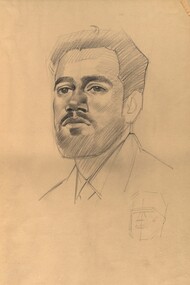
Drawing - Drawings, Life Drawing with markings by tutor Geoffrey Mainwaring
... Geoffrey Mainwarring taught art at the Ballarat School of Mines, and had served as an Australian War Artist. education janice edwards jan edwards life drawing geoff mainwaring geoffrey mainwaring alumni unframed Twenty-two life drawings in pencil and charcoal drawn by Jan Edwards, with suggestions, modelling and drawing ratios drawn onto, and around the work, by tutor Geoffrey Mainwaring. ...Jan Edwards is the grandaughter of Perceval Richards, and daughter of architect Geoffrey Richards. Of the drawings Jan said mainwarring would come up to the eisel and draw in the paper, suggesting lines, emphasis, and giving educational advice by drawing on the side of the paper. Geoffrey Mainwarring taught art at the Ballarat School of Mines, and had served as an Australian War Artist.Twenty-two life drawings in pencil and charcoal drawn by Jan Edwards, with suggestions, modelling and drawing ratios drawn onto, and around the work, by tutor Geoffrey Mainwaring. One drawing, a head study, is totally by Geoffrey Mainwaring, but is not signed. (.23) is a head study produced in a few minutes Geoff Mainwaring during a class.education, janice edwards, jan edwards, life drawing, geoff mainwaring, geoffrey mainwaring, alumni, unframed -
 Federation University Historical Collection
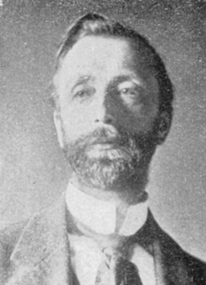
Photograph - Black and White, Ponsonby May Carew Smyth, 1906
... work, and humour; he was considered quite a raconteur. Survived by his wife, a son and a daughter, he died in his home at South Yarra on 9 October 1939, and was cremated." (Margot Lethlean, 'Carew-Smyth, Ponsonby May (1860–1939)', Australian Dictionary of Biography, National Centre of Biography, Australian National University, http://adb.anu.edu.au/biography/carew-smyth-ponsonby-may-5501/text9359, accessed 4 June 2013.) Carew Smyth Inspector Technical Schools Art ...Ponsonby Carew Smyth, A.R.C.A. London, was Victorian Art Inspector of Technical Schools. "Ponsonby May Carew-Smyth (1860-1939), educationist, was born on 7 August 1860 at Cork, Ireland, son of Emmanuel Uniacke Smyth, gentleman, and his wife Catherine Giles, née Carew. Carew-Smyth's initial art training and teaching was at the Belfast Government School of Art and Design. In 1885 he entered the National Art Training School at South Kensington, London, where he remained as student and teacher for five years. He also taught at Rugby School, studied at the Royal School of Wood Carving and the Guild School of Handicrafts, London, and was sent by the Department of Science and Art to study art, art education and museum procedures in Paris. Testimonials to his career in England affirm his ability and dedication as an educationist and his integrity as a man. On 23 December 1890 Carew-Smyth married Marie Reynolds of Brixton; they migrated to Australia next January. In September Carew-Smyth applied from Melbourne for the position of master of the school of art and design, established under the auspices of the Ballarat Fine Art Gallery. Opening in November, the school offered day classes and a broad curriculum, and under Carew-Smyth's guidance, established a sound reputation. In November 1899 he was appointed inspector of drawing in the Department of Education. Carew-Smyth saw drawing as a crucial link between primary and technical education, insisting on it as a 'mental process quite as much as a manual'; he believed strongly in the utilitarian value of drawing to the artisan class and of art as 'craftmanship'. By his emphasis on teacher-training, by his role in the Teachers' Training College, and by his constant travels, writing and lecturing, he upgraded both the standard and importance of drawing early in the century. His meticulous mind formulated the Austral Drawing Books which provided the basis of instruction in the subject in Victoria until 1927. Although he gave his occupation as 'artist', Carew-Smyth was primarily an educationist. He was actively involved in the early years of Prahran and Swinburne Technical colleges, and especially the Working Men's College which held his interest even after his retirement. In 1906 he was appointed chairman of the Victorian State Schools' Equipment and Decoration Society, and he was important in the organization of the state schools' exhibition that year. He designed the commemorative wall plaques installed in state schools after World War I, and the art teachers' certificate. He was prominent in bringing about the 1922 Jubilee Exhibition, and the 1926 showing of work of overseas schools, and especially the 1934 Melbourne centenary 'Early Victorian Art' exhibition. In the 1930s he wrote wide-ranging, informative and sometimes humorous articles for the Argus on various aspects of the decorative arts. In mid-1936 he was acting director of the National Gallery of Victoria. To students his single-mindedness sometimes suggested sternness, but Carew-Smyth was always held in the highest regard both professionally and personally. His colleagues recalled a man of kindness, unstinting devotion to work, and humour; he was considered quite a raconteur. Survived by his wife, a son and a daughter, he died in his home at South Yarra on 9 October 1939, and was cremated." (Margot Lethlean, 'Carew-Smyth, Ponsonby May (1860–1939)', Australian Dictionary of Biography, National Centre of Biography, Australian National University, http://adb.anu.edu.au/biography/carew-smyth-ponsonby-may-5501/text9359, accessed 4 June 2013.)Image of the face and shoulders of a bearded man - Ponsonby Carew Smyth. The image was originally published from the State Schools Exhibition Catalogue, 1906. (Cat. No. 401)carew smyth, inspector, technical schools, art. -
 Federation University Historical Collection
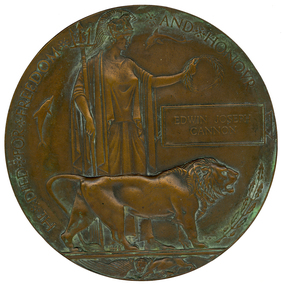
Medal - Numismatics, 'Dead Man's Penny' for Edwin Joseph 'Ted' Cannon, c1919
... Art School. During the Battle of Pozieres on the Western Front Ted Cannon worked with the Scout Platoon sketching the enemy's gun emplacements. Ted proved invaluable to the Brigade and brought he came under the attention of the Australian High Command. ...Art School. During the Battle of Pozieres on the Western Front Ted Cannon worked with the Scout Platoon sketching the enemy's gun emplacements. Ted proved invaluable to the Brigade and brought he came under the attention of the Australian High Command. ...The Dead Man’s Penny is a commemorative medallion which was presented to the next-of-kin of the men and women from England and the Empire who died during World War One. The Dead Man’s Penny was accompanied by a letter from King George V, stating ‘I join with my grateful people in sending you this memorial of a brave life given for others in the Great War’.[http://nma.gov.au/blogs/education/2010/11/14/dead-mans-penny/] Popularly known as the "Dead Man’s Penny", because of the similarity in appearance to the somewhat smaller penny coin. 1,355,000 plaques were issued, which used a total of 450 tonnes of bronze, and continued to be issued into the 1930s to commemorate people who died as a consequence of the war. [http://en.wikipedia.org/wiki/Memorial_Plaque_(medallion)] It was decided that the design of the plaque was to be picked from submissions made in a public competition. Over 800 designs were submitted and the competition was won by the sculptor and medallist Edward Carter Preston with his design called Pyramus, receiving a first place prize of £250.[http://en.wikipedia.org/wiki/Memorial_Plaque_(medallion)] They were initially made at the Memorial Plaque Factory, 54/56 Church Road, Acton, W3, London from 1919. Early plaques did not have a number stamped on them but later ones have a number stamped behind the lion's back leg. [http://en.wikipedia.org/wiki/Memorial_Plaque_(medallion)] Ted Cannon's plaquette does not have a stamped number. Ted Cannon was a gifted artist and cartoonist who studied at the Ballarat School of Mines Technical Art School. During the Battle of Pozieres on the Western Front Ted Cannon worked with the Scout Platoon sketching the enemy's gun emplacements. Ted proved invaluable to the Brigade and brought he came under the attention of the Australian High Command. On 13 September 1916 Ted was given a special assignment for General C.B.B. White. Ted was sent out forward of the Old Mill at Verbrandenmolen (in the Ypres Salient) to draw a panorama of the German lines in the area from Hill 60 to The Bluff. It was a hazardous task and Ted was warned to be careful. Tragically he was sniped by an enemy machine-gunner and sustained severe abdominal wounds. Stretcher-bearers rushed him to the 17th Casualty Clearing Station where he was operated on by the doctors at 8.30 that night. With little chance of success, but ever resilient, Ted remained conscious almost to the end. He died early in the morning of the 14 September 1916. His body was buried in the large Military Cemetery at Lijssenthoek. The effects of the late Ted Cannon were returned to his parents. These were an autograph book, three brushes, prayer book, housewife, whistle, book, hymn book, curios. Another listing gives his effects as "identity disc, letters, photos, wallet, 2 books, Mexican Dollar, 1 cent (Ceylon), 3 German Straps, Fountain Pen, Cigarette-holder, Franc Note, 50 centimes Note, devotional book, mirror, rosary, scapula, metal ring, two combs, book of views, nail clippers, badges, tie clip, Egyptian stamp.[http://recordsearch.naa.gov.au/scripts/Imagine.asp?B=3202589] Ted Cannon was an only child. It is not known how the 'Dead Man's Penny' came into the ownership of the donor, but it is thought that it may have been left in a house owned by the donor's mother. Further information on Ted Cannon can be found at http://bih.ballarat.edu.au/index.php/Edwin_J._Cannon and http://www.ballarat.edu.au/about-ub/history/art-and-historical-collection/ub-honour-roll/c/edwin-joseph-ted-cannon-1895-1916Large bronze medallion or plaquette featuring an image of Lady Britannia surrounded by two dolphins (representing Britain’s sea power) and a lion (representing Britain) standing over a defeated eagle (symbolising Germany). Around the outer edge of the medallion are the words ‘He died for freedom and honour’. Next to Lady Britannia is the deceased solider’s name, with no rank provided to show equality in their sacrifice. (http://nma.gov.au/blogs/education/2010/11/14/dead-mans-penny) The plaque was distributed throughout the British Empire, and the first plaques were distributed in Australia in 1922 "Returned home" by W. & O. Mayne, 2013. ted cannon, edwin joseph cannon, cannon, world war 1, world war -
Federation University Historical Collection
Book, Freund, Peter, Victorian Indigenous Art Awards, 2013, 2013
... art practice of aboriginal and Torres Straight Islander Victorians and showcase and raise the profile of the uniqueness of South-East Australian Aboriginal Art. The awards were presented at the Art Gallery of Ballarat for the first time in 2013. In 2013 the University of Ballarat (now Federation University Australia) sponsored The University of Ballarat Acquisitive Award for Work...art practice of aboriginal and Torres Straight Islander Victorians and showcase and raise the profile of the uniqueness of South-East Australian Aboriginal Art. The awards were presented at the Art Gallery of Ballarat for the first time in 2013. In 2013 the University of Ballarat (now Federation University Australia) sponsored The University of Ballarat Acquisitive Award for Work ...The Victorian Indigenous Art Awards started in 2005. The awards celebrate the quality and diversity of current art practice of aboriginal and Torres Straight Islander Victorians and showcase and raise the profile of the uniqueness of South-East Australian Aboriginal Art. The awards were presented at the Art Gallery of Ballarat for the first time in 2013. In 2013 the University of Ballarat (now Federation University Australia) sponsored The University of Ballarat Acquisitive Award for Work Reflecting Victoria's Western District.Red soft covered book of 64 pages. The book has coloured reproctions and artist's overview on the works exhibited at the Art Gallery of Ballarat as part of the Awards. Artists include Ray Thomas, Georgia MacGuire, John Duggan, Peter Waples-Crowe, Bindi Cole, Bronwyn Razem, Lucy Williams-Connelly, Jack Anselmi, Deanne Gilson, Marlene Gilsonvictorian indigenous art awards, ray thomas, georgia macguire, john duggan, peter waples-crowe, bindi cole, bronwyn razem, lucy williams-connelly, jack anselmi, deanne gilson, marlene gilson, alumni -
 Federation University Historical Collection
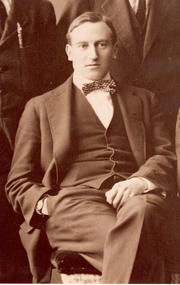
Photograph - Photograph - Black and White, Harold Herbert of the Ballarat Technical Art School, 1919
... art. Amongst these later, the most brilliant is Harold B. Herbert whose work is so widely and justly appreciated throughout Australia and whose achievements are watched by his old school with the greatest pride. ...art. Amongst these later, the most brilliant is Harold B. Herbert whose work is so widely and justly appreciated throughout Australia and whose achievements are watched by his old school with the greatest pride. ...Harold Brocklebank Herbert (16.09.1891-1945) Harold Herbert was one of the first pupils at the school starting in 1891, commencing as a 15 years old he studied Applied Design and Architecture at the Ballarat Technical School of design attached to the Ballarat Fine Art Galery, transferring to the Ballarat Technical Art school attached to the Ballarat School of Mines. He was a certificated Art Teacher with the Victorian Education Department. His talents were identified by Ballarat’s Ponsonby Carew-Smith who rose to become Art Inspector with the Victorian Education Department. His teaching career included being appointed Principal of the Sale Technical Art School in 1898. Harold Herbert undertook further studies in England returning to Ballarat with all new entrepreneurial ideas. He worked at the Ballarat Technical Art School between 1915-19. Harold Herbert was involved with the design of the Ballarat Arch of Victory, and was responsible for the reproductions in ‘The Education Department’s Record of War Service. Had been principal of the Sale Technical Art School since 1898, and had undertaken further studies in England returning to Ballarat with all sorts of entrepreneurial ideas. In 1924 the Ballarat School of Mines Students’ Magazine reported “We are perfectly safe in claiming on behalf of our school, that no institution of its kind has turned out a greater number of men and women students who have since “made good” while some have achieved enviable prominence in the world of art. Amongst these later, the most brilliant is Harold B. Herbert whose work is so widely and justly appreciated throughout Australia and whose achievements are watched by his old school with the greatest pride. He commenced at the School when he was about 15 years of age, and followed a course of training very similar to what most students are doing the most valuable qualities shown by him during his career as a student were a passion for drawing and a capacity for taking pains, so essential in all artwork. He was appointed as Assistant Art Teacher at Ballarat on completion of his course, and later assistant in the office of Art Inspector. All of his spare time was devoted to out-door sketching and commercial drawing and he showed an ability in practical design for various crafts quite equal to the ability he has since displayed in depictive art. His return to this School as senior master and his departure to devote himself entirely to fine art are quite recent happenings with which all students are familiar. The wonderful exhibition he held in Melbourne on return from a sketching trip abroad has place him amongst the leading artists of Australia. Upon his death in 1945 the Ballarat School of Mines Student's Magazine recorded: "The death of the famous water-colour artist, Harold Herbert, will be a distinct loss to art in Australia. he was educated at the Ballarat Art School which it was situated in Sturt Street, and the gave promise of becoming a famous artist then. his talents were recognised, and in water-colour work he quickly made a name for himself. his landscapes in water-colour are in the principle galleries of the world, and many of them are to be found in the Ballarat gallery and in other provincial galleries. In 1941 he was appointed official war artist for the COmmonwealth, and he served in the Middle East and Syria. Exhibitions of his war pictures have been seen at different times in Melbourne."Portrait of a young man in a suit. He is Harold Brocklehurst Herbert, staffmember of the Ballarat Technical Art School (a division of the Ballarat Technical Art School). The photograph is a detail of the Ballarat School of Mines Magazine Committee, 1919. (http://victoriancollections.net.au/items/54923a682162f116140de59c)harold herbert, harold b. herbert, harold brocklebank herbert, ballarat school of mines, ballarat technical art school, art, arch of victory -
 Federation University Historical Collection
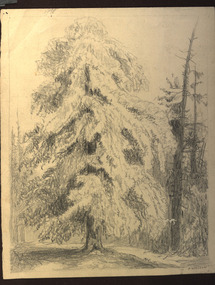
Drawing - Artwork -Drawing, Alice Watson, Lettering Exercises by Alice Watson, c1930
... Alice Watson completed a course of work at the Ballarat Technical Art School, a division of the Ballarat School of Mines. Her complete folio is held by Federation University Australia. ...Alice Watson completed a course of work at the Ballarat Technical Art School, a division of the Ballarat School of Mines. Her complete folio is held by Federation University Australia. ballarat technical art school ballarat technical art school number 10 ballarat school of mines alice watson edith alice watson artwork alumni drawing A collection of works undertaken at the Ballarat Technical Art School by Edith Alice (Alice) Watson. .1 .3 .4 may be by another person with the initials BM (possibly Robert Montgomery); .3 dated 1928 Lettering Exercises by Alice Watson Drawing Artwork -Drawing Alice Watson ...Alice Watson completed a course of work at the Ballarat Technical Art School, a division of the Ballarat School of Mines. Her complete folio is held by Federation University Australia. A collection of works undertaken at the Ballarat Technical Art School by Edith Alice (Alice) Watson. .1 .3 .4 may be by another person with the initials BM (possibly Robert Montgomery); .3 dated 1928 ballarat technical art school, ballarat technical art school number 10, ballarat school of mines, alice watson, edith alice watson, artwork, alumni, drawing -
 Federation University Historical Collection
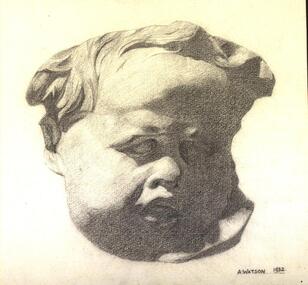
Drawing - Artwork - Drawing, Edith Alice Watson, 'Drawing the Human Figure from Casts' by Alice Watson, 1931 and 1932
... Art School. The works were undertaken by Edith Alice Watson. The full folio of work undertaken while Alice Watson was a student at the Ballarat Technical Art School is held by Federation University Australia....Art School. The works were undertaken by Edith Alice Watson. The full folio of work undertaken while Alice Watson was a student at the Ballarat Technical Art School is held by Federation University Australia. ...Edith (Alice) WATSON (1914–2010) Murtoa | Australia Alice Watson studied at the Ballarat Technical Art School (at the School of Mines, Ballarat) from 1930 until 1933. Watson sat several departmental exams, including drawing and painting plant forms from nature, lettering, Composition of Form and Colour and advanced General Design, as well as dressmaking and embossed leatherwork. Her folio applies many Australian native floral elements to design. Upon graduating, Watson taught at the Murtoa High School, living with her parents until their deaths in 1972 and 1988 when she was 74 years old. Alice Watson died in Ballarat, aged 95, having conserved her beautiful student folio, which was generously gifted to the Federation University permanent Historical Collection by the Watson family.Twelve drawings undertaken for the 'Drawing the Human Figure from Casts' class at the Ballarat Technical Art School. The works were undertaken by Edith Alice Watson. The full folio of work undertaken while Alice Watson was a student at the Ballarat Technical Art School is held by Federation University Australia.most are signed A.Watson 1932.edith alice watson, alice watson, ballarat technical art school, plaster cast, artwork, alumni, drawing the human figure from casts, visual arts -
 Federation University Historical Collection
Photograph - Photograph - Colour, Churchill Service Memorial, 2015, 2015
... art work. It will complement the Art and Culture Pathway which links Switchback Gallery at the Federation University Campus to the Town Centre. We hope Churchill citizens will pause to view the Memorial, ponder its meaning, reflect on the service of others and commemorate the fallen. churchill churchill war memorial paul jessie anzac centenary federation university gippsland art and culture pathway world war Colour photograph on an abstract Australia-shaped sculpture by Boolarra artist Paul Jesse. ...In recognition of its fallen soldiers and Churchill's 50th birthday a service memorial was erected on a concrete plinth at the Churchill town plaza and used for the first time to mark the ANZAC centenary on Anzac Day 2015. Churchill never had a war memorial and received a grant from the Department of Veterans' Affairs six years ago to commission a sculpture with Latrobe City Council's support. It was decided the sculpture needed to recognise more than just the war effort, but service and volunteerism, considering Churchill was only founded in 1965. (http://www.latrobevalleyexpress.com.au/story/2816903/churchills-new-memorial/, accessed 01 may 2015) Sculptor Paul Jesse discussed the work in Churchill and District Community news, 18 December 2014: Some time ago CDCA commissioned a sculpture to be used as a Service Memorial to commemorate the fallen that have died in service of our community and country. Traditional memorials usually commemorate Armed Services personnel, but CDCA was of the opinion that a more inclusive view which included Emergency Services personnel, such as CFA, SES and Police, could be incorporated into the Churchill Memorial. Boolarra artist, Paul Jesse, who is accomplished in Ferro-Cement sculpture techniques, was commissioned to create a memorial that would cause people to reflect on the meaning of ‘service’ and ‘sacrifice’. The following is a description of the Churchill Service Memorial Sculpture written by the sculptor, Paul Jesse. “My sculpture is different from most War Memorial sculptures because it uses as its basis the reasons why people go into service or to war. One side of the sculpture is colourful and optimistic; its theme is home, family, community and the future. These themes are crafted by flow lines which are connected to the other side of the sculpture through the round hole and the Crosspiece. These lines can be seen as a multi-layered connection between the sides. On the “dark” side of the sculpture, the lines begin with a spiral of coloured mosaics. This spiral is representative of our service people. Its beginning can be seen on one level as their soul. The spiralling mosaics of them flow to the other side of the sculpture where they create the landscape and figures. These lines can also be seen as a range of connectors between the two sides, representing a flow of thoughts, love, fear, concern and dreams. They also represent physical communication such as letters and phone calls.” This ‘Service Memorial’ is located in the Churchill Plaza (adjacent to the Town Hall), along with four flagpoles, seating and garden beds. The Churchill Service Memorial has deliberately been designed as a thought-provoking public art work. It will complement the Art and Culture Pathway which links Switchback Gallery at the Federation University Campus to the Town Centre. We hope Churchill citizens will pause to view the Memorial, ponder its meaning, reflect on the service of others and commemorate the fallen. Colour photograph on an abstract Australia-shaped sculpture by Boolarra artist Paul Jesse. The abstract Australia-shaped sculpture is in stark contrast to the bronze-cast "fallen mate" or concrete cenotaph seen in many country towns. The photograph includes wreaths from the ANZAC centenary service on ANZAC Day 2015. churchill, churchill war memorial, paul jessie, anzac centenary, federation university, gippsland, art and culture pathway, world war -
 Federation University Historical Collection
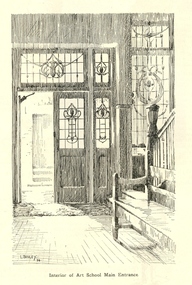
Artwork, other - Artwork, Artwork from the Ballarat School of Mines Students' Magazine, 1934, 1934
... This building is now the Gribble Building on the Federation University Australia SMB Campus. ballarat technical art school gribble building gribble stained glass white flat hopwood bailey gude Ballarat Junior Technical School Visual Arts Artwork by students of the Ballarat Technical Art School from the 1934 Ballarat School of Mines Students' Magazine .1) Stairs to the Ballarat Junior Technical School from Grant Street .2) Caricatures by Nornie Gude .3) work by Colin S. ...Sir Alexander Peacock opened the Ballarat Technical Art School in July 1915. It cost 10,000 pounds and was constructed by the Public Works Department from plans drawn by the then Art School Principal, Herbert H. Smith. The building contractors were Messrs Gower and Eddards. According to the SMB Annual Report of 1914 'the internal upholstering and fittings have all been carried out in Australian timbers, with Queensland maple largely used throughout.' Before this building was constructed art and craft classes were held in various buildings around Ballarat. The building could be described as federation-art deco in style. It features sandstone insertion with sandstone string coursing. The base of the building is rusticated sandstone. The relief stone panel on the front with the words "Technical Art School" features stone pilaster brackets and corbels. In the centre front can be seen rectangular sandstone pediment with decorative stonework incorporating the date of construction. The windows in the lower floor feature five supporting keystones whereas the upper windows have sandstone lintels. The building also features decorative cast iron downpipes. The entrance on the northern side has attractive leadlight glazing in an art deco style. Above the door a miner's lamp and pick are featured in the design. The building is functional in design with large metal windows in the south wall to ensure good light into the studios. The northern wall has standard double hung windows. The interior of the building features a carved wooden staircase and cast iron ceiling vents. The rear drawing studios can be made into one large studio by opening panelled timber doors. This opening features classical plaster pilasters with a pediment above. This building is now the Gribble Building on the Federation University Australia SMB Campus.Artwork by students of the Ballarat Technical Art School from the 1934 Ballarat School of Mines Students' Magazine .1) Stairs to the Ballarat Junior Technical School from Grant Street .2) Caricatures by Nornie Gude .3) work by Colin S. Hunt .4) A girl and a rooster by Gilda Gude .5) Self Portrait .6) Main entrance to the Ballarat Technical Art School by Lorna Bailey .7) Artwork from the magazineballarat technical art school, gribble building, gribble, stained glass, white flat, hopwood, bailey, gude, ballarat junior technical school, visual arts -
 Flagstaff Hill Maritime Museum and Village
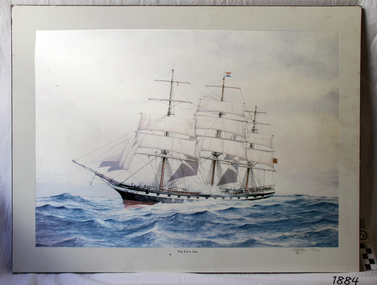
Print, The Loch Ard, 1993
... Art Historian, 2014] Philip James Gray was born in London but has lived most of his life in Australia. He graduated from a London school of art as an illustrator, specialising in technical and scientific illustration as well as other commercial and applied art. He was also a student for a time of Fyffe Christie - British figurative artist, mural painter and humanitarian – who had a great influence on his career. Philip has always worked...Art Historian, 2014] Philip James Gray was born in London but has lived most of his life in Australia. He graduated from a London school of art as an illustrator, specialising in technical and scientific illustration as well as other commercial and applied art. He was also a student for a time of Fyffe Christie - British figurative artist, mural painter and humanitarian – who had a great influence on his career. Philip has always worked ...ABOUT THE ARTIST – Philip James Gray “Philip is one of Australia’s leading maritime artists and his meticulous research and social commentary paintings of ships, such as, the Loch Ard and Schomberg form an important part of Warrnambool’s Flagstaff Hill Maritime Museum.” [ref. Dr Marion Manifold, Artist and Art Historian, 2014] Philip James Gray was born in London but has lived most of his life in Australia. He graduated from a London school of art as an illustrator, specialising in technical and scientific illustration as well as other commercial and applied art. He was also a student for a time of Fyffe Christie - British figurative artist, mural painter and humanitarian – who had a great influence on his career. Philip has always worked as a professional artist and illustrator. Many publications on maritime history have featured his work. His paintings have been released and sold all over the world as limited edition prints. The State Library of Victoria’s ‘Latrobe Collection’ holds two of his paintings. His street painting of ‘The Ashes Contest’ decorates the brick wall of Old Bakery Laneway in Sunbury and a Sunbury café owner commissioned him to paint the ‘Sunbury Pop Festival’ as a remembrance of local history. [ref. Sunbury Leader, Nov 15 2013] Philip has been an active member of the Sunbury Art Society in Victoria for several years, serving on the committee for some of that time and being involved in exhibitions. He enjoys helping new artists and sharing his skills and experience. [other references: Sunbury Art Society Inc. Oct-Nov 2012] HISTORY OF THE LOCH ARD The LOCH ARD belonged to the famous Loch Line which sailed many ships from England to Australia. Built in Glasgow by Barclay, Curdle and Co. in 1873, the LOCH ARD was a three-masted square rigged iron sailing ship. The ship measured 262ft 7" (79.87m) in length, 38ft (11.58m) in width, 23ft (7m) in depth and had a gross tonnage of 1693 tons. The LOCH ARD's main mast measured a massive 150ft (45.7m) in height. LOCH ARD made three trips to Australia and one trip to Calcutta before its final voyage. LOCH ARD left England on March 2, 1878, under the command of Captain Gibbs, a newly married, 29 year old. She was bound for Melbourne with a crew of 37, plus 17 passengers and a load of cargo. The general cargo reflected the affluence of Melbourne at the time. On board were straw hats, umbrella, perfumes, clay pipes, pianos, clocks, confectionary, linen and candles, as well as a heavier load of railway irons, cement, lead and copper. There were items included that intended for display in the Melbourne International Exhibition in 1880. The voyage to Port Phillip was long but uneventful. At 3am on June 1, 1878, Captain Gibbs was expecting to see land and the passengers were becoming excited as they prepared to view their new homeland in the early morning. But LOCH ARD was running into a fog which greatly reduced visibility. Captain Gibbs was becoming anxious as there was no sign of land or the Cape Otway lighthouse. At 4am the fog lifted. A man aloft announced that he could see breakers. The sheer cliffs of Victoria's west coast came into view, and Captain Gibbs realised that the ship was much closer to them than expected. He ordered as much sail to be set as time would permit and then attempted to steer the vessel out to sea. On coming head on into the wind, the ship lost momentum, the sails fell limp and LOCH ARD's bow swung back. Gibbs then ordered the anchors to be released in an attempt to hold its position. The anchors sank some 50 fathoms - but did not hold. By this time LOCH ARD was among the breakers and the tall cliffs of Mutton Bird Island rose behind the ship. Just half a mile from the coast, the ship's bow was suddenly pulled around by the anchor. The captain tried to tack out to sea, but the ship struck a reef at the base of Mutton Bird Island, near Port Campbell. Waves broke over the ship and the top deck was loosened from the hull. The masts and rigging came crashing down knocking passengers and crew overboard. When a lifeboat was finally launched, it crashed into the side of LOCH ARD and capsized. Tom Pearce, who had launched the boat, managed to cling to its overturned hull and shelter beneath it. He drifted out to sea and then on the flood tide came into what is now known as LOCH ARD Gorge. He swam to shore, bruised and dazed, and found a cave in which to shelter. Some of the crew stayed below deck to shelter from the falling rigging but drowned when the ship slipped off the reef into deeper water. Eva Carmichael had raced onto deck to find out what was happening only to be confronted by towering cliffs looming above the stricken ship. In all the chaos, Captain Gibbs grabbed Eva and said, "If you are saved Eva, let my dear wife know that I died like a sailor". That was the last Eva Carmichael saw of the captain. She was swept off the ship by a huge wave. Eva saw Tom Pearce on a small rocky beach and yelled to attract his attention. He dived in and swam to the exhausted woman and dragged her to shore. He took her to the cave and broke open case of brandy which had washed up on the beach. He opened a bottle to revive the unconscious woman. A few hours later Tom scaled a cliff in search of help. He followed hoof prints and came by chance upon two men from nearby Glenample Station three and a half miles away. In a state of exhaustion, he told the men of the tragedy. Tom returned to the gorge while the two men rode back to the station to get help. By the time they reached LOCH ARD Gorge, it was cold and dark. The two shipwreck survivors were taken to Glenample Station to recover. Eva stayed at the station for six weeks before returning to Ireland, this time by steamship. In Melbourne, Tom Pearce received a hero's welcome. He was presented with the first gold medal of the Royal Humane Society of Victoria and a £1000 cheque from the Victorian Government. Concerts were performed to honour the young man's bravery and to raise money for those who lost family in the LOCH ARD disaster. Of the 54 crew members and passengers on board, only two survived: the apprentice, Tom Pearce and the young woman passenger, Eva Carmichael, who lost all of her family in the tragedy. Ten days after the LOCH ARD tragedy, salvage rights to the wreck were sold at auction for £2,120. Cargo valued at £3,000 was salvaged and placed on the beach, but most washed back into the sea when another storm developed. The wreck of LOCH ARD still lies at the base of Mutton Bird Island. Much of the cargo has now been salvaged and some was washed up into what is now known as LOCH ARD Gorge. Cargo and artefacts have also been illegally salvaged over many years before protective legislation was introduced. One of the most unlikely pieces of cargo to have survived the shipwreck was a Minton porcelain peacock - one of only nine in the world. The peacock was destined for the Melbourne International Exhibition in 1880. It had been well packed, which gave it adequate protection during the violent storm. Today, the Minton peacock can be seen at the Flagstaff Hill Maritime Museum in Warrnambool. From Australia's most dramatic shipwreck it has now become Australia's most valuable shipwreck artefact and is one of very few 'objects' on the Victorian State Heritage Register. Flagstaff Hill’s collection of artefacts from LOCH ARD is significant for being one of the largest collections of artefacts from this shipwreck in Victoria. It is significant for its association with the shipwreck, which is on the Victorian Heritage Register (VHR S417). The collection is significant because of the relationship between the objects, as together they have a high potential to interpret the story of the LOCH ARD. The LOCH ARD collection is archaeologically significant as the remains of a large international passenger and cargo ship. The LOCH ARD collection is historically significant for representing aspects of Victoria’s shipping history and its potential to interpret sub-theme 1.5 of Victoria’s Framework of Historical Themes (living with natural processes). The collection is also historically significant for its association with the LOCH ARD, which was one of the worst and best known shipwrecks in Victoria’s history. Print of the sailing ship Loch Ard by artist Philip J. Gray, 1993. Depicts the Loch Ard in full sail at sea, figures on deck. Limited Edition number 54/925. Print is adhered to a piece of chipboard and is stamped by the framer, Ian's Picture Framing of Warrnambool.Signature of "Philip J. Gray" , "54/925" Stamped on back "IAN'S PICTURE FRAMING, 48 KEPLER STREET, WARRNAMBOOL 3280, PH: (055) 628 022, FAX: (055) 628 145"flagstaff hill, warrnambool, shipwrecked coast, flagstaff hill maritime museum, maritime museum, shipwreck coast, flagstaff hill maritime village, great ocean road, loch line, loch ard, captain gibbs, eva carmichael, tom pearce, glenample station, mutton bird island, loch ard gorge, print, philip j. gray -
 Flagstaff Hill Maritime Museum and Village
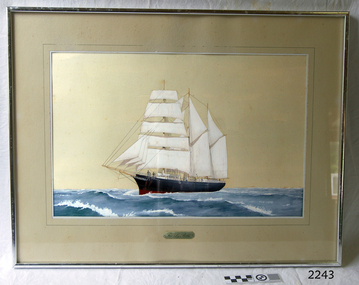
Painting - Maritime painting, The La Bella, 1980s
... Art Historian, 2014] Philip James Gray was born in London but has lived most of his life in Australia. He graduated from a London school of art as an illustrator, specialising in technical and scientific illustration as well as other commercial and applied art. He was also a student for a time of Fyffe Christie - British figurative artist, mural painter and humanitarian – who had a great influence on his career. Philip has always worked...Art Historian, 2014] Philip James Gray was born in London but has lived most of his life in Australia. He graduated from a London school of art as an illustrator, specialising in technical and scientific illustration as well as other commercial and applied art. He was also a student for a time of Fyffe Christie - British figurative artist, mural painter and humanitarian – who had a great influence on his career. Philip has always worked ...This painting of the “La Bella” is associated with Flagstaff Hill’s collection of artefacts from the wreck of the “La Bella”. It was painted around the 1980s by maritime artist Philip J. Gray. Some 15 – 17 ships are believed to have sunk in Lady Bay, but only two have been discovered on the seafloor; the “La Bella” and the “Edinburgh Castle”. Both wrecks are popular diving sites and are preserved as significant historical marine and marine archaeological sites. The Kosnar Picture Framing and Mirrors Shop identified the "GRAY 3135, Y04/111" as their job number for the framing and said that the label "ANOTHER KOSNAR FEATURE" was last used before about 1990. About artist Philip J. Gray “Philip is one of Australia’s leading maritime artists and his meticulous research and social commentary paintings of ships, such as, the Loch Ard and Schomberg form an important part of Warrnambool’s Flagstaff Hill Maritime Museum.” [Dr Marion Manifold, Artist and Art Historian, 2014] Philip James Gray was born in London but has lived most of his life in Australia. He graduated from a London school of art as an illustrator, specialising in technical and scientific illustration as well as other commercial and applied art. He was also a student for a time of Fyffe Christie - British figurative artist, mural painter and humanitarian – who had a great influence on his career. Philip has always worked as a professional artist and illustrator. Many publications on maritime history have featured his work. His paintings have been released and sold all over the world as limited edition prints. The State Library of Victoria’s ‘Latrobe Collection’ holds two of his paintings. His street painting of ‘The Ashes Contest’ decorates the brick wall of Old Bakery Laneway in Sunbury and a Sunbury café owner commissioned him to paint the ‘Sunbury Pop Festival’ as a remembrance of local history. Philip has been an active member of the Sunbury Art Society in Victoria for several years, serving on the committee for some of that time and being involved in exhibitions. He enjoys helping new artists and sharing his skills and experience. About the “La Bella” The wreck of the La Bella lies at the bottom of the Warrnambool Harbour in Lady Bay. Some 15 ships are believed to have been wrecked there but only two have been discovered on the sea floor; the La Bella and the Edinburgh Castle. Both wrecks are popular diving sites and are preserved as significant historical marine and marine archaeological sites. The story of the final voyage of the La Bella is summarised as follows … The ship from which the sailors were rescued was the three-masted, iron and steel barquentine the La Bella, built in Norway in 1893. She was one of two iron and steel ships by Johan Smith, the company being one of the leading shipping families in Tvedestrand, Norway. She was significant to Norwegian shipping, being one of only 27 iron and steel ships ever built in Norway. La Bella was registered in New Zealand and engaged from 1902 in inter-colonial trading of timber in the pacific, between New Zealand and Australia and was often in Port Phillip Bay, Victoria. On 5th October 1905 the twelve year old La Bella left Lyttleton, New Zealand carrying a cargo of timber bound for Warrnambool, Australia . She was manned by a crew of twelve: the Master, (Captain Mylius, previously 1st Mate of La Bella, appointed Captain to La Bella on 6th February 1903) 2 Mates, Cook, six able seamen, one ordinary seaman and a boy. Bad weather en-route caused her to shelter at Burnie on Tasmania's North West coast. On November 10th, the 37th day of her journey, La Bella approached Warrnambool. Captain Mylius steered her towards Lady Bay Channel in heavy south-west seas and evening mist. He ordered the helmsman to steer for the light. As the ship came round, a tremendous sea struck her on the port quarter, causing her to breach broadside in a north-westerly direction into breakers. The helm was brought round twice more, but each time heavy seas broke over her, the third time throwing the La Bella on to a submerged reef in Lady Bay now known as La Bella Reef (about 100 yards from the Warrnambool breakwater). The sea was so rough that it even wrenched a one-and-a-half ton anchor from its fastenings and into the sea. As Captain Mylius headed to the steel wheelhouse, intending to send up a rocket flare, a huge sea slammed the steel door into him (resulting in massive bruising front and back) Despite his injuries he still managed to set off a blue light, which he held up in his hands. La Bella’s lifeboats were filled with sea water and broke up on their chocks. The blue light was the first indication to people on shore that there was a ship in distress. The Harbour Master, Captain Roe (who lived in the Harbour Master’s House opposite Flagstaff Hill), organised a group of volunteers to crew the lifeboat because the trained crew was unavailable; the crewmen were working on a steamer in Port Fairy at the time. He then poured oil onto the water to try and smooth the sea. At around 11pm three of the crew took shelter in the steel forecastle but the sea crashed into it and broke it up. While the rest of the crew and onlookers watched helplessly in the moonlight the bodies were washed away into the sea, never to be seen again. Some of the crew lashed themselves to the weather rail to keep from being washed away. Watson, the ordinary seaman, became tangled in the rigging lines and was too weak to move, so the 2nd Mate, Robertson, put a line onto him so that he wouldn’t wash off. Around 11pm three of the crew were unconscious from exhaustion. The situation on La Bella was becoming dangerous. The 2nd Mate moved to the ‘house’ and soon afterwards the ship slipped in the heavy sea. The lashings of the 1st Mate and the ‘boy’ Denham had kept them safe until about 2am when they were washed overboard; no one was able to help. One by one, the exhausted crew were being washed overboard, too weak to hold on any longer. During the night the La Bella had broken into two and the deckhouse ran out towards the sea. Two more men drowned when trying to reach the lifeboat. By sunrise the only survivors of the twelve were the Master, 2nd Mate and three seamen. Early in the morning Captain Roe used the rocket apparatus on shore to try and shoot a line to the ship for a safer rescue but each attempt fell short of the target. Several attempts were made by the lifeboat to rescue the stricken sailors, but the rough conditions made this difficult for the boat to get close enough to the ship and the lifeboat had to return to shore. During a final attempt to reach the ship Captain Mylius ordered his men to jump into the sea. Leonard Robertson, 2nd mate, jumped and swam towards the lifeboat, taking hold of the boat hook offered to him. Oscar Rosenholme managed to reach the boat floating on a piece of timber from the ship’s load and a third survivor, Noake, also made the boat. Along with the lifeboat rescue crew, 25 year old William Ferrier rowed his small dingy through the heavy seas and managed to rescue the Captain, whom he landed on the breakwater. Ferrier then returned to the ship to attempt a final rescue, losing his oars and rowlocks into the high sea. Using just a spare paddle he skulled towards the La Bella, reaching her stern in time to cut loose the lone surviving sailor, Payne, from the lashing that held him to the ship; the terrified sailor dropped from the ship and into the dingy. Shortly after the last man was rescued, the La Bella was lifted by a huge wave and crashed back down on the reef; she broke up and sank. The ordeal had lasted ten hours. The survivors were taken to the nearby Bay View Hotel and gratefully received warm food and clothing, medical attention and a place to sleep. In the following days an unidentified body of a young person was washed ashore; it was either Watson or Denham. The body was buried in the Warrnambool cemetery with an appropriate gravestone and inscription. William Ferrier became a national hero as news of the daring rescue spread. In recognition of his bravery in the two daring rescues he was awarded the Silver Medal for Bravery by the Royal Humane Society and was honoured in the letter from the Prime Minister and the Parliament of the Commonwealth, telegrams and a cheque for £20 from the Governor General, over £150 subscribed by the public, including Warrnambool and district and readers of The Argus, and a gold medal from the Glenelg Dinghy Club of South Australia. Ferrier’s rescue efforts are one of the most heroic in Victoria’s shipwreck history. (William Ferrier’s son, Frank, received a similar award almost fifty years later, when he helped rescue four members of the crew on the yacht Merlan, after it ran on to a reef near the Point Lonsdale Lighthouse. ) The wreck of La Bella now lies on her port side in 13 metres of sheltered water inside the reef she struck. The bow section is relatively intact and part of the stern has drifted north-easterly towards the mouth of the Hopkins River. The reef the La Bella struck now bears its name. Those five rescued from the La Bella were Captain George Mylius, Leonard Robertson (2nd Mate, 21 years old), R. Payne, Oscar Rosenholme and Jack Noake. Those seven who lost their lives were Mr Coulson (1st mate), Charles Jackman (cook) Gustave Johnson, Pierre Johann and Robert Gent (all able seamen), Harry Watson (ordinary seaman) and Jack Denham (ship’s boy). Captain Mylius was found guilty of careless navigation; he had sailed into the bay without the services of a pilot. His Master Certificate was suspended for twelve months. Later he was also charged with manslaughter of one of the crew who had died when the La Bella was wrecked, but found not guilty. The event’s adverse publicity and damage to his career took a toll on his health and he died of a heart attack six months after the wreck; he was only thirty-seven. His body was buried in the Melbourne General Cemetery. The La Bella was “the best documented of all sailing ships owned in New Zealand”. Her record books, ship logs, correspondence and supporting papers are still available. At the time of the tragedy she was owned by Messers David C.Turnbull and Co. of Timaru, New Zealand timber merchants and shipping agents, who had purchased her on 13th December 1901. A detailed account of the last journey of La Bella can be read in “Leonard Robertson, the Whangaroa & La Bella” written by Jack Churchouse, published in 1982 by Millwood Press Ltd, Wellington, NZ.This painting of the La Bella by Philip J. Gray is part of the La Bella Collection and is significant at both a local and state level. Its connection to the La Bella shipwreck and the rescue of five survivors highlights the dangers of Victoria’s Shipwreck Coast. The painting connects with other objects and artefacts associated with the wreck of the La Bella. This painting is significant because of its association with the sailing ship “La Bella” . the “La Bella” is of local and state and national significance. It is one of the only two shipwrecks discovered in Lady Bay, Warrnambool, out of the 15-17 shipwrecks in the bay. Large framed painting of the three masted barquentine "La Bella" fully rigged. Painted by Phillip J Gray. A fine printed line squares off the painting. Beneath painting and line is a gold plate with black copper plate designating "La Bella" is encased in glass, surrounded by a silver-metal frame. Yellow and brown paper label is adhered to back of painting. Picture framed by Kosnar in Melbourne."The La Bella" on gold plaque Logo of "K" inside a brown square. "GRAY 3135, Y04/111", "ANOTHER KOSNAR FEATURE" flagstaff hill, warrnambool, shipwrecked-coast, flagstaff-hill, flagstaff-hill-maritime-museum, maritime-museum, shipwreck-coast, flagstaff-hill-maritime-village, painting, la bella, artist phillip j gray, maritime painting, lady bay warrnambool -
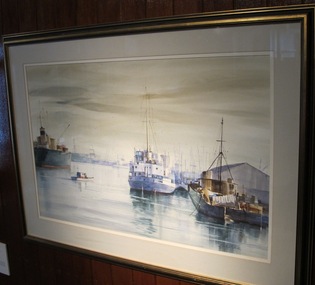 Mission to Seafarers Victoria
Painting - Watercolour, R.T. Miller, Harbour Reflections, c. 2000
... Robert Thomas Miller Born in Melbourne in 1916 Studied commercial art at RMIT and for many years worked as graphic designer and design director at ACI Ltd. Member of the Victorian Artists's Society (Council member since 1965), Australian Guild of Realist Artists, Old Water Colour Society Club (past president), Australian Watercolour Institute, Hughesdale Arts Group (past president), Burnie (Tas.) ...Robert Thomas Miller Born in Melbourne in 1916 Studied commercial art at RMIT and for many years worked as graphic designer and design director at ACI Ltd. Member of the Victorian Artists's Society (Council member since 1965), Australian Guild of Realist Artists, Old Water Colour Society Club (past president), Australian Watercolour Institute, Hughesdale Arts Group (past president), Burnie (Tas.) ...Robert Thomas Miller Born in Melbourne in 1916 Studied commercial art at RMIT and for many years worked as graphic designer and design director at ACI Ltd. Member of the Victorian Artists's Society (Council member since 1965), Australian Guild of Realist Artists, Old Water Colour Society Club (past president), Australian Watercolour Institute, Hughesdale Arts Group (past president), Burnie (Tas.) Coastal Art Group. His watercolours have won over 40 major awards, including Victorian Artists' Society, 1973 Artist of the Year Award, and the Rotary Club of Camberwell Watercolour Prize (twice). Represented in many Australian collections both public and private.Maritime artRobert T. Miller, Mission to Seafarers Victoria CollectionA framed and glazed mat mounted watercolour painting by award winning artist Robert T Miller in ''landscape" format showing moored, masted ships; The modern frame is of moulded or carved wood with appearance of brushed gilt type gilding; image is mounted with pale grey window mount; Backing sealed with paper wire strand hanging system;Artist signed front lower right corner of painting in black ink; no date; sepia label adhered on top centre Verso with artist bio and brief CV ; Other exhibition labels adhered ; inscription describing acquisition and title of work; ( details TBA) M3 in black markerharbour, dockside, artwork, marine art, robert thomas miller, robert t. miller, watercolour, artwork-paintings -
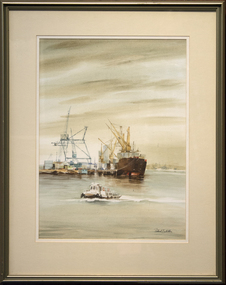 Mission to Seafarers Victoria
Painting - Watercolour, Robert Thomas Miller, The Busy Tug Boat, c. 2000
... Robert Thomas Miller Born in Melbourne in 1916 Studied commercial art at RMIT and for many years worked as graphic designer and design director at ACI Ltd. Member of the Victorian Artists's Society (Council member since 1965), Australian Guild of Realist Artists, Old Water Colour Society Club (past president), Australian Watercolour Institute, Hughesdale Arts Group (past president), Burnie (Tas.) ...Robert Thomas Miller Born in Melbourne in 1916 Studied commercial art at RMIT and for many years worked as graphic designer and design director at ACI Ltd. Member of the Victorian Artists's Society (Council member since 1965), Australian Guild of Realist Artists, Old Water Colour Society Club (past president), Australian Watercolour Institute, Hughesdale Arts Group (past president), Burnie (Tas.) ...Robert Thomas Miller Born in Melbourne in 1916 Studied commercial art at RMIT and for many years worked as graphic designer and design director at ACI Ltd. Member of the Victorian Artists's Society (Council member since 1965), Australian Guild of Realist Artists, Old Water Colour Society Club (past president), Australian Watercolour Institute, Hughesdale Arts Group (past president), Burnie (Tas.) Coastal Art Group. His watercolours have won over 40 major awards, including Victorian Artists' Society, 1973 Artist of the Year Award, and the Rotary Club of Camberwell Watercolour Prize (twice). Represented in many Australian collections both public and private.Maritime ArtRobert T. Miller, Mission to Seafarers Victoria CollectionContemporary framed in limed wood, mounted and glazed watercolour painting by R.T. MILLER in portrait format. Mat mount is white. Image features freighter with black hull at mooring in dockland setting; wire hanging systemInterpretation label adhered to back, includes photographic portrait of the artist Value on label Signature M4 in black markermarine painting, port melbourne, artwork, docklands, tug boat, robert thomas miller, robert t. miller, r.t. miller, artwork-paintings, tugboat -
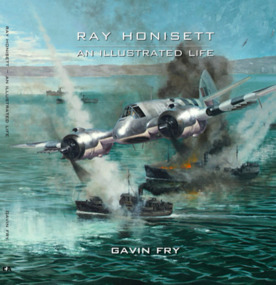 Mission to Seafarers Victoria
Book, Gavin Fry, Ray Honisett, An Illustrated Life, 2021
... Australian art and history and a large number of catalogue and journal essays. In retirement Gavin has returned to his art training and exhibits as a painter in Newcastle and Melbourne. Gavin holds the degrees of Bachelor of Arts [Hons] and Master of Arts from Monash University and Master of Philosophy from Leicester University. He has entered the ANL Maritime Art Prize several times. ray honisett gavin fry The first comprehensive study of the life and work ...The first comprehensive study of the life and work of Ray Honisett [1931-2019], one of the most significant illustrators of his generation and the doyen of Australian aviation art.164 pages, softcover with colour illustrations.non-fictionThe first comprehensive study of the life and work of Ray Honisett [1931-2019], one of the most significant illustrators of his generation and the doyen of Australian aviation art.ray honisett, gavin fry -
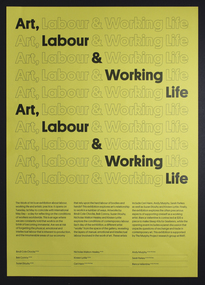 Mission to Seafarers Victoria
Poster, Art, Labour and Working Life, 2018
... work of art. CONTRIBUTION I was invited to develop the exhibition by the "Murphy Group", a group of researchers at RMIT. As the lead co-curator for the exhibition, I researched the history of artistic responses to working conditions. Through this process I identified a gap - while many artists have explored the conditions of labour and working life in their artworks, fewer have drawn attention to the working conditions of artists themselves. This became a key theme in the exhibition. The exhibition presented the work of nine contemporary Australian...work of art. CONTRIBUTION I was invited to develop the exhibition by the "Murphy Group", a group of researchers at RMIT. As the lead co-curator for the exhibition, I researched the history of artistic responses to working conditions. Through this process I identified a gap - while many artists have explored the conditions of labour and working life in their artworks, fewer have drawn attention to the working conditions of artists themselves. This became a key theme in the exhibition. The exhibition presented the work of nine contemporary Australian ...A poster printed by the RMIT in 2018, to promote an exhibition of works at the MTSV about the interelationships between labour, working life and artistic practice. BACKGROUND The Work of Art was an exhibition about labour, working life and artistic practice. The exhibition explored three aspects of art's relationship to work: (1) artworks about contemporary labour, (2) the labour of art-making itself and (3) the often precarious aspects of life as a working artist. Throughout the exhibition, different artists "worked" from the space of the gallery, revealing the layers of manual, emotional and intellectual labour involved in the work of art. CONTRIBUTION I was invited to develop the exhibition by the "Murphy Group", a group of researchers at RMIT. As the lead co-curator for the exhibition, I researched the history of artistic responses to working conditions. Through this process I identified a gap - while many artists have explored the conditions of labour and working life in their artworks, fewer have drawn attention to the working conditions of artists themselves. This became a key theme in the exhibition. The exhibition presented the work of nine contemporary Australian artists, including high profile and mid-career artists like Bindi Cole and Bek Conroy, alongside the work of emerging artists. In addition to the display of artworks throughout the space, five artists worked performatively, bringing to life the processes and manual labour involved in artmaking. A public forum extended the complex discussion on the relationship between art, work and labour. SIGNIFICANCE The works were presented in the context of a public space that has a strong relationship to contemporary labour - the Mission to Seafarers in Docklands. The Mission to Seafarers is a working mission that provides support to ship-workers. Presenting the works in this space created a real connection between the artworks and the lived experience of precarious labour. The exhibition reached a large audience including over 1000+ visitors in 10 days. It fostered a high engagement on social media and attracted media coverage including a feature in ArtsHub.A record of the ongoing involvement of the MTSV in art, and working with the art community by providing a suitable venue and display space.A3 size yellow paper promotional poster, double-sided. Three-quarters of the front of the poster is covered with the repeated line "Art, Labour & Working Life" in large font, to form ten rows. These rows are in outline form except for picked out words which are in entirely black characters and these cascade down, a row at a time, a word at a time, to form the same line ("Art, Labour & Working Life"). rmit, 2018, events, labour, working life, artistic practice, hiring event, cultural events, multimedia, nicholas walton-healey -
Federation University Historical Collection
Book, Joan Luxemburg, "The Inimitable Mr Meek' by Joan Luxemburg, 2015
... Australia. It was held at the Art Gallery of Ballarat from 13 June 2015 until 09 August 2015 james mckain meek james meek joan luxemburg artwork ballarat christchurch new zealand eureka stockade calligraphy james oddie tom touchstone warrnambool william bramwell withers photolithography francis niven peter lalor thomas bury alumni 88 page, soft covered exhibition catalogue on the work of James Meek of Ballarat. ...The exhibition and catalogue is part of a PhD project on Meek undertaken at Federation University Australia. It was held at the Art Gallery of Ballarat from 13 June 2015 until 09 August 201588 page, soft covered exhibition catalogue on the work of James Meek of Ballarat. The catalogue contains numerous illustrations of the work of James Meek.james mckain meek, james meek, joan luxemburg, artwork, ballarat, christchurch, new zealand, eureka stockade, calligraphy, james oddie, tom touchstone, warrnambool, william bramwell withers, photolithography, francis niven, peter lalor, thomas bury, alumni -
Federation University Historical Collection
Book - Report, Ballarat School of Mines Conservation Management Plan, 2016, 2016
... The Ballarat School of Mines was the first school of mines in Australasia, and is a predecessor institution of Federation University Australia. david rowe wendy jacobs ballarat school of mines conservation management plan ballarat school of mines buildings wesleyan church reserve former ballarat gaol court of mines circuit courthouse gal culvert ballarat school of mines museum ballarat technical art school x-rays ballarat junior technical school motor mechanics wool classing former governor's quarters library flecknoe building former supreme court architects henry richards caselli figgis molloy and smith public work department architects ballarat school of mines botanic garden former ballarat junior technical school commemorative gardem w.j. gribble building old chemistry building amenities building former warden's quarters courthouse theatre a.w. steane building old plumbing building unistyle hairdressing building former ballarat post office post office gallery former ballarat government offices CMP Conservation management plan Ballarat School of Mines Campus SMB Campus CD-ROM of the SMB Campus Conservation Management plan, and a printout of the 390 page Draft report on the Federation University SMB Campus. ...The Ballarat School of Mines was the first school of mines in Australasia, and is a predecessor institution of Federation University Australia.CD-ROM of the SMB Campus Conservation Management plan, and a printout of the 390 page Draft report on the Federation University SMB Campus. Contents include: Establishment of the Wesleyan church Reserve Selection of a Site for the Ballarat Gaol and Court House Building the Court of Mines The Gaol Culvert The Ballarat School of Mines Establishment Ballarat iron Workers' Association Ballarat Technical Art School Ballarat School of Mines Museum Acquisition of Lewin's Land The Ballarat School of Mines site in c1970 Master Planning Flecknoe Biulding The Ballarat School of Mines in 1988 Architectects Caselli, Figgus, Molloy and Smith. Public Work Department Architects Ballarat School of Mines Botanical Garden Former Ballarat Junior Technical School Administration Building - Building A W.J. Gribble Building (Ballarat Technical Art School) - Building B Old Chemistry Building Building C Amenities Building, Governor's Quarters, Gaol Gatehouse and Watch Tower and Gaol Walls - Building D Courthouse Theatre (Former Ballarat Supreme Court) - Building F A.W. Steane Building (Former Ballarat Junior Technical School) - Building J Flecknoe Building and E.J. Barker Building (Building N) Old Plumbing Building - Builidng ) Unistyle Haridressing Building (Formerly Ballarat School of Mines Museum and Wesleyan Church) - Building P david rowe, wendy jacobs, ballarat school of mines conservation management plan, ballarat school of mines, buildings, wesleyan church reserve, former ballarat gaol, court of mines, circuit courthouse, gal culvert, ballarat school of mines museum, ballarat technical art school, x-rays, ballarat junior technical school, motor mechanics, wool classing, former governor's quarters, library, flecknoe building, former supreme court, architects, henry richards caselli, figgis, molloy and smith, public work department architects, ballarat school of mines botanic garden, former ballarat junior technical school commemorative gardem, w.j. gribble building, old chemistry building, amenities building, former warden's quarters, courthouse theatre, a.w. steane building, old plumbing building, unistyle hairdressing building, former ballarat post office, post office gallery, former ballarat government offices, cmp, conservation management plan, ballarat school of mines campus, smb campus -
Federation University Historical Collection
Booklet, The Ballarat School of Mines and Industries 1870-1920 Jubilee Booklet, 1920 (estimated)
... Art Metal Work, Woodcarving, Needlework, and Leather work. The Trade Classes give instruction in Telephone Mechanics, telegraphy, Carpentry, Cabinet Making, Plumbing, Blacksmithing, Fitting, Electric Wiring, and Printing. Numerous Scholarships are offered every year, and altogether students will find few places to equal the Ballarat School of Mines and Industries as a training place for their life's work. One of the first in the continent to be established, its Jubilee finds it still in the front rank, keeping pace with the times, and offering to the youths of this country the means of taking advantage of Australia's...Art Metal Work, Woodcarving, Needlework, and Leather work. The Trade Classes give instruction in Telephone Mechanics, telegraphy, Carpentry, Cabinet Making, Plumbing, Blacksmithing, Fitting, Electric Wiring, and Printing. Numerous Scholarships are offered every year, and altogether students will find few places to equal the Ballarat School of Mines and Industries as a training place for their life's work. One of the first in the continent to be established, its Jubilee finds it still in the front rank, keeping pace with the times, and offering to the youths of this country the means of taking advantage of Australia's ...The first school of Mines in Australia was established at Ballarat in 1870. At the time of its jubilee (1930) the following people were members of the School Council: W.H. Middleton (President), W.T. Humphreys (VP), J.S. Vickery (VP), F. Barrow, Col. W.K. Bolton, William Baragwanath, A.E. Cutter, J.N. Dunn, G. Fitches, W.H. Fleay, F. Herman. W.D. Hill, T. Hurley, K. Kean. J. Kelly, L. Lederman, Mayor of Ballarat, Mayour of Ballarat East, D. Maxwell, M. Martin, R. Maddern, D. Ronaldson, F. Saunders, R. Stephenson, A.O. Stubbs, R.E. Tunbridge. The School Staff in 1920 comprised: Herbert H. Smith, Walter Rowbotham, Reginald L. Cutter, M.C. Young, Hilda Wardle, M. Wiliamson, P.S. Richards, L.H. Archibald, J. Woods, Ken Moss, W. Kenneth, Mrs McIlvena. B. Robinson, S. Rowe, E. Hope-Jones, Miss Abrams, L.St.G.P. Austin, Alfred Mica Smith, J.R. Pound, Herbert R. Murphy, N.H. Junner, Maurice Copland, L.H. Archibald, E.J.A. McConnon, Newton King, D.m. Hull, T.R. Gordon, John M. Sutherland, T.K. Jebb, Dick Richards, C. Tonkin, A.W. Steane, J. Paterson, H.W. Malin, R.V. Maddison, S.M. Mayo, F.A. King, W.H. Steane, T.R. Gordon, T.A. Williams, H. Waldron, G. Black, E.J. McConnon, R.V. Duncan. R. Cutter, E.G. Vawdrey, Hilda WardleWhite stapled booklet - landscape format - 20pp + soft covers with blue writing. Includes an historical sketch of the Ballarat School of Mines. Contains images of the school from around 1920. The history outlined in the booklet follows: 'Ballarat has helped to influence the life and destinies of Australia in many ways, the recital of which would perhaps prove tedious to the citizens of less favoured localities! However, it can be said, without much fear of contradiction, that only less known thought Australia than its fame as a gold field is the reputation won for it by its school of Mines, ... Ballarat was still quite a new place when the School was founded, but a very propserous and popular place all the same, with a go-ahead lot of citizens brim full of the spirit of enterprise which seemsto animate mining populations generally. Money was plentiful, and they launched out into ventures, which later, were to develop and take the place of the gold mines, while what is more to the point, they understood the value of education. the old digging days were passing away. So far as Ballarat itself was concerned the day of the cradle and tin dish had already passed into an antiquity "as dead and distant as the age of the Tubal Caon," said dir redmond Barry on declaring the School open. Mining had become a serious business, and the mining engineer, the metallurgist, and the geologist had become a power in the land. In these circumstances the suggestions to found a School of Mines met with ready acceptance. The late Mr James M. Bickett had the honor of bringing forward the proposition at a meeting of the Ballarat Mining Board in October, 1869. it was agreed to, and the Government, having been approached for assistance, granted a lease of the old Supreme Court buildings at a nominal reantal. A modest sum, including 100 pounds from the Borough Council of Ballarat West, was subscribed by a number of sympathisers, and on the 26th October, 1870, the inaugural address was delivered by Sir Redmond Barry, the first President of the School. Classes were commenced on the 23rd January, 1871. The students at first were mostly adults. They were chiefly men emloyed at the mines, who had the wisdom and energy to devote their spare time to study, and, though their attendance was somewhat irregular, they made very good progress. Old prints which have been preserved show them at work at furnaces, big bearded men of the old-fashioned type of miner. It is interesting to note that among those who gave evidence and encouragement was Sir Roderick Murchison, who many years before had advised Cornish miners to emigrate to Australia to search for gold, and who in 1848 was in possession of gold ore sent from this country. Sir Roderick sent a parcel of books for the library, and gave useful advice as to the curriculum which should be adopted. The Museum, which now contains a most valuable collection of minerals, was one of the first things attended to, and the reports presented to the Council from time to time speak of additions being made from all parts of the world. New equipment was constantly being added to the School, a good deal of assay work was done, and some specimens were sent from the East Indies for examination as far back as 1873. By this time there was a difficulty in providing accomodation for the students who wished to enrol, and the number of instructors had grown from two to four. In 1882 the first building was being erected on what was then part of the gaol reserve. A little more than ten years afterwards a buildnig formerly serving as a Methodist Church was absorbed, while later on, the demand for accomodation increasing, the attack upon the gaol was renewed. The School continued to grow in reputation and size, and became the science centre of the district, and in 1889 a learge new building was opened by Sir Alexander Peacock. Students came from over seas as well as from all the States of Australia, and after going through their courses they took with them the name and fame of the old School to all parts of the globe. School of Mines boys have played a great part in developing the mining fields of Western Australia, South Australia, and africa, while old students who have made a name in their profession are constantly dropping in to see how the old place is getting along. It was not to be expected, however, that the Ballarat School would be left without rivals, its very success inspiring competition. Mining Schools were started in other parts of Australia, and, at the same time, Victoria ceased to hold first place as a mining state. On the other hand there was a great advance in manufacturing, and the demand for technicaly trained men became a great and as insistent as ever it had been for trained mining men. The Council was quick to adapt the school to the new conditions, and the result is seen in the institution, which is one of Ballarat's proudest possession. Instruction is given in all branches of technical work, and the classes are filled with students who are building up for Ballarat a reputation as an industrial centre, which promises to equal that which it formerly held as a mining town. Owing to its bracing climate, its abundant opportunities for recreations, and its accessibilty, Ballarat as a city is an ideal place for educational purposed, and is yearly becoming more and more appreciated throughout the State. The chairman of one of Ballarat's biggests industries claims that the workman can do twice the day's work here that he can do in Melbourne. he was a little enthusiastic over it, perhaps, but it is a well-known fact that the healthy and invigourating Ballarat climate is conducive to both physical and mental activity, and the records of the School provide ample proof of it. One of the most interesting and successful branches of the School of Mines and Industries - if the name be enlarged with the enlargement of its scope - is the Technical Art School. "The City of Statues" has from its earliest days been a stronghold of art. Art schools have flourised here, and in 1905 the Education Department came to the conclusion that the best thing to do with them was to place them under the management of the School of Mines Council. A magnificent new Technical Art School was built at a cost of some 12,000 pounds on the site of the old Supreme Court building, and was formally opened on the 23rd July, 1915. The results have not only been justified but surpassed all anticipations. The most comprehensive list of subjects is taught, and this list is constantly added to. Students have flocked to the art School, which may be said to occupy a unique position in Australia, and its record of success is really astonishing. Its students supply art teachers for the newer schools that are being built, and many occupy leading positinos in important business houses. So well is its reputation known that orders are constantly being received, not only from Victoria, but from other States, for honor boards and challenge shields to be designed and made. The most recent addition to the School of Mines and Industries is the Junior Technical School, for which a new building is now being erected on a portion of the gaol site, transferred to the School of Mines Counci by the Government. At the present moment temporary quarters are being occupied. Some students after passing through the Junior School go straight to employment, continuing perhaps to attend the evening trade classes, while others move on to the senior School. In a review of the work of the School of Mines mention must be made of a series of industrial research carried out under supervision of the Principal. One in particular, regarding the suitability of the local ores for the manufacture of pigments attracted much attention, while the experiemtns on the manufacture of white potery from Victorian clayes were considered of sufficient importance by the Federal Advisory Council of Science and Industry to warrant the appointment of a special investigator. The results of these have been most encouraging, and may have far-reaching consequences. The vocational training of returned soldiers also should not be overlooked. The work was taken in hand from the first, before the Repatriation Department gave assistance, and now with the help of the department of the School has become one of the largest vocational training centres in Victoria outside of Melbourne. The soldiers, trained in a variety of occupations, have made remarkable progress, and already considerable numbers have found employment in local workshops and factories. To sum up, the School is divided into the following departments, each well staffed and equipped: - The School of Mines, science, and Engineering; the Techncial Art School, the Boys' Junior Technical School, the Girl's Preparatory Technical Classes, Trade Classes, and the Commercial School. The school of Mines, science and Engineering, comprises the following branches: - Mining, Metallurgy, Geology, Electrical Engineering, Civil Engineering, Mechanical Engineering, Applied Chemistry, and Pharmacy. Battery treatments, Cyanide Testing, Smelting, Assays, and Clay Testing from a regular part of the School's work. Students gaining qualifications obtain concession in their courses at the university, should they proceed there to continue their studies. The technical Art school curriculum includes training in all branches of pictorial and applied art, an Architectural Diploma Course, a Draughtman's Course, technical Art teachers' Course, Photography,Ticket Writing, Art Metal Work, Woodcarving, Needlework, and Leather work. The Trade Classes give instruction in Telephone Mechanics, telegraphy, Carpentry, Cabinet Making, Plumbing, Blacksmithing, Fitting, Electric Wiring, and Printing. Numerous Scholarships are offered every year, and altogether students will find few places to equal the Ballarat School of Mines and Industries as a training place for their life's work. One of the first in the continent to be established, its Jubilee finds it still in the front rank, keeping pace with the times, and offering to the youths of this country the means of taking advantage of Australia's teeming opportunities. william, battery, smith, herbert, drawing from the antique, ballarat school of mines botanical gardens, ballarat school of mines, redmond barry, alfred mica smith, james bickett, museum, dick richards, ballarat junior technical school, s m b, ballarat school of mines and industries, ballarat technical art school, model mine, james m bickett, j m bickett, roderick murchison, vocational training rooms, wesley church, methodist church, alexander peacock, lathes, repatriation, repatriatin department, war service, school council, baragwanath, gold mining, mining laboratory, plaster cast, r.w. richards, anniversary, jubilee -
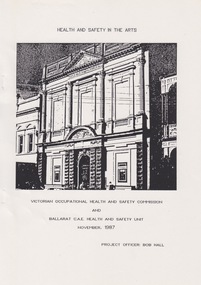 Federation University Historical Collection
Document - Document - Booklet, VIOSH: VIOSH Commission and Ballarat College of Advanced Education Health and Safety Unit: Health and Safety in the Arts, Bob Hall, 1987
... Australia and industry. Students are taught active research and enquiry; rather than textbook learning and a one-size fits all approach. VIOSH accepts people into the Graduate Diploma of Occupational Hazard Management who have no undergraduate degree - on the basis of extensive work experience and knowledge. The stimulus for this project to investigate health and safety in art...Australia and industry. Students are taught active research and enquiry; rather than textbook learning and a one-size fits all approach. VIOSH accepts people into the Graduate Diploma of Occupational Hazard Management who have no undergraduate degree - on the basis of extensive work experience and knowledge. The stimulus for this project to investigate health and safety in art ...Victorian Institute of Occupational Safety and Health (VIOSH) Australia is the Asia-Pacific centre for teaching and research in occupational health and safety (OHS) and is known as one of Australia's leaders on the field. VIOSH has a global reputation for its innovative approach within the field of OHS management. VIOSH had its first intake of students in 1979. At that time the Institution was known as the Ballarat College of Advanced Education. In 1990 it became known as Ballarat University College, then in 1994 as University of Ballarat. It was 2014 that it became Federation University. VIOSH Australia students are safety managers, senior advisors and experienced OHS professionals. They come from all over Australia and industry. Students are taught active research and enquiry; rather than textbook learning and a one-size fits all approach. VIOSH accepts people into the Graduate Diploma of Occupational Hazard Management who have no undergraduate degree - on the basis of extensive work experience and knowledge. The stimulus for this project to investigate health and safety in art teaching and to suggest cost effective control measures, arose from concerns that had been expressed by some members of staff within the Arts Faculty at the Ballarat College of Advanced Education about aspects of health and safety at their workplace. As a non-artist it is hard to attempt to describe the artists' perspective of their working environment. Within the artistic community there is a great concern for individuality and this is expressed in the artists' work. The need for flexibility and spontaneity is a vital and intuitive part of the artistic environment. Consequently codes and standards of practice that would restrict this environment ethic are unlikely to be viewed favourably by artists. Comments made by Bob Hall; Project Officer BCAESixty pages stapled together. Type written with illustrations relevant to safety issues. Front has clear perspex sheetviosh, victorian institute of occupational safety and health, bob hall, project officer, commission, ballarat college of advanced eucation, health and safety in the arts, control measures, codes and standards of practice, chemical environment, protective equipment, management of environment, noise, machines, temperature control -
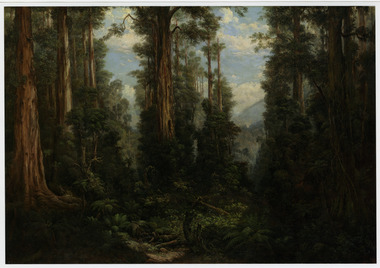 Marysville & District Historical Society
Painting (Item) - Oil painting, Isaac Whitehead, A spring morning near Fernshaw 1880, 1880
... Isaac Whitehead (1819–1881) was an Irish-Australian artist who worked in watercolour and pastel. He was also a picture framer and art promoter. ...A copy of an early oil painting of Fernshaw in Victoria.A copy of an early oil painting of Fernshaw in Victoria by Isaac Whitehead. Isaac Whitehead (1819–1881) was an Irish-Australian artist who worked in watercolour and pastel. He was also a picture framer and art promoter. It is believed that Isaaz Whitehead emigrated to Australia with his family in either 1853 or 1858. Isaac Whitehead died at his home 50 Punt Road, Prahran, Melbourne, on 21 April 1881. Isaac Whitehead had established himself as the foremost picture framer in Melbourne by 1860, known for his highly ornate frames with floral decorations. Among the clients of his framing business were Louis Buvelot, Nicholas Chevalier, and Eugene von Guérard. In his own paintings, he painted a number of scenes of the forests of Gippsland, Victoria. His work focused on the rich landscapes with trees and ferns, with a high degree of botanical detail. His work won him two medals and his work was posthumously exhibited at 1884 Victorian Jubilee Exhibition, the 1886 London Colonial and Indian Exhibition, and the 1888 Melbourne Centennial Intercolonial Exhibition. Fernshaw was a rural township 63 km northeast of Melbourne and 10 km northeast of Healesville. Situated on the Watts River, near where a log had fallen making a convenient crossing, Fernshaw was settled in the 1860s. It provided good country for orchards and berry growing. The location was at the foot of Blacks Spur, with Mounts Juliet and Mondah rising on either side, providing spectacular scenery. There were nearby fern gullies giving rise to the name – ‘shaw’ is old English for thicket or wood. By 1875 Fernshaw had a post office (1865), two hotels, a school (1871), and stores. It was famed for its beauty, attracting tourists. In 1886 the Melbourne and Metropolitan Board of Works began work on the Watts River water catchment scheme – later to become Maroondah – and the Board obtained approval for the catchment country to be reserved and kept free of settlement. This required the removal of the Fernshaw township, which was completed by about 1890.isaac whitehead, fernshaw, victoria, louis buvelot, nicholas chevalier, eugene von guerard, gippsland, victorian jubilee exhibition, london colonial and indian exhibition, melbourne centennial intercolonial exhibition, watts river, healesville, blacks spur, mount juliet, mount mondah
