
Showing 97 items matching "australian one penny"
-
 Tatura Irrigation & Wartime Camps Museum
Currency - Coin, Australian One Penny 1932, 1932
... Australian One Penny 1932...Circular Commonwealth of Australia copper coin, value one penny, dated 1932. Head and shoulders impression of George V wearing a crown on reverse side...Contained in a gold coloured material covered display box. camp 13 penny coin australian currency 1932 australian penny one penny Circular Commonwealth of Australia copper coin, value one penny, dated 1932. ...Found at POW camp 13 site post war by war time guard. Contained in a gold coloured material covered display box.Circular Commonwealth of Australia copper coin, value one penny, dated 1932. Head and shoulders impression of George V wearing a crown on reverse sideone pennycamp 13, penny coin, australian currency, 1932 australian penny -
 Tatura Irrigation & Wartime Camps Museum
Currency - Coin, Australian One Penny 1945, 1945
... Australian One Penny 1945...Circular Commonwealth of Australia copper coin, value one penny, dated 1945. Head and shoulders impression of George V1 on reverse side. ...Latin script around circumference. Australian One Penny 1945 Currency Coin Melbourne Mint ...Found at POW camp 13 site post war by war time guard. Contained in a gold coloured material covered display box.Circular Commonwealth of Australia copper coin, value one penny, dated 1945. Head and shoulders impression of George V1 on reverse side. Kangaroo on front. Latin script around circumference.Australian half penny 1945camp 13, penny coin, australian currency, murchison internment camp -
 Tatura Irrigation & Wartime Camps Museum
Currency - Coin, Australian One Penny 1943, 1943
... Australian One Penny 1943...Circular Commonwealth of Australia copper coin, value one penny, dated 1943. Head and shoulders impression of George V1 on reverse side. ...Contained in a gold coloured material covered display box. camp 13 penny coin australian currency murchison camp 1942 australian penny Australia Penny 1943 Circular Commonwealth of Australia copper coin, value one penny, dated 1943. ...Found at POW camp 13 site post war by war time guard. Contained in a gold coloured material covered display box.Circular Commonwealth of Australia copper coin, value one penny, dated 1943. Head and shoulders impression of George V1 on reverse side. Kangaroo in flight on front. Latin script around circumference.Australia Penny 1943camp 13, penny coin, australian currency, murchison camp, 1942 australian penny -
 Bendigo Historical Society Inc.
Ephemera - XMAS CARD IN CARDBOARD BOX / CARDBOARD BOX WITH A ONE PENNY AUSTRALIAN POSTAGE STAMP
... XMAS CARD IN CARDBOARD BOX / CARDBOARD BOX WITH A ONE PENNY AUSTRALIAN POSTAGE STAMP...Enclosed in small cardboard box with a one penny Australian Postage stamp .Addressed to Miss Ada Bailey Dudley House, View Street Bendigo, Victoria....Enclosed in small cardboard box with a one penny Australian Postage stamp .Addressed to Miss Ada Bailey Dudley House, View Street Bendigo, Victoria. ...British manufacture XMAS card with Celluloid front - showing floral and vine leaves decoration - reading 'Good luck To Greet You. Xmas message inside. Enclosed in small cardboard box with a one penny Australian Postage stamp .Addressed to Miss Ada Bailey Dudley House, View Street Bendigo, Victoria.British manufactureephemera, mementoes, miss ada bailes dudley house , view street bendigo , victoria -
 Bendigo Military Museum
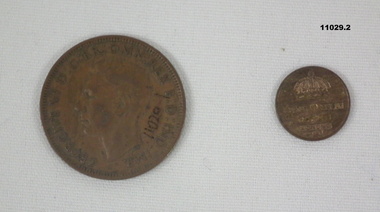
Coin - COPPER COINS, Aust Penny 1942, Swedish Krona 1956
... Australian One penny...Australian Penny, Year 1942. Features a Kangaroo one side and bust of King George IV on rear. 2. ...See 11021. Australian One penny Swedish coin 1. Australian Penny, Year 1942. ...See 11021.1. Australian Penny, Year 1942. Features a Kangaroo one side and bust of King George IV on rear. 2. Swedish Krona, shows a Crown and the number 1. Date 1956. Other side has a Crown and words Gustave Adolf Sveridge Koning.australian one penny, swedish coin -
 Emerald Museum & Nobelius Heritage Park
Coin - Australian penny 1922, 1922
... Australia...1922...one penny...On back of coin: COMMONWEALTH OF AUSTRALIA / ONE / PENNY / 1922 On front of coin: Portrait of monarch George V and Latin inscription...penny bought a postage stamp at the time. The Charmans were early residents in Emerald, particularly well known for running the Brookdale Guest House in the early part of the 20th century. Charman coins Emerald Victoria Australia 1922 one ...This 1922 penny bought a postage stamp at the time. The Charmans were early residents in Emerald, particularly well known for running the Brookdale Guest House in the early part of the 20th century.One Penny - 1922 - owned by Charman familyOn back of coin: COMMONWEALTH OF AUSTRALIA / ONE / PENNY / 1922 On front of coin: Portrait of monarch George V and Latin inscriptioncharman, coins, emerald, victoria, australia, 1922, one penny -
 Warrnambool and District Historical Society Inc.
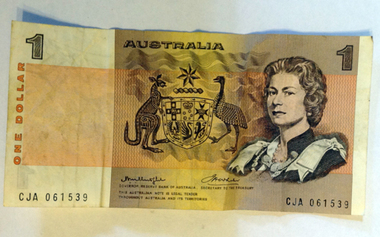
Currency - Australian 1962 & 1966, 1962 & 1966
... 000496.1 Australian decimal currency bank note: $1 note 000496.2 Australian decimal currency coin: 2c 000496.3 Australian pre-decimal currency coin: 1 penny The one dollar notes are orange, yellow, black and white in colour. ...One dollar note- numbers CJA 061539 and CEU 647543 Two cent coin: Elizabeth 11, Australia 1966 One penny: Australia, Penny, 1962 ...These coins are kept as mementoes of notes and coins no longer in use and are therefore of historical interest. australian currency Australian decimal currency Pre-Decimal Currency in Australia One dollar note- numbers CJA 061539 and CEU 647543 Two cent coin: Elizabeth 11, Australia 1966 One penny: Australia, Penny, 1962 000496.1 Australian decimal currency bank note: $1 note 000496.2 Australian decimal currency coin: 2c 000496.3 Australian pre-decimal currency coin: 1 penny The one dollar notes are orange, yellow, black and white in colour. ...In value the penny was the second smallest denominator in the old imperial currency in Australia in the mid 20th century (halfpenny was the smallest). Decimal currency was introduced in 1966 and the two cent coin was the second lowest in value. It was withdrawn from circulation in 1992 but it is still legal tender in some circumstances. This coin was minted in the first year of decimal currency in Australia. The dollar note was introduced in 1966 and it in turn was replaced in 1984 by the dollar coin. These coins are kept as mementoes of notes and coins no longer in use and are therefore of historical interest. 000496.1 Australian decimal currency bank note: $1 note 000496.2 Australian decimal currency coin: 2c 000496.3 Australian pre-decimal currency coin: 1 penny The one dollar notes are orange, yellow, black and white in colour. They have images of Queen Elizabeth 11 and the Australian Coat of Arms on one side and aboriginal motifs on the other side. The metal two cent coin has the Queen’s head on one side and an image of a frilled lizard on the other. The metal penny has the Queen’s head on one side and a kangaroo image on the other.One dollar note- numbers CJA 061539 and CEU 647543 Two cent coin: Elizabeth 11, Australia 1966 One penny: Australia, Penny, 1962 australian currency, australian decimal currency, pre-decimal currency in australia -
 Tatura Irrigation & Wartime Camps Museum
Currency - Coin, Australian Penny 1945, 1944
... Circular Commonwealth of Australia copper coin, value one penny, dated 1945. Head and shoulders impression of George V1 on reverse side. ...Contained in a gold coloured material covered display box. camp 13 penny coin australian currency murchison camp Australian penny 1944 Circular Commonwealth of Australia copper coin, value one penny, dated 1945. ...Found at POW camp 13 site post war by war time guard. Contained in a gold coloured material covered display box.Circular Commonwealth of Australia copper coin, value one penny, dated 1945. Head and shoulders impression of George V1 on reverse side. Kangaroo in flight on front. Latin script around circumference.Australian penny 1944camp 13, penny coin, australian currency, murchison camp -
 Ballarat Tramway Museum
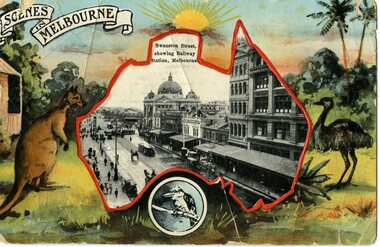
Postcard, Swanston St Melbourne, showing Flinders St station, 1913
... On rear of card "Printed in Saxony" Has been sent by a person on the RMS Medina, from Sydney, 29/10/1913 to Miss M Fenton at the "All Nations Hotel", Port Melbourne. Has an Australian 1d one penny stamp....On rear of card "Printed in Saxony" Has been sent by a person on the RMS Medina, from Sydney, 29/10/1913 to Miss M Fenton at the "All Nations Hotel", Port Melbourne. Has an Australian 1d one penny stamp. Swanston St Melbourne, showing Flinders St station Postcard ...Yields information about Swanston St Melbourne and demonstrates German printed colour photo postcards.Black and white view of Swanston St Melbourne, showing Flinders St station, with cable trams, located within a map of main land Australia, with a colour printed background containing a kangaroo, emu and kookaburra. Title "Scenes in Melbourne". On rear of card "Printed in Saxony" Has been sent by a person on the RMS Medina, from Sydney, 29/10/1913 to Miss M Fenton at the "All Nations Hotel", Port Melbourne. Has an Australian 1d one penny stamp.Written on reartrams, tramways, postcards, melbourne, swanston st -
 Kiewa Valley Historical Society
Whistle Penny, circa 1950s
... Penny Whistle made in Thailand Circa 1955. The item was one of the first wave of imports from the growing Asian steel producers. This was an era where cheaper Asia based steel companies did not compete against the stronger, and well established Australian ones. ...Penny Whistle made in Thailand Circa 1955. The item was one of the first wave of imports from the growing Asian steel producers. This was an era where cheaper Asia based steel companies did not compete against the stronger, and well established Australian ones. ...This item is a cheap Penny Whistle made in Thailand Circa 1955. The item was one of the first wave of imports from the growing Asian steel producers. This was an era where cheaper Asia based steel companies did not compete against the stronger, and well established Australian ones. This Penny Whistle was "roughly" made and possibly purchased by the Victorian Education Department for use in school bands and music classes. Schools within the Kiewa Valley would have used them to integrate students the fundamentals of reading music and playing basic musical scores. Later conversion from steel to plastics would have been more conducive to multiple users in a classroom environment (more hygienic and rust proof.This item shows how the "cheaper" invasion of all types of manufactured goods from the Asian regions have altered the purchasing patterns of rural Australians(the more traditional consumer). The cost imbalance of purchasing from "The Mother Country (England)" or European supply versus the Asian manufacturers was due to not only the financial pressures post World War II but also in the elimination of Tariff restrictions placed on non favoured suppliers.This tin Penny Whistle is made from rolled tin(steel), cylindrical in shape, with a wooden Fipple plug at the mouth end and six note holes starting half way down the front side evenly spaced and ending 35mm from the bottom. This whistle is in the key of D"G steel & Co. D"music, wind instruments, whistle, celtic music -
 Lara RSL Sub Branch
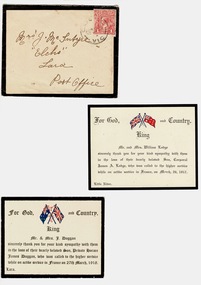
Sympathy Cards Mc Intyre, 1917 and 1918
... Envelope Addressed to Mrs J MC Intyre Elcho Lara Australia, includes a one penny stamp. Two standard printed Cards " Thanking you for your kind Sympathy ........." . ...Standard sympathy cards sent by family acknowledging the loss of their sons killed during World War One Standard sympathy cards sent by parents acknowledging letters of sympathy sent to them on the loss of their sons. Envelope Addressed to Mrs J MC Intyre Elcho Lara Australia, includes a one penny stamp. ...Standard sympathy cards sent by family acknowledging the loss of their sons killed during World War OneStandard sympathy cards sent by parents acknowledging letters of sympathy sent to them on the loss of their sons.2 Cards and one envelope stuck to white a4 paperEnvelope Addressed to Mrs J MC Intyre Elcho Lara Australia, includes a one penny stamp. Two standard printed Cards " Thanking you for your kind Sympathy ........." . One card from Mr. and Mrs. Lodge for the loss of their son Corporal James A lodge ( France March 26 1917) Little River and the other from Mr. and Mrs. J Duggan Lara on the loss of their son Private Horace James Duggan. (France 27th March 1918) For God, King and Country with the Australian and English flag. -
 Bendigo Historical Society Inc.
Postcard - GLADYS DEAN COLLECTION: POSTCARD, 1906 - 1908
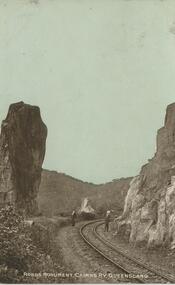
... Image is sepia with a pale blue sky.The words Robbs Munument Cairns Ry Queensland are printed in white along the bottom of the image.The reverse is addressed to Miss Dean Post Office Golden Square Victoria. A one penny Australian stamp postmarked Rockhampton Queensland is affixed to the top right hand corner....Image is sepia with a pale blue sky.The words Robbs Munument Cairns Ry Queensland are printed in white along the bottom of the image.The reverse is addressed to Miss Dean Post Office Golden Square Victoria. A one penny Australian stamp postmarked Rockhampton Queensland is affixed to the top right hand corner. ...Photographic postcard of Robbs Monument CAirns Railwya Queensland. Image of railway line curving around a hill with two men standing either side of the railway line looking up at a rocky monolith. Image is sepia with a pale blue sky.The words Robbs Munument Cairns Ry Queensland are printed in white along the bottom of the image.The reverse is addressed to Miss Dean Post Office Golden Square Victoria. A one penny Australian stamp postmarked Rockhampton Queensland is affixed to the top right hand corner.postcard -
Bendigo Historical Society Inc.
Document - ROYAL PRINCESS THEATRE COLLECTION: MAJORIE IN WONDERLAND, 12 Aug 1916
... ... One Penny. Australian Children's Pantomime. Matinee Performance. ...Price of Program, One Penny. Australian Children's Pantomime. Matinee Performance. ...Price of Program, One Penny. Australian Children's Pantomime. Matinee Performance. ...Royal Princess Theatre - Majorie in Wonderland. Saturday, 12 August, 1916. Price of Program, One Penny. Australian Children's Pantomime. Matinee Performance. In Aid of Fruit and Vegtable Fund For Our Soldiers in The Trenches. Produced by Miss Girlie Mackay. Children's Vocal Training by Madame Rossow. Dialogue by Miss Eileen O'Keefe. Musical Director, Mr Stanley Upton. Stage Manager, Mr J Dunphy. Lighting Effects Mr W Wenborn. Theatre kindly lent by W Crowley, Esq. Hon. Sec., Norman Howell. Prologue. The curtain rises showing the flowers asleep. The fairies, summoned by daylight, entre and sing, awakening the flowers, and leave. Then Puck entres, followed by the Blue Wrens, singing, and after them the Bunnies, who are all . . . Sale of Sweets supervised by Miss Nita Weller and Assistants. Novelties by Mrs Julius Cohn. Dresses designed and made by Mrs McQuie, Mrs Marc Cohn, Miss Lena Weller, and Miss Girlie Mackay, assisted by Mrs Balsillie, Mrs Ralph Ross. Mrs Robert Makayand the Misses Gladys McQuie, Norma Moorhead, Carola Iser, and Hilda Meurer. Program: Songs sung throught Performance. Act I. 1 Chorus-Fairy Song. 2 'Bunnies' Adventure' by the Bunnies. 3 Chorus-Holiday Song. 4 Bell Bird Duett-Jean & Jim Walker. 5 Sailor's Hornpipe-Crissie Cravino. 6 'Marjorie Sunbeam'-Myrtle Glanville. 7 'As I went o'er the Paddock'-Jean Walker. 8 Chorus'Billy Tea. 9 Song-'Possum'-Bertie Barkell. 10 'Bogie Man'-Stella Coghlan. 11 'Kookooburra'-Mel Wearne. 12 Chorus-'Winter Bells'. Act II. 1 Chorus-'Autumn Winds'. 2 'Stay Little Wave'-Jean Walker. 3 'Southern Cross'-Rose Murphy. 4 Song-'Kangaroo'-Brownies. 5 'Pixie Man'-Ruthie Murphy. 6 Chorus-'Wattle'. 7 'Grow Little Mushroom'-Stella Cook. 8 'Cooee'-Myrtle Glanville & Marie Hamilton. 9 Butterfly Dance-Sheila Shannon.10 'King Billy & Black Mary'-Ken McQuie. 11 Boomerang Song-Ken McQuie. 12 Final Chorus-'To the Fairies', 'Good Night'. God Bless Our Splendid Men. Cast of Characters:Marjorie & Jean Walker, Myrtle Glanville, Ruthie Murphy, Marie Hamilton, Thelma Thomas, Stella Coghlan, Jim Walker, Jim Long, Bertie Barkell. Fairies:-Mary Hunter, Lily Brown, Una Grelis, Biddie Bulley, Rosa Dyring, Ellie Colcough, Ida Collins. Puck:-Una Leggo. Butterfly:-Sheila Shannon. Brownies:-Tom Green, Douglas McQuie, Hunphrey, Gill, Mel Wearne, Laurence Skewes. Aboriginal:-Ken Mquie. Frog:-Sid Whitelaw. Native Bear:-Ken Moore. Blue Wrens:- Alma Jorgenson, Doris Reed, Geoff Schultz, Jean Cahill. Flowers. Orchids:- Joyce Ross, Margaret Long, Dorothy Thomas, Margaret McQuie, Mollie Roberts, Rose Murphy. Pink Gums:-Lorna Weddell, Minnie Hartley, Isola Woodward, Jean Moran, Decima Holtorf, Merle Nagel. Flannel Flowers: Gwen Hunter, Nancy Tatchell, Catherine Green, Mary Rymer, Thelma Cairns, Cecil Gleeson. Poppies:-Lorna Cattran, Alice Murphy, Maisie O'Grady, Eileen Coglan, Alma McWilliams, Jean Miller. Blue Bells:-Mavis Tozer, Vivian Reed, Monnie Fattorini, Gwennie Seely, Alice Evans, Lily O'Conner. Southern Cross:-Eileen Martin, Jean Murdoch, Effie Williams, Verna Mayne, Minnie Hartley, Mollie Martin.Cambridge Press, Print.program, theatre, royal princess theatre, royal princess theatre - majorie in wonderland. 12 august, 1916. program, one penny. australian children's pantomime. matinee performance. in aid of fruit and vegtable fund for our soldiers in the trenches. produced by miss girlie mackay. children's vocal training by madame rossow. dialogue by miss eileen o'keefe. musical director, mr stanley upton. stage manager, mr j dunphy. lighting effects mr w wenborn. theatre lent by w crowley, esq. hon. sec., norman howell. prologue. the curtain rises showing the flowers asleep. the fairies, summoned by daylight, entre and sing, awakening the flowers, and leave. then puck entres, followed by the blue. . . sale of sweets supervised by miss nita weller and assistants. novelties by mrs julius cohn. dresses designed and made by mrs mcquie, mrs marc cohn, miss lena weller, and miss girlie mackay, assisted by mrs balsillie, mrs ralph ross. mrs robert makayand the misses gladys mcquie, norma moorhead, carola iser, and hilda meurer. program: songs sung throught performance. act i. 1 chorus-fairy song. 2 'bunnies' adventure' by the bunnies. 3 chorus-holiday song. 4 bell bird duett-jean & jim walker. 5 sailor's hornpipe-crissie cravino. 6 'marjorie sunbeam'-myrtle glanville. 7 'as i went o'er the paddock'-jean walker. 8 chorus'billy tea. 9 song-'possum'-bertie barkell. 10 'bogie man'-stella coghlan. 11 'kookooburra'-mel wearne. 12 chorus-'winter bells'. act ii. 1 chorus-'autumn winds'. 2 'stay little wave'-jean walker. 3 'southern cross'-rose murphy. 4 song-'kangaroo'-brownies. 5 'pixie man'-ruthie murphy. 6 chorus-'wattle'. 7 'grow little mushroom'-stella cook. 8 'cooee'-myrtle glanville & marie hamilton. 9 butterfly dance-sheila shannon.10 'king billy & black mary'-ken mcquie. 11 boomerang song-ken mcquie. 12 final chorus-'to the fairies', 'good night'. god bless our splendid men. cast of characters:marjorie & jean walker, myrtle glanville, ruthie murphy, marie hamilton, thelma thomas, stella coghlan, jim walker, jim long, bertie barkell. fairies:-mary hunter, lily brown, una grelis, biddie bulley, rosa dyring, ellie colcough, ida collins. puck:-una leggo. butterfly:-sheila shannon. brownies:-tom green, douglas mcquie, hunphrey, gill, mel wearne, laurence skewes. aboriginal:-ken mquie. frog:-sid whitelaw. native bear:-ken moore. blue wrens:- alma jorgenson, doris reed, geoff schultz, jean cahill. flowers. orchids:- joyce ross, margaret long, dorothy thomas, margaret mcquie, mollie roberts, rose murphy. pink gums:-lorna weddell, minnie hartley, isola woodward, jean moran, decima holtorf, merle nagel. flannel flowers: gwen hunter, nancy tatchell, catherine green, mary rymer, thelma cairns, cecil gleeson. poppies:-lorna cattran, alice murphy, maisie o'grady, eileen coglan, alma mcwilliams, jean miller. blue bells:-mavis tozer, vivian reed, monnie fattorini, gwennie seely, alice evans, lily o'conner. southern cross:-eileen martin, jean murdoch, effie williams, verna mayne, minnie hartley, mollie martin. -
 Flagstaff Hill Maritime Museum and Village
Currency - Bank cheque, Sands & McDougall Limited, 03-12-1885
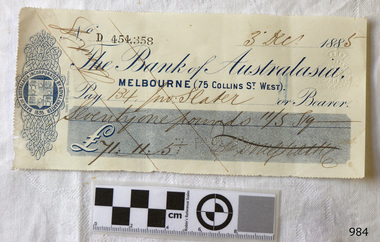
... Flagstaff Hill Warrnambool Shipwrecked-coast Flagstaff-Hill Flagstaff-Hill-Maritime-Museum Maritime-Museum Shipwreck-coast Flagstaff-Hill-Maritime-Village bank cheque Shipwrecked coast Flagstaff Hill Maritime Museum Maritime Museum Shipwreck coast Flagstaff Hill Maritime Village Great Ocean Road Bank of Australasia BoA Union Bank Australia & New Zealand Bank ANZ Bank bank note Melbourne Slater Sands & McDougall chrssed cheque embossed dots paid cheque banknote Printed: "Bank of Australasia, MELBOURNE (75 COLLINS ST. WEST)." "454,358" "Sands & McDougall, Melbourne" Embossed stamp: Symbol of Crown above double oval lines " - STAMP DUTY" "ONE PENNY" Embossed dots forming test "7 PAID T2" Handwritten: "3rd Dec. [188] 5" "134 - Slater" "Seventy one pounds 11/S 5p" "£71.11.5" Signature: (undecipherable) Bank cheque of the Bank of Australasia, Melbourne branch. ...This bank cheque originated from the Bank of Australasia, Melbourne branch. It was issued on 3rd December 1885 to a person surnamed Slater for £71.11.5 (seventy-one pounds, eleven shillings and five pence). The parallel lines are called Cheque Crossed and mean that only Slater and no one else could receive the payment and that it would have been paid into Slater's bank account, not exchanged for cash. The embossed dots signify that the cheque amount was also paid to be the bearer of the cheque. Slater would have visited the bank to deposit the money into his or her own account. The cheque was printed by Sands & McDougall, a long-standing Melbourne printing and stationery company. It was then Stamped at the bank with its own unique number before it was issued to the customer. From its previously perforated edges, it is presumed that the cheque was part of a page of cheques, likely to be contained within a book of similar cheques ready for use. The Bank of Australia was incorporated by Royal Charter of England in March 1834. It had its Australian beginnings on 14th December 1835, opening in Sydney. The Acting Superintendent of the bank at that time was David Charters McArthur. He was Superintendent from 1867-to 1876. The Melbourne branch opened on 28th August 1838 in a two-roomed brick cottage on the north side of Little Collins Street, where two huge mastiff dogs were used at night to guard the bank. The government also provided an armed military sentinel. Due to the bank's rapid growth, a new building for the Melbourne branch was opened in 1840 at 75 Collins Street West. By 1879 the bank had been upgraded to a magnificent two-storey building on the corners of Collins and Queens Streets, with the entry on Collins Street. In 1951 the Bank of Australasia amalgamated with the Union Bank to form the Australia and New Zealand Bank, now known as the ANZ. Then in 1970, the ANZ merged with both the ES&A and the London Bank of Australia to form the ANZ Banking Group Limited. The ANZ Banking Group Ltd kindly donated a variety of historic items from the Bank of Australasia. BANK of AUSTRALASIA, WARRNAMBOOL – In 1854 Warrnambool had two banks, the Union Bank and the Bank of Australasia. Later, completely different bank businesses opened; in 1867 the National Bank of Australasia, then in 1875 the Colonial Bank of Australasia. The original Warrnambool branch of the Bank of Australasia was established in July 1854, and operated from a leased cottage on Merri Street, close to Liebig Street. The bank next bought a stone building previously erected by drapers Cramond & Dickson on the corner of Timor and Gibson Streets. Samuel Hannaford was a teller and then Manager at the Warrnambool branch from 1855 to 1856 and the Warrnambool Council chose that bank for its dealings during 1856-57. In 1859 Roberts & Co. was awarded the contract to build the new Bank of Australasia branch for the sum of £3,000. The land was on a sand hill on the northeast corner of Timor and Kepler Streets and had been bought in 1855 from investor James Cust. The new building opened on May 21, 1860. The bank continued to operate there until 1951 when it merged with the Union Bank to form the ANZ Bank, which continued operating from its Liebig Street building. Warrnambool City Council purchased the former Bank of Australasia building in 1971 and renovated it, then on 3rd December 1973 it was officially opened as the Art Gallery by Cr. Harold Stephenson and Gallery Director John Welsh. The Gallery transferred to the purpose-built building in Liebig Street in 1986 and the old bank building is now the Gallery club. Staff at the Bank of Australasia in Warrnambool included the following men but others were also involved: Samuel Hannaford, Teller then Manager from 1855-1856; W H Palmer, Manager from January 1857 until November 1869 when the Teller Basil Spence was promoted to Manager; H B Chomley, Manager from April 1873 and still there in 1886; A Butt, Manager in 1895-1904; J R McCleary Accountant and Acting Manager for 12 months, until 1900; A Kirk, Manager 1904; J Moore, staff until his transfer to Bendigo in December 1908; J S Bath was Manager until 1915; C C Cox, Manager until April 1923; Richard C Stanley, Manager 1923 to April 1928. The bank cheque has significance through its association with the Bank of Australasia. The early Australian bank was established in 1834 by Royal Charter and opened in Sydney, Australia, in Sydney in 1835. The bank had many Australian offices in November 1877, particularly on the east and south coasts. Victoria had 45 percent of all Offices. The bank cheque is significant as an early example of financial management of money and money exchange or transfer.Bank cheque of the Bank of Australasia, Melbourne branch. The rectangular paper has three sides that have been perforated. It is printed in blue with bank's Insignia of a heraldic shield of sheep hung by their waists and ships in full sail. Embossed Stamp Duty mark. Embossed dots. Handwritten black ink details Dated 3rd Dec 1885. Printed in Melbourne by Sands & McDougall. Diagonal parallel lines are across the cheque. Printed: "Bank of Australasia, MELBOURNE (75 COLLINS ST. WEST)." "454,358" "Sands & McDougall, Melbourne" Embossed stamp: Symbol of Crown above double oval lines " - STAMP DUTY" "ONE PENNY" Embossed dots forming test "7 PAID T2" Handwritten: "3rd Dec. [188] 5" "134 - Slater" "Seventy one pounds 11/S 5p" "£71.11.5" Signature: (undecipherable) flagstaff hill, warrnambool, shipwrecked-coast, flagstaff-hill, flagstaff-hill-maritime-museum, maritime-museum, shipwreck-coast, flagstaff-hill-maritime-village, bank cheque, shipwrecked coast, flagstaff hill maritime museum, maritime museum, shipwreck coast, flagstaff hill maritime village, great ocean road, bank of australasia, boa, union bank, australia & new zealand bank, anz bank, bank note, melbourne, slater, sands & mcdougall, chrssed cheque, embossed dots, paid cheque, banknote -
 Flagstaff Hill Maritime Museum and Village
Instrument - Scale, Weighing Machine, G. Salter & Co, 1884-1909
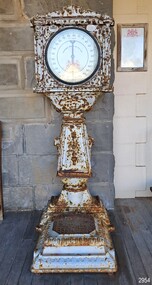
... penny coin, and the weight measurements on the face were in Imperial stones and pounds. Quite some time after 1966, when Australia introduced new decimal weights, measurements and currency, the scale was updated; the coin slot size was changed, and a new face with metric measurements was installed. The scale now accepts a $1 coin (one...penny coin, and the weight measurements on the face were in Imperial stones and pounds. Quite some time after 1966, when Australia introduced new decimal weights, measurements and currency, the scale was updated; the coin slot size was changed, and a new face with metric measurements was installed. The scale now accepts a $1 coin (one ...This ornate, Victorian-era automatic weighing machine was made in England around 1884-1909, by George Salter and Co. of West Bromwich, UK, makers of scales since 1760. It is protected by Queen Victoria’s Royal Letters Patent, signed in 1900. The scale stood outside the Warrnambool Post Office in Timor Street from around 1909 to 1966, as shown on postcards and photographs held at the State Library of Victoria. The scale is identified by the Serial Number '665', and was installed by the distributors, the Australasian Automatic Weighing Machine Co. Ltd.. The scale’s weight measurements were in Imperial stones and pounds up to 20 stone (127 kg). The scale’s face included charts of average weights, for men, women, boys and girls, by various heights, in feet and inches. The coin slot and its face were converted to metric measurements by the Eastern Scale Company Pty. Ltd; that firm was registered on October 2, 1974. The Australasian Automatic Weighing Machine Co. Ltd was a large supplier of weighing scales in Australia and held the Royal Letters patent for their machines, distributing them in prominent locations. In 1902, the firm was listed under the Import Entries Passed at His Majesty’s Customs, importing into Sydney, NSW, eight cases of scales. In 1911, the company asked permission from the Port Pirie Corporation to install a machine in Alexander Street. In 1913, the company applied to the City of Sydney to install machines around the city, including at the tram depot. One application mentions “… three machines in three places for three pounds per year”. In 1923, the firm tendered for the right to place Automatic Weighing Machines on railway and tram premises throughout New South Wales, subsequently for five-year terms, in return for a fixed payment per machine and a portion of the revenue to the NSW Government. In 1928, the Sydney Harbour Trust gave the firm the right to place the weighing machines on various ferry jetties. The firm was still operating in 1941, advertising for two boys aged 14-16 for the workshop and messages, at the Rialto building, 497 Collins St., Melbourne. On December 21, 1946, the Commonwealth government invited offers to tender for the right to place automatic weighing machines on postal premises throughout the six states; the successful company then made arrangements with the federal Postmaster General's Department to place machines outside post offices across the country. A few years later, on September 11, 1950, the firm's Adelaide branch ceased trading. From 11th July 1950, the Australian and Eastern Engineering Company Pty. Ltd took over at the same premises, at 179 Pirie Street, Adelaide. The Perth branch ceased business in WA on July 6th, 1950. Percival Everitt invented and patented the automatic, coin-operated personal scale design. Everitt was a Norfolk-born engineer and regarded as the father of the coin-operated industry. As a young man in 1877, he invented a hay and corn pitcher, a turnip thinner in 1878 and an Automatic Travelling Anchor in 1880. But his fame came in 1883 with the first postcard-vending machine, over a hundred of which he distributed around London. In 1884, he patented one of his many inventions, the coin-operated scales for use in public places; for many people, it was their first exposure to coin-operated machines. His success prompted the formation of the Weighing Machine Company in 1885. Further inventions followed: a blow tester in 1887, the machine for testing a person's grip in 1888, and in 1889, the dispensing machine for hiring out opera glasses, and a device for shutting down the coin entry slot if the machine was empty. In 1890, he invented a fortune-telling machine. Everitt sadly did not make his fortune; he died suddenly in February 1893, in his late forties, with £71 to his name. George Salter & Co., West Bromwich, England, produced automatic weighing scale machines from Everitt’s patented design, and advertised them as suitable for hotels, pleasure gardens, theatres, exhibition halls, clubs, baths and places of public resort. The company was established in 1760 by brothers Richard and William Salter, and manufactured springs and pocket steelyards (spring balances). After several generations, the company was taken over in 1855 by a nephew, George, and renamed George Salter & Co. In 1884, Salter registered the trademark of a Staffordshire knot pierced by an arrow. The company's expanded range of products included the first coin-operated public weighing machines in the 1880s and, in 1895, the first English-made typewriter. In 1915, Salter became a limited company, Geo. Salter & Co. Ltd. When the last George Salter died in 1917, the company passed into the hands of other relatives, but continued to grow before being bought out by Staveley Industries in 1973. Despite several subsequent mergers, the Salter name continues to be seen on household products such as digital scales. This patented, coin-operated weight machine is significant for its association with Percival Everitt, the inventor of the world’s first slot machine, with the renowned maker of scales, G. Salter & Co., which began operating in 1760, and also with the Australasian Automatic Weighing Scale Co., which imported and widely distributed the scales throughout Australia from the early-to-mid 20th century. It is a rare example of an early vending machine used in public places from the late 19th through to the mid-20th century. These machines were the early step in the evolution of coin-in-the-slot machines, which are still used today. The scales give a glimpse into our history; they became quickly popular with the public, which, until then, had little access to weight scales apart from those at medical services. They also provided inexpensive entertainment for families, especially while waiting for trains or visiting the post office. The machines were also attractive and lucrative to the distributors; once installed, they required very little maintenance, and their low cost to customers kept the money coming in. This automatic weighing machine is also significant for its decades of service to the local and regional community of Warrnambool, for personal and commercial purposes. A public coin-operated weighing scale, also called a penny scale. It is a large, silver-painted cast metal stand with a square top on a pedestal that flares outwards to join a rectangular platform base with posts on the side and corners that may have had fitted wheels. The round, white face on top has red and black measurements and inscriptions. A slim indicator with a point at one end and an arc at the other is attached to the face’s centre. The coin slot is above the face, on the left, and the scale’s identification number is engraved on an oval plate on the right. Moulded motifs decorate the pedestal’s front and are repeated on its sides; they depict a tall, narrow urn with a bowl on top and fancy scrolls on either side. There is a decorative panel across the front top of the stand. The top of the pedestal has a small keyhole. The size of the coin slot fitted a penny coin, and the weight measurements on the face were in Imperial stones and pounds. Quite some time after 1966, when Australia introduced new decimal weights, measurements and currency, the scale was updated; the coin slot size was changed, and a new face with metric measurements was installed. The scale now accepts a $1 coin (one dollar) and the scale measures weight in kilograms and grams, from 0 to 125 kg.. The rear of the scale has a small, rectangular metal plate with printed text. The scale was made by G Salter & Co. of West Bromwich, UK, distributed by the Australasian Automatic Weighing Platform Co., and updated to metric measurements by Eastern Scale Co. Pty Ltd. It was previously installed at the Warrnambool Post Office. Engraved on an oval plate on the right: "665" Top centre of the face, in red: "$1 coin" Top of face: "EASTERN SCALE CO. PTY LTD" Base of face, in red: "[Royal Coat of Arms of Britain]" with words, below in red: "BY ROYAL LETTERS PATENT" Around the face, in black: "[numbers 0 to 125, in increments 5, and makes between the numbers for each 500g]" "kg" Below the face, moulded letters within a shield: "AUSTRALASIAN AUTOMATIC WEIGHING MACHINES CO. LTD." At the back of the weighing platform: "G SALTER & CO. / WEST BROMWICH", remnants of logo “[Staffordshire knot pierced by an arrow]” Plate on rear: THIS SCALE REMAINS THE PROPERTY OF EASTERN SCALE CO. PTY. LTD., 8 GEORGE COURT, GREENSBOROUGH, VIC, 3088. PHONE (03 ) _ 34 _ _ 33” (434 9333 ?_flagstaff hill, warrnambool, maritime village, maritime museum, flagstaff hill maritime museum and village, shipwreck coast, great ocean road, scale, weighing scale, salter, australasian, 1 dollar, $1 coin, 1p, 1 penny coin, penny scale, coin in slot scale, eastern scale co. pty. ltd., british royal coat of arms, royal letters patent, letters patent, health, ending machine, coin-operated machine, percival everett, weighing machine co., george salter & co., g salter & co, west bromwich, vending machine, weights & balances, measurements, slot machine, coin operated machine, penny-in-the-slot, coin fed, coin op scale, weights & measures, australasian automatic weighing machine co. ltd., warrnambool post office, machine 665, no. 665, blalnce technology, scales and weights, weights and measures, penny weight scales, vintage, weighing machine, coin in the slot, coin operated, public scale, public weighing machine, penny-weighing machines, penny weighing machines, penny scales, coin operated weighing machine, scale weighing machine -
 Flagstaff Hill Maritime Museum and Village
Medal - Token, Richard Parker, ironmonger, Mid-to-late 19th century
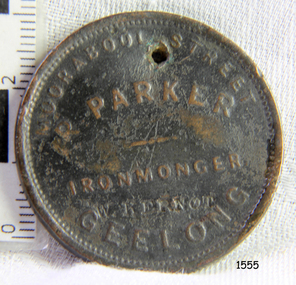
... penny R Parker ironmonger Moorabool Street Geelong W. Kernot Richard Parker currency Australian currency Embossed on the obverse: "R. PARKER / IRONMONGER. / MOORABOOL STREET / GEELONG" "W. KERNOT" Embossed on reverse: "AUSTRALIA" Token coin; a round copper one ...This copper penny token was issued in Geelong by ironmonger R. Parker. Richard Parker was an early settler in Victoria. He had a general store in Elizabeth Street, then Collins Street, Melbourne for five years before moving to Geelong in 1844. He soon established several branches of his ironmonger business in towns around Victoria. He encouraged trade by providing customers with the small change of penny tokens in exchange for their more valuable and less convenient silver coins. The token carried a surcharge and was overstamped with the mane of W. Kernot. William Charles Kernot was a chemist at Chillwell, Geelong. The token is of historical significance, representing a form of currency used in Australia's colonial era before Australia had official currency.Token coin; a round copper one penny token. Obverse had promotional text and a sketch and was overstamped with a name. Reverse had the image of a woman holding up a set of balance scales in one hand and a cornucopia in the other, standing beside the sea, with a three-masted sailing ship in the background, There is a formed hole in the metal; on the obverse, it is on the top of the design, on the reverse it is on the bottom of the design. It advertises R. Parker, Ironmonger, Moorabool Street, Geelong, overstamped with the name W. Kernot.Embossed on the obverse: "R. PARKER / IRONMONGER. / MOORABOOL STREET / GEELONG" "W. KERNOT" Embossed on reverse: "AUSTRALIA"warrnambool, shipwreck coast, flagstaff hill, flagstaff hill maritime museum, flagstaff hill maritime village, medallion, coin, token, promotional medallion, one penny, r parker, ironmonger, moorabool street geelong, w. kernot, richard parker, currency, australian currency -
 Ballarat Clarendon College
Albert Telfer White (1918) collection
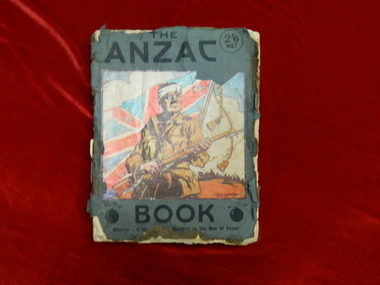
... Australian War Memorial Canberra. (These notes provided by family November 2016) albert-telfer-white ballarat college world-war-one avenue-of-honour The ANZAC book 1916 (flyleaf inscribed: No 2012 / Pte A T White / H Quarters / 22nd Battalion / 6th Inf Brigade / France) Gallipoli medal: engraved on reverse: A T WHITE Embossed lettering on death penny: ALBERT TELFER WHITE Handwritten on reverse of portraits: Lovingly yours / Cis / 21/11/17; your / loving sister / Addie; your loving / sister / Evelyn; Yours lovingly / Bessie Handwritten on back of postcard of ship H M A T 'Anchisis' 14.3.16: Dear Mother, I am sending you a card / of the boat we are on. ...Significant items relating to Albert Telfer White who entered Ballarat College April 1912 and left December 1918. Albert was born 29 June 1897 at his home 'Ashford Vale" farm, Cuthbert's Road, Cardigan. Albert, a second generation Australian, was the fourth son and sixth of eleven children born to dairy farmer John White and his wife Elizabeth, nee Douglas. Albert attended Bunker's Hill State School prior to enrolling at Ballarat College. After College he obtained employment with the engineering firm Ronaldson and Tippett in Ballarat. Following his eighteenth birthday Albert enlisted in the AIF in Ballarat with the rank of Private, No 2012. He embarked for the Middle East with 23rd Battalion on 26 August 1915 and was 'taken on strength at the Gallipoli Peninsular 25 October 1915". On 10 January 1916 Albert was posted to Alexandria, Egypt and during this time he was able to meet with his aunt Rose Douglas, an Australian Army Nursing Sister. This was a great comfort to his family. Albert was sent to France 19 March 1916 and transferred to the 22nd Battalion. He was mentioned in dispatches for 'good and gallant conduct' 5 August (1917?). Albert was hospitalised 30 March 1918, rejoined 22nd Battalion 3 June 1918, wounded in action 3 October 1918 but died of wounds at Rouen 10 October 1918. news of his death was received by his family n Australia just prior to the armistice. Albert Telfer White's sacrifice is commemorated at Ballarat College, Avenue of Honour Ballarat (Tree 1214), Ballarat Shire Honour Avenue Learmonth (Tree 163) and the Australian War Memorial Canberra. (These notes provided by family November 2016)Collections of items including: Bayonet, Carl Eickhorn, Solingen, (29.A.159 engraved on handle) Trench shovel The ANZAC book 1916 (flyleaf inscribed: No 2012 / Pte A T White / H Quarters / 22nd Battalion / 6th Inf Brigade / France) Gallipoli medal with documentation First World War Mothers’ and Widows’ Badge Next of Kin Memorial Plaque (Death Penny) and accompanying letter from King George V Imperial War Graves Commission documentation and photograph Australia Graves Services In Memory card and photograph Documentation relating to Australian War Memorial Roll of Honour, Learmonth Memorial Wall, Ballarat and Learmonth Avenues of Honours Documentation from the Australian Army Records office Documentation relating to Military Medal, 1914/15 Star, British War Medal and Victory Medal (whereabouts unknown, November 2016) Portraiture of Albert Telfer White as a child, as a young adult (civilian dress), in full kit (A I E F formal), and at camp 1915 Portraiture of sisters Cis, Addie, Bessie, Evelyn (with personal inscriptions) Four postcards (one with letter from Albert ‘at sea’ to his mother - undated) Death notice (unreferenced newspaper clipping) Biographical and family relationship details Photocopy of The White Family 1906 showing (standing) Adeline, Leslie, Harold (father), Muriel (mother), William; (seated) Albert, John (Grandfather), Elizabeth, Allan, Elizabeth (Grandmother), Evelyn (baby) and Benjamin The ANZAC book 1916 (flyleaf inscribed: No 2012 / Pte A T White / H Quarters / 22nd Battalion / 6th Inf Brigade / France) Gallipoli medal: engraved on reverse: A T WHITE Embossed lettering on death penny: ALBERT TELFER WHITE Handwritten on reverse of portraits: Lovingly yours / Cis / 21/11/17; your / loving sister / Addie; your loving / sister / Evelyn; Yours lovingly / Bessie Handwritten on back of postcard of ship H M A T 'Anchisis' 14.3.16: Dear Mother, I am sending you a card / of the boat we are on. Our deck is right / on the back. I have marked it with an X. / We are not allowed to put the date on or / where we are. I am sitting on the deck now / holding the card in my hand so it is hard / to write. We are together yet haven't been / separated Bill, Matt and myself. Haven't / had anything to do. I will write a couple / of letters now. Albert Handwritten on back of postcard photograph of Albert at camp: 30th September 1915 / Dear Mother / There is a studio at the / camp so Matt and I got our Photos / taken yesterday morning, & got them/ this morning. I am sending / Ciss one of Matt.albert-telfer-white, ballarat college, world-war-one, avenue-of-honour -
 Lara RSL Sub Branch
Memorial Plaque and Scroll, Dead Man's Penny, World war One
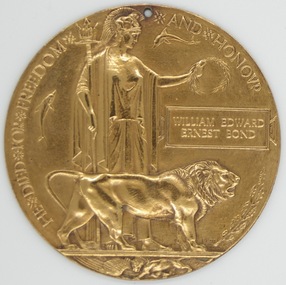
... There were some relatives who returned the pennies to the Australian Government in protest as b they felt it was insulting and it did not replace their loved one's life....There were some relatives who returned the pennies to the Australian Government in protest as b they felt it was insulting and it did not replace their loved one's life. ...Bronze Memorial plaque and Memorial Scroll issued to families whose relative was killed in action during word war 1. The history of the dead man's penny began in 1916 with the realisation by the British Government hat some form of an official token of gratitude should be given to the fallen service men and women's bereaved next of kin. Production of the plaques and scrolls, which was supposed to be financed by the German reparation money began in 1919 with approximately 1,150,00 issued. There were some relatives who returned the pennies to the Australian Government in protest as b they felt it was insulting and it did not replace their loved one's life.Killed in Action William Edward Ernest Bond joined the 58th Bn on the 24th November 1915 as a labourer from Geelong. As a private (4296), he was sent to France and the Western Front. He initially went missing in action in the Fleurbaix area on 19th of July 1917. It took a court of Inquiry in the field in September,1917 to determine he was killed in action, although his body was never recovered. He died aged 18. His name can be found on Panel 14, VC Corner Australian Cemetery and Memorial, Fromelles, Lille, Nord Pas de Calais, FranceMemorial Bronze Plaque and Scroll. The Memorial Plaque was also known as the WW1 'Death Penny' in memory of William Edward Ernest BONDBrass Plaque " He died for Freedom and Honour William Edward Ernest Bond" Scroll Commemoration to Pte Edward Ernest Bond 58th Bn AIFbrass memorial plaque and scroll dead man's penny bond william lara geelong killed in action world war one kia -
 Flagstaff Hill Maritime Museum and Village
Currency - Token, 1850's
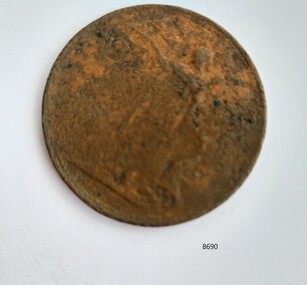
... Australia and overseas. This is a Warrnambool Bateman penny token. It is an example of an Australian token – a coin that had the value of a penny and was produced by businessmen in the 1850s to be used only in the business of the person named on the coin. There were two firms in Warrnambool that produced tokens in the 1850s – William Jamieson, a general storekeeper and William Bateman. The latter had a general store in Banyan Street in the early 1850's and became one...Australia and overseas. This is a Warrnambool Bateman penny token. It is an example of an Australian token – a coin that had the value of a penny and was produced by businessmen in the 1850s to be used only in the business of the person named on the coin. There were two firms in Warrnambool that produced tokens in the 1850s – William Jamieson, a general storekeeper and William Bateman. The latter had a general store in Banyan Street in the early 1850's and became one ...For around a decade or so in the Gold Rush period in Australia there was a shortage of official government currency. It was acceptable during this time to use token coins minted by local businesses to be used within their store, much like the loyalty and rewards cards that businesses give their customers in modern times. The tokens were also a good way to advertise their wares and details. The first token was introduced in Melbourne in 1848 and were used until 1868, when they became illegal in New South Wales. They were minted in Australia and overseas. This is a Warrnambool Bateman penny token. It is an example of an Australian token – a coin that had the value of a penny and was produced by businessmen in the 1850s to be used only in the business of the person named on the coin. There were two firms in Warrnambool that produced tokens in the 1850s – William Jamieson, a general storekeeper and William Bateman. The latter had a general store in Banyan Street in the early 1850's and became one of the largest merchant firms in the Warrnambool district. In November 1856 the store belonging to William Bateman Jnr & Co. was destroyed by fire and caused a great number of insolvencies in the district as many businessmen and farmers were financed by Bateman.This token is a significant example of the business practices of merchants in the early days of the colony and is connected to a well-known member of Warrnambool's early town history. It is comparatively rare because many Bateman tokens were destroyed in the 1856 fire.A round metal coin token associated with the Warrnambool business owned by William Bateman in the 1850's. It has a weathered figure on one side and writing (also quite weathered) on the other side.Around edge - IMPORTERS AND GENERAL MERCHANTS 185? Inside circle - WILLIAM BATEMAN JUNR & CO WARRNAMBOOL Across center - VICTORIAflagstaff hill maritime museum and village, warrnambool, great ocean road, shipwreck coast, penny token, william bateman, william bateman jnr &co, bateman general store, bateman token, bateman penny token, token coin, token -
 Flagstaff Hill Maritime Museum and Village
Postcard - Ships Collection, Stephen Cribb, circa 1914-1945
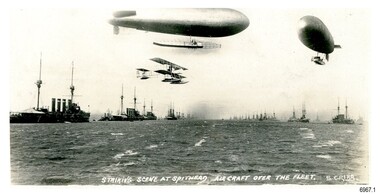
... one penny for foreign” 6967.23 Entrance to the Cambor, from Portsmouth Harbour. “312, copyright Edgar Ward” 6967.24 Royal yacht alongside Portsmouth Dockyard, “305” J. Welch & Sons, English Photography 6967.25 The Royal Yacht, Victoria & Albert “50” 6967.26 The VICTORY, firing a Royal Salute “21” Published by E.A. Schwerdtfeger & Co. London E.C. Printed at their works in Berline. Trade Mark E.A.S. 6967.27 The Hard and Viaduct, Portsea, Portsmouth 6967.28 SS MACEDONIA, P&O, 15212 tons, 1500 h.p., Coloured drawing. On reverse “Master Jack de Little, Caramut House, Caramut, Victoria, Australia...one penny for foreign” 6967.23 Entrance to the Cambor, from Portsmouth Harbour. “312, copyright Edgar Ward” 6967.24 Royal yacht alongside Portsmouth Dockyard, “305” J. Welch & Sons, English Photography 6967.25 The Royal Yacht, Victoria & Albert “50” 6967.26 The VICTORY, firing a Royal Salute “21” Published by E.A. Schwerdtfeger & Co. London E.C. Printed at their works in Berline. Trade Mark E.A.S. 6967.27 The Hard and Viaduct, Portsea, Portsmouth 6967.28 SS MACEDONIA, P&O, 15212 tons, 1500 h.p., Coloured drawing. On reverse “Master Jack de Little, Caramut House, Caramut, Victoria, Australia ...The postcards and photograph in this Ships Collection were found by the donor. Two of the cards are addressed to a local person "Master Jack de Little, Caramut House, Caramut, Victoria, Australia". Another has a message written in a different language. The remainder have no personal messages on them. The details of the postcards are- Published by Stephen Cribb, Southsea: 6967.1 Striking scene at Spithead; Aircraft over the fleet, including airships 6967.2 The King’s Ships; Fleet of ships. Aircraft overhead. 6967.3 HMS HIBERNIA; King Edward Class ship 6967.4 For Docking; Super Dreadnaughts, largest floating dock in the world, in Portsmouth Harbour 6967.5 HMS COLLINGWOOD; Dreadnaught, on which His Majesty’s son is serving. 6967.6 HMS BRITANNICA; Pre-Dreadnaught, 16,350 tons. Inscription “b1” or “61” written on the sea on the front of the postcard. 6967.7 HMS IRON DUKE; Fleet Flagship 6967.8 HMS Submarine D8. Ship numbered “78” 6967.9 HMS IRON DUKE, Fleet Flagship 6967.10 HMS SOUTHAMPTON 6967.11 SHAMROCK IV (Ketch rigged), leaving for America July 18, 14 (1914’) to fetch home the American to Gosport 6967.12 HMS CONQUEROR, June 1913 6967.13 Portsmouth Harbour, The Entrance (from Gosport Hard) 6967.14 Seaplane rising; 20th Century Marvel. Naval air defence. Types of airships, Seaplanes, Monoplanes in The Solent review 6967.15 HMS AUDACIOUS 6967.16 HMS DREADNAUGHT, pioneer of the all-big-gun warship ”Marcus Ward Series, McCaw Stevenson & Oms Ltd” 6967.17 HMS TERRIBLE, textured paper on front with aqua lower border, remnants of blue paper on the back. Published by Stephen Cribb, Southsea 6967.18 “In time of peace, prepare for war” Hoisting guns and torpedo heads on board a warship 6967.19 HMS LORD NELSON 6967.20 HMS HINDUSTAN 6967.21 Spitbank Fort, Spithead, on Solvent Sea 6967.22 HMS GARLAND of Netley Photographer Edgar Ward. “A halfpenny stamp for inland, one penny for foreign” 6967.23 Entrance to the Cambor, from Portsmouth Harbour. “312, copyright Edgar Ward” 6967.24 Royal yacht alongside Portsmouth Dockyard, “305” J. Welch & Sons, English Photography 6967.25 The Royal Yacht, Victoria & Albert “50” 6967.26 The VICTORY, firing a Royal Salute “21” Published by E.A. Schwerdtfeger & Co. London E.C. Printed at their works in Berline. Trade Mark E.A.S. 6967.27 The Hard and Viaduct, Portsea, Portsmouth 6967.28 SS MACEDONIA, P&O, 15212 tons, 1500 h.p., Coloured drawing. On reverse “Master Jack de Little, Caramut House, Caramut, Victoria, Australia” Published by Union Postale Universelle, Gibralta. 6967.29 HMS KING EDWARD VII leaving Dock N.3 GIBRALTAR – 11/3/05 (1905). Printer V.B. Cumbo, Gibraltar. Drawing. Handwritten “Oroton 28/5/06”. “Master Jack De Little Caramut, Victoria, Australia” 6967.30 7274 BARBARA, Hamburg. Imprinted “ ---O WEDDE ----- VORSETZEN 35/37” inscription, six lines of handwritten text in another language on the back. Published by the Valentine & Sons Co. Publishing Ltd., Melbourne, Sydney and Brisbane. Branches Sydney. London, Dundee, Cape Town, Montreal, Toronto. 6967.31 SS MOLDAVIA, the first dining saloon, Valentine Series M.4059. Valentines Real Photo Series Postcard. Postcard made in U.S.A. Agfa ANSCO 6967.32 Port McNicoll, Ont. DSR.. 6967.33 Orient Line SS ORONSAY, 20,000 tons. On board the Orient Line. Tuck’s Post Card, Carte Postale. ‘Our Navy’ Series II, Raphael Tuck & Sons. “Photogravure” Postcard Nu. 4305. Art publishers to their Majesties the King and Queen. 6967.34 HMS QUEEN MARY, HMS Queen Mary, Battle Cruiser, launched 1912, completed 1913, 27,000 tons, 75,000 S.H.P., 28 knots per hour, 8 13.5-inch guns, 16 4-inch guns, 2 torpedoes. Commissioned September 1913. Printed in England. 6967.35 HMS SUPERB 6967.36 HMS TEMERAIRE 6967.37 HMS MONARCH Small photograph, not a postcard, H 6 x W 9 cm 6967.38 PHOTOGRAPH NESTOR? Small sepia photograph, ship at dock. Stamped “Kodak print” “549”. Handwritten on back is “NESTOR?“ The Ships Collection of postcards and a small photograph depict maritime vessels connected to our Australian alliance with Britain, particularly during World War I. Two of the postcards are specifically addressed to a ‘Master Jack de Little’ at Caramut House, in the local township of Caramut which was a Pioneer Settlement and a Soldier Settlement area after World War I. Collection of thirty-eight postcards from various photographers. They depict shipping, harbours and naval vessels from the Great War to the Second War War. Most of the cards have a title, generally handwritten, on the front of the postcard. A few of the postcards have inscriptions.6967.6 Handwritten on the sea in the photograph “b1” or “61” 6967.28 Handwritten on reverse “Master Jack de Little, Caramut House, Caramut, Victoria, Australia” 6967.29 Handwritten “Oroton 28/5/06”. “Master Jack De Little Caramut, Victoria, Australia” 6967.30 Imprinted Stamp “ ---O WEDDE ----- VORSETZEN 35/37” (a location in Germany). Handwritten, six lines of text in another language, possibly German. 6967.38 Handwritten on the back is “NESTOR?“flagstaff hill, maritime village, maritime museum, postcard, world war ii, ww2, royal navy, british merchant navy, portsmouth, the great war, ship, world war i, wwi, british, 1914-1918, jack de little, caramut, caramut house, vorsetzen, spithead, sea fort, fort, spithead fort, aircraft, fleet, airship, the king’s ships, hms hibernia, king edward class ship, super dreadnaught, floating dock, portsmouth harbour, hms collingwood, dreadnaught, hms britannica, hms iron duke, fleet flagship, hms submarine d8, hms southampton, shamrock iv, hms conqueror, the entrance, gosport head, seaplane, naval air defence, monoplane, the solvent, hms audacious, hms dreadnaught, warship, marcus ward series, mccaw stevenson & oms ltd, s cribb, southsea, hms terrible, hms hindustan, hms garland, edgar ward, cambor, portsmouth dockyard, j. welch & sons, the royal yacht, victoria & albert “50”, victory, royal salute “21”, e.a. schwerdtfeger & co, e.a.s., the hard and viaduct, ss macedonia, p&o, master jack de little, hms king edward vii, dock n.3 gibraltar, v.b. cumbo, gibraltar, union postale universelle, 7274 barbara, ss moldavia, valentine series, valentine & sons co, port mcnicoll, agfa ansco, ss oronsay, orient line, raphael tuck & sons, hms queen mary, hms superb, hms temeraire, hms monarch, nestor, stephen cribb, stephen cribb photography, hms lord nelson -
 Flagstaff Hill Maritime Museum and Village
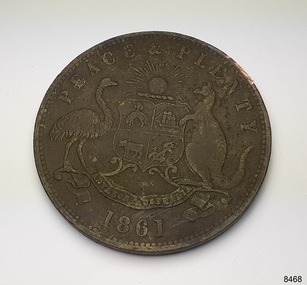
Currency - Coin, Robert Hyde & Co. Shipping Merchants, 1861
... penny token coin in the sand dunes of Lady Bay, Warrnambool, in 2023. The coin could have come from a local shipwreck, passengers, or members of the community. Trade was carried out along the southwest coast of Victoria between Melbourne and Portland, with the Port of Warrnambool receiving passengers and goods by coastal traders, the steamboat that set off from ports every few days. One such vessel was the steamship SS Edina that made her first voyage from Melbourne to Portland in 1863. For around a decade or so in the Gold Rush period in Australia...penny token coin in the sand dunes of Lady Bay, Warrnambool, in 2023. The coin could have come from a local shipwreck, passengers, or members of the community. Trade was carried out along the southwest coast of Victoria between Melbourne and Portland, with the Port of Warrnambool receiving passengers and goods by coastal traders, the steamboat that set off from ports every few days. One such vessel was the steamship SS Edina that made her first voyage from Melbourne to Portland in 1863. For around a decade or so in the Gold Rush period in Australia ...The donor (a local resident.) of this coin found this penny token coin in the sand dunes of Lady Bay, Warrnambool, in 2023. The coin could have come from a local shipwreck, passengers, or members of the community. Trade was carried out along the southwest coast of Victoria between Melbourne and Portland, with the Port of Warrnambool receiving passengers and goods by coastal traders, the steamboat that set off from ports every few days. One such vessel was the steamship SS Edina that made her first voyage from Melbourne to Portland in 1863. For around a decade or so in the Gold Rush period in Australia there was a shortage of official government currency. It was acceptable during this time to use token coins minted by local businesses to be used within their store, much like the loyalty and rewards cards that businesses give their customers in modern times. The tokens were also a good way to advertise their wares and details. The first token was introduced in Melbourne in 1848 and were used until 1868, when they became illegal in New South Wales. They were minted in Australia and overseas. The token was issued by Robert Hyde & Co. who traded in second-hand goods such as old clothes, sheets, metal items and glass, which they resold to be re-manufactured, or "recycled".A token such as this one identifies businesses existing in the post-Gold Rush period in Australia. Round copper coin. Penny token coin bearing the Australian Coat of Arms and motto. The coin also has the company's name, location, nature of business and motto. The coin has grooves around the edge. It was made in 1861.OBVERSE: Logo: (Australian Coat of Arms), Motto: "PEACE & PLENTY", Date: 1861 REVERSE: "ROBERT HYDE & CO MELBOURNE", "GENERAL MARINE STORE, SHIPPERS OF RAGS GLASS METALS &.C"flagstaff hill maritime museum and village, warrnambool, great ocean road, shipwreck coast, merchant token, melbourne, token, australian token, trade token, coins, merchants, medal, colonisation, gold rush, robert hyde & co., general marine store, shippers of rags glass metals etc., numismatics, second-hand scrap, scrap goods -
 City of Moorabbin Historical Society (Operating the Box Cottage Museum)
Education, Booklet, Australian Copy Book 1907, c1907
... Rossiter Whelan / AUSTRALIAN COPY BOOK / LOWER FIRST CLASS / FOR TRACING WITH LEAD PENCIL OR PEN / INTRODUCTORY BOOK, PRICE ONE PENNY /MELBOURNE PUBLISHED FOR THE EDUCATION DEPARTMENT BY ROBT. ...Rossiter Whelan was an early settler's child who attended Cheltenham State School c 1907 This is a typical Copy Book used by school children learning to print and write with lead pencil and dipping pens and ink c 1907 Rossiter Whelan / AUSTRALIAN COPY BOOK / LOWER FIRST CLASS / FOR TRACING WITH LEAD PENCIL OR PEN / INTRODUCTORY BOOK, PRICE ONE PENNY /MELBOURNE PUBLISHED FOR THE EDUCATION DEPARTMENT BY ROBT. ...School children were taught to print and write with lead pencil using this type of copy book. When proficient they were permitted to begin using dipping pen and ink. Rossiter Whelan was an early settler's child who attended Cheltenham State School c 1907This is a typical Copy Book used by school children learning to print and write with lead pencil and dipping pens and ink c 1907'Copy Book' for learning to write for 1st class Cheltenham State School 1907Rossiter Whelan / AUSTRALIAN COPY BOOK / LOWER FIRST CLASS / FOR TRACING WITH LEAD PENCIL OR PEN / INTRODUCTORY BOOK, PRICE ONE PENNY /MELBOURNE PUBLISHED FOR THE EDUCATION DEPARTMENT BY ROBT. S, BAIN, GOVERNMENT PRINTER -
 Geelong RSL Sub Branch
Tobacco Tin, Badges, Stamps, Mid 20th Century
... A Tobacco Tin with four Star badges of rank, two Australia Shoulder Flashes, two Collar Rising Sun Badges, six x 2 penny stamps, one 6 penny stamp, one collar pin, two studs....A Tobacco Tin with four Star badges of rank, two Australia Shoulder Flashes, two Collar Rising Sun Badges, six x 2 penny stamps, one 6 penny stamp, one collar pin, two studs. ...These items are originals.These items are the originals that were issued.A Tobacco Tin with four Star badges of rank, two Australia Shoulder Flashes, two Collar Rising Sun Badges, six x 2 penny stamps, one 6 penny stamp, one collar pin, two studs.The tobacco tin - THE 'GREYS' Silk Cut Virginia Tobacco.tobacco, tin badges, stamps -
 City of Moorabbin Historical Society (Operating the Box Cottage Museum)
Magazine - The School Paper for Grades III and IV (1948) No 569 to 597; Feb 1948 to Dec 1948, 11 Editions, 1948
... penny per issue. These copies were collected and saved by one of the pioneer families of City of Moorabbin. Issued by the Education Department of Victoria, printed J. J. Gourley, Government Printer, Melbourne education victoria australian ...School Papers were issued to the children going to school in the state of Victoria by the Education Department for a cost of 1 penny per issue. These copies were collected and saved by one of the pioneer families of City of Moorabbin.Issued by the Education Department of Victoria, printed J. J. Gourley, Government Printer, Melbourne The School Paper For Grades III and IV (1948)EDUCATION DEPARTMENT VICTORIA / SCHOOL PAPER / For Grades III and IV (1948)education, victoria, australian history, victorian education department, marriott william, marriott geoff, market gardeners, pioneers, moorabbin shire, henry dendy special survey brighto 1841, east bentleigh state school no. 2083 -
 City of Moorabbin Historical Society (Operating the Box Cottage Museum)
Magazine - The School Paper for Grades III and IV (1949) No 293 May and No 597 September, 2 editions, 1949
... penny per issue. This copy was collected and saved by one of the pioneer families of City of Moorabbin. Issued by the Education Department of Victoria, printed J. J. Gourley, Government Printer, Melbourne education victoria australian ...These School Papers were issued to the children going to school in the state of Victoria by the Education Department for a cost of 1 penny per issue. This copy was collected and saved by one of the pioneer families of City of Moorabbin.Issued by the Education Department of Victoria, printed J. J. Gourley, Government Printer, MelbourneThe School Paper For Grades III and IV (1949) 12 pagesEDUCATION DEPARTMENT VICTORIA / SCHOOL PAPER / For Grades III and IV (1949)education, victoria, australian history, victorian education department, marriott william, marriott geoff, market gardeners, pioneers, moorabbin shire, henry dendy special survey brighto 1841, east bentleigh state school no. 2083 -
 City of Moorabbin Historical Society (Operating the Box Cottage Museum)
Magazine - The School Paper for Grades III and IV (1950), 1949
... penny per issue. This copy was collected and saved by one of the pioneer families of City of Moorabbin. Issued by the Education Department of Victoria, printed J. J. Gourley, Government Printer, Melbourne education victoria australian ...These School Papers were issued to the children going to school in the state of Victoria by the Education Department for a cost of 1 penny per issue. This copy was collected and saved by one of the pioneer families of City of Moorabbin.Issued by the Education Department of Victoria, printed J. J. Gourley, Government Printer, MelbourneThe School Paper For Grades III and IV (1950) 12 pagesEDUCATION DEPARTMENT VICTORIA / SCHOOL PAPER / For Grades III and IV (1950)education, victoria, australian history, victorian education department, marriott william, marriott geoff, market gardeners, pioneers, moorabbin shire, henry dendy special survey brighto 1841, east bentleigh state school no. 2083 -
 Orbost & District Historical Society
coins, 1919 - 1944
... Five Australian pennies - 1935, 1919, 1936 and 1933. One British penny -1944. .1 is a1919 Australian penny. .2 is a 1933 Australian penny. .3 is a 1935 Australian penny. .4 is a 1936 Australian penny and .5 is a 1944 British penny....These coins are examples of pre-decimal Australian currency. pennies coins numismatics bronze Five Australian pennies - 1935, 1919, 1936 and 1933. One ...These coins are examples of pre-decimal Australian currency.Five Australian pennies - 1935, 1919, 1936 and 1933. One British penny -1944. .1 is a1919 Australian penny. .2 is a 1933 Australian penny. .3 is a 1935 Australian penny. .4 is a 1936 Australian penny and .5 is a 1944 British penny.pennies coins numismatics bronze -
 Flagstaff Hill Maritime Museum and Village
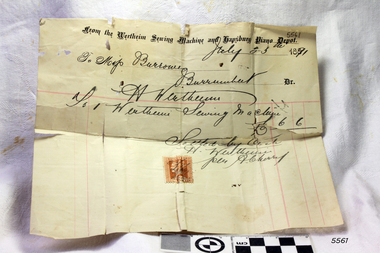
Document - Receipt, Joseph Wertheim, Wertheim Sewing Machine and Hapsburg Piano Depot, 23-07-1891
... Australia. The receipt also gives a fixed date to the machine accessories and instruction book in our Collection, connecting them all to domestic life in the Victorian era. Flagstaff Hill Flagstaff Hill Maritime Museum and Village Warrnambool Maritime Museum Maritime Village Great Ocean Road Shipwreck Coast Wertheim sewing machine Victorian era sewing machine accessories sewing machine instructions Wertheim Sewing Machine and Hapsburg Piano Depot 23-7-1891 £6 6/- Mrs Burrowes Burrumbeet H. Wertheim Wertheim Sewing Machines Domestic machines dress making home industry fashion Receipt Queen Victoria stamp one-penny ...This receipt was donated with our collection's Wertheim sewing machine accessory box. The box contains twelve accessories, the instruction book and the receipt for the purchase of a Wertheim sewing machine. The receipt was written on July 23rd 1891 by the Wertheim distributor in Melbourne, Hugo Wertheim. His business was the Wertheim Sewing Machine and Hapsburg Piano Depot, trading at 173 Williams Street, Melbourne. The purchaser was Mrs Burrowes from Burrumbeet, Victoria, a district northwest of Ballarat. She paid £6-6 (six pounds and six shillings) in cash. The receipt was signed by H. Wertheim and the other signatory looks like John A. Cherry. Hugo Wertheim (1854-1919) was an agent for his father’s cousin Joseph Wertheim, a well-established sewing machine manufacturer in Germany. He was born in Lispenhausen, Germany, and migrated to Melbourne in October 1875, where he opened a merchandising business at 39 Flinders Lane East. He returned to Germany in 1885 to marry Joseph Wertheim's daughter Sophie Emilie. The couple came back to Melbourne, and Hugo quickly established a substantial business selling sewing machines, bicycles, pianos and other mechanical devices, under brands such as Wertheim, Electra, Planet, Griffin and Hapsburg. He exhibited at agricultural shows and in 1901 at the Pan American Exposition, Buffalo, United States of America. One of his staff was O. C. Beale, who later set up his own piano business in New South Wales. Hugo continued to own 25 per cent of one of Beale's companies, which became Wertheim's Queensland business. In 1908 Hugo Wertheim opened a piano factory in Richmond, Melbourne, aiming to produce 2000 pianos and player pianos a year, predominantly using Australian materials. In laying the foundation stone, Prime Minister Alfred Deakin observed that “few men with such opportunities for a life of ease would have embarked on such an enterprise” Hugo died of chronic hepatitis in 1919 at his home in South Yarra. His eldest son, Herbert Joseph (1886-1972), continued the business. The piano factory closed in 1935, becoming a Heinz food processing plant and in 1955, GTV Channel 9 studios and offices. The Wertheim Sewing Machine Company – Joseph Wertheim (1804–1899) founded the company in 1868 in Frankfurt, Germany. At this time Joseph was the Frankfurt city delegate for the Democratic Party. At its height, the Wertheim factory employed approximately 650 workers. The company used a trademark of a dwarf holding a hammer which is known to have been used until at least 1925, however in 1909 a Star of David was also registered. In 1870 a Wertheim subsidiary was formed in Barcelona, Spain. The business imported and sold complete machines, including the English Jones machine. Locals began calling the sewing machines “las rapidas”, and the business became known as “las casa de las rapidas”. In 1915 production began of a totally manufactured Spanish Wertheim machine. Wertheim in Germany continued manufacturing machines until 1932 when the Wertheim family fled to Spain. Despite converting to Christianity from Judaism, they feared the political unrest in Germany during that time. Wertheim Spain became Rapida SA and was then the sole manufacturer of the Wertheim machines. The factory was managed by Karl Wertheim under the alias Carlos Vallin.The receipt is significant for its connection with Victoria's northwestern district, the Melbourne distributor Hugo Wertheim, and the well-known German manufacturer of the early domestic sewing machines, Joseph Wertheim. The stamp with Queen Victoria's profile also connects the receipt to the Victorian era and connects Melbourne to Colonial Australia. The receipt also gives a fixed date to the machine accessories and instruction book in our Collection, connecting them all to domestic life in the Victorian era.Receipt on cream paper, rectangular, with red horizontal and vertical lines. Printed letterhead and heading text. Handwritten details of the seller, owner, the item purchased, method of payment, and cost. Signed by two signatories. A one-penny stamp is attached. Sold by Wertheim Sewing Machines and Hapsburg Pianos,.dated 23rd July 1891 for £6 6/- from Mrs Burrowes, Burrumbeet, Victoria, for the purchase of a Wertheim sewing machine.Printed "From the Wertheim Sewing Machine and Hapsburg Piano Depot" Handwritten "Mrs Burrowes, Burrumbeet" "July 23rd 1891" "Wertheim Sewing Machine" "£6 6" "Settled by Cash" Signatures "H. Wertheim" and (Looks Like) "John A Cherry" Ont the stamp, [image of Queen Victoria's profile] and "VICTORIA" "ONE PENNY" flagstaff hill, flagstaff hill maritime museum and village, warrnambool, maritime museum, maritime village, great ocean road, shipwreck coast, wertheim, sewing machine, victorian era, sewing machine accessories, sewing machine instructions, wertheim sewing machine and hapsburg piano depot, 23-7-1891, £6 6/-, mrs burrowes, burrumbeet, h. wertheim, wertheim sewing machines, domestic machines, dress making, home industry, fashion, receipt, queen victoria stamp, one-penny stamp -
 Flagstaff Hill Maritime Museum and Village
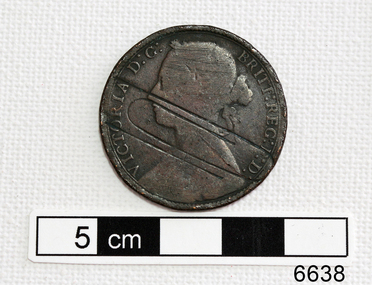
Currency - Coin, 1872
... Australia in the 19th century. Flagstaff Hill Flagstaff Hill Maritime Museum and Village Warrnambool Maritime Museum Maritime Village Great Ocean Road Shipwreck Coast coin British coin currency penny 19th century Queen Victoria Young Queen Victoria 1872 Blank cancellation stamp cancelled coin Brittania Obverse: "VICTORIA D.G." BRITT : REG : F D " Reverse: "one ...The image on this coin shows a British monarch, the young Queen Victoria, at a time when Australia was a Colony of Britain. This coin has be cancelled from circulation.This coin represents the currency used in Australia in the 19th century.Coin, Queen Victorian Penny, 1872, Obverse shows the "Young Head" of Queen Victoria. Reverse shows Britannia. Coin well worn. Obverse has a cancellation stamp.Obverse: "VICTORIA D.G." BRITT : REG : F D " Reverse: "one - - - - - - -" "18 - - " Stamp: (paperclip shape)flagstaff hill, flagstaff hill maritime museum and village, warrnambool, maritime museum, maritime village, great ocean road, shipwreck coast, coin, british coin, currency, penny, 19th century, queen victoria, young queen victoria, 1872, blank, cancellation stamp, cancelled coin, brittania -
 Flagstaff Hill Maritime Museum and Village
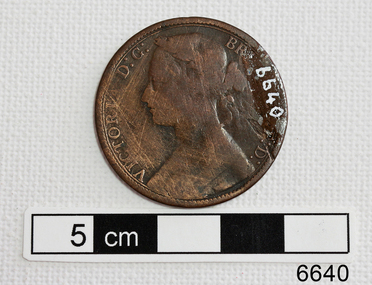
Currency - Coin, 1877
... Australia in the 19th century. Flagstaff Hill Flagstaff Hill Maritime Museum and Village Warrnambool Maritime Museum Maritime Village Great Ocean Road Shipwreck Coast coin British coin currency penny 19th century Queen Victoria Young Queen Victoria Brittania 1877 Obverse: "VICTORIA : D: G:" "BRIT - - - - -F : D :" Reverse: "ONE PENNY" "1877" Coin, Queen Victorian Penny, 1877, Obverse shows the "Young Head" of Queen Victoria. ...The image on this coin shows a British monarch, the young Queen Victoria, at a time when Australia was a Colony of Britain.This coin represents the currency used in Australia in the 19th century.Coin, Queen Victorian Penny, 1877, Obverse shows the "Young Head" of Queen Victoria. Reverse shows Britannia. Coin well worn. Obverse: "VICTORIA : D: G:" "BRIT - - - - -F : D :" Reverse: "ONE PENNY" "1877"flagstaff hill, flagstaff hill maritime museum and village, warrnambool, maritime museum, maritime village, great ocean road, shipwreck coast, coin, british coin, currency, penny, 19th century, queen victoria, young queen victoria, brittania, 1877
