
Showing 32 items matching "australian sheep and wool show"
-
 National Wool Museum
Ribbon, Australian Sheep and Wool Show, Woolcraft Competition
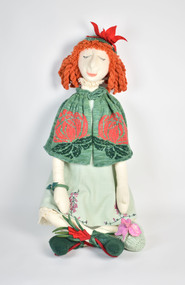
... Australian Sheep and Wool Show, Woolcraft Competition...It won 1st prize in the Australian Sheep and Wool Show, Bendigo, 2000....Australian Sheep and Wool Show, Woolcraft Competition...Felting Hand spinning Hand Knitting Weaving Australian Sheep and Wool Show, Woolcraft Competition Australian Sheep and Wool Show, Woolcraft Competition Ribbon ..."Federaton Flora" was created by 13 members of the Geelong Handweavers and Spinners Guild Inc for the centenary of Federation in Australia. It won 1st prize in the Australian Sheep and Wool Show, Bendigo, 2000.Australian Sheep and Wool Show, Woolcraft Competitionhandicrafts, geelong handweavers and spinners guild inc., felting, hand spinning, hand knitting, weaving -
 National Wool Museum
Textile - Doll, Geelong Handweavers and Spinners Guild Inc, Federation Flora, 2000
... ...Australian Sheep and Wool Show...It won 1st prize in the Australian Sheep and Wool Show, Bendigo, 2000....It won 1st prize in the Australian Sheep and Wool Show, Bendigo, 2000. Handicrafts Geelong Handweavers and Spinners Guild Inc. ..."Federaton Flora" was created by thirteen members of the Geelong Handweavers and Spinners Guild Inc for the centenary of Federation in Australia. It won 1st prize in the Australian Sheep and Wool Show, Bendigo, 2000.Large handmade doll featuring white felted wool with wooden disc joints and orange woollen, possibly hand spun, hair. The facial features have been formed with white stitching, eyelashes are embroidered with black cotton, the lips have been painted on. The doll is dressed in a pale green short sleeved dress, of hand spun wool, buttoned at the back and lined with pale green silk. It is embroidered at the lower front with pink heath, the floral emblem of Victoria. She is wearing a cream woollen hand knitted underwear set consisting of singlet and pantaloons. The pantaloons have a fine hand knitted edge. Her shoes are of dark green felt with red kangaroo paw decoration. A green knitted cape with red and dark green waratah decoration is tied around her neck and tied to her left arm is a small pale felted bangle. handicrafts, geelong handweavers and spinners guild inc., felting, hand spinning, hand knitting, weaving, bendigo, australian sheep and wool show, federation, flora, doll -
 National Wool Museum
Textile - Felted Coat of Arms, Heather Frizzell, 2016
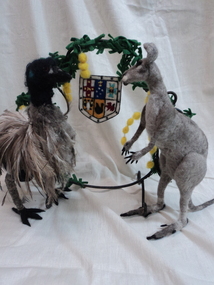
... ...Australian Sheep and Wool Show...This felted coat of arms was made by Heather Frizzell for entry into the Australian Sheep and Wool Show in 2016. It was entered into the needle felting section, which it won. ...This felted coat of arms was made by Heather Frizzell for entry into the Australian Sheep and Wool Show in 2016. It was entered into the needle felting section, which it won. ...This felted coat of arms was made by Heather Frizzell for entry into the Australian Sheep and Wool Show in 2016. It was entered into the needle felting section, which it won. The emu and the kangaroo and predominantly made from ultra fine merino from a sheep named Ninja, with a micron count between 14-15, from Casalana Fine Wool. The emu feathers were supplied by an emu farm in South Australia. It took approximately fifty hours for the maker, Heather Frizzell, to complete this piece at her home in Barraboool, Victoria.Woollen Australian Coat of Arms, with felted Kangaroo and Emu. Includes a round metal stand, winning sash, plastic bag of sample materials and a certificate.heather fizzell, coat of arms, kangaroo, emu, feathers, felting, australian sheep and wool show, needle work, competition, casalana fine wool, merino -
 National Wool Museum
Archive - About Wool, International Wool Secretariat, 1995
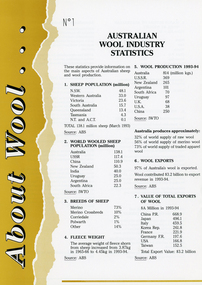
... All have different colours and titles, including 'Australian Wool Industry Statistics', 'History of the Australian Wool Industry', 'Guide to Wool Textiles', 'Wool the Fibre', 'Trademarks of Wool', 'Wool and the Environment', 'The Australian Sheep Flock', 'Care of Wool', 'The Natural Properties of Wool' and 'The Processing of Raw Wool into Yarn'. ...All have different colours and titles, including 'Australian Wool Industry Statistics', 'History of the Australian Wool Industry', 'Guide to Wool Textiles', 'Wool the Fibre', 'Trademarks of Wool', 'Wool and the Environment', 'The Australian Sheep Flock', 'Care of Wool', 'The Natural Properties of Wool' and 'The Processing of Raw Wool into Yarn'. ...Part of a collection of books, manuals, photographs, letters and clothing relating to the working life of Stuart Ascough. Stuart's career in the wool industry spanned over 43 years from 1960 to 2003 in various roles including Topmaking Plant Manager at Courtaulds Ltd. in Spennymore, U.K., Operations Manager at Port Phillip Mills in Williamstown Victoria, Marketing Executive, Early Stage Wool Processing at the International Wool Secretariat Melbourne, Australia and General Manager of Victoria Wool Processors Pty. Ltd. in Laverton North, Victoria. Throughout his career Stuart travelled extensively, and in the 1990s worked at many topmaking mills in China on quality improvement projects. He also provided technical advice and training at mills in India, Ukraine, Lithuania, Kyrgyzstan, Russia, Latvia, Byelorussia and other parts of Europe and Asia.A series of ten A4 information leaflets with various titles on the theme of 'About Wool...'. Some leaflets are single sheets double sided, some are folded four sided leaflets. All have different colours and titles, including 'Australian Wool Industry Statistics', 'History of the Australian Wool Industry', 'Guide to Wool Textiles', 'Wool the Fibre', 'Trademarks of Wool', 'Wool and the Environment', 'The Australian Sheep Flock', 'Care of Wool', 'The Natural Properties of Wool' and 'The Processing of Raw Wool into Yarn'. Leaflets show illustrations, logos, images and text.8394.1: No.1 / AUSTRALIAN / WOOL INDUSTRY / STATISTICS 8394.2: No. 2 / HISTORY OF THE / AUSTRALIAN WOOL / INDUSTRY 8394.3: No. 3 / GUIDE TO WOOL TEXTILES 8394.4: No. 4 / WOOL THE FIBRE 8394.5: No. 5 / TRADEMARKS OF WOOL 8394.6: No. 6 / WOOL AND THE ENVIRONMENT 8394.7: No. 7 / THE / AUSTRALIAN SHEEP / FLOCK 8394.8: No. 8: / CARE OF WOOL 8394.9: No. 9 / THE NATURAL / PROPERTIES OF WOOL 8394.10: No. 10 / THE PROCESSING OF / RAW WOOL INTO YARNstuart ascough, international wool secretariat, victoria wool processors, port phillip mills pty ltd, topmaking, career, wool industry, mills, leaflet -
 Orbost & District Historical Society
Textile - Handmade quilt, Elsa Williams, late1980s
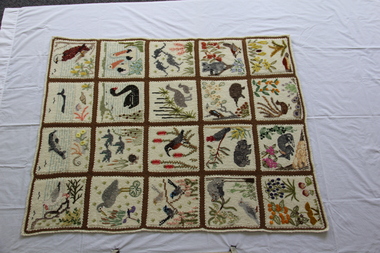
... sheep, spun and dyed the wool, and crafted this quilt. For about 20 years, Elsa was a member of a weaving group started by Gwenda Bland at Lake Tyers. Elsa wove carpets for her own home at Wombat Creek. Gwenda Beavis was given this quilt by Elsa in 2007 and it was often displayed around the district, receiving many comments due to the quality of the workmanship and design. This quilt has been made from hand-spun and hand-dyed wool. The background is Tricot crochet squares, and the coloured decorations of Australian ...This quilt or wall hanging is entirely hand-made by noted Orbost district craftsperson, Elsa Williams (nee Elsa Beavis, b 27-5-1924, d 22-6-2007) who lived on a property at Wombat Creek near Orbost in the 1980s. Elsa had her own sheep, spun and dyed the wool, and crafted this quilt. For about 20 years, Elsa was a member of a weaving group started by Gwenda Bland at Lake Tyers. Elsa wove carpets for her own home at Wombat Creek. Gwenda Beavis was given this quilt by Elsa in 2007 and it was often displayed around the district, receiving many comments due to the quality of the workmanship and design. This quilt has been made from hand-spun and hand-dyed wool. The background is Tricot crochet squares, and the coloured decorations of Australian animals and plants have been embroidered onto the tricot squares. This items is significant because it shows excellent creativity and quality of workmanship. It also represents an era in Australia when hand-weaving, spinning, and dying wool became very popular as hand-crafts. A hand-made woollen quilt, cream background, with images of Australian flowers, plants, birds, and animals embroidered onto the cream background. elsa williams, handcrafted quilt, australiana design, spinning and weaving -
 Kiewa Valley Historical Society
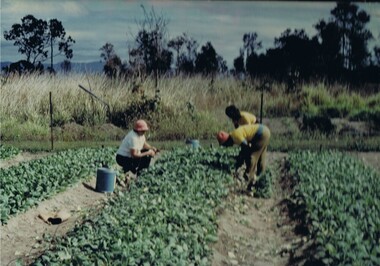
Photograph Tobacco seedlings, Pulling tobacco seedlings for Planting, Circa mid to late 1900s
... Australia (after 136 years of planting the first crop). It was also significant that the major tobacco companies such as Philip Morris and The British American Tobacco Australasia advised the industry that it would source its tobacco requirements overseas by 2009. The death of the tobacco industry(2006) resulted in the expansion of the dairy , sheep ...This promotional photograph by the Tobacco Growers Association was in response to a 1935 meeting of tobacco growers from Victoria, South Australia and Queensland which produced four major resolutions for the industry covering the remainder of the 1900s. These four resolutions were: (1) Adequate tariff protection (2) Control of pests and diseases (3) Orderly marketing (4) The formation of an advisory council of growers. History has produced the following results. (1) adequate tariff protection was never achieved,(2) control of disease through benzol vapour (CSIRO) breakthrough, was later identified as carcinogenic, (3) orderly marketing was achieved through (4) the establishment of the Tobacco Growers Association(19840. In October 2006, by way of Government buy back of tobacco leases from growers, resulted in the end of Tobacco farming in Australia (after 136 years of planting the first crop). It was also significant that the major tobacco companies such as Philip Morris and The British American Tobacco Australasia advised the industry that it would source its tobacco requirements overseas by 2009.The death of the tobacco industry(2006) resulted in the expansion of the dairy , sheep, beef cattle, venison and lama wool producers in the Kiewa Valley and surrounding regions. The remnants of the Tobacco Industry can still be viewed throughout the Kiewa Valley and adjacent regions on the former tobacco farms which still have the tobacco drying sheds and now converted into hay sheds. The problems from the large quantities of carcinogenic infused soil of farmlands in the region, still remains a problem now and for future generations. This particular photograph shows the lack of understanding by farmers and the contracted labour, at that time, and is demonstrated by the lack of protection of hands when handling seedlings and attached soil. Hand and foot protection was rarely used, even when later warnings were issued of the carcinogenic toxicity of the soil. The majority of farm owners, up until Health authorities stepped in the later stages of 1900s, were skeptical of city scientists' "carcinogenic" health warnings and it was only after the younger generation of farmers, who had graduated from Agricultural colleges, encompassed the scientific approach to farm management. The "she'll be right mate" attitude of the farming/rural community has since the 1970s been slowly dissipating. Stricter controls of herbicides and pesticides used in agriculture are now in force.Coloured photograph pasted onto a thick wood chip backing. Two galvanised eyelets at the top of the frame, 50mm from each end, with a twine cord stretch from each, for hanging purposes. See also KVHS 0054A, KVHS0054C to KVHS 0054FA sign, which has been removed from the picture at some previous point in time is "Pulling seedlings for planting"tobacco, farming, rural industry, licences, ollie mould, blue mould, benzol vapour, photograph -
 Kiewa Valley Historical Society
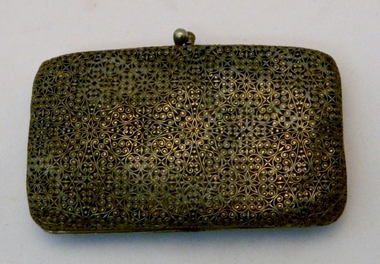
Purse Money Filigree, circa early 1900s
... This item has historical value as it shows part of the importance of fashionable money containers specific to a more affluent rural family. The period when sheep properties producing high grade wool were providing Australia with the high yield capital return to sustain an ever growing population. ...This item has historical value as it shows part of the importance of fashionable money containers specific to a more affluent rural family. The period when sheep properties producing high grade wool were providing Australia with the high yield capital return to sustain an ever growing population. ...This item has historical value as it shows part of the importance of fashionable money containers specific to a more affluent rural family. The period when sheep properties producing high grade wool were providing Australia with the high yield capital return to sustain an ever growing population. This was an era where most of the manufactured goods were imported from England and the European continent.This has relevant significant value as it portrays the earlier reliance that the growing Australian population had from the rural sector. The wealth capital was from the rural sector and the elaborate fashion accessories, such as this money purse, shows how that wealth was utilised. The Kiewa Valley was part of the "rich" farm regions of Victoria and besides gold mines and tobacco plantations, dairy and cattle properties provided for not only the needs of the Victorian region but also the rest of Australia. This gold plated filigree money purse has a clasp on top for fastening purposes and has on either side inside a small extension frame which would have contained a felt/silk padding buffer. The buffer would have highlighted the intricate pattern of the filigree metalwork.hand purse, money purse, filigree women's accessories -
 Warrnambool and District Historical Society Inc.
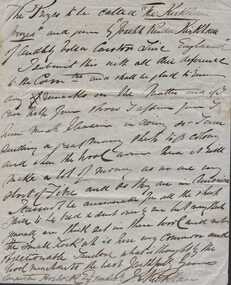
Document, Letter J Kirkham, 1873
... wool. He states as an aside at the end of the letter,” I have now determined to export my best sheep leaving the home ** to my father and nephew, I would like to number ** amongst my customers This letter shows the link between wool breeders in England and their efforts to establish connections and supplies in Australia. warrnambool j kirkham augustus bostock long wool lincoln sheep long wool lincoln Signed Kirkham. ...From other correspondence in this collection of letters we have established that Mr Kirkham is a breeder of long wool Lincoln sheep who was eager to establish the breed in Australia and New Zealand. Augustus Bostock is mentioned at the bottom of this letter To that end, he speaks of establishing a number of prizes called the Kirkham prizes with the emphasis being on the quality of the wool. He states as an aside at the end of the letter,” I have now determined to export my best sheep leaving the home ** to my father and nephew, I would like to number ** amongst my customersThis letter shows the link between wool breeders in England and their efforts to establish connections and supplies in Australia.Large cream sheet of paper with black ink hand writing .Back of sheet is blank. Folded in half.Signed Kirkham.warrnambool, j kirkham, augustus bostock, long wool lincoln sheep, long wool lincoln -
 Warrnambool and District Historical Society Inc.
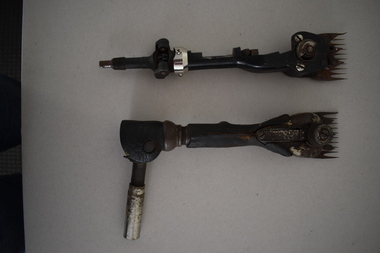
Artefact, Lister, Shearing heads, Early 20th century
... wool production in the mid to late 19th century in Australia led to the need to replace the hand shears with some mechanized form of shearing. The first sheep shearing machine in Australia was patented in 1867 and improvements to this early model were made over the ensuing years. The early 1890s saw the introduction of flexible drive shafts. The two items here described show...wool production in the mid to late 19th century in Australia led to the need to replace the hand shears with some mechanized form of shearing. The first sheep shearing machine in Australia was patented in 1867 and improvements to this early model were made over the ensuing years. The early 1890s saw the introduction of flexible drive shafts. The two items here described show ...The woollen industry has always been of the utmost importance in Australia. Although exports have declined over the past decades the production of fine wool still remains important in our economy. The great increase in wool production in the mid to late 19th century in Australia led to the need to replace the hand shears with some mechanized form of shearing. The first sheep shearing machine in Australia was patented in 1867 and improvements to this early model were made over the ensuing years. The early 1890s saw the introduction of flexible drive shafts. The two items here described show this innovation. These two items are of interest as examples of handpieces used early in the 20th century in the mechanized shearing of sheep. They would be typical of the pieces used in the wool industry in the early 20th century in Western Victoria. There are today many local shearers living in Warrnambool and nearby towns and working in the district. .1 This is a metal handpiece for a sheep shearing mechanism. It has a toothed blade attached with metal screws at one end and a jointed metal pipe at the other end for attachment to the shearing machine. The middle section has been covered with black leather for easier gripping. .2 This is a metal handpiece for a sheep shearing mechanism. It has a toothed blade at one end and a flexible metal attachment at the other end to connect it to the shearing machine. Both items are rusted and stained. ‘Sunbeam Flight Lister’sheep shearing in the western district, warrnambool -
 National Wool Museum
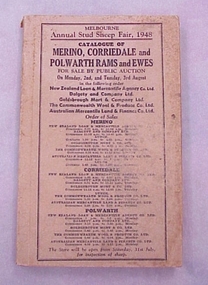
Catalogue, Melbourne Annual Stud Sheep Fair, 1948 Catalogue of Merino, Corriedale and Polwarth Rams and Ewes
... Agricultural shows Merino sheep Corriedale sheep Polwarth Sheep Dalgety and Company Limited Goldsbrough Mort and Company Limited Australian Mercantile Land and Finance Company Ltd New Zealand Loan and Mercantile Agency Co. Ltd Commonwealth Wool ...Melbourne Annual Stud Sheep Fair, 1948 Catalogue of Merino, Corriedale and Polwarth Rams and Ewes. Owned by donors uncle, J.P. Swanton, who ran a small merino stud called 'Spring Hills' at Koriella.agricultural shows merino sheep corriedale sheep polwarth sheep, dalgety and company limited goldsbrough, mort and company limited australian mercantile land and finance company ltd new zealand loan and mercantile agency co. ltd commonwealth wool and produce co. ltd, agricultural shows, merino sheep, corriedale sheep, polwarth sheep -
 National Wool Museum
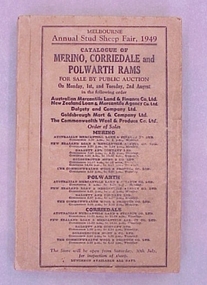
Catalogue, Melbourne Annual Sheep Fair, 1949 Catalogue of Merino, Corriedale and Polwarth Rams
... Agricultural shows Merino sheep Corriedale sheep Polwarth Sheep Dalgety and Company Limited Goldsbrough Mort and Company Limited Australian Mercantile Land and Finance Company Ltd New Zealand Loan and Mercantile Agency Co. Ltd Commonwealth Wool ...Melbourne Annual Sheep Fair, 1949 Catalogue of Merino, Corriedale and Polwarth Rams. Owned by donors uncle, J.P. Swanton, who ran a small merino stud called 'Spring Hills' at Koriella.F0404agricultural shows merino sheep corriedale sheep polwarth sheep, dalgety and company limited goldsbrough, mort and company limited australian mercantile land and finance company ltd new zealand loan and mercantile agency co. ltd commonwealth wool and produce co. ltd, agricultural shows, merino sheep, corriedale sheep, polwarth sheep -
 National Wool Museum
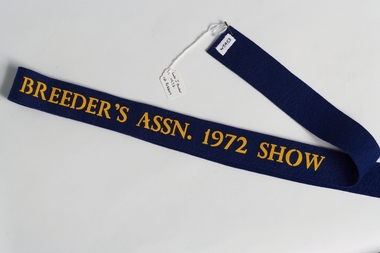
Ribbon
... Presented to Joyce Hucker for objects entered in the Australian Sheep Breeders' Association 1972 Show. ...Presented to Joyce Hucker for objects entered in the Australian Sheep Breeders' Association 1972 Show. ...Presented to Joyce Hucker for objects entered in the Australian Sheep Breeders' Association 1972 Show. Hucker began working with unspun wool and making dyes from the natural sources from her garden and the farm trees around her. From knitting and croceting articles, she progressed to felting and a 'wrapping' technique, always using unspun wool. She was a successful exhibitor at many craft shows and was always willing to pass on her experience and knowledge to others, often travelling widely to help groups requiring a demonstration.Presented to Joyce Hucker for objects entered in the Australian Sheep Breeders' Association 1972 Show.Australian Sheep Breeders' Assn, 1972 Show Late J Hucker 1972 1st Ribbonagricultural shows, hucker, mrs joyce -
 National Wool Museum
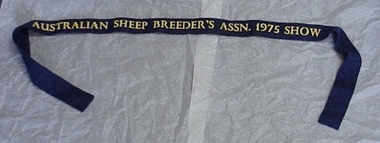
Ribbon
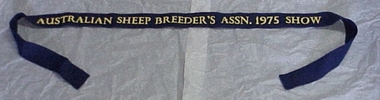
... Presented to Joyce Hucker for objects entered in the Australian Sheep Breeders' Association 1972 Show. ...Presented to Joyce Hucker for objects entered in the Australian Sheep Breeders' Association 1972 Show. ...Presented to Joyce Hucker for objects entered in the Australian Sheep Breeders' Association 1972 Show. Hucker began working with unspun wool and making dyes from the natural sources from her garden and the farm trees around her. From knitting and croceting articles, she progressed to felting and a 'wrapping' technique, always using unspun wool. She was a successful exhibitor at many craft shows and was always willing to pass on her experience and knowledge to others, often travelling widely to help groups requiring a demonstration.Presented to Joyce Hucker for items entered in the Australian Sheep Breeders' Association 1975 Show.Australian Sheep Breeders' Assn, 1975 Showagricultural shows, hucker, mrs joyce -
 National Wool Museum
Ribbon
... Presented to Joyce Hucker for objects entered in the Australian Sheep Breeders' Association 1972 Show. ...Presented to Joyce Hucker for objects entered in the Australian Sheep Breeders' Association 1972 Show. ...Presented to Joyce Hucker for objects entered in the Australian Sheep Breeders' Association 1972 Show. Hucker began working with unspun wool and making dyes from the natural sources from her garden and the farm trees around her. From knitting and croceting articles, she progressed to felting and a 'wrapping' technique, always using unspun wool. She was a successful exhibitor at many craft shows and was always willing to pass on her experience and knowledge to others, often travelling widely to help groups requiring a demonstration.Presented to Joyce Hucker for items entered in the Australian Sheep Breeders' Association 1975 Show.Australian Sheep Breeders' Assn, 1975 Showagricultural shows, hucker, mrs joyce -
 National Wool Museum
Video recording, Elders Limited, "The Fleece that would not die"
... Australia. Whilst out riding in some rough country he came across a sheep that had been left by the previous owner of the station. ...Australia. Whilst out riding in some rough country he came across a sheep that had been left by the previous owner of the station. ...Video recording, produced to accompany display of coat. In 1928 Mr Mal Groves took over the Dutchman Station near Port Augusta in South Australia. Whilst out riding in some rough country he came across a sheep that had been left by the previous owner of the station. As he carried shears with him, he sheared the sheep and left the fleece rolled up and partially covered by rocks and wood, as he had no bag to carry it back with him. He intended to come back for the fleece, but forgot about it until he came across it some forty years later. It was still in good condition (despite having experienced extreme temperatures and rainfall whilst in the open), so he showed it to Elders who arranged to display it at agricultural shows in Adelaide, Melbourne and Geelong. The Gordon Institute of Technology, Geelong, offered to spin the fleece into a fabric and make a coat for Mrs Groves. The fabric was tailored into a coat by Lindsay and McKenzie of Geelong and presented to Mrs Groves in July 1968 by the SA manager of Elder Smith Goldsbrough Mort Ltd. It is not know how the coat came to Elders from the Groves family, but Elders displayed the coat under the heading "The Fleece That Would Not Die" before donating it to the National Wool Museum in 1997. A text panel giving the history of the coat as well as this video was also donated at the same time.Video recording, in a white case with Tasmanian Trades and Labour Council with compliments slip printed on yellow paper inserted into back sleeve.shearing wool - history, elders limited, groves, mr mal groves, shearing, wool - history -
 National Wool Museum
Text panel, Elders Limited, "The Fleece that would not die"
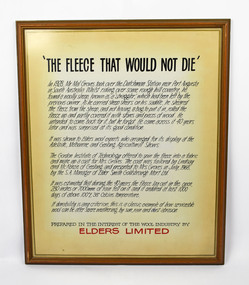
... Australia. Whilst out riding in some rough country he came across a sheep that had been left by the previous owner of the station. ...Australia. Whilst out riding in some rough country he came across a sheep that had been left by the previous owner of the station. ...Text panel produced by Elders to accompany display of coat. In 1928 Mr Mal Groves took over the Dutchman Station near Port Augusta in South Australia. Whilst out riding in some rough country he came across a sheep that had been left by the previous owner of the station. As he carried shears with him, he sheared the sheep and left the fleece rolled up and partially covered by rocks and wood, as he had no bag to carry it back with him. He intended to come back for the fleece, but forgot about it until he came across it some forty years later. It was still in good condition (despite having experienced extreme temperatures and rainfall whilst in the open), so he showed it to Elders who arranged to display it at agricultural shows in Adelaide, Melbourne and Geelong. The Gordon Institute of Technology, Geelong, offered to spin the fleece into a fabric and make a coat for Mrs Groves. The fabric was tailored into a coat by Lindsay and McKenzie of Geelong and presented to Mrs Groves in July 1968 by the SA manager of Elder Smith Goldsbrough Mort Ltd. It is not know how the coat came to Elders from the Groves family, but Elders displayed the coat under the heading "The Fleece That Would Not Die" before donating it to the National Wool Museum in 1997. A video giving the history of the coat as well as this text panel used by Elders were also donated at the same time.Text panel with black and red text on cream paper, framed in wooden frame and glass, with hanging wire.shearing, elders limited, groves, mr mal groves, dutchman station, south australia -
 National Wool Museum
Pamphlet, A souvenir from the Melbourne Sheep Show, July 21-24, 1979
... "A souvenir from the Melbourne Sheep Show, July 21-24, 1979". Souvenir pamphlet, promoting wool. Corriedale sheep Sheep breeding Australian Corriedale Association Australian Sheep Breeders Association Pettitt Mr R. ..."A souvenir from the Melbourne Sheep Show, July 21-24, 1979". Souvenir pamphlet, promoting wool.corriedale sheep sheep breeding, australian corriedale association australian sheep breeders association, pettitt, mr r. w., corriedale sheep, sheep breeding -
 National Wool Museum
Currency - One Pound Note, John Ash, 1938 - 1948
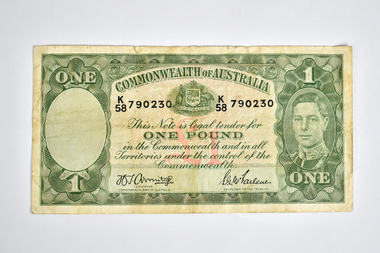
... A sheep in Montford's pastoral scene, for example, stands forward from the frame as if entering the viewer's space to escape branding and Manley preserves this visual conceit in his drawing. Whereas the printing of the previous series of Australian...A sheep in Montford's pastoral scene, for example, stands forward from the frame as if entering the viewer's space to escape branding and Manley preserves this visual conceit in his drawing. Whereas the printing of the previous series of Australian ...John Ash succeeded Thomas Harrison as the Australian Note Printer in 1927 and oversaw the printing of a new series of banknotes, known as the Ash Series. First issued between 1933 and 1934, the new banknotes sought to improve the currency's resistance to counterfeiting. A special watermark was created to increase the security of the new series. Shaped as a medallion, the watermark showed the profile of Edward, the Prince of Wales. A new portrait of the King was also introduced, depicting him frontally rather than in profile as he had appeared in the prior banknotes of the Harrison Series (1923-1925). The back of each denomination contained an individual vignette that reflected a sector of the country's economy. The wool and agricultural industries were represented, as they had been in the first series of the nation's banknotes (1913-1914), and they were joined by manufacturing and commerce. The prominent British sculptor, Paul Montford, contributed to the design of the new series. Recognised for his sculptural works on the exterior of Melbourne's Shrine of Remembrance, Montford was commissioned to produce relief sculptures that formed the basis of the banknotes' vignettes. His sculptures were translated into wash drawings by Frank Manley, the artist and engraver for the Commonwealth Bank's Note Printing Branch. Manley accentuated the sculpture's three-dimensional qualities with deep shadows and touches of illusionism. A sheep in Montford's pastoral scene, for example, stands forward from the frame as if entering the viewer's space to escape branding and Manley preserves this visual conceit in his drawing. Whereas the printing of the previous series of Australian banknotes had been criticised for its poor definition, the sculptural basis of the Ash Series clarified the banknotes' imagery. During a period of record unemployment, the scenes emphasised the strength of the human figure in gestures of labour, evoking classical, heroic qualities in their poses. The sculptural forms suggested stability in the turbulence of the Great Depression and imparted a sense of solidity to paper currency. - museum.rba.gov.auCommonwealth of Australia paper one pound note in green and white tones depicting graphics and text. The obverse has a framed design with a blank portal to the left and King George VI in the right portal. The centre shows the Australian Coat of Arms, serial number, and detail over one pound symbol on a mosaic background, with signatories below. The reverse features a framed pastoral scene with farmers tending sheep, with a blank portal to the right.Obverse: ONE / 1 / 1 / ONE / COMMONWEALTH OF AUSTRALIA / K / 58 / 790230 / K / 58 / 790230 / This Note is legal tender for / ONE POUND / in the Commonwealth and in all / Territories under the control of the / Commonwealth. / [signature] / GOVERNOR / COMMONWEALTH BANK ON AUSTRALIA / [signature] / SECRETARY TO THE TREASURY Reverse: 1 /1 / 1 / 1 / PASTORALcurrency, money, pound note, pastoral scene, industry, commonwealth of australia, paul montford, king george vi, frank manly, john ash -
 National Wool Museum
Currency - One Pound Note, John Ash, 1938 - 1948
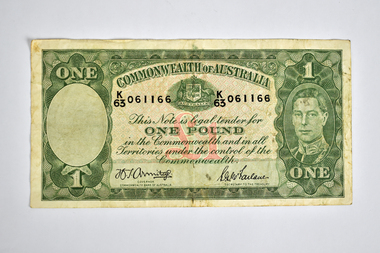
... A sheep in Montford's pastoral scene, for example, stands forward from the frame as if entering the viewer's space to escape branding and Manley preserves this visual conceit in his drawing. Whereas the printing of the previous series of Australian...A sheep in Montford's pastoral scene, for example, stands forward from the frame as if entering the viewer's space to escape branding and Manley preserves this visual conceit in his drawing. Whereas the printing of the previous series of Australian ...John Ash succeeded Thomas Harrison as the Australian Note Printer in 1927 and oversaw the printing of a new series of banknotes, known as the Ash Series. First issued between 1933 and 1934, the new banknotes sought to improve the currency's resistance to counterfeiting. A special watermark was created to increase the security of the new series. Shaped as a medallion, the watermark showed the profile of Edward, the Prince of Wales. A new portrait of the King was also introduced, depicting him frontally rather than in profile as he had appeared in the prior banknotes of the Harrison Series (1923-1925). The back of each denomination contained an individual vignette that reflected a sector of the country's economy. The wool and agricultural industries were represented, as they had been in the first series of the nation's banknotes (1913-1914), and they were joined by manufacturing and commerce. The prominent British sculptor, Paul Montford, contributed to the design of the new series. Recognised for his sculptural works on the exterior of Melbourne's Shrine of Remembrance, Montford was commissioned to produce relief sculptures that formed the basis of the banknotes' vignettes. His sculptures were translated into wash drawings by Frank Manley, the artist and engraver for the Commonwealth Bank's Note Printing Branch. Manley accentuated the sculpture's three-dimensional qualities with deep shadows and touches of illusionism. A sheep in Montford's pastoral scene, for example, stands forward from the frame as if entering the viewer's space to escape branding and Manley preserves this visual conceit in his drawing. Whereas the printing of the previous series of Australian banknotes had been criticised for its poor definition, the sculptural basis of the Ash Series clarified the banknotes' imagery. During a period of record unemployment, the scenes emphasised the strength of the human figure in gestures of labour, evoking classical, heroic qualities in their poses. The sculptural forms suggested stability in the turbulence of the Great Depression and imparted a sense of solidity to paper currency. - museum.rba.gov.auCommonwealth of Australia paper one pound note in green and white tones depicting graphics and text. The obverse has a framed design with a blank portal to the left and King George VI in the right portal. The centre shows the Australian Coat of Arms, serial number, and detail over one pound symbol on a mosaic background, with signatories below. The reverse features a framed pastoral scene with farmers tending sheep, with a blank portal to the right.Obverse: ONE / 1 / 1 / ONE / COMMONWEALTH OF AUSTRALIA / K / 58 / 790230 / K / 58 / 790230 / This Note is legal tender for / ONE POUND / in the Commonwealth and in all / Territories under the control of the / Commonwealth. / [signature] / GOVERNOR / COMMONWEALTH BANK ON AUSTRALIA / [signature] / SECRETARY TO THE TREASURY Reverse: 1 /1 / 1 / 1 / PASTORALcurrency, money, pound note, pastoral scene, industry, commonwealth of australia, paul montford, king george vi, frank manly, john ash -
 National Wool Museum
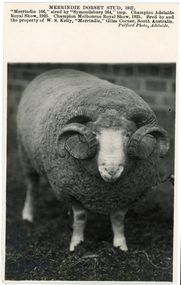
Postcard - Merrindie Dorset Stud, Pulford, 1927
... The album was found in a clean out at the Great Southern Agricultural Research Institute and donated to the National Wool Museum, along with other related material such as photographs, glass lantern slides and ephemera. world tour sheep graziers photograph agriculture rams stud south australia Merrindie Giles Corner W S Kelly pulford Front: MERRINDIE DORSET STUD, 1927. / “Merrindie 166” sired by “Symondsbury 264,” imp. Champion Adelaide / Royal Show ...This postcard was found loose in the first of three albums compiled and owned by J W Allen, Secretary of New South Wales Grazier's, and is associated with the New South Wales Graziers Association world tour of sheep 1928-1929. The album contains photographs of travel, sheep, farms, stations, people and landscapes from around the world. Locations include Naples, Port Said, Suez, Birregurra (Vic), Alexandra (Vic), Ballangeich (Vic), Keith (SA), Mt Gambier (SA), Buckland Park (SA), Tasmania, Winton (QLD), Sydney Harbour, Canberra (ACT), Toowoomba (QLD), Rockhampton (QLD), Tocal (NSW), Deepwater (NSW), Glen Innes (NSW), Longreach (QLD), Moree (NSW), Barraba (NSW) and Mudgee (NSW). Properties depicted include Mooleric, Turkeith, Woolongoon, Minadale, Crower Station, Merrindie, Koomooloo Station, Cappeedee, Koonoona, Rathmore, Ellenthorpe, Camden Park Station, Glenlegh, Strathmore Station, Ilparran Station, Binneguy, Midkin, Terlings, Ashley, Bereen, Plumthorpe, Mayvale and Havilah. The album was found in a clean out at the Great Southern Agricultural Research Institute and donated to the National Wool Museum, along with other related material such as photographs, glass lantern slides and ephemera.Photograph postcard with a black and white image of a ram, and printed black text.Front: MERRINDIE DORSET STUD, 1927. / “Merrindie 166” sired by “Symondsbury 264,” imp. Champion Adelaide / Royal Show, 1925. Champion Melbourne Royal Show, 1925. Bred by and / the property of W. S. Kelly, “Merrindie,” Giles Corner, South Australia. / Pulford Photo, Adelaide. Back: POST CARD / CORRESPONDENCE / ADDRESS ONLY / KODAK / AUSTRALIA / KODAK / AUSTRALIAworld tour, sheep, graziers, photograph, agriculture, rams, stud, south australia, merrindie, giles corner, w s kelly, pulford -
 National Wool Museum
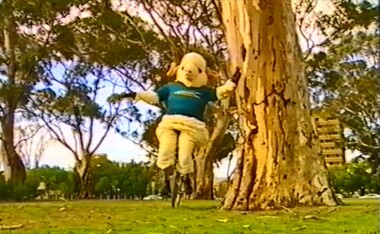
Film - Sportwool, c.2000
... Tape shows a long form advertisement for Sportwool, featuring national and international sports athletes. Film Textile Industry Sheep Training Fitness Sport Athletes Uniforms Pat Farmer Sportwool Label on tape: THE WOOLMARK COMPANY / SPORTS WOOL / Duration: 4 min 38 sec Black VHS tape with white stickers and hand written and printed text. ...Tape shows a long form advertisement for Sportwool, featuring national and international sports athletes.Black VHS tape with white stickers and hand written and printed text. Tape is housed in a white plastic case. Film includes colour footage and audio. 00:06 - titles 'Sportwool' 00:11 - line of cold looking people and sheep mascot 00:21 - sheep mascot and basketball players on indoor court 00:42 - sheep mascot on unicycle 00:54 - various scenes of Australian athletes 01:37 - Manchester United, various scenes 01:56 - basketball 02:16 - cyclists 02:32 - hockey 02:53 - Pat Farmer, ultramarathon athlete, running through outback landscape 03:03 - skiing 03:14 - netball 03:27 - australian football league 04:42 - end credits 04:45 - endLabel on tape: THE WOOLMARK COMPANY / SPORTS WOOL / Duration: 4 min 38 secfilm, textile industry, sheep, training, fitness, sport, athletes, uniforms, pat farmer, sportwool -
 National Wool Museum
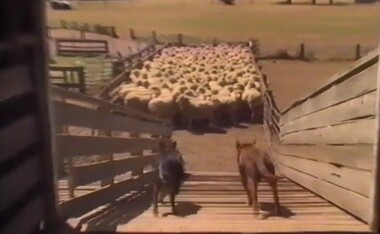
Film - Herding Sheep, Sound Design Studio, c.2000
... Tape shows farmer working with cattle dogs to herd sheep on a property. Probably used in previous displays at the National Wool Museum. ...Tape shows farmer working with cattle dogs to herd sheep on a property. Probably used in previous displays at the National Wool Museum.Black VHS tape with white stickers and hand written and printed text. Tape is housed in a black plastic case with stickers. Film includes colour footage and audio. 00:04 - Herding sheep on a property, featuring farmer, cattle dogs, sheep, motorbike and a horse. 04:49 - end Film loops four times.Label on tape: VIDEO VISION / VHS / NATIONAL WOOL MUSEUM / SHEEP DOG / COMPILE / SOUND / DESIGN / STUDIO / LES GILBERT/DIRECTOR / 9A GARDEN STREET PRAHRAN / VICTORIA 3181 AUSTRALIA / TELEPHONE (03) 529 3086film, sheep, rural industries, farm, farming, cattle dogs, herding, property, farmer -
 National Wool Museum
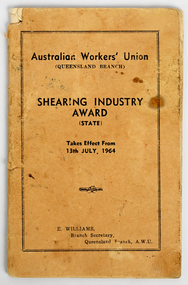
Booklet - Australian Workers’ Union, Shearing Industry Award, Queensland Branch, The Industrial Conciliation and Arbitration Commission of Queensland, 1964
... This booklet details the award which applies to all employers and employees in the callings of shearers, crutchers, wool-pressers, shed hands, cook, and cooks’ offsiders (other than station cooks) in the State of Queensland. It shows ...This booklet details the award which applies to all employers and employees in the callings of shearers, crutchers, wool-pressers, shed hands, cook, and cooks’ offsiders (other than station cooks) in the State of Queensland. It shows the pivotal role of unions in protecting workers work conditions and health.Forty eight page cream booklet with black printed text and black printed graphics.Australian Workers’ Union / (QUEENSLAND BRANCH) / SHEARING INDUSTRY / AWARD / (STATE) / Takes Effect From / 13th JULY, 1964 / E. WILLIAMS, / Branch Secretary, / Queensland Branch, A. W. U.the industrial conciliation and arbitration act of 1961, unions, australian workers union, shearers award, sheep industry, wool industry, farming, employee, employer, working life, work, the industrial conciliation and arbitration commission of queensland, queensland -
 National Wool Museum
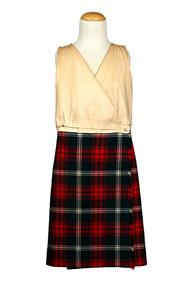
Textile - Children’s Kilt, Fletcher Jones, 1960s
... sheep farm near Torquay. The kilts were worn on special occasions, with woollen jumpers worn on top of the bodices. Photos show Heather (aged 8) and Sandra (aged 6) with their younger sister Melinda (aged 1), wearing the kilts at family farms “South Beach” and “Lambidgee”, both near Torquay, in 1965. The kilts were purchased by the children’s grandmother, most likely from Fletcher Jones in Geelong, and were highly valued by the family. This kilt belonged to Heather. Fletcher Jones Kilts Family Life Farming 1960s Fashion Children's Fashion Children's Clothing Tartan printed [label]: FLETCHER JONES AUSTRALIA ...One of two children’s kilts with bodices owned by Heather White and Sandra Hooker (nee White). The Fletcher Jones kilts were made in the 1960s and are in two different tartan designs. They were designed to be lengthened as the children grew by adjusting the hem of the bodice. An original clothing tag (NWM-9154) features a poem about this, which was greatly treasured by Sandra as a child. Three sisters, Sandra, Heather and Melinda, all had kilts as children growing up in the 1960s on a sheep farm near Torquay. The kilts were worn on special occasions, with woollen jumpers worn on top of the bodices. Photos show Heather (aged 8) and Sandra (aged 6) with their younger sister Melinda (aged 1), wearing the kilts at family farms “South Beach” and “Lambidgee”, both near Torquay, in 1965. The kilts were purchased by the children’s grandmother, most likely from Fletcher Jones in Geelong, and were highly valued by the family. This kilt belonged to Heather.Woollen tartan kilt with cream coloured cotton v necked sleeveless bodice attached. Kilt is green, red and cream. printed [label]: FLETCHER JONES AUSTRALIA / PURE WOOL / CREATED BY / Fletcher Jones / AUSTRALIA / F. J. DRY CLEANING & REPAIRS / SERVICE WILL CARE FOR / THIS GARMENT always fletcher jones, kilts, family life, farming, 1960s, fashion, children's fashion, children's clothing, tartan -
 National Wool Museum
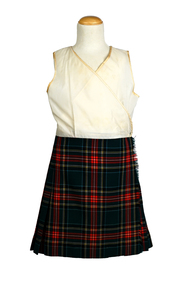
Textile - Children’s Kilt, Fletcher Jones, 1960s
... sheep farm near Torquay. The kilts were worn on special occasions, with woollen jumpers worn on top of the bodices. Photos show Heather (aged 8) and Sandra (aged 6) with their younger sister Melinda (aged 1), wearing the kilts at family farms “South Beach” and “Lambidgee”, both near Torquay, in 1965. The kilts were purchased by the children’s grandmother, most likely from Fletcher Jones in Geelong, and were highly valued by the family. This kilt belonged to Sandra. Fletcher Jones Kilts Family Life Farming 1960s Fashion Children's Fashion Children's Clothing Tartan printed [label]: FLETCHER JONES AUSTRALIA ...One of two children’s kilts with bodices owned by Heather White and Sandra Hooker (nee White). The Fletcher Jones kilts were made in the 1960s and are in two different tartan designs. They were designed to be lengthened as the children grew by adjusting the hem of the bodice. An original clothing tag (NWM-9154) features a poem about this, which was greatly treasured by Sandra as a child. Three sisters, Sandra, Heather and Melinda, all had kilts as children growing up in the 1960s on a sheep farm near Torquay. The kilts were worn on special occasions, with woollen jumpers worn on top of the bodices. Photos show Heather (aged 8) and Sandra (aged 6) with their younger sister Melinda (aged 1), wearing the kilts at family farms “South Beach” and “Lambidgee”, both near Torquay, in 1965. The kilts were purchased by the children’s grandmother, most likely from Fletcher Jones in Geelong, and were highly valued by the family. This kilt belonged to Sandra.Woollen tartan kilt with cream coloured silk v necked sleeveless bodice attached. Kilt is green, red, yellow and cream. printed [label]: FLETCHER JONES AUSTRALIA / PURE WOOL / CREATED BY / Fletcher Jones / AUSTRALIA / F. J. DRY CLEANING & REPAIRS / SERVICE WILL CARE FOR / THIS GARMENT always fletcher jones, kilts, family life, farming, 1960s, fashion, children's fashion, children's clothing, tartan -
 National Wool Museum
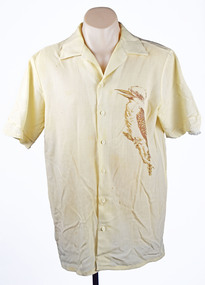
Clothing - 1984 Los Angeles Olympics Men's Opening Ceremony Shirt, c. 1984
... On the 1984 Los Angeles Olympic Uniforms donator Doug wrote- During the 1980s the Australian wool industry was at its most prosperous times with record numbers of sheep producing wool receiving ever increasing values due to the success of the Reserve Price Scheme, and the overall guidance of the Australian Wool Corporation (AWC). ...On the 1984 Los Angeles Olympic Uniforms donator Doug wrote- During the 1980s the Australian wool industry was at its most prosperous times with record numbers of sheep producing wool receiving ever increasing values due to the success of the Reserve Price Scheme, and the overall guidance of the Australian Wool Corporation (AWC). ...On the 1984 Los Angeles Olympic Uniforms donator Doug wrote- During the 1980s the Australian wool industry was at its most prosperous times with record numbers of sheep producing wool receiving ever increasing values due to the success of the Reserve Price Scheme, and the overall guidance of the Australian Wool Corporation (AWC). As a humble technician, my role was a low profile newly created position of “Controller, Technical Marketing” where wool was to be marketed on its technical properties, as distinct from the “Product Marketing Group” which exploited trhe traditional high profile approach of marketing wool;s superior fashion attributes. The Woolmark was the tool central to this approach. When the forthcoming Los Angeles Olympic Games was announced, the Product Marketing Group seized upon the chance to show the world that we could make top fashion garments and display them on our elite athletes on the world stage. A concept was launched using a contemporary top designer, Adel Weiss, with the most exclusive fabrics and knits available, and all with a lot of hype. This launch failed dismally for the following reasons- - The designer did a wonderful job presenting an excellent fashion range on perfect skinny models. The AOC however wanted a uniform which had an obvious Australian appearance when fitted to elite, and frequently muscular, athletes. - The fabrics chosen did not reflect the performance required by travelling athletes, there was no recognition of the need for ‘easy care.’ - There was no recognition given to the problem of measuring, manufacturing and distribution of a range of articles when the selected athlete could be domiciled anywhere in Australia. - There was no appreciation of such historical facts as Fletcher Jones, who had been unofficial suppliers dating back to the 1954 Olympics in Melbourne, and the Fletcher Jones board member, who was also an AWC board member, and was not in favour of the change. The project passed from Product Marketing to Public Relations, a big spending off-shoot of the AWC Chairman David Asimus, and due to the day to day operations of the project was passed to me and PR took care of the financial matters. The first task was to meet with the AOC and find out exactly their requirements. This lead to the production of a design and manufacturing brief, cointaining exact time lines for each event required to ensure an appropriate uniform on every athlete chosen to represent his/her country on the date given for the Opening Ceremony in Los Angeles. Working backwards the timeline becomes- 1. Noted the exact date of the Opening Ceremony. 2. Estimated the date for distributing completed garments to each athlete. 3. Estimated the time span available for measuring each athlete and commence making each component of the ensemble to the individual measurements of each athlete. 4. Decided the date for making the final choice of uniform design concept. 5. Decided the date for distribution of the design brief to selected designers. These five steps were spread out over a two year period. The Commonwealth Games occur midway between each Olympic Games, work on the Olympic uniform commences the week after the Commonwealth Games closing ceremony and MUST be ready by the prescribed day two years hence. The project also had to remain cognisant of trade politics existing within the span of the task, as well as the temperament of designers in general. It is no overstatement to say that in the past every designer in Australia believed they could, and should, be chosen to design the Australian Uniform. The final choice of designer almost always faced criticism from the fashion press and any designer who had been overlooked. However, with the contenders receiving an exacting brief the numbers of serious contenders greatly reduced. The Los Angeles Olympic Uniforms. A further reason for the AWC bid failure to design the LA uniform was that the AOC had already chosen Prue Acton to design it. This was based on her proven performance during previous games as she had a talent for creating good taste Australiana. Her design concepts also considered the effect when they were viewed on a single athlete as well as the impact when viewed on a 400 strong team coming on to the arena. A blazer trouser/skirt uniform in bright gold was chosen for the formal uniform. It was my task to select a pure wool faille fabric from Foster Valley weaving mill and have sufficient woven and ready within the prescribed timeline. The trouser/skirt fabric selected was a 60/40 wool polyester plain weave fabric from Macquarie Worsted. This fabric had a small effect thread of linen that was most attractive when dyed to match some eucalyptus bark Prue had brought back from central Australia. For the Opening Ceremony uniform, Prue designed a series of native fauna, a kookaburra for the men’s shirt and a pleated skirt with a rural scene of kangaroos, hills and plants. This presented an insurmountable printing challenge to the local printing industry as it had an unacceptably large repeat size and the number required (50) was also commercially unacceptable. The solution was a DIY mock up at RMIT and the employment of four student designers. The fabric selected for this garment was a light weight 19 micron, pure wool with a very high twist yarn in alternating S and Z twist, warp and weft. This fabric proved to be the solution to a very difficult problem, finding a wool product which is universally acceptable when worn next to the sin by young athletes competing in the heat of a Los Angeles summer. Modifications to this fabric were developed to exploit its success when facing the same problem in future games. Garment Making- The most exacting garment in the ensemble is the tailored blazer, plus the related trouser/skirt. Unfortunately tailoring athletes that come in various shapes and sizes such as; - Weight lifters develop an enormous chest, arms and neck size. A shirt made to a neck size of 52 would produce a shirt with cuffs extending well beyond the wearer’s hands. - Basketball players are up to 7 feet tall and garments relying ona chest measurement grading would produce a shirt with cuffs extending only to elbow length. - Swimmers develop enormous shoulders and slim hips, cyclists by contrast develop thighs I liken to tree trunks and a uniform featuring tight trousers must be avoided at all cost. Suffice to say many ensembles require specialist ‘one off’ treatment for many athletes. Meanwhile there is a comfortable in between group who can accept regular sizes so you can cater for these by having back up stock with plenty of built in contingencies. Athletes may be domiciled anywhere in Australia, this creates a fundamental problem of taking their measurements. The Fletcher Jones organisation was key to answering this problem due to their presence in every capital city, as well as many provincial towns around Australia. Each athlete on being selected for the Olympic Team was simultaneously requested to visit their nearest Fletcher Jones shop. The standardised measurement data collected was shared with the other manufacturers, e.g. Pelaco Shirts, Holeproof Socks and Knitwear, Maddison Belts, and even Hush Puppy Shoes. As the time for the Games approached the AOC made arrangements for combining meeting of all. Selected available athletes at the Australian Institute of Sport, Canberra, where, among other things, they were fitted and supplied with their uniform. The method evolved as follows.Men’s cream coloured button up, collared shirt. Images of a kookaburra have been printed onto the shirt, a single kookaburra on the left breast and a pair of kookaburras on the reverse of the shirt. The kookaburras are printed in a brown tone to complement the cream colour of the fabric.On tag - FMaustralian wool corporation, 1984 los angeles olympics, olympic uniforms, men's uniforms, sport, athletes -
 National Wool Museum
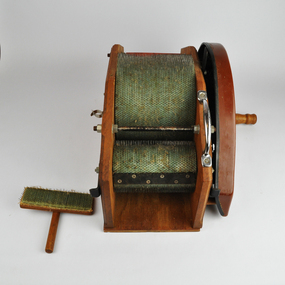
Tool - Drum Carder, Kacoonda, c.1980
... Show in the late 1980s. The carder allowed Gill to spin fleece from her own Merino sheep. Merino is a difficult wool to spin when compared to other popular varieties, such as Corriedale or crossbred wool. ...Show in the late 1980s. The carder allowed Gill to spin fleece from her own Merino sheep. Merino is a difficult wool to spin when compared to other popular varieties, such as Corriedale or crossbred wool. ...This drum carder was purchase by Gill Stange at the Whittlesea Show in the late 1980s. The carder allowed Gill to spin fleece from her own Merino sheep. Merino is a difficult wool to spin when compared to other popular varieties, such as Corriedale or crossbred wool. The carder helped her to tease out the fleece, slightly separating the fibres before spinning. It also allowed for easier removal of foreign matters, such as seeds and mud. Little is known about the Kacoonda brand who produced the carder. They were Australian based and appear to have only operated throughout the 1980s.The carder has one large central roller with two smaller rollers on either side. The larger roller rotates in the inverse direction of the two smaller rollers. The carding cloth is a mint green in which closely spaced wire pins are embedded. The shape, length, diameter, and spacing of these wire pins is that of a standard carder. On one side of the carder a handle is found that is used to spin the three rollers. Additionally on this side is a sticker which reads “The Kacoonda Carder. Subject to Patent Action”. A Silver grip for the easy movement of the carder can also be found high on this side. On the opposite side of the carder, many nuts and plates can be found which hold the rollers in place. This is opposed to the other side of the carder, which has a brown plastic cover plate attached underneath the handle. The walls providing a path for the carded wool to follow when being carded, are made of wood. The carder comes complete with a teasing tool. This tool has the same mint green carding cloth as the carder’s rollers. It is attached to a simple wood handle for ease of use.Wording, green, printed. Sticker on side of carder. “The Kacoonda Carder / SUBJECT TO PATENT ACTION”whittlesea show, drum carder, textile production, carding wool, kacoonda -
 National Wool Museum
Sash
... wool sash with yellow text attached. Test reads "THE AUSTRALIAN SHEEP BREEDERS ASSOCIATION INC. / 1988 WEEKLY TIMES MELBOURNE SHEEP & WOOLCRAFT SHOW / WOOLCRAFT COMPETITION"...wool sash with yellow text attached. Test reads "THE AUSTRALIAN SHEEP BREEDERS ASSOCIATION INC. / 1988 WEEKLY TIMES MELBOURNE SHEEP & WOOLCRAFT SHOW / WOOLCRAFT COMPETITION" Sash ...Presented to Jean Inglis as a prize for winning the textile competition at the 1988 Royal Melbourne Sheep Show. Her entry was a hand spun, woven and dyed wool suit for the Fashions for the Eighties parade competition. Earliest Date: 1988Dark blue felted wool sash with yellow text attached. Test reads "THE AUSTRALIAN SHEEP BREEDERS ASSOCIATION INC. / 1988 WEEKLY TIMES MELBOURNE SHEEP & WOOLCRAFT SHOW / WOOLCRAFT COMPETITION" -
 National Wool Museum
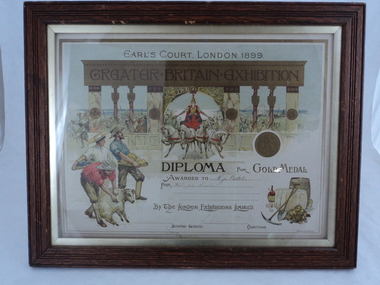
Certificate
... Diploma for Gold Medal won by John Baker for best Lincoln Wool in show at the Earls Court Greater Britain Exhibition, London, 1899. ...Sheep published in 1898. Lakeside rams and ewes were awarded Champion Ram and Ewe at the Sydney Show in 1892. By 1919 Lakeside was the largest registered Lincoln stud in Australia. ...Diploma for Gold Medal won by John Baker for best Lincoln Wool in show at the Earls Court Greater Britain Exhibition, London, 1899. John Baker owned a Lincoln sheep stud with 300 ewes and rams in Pomborneit, Victoria. The property was named Lakeside and the stud was Flock No. 5 in the first Flock Book of British Breed Sheep published in 1898. Lakeside rams and ewes were awarded Champion Ram and Ewe at the Sydney Show in 1892. By 1919 Lakeside was the largest registered Lincoln stud in Australia. The stud was dispersed in 1925.Brown timber frame with glass covering at front. Pale gold timber framed paper certificate inside. Certificate has a painting of a man being drawn by four horses beneath and arch with more people in the background and a tall ship. Front foreground depicts three men, one carrying a tray of food, another with a tray of gold and a third shearing a sheep. There is an embossed gold medal on the right centre of the page.EARL'S COURT, LONDON. 1899 GREATER BRITAIN EXHIBITION DIPLOMA FOR GOLD MEDAL AWARDED TO Mr J Baker FOR Wool, pure Lincoln BY THE LONDON EXHIBITIONS LIMITED DIRECTOR GENERAL. CHAIRMAN WEINERS LTD LONDON N.W -
 National Wool Museum
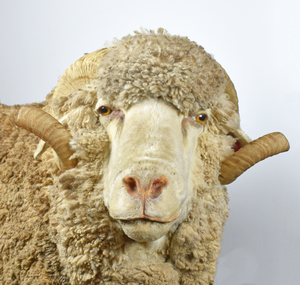
Taxidermy Sheep, Goliath, c1980
... His wool is generally the strongest of the Australian Merinos, from 22 microns and upwards. Record Merino prices peaked in the 1980s when a Merino ram secured $450 000 at the 1989 Royal Adelaide Show ram sales. ...The South Australian Merino has been developed to perform well in the more arid, pastoral environments found in areas of South Australia, Western Australia, Queensland and New South Wales. Goliath has greasier wool which protects the fibre in adverse weather conditions. His wool is generally the strongest of the Australian Merinos, from 22 microns and upwards. Record Merino prices peaked in the 1980s when a Merino ram secured $450 000 at the 1989 Royal Adelaide Show ram sales. The ram was from the Collinsville Merino Stud which had also set sales records in the preceding two years; records that have never been beaten. South Australian Merino ram. Large size body and short legs with white fleece. sheep, south australia
