
Showing 9 items matching "aviation in warrnambool’s history"
-
 Warrnambool and District Historical Society Inc.
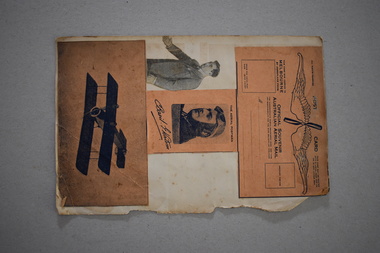
Postcard, Basil Watson Scrapbook, 1917
... ...Aviation in Warrnambool’s History...Warrnambool. These four items are of considerable historical interest as they are souvenirs issued at the time of Basil Watson’s aviation exploits in the early 1900s and Watson is of great importance in the aviation history of Warrnambool. ...The Hollywood film stars pasted on to one side of this paper are of no historical interest to our Society. The four paper items attached to the other side relate to the pioneer aviator, Basil Watson. He flew the first aeroplane to come to Warrnambool in January 1917. Watson flew from Point Cook to Warrnambool in one hour 55 minutes, an Australian cross-country flying record at the time. He had built his own aeroplane which was 18 feet long with a wing span of 26 feet and it had a 7 cylinder 50 H.P. rotary Gnome engine. In Warrnambool he amazed the crowds with his dare-devil aerial acrobatics, looping the loop 14 times over the Warrnambool Racecourse. Watson also brought several letters with him, making him the bearer of the first aerial mail to Warrnambool. Sadly Basil Watson died when his plane crashed at Point Cook in March 1917, just two months after his record-breaking flight to Warrnambool. The Warrnambool and District Historical Society has in its collection the small galvanized bucket seat which came from Watson’s plane and the original first air letter written by the Mayor of Melbourne to the Mayor of Warrnambool. These four items are of considerable historical interest as they are souvenirs issued at the time of Basil Watson’s aviation exploits in the early 1900s and Watson is of great importance in the aviation history of Warrnambool.This is a piece of paper (possibly from a scrapbook) with one torn edge. Pasted on to the paper on one side are newspaper photographs of early Hollywood female film stars. On the other side are four items relating to the pioneer aviator, Basil Watson – an airmail post card, a newspaper black and white photograph, a souvenir black and white photograph and a card with an illustration of an early aeroplane (pictured upside down). ‘The Aerial Postman Basil Watson’ ‘Official Souvenir Australian Aerial Mail’ basil watson, pioneer aviator, aviation in warrnambool’s history, history of warrnambool -
 Flagstaff Hill Maritime Museum and Village
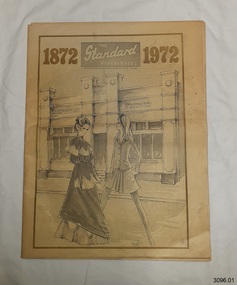
Newspaper - The Standard, Warrnambool Standard Centenary Issue 1872-1972, 02/10/1972
... Page 1: "The Standard Warrnambool" "Warrnambool Standard Centenary Issue October 2 1972, 72 pages" On illustration of building "1872 / Warrnambool Standard" Page 34: "On this site ... since 1924" [Ponting Bros} "Staff of Ponting Bros. 1972" Page 39: "Aviation history-maker" "RECORD TRIP BY FIRST PLANE TO VISIT CITY" "Thrilling display of aerial acrobatics" Page 70: "PM HOLT IS PRESUMED DROWNED" "GAVE GOVT. ...Flagstaff Hill Flagstaff Hill Maritime Museum and Village Warrnambool Maritime Museum Maritime Village Great Ocean Road Shipwreck Coast ladies fashion 1872 ladies fashion 1972 Ponting Bros. centenary 1872-1972 Ponting Bros. staff Basil Watson Basil Watson 1917 Harold Holt 1967 car crash at Loch Ard Gorge Fletcher Jones and Staff 1972 The Standard Centenary 1872-1972 Warrnambool newspaper Warrnambool Standard Centenary edition The Standard Page 1: "The Standard Warrnambool" "Warrnambool Standard Centenary Issue October 2 1972, 72 pages" On illustration of building "1872 / Warrnambool Standard" Page 34: "On this site ... since 1924" [Ponting Bros} "Staff of Ponting Bros. 1972" Page 39: "Aviation history-maker" "RECORD TRIP BY FIRST PLANE TO VISIT CITY" "Thrilling display of aerial acrobatics" Page 70: "PM HOLT IS PRESUMED DROWNED" "GAVE GOVT. ...The Warrnambool Standard Centenary Issue, 1872 - 1972, summarises the local and world history highlights over 100 years. The pages in the images are a sample of the newspaper's contents. They show: - PAGE 1; sketches of two young women, one dressed in 1872 fashion, the other in 1972 fashion. PAGE 34; This page was dedicated to the Ponting Bros. The business celebrated its Centenary in 1972. There apr photographs of the original and the new building, and a photograph and names of the staff of 1972. PAGES 34-38: Lift out facsimile copy of the first edition of The Standard (no longer in 3096.01) PAGE 39; In January 1917 Mr Basil Watson flew the first aeroplane to visit the Warrnambool area. He entertained the crowds by performing aerobic acrobatics in the plane he'd built himself. Two months later he died in a plane accident. PAGE 70; In 1967 Australia's Prime Minister, Mr Harold Holt, goes missing, presumed drowned. PAGE 71; In 1970 the mystery of four bodies were found in a car that crashed over the cliff at Loch Ard Gorge, near Port Campbel, made headlines in the Standard. PAGE 72; The back page features a photograph and greetings from Fletcher Jones and Staff. There are many staff members in front of the Fletcher Jones factory in Warrnambool, which was established around 1924.The centennial edition of the Standard newspaper includes local social, economic and historical aspects of Warrnambool, Victoria, Australia and the World. It reflects the interests of the local community and the reactions to the events of the time.The Standard, Warrnambool, Centenary Issue 1872 – 1972 (Two copies).100 years of District Service. The issue includes World and Local History, Advertisements, Timeline, Facsimile of the First Issue, Shipwrecks, and Wars. The Centenary edition was printed on October 2, 1972, 72 pages. One copy (3096.02) includes the centre lift-out on pages 35 to 38 of a facsimile copy of the first edition published on October 1, 1872.Page 1: "The Standard Warrnambool" "Warrnambool Standard Centenary Issue October 2 1972, 72 pages" On illustration of building "1872 / Warrnambool Standard" Page 34: "On this site ... since 1924" [Ponting Bros} "Staff of Ponting Bros. 1972" Page 39: "Aviation history-maker" "RECORD TRIP BY FIRST PLANE TO VISIT CITY" "Thrilling display of aerial acrobatics" Page 70: "PM HOLT IS PRESUMED DROWNED" "GAVE GOVT. IMAGE OF YOUTH" Page 71: "Where death car crashed on ledge" "PT CAMPBELL MYSTERY: FOUR BODIES FOUND IN CAR AT BOTTOM OF CLIFF" "POLICE SEARCH SWINGS BACK TO MELBOURNE" Page 72: "Greetings to the"Standard"" "Fletcher Jones" flagstaff hill, flagstaff hill maritime museum and village, warrnambool, maritime museum, maritime village, great ocean road, shipwreck coast, ladies fashion 1872, ladies fashion 1972, ponting bros. centenary 1872-1972, ponting bros. staff, basil watson, basil watson 1917, harold holt 1967, car crash at loch ard gorge, fletcher jones and staff 1972, the standard centenary 1872-1972, warrnambool newspaper, warrnambool standard, centenary edition, the standard -
 Flagstaff Hill Maritime Museum and Village
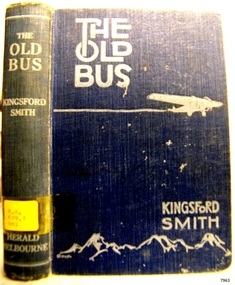
Book, The Old Bus
... aviation history. They returned to Australia to make an attempt at the trans-Tasman flight but their attempt failed due to engine failure; they managed to get back to Sydney safely, minus most of their cargo. Kingsford Smith had his unsold “Lady Southern Cross” shipped back to England, from where he and J. T. Pethybridge in the “Lady Southern Cross” attempted another record breaking flight from England flagstaff hill warrnambool ...Sir Charles Edward Kingsford Smith is a famous Australian, well known in civil aviation history for his courageous endeavours in flight. He broken many flight records for long distance and time travelled and he was also a war hero in World War 1. He has been referred to as being “known to millions of Australians as “Smithy” … he was one of Australia’s true twentieth-century legends”. In honour of his place amongst the world’s famous pioneers his image is featured on Australia’s $20 note, Sydney airport is named after him, there is a memorial to Kingsford Smith, Taylor and Ulm at the Anderson Park, also in Sydney and his plane “Southern Cross” is on view at Brisbane Airport. Kingsford Smith wrote ‘The Old Bus’ (1932) and he and Ulm were co-authors of ‘Story of 'Southern Cross' Trans-Pacific Flight’ (1928). His also wrote a book about his own life ‘My Flying Life’ which was published after his death in 1937. and the story of his life was filmed in Australia in 1946. A BRIEF HISTORY OF SIR CHARLES EDWARD KINGSFORD SMITH (1897 – 1935) … Kingsford Smith was born 9th February 1897 in Brisbane, Queensland, Australia. His parents were William Charles Smith and Catherine Mary, nee Kingsford. His mother’s maiden name of “Kingsford” was added to the family name when they spent time in Canada from around 1903 to 1907, after which they returned to Sydney, Australia. In 1915 Kingsford Smith enlisted in Australian Imperial Force. He served in 4th Signal Troop, 2nd Division Signal Company at Gallipoli Peninsular as a ‘sapper’ or combat engineer and later in Egypt and in France as a dispatch rider. In 1916 Kingsford Smith was transferred to the Australian Flying Corps as a sergeant. He was discharged after training in England and commissioned as a second lieutenant in the Royal Flying Corps. He was appointed fling officer and soon joined the 23rd Squadron in France. He brought down four machines in his first month there and also did invaluable work attacking enemy targets. He was wounded and shot down and later awarded the Military Cross ‘for conspicuous gallantry and devotion to duty’. He was promoted to lieutenant in 1918 and served as a Flying Instructor with the R.F.C. Kingsford Smith was not allowed to participate in the 1919 England to Australia air race because of assumed lack of navigational experience. He and his pilot friend Cyril Maddocks formed a business and flew joy-flights in both England and America. In America he did some stunt flying with a Flying Circus. Kingsford Smith returned to Australia in 1921 and found employment as a pilot. He soon realised the value of air transport in such a vast country. He formed a partnership with pilot Keith Anderson in 1924 and they purchased two Bristol Tourer biplanes. Their business broadened to include Charles Ulm and became the Interstate Flying services in Sydney. Together they performed important ‘demonstration’ flights including a flight around Australia in 10 days and 5 hours using very limited navigational equipment. Kingsford Smith immediately started to search for support to do a trans-Pacific flight. This support came from the New South Wales government, Sidney Myer and G. Allan Hancock, an American oil magnate. On 31st May 1928 Kingsford Smith, Charles Ulm and two American crewmen, Harry Lyan and Jim Warner, took off from Oakland, California and flew to Brisbane via Hawaii and Suva. This historic flight took 83 hours and 38 minutes. Their Fokker plane had three engines and was named the “Southern Cross”. This amazing achievement resulted in huge financial subscriptions. Kingsford Smith was awarded the Air Force Cross and appointed as honorary squadron leader, Royal Australian Air Force. Kingsford Smith flew his Southern Cross plane from Point Cook in Victoria to Perth nonstop. Then in September – October 1928, with Charles Ulm and an Australian crew, he piloted the Southern Cross from Sidney to Christchurch New Zealand. This flight showed that was possible for regular passenger and mail services across the Tasman Sea. Kingsford Smith flew his plane to England to an order for four aircraft, planning to use them for an inter-capital air service in Australia. Sadly on 1st April 1929 he was forced to land, having lost radio contact with the ground and having run into bad weather over north – west Australia. Keith Anderson and Robert Hitchcock both perished before the search party reached them. Once official enquiries were completed the flight to England continued in June and was completed in record time of 12 days and 18 hours. In January 1930 Kingsford Smith piloted the “Southern Cloud”, one of the new Avro Ten planes, on the first flight of his airline, the Australian National Airways, from Sydney to Melbourne. The “Southern Cross” was overhauled in Holland by the Fokker Aircraft Co. and in June 1930 Kingsford Smith achieved an east-west crossing of the Atlantic from Ireland to Newfoundland in 31.5 hours. Kingsford Smith returned to England and took delivery of an Avro Avian biplane that he named the “Southern Cross Junior” and flew solo from England to Darwin, Australia. This record breaking flight took less than 10 days. He beat four other planes that had left England before him and he was 5.5 days faster than Hinkler. Sadly Kingsford Smith’s “Southern Cloud” was lost during a flight from Sydney to Melbourne in 1931 with no surviving crew or passengers; in 1958 the wreckage was discovered in the Snowy Mountains. Later that year Kingsford Smith flew his “Southern Cloud” from Australia to Timor, collecting mail from a damaged Imperial Airways plane in Timor. Other flights followed. Kingsford Smith was knighted in 1932 for his services in Aviation. He returned to selling joy flights then established the Kingsford Smith Air Service, a flying training school in Sydney. In 1933 Kingsford Smith flew the amazing record flight in “Miss Southern Cross” – a Percival Gull - from London to Wyndham in Western Australia in just over ten days. The Australian Commonwealth then gave Kingsford Smith a large grant and he was also appointed as aviation consultant to Vacuum Oil Co. Another flying record was made when Kingsford Smith and Sir P.G. Taylor flow “Lady Southern Cross” from Brisbane to San Francisco in order to sell her there; the west-east-trans-Pacific flight made aviation history. They returned to Australia to make an attempt at the trans-Tasman flight but their attempt failed due to engine failure; they managed to get back to Sydney safely, minus most of their cargo. Kingsford Smith had his unsold “Lady Southern Cross” shipped back to England, from where he and J. T. Pethybridge in the “Lady Southern Cross” attempted another record breaking flight from England The Old Bus Author: Charles Kingsford Smith Publisher: Distibuted by Herald Feature Service Date; 1932Label on spine cover with typed text RA 629.1309 KIN flagstaff hill, warrnambool, shipwrecked coast, flagstaff hill maritime museum, maritime museum, shipwreck coast, flagstaff hill maritime village, great ocean road, the old bus, charles kingsford smith -
 Warrnambool and District Historical Society Inc.
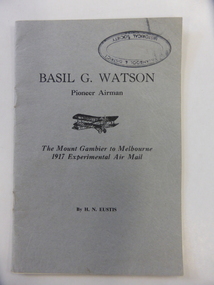
Booklet, Basil G Watson, 1967
... aviation in victoria...history of warrnambool... as the first man to fly into the town in 1917 and the first person to bring air mail to Warrnambool, including a letter from the Lord Mayor of Melbourne to the Mayor of Warrnambool. basil watson history of aviation in victoria history of warrnambool ‘Donated by Mrs Giles W’bool’ ‘J.C.Hardingham, Pilot’ ‘D.Watson’ This is a booklet of 16 pages produced to commemorate the Mount Gambier to Melbourne 1917 Experimental Air Mail Flight. ...This is a booklet produced in 1967 to commemorate the 50th anniversary of the aeroplane flights of Basil Watson in 1917 (the Mount Gambier to Melbourne 1917 Experimental Air Mail). In the 1967 Mount Gambier/Melbourne air mail flight re-enactment the aircraft was from Aviation Services (Hardingham) Limited, a Piper Cherokee, and on board was Douglas Watson, Basil Watson’s nephew. Basil Watson was a pioneer aviator who built his own plane which had a 50 H.P. Rotary Gnome engine. He flew the first aeroplane to Warrnambool in January 1917, bringing with him the first air mail to the town. In Warrnambool he amazed the crowds with his dare-devil aerial acrobatics over the Warrnambool Racecourse. He died two months later, crashing into the sea near Point Cook. This booklet is of great interest as it gives details of the life of Basil Watson, important in Warrnambool’s history as the first man to fly into the town in 1917 and the first person to bring air mail to Warrnambool, including a letter from the Lord Mayor of Melbourne to the Mayor of Warrnambool. This is a booklet of 16 pages produced to commemorate the Mount Gambier to Melbourne 1917 Experimental Air Mail Flight. It has a grey cover with black printing and an image of an early model aeroplane on the front cover. The text includes illustrations, maps and black and white photographs. The first page has two signatures. The booklet has been stapled but the staples have been removed.‘Donated by Mrs Giles W’bool’ ‘J.C.Hardingham, Pilot’ ‘D.Watson’ basil watson, history of aviation in victoria, history of warrnambool -
 Warrnambool and District Historical Society Inc.
Document, Ist Airmail letter 1917, 1917
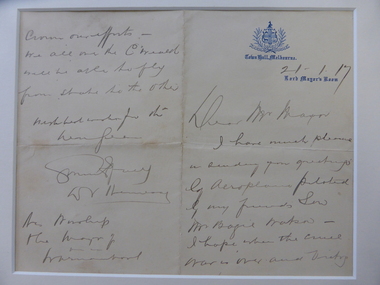
... Aviation in the Western District...Basil Watson...History of Warrnambool...It is an important memento of the first aeroplane flight into Warrnambool by the pioneer aviator Basil Watson. Pioneer Aviation in the Western District Basil Watson History of Warrnambool ‘Town Hall, Melbourne, 21/1/17. ...This letter, the first air mail letter sent to Warrnambool, was written by the Lord Mayor of Melbourne, Sir David Valentine Hennessy and carried by the aviator, Basil Watson on the first flight to Warrnambool January 24th 1917. The letter was delivered to the Mayor of Warrnambool, Cr Webb.There were several other letters delivered at the same time but this is the important official one. Basil Watson was a pioneer aviator who built his own aeroplane which was 18 feet long with a wing span of 26 feet and it had a 7 cylinder 50 H.P. Rotary Gnome engine. Watson flew from Point Cook to Warrnambool in one hour 55 minutes, an Australian cross-country flying record at the time. In Warrnambool Watson amazed the crowd with his dare-devil aerial acrobatics, looping the loop 14 times over the Warrnambool Racecourse. Basil Watson died when he crashed his plane into the sea near Point Cook, just two months after he landed in Warrnambool. This letter is of the utmost significance being the first air mail letter delivered to Warrnambool. It is an important memento of the first aeroplane flight into Warrnambool by the pioneer aviator Basil Watson. This is a cream-coloured sheet of paper folded in two to make four pages. It has handwriting in black ink on two pages. The writing is a little faded. The first page has the logo of the Melbourne Town Hall. The pages are partly torn at the folds. ‘Town Hall, Melbourne, 21/1/17. Lord Mayor’s Room, Dear Mr Mayor, I have much pleasure in sending you greetings by aeroplane piloted by my friend’s son, Mr Basil Watson. I hope when the cruel war is over and victory crowns our efforts, we all in the C’wealth will be able to fly from one state to the other. With best wishes for the New Year, …….. (signature indecipherable), D.V. Hennessy. His Worship the Mayor of Warrnambool.’pioneer aviation in the western district, basil watson, history of warrnambool -
 Warrnambool and District Historical Society Inc.
Book, Pacific flight, 1935
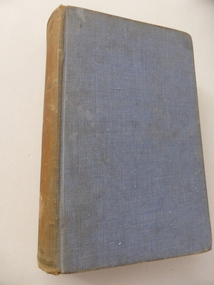
... The subject matter of the book, an account of the aviation exploits in the South Pacific region of the well-known aviator, P. G. Taylor, would have appealed to young boys at that time. Radio Station 3YB Warrnambool Everyboys Club History ...This book has been part of a library that had been set up by the radio station 3YB in Warrnambool. This station was founded in 1936 from a Mobile Radio Station formed by Jack Young of Ballarat (hence the letter, YB). 3YB sponsored a Boys’ Club in the late 1930s and 1940s and a library for the boys was part of this sponsorship. This book is of minor interest because it was part of the library connected to the Everyboys Club established in the late 1930s by the Warrnamboool Radio Station 3YB. The subject matter of the book, an account of the aviation exploits in the South Pacific region of the well-known aviator, P. G. Taylor, would have appealed to young boys at that time. This is a hard cover book of 262 pages. The cover is blue but the colour on the spine has faded to a brown shade. There is some black lettering on the spine and also a small library sticker with the number ‘31’ on it. The book has outline maps on the inside of both covers, a Foreword, a Contents page, a List of Illustrations, fifteen Chapters of Text and an Epilogue. There are many black and white photographs and illustrations scattered throughout the text. The first two pages contain several date stamps from a library and two stamps of the Everyboys Club, 3YB. ‘Everyboys Club, 3YB’ ‘31’ radio station 3yb warrnambool, everyboys club, history of warrnambool -
 Warrnambool and District Historical Society Inc.
Booklet, Australia's second Air Mail. The aviation Career of Basil Watson 1893-1917, 2017
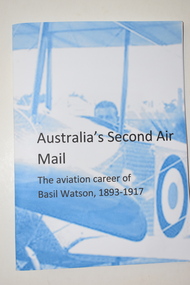
... This booklet tells the story of an interesting part of Warrnambool and Australia's aviation history. It has special significance as it enlightens two significant items in our local collection, namely the letter which he delivered and the seat from his aircraft. warrnambool basil watson first airmail flight aviation career of basil watson Introduction from the author, "This small booklet recognises the short career of Basil Watson. ...This booklet relates the life of Basil Watson. It tells in detail his early life, background, his home built aeroplane, his display flights and his tragic death and the story since. This year marks 100 years since one of Australia’s pioneering aviators, Basil Watson arrived in Warrnambool and delivered the first airmail to the town. Basil Watson was born in Bendigo in 1894. His interest in aviation which began at a young age, took him to England at the commencement of WW1 where he worked at Brookland in aviation workshops and as a test pilot. Despite crashing and suffering injuries he was not deterred. He returned to Australia and by 1916 Basil had built his own plane. He soon took to the air performing tricks and barnstorming to the delight of onlookers. His connection to Warrnambool lies with his delivery of the first airmail to the town, an event which was filled with much excitement. Basil Watson, pioneer aviator landed his 50hp home built aeroplane on the racecourse on Saturday January 27th 1917, after a flight from Point Cook. The trip of 166 miles took just under two hours, and set a record non-stop cross country flight for Australia. Watson was heartily welcomed by the Mayor, to whom he delivered three letters, the first aerial post to Warrnambool. One of the letters, from the Mayor of Melbourne Sir David Hennessy to the Mayor of Warrnambool is now in the W&DHS collection: I have much pleasure in sending you greetings by aeroplane piloted by my friend, Mr Basil Watson. I hope when the cruel war is over and victory crowns our efforts, we, over the Commonwealth, will be able to fly from one State to the other. With best wishes for the New Year. Yours truly, DV Hennessy. Basil Watson was unfortunately killed two months after his historic visit to Warrnambool. While participating in an air show at Point Cook, the plane he was flying that day crashed into the sea. This booklet tells the story of an interesting part of Warrnambool and Australia's aviation history. It has special significance as it enlightens two significant items in our local collection, namely the letter which he delivered and the seat from his aircraft.A small 29 page booklet with blue and white photograph of Basil Watson in his aeroplane. It contains a number of black and white and some colour photographs. Introduction from the author, "This small booklet recognises the short career of Basil Watson. He came to my attention when researching the French aviator Maurice Guillaux who carried the first official air mail in Australia, Melbourne to Sydney in two and a half days 16/18 July 1914..... Tom Lockley 1 June 2017. Handwritten inside front cover,"These items may be of interest to add to your material about Basil Watson. Its a pity that the 100 year anniversary of his flight was not more widely recognised but thank you for mounting some of his records. Tom Hockley."warrnambool, basil watson, first airmail flight, aviation career of basil watson -
 Warrnambool and District Historical Society Inc.
Book - Catalogue, The Australian Airmail Catalogue, 1990
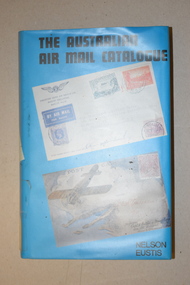
... early aviation in warrnambool...history...This book is of minor interest as it has information on early airmail in Australia and includes information on two people connected to Warrnambool’s history - Basil Watson, the first person to fly a plane to Warrnambool and Paul McGinness, from Framlingham near Warrnambool, the founder of Qantas Airways. aviation in australia early aviation in warrnambool history of warrnambool This is a catalogue of postal covers carried by air mail with flight details. ...This is a catalogue of postal covers carried by air mail with flight details.This is a hard cover book of 307 pages. It has a blue cover with five images of early airmail cards and black printing. It contains printed information on airmail letters and cards and images of many of these letters and cards. It contains valuations of these cards and letters as in 1990. The book has a plastic covering.non-fictionThis is a catalogue of postal covers carried by air mail with flight details. aviation in australia, early aviation in warrnambool, history of warrnambool -
 Warrnambool and District Historical Society Inc.
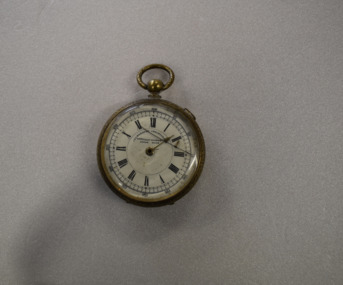
Functional object - chronograph, early 20th century
... Chronographs date from the early 19th century and were used particularly in aviation, astronomy, diving, automobile and other racing contests and artillery firing and with more sophisticated designs are still used today. This item has no known local provenance but is retained for display purposes because of its age and its exceptional quality Vintage chronographs Warrnambool History Celebrated Chronograph Specially Examined Swiss Made This is a chronograph, a display watch which also has a stopwatch function. ...This is an early 20th century example of a chronograph, a watch with stopwatch functions. Chronographs date from the early 19th century and were used particularly in aviation, astronomy, diving, automobile and other racing contests and artillery firing and with more sophisticated designs are still used today.This item has no known local provenance but is retained for display purposes because of its age and its exceptional qualityThis is a chronograph, a display watch which also has a stopwatch function. It has a white face with black markings and Roman numerals and a gauge around the outer circle with numbers from 0 to 300. The face is covered with a glass frame. One hand and its pin are loose in the glass. The watch case is gold-coloured with a heavy ornamental pattern around the sides. At the top of the case is a ring for attaching the watch to a chain or belt. The button on the side for working the stop watch mechanism no longer functions.Celebrated Chronograph Specially Examined Swiss Madevintage chronographs, warrnambool history
