
Showing 457 items matching "bank place"
-
 Flagstaff Hill Maritime Museum and Village
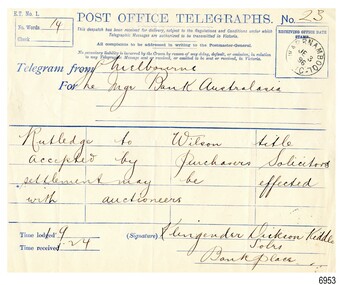
Document - Telegraph, Klingender Dickson and Kiddle, solicitors, 3-6-1896
... ...Bank Place...FROM: Klingender, Dickson, and Kiddle, solicitors, Bank Place, Melbourne FOR :the Manager, Bank of Australasia, Warrnambool, REGARDING: Rutledge to Wilson title...STAMP: text inside circle "WARRNAMBOOL VIC", and in centre of the circle "JE 3 96" Telegraph No. "23", FROM :"Melbourne", FOR: "The Mgr, Bank of Australasia" MESSAGE (14 words): "Rutledge to Wilson title accepted by Purchaser's Solicitors settlement may be effected with auctioneers" TIME: "9:24" SIGNED: " Klingender Dickson Kiddle, Solrs, Bank Place"...FROM: Klingender, Dickson, and Kiddle, solicitors, Bank Place, Melbourne FOR :the Manager, Bank of Australasia, Warrnambool, REGARDING: Rutledge to Wilson title Document Telegraph Klingender Dickson and Kiddle, solicitors Warrnambool Post Office Bank of Australasia ...The telegraph system of sending and receiving messages was developed in the early 1800s and improved as time went on. It sends electronic signals that represent letters and words along a wire. Those signals are then converted back to words at the other end of the wire. Morse code is a similar system. A fee is charged to send a telegraph, per letter or per word. The telegraph greatly improved communication, particularly in a large country like Australia. It was a fast way to send news and send out calls for help for people during a shipwreck. In Warrnambool, it was even used to set the correct time every day; a signal was sent from the time ball in Melbourne, and along the railway line to the Warrnambool Post Office. This 1896 telegraph tells a big story in very few words, only fourteen! The layout of the paper form includes a table with four columns and five rows, set out for writing just one word into each of the twenty spaces. The happy message is the approval to go ahead with the exchange/sale of the title from landowner Rutledge to Wilson. The Melbourne Legal firm Klingender Dickson and Kiddle sent this message on behalf of its client to the Bank of Australasia in Warrnambool. The Bank of Australasia was incorporated by the Royal Charter of England in March 1834. The bank began in Australia on 14th December 1835, opening in Sydney. The Acting Superintendent of the bank at that time was David Charters McArthur. He was Superintendent from 1867-to 1876. The Melbourne branch opened on 28th August 1838 in a two-roomed brick cottage on the north side of Little Collins Street, where two huge mastiff dogs were used at night to guard the bank. The government also provided an armed military sentinel. Due to the bank's rapid growth, a new building for the Melbourne branch was opened in 1840 at 75 Collins Street West. By 1879 the bank had been upgraded to a magnificent two-storey building on the corners of Collins and Queens Streets, with the entry on Collins Street. In 1951 the Bank of Australasia amalgamated with the Union Bank to form Australia and New Zealand Bank, now known as the ANZ. Then in 1970, the ANZ merged with both the ES&A and the London Bank of Australia to form the ANZ Banking Group Limited. The ANZ Banking Group Ltd kindly donated a variety of historic items from the Bank of Australasia. BANK of AUSTRALASIA, WARRNAMBOOL – In 1854 Warrnambool had two banks, the Union Bank and the Bank of Australasia. Later, completely different bank businesses opened; in 1867 the National Bank of Australasia, then in 1875 the Colonial Bank of Australasia. The original Warrnambool branch of the Bank of Australasia was established in July 1854, and operated from a leased cottage on Merri Street, close to Liebig Street. The bank later bought a stone building previously erected by drapers Cramond & Dickson on the corner of Timor and Gibson Streets. Samuel Hannaford was a teller and then Manager at the Warrnambool branch from 1855 to 1856 and the Warrnambool Council chose that bank for its dealings during 1856-57. In 1859 Roberts & Co. was awarded the contract to build the new Bank of Australasia branch for the sum of £3,000. The land was on a sand hill on the northeast corner of Timor and Kepler Streets and had been bought in 1855 from investor James Cust. The new building opened on May 21, 1860. The bank continued to operate there until 1951 when it merged with the Union Bank to form the ANZ Bank, which continued operating from its Liebig Street building. Warrnambool City Council purchased the former Bank of Australasia building in 1971 and renovated it, then on 3rd December 1973 it was officially opened as the Art Gallery by Cr. Harold Stephenson and Gallery Director John Welsh. The Gallery transferred to the purpose-built building in Liebig Street in 1986 and the old bank building is now the Gallery club. Staff at the Bank of Australasia in Warrnambool included the following men but others were also involved: Samuel Hannaford, Teller then Manager from 1855-1856; W H Palmer, Manager from January 1857 until November 1869 when the Teller Basil Spence was promoted to Manager; H B Chomley, Manager from April 1873 and still there in 1886; A Butt, Manager in 1895-1904; J R McCleary Accountant and Acting Manager for 12 months, until 1900; A Kirk, Manager 1904; J Moore, staff until his transfer to Bendigo in December 1908; J S Bath was Manager until 1915; C C Cox, Manager until April 1923; Richard C Stanley, Manager 1923 to April 1928. This telegraph has historical significance as it was sent to the Bank of Australasia in Warrnambool. The parties involved in the message, Rutledge and Wilson, were involved in a land deal in 1896 when the district was importing and exporting goods into and out of Warrnambool Harbour via sailing ships. It is also a historical record of the nature of financial agreements between similar institutions in Warrnambool and the district. The telegraph is significant for its association with the Bank of Australasia in Warrnambool, the first bank in Warrnambool, established in 1854. The bank continued to operate until its merger in 1951 when it became the ANZ Bank, which is still in operation today. The Bank was an integral part of the establishment and growth of commerce in Colonial Warrnambool and throughout Australia.Telegraph RECEIVED: Warrnambool Post Office, Wednesday 3rd June 1896. FROM: Klingender, Dickson, and Kiddle, solicitors, Bank Place, Melbourne FOR :the Manager, Bank of Australasia, Warrnambool, REGARDING: Rutledge to Wilson titleSTAMP: text inside circle "WARRNAMBOOL VIC", and in centre of the circle "JE 3 96" Telegraph No. "23", FROM :"Melbourne", FOR: "The Mgr, Bank of Australasia" MESSAGE (14 words): "Rutledge to Wilson title accepted by Purchaser's Solicitors settlement may be effected with auctioneers" TIME: "9:24" SIGNED: " Klingender Dickson Kiddle, Solrs, Bank Place"flagstaff hill, warrnambool, flagstaff hill maritime museum, maritime museum, commerce, banking, bank of australasia, australia & new zealand bank, anz bank, david charters mcarthur, telegraph, 1896, rutledge, wilson, klengender, dickson, kiddle, warrnambool post office, klengender dickson and kiddle, bank place -
 Williamstown Historical Society Inc
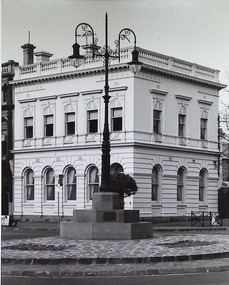
Photograph - Nelson Place, Bank of Australasia
... Nelson Place, Bank of Australasia...Nelson Place...Bank...Black and white image taken in 1994 of the former Bank of Australasia at 193 Nelson Place...Nelson Place Bank of Australasia 1994 193 Nelson Place Arch Roberts Collection 3 - Streetscapes & Nelson Place Black and white image taken in 1994 of the former Bank of Australasia at 193 Nelson Place Photograph Nelson Place, Bank of Australasia ...Black and white image taken in 1994 of the former Bank of Australasia at 193 Nelson PlaceArch Roberts Collection 3 - Streetscapes & Nelson Place nelson place, bank of australasia, 1994, 193 nelson place -
 Williamstown Historical Society Inc
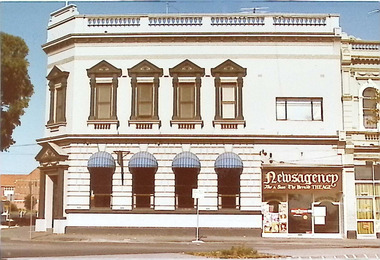
Photograph - Nelson Place, Commercial Bank of Australia
... Nelson Place, Commercial Bank of Australia...Place...Commercial Bank of Australia...Undated photograph showing the former Commercial Bank of Australia, located at 193 Nelson Place. As noted in Hobsons Bay Heritage Study Amended 2017 - Volume 3 (HO222) the bank was designed for the Commercial Banking Company by architects Sydney Smith and Ogg. ...Nelson Place Commercial Bank of Australia 193 Nelson Place Undated photograph showing the former Commercial Bank of Australia, located at 193 Nelson Place. ...Undated photograph showing the former Commercial Bank of Australia, located at 193 Nelson Place. As noted in Hobsons Bay Heritage Study Amended 2017 - Volume 3 (HO222) the bank was designed for the Commercial Banking Company by architects Sydney Smith and Ogg. The building was completed by 1892 and John Bingle was installed as manager, followed by Robert Owen in 1898. It was described as a stone and brick premises, of 8 or 9 rooms with an adjoining shop which was leased by tenants such as Henry Ternes, watchmaker. nelson place, commercial bank of australia, 193 nelson place -
 Williamstown Historical Society Inc
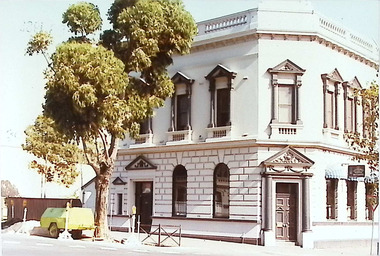
Photograph - Nelson Place, Commercial Bank of Australia
... Nelson Place, Commercial Bank of Australia...Place...Commercial Bank of Australia...Undated photograph showing the former Commercial Bank of Australia, located at 193 Nelson Place. As noted in Hobsons Bay Heritage Study Amended 2017 - Volume 3 (HO222) the bank was designed for the Commercial Banking Company by architects Sydney Smith and Ogg. ...Nelson Place Commercial Bank of Australia 193 Nelson Place Undated photograph showing the former Commercial Bank of Australia, located at 193 Nelson Place. ...Undated photograph showing the former Commercial Bank of Australia, located at 193 Nelson Place. As noted in Hobsons Bay Heritage Study Amended 2017 - Volume 3 (HO222) the bank was designed for the Commercial Banking Company by architects Sydney Smith and Ogg. The building was completed by 1892 and John Bingle was installed as manager, followed by Robert Owen in 1898. nelson place, commercial bank of australia, 193 nelson place -
![Map, Plan of Subdivision of Crown Portion 23 & parts 24-25, Parish of Korkuperrimul [1900s?]](/media/collectors/5e461d8021ea67224c82f2a1/items/675fe058304668462205d4fb/item-media/675fe0ef304668462205d7d6/item-fit-380x285.jpg?cb=6) Bacchus Marsh & District Historical Society
Bacchus Marsh & District Historical SocietyMap, Plan of Subdivision of Crown Portion 23 & parts 24-25, Parish of Korkuperrimul [1900s?]
... Cor Collins Street and Bank Place...Cor Collins Street and Bank Place A single page paper map showing 20 blocks of land for sale in the Parish of Korkuperrimul. ...The Parish of Korkuperrimul includes a significant section of the township of Bacchus Marsh and extends in western and northern directions from the township area. The date of the subdivision indicated on this plan has not been established. The engineer's stamp on the drawing shows the firm of Muntz and Muntz who were operating under that name in the early part of the 20th century.A single page paper map showing 20 blocks of land for sale in the Parish of Korkuperrimul. Scale 100 feet to 1 inch. The map is pasted into a bound volume containing 76 maps or plans in total. High resolution digital image stored on BMDHS computer network. Stamped: 'Muntz & Muntz Civil Engineers, Architects & Surveyors, Trustees Chambers ?? Cor Collins Street and Bank Placeland sales bacchus marsh, bacchus marsh victoria maps, land sales korkuperrimul parish -
 Warrnambool and District Historical Society Inc.
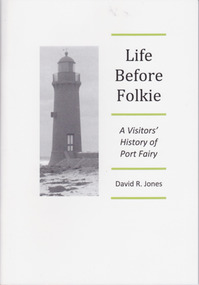
Booklet - Booklet about Port Fairy, Life before Folkie, 2013
... Railway Place, Bank Street, Port Fairy, Victoria, Australia ...This booklet aims to give a brief outline of Port Fairy’s history for the benefit of visitors. Port Fairy was an early sealing and whaling town with white settlement established by 1836. As the port and shipping declined so did the town until its reinvigoration in the mid 20th century as a tourist town and the home of the annual Port Fairy Folk FestivalThe book is of use as a quick reference to Port Fairy history.This is a booklet of 48 pages. It contains printed material, black and white photographs and a map. The front cover has a black and white image of the Port Fairy lighthouse. Front Cover: ‘Life Before Folkie, A Visitors’ History of Port Fairy, David R. Jones’port fairy, david r. jones -
 Bendigo Historical Society Inc.
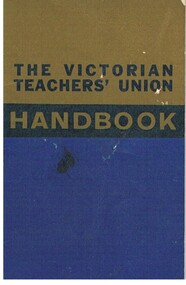
Document - NORMAN PENROSE COLLECTION: THE VICTORIAN TEACHERS' UNION HANDBOOK, 1965
... Victorian Treachers Union 20 Bank Place, Melbourne. Printed by Mylund Press Pty Ltd., 289 Bank St., S. ...Victorian Treachers Union 20 Bank Place, Melbourne. Printed by Mylund Press Pty Ltd., 289 Bank St., S. ...Document. Norman Penrose collection: the Victorian Teacher's Union Handbook 1965 edition. Contains information, rates of pay, etc for teachers. Blue book, with khaki at the top and a darker background behind 'Handbook'.Victorian Treachers Union 20 Bank Place, Melbourne. Printed by Mylund Press Pty Ltd., 289 Bank St., S. Melb., Vic.government, state, victorian teachers union handbook, norman penrose collection, the victorian teachers' union handbook'. -
 Eltham District Historical Society Inc
Film - Video (VHS), IMP Productions, The Shire of Etham - The Evergreen Shire (Series 69, Item 4), c.1985
... bank...commercial place...Also scenes of Commercial Place, Diamond Valley Railway, Eltham Galley, Riverclay and canoeing on the Yarra intermingled with images of the shire from the Shire of Eltham Pioneers Photograph collection. shire of eltham video recording shire of eltham archives alistair knox park allwood house arthur street arthur street mall bob manuell canoeing carparks cba bank commercial place council staff councillors cr. mary grant cricket diamond valley railway eltham community banner project eltham community centre eltham galley eltham leisure centre eltham living and learning centre eltham lower park eltham railway trestle bridge eltham war memorial gordon ford garden horse riding housing estates hurstbridge infant welfare centre john cohen kangaroo ground local history centre montmorency montsalvat mudbrick parks and gardens peck's dam pigeon bank police residence river of life banner riverclay road drainage road planning rodney roschellor shillinglaw cottage shire of eltham pioneers photograph collection st andrews market tracey naughton tree canopy were street yarra river Alan Baker VHS Video cassette Converted to MP4 file format 00:11:56; 79MB The Shire of Etham - The Evergreen Shire (Series 69, Item 4) Film Video (VHS) IMP Productions ...Shire of Eltham Archives: Series 69, Item 4 This video was produced for the Shire of Eltham by IMP Productions and provides a description of the shire, 277 square km on a north/northeast axis, some 25 km northeast of the centre of Melbourne with a population of around 40,000. Scenes include Yarra River, rural settings and urban settings, housing estates, Shillinglaw Cottage, Pigeon Bank at Kangaroo Ground, the Eltham Railway Trestle Bridge with reference to the fight by locals in the 1970s to save it from replacement, Montsalvat, mudbrick making and its use as a building material, the use of mudbrick in the Eltham Community Centre blending harmoniously with the environment. Emphasises people living in the area due to the qualities of life provided. Also the Living and Learning Centre, St Andrews Markets and other local markets, the Eltham Leisure Centre, cricket and horse riding at Eltham Lower Park, the Infant Welfare Centre (part of the Eltham War Memorial), how residents are mindful of protecting their historical heritage, the CBA bank and Allwood House at Hurstbridge, Tracey Naughton about the Eltham "As we are" Community Banner project and the “River of Life banner”, the Parks and Gardens office in the former Police Residence building (now the Local History Centre), Alistair Knox Park, road planning and types of roads, tree canopy, Peck's Dam, green carparks, road drainage, Gordon Ford's garden and natural landscapes, and Were Street shops in Montmorency. Planning for shopping facilities and carparks with a population of 40,000 growing to 55,000, Arthur Street Mall and carpark, local village feel in the shopping centre. Councillors and Council staff featured include Mary Grant, Bob Manuell, Rodney Roschellor, John Cohen, Alan Baker. Also scenes of Commercial Place, Diamond Valley Railway, Eltham Galley, Riverclay and canoeing on the Yarra intermingled with images of the shire from the Shire of Eltham Pioneers Photograph collection.VHS Video cassette Converted to MP4 file format 00:11:56; 79MBshire of eltham, video recording, shire of eltham archives, alistair knox park, allwood house, arthur street, arthur street mall, bob manuell, canoeing, carparks, cba bank, commercial place, council staff, councillors, cr. mary grant, cricket, diamond valley railway, eltham community banner project, eltham community centre, eltham galley, eltham leisure centre, eltham living and learning centre, eltham lower park, eltham railway trestle bridge, eltham war memorial, gordon ford garden, horse riding, housing estates, hurstbridge, infant welfare centre, john cohen, kangaroo ground, local history centre, montmorency, montsalvat, mudbrick, parks and gardens, peck's dam, pigeon bank, police residence, river of life banner, riverclay, road drainage, road planning, rodney roschellor, shillinglaw cottage, shire of eltham pioneers photograph collection, st andrews market, tracey naughton, tree canopy, were street, yarra river, alan baker -
 Port Fairy Historical Society Museum and Archives
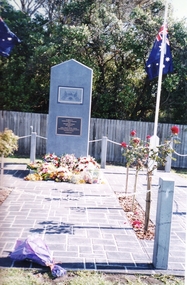
Photograph
... bank street...railway place...Memorial bank street railway place soldier Coloured photograph of Soldier’s memorial with flowers during Anzac Day Photograph Photograph ...This Soldiers Memorial was erected in the centre of the town as the original Memorial stands at the top of the hill on the busy Princes Highway. This made the site difficult to police and march to because of the traffic passing through the town.Coloured photograph of Soldier’s memorial with flowers during Anzac Daymemorial, bank street, railway place, soldier -
 Bendigo Historical Society Inc.
Document - KELLY AND ALLSOP COLLECTION: BUX TIN MINING SYNDICATE - CIRCULAR, 01/11/1926
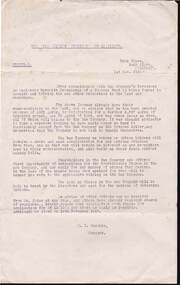
... A typed single sheet circular issued by The Bux Tin Mining Syndicate, Bank House, Bank Place, Melbourne, dated 1st Nov. 1926. Issued by M.I.Murchie, Manager. ...A typed single sheet circular issued by The Bux Tin Mining Syndicate, Bank House, Bank Place, Melbourne, dated 1st Nov. 1926. Issued by M.I.Murchie, Manager. ...Document. KELLY & ALLSOP COLLECTION. A typed single sheet circular issued by The Bux Tin Mining Syndicate, Bank House, Bank Place, Melbourne, dated 1st Nov. 1926. Issued by M.I.Murchie, Manager. Relates to issue of shares and mentions a prospectus, not attached. Bux Tin Mining is in Malaya???M.I.Murchiebusiness, stockbroker, kelly & allsop, kelly & allsop collection, bux tin mining syndicate, m.i.murchie -
 Bendigo Historical Society Inc.
Document - KELLY AND ALLSOP COLLECTION: PROSPECTUS - TRENGGANU TIN DEVELOPMENT COMPANY
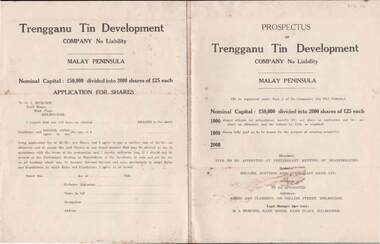
... Legal Manager is M.I.Murchie, Bank Place, Melbourne. Date shown on form is 1926....Legal Manager is M.I.Murchie, Bank Place, Melbourne. Date shown on form is 1926. ...Document. KELLY & ALLSOP COLLECTION. 4 page Prospectus of the Trengganu Tin Development Company (No Liability). Malay Peninsula. Nominal capital - 2,000 shares @ 25 Pounds each. Includes an application for shares form. Bankers are English Scottish and Australian Bank Ltd. Solicitors are Amess and Clarkson, Melbourne. Legal Manager is M.I.Murchie, Bank Place, Melbourne. Date shown on form is 1926.Trengganu Tin Development Co.business, stockbroker, kelly & allsop, kelly & allsop collection, prospectus, trengganu tin development co., malay peninsula, e.s.& a. bank, amess and clarkson, m.i.murchie. -
 Williamstown Historical Society Inc
Photograph - Nelson Place, ES&A Bank
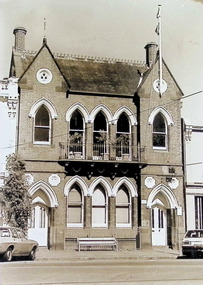
... Nelson Place, ES&A Bank...Place...ES&A Bank...Black and white image taken in 1993 of the former ES&A Bank at 139 Nelson Place. ...Nelson Place ES&A Bank c1993-4 Arch Roberts Collection 3 - Streetscapes & Nelson Place Black and white image taken in 1993 of the former ES&A Bank at 139 Nelson Place. ...Black and white image taken in 1993 of the former ES&A Bank at 139 Nelson Place. Arch Roberts Collection 3 - Streetscapes & Nelson Place nelson place, es&a bank, c1993-4 -
 Clunes Museum
Certificate - BANK WITHDRAWAL FORMS
... .1 .2 ORIGINAL CHEQUE FORM OF THE STATE SAVINGS BANK OF VICTORIA. PLACE FOR PASS BOOK NO., BEARER, PAY AND SIGNATURE OF DEPOSITOR. ...local history document banking THE STATE SAVINGS BANK OF VICTORIA Form No. 35 8,000 5/23 .1 .2 ORIGINAL CHEQUE FORM OF THE STATE SAVINGS BANK OF VICTORIA. PLACE FOR PASS BOOK NO., BEARER, PAY AND SIGNATURE OF DEPOSITOR. ....1 .2 ORIGINAL CHEQUE FORM OF THE STATE SAVINGS BANK OF VICTORIA. PLACE FOR PASS BOOK NO., BEARER, PAY AND SIGNATURE OF DEPOSITOR. YELLOW FORM-RED PRINTING.THE STATE SAVINGS BANK OF VICTORIA Form No. 35 8,000 5/23local history, document, banking -
 Melbourne Tram Museum
Functional object - Bank note cash bag, Melbourne & Metropolitan Tramways Board (MMTB)
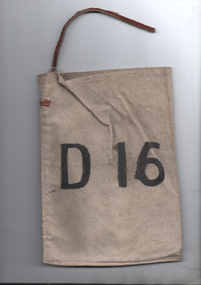
... Used by the MMTB Doncaster bus drivers and conductors to place their bank notes into and secure it with the leather cord. ...Used by the MMTB Doncaster bus drivers and conductors to place their bank notes into and secure it with the leather cord. ...Used by the MMTB Doncaster bus drivers and conductors to place their bank notes into and secure it with the leather cord. Coins were paid in using a separate method. D 16 - Doncaster Bus depot, A - South Melbourne.Demonstrates the method of securing bank notes for paying in.Set of 3 cloth bags, fitted with leather cord and stamp in black ink.tramways, conductors, bank notes, pay-in, cash handling, cash bag -
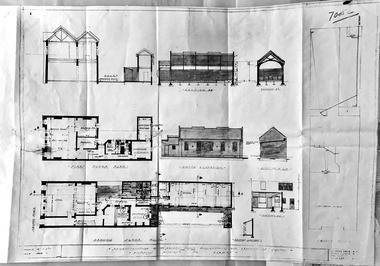 Mission to Seafarers Victoria
Plan, Arthur Peck, Victorian Missions to Seaman - Reconstruction of 139 Nelson Place, Williamstown and Erection of chapel, July 1943
... After the closure of the Institute (former skating rink) on Thompson St, the Mission, thanks to the Williamstown Lightkeepers Auxiliaire and funds donated by the High Commissioner of Canada, the former E,S & B Bank on Nelson Place was purchased and renovated. ...After the closure of the Institute (former skating rink) on Thompson St, the Mission, thanks to the Williamstown Lightkeepers Auxiliaire and funds donated by the High Commissioner of Canada, the former E,S & B Bank on Nelson Place was purchased and renovated. ...After the closure of the Institute (former skating rink) on Thompson St, the Mission, thanks to the Williamstown Lightkeepers Auxiliaire and funds donated by the High Commissioner of Canada, the former E,S & B Bank on Nelson Place was purchased and renovated. The St Nicholas chapel was added at the back of the building. Architects Arthur Peck and his eldest son, Hugh, were commissionned for the design. Arthur Peck was himself a keen yachstman. He died in 1945 at the age of 90.Large photocopie of original plans for the renovation of the E,S & B Bank building in Williamstown with the addition of the St Nicholas chapel.williamstown, williamstown lightkeepers auxiliary, arthur peck, hugh l. peck, st nicholas chapel -
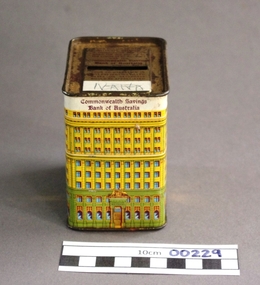 Upper Yarra Museum
Money box
... This money box is a copy of the Commonwealth Savings Bank of Australia's Martin Place, Sydney Branch Building, the money boxes were produced c 1970's, (earlier money boxes were in the shape of a cash register or till.) ...This money box is a copy of the Commonwealth Savings Bank of Australia's Martin Place, Sydney Branch Building, the money boxes were produced c 1970's, (earlier money boxes were in the shape of a cash register or till.) ...This money box is a copy of the Commonwealth Savings Bank of Australia's Martin Place, Sydney Branch Building, the money boxes were produced c 1970's, (earlier money boxes were in the shape of a cash register or till.) When you filled the money box you returned it to the bank, the would put the contents into your savings account and issue you with a new tin.box, commonwealth, money, tin, bank, saving -
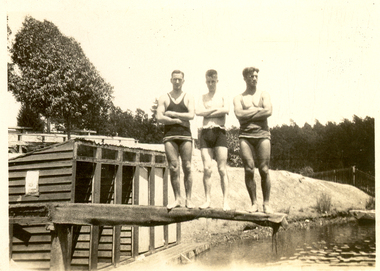 Federation University Historical Collection
Photograph - Photograph - Black and White, Frank Wright, Jack Cartasso and Jack Zilles at Creswick, 3/2/1930
... In the background are changing rooms, a grassy bank and trees. The place is Calembeen Park at Creswick and the men are Jack Zilles, Jack Cartasso and Frank Wright. .2) Black and white photo taken at Creswick, The men on the diving board are Ron Hammond, Norman Jebart, Harley Chapman, Jack Cartasso and Frank Wright....In the background are changing rooms, a grassy bank and trees. The place is Calembeen Park at Creswick and the men are Jack Zilles, Jack Cartasso and Frank Wright. .2) Black and white photo taken at Creswick, The men on the diving board are Ron Hammond, Norman Jebart, Harley Chapman, Jack Cartasso and Frank Wright. ...Frank Wright was a renown resident of Smeaton, where he was born. He lived at Laura Villa, and attended Smeaton State School. His father William was a gold miner and his mother's name was Sarah. Their family won many singing and instrumental awards. Frank was tutored by Percy Code and was awarded a gold medal for the highest marks in the ALCM examinations in the British Colonies at the age of seventeen years. He became the Australian Open Cornet Champion by the age of eighteen. A year later, Frank conducted the City of Ballarat Band, and later the Ballarat Soldiers’ Memorial Band. He formed the Frank Wright Frisco Band and Frank Wright and his Coliseum Orchestra. These bands won many South Street awards, and Frank as conductor won many awards in the Australian Band Championship contest. In 1933 Frank Wright sailed to England to conduct the famous St Hilda’s Band and was later appointed Musical Director of the London County Council, where he organized many amazing concerts in parks, in and around the London district. He was made Professor of Brass and Military Band Scoring and conducted at the Guildhall of Music and Drama. Frank was often invited to adjudicate Brass Band Championships around Europe, in Australia, including South Street and in New Zealand. The Frank Wright Medal at the Royal South Street competition is awarded to an individual recognized as making an outstanding contribution to brass music in Australia..1) Black and white photograph of three men in bathing costumes standing with arms crossed on a diving board. In the background are changing rooms, a grassy bank and trees. The place is Calembeen Park at Creswick and the men are Jack Zilles, Jack Cartasso and Frank Wright. .2) Black and white photo taken at Creswick, The men on the diving board are Ron Hammond, Norman Jebart, Harley Chapman, Jack Cartasso and Frank Wright..1) Written in pencil on back - Jack Zilles, Jack Cartasso, Frank Wright, Creswick, Feb 3rd 1930 .2) Written on the back in pencil - Ron Hammond, Norman Jebart, Harley Chapman, Jack Cartasso, Frank Wright. Creswick Feb 3rd 1930bathing costumes, swimming, changing sheds, creswick, frank wright, calembeen park, jack zilles, jack cartasso, ron hammond, norman jebart -
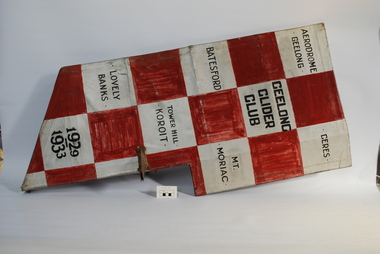 Australian Gliding Museum
Functional object - Rudder from Geelong Gliding Club Primary Glider, 1929
... The club built a Zogling (Primary Glider) based on plans obtained from Germany and flew it off nearby hills at Lovely Banks and other places in the Geelong region. The checked rudder design (without logo and markings) is evident in a picture of a Geelong Glider Club Zogling flying at Tower Hill near Warrambool, Victoria, at Easter 1931 and this lends support to the conclusion that the rudder was part of the Club’s first glider. ...On starboard side – Geelong Glider Club; and place names including Geelong Aerodrome, Batesford, Ceres, Lovely Banks, Tower Hill, Koroit, Mount Moriac; and years, 1929-1933 ...The club built a Zogling (Primary Glider) based on plans obtained from Germany and flew it off nearby hills at Lovely Banks and other places in the Geelong region. The checked rudder design (without logo and markings) is evident in a picture of a Geelong Glider Club Zogling flying at Tower Hill near Warrambool, Victoria, at Easter 1931 and this lends support to the conclusion that the rudder was part of the Club’s first glider. ...The Geelong Glider Club was formed in June 1929 at a meeting held at the Belmont Common hangar of Percy Pratt. The club built a Zogling (Primary Glider) based on plans obtained from Germany and flew it off nearby hills at Lovely Banks and other places in the Geelong region. The checked rudder design (without logo and markings) is evident in a picture of a Geelong Glider Club Zogling flying at Tower Hill near Warrambool, Victoria, at Easter 1931 and this lends support to the conclusion that the rudder was part of the Club’s first glider. The logo and markings appear to be a more recent elaboration to the design. Exhibit is a historical link to the earliest gliding activities of the Geelong Glider Club.Fabric covered wooden framed primary glider rudder with metal levers decorated with silver and dark red checkered design. The item has a cat logo on one side and markings on the other of places where the Geelong Gliding Club flew in its early years.On port side – Cat logo. On starboard side – Geelong Glider Club; and place names including Geelong Aerodrome, Batesford, Ceres, Lovely Banks, Tower Hill, Koroit, Mount Moriac; and years, 1929-1933 australian gliding, glider, zogling, primary glider, rudder, geelong gliding club, lovely banks, tower hill. koroit -
 Ringwood and District Historical Society
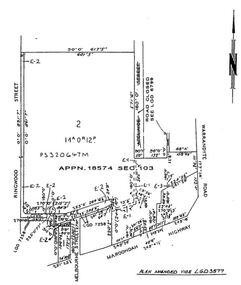
Document - Folder, Commercial and Retail Property Sales Information, Civic Place and Melbourne Street, Ringwood - 1998
... . - Yarra Valley Water statements relating to encumbrances for Shop 11, 149 Maroondah Highway; Shop 10, 149A Maroondah Highway; Shop 9, 149B Maroondah Highway; numer 8 Civic Place; Unit 3, 20 Melbourne Street; Office 4, 20 Melbourne Street; Shop 7, 22 Melbourne Street; and Shop 8, 24 Melbourne Street. - Land Tax Certificate pertaining to Commonwealth Bank, Civic Place, Ringwood. - Certificate of Title Vol 8892 Fol 906, Lot One on Plan of Subdivision No. 80718, Parish of Ringwood - Hanover Developments P/L - 29th June, 1971..... - Yarra Valley Water statements relating to encumbrances for Shop 11, 149 Maroondah Highway; Shop 10, 149A Maroondah Highway; Shop 9, 149B Maroondah Highway; numer 8 Civic Place; Unit 3, 20 Melbourne Street; Office 4, 20 Melbourne Street; Shop 7, 22 Melbourne Street; and Shop 8, 24 Melbourne Street. - Land Tax Certificate pertaining to Commonwealth Bank, Civic Place, Ringwood. - Certificate of Title Vol 8892 Fol 906, Lot One on Plan of Subdivision No. 80718, Parish of Ringwood - Hanover Developments P/L - 29th June, 1971. ...45 photocopied pages including - Plan of Subdivision No.LP80718, Parish of Ringwood, Victoria, Crown Portion 12(Part) and part of a former government road Ref Vol 8668 Fol 745. - Vendors Statement, Planning Certificate and Heritage Council (Victoria) Certificate issued for 20 Melbourne Street, Ringwood. - Maroondah City Council Land Information Certificate for 149 149A and 149B Maroondah Highway; number 8 Civic Mall; and numbers 16, 20, 22 & 24 Melbourne Street Mall. - Yarra Valley Water statements relating to encumbrances for Shop 11, 149 Maroondah Highway; Shop 10, 149A Maroondah Highway; Shop 9, 149B Maroondah Highway; numer 8 Civic Place; Unit 3, 20 Melbourne Street; Office 4, 20 Melbourne Street; Shop 7, 22 Melbourne Street; and Shop 8, 24 Melbourne Street. - Land Tax Certificate pertaining to Commonwealth Bank, Civic Place, Ringwood. - Certificate of Title Vol 8892 Fol 906, Lot One on Plan of Subdivision No. 80718, Parish of Ringwood - Hanover Developments P/L - 29th June, 1971. -
 Sunshine and District Historical Society Incorporated
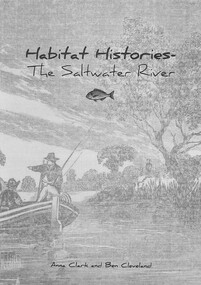
Document - Habitat Histories The Saltwater, Anne Clark et al, 2023
... These are tangible features which connect us to the lifeways of our ancestors in this significant place. The banks of the Maribyrnong River and its tributaries also hold our sacred ancestral remains. ...These are tangible features which connect us to the lifeways of our ancestors in this significant place. The banks of the Maribyrnong River and its tributaries also hold our sacred ancestral remains. ...This story is about how the Maribyrnong River was, how it once ran wild, and how it has changed. You will glimpse the Indigenous connections to the river and the river’s passage through early settlement, industrialisation and modern times. All the while, reflecting on its worth, not through a commercial or residential lens, but through the eyes of recreational fishers who love the river for itself. From historical newspaper articles, through piscatorial societies and angling clubs, fishers have long stood up to protect the environmental values of the Maribyrnong River. By committing their licence fees to this project, anglers are again pressing for the recovery of this wonderful river.Digital PDF Filenon-fictionThis story is about how the Maribyrnong River was, how it once ran wild, and how it has changed. You will glimpse the Indigenous connections to the river and the river’s passage through early settlement, industrialisation and modern times. All the while, reflecting on its worth, not through a commercial or residential lens, but through the eyes of recreational fishers who love the river for itself. From historical newspaper articles, through piscatorial societies and angling clubs, fishers have long stood up to protect the environmental values of the Maribyrnong River. By committing their licence fees to this project, anglers are again pressing for the recovery of this wonderful river.maribyrnong river, salt river, aborginal, aborigine, first nations -
 Flagstaff Hill Maritime Museum and Village
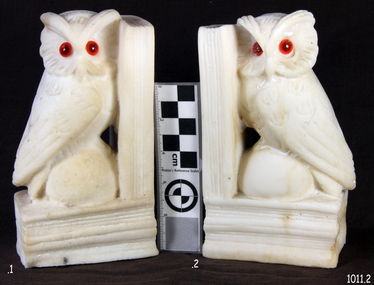
Decorative object - Bookends, ca. 1930s
... They are used and displayed in places where books are appreciated and valued, such as homes, libraries, educational buildings, business offices, legal institutions and banks. ...They are used and displayed in places where books are appreciated and valued, such as homes, libraries, educational buildings, business offices, legal institutions and banks. ...The pair of ornamental white resin owl bookends was likely made around the 1930s when epoxy resin became available. Bookends modelled on owls have been a popular ornament for many years, possibly because of the association between owls, books and wisdom. They are used and displayed in places where books are appreciated and valued, such as homes, libraries, educational buildings, business offices, legal institutions and banks. Bookends hold a row of upright books in place by supporting the beginning and end of the row. The books are more likely to keep their integrity when stored vertically. The first patent for a metal bookend was placed by William Stebbins Barnard in 1877. Bookends became useful and decorative items around the middle of the sixteenth century after printed books became available. At that time books were expensive and treasured possessions, treated with much respect. Even in the early nineteenth century, a Bible was often the only book in the home. It was included among the limited items brought by many immigrants to Australia. Books became more available and affordable to the public by the end of the nineteenth century and households and businesses were able to build their own libraries. Bookends were used then, and are still used now, to keep books organised, cared for, and readily accessible. Bookends, a pair of two (2) small white resin owls with clear bright red eyes standing on a stack of books, their bodies facing towards each other, chests on an upright book, heads turned towards the viewer. The ends are left and right-handed.flagstaff hill, flagstaff hill maritime museum and village, warrnambool, maritime museum, maritime village, great ocean road, shipwreck coast, ornament, bookend, bookends, pair of bookends, library, book storage, book display, room decoration, resin ornament, white bookends, owl bookends, owl ornament, white owls, resin owls, book support, bookend patent, william stebbins barnard -
 Flagstaff Hill Maritime Museum and Village
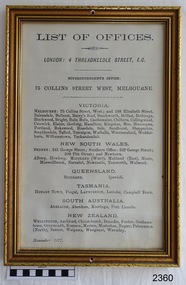
Document - Bank notice, List of Offices, ca Nov. 1877
... bank offices throughout Australia and New Zealand. It refers to the Superintendent's Office address at 75 Collins Street West, Melbourne and is dated November 1877. This places...bank offices throughout Australia and New Zealand. It refers to the Superintendent's Office address at 75 Collins Street West, Melbourne and is dated November 1877. This places ...The addresses given on the List for the London and Melbourne offices have connected the document to the Bank of Australasia. The List is dated November 1877 and shows the number and the location of all of the branches of the Bank at that point in time., a total of 77. - Victoria 35, New South Wales 14, Queensland 2, Tasmania 5, South Australia 5, New Zealand 16 Copies of the notice would have been displayed in all branches of the bank in both Australia and New Zealand to inform customers and perhaps impress them too with a large number of locations and the reference to the bank's connection with London. This document gives information on all bank offices throughout Australia and New Zealand. It refers to the Superintendent's Office address at 75 Collins Street West, Melbourne and is dated November 1877. This places the document at the time just before the new Melbourne office opened on the corner of Collins Street and Queen's Street in 1879. The Bank of Australasia was incorporated by Royal Charter of England in March 1834. It came to Australia on 14th December 1835, opening in Sydney. The Acting Superintendent of the Bank of Australasia in Sydney at that time was David Charters McArthur. He was Superintendent from 1867-to 1876. The Melbourne branch of the Bank of Australasia opened on 28th August 1838 in a two-roomed brick cottage on the north side of Little Collins Street. Two huge mastiff dogs were kept in the backyard and let loose at night to guard the bank. The government also provided an armed military sentinel. Due to the bank's rapid growth, a new building for the Melbourne branch was opened in 1840 at 75 Collins Street West. By 1879 the bank had been upgraded to a magnificent two-storey building on the corners of Collins and Queens Streets, with the entry on Collins Street. In 1951 the Bank of Australasia amalgamated with the Union Bank to form the Australia and New Zealand Bank, now known as the ANZ. Then in 1970, the ANZ merged with both the ES&A and the London Bank of Australia to form the ANZ Banking Group Limited. The ANZ Banking Group Ltd kindly donated a variety of historic items from the Bank of Australasia. BANK of AUSTRALASIA, WARRNAMBOOL – In 1854 Warrnambool had two banks, the Union Back and the Bank of Australasia. Later, completely different bank businesses opened; in 1867 the National Bank of Australasia, then in 1875 the Colonial Bank of Australasia. The original Bank of Australasia was established in Warrnambool in July 1854, and operated from a leased cottage on Merri Street, close to Liebig Street. The bank bought a stone building previously erected by drapers Cramond & Dickson on the corner of Timor and Gibson Streets. Samuel Hannaford was a teller and then Manager at the Warrnambool branch from 1855 to 1856. Warrnambool’s Council chose the Bank of Australasia as its bank 1856-57. In 1859 Roberts & Co. was awarded the contract to build the new Bank of Australasia branch for the sum of £3,000. The land was on a sand hill on the northeast corner of Timor and Kepler Streets and had been bought in 1855 from investor James Cust. The new building opened on May 21, 1860. The bank continued to operate there until 1951 when it merged with the Union Bank to form the ANZ Bank, which continued operating from its Liebig Street building. Warrnambool City Council purchased the former Bank of Australasia building in 1971 and renovated it, then on 3rd December 1973 it was officially opened as the Art Gallery by Cr. Harold Stephenson and Gallery Director John Welsh. The Gallery transferred to the purpose-built building in Liebig Street in 1986 and the old bank building is now the Gallery club. The List of Offices of the Bank of Australasia has early Australian historical significance through its association with the Bank, which was established in 1834 by Royal Charter and opened in Sydney, Australia, in Sydney in 1835. The List is significant for showing the number and location of all of the Offices of the Bank of Australia in November 1877. This shows that Victoria had 45 percent of all Offices. The framed document is locally significant for its association with the Bank of Australasia, Warrnambool's first bank, established in 1854. The bank continued to operate until the organisation's merger in 1951. It became the ANZ Bank, which is still in operation today. The Bank was an integral part of the establishment and growth of commerce in Colonial Warrnambool and throughout Australia.Document in a decorative gilt frame. Titled List of Bank Offices and dated November 1877, facsimile. Offices include London, and a variety of offices in Victoria, New South Wales, Queensland, Tasmania, South Australia and New Zealand. Round holes in the centre top and bottom of the frame. Text includes: "LONDON: 4 THREADNEEDLE STREET, E.C." "SUPERINTENDENT'S OFFICE: / 75 COLLINS STREET WEST, MELBOURNE" "Warrnambool" " November 1877" flagstaff hill, warrnambool, bank of australasia 1877, branches of bank of australasia 1877, banks in australia 1877, commerce 1877, shipwreck-coast, document, bank document, flagstaff hill maritime museum & village, bank of australasia, 1877, branches in australia, bank of london, offices in australia, offices in new zealand, commerce, banking, finance, shipwrecked coast, flagstaff hill maritime museum, maritime museum, shipwreck coast, flagstaff hill maritime village, great ocean road, boa, union bank, australia & new zealand bank, anz bank, david charters mcarthur, d c mcarthur, sydney, new south wales, currency, banknote, legal tender, list of bank offices -
 Flagstaff Hill Maritime Museum and Village
Artwork, other - Window, Brooks, Robinson & Co, Christ Showing the Helmsman the Way, circa August 1947
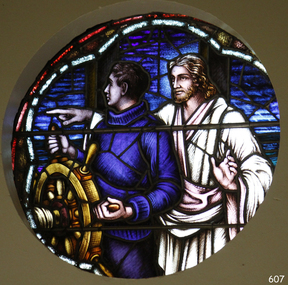
... place williamstown...religion...religious service...sailors rest...bethel sailors’ church...bethel floating church...e. s. & a. bank...This memorial window is significant as a part of Victoria's War Heritage and is listed on the Victorian Heritage Database, Heritage Number 196973. flagstaff hill warrnambool shipwrecked coast flagstaff hill maritime museum maritime museum shipwreck coast flagstaff hill maritime village great ocean road mission to seamen williamstown st nicholas seaman’s church williamstown missions to seamen victoria mission to seafarers lightkeepers auxiliary ladies harbour light guild 139 nelson place williamstown religion religious service sailors rest bethel sailors’ church bethel floating church e. s. & a. bank williamstown christ directing a sailor christ showing the helmsman the way quartermaster’s hand on the wheel stained glass window church window religious window sanctuary window memorial window war memorial window victorian war heritage inventory victorian heritage database merchant navy ww2 1939-1945 anglican church bishop mckie mrs musther brooks robinson & co flying angel club williamstown lightkeepers' auxiliary ladies' harbour lights guild commemorative window Window, stained glass, circular, with reinforcing bars. ...This round, stained glass window, titled "Christ Showing the Helmsman the Way", was also referred to as the Sanctuary Window or Memorial window. It was installed in the St Nicholas Seamen's Church at 139 Nelson Place, Williamstown, Victoria, inside the chapel above the altar. This memorial window has significance as a part of Victoria's War Heritage and is listed on the Victorian Heritage Database. The window and subsequent plaque were donated to St Nicholas Seamen’s Church as a memorial to the members of the Merchant Navy whose lives were lost in the Second World War, 1939-1945. The donor was the Williamstown Lightkeepers Auxiliary, an independent ladies' association working with the Williamstown Missions to Seamen (the Missions to Seamen organisation was re-named the Mission to Seafarers in the year 2000). The window was officially dedicated on December 14, 1947, by Geelong's Anglican Bishop, Rt. Rev. J.D. McKie. In the early months of 1948, a bronze plaque was also placed in the chapel above the altar. It recognises the lost souls of the Merchant Navy during World War 2, as well as the donor of the window, the Williamstown Lightkeepers Auxiliary. The inscription impressed on the rectangular bronze plaque, 20.4 x 10.2cm, is as follows: “IN MEMORY OF THE MEMBERS OF THE MERCHANT NAVY WHO WERE LOST IN THE SECOND WORLD WAR 1939-1945 FAITHFUL UNTO DEATH. THE WINDOW ABOVE THE ALTAR WAS ERECTED BY THE WILLIAMSTOWN LIGHTKEEPERS AUXILIARY 1947.” The Williamstown St Nicholas Seamen’s Church ceased operation in 1966. In 1979, the Victoria Missions to Seamen donated this round, stained glass window and the memorial plaque to Flagstaff Hill Maritime Village, along with many other items and furnishings. These items have been used to simulate the Williamstown Mission and Chapel as much as possible. The round space that formerly displayed the window can still be seen at the back of the old St Nicholas Seamen’s Church, previously the ES&A bank, in Williamstown. THE MISSIONS TO SEAMEN (Brief History): - The Missions to Seamen was an Anglican charity in Great Britain that has served the world's seafarers since 1856. Its symbol is a Flying Angel, inspired by a Bible verse. Today, there are centres in over 200 ports worldwide where seamen of all backgrounds are offered a warm welcome and provided with a wide range of facilities. In Victoria, the organisation began in Williamstown in 1857 as a Sailors’ Church, also known as ‘Bethel’ or the ‘Floating Church’ in an old hulk floating in Hobson’s Bay, Port of Melbourne. It soon became part of the Missions to Seamen, Victoria. In 2000, the organisation, now named Mission to Seafarers, still operated locally in Melbourne, Portland, Geelong and Hastings. The Ladies’ Harbour Lights Guild was formed in 1906 to support the Missions to Seamen in Melbourne and other centres, such as Williamstown. Two of the most significant ladies of the Guild were founder Ethel Augusta Godfrey and foundation member Alice Sibthorpe Tracy (who established a branch of the Guild in Warrnambool in 1920). The Guild continued its work until the 1960s. In 1943, a former Williamstown bank was purchased for the Missions to Seamen Club. The chapel was named St Nicholas’ Seamen’s Church and was supported by the Ladies’ Harbour Lights Guild, the Williamstown Lightkeepers’ Auxiliary and the League of Soldiers’ and Sailors’ Friends. It ceased operation in 1966. A Missions to Seamen Chapel and Recreation Room was a significant feature of ports during the late 1800s and 1900s. It seemed appropriate for Flagstaff Hill to include such a representation within the new Maritime Village, and the Melbourne Board of Management of Missions to Seamen Victoria gave its permission on 21st May 1979 for the entire furnishings of the Williamstown chapel to be transferred to Flagstaff Hill. The St Nicholas Seamen’s Church was officially opened on October 11, 1981, and resembles the Williamstown chapel. This stained glass window is historically significant for its connection to the St Nicholas Mission to Seamen's Church in Williamstown, established in 1857 to cater for the physical, social, and spiritual needs of seafarers. It was donated to the Mission by the Lightkeepers Auxiliary (Ladies Harbour Lights Guild, which was formed in 1905). The Missions to Seamen organisation had its origins in Bristol, England, when a Seamen's Mission was formed in 1837. The first Australian branch was started in 1856 by the Rev. Kerr Johnston, a Church of England clergyman, and operated from a hulk moored in Hobson’s Bay. Later, the Mission occupied buildings in Williamstown and Port Melbourne. The connection of this window, the Mission to Seamen and the Ladies Harbour Lights Guild highlights the strong community awareness of the life of people at sea, their dangers and hardships, and their need for physical, financial, spiritual and moral support. This memorial window is significant as a part of Victoria's War Heritage and is listed on the Victorian Heritage Database, Heritage Number 196973.Window, stained glass, circular, with reinforcing bars. The window represents Christ showing the helmsman the way. It shows a man in blue knitted jumper holding onto a ship's wheel, looking over his right shoulder. Behind him stands a man in a white robe, pointing to his right and looking to his left, his left hand gesturing to pause. The background has various shapes and patterns of blue glass, bordered by two arcs; the outer one is white, the inner one is red. This beautiful window is in our St Nicholas Seamen's Church Collection and was brought to Warrnambool from the original St Nicholas Seamen’s Church in Williamstown. flagstaff hill, warrnambool, shipwrecked coast, flagstaff hill maritime museum, maritime museum, shipwreck coast, flagstaff hill maritime village, great ocean road, mission to seamen williamstown, st nicholas seaman’s church williamstown, missions to seamen victoria, mission to seafarers, lightkeepers auxiliary, ladies harbour light guild, 139 nelson place williamstown, religion, religious service, sailors rest, bethel sailors’ church, bethel floating church, e. s. & a. bank williamstown, christ directing a sailor, christ showing the helmsman the way, quartermaster’s hand on the wheel, stained glass window, church window, religious window, sanctuary window, memorial window, war memorial window, victorian war heritage inventory, victorian heritage database, merchant navy ww2, 1939-1945, anglican church, bishop mckie, mrs musther, brooks robinson & co, flying angel club, williamstown lightkeepers' auxiliary, ladies' harbour lights guild, commemorative window -
 Flagstaff Hill Maritime Museum and Village
Photograph - Historical, religious, mid-20th century
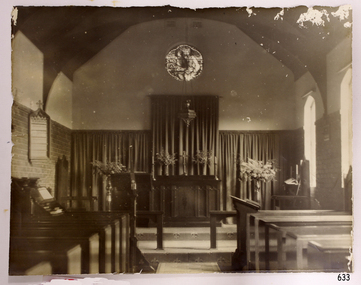
... In 1943, the former ES&A Bank building at 139 Nelson Place, Williamstown, was purchased to become the new Mission to Seamen’s Club. ...In 1943, the former ES&A Bank building at 139 Nelson Place, Williamstown, was purchased to become the new Mission to Seamen’s Club. ...This photograph records the interior of St Nicholas Seamen's Church at 139 Nelson Place, Williamstown, Victoria, which was purchased and furnished around 1943. The furniture and furnishings are now part of the St. Nicholas Seamen's Church collection. HISTORY of the Missions to Seamen: - DETAILED HISTORY of the Missions to Seamen: - The Missions to Seamen is an Anglican (Church of England) charity that has served the world’s seafarers since 1856. It was inspired by the work of Rev. John Ashley, who, 20 years earlier, had pioneered a ministry to seafarers in the Bristol Channel in Great Britain. When Ashley retired, others continued the work, founding the Missions to Seamen. It adopted a Flying Angel as its symbol, inspired by a verse from the Bible in Revelation 14. Today, over 200 world ports have Missions to Seamen centres and chaplains. A Missions to Seamen’s Club warmly welcomes sailors of all colours, creeds and races and provides a wide range of facilities. The Missions to Seamen organisation changed its name to the Mission to Seafarers in 2000, continuing to include Missions to Seamen clubs in Victoria’s cities of Melbourne, Portland, Geelong and Hastings. Flagstaff Hill’s St Nicholas’ Seamen’s Church is named after its namesake from Williamstown, Victoria, which began in 1857. Bishop Perry opened the first Sailors’ Church there, known as ‘Bethel’, on an old hulk floating in Hobson’s Bay, Port of Melbourne. In 1860, a Sailors’ Rest started operating from rented premises in Williamstown. In 1878, the Sailors’ Church moved into an old Wesleyan chapel in Ann Street. By the end of that year, they managed to purchase the building, which they had already refurbished. In 1883, they affiliated with the Victorian Seamen’s Mission. A few years later, in 1906, the building had to be demolished because it was no longer safe. While they raised funds for a new building, the Sailors’ Rest temporarily moved to premises in front of Customs House in Nelson Place. Around this time, in 1906, the Ladies Harbour Lights Guild was formed in Australia to support and raise funds for the Mission to Seamen organisation in Melbourne. Two of the most significant ladies of the Guild were founding members Ethel Godfrey and Alice Sibthorpe. During the Mission's time at Siddeley Street, Melbourne, the activities of the Guild raised funds for the Mission to Seamen's Chapel at their new, and still current, premises in Flinders Street, Melbourne, opened in 1917. The Guild continued its important work until the 1960s. In 1908, the Williamstown Mission had enough money to purchase the former Mascotte skating rink on Thompson Street, Williamstown. In August of that year, they were inaugurated into the Victorian Missions to Seamen. They continued at that venue for a few decades. In 1943, the former ES&A Bank building at 139 Nelson Place, Williamstown, was purchased to become the new Mission to Seamen’s Club. On May 6th, 1944, it was officially opened, described as a ‘distinctive little building’. Funds had previously been raised for the building and furnishing of the chapel at the rear. The chapel was named St Nicholas’ Seamen’s Church, after St Nicholas, fourth-century bishop and patron saint of sailors. Services were held on Wednesdays and Sundays. The church was supported by the Williamstown Lightkeepers’ Auxiliary, newly founded by Mrs Ethel Margaret Musther in 1943, as well as the Harbour Lights Guild and the League of Soldiers’ and Sailors’ Friends. The Williamstown Mission to Seamen’s Church operated until 1966, when large international ships no longer used the Port of Williamstown. The Commonwealth Government then leased the premises. In the formative years of Flagstaff Hill Maritime Village, the Advisory Board decided to include a Missions to Seamen Chapel and Recreation Room in its village. The Missions organisation was a significant feature of ports during the late 1800s and early 1900s, the period that the Village represents. They often erected Missions to house social and worshipful activities for seamen. Flagstaff Hill’s curator, Mr Ken Marshman, approached the Melbourne Board of Management of Missions to Seamen regarding the Williamstown branch. Consequently, the Board permitted the furnishings of the Williamstown chapel to be transferred to Flagstaff Hill Maritime Village. A provision of the transfer was that the Victoria Missions to Seamen be recognised, that the items would remain as a collection, and that the chapel would be called St Nicholas Seamen’s Church and conduct Divine services. The donation was approved on 21st May 1979. Flagstaff Hill's St. Nicholas Seamen's Church: - The idea behind Flagstaff Hill’s Missions to Seamen’s Church was partly driven by the offer of Stained Glass Memorial Windows that originated from the Warrnambool and District Base Hospital, which was undergoing multi-storey expansion in the late 1960s and early 1970s. The hospital’s Manager/Secretary was eager to see the historic window installed in a suitable place. The church, or chapel, was designed by a local architectural draftsman in collaboration with the Flagstaff Hill Planning Board and was constructed by Mr Leon Habel. The designers hoped that the church would be used for formal worship such as weddings, funerals, and multi-denominational special services like war commemorations. The design is inspired by the ‘Missions to Seamen’ buildings in Portland and the Port of Melbourne. The furniture and furnishings were placed as accurately as possible according to photographs of the Williamstown St Nicholas Seamen’s Church and with assistance from local clergy. The Recreation Room was furnished and arranged on advice from experienced members of the Missions to Seamen organisation. A framed document in the building recognises the donor of the furnishings, Victoria Missions to Seamen, and includes the names of some original donors and their donated item/s. The building’s design incorporates local features such as Warrnambool sandstone, which was no longer commercially available but was procured from demolished buildings and uniformly cut to use as a veneer over the stronger Mt. Gambier stone. Also, traditional green American roofing slate was used, sourced from the 1908 local shipwreck “Falls of Halladale” by Flagstaff Hill volunteer divers. The bell tower includes a bell believed to be from a local shipwreck. Additional furnishings were acquired locally, along with several items donated by Warrnambool residents. Light fittings in both rooms were assembled to simulate 19th-century gas light fittings. The stained-glass window at the back of the church is a memorial to Dr Connell, a well-respected member of the Warrnambool community. It was originally installed in 1928 in the main building of Warrnambool Hospital. The St Nicholas’ Seamen’s Church at Flagstaff Hill was officially opened by His Worship the Mayor, Cr. John Lindsay, on Sunday, 11th October 1981. The event included a service of thanksgiving conducted by the Warrnambool Ministers Fraternal. Since then, the Chapel has been the historic venue for many weddings. This photograph is significant through its association with the St Nicholas' Mission to Seamen Church in Williamstown, Melbourne, established in 1857. The building in the photograph is the former English, Scottish and Australian Bank (ES&A bank), also known as the Mission to Seamen. It is listed on the Victorian Heritage Database for having local historic and aesthetic interest. Photograph of St Nicholas Seamen's Church, Williamstown. Sepia photograph. The photograph shows the inside of the Chapel of Mission to Seamen, including organ, pews and other furniture and furnishings. There is a circular stained glass window high on the back wall depicting a sailor at the helm of a ship and a man standing behind him and pointing the way - "Christ Showing The Helmsman The Way". A Sanctuary Light is suspended from the ceiling. The Sanctuary chars are visible. This shows the St Nicholas Seamen's Church in Williamstown, the furnishings and furniture of which is now part of the St Nicholas Seamen's Church Collection’.flagstaff hill, warrnambool, shipwrecked-coast, flagstaff-hill, flagstaff-hill-maritime-museum, maritime-museum, shipwreck-coast, flagstaff-hill-maritime-village, st nicholas mission to seamen's church williamstown, mission to seamen williamstown, mission to seamen victoria, st nicholas mission to seamen, chapel window, christ showing the helmsman the way, stained glass window, st nicholas seamen's church, religion, religious service, sailor's rest, ladies harbour light guild -
 Federation University Historical Collection
Photograph - Black and White, Concert Bowl at Kenwood, Hampstead, London, 1969, 1969
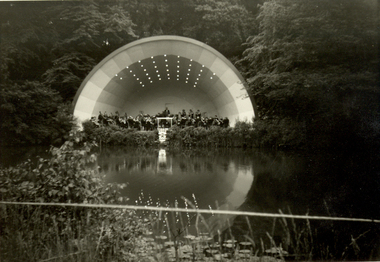
... banks of a lake, with the reflection seen in the lake below. The structure is a concert bowl, with numerous spotlights on the ceiling lighting the stage area below. On the stage is a group of musicians playing. The place...banks of a lake, with the reflection seen in the lake below. The structure is a concert bowl, with numerous spotlights on the ceiling lighting the stage area below. On the stage is a group of musicians playing. The place ...Frank Wright was a renown resident of Smeaton, where he was born on 2 August 1901. He lived at Laura Villa, and attended Smeaton State School. His father William was a gold miner and his mother's name was Sarah. Their family won many singing and instrumental awards. Frank was tutored by Percy Code and was awarded a gold medal for the highest marks in the ALCM examinations in the British Colonies at the age of seventeen years. He became the Australian Open Cornet Champion by the age of eighteen. A year later, Frank conducted the City of Ballarat Band, and later the Ballarat Soldiers’ Memorial Band. He formed the Frank Wright Frisco Band and Frank Wright and his Coliseum Orchestra. These bands won many South Street awards, and Frank as conductor won many awards in the Australian Band Championship contest. In 1933 Frank Wright sailed to England to conduct the famous St Hilda’s Band and was later appointed Musical Director of the London County Council, where he organized many amazing concerts in parks, in and around the London district. He was made Professor of Brass and Military Band Scoring and conducted at the Guildhall of Music and Drama. Frank was often invited to adjudicate Brass Band Championships around Europe, in Australia, including South Street and in New Zealand. The Frank Wright Medal at the Royal South Street competition is awarded to an individual recognized as making an outstanding contribution to brass music in Australia.1). Black and white photograph of a semicircular structure set amidst trees on the banks of a lake, with the reflection seen in the lake below. The structure is a concert bowl, with numerous spotlights on the ceiling lighting the stage area below. On the stage is a group of musicians playing. The place is the Concert Bowl in Kenwood, Hampstead, London. The musicians are the London Symphony Orchestra, conducted by Frank Wright. 2). Black and white newspaper clipping of the same scene with a caption. The newspaper is 'The British Bandsman'.1). Written in pencil on back - Kenwood, Hampstead, London, c1969 2). Typed caption - A Remarkable Photograph.The many thousands of visitors to Kenwood, home of outdoor Concerts in Hampstead, London, will recognise the scene of the Concert Bowl, looking over the lake. Our photograph was taken on 7 June this year and shows the London Symphony Orchestra conducted by Frank Wright. The music performed was Mr Wright's Prelidio Marziale and the occasion was the 100th performance at Kenwood.frank wright, conductor, brass bands, london symphony orchestra, kenwood hampstead, concert bowl, reflection on lake -
 Federation University Historical Collection
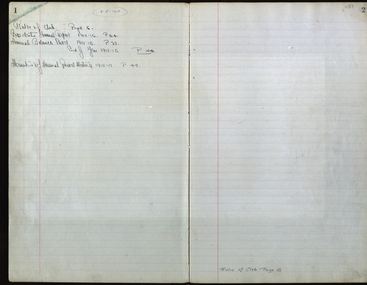
Book, Minute Book of the Ballarat School of Mines Science and Field Naturalists Club, 1915-1918, 8 May 1915 - October 1918
... place on 17th November 1918, resolved that "there would be no further meeting of the Club until further notice was given." (Ballarat School of Mines Annual Report of 1888, p.17. Also mentioned in Annual Report 1889, p.195) ballarat school of mines smb science and field naturalists club fenner charles fenner albert w. steane william baragwanath john brittain lal lal lal lal excursion Science nad Field Naturalists Club Ballarat field naturalists wild flower show Maurice copland alfred mica smith sunnyside woollen mill excursion Wilson's promontory charles hoadley Included: State Savings Bank of Victoria account booklet No. 128.155, issued to School of Mines Science and Field Naturalists Club. ...This minute book records the reformed Science and Field Naturalists Club of the Ballarat School of Mines. Such a club had existed in 1888 and 1889. Final recorded meeting took place on 17th November 1918, resolved that "there would be no further meeting of the Club until further notice was given." (Ballarat School of Mines Annual Report of 1888, p.17. Also mentioned in Annual Report 1889, p.195)Dark blue hard-cover minute book with dark red spine. 186 numbered lined pages with left hand margin. Last entry on p.128. Courier Newspaper article 'Victorian National Park: Our Fauna and Fauna' by Charles Hoadley published 16/06/1915 Included: State Savings Bank of Victoria account booklet No. 128.155, issued to School of Mines Science and Field Naturalists Club.ballarat school of mines, smb, science and field naturalists club, fenner, charles fenner, albert w. steane, william baragwanath, john brittain, lal lal, lal lal excursion, science nad field naturalists club, ballarat field naturalists wild flower show, maurice copland, alfred mica smith, sunnyside woollen mill excursion, wilson's promontory, charles hoadley -
 Flagstaff Hill Maritime Museum and Village
Souvenir - Wood Sample, Alexander Stephen and Sons, 1869
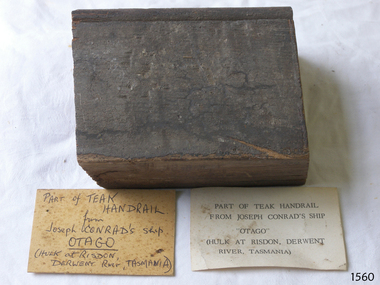
... It was sold for scrap and eventually abandoned on the banks of the Derwent River at a place now known as Otago Bay, opposite Conrad Drive, Otago. ...It was sold for scrap and eventually abandoned on the banks of the Derwent River at a place now known as Otago Bay, opposite Conrad Drive, Otago. ...This teak wood sample was part of a handrail from the wreck of the barque Otago. The barque Otago 1869-1931 - The iron-hulled 3-masted barque Otago was built in Glasgow by Alexander Stephen & Sons Ltd, Kelvinhaugh, as a merchant ship and launched in 1869. The vessel changed hands several times in the late 19th century after being sold to an Australian firm in 1871. During one of its voyages, the captain died while the ship was in port at Bangkok. Marine author Joseph Conrad was on board and, being a qualified captain, he took command and continued the journey to Sydney and Mauritius. It was the only ship he ever commanded. In 1903, the Melbourne shipping company Huddart, Parko & Co., purchased the Otago and converted it to serve as a coal hulk for use in Sydney. The Otago was later sent to Hobart, Tasmania, where it continued as a hulk until 1931. It was sold for scrap and eventually abandoned on the banks of the Derwent River at a place now known as Otago Bay, opposite Conrad Drive, Otago. The outline of the hull is still visible, and a nearby plaque tells the story. There are other vessels also named Otago, one of which was built in the same year. Joseph Conrad (1857-1927): - Polish-born Joseph Conrad became a British subject in 1886. He was a renowned marine fiction writer and, for a short time, a mariner and Captain. As a 13-year-old boy, Joseph Conrad desired to be a sailor. At 19, he joined the British merchant marine, working in several roles. He eventually qualified as a captain but only served in this role once: from 1888 to 1889, when he commanded the barque Otago, taking over from the deceased captain and completing the ship’s journey from Sydney to Mauritius. In 1889, he began writing his first novel, Almayer’s Folly. He retired from life as a mariner in 1894, aged 36. Conrad’s affection for Australia and his visits to Australia from 1878 to 1982 were later commemorated by a plaque in Circular Quay, Sydney. Conrad continued as an author; some characters in his books were said to be inspired by his maritime experiences and the people he had met. By the end of his life, he had completed 19 novels, stories, and essays, plus one incomplete novel, Suspense, which was finished and published posthumously. In 1924, Prime Minister Ramsay MacDonald offered Conrad a knighthood for his work, but he declined. There is an 1882 sailing ship named the Joseph Conrad, after the author, that is now preserved at the Mystic Seaport Maritime Museum in the USA as part of the fleet of historic ships, used as an exhibit and a training ship. The Danish square-rigged training ship was originally named Georg Stage but was renamed by marine author Alan Villiers when he bought it in 1934. The wood sample from the Otago is significant for its association with renowned marine author Joseph Conrad, who had once commanded the vessel; it was his only command as Captain and was known as Joseph Conrad's Otago. The maritime connection with Conrad extends to items in the collection, including some of his maritime novels based on his first-hand knowledge, a wooden ship model of a ship named after him, and a navigation chart of Otago Harbour. The sample of teak is significant as an example of materials used in the construction of the 1869 iron-hulled sailing ship, built in Glasgow, Scotland, specifically for use to sail across the world with cargo to trade between the colonies including Australian ports. Wood sample; a rectangular section of a teak wood handrail that has a bead planed along one side. Two cards with the sample have inscriptions, one handwritten and one typed. The sample is from the wreck of the barque Otago, once under the command of Captain Joseph Conrad. Handwritten on a card, and typed on another card: "PART OF TEAK HANDRAIL / from / Joseph CONRAD'S ship / OTAGO / (HULK at RISDON, DERWENT River, TASMANIA)flagstaff hill, flagstaff hill maritime museum and village, warrnambool, maritime museum, maritime village, great ocean road, shipwreck coast, joseph conrad, joseph conrad's ship, captain joseph conrad, otago, barque otago, merchant ship, cargo ship, hulk, 1869 ship, iron hull, sailing ship, handrail, fitting, souvenir, wood sample, teak, new zealand, sydney, newcastle, tasmania, hobart, derwent river, otago harbour, otago bay, conrad drive, 19th century, mauritius, marine author, marine novel, alex villiers, georg stage -
 Mission to Seafarers Victoria
Photograph - Colour photograph, series, c. 2020
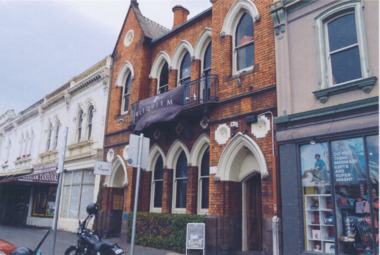
... The former ES&A Bank building was purchased to be used as the new premisces in Williamstown in 1943. The St Nicholas chapel usa added at the back. The place...The former ES&A Bank building was purchased to be used as the new premisces in Williamstown in 1943. The St Nicholas chapel usa added at the back. The place ...The former ES&A Bank building was purchased to be used as the new premisces in Williamstown in 1943. The St Nicholas chapel usa added at the back. The place was furnished thanks to funds donated by the High Commissioner of Canada.The Nelson place building and the chapel are still standing and are heritage listed.3 colour photographs depicting the former mission in the ES&A Bank in Williamstown, the heritage plaque and the street with an inscription from Nancy OakleyInscription handwritten in black ink in capital letters by Nancy Oakley: nancy oakley, mission to seamen, nancy dingle, williamstown, nelson place -
 Mission to Seafarers Victoria
Card - Invitation card, The Victoria Missions to Seamen, 1959
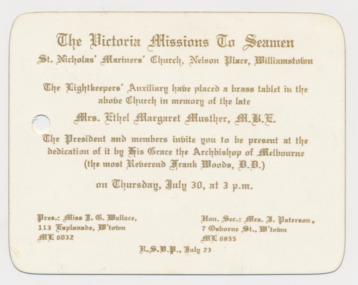
... Bank. Thanks to her philanthropic work, she was rewarded with a Medal of the British Empire in 1953 for all her charitable work. ethel margaret musther st nicholas' mariners' chapel nelson place williamstown lightkeepers' auxiliary Invitation card to the dedication of a brass plaque in memory of Ethel Margaret Musther Card Invitation card The Victoria Missions to Seamen ...A Williamstown local, Ethel Margaret Musther nee Barber (1872-1956) was the daughter of Captain John Henry Barber (1842-1924), a sea pilot and Janet Lidell (1846-1891) Her grandfather, Captain Lidell, was also a seaman. In 1900, she married Nathan George Musther,(18..-1933) a chemist, and dentist in the Navy. They had two daughters: Rosamund Janet Musther(born 1903) and Nanoya Gwendoline Musther (born 1906). She was the principal of the Ladies' College in Footscray. She was involved in many philantropic associations especially for sailors but also during WWI and WW2. She worked for the Anzac Club, the Red Cross, She formed: 1941: the R.A.N. Friendly Union of Sailor's Wives and Mothers. 1943: the Lightkeepers Auxiliary to help the Mission raised funds. The plaque was a gift of the Lightskeeper Auxiliaire and unveiled on 30 July 1959 at the St Nicholas Chapel, by her eldest daughter, Mrs Jean McDonald.It was originally on stained and polished hardwood mount made by Mrs Murdoch (AR1959, page 24). On the day, a desk service-book was also dedicated in memory of Dr John Thompson at the request of his daughter, Mrs Sparrow.In early 1943, Ethel Margaret Musther formed the Lightkeepers' Auxiliaire and raised funds for the third building purchased for the Williamstown branch of the Victorian Seamen's Mission, the former E,S & A Bank. Thanks to her philanthropic work, she was rewarded with a Medal of the British Empire in 1953 for all her charitable work.Invitation card to the dedication of a brass plaque in memory of Ethel Margaret Mustherethel margaret musther, st nicholas' mariners' chapel, nelson place, williamstown, lightkeepers' auxiliary -
 Mission to Seafarers Victoria
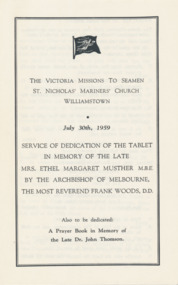
Booklet - Chapel service, The Victoria Missions to Seamen, Dedication of Ethel Musther, 1959
... Bank. Thanks to her philanthropic work, she was rewarded with a Medal of the British Empire in 1953 for all her charitable work. ethel margaret musther st nicholas' mariners' chapel nelson place williamstown lightkeepers' auxiliary dr john thompson Folded booklet on creamy colour paper and black ink Dedication of Ethel Musther Booklet Chapel service The Victoria Missions to Seamen ...A Williamstown local, Ethel Margaret Musther nee Barber (1872-1956) was the daughter of Captain John Henry Barber (1842-1924), a sea pilot and Janet Lidell (1846-1891) Her grandfather, Captain Lidell, was also a seaman. In 1900, she married Nathan George Musther,(18..-1933) a chemist, and dentist in the Navy. They had two daughters: Rosamund Janet Musther(born 1903) and Nanoya Gwendoline Musther (born 1906). She was the principal of the Ladies' College in Footscray. She was involved in many philantropic associations especially for sailors but also during WWI and WW2. She worked for the Anzac Club, the Red Cross, She formed: 1941: the R.A.N. Friendly Union of Sailor's Wives and Mothers. 1943: the Lightkeepers Auxiliary to help the Mission raised funds. The plaque was a gift of the Lightskeeper Auxiliaire and unveiled on 30 July 1959 at the St Nicholas Chapel, by her eldest daughter, Mrs Jean McDonald. It was originally on stained and polished hardwood mount made by Mrs Murdoch (AR1959, page 24). On the day, a desk service-book was also dedicated in memory of Dr John Thompson at the request of his daughter, Mrs Sparrow.In early 1943, Ethel Margaret Musther formed the Lightkeepers' Auxiliaire and raised funds for the third building purchased for the Williamstown branch of the Victorian Seamen's Mission, the former E,S & A Bank. Thanks to her philanthropic work, she was rewarded with a Medal of the British Empire in 1953 for all her charitable work.Folded booklet on creamy colour paper and black inkethel margaret musther, st nicholas' mariners' chapel, nelson place, williamstown, lightkeepers' auxiliary, dr john thompson
