
Showing 50 items matching "banka"
-
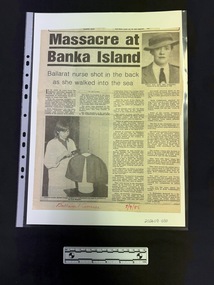
![Newspaper - Photocopy of newspaper clipping, Jan Clarke, Massacre at Banka Island: Ballarat nurse shot in the back as she walked into the sea, [7/9/85]](/media/collectors/64a5077bc83bd7b7b94f4211/items/69b0b4143d5082ac59e3b0f7/item-media/69b0b5193d5082ac59e3d181/item-fit-380x285.jpg?cb=6) Returned Nurses RSL Sub-branch
Returned Nurses RSL Sub-branchNewspaper - Photocopy of newspaper clipping, Jan Clarke, Massacre at Banka Island: Ballarat nurse shot in the back as she walked into the sea, [7/9/85]
... Massacre at Banka Island: Ballarat nurse shot in the back as she walked into the sea...WWII WW2 World War Two Banka Island Army Nurse Mary Elizabeth Cuthbertson SS Vyner Brooke Photocopy of a large newspaper clipping. ...Biographical article on Mary Elizabeth Cuthbertson (killed on Bangka Island) of Ballarat and the upcoming exhibition of her wartime & personal effects at Soverign Hills Gold Museum. Article mentions Vivian Bullwinkel and her dedication to the nurses she survived in the massacre.Photocopy of a large newspaper clipping. Small photo in top right hand corner of an Army Nurse. Larger photo in bottom left corner of an assistant curator preparing a cape for exhibition. Large underlined title. The remaining page is divided into two small and two large columns of text.wwii, ww2, world war two, banka island, army nurse, mary elizabeth cuthbertson, ss vyner brooke -
 Returned Nurses RSL Sub-branch
Newspaper - Newspaper clipping, [Ballarat Courier], Massacre at Banka [sic] Island, [7/9/85]
... Massacre at Banka [sic] Island...Photo in bottom left hand corner of a woman cleaning a cape on a stand. Massacre at Banka [sic] Island Newspaper Newspaper clipping [Ballarat Courier] Jan Clarke ...Biographical article on Mary Elizabeth Cuthbertson (killed on Bangka Island) of Ballarat and the upcoming exhibition of her wartime & personal effects at Soverign Hills Gold Museum. Article mentions Vivian Bullwinkel and her dedication to the nurses she survived in the massacre.Large newspaper clipping with four columns of text and two black and white photographs in diagonal corners. Photo in top right hand corner a portrait of a young woman in army nursing uniform. Photo in bottom left hand corner of a woman cleaning a cape on a stand.'Ballarat Courier 7/9/85' [red ink along lower edge of page]wwii, world war two, ww2, bangka island, ss vyner brooke, mary elizabeth cuthbertson, vivian statham (nee bullwinkel) -
 Running Rabbits Military Museum operated by the Upwey Belgrave RSL Sub Branch
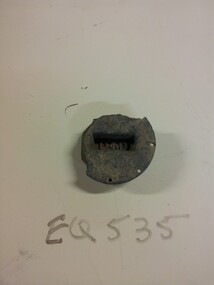
Lid
... Lid off 44 gal drum - Banka Banka Staging Camp, Alice Springs,...Running Rabbits Military Museum operated by the Upwey Belgrave RSL Sub Branch 1 Mast Gully Road Upwey melbourne Equipment WW2 Army Lid off 44 gal drum - Banka Banka Staging Camp, Alice Springs, Lid ...Lid off 44 gal drum - Banka Banka Staging Camp, Alice Springs,equipment, ww2, army -
 Returned Nurses RSL Sub-branch
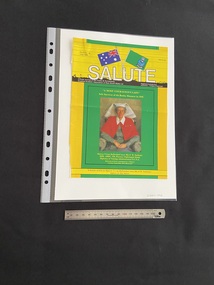
Journal - Pages from the official Journal of the Totally and Permanently Disabled Soldiers' Association of New South Wales, Totally & Permanently Disabled Soldiers Association of New South Wales, Salute: Volume 6, Number 78, July 1990, July,1990
... Contains a two and a half page article on Matron Vivian Bullwinkel 'sole survivor of the Banka Massacre in 1942'. ...Contains a two and a half page article on Matron Vivian Bullwinkel 'sole survivor of the Banka Massacre in 1942'. World War Two WWII WW2 Vivian Bullwinkel Banka Island SS Vyner Brooke Prisoner of war Yellow background overlaid by a large green vertical strip down the centre that contains a painted image of a military nurse. ...Contains a two and a half page article on Matron Vivian Bullwinkel 'sole survivor of the Banka Massacre in 1942'. Yellow background overlaid by a large green vertical strip down the centre that contains a painted image of a military nurse. There is a wide horizontal yellow strip across the top of the page with the journal details printed in white text and two flags crossing in the centre. There is a thin horizontal strip across the bottom of the page with black text printed in it. On the back of the cover are two advertisements. The other four pages are pages 9 -12 of the journal and contain two columns of text running down each page.world war two, wwii, ww2, vivian bullwinkel, banka island, ss vyner brooke, prisoner of war -
 Alfred Hospital Nurses League - Nursing History Collection
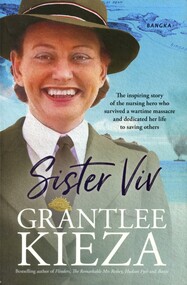
Book - Illustrated book, Grantlee Kieza, Sister Viv, 2024
... Also on front cover is a coloured photograph of a woman in Australian Army Uniform (Siter Vivian Bullwinkle) In the bakground ther is a map of Banka Island and a ship. Title and author's name are printed on front cover and spine. ...Also on front cover is a coloured photograph of a woman in Australian Army Uniform (Siter Vivian Bullwinkle) In the bakground ther is a map of Banka Island and a ship. Title and author's name are printed on front cover and spine. ...A biography about Vivivien Bullwinkel : the astonishing story of the courage, sacrifice and love of a young army nurse who became an Australian iconIllustrated book with light blue cover and black and white print. Also on front cover is a coloured photograph of a woman in Australian Army Uniform (Siter Vivian Bullwinkle) In the bakground ther is a map of Banka Island and a ship. Title and author's name are printed on front cover and spine. Summary of the book is printed on the back cover, along with a small photoraph and information about the author.non-fictionA biography about Vivivien Bullwinkel : the astonishing story of the courage, sacrifice and love of a young army nurse who became an Australian iconvivian bullwinkel, world war 1939-1945, prisoners of war -
 Bendigo Military Museum
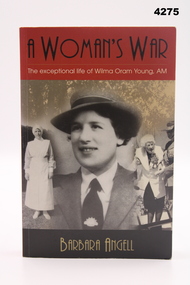
Book - BOOK, NURSES BIOGRAPHY, New Holland Publishers (Australia) PTY LTD, A Woman’s War, 2002
... Wilma Oram enlisted 0n 12.3 1941 age 24 years VFX58783 in the AANS, embarked for Singapore 2.9.1941, evacuated from Singapore on 12.2.1942 on the Vyner Brooke which was then sunk by the Japanese of Banka Island, they made it to shore on Banka Isl and taken POW for the duration of the War and finally arrived home in Australia on 24.10.1945....Wilma Oram enlisted 0n 12.3 1941 age 24 years VFX58783 in the AANS, embarked for Singapore 2.9.1941, evacuated from Singapore on 12.2.1942 on the Vyner Brooke which was then sunk by the Japanese of Banka Island, they made it to shore on Banka Isl and taken POW for the duration of the War and finally arrived home in Australia on 24.10.1945. books biography nurses pow’s ww2 Soft cover cardboard, black, white and gold print on front, spine and back, front cover has a collage of B & W photographs of Nurse Wilma Oram Young AM, red, black and gold background colours, 328 pages, white paper, illustrated with B & W photographs. ...Biography, the exceptional life of Wilma Oram Young AM, an Australian Nurse, a captive of the Japanese during WW2. After the War following her return to Australia she was inspired to help her fellow ex POW’s and war veterans through her tireless work with the RSL. Wilma Oram enlisted 0n 12.3 1941 age 24 years VFX58783 in the AANS, embarked for Singapore 2.9.1941, evacuated from Singapore on 12.2.1942 on the Vyner Brooke which was then sunk by the Japanese of Banka Island, they made it to shore on Banka Isl and taken POW for the duration of the War and finally arrived home in Australia on 24.10.1945.Soft cover cardboard, black, white and gold print on front, spine and back, front cover has a collage of B & W photographs of Nurse Wilma Oram Young AM, red, black and gold background colours, 328 pages, white paper, illustrated with B & W photographs.books, biography, nurses, pow’s, ww2 -
 Ballarat Heritage Services
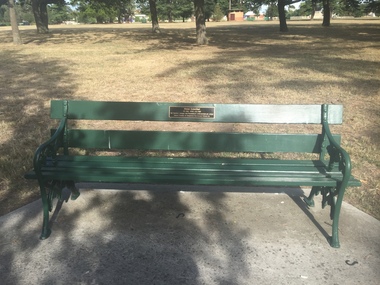
Photograph, Clare Gervasoni, Vivian Bullwinkel Memorial Seat in the Ballarat Gardens, 11/03/2017
... Vivian Bullwinkel, sole survivor of the 1942 Banka Island massacre. She began her nursing career in Hamilton, Victoria, before moving to the Jessie McPherson Hospital in Melbourne in 1940. ...Ballarat Heritage Services PO Box 2209 Bakery Hill Post Office goldfields Vivian Bullwinkel, sole survivor of the 1942 Banka Island massacre. She began her nursing career in Hamilton, Victoria, before moving to the Jessie McPherson Hospital in Melbourne in 1940. ...Vivian Bullwinkel, sole survivor of the 1942 Banka Island massacre. She began her nursing career in Hamilton, Victoria, before moving to the Jessie McPherson Hospital in Melbourne in 1940. She joined the Australian Army Nursing Service in September 1941 Seat in proximity to the Ballarat Prisoner of War MemorialVivian Bullwinkel, AO, MBE, ARRC, ED, FNM Her heroism, courage and humanitarian achievements are unique. Valued member of Soroptimist International Victoria Incvivian bullwinkel, memorial seat ballarat -
 Returned Nurses RSL Sub-branch
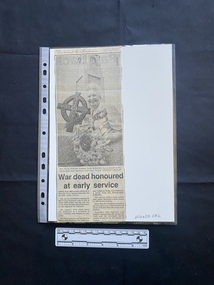
Newspaper - Newspaper clipping, [The West Australian], War dead honoured at early service, [18/4/88]
... The service included a requiem by Mrs Vivian Statham, the sole survivor of the Banka Island massacre....The service included a requiem by Mrs Vivian Statham, the sole survivor of the Banka Island massacre. Vivian Bullwinkel Japanese Sumatra Jack Howson Bicentennial Authority Don Ingersole ' "The West Australian ' 18/4/88 ' [blue ink, along top] A newspaper clipping of a large black and white photo of an older woman smiling and holding a memorial wreath in front of a clock tower, above two small columns of text. ...Melville Civic Square saw an early Anzac service on [17 April 1988], as the square's civic clock tower was dedicated as a memorial to local residents who fought for Australia. The service included a requiem by Mrs Vivian Statham, the sole survivor of the Banka Island massacre.A newspaper clipping of a large black and white photo of an older woman smiling and holding a memorial wreath in front of a clock tower, above two small columns of text.' "The West Australian ' 18/4/88 ' [blue ink, along top]vivian bullwinkel, japanese, sumatra, jack howson, bicentennial authority, don ingersole -
 Returned Nurses RSL Sub-branch
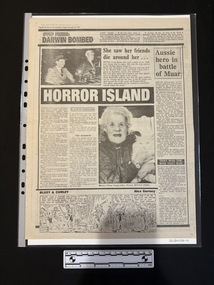
Newspaper - Newspaper clipping, The Sun, Horror island, Tuesday, November 28, 1989
... The only survivor of the Banka Island massacre, Vivian Bullwinkel (pictured), testified at the 1946 war crimes trial in Japan. ...The only survivor of the Banka Island massacre, Vivian Bullwinkel (pictured), testified at the 1946 war crimes trial in Japan. ...Story one - Horror Island The story retells the story of the Vyner Brooke bombing and the following massacre of twenty one nurses on a Banka Island beach. The Vyner Brooke was carrying almost 300 women, children and elderly men fleeing Singapore for Australia. On the ship were also 65 nurses from the 10th and 13th Australian General Hospital. A few days into their journey they were spotted by the Japanese and subsequently bombed, with three out of the 29 bombs dropped scoring direct hits. Only seventy people survived to make it to the nearby Banka Island. The smaller group, that included twenty two nurses, surrendered to the Japanese, who shot and bayoneted the men, then shot the nurses, with only one surviving. Wilma Young (pictured) was among the larger group who were luckier, only being taken prisoners. Story two - She saw her friends die around her... The only survivor of the Banka Island massacre, Vivian Bullwinkel (pictured), testified at the 1946 war crimes trial in Japan. Vivian gave evidence of the massacre, not for revenge, but for the sake of the twenty two nurses who died around her. A large folded newspaper page, folded to show, in the middle, a large title above the main story and associated black and photo, of an older woman holding a cat. At the top is a shorter, related story under a title, with a black and white photo of a woman in uniform, seated next to a man in uniform. wwii, ww2, world war two, pow, prisoner of war, wilma oram, empire star, british -
 Returned Nurses RSL Sub-branch
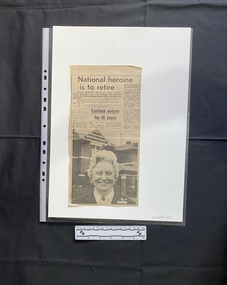
Newspaper - Newspaper clipping, National heroine is to retire, [1977]
... Vivian was the sole survivor of the [Banka Island Massacre], followed by three years as a prisoner of war (POW) in Sumatra and Banka Island. ...Vivian was the sole survivor of the [Banka Island Massacre], followed by three years as a prisoner of war (POW) in Sumatra and Banka Island. ...Vivian Bullwinkel (Mrs Frank Statham), matron of Fairfield Hospital since 1961, is to retire after sixteen years. Born in Kapunda, South Australia, Vivian did her training at the Broken Hill District Hospital from 1934-39, moving on to a private hospital in Hamilton, the Jessie McPherson Hospital, Melbourne, after graduation. She served with the 13th Australian General Hospital, Australian Imperial Force, from 1941 in Singapore and Johore Bahru, Malaysia. Vivian was the sole survivor of the [Banka Island Massacre], followed by three years as a prisoner of war (POW) in Sumatra and Banka Island. After the war Vivian was the matron of Heidelberg General Hospital from 1956-60. In 1963 she became trustee for the National War Memorial, Canberra, and was appointed deputy principal commandant of the Australian Red Cross Society.A newspaper clipping consisting of titles, four columns of text and a black and white photo of a middle aged woman outside a building.ww2, wwii, world war two, vivian st, vivian statham, perth, 13th agh, aif, army nurses, vyner brooke, banka strait, banka straits, florence night, florence nightingale medal -
 Alfred Hospital Nurses League - Nursing History Collection
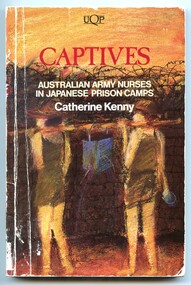
Book - Illustrated Book, Catherine Kenny 1962, Captives: Australian army nurses in Japanese prison camps, 1986
... Twelve drowned when the ship was sunk off the coast of Sumatra, a further 21 died in the Banka Island massacre, and another eight died in captivity...Twelve drowned when the ship was sunk off the coast of Sumatra, a further 21 died in the Banka Island massacre, and another eight died in captivity Of significance to AHNL as Alfred graduates were among the captives World War 1939-1945 Australian Army Nurses prisoners of War military nursing nurses Experiences of Australian Army nurses who were prisoners of the Japanese during World War two At the bottom left of the first page is a printed coloured donation sticker: AHNL logo, "This book was donated to AHNL Inc-Nursing Archives by" the Alfred Hospital Library 21/3/18 (handwritten in ink) The previous catalogue number is handwritten in ink at top right of this page. ...Experiences of Australian Army nurses who were prisoners of the Japanese during World War twoIllustrated book. Front cover has a painting by Cynthia Breusch depicting two female figures carrying a container hanging from a pole on their shoulders. Behind them is a barbwire topped fence. The book title is printed over this painting in red and white ink. The author's name is printed in white below the title, and the publisher's mark is printed in black above the title. The Spine is cream in colour, with abbreviated title printed in red, author's surname and publishers mark printed in black. The back cover has a cream background, with quotes from two nurses and a summary of the book overprinted in blacknon-fictionExperiences of Australian Army nurses who were prisoners of the Japanese during World War twoworld war 1939-1945, australian army nurses, prisoners of war, military nursing, nurses -
 Ballarat Base Hospital Trained Nurses League
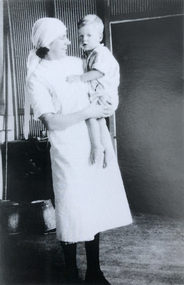
Beth Cuthbertson, commenced training 1929 - holding Jim Kinnersly, diphtheria patient BBH
... The Service was to remember all nurses who have served our country, and in particular Sr Beth Cuthbertson, WW11, who lost her life in the Banka Island Massacre. The 16th February is the anniversary of that Massacre which happened in 1942....The Service was to remember all nurses who have served our country, and in particular Sr Beth Cuthbertson, WW11, who lost her life in the Banka Island Massacre. The 16th February is the anniversary of that Massacre which happened in 1942. cuthbertson, 1929, 1930s, jim kinnersly, diphtheria, ww11, banka island Digital Copy Beth Cuthbertson, commenced training 1929 - holding Jim Kinnersly, diphtheria patient BBH ...Jim Kinnersly brought photo to Nurses Commemorative Service held at the Arch of Victory, Ballarat on Sunday, 16th February 2020. The Service was to remember all nurses who have served our country, and in particular Sr Beth Cuthbertson, WW11, who lost her life in the Banka Island Massacre. The 16th February is the anniversary of that Massacre which happened in 1942.Digital Copycuthbertson, 1929, 1930s, jim kinnersly, diphtheria, ww11, banka island -
 Dandenong/Cranbourne RSL Sub Branch
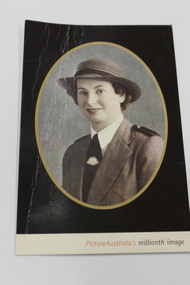
Photograph - Sepia phtograph/postcard, Unknown
... Vivian Bullwinkel, a Second World War army nursing sister, is best known as the sole survivor of the infamous Banka Island massacre, in which 21 of her colleagues were killed by Japanese troops. ...Dandenong/Cranbourne RSL Sub Branch 44 – 50 Clow Street Dandenong melbourne WWII historical significance Vivian Bullwinkel, a Second World War army nursing sister, is best known as the sole survivor of the infamous Banka Island massacre, in which 21 of her colleagues were killed by Japanese troops. ...WWII historical significancePortrait of Vivian Bullwinkel AO, MBE (1915 - 2000)Vivian Bullwinkel, a Second World War army nursing sister, is best known as the sole survivor of the infamous Banka Island massacre, in which 21 of her colleagues were killed by Japanese troops. Her courage while a prisoner pf the Japanese for over three and a half years exemplified the bravery of Australian women in war, and her distinguished postwar career was marked by many humanitarian achievements. -
 Returned Nurses RSL Sub-branch
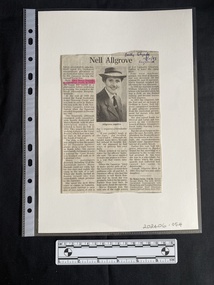
Newspaper - Newspaper clipping, [Daily Telegraph], Nell Allgrove, [10/11/93]
... The article details significant events in her life including: joining the Royal Australian Army Nursing Corps, surviving the sinking of the Vyner Brooke and becoming a Japanese POW; marrying and moving to Essex, England; her campaigning for adequate Australian pensions for nurses who had been interred; before returning to Banka Island for the unveiling of a memorial to the nurses who perished as a result of the Vyner Brooke sinking....The article details significant events in her life including: joining the Royal Australian Army Nursing Corps, surviving the sinking of the Vyner Brooke and becoming a Japanese POW; marrying and moving to Essex, England; her campaigning for adequate Australian pensions for nurses who had been interred; before returning to Banka Island for the unveiling of a memorial to the nurses who perished as a result of the Vyner Brooke sinking. ...This article is a biographical article about Nell (Ellen) Allgrove (nee Hannah) published after her death. The article details significant events in her life including: joining the Royal Australian Army Nursing Corps, surviving the sinking of the Vyner Brooke and becoming a Japanese POW; marrying and moving to Essex, England; her campaigning for adequate Australian pensions for nurses who had been interred; before returning to Banka Island for the unveiling of a memorial to the nurses who perished as a result of the Vyner Brooke sinking.A newspaper article clipped from a larger page with three columns of text and a centered black and white photo of a young woman in uniform.'Daily Telegraph / 10/11/93 / England' [blue ink top right of page]nell allgrove, ww2, wwll, nell hannah -
 Returned Nurses RSL Sub-branch
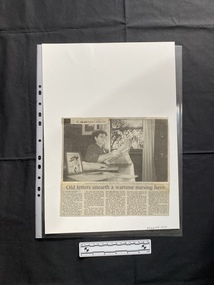
Newspaper - Newspaper clipping, The Age, Old letters unearth a wartime nursing hero, 1 January 1996
... Sally's aunt was Gwendoline Elmes, who died in the Banka Island massacre, shot by the Japanese. ...Sally's aunt was Gwendoline Elmes, who died in the Banka Island massacre, shot by the Japanese. ...Mrs Sally Alsop cherishes a treasure-trove of letters written by her aunt that she hopes will be collated into a book. Sally's aunt was Gwendoline Elmes, who died in the Banka Island massacre, shot by the Japanese. The Japanese had previously bombed and sunk the ship, Vyner Brooke, Gwen and 300 othe men, women, children and nurses were on, evacuating from Singapore. Sally gre up knowing little about her aunt, but when her mother became ill she heard about the letters and spent the night reading themA newspaper clipping of a large black and white photo with a title and five columns of text beneath. The photo shows a woman in glasses sitting in front of a window holding several sheets of paper'NC9' [blue ink, top left, sticky taped on]wwii, world war two, ww2, vivian bullwinkel, vivian statham (nee bullwinkel), banka strait, dorothy gwendoline elmes, bud, pacific war, sumatra, australian red cross -
 Returned Nurses RSL Sub-branch
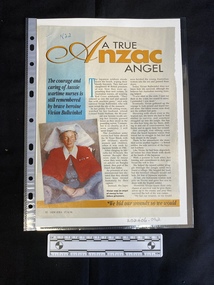
Newspaper - Newspaper clipping, New Idea, A true anzac angel, 27/4/96
... More than 50 years later Vivian is to return to Banka Island as and honoured guest of Indonesia, to chose the site of of a memorial to her dead comrades. ...More than 50 years later Vivian is to return to Banka Island as and honoured guest of Indonesia, to chose the site of of a memorial to her dead comrades. ...The article details the war time recollections of Vivian Bullwinkel, sole survivor of the Japanese massacre of Australian nurses in 1942. The Australian Army nurses, with 200 civilians, were aboard the SS Vyner Brook when the Japanese bombed and sank the ship. After ten hours, twenty four nurses survived to make it ashore on Banka Island. The Japanese took them prisoner and then proceeded to shoot them all, after first bayoneting forty Bristish prisoners. Vivian was shot in the side and pretended she was dead. Vivian credits her initial survival to the duty she felt to a fellow survivor of the massacre, a British man. They then had to make the decision that giving themselves up to the Japanese was their best chance of survival. After threes years as a POW Vivian had lost alot of weight and seen many die, but she had continued to care for those that were her patients. More than 50 years later Vivian is to return to Banka Island as and honoured guest of Indonesia, to chose the site of of a memorial to her dead comrades. Vivian avoids talking in detail about her POW experiences but she does have strong views on selling Australian land to Japanese investors. The Japanese government had recently apologised for the atrocities they committed, but Vivian believes the apology was not specific enough. The first page of a magazine article including two columns of text and a colour reproduction of a painting of a woman in nurse's uniform, page one of two'N22' [blue ink, top right]ww2, wwii, red cross, frank statham, dutch east indies, anzac day -
 Returned Nurses RSL Sub-branch
Magazine - Magazine clipping in two parts, New Idea, A true anzac angel, 27/4/96
... More than 50 years later Vivian is to return to Banka Island as and honoured guest of Indonesia, to chose the site of of a memorial to her dead comrades. ...More than 50 years later Vivian is to return to Banka Island as and honoured guest of Indonesia, to chose the site of of a memorial to her dead comrades. ...The article details the war time recollections of Vivian Bullwinkel, sole survivor of the Japanese massacre of Australian nurses in 1942. The Australian Army nurses, with 200 civilians, were aboard the SS Vyner Brook when the Japanese bombed and sank the ship. After ten hours, twenty four nurses survived to make it ashore on Banka Island. The Japanese took them prisoner and then proceeded to shoot them all, after first bayoneting forty Bristish prisoners. Vivian was shot in the side and pretended she was dead. Vivian credits her initial survival to the duty she felt to a fellow survivor of the massacre, a British man. They then had to make the decision that giving themselves up to the Japanese was their best chance of survival. After threes years as a POW Vivian had lost alot of weight and seen many die, but she had continued to care for those that were her patients. More than 50 years later Vivian is to return to Banka Island as and honoured guest of Indonesia, to chose the site of of a memorial to her dead comrades. Vivian avoids talking in detail about her POW experiences but she does have strong views on selling Australian land to Japanese investors. The Japanese government had recently apologised for the atrocities they committed, but Vivian believes the apology was not specific enough. First page of a magazine clipping consisting of a large title with two columns of text next to a colour reproduction of a painting of a nurse Second page of a magazine clipping consisting of three columns of text under a large colour photo of an older man and woman leaning into each other'N22' [blue ink, top left, first page]ww2, wwii, red cross, frank statham, dutch east indies, anzac day -
 Returned Nurses RSL Sub-branch
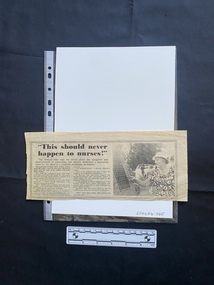
Newspaper - Newspaper clipping, Hamilton Spectator, "This should never happen to nurses!", Tuesday, November 7, 1978
... ...Banka...WWII World War 2 World War Two WW2 Vyner Brooke Banka Banka Island Vivien Bullwinkel Vivien Stratham Java Seas Japanese Woodhouse-Nareeb RSL sub-branch RSL Returned Services League A newspaper article with a title, two columns of text and a black and white photo of an older woman wearing service medals, gesturing to a memorial plaque. ...Sister Berry Jeffrey conducted the dedication for a new memorial cairn on the Hamilton-Chatsworth Rd. It was planned as a more lasting mark to the Second World War's fallen servicemen and women than a plantation of trees dedicated by Sister Jeffery in 1955. The recent dedication came 36 years after the horror which was the basis for her widely-read book, White Coolies. The book retold the stories of the nurses who died when their ship was strafed with aerial fire, then sunk, and how some surviving this were lined up on a beach and shot, while still others became POWs.A newspaper article with a title, two columns of text and a black and white photo of an older woman wearing service medals, gesturing to a memorial plaque.wwii, world war 2, world war two, ww2, vyner brooke, banka, banka island, vivien bullwinkel, vivien stratham, java seas, japanese, woodhouse-nareeb rsl sub-branch, rsl, returned services league -
 Melbourne Legacy
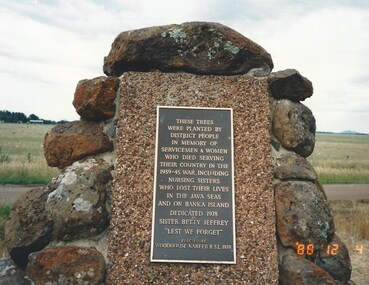
Photograph, Widow Daytrip, 1988
... The plaque says 'These trees were planted by district people in memory of servicemen and women who died serving their country in the 1939-45 war, including nursing sisters who lost their lives in the java seas and on Banka Island. Dedicated 1978, Sister Jeffery 'Lest We Forget'. ...The plaque says 'These trees were planted by district people in memory of servicemen and women who died serving their country in the 1939-45 war, including nursing sisters who lost their lives in the java seas and on Banka Island. Dedicated 1978, Sister Jeffery 'Lest We Forget'. ...An outing by the widows club to visit a memorial to servicemen and women from the Woodhouse-Nareeb area. The photos show a group of ladies who attended and the plaques and memorial board. The plaque says 'These trees were planted by district people in memory of servicemen and women who died serving their country in the 1939-45 war, including nursing sisters who lost their lives in the java seas and on Banka Island. Dedicated 1978, Sister Jeffery 'Lest We Forget'. The memorial board says 'World War 2 Soldier Settlement Woodhouse-Nareeb area. The settlers served with Navies, Armies, and Air Forces of the British Commonwealth, many of their wives served with the Womens' Auxillaries and nursing services.'A record of the types of activities Legacy provided as a physical and social outlet for widows.Colour photo x 5 of an outing to a memorial in 1988.Photos are marked as 4 December 1988.widows, widows outing, memorial, daytrip -
 Returned Nurses RSL Sub-branch
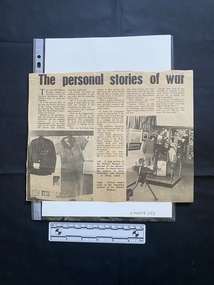
Newspaper - Newspaper clipping, [Weekender], The personal stories of war, October 26, 1972
... After coming ashore Sister Bullwinkel joined a group of other nurses, only to become the sole survivor of the Banka Island massacre, when she feigned death after being machine gunned down with the other nurses by the Japanese. ...After coming ashore Sister Bullwinkel joined a group of other nurses, only to become the sole survivor of the Banka Island massacre, when she feigned death after being machine gunned down with the other nurses by the Japanese. ...The Swan Hill Military Museum, unique in Australia, if not the Southern Hemisphere tells a different story to most war museums. Every item has a personal story story with it. Included in the area especially set aside for members of the women's services are the uniforms of Sisters Vivian Bullwinkel and Veronica Clancy, both of which have very interesting stories to tell. Both nurses survived the sinking of the Vyner Brooke, by Japanese bombs. Sister Clancy was able to make it ashore on a raft using her uniform as a sail. After coming ashore Sister Bullwinkel joined a group of other nurses, only to become the sole survivor of the Banka Island massacre, when she feigned death after being machine gunned down with the other nurses by the Japanese. A large newspaper clipping consisting of five columns of text and two black and white photos. The first photo shows a display of a military jacket with medals and a nurse's uniform, while the second photo shows a man and a woman looking at a military display.'WWII' [blue ink, top, right of centre] '26-10.72' [blue ink, top right corner]crimean war, sudan war, boer war, world war 1, world war one, wwi, ww1, world war 2, wwii, ww2, korean war, vietnam war, pioneer settlement, general sir william birdwood, anzac, gallipoli, pow -
 Returned Nurses RSL Sub-branch
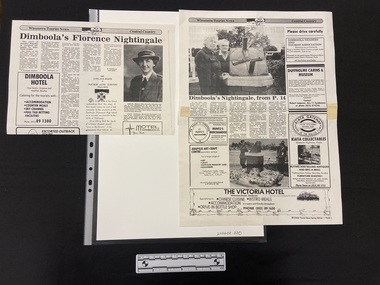
Newspaper - Photocopy of newspaper clipping, Wimmera Tourist News, Dimboola's Florence Nightingale, Spring edition, year unknown
... Despite their attempts to steer the raft towards Banka Island where the other nurses landed, the current pulled them out to sea. ...Despite their attempts to steer the raft towards Banka Island where the other nurses landed, the current pulled them out to sea. ...The story of Dorothy Paschke and the memorial built in honour of her service and sacrifice in the Second World War. Matron Paschke was aboard the Vyner Brooke ship when it was bombed. She made it on to a small raft with seven other nurses and some civillians. Despite their attempts to steer the raft towards Banka Island where the other nurses landed, the current pulled them out to sea. After eighteen hours, Dorothy and three others slid into the water to paddle alongside, in the hopes it would lighten the load and help them reach shore. The current pulled Dorothy further out to sea and she was not seen again. A memorial sundial has been built in her honour and stands at the Dimboola Memorial High School.Two pages of photocopies of black and white newspaper pages. The first page is a copy of half a page. The second page is a copy of a full page printed on two sheets of paper taped together. Publication details printed across the top of both pages. The half page contains five columns of text and on the right is a portrait of Matron Paschke, to the left of the image is another image of the first page of a memorial book in her honour. (The page also contains unrelated advertisements). The second page continues the story with five columns of text in the middle of the page, above and below the text are photographs from the unveiling ceremony of the memorial sundial built in her honour. (Below and around the article are seven unrelated advertisements.)australian army nurses, wwii, ww2, world war 1939-1945, olive dorothy paschke, olive dorothy paschke memorial, vyner brooke -
 Returned Nurses RSL Sub-branch
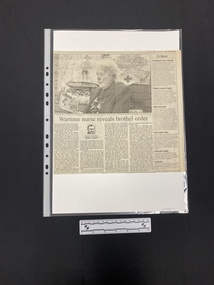
Newspaper - Newspaper clipping, The Age, Wartime nurse reveals brothel order, Saturday 12 August 1995
... Of the 65 nurses who fled from Singapore on the Vyner Brooke in February 1942, 54 made it to Banka Island after the ship was bombed, with 21 being massacred on a beach. ...Of the 65 nurses who fled from Singapore on the Vyner Brooke in February 1942, 54 made it to Banka Island after the ship was bombed, with 21 being massacred on a beach. ...Main story Mrs Wilma Young (nee Oram) is speaking for the first time publicly about certain happenings during World War Two, when she and other Australian Nurses were held as POWs in Sumatra. Of the 65 nurses who fled from Singapore on the Vyner Brooke in February 1942, 54 made it to Banka Island after the ship was bombed, with 21 being massacred on a beach. Over the next three years the remaining nurses were imprisonesd by the Japanese in a series of camps in Sumatra and on Banka Island, before being liberated. The group of surviving nurses had not spoken of certain events publicly before, but at 78 Mrs Wilma Young has decided to. The Japanese tried to force the nurses into participating in a makeshift brothel, or 'club' as the Japanese called it. The instructions were for four nurses to go to the 'club', but instead 28 went. They made themselves as horrible as they could, and made use of their time there by stealing sugar, toilet paper and anything else they could. Eventually four women were pressured into staying behind, but they were able to hold out against the Japanese. Eventually the Japanese gave up on this idea. The Japanese' treatment of the the nurses, as well as the other women and children in the camp was brutal. Punishments could include being made to stand out in the punishing sun for hours without a hat, or being slapped on each side of the face, hard enough to be knocked over. The daily food rations consisted of a cup of rice, sometimes supplemented palm oil, rotten vegetables or similar. Daily work for the nurses included caring for the sick prisoners, rarely with medicinal aid. In brief stories do not appear relevantA large newspaper clipping consisting of a large black and white photo with a story of four columns of text underneath, with a column of brief stories to the right. The black and photo features an older woman looking at a photo of a young woman in uniform. The story is written by John Lahey.wwii, ww2, 13th australian general hospital, major gideon jacobs, royal marines, indonesians, dutch -
 Returned Nurses RSL Sub-branch
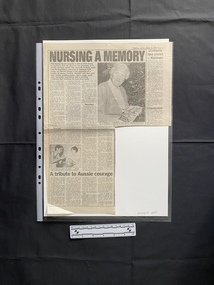
Newspaper - Newspaper clipping, Herald Sun, 'Nursing a memory' ' A tribute to Aussie courage', 19911026
... Nursing a memory Several of the nurse survivors of the Banka Straits tragedy share their stories and personal recollections of the war. ...Nursing a memory Several of the nurse survivors of the Banka Straits tragedy share their stories and personal recollections of the war. ...Nursing a memory Several of the nurse survivors of the Banka Straits tragedy share their stories and personal recollections of the war. Some nurses wrote books, some talk about staying optimistic while being prisoners of war (POW), others say they've never stopped being stunned by the war years. Fifty years after the Banka Straits tragedy and the years the POWs spent in camps in Sumatra, the poignancy has not been dulled, and has been etched into the memories of the nurses who survived. Betty Jeffery, now in her 80's, says that despite the hardships she faced, it change her life for the better. When the ship, the SS Vyner Brooke, was bombed she was in the water for seventy hours. In the POW camps they slept on concrete floors and starved as food was allowed to rot just out of reach. The nurses that endured so much together have stayed in touch. Betty has also written a highly successful book, 'White Coolies', based on diaries of her experience. Of all the nurses Vivian Bullwinkel is the most celebrated, her story being one of ultimate survival. One of a group of about 100 survivors after the sinking of the SS Vyner Brooke, she and the others thought the Japanese wouldn't kill such a large number when they surrendered to them. The soldiers were bayonetted, the nurses and civilians were lined up in the sea and shot. Vivian played dead. A tribute to Aussie courage A brief recounting of the sinking of the SS Vyner Brooke and the survivors' three and a half years as prisoners of war (POW) of the Japanese. Of the sixty-five who attempted to evacuate Singapore on the SS Vyner Brooke, twenty-four made it home to Australia. A memorial to the brave Australian nurses has been organised to ensure their contribution is remembered forever.A large newspaper clipping consisting of two stories with titles and four columns of text each. The larger story also has two black and white photos, on of an older woman holding a book, and the other of two young women leaning in toward each otherww2, wwii, world war two, vivian statham, 13th agh, aif, vyner brooke, florence nightingale medal, muntok, malacca, iole harper, australian army nurses, katong, perth, red cross, heidelberg repatriation hospital, fairfield hospital, wilma oram, 13th australian general hospital, murtoa, warrnambool, singapore, johore baru, wilma young, cardinia, jessie simons, in japanese hands - australian nurses as pows, jessie hookaway, tasmania, british, singapore harbour, banka island, empire star, prisoner of war, palembang, sumatra, malay, dutch, ex-prisoners of war association of australia, sir edward 'weary' dunlop, jenny greer, ahs wanganella -
 Returned Nurses RSL Sub-branch
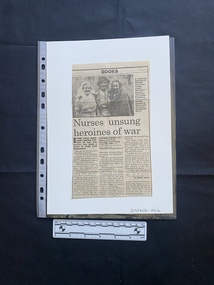
Newspaper - Newspaper clipping, Judith White, Nurses unsung heroines of war, [1988]
... Another was Sister Anderson, who was tending wounded on deck aboard the Empire Star and threw herself over a Digger to protect him from strafing as they were escaping from the fall of Singapore. Or the Banka Island massacre. Twenty three nurses were ordered to march into the sea and were shot dead. ...Another was Sister Anderson, who was tending wounded on deck aboard the Empire Star and threw herself over a Digger to protect him from strafing as they were escaping from the fall of Singapore. Or the Banka Island massacre. Twenty three nurses were ordered to march into the sea and were shot dead. ...Our war heroines have always received less attention than their male counterparts, but Dr Rupert Goodman is helping to set the record straight, with the first book to give a comprehensive history of Australia's war nurses. Among those commemorated in the book are the nurses killed or died in action in World War II. Dr Goodman says one of the most outstanding episodes was the sinking of the hospital ship, the Centaur, off Brisbane by a Japanese sub. Of 11 sisters, one survived, Sister Savage and she kept up the morale of the survivors in shark-infested waters for 24 hours. Another was Sister Anderson, who was tending wounded on deck aboard the Empire Star and threw herself over a Digger to protect him from strafing as they were escaping from the fall of Singapore. Or the Banka Island massacre. Twenty three nurses were ordered to march into the sea and were shot dead. Only one survived, Sister Vivian Bullwinkel, after feigning death, she returned to shore tended to a wounded solider, then was captured and became a POW.A newspaper clipping of three columns of text with a black and white photo above of three women, two obviously in nurse's uniformwwii, ww2, world war two, our war nurses - the history of the royal australian army nursing corps 1902-1988, george medal, banker island, edith cavell, world war 1, world war one, ww1, wwi, war memorial, canberra -
 Bendigo Military Museum
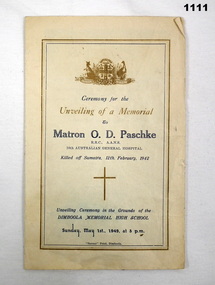
Memorabilia - NURSE MEMORIAL, 1.5.1949
... She with many other Nurses during the bombing left on the ill fated "Vyner Brooke" which was later bombed by the Japanese in the Sundra Straits near Banka Island. Abandoning the ship she and 5 other Nurses drifted away on a raft and never seen again on 14.2.42. ...She with many other Nurses during the bombing left on the ill fated "Vyner Brooke" which was later bombed by the Japanese in the Sundra Straits near Banka Island. Abandoning the ship she and 5 other Nurses drifted away on a raft and never seen again on 14.2.42. ...Matron (Major) Olive Dorothy PASCHKE No VX38812 enlisted in the AAMC on 3.8.40 age 35 years. Promoted to Matron 8.1.1941, posted to 10th AGH on 11.1.1941, embarked for Malaya 3.2.1941 disembarking 18.2.1941, awarded the RRC 1st Class 1.1.1942 in the New Years Honors list signed by Gordon Bennett, detached to 2/4th CCS on 6.1.1942, embarked from Singapore 12.2.1942 for Australia. She was serving in Singapore when the Japanese invaded. She with many other Nurses during the bombing left on the ill fated "Vyner Brooke" which was later bombed by the Japanese in the Sundra Straits near Banka Island. Abandoning the ship she and 5 other Nurses drifted away on a raft and never seen again on 14.2.42. Many others became POW,s, drowned or murdered by the Japanese. Her records state believed killed on or after 11.2.142 dated 8.6.1944 then Now reported missing and for official purposes presumed dead, dated 11.4.1945. Records state she was granted the promotion of Major in 1943. CCS (Casualty Clearing Station) RRC ( Royal Red Cross) AGH (Australian General Hospital)Five page "order of service" re the unveiling of a memorial to "Matron O.D. Paschke RRC AANS 10th Australian General hospital." at the Dimboola Memorial High school." A sepia tone photo of O.D Paschke is stapled inside the order of service." printing is in blue & Brown. Front page has the Australian coat of arms at the top.documents - pamphlets, religon - christian, paschke, pow -
 Returned Nurses RSL Sub-branch
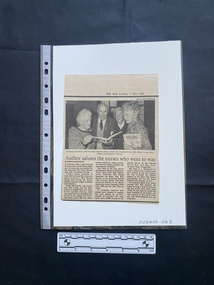
Newspaper - Newspaper clipping, The Age, Author salutes the nurses who went to war, Tuesday 17 May 1988
... ...Banka...WWII WW2 World War Two Our War Nurses - The History of the Royal Australian Army Nursing Corps 1902-1988 World War 2 World War One World War 1 WW1 WWI Korea Vietnam Margaret Anderson Wilma Oram Vyner Brooke Empire Star Banka Banka Island Pacific POW Prisoner of war Returned Nurses Club Anzac House A newspaper clipping of three columns of text beneath a large black and white photo of three older women and an older man looking at an open book between them. ...Dr Rupert Goodman has spent three years writing his book, 'Our War Nurses', as a "memorial to some of those brave women who have helped in our war years". The book traces the history of the Royal Australian Army Nursing Crorps from 1902 and the Boer War to today. Dr Goodman met with three of the women who inspired the book, Wilma Young, Betty jeffrey and Margaret O'Bryan. In Februrary 142, a ship ferrying 65 Australian nurses from Singapore to Australia was bombed by the Japanese. Twelve nurses drowned, 21 were shot and the rest were taken prisoner.A newspaper clipping of three columns of text beneath a large black and white photo of three older women and an older man looking at an open book between them.wwii, ww2, world war two, our war nurses - the history of the royal australian army nursing corps 1902-1988, world war 2, world war one, world war 1, ww1, wwi, korea, vietnam, margaret anderson, wilma oram, vyner brooke, empire star, banka, banka island, pacific, pow, prisoner of war, returned nurses club, anzac house -
 Returned Nurses RSL Sub-branch
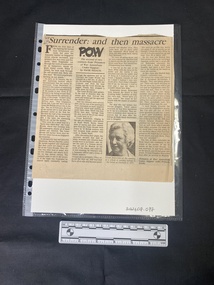
Newspaper - Newspaper clipping, Hank Nelson, Surrender: and then massacre, 26/4/[1985]
... Sister Vivian Bullwinkel, clinging to the side of a lifeboat, came ashore on Radji Beach, Banka Island. She became one of a group of twenty-two nurse, other Vyner Brooke passengers and twenty British soldier from another bombed ship. ...Sister Vivian Bullwinkel, clinging to the side of a lifeboat, came ashore on Radji Beach, Banka Island. She became one of a group of twenty-two nurse, other Vyner Brooke passengers and twenty British soldier from another bombed ship. ...The newspaper clipping is the second of two extract from 'Prisoners of War: Australians Under Nippon', by Hank Nelson. The extract touches on the conditions the nurses serving in Singapore experienced, moving into the eventual evacuation. The first nurses were evacuated on February 10, [1942], with half of the remainder the following day, and the final nurses were evacuated February 13. These sixty-five nurses were aboard the Vyner Brooke with 300 other passengers, mostly women and children. The ship was spotted and bombed the next day. Sister Vivian Bullwinkel, clinging to the side of a lifeboat, came ashore on Radji Beach, Banka Island. She became one of a group of twenty-two nurse, other Vyner Brooke passengers and twenty British soldier from another bombed ship. This group decided to surrender to the Japanese, who proceeded to kill all but one British soldier and Vivian Bullwinkel. After holding out for ten days the pair made their way to Muntok, hiding the evidence they had both survived a massacre. Of the sixty-five nurses to board the Vyner Brooke, twelve had drowned, twenty-one had been killed on the beach and thirty-two became prisoners of war (POW).A newspaper clipping consisting of four large columns of text and a small black and white photo of an older woman (head).'A[G]E / 26/4'[blue ink, top left]world war 2, wwii, ww2, world war ii, olive dorothy paschke, vyner brooke, vivian bullwinkel, sumatra, palembang, jean ashton, betty jeffrey, wah sui, empire star, micky syer, banka strait, private kingsley, cecil kingsley, 10th australian general hospital -
 Returned Nurses RSL Sub-branch
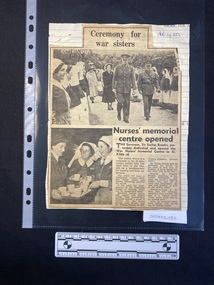
Newspaper - Newspaper clippings, The Argus, 'Ceremony for war sisters: Nurses' memorial centre opened' [front of page], 'Nurses' memorial centre opened' [back of page], 20 Feb 1950
... May 1943, the Australian hospital ship, the Centaur, was torpedoed by the Japanese, resulting in 299 dead, eleven of them nurses, and only 64 survivors. Also the Banka massacre, where 22 nurses were shot by the Japanese, after surviving the sinking of their ship. ...May 1943, the Australian hospital ship, the Centaur, was torpedoed by the Japanese, resulting in 299 dead, eleven of them nurses, and only 64 survivors. Also the Banka massacre, where 22 nurses were shot by the Japanese, after surviving the sinking of their ship. ...Front page - Governor, Sir Dallas Brooks, opens the War Nurses' Memorial Centre on St Kilda Road. The centre is a memorial to the 75 Australian nurses who lost their lives in the war. The centre will offer various rooms for use and house the the headquarters of the Australian College of Nursing. General Sir Thomas Blamey, chairman of the Centre Committee said there was hardly a fighting soldier who had not at some time experienced the care and devotion to duty of the service sisters. Back page - Left hand clipping - About 500 people, including more than 100 service and civilian nurses attended the ceremony that opened the War Nurses Memorial Centre. The centre is a refurbished and converted house. The crowd also included former POWs and relatives of the 75 nursing sisters who lost their lives in the 1939-45 war. Dr Garnet Leary gave 100 pounds towards the establishment of a nurses' library in the centre. Back page - Right hand clippings - top - The author heard a service broadcasted from St Paul's Cathedral and felt overwhelming gratitude towards nurses. bottom - After the dedication of the War Nurses Memorial Centre, the author was reminded of two instances of senseless loss of nurses' live during the war. May 1943, the Australian hospital ship, the Centaur, was torpedoed by the Japanese, resulting in 299 dead, eleven of them nurses, and only 64 survivors. Also the Banka massacre, where 22 nurses were shot by the Japanese, after surviving the sinking of their ship. Only one nurse survived the massacre. Three newspaper clippings have been glued to either side of a lined sheet of paper. Front of page - A newspaper clipping of two black and white photos and a short story in two columns. the larger photo is of two men in military uniform walking through women in nurses uniforms lined up on either side of a path. The smaller photo is of three women, all wearing nurse's uniforms, one woman holding a tray with cups. Back of page -Two newspaper clippings have been glued to a lined sheet of paper. The left hand clipping consists of a large black and white photo of a crowd of people and nurses outside a nice house, and a column of text. The right hand clipping is of two separate paragraphs of text, both appear to be letters to the editor.'Feb 19 50.' [blue ink, front of page, top right]melbourne, wwii, ww2, st kilda road, muriel violet turner laing, thomas blamey, annie moriah sage, muriel brooks, queensland, vivian bullwinkel, heidelberg military hospital -
 Returned Nurses RSL Sub-branch
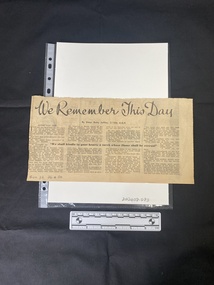
Newspaper - Newspaper clipping, Betty Jeffrey (1908-2000), We remember this day, Wednesday, April 26, 1950
... Later, on the beach of Banka Island, a group of twenty-one surviving nurses were kllled by the Japanese with only one survivor. ...Later, on the beach of Banka Island, a group of twenty-one surviving nurses were kllled by the Japanese with only one survivor. ...An anniversary commemoration written by Sister Betty Jeffrey, 2/10th Australian General Hospital (AGH). Five years have passed since the end of the war, but it still feels like yesterday that Betty's hospital unit, who nursed in Malaya and Singapore was complete. Betty remembers the outstanding personality of Matron O. D. Paschke, RRC, particularly how she made the frightening leap from the deck of the sinking evacuation so much easier for her nurses. Matron Paschke was one of twelve nurses lost at sea that day. Later, on the beach of Banka Island, a group of twenty-one surviving nurses were kllled by the Japanese with only one survivor. Of the nurses who were taken prisoner of war (POW), of which Betty was also one, eight more died when the end of the war was almost in sight. Betty also remembers the tragedy of losing twelve members of the Australian Army Nursing Service (AANS) in the sinking of the hospital ship, Centaur, again with only one nurse surviving. On Anzac Day members of the Navy, Army and Air Force will gather at the Edith Cavell Memorial, where a service is read in memory of Nurse Edith Cavell and the women who lost their lives in the two world wars. Betty remembers the courage of her fellow POW nurses, particularly when they knew they were dying. Christmas 1943, in the POW camp, Betty recieved a card made from a scrounged page, hand decorated. The sister who gave her the card later died a week before the war ended. The simple short Anzac services for the women who lost their lives will always remind Betty of the only service the sisters could face holding in the POW camp, in 1943.A newspaper clipping with a large title and four columns of text beneath'Sun p2 26.4.50'[graphite pencil, bottom left]world war 2, wwii, ww2, world war ii, olive dorothy paschke, vyner brooke, vivian bullwinkel, sumatra, palembang, jean ashton -
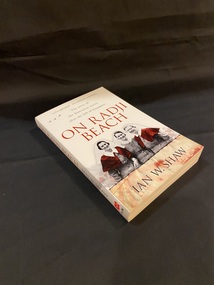 Returned Nurses RSL Sub-branch
Book - Paperback book, Ian W. Shaw, On Radji Beach: the story of the Australian nurses after the fall of Singapore, 2012
... Those who survived drifted for up to three days before making landfall on one of the many beaches on Banka Island. A group of survivors, including 22 nurses, gathered at Radji Beach. ...When Singapore fell dramatically to the Japanese on 15 February 1942, hundreds of people scrambled to leave. Amongst the evacuees were 65 Australian nurses. They boarded a coastal freighter named the Vyner Brooke, which was sunk by the Japanese. Miraculously, there was one survivor, Vivian Bullwinkel who, in spite of a bullet wound, endured 13 days in the jungle before surrendering to another Japanese patrol. On 12 February 1942, Singapore was just days away from its fall to the Japanese. As the city burned, hundreds of desperate people scrambled to the docks to flee. Amongst them were 65 Australian Army nurses, who boarded a coastal freighter, the Vyner Brooke. But theirs was a doomed voyage. Japanese bombers attacked and sank the vessel off Sumatra. Those who survived drifted for up to three days before making landfall on one of the many beaches on Banka Island. A group of survivors, including 22 nurses, gathered at Radji Beach. They voted to surrender, but the Japanese patrol that found them divided them into three groups and the executions began. In the last group were the Australian nurses, who died in a hail of bullets as they walked, abreast, into the sea. Miraculously, there was one survivor, Vivian Bullwinkel, who in spite of a bullet wound endured 13 days in the jungle before surrendering to another Japanese patrol. She was reunited with the other surviving Vyner Brooke nurses in a makeshift camp on the island. Three-and-a-half years later, only 24 made it home. Meticulously researched from the diaries and papers of some of the nurses who survived, this is a moving account of the fate of every nurse who boarded the Vyner Brooke that day. [From Trove]Paperback book with a white cover and the title printed in red. The cover shows three Australian nurses standing together.non-fictionWhen Singapore fell dramatically to the Japanese on 15 February 1942, hundreds of people scrambled to leave. Amongst the evacuees were 65 Australian nurses. They boarded a coastal freighter named the Vyner Brooke, which was sunk by the Japanese. Miraculously, there was one survivor, Vivian Bullwinkel who, in spite of a bullet wound, endured 13 days in the jungle before surrendering to another Japanese patrol. On 12 February 1942, Singapore was just days away from its fall to the Japanese. As the city burned, hundreds of desperate people scrambled to the docks to flee. Amongst them were 65 Australian Army nurses, who boarded a coastal freighter, the Vyner Brooke. But theirs was a doomed voyage. Japanese bombers attacked and sank the vessel off Sumatra. Those who survived drifted for up to three days before making landfall on one of the many beaches on Banka Island. A group of survivors, including 22 nurses, gathered at Radji Beach. They voted to surrender, but the Japanese patrol that found them divided them into three groups and the executions began. In the last group were the Australian nurses, who died in a hail of bullets as they walked, abreast, into the sea. Miraculously, there was one survivor, Vivian Bullwinkel, who in spite of a bullet wound endured 13 days in the jungle before surrendering to another Japanese patrol. She was reunited with the other surviving Vyner Brooke nurses in a makeshift camp on the island. Three-and-a-half years later, only 24 made it home. Meticulously researched from the diaries and papers of some of the nurses who survived, this is a moving account of the fate of every nurse who boarded the Vyner Brooke that day. [From Trove]australian nurses, singapore, prisoners of war, world war two, wwii, world war 2, vivian bullwinkel
