
Showing 12 items matching "bateman’s fire"
-
 Flagstaff Hill Maritime Museum and Village
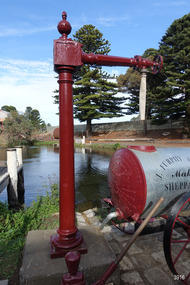
Functional object - Water standpipe, Langlands Bros. & Co, 1880-1893
... ...Bateman’s fire...The town experienced a huge, destructive fire in William Bateman Jnr. & Co.’s large produce store in November 1856, which highlighted the need for both a fire brigade and a good supply of water. ...The town experienced a huge, destructive fire in William Bateman Jnr. & Co.’s large produce store in November 1856, which highlighted the need for both a fire brigade and a good supply of water. ...This water standpipe is believed to be the only one of its kind in working order. It was originally located in Warrnambool, on the hillside at the corner of Mickle Crescent and Banyan Street, providing water for the Chinese Market Gardens below, on the flats. It was removed from this location on May 2nd, 1979, with the intention to relocate it at the new Flagstaff Hill Maritime Museum & Village. The standpipe lay in storage for years until the Warrnambool Company, Chemblast, offered to restore it for use as a working display. The display was officially opened on March 31, 2014. The water from the adjacent lake is drawn out with a hand operated water pump, and goes up into the standpipe, where flows through the canvas hose and into the top of the Furphy Farm Water Cart. The display is a visual acknowledgement of the years served by Flagstaff Hill volunteer and Friends of Flagstaff Hill Chairperson, Bob Crossman. Warrnambool’s early settlers had no water supply prior to the mid-1850s. They relied on rain water tanks, domestic wells and springs. The town experienced a huge, destructive fire in William Bateman Jnr. & Co.’s large produce store in November 1856, which highlighted the need for both a fire brigade and a good supply of water. In 1863 a volunteer fire brigade was established. In August 1880 the town celebrated the installation of its first water standpipe on the corner of Liebig and Timor streets. The water was pumped from springs at Cannon Hill through the connected pipeline to the standpipe, then distributed to households via horse and cart. Each of the licenced cart drivers were compelled by Council regulations to keep their carts full from sunset to sunrise, ready to cart water to outbreaks of fire. They received a fee for this service. In 1893 the town installed a water supply, sourced from the Merri River, stored in a reservoir basin and tower in north Liebig Street, and distributed throughout the town in a system of pipes. By late 1939 a reticulated supply was installed, with the water piped in under the Otway Scheme. Standpipes are still used in modern times in rural and remote areas for homes, farms, stock, agriculture and firefighting. Many commercial or government owned standpipes are metered, charging a fee for the quantities of water supplied. This water standpipe was made by Langlands Foundry Co. Limited, Melbourne, which was establish in 1842. It was Melbourne’s first foundry and iron shipbuilder, and one of the largest employers in Victoria at the time. Langlands was known for its high quality workmanship and wide range of goods for mining, engineering, marine, railway and other industrial uses. The company made the first cast bell, the first lamp posts in the colony, and the boiler for the first Australian train. In the 1860s it produced cast iron pipes for the Board of Works, which laid the pipes for Melbourne’s first reticulated water supply. The firm was bought by Austral Otis Co. in 1897.This water standpipe is significant historically as it is believed to be the only one of its type in working condition. The standpipe is significant for being manufactured by early colonial firm Langlands Foundry of Melbourne, which was known for high quality, cast iron products. The firm made the boiler for the first Australian train, assembled the first Australian paddle steamer and made the first Australian cast bell and lamp posts. Langlands was one of the largest employers in Victoria at the time. The standpipe is significant historically as it represents the evolution of water supply services in Australia. Standpipe; vertical cast iron water pipe, painted crimson, fixed in position, tapering inward from the round base to the rectangular joint near the finial on top. A hexagonal pipe extends at right angles from the joint, with an outlet fitting and flow-controlling wheel on the end. A length of canvas hose hangs from the outlet fitting. Inscriptions are on one face of the joint. The standpipe was made by Langlands Foundry Company of Melbourne. Embossed “LANGLANDS FOUNDRY CO. / LIMITED / ENGINEERS / MELBOURNE”warrnambool, flagstaff hill maritime museum, maritime museum, shipwreck coast, flagstaff hill maritime village, great ocean road, flagstaff hill, standpipe, stand-pipe, water standpipe, fire standpipe, firefighting equipment, water supply equipment, chinese market gardens, banyan street, liebig street, water tower, bateman’s fire, working display, water supply, town water, rural water, reticulated water, cannon hill spring, merri river, otway water, water carters, horse and cart water supply, volunteer fire brigade, langlands foundry, early melbourne, iron works, bob crossman, late 19th century water supply -
 Warrnambool and District Historical Society Inc.
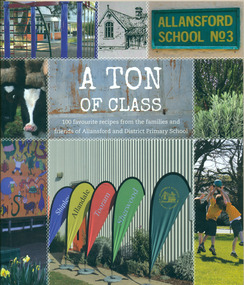
Book, A Ton of Class: 100 favourite recipes from the families and friends of Allansford and District Primary School, 2014
... In an attempt to recoup some of the heavy losses due to the disastrous Bateman fire of 1854 John subdivided a portion of Tooram at the Hopkins River crossing known as Allans ford. ...In an attempt to recoup some of the heavy losses due to the disastrous Bateman fire of 1854 John subdivided a portion of Tooram at the Hopkins River crossing known as Allans ford. ...This cookery book was produced in 2014 as a school fundraiser. It was purchased at Allansford Cheese World in January 2015 for $15. Allansford school was established as a National School in 1856 on land reserved for the purpose by John McMahon Allan. It comprised two sandstone classrooms -one for boys and one for girls -with an attached pise teacher's residence. In 1872 when the Victorian Education Department was set up existing schools were listed in alphabetical order and given a number. Allansford State School was No.3. The school was enlarged in the late 1800s and again in the early 1920s. In 1994 following the amalgamation of the Allansford, Allans Forest and Naringal schools a new school was built which adjoined the existing buildings. The old buildings were refurbished as administration and staff facilities. John McMahon Allan settled in the area in 1839 with his brother William Osborne Allan. They were the sons of David Allan, Deputy Commissary General during Macquarie's term of government. The brothers divided the station with William retaining the Allandale portion and John naming his portion Tooram. John McMahon Allan was president of the early district Roads Board. In an attempt to recoup some of the heavy losses due to the disastrous Bateman fire of 1854 John subdivided a portion of Tooram at the Hopkins River crossing known as Allans ford. A school reserve was included in this subdivision. Source: McLeod, Graeme & Barbara. Allansford 1855-2006This book has social and historical interest and significance as it is connected to a local school. It provides a snapshot of food and cooking methods in the early 21st cebturyCookery book with full colour cover featuring 8 photographs and drawings of the Allansford Primary School surrounds and pupil activities. The images are 'stitched' together with a white zig-zag diamond pattern as if a quilt. The foldout cover has an image of the school's centenary memorial gates and a brief history of the school. Inside the foldout are images of the pupils in each of the school's four team houses. The foldout back cover has full colour images of pupils performing at the school concert. A white strip noting 'our values' is included on the inside back cover foldout. Soft cover, 112 pages.allansford school, a ton of class, allansford primary school, a ton of class recipe book -
 Mission to Seafarers Victoria
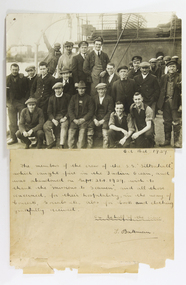
Photograph - Photograph and letter, attached, T. Bateman, The members of the crew S.S. Siltonhall 1929, 16/10/1929
... fire...bateman.... / The members of the crew of the SS Siltonhall, / which caught fire in the Indian Ocean, and / was abandoned on Sept 21st 1929, wish to / thank the 'Missions to Seamen', and all those / concerned, for their hospitality, in the way of / Concerts, Socials, etc., also for boots and clothing / gratefully received. / On behalf of the crew. T. Bateman...The picture was possibly taken in a nautical context, perhaps at the docks or on board a ship. photograph letter 1929 siltonhall ship crew mission seafarers wreck fire bateman melbourne australia shipwreck reverend howard s. bailey j. bateman "Oct 16th 1929. / The members of the crew of the SS Siltonhall, / which caught fire in the Indian Ocean, and / was abandoned on Sept 21st 1929, wish to / thank the 'Missions to Seamen', and all those / concerned, for their hospitality, in the way of / Concerts, Socials, etc., also for boots and clothing / gratefully received. / On behalf of the crew. ...This letter was written by a representative of the crew of the SS Siltonhall to the Mission to Seafarers in Oct 1929. Their ship caught fire in the Indian Ocean and were rescued by the SS Anthea. The crew was sent to Melbourne and spent some time at the Mission. Article in the Argus, Tuesday 15 October 1929, page 6 "THE SILTONHALL'S SEAMEN. TO THE EDITOR OF THE ARGUS Sir, the story of the disaster to the s.s. Siltonhall is still fresh in the public mind. The ship caught fire and she was abandoned and sank in the Indian Ocean. The crew took to the boats and were rescued and brought safely in to Melbourne. They have been with us now for nearly a week now, taking full advantage of the hospitality of the Mission to Seamen Institute.So far they have been provided with the bare necessities of one complete suit of clothing by the shipping authorities. They leave here to return home to England on Wednesday. If anyone will kindly contribute any articles of clothing or boots they will be most acceptable, especially as the men will be going to a cooler climate. Please send them to me. Yours Sincerily, HOWARD S. BAILEY, Chaplain, Missions to Seamen, Australian Wharf, Oct. 14."This letter and photograph indicate the valuable service that the Mission to Seafarers provides to crews of ships wrecked off the Australian coast. The smiling crew of the S.S. Siltonhall evidently appreciated that when they were in desperate need they were cared for. The picture was possibly taken in a nautical context, perhaps at the docks or on board a ship.B/W photograph of group of 22 men. Letter signed T. Bateman from crew of the SS Siltonhall dated Oct. 16th 1929. "Oct 16th 1929. / The members of the crew of the SS Siltonhall, / which caught fire in the Indian Ocean, and / was abandoned on Sept 21st 1929, wish to / thank the 'Missions to Seamen', and all those / concerned, for their hospitality, in the way of / Concerts, Socials, etc., also for boots and clothing / gratefully received. / On behalf of the crew. T. Bateman." photograph, letter, 1929, siltonhall, ship, crew, mission, seafarers, wreck, fire, bateman, melbourne, australia, shipwreck, reverend howard s. bailey, j. bateman -
 Federation University Historical Collection
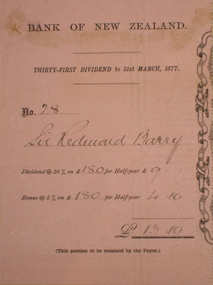
Print - Scrapbook, Ballarat School of Mines Invoice Scrapbook, 1875-1879, 1875-1879
... Bateman and Clarke, National bank of Aust., James Lory, F. Atkins 27/7/1876 - account from H. Hunt - Builder 26/7/1876 - account to G. Leitch and co. 1/8/1876 - receipt to The National Insurance Co. of Aust., Ltd. 1/8/1876 - receipt from Victoria Fire and Marine Insurance Company 1/8/1876 - account to The Victoria Lime and Cement Co. 1/8/1876 - receipt from Ballarat Gas Company 1/8/1876 - account from Charles J. ...Bateman and Clarke, National bank of Aust., James Lory, F. Atkins 27/7/1876 - account from H. Hunt - Builder 26/7/1876 - account to G. Leitch and co. 1/8/1876 - receipt to The National Insurance Co. of Aust., Ltd. 1/8/1876 - receipt from Victoria Fire and Marine Insurance Company 1/8/1876 - account to The Victoria Lime and Cement Co. 1/8/1876 - receipt from Ballarat Gas Company 1/8/1876 - account from Charles J. ...Quarter leather bound scrap book with pasted in invoices which were sent to the Ballarat School of Mines.Ballarat School of Mines Invoice Scrapbook, with many invoices made out to the Ballarat School of Mines stuck into the book (most folded over). * 01/12/1875 - 31/12/1875 - Annual account of all sums of Money for subscriptions to the Ballarat School of Mines * 31/12/1875 - Charles J. Evans - printer * 1875 - William Gooch - for Argus newspaper * 13/01/1876 - M.D. Hamilton - salary payment * 14/01/1876 - receipt for two shillings and sixpence from M.D. Hamilton * 31/1/1876 - account to R.J. Vale * 1/2/1876 - Caxton printing works - account to James Curtis * 4/12/1876 - Ballarat Gas company - receipt from J.W.Robertson * 29/1/1876 - Permewan Hunt and company - account to Hon. W.H.Barnard *28/1/1876 - Osborn, Cushing and company - account to Hon. W.H.Barnard * 7/10/1875 - Geo. H. Bliss and company - account to Hon.N.H. Barnard * 31/12/1875 - I. Longstaff - Druggist * 1875 - A. M. Leirnan * 9/12/1876 - Petty cash - M. Hamilton * 15/12/1875 - reimbursement to W.D. Barnard * 31/1/1876 - "Ballarat Star" newspaper account - Rob Wreford * 12/4/1876 - Geelong Gas company - receipt for 2 pounds and ten shillings - A.B. Langlands * 27/1/1876 - Geelong Gas company - account to School of Mines * 1/2/1876 - Cornell and King - Chemists - account to School of Mines * 10/2/1876 - Salary payment slip to M.D. Hamilton for 8 pounds 6 shillings and 8 pence * January 1876 - Stansfield and Robson, Importers - account to School of Mines * January 1876 - Stansfield and Robson - School of Mines - Dr. A.M.Leisman - account * 31/1/1876 - Charles J. Evans - account to School of Mines * 31/1/1876 - Proprietors of the Evening Post - account to School of Mines * 10/2/1876 - Petty cash receipt from W. Barnard * 1/2/1876 - Bateman, Clark and Company - account to School of Mines * 8/3/1876 - Salary payment to M.D. Hamilton from School of Mines Ballarat *1/3/1876 - William Johnson - Chemist - account to School of Mines Ballarat * 28/2/1876 - Cornell and King - Chemists - account to School of Mines Ballarat * 2/1876 - Hugh Gray and Son - Instrument makers - account from School of Mines * 28/2/1876 - J. Longstaff - druggist * 11/3/1876 - Fidelity Guarantee of Alfred B.Burne for 100 pounds from Victoria Life Insurance Co. *10/3/1876 - Petty cash slip from W.H. Barnard * 4/3/1876 - account from Alfred B. Burne * 15/3/1876 - personal expenses account from I.W. Jonan * 27/3/1876 - account from John Victor * 25/3/1876 - account from C.W. Thomas * 27/3/1876 - account from W. Schmidt - Lecturer * 25/3/1876 - account from Joseph Flude * 29/6/1876 - account from J. Thomas * 30/6/1876 - receipt from W.M. Barnard * 1/4/1876 - receipt from Joseph Flude * 1/3/1876 - account from William Blomeley, Iron and Brass Founder * 31/3/1876 - account from A.H. King, Iron Merchant * 31/3/1876 - account from W.M. Gooch, Newsagent * 13/4/1876 - salary payment to M.D. Hamilton * 12/4/1876 - Petty cash receipt * 13/4/1876 - List of subscriptions received from Alfred B. Burne (collector) (John P. Hanson, Comm. Bank of Aust., T.A. Wanliss, Andrew Cant, B. Hepburn, R. Lewis, Sovereign Hill Mining Co., Buninyong Shire Council, Union Bank Aust. Francis Taylor) * 15/2/1876 - account from Battersea Works London * 2/5/1876 - account from Charles J. Evans Lithographic Printer etc. * 11/5/1876 - salary slip to M.D. Hamilton * 30/4/1876 - subscriptions received from Alfred B. Bruce (M.P. Whiteside, S. Steele, J. Usher, Charles Walker, W.H. Bougghen, W.V. Jenkins, A.M. Gransfield, Hon. Henry Cuthbert, Aust. Bank, Borough Council, Thomas Bath, Rev. William Henderson, James Smith, S. Hamburger) * 30/4/1876 - account from The Ballarat Star Newspaper * 7/6/1876 - account from Ballarat Gas Company * 11/5/1876 - petty cash account from M.J. Barnard * 9/5/1876 - receipt from M.D. Hamilton * 6/5/1876 - account from M.D. Barnard * 4/1876 - account from W.M. Gooch - News and Advertising agents * 22/4/1876 - account from Broadbent Bros and Co. - Railway Carriers etc * 1/6/1876 - account from Bateman, Clark, and Co. * 31/5/1876 - account from J. Longstaff - Druggist * 16/2/1876 account from A.M. Leiman * 6/1876 - account from R.T. Vale - Newsagent * 31/5/1876 - receipt from Sir Redmond Barry for one shilling * 1/6/1876 - account from F.W. Niven - Stationer etc. * 31/5/1876 - account to The Ballarat Star and The Miner newspapers * 31/5/1876 - account from Stansfield and Robson, Importers * 31/5/1876 - account from The Evening Post * 8/6/1876 - Salary slip fro M.D. Hamilton * 1/6/1876 - account to J. McHutchison, Bookbinder * 1/6/1876 - account from A.H. King - Iron Merchant * 1/6/1876 - account from Cornell and King - Chemists * 31/5/1876 - account from W.M. Gooch - Advertising agent * 8/6/1876 - petty cash receipt from M.D. Barnard * 31/5/1876 - List of subscriptions from Alfred B. Bruce (T.J. Kerr, Jacob Showman, J.L. Thompson, W.J. Clarke, R.C. Baih, L. Ballhausen, James Coghlan, Parade Gold mining Co., A. Williams, Sung Hung Fat, A. Dimmock Esq.M.D., Bank Victoria, Reform Co., Gilbert, James Ward, James Stewart, Ian Kwong Yick 7/6/1876 - account to Alfred White - Custom House Agent 30/6/1876 - receipt from John Victor for twelve pounds 10 shillings 29/7/1876 - receipt from A.M. Barnard 26/6/1876 - receipt from Joseph Flude 4/6/1876 - receipt from E.S. Schmidt 22/6/1876 - receipt from John W. Tail 19/6/1876 - receipt from Jonathan Butterworth 3/7/1876 - receipt from Joseph Hurde 1/7/1876 - account from Henry Richards Caselli - Architect and Building Surveyor 30/6/1876 - account from J. Scovell - Cabinet Maker 14/7/1876 - account from H.R. Caselli - Architect and Building Surveyor 20/7/1876 - payslip to M.D. Hamilton 1/7/1876 - account from Henry Brind - Chemist 6/1876 - account from W.M. Gooch - News and Advertising Agent 21/7/1876 - account from W.D. Hamilton 26/6/1876 - account from Parkinson and co. - City Nightmen and van proprietors 19/7/1876 - petty cash receipt from M.D.Barnard 30/6/1876 - account of subscriptions received - J.A. Anderson, A. Anderson, John Osborne, J. Noble Wilson, Bateman and Clarke, National bank of Aust., James Lory, F. Atkins 27/7/1876 - account from H. Hunt - Builder 26/7/1876 - account to G. Leitch and co. 1/8/1876 - receipt to The National Insurance Co. of Aust., Ltd. 1/8/1876 - receipt from Victoria Fire and Marine Insurance Company 1/8/1876 - account to The Victoria Lime and Cement Co. 1/8/1876 - receipt from Ballarat Gas Company 1/8/1876 - account from Charles J. Evans, Printer 1/8/1876 - account from Cornell and King - Druggists and Chemists 8/8/1876 account from Cornell and King - Druggists and Chemists 5/6/1876 to 22/9/1876 - account to A.N. Lennan 11/8/1876 - receipt from W.D. Hamilton 16/9/1876 - receipt from Geelong Gas Company 7/8/1876 - account to the Geelong Gas Company 1/8/1876 - account to Bateman, Clark and Co. 31/7/1876 - account from The Ballarat Star and of The Miner 10/8/1876 - salary slip to M.D. Hamilton 1/7/1876 to 31/7/1876 - list of subscriptions from Alfred B. Burne - P. Channey, P. Pakenhagen, John Price, Ballarat Gas Co., L.E. Brann, A.H. King, M. O"Ferrall, John Foord 19/7/1876 to 10/8/1876 - Petty cash receipt from M.N. Barnard 7/ 1876 - account to W. M. Gooch - General News and Advertising agent 1/7/1876 - account to Stansfield and Robson - Importers in Oils, colours, window glass, etc. 17/8/1876 - account to Lermes Lamurk 4/8/1876 - account to James Allen "Camperdown Chronicle" general printing office from W.H. Barnard 6/9/1876 - account to Henry Masham 1/9/1876 - account to A.H. King - Iron Merchant, Furnishing and General Ironmonger 22/9/1876 - travelling expenses account from R.D. Ellery 25/9/1876 - receipt from M. Schmidt 15/9/1876 - receipt from M.D. Hamilton 1/9/1876 - account to James Curtis - Caxton Printing Works 25/8/1876 - account from William McCulloch and Co., General Carriers 18/8/1876 - account to G. Leitch and Co. 14/9/1876 - payment slip to M.D. Hamilton 10/8/1876 - petty cash account from M.H. Barnard 25/9/1876 - receipt from John Victor 25/9/1876? - receipt from M.H.Barnard 6/10/1876 - receipt from Joseph Fude 12/10/1876 - receipt from M.D. Hamilton 30/9/1876 - receipt from Joseph Fude 1/10/1876 - account to A.M. Lennan 12/10/1876 - salary slip to M.D. Hamilton 30/9/1876 - account from Ballarat Star Newspaper Office 12/10/1876 - petty cash account - M.H. Barnard 30/9/1876 - account to J. McHutchison - Bookbinder 1/8/1876 - account from Ballarat Gas Company 1/11/1876 - receipt from Ballarat Gas Company 1/11/1876 - account to Charles J. Evans - Lithographic Printer 1/11/1876 - account from Cornell and King - Chemists 9/1876 - account from W.M. Gooch - General news and advertising agent 10/1876 - account from J. and J. McDonald - Plumbers and gas fitters 13/10/1876 to 9/11/1876 - petty cash statement from M.H. Barnard 14/11/1876 - receipt from M.D. Hamilton 11/9/1876 - account from A.M. Lennan 9/11/1876 - Salary slip to M.D. Hamilton 12/10/1876 - Expenses account received by M.H. Barnard 1/11/1876 - account from J. Longstaff - Druggist 10/1876 - account from Parkinson and Co. - City Nightmen and van proprietors 6/12/1876 - account from Emanuel Steinfield, Importer of Furniture etc. 13/11/1876 - account The Geelong Gas Company 31/11/1876 - account from The Ballarat Star Newspaper office 28/11/1876 - account from R.T. Vale - bookseller, stationer and news agent 28/11/1876 - acount from John Slater and co. 1/12/1876 - account from J. Doig and co., Tinsmiths, Gasfitters etc. 14/12/1876 - Salary slip to M.D. Hamilton 14/12/1876 - receipt from M.D. Hamilton for one pound one shilling and ninepence 1/11/1876 to 31/12/1876 - petty cash statement 15/12/1876 - statement of travelling expenses for A.B. Barnes 23/12/1876 - receipt from John Victor 21/2/1877 - receipt from C.M.Thomas 23/12/1876 - receipt from Joseph Flude 29/12/1876 - receipt from Lecturer - S.Schmidt 30/12/1876 - receipt from Joseph Flude 1876 - receipt from Joseph Flude 12/1/1877 - statement of refund to W.H. Barnard 11/1/1877 - Salary slip to M.D.Hamilton 8/1/1877 - petty cash statement 18/1/1877 - receipt for Ballarat Gas company 2/1/1877 - account from Eyres Brothers - Furnishing and general ironmongers 19/12/1876 - statement from W.H. Barnard - registrar 1/1/1877 - account from Bateman, Clark and company 11/121876 - account from Parkinson and co. - City nightmen 31/12/1876 - account from Ballarat Star Newspaper office 25/1/1877 - account from J. McHutchison, Bookbinder 3/2/1877 - account from J. McHutchison, Bookbinder 1/2/1877 - account from Cornell and King - Chemists 1/2/1877 - account from Stansfield J. Robson - Importers in oils, colours, window glass etc. 1/2/1877 - account from Charles J. Evans - Bookbinder etc. 12/12/1876 - account from W. Gooch - General news and advertising agent 2/1/1877 - account from proprietors of the Evening Post 14/2/1877 - account from John F.Paten - Printer, Publisher and Bookseller "Avoca Mail" 2/2/1877 - account from T. Longstaff - wholesale and retail druggist 8/81877 - salary slip for M.D. Hamilton 21/1/1877 - account from Ballarat Star Newspaper office 9/2/1877 - account for petty cash from W.H. Barnard 7/2/1877 - account from S.C. Steele - Ballarat Fine Art Gallery 13/2/1877 account from R.T. Vale - Bookseller, Stationer and News Agent 8/2/1877 - account from Joseph Flude 13/1/1877 - account from William Johnson, Chemist 9/1877 - account to J. Flude from William Johnson, Chemist, 3 accounts 2/11/1876 to 23/1/1877 - account from A.N. Leiman 1/3/1877 - account from Bateman, Clark and company 8/3/1877 - salaray payment to M.D. Hamilton 8/3/1877 - salary payment to J. Ashley 9/3/1877 - statement from Post Office Ballarat (one shilling - for the first years rent of telegraph line on school premises) 1/2/1877 - statement from Mining and commercial stationer - J.W. Niven Dec.1876 to 15/2/1877 - account from R.T. Vale - Bookseller, Stationer, and News agent 1/1877 - statement from C.W. Thomas 8/3/1877 - petty cash account from W.H. Barnard 9/3/1877 - account from R. Gibbings - Livery and Letting Stables and carriage repository 28/2/1877 - account from Charles J. Evans - Stationer, Lithographic printer etc. 9/3/1877 - receipt from M.D. Hamilton 31/3/1877 - account from Ballarat Star and The Miner 2/1877 - receipt from Joseph Flude 8/3/1877 - receipt from F.J. Ashley 28/3/1877 salary statement from John Victor 28/4/1877 - salary statement from John A. Sharp 28/3/1877 - receipt from Joseph Flude 26/3/1877 - receipt from T.Schmidt - Lecturer 12/3/1877 - receipt from C.H. Walker 6/4/1877 - account from Mr. Ellery 27/4/1877 - account from A. M. Leiman 31/3/1877 - account from W.M. Gooch, General news and advertising agent 6/3/1877 - statement from London Remittances 12/4/1877 - salary payment to M.D. Hamilton 1877 - receipt from W.H. Barnard 1/4/1877 - account from Parkinson and company, City nightmen and van proprietors 5/4/1877 - account from William McCulloch and company, General carriers 11/4/1877 - account from S. Steele, Draper 31/3/1877 - account from Charles J. Evans, Stationer etc. 1/4/1877 - account from James Curtis - Caxton Printing Works 4/1877 - receipt from W.H. Barnard 8/3/1877 to 12/4/1877 - petty cash receipt from W.H.Barnard 12/4/1877 - receipt from C. Flude 31/3/1877 - receipt for Sir Redmond Barry for 13 pounds 10 shillings 1/1877 - receipt from Alphonse Ausaldie 1/3/1877 - 30/4/1877 - account from Joseph Flude 9/5/1877 - account from Henry Costin - Machinery Merchant 31/1/1877 to 3/5/1877 - Ballarat Gas Company 13/6/1877 - receipt to Ballarat Gas Company 9/5/1877 - salary slip to M.D. Hamilton 11/5/1877 - account for stationary from C. Flude, Registrar 23/3/1877 - account from Edmund Donelly 1/5/1877 - account from Charles J. Evans, Stationer etc. 9/4/1877 - account from W.M. Gooch, News and advertising agent 30/4/1877 - account from The Ballarat Star and The Miner 13/4/1877 - account from T. Longstaff, wholesale and retail druggist 30/4/1877 - account from Echuca railway station 1/5/1877 - account from Cornell and King, Chemists 11/5/1877 - salaray slip for C. Flude 11/5/1877 - petty cash account to the Registrar, W.H. Barnard 2/5/1877 - account from William McCulloch and co.,general carriers 5/1877 - account from William Willis and co. Locksmiths etc. 1/5/1877 - account from Joseph Flude 6/6/1877 - account from Henry Morham 31/5/1877 - account from Charles J. Evans, Stationer and Printer etc. 14/6/1877 - salary payment to M.D. Hamilton 15/6/1877 - salary payment to C. Flude 15/6/1877 - receipt from M.D. Hamilton 1/6/1877 - account from James Curtis, Caxton Printing Works 31/1/1877 - Ballarat Gas company account 23/8/1877 - receipt from Ballarat Gas company 15/6/1877 - receipt from The National Insurance Company of Aust., Ballarat Branch 1/6/1877 - account from The Ballarat Courier 3/1877 - receipt from L.M. Cook 1/6/1877 - account from J.McHutchison, Bookbinder 10/5/1877 to 14/6/1877 - petty cash account 17/5/1877 - account from William McCulloch and co., general carriers 15/6/1877 - account from T. Longstaff, Wholesale and retail Druggist 1/5/1877 - account from H. Hunt, Builder 4/1877 - receipt from John Victor 3/7/1877 - receipt from J.Alex Sharp 15/6/1877 - receipt from Sir Redmond Barry to Revenue and Pay Office 26/6/1877 - receipt from M. Shaw, Lecturer 25/6/1877 - receipt from Joseph Flude 23/6/1877 - receipt from S.Schmidt 6/1877 - account from W.M. Gooch, general news and advertising agent for Argus newspapers 6/1877 - account from the Proprietors of the Evening Post 21/6/1877 - account from John F. Paten, "Avoca Mail" and general printing office 14/6/1877 - account from Ballarat Star and The Miner Newspaper office 30/6/1877 - account from Ballarat Star Newspaper office 2/7/1877 - account from R.T. Vale, News Agent 19/6/1877 account for railway fare and personal expenses 23/5/1877 - account from William Johnson, Chemist 1/7/1877 - account from Henry Brind, Chemist and Family Pharmacist 2/7/1877 - account from Cornell and King, Druggists and Chemists 12/7/1877 - salary slip to M.D. Hamilton 14/7/1877 - salary slip to C. Flude 14/6/1877 - 12/7/1877 petty cash account from W.H. Barnard 16/6/1877 - account from William McMulloch and Co., general carriers 1/7/187 - account from Parkinson and Co., City Nightmen and Van Proprietors 1/6/1877 to 30/6/1877 - account from Joseph Flude 1/8/1877 - receipt to Victoria Fire and Marine Insurance Company 21/7/1877 - account to Brush and Drummond, Importers and Manufacturing Jewellers 11/7/1877 - account from Charles J. Evans, Printer etc. 31/7/1877 - account from The Ballarat Star Newspaper Office 1/8/1877 - account from James Curtis, Caxton Printing Works 7/71877 - account from W.M. Gooch, Advertising Agent 7/1877 - account from Hugh Gray and Son, Mechanists and Philosophical Instrument Makers 13/8/1877 - account from Ballarat Gas Company redmond barry, joseph flude, hall of commerce, george crocker, ballarat star, the miner, bank of new zealand, daniel brophy, james curtis, caxton printing works, mcdonald plumbers and gas fitters, mcvitty and co, j. mchutchison, bookbinder, niven, john warrington rogers, henry bland, rivett henry bland, telegraphy, ellery, r.t. vale, richard vale, w. johnson analytical chemist st kilda, judge warrington rogers, art gallery of ballarat, henry richards caselli, h. hunt, ballarat school of mines botanical gardens, henry caselli, charles flude, ballarat star news, john armstrong -
 Flagstaff Hill Maritime Museum and Village
Currency - Token, 1850's
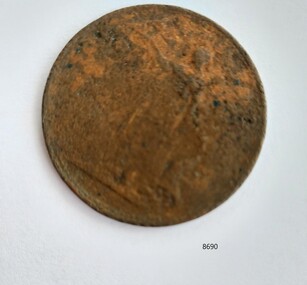
... In November 1856 the store belonging to William Bateman Jnr & Co. was destroyed by fire and caused a great number of insolvencies in the district as many businessmen and farmers were financed by Bateman....In November 1856 the store belonging to William Bateman Jnr & Co. was destroyed by fire and caused a great number of insolvencies in the district as many businessmen and farmers were financed by Bateman. ...For around a decade or so in the Gold Rush period in Australia there was a shortage of official government currency. It was acceptable during this time to use token coins minted by local businesses to be used within their store, much like the loyalty and rewards cards that businesses give their customers in modern times. The tokens were also a good way to advertise their wares and details. The first token was introduced in Melbourne in 1848 and were used until 1868, when they became illegal in New South Wales. They were minted in Australia and overseas. This is a Warrnambool Bateman penny token. It is an example of an Australian token – a coin that had the value of a penny and was produced by businessmen in the 1850s to be used only in the business of the person named on the coin. There were two firms in Warrnambool that produced tokens in the 1850s – William Jamieson, a general storekeeper and William Bateman. The latter had a general store in Banyan Street in the early 1850's and became one of the largest merchant firms in the Warrnambool district. In November 1856 the store belonging to William Bateman Jnr & Co. was destroyed by fire and caused a great number of insolvencies in the district as many businessmen and farmers were financed by Bateman.This token is a significant example of the business practices of merchants in the early days of the colony and is connected to a well-known member of Warrnambool's early town history. It is comparatively rare because many Bateman tokens were destroyed in the 1856 fire.A round metal coin token associated with the Warrnambool business owned by William Bateman in the 1850's. It has a weathered figure on one side and writing (also quite weathered) on the other side.Around edge - IMPORTERS AND GENERAL MERCHANTS 185? Inside circle - WILLIAM BATEMAN JUNR & CO WARRNAMBOOL Across center - VICTORIAflagstaff hill maritime museum and village, warrnambool, great ocean road, shipwreck coast, penny token, william bateman, william bateman jnr &co, bateman general store, bateman token, bateman penny token, token coin, token -
 Warrnambool and District Historical Society Inc.
Numismatic, Token coin of WW Jamieson. Issued in W'bool 1862, 1862
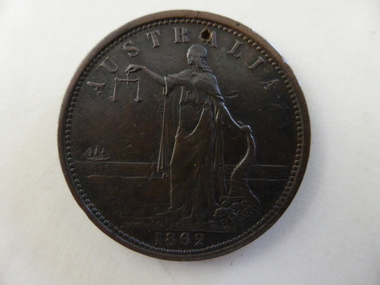
... Bateman, Junior. Born in Scotland, William Wilson Jamieson completed an apprenticeship in the ironmongery trade in that country. He worked in the ironmongery business in Melbourne before establishing ironmongery stores in Koroit and Warrnambool (Liebig Street). He was a Warrnambool Councillor (1862 to1874 & 1877 to1880) and Mayor (1866 to 1868 & 1872 to 1873). He was active in many local organizations including the Warrnambool Hospital, the Fire...Bateman, Junior. Born in Scotland, William Wilson Jamieson completed an apprenticeship in the ironmongery trade in that country. He worked in the ironmongery business in Melbourne before establishing ironmongery stores in Koroit and Warrnambool (Liebig Street). He was a Warrnambool Councillor (1862 to1874 & 1877 to1880) and Mayor (1866 to 1868 & 1872 to 1873). He was active in many local organizations including the Warrnambool Hospital, the Fire ...This is a token made for William Jamieson of Warrnambool in 1862. Tokens were coins made in the mid 1850s to alleviate the shortage of currency coins in Australia. They usually had the value of one penny and could only be used in the store or business designated on the coin. Two Warrnambool businesses had tokens made – those of William Jamieson and William Bateman, Junior. Born in Scotland, William Wilson Jamieson completed an apprenticeship in the ironmongery trade in that country. He worked in the ironmongery business in Melbourne before establishing ironmongery stores in Koroit and Warrnambool (Liebig Street). He was a Warrnambool Councillor (1862 to1874 & 1877 to1880) and Mayor (1866 to 1868 & 1872 to 1873). He was active in many local organizations including the Warrnambool Hospital, the Fire Brigade, the Mechanics Institute, the Villiers Building Society, the Bowling Club and the Caledonian Society. He died in 1882. This token is of great importance as it is an Australian token issued by William Jamieson and Co. of Warrnambool and so is part of the fiscal history of Australia. It is also important as it comes from one of only two businesses in Warrnambool to issue tokens. It is today a rare token. This is a round metal coin (token) with, on one side, an image of a woman holding the scales of justice in one hand and a cornucopia in the other. The other side has lettering. There is a small dent on one side of the token. Side One: ‘Australia 1862’ Side Two: ‘Liebeg Street W.W. Jamieson & Co. Storekeepers Warrnambool’ (N.B. Note the Warrnambool 1860s spelling of ‘Liebig Street’) william jamieson, australian tokens, history of warrnambool -
 Warrnambool and District Historical Society Inc.
Coin - Token, Bateman token, 1855
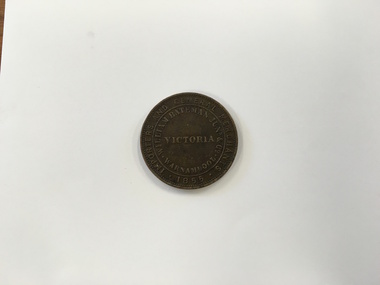
... Bateman. The latter had a general store in Banyan Street and became in the early 1850s one of the largest merchant firms in the Warrnambool district. But the firm’s liabilities were financed by overdrafts and insolvency resulted. A disastrous and suspicious fire...It is a Bateman token and these are comparatively rare because many Bateman tokens were destroyed in the 1856 fire. william bateman junior warrnambool tokens bateman token coin tokens One side: Woman image and the word ‘Australia’ Obverse side: ‘William Bateman Junr. & Co., Importers and General Merchants, Warnambool (sic), Victoria, 1855’ This is an 1855 metal token with, on one side, an image of a woman holding scales in one hand and a cornucopia in the other (Dea Pecunia?). ...This coin is a Warrnambool Bateman penny. It is an example of an Australian token – a coin that had the value of a penny and was produced by businessmen in the 1850s to be used only in the business of the person named on the coin. There were two firms in Warrnambool that produced tokens in the 1850s – William Jamieson, a general storekeeper and William Bateman. The latter had a general store in Banyan Street and became in the early 1850s one of the largest merchant firms in the Warrnambool district. But the firm’s liabilities were financed by overdrafts and insolvency resulted. A disastrous and suspicious fire in 1856 destroyed the Bateman store and caused a great number of insolvencies in the district as so many businessmen and farmers were financed by Bateman who eventually left the district. This token is of supreme importance. It is significant for three reasons: 1. It is an example of an 1850s Australian token, demonstrating an early business practice in our history. 2. It is an example of a Warrnambool token produced by an important Warrnambool business (only two firms in Warrnambool produced tokens) 3. It is a Bateman token and these are comparatively rare because many Bateman tokens were destroyed in the 1856 fire. This is an 1855 metal token with, on one side, an image of a woman holding scales in one hand and a cornucopia in the other (Dea Pecunia?). The obverse side has the name of William Bateman Junior of Warrnambool. It is a business token which could be used only in the Bateman store in Warrnambool in place of a penny.One side: Woman image and the word ‘Australia’ Obverse side: ‘William Bateman Junr. & Co., Importers and General Merchants, Warnambool (sic), Victoria, 1855’ william bateman junior, warrnambool tokens, bateman token, coin tokens -
 Warrnambool and District Historical Society Inc.
Token, W Jamieson, 1862
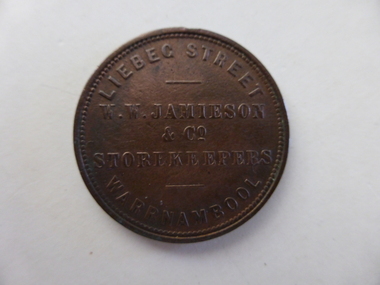
... Bateman Junior. Born in Scotland, William Wilson Jamieson completed an apprenticeship in the ironmongery trade in that country. He worked in the ironmongery business in Melbourne before establishing ironmongery stores in Koroit and Warrnambool (Liebig Street) in the late 1850s. He was a Warrnambool Councillor (1862 to 1874 & 1877 to 1880 and was Mayor (1866 to 1868 & 1872 to 1873). He was active in many local organizations, including the Warrnambool Hospital, the Fire...Bateman Junior. Born in Scotland, William Wilson Jamieson completed an apprenticeship in the ironmongery trade in that country. He worked in the ironmongery business in Melbourne before establishing ironmongery stores in Koroit and Warrnambool (Liebig Street) in the late 1850s. He was a Warrnambool Councillor (1862 to 1874 & 1877 to 1880 and was Mayor (1866 to 1868 & 1872 to 1873). He was active in many local organizations, including the Warrnambool Hospital, the Fire ...This is a token made for William Jamieson of Warrnambool in 1862. Tokens were coins made in the 19th century to alleviate the shortage of currency coins in Australia. They usually had a value of one penny and could only be used in the store or business designated on the coin. Two Warrnambool businesses had tokens made – those of William Jamieson and William Bateman Junior. Born in Scotland, William Wilson Jamieson completed an apprenticeship in the ironmongery trade in that country. He worked in the ironmongery business in Melbourne before establishing ironmongery stores in Koroit and Warrnambool (Liebig Street) in the late 1850s. He was a Warrnambool Councillor (1862 to 1874 & 1877 to 1880 and was Mayor (1866 to 1868 & 1872 to 1873). He was active in many local organizations, including the Warrnambool Hospital, the Fire Brigade, the Mechanics’ Institute, the Villiers Building Society the Caledonian Society and the Bowling Club. He died in 1882. This token is of great importance as it is an Australian token issued by W.W. Jamieson of Warrnambool in 1862 and so it is part of the fiscal history of Australia. It is also of great local significance as it comes from one of only two businesses in Warrnambool to issue tokens in the 19th century. It is today a rare token. This is a round metal coin (token) with, on one side, an image of a woman holding the scales of justice in one hand and a cornucopia in the other hand. This side of the coin has considerable staining. The other side has printing. Side One: ‘Australia 1862’ Side Two: ‘Liebeg Street W.W. Jamieson & Co. Storekeepers Warrnambool’ (N.B. Note the Warrnambool 1862 spelling of ‘Liebig Street’) william jamieson, australian tokens, history of warrnambool -
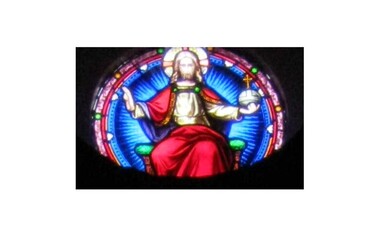 Christ Church Anglican Parish of Warrnambool
Memorial Windows: William & Sarah BATEMAN, 1869
... Sellars (nephew of William Bateman Jnr) and shortly afterwards the store closed with an order for the sequestration of the insolvents estate, but was not made absolute until December 1856 when the Insolvency court ruled for the “compulsory sequestration” of the business due to fraudulent activities within the business. But in the meantime in early November fire...Sellars (nephew of William Bateman Jnr) and shortly afterwards the store closed with an order for the sequestration of the insolvents estate, but was not made absolute until December 1856 when the Insolvency court ruled for the “compulsory sequestration” of the business due to fraudulent activities within the business. But in the meantime in early November fire ...William Bateman Snr was born to parents Daniel Bateman and Patience Wilkinson in Bradford, Yorkshire, England in approx. 1794. He married Sarah Smith on 20th November 1815 in Bradford, Yorkshire, England. They had four children – Patience (Born abt 1817), Daniel (born abt 1819) William (born abt 1831) & James (born abt 1837)all born in England. William Snr and Sarah Bateman and two sons – William and James - arrived in Australia in approx 1853. They brought with them considerable capital/stock and bought into a business in Warrnambool in William Jnr’s name. Bateman & Co rapidly became the largst mercantile business in the area and did rather extensive business with the Banks of Victoria and Australiasia. It is thought that William Snr assisted in the business to some extent, expecially financially. His other son Daniel (who remained in England) is also thought to have had a financial interest in the business as a dormant partner. The business was so prominent, Bateman & Co issued round copper tokens as a Trade Token - value one penny. These were inscribed with the Business name and were limited in their use to the business. In Sept 1856 the business was transferred to a Mr. Thos W. Sellars (nephew of William Bateman Jnr) and shortly afterwards the store closed with an order for the sequestration of the insolvents estate, but was not made absolute until December 1856 when the Insolvency court ruled for the “compulsory sequestration” of the business due to fraudulent activities within the business. But in the meantime in early November fire completely destroyed the business which left only the insurance payouts. Both William Bateman Snr and William Bateman Jnr are listed on the Pioneers’ Honour Board in the foyer of the Warrnambool Library. It is reported William Bateman Jnr was a trustee of Christ Church, was a City Councillor, and was involved in many other community organisations. He also subscribed towards the cost of building a permanent Church which was opened in 1856. William Bateman Snr died in Warrnambool on 30/03/1868 and his wife Sarah died in August 1868. William Bateman Jnr presented to Christ Church, stained glass windows in memory of his parents William & Sarah Bateman. William Bateman Jnr died in June 1913. Four stained glass windows, three lancet and one circular. The theme of the lancet windows depicts the three occasions when the apostles Peter, James and John were Jesus' sole attendants: The raising of Jairus' daughter. On the Mount of Transfiguration. In the Garden of Gethsemane. The circular window in the gable of the wall represents "The Enthroned Christ". -
 Nillumbik Shire Council
Painting: Piers BATEMAN (b.1947, Perth - d.2015, NSW), Piers Bateman, Blackboys, 1989
... The tree’s ability to be one of the first to flower after a wild fire ensures a food source for many insects and birds. bateman, grass trees, xanthorrhoea johnsonii, landscape Hand written, low right in capitals: 'BATEMAN' Oil on canvas painting. ...Piers Bateman was a local artist, held in very high esteem by his peers and community. He was born in Perth in 1947, moving to Eltham in 1955 as a young child with his family. In 1966 Bateman moved to London for eighteen months to develop his craft. In 1969 he settled in St Andrews, where he built a studio. The St Andrews locale is said to have been a strong influence on his work. Bateman’s talent was such that he was promoted and mentored by such ilk as Charles Blackman, Clifton Pugh and Arthur Boyd, among others. Bateman’s work is an intimate dialogue with the environment, renowned for his paintings of the outback, wilderness frontiers and the sea. He spent a year in the mid-seventies sailing the Greek Islands and the French canals to Amsterdam. In 1980 Bateman and Marcus Skipper embarked on a trans-Australian venture to the red centre and across northern Australia from Cairns to Broome. In the mid-eighties Bateman returned to the Mediterranean, before returning to the Australian outback in the late-eighties. His international career continued on an upwards trajectory between the Australian outback and European seas, providing a unique contrast throughout the course of his career. Bateman's work questions our relationship with the natural world, and in particular, reconciling our colonial heritage with our indigenous past. This line of questioning and his genuine response to place is the key to Piers Bateman’s work, for which he is lauded and celebrated. On September 4th 2015, Piers Bateman died in a boating accident on the NSW coast line. Piers Bateman was an instinctive painter whose inspiration came from nature. He reworked and scraped off the paint, moving it around until forms and colours of the landscape took shape. Although Bateman lived in Spain and Italy, his time in Europe made him aware of the contrast between the two continents and the bright clear light that defined the Australian landscape. At the time of this work, Bateman was living in St. Andrews, but travelled regularly to New South Wales and South Australia on painting trips. The ‘Grass Tree’ Xanthorrhoea johnsonii (commonly known as ‘blackboy’) is indigenous to these areas. It is a uniquely Australian, slow growing plant with twenty-eight species growing within Australia. Old examples of this tree are survivors of many wild fires, which can cause their blackened trunk, of one to two metres, branch into two or more heads. These heads consist of thick, rough corky bark, surrounded by long, wiry leaves and flowers that produce seed capsules with hard black seeds. The tree’s ability to be one of the first to flower after a wild fire ensures a food source for many insects and birds.Oil on canvas painting. Detail of three grass trees resting on the side of a mountain/hill. Green and gold palette throughout depicting the colours and light of the Australian landscape. Hand written, low right in capitals: 'BATEMAN'bateman, grass trees, xanthorrhoea johnsonii, landscape -
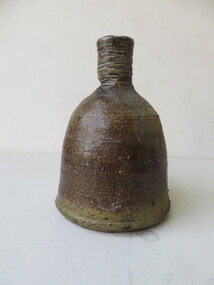 Federation University Art Collection
Ceramic, Woodfired Bottle by Hugh Legge, c1987
... Hugh LEGGE Hugh Legge attended the Canberra School of Art (at time of Alan Peascod) and moved to Rosedale (near Batemans Bay) back in the 1980s where he was wood firing. His work may be marked with an impressed 'HL' in a circle...Hugh LEGGE Hugh Legge attended the Canberra School of Art (at time of Alan Peascod) and moved to Rosedale (near Batemans Bay) back in the 1980s where he was wood firing. His work may be marked with an impressed 'HL' in a circle hugh legge ceramics jan feder memorial ceramics collection gippsland campus Woodfired bottle Woodfired Bottle by Hugh Legge Ceramic Hugh Legge ...Hugh LEGGE Hugh Legge attended the Canberra School of Art (at time of Alan Peascod) and moved to Rosedale (near Batemans Bay) back in the 1980s where he was wood firing. His work may be marked with an impressed 'HL' in a circleWoodfired bottlehugh legge, ceramics, jan feder memorial ceramics collection, gippsland campus -
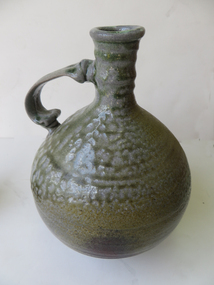 Federation University Art Collection
Ceramic, Woodfired Bottle with Handle by Hugh Legge, 1987
... Hugh LEGGE
Hugh Legge attended the Canberra School of Art (at time of Alan Peascod) and moved to Rosedale (near Batemans Bay) back in the 1980s where he was wood firing. His work may be marked with an impressed 'HL' in a circle...Hugh LEGGE
Hugh Legge attended the Canberra School of Art (at time of Alan Peascod) and moved to Rosedale (near Batemans Bay) back in the 1980s where he was wood firing. His work may be marked with an impressed 'HL' in a circle hugh legge ceramics jan feder memorial ceramics collection gippsland campus Woodfired bottle with handle Woodfired Bottle with Handle by Hugh Legge Ceramic Hugh Legge ...Hugh LEGGE Hugh Legge attended the Canberra School of Art (at time of Alan Peascod) and moved to Rosedale (near Batemans Bay) back in the 1980s where he was wood firing. His work may be marked with an impressed 'HL' in a circleWoodfired bottle with handlehugh legge, ceramics, jan feder memorial ceramics collection, gippsland campus
