
Showing 119 items matching "battlefields - australia"
-
 Monbulk RSL Sub Branch
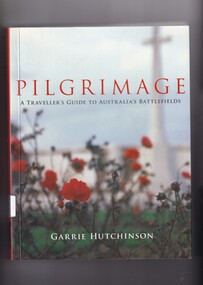
Book, Garrie Hutchison, Pilgrimage: A travellers guide to Australia's battlefields, 2006
... ...battlefields - australia...battlefields - guidebooks battlefields - australia ourneying through time and place, author Garrie Hutchinson visits the battlefields where Australians have fought, in both World Wars, Vietnam, Korea, and others. ...ourneying through time and place, author Garrie Hutchinson visits the battlefields where Australians have fought, in both World Wars, Vietnam, Korea, and others.Index, ill (b/w) (col), 417.p.non-fictionourneying through time and place, author Garrie Hutchinson visits the battlefields where Australians have fought, in both World Wars, Vietnam, Korea, and others.battlefields - guidebooks, battlefields - australia -
 Hume City Civic Collection
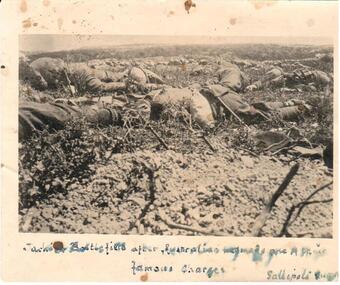
Photograph, c1915
... JACKO - BATTLEFIELD AFTER AUSTRALIANS .................... ...FAMOUS CHARGES GALLIPOLI ...............15...Battlefield scene after charge Gallipoli 1915 Dead Turks on battlefield. world war 1 soldiers gallipoli george evans collection JACKO - BATTLEFIELD AFTER AUSTRALIANS .................... ...FAMOUS CHARGES GALLIPOLI ...............15 A b/w photograph of a battle scene at Gallipoli during World War 1. ...Battlefield scene after charge Gallipoli 1915 Dead Turks on battlefield.A b/w photograph of a battle scene at Gallipoli during World War 1.JACKO - BATTLEFIELD AFTER AUSTRALIANS .................... ...FAMOUS CHARGES GALLIPOLI ...............15world war 1, soldiers, gallipoli, george evans collection -
 Bendigo Military Museum
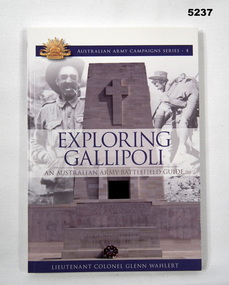
Book - BOOK, GUIDE to ANZAC BATTLEFIELDS, LIEUTENANT COLONEL GLENN WAHLERT, "Exploring Gallipoli", 2008
... 'EXPLORING/ GALLIPOLI - / AN AUSTRALIAN ARMY BATTLEFIELD GUIDE"...'EXPLORING/ GALLIPOLI - / AN AUSTRALIAN ARMY BATTLEFIELD GUIDE" Books WW1 Gallipoli History Soft cover book. ...'EXPLORING/ GALLIPOLI - / AN AUSTRALIAN ARMY BATTLEFIELD GUIDE"Soft cover book. Soft cover - cardboard, blue, grey and black print on front, spine, back and front and back flaps of cover. Front and back illustrations - montage of grey with black and white photographs of soldiers and War Memorial. Back flap - illustrations in colour - maps. 136 pages, paper, cut, plain, semi gloss white, illustrated - colour and black and white photographs, diagrams, maps, illustrations.books, ww1, gallipoli, history -
 Nhill Aviation Heritage Centre
Book - RAAF at War, Victory Roll, 1945
... In formative promotional style writing with stories of bravery and battlefield success. raaf pilot experiences flying out of operational bases of europe and the pacific. Victory Roll, The Royal Australian Air Force in it's sixth year of war Hard back 200 pages with colour paintings and sketches, black and white photographs. ...Hard back 200 pages with colour paintings and sketches, black and white photographs.raaf pilot experiences flying out of operational bases of europe and the pacific. -
 Federation University Historical Collection
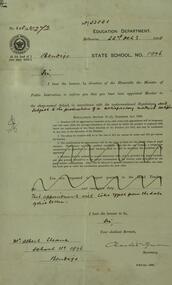
Book - Scrap Book, Ballarat School of Mines Scrap Book, 1924 - 1929, c1931
... Galloway - An Australian Abroad - Tragic end. 1929 - Technical Education 17 October 1929 - Agricultural Engineering 15 February 1930 - Ballarat School of Mines Student Association 20 February 1930 - 61s Annual Meeting of the Ballarat School of Mines 02 June 1930 - R. Young in Belgium and visits battlefields...Galloway - An Australian Abroad - Tragic end. 1929 - Technical Education 17 October 1929 - Agricultural Engineering 15 February 1930 - Ballarat School of Mines Student Association 20 February 1930 - 61s Annual Meeting of the Ballarat School of Mines 02 June 1930 - R. Young in Belgium and visits battlefields ...The Ballarat School of Mines was a predecessor institution of Federatin University Australia. The scrap books were kept by the librarians and related to topics of interest to the Ballarat School of Mines, its students and its staff. 17 December 1954 - Ballarat Junior Technical School Headmaster's Report 05 February 1925 - Ballarat School of Mines Museum closure 25 February 1925 - War Trophies Museum 06 May 1925 - Ballarat's Museum. Where is it? Some Interesting Facts 14 May 1925 - White Flat Reserve 21 June 1928 - Ballarat School of Mines Procession 14 March 1929 - Mr A.D.R. Galloway - An Australian Abroad - Tragic end. 1929 - Technical Education 17 October 1929 - Agricultural Engineering 15 February 1930 - Ballarat School of Mines Student Association 20 February 1930 - 61s Annual Meeting of the Ballarat School of Mines 02 June 1930 - R. Young in Belgium and visits battlefields including Hill 60. 19 February 1931 - School Hostel Suggested 14 April 1931 - Frank Pinkerton Obituary 15 October 1921 - Life at Mt Isa (E. Loveland) 18 February 1932 - Discussion on Teachers College (Ballarat Teachers' College) 11 July 1931 - Phoenix Model Locomotive donation to the Ballarat School of Mines 06 May 1932 - The Mt Isa Country 11 Oct 1932 - Death of F.W. Alsopp (former SMB student) 21 January 1933 - Education In Victoria: Will a New Era Open 28 September 1933 - New Teaching System Explained by the Minister 17 February 1934 - Trip to New Guinea (A.F. Heseltine) 19 April 1934 - Early Ballarat - Address by Nathan Spielvogel 30 August 1934 - Ballarat Junior Technical School Tennis Court 23 August 1934 - Welding plant and Battery 17 June 1935 - Men about Town - A.F. Heseltine 21 June 1935 - Vocational Guidance 16 July 1935 - Ballarat School of Mines (history) 03 August 1935 - Men About Town - William H. Middleton 10 August 1935 - A.E.C. Kerrballarat school of mines, martha pinkerton, scrap book, a.w. nicholson, john lynch (junior), mount lyell, leslie evans, leslie blake evans, herald shield for athletics, ballarat school of mines museum, motor mechanics' classes for ladies, farm engineering, villers bretonneux carvings, trengrove, museum, port pirrie, j.i. simpson, reuben s. russelll, ballarat technical art school, charles harvey, elliott gower, la gerche, c. curnow, applied art, macroberston scholarship, ballarat school of mines procession, rag, vale park tree planting, smb ball, pottery classes, delineascope, mica smith scholarship, james peart, burma mnies, smb excursion to western australia, kalgoorlie, elsie mckissock, war trophies, warwick smith, spencer street bridge, war museum, richard j. young, alfred mica smith obituary, reginald callister, john rowell, sewerage installation, h.h. smith, w.h. middleton, olive scott, dolly whitehead, vale park, ballarat war museum opening, repatriation classes, sewerage at the ballarat school of mines, australian coals, j.p. ellsworth, yallourn, w.g. walker, reunion, norfolk island pine, mica smith memorial, jessice smith, harry fern, t. henderson, bhp, john adam, ols students' association, l.b. curnow, laura crouch, signwriting, excursion, port pirrie excursion, albert potter, pearl fricke, technica school sports, percy trompf, ballarat school of mines battery, albert mclean, a.d.r. galloway, alan douglas richard galloway, r.j. young, alan ludbrook, r. timpe, ballarat ironworkers and polytechnic association, h. jolly, carpentry, harold jolly, millinery classes, phoenix model locomotive, s.j. morgan, r.d. bannister, juvenile industrial exhibition, w.h. shaw, j.c. winds, f.h. davis, h.r. worland, w.t. magee, l. george, l. balhausen, white flat oval, resue from yarrowee creek, e. berriman, ballarat teachers' college, reg mcconnell, mount lyell co, munro reaper, munro reaper model, weaving classes, mervyn trimmings, briquette dust, edna findlay, jean rogers, n. mccallum, jessie glass, classroom ventilation, art metal, charles fenner, levi molyneux, olice scott, poster competition, kerr grant, w.h. steane, h. caddy, colvin smith, claude creelman, robert colins, stan hillman, n.c. heathcote, egg collection, john alexander, nornie gude, charles deane, graham hopwood, roswald john dart, max wilson, new battery, jess hopwood, william middleton, a.e.c. kerr, hand weaving classes, m. martin, a.h. leeson, mona rogerson, lorna bailey, prospectors classes, edwin robinson, kalgoorlie vist, railway locomotive -
 Federation University Historical Collection
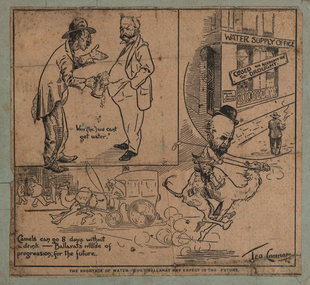
Print, Edwin Cannon, The Shortage of Water - What Ballarat Can Expect in the Future, 1914
... Australia Ted Cannon was a lively, clever and popular student who demonstrated great ability in caricature and cartoon work. He found competition success and was granted a valuable five-year senior scholarship. Cannon also assisted teaching staff and contributed many drawings to the Ballarat Star. Following his AIF enlistment in 1915, Cannon’s superiors soon put his skill to use observing the enemy and illustrating sections of the battlefield...Australia Ted Cannon was a lively, clever and popular student who demonstrated great ability in caricature and cartoon work. He found competition success and was granted a valuable five-year senior scholarship. Cannon also assisted teaching staff and contributed many drawings to the Ballarat Star. Following his AIF enlistment in 1915, Cannon’s superiors soon put his skill to use observing the enemy and illustrating sections of the battlefield ...Edwin Joseph (Ted) CANNON (1895-1916) Australia Ted Cannon was a lively, clever and popular student who demonstrated great ability in caricature and cartoon work. He found competition success and was granted a valuable five-year senior scholarship. Cannon also assisted teaching staff and contributed many drawings to the Ballarat Star. Following his AIF enlistment in 1915, Cannon’s superiors soon put his skill to use observing the enemy and illustrating sections of the battlefield. He was sketching a German position in France when he was shot in the abdomen and died.black and white artA newspaper clipping of a cartoon by Ted Cannon. ted cannon, edwin cannon, camel, water, water supply office, publication, black and white -
 Lara RSL Sub Branch
Book, Jungle Warfare - With the Australian Army in the South West Pacific, 1944
... There the terrain and climate gave to the fighting a character of its own, unlike anything experienced by Australians previously and never to be forgotten by those who took part in it. jungle warfare new guinea australian army royal australian navy united nations amphibious operation hidden battlefields shaggy ridge operational drop life-saving moresby style stretcher bearing Jungle Warfare - With the Australian Army in the South West Pacific. ...This is the fourth book in this series to the people at home during WWII. Stories of military operations in the jungle and Kenai, mountains and swamps of New Guinea. There the terrain and climate gave to the fighting a character of its own, unlike anything experienced by Australians previously and never to be forgotten by those who took part in it.Jungle Warfare - With the Australian Army in the South West Pacific. Brown front and back cover with Ore text and picture of soldier carrying his webbing. Same text on the spine. The inside front and back cover has text ore coloured text on a brown background. Photographs, illustrations, poems, stories, paintings jungle warfare, new guinea, australian army, royal australian navy, united nations, amphibious operation, hidden battlefields, shaggy ridge, operational drop, life-saving moresby style, stretcher bearing -
Lara RSL Sub Branch
Book, Jungle Warfare - With the Australian Army in the South West Pacific, 1944
... There the terrain and climate gave to the fighting a character of its own, unlike anything experienced by Australians previously and never to be forgotten by those who took part in it. jungle warfare new guinea australian army royal australian navy united nations amphibious operation hidden battlefields shaggy ridge operational drop life-saving moresby style stretcher bearing Jungle Warfare - With the Australian Army in the South West Pacific. ...This is the fourth book in this series to the people at home during WWII. Stories of military operations in the jungle and Kenai, mountains and swamps of New Guinea. There the terrain and climate gave to the fighting a character of its own, unlike anything experienced by Australians previously and never to be forgotten by those who took part in it.Jungle Warfare - With the Australian Army in the South West Pacific. Brown front and back cover with Ore text and picture of soldier carrying his webbing. Same text on the spine. The inside front and back cover has text ore coloured text on a brown background. Photographs, illustrations, poems, stories, paintings. This book has a paper jacket cover - slightly torn. jungle warfare, new guinea, australian army, royal australian navy, united nations, amphibious operation, hidden battlefields, shaggy ridge, operational drop, life-saving moresby style, stretcher bearing -
 Lara RSL Sub Branch
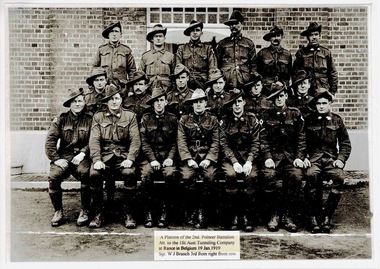
Photograph, A Platoon of the 2nd, Pioneer Battalion Att. to the 1St.Aust. Tunneling Company at Rance in Belgium 19 Jan 1919
... Australian Imperial Force. Formed in Egypt in March 1916, the battalion subsequently served on the Western Front in France and Belgium, after being transferred to the European battlefields shortly after its establishment. ...Australian Imperial Force. Formed in Egypt in March 1916, the battalion subsequently served on the Western Front in France and Belgium, after being transferred to the European battlefields shortly after its establishment. army, rance belgium,australian army, lara r.s.l. ! ...The 2nd Pioneer Battalion was an Australian infantry and light engineer unit raised for service during the First World War as part of the all volunteer Australian Imperial Force. Formed in Egypt in March 1916, the battalion subsequently served on the Western Front in France and Belgium, after being transferred to the European battlefields shortly after its establishment. Rectangular shaped black and white Photograph.A Platoon of the 2nd, Pioneer Battalion Att. to the 1St.Aust. Tunnelling Company at Rance in Belgium 19 Jan 1919 Sgt. W J Branch 3rd from right front row. army, rance belgium,australian army, lara r.s.l., !st.australian tunnelling company, 2nd pioneer battalion. -
 Lara RSL Sub Branch
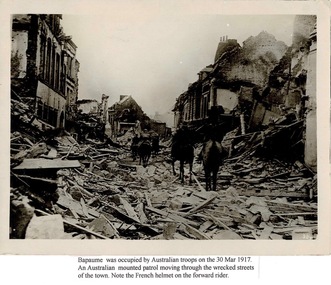
Photograph, Photograph of Bapaume
... Australian Brigade playing amid the burning ruins as they marched into the old town square on the 19th. However booby traps and time bombs had been left behind; one exploded in the town hall a week later burying men and killing twenty-five. On the Western Front, Bapaume was a coveted position between the two strategically-important areas of Artois and Somme. The Germans occupied the town in 1914 and in the final eighteen months of the war it changed hands three times. ww1, bapaume, french battlefields ...Bapaume was a large German-held town almost within sight of the Australians’ trench lines throughout the winter months on the Somme. Suddenly, from 24 February 1917 it became evident that the enemy was retiring. The British advanced after them, and by the morning of 17 March Australian troops reached the outskirts of Bapaume. The soldiers’ heightened spirits were exemplified by the band of the 5th Australian Brigade playing amid the burning ruins as they marched into the old town square on the 19th. However booby traps and time bombs had been left behind; one exploded in the town hall a week later burying men and killing twenty-five.On the Western Front, Bapaume was a coveted position between the two strategically-important areas of Artois and Somme. The Germans occupied the town in 1914 and in the final eighteen months of the war it changed hands three times.Rectangular shaped Sepia photograph with an added note underneath.Bapaume was occupied by Australian troops on the 30th Mar 1917. An Australian mounted patrol moving through the wrecked streets of the town. Note the French helmet on the forward rider.ww1, bapaume, french battlefields, lara r.s.l.world war one, australian army. -
 Lara RSL Sub Branch
Group of Maps World War One, Group of Maps World War One - Dardanelles and Anzac Gallipoli Maps Circ 1915, Circ 1916
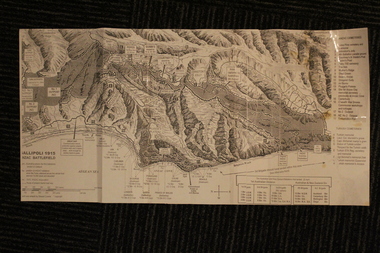
... Battlefield with Landings and later evacuation marked. 2. Details of Naval actions taken in the Dardanelles Passage 18 March 1918. 3. Local area Map or Turkey. Shows roads network and townships. 4. ANZAC Trench Diagram, copyright Whitcombe & Tombs Limited , Wellington N.Z. 1919 5. Panorama of two coast views of ANZAC area. Australian...Battlefield with Landings and later evacuation marked. 2. Details of Naval actions taken in the Dardanelles Passage 18 March 1918. 3. Local area Map or Turkey. Shows roads network and townships. 4. ANZAC Trench Diagram, copyright Whitcombe & Tombs Limited , Wellington N.Z. 1919 5. Panorama of two coast views of ANZAC area. Australian ...Gallipoli 1915 Maps and Naval plan of Operations World War One ANZACRare examples that explain both ANZAC and Naval Operations during World War One Gallipoli & Dardanelles Passage .!. Black and White Photocopy of Gallipoli 1915 ANZAC Battlefield - detailed positions of troops and Cemeteries. 2.The Allied Failure to Force The Dardanelles Passage 18 March 1915 - detailed line of Attack Naval Organisation, Mine layout, Plan of Attack (and copy).. 3. Map of Turkey and surrounding area written in Turkish and German Languages. C0olor version main roads and distances. (and copy).. 4. Map of ANZAC Trench Diagram. World War One.Color. (and copy). 5.Panorama of Chunuk Blair from 3 miles south of Nibrunesi Point, 3 November 1915 and Anzac from 1 mile N. E. of Ari Burnu, 21 November 1915. Black & White 6. Color Map of ANZAC positions with topographical Details, notes. 1. Artwork and copyright by Srewart Cownie, Gallipoli 1915 ANZAC Battlefield with Landings and later evacuation marked. 2. Details of Naval actions taken in the Dardanelles Passage 18 March 1918. 3. Local area Map or Turkey. Shows roads network and townships. 4. ANZAC Trench Diagram, copyright Whitcombe & Tombs Limited , Wellington N.Z. 1919 5. Panorama of two coast views of ANZAC area. Australian War Memorial, 6. Map of ANZAC positions of World War One, Gallipoli 1915. Published by H.E.C. Roberinson, George Street, Sydney N.S.W.18 April 1916maps operational of anzac and naval opations during 1915 etc, dardanelles naval opations -
Lara RSL Sub Branch
Book, Jungle Warfare - With the Australian Army in the South West Pacific, 1944
... Jungle warfare New Guinea Australian Army Royal Australian Navy United Nations amphibious operation hidden battlefields shaggy ridge operational drop life-saving Moresby style stretcher bearing Jungle Warfare - With the Australian Army in the South West Pacific. ...This is the fourth book in this series to the people at home during WWII. Stories of military operations in the jungle and Kenai, mountains and swamps of New Guinea. There the terrain and climate gave to the fighting a character of its own, unlike anything experienced by Australians previously and never to be forgotten by those who took part in it.Jungle Warfare - With the Australian Army in the South West Pacific. Brown front and back cover with Ore text and picture of soldier carrying his webbing. Same text on the spine. The inside front and back cover has text ore coloured text on a brown background. Photographs, illustrations, poems, stories, paintings jungle warfare, new guinea, australian army, royal australian navy, united nations, amphibious operation, hidden battlefields, shaggy ridge, operational drop, life-saving moresby style, stretcher bearing -
 Lara RSL Sub Branch
Education Kit - A Heritage Kit, THE ANZAC BATTLEFIELD, Published by Southdown Press Pty Ltd Melbourne in 1964
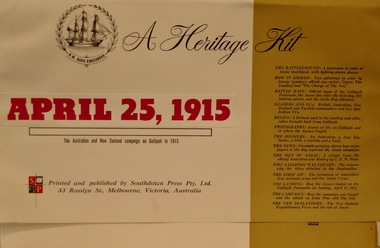
... Australian and New Zealand campaign on Gallipoli in 1915. Rectangular shaped folder containing information and pictures of the Gallipoli campaign. THE ANZAC BATTLEFIELD ...The Gallipoli campaign, also known as the Dardanelles campaign, the Battle of Gallipoli or the Battle of Çanakkale, was a campaign of the First World War that took place on the Gallipoli peninsula, from 17 February 1915 to 9 January 1916. Rectangular shaped folder containing information and pictures of the Gallipoli campaign.A Heritage Kit, APRIL 25,1915. The Australian and New Zealand campaign on Gallipoli in 1915.how it looked, battle maps, leaders and vcs, relics, photographs, the soldiers, the news, the men of anzac, the battleground, why gallipoli was fought, the first aif, the landing, the campaign, the new zealanders -
 Flagstaff Hill Maritime Museum and Village
Book, Official History of Australia In The War of 1914-18 Vol 4
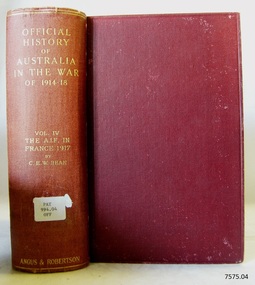
... battlefields of France and Belgium. The High Commissioner ( Mr. S. M. Bruce) states in his annual report that, althoughthe 47 bodies were readily identifiable by their uniforms,caps,and badges and shoulder titles as those of Australian soldeirs, it must be regretfully recorded that in most cases their names will never be known." ...His aim was to foster portraiture, as well as support artists, and perpetuate the memory of great Australians. warrnambool shipwrecked-coast flagstaff-hill flagstaff-hill-maritime-museum maritime-museum shipwreck-coast flagstaff-hill-maritime-village shipwrecked-artefact book warrnambool mechanics’ institute pattison collection warrnambool library ralph eric pattison warrnambool city librarian mechanics’ institute library victorian library board warrnambool books and records warrnambool children’s library official history of australia in the war of 1914-18 vol 4 official history of australia in the war of 1914-18 the australian imperial force in france 1917 a.i.f. c e w bean s. m. bruce Label on spine cover with typed text PATT 994.04 OFF Front loose endpaper has a sticker from Warrnambool Public Library covered by a sticker from Corangamite Regional Library Service Front end pastedown paper has a type written paper that reads "Unknown Soldiers. Last year 795 bodies of British Soldiers of which 47 were Australiands, were recovered from the battlefields ...This item is from the ‘Pattison Collection’, a collection of books and records that was originally owned by the Warrnambool Mechanics’ Institute, which was founded in Warrnambool in 1853. By 1886 the Warrnambool Mechanics’ Institute (WMI) had grown to have a Library, Museum and Fine Arts Gallery, with a collection of “… choice productions of art, and valuable specimens in almost every branch and many wonderful national curiosities are now to be seen there, including historic relics of the town and district.” It later included a School of Design. Although it was very well patronised, the lack of financial support led the WMI in 1911 to ask the City Council to take it over. In 1935 Ralph Pattison was appointed as City Librarian to establish and organise the Warrnambool Library as it was then called. When the WMI building was pulled down in 1963 a new civic building was erected on the site and the new Warrnambool Library, on behalf of the City Council, took over all the holdings of the WMI. At this time some of the items were separated and identified as the ‘Pattison Collection’, named after Ralph Pattison. Eventually the components of the WMI were distributed from the Warrnambool Library to various places, including the Art Gallery, Historical Society and Flagstaff Hill. Later some were even distributed to other regional branches of Corangamite Regional Library and passed to and fro. It is difficult now to trace just where all of the items have ended up. The books at Flagstaff Hill Maritime Village generally display stamps and markings from Pattison as well as a variety of other institutions including the Mechanics’ Institute itself. RALPH ERIC PATTISON Ralph Eric Pattison was born in Rockhampton, Queensland, in 1891. He married Maude Swan from Warrnambool in 1920 and they set up home in Warrnambool. In 1935 Pattison accepted a position as City Librarian for the Warrnambool City Council. His huge challenge was to make a functional library within two rooms of the Mechanics’ Institute. He tirelessly cleaned, cleared and sorted a disarrayed collection of old books, jars of preserved specimens and other items reserved for exhibition in the city’s museum. He developed and updated the library with a wide variety of books for all tastes, including reference books for students; a difficult task to fulfil during the years following the Depression. He converted all of the lower area of the building into a library, reference room and reading room for members and the public. The books were sorted and stored using a cataloguing and card index system that he had developed himself. He also prepared the upper floor of the building and established the Art Gallery and later the Museum, a place to exhibit the many old relics that had been stored for years for this purpose. One of the treasures he found was a beautiful ancient clock, which he repaired, restored and enjoyed using in his office during the years of his service there. Ralph Pattison was described as “a meticulous gentleman whose punctuality, floorless courtesy and distinctive neat dress were hallmarks of his character, and ‘his’ clock controlled his daily routine, and his opening and closing of the library’s large heavy doors to the minute.” Pattison took leave during 1942 to 1942 to serve in the Royal Australian Navy, Volunteer Reserve as Lieutenant. A few years later he converted one of the Museum’s rooms into a Children’s Library, stocking it with suitable books for the younger generation. This was an instant success. In the 1950’s he had the honour of being appointed to the Victorian Library Board and received more inspiration from the monthly conferences in Melbourne. He was sadly retired in 1959 after over 23 years of service, due to the fact that he had gone over the working age of council officers. However he continued to take a very keen interest in the continual development of the Library until his death in 1969. WARRNAMBOOL PUBLIC LIBRARY The Warrnambool Mechanics’ Institute (WMI) was formed by a voluntary community group in 1863, within six years of Warrnambool’s beginnings, and its Reading Room opened in 1854. The WMI operated until 1963, at which time it was one of the oldest Mechanics’ Institutes in Victoria. Mechanics’ Institutes offered important services to the public including libraries, reading rooms and places to display and store collections of all sorts such as curiosities and local historical relics. In 1886 a Museum and Fine Arts Gallery were added to the WMI and by the beginning of the 20th century there was also a billiards room and a School of Art. By this time all Mechanics’ Institutes in country Victoria had museums attached. Over the years the Warrnambool Mechanics’ Institute Library was also known as the Warrnambool Public Library the Warrnambool Library and the Free Library. Early funding from the government was for the “Free Library”. The inscription in a book “Science of Man” was for the “Warrnambool Public Library”, donated by Joseph Archibald in 1899. Another inscription in the book “Catalogue of Plants Under Cultivation in the Melbourne Botanic Gardens 1 & 2, 1883” was presented to the “Warrnambool Library” and signed by the author W.R. Guilfoyle. In 1903 the Warrnambool Public Library decided to add a Juvenile Department to library and stock it with hundreds of books suitable for youth. In 1905 the Public Library committee decided to update the collection of books and added 100 new novels plus arrangements for the latest novels to be included as soon as they were available in Victoria. In July 1911 the Warrnambool Council took over the management of the Public Library, Art Gallery, Museum and Mechanics’ Institute and planned to double the size of the then-current building. In 1953, when Mr. R. Pattison was Public Librarian, the Warrnambool Public Library’s senior section 10,000 of the 13,000 books were fiction. The children’s section offered an additional 3,400 books. The library had the equivalent of one book per head of population and served around 33 percent of the reading population. The collection of books was made up of around 60 percent reference and 40 percent fiction. The library was lending 400 books per day. In 1963 the Warrnambool City Council allocated the site of the Mechanics’ Institute building, which included the Public Library, Museum and Art Gallery, for the new Municipal Offices and the Collections were dispersed until 1971. The Warrnambool Library took over the Mechanics’ Institute Library’s holdings on behalf of the Warrnambool City Council. Since the closure of the Warrnambool Mechanics’ Institute the exact location and composition of the original WMI books and items has become unclear. Other materials have been added to the collection, including items from Terang MI, Warrnambool Court House and Customs House. Many of the books have been identified as the Pattison Collection, named after the Librarian who catalogued and numbered the books during his time as Warrnambool Public Librarian in the time before the Mechanics’ Institute closed. It seems that when Warrnambool became part of the Corangamite Regional Library some of the books and materials went to its head office in Colac and then back to Warrnambool where they were stored at the Art Gallery for quite some time. Some then went to the Warrnambool Historical Society, some stayed at the Art Gallery and some were moved to Flagstaff Hill Maritime Village. The various stamps and labels on the books held at Flagstaff Hill show the variety of the collection’s distribution and origin. The books in the collection at Flagstaff Hill Maritime Village date from the 1850’s to the late 1950’s and include rare and valuable volumes. Many of the books are part of the “Pattison Collection” after the Warrnambool’s Public Librarian, Mr. R. Pattison The Pattison Collection, along with other items at Flagstaff Hill Maritime Village, was originally part of the Warrnambool Mechanics' Institute’s collection. The Warrnambool Mechanics’ Institute Collection is primarily significant in its totality, rather than for the individual objects it contains. Its contents are highly representative of the development of Mechanics' Institute libraries across Australia, particularly Victoria. A diversity of publications and themes has been amassed, and these provide clues to our understanding of the nature of and changes in the reading habits of Victorians from the 1850s to the middle of the 20th century. The collection also highlights the Warrnambool community’s commitment to the Mechanics’ Institute, reading, literacy and learning in the regions, and proves that access to knowledge was not impeded by distance. These items help to provide a more complete picture of our community’s ideals and aspirations. The Warrnambool Mechanics Institute book collection has historical and social significance for its strong association with the Mechanics Institute movement and the important role it played in the intellectual, cultural and social development of people throughout the latter part of the nineteenth century and the early twentieth century. The collection of books is a rare example of an early lending library and its significance is enhanced by the survival of an original collection of many volumes. The Warrnambool Mechanics' Institute’s publication collection is of both local and state significance. The Warrnambool Mechanics' Institute Collection is primarily significant in its totality, rather than for the individual objects it contains. Its contents are highly representative of the development of Mechanics' Institute libraries across Australia, particularly Victoria. A diversity of publications and themes has been amassed, and these provide clues to our understanding of the nature of and changes in the reading habits of Victorians from the 1850s to the middle of the 20th century. The collection also highlights the Warrnambool community’s commitment to the Mechanics’ Institute, and to reading, literacy and learning in the regions, and proves that access to knowledge was not impeded by distance. These items help to provide a more complete picture of our community’s ideals and aspirations. As with many Mechanics' Institutes in Australia, the one which operated in Warrnambool was established and overseen for many years by key individuals associated with the development of the city itself. The WMI publication collection is historically significant because of its association with local people, places and the key historical themes in the development of Warrnambool of rural development, industry, farming, education, and community. The collection documents and illustrates the changing interests, focus and tastes of Victorians, especially those in regional cities. Generally the individual items in the collection are not particularly rare, as examples of all probably exist in other public collections in Victoria. It is primarily because there are so very few surviving Mechanics' Institute collections in Victoria, which lends this overall collection its significance. Many items in the WMI Collection have the potential to support further research, both as individual objects and through the collection in its entirety. This material is significant for its ability to assist in the interpretation of the history of the area and adds to the general understanding of the development of the township. Many components of the WMI publication collection complement and reinforce the Flagstaff Hill Maritime Museum Collection, the Warrnambool Art Gallery Collection, and that in the Warrnambool Historical Society, and also contribute to a clearer understanding of the original Warrnambool Mechanics' Institute collections. This will greatly enhance the appreciation of the few surviving Mechanics' Institute collections across Victoria, and also in New South Wales. The similarities and differences between the small number of collections that have survived can provide further insights into how the people of Victoria in general, and Warrnambool in particular, constructed a civic culture of adult learning to foster an informed citizenry. The Warrnambool Mechanics' Institute publication collection is of both local and state significance. (This Statement of Significance is quoted from the Significance Assessment : Warrnambool Mechanics’ Institute Book Collection at Flagstaff Hill Maritime Museum, February 2009, by Annette Welkamp, Cultural Connections, for Delise Oldfied, FHMV) References Juvenile Department in Warrnambool Public Library In August 1903 The Age newspaper reported in its Warrnambool news section that “With the object of discouraging boys from reading literature of the “penny dreadful” class, the committee of the local public library has decided to open a juvenile department and to stock it with hundreds of suitable books attractive to the youthful mind.” 100 new novels added to Warrnambool Public Library Shelves In November 1905 The Argue newspaper’s Warrnambool news section announced “The committee of the Public Library is bringing the collection of books more up to date. It has recently added 100 new novels to the shelves, and arrangements have been made for a supply of the latest novels immediately they arrive in the state.” Warrnambool Town Council takes over Mechanics’ Institute, Art Gallery, Public Library, Museum – and will double the building’s size In 1912 The Age reported in its Warrnambool news section “Considerable improvements are being effected by the town council in the most picturesque part of Liebig Street. Between the fire brigade station and the mechanics’ institute and art gallery a vacant block of land is being transformed a garden for carpet bedding and flowering plants. The council, which recently took over the control of the art gallery, public library, museum and mechanics’ institute, is doubling the size of the substantial stone building containing these institutions. The new building will contain a supper room for use in conjunction with functions in the town hall, adjoining, and a new reading room.” Mr Pattison, Public Librarian, says Library has a book per head of population In 1953 The Age reported an interview with the Public Librarian, Mr. R. Pattison, who said “Warrnambool has an insatiable thirst for reading. And its reading recipe contains a strong dash of fiction – 73 percent of it. Fiction makes up 10,000 of the 13,000 books in the senior section of the public library. That works out at a book per head of population. Warrnambool today is really book minded. This city has an almost insatiable thirst for knowledge as well as fiction. We’re lending 400 books a day. We supply 33 percent of the reading population of Warrnambool.” The reporter goes on to say “Warrnambool Public Library also has an ultra-modern children’s section of 3,400 books, open to every boy and girl attending school in Warrnambool. Mr Pattison hopes to show travel-talk films and install a radiogram in the children’s section “later on”. But it won’t disturb adult reading next door because the junior section is sound proof. “ Mechanics’ Institutes and Museums Mechanics’ Institutes were important sites for collecting in country Victoria … Warrnambool … all had museums attached to Mechanics’ Institutes before the end of the twentieth century” Warrnambool Mechanics’ Institute Ms Tierney said FHMV holds the collection of the Warrnambool Mechanics’ Institute in three different locations on its site. “The Mechanics’ Institute opened in 1871, was demolished in the 1960s and was one of the oldest in Victoria. “FHMV intends to create a new storage area and bring the collection together in one place which will greatly facilitate access and research. “The collection consists of books and archives dating from the 1850s to 1959s. “Some of the books are rare and valuable but it is unclear as to their relevance to the history of Warrnambool or Victoria,” Ms Tierney said. Warrnambool TAFE History South West TAFE has a long and proud history of providing technical and specialist education, with links back to the formation of the Mechanic’s Institute in 1853. Warrnambool Art Gallery’s History The Warrnambool Art Gallery began in 1886 when retired police officer Joseph Archibald opened its doors in a building behind the mechanics institute in Liebig Street. The Gallery began with an eclectic mix of artworks and museum curios. Before long Archibald mobilised public support and paid for a new gallery annex. Loans and grants allowed the Gallery collection to grow with significant early acquisitions by French, German, and Belgian artists, which were less expensive than British works. Despite its enthusiastic start the economic downturn of the 1890s brought the Collection to a halt. In 1910 the Council took control of the Mechanics Institute and ran the Gallery there until 1963 when the building was allocated for municipal offices. The Collection was dispersed on loan to galleries in Shepparton and Hamilton and not reunited until 1971. In 1986 the Gallery’s Centenary year, a permanent home was built next to the ‘Civic Green’ and named in memory of one its champions Sir Fletcher Jones O.B.E. 2016 Warrnibald Entries Joseph Archibald established the Warrnambool Museum and Art Gallery in 1886 while his son Jules Francois Archibald founded the Archibald Prize through his bequest of 1919. His aim was to foster portraiture, as well as support artists, and perpetuate the memory of great Australians. Official History of Australia In The War of 1914-18 Vol 4 The Australian Imperial Force in France 1917 Author: C E W Bean Publisher: Angus & Robertson Date: 1936 Label on spine cover with typed text PATT 994.04 OFF Front loose endpaper has a sticker from Warrnambool Public Library covered by a sticker from Corangamite Regional Library Service Front end pastedown paper has a type written paper that reads "Unknown Soldiers. Last year 795 bodies of British Soldiers of which 47 were Australiands, were recovered from the battlefields of France and Belgium. The High Commissioner ( Mr. S. M. Bruce) states in his annual report that, althoughthe 47 bodies were readily identifiable by their uniforms,caps,and badges and shoulder titles as those of Australian soldeirs, it must be regretfully recorded that in most cases their names will never be known." warrnambool, shipwrecked-coast, flagstaff-hill, flagstaff-hill-maritime-museum, maritime-museum, shipwreck-coast, flagstaff-hill-maritime-village, shipwrecked-artefact, book, warrnambool mechanics’ institute, pattison collection, warrnambool library, ralph eric pattison, warrnambool city librarian, mechanics’ institute library, victorian library board, warrnambool books and records, warrnambool children’s library, official history of australia in the war of 1914-18 vol 4, official history of australia in the war of 1914-18, the australian imperial force in france 1917, a.i.f., c e w bean, s. m. bruce -
 City of Moorabbin Historical Society (Operating the Box Cottage Museum)
Clothing - Wedding Dress, Mary Box (nee Closter), circa 1918
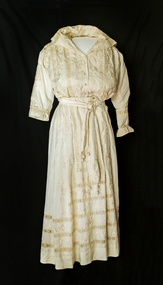
... battlefields of France and Flanders before returning home to Melbourne in February 1918. Rebecca Box, the eldest child of John and Martha Sheldrake Box, was in the first party of Methodist Missionaries to leave Australia for the China Inland Mission in 1890. ...battlefields of France and Flanders before returning home to Melbourne in February 1918. Rebecca Box, the eldest child of John and Martha Sheldrake Box, was in the first party of Methodist Missionaries to leave Australia for the China Inland Mission in 1890. ...Alonzo Box, of Oakleigh ,a nephew of William and Elizabeth Box who resided in 'Box Cottage' 1865 - 1914, married Mary Closter (Kloster), of Oakleigh, on June 12th 1918. Alozo's elder sister, Rebecca, sent a bolt of Chinese hand-embroidered silk from which this wedding dress was made. Rebecca Viloudakia, nee Box, was a missionary in China, and married to a Greek Silk Merchant. Alonzo Box, the 9th child of John and Martha Sheldrake Box , enlisted in the Army and landed at Gallipoli 25/4/1918. He was evacuated to Egypt and then sent to the battlefields of France and Flanders before returning home to Melbourne in February 1918. Rebecca Box, the eldest child of John and Martha Sheldrake Box, was in the first party of Methodist Missionaries to leave Australia for the China Inland Mission in 1890. During the Boxer Uprising 1900-1901 her Mission outpost was attacked but she escaped and was taken to Shanghai. She later married one of the rescue party Nicholas Viloudakia a Greek silk merchant .Australian Dress Register ID 573 12/5/2015 Following Henry Dendy's Special Survey 1841 pioneer settlers bought allotments of land in the area of Moorabbin Parish. Alonzo Box was the nephew of William and Elizabeth Box who bought the cottage on the 30acre allotment from an unknown pioneer settler in 1868 and resided there until Elizabeth's death in 1914. Alonzo Box served in the Army World War 1 1914- 1918 at Gallipoli, France and Flanders. Rebecca Box -Viloudakia was in the first party of Methodist Missionaries to leave Australia for the China Inland Mission in 1890 and was rescued during the Boxer Rebellion 1900-1901 and taken to Shanghai by her future husband.A cream two piece wedding dress made from a bolt of hand embroidered Chinese silk for the marriage of Mary Closter and Alonzo Box on June 12th, 1918. The bolt of Chinese silk was sent by Alonzo’s older sister, Mrs Rebecca Viloudakia, a missionary in China, who was married to a Greek silk merchant. The machine sewn dress was made by a dressmaker in Dandenong, Victoria. The jacket is blouson, with a front opening and is gathered at the waist by a band enclosing a drawstring. The collar is a sailor style that forms a slight / high V-shape front neckline. Four vertical roses are separated by three bands of lacework. The back of the jacket is plain silk. The right front of the jacket has a panel of embroidered roses, band of lacework and a facing fold that encloses 4 fastening presses. There are crocheted bobbles on the front representing buttons. The left jacket front also has the panel of embroidered roses, lacework and matching fold for the 4 fastening studs. The full length inset sleeves are gathered to a cuff that fastens with silk covered buttons. The sleeves have floral embroidery down the outside centre line. The left sleeve has an extra detachable cuff with embroidery on the flounce that matches the bottom panel of the skirt. It is held in position around the wrist by 4 white metal press studs. The skirt sits above the ankle. It consists of 5 panels slightly gathered at the back waistline with a left side placket 21cm with hooks and eyes and press studs. The waistband is lined with petersham and has 6 whalebone inserts. The front of the skirt has small pleats to fit the 3 decorated panels to the waistline. The front has 3 bands of lacework around the lower part. 3 panels form the centre front each embroidered with a different floral pattern. The back of the skirt is plain with 3 bands of lacework rising from the hem, which is sewn with spoke work stitch. The long waist sash/belt is plain silk with embroidered ends and 3 silk balls with crocheted caps suspended on 3 crocheted silk chains. It has a rose knot with 2 metal press stud fasteners. There are a variety of floral designs embroidered on the material including ‘corner motifs’ on the 2nd inner front panel of skirt. brighton, moorabbin, silk, box william, box elizabeth, box alonzo, box mary, kloster mary, closter mary, oakleigh, dandenong, chinese silk merchant, boxer rebellion 1900-1901, box rebecca, methodist china inland mission, viloudakia nichols, anzac landings, world war 1, gallipoli -
 City of Moorabbin Historical Society (Operating the Box Cottage Museum)
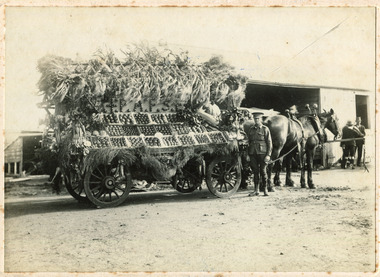
Photograph, Black & White, Fruit & Vegetable display Float Easter Parade c1917, c1916
... As elsewhere in Australia most of the local young men had enlisted in the AIF and some were coming home wounded - many were killed on overseas battlefields. ...As elsewhere in Australia most of the local young men had enlisted in the AIF and some were coming home wounded - many were killed on overseas battlefields. ...The Friendly Societies Carnival at Mentone 1916 during WW1 was arranged to showcase the local activities and raise funds for the 'Discharged Wounded Soldiers Fund' = £140 was raised. As elsewhere in Australia most of the local young men had enlisted in the AIF and some were coming home wounded - many were killed on overseas battlefields. This Parade was led by the Cheltenham Brass Band with the following Friendly Societies AOF, IOR, HACBS, PAFS, and ANA. The PAFS - Protestant Alliance Friendly Society - had 2 entries 'Fruit & Vegetable Display' and 'The Murder of Nurse Edith Cavell' both floats won their category. The Carnival gave prizes for sports events on the Mentone Oval and a concert was held at night at the Mentone Ice Skating Rink.World War 1 1914-1918 had a devastating impact on many early settler families whose sons had volunteered to serve in AIF. 1916 many of these young men were returning injured or had been killed overseas The Community rallied around to support these men and their families by holding fund raising events like the CarnivalBlack & White photograph of a horse drawn wagon displaying Fruit and Vegetables for a procession c 1916Handwritten ; Decorated wagon possibly part of a procession of market gardeners cartsfriendly societies cheltenham 1916, nurse edith cavell, cheltenham brass band 1916, ww1 1914-1918, wounded soldiers fund, allnutt ella, smith j l; smith mary ann, stanley helen, smith vic, chaff cutter, horse drawn carts, toll gates brighton, motor cars 1900, steam engines, early settlers, bentleigh, mckinnon, parish of moorabbin, city of moorabbin, county of bourke, moorabbin roads board, shire of moorabbin, henry dendy's special survey 1841, were j.b.; bent thomas, o'shannassy john, king richard, charman stephen, highett william, ormond francis, maynard dennis, market gardeners, vineyards, orchards -
 City of Moorabbin Historical Society (Operating the Box Cottage Museum)
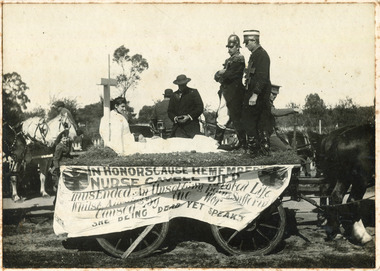
Photograph - 'Edith Cavell Tableau' Easter Parade Cheltenham 1916, 1916
... As elsewhere in Australia most of the local young men had enlisted in the AIF and some were coming home wounded - many were killed on overseas battlefields. ...As elsewhere in Australia most of the local young men had enlisted in the AIF and some were coming home wounded - many were killed on overseas battlefields. ...The Friendly Societies Carnival at Mentone on Easter Monday, 1916 during WW1 was arranged to showcase the local activities and raise funds for the 'Discharged Wounded Soldiers Fund' = £140 was raised. As elsewhere in Australia most of the local young men had enlisted in the AIF and some were coming home wounded - many were killed on overseas battlefields. This Parade was led by the Cheltenham Brass Band, followed by the Friendly Societies AOF, IOR, HACBS, PAFS, and ANA. The PAFS - Protestant Alliance Friendly Society - had 2 entries 'Fruit & Vegetable Display' and 'The Murder of Nurse Edith Cavell' both floats won their category. Ella Allnutt portrayed Nurse Cavell. The Carnival gave prizes for sports events on the Mentone Oval and a concert was held at night at the Mentone Ice Skating Rink. "The Cheltenham P.A.F.S. had, as their tableaux, the murder of Nurse Cavell, in which Miss E. Allnutt took the roll of the nurse and other participants were Miss V. Rose and Messrs. A. Clark, F. Robinson, E. Hutchins, S. Butler and A. Biehl." 1916 'MOORABBIN'S PATRIOTIC CARNIVAL.', Brighton Southern Cross, 29 April, p. 2. World War 1 1914-1918 had a devastating impact on many early settler families whose sons had volunteered to serve in AIF. 1916 many of these young men were returning injured or had been killed overseas The Community rallied around to support these men and their families by holding fund raising events like the CarnivalBlack & White photograph of a decorated float with a Tableau ' The Murder of Nurse Edith Cavell' in the Friendly Societies Carnival Cheltenham 1916Front Handwritten ; Procession ( part of ) to honour Sister Edith Cavell an English nurse executed by the Germans in Brussels (BELG.) in 1914 (1st World War)cheltenham brass band 1916, ww1 1914-1918, cavell edith, friendly societies, protestant alliance friendly society, moorabbin, cheltenham, dendy henry, dendy's special survey 1841, assisted emigrants early settlers, pioneers, market gardeners, marigold flowers, pharmacy, charman stephen, gettens mary, charman harriet, methodist church, primitive methodists, box william, box elizabeth, state schools, education, moorabbin shire, moorabbin roads board, city of moorabbin, kingston city council, cheltenham brass band 1916, ww1 1914-1918, cavell edith, friendly societies, protestant alliance friendly society, moorabbin, cheltenham, dendy henry, dendy's special survey 1841, assisted emigrants early settlers, pioneers, market gardeners, marigold flowers, pharmacy, charman stephen, gettens mary, charman harriet, methodist church, primitive methodists, box william, box elizabeth, state schools, education, moorabbin shire, moorabbin roads board, city of moorabbin, kingston city council -
 City of Moorabbin Historical Society (Operating the Box Cottage Museum)
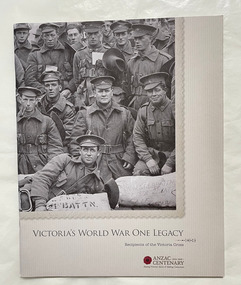
Book, Victorian Government, Victoria's World War One Legacy : Recipients of the Victoria Cross : ANZAC centenary, 2014-2018 sharing Victoria's stories & making connections, 2014
... Australian Army Soldiers World War One Victoria Cross military decorations The following 26 stories are about outstanding valour on the battlefields of the Great War. ...The following 26 stories are about outstanding valour on the battlefields of the Great War. They tell the story of men who were recipients of the Victoria Cross, the British Empire’s highest award for bravery in wartime, and now Australia’s pre-eminent award for conspicuous gallantry in combat. Inside cover.31 pages : portraits Includes bibliographical references.non-fictionThe following 26 stories are about outstanding valour on the battlefields of the Great War. They tell the story of men who were recipients of the Victoria Cross, the British Empire’s highest award for bravery in wartime, and now Australia’s pre-eminent award for conspicuous gallantry in combat. Inside cover.australian army, soldiers, world war one, victoria cross, military decorations -
 The Beechworth Burke Museum
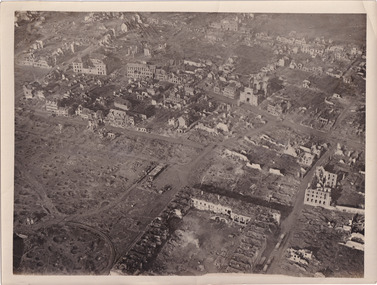
Photograph, c1914
... Aerial photograph of a battle field in France during World War One Military Album Burke Museum Beechworth Beechworth Museum World War War WWI Trenches Aerial Photo Battlefield Reverse: 6534 / Australian Official Photographs, No. ...Aerial photograph of a battle field in France during World War OneBlack and white rectangular photograph printed on photographic paperReverse: 6534 / Australian Official Photographs, No. E1253 /military album, burke museum, beechworth, beechworth museum, world war war, wwi, trenches, aerial photo, battlefield -
 Ringwood and District Historical Society
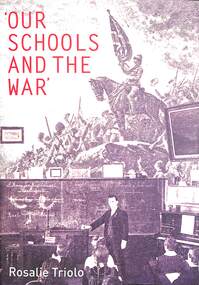
Book, Australian Scholarly Publishing Pty Ltd, Our Schools and the War - Rosalie Triolo, 2012
... She p[resents regularly to academic and general audiences on different aspects of the Great War and Australian education, and has led battlefield tours for History teachers as well as Australian History fellowships for student-teachers. ...She p[resents regularly to academic and general audiences on different aspects of the Great War and Australian education, and has led battlefield tours for History teachers as well as Australian History fellowships for student-teachers. ...Rosalie Triolo presented Our Schools and the War as Ringwood and District Historical Society guest speaker - June, 2022. Dr Rosalie Triolo is the History Method lecturer in the Faculty of Education at Monash University and is active as a writer and presenter in state and national History Education communities. She taught for 13 years in country and metropolitan Victorian government secondary schools, and has been involved for 30 years with the History Teachers’ Association of Victoria. She p[resents regularly to academic and general audiences on different aspects of the Great War and Australian education, and has led battlefield tours for History teachers as well as Australian History fellowships for student-teachers. The doctorate on which this book is based was awarded a Monash University Mollie Holman medal.Soft cover book detailing how The Great War profoundly touched the lives of Australian teachers, school children, and local communities.Handwritten inscription - For RDHS, Congratulations on all you are doing so well. Sincerely, Rosalie Triolo, June 2022. -
 Montmorency–Eltham RSL Sub Branch
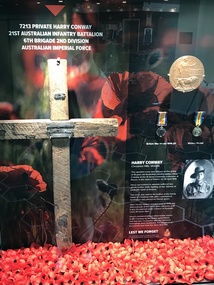
Memorabilia - WW1 Wooden Cross
... battlefields in WW1 Pte. Henry Conway was a resident of the Christmas Hills district, north of Montmorency, on enlistment; after the war, the cross was returned to his parents in Christmas Hills Stamped on metal strips: 7213 Pte. H. CONWAY 21ST AUSTRALIAN ...Temporary cross erected in memory of fallen soldiers in the cemeteries in battlefields in WW1Pte. Henry Conway was a resident of the Christmas Hills district, north of Montmorency, on enlistment; after the war, the cross was returned to his parents in Christmas HillsWooden CrossStamped on metal strips: 7213 Pte. H. CONWAY 21ST AUSTRALIAN (unfinished label) 28TH APRIL 1918 -
 Lorne Historical Society
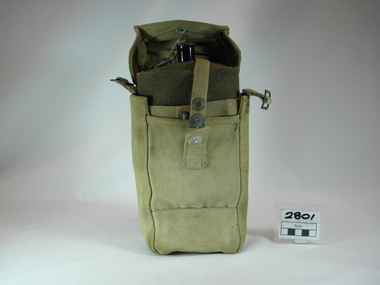
Equipment - Water bottle in pouch, S. and U. Ltd, 1943
... This water bottle and pouch used in New Guinea in WW2 by Mr W.Norton of Lorne Victoria An item of national significance, used in WW2 battlefields, and carried and used by an Australian soldier. ww2 papua new guinea soldier water bottle pouch khaki w. norton lorne Stamped, inside upper rear, "S and U Ltd, 1943" WW2 canvas pouch for water bottle, including water bottle with cork, and belt loops. ...This water bottle and pouch used in New Guinea in WW2 by Mr W.Norton of Lorne Victoria An item of national significance, used in WW2 battlefields, and carried and used by an Australian soldier.WW2 canvas pouch for water bottle, including water bottle with cork, and belt loops.Stamped, inside upper rear, "S and U Ltd, 1943"ww2, papua new guinea, soldier, water bottle, pouch, khaki, w. norton, lorne -
 Bendigo Military Museum
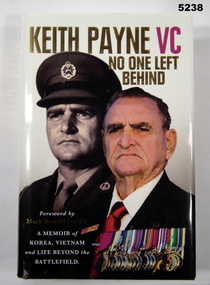
Book - BOOK, AUTOBIOGRAPHY, KEITH PAYNE V.C, Keith Payne VC, "NO ONE LEFT BEHIND", 2021
... Battlefield. Foreword by Mark Donaldson VC Author - Keith Payne VC with Tony Park. Books History Autobiography Hard cover book with dust cover. Hardcover - cardboard, black colour buckram, white print on spine. Dust cover - paper, gold, white, black, pink print on front, spine, back and front and back flaps. Front and back illustrated with collection of three portrait photographs, two front, one back. 432 pages - paper- cut, plain, off white, illustrated colour, black and white photographs. End papers - crimson colour. "NO ONE LEFT BEHIND" Book BOOK, AUTOBIOGRAPHY, KEITH PAYNE V.C. Keith Payne VC Pan Macmillan Australia ...Keith Payne VC/ NO ONE LEFT/ BEHIND. A Memoir of Korea, Vietnam and Life Beyond the Battlefield. Foreword by Mark Donaldson VC Author - Keith Payne VC with Tony Park.Hard cover book with dust cover. Hardcover - cardboard, black colour buckram, white print on spine. Dust cover - paper, gold, white, black, pink print on front, spine, back and front and back flaps. Front and back illustrated with collection of three portrait photographs, two front, one back. 432 pages - paper- cut, plain, off white, illustrated colour, black and white photographs. End papers - crimson colour.books, history, autobiography -
 Bendigo Military Museum
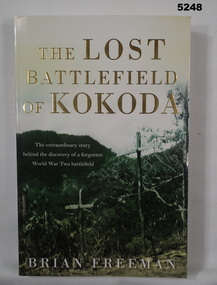
Book - BOOK, KOKODA BATTLEFIELD DISCOVERY, Brian FREEMAN, The Lost Battlefield of Kokoda, 2012
... The Lost Battlefield of Kokoda Book BOOK, KOKODA BATTLEFIELD DISCOVERY Brian FREEMAN Pan Macmillan Australia Pty Limited McPherson's Printing Group ..."The Lost/ Battlefield/ Of Kokoda/ The extraordinary story/ behind the discovery of a forgotten/ World War Two Battlefield."Soft cover book. Soft cover - cardboard, gold, white and dark green print on front, spine and back. Illustrated - green tones - photograph of jungle scene with 2 timber crosses in foreground. 269 Pages - paper, plain, cut, white, illustrated - colour photographs.books, history, ww2, kokoda -
 Bendigo Military Museum
Photograph - WW1 PHOTOGRAPHS, c.1917
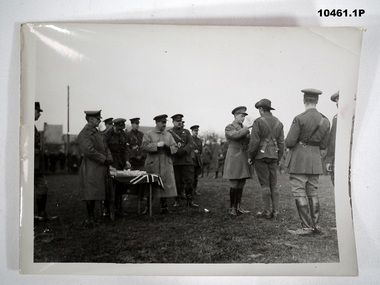
... Battlefields WW1. Part of the collection of William (Bill) Thomason. Refer Cat No. 4136P. Photographs WW1 Collection of William (Bill) Thomason On back of all is "R. Wright". Detailed description on back of photos Series of black and white photos from WW1. 1. Photo of the Prince of Wales (Edward VIII) investing an Australian ...Photos from France & Belgium Battlefields WW1. Part of the collection of William (Bill) Thomason. Refer Cat No. 4136P.Series of black and white photos from WW1. 1. Photo of the Prince of Wales (Edward VIII) investing an Australian Soldier with a medal in France 1916. 2. Photo of some rifles leaning against a brick house bombed out and an ANZAC sign on it. Between Zonnebeke and Polygon Wood, Belgium 1917. 3. Photo of a bombed out road with some horses and carts. Sign identifies it as Hell Fire Corner which was at Menin Road near Ypres, Belgium 1916-17 when German guns ranged up on the corner.On back of all is "R. Wright". Detailed description on back of photosphotographs, ww1, collection of william (bill) thomason -
 Bendigo Military Museum
Book - MILITARY JOURNAL
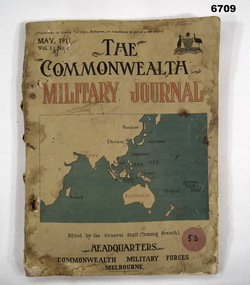
... Battlefield Donations. Cover has Commonwealth Emblem, Title, Volume No. and map covering Asian, African and Australian Zones. ...Battlefield Donations. Cover has Commonwealth Emblem, Title, Volume No. and map covering Asian, African and Australian Zones. ...Journal issued by Commonwealth General Staff covering various aspects of Military Activities. Used as a training source by Military Servicemen.Brown A.4 size book with 201 pages issued May 1911 whose contents cover various aspects of Military Battlefield Donations. Cover has Commonwealth Emblem, Title, Volume No. and map covering Asian, African and Australian Zones. Military Journal in Red, large metal staples.Headed "The Commonwealth Military Journal Vol 1, May 1911. "Edited by General Staff (Training Branch), Commonwealth Military Forces Melbourne".passchendaele barracks trust, book, military training, ww1 -
 Bendigo Military Museum
Photograph - WW1 CARD SERIES, Magpie Cigarettes, Post WW1
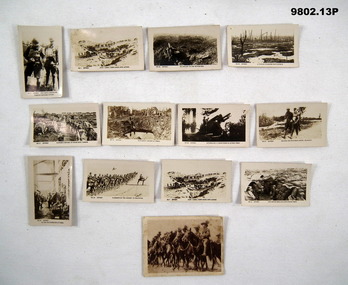
... Australian Camel Corps going into action. 3. "We fought to the bitter end." 4. A typical Flanders Battlefield. 5. ...Australian Camel Corps going into action. 3. "We fought to the bitter end." 4. A typical Flanders Battlefield. 5. ...Photos were issued as collectable cards with funds raised going to fund the War Memorial.Collectable Black and white photos from Magpie Cigarettes with ads on back in brown writing. 1. Preparing a Bangalore torpedo to cut wire. 2. Australian Camel Corps going into action. 3. "We fought to the bitter end." 4. A typical Flanders Battlefield. 5. Support moving up to Idiot Corner. 6. A gigantic crater at Ypres. 7. Aust. 9.2" Howitzer in action Ypres. 8. Helping his wounded enemy Messines. 9. Old barracks at Ypres. 10 Warships of the desert Palestine (Camels). 11 Aust. Camel Corp going into action. 12. Uncomfortable dugouts in Ypres. 13 Empire Defence Series cards showing Australian Light Horsemmen. Description of each card as above.collectable cards, official war photographs, ww1 -
 Bendigo Military Museum
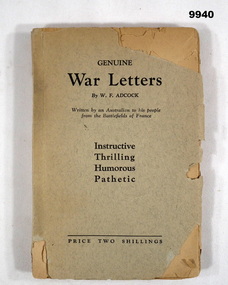
Book - GENUINE LETTERS WW1, The National Press, Post WW1
... Genuine War Letters written by an Australian to his people from the Battlefields of France. Letters date from 15th February 1916 to 11th November 1918....ADCOCK” [italic]/Written by an Australian to his people/from the Battlefields of France [italic]/Instructive/Thrilling/Humorous/Pathetic/[under a black line] PRICE TWO SHILLINGS" Verso: Printer's logo in black in bottom right corner. ...Genuine War Letters written by an Australian to his people from the Battlefields of France. Letters date from 15th February 1916 to 11th November 1918. ...Genuine War Letters written by an Australian to his people from the Battlefields of France. Letters date from 15th February 1916 to 11th November 1918.Book is a paperback, bound in thin brown cardboard with black flecks. 288 pages - some not cut through or separated. No illustrations.Printed in black. Recto: "GENUINE/War Letters/By W. F. ADCOCK” [italic]/Written by an Australian to his people/from the Battlefields of France [italic]/Instructive/Thrilling/Humorous/Pathetic/[under a black line] PRICE TWO SHILLINGS" Verso: Printer's logo in black in bottom right corner. "The/National/Press/34 LONSDALE/STREET/MELBOURNE/in 1919" ww1, letters, book, genuine -
 Bendigo Military Museum
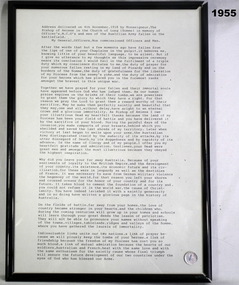
Literary work - DOCUMENT, FRAMED, RSL Bendigo Military Museum, c.2000
... In memory of Officers, NCO's and men of the Australian Army fallen on the battlefield....In memory of Officers, NCO's and men of the Australian Army fallen on the battlefield. Literary work DOCUMENT, FRAMED RSL Bendigo Military Museum ...Full A4 size typed transcript of the Bishop of Amiens address given on 4 Nov 1918 in the Church of Long (Somme). In memory of Officers, NCO's and men of the Australian Army fallen on the battlefield.documents-speech transcripts, amiens -
 Bendigo Military Museum
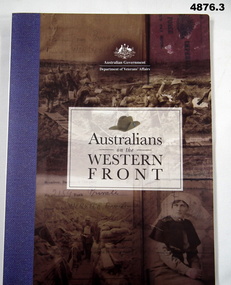
Booklet, Department of Veterans Affairs, Australians on the Western Front, 2006
... battlefield photographs. Back - one street scene photograph. 99 Pages - cut, plain, white paper. Illustrated black and white, sepia and colour photographs, maps and diagrams. .2 CD-ROM enclosed in plastic pocket, front cover. .3 Poster - white print, illustrated black and white, and colour montage photographs for 25 APRIL 2006, Commonwealth Coat of Arms top, folded. Australians ...Booklet, CD-ROM, Poster .1 Hardcover booklet, plastic with metal spiral bound pages. Cover - black and white print on front, spine and back. Illustrated, sepia colour. Front - collection three battlefield photographs. Back - one street scene photograph. 99 Pages - cut, plain, white paper. Illustrated black and white, sepia and colour photographs, maps and diagrams. .2 CD-ROM enclosed in plastic pocket, front cover. .3 Poster - white print, illustrated black and white, and colour montage photographs for 25 APRIL 2006, Commonwealth Coat of Arms top, folded.wwi, anzac day, documents - education
