
Showing 25 items matching "bay chapel"
-
 Victorian Harness Racing Heritage Collection at Lord's Raceway Bendigo
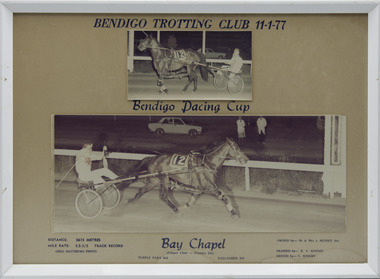
Photograph - Framed photo finish, Greg Matthews Photo, Bay Chapel, 11 January 1977
... Bay Chapel......bay chapel...Bay Chapel won the Bendigo Pacing Cup on the 11 January 1977, followed by Purple Para and Gallagher. ...At the top: Bendigo Trotting Club 11-1-77/ Bendigo Pacing Cup At the bottom: Left corner: Distance 2615 metres/ Mile rate 2.5.3/5 /Track Record / Greg Matthews Photo Centre: Bay Chapel (Chapel Chief - Princess Del) / Purple Para 2nd / Gallagher 3rd Right corner: Owned by- Mr & Mrs J Hussey Jnr/ Trained by RV Knight/ Driven by - V Knight...Bay Chapel won the Bendigo Pacing Cup on the 11 January 1977, followed by Purple Para and Gallagher. ...Bay Chapel won the Bendigo Pacing Cup on the 11 January 1977, followed by Purple Para and Gallagher. Bay Chapel owned by Mr & Mrs J Hussey Jnr, was trained by RV Knight, driven by V Knight. Bay Chapel raced from 1973 (2yo) through to 197 (8yo). Career: 23 wins 14 seconds 17 thirds 132 starts. Refer to Identifier 15.035 (Media) for Full Career Performance Record.Two colour photographs, one small one large in a white frame. At the top: Bendigo Trotting Club 11-1-77/ Bendigo Pacing Cup At the bottom: Left corner: Distance 2615 metres/ Mile rate 2.5.3/5 /Track Record / Greg Matthews Photo Centre: Bay Chapel (Chapel Chief - Princess Del) / Purple Para 2nd / Gallagher 3rd Right corner: Owned by- Mr & Mrs J Hussey Jnr/ Trained by RV Knight/ Driven by - V Knightbendigo harness racing club, horses, race, winner, bendigo trotting club, pacing cup, driver, trainer, owner, 1977, bay chapel, rv knight, mr & mrs j hussey jnr, purple para, gallagher, vj knight, vin knight, bob knight -
 Victorian Harness Racing Heritage Collection at Lord's Raceway Bendigo
Document - Record, Harness Horse, Bay Chapel
... Bay Chapel......bay chapel...Bay Chapel Document Record, Harness Horse ...Stephen Spark compiled horses performance records starting in 1983 on his typewriter. Bay Chapel raced from 1973 (2yo) through to 1979 (8yo). Career: 23 wins 14 seconds 17 thirds 132 starts.Typed document in black and red ink.harness racing, australasian harness racing, horse career, performance records, bendigo harness racing club, bhrc, bay chapel, vin knight, vj knight, rv knight, bob knight -
 Federation University Historical Collection
Book, Art Decoration Ornaments
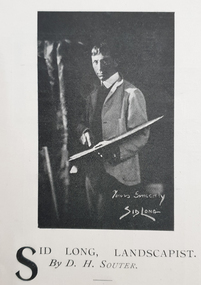
... ...rose bay convent chapel...ballarat technical art school ballarat technical art school library bank of australasia mount kosciusko siry henry parkes pyrmont bridge maori ancient egypt julian ashton st andrew'e cathedral sydney edmond thomas blacket sydney university comisariat stores circular quay the rocks w. lister-lister sydney domestic architecture james barnet john horbury hunt sidney long maori art wall decoratoni paperhangings australian stained glass art and architecture stamped metalwork w.c. piguenit australian architecture rose bay convent chapel australian posters pottery cyril blacket bookbinding new south wales state library architecture oxford st sydney'tom roberts repousse sydney harbour bridge john longstaff women painters the great pyramid of egypt skyscraper comes to new south wales melbourne hospital plans governor bligh electric illumination Black cloth covered book with leather spine. ...Black cloth covered book with leather spine. Colour illustrationsballarat technical art school, ballarat technical art school library, bank of australasia, mount kosciusko, siry henry parkes, pyrmont bridge, maori, ancient egypt, julian ashton, st andrew'e cathedral sydney, edmond thomas blacket, sydney university, comisariat stores circular quay, the rocks, w. lister-lister, sydney domestic architecture, james barnet, john horbury hunt, sidney long, maori art, wall decoratoni, paperhangings, australian stained glass, art and architecture, stamped metalwork, w.c. piguenit, australian architecture, rose bay convent chapel, australian posters, pottery, cyril blacket, bookbinding, new south wales state library architecture, oxford st sydney'tom roberts, repousse, sydney harbour bridge, john longstaff, women painters, the great pyramid of egypt, skyscraper comes to new south wales, melbourne hospital plans, governor bligh, electric illumination -
 Federation University Historical Collection
Photograph - Lantern Slides, Boxed Lantern Slides, c1920
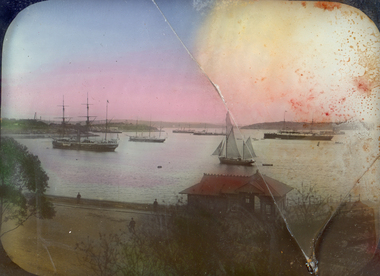
... The box contains 50 lantern slides including: * male Turk in turbin *interior of a cathedral * Cavalry Scene, Boer War (c1900) * Richard Seddon portrait * Fishermen at Sea * Turkish domed building * Eddystone Lighthouse, England * image of early printing * Cloister Court, Trinity College, Cambridge * Farm Cove, Sydney Harbour (by I.F.E) * National Park, Sydney * Customs House, Sydney * View from the Dome of St Peter's, Rome (Pre 1929) * Botanical Gardens, Sydney * Coogee Bay, NSW * Keeble College Chapel, Oxford * Holy Land - The Village of Endor * Sydney Cove * Interior portrait of members of the Victorian Legislative Assembly, Parliament House, Melbourne * Palace Dela Concord, Italy...The box contains 50 lantern slides including: * male Turk in turbin *interior of a cathedral * Cavalry Scene, Boer War (c1900) * Richard Seddon portrait * Fishermen at Sea * Turkish domed building * Eddystone Lighthouse, England * image of early printing * Cloister Court, Trinity College, Cambridge * Farm Cove, Sydney Harbour (by I.F.E) * National Park, Sydney * Customs House, Sydney * View from the Dome of St Peter's, Rome (Pre 1929) * Botanical Gardens, Sydney * Coogee Bay, NSW * Keeble College Chapel, Oxford * Holy Land - The Village of Endor * Sydney Cove * Interior portrait of members of the Victorian Legislative Assembly, Parliament House, Melbourne * Palace Dela Concord, Italy Boxed Lantern Slides Photograph Lantern Slides ...The lantern slides were most probably used at the Ballarat School of Mines. The image of Rome from St Peter's (Vatican) was taken before 1929. The "Via Conciliazione", built by Mussolini in 1929 is not present in the image. Hinged timber box designed to hold glass lantern slides. The box contains 50 lantern slides including: * male Turk in turbin *interior of a cathedral * Cavalry Scene, Boer War (c1900) * Richard Seddon portrait * Fishermen at Sea * Turkish domed building * Eddystone Lighthouse, England * image of early printing * Cloister Court, Trinity College, Cambridge * Farm Cove, Sydney Harbour (by I.F.E) * National Park, Sydney * Customs House, Sydney * View from the Dome of St Peter's, Rome (Pre 1929) * Botanical Gardens, Sydney * Coogee Bay, NSW * Keeble College Chapel, Oxford * Holy Land - The Village of Endor * Sydney Cove * Interior portrait of members of the Victorian Legislative Assembly, Parliament House, Melbourne * Palace Dela Concord, Italylantern slides, entertainment, ballarat school of mines, boer war, richard seddon, sydney harbour, coogee beach, legislative assembly, rome, roma, vatican, vaticono, fairyland, lake wendouree, glass slide, lantern slide -
 Flagstaff Hill Maritime Museum and Village
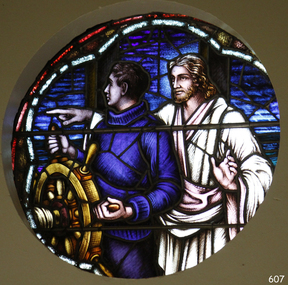
Artwork, other - Window, Brooks, Robinson & Co, Christ Showing the Helmsman the Way, circa August 1947
... chapel. This stained glass window is historically significant for its connection to the St Nicholas Mission to Seamen's Church in Williamstown, established in 1857 to cater for the physical, social, and spiritual needs of seafarers. It was donated to the Mission by the Lightkeepers Auxiliary (Ladies Harbour Lights Guild, which was formed in 1905). The Missions to Seamen organisation had its origins in Bristol, England, when a Seamen's Mission was formed in 1837. The first Australian branch was started in 1856 by the Rev. Kerr Johnston, a Church of England clergyman, and operated from a hulk moored in Hobson’s Bay ...This round, stained glass window, titled "Christ Showing the Helmsman the Way", was also referred to as the Sanctuary Window or Memorial window. It was installed in the St Nicholas Seamen's Church at 139 Nelson Place, Williamstown, Victoria, inside the chapel above the altar. This memorial window has significance as a part of Victoria's War Heritage and is listed on the Victorian Heritage Database. The window and subsequent plaque were donated to St Nicholas Seamen’s Church as a memorial to the members of the Merchant Navy whose lives were lost in the Second World War, 1939-1945. The donor was the Williamstown Lightkeepers Auxiliary, an independent ladies' association working with the Williamstown Missions to Seamen (the Missions to Seamen organisation was re-named the Mission to Seafarers in the year 2000). The window was officially dedicated on December 14, 1947, by Geelong's Anglican Bishop, Rt. Rev. J.D. McKie. In the early months of 1948, a bronze plaque was also placed in the chapel above the altar. It recognises the lost souls of the Merchant Navy during World War 2, as well as the donor of the window, the Williamstown Lightkeepers Auxiliary. The inscription impressed on the rectangular bronze plaque, 20.4 x 10.2cm, is as follows: “IN MEMORY OF THE MEMBERS OF THE MERCHANT NAVY WHO WERE LOST IN THE SECOND WORLD WAR 1939-1945 FAITHFUL UNTO DEATH. THE WINDOW ABOVE THE ALTAR WAS ERECTED BY THE WILLIAMSTOWN LIGHTKEEPERS AUXILIARY 1947.” The Williamstown St Nicholas Seamen’s Church ceased operation in 1966. In 1979, the Victoria Missions to Seamen donated this round, stained glass window and the memorial plaque to Flagstaff Hill Maritime Village, along with many other items and furnishings. These items have been used to simulate the Williamstown Mission and Chapel as much as possible. The round space that formerly displayed the window can still be seen at the back of the old St Nicholas Seamen’s Church, previously the ES&A bank, in Williamstown. THE MISSIONS TO SEAMEN (Brief History): - The Missions to Seamen was an Anglican charity in Great Britain that has served the world's seafarers since 1856. Its symbol is a Flying Angel, inspired by a Bible verse. Today, there are centres in over 200 ports worldwide where seamen of all backgrounds are offered a warm welcome and provided with a wide range of facilities. In Victoria, the organisation began in Williamstown in 1857 as a Sailors’ Church, also known as ‘Bethel’ or the ‘Floating Church’ in an old hulk floating in Hobson’s Bay, Port of Melbourne. It soon became part of the Missions to Seamen, Victoria. In 2000, the organisation, now named Mission to Seafarers, still operated locally in Melbourne, Portland, Geelong and Hastings. The Ladies’ Harbour Lights Guild was formed in 1906 to support the Missions to Seamen in Melbourne and other centres, such as Williamstown. Two of the most significant ladies of the Guild were founder Ethel Augusta Godfrey and foundation member Alice Sibthorpe Tracy (who established a branch of the Guild in Warrnambool in 1920). The Guild continued its work until the 1960s. In 1943, a former Williamstown bank was purchased for the Missions to Seamen Club. The chapel was named St Nicholas’ Seamen’s Church and was supported by the Ladies’ Harbour Lights Guild, the Williamstown Lightkeepers’ Auxiliary and the League of Soldiers’ and Sailors’ Friends. It ceased operation in 1966. A Missions to Seamen Chapel and Recreation Room was a significant feature of ports during the late 1800s and 1900s. It seemed appropriate for Flagstaff Hill to include such a representation within the new Maritime Village, and the Melbourne Board of Management of Missions to Seamen Victoria gave its permission on 21st May 1979 for the entire furnishings of the Williamstown chapel to be transferred to Flagstaff Hill. The St Nicholas Seamen’s Church was officially opened on October 11, 1981, and resembles the Williamstown chapel. This stained glass window is historically significant for its connection to the St Nicholas Mission to Seamen's Church in Williamstown, established in 1857 to cater for the physical, social, and spiritual needs of seafarers. It was donated to the Mission by the Lightkeepers Auxiliary (Ladies Harbour Lights Guild, which was formed in 1905). The Missions to Seamen organisation had its origins in Bristol, England, when a Seamen's Mission was formed in 1837. The first Australian branch was started in 1856 by the Rev. Kerr Johnston, a Church of England clergyman, and operated from a hulk moored in Hobson’s Bay. Later, the Mission occupied buildings in Williamstown and Port Melbourne. The connection of this window, the Mission to Seamen and the Ladies Harbour Lights Guild highlights the strong community awareness of the life of people at sea, their dangers and hardships, and their need for physical, financial, spiritual and moral support. This memorial window is significant as a part of Victoria's War Heritage and is listed on the Victorian Heritage Database, Heritage Number 196973.Window, stained glass, circular, with reinforcing bars. The window represents Christ showing the helmsman the way. It shows a man in blue knitted jumper holding onto a ship's wheel, looking over his right shoulder. Behind him stands a man in a white robe, pointing to his right and looking to his left, his left hand gesturing to pause. The background has various shapes and patterns of blue glass, bordered by two arcs; the outer one is white, the inner one is red. This beautiful window is in our St Nicholas Seamen's Church Collection and was brought to Warrnambool from the original St Nicholas Seamen’s Church in Williamstown. flagstaff hill, warrnambool, shipwrecked coast, flagstaff hill maritime museum, maritime museum, shipwreck coast, flagstaff hill maritime village, great ocean road, mission to seamen williamstown, st nicholas seaman’s church williamstown, missions to seamen victoria, mission to seafarers, lightkeepers auxiliary, ladies harbour light guild, 139 nelson place williamstown, religion, religious service, sailors rest, bethel sailors’ church, bethel floating church, e. s. & a. bank williamstown, christ directing a sailor, christ showing the helmsman the way, quartermaster’s hand on the wheel, stained glass window, church window, religious window, sanctuary window, memorial window, war memorial window, victorian war heritage inventory, victorian heritage database, merchant navy ww2, 1939-1945, anglican church, bishop mckie, mrs musther, brooks robinson & co, flying angel club, williamstown lightkeepers' auxiliary, ladies' harbour lights guild, commemorative window -
 Flagstaff Hill Maritime Museum and Village
Photograph - Historical, religious, mid-20th century
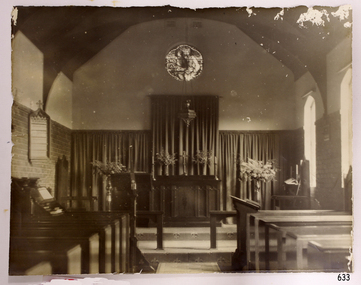
... Bay, Port of Melbourne. In 1860, a Sailors’ Rest started operating from rented premises in Williamstown. In 1878, the Sailors’ Church moved into an old Wesleyan chapel in Ann Street. ...Bay, Port of Melbourne. In 1860, a Sailors’ Rest started operating from rented premises in Williamstown. In 1878, the Sailors’ Church moved into an old Wesleyan chapel in Ann Street. ...This photograph records the interior of St Nicholas Seamen's Church at 139 Nelson Place, Williamstown, Victoria, which was purchased and furnished around 1943. The furniture and furnishings are now part of the St. Nicholas Seamen's Church collection. HISTORY of the Missions to Seamen: - DETAILED HISTORY of the Missions to Seamen: - The Missions to Seamen is an Anglican (Church of England) charity that has served the world’s seafarers since 1856. It was inspired by the work of Rev. John Ashley, who, 20 years earlier, had pioneered a ministry to seafarers in the Bristol Channel in Great Britain. When Ashley retired, others continued the work, founding the Missions to Seamen. It adopted a Flying Angel as its symbol, inspired by a verse from the Bible in Revelation 14. Today, over 200 world ports have Missions to Seamen centres and chaplains. A Missions to Seamen’s Club warmly welcomes sailors of all colours, creeds and races and provides a wide range of facilities. The Missions to Seamen organisation changed its name to the Mission to Seafarers in 2000, continuing to include Missions to Seamen clubs in Victoria’s cities of Melbourne, Portland, Geelong and Hastings. Flagstaff Hill’s St Nicholas’ Seamen’s Church is named after its namesake from Williamstown, Victoria, which began in 1857. Bishop Perry opened the first Sailors’ Church there, known as ‘Bethel’, on an old hulk floating in Hobson’s Bay, Port of Melbourne. In 1860, a Sailors’ Rest started operating from rented premises in Williamstown. In 1878, the Sailors’ Church moved into an old Wesleyan chapel in Ann Street. By the end of that year, they managed to purchase the building, which they had already refurbished. In 1883, they affiliated with the Victorian Seamen’s Mission. A few years later, in 1906, the building had to be demolished because it was no longer safe. While they raised funds for a new building, the Sailors’ Rest temporarily moved to premises in front of Customs House in Nelson Place. Around this time, in 1906, the Ladies Harbour Lights Guild was formed in Australia to support and raise funds for the Mission to Seamen organisation in Melbourne. Two of the most significant ladies of the Guild were founding members Ethel Godfrey and Alice Sibthorpe. During the Mission's time at Siddeley Street, Melbourne, the activities of the Guild raised funds for the Mission to Seamen's Chapel at their new, and still current, premises in Flinders Street, Melbourne, opened in 1917. The Guild continued its important work until the 1960s. In 1908, the Williamstown Mission had enough money to purchase the former Mascotte skating rink on Thompson Street, Williamstown. In August of that year, they were inaugurated into the Victorian Missions to Seamen. They continued at that venue for a few decades. In 1943, the former ES&A Bank building at 139 Nelson Place, Williamstown, was purchased to become the new Mission to Seamen’s Club. On May 6th, 1944, it was officially opened, described as a ‘distinctive little building’. Funds had previously been raised for the building and furnishing of the chapel at the rear. The chapel was named St Nicholas’ Seamen’s Church, after St Nicholas, fourth-century bishop and patron saint of sailors. Services were held on Wednesdays and Sundays. The church was supported by the Williamstown Lightkeepers’ Auxiliary, newly founded by Mrs Ethel Margaret Musther in 1943, as well as the Harbour Lights Guild and the League of Soldiers’ and Sailors’ Friends. The Williamstown Mission to Seamen’s Church operated until 1966, when large international ships no longer used the Port of Williamstown. The Commonwealth Government then leased the premises. In the formative years of Flagstaff Hill Maritime Village, the Advisory Board decided to include a Missions to Seamen Chapel and Recreation Room in its village. The Missions organisation was a significant feature of ports during the late 1800s and early 1900s, the period that the Village represents. They often erected Missions to house social and worshipful activities for seamen. Flagstaff Hill’s curator, Mr Ken Marshman, approached the Melbourne Board of Management of Missions to Seamen regarding the Williamstown branch. Consequently, the Board permitted the furnishings of the Williamstown chapel to be transferred to Flagstaff Hill Maritime Village. A provision of the transfer was that the Victoria Missions to Seamen be recognised, that the items would remain as a collection, and that the chapel would be called St Nicholas Seamen’s Church and conduct Divine services. The donation was approved on 21st May 1979. Flagstaff Hill's St. Nicholas Seamen's Church: - The idea behind Flagstaff Hill’s Missions to Seamen’s Church was partly driven by the offer of Stained Glass Memorial Windows that originated from the Warrnambool and District Base Hospital, which was undergoing multi-storey expansion in the late 1960s and early 1970s. The hospital’s Manager/Secretary was eager to see the historic window installed in a suitable place. The church, or chapel, was designed by a local architectural draftsman in collaboration with the Flagstaff Hill Planning Board and was constructed by Mr Leon Habel. The designers hoped that the church would be used for formal worship such as weddings, funerals, and multi-denominational special services like war commemorations. The design is inspired by the ‘Missions to Seamen’ buildings in Portland and the Port of Melbourne. The furniture and furnishings were placed as accurately as possible according to photographs of the Williamstown St Nicholas Seamen’s Church and with assistance from local clergy. The Recreation Room was furnished and arranged on advice from experienced members of the Missions to Seamen organisation. A framed document in the building recognises the donor of the furnishings, Victoria Missions to Seamen, and includes the names of some original donors and their donated item/s. The building’s design incorporates local features such as Warrnambool sandstone, which was no longer commercially available but was procured from demolished buildings and uniformly cut to use as a veneer over the stronger Mt. Gambier stone. Also, traditional green American roofing slate was used, sourced from the 1908 local shipwreck “Falls of Halladale” by Flagstaff Hill volunteer divers. The bell tower includes a bell believed to be from a local shipwreck. Additional furnishings were acquired locally, along with several items donated by Warrnambool residents. Light fittings in both rooms were assembled to simulate 19th-century gas light fittings. The stained-glass window at the back of the church is a memorial to Dr Connell, a well-respected member of the Warrnambool community. It was originally installed in 1928 in the main building of Warrnambool Hospital. The St Nicholas’ Seamen’s Church at Flagstaff Hill was officially opened by His Worship the Mayor, Cr. John Lindsay, on Sunday, 11th October 1981. The event included a service of thanksgiving conducted by the Warrnambool Ministers Fraternal. Since then, the Chapel has been the historic venue for many weddings. This photograph is significant through its association with the St Nicholas' Mission to Seamen Church in Williamstown, Melbourne, established in 1857. The building in the photograph is the former English, Scottish and Australian Bank (ES&A bank), also known as the Mission to Seamen. It is listed on the Victorian Heritage Database for having local historic and aesthetic interest. Photograph of St Nicholas Seamen's Church, Williamstown. Sepia photograph. The photograph shows the inside of the Chapel of Mission to Seamen, including organ, pews and other furniture and furnishings. There is a circular stained glass window high on the back wall depicting a sailor at the helm of a ship and a man standing behind him and pointing the way - "Christ Showing The Helmsman The Way". A Sanctuary Light is suspended from the ceiling. The Sanctuary chars are visible. This shows the St Nicholas Seamen's Church in Williamstown, the furnishings and furniture of which is now part of the St Nicholas Seamen's Church Collection’.flagstaff hill, warrnambool, shipwrecked-coast, flagstaff-hill, flagstaff-hill-maritime-museum, maritime-museum, shipwreck-coast, flagstaff-hill-maritime-village, st nicholas mission to seamen's church williamstown, mission to seamen williamstown, mission to seamen victoria, st nicholas mission to seamen, chapel window, christ showing the helmsman the way, stained glass window, st nicholas seamen's church, religion, religious service, sailor's rest, ladies harbour light guild -
 Mission to Seafarers Victoria
Equipment - Ship bell, Vickers, Barrow, SS Moreton Bay, 1920-1921
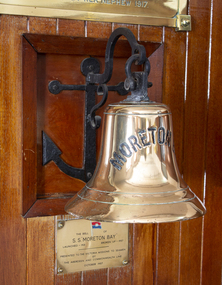
... In the Annual Report 1957, Padre Oliver mentioned "the bell was found unsuited for the chapel belfry, it is to be mounted on a bracket and placed in the Celia Little lounge." bell anchor brass ss moreton bay ship's bell plaque celia little room bracket p&o peninsular and oriental steam navigation company passengers liners passenger ships emigrants emigration Bell inscribed with upper case capital letters MORETON BAY. / Also brass presentation wall plaque (see image) Cast brass bell with wrought iron anchor and hook design wall mount: decoratively plaited cord in maritime knot pattern to resemble chain, sealed with a varnish and attached to cast iron clapper. ...The Bell was presented to the Mission by the Aberdeen and Commonwealth Line in October 1957, after the ship made her final voyage to Australia in 1956 and it was broken up in Barrow in April 1957 by Thomas W Ward (UK). In the Annual Report 1957, Padre Oliver mentioned "the bell was found unsuited for the chapel belfry, it is to be mounted on a bracket and placed in the Celia Little lounge."Cast brass bell with wrought iron anchor and hook design wall mount: decoratively plaited cord in maritime knot pattern to resemble chain, sealed with a varnish and attached to cast iron clapper. Wrought iron hook secured by metal bolt. Bell is inscribed in upper case capital letters with MORETON BAY. Anchor attached with four flat headed hexagonal bolts with mighted wooden frame. Bell inscribed with upper case capital letters MORETON BAY. / Also brass presentation wall plaque (see image)bell, anchor, brass, ss moreton bay, ship's bell, plaque, celia little room, bracket, p&o, peninsular and oriental steam navigation company, passengers liners, passenger ships, emigrants, emigration -
 Mission to Seafarers Victoria
Article - Newspaper clipping, Argus newspaper, Seamen's floating church in Hobson's Bay, 2 July 1857
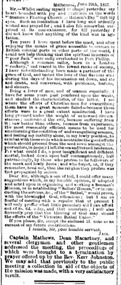
... chapel. The article is significant as it describes the ship and its location: "The hulk is moored midway between Sandridge and Williamstown, and is distinguished by a blue flag flying at the mainmast with "Bethel" inscribed on it; and in one corner of the flag is the star of Bethlehem, in another a dove with an olive branch." ship emily floating church reverend kerr johnston, 1812-1887 hobson's bay sandridge captain ferguson Captain Charles Ferguson (1813-1868) convict ships 1 column article in the Argus Seamen's floating church in Hobson's Bay Article Newspaper clipping Argus newspaper ...After an attempt of building a Seamen's Hospital in Williamstown, the ship Emily was transformed in a floating chapel to welcome seamen for service. Captain Charles Ferguson (1813-1868) was one of the members of the committee who founded the floating church. The ship Emily may have been a convict ship sailing from England to the Van Diemen's land in 1842 and 1844. Before 1856, it was used as a "water police hulk" then transformed in an accommodation for Reverend Kerr Johnson and his large family and fitted to receive 200 attendees in the chapel.The article is significant as it describes the ship and its location: "The hulk is moored midway between Sandridge and Williamstown, and is distinguished by a blue flag flying at the mainmast with "Bethel" inscribed on it; and in one corner of the flag is the star of Bethlehem, in another a dove with an olive branch."1 column article in the Argusship emily, floating church, reverend kerr johnston, 1812-1887, hobson's bay, sandridge, captain ferguson, captain charles ferguson (1813-1868), convict ships -
 Mission to Seafarers Victoria
Photograph - Framed montage, Arthouse - Picture Framing & Gallery, Jervis Bay, 2013
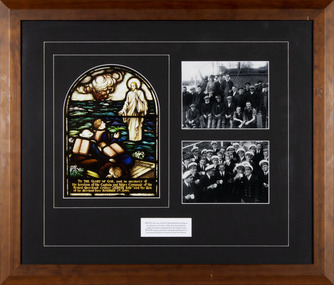
... chapel. This exhibition curated by Georgia Melville and Catherine McLay, and funded by PROV and Creative Victoria, was displayed in the World Trade Centre Wharf Gallery in June July 2013 and toured to Queenscliff Maritime Museum. The photographs of the windows were taken by scientific photographer Justine M. Philip. This frame is showcasing the memorial window to the Jervis Bay...chapel. This exhibition curated by Georgia Melville and Catherine McLay, and funded by PROV and Creative Victoria, was displayed in the World Trade Centre Wharf Gallery in June July 2013 and toured to Queenscliff Maritime Museum. The photographs of the windows were taken by scientific photographer Justine M. Philip. This frame is showcasing the memorial window to the Jervis Bay ...THE SEAS IN WARTIME During WWII, as many as 27,000 men of the merchant and the King’s navy perished during active service. Dedicated to seafarers’ wellbeing, the Mission’s spiritual roots also make it a place for reflection on the loss of human life at sea. The Mission to Seafarers’ ministry offers its support in hundreds of seaports around the world, and has played an important role in supporting those who have lost friends and family at sea during wartime. Many of the stained glass windows in the chapel are dedicated to these people, and represent many close maritime community relationships. This window was installed in 1947 in recognition of the heroism and courage of those who have served in the Merchant Navy, and in particular to those who lost their lives aboard the armed merchant cruiser, ‘Jervis Bay’. This vessel was attacked by an enemy packet battleship whilst leading an escort from Nova Scotia to the UK in 1940.Reflections of the Sea was an exhibition of 10 framed montage of photographs from the mission's archive collection showcasing 10 stained glass windows from the St Peter chapel. This exhibition curated by Georgia Melville and Catherine McLay, and funded by PROV and Creative Victoria, was displayed in the World Trade Centre Wharf Gallery in June July 2013 and toured to Queenscliff Maritime Museum. The photographs of the windows were taken by scientific photographer Justine M. Philip. This frame is showcasing the memorial window to the Jervis Bay crew, a group photograph of the seamen from the SS Siltonhall and a group photograph of seamenFramed and mounted on black cardboard of black and white and colour reproductions from the MTSV collection for the exhibition Reflections of the Sea with brief label signageon label: ABOVE: VThe crew of the SS Siltonhall found refuge at the Mission in October, 1929, after their ship had caught fire and was abandoned in the Indian Ocean BELOW: A group of seafarers enjoying refreshments at the docks provided by volunteers from the Missionreflections of the sea, georgia melville, exhibition, 2013, world trade centre, wtc, hms jervis bay, ss siltonhall, siltonhall, ww2, creative victoria, prov, mission to seafarers, stained glass windows, justine m. philip, flinders street, catherine mclay, arthouse -
 Flagstaff Hill Maritime Museum and Village
Plaque - Commemorative Plaque, circa August 1947
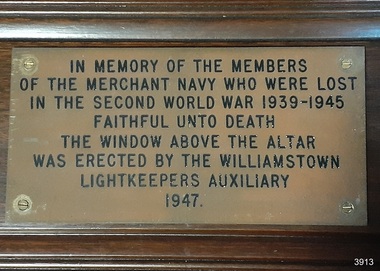
... Chapel as much as possible. THE MISSIONS TO SEAMEN: - The Missions to Seamen was an Anglican charity that served seafarers since 1856 in Great Britain. Its symbol is a Flying Angel, inspired by a Bible verse. Today, there are centres in over 200 ports worldwide where seamen of all backgrounds are offered a warm welcome and provided with a wide range of facilities. In Victoria, the orgainsation began in Williamstown in 1857 as a Sailors’ Church, also known as ‘Bethel’ or the ‘Floating Church’ in an old hulk floating in Hobson’s Bay...Chapel as much as possible. THE MISSIONS TO SEAMEN: - The Missions to Seamen was an Anglican charity that served seafarers since 1856 in Great Britain. Its symbol is a Flying Angel, inspired by a Bible verse. Today, there are centres in over 200 ports worldwide where seamen of all backgrounds are offered a warm welcome and provided with a wide range of facilities. In Victoria, the orgainsation began in Williamstown in 1857 as a Sailors’ Church, also known as ‘Bethel’ or the ‘Floating Church’ in an old hulk floating in Hobson’s Bay ...This commemorative plaque was made for the round, stained glass memorial window titled “Christ showing the helmsman the way”, originally installed at the St Nicholas Seamen’s Church in Williamstown. The window was donated as a memorial to the members of the Merchant Navy whose lives were lost in the Second World War, 1939-1945. The donor was the Williamstown Lightkeepers Auxiliary, an independent ladies' association that worked with the Williamstown Missions to Seamen (renamed the Mission to Seafarers in 2000). The window was officially dedicated on December 14, 1947, by Geelong's Anglican Bishop, Rt. Rev. J.D. McKie. In the early months of 1948, this bronze plaque was also placed in the chapel above the altar. The Williamstown St Nicholas Seamen’s Church ceased operation in 1966. In 1979, the Victoria Missions to Seamen donated this round, stained glass window and the memorial plaque to Flagstaff Hill Maritime Village, along with many other items and furnishings. These items have been used to simulate the Williamstown Mission and Chapel as much as possible. THE MISSIONS TO SEAMEN: - The Missions to Seamen was an Anglican charity that served seafarers since 1856 in Great Britain. Its symbol is a Flying Angel, inspired by a Bible verse. Today, there are centres in over 200 ports worldwide where seamen of all backgrounds are offered a warm welcome and provided with a wide range of facilities. In Victoria, the orgainsation began in Williamstown in 1857 as a Sailors’ Church, also known as ‘Bethel’ or the ‘Floating Church’ in an old hulk floating in Hobson’s Bay, Port of Melbourne. It soon became part of the Missions to Seamen, Victoria. In the year 2000, the organisation, now named Mission to Seafarers, still operated locally in Melbourne, Portland, Geelong and Hastings. The Ladies’ Harbour Lights Guild was formed in 1906 to support the Missions to Seamen in Melbourne and other centres such as Williamstown. Two of the most significant ladies of the Guild were founder Ethel Augusta Godfrey and foundation member Alice Sibthorpe Tracy (who established a branch of the Guild in Warrnambool in 1920). The Guild continued its work until the 1960s. In 1943, a former Williamstown bank was purchased for the Missions to Seamen Club. The chapel was named St Nicholas’ Seamen’s Church and was supported by the Ladies’ Harbour Lights Guild, the Williamstown Lightkeepers’ Auxiliary and the League of Soldiers’ and Sailors’ Friends. It ceased operation in 1966. A Missions to Seamen Chapel and Recreation Room was a significant feature of ports during the late 1800s and into the 1900s. It seemed appropriate for Flagstaff Hill to include such a representation within the new Maritime Village, so the Melbourne Board of Management of Missions to Seamen Victoria gave its permission on 21st May 1979 for the entire furnishings of the Williamstown chapel to be transferred to Flagstaff Hill. The St Nicholas Seamen’s Church was officially opened on October 11, 1981 and closely resembles the Williamstown chapel. This plaque is significant for its connection with the round Sanctuary window above the altar in the chapel at Flagstaff Hill. The window was originally installed at the chapel of the St Nicholas Seamen’s Church in Williamstown in 1947, and is listed on the Victorian War Heritage Inventory No. 196973 as an object of significance. The plaque is also significant for its recognition of the members of the Merchant Navy who lost their lives in service to our country during World War II. The plaque is important for its connection with the Williamstown Lightkeepers’ Auxiliary and Missions to Seamen, which were dedicated to supporting seafarers from all over the world. The funds the group raised helped to furnish the St Nicholas Seamen’s Church in Williamstown, including the Sanctuary window, pews, carpets and hangings. These items are now part of the St Nicholas Seamen's Church Williamstown Collection at Flagstaff Hill Maritime Village, Warrnambool. Plaque: rectangular brass commemorative plaque. Each corner has a round hole. Inscription impressed into the metal and filled in with black paint. Plaque refers to the memorial, a stained glass window titled "Christ Showing the Helmsman the Way," donated by the Williamstown Lightkeepers' Auxiliary to the Willimastown Missions to Seamen. This plaque is part of the St. Nicholas Seamen's Church Collection. “IN MEMORY OF THE MEMBERS / OF THE MERCHANT NAVY WHO WERE LOST / IN THE SECOND WORLD WAR 1939-1945 / FAITHFUL UNTO DEATH / THE WINDOW ABOVE THE ALTAR / WAS ERECTED BY THE WILLIAMSTOWN / LIGHTKEEPERS AUXILIARY / 1947.”flagstaff hill, warrnambool, flagstaff hill maritime museum, maritime museum, shipwreck coast, flagstaff hill maritime village, mission to seamen williamstown, st nicholas seaman’s church williamstown, missions to seamen victoria, mission to seafarers, lightkeepers auxiliary, ladies harbour light guild, 139 nelson place williamstown, religion, religious service, sailors rest, bethel sailors’ church, bethel floating church, e. s. & a. bank williamstown, christ directing a sailor, christ showing the helmsman the way, quartermaster’s hand on the wheel, stained glass window, church window, religious window, sanctuary window, memorial window, war memorial window, victorian war heritage inventory, victorian heritage database, merchant navy ww2, 1939-1945, anglican church, bishop mckie, flying angel club, williamstown lightkeepers' auxiliary, ladies' harbour lights guild, commemorative window, memorial plaque, merchant navy, ww ii, st. nicholas seamen's church -
 Flagstaff Hill Maritime Museum and Village
Textile - Seat Squabs, mid-20th century
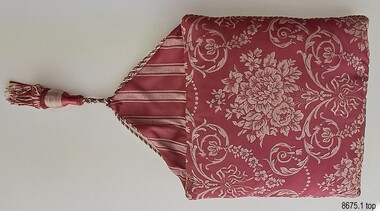
... Bay, Port of Melbourne. In 1860, a Sailors’ Rest started operating from rented premises in Williamstown. In 1878, the Sailors’ Church moved into an old Wesleyan chapel in Ann Street. ...Bay, Port of Melbourne. In 1860, a Sailors’ Rest started operating from rented premises in Williamstown. In 1878, the Sailors’ Church moved into an old Wesleyan chapel in Ann Street. ...The term 'seat squabs' is no longer commonly used, but is sometimes referred to in the upholstery and motor vehicle industries. Squabs are padded cushions frequently added to wooden chairs or benches to add comfort to their hard forms. They have been made to an 18th-to-19th-century pattern using beautiful, richly coloured satin fabric and fancy cord tassels. The weighted flap at the rear of the squabs helps to keep them in place on the chair, and could be used on the top of the backrest instead of on the seat. These days, squabs are attached with fabric ties or hook-and-loop tabs. These seat squabs were once used in the St Nicholas Seamen's Church at 139 Nelson Place, Williamstown, Victoria, which was purchased and furnished around 1943. The furniture and furnishings are now part of the St. Nicholas Seamen's Church collection. DETAILED HISTORY of the Missions to Seamen: - The Missions to Seamen is an Anglican (Church of England) charity that has served the world’s seafarers since 1856. It was inspired by the work of Rev. John Ashley, who, 20 years earlier, had pioneered a ministry to seafarers in the Bristol Channel in Great Britain. When Ashley retired, others continued the work, founding the Missions to Seamen. It adopted a Flying Angel as its symbol, inspired by a verse from the Bible in Revelation 14. Today, over 200 world ports have Missions to Seamen centres and chaplains. A Missions to Seamen’s club warmly welcomes sailors of all colours, creeds and races and provides a wide range of facilities. The Missions to Seamen organisation changed its name to the Mission to Seafarers in 2000, continuing to include Missions to Seamen clubs in Victoria’s cities of Melbourne, Portland, Geelong and Hastings. Flagstaff Hill’s St Nicholas’ Seamen’s Church is named after its namesake from Williamstown, Victoria, which began in 1857. Bishop Perry opened the first Sailors’ Church, which was known as ‘Bethel’, on an old hulk floating in Hobson’s Bay, Port of Melbourne. In 1860, a Sailors’ Rest started operating from rented premises in Williamstown. In 1878, the Sailors’ Church moved into an old Wesleyan chapel in Ann Street. By the end of that year, they managed to purchase the building, which they had already refurbished. In 1883, they affiliated with the Victorian Seamen’s Mission. A few years later, in 1906, the building had to be demolished because it was no longer safe. While they raised funds for a new building, the Sailors’ Rest temporarily moved to premises in front of Customs House in Nelson Place. Around this time, in 1906, the Ladies Harbour Lights Guild was formed in Australia to support and raise funds for the Mission to Seamen organisation in Melbourne. Two of the most significant ladies of the Guild were founding members Ethel Godfrey and Alice Sibthorpe. During the Mission's time at Siddeley Street, Melbourne, the activities of the Guild raised funds for the Mission to Seamen's Chapel at their new, and still current, premises in Flinders Street, Melbourne, opened in 1917. The Guild continued its important work until the 1960s. In 1908, the Williamstown Mission had enough money to purchase the former Mascotte skating rink on Thompson Street, Williamstown. In August of that year, they were inaugurated into the Victorian Missions to Seamen. They continued at that venue for a few decades. In 1943, the former ES&A Bank building at 139 Nelson Place, Williamstown, was purchased for the new Mission to Seaman’s Club. The official opening was on May 6th, 1944. It was described as a ‘distinctive little building’. Funds had previously been raised for the building and furnishing of the chapel at the rear. The chapel was named St Nicholas’ Seamen’s Church, after St Nicholas, fourth-century bishop and patron saint of sailors. Services were held on Wednesdays and Sundays. The church was supported by the Williamstown Lightkeepers’ Auxiliary, newly founded by Mrs Ethel Margaret Musther in 1943, as well as the Harbour Lights Guild and the League of Soldiers’ and Sailors’ Friends. The Williamstown Mission to Seamen’s Church operated until 1966, when large international ships no longer used the Port of Williamstown. The Commonwealth Government then leased the premises. In the formative years of Flagstaff Hill Maritime Village, the Advisory Board decided to include a Missions to Seamen Chapel and Recreation Room in its village. The Missions organisation was a significant feature of ports during the late 1800s and early 1900s, the period that the Village represents. They often erected Missions to house social and worshipful activities for seamen. Flagstaff Hill’s curator, Mr Ken Marshman, approached the Melbourne Board of Management of Missions to Seamen regarding the Williamstown branch. Consequently, the Board permitted the furnishings of the Williamstown chapel to be transferred to Flagstaff Hill Maritime Village. A provision of the transfer was that the Victoria Missions to Seamen be recognised, that the items would remain as a collection, and that the chapel would be called St Nicholas Seamen’s Church and conduct Divine services. The donation was approved on 21st May 1979. Flagstaff Hill's St. Nicholas Seamen's Church: - The idea behind Flagstaff Hill’s Missions to Seamen’s Church was partly driven by the offer of Stained Glass Memorial Windows that originated from the Warrnambool and District Base Hospital, which was undergoing multi-storey expansion in the late 1960s and early 1970s. The hospital’s Manager/Secretary was eager to see the historic window installed in a suitable place. The church, or chapel, was designed by a local architectural draftsman in collaboration with the Flagstaff Hill Planning Board and was constructed by Mr Leon Habel. The designers hoped the church would be used for formal worship, such as weddings, funerals, and multi-denominational special services like war commemorations. Its design was inspired by the ‘Missions to Seamen’ buildings in Portland and the Port of Melbourne. The furniture and furnishings were placed as accurately as possible according to photographs of the Williamstown St Nicholas Seamen’s Church and with assistance from local clergy. The Recreation Room was furnished and arranged on advice from experienced members of the Missions to Seamen organisation. A framed document in the building recognises the donor of the furnishings, Victoria Missions to Seamen, and includes the names of some original donors and their donated item/s. The building’s design incorporates local features such as Warrnambool sandstone, which was no longer commercially available but was procured from demolished buildings and uniformly cut to use as a veneer over the stronger Mt. Gambier stone. Also, traditional green American roofing slate was used, sourced from the 1908 local shipwreck “Falls of Halladale” by Flagstaff Hill volunteer divers. The bell tower includes a bell believed to be from a local shipwreck. Additional furnishings were acquired locally, and several items were donated by Warrnambool residents. Light fittings in both rooms were assembled to simulate 19th-century gas light fittings. The stained-glass window at the back of the church is a memorial to Dr Connell, a well-respected member of the Warrnambool community. It was originally installed in 1928 in the main building of Warrnambool Hospital. The St Nicholas’ Seamen’s Church at Flagstaff Hill was officially opened by His Worship the Mayor, Cr. John Lindsay, on Sunday, 11th October 1981. The event included a service of thanksgiving conducted by the Warrnambool Ministers Fraternal. Since then, the Chapel has been the historic venue for many weddings. This pair of seat squabs is historically significant for its origin in the St Nicholas Mission to Seamen's Church in Williamstown, established in 1857 to cater for seafarers’ physical, social, and spiritual needs. The organisation originated in Bristol, England, when a Seamen's Mission was formed in 1837. The squabs are also significant for their use in the St Nicholas Missions to Seamen's chapel, Williamstown, as the original building is now listed on the Victorian Heritage Register. Squabs or padded seat cushions, a pair of two. These 18th to 19th-century design squabs have crimson and cream satin fabric on top and underneath, and weighted tassels are attached to their rear corners. They can be used for comfort on hard seats and benches. The squabs were furnishings from the Missions to Seamen chapel in Williamstown, and they are now part of the St Nicholas Seamen's Church Collection.flagstaff hill, warrnambool, shipwrecked-coast, flagstaff-hill, flagstaff-hill-maritime-museum, maritime-museum, shipwreck-coast, flagstaff-hill-maritime-village, st nicholas mission to seamen's church williamstown, mission to seamen williamstown, mission to seamen victoria, st nicholas mission to seamen, st nicholas seamen's church, religion, religious service, sailor's rest, ladies harbour light guild, squab, seat covers, cushions, squabs, religious furnishing, padded seats, seating, accessory -
 Phillip Island and District Historical Society Inc.
Photographs, 11/1946
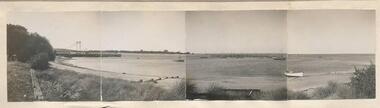
... bay...westernport...shelly beach...inverloch inlet...s.s.reliance...wildlife - seabirds...seagull...st. paul's training school newhaven, phillip island...chapel...bay. 229-54. Black & White photograph of a Sea bird sitting on top of a pole. 229-55. Black & White photograph of the Chapel at St. ...bay. 229-54. Black & White photograph of a Sea bird sitting on top of a pole. 229-55. Black & White photograph of the Chapel at St. ...Part of a collection of photographs donated by Julie Barnett. Photographs taken by Julie's In-law's whilst on their honeymoon in November 1946.229-50. Black & White panorama of 4 photographs joined together of Westernport from San Remo looking towards Newhaven. Piers with bridge in background & boats in the bay. 229-51. Black & White photograph of Shelly Beach. 229-52. Black & White photographs (2 pasted together) of Inverloch Inlet. 229-53. Black & White photograph of Westernport with S. S. Reliance in the bay. 229-54. Black & White photograph of a Sea bird sitting on top of a pole. 229-55. Black & White photograph of the Chapel at St. Paul's Training School in Newhaven, Phillip Island. 229-56. Black & White photograph of the Summerland Jetty and coastline. 229-57. Black & White photograph of a Corvette in Westernport Bay. Trees in foreground and man walking on the beach. 229-58. Black & White photograph of Westernport looking towards French Island. 229-59 to 229-62. Black & White photographs of a Koala in a tree.westernport bay, westernport, shelly beach, inverloch inlet, s.s.reliance, wildlife - seabirds, seagull, st. paul's training school newhaven, phillip island, chapel at st. paul's training school, summerland jetty phillip island, corvette westernport bay, wildlife - koala, koala -
 Mission to Seafarers Victoria
Plaque - Memorial Plaque, Ballarat Branch and Lucas Girls, 1946
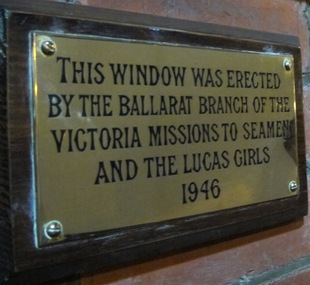
... The Ballarat Branch Committee and girls of Lucas & Co. raised the money for the memorial window in Good Chapel of Saint Peter which is dedicated to the men of the Jervis Bay and all Merchant seamen who gave their lives in the world wars. ...The Ballarat Branch Committee and girls of Lucas & Co. raised the money for the memorial window in Good Chapel of Saint Peter which is dedicated to the men of the Jervis Bay and all Merchant seamen who gave their lives in the world wars. ...The Ballarat Branch Committee and girls of Lucas & Co. raised the money for the memorial window in Good Chapel of Saint Peter which is dedicated to the men of the Jervis Bay and all Merchant seamen who gave their lives in the world wars. To see a picture of the actual window go to VC database Mtsv record 0035.Regionally based support across Victoria provided crucial funds to the Mission for Seafarer welfare, activities and operations. This support was very often sourced either through a country Auxiliary group based in places such as Ballarat, Camperdown, Hamilton, Bendigo and other similar towns or centres. Op shops and CWA, Church Auxiliaries and other similar charities mainly operated by the womenfolk of the respective communities, recognized the vital importance of 19th and 20th C Merchant and Military Naval services to the development of Australia. The cumulative local fundraising efforts helped maintain the work of the Coastal based Mission services to seafarers.Rectangular brass plaque mounted to wood board.This window was erected by the Ballarat Branch of the Victoria Missions to Seamen and the Lucas Girls 1946.ballarat, lucas girls, lucas & co., 1946, window, plaque, ww2, world war 2, textile company, lucas clothing factory -
 Mission to Seafarers Victoria
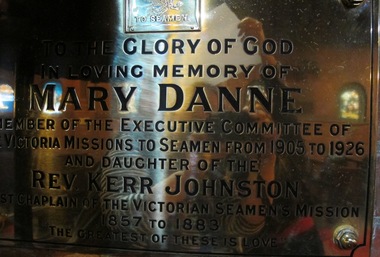
Plaque - Memorial plaque, Mary Danne, 1927
... bay...glenfern...flinders street...st peter chapel...The Reverend took up his appointment with the Victorian Bethel Union for Seamen in 1857 and moved all his family in the "floating church", the ex water police hulk Emily, first Chaplain serving the seamen in Hobsons' Bay. mary alice isabelle danne nee johnston, 1851-1926 reverend kerr johnston reverend richard vallencey danne, 1846-1904 bethel hulk emily hobson's bay glenfern flinders street st peter chapel Mission to Seamen. ...Mary was the fifth daughter of Reverend Kerr Johnston and his wife Elizabeth. Mary married Reverend Richard Vallencey Danne (1846-1904), they had 8 children. One of their son Noel also became a reverend. She continued her father's work by becoming part of the Mission's committee in 1905. On 9 November 1906, for King's Birthday, she hosted a sailors' picnic at the property she rented, Glenfern on Inkerman Road (see item 1637), where she was running a school, Newington. She died on the 30th of July 1926 at her residence, Seymour Grove in Camberwell. The plaque was erected on the 9 October 1927 (AR 1927).The Kerr Johnston Family migrated to Tasmania in 1854. The Reverend took up his appointment with the Victorian Bethel Union for Seamen in 1857 and moved all his family in the "floating church", the ex water police hulk Emily, first Chaplain serving the seamen in Hobsons' Bay.Large rectangular brass plaque with smaller plaque mounted onto it of Mission to Seamen insignia. The Larger plaque is mounted to a brick wall.Mission to Seamen. To the glory of God In loving memory of Mary Danne member of the executive committee of the Victoria Missions to Seamen from 1905 to 1920 and daughter of the REv. Kerr -Johnston chaplain of the Victorian Seamen's Mission 1857 to 1883 "The greatest of these is love"mary alice isabelle danne nee johnston, 1851-1926, reverend kerr johnston, reverend richard vallencey danne, 1846-1904, bethel, hulk emily, hobson's bay, glenfern, flinders street, st peter chapel -
 Mission to Seafarers Victoria
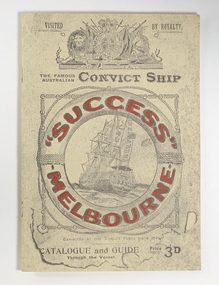
Book - Catalogue and Guide, Facsimile, Pryor Publications, The Famous Australian Convict Ship: "Success" Melbourne
... Bay. From 1890, it was refitteed as Museum Ship. The Emily, the Water Police hulk which was transformed in floating chapel in 1857, may have been a convict ship and looked similar. convict ships success The Famous Australian Convict Ship: "Success" Melbourne Book Catalogue and Guide, Facsimile Pryor Publications ...non-fictionconvict ships, success -
 Mission to Seafarers Victoria
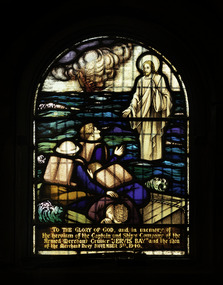
Artwork, other - Stained glass window, Brooks Robinson & Co, Jervis Bay, 1947
... chapel...hope...jervis bay...(AR1947) Unfortunately it is lost. altar st peter chapel flinders street mission to seafarers seamen's mission mission to seamen st peter sailors seamen anchor stained glass windows WIN memorial chapel hope jervis bay crew lucas girls ballarat branch hlg Jesus To the Glory of God and in loving memory of the heroism of the Captain and Ship’s Company, of the Armed Merchant Cruiser ‘Jervis Bay’ and the Men of the Merchant Navy November 5th 1940. ...This window, in memory of the crew of the ship Jervis Bay, was unveiled on the 14 December 1947 by Mrs Johnson, wife of the Bishop of Ballarat. As mentioned on the plaque below the window, it was a gift of the Ballarat branch of the HLG and the Lucas Girls from Ballarat. E Lucas & Co was a textile company in Ballarat. The "Lucas girls" are known Ballarat-wide for their commitment to philanthropic work during the period of the Great War. From Bronwyn Hughes report: The window was designed and made by Brooks, Robinson & Co. Melbourne, from an old cartoon that was ‘touched up’. The size (24 1⁄2 x 17 1⁄4 inches) precluded the inclusion of any ornamental borders or other decorative features. The order was not received until 1947. Below this window is the plaque from the donors: the Ballarat Branch of the Harbour Lights Guild and Lucas Girls. On the same occasion the mallet, used to launch the ship Manunda was donated to the Mission. (AR1947) Unfortunately it is lost. Arched stained glass windows depicting Jesus floating on the surface of the sea holding out his right hand to seamen who on a raft, their ship sinking in the background.To the Glory of God and in loving memory of the heroism of the Captain and Ship’s Company, of the Armed Merchant Cruiser ‘Jervis Bay’ and the Men of the Merchant Navy November 5th 1940.altar, st peter chapel, flinders street, mission to seafarers, seamen's mission, mission to seamen, st peter, sailors, seamen, anchor, stained glass windows, win, memorial chapel, hope, jervis bay, crew, lucas girls, ballarat branch, hlg, jesus -
 Mission to Seafarers Victoria
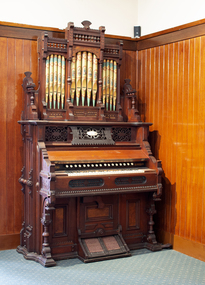
Instrument - Reed organ, W Bell & Co, c. 1888
... chapel was built at the back (see item 0548. It was transfered to the new Port Melbourne mission in 1937 (link on postcard from State Library Victoria). In 1972, it was transferred to the Holy Trinity Church in Bay...chapel was built at the back (see item 0548. It was transfered to the new Port Melbourne mission in 1937 (link on postcard from State Library Victoria). In 1972, it was transferred to the Holy Trinity Church in Bay ...This organ was gifted by the Bethel Community in 1890 to the then Victorian Seamen's Mission, originally founded by the Bethel Union in 1857. The gift was intended to assist with worship. Despite all appearance, this organ is not a pipe organ but a reed organ that works in a similar manner to an accordion. In May 1890, the sum of seventy pounds was put towards the purchase of the organ. The sum being raised via subscriptions. The organ was inaugurated in September 1890. Jabez Carnegie (1832-1892), importer of piano and organs in Melbourne, had made a trip to Europe and Canada in 1887 and had secured the agency of Bell organs. W. Bell & Co were a Canadian organ and piano manufacturer, considered the premier organ manufacturer of the time. W Bell & Co changed its name to Bell Organ and Piano Co in 1888 meaning this organ had to be manufactured prior to the name change. The organ was first used in the mission main room from 1890 to 1915 when the St Nicholas chapel was built at the back (see item 0548. It was transfered to the new Port Melbourne mission in 1937 (link on postcard from State Library Victoria). In 1972, it was transferred to the Holy Trinity Church in Bay Street after the closure of the Mission In the late 1980s during a National Trust campaign to save the building, the organ was sold by the Anglican Men's Society to the Trust's organ committee, who carried out some restoration work and returned it to the former Missions to Seamen chapel. In 1991 the Office of Major Projects had control of the whole 'Bayside' development site. With the Mission to Seamen Building emptied and proposed for demolition, the Office of Major Projects removed the organ and placed it in storage in various locations - finally, in the Museum of Victoria store in Abbotsford. In 1995-6, enquiries by Jim Hillis resulted in the return of the organ to the control of the Port Melbourne HIstorical & Preservation Society. As the Society had no suitable location for the organ, several churches and schools in Port Melbourne were approached to take the organ with no results. The nearby suburbs were suggested next. Finally the Melbourne Maritime Museum (Polly Woodside) was approached and agreed to place it in their Museum on a long term loan. In 1997 it was on display in no 5 shed South Wharf (23/3/1997). In 2006, the Polly Woodside South Wharf site was to be re-developed, and they could no longer retain the organ. Accordingly, on 4 May 2006, the organ was transferred to the Mission To Seafarers building in Flinders Street Extension as an indefinite loan (refer OL 022) The PMHPS deaccessioned it to finally transfered it in 2018 to MTSV.(See also acquisition details re 21st C finalisation of acquisition) This organ is a tangible reminder of the longevity of the Mission to Seafarers, a link with the original Bethel Union which was instrumental in 1856 calling a public meeting and inviting subscriptions by various non-conformist churches to found a mission to Seamen. Rev Kerr-Johnson delivered the first service in 1857 aboard the Emily. The Mission to Seafarers has been in operation ever since and continues to operate to the same purpose today.Large reed organ that looks like a pipe organ with fifteen elaborately painted pipes bearing a floral motif. The body of the organ is elaborately decorated in carved wood. It has 17 knobs above the keyboard both which can be concealed when the keyboard cover is lowered. There are two foot pedals at the bottom of the organ with "Mouse Proof Pedals" cast into the framing iron. list of stop names: Viola 4Ft Diapason 8Ft Dolce 4Ft Violetta 2Ft Sub Bass 16 Ft Octave Coupler Vox Humana Forte Picciolo 2Ft Hautboy 8Ft Aeoline 8Ft Cremona 16Ft E---bone 16Ft Echo 8Ft Celeste 8Ft Melodia 8Ft Flute 4FtMaker's mark in gold lettering above keyboard: W. Bell & Co Brass plaque on front board: Presented to/The Victorian Seamen's Mission/by/Congregation worshipping in Bethel/& friends./1st September 1890 Behind the stops a wooden plaque: J. CARNEGIE & SONS, SOLE AGENTS FOR VICTORIA MELBOURNE organ, worship, bethel, pipes, reed, bethel union, pipe top, jabez carnegie, w. bell & co, port melbourne, mission to seafarers, seamens' mission, mission to seamen, guelph, ontario, canada, pmhps, polly woodside, harmonium, reed organ -
Glen Eira Historical Society
Article - St Peter's Catholic Church, Bentleigh East
... Bay... East Boundary Road... North Road... Ormond... Old Dandenong Road... Mordialloc Creek... Moorabbin... Springvale... No Good Damper Road... Kingstown... Keysborough... Bignell Road... South Road... Heatherton... Big Brighton... Gardenvale... Elsternwick... Brady Road... Jasper Road... Chesterville Road... Cochrane Road... McGuinness Road... H.A.C.B.S.... School House... St Patrick's Church... Brighton Parish... Denominational School... Little Brighton School... Moorabbin Catholic School... Temporary Chapel...O’ Connell John FR Glass Hugh MR O’ Farrell Peter Brady Peter Kennedy James Boland Michael McCormick Francis Orrong Road Little Brighton Oakleigh Port Phillip Bay East Boundary Road North Road Ormond Old Dandenong Road Mordialloc Creek Moorabbin Springvale No Good Damper Road Kingstown Keysborough Bignell Road South Road Heatherton Big Brighton Gardenvale Elsternwick Brady Road Jasper Road Chesterville Road Cochrane Road McGuinness Road H.A.C.B.S. School House St Patrick's Church Brighton Parish Denominational School Little Brighton School Moorabbin Catholic School Temporary Chapel ...Included In The File is A Newspaper Clipping From The Age Newspaper, Dated Sat 09/11/1974 On The Opening Written By Stuart Sayers. The Article Mentions A Brief History Of The Church & School Beginnings & The Opening Ceremony. There Are Two Copies Of The Living Harvest (One Without The Cover), The Book Gives A Detailed History Of St Peter's Catholic Church, Bentleigh East Written By W.T. Dobson And Published in 1974. From The First White Settlers, The Irish Exodus, And The Irish Catholic families, The School House And The History Of The Parish & Clergy Up To 1974.st peter's catholic church, niall patrick rev, emerald hill, bentleigh east, dobson w. t., yarra, moorabbin, heriot m. b., elsternwick, north road, quinn fred, bentleigh, centre road, kennedy james joseph, melbourne south, bignell road, kennedy market garden, oakleigh, st peter's parish, st james parish, the living harvest, catholic church, hibernian society, bavarian brass band, st peter's primary school, st james regional college, brighton catholic school, brighton – st kilda mission, niall patrick william fr, dendy henry, guiney john mr, king richard, king john, keys george, o’ shanassy john, keys robert, were jonathan b., o’ connell john fr, glass hugh mr, o’ farrell peter, brady peter, kennedy james, boland michael, mccormick francis, orrong road, little brighton, oakleigh, port phillip bay, east boundary road, north road, ormond, old dandenong road, mordialloc creek, moorabbin, springvale, no good damper road, kingstown, keysborough, bignell road, south road, heatherton, big brighton, gardenvale, elsternwick, brady road, jasper road, chesterville road, cochrane road, mcguinness road, h.a.c.b.s., school house, st patrick's church, brighton parish, denominational school, little brighton school, moorabbin catholic school, temporary chapel, st james regional college, sister of mercy, lanigans ball, east brighton public hall company ltd, east bentleigh hall, messrs. robert dunn & son, bavarian brass band, st joan of arc parish, east bentleigh parish, the sisters of our lady of sacred heart, the anchor club, mccormick cornelius, cochrane james, cochrane david, mcguinness margaret, cormick john, cahill james, quinn frederick, prendegast john patrick, naughton dennis, leary william, charlston john, carey matthew fr, gibbons patrick, kennedy joseph james, o’ sullivan tim fr, mckenna fred fr, casey william fr, browne joseph fr, crawford mal fr, hanrahan mr, gillon rose miss, sampson kate mrs, horan miss, coakley daniel fr, dillon kevin fr, whitehouse ray fr, mannix daniel dr, dobson william mr, gahan patrick, hallinan thomas, delaney john, fitzgerald patrick, st peter's catholic church -
 St Kilda Historical Society
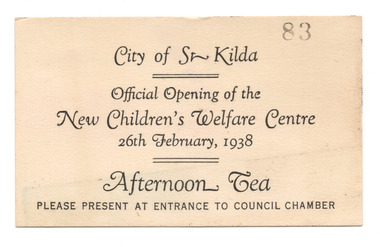
Ephemera - Entree card, Official Opening of the New Children's Welfare Centre, 1938
... Chapel Street, on 26 February 1938. The building was replaced in 1971 with a new Children's Centre and Maternal & Child Health Centre, which was later demolished and replaced in 2013 with the Bubup Nairm Children's Centre. Bubup means 'children' in local Boon Wurrung language, and Nairm is Port Phillip Bay...Chapel Street, on 26 February 1938. The building was replaced in 1971 with a new Children's Centre and Maternal & Child Health Centre, which was later demolished and replaced in 2013 with the Bubup Nairm Children's Centre. Bubup means 'children' in local Boon Wurrung language, and Nairm is Port Phillip Bay ...Entree card to afternoon tea at the official opening of the City of St Kilda's Children's Welfare Centre, at 171 Chapel Street, on 26 February 1938. The building was replaced in 1971 with a new Children's Centre and Maternal & Child Health Centre, which was later demolished and replaced in 2013 with the Bubup Nairm Children's Centre. Bubup means 'children' in local Boon Wurrung language, and Nairm is Port Phillip Bay: i.e. “ Children of Port Philip Bay”.Cream coloured card printed on one side in black.Stamped number 83city of st kilda, children's welfare centre -
 St Kilda Historical Society
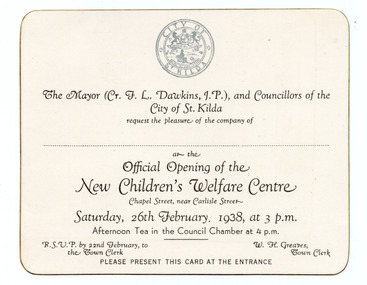
Ephemera - Invitation, Official Opening of the New Children's Welfare Centre, 1938
... Chapel Street, on 26 February 1938. The building was replaced in 1971 with a new Children's Centre and Maternal & Child Health Centre, which was later demolished and replaced in 2013 with the Bubup Nairm Children's Centre. Bubup means 'children' in local Boon Wurrung language, and Nairm is Port Phillip Bay...Chapel Street, on 26 February 1938. The building was replaced in 1971 with a new Children's Centre and Maternal & Child Health Centre, which was later demolished and replaced in 2013 with the Bubup Nairm Children's Centre. Bubup means 'children' in local Boon Wurrung language, and Nairm is Port Phillip Bay ...Unused invitation to the official opening of the City of St Kilda's Children's Welfare Centre, on Chapel Street, on 26 February 1938. The building was replaced in 1971 with a new Children's Centre and Maternal & Child Health Centre, which was later demolished and replaced in 2013 with the Bubup Nairm Children's Centre. Bubup means 'children' in local Boon Wurrung language, and Nairm is Port Phillip Bay: i.e. “ Children of Port Philip Bay”.White card, discoloured with age, printed in black with the City of St Kilda logo in bluechildren's welfare centre, city of st kilda -
 Brighton Historical Society
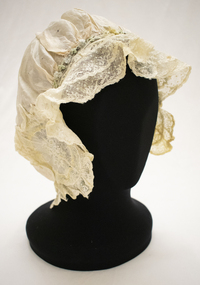
Bonnet, circa 1900s
... Bay Street, Brighton in 1915. Their daughter, Dorothy Marshall (1910-2000) married Robert George (Argie) Wells in 1937 at Wesley College Chapel. ...Bay Street, Brighton in 1915. Their daughter, Dorothy Marshall (1910-2000) married Robert George (Argie) Wells in 1937 at Wesley College Chapel. ...This bonnet is part of a collection of clothing donated to the Brighton Historical Society by Dr William and Helen Wells. It is believed to have belonged to William's grandmother Winifred Marshall (nee Hayball, 1886-1971). William's family has had a long association with Brighton, dating back to the town's earliest days in 1843 when his ancestors Robert and Eliza Hayball, who had emigrated to Melbourne two years prior, established a wattle-and-daub hut in what is now New Street, close to Tovell Street. Robert established a business as a timber merchant on the opposite side of New Street. His sons, Robert, William and Edwin took over the firm following his retirement, trading as the Hayball Bros. Hayball Court, which runs off New Street, is named after the family. Robert's son William (1855-1926) married Jessie Robertson and had four children. Their eldest, Winifred Grace Hayball (1886-1971), married Andrew Hollingsworth Marshall at the Black Street Congregational Church in 1907. They subsequently lived in Hill Street, Hawthorn, before moving into a house designed by Andrew and Winifred's brother Robert at 39 Bay Street, Brighton in 1915. Their daughter, Dorothy Marshall (1910-2000) married Robert George (Argie) Wells in 1937 at Wesley College Chapel. They lived in East Malvern until 1947, when they moved into a newly built home in Hawthorn Road, East Brighton, where they lived for the rest of their lives. Their son, William Wells (b. 1939) married Helen Pickering in 1968 and the couple have lived together in Brighton ever since.Pale pink silk bonnet (sleeping or house cap) with cream lace edging. The bonnet is embellished with oval-shaped embroidered appliqué on either side, featuring floral design in white and pale yellow, blue and green. A cream silk ribbon and a row of pale blue and green rosettes run along the top edge between the two appliquéd segments. A length of elastic is sewn through the bottom edge.wells family, winifred grace hayball, winifred grace marshall, bonnet, 1900s -
 Brighton Historical Society
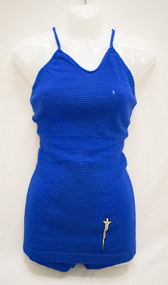
Swimsuit, Black Lance, circa 1930s
... Bay Street, Brighton in 1915. Their daughter, Dorothy Marshall (1910-2000) married Robert George (Argie) Wells in 1937 at Wesley College Chapel. ...Bay Street, Brighton in 1915. Their daughter, Dorothy Marshall (1910-2000) married Robert George (Argie) Wells in 1937 at Wesley College Chapel. ...This swimsuit is part of a collection of clothing donated to the Brighton Historical Society by Dr William and Helen Wells. It belonged to William's mother, Dorothy Wells (nee Marshall, 1910-2000). William's family has had a long association with Brighton, dating back to the town's earliest days in 1843 when his ancestors Robert and Eliza Hayball, who had emigrated to Melbourne two years prior, established a wattle-and-daub hut in what is now New Street, close to Tovell Street. Robert established a business as a timber merchant on the opposite side of New Street. His sons, Robert, William and Edwin took over the firm following his retirement, trading as the Hayball Bros. Hayball Court, which runs off New Street, is named after the family. Robert's son William (1855-1926) married Jessie Robertson and had four children. Their eldest, Winifred Grace Hayball (1886-1971), married Andrew Hollingsworth Marshall at the Black Street Congregational Church in 1907. They subsequently lived in Hill Street, Hawthorn, before moving into a house designed by Andrew and Winifred's brother Robert at 39 Bay Street, Brighton in 1915. Their daughter, Dorothy Marshall (1910-2000) married Robert George (Argie) Wells in 1937 at Wesley College Chapel. They lived in East Malvern until 1947, when they moved into a newly built home in Hawthorn Road, East Brighton, where they lived for the rest of their lives. Their son, William Wells (b. 1939) married Helen Pickering in 1968 and the couple have lived together in Brighton ever since.Blue knitted woollen women's one-piece swimsuit featuring a scooped back and braided crossover shoulder straps which thread through loops at the back. Small shorts cover the tops of the thighs, underneath a short modesty skirt.Designer's label near front hem, proper left: a narrow white triangular lance logo, bordered with black and featuring black text: "BLACK LANCE". Small label proper left inside seam: "BLACK LANCE / KNITTED WEAR / 38"wells family, dorothy marshall, dorothy wells, 1930s, swimwear, black lance, melbourne designers, peter o'sullivan, botany knitting mills -
 Kew Historical Society Inc
Photograph - 'Otira', 73 Walpole Street, 1978
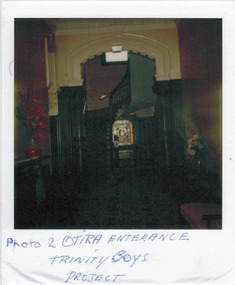
... chapel that was built on the property in 1957.' Otira is now a private residence. otira - 73 walpole street henry berry historic houses -- kew (vic.) trinity grammar school melbourne architects -- crouch interior design -- entrance halls -- 1880s "Photo 2 / Otira entrance / Trinity Bays Project" Original colour positive photograph (polaroid) of 'Otira', 73 Walpole Street, Kew, taken in 1978 by students in Form 3R at Trinity Grammar School as part of a project. ...Sanderson P (1988): '73 Walpole Street (Kew), 'Otira'. Built 1887. Original use - Residence. Architect - Crouch. Henry Berry, a noted philanthropist and salt merchant of Melbourne, was the original owner of this two-storey, boom-period house. Berry occupied the residence until his death in 1923 while in February the following year, the property was auctioned. Subsequently purchased by the Methodist Church for use as a training college for missionaries, a number of additions and alterations were made at that stage including a memorial chapel that was built on the property in 1957.' Otira is now a private residence. Original colour positive photograph (polaroid) of 'Otira', 73 Walpole Street, Kew, taken in 1978 by students in Form 3R at Trinity Grammar School as part of a project. The view in the photograph is of the panelled entrance hall."Photo 2 / Otira entrance / Trinity Bays Project"otira - 73 walpole street, henry berry, historic houses -- kew (vic.), trinity grammar school, melbourne architects -- crouch, interior design -- entrance halls -- 1880s -
 Melbourne Tram Museum
Drawing - early Melbourne CBD scenes, Sands & Kenny Melbourne & Sydney, 1856
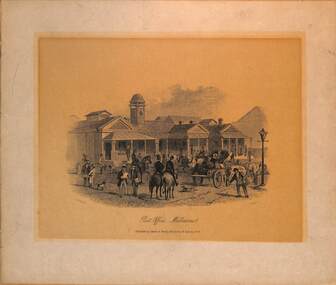
... Set of three prints of Melbourne street scenes published by Sands & Kenny in 1856 1 - Post Office 2 - Princes Bridge and city terminus of M&HB Railway Melbourne (Melbourne and Hobsons Bay Railway) 3 - Collins Street looking east from Wesleyan Chapel Melbourne (near Queens St) Shows typical horse-drawn transport, railway and pedestrians of the era....Set of three prints of Melbourne street scenes published by Sands & Kenny in 1856 1 - Post Office 2 - Princes Bridge and city terminus of M&HB Railway Melbourne (Melbourne and Hobsons Bay Railway) 3 - Collins Street looking east from Wesleyan Chapel Melbourne (near Queens St) Shows typical horse-drawn transport, railway and pedestrians of the era. ...Set of three prints of Melbourne street scenes published by Sands & Kenny in 1856 1 - Post Office 2 - Princes Bridge and city terminus of M&HB Railway Melbourne (Melbourne and Hobsons Bay Railway) 3 - Collins Street looking east from Wesleyan Chapel Melbourne (near Queens St) Shows typical horse-drawn transport, railway and pedestrians of the era.Yields infomaition about Melbourne in 1856.Set of three prints or lithographs of drawings of early Melbourne scenes on paper.melbourne, horses, horse drawn vehicles, collins st, post office, princes bridge, railways, m&hbr -
 Linton Mechanics Institute and Free Library Collection
Book - Novel, Chisholm, Lilian, Stranger at the door, 1947
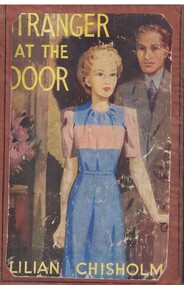
... Stamps indicating book was previously in other collections: "Stan Hall, 541 Chapel St., south Yarra"; "Tresgrove Library, Apollo Bay"; "K. & G. Downe, Newsagent, Wedderburn"....Fiction Romance Lilian Chisholm Romance fiction Stamps indicating book was previously in other collections: "Stan Hall, 541 Chapel St., south Yarra"; "Tresgrove Library, Apollo Bay"; "K. & G. Downe, Newsagent, Wedderburn". 206 p. : brown cover, title and author's name printed in black on spine. ...Romance fiction206 p. : brown cover, title and author's name printed in black on spine. Section of original dust jacket pasted to front, with illustration of a man in a suit, standing behind a woman . fictionRomance fictionfiction, romance, lilian chisholm
