
Showing 54 items matching "beauty point"
-
 Eltham District Historical Society Inc
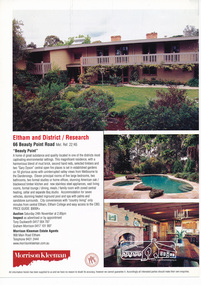
Folder, Beauty Point, 66 Beauty Point Road, Research
... Beauty Point, 66 Beauty Point Road, Research......Beauty Point...Eltham District Historical Society Inc 728 Main Rd Eltham melbourne Morrison Kleeman Real Estate sales information material gayle blackwood collection houses morrison kleeman real estate mudbrick research (vic.) Beauty Point Beauty Point Road 1 document, 2 pages A4 Beauty Point, 66 Beauty Point Road, Research Folder ...Morrison Kleeman Real Estate sales information material1 document, 2 pages A4 gayle blackwood collection, houses, morrison kleeman real estate, mudbrick, research (vic.), beauty point, beauty point road -
 Chelsea & District Historical Society Inc
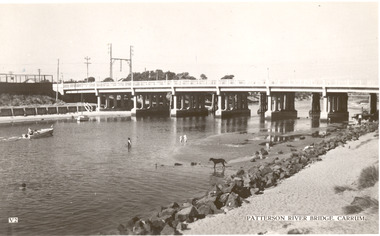
Photograph - Patterson River, Rail and Road Bridge, Carrum
... ...Beauty Point...Black and white photo of Patterson River, taken from Beauty Point, Carrum Victoria. ...Patterson River Chelsea Patterson River Bridge Carrum Bridge beach leisure Beauty Point boats Black and white photo of Patterson River, taken from Beauty Point, Carrum Victoria. ...The first bridge over the river was built in the early 1880's, prior to this it was a pontoon bridge. In 1927 a concrete bridge was built to replace the wooden bridge.Black and white photo of Patterson River, taken from Beauty Point, Carrum Victoria. patterson river, chelsea, patterson river bridge, carrum bridge, beach, leisure, beauty point, boats -
 Queenscliffe Maritime Museum
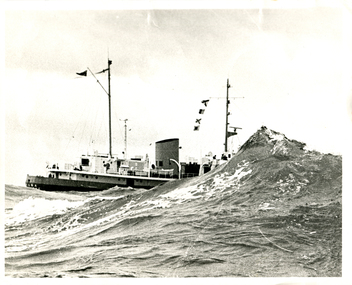
Photograph - Monochrome, MV Wyuna
... For a time she was docked at Beauty Point, Tasmania, and after being refurbished for 18 months she was to be moved to Docklands in Melbourne, Victoria. ...For a time she was docked at Beauty Point, Tasmania, and after being refurbished for 18 months she was to be moved to Docklands in Melbourne, Victoria. ...The ship was built in 1953 by Ferguson Shipbuilders of Port Glasgow, Scotland for the Port Phillip Sea Pilots organisation as a pilot cutter. Her role as a pilot cutter was to sail with pilots on board to meet ships entering Port Phillip Bay. Pilots would be transferred by the Wyuna's workboat to the vessel requiring pilotage while it was stopped dead in the water, with shelter provided by the vessel itself. In the early 1970s the pilot service started using fast launches to allow pilots to board while ships were still underway, and in 1979 the Wyuna was sold to the Australian Maritime College in Launceston, Tasmania as a training vessel. She continued in that role until 2004 when sold to Mineralogy Pty Ltd as an accommodation vessel. In September 2013 she was donated to the Western Port Oberon Association for the Victorian Maritime Centre currently at Crib Point. For a time she was docked at Beauty Point, Tasmania, and after being refurbished for 18 months she was to be moved to Docklands in Melbourne, Victoria. After this berth became unavailable the vessel was docked at Inspection Head Wharf in Beauty Point. After a period there it was towed into Bell Bay where she lays at anchor as of January 2016. When funding becomes available the Western Port Oberon Association has plans to display the vessel in a wet berth alongside the former Royal Australian Navy Oberon-class submarine HMAS Otama.Mr Henry HudsonBlack and white photograph of the Pilot Tender MV Wyuna partially obscured by a large wave at the rip, entrance to Port Phillip Bay.mv wyuna, port phillip pilot service, the rip, the heads, queenscliff, point lonsdale -
 Bendigo Historical Society Inc.
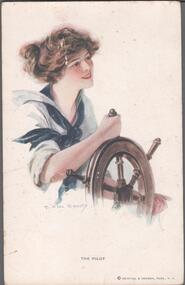
Postcard - Elliot Postcard Collection: Australia, 1895 - 1914
... Sheffield Tas 1405.256 Floods 1929 1405.257 The Gorge at Launceston in Flood (1929) 1405.258 Lower End of Launceston during the Floods (1929) 1405.259 Beauty Point, River Tamar 1405.260 Hobart, Tasmania...Sheffield Tas 1405.256 Floods 1929 1405.257 The Gorge at Launceston in Flood (1929) 1405.258 Lower End of Launceston during the Floods (1929) 1405.259 Beauty Point, River Tamar 1405.260 Hobart, Tasmania Postcard Elliot Postcard Collection: Australia ...Thought to have originated in Austria in 1869, postcards first gained popularity in Australia in the 1890s.They were used to send short messages to friends and family. This collection was generated by Mary Emma Elliot of Talgarno. Talgarno is a rural locality in Victoria, Australia, situated on the southern shoreline of Lake Hume, about 23 km east of Albury-Wodonga. The collection contains postcards from across the world. Mary Emma Sibley was born in Ironbark, Bendigo in 1859. She married James Elliot in 1893 and they settled at “Kelso”, Talgarno. They had two children – Mona and Sibley. Mary Emma Elliot died in Melbourne in 1944, aged 84 years. Australian postcards collected by Mrs. James Elliot between 1898 and 1915. 1405.241 The Pilot 1405.242 St. Peter's Cathedral, Adelaide, South Australia 1405.243 Hindmarsh River, Victor Harbour, S. A. 1405.244 Breakers Ahead 1405.245 At Glenelg - Commemoration Day 1405.246 Pleasant Cove, Ocean Beach 1405.247 Millicent, S. A. 1405.248 Leg of Mutton Lake, Mount Gambier 1405.249 On the Torrens 1405.250 Bronte, Sydney 1405.251 Adelaide Hills, Montacute Rd 1405.252 Rough Seas, Australian Coast 1405.253 St. Leonards Road. Tasmania 1405.254 On the Gordon River, W. Coast. Tas. 1405.255 A Pretty Cascade. Sheffield Tas 1405.256 Floods 1929 1405.257 The Gorge at Launceston in Flood (1929) 1405.258 Lower End of Launceston during the Floods (1929) 1405.259 Beauty Point, River Tamar 1405.260 Hobart, Tasmaniapostcards, collecting, collections, talgarno -
 Kiewa Valley Historical Society
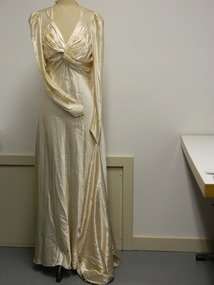
Dress - Wedding Ivory Satin
... Beauty. Wedding dress; Margaret Vyner (McKendrick); Tawonga; ladies' clothing Ivory / off white satin wedding dress with a train at the back. Puffed with stiffening & padded long sleeves which come to a point at the wrist where fastened with a press stud. ...This dress was worn by Margaret Vyner on her wedding day to Ian Mc Kendrick. Margaret's mother's name was Rita. Margaret was living with her family at Tawonga, Ian was living at Mt Beauty.The couple were locals of the Kiewa Valley. Ian worked at the Mt Beauty Post Office and Margaret at the Tawonga & District Hospital. Their 3 children grew up in Mt Beauty.Ivory / off white satin wedding dress with a train at the back. Puffed with stiffening & padded long sleeves which come to a point at the wrist where fastened with a press stud. Ruched cross over bodice with a V neckline with a semi circular skirt. Plain back to the waist and a half self belt fastened at the back by 3 covered buttons and 3 loops. Left side as a plaquet fastened by 2 hooks and eyes. Semi circular skirt which has, at the rear, a 100 cm train with a finger loop.wedding dress; margaret vyner (mckendrick); tawonga; ladies' clothing -
 Kiewa Valley Historical Society
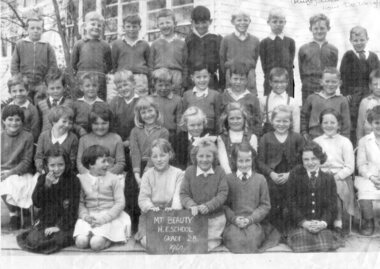
Photograph – Mt Beauty Higher Elementary School Grade 2B, 1960 – Black and white photocopy of original photograph
... Chalk Board at front of children in photograph – MT BEAUTY H.E.SCHOOL GRADE 2B. 1960 Handwritten in top right hand corner of photograph, with arrow pointing to the boy 4th from the right Alex Van De Auigh (Ruijt) dutch now De Wright Handwritten on back of photograph – Top row: 6 from left (4th from Right) ...Many of the children would also have been the descendants of parents who immigrated to Australia as foreign workers on the Hydro Electric Scheme such as Alex Van De Ruijt, whose parents were Dutch. mt beauty school Chalk Board at front of children in photograph – MT BEAUTY H.E.SCHOOL GRADE 2B. 1960 Handwritten in top right hand corner of photograph, with arrow pointing to the boy 4th from the right Alex Van De Auigh (Ruijt) dutch now De Wright Handwritten on back of photograph – Top row: 6 from left (4th from Right) Photocopy of a black and white class photograph of Mt Beauty H E School Grade 2B, 1960 Back row: Lawrence Woods, John Wayne, Terry Hertzog, Phillip Jervies, ? ...On Feb 3rd 1948, the Mt Beauty State School was opened with 28 pupils in all grades up to VII. Classes began in the SECV Recreation Hall, which was converted to classrooms during the school week and returned to a recreation hall on weekends for motion pictures and social occasions for SECV workers and their families. A new school building was opened in 1950 on the current school site, with an enrolment of 170 primary and secondary students. A further extension of 4 buildings was added in 1951 with a population increase to 303 students. In May 1953, the status of the school was raised to Higher Elementary School with a total of 403 students. In 1958, the school population rose to a high of 617 students with 436 in primary and 181 in secondary. In 1964, the status of the secondary section of Mt Beauty HES was raised to a High School and was moved to separate facilities in the west of town in September 1964 Pictorial history of children who attended Mt Beauty Higher Elementary School in 1960. Many of the students would have had parents working on the Hydro-Electric Scheme in and around Mt Beauty. Many of the children would also have been the descendants of parents who immigrated to Australia as foreign workers on the Hydro Electric Scheme such as Alex Van De Ruijt, whose parents were Dutch. Photocopy of a black and white class photograph of Mt Beauty H E School Grade 2B, 1960 Back row: Lawrence Woods, John Wayne, Terry Hertzog, Phillip Jervies, ?, Alex Van De Wright , ?John Sigmund, Wayne Shoebridge, Brian Harkin 3rd row: Doug Newbound, Roy Hetherington, ? Kevin Hills, Peter Renshaw, ? Grenville Gerecke, ?, Ken Thomas, Detlef Rueff, ?, not in picture Berndt Homfeld 2nd Row, ?, Lyn Plant, ?, Gabrielle Sigmund, ? Pauline Gerecke, Christine Harmer, ?, Lesley McDonald, not in picture, Jenny Richardson Front Row, ? Christine Pennery, Robyn Symons, ?, ?, Sue Mckendrick, ?, ? with a name may not be correct Chalk Board at front of children in photograph – MT BEAUTY H.E.SCHOOL GRADE 2B. 1960 Handwritten in top right hand corner of photograph, with arrow pointing to the boy 4th from the right Alex Van De Auigh (Ruijt) dutch now De Wright Handwritten on back of photograph – Top row: 6 from left (4th from Right) mt beauty school -
 Kiewa Valley Historical Society
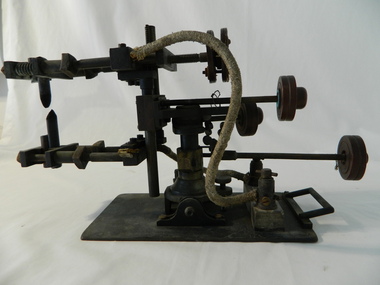
Lamp - Carbon arc projector lamp
... Beauty high-country The arc lamp provided one of the first commercial uses for electricity, a phenomenon previously confined to experiment, the telegraph, and entertainment. Ref. Wikipedia. An old item and very rare. Owned by a local resident's grandfather who lived in Melbourne. silent movies projector lamp carbon arc projector lamp Nil Brass base with handle at front. Horizontal round bakelite handles for adjusting the arc between the electrodes (vertical carbon pencil shapes meeting at point ...The arc lamp provided one of the first commercial uses for electricity, a phenomenon previously confined to experiment, the telegraph, and entertainment. Ref. Wikipedia.An old item and very rare. Owned by a local resident's grandfather who lived in Melbourne.Brass base with handle at front. Horizontal round bakelite handles for adjusting the arc between the electrodes (vertical carbon pencil shapes meeting at point and opposite each other. It has adjustments for direction and height. It is heavy. Unknown source of power - battery?Nilsilent movies, projector lamp, carbon arc projector lamp -
 Kiewa Valley Historical Society
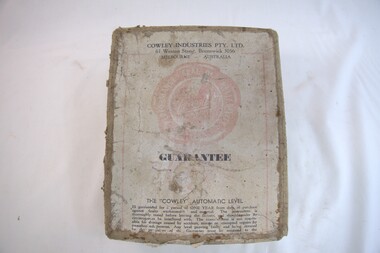
Automatic Level - Cowley
... Kiewa Valley Historical Society Mount Beauty Information Centre 31 Bogong High Plains Rd Mt Beauty high-country Used in the Kiewa Valley to measure the height of distant points relative to a known point used in surveying and construction. ...Used in the Kiewa Valley to measure the height of distant points relative to a known point used in surveying and construction. The older levels consist of a telescope fitted with a spirit level and, are generally, mounted on a tripod. Modern levels are automatic.This Cowley automatic level was used in the Kiewa Valley by a Mount Beauty resident."The Cowley" Automatic Level. Automatic Level made of metal with black leather carry strap. Metal plaque with black background fixed with four nails "Cowley Automatic Level. Made in Australia". Stamped under the plaque are numbers 80950. A sticker above the plaque in red print "Warning level will not operate unless placed on tripod." A silver sticker on top of the unit "It is unnecessary to see a complete circle when finding level" it includes three diagrams to assist. Comes in the original cardboard box with instruction booklet. cowley tripod; surveying; kiewa valley -
 Kiewa Valley Historical Society
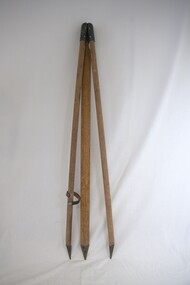
Tripod
... Kiewa Valley Historical Society Mount Beauty Information Centre 31 Bogong High Plains Rd Mt Beauty high-country This tripod was used to measure the height of distant points relative to a known point used in surveying and construction. ...This tripod was used to measure the height of distant points relative to a known point used in surveying and construction. The older levels consist of a telescope fitted with a spirit level and, generally, mounted on a tripod. Modern levels are automatic.This tripod was used in the Kiewa Valley by a Mt Beauty resident.Wooden tripod with pointy ends and with metal hinges at the top to collapse. It has a leather strap attached by a button press stud towards the pointy end. This is to enable the legs of the tripod to be fastened together. cowley tripod; surveying; kiewa valley; -
 Kiewa Valley Historical Society
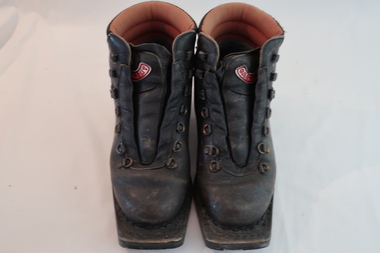
Ski Boots - Cross Country
... Beauty high-country Embossed brand name Garmont on outer sides. Size 37 inscribed in white paint on each heel. Pair of black Garmont leather ski boots for cross country skiing with padded orange fabric lining at entry point. 6 metal hooks and 8 metal eyelets for lacing boots (no laces included). ...Pair of black Garmont leather ski boots for cross country skiing with padded orange fabric lining at entry point. 6 metal hooks and 8 metal eyelets for lacing boots (no laces included). Thick rubber over leather sole- protruding toe lug. Leather upper shoe. Padded leather tongue attached to boot with a red and white leather Garmont name tag attached.Embossed brand name Garmont on outer sides. Size 37 inscribed in white paint on each heel. -
 Kiewa Valley Historical Society
Folder - Alex McCullough's Autobiography, Kiewa Its History From A Human Point of View By Alex McCullough
... It includes the history of some Mt Beauty Clubs and Associations and the Autobiography of Alex McCullough and the groups he belonged to. Kiewa Its History From A Human Point of View By Alex McCullough Folder - Alex McCullough's Autobiography ...Alex McCullough (1916 - 2011) was a prolific writer, an historian, a family man and resident of Mt Beauty, an employee (foreman) of the SECV, served in the war and was on the committee of many clubs (27 at one stage) and associations including the Bright/Alpine Shire (1961-1981).Alex McCullough gives an insight into the development of Mt Beauty township and its community. Due to his heavy involvement at committee level of so many clubs and associations he has been able to document the town's history during his life time enabling the reader to see the changes at all levels and to compare life during that time with that of today.Typed pages on A4 paper held by metal fastener. It includes the history of some Mt Beauty Clubs and Associations and the Autobiography of Alex McCullough and the groups he belonged to.alex mccullough's autobiography, mt beauty clubs and associations -
 Kiewa Valley Historical Society
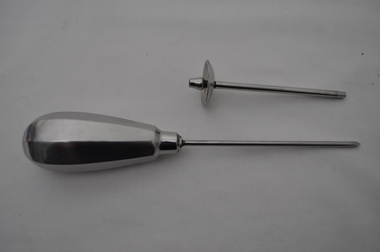
Antral Trochar and Cannula
... beauty. tawonga. surgery. doctor. nurse In sterilised bag. Long pointed steel instrument with plastic handle with a protective shield a little along from the handle. The end of the steel rod has a very sharp point ...This medical / hospital instrument was used in the Tawonga District General Hospital which was built in the 1950s specifically for the increase in population due to the Kiewa Hydro Scheme. This instrument was used in nasal surgery and is in a sterilised bag.Historically: Shows the development of scientific hospital equipment. Provenance: Used in the Tawonga District General Hospital which was remote and therefore required good equipment. Good condition and good interpretation capacity.In sterilised bag. Long pointed steel instrument with plastic handle with a protective shield a little along from the handle. The end of the steel rod has a very sharp point.medical instrument. hospital equipment. nasal. nose. mt beauty. tawonga. surgery., doctor. nurse -
 Kiewa Valley Historical Society
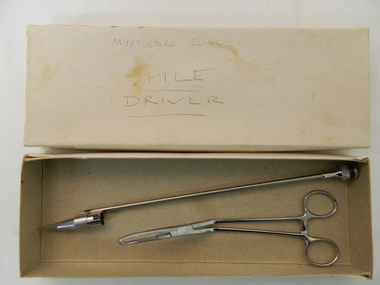
Sabre Haemorrhoid Ligator
... beauty. haemorrhoid myrtleford On box, in pencil "Mrytleford Clinic' / Pile Driver In a white cardboard box 2 metal instruments. One is a pair of scissors with 'teeth' at the handle end and a bow at the instrument end when the ends meet The scissors are bent before the pivot. The other instrument is a long rod with a screw at one end that turns the other end around. This other end has a funnel that comes to a point ...This medical instrument was used in the Tawonga District General Hospital which was built in the 1950s specifically for the increase in population due to the Kiewa Hydro Scheme.Historical: Shows the development of scientific hospital equipment. Provenance: Used in the Tawonga District General Hospital which was remote and therefore required good equipment. In a white cardboard box 2 metal instruments. One is a pair of scissors with 'teeth' at the handle end and a bow at the instrument end when the ends meet The scissors are bent before the pivot. The other instrument is a long rod with a screw at one end that turns the other end around. This other end has a funnel that comes to a point. A holding instrument used during the operation.On box, in pencil "Mrytleford Clinic' / Pile Drivermedical instrument. hospital equipment. tawonga. mt beauty. haemorrhoid, myrtleford -
 Kiewa Valley Historical Society
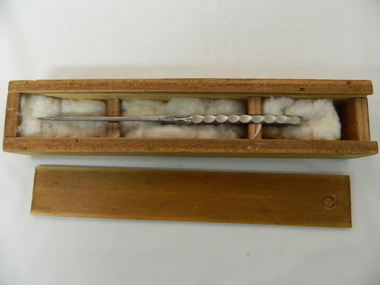
Skin Graft Knife
... beauty. skin graft. knife. doctor In wooden box with a sliding lid. Silver knife held by 2 wooden pieces with slots for knife to fit. Knife is surrounded by cotton wool. Knife is flat with wavy sides. Blade is flat with point ...This medical instrument was used in the Tawonga District General Hospital which was built in the 1950s specifically for the increase in population due to the Kiewa Hydro Scheme.Historial: Shows the development of scientific hospital equipment. Provenance: Used in the Tawonga District General Hospital which was remote and therefore required good equipment.In wooden box with a sliding lid. Silver knife held by 2 wooden pieces with slots for knife to fit. Knife is surrounded by cotton wool. Knife is flat with wavy sides. Blade is flat with point.medical instrument. hospital equipment. tawonga. mt beauty. skin graft., knife. doctor -
 Kiewa Valley Historical Society
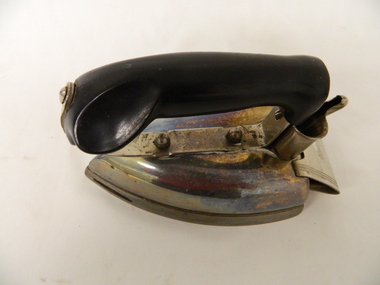
Iron - Electric
... Beauty high-country This iron was used when electricity became available. It was possibly used for smaller items that didn't require a lot of time. Residents of the Kiewa Valley used irons for pressing the family's clothes and linen - usually by the women as it was considered to be part of their domestic duties. iron laundry domestic pressing clothes household electric Hotpoint Cat No. 6266 G7 Watts 575 - Volts 240. Ps 7 Made in Australia A small electric iron, for heating only. "Hot Point ...This iron was used when electricity became available. It was possibly used for smaller items that didn't require a lot of time. Residents of the Kiewa Valley used irons for pressing the family's clothes and linen - usually by the women as it was considered to be part of their domestic duties.A small electric iron, for heating only. "Hot Point" brand with a steel body and a black plastic (or could be Bakelite) upper body that is chromed. The electric cord is detachable and not with the iron.Hotpoint Cat No. 6266 G7 Watts 575 - Volts 240. Ps 7 Made in Australiairon, laundry, domestic, pressing clothes, household, electric -
 Kiewa Valley Historical Society
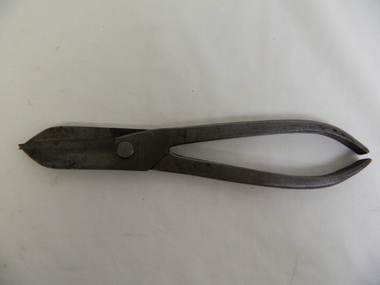
Tin Snips - Tool
... Beauty high-country Used by builders and plumbers to cut tin. Used by Alan Tyers who worked for the State Electricity Commission of Victoria on the Kiewa Hydro Scheme. tinsmith tin snips tool secv cousin's & sons "J. Cousins & Sons. Sheffield"- Inscribed on handle side of pivot on one side. Cousin's Regular Pattern. Used by builders and plumbers to cut tin. Regular pattern with straight cutting edge. Best cast steel, black finish, ground blades. 9 inch. When closed blades meet at the point ...Used by builders and plumbers to cut tin.Used by Alan Tyers who worked for the State Electricity Commission of Victoria on the Kiewa Hydro Scheme.Cousin's Regular Pattern. Used by builders and plumbers to cut tin. Regular pattern with straight cutting edge. Best cast steel, black finish, ground blades. 9 inch. When closed blades meet at the point. Handles meet when closed and are curved outwards."J. Cousins & Sons. Sheffield"- Inscribed on handle side of pivot on one side.tinsmith, tin snips, tool, secv, cousin's & sons -
 Kiewa Valley Historical Society
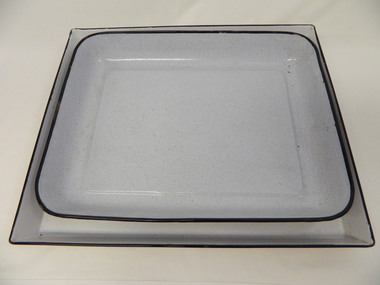
Medical Instrument Tray x2
... beauty. tray. medical instruments. Two large enamel trays used for the required instruments for an operation. Both have black rounded edges. 1. White with straight sides angled at point ...This medical / hospital equipment was used in the Tawonga District General Hospital which was built in the 1950's specifically for the increase in population due to the Kiewa Hydro Electric Scheme.Shows the development of hospital equipment and the material used to make them. It was used in the Tawonga District General Hospital which was remote and therefore required good equipment.Two large enamel trays used for the required instruments for an operation. Both have black rounded edges. 1. White with straight sides angled at point of contact with the surface and form corners. 2. Speckled grey with straight sides that are curved at point of contact with the surface and curved at each corner.medical equipment. hospital equipment. tawonga. mt beauty. tray. medical instruments. -
 Kiewa Valley Historical Society
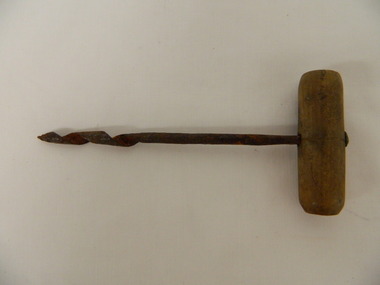
Auger
... Beauty high-country Augers are used to drill holes. Sizes vary as does the surface that they can drill into. Electric and cordless (battery operated) drills are more commonly used now. auger. woodwork. drill. Small wood auger used to drill small holes in timber. It has a wooden cylindrical handle attached at right angles to a steel auger half of which is straight before twisting to a point ...Augers are used to drill holes. Sizes vary as does the surface that they can drill into. Electric and cordless (battery operated) drills are more commonly used now.Small wood auger used to drill small holes in timber. It has a wooden cylindrical handle attached at right angles to a steel auger half of which is straight before twisting to a point.auger. woodwork. drill. -
 Kiewa Valley Historical Society
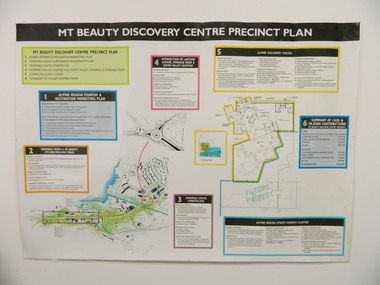
Poster - Mt Beauty Discovery Centre Precinct Plan
... beauty. tourism. discovery centre. sports cluster. Very large laminated poster depicting 6 points for the Alpine Region Sports Tourism Cluster. Each point ...The current (2015) Mt Beauty Tourist Centre site was to be upgraded into a 'Sports Tourism Cluster' with funding from the Government and the Alpine Shire with 'In Kind' assistance from Falls Creek Resort management Board, Parks Victoria and the Local Community & Tourism Industry. This project didn't go ahead.The Mt Beauty town was handed over to the Alpine Shire in the 1960's after completion of the Kiewa Hydro Electric Scheme. Plans for up dating facilities are on-going but are rarely completed. This poster is an example of this.Very large laminated poster depicting 6 points for the Alpine Region Sports Tourism Cluster. Each point has a coloured border and background to black writing. There are 3 maps.mt beauty. tourism. discovery centre. sports cluster. -
 Kiewa Valley Historical Society
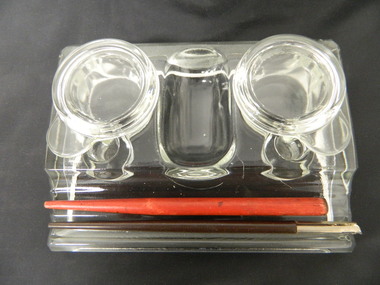
Ink Well - Mt Beauty Post Office
... This inkwell was used by the staff of the Mount Beauty Post Office, from the late 1940's until the change from pen and ink to the use of fountain pens and then ball-point pens. ...Kiewa Valley Historical Society Mount Beauty Information Centre 31 Bogong High Plains Rd Mt Beauty high-country This inkwell was used by the staff of the Mount Beauty Post Office, from the late 1940's until the change from pen and ink to the use of fountain pens and then ball-point pens. ...This inkwell was used by the staff of the Mount Beauty Post Office, from the late 1940's until the change from pen and ink to the use of fountain pens and then ball-point pens. The last Post Master at Mount Beauty rescued this item when the Mt Beauty Post Office was privatised in the 1990's. Ian Mc Kendrick worked at the Mt Beauty post office.Clear glass rectangular shaped set of two ink wells with a pen holder in front. Each ink well has a glass lid. Between the ink wells there is an open area for storing items such as paper clips etc. In addition it Includes a red and a black pen handle.mt beauty post office. inkwell. pen. writing equipment. -
 Kiewa Valley Historical Society
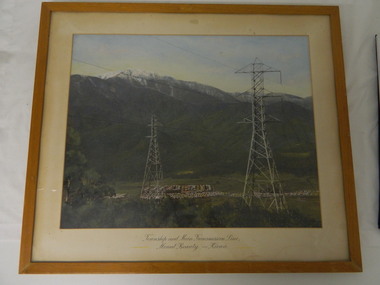
Framed photo - Mt Beauty Township & Main Transmission Line, 1954
... This is a photo of Mount Beauty taken from a high vantage point near the hair-pin bend on the Tawonga Gap Road (half way up) in 1954. ...Kiewa Valley Historical Society Mount Beauty Information Centre 31 Bogong High Plains Rd Mt Beauty high-country This is a photo of Mount Beauty taken from a high vantage point near the hair-pin bend on the Tawonga Gap Road (half way up) in 1954. ...This is a photo of Mount Beauty taken from a high vantage point near the hair-pin bend on the Tawonga Gap Road (half way up) in 1954. Mount Beauty was built by the State Electricity Commission of Victoria during the construction of the Kiewa Hydro Electric Scheme.This photo belonged to Mr & Mrs Gordon White SECV employee and long time residents of Mt Beauty.This is a framed coloured photo of the Mount Beauty Township and main Transmission Line from Mt Beauty to Kiewa. The photo has two transmission lines in the foreground with the Mt Beauty township in the background, but at the foot of Mount Bogong.Approx 1954 / Conroy-Moffatt Pty Ltd / Picture Framer / ..McKillop Street / Tel Mu .. 78 ....mt beauty; transmission line; tawonga gap road; kiewa hydro electric scheme -
 Kiewa Valley Historical Society
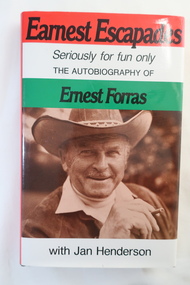
Book - The Autobiography of Ernest Forras, Earnest Escapades Seriously for fun only The autobiography of Ernest Forras with Jan Henderson
... Beauty high-country Ernest migrated from Hungary in January 1951 and helped bring commercial development to Australia's fledgling snowfields. He was keen to find Alpine employment, eventually importing ski and sports gear. This book covers his time in Hungary and his visits to the Alpine Ski Resorts - an insight into the early years of skiing in Australia. Ernest visited Falls Creek on the Bogong High Plains in 1951 and describes the area on pages 66 to76 from the point ...Ernest migrated from Hungary in January 1951 and helped bring commercial development to Australia's fledgling snowfields. He was keen to find Alpine employment, eventually importing ski and sports gear. This book covers his time in Hungary and his visits to the Alpine Ski Resorts - an insight into the early years of skiing in Australia.Ernest visited Falls Creek on the Bogong High Plains in 1951 and describes the area on pages 66 to76 from the point of view of an Hungarian migrant. He visited Falls Creek because his brother had got work on Kiewa Hydro Electric Ssheme.Hard dark brown cover book with dust cover coloured in red, white and green with title in black and a photo of Ernest Forras below. It consists of 190 pages. After page 54 and between Part one and Two, there are 18 pages of photos on photographic paper.Written in shaky writing on inside first page "To Debbie / From Hungary With Love / Ernest Forras 2002 / Mt Beautyernest forras, australian ski resorts from 1951, hungary pre 1951 -
 Kiewa Valley Historical Society
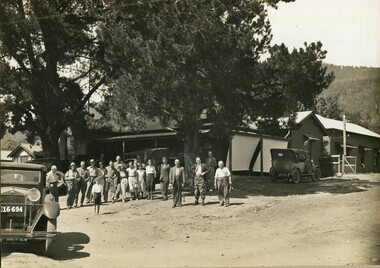
Photos: Bogong Hotel and Kiewa Valley
... Kiewa Valley Historical Society Mount Beauty Information Centre 31 Bogong High Plains Rd Mt Beauty high-country The Bogong Hotel was a central point for social gatherings in the Kiewa Valley. ...The Bogong Hotel was a central point for social gatherings in the Kiewa Valley. It was 125 years old when it was burnt down in December 2011. See KVHS 0965See KVHS 0965Black and white photos framed with thick brown cardboard that is framed by two rows of lines around the photo thus forming a frame. The cardboard is folded in half to form a 'card' enabling the photo to stand. 1. People standing outside the Bogong Pub. The pub is behind trees. Two old/vintage cars are partially in the photo. 2.The Kiewa Valley showing paddocks, trees lining the Kiewa River and mountains in the background.bogong pub, kiewa valley -
 Kiewa Valley Historical Society
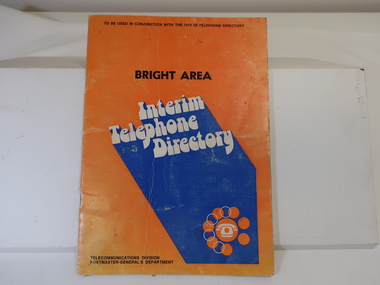
Book - Telephone Directory - 'Bright Area', Bright Area / Interim / Telephone / Directory (1974)
... Beauty resident's addresses 1974 Between first pages a piece of paper is inserted. It has the heading "Subscriber Trunk Dialling (S.T.D.) 18 places named 6 of which have the 060 code. Looks like an orange exercise book with black and white print and a blue arrow pointing ...STD (Subscriber trunk dialling) codes were introduced in Australia between 1971 and 1996. 'STD is fast, convenient and easy. Calls can be cheaper .. so use it for all it's worth.' This directory lists all the town's area codes in each Australian state and explains how STD operates.This list is followed by an 'Alphabetical list of the Bright Area Telephone subscribers.The 'Bright' area included Mt Beauty, Dederang, Bruarong, Kergunuyah, Kiewa, Mitta and Tallandoon.The 1974 directory gives the names and addresses of residents and businesses in Mt Beauty and the Kiewa Valley.Looks like an orange exercise book with black and white print and a blue arrow pointing to the bottom left corner..Book is held by 2 staples. Includes an index of places and information available in this directory. Between first pages a piece of paper is inserted. It has the heading "Subscriber Trunk Dialling (S.T.D.) 18 places named 6 of which have the 060 code.telephone directory 1974, mt beauty telephone directory 1974, mt beauty resident's addresses 1974 -
 Kiewa Valley Historical Society
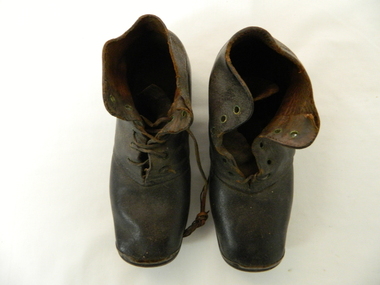
Boots, circa 1940s to 1950s
... Beauty high-country The construction of these boots suggests that it was not purchased locally or from any large town. It may have been introduced by a wandering caravan trader in clothes and shoes. In this era of rural development shoes, especially children footwear, were regarded as a longer term requirement that only required the soles and heels to be replaced. Multiple shoe types were not common only basics that could be handed down. The policy of one main work/play shoe and one church shoe (special occasion) was the norm at this point ...The construction of these boots suggests that it was not purchased locally or from any large town. It may have been introduced by a wandering caravan trader in clothes and shoes. In this era of rural development shoes, especially children footwear, were regarded as a longer term requirement that only required the soles and heels to be replaced. Multiple shoe types were not common only basics that could be handed down. The policy of one main work/play shoe and one church shoe (special occasion) was the norm at this point in history.Worn by Everil Fisher (girl) at Dederang in 1880. They have 'copper toes' and are 'Hob Nail' These items although very basic were what the region required and was applicable to all levels of society at this time. Durability and no fashion infiltration from larger cities resulted in a spartan attitude to basic living requirements. The rural regions of this area were more in focus to the character of the person rather than what was worn. The personal interactions of everyone in the region were more "true blue" than that of the cities. The concept of "mate-ship' far outweighed the type of fashion being wornBrown/Black ankle high boot for child age 4 (approx). Tongue and six eyelets with broken leather laces. Hob Nail visible on soles and heel. Copper Toes. costume, children's footwear, boots, anklets -
 Kiewa Valley Historical Society
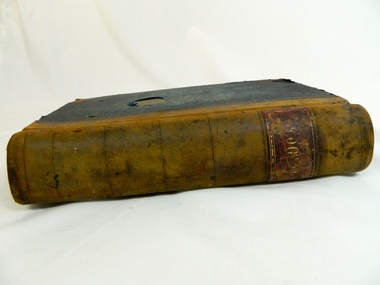
Book - Ledger Commercial, 1902
... Beauty high-country This ledger was started in 1901 when ledgers and other bookkeeping methods were hand written and with nib or fountain pen application. The various ink spots on the pages of this ledger suggests that when the office worker scribed they used the nib and the owner used the fountain pen. It was not until the mid 1950s that ball point ...This ledger was started in 1901 when ledgers and other bookkeeping methods were hand written and with nib or fountain pen application. The various ink spots on the pages of this ledger suggests that when the office worker scribed they used the nib and the owner used the fountain pen. It was not until the mid 1950s that ball point pens were discovered and used in rural areas. The owner of this rural general store was more interested in recording transactions, be it in ink or pencil than the aesthetics of a neat and tidy document. Even though in this era, the principle of neat and tidiness was instilled in workers, this was overlooked and fell away through the economics of employing one staff member to do a variety of tasks for which they may not have had the proper training. It was in the early 1900s that the rural areas such as the Kiewa Valley "had to do" with local employees who had basic training but knew their customers very well and were very respectful of age and the mores of the trading public. The respect by shop owners and staff towards their customers was greater in small rural townships and villages within the Kiewa Valley than in the larger towns and cities. Their was no rushing to get the groceries or to spend the least amount of time within the shop. The social interactions where mixed with commercial activities at a very personalised level of one on one. This closeness gave the customer the confidence that those in the commercial transactions in the shop, where looking after them. This ledger is very significant to the Kiewa Valley as it lists the personal transactions of local businesses, farmers, graziers and miners. Larger accounts and other businesses had one or more pages set aside for their transactions. The words are in large freehand (Capitals 5 mm high) possibly to be read by those with poorer eyesight. The relative long distance to travel for reading glasses or specialised optometrist was overcome by writing in larger fonts. The time taken to register produce or other consumables was not critical during the period when this ledger was in use because the local population was not at the critical level where the demand was not as intense as later on when periods of tourist influx became more demanding. The lay back and relaxed attitude of the local population during this period (early 1900s) was not intense and impersonal as within the larger city shopping and commercial environment. The ability of the shop keepers to interact with their customers not only in the commercial sense but also in a social atmosphere permitted the long hand scribbling of purchases without causing any offence.This item is a cloth and suede leather covered ledger.The spine is suede leather with a red stamped "LEDGER" title. The cover is covered with a dark blue cloth and shows a faded unrecognisable pattern. Each page has light blue lines running horizontal and 90 mm apart. Each page has, from the second line going horizontal two fine 1 mm apart red line. Each page is divided horizontally by single vertical line (except for the two double lines in the centre of the page). The first division separates the month from the day.Next to these lines is an area for the description of the item being purchased. Within the central double lines are vertical lines separating the type of tender paid, i.e., pounds, shillings and pence. The last section of the page has various comments, as required by the scribe.Each page is approximately 160 g/ms. The ledger has 698 pages drawn up on both sides and page numbers of 5 mm in height. 'On spine " LEDGER"commerce, book keeping, shop ledger, local history -
 Kiewa Valley Historical Society
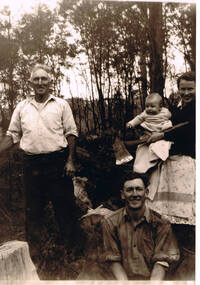
Photograph of Kiewa Valley Pioneer Family, Three Generations of Kiewa Valley Pioneer Family (Coopers), late 1900s'
... Beauty high-country This historical family photograph spans three generations of the Cooper Family, a pioneer family, still residing in the Kiewa Valley. The large axe held by Pat was a handy tool for pioneer families to chop down trees for land clearing, building sheds and fences, outhouses and fire wood. This photograph was taken during a time where both male and females did some heavy lifting and processing. The rural sector at this point ...This historical family photograph spans three generations of the Cooper Family, a pioneer family, still residing in the Kiewa Valley. The large axe held by Pat was a handy tool for pioneer families to chop down trees for land clearing, building sheds and fences, outhouses and fire wood. This photograph was taken during a time where both male and females did some heavy lifting and processing. The rural sector at this point in time was physically a hard location for both sexes. The segregation of the sexes into specific job categories was some times non existent although household "chores" was in the main a woman's domain. The rural sector was in this point of time one which women were highly respected and the unwritten law of providing "assistance" and "reverence" by men in such actions as, socially opening doors, tipping the cap, offering a sturdy arm for support and refraining from doing or saying anything "uncouth" in a woman's presence. It was in a time when women's liberation was just starting to grow strength. Rural areas, on the hole, took longer to interfuse "city" hatched norms of behaviour. This photograph of a pioneer family still residing in the Kiewa Valley demonstrates not only the close protective environment that the valley has on all its inhabitants but also the close bonding that neighbors have towards each other. The term "God's gifted country" fits warmly with all the settlements in the valley. The relatively isolated (physically, visually and communications wise) has since post World War II been whittled away by faster and vastly improved communications with "the outside" world. The strength of commitment to the rural life can be seen in the faces of the family members in this photograph. The proud heritage is displayed without any external pressure. This large black and white family photograph is a reproduction on Fujicolor Crystal Archive Paper manufactured by Fujifilm. It is 200gsm matt finished paper with no borders. On the reverse side, written in pencil "Ted Cooper sitting aged 24-25, Pat Amery (Ted's youngest sister) holding Ted's eldest son Doug and Ted's father John Franklin Cooper(22-8-1892)"john cooper, ted cooper, pat amery, doug cooper, pioneer family kiewa valley -
 Kiewa Valley Historical Society
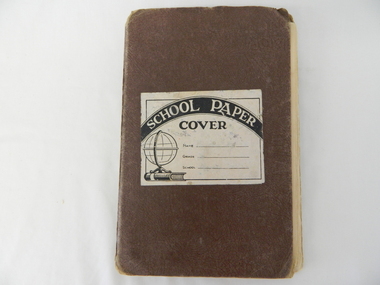
Binder Victorian Education 1947, Circa 1947
... Kiewa Valley Historical Society Mount Beauty Information Centre 31 Bogong High Plains Rd Mt Beauty high-country These educational publications covering a topical monthly theme and providing a slice "of the era" in general knowledge, was used by schools in Victoria as a basic starting point for a particular level of perceived knowledge. ...These educational publications covering a topical monthly theme and providing a slice "of the era" in general knowledge, was used by schools in Victoria as a basic starting point for a particular level of perceived knowledge. The general articles and extracts contained within, were not targeting a specific gender or socio economic sector but designed for all children at a particular stage of their development. This publication did have a format of: 1st page topical, e.g. ANZAC day scouting (U.N.), one page of regional Victoria, one page of poetry, one page of short stories, one page of world history and the last page of a song, complete with appropriate notes. These publications were produced during the second World War and made special references to it. This publication occurred during a period when the Education Department was highly authoritarian in its approach to State levels of learning. Fragmenting "special" schools like later "New Age" teaching methods and doctrines (home schooling) were repressed with considerable force.This binder full of monthly educational studies was particularly important to "hidden away" rural communities such as in the Kiewa Valley, especially at this point in time (World War II). The teaching methods used by local schools provided the necessary break through required by local school children to stop any adverse knowledge deficiencies due to factors of regional isolation. School children with in the Kiewa Valley would be able to integrate with children from all regions, weather in cities or larger towns. This hard cover (card) binder contains 11 monthly publications produced by the Victorian Department of Education for Grades 7 and 8 in the year 1947. Each issue has 16 pages with the cover page covering the major theme for the month. Each issue is placed within the folder by the folded middle page constrained by a thin cord. This is the only method to contain each monthly edition as they have no clasp or are stapled.The folder"SCHOOL PAPER COVER" underneath and to the left is a sketch of the world (revolving desk top stand) on top of a book and next to this "Name ------------ " underneath "Grade-----------" underneath "School---------" all enclosed by a thin border line.school paper, victorian education curriculum, education news letters, loose leaf educational binders -
 Kiewa Valley Historical Society
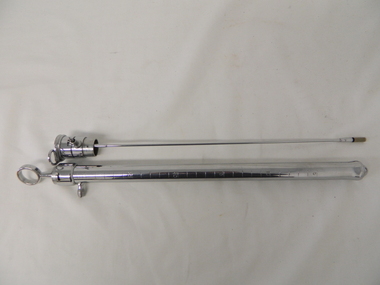
Sigmoidoscope Rigid, Mid to late 1900s
... Beauty Hospital for qualified Physicians to use in their diagnostic evaluation of patients. This would not be an instrument used by a General Physician. This item is still a internal observatory method which may, in some instances, cause some minor complications. This item does point ...This item was used before the flexible sigmoidoscope (1996) and before the introduction of fibre optics late 1900s. The 1900s saw an incredible leap forward in the field of medical procedures. The ability to visually see what was happening within the human body (in real time) provided greater analysis about certain biological abnormalities during a greater time elapse than before. This procedure involved less trauma to the patient and greater flexibility to the Physician in treatment schemes. The rigid signoidscope, however provided the first visual of the colon in situ, but was highly invasive to the patient.This item was used in the Mount Beauty Hospital for qualified Physicians to use in their diagnostic evaluation of patients. This would not be an instrument used by a General Physician. This item is still a internal observatory method which may, in some instances, cause some minor complications. This item does point to the level of medical diagnostics, equivalent to those available in larger towns and cities, which brings this rural area (once considered to be an isolated region) to a higher level of medical care.This rigid 35 cm long sigmoidoscope (internal probe) is made of stainless steel outer hollowed rounded rod, which permits the use of both a fixed (very thin) lighting rod and two flexible cord lights access. Both the lighting rod and the flexible lights can be lowered within the main rod to allow the physician to see the colon at the bottom of the rod.These items are all contained within a specifically inlaid wooden box. The box has separate open compartments for the main instruments and a small lidded compartment containing replacement light bulbs. The hollowed tube permits the physician to visually observe the signoid (an S shaped part) of the colon.On the stainless steel main rod body are engraved the lengths of the body,in centimetres ,with numbers starting at the five centimeter mark and then every five centimetres up to the thirty centimetre mark. On the front inside rim of the box are two inlaid white plastic strips with black print, "ALLEN & HANBURYS Ltd" and the other "LONDON"medical diagnostics, sigmoidoscope examinations, medical examinations, hospital equipment -
 Kiewa Valley Historical Society
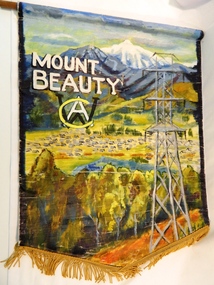
Flag C.W.A, Mount Beauty CWA, circa mid to late 1900's
... point for women in this still relatively isolated rural region and the need to have a place of refuge from the heavy domestic demands that family and business exerted. It was place where the need of a time and space to gain all the mental relaxation and group bonding necessary to balance the sometimes harsh environment that rural life presented existed. The C.W.A. motto "Honour our God, Loyalty to the throne, Service to the country, Through country women, For country women, By country women." cwa flag national cwa victoria country women's association jan burnett mt beauty ...This flag was used by Country Women's Association (C.W.A) Kiewa Valley Branch circa 1950's. This was in a period when the C.W.A. was the major women's organisation which had the greatest influence amongst rural women (especially in isolated areas). This was a period when broad based communications were mainly by radio,women orientated magazines and the telephone. The CWA was an organisation that catered exclusively to country(rural) women's needs. The atmosphere was one of "sisterhood" and covered nearly all the needs of rural based women. This one organisation incorporated knowledge and learning targeting women who physically may be isolated but not mentally.The Kiewa Valley Group of the C.W.A. was a focal point for women in this still relatively isolated rural region and the need to have a place of refuge from the heavy domestic demands that family and business exerted. It was place where the need of a time and space to gain all the mental relaxation and group bonding necessary to balance the sometimes harsh environment that rural life presented existed. The C.W.A. motto "Honour our God, Loyalty to the throne, Service to the country, Through country women, For country women, By country women."This flag is made from dark green cloth and has the Country Womens Association of Victoria insignia embroidered on it in gold and white lettering.This insignia is contained in a circular motif."C.W.A." (each letter layered over each other) cwa flag, national cwa victoria, country women's association, jan burnett, mt beauty
