
Showing 14 items matching "belt driven machinery"
-
 Flagstaff Hill Maritime Museum and Village
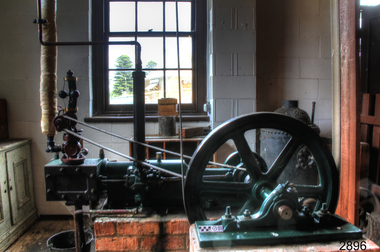
Machine - Steam Engine, Tangyes engineering, Mid-1880s
... ...belt driven machinery...Tangye Richard Tangye James Tangye Joseph Tangye Edward Tangye George Tangye Cornwall Works Birmingham Pickering governor Pickering Portland Connecticut USA 19th century dairy plant steam power Tangye's Patent 238930 Tangye B Size engine Cameron & Sutherland machine merchants 1880s mid-1880s cheese manufacturer butter manufacturer diary industry Warrnambool Technical School belt driven machinery agriculture mechanical governor Farnham Butter Factory Warrnambool Butter Factory TANGEYS PATENT BIRMINGHAM B SIZE 238930 CAMERON & SUTHERLAND MELBOURNE THE PICKERING PORTLAND . ...This Tangye B-size, single-cylinder, horizontal steam engine was likely manufactured in England around the mid-1880s. It was distributed by Melbourne machinery merchants Cameron & Sutherland, which also operated in Bendigo and Ballarat. A local cheese maker once used the engine to drive factory equipment. It was later donated to the Warrnambool Technical School, which then donated it to Flagstaff Hill to add to its historical steam engine collection. Between its manufacture and its donation to Flagstaff Hill, the governor had been replaced by the current Pickering governor. This engine design was very popular in the late 19th and early 20th centuries. When connected and powered up, the engine could drive an overhead line shaft via a flat belt off its flywheel. The line shaft would then drive the machinery via flat belts. It could drive virtually any type of machinery, such as water and sewerage pumps, mine elevators, winches, cranes, metal forges, air blowers, and marine machinery. This engine features a mechanical governor, which controls the speed of the engine regardless of whether it is under load. It also has a water pump built into the valve rod, which is used to supply the boiler with water. Steam enters the cylinder via a slide valve and applies pressure to the piston; it is like a modern internal combustion engine, but in the case of the steam engine, the pressure is exerted in turn on either side of the piston. In other words, the connecting rod is pushed by steam via the piston and piston rod and then pulled back again by steam pushing on the opposite side of the piston. Thus, power is exerted almost continuously, except at the end of each piston stroke, when it reverses direction. In the 1880s, many local butter and cheese manufacturers installed Tangye steam engines to power their machinery. A comprehensive article in the Gippsland Mercury in September 1889 extolled the magnificence of the Farnham Butter Factory in Dennington, Warrnambool, and described how one Tangye engine was used to drive several machines in the cheese- and butter-making processes. A report in the Warragul Guardian in December 1890 notes that the newly opened Warrnambool Butter Factory used a Tangye steam engine to pump water from a 60-foot well. Tangye: Richard Tangye (1833–1906) and four of his brothers—James, Joseph, Edward, and George—were the sons of Joseph Tangye, a Quaker Cornish miner. In 1857, they founded the engineering firm Richard Tangye & Brothers in Birmingham, UK. In 1860, the firm became Tangye Brothers and moved to Cornwall Works in Birmingham. The business encouraged inventors to join the company and develop their patents there, as happened with Weston’s differential pulley block, invented by the Englishman Thomas Aldridge Weston in 1854. Tangye bought the patent in 1858, giving the firm the sole right to manufacture it. The design received a medal for “original application, practical utility and success” at the 1862 International Exhibition in London. Also in 1858, the Tangye firm was commissioned by Brunel’s shipping company to manufacture hydraulic lifting jacks, or rams, to launch the steamship SS Great Eastern. The success of this project brought favourable attention to the firm, and it became involved in other notable projects, including the erection of Cleopatra’s Needle in London in 1878 and work on the Forth Road Bridge in Scotland. The firm underwent several name changes over the years, including James Tangye and Brothers (1857), Tangye Brothers and Price (1859), Tangye Brothers (1860), Tangye Brothers & Holman (1876), Tangye Brothers (by 1878), Tangye Ltd. (1881), and then simply Tangye. Its machinery and equipment were exported worldwide. In 1884, a branch with showrooms, offices, and a warehouse was opened in Melbourne at Cornwall House, Collins Street West. The firm was well known for producing high-quality machinery for agriculture and industry. Even today, new Tangye machinery is available for a subsidiary of Allspeeds. An extensive account of the firm’s history, names, inventions, and further references is available in Grace’s Guide, which also includes references to and diagrams of the Tangye horizontal steam engine. The horizontal steam engine was made by the well-known engineering firm Tangye, known for its high quality of manufacture. It was an important development in machinery because it helped improve productivity. Engines of this type are still used in some parts of the world today. This engine is a good example of a late 19th-century steam engine used in industry and agriculture and adapted for many different purposes. It is also important locally because it was connected to a local cheese making business and part of the thriving western district dairy industry. It may have been one of the Tangyes engines used at the Farnham butter factory or the Warrnambool Butter Factory, which was reported to be one of the most important in the Colony. It is also connected to the Warrnambool Technical School, established in 1968. Steam engine: stationary Tangye Size B, single-cylinder, horizontal Mill type steam engine. It has a 4-inch diameter cylinder with an 8-inch stroke. The body is painted green, and the Pickering governor is red. It was manufactured in Birmingham, England, in accordance with Tangye's Patent 238930, and distributed by Cameron and Sunderland, Melbourne, in the mid-1880s. TANGEYS PATENT BIRMINGHAM B SIZE 238930 CAMERON & SUTHERLAND MELBOURNE THE PICKERING PORTLAND . GOVERNOR . CONN. U.S.A.flagstaff hill, warrnambool, maritime village, maritime museum, flagstaff hill maritime museum and village, shipwreck coast, great ocean road, machine, invention, engine, steam, steam engine, horizontal steam engine, tangyes horizontal steam engine, stationary steam engine, single cylinder steam engine, manufacturing, farming, pumps, lifting equipment, engines, machine tools, hydraulic rams, hydraulic pumps, steam pumps, differential pulleys, mill type steam engine, 4 inch cylinder, weston’s differential pulley, thomas aldridge weston, 1862 international exhibition in london, brunel, ss great eastern, cleopatra’s needle, forth road bridge, cornwall house, collins street melbourne, agricultural machinery, industrial machinery, allspeeds, dairy, pump, richard tangye & brothers, james tangye and brothers, tangye brothers and price, tangye brothers, tangye brothers & holman, tangyes ltd., tangye, richard tangye, james tangye, joseph tangye, edward tangye, george tangye, cornwall works, birmingham, pickering governor, pickering portland connecticut usa, 19th century, dairy plant, steam power, tangye's patent 238930, tangye b size engine, cameron & sutherland, machine merchants, 1880s, mid-1880s, cheese manufacturer, butter manufacturer, diary industry, warrnambool technical school, belt driven machinery, agriculture, mechanical governor, farnham butter factory, warrnambool butter factory -
 Flagstaff Hill Maritime Museum and Village
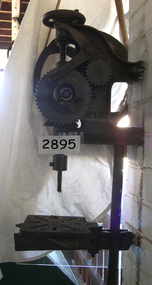
Drill Press, 1930s
... In November 1998, Dawn regained its 100% Australian ownership and now as a separate strategic business unit, began to improve and expand its manufacturing and marketing operations in Australia and overseas. flagstaff hill warrnambool shipwrecked-coast flagstaff-hill flagstaff-hill-maritime-museum maritime-museum shipwreck-coast flagstaff-hill-maritime-village machinery dawn drill press drill press Embossed within the casting "Dawn Melb Australia Mfg". Drill Press, Self-feeding, belt-driven. ...Dawn commenced operations in the Melbourne suburb of Coburg, Victoria in 1917 under the name of Dawn Manufacturing Co. It was founded by four brothers named Blake, who were all engineers. The first products manufactured were vices. After the first world war, Dawn grew considerably and was selling its products all over Australia. They were very busy during the depression with each employee working 60-80 hours a week. During the second world war, Dawn was supplying vices and clamps to the Australian Defence Department along with munitions. In 1959, the company was taken over by the G.N. Raymond Group. The Dawn catalogue was expanded to now included a wide range of engineer's vices, woodworker's vices, plumber's vices & equipment, G-clamps, quick-action clamps and toggle clamps. In 1973, Dawn was acquired by Siddons Ramset Limited. In December 1991, Dawn became a unit of the United States owned Stanley Works Pty. Ltd. In November 1998, Dawn regained its 100% Australian ownership and now as a separate strategic business unit, began to improve and expand its manufacturing and marketing operations in Australia and overseas. Drill Press, Self-feeding, belt-driven. Embossed within the casting "Dawn Melb Australia Mfg".flagstaff hill, warrnambool, shipwrecked-coast, flagstaff-hill, flagstaff-hill-maritime-museum, maritime-museum, shipwreck-coast, flagstaff-hill-maritime-village, machinery, dawn drill press, drill press -
 Flagstaff Hill Maritime Museum and Village
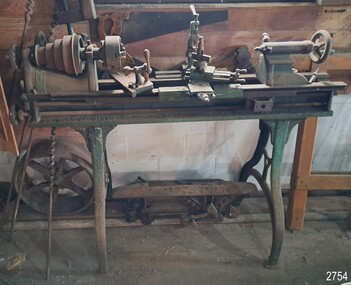
Machine - Lathe, W F & John Barnes, early 1900s
... machinery. Large machine shops often utilised a single power source, distributing power via roof-mounted belts and pulleys to operate several machines simultaneously. Over time, petrol-driven...machinery. Large machine shops often utilised a single power source, distributing power via roof-mounted belts and pulleys to operate several machines simultaneously. Over time, petrol-driven ...This woodworking lathe, connected to both a pulley and a flywheel, demonstrates its historical operation with a steam engine. Such a configuration reflects manufacturing practices from the late 1800s and early 1900s, when steam power was the predominant source for driving workshop and factory machinery. Large machine shops often utilised a single power source, distributing power via roof-mounted belts and pulleys to operate several machines simultaneously. Over time, petrol-driven motors were introduced, and eventually, electricity became the standard power source. Conversion kits were made available in the late 19th and early 20th centuries to adapt older lathes to these newer, cleaner fuels. Manufacturer's History: W.F. & J. Barnes was a renowned maker of hand- and foot-powered treadle woodworking and metalworking machinery, established in 1869. The partnership between William F. Barnes and John Barnes was formalised in 1872, and the firm was incorporated in 1884. Their machines were used for both ‘farm’ applications and professional engineering. By 1881, the company began producing electrically powered machinery. By 1937, W.F. & J. Barnes expanded into manufacturing machinery for automotive assembly. The business closed in 1983, and in 1998, LeBlond Ltd. of Ohio acquired the firm. The lathe was donated by Briggs Marine, Melbourne: In Flagstaff Hill’s formative years, 1972-1975, Briggs Marine, Melbourne (Briggs Brass Foundry), donated equipment and objects used or made at their premises. The foundry was established in 1912 by Herbert Harrison Briggs. In 1965, the firm was owned by partners Cyril Briggs and Frank Lee: Cyril died in 1967, and Frank died in 1971, so the foundry was then run by his son and daughter-in-law, Les and Eva Lee. Briggs Marine’s Warrnambool Branch closed in 1972 after the death of Frank Lee in 1971. Flagstaff Hill’s founding director, John Lindsay, recalled that Briggs Marine’s family members gave personal assistance in setting up the displays in the original village shops, particularly the ‘Brass Foundry’ building, around the time the Maritime Museum opened in 1975. Briggs Marine still exists today, but the Briggs family is no longer involved. This early 1900s lathe marks a significant stage in the evolution of machinery, positioned between the era of hand-operated machines and the advent of electrically powered equipment. Its presence exemplifies the progression of industrial technology and craftsmanship during this period. The lathe is particularly notable for its association with the Briggs Brass Foundry. The foundry was known for developing a specialised brass alloy composed of non-ferrous metals, a formulation that resulted in durable products built to withstand the demanding conditions of marine environments. This focus on resilience and longevity made Briggs Brass Foundry’s goods highly sought after within the maritime sector. Briggs Maine, a long-established business, utilised the foundry’s capabilities to create cast goods tailored to the needs of the marine industry. The facility was equipped to deliver both custom-designed and mass-produced items, ensuring versatility in meeting various requirements. Many of Briggs Foundry’s products found their place on sailing and steam vessels throughout Victoria’s coastline, including in the port town of Warrnambool, where there was once a brancy of Briggs Marine. In addition to general marine fittings, Briggs Marine earned recognition for its expertise in bell-founding. The foundry’s reputation is closely linked to the restoration of the Schomberg Bell at Flagstaff Hill, a small but historically significant bell from a luxury migrant vessel dating back to the mid-19th century. The successful restoration of the Schomberg Bell demonstrates Briggs Brass Foundry’s commitment to preserving craftsmanship and maritime heritage.The lathe is a green, bench-type, steam-powered woodworking machine. Its bench is supported by decorative posts at each end, with each post dividing into arched legs. The lathe is mechanically connected to both a pulley and a flywheel, designed to be operated in conjunction with a steam engine. Included with the lathe is a range of accessories. Across the front of the machine, an inscription is cast, and a stamped, metal lathe pulley guide is attached to the drive mechanism. The lathe was manufactured by W. F. and J. Barnes, Rockford, Illinois, USA, during the 1900s.“W F and J Barnes, Rockford, USA” "1820" "1887"flagstaff hill, flagstaff hill maritime museum and village, warrnambool, maritime museum, maritime village, great ocean road, shipwreck coast, lathe, steam-operated lathe, steam-operated pulley, steam power, steam engine, machine, steam operated machine, metal work, foundry work, metal working trade, tool, pulley driven, metalworking, woodworking, barnes lathe, briggs marine, belt driven, wordworking lathe, free standing lathe, bench lathe, steam powered, vintage lathe, woodturning lathe, w. f. and j. barnes, illanois, early 20th century, briggs, briggs brass foundry, briggs marine foundry, briggs marine products, herbert harrison briggs, george edward briggs, cyril falkiner mckinnon briggs, collingwood, moorabbin, frank lee, les lee, eva lee, briggs marine warrnambool, non-ferrous founders, bell specialists, ship bell specialists, sand cast, marine equipment, marine fittings, foundry, brass foundry, founders -
 Flagstaff Hill Maritime Museum and Village
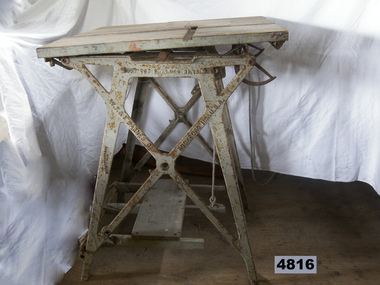
Tool - Tilting Saw Bench, W F & John Barnes, 1874 to 1880
... driven by a pedal that spins a heavy flywheel with a leather belt attached to a gear drive that in turn drives the circular saw blade. The operator holds a wood workpiece on the table and moves it forward so the blade cuts it to the desired width and length. Company History: WF & John Barnes Co. was established in 1869, by making a formal partnership between William F. Barnes and John Barnes in 1872, and then incorporating in 1884. This company was an early manufacturer of pedal-powered equipment. By 1881 they were also making powered machinery...driven by a pedal that spins a heavy flywheel with a leather belt attached to a gear drive that in turn drives the circular saw blade. The operator holds a wood workpiece on the table and moves it forward so the blade cuts it to the desired width and length. Company History: WF & John Barnes Co. was established in 1869, by making a formal partnership between William F. Barnes and John Barnes in 1872, and then incorporating in 1884. This company was an early manufacturer of pedal-powered equipment. By 1881 they were also making powered machinery ...he subject item is a pedal-powered rip saw with a tilting table made in the USA by W.F. & John Barnes Co. of Rockford, Illinois, between 1874 and 1890. The saw's blade moves rapidly in a circular motion and is driven by a pedal that spins a heavy flywheel with a leather belt attached to a gear drive that in turn drives the circular saw blade. The operator holds a wood workpiece on the table and moves it forward so the blade cuts it to the desired width and length. Company History: WF & John Barnes Co. was established in 1869, by making a formal partnership between William F. Barnes and John Barnes in 1872, and then incorporating in 1884. This company was an early manufacturer of pedal-powered equipment. By 1881 they were also making powered machinery such as lathes and pedestal drills. Many companies were making lightweight foot-powered equipment, but Barnes and the Seneca Falls Co. were the only ones to also make professional-grade workshop machines. From the beginning of their existence, they focused on pedal-powered machinery and specialised in making scroll saws. By 1937 the company focus had completely shifted to automotive assembly machinery, and custom-built machinery, machine tools, electrical, hydraulic, and mechanical controls and systems, including nuclear hardware. their production of foot-powered machinery had ceased. In the intervening years, they have got out of manufacturing completely. After a series of ownership changes, their equipment parts and stock were purchased in 1998 by LeBlond Ltd. of Amelia, Ohio. An item that although incomplete gives a snapshot into the manufacture and use of early woodworking machinery before the introduction of electricity or electric motors to power machines.A treadle powered tilting table saw bench"WF & J Barnes, Rockford Ill USA"flagstaff hill, flagstaff hill maritime museum and village, warrnambool, maritime museum, maritime village, great ocean road, shipwreck coast, tilting saw bench, saw bench, 19th century saw bench, treadle saw bench, woodworking building equipment, carpentry equipment, carpentry, w. f. and j. barnes, usa -
 Flagstaff Hill Maritime Museum and Village
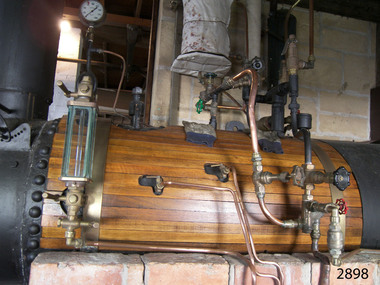
Equipment - Boiler, T & F Johnson, boilermakers, late 19th century
... machinery such as ship and train engines, turbines, presses, wheels, and driving belts to operate looms and saws. The heat associated with the boiler can be used for preserving food, sterilising, factory manufacturing processes, and steaming wood for shipbuilding. Every boiler has several components fitted for safe operation: - - Safety valves - Gauge glass - Pressure gauge - Main steam stop valve - Water check valve - Blowdown valve - Manhole door The boiler is a significant item that gives us a snapshot of early Melbourne's industrial history. It is an example of the technological advancement during the Industrial Revolution where steam-driven ...A steam boiler like this late 18th century boiler, is often called a colonial boiler. Steam boilers were used in factories throughout Australia, mounted over similar designs of brick furnaces. This heat from the fire travels through the tubes in this fire tube boiler and the water heats as it circulates around them. Another kind of boiler is a water tube boiler, in which the water is inside the tubes and the heat of the combustion surrounds the tubes. The boiler in our collection burned wood as fuel but others of this design could also burn coal, coke, gas and liquid fuels. The boiler was made by T & F Johnson, boilermakers. In 1922 their factory was located at Coventry Street, South Melbourne. They were still advertising their 'Colonial, multi, vertical boilers, all sizes' at the same address in 1934. The connected pressure gauge, made in London by Dewrance, measures 0 to 400 pounds per square inch. John Dewrance is renowned as a pioneer of the steam locomotive in the early 19th century. He founded John Dewrance & Co. in South London in 1844. His son Sir John Dewrance took over in 1879. In 1939 the company became a subsidiary of Babcock & Wilcox, and was eventually owned by Emerson. How the boiler works: - A boiler is about two-thirds filled with water and heat is applied, in this case in the form of burning wood. The heat is transferred through the metal of the boiler to the water. When the water boils the steam rises to the top, and as it escapes from the boiler the steam pressure builds up in the steam space to later be released to do work; drive machinery such as ship and train engines, turbines, presses, wheels, and driving belts to operate looms and saws. The heat associated with the boiler can be used for preserving food, sterilising, factory manufacturing processes, and steaming wood for shipbuilding. Every boiler has several components fitted for safe operation: - - Safety valves - Gauge glass - Pressure gauge - Main steam stop valve - Water check valve - Blowdown valve - Manhole doorThe boiler is a significant item that gives us a snapshot of early Melbourne's industrial history. It is an example of the technological advancement during the Industrial Revolution where steam-driven machinery and motors could perform tasks more efficiently than manual labour. The makers were one of many boilermaker businesses in Melbourne during the early late-19th andearly 20th centuries. The maritime trade and skills of boilermaking are still learned and applied today. The Dewrance steam pressure gauge connected to the boiler was made by the London firms foundered by John Dewrance. He was renowned for developing the steam locomotive in the early 19th century.Boiler; a horizontal cylindrical underfired steam boiler. It is a multi-tubular design and is timber plank-clad, with brass fittings and pressure gauges. The boiler has an iron door at one end with a metal chimney above it. It is installed over a brick-enclosed solid fuel furnace. Two large, wood-mounted pressure gauges are connected to the boiler and have inscriptions. An inscription is on a red, cast iron plaque above the boiler door. The boiler's maker is T & F Johnson, South Melbourne. One of the pressure gauges was made by Dewrance, London..Maker's plate: "T & F JOHNSON / BOILERMAKERS / SOUTH MELBOURNE" Pressure gauge: "POUNDS PRESSURE / PER [square] INCH / DEWRANCE LONDON"flagstaff hill, warrnambool, maritime museum, shipwreck coast, flagstaff hill maritime village, great ocean road, boiler, multi tube boiler, steam boiler, steam technology, underfired boiler, horizontal boiler, timber clad boiler, steam power, industrialisation, boilermakers, south melbourne, dewrance, john dewrance, pressure gauge, dewrance pressure gauge, t & f johnson, london, steam engine, steam locomotive, pounds per square inch, 19th century, steam machine, johnson tyne foundry, colonial boiler, fire tube boiler -
 Coal Creek Community Park & Museum
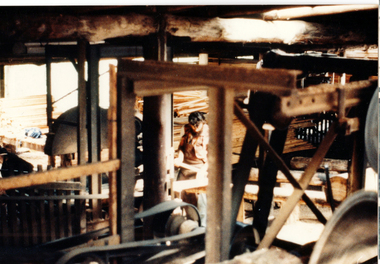
Photograph (item) - Sawmill Interior, Coal Creek Community Park & Museum
... In front a large piece of machinery showing belt-driven parts. The mill was essential to settlement towns, often being the first building to be constructed. ...In front a large piece of machinery showing belt-driven parts. The mill was essential to settlement towns, often being the first building to be constructed. sawmill timber worker pencilled on the reverse 'A8'. ...The interior of the timber sawmill was designed to replicate what a mill may have looked like in a small country town circa 1890s. The image shows a rough-hewn building made from tree trunks and raw timber. In the centre, a man is working on making timber planks - around him lat many more pieces. In front a large piece of machinery showing belt-driven parts. The mill was essential to settlement towns, often being the first building to be constructed. pencilled on the reverse 'A8'. Kodak watermarks.sawmill, timber worker -
 National Wool Museum
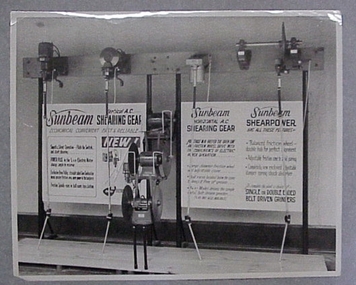
Photograph, Commercial display - full range Sunbeam shearing gear
... Shearing machinery Ingerson-Arnold Studios Ltd Commercial display - full range Sunbeam shearing gear electric vertical & horizontal heavy duty models farm models for small flock owners Shearpower overhead shearing gear single and double ended electirc and belt driven grinders circa 1956 Ingerson-Arnold Studios Limited 84-88 Franklin St., Adleaide telephones LA 2848 LA 5867 To reorder quote No ....... ...Photograph of Sunbeam shearing machinery at a commercial display.Photograph of Sunbeam shearing machinery at a commercial display.Commercial display - full range Sunbeam shearing gear electric vertical & horizontal heavy duty models farm models for small flock owners Shearpower overhead shearing gear single and double ended electirc and belt driven grinders circa 1956 Ingerson-Arnold Studios Limited 84-88 Franklin St., Adleaide telephones LA 2848 LA 5867 To reorder quote No ....... AB 4569shearing machinery, ingerson-arnold studios ltd -
 Yarrawonga and Mulwala Pioneer Museum
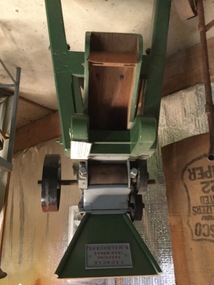
Grain Grister, 1925
... machinery Metal plaque attached to top of delivery box. J Buncle Parkside Ironworks North Melbourne Wooden delivery /storage box on top of metal Grister with three cogs and flywheel [approx. 30 cm diameter] and metal grinding cylinders [rollers] with horizontal grooved lines all around .This is bolted to a wooden stand [painted green] which has a wooden box to receive the crushed grain Rollers are adjustable .Machine driven by flat leather belt on a pulley from a small stationary engine Grain Grister J Bruce & Son ...grinding grainWooden delivery /storage box on top of metal Grister with three cogs and flywheel [approx. 30 cm diameter] and metal grinding cylinders [rollers] with horizontal grooved lines all around .This is bolted to a wooden stand [painted green] which has a wooden box to receive the crushed grain Rollers are adjustable .Machine driven by flat leather belt on a pulley from a small stationary engine Metal plaque attached to top of delivery box. J Buncle Parkside Ironworks North Melbournegrain, grister, farming, machinery -
 Harcourt Valley Heritage & Tourist Centre
Cider Press, 1880s
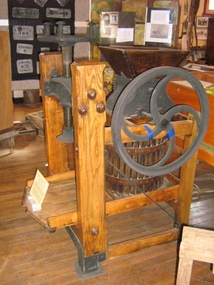
... machinery, being sold in every American state, Europe and Australia. This press was used by the Gaasch family of Harcourt over several generations from 1898 to crush grapes for wine and vinegar making, subsequently to crush apples and then press the pulp to make apple vinegar and cider. The crushing was accompanied by lusty singing of songs and hymns such as 'Ein Feste Burg ist unter Gott'. The press was designed to be hand-operated but was later used by Harcourt Coolstores to press apples. It was then belt-driven...machinery, being sold in every American state, Europe and Australia. This press was used by the Gaasch family of Harcourt over several generations from 1898 to crush grapes for wine and vinegar making, subsequently to crush apples and then press the pulp to make apple vinegar and cider. The crushing was accompanied by lusty singing of songs and hymns such as 'Ein Feste Burg ist unter Gott'. The press was designed to be hand-operated but was later used by Harcourt Coolstores to press apples. It was then belt-driven ...A 'BUCKEYE" grape and cider press, manufactured by P.P. Mast & Co. of Springfield, Ohio, USA and distributed by P. Rohs, Sandhurst (Bendigo). The PP Mast Company was established in 1854. Their Buckeye drills, seeders and other implements played an important role in the development of American farm machinery, being sold in every American state, Europe and Australia. This press was used by the Gaasch family of Harcourt over several generations from 1898 to crush grapes for wine and vinegar making, subsequently to crush apples and then press the pulp to make apple vinegar and cider. The crushing was accompanied by lusty singing of songs and hymns such as 'Ein Feste Burg ist unter Gott'. The press was designed to be hand-operated but was later used by Harcourt Coolstores to press apples. It was then belt-driven by an electric motor. The press was restored (timber cleaned and varnished, metal shoes on base of wooden uprights, which had rotted ) by Mr. Howard Carr, 2001-An early application of mechanics to the crushing of grapes. Hand-driven, geared drive metal crushing parts, with metal flywheel, wooden feed hopper in vertical arrangement, wooden frame, tray and vat, with metal pressing screw installed in heavy metal yoke at front. Metal crushing section carries cast-in maker's name and patent details'BUCKEYE" manufactured by P.P. Mast & Co. of Springfield, Ohio, USA distributed by P. Rohs, Sandhurst (Bendigo). -
 Whitehorse Historical Society Inc.
Equipment - Stationary Motor
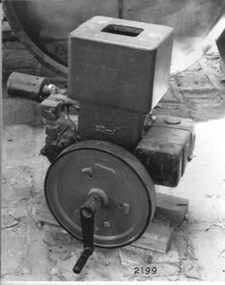
... 3 HP 4 cycle motor primarily used to belt drive other equipment such as pumps and machinery on a farm etc. Petrol driven, magneto ignition and water cooled....Tom did some reconditioning and preservation on the unit. rural industry farm machinery machinery engines - internal combustion Bronze plate 'The Rosebery Engine C25387 RPM 1000 HP3 manufacturer Westinghouse Rosebery Ltd Sydney. 3C-103 on water jacket; 3D-1 on engine housing; 3C-15 on flywheel. 3 HP 4 cycle motor primarily used to belt drive other equipment such as pumps and machinery on a farm etc. Petrol driven ...Used by Ted Beddiscomb of Gormandale near Traralgon, brother in law of donor. Ted was a dairy farmer and used the motor for about 10 years to pump water. It is possible it was on his farm for some years prior to this. Tom did some reconditioning and preservation on the unit.3 HP 4 cycle motor primarily used to belt drive other equipment such as pumps and machinery on a farm etc. Petrol driven, magneto ignition and water cooled.Bronze plate 'The Rosebery Engine C25387 RPM 1000 HP3 manufacturer Westinghouse Rosebery Ltd Sydney. 3C-103 on water jacket; 3D-1 on engine housing; 3C-15 on flywheel.rural industry, farm machinery, machinery, engines - internal combustion -
 Maldon Vintage Machinery Museum Inc
Pump - Centrifugal
... Machinery Pumps Centrifugal Metal Brass specification on sides - "Suction pump manufactured for Victorian Railways in 1930. Model H" Elaborate monogram in black on side denoting Kelly & Lewis Pumps. Brass plate with Kelly & Lewis Ltd / Centrifugal Pump / Type W. Painted light green with moving parts and bolts picked out in black. End suction, overshot discharge Bolted to a wooden base. V belt driven ...Painted light green with moving parts and bolts picked out in black. End suction, overshot discharge Bolted to a wooden base. V belt driven.Brass specification on sides - "Suction pump manufactured for Victorian Railways in 1930. Model H" Elaborate monogram in black on side denoting Kelly & Lewis Pumps. Brass plate with Kelly & Lewis Ltd / Centrifugal Pump / Type W.machinery pumps centrifugal metal -
Maldon Vintage Machinery Museum Inc
Air Compressor
... MACHINERY - Compressors; METALCRAFT. Logo cast in relief in several places signifying - "Thompsons Castlemaine Engineering Propriety". Stenciled on cylinder "M75". Horizontal single cylinder air compressor. V belt driven ...Horizontal single cylinder air compressor. V belt driven with 11 belts. V belt on one end of crankshaft and flywheel on the other end. Painted pale green.Logo cast in relief in several places signifying - "Thompsons Castlemaine Engineering Propriety". Stenciled on cylinder "M75".machinery - compressors; metalcraft. -
 Maldon Vintage Machinery Museum Inc
Motor Mower
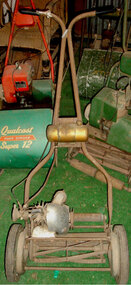
... Machinery motor mower "OGDEN" painted on engine cowl. OGDEN early model cylindrical lawn mower. Small back roller, no catcher, rope start. Small gold painted petrol tank mounted between handles for gravity feed. Belt driven ...OGDEN early model cylindrical lawn mower. Small back roller, no catcher, rope start. Small gold painted petrol tank mounted between handles for gravity feed. Belt driven cylinder blades, aluminium engine cowl, rubber rimmed wheels, engine control on RHS handle."OGDEN" painted on engine cowl.machinery, motor mower -
Maldon Vintage Machinery Museum Inc
Leaflets
... MACHINERY - Pumps; DOCUMENTS - Pamphlets Seven leaflets each advertising a different pump. Illustrated in black & white. .1) Horizontal Dry Vacuum Pump, single bearing frame type with Outboard Bearing. .2) Direct coupled Single-stage Class "G" Centrifugal Pump. .3) Single-Stage Glass "G" Pump with overhung pulley. .4) Thompson Improved Type Gravel Pump .5) Belt-Driven Class "G" Centrifugal 5inch Single-Stage Pump with Belt striking gear. .6) Direct coupled Two-Stage Class "G" centrifugal pump. .7) Belt-driven Two-Stage Class "G" centrifugal pump. ...Seven leaflets each advertising a different pump. Illustrated in black & white. .1) Horizontal Dry Vacuum Pump, single bearing frame type with Outboard Bearing. .2) Direct coupled Single-stage Class "G" Centrifugal Pump. .3) Single-Stage Glass "G" Pump with overhung pulley. .4) Thompson Improved Type Gravel Pump .5) Belt-Driven Class "G" Centrifugal 5inch Single-Stage Pump with Belt striking gear. .6) Direct coupled Two-Stage Class "G" centrifugal pump. .7) Belt-driven Two-Stage Class "G" centrifugal pump.machinery - pumps;, documents - pamphlets
