
Showing 6 items matching "berber"
-
 National Wool Museum
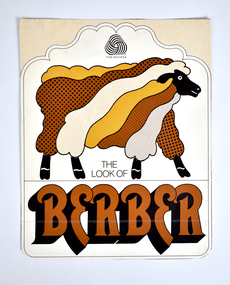
Card - Packaging – The Look of Berber, c.1980s
... ...Berber...Modern industrialized Berber carpets are distinguished by a loop pile construction type that gives a similar appearance to the distinct knot of traditionally woven Berber carpets. ...Printed: PURE NEW WOOL / THE / LOOK OF / BERBER...Modern industrialized Berber carpets are distinguished by a loop pile construction type that gives a similar appearance to the distinct knot of traditionally woven Berber carpets. ...Modern industrialized Berber carpets are distinguished by a loop pile construction type that gives a similar appearance to the distinct knot of traditionally woven Berber carpets. The modern carpets usually contain small flecks of dark colour on lighter shades of background colours resembling a natural undyed version of the traditional carpets. Berber is known for being one of the oldest and most durable kinds of carpet. Traditionally, Berber carpets are carpets hand-woven by the Berber people in North Africa and the Sahara. The carpets come in traditional and modern designs, which are distinguished by different knotting patterns, dyes and fabric textures. The origin of carpet weaving by the Berber populations dates back several millennia. The hand-spun cloth they created was named after the individual tribe, and they used natural fibres to create cloaks, rugs and other fabrics. Card showing printed text and graphic featuring an image of a sheep in tones of orange, brown and cream. Printed: PURE NEW WOOL / THE / LOOK OF / BERBER collins bros mill pty ltd, manufacturing, geelong, wool, berber -
 National Wool Museum
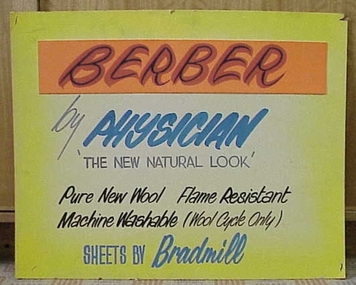
Sign
... Berber by Physician 'The New Natural Look' Pure New Wool flame Resistant Machine Washable (Wool Cycle Only) Sheets by Bradmill...Three display signs advertsing Physician blankets and Bradmill sheets. Sign Berber by Physician 'The New Natural Look' Pure New Wool flame Resistant Machine Washable (Wool Cycle Only) Sheets by Bradmill One of three display signs. ...Three display signs advertsing Physician blankets and Bradmill sheets. One of three display signs. One of three display signs. One of three display signs. Berber by Physician 'The New Natural Look' Pure New Wool flame Resistant Machine Washable (Wool Cycle Only) Sheets by Bradmill sign -
 Bendigo Historical Society Inc.
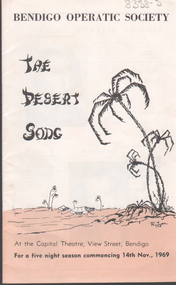
Programme - Bendigo Operatic Society: The Desert Song
... The Desert Song" is an operetta based on the uprising of a Berber group against French Colonial rule in Morocco. ...The Desert Song" is an operetta based on the uprising of a Berber group against French Colonial rule in Morocco. ...The Desert Song" is an operetta based on the uprising of a Berber group against French Colonial rule in Morocco. The music was by Sigmund Romberg and the lyrics were a collaboration between Oscar Hammerstein II, Harbach and Mandel. It opened on Broadway in 1926. Bendigo Operatic Society Program for the production of The Desert Song White & orange/pink front page with a picture image of a desert scene Information on front cover: At the Capital Theatre for a five night season commencing 14th Nov, 1969 8 double sided pages with black & white photos of cast & production team souvenir programme, bendigo operatic society -
 Bendigo Historical Society Inc.
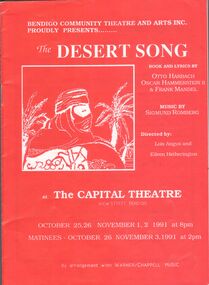
Programme - Programme ""The Desert Song" by Bendigo Community Theatre and Arts Inc
... "The Desert Song" is an operetta in two acts with book and lyrics by Otto Harbach, Oscar Hammerstwin II and Frank Mandel and music by Sigmund Romberg inspired by the 1925 upprising of a group of Berber fighters against French colonial rule in Morocco...."The Desert Song" is an operetta in two acts with book and lyrics by Otto Harbach, Oscar Hammerstwin II and Frank Mandel and music by Sigmund Romberg inspired by the 1925 upprising of a group of Berber fighters against French colonial rule in Morocco. ..."The Desert Song" is an operetta in two acts with book and lyrics by Otto Harbach, Oscar Hammerstwin II and Frank Mandel and music by Sigmund Romberg inspired by the 1925 upprising of a group of Berber fighters against French colonial rule in Morocco. Music Programme for The Desert Song" a musical performed by Bendigo Community Theatre and Arts Inc. October 25, 26, November 1, 2 and matinees October 26, November 3, 1991 at the Capital Theatre, View Street- a 20 page booklet with acknowledgements, advertisements, details of Acts, cast,and story synopsis. programme, concert -
 Embroiderers Guild, Victoria
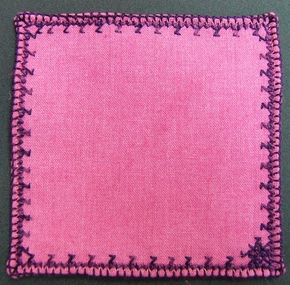
Textile - Moroccan Handkerchief/Mat
... Moroccan hand embroidery dates back to the earl 18th century. The Berber tribes of Morocco, North Africa, used permanent tattoo symbols on their bodies, as a sign of cultural beauty. ...Moroccan hand embroidery dates back to the earl 18th century. The Berber tribes of Morocco, North Africa, used permanent tattoo symbols on their bodies, as a sign of cultural beauty. ...Moroccan hand embroidery dates back to the earl 18th century. The Berber tribes of Morocco, North Africa, used permanent tattoo symbols on their bodies, as a sign of cultural beauty. Later this very decoration was transferred onto pottery and then as hand embroidery, and became a big part of the country's tradition. Many cities in the north of Morocco, like Meknes, Rabat, Salé, and Fez are all known for their unique way of embroidery style, technique, colours and fabric. This particular piece of hand embroidery was done in Meknes in 1991. It has no pattern transferred or drawn onto the actual fabric. The embroiderer simply counts each thread; one stitch spans two to four threads of the fabric. Embroidering horizontally, vertically or diagonally, leaving blanks to achieve the desired symmetrical design. This is an extremely time-consuming technique, which requires mathematical precision and a lot of concentration and patience, There is no reverse side. (a) Cotton handkerchief embroidered in blue tones in various stitches with a rolled buttonhole stitched edge (b) Linen mat with rolled buttonhole stitched edge and various even weave stitches. morocco, handkerchief, mat -
 Embroiderers Guild, Victoria
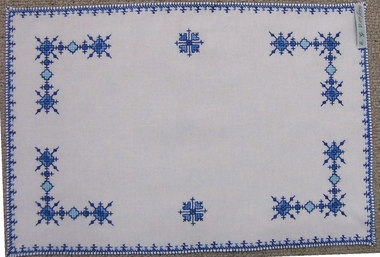
Textile - Moroccan Blue and White Mat
... Moroccan hand embroidery dates back to the earl 18th century. The Berber tribes of Morocco, North Africa, used permanent tattoo symbols on their bodies, as a sign of cultural beauty. ...Moroccan hand embroidery dates back to the earl 18th century. The Berber tribes of Morocco, North Africa, used permanent tattoo symbols on their bodies, as a sign of cultural beauty. ...Moroccan hand embroidery dates back to the earl 18th century. The Berber tribes of Morocco, North Africa, used permanent tattoo symbols on their bodies, as a sign of cultural beauty. Later this very decoration was transferred onto pottery and then as hand embroidery, and became a big part of the country's tradition. Many cities in the north of Morocco, like Meknes, Rabat, Salé, and Fez are all known for their unique way of embroidery style, technique, colours and fabric. This particular piece of hand embroidery was done in Meknes in 1991. It has no pattern transferred or drawn onto the actual fabric. The embroiderer simply counts each thread; one stitch spans two to four threads of the fabric. Embroidering horizontally, vertically or diagonally, leaving blanks to achieve the desired symmetrical design. This is an extremely time-consuming technique, which requires mathematical precision and a lot of concentration and patience, There is no reverse side. White cotton mat decorated with counted thread and with a rolled, buttonhole stitched hem in shades of blue, mat, embroidery, morocco, cross stitch
