
Showing 104 items matching "best practices"
-
 Surrey Hills Historical Society Collection
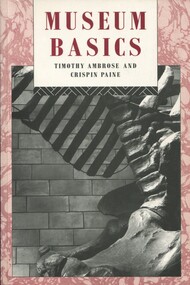
Book, Museum Basics, 1995
... This book provides a basic guide to best practice in every aspect of museum work from organisation, through collections management and conservation to marketing and security. ...This book provides a basic guide to best practice in every aspect of museum work from organisation, through collections management and conservation to marketing and security. ...This book provides a basic guide to best practice in every aspect of museum work from organisation, through collections management and conservation to marketing and security. ...This book provides a basic guide to best practice in every aspect of museum work from organisation, through collections management and conservation to marketing and security. The book is designed as a basis for training courses.This book provides a basic guide to best practice in every aspect of museum work from organisation, through collections management and conservation to marketing and security. The book is designed as a basis for training courses.Front Page : Susan Barnettmuseums, management, archives, educations and research establishments -
 Moorabbin Air Museum
Book - Flight Simulation & Simulators, Microsoft Flight Simulator as a Training Aid
... ...Best practices...Flight Simulation & Simulators Using flight simulators as a training aid Best practices Flight simulator essentials Advanced training features Practice flights Supplemental information & web links VFR practice flights IFR practice flights Guide to Microsoft Flight Simulator for pilots, instructors & virtual aviators, circa 2006 Microsoft Flight Simulator as a Training Aid Book Flight Simulation & Simulators ...Guide to Microsoft Flight Simulator for pilots, instructors & virtual aviators, circa 2006non-fictionGuide to Microsoft Flight Simulator for pilots, instructors & virtual aviators, circa 2006using flight simulators as a training aid, best practices, flight simulator essentials, advanced training features, practice flights, supplemental information & web links, vfr practice flights, ifr practice flights -
NMIT (Northern Melbourne Institute of TAFE)
Journal: Northern contact, Northern Area Consultative Committee 1998-2007
... Dealt with 'Issues related to vocational skills, business growth and development, vocational education and training, school to work transition and demonstration and achievement of best practice in business, industry and education in the north of Melbourne.' ...Dealt with 'Issues related to vocational skills, business growth and development, vocational education and training, school to work transition and demonstration and achievement of best practice in business, industry and education in the north of Melbourne.' ...A4 size journal published since 1998. Years held 1998-2007 (incomplete). Dealt with 'Issues related to vocational skills, business growth and development, vocational education and training, school to work transition and demonstration and achievement of best practice in business, industry and education in the north of Melbourne.' northern area consultative committee, journals -
 Vision Australia
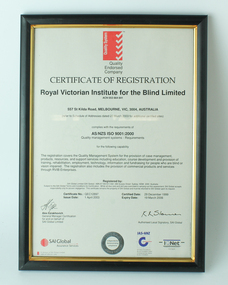
Certificate - Text, Certificate of Quality Assurance System registration, April 2003: 557 St Kilda Road, 1 April 2003
... As part of management standards to adhere to best practice, RVIB went through the certification process to receive ISO accreditation within its offices....As part of management standards to adhere to best practice, RVIB went through the certification process to receive ISO accreditation within its offices. ...As part of management standards to adhere to best practice, RVIB went through the certification process to receive ISO accreditation within its offices.1 certificate with signatures and stampCertificate reads "Certificate of Registration. Royal Victorian Institute for the Blind Limited, 557 St Kilda Road Melbourne, VIC 3004 Australia (refer to Schedule of Addresses dated March 20 2003 for additional certified sites) complies with the requirements of AS/NZS ISO 9001:2000 Quality Management Systems Requirements for the following capability: This registration covers the Quality Management System for the provision of case management, production, resources, and support services including education, course development and provision of training, rehabilitation, employment, technology, information and fundraising for people who are blind or vision impaired. The registration also includes the provision of commercial products and services through RVIB Enterprises." Signed: Alex Ezrakhovich, General Manager Certification. Certificate #: QEC12897. Issue Date: 1st April 2003. Certified Date: 29th December 1999. Expiry Date 19th March 2006.royal victorian institute for the blind, registration -
Lakes Entrance Historical Society
Book, Commonwealth of Australia, Style Manual for authors, editors and printers, Third Edition, 1978
... A style manual to encourage consistency of editorial style in Australian government publications, and providing a guide to the best typographical and printing practices....Directories Government A style manual to encourage consistency of editorial style in Australian government publications, and providing a guide to the best typographical and printing practices. Style Manual for authors, editors and printers, Third Edition Book Commonwealth of Australia ...A style manual to encourage consistency of editorial style in Australian government publications, and providing a guide to the best typographical and printing practices.directories, government -
 Federation University Art Collection
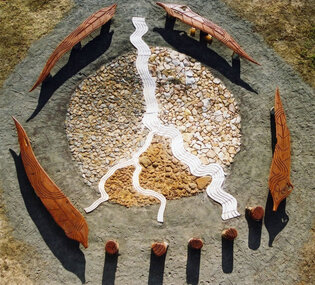
Sculpture, 'Fire Pit' by Glenn Romanis, 2004
... The programming champions best practice and strengthens a national network of artists and practitioners working in regional, rural and remote Australia. ...The programming champions best practice and strengthens a national network of artists and practitioners working in regional, rural and remote Australia. ...My visual stories seek to inform about the natural and cultural histories that attribute to the experience of country (place), in order hat the audience gains respect, understanding and a sense of belonging to the place. My practice involves various mediums in two and three dimensional form, which include permanent and ephemeral installation, paving, stonework, woodwork, metal work, lighting design, illustration, mural painting and mosaic work. I am competent in using all these mediums, but do have a preference to stone and wood. Having been involved in public and community art as a designer and sculpture/maker in both individual and collaborations for the past fifteen years, I have been fortunate to work with and partake in various collaborations and project teams; working with council organizations, landscape designers, art practitioners, artisans and arts workers. (https://www.glennromanis.com/biography, accessed 08 June 2022)Glenn ROMANIS Wurundjeri/woi wurrung and Boonwerrung This item is part of the Federation University Art Collection. The Art Collection features over 2000 works and was listed as a 'Ballarat Treasure' in 2007.A fire pit with sculpted redgum seats in the shape of a gum leaf. It was created for the Arts Victoria 'Artlands' Conference held in Horsham in 2004. Artlands is a national event designed to reflect and respond to emerging trends and shine a spotlight on arts in regional Australia. It is designed to showcase new thinking, present contemporary work, and generate exchange and conversations. The programming champions best practice and strengthens a national network of artists and practitioners working in regional, rural and remote Australia. Presented and delivered by Regional Arts Australia, Artlands is positioned as a multi-art, cross-industry and inter-generational. It presents a critical survey of the contemporary regional cultural landscape; and provides much-needed opportunities for artists to gather, present work and enter into meaningful exchange.art, artwork, aboriginal, glenn romanis, sculpture, campsite, camp fire -
 Wooragee Landcare Group
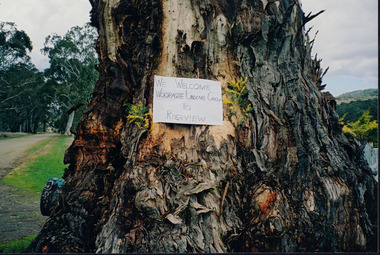
Photograph, 5 September 2004
... The organisation has drawn on the work of a variety of Government and academic experts to ensure best practice approaches are utilised. This photograph was taken at Riverview Farm, Victoria on Sunday the 5th of September as part of a day trip by the Wooragee Landcare Group. ...The organisation has drawn on the work of a variety of Government and academic experts to ensure best practice approaches are utilised. This photograph was taken at Riverview Farm, Victoria on Sunday the 5th of September as part of a day trip by the Wooragee Landcare Group. ...Wooragee Landcare was formed in 1989 to promote sustainable conservation and land-use practices in the North-East region of Victoria. The organisation's work has included public awareness and education campaigns to control invasive, introduced species and protect native wildlife, such as campaigns to replant native plant species to improve soil integrity and restore habitat for flora and fauna. The organisation has drawn on the work of a variety of Government and academic experts to ensure best practice approaches are utilised. This photograph was taken at Riverview Farm, Victoria on Sunday the 5th of September as part of a day trip by the Wooragee Landcare Group. The event was about looking at land use on small farms and as a social get-together for the Group. Wooragee was also researching how small landholders could run some enterprises around the time of the trip. This photograph is a great example of the type of events that Wooragee Landcare Group has organized, while educating the public about the importance of land use management.Landscape colour photograph printed on gloss paper. Reverse: WAN NA E0NA2N2. NNN+ 4 4240/ [PRINTED] (No. 24) / 377wooragee, wooragee landcare group, wooragee landcare's collection, land use, social, riverview farm, animals, pests, indigo shire, tatong, samaria, north-east victoria -
![Book, Chris Cunneen et al, Keeping Aboriginal and Torres Strait Islander people out of custody : an evaluation of the implementation of the recommendations of the Royal Commission in [ie. into] Aboriginal Deaths in Custody, 1997](/media/collectors/52f0758a9821f40464f742c1/items/56c69101400d0c3518d1512f/item-media/56c69101400d0c3518d15130/item-fit-380x285.jpg?cb=6) Victorian Aboriginal Corporation for Languages
Victorian Aboriginal Corporation for LanguagesBook, Chris Cunneen et al, Keeping Aboriginal and Torres Strait Islander people out of custody : an evaluation of the implementation of the recommendations of the Royal Commission in [ie. into] Aboriginal Deaths in Custody, 1997
... Contents: 1: Introduction 2: Data on Aboriginal and Torres Strait Islander over-representation in the criminal justice system 3: Explanations for Aboriginal and Torres Strait Islander over-representation in the criminal justice system PART TWO : CASE STUDIES 4 : Poor Practice Case Studies - 5 : Best Practice Case Studies PART THREE: ANALYSIS OF THE RECOMMENDATIONS AND THEIR IMPLEMENTATION 6: Adequacy of Information -7: Aboriginal and Police Community Relations 8: Responding to Public Drunkenness 9: Police Practices and Procedures 10: Imprisonment as a Last Resort 11: Court Processes, Legislation and Aboriginal Legal Representation 12: Aboriginal Young People and the Juvenile Justice System PART FOUR 13: Conclusion APPENDIXES Appendix 1: The recommendations of the Royal Commission most proximate to reducing the over-representation of Aboriginal people in custody Appendix 2: Methodological issues in determining over-representation Appendix 3: Details of Federal funding related to State agencies for the implementation of the Royal Commission into Aboriginal Deaths in Custody recommendations....Aboriginal deaths in custody criminal justice system b&w illustrations, tables Contents: 1: Introduction 2: Data on Aboriginal and Torres Strait Islander over-representation in the criminal justice system 3: Explanations for Aboriginal and Torres Strait Islander over-representation in the criminal justice system PART TWO : CASE STUDIES 4 : Poor Practice Case Studies - 5 : Best Practice Case Studies PART THREE: ANALYSIS OF THE RECOMMENDATIONS AND THEIR IMPLEMENTATION 6: Adequacy of Information -7: Aboriginal and Police Community Relations 8: Responding to Public Drunkenness 9: Police Practices and Procedures 10: Imprisonment as a Last Resort 11: Court Processes, Legislation and Aboriginal Legal Representation 12: Aboriginal Young People and the Juvenile Justice System PART FOUR 13: Conclusion APPENDIXES Appendix 1: The recommendations of the Royal Commission most proximate to reducing the over-representation of Aboriginal people in custody Appendix 2: Methodological issues in determining over-representation Appendix 3: Details of Federal funding related to State agencies for the implementation of the Royal Commission into Aboriginal Deaths in Custody recommendations. ...Contents: 1: Introduction 2: Data on Aboriginal and Torres Strait Islander over-representation in the criminal justice system 3: Explanations for Aboriginal and Torres Strait Islander over-representation in the criminal justice system PART TWO : CASE STUDIES 4 : Poor Practice Case Studies - 5 : Best Practice Case Studies PART THREE: ANALYSIS OF THE RECOMMENDATIONS AND THEIR IMPLEMENTATION 6: Adequacy of Information -7: Aboriginal and Police Community Relations 8: Responding to Public Drunkenness 9: Police Practices and Procedures 10: Imprisonment as a Last Resort 11: Court Processes, Legislation and Aboriginal Legal Representation 12: Aboriginal Young People and the Juvenile Justice System PART FOUR 13: Conclusion APPENDIXES Appendix 1: The recommendations of the Royal Commission most proximate to reducing the over-representation of Aboriginal people in custody Appendix 2: Methodological issues in determining over-representation Appendix 3: Details of Federal funding related to State agencies for the implementation of the Royal Commission into Aboriginal Deaths in Custody recommendations.b&w illustrations, tablesaboriginal deaths in custody, criminal justice system -
 Mission to Seafarers Victoria
Programme - Catalogue, Open House Melbourne, Takie Hold of the Clouds, 2022
... Embedding the work within the city itself rather than a traditional gallery, the exhibition models best practices for high-impact yet sustainable and resource-sensitive exhibition-making. ...Embedding the work within the city itself rather than a traditional gallery, the exhibition models best practices for high-impact yet sustainable and resource-sensitive exhibition-making. ...Catalogue for an artistic discovery Ttail during Open House 2022.Digital copy of an artistic event catalogue 142 pages.non-fictionCatalogue for an artistic discovery Ttail during Open House 2022.open house melbourne, 2022, ying-lan dann, circular temporalities, norla dome, exhibitions, video installation, cultural events -
 Mission to Seafarers Victoria
Poster, Ying-Lan Dann, Circular Temporalities, July 2022
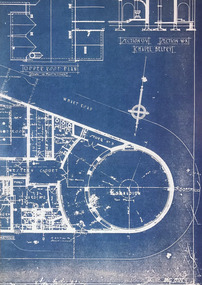
... Embedding the work within the city itself rather than a traditional gallery, the exhibition models best practices for high-impact yet sustainable and resource-sensitive exhibition-making. ...Embedding the work within the city itself rather than a traditional gallery, the exhibition models best practices for high-impact yet sustainable and resource-sensitive exhibition-making. ...Take Hold of the Clouds is a curated exhibition featuring two key works by renowned international contributors – Forensic Architecture’s Cloud Studies (2021) and Cauleen Smith’s Sojourner (2018) – along with six, newly commissioned, responsive works from local and national creative practitioners. The experimental exhibition is distributed across seven of the city’s most significant buildings and urban spaces, with each temporal creative work adding a new layer to how we understand these spaces in relation to the world around us. Embedding the work within the city itself rather than a traditional gallery, the exhibition models best practices for high-impact yet sustainable and resource-sensitive exhibition-making. Created in partnership with Monash University, Take Hold of the Clouds navigates the Weekend’s theme of Built/Unbuilt through a series of thoughtful encounters in which artists reveal the invisible stories and issues in corners of the city. The exhibition is conceived by Tara McDowell, Director of Curatorial Practice at Monash Art, Design and Architecture, and co-curated with Fleur Watson, Open House Melbourne’s Executive Director. To create this poster, the artist used a copy of of one of Walter Butler plans for the 7171 building held in the archives as an homage to the architect. The sketch was then retouched to make it loo like a blueprint. The Mission is one of the sites open every year during Open House. A3 size Blue print type plan print on glose paper.open house melbourne, 2022, ying-lan dann, circular temporalities, norla dome, blueprint, plans, walter richmond butler (1864–1949), cultural events -
 Federation University Historical Collection
Document - Document - Outline for VIOSH, VIOSH: The Vision, Mission, Aims, Goals and Principles for the Victorian Institute of Occupational Safety and Health,1997
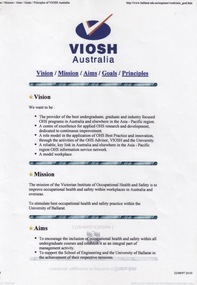
... Improvement in occupational health and safety within workplaces in Australia and overseas and stimulate best practice within the University of Ballarat is the mission. ...Improvement in occupational health and safety within workplaces in Australia and overseas and stimulate best practice within the University of Ballarat is the mission. ...Victorian Institute of Occupational Safety and Health (VIOSH) Australia is the Asia-Pacific centre for teaching and research in occupational health and safety (OHS) and is known as one of Australia's leaders on the field. VIOSH has a global reputation for its innovative approach within the field of OHS management. VIOSH had its first intake of students in 1979. At that time the Institution was known as the Ballarat College of Advanced Education. In 1990 it became known as Ballarat University College, then in 1994 as University of Ballarat. It was 2014 that it became Federation University. VIOSH Australia students are safety managers, senior advisors and experienced OHS professionals. They come from all over Australia and industry. Students are taught active research and enquiry; rather than textbook learning and a one-size fits all approach. VIOSH accepts people into the Graduate Diploma of Occupational Hazard Management who have no undergraduate degree - on the basis of extensive work experience and knowledge. Document outlining the Vision, Mission, Aims, Goals and Principles of VIOSH Australia. The main vision is to provide the best undergraduate, graduate and industry focused OHS program in Australia and Asia - Pacific Region. Improvement in occupational health and safety within workplaces in Australia and overseas and stimulate best practice within the University of Ballarat is the mission. Detailed statements covering Aims, Goals and Principles outline how this will be achieved.Thirteen A4 pages, typed. Coloured sections.Symbols for VIOSH, CSIRO, SafetyLine, Safety Institute of Australia, Worksafe Australia,Canadian Centre for OH&S. Health and Safety Executive (United Kingdom), National Institute for OH&S (United States), Occupational Health and Safety (United States), International Occupational Safety and Health Information (Finland)viosh, victorian institute of occupational safety and health, university of ballarat, vision, mission, aims, goals, principles, research and colsultancy, courses, viosh working papers, noise control in mining, resources, australia, csiro, safetyline, safety institute of australia, worksafe australia, canada, canadian centre for occupational health and safety, united kingdom, health and safety executive, united states, national institute for occupational safety and health, occupational health and safety administration, finland, international occupational safety and health information -
 Wooragee Landcare Group
Photograph, 28th April 2004
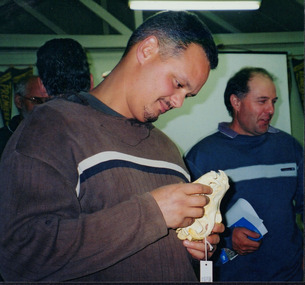
... The organisation has drawn on the work of a variety of Government and academic experts to inform best practice approaches are utilised. In 2004 Andrew Murray, a leading quoll expert from Parks Victoria, conducted training for Wooragee Landcare members and the local community in how to identify potential quoll habitat and populations (through identifying scat and other methods). ...The organisation has drawn on the work of a variety of Government and academic experts to inform best practice approaches are utilised. In 2004 Andrew Murray, a leading quoll expert from Parks Victoria, conducted training for Wooragee Landcare members and the local community in how to identify potential quoll habitat and populations (through identifying scat and other methods). ...Wooragee Landcare was formed in 1989 to promote sustainable conservation and land-use practices in the North-East region of Victoria. The organisation's work has included public awareness and education campaigns to control invasive, introduced species and protect native wildlife, such as campaigns to bait or trap foxes and to identify and monitor quoll populations in the region. The organisation has drawn on the work of a variety of Government and academic experts to inform best practice approaches are utilised. In 2004 Andrew Murray, a leading quoll expert from Parks Victoria, conducted training for Wooragee Landcare members and the local community in how to identify potential quoll habitat and populations (through identifying scat and other methods). Spotted-tail or Tiger quolls were known to have lived in the Mt Pilot and Stanley Plateau region previously but habitat encroachment, competitor species such as foxes and natural disasters had reduced sightings in recent years. The Spotted-Tail quoll (formerly known as the Tiger Quoll) is the largest of four species of native marsupial carnivore on mainland Australia, and the second-largest carnivore (after the dingo). The species' scientific name, Dasyurus maculatus, references its' 'hairy tail'. Adults are approximately 125cm long, including their long tail, and weigh around 5 kilograms. The Spotted-tail quoll is currently considered to be a threatened species, but other species are currently listed as endangered. This photograph is significant as an example of wildlife protection awareness programs undertaken by Wooragee Landcare Group in the 2000s in Indigo Shire.Landscape coloured photograph printed on gloss paper.Reverse: WAN NA 0ANA2N0 NNN+ 2 8743 / [PRINTED] (No.22) / 268wooragee, wooragee landcare, kiewa landcare, indigo shire, north-east victoria, farming, conservation, wildlife, quoll, quolls, marsupials, predators, simon feillafe, andy murray, south-east forests, spotted tail quoll, mt pilot, stanley plateau, andrew murray -
 Wooragee Landcare Group
Photograph, 28th April 2004
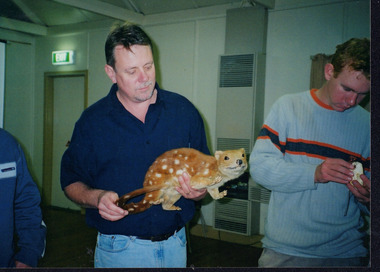
... The organisation has drawn on the work of a variety of Government and academic experts to inform best practice approaches are utilised. In 2004 Andrew Murray, a leading quoll expert from Parks Victoria, conducted training for Wooragee Landcare members and the local community in how to identify potential quoll habitat and populations (through identifying scat and other methods). ...The organisation has drawn on the work of a variety of Government and academic experts to inform best practice approaches are utilised. In 2004 Andrew Murray, a leading quoll expert from Parks Victoria, conducted training for Wooragee Landcare members and the local community in how to identify potential quoll habitat and populations (through identifying scat and other methods). ...Wooragee Landcare was formed in 1989 to promote sustainable conservation and land-use practices in the North-East region of Victoria. The organisation's work has included public awareness and education campaigns to control invasive, introduced species and protect native wildlife, such as campaigns to bait or trap foxes and to identify and monitor quoll populations in the region. The organisation has drawn on the work of a variety of Government and academic experts to inform best practice approaches are utilised. In 2004 Andrew Murray, a leading quoll expert from Parks Victoria, conducted training for Wooragee Landcare members and the local community in how to identify potential quoll habitat and populations (through identifying scat and other methods). Spotted-tail or Tiger quolls were known to have lived in the Mt Pilot and Stanley Plateau region previously but habitat encroachment, competitor species such as foxes and natural disasters had reduced sightings in recent years. The Spotted-Tail quoll (formerly known as the Tiger Quoll) is the largest of four species of native marsupial carnivore on mainland Australia, and the second-largest carnivore (after the dingo). The species' scientific name, Dasyurus maculatus, references its' 'hairy tail'. Adults are approximately 125cm long, including their long tail, and weigh around 5 kilograms. The Spotted-tail quoll is currently considered to be a threatened species, but other species are currently listed as endangered.This photograph is significant as an example of wildlife protection awareness programs undertaken by Wooragee Landcare Group in the 2000s in Indigo Shire.Landscape coloured photograph printed on gloss paper.Reverse: WAN NA 0ANA2N0 NNN+ 1 8743 / [PRINTED] (No.23) / 269wooragee, wooragee landcare, indigo shire, north-east victoria, andrew murray, queries about quolls, wildlife, conservation, farming, predators, spotted tail quolls, quolls, marsupials, south-east forests, mt pilot, stanley plateau -
 Wooragee Landcare Group
Photograph, 5 September 2004
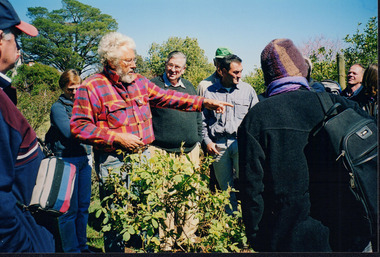
... Events like this meet Wooragee Landcare's organisational goals of promoting best land management practices, cooperating and engaging with landowners, and providing information on plant management and care. ...Events like this meet Wooragee Landcare's organisational goals of promoting best land management practices, cooperating and engaging with landowners, and providing information on plant management and care. ...This photograph was taken during a bus excursion to Tatong in North East Victoria, held by the Wooragee Landcare Group in September 2004. The purpose of the excursion was to look at land use on small farms. As part of this, the excursion included a visit to Samaria Farm, run by Sue and Don Matheson. In this photo, taken at Samaria Farm, Don Matheson is discussing the management of his commercial rose garden. Events like this meet Wooragee Landcare's organisational goals of promoting best land management practices, cooperating and engaging with landowners, and providing information on plant management and care. This object is significant as a record of Wooragee Landcare's activities and community involvement. Landscape colour photograph printed on gloss photographic material. Reverse: "WAN NA E0NA2N2 NNN+ 1 4240/ don matheson, sue matheson, matheson, tatong, excursion, bus trip, wooragee landcare, wooragee, landcare, wooragee landcare group, samaria farm, roses, commercial rose garden, rose growing, education, activity, 2004, rose, farm, small farms, land use -
 National Vietnam Veterans Museum (NVVM)
Memorabilia - Ceramic port jug, Port Jug
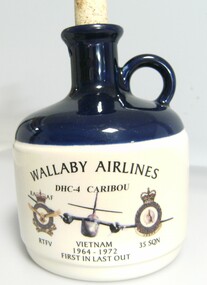
... Colin developed best practice engineering and fund-raising programs for a volunteer group, the Phillip Island Aquatic Centre. ...Colin developed best practice engineering and fund-raising programs for a volunteer group, the Phillip Island Aquatic Centre. ...This item was donated by Colin Laurence Grey OAM. Colin was the driving force behind many of the displays at the National Vietnam Veterans Museum. He will be remembered for his expertise, and boundless enthusiasm for all things Australian. Colin organised teams of like-minded souls to bring home and restore many important historical aircraft. His success has been recognised and rewarded with an Order of Australian Medal 2000, and he is named in the Worldwide Who’s Who 2014-2015. Colin’s skills as an engineer, tool maker, boiler maker and organiser enabled him to restore steam trains, trucks, tanks, infantry weapons, various aircraft including a MIG-15 jet fighter and his largest project the Consolidated B-24 Liberator bomber. He even replicated two dinosaur skeletons for Museum Victoria. In 1989 Colin joined the fledgling B-24 Liberator Memorial Fund as Project Manager/Restoration Co-Ordinator with the task to build a volunteer organisation that could find the AUD$10m required, source parts and materials for the largest aircraft restoration in Australia. The B-24 program had 10 volunteers, 60 sponsors and an international support network that provided parts, tooling, aviation equipment and political support. Colin’s combined engineering, academic and logistical skills provided the basis for advancing the skills of a very disparate group of volunteers form all walks of life. Colin established links with Centrelink, Corrections Victoria, RMT Uni and the ADF to develop the skills base of many less fortunate individuals of all ages and backgrounds. Colin’s work in this area gained him an AOM (2000). He featured in an ABC Australian Stories program and was awarded a life membership of the organisation. Colin was a founding member and President of the Oceania Aviation Museum Inc. which was instrumental in the historic listing of the joint WW2 USAAC/RAAF facility at Werribee and the Preserve Point Cook Aerodrome Group. Colin developed best practice engineering and fund-raising programs for a volunteer group, the Phillip Island Aquatic Centre. Colin’s constant learning, curiosity, passion and contribution to all things Australian have been an inspiration and a great example to all of us. He will be sorely missed and fondly remembered.Blue and beige coloured decanter with a cork stopper. Top is dark blue with handle. Bottom half is beige with Wallaby Airlines printed in blue ink. Has RAAF emblem with RTFV underneath a Caribou (DHC-4) and 35 SQN emblem. Vietnam 1964-1972 First In Last Out written in blue along bottom.Vietnam 1964-1972 First in Last Out written in blue along bottom. On reverse of Jug is the story of RAAF Transport Flight Vietnam and No 35 Squadron RAAF. Known as WAllaby Airlinesvietnam history - 1945 - 1975, raaf, bottles, 35 squadron, wallaby airlines, caribou, ceramic jug, colin grey, medal of the order of australia -
 National Vietnam Veterans Museum (NVVM)
Memorabilia - Framed decal of a roaring tiger in centre of black background bordered by gold and frown design
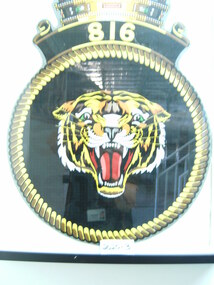
... Colin developed best practice engineering and fund-raising programs for a volunteer group, the Phillip Island Aquatic Centre. ...Colin developed best practice engineering and fund-raising programs for a volunteer group, the Phillip Island Aquatic Centre. ...This item was donated by Colin Laurence Grey OAM. Colin was the driving force behind many of the displays at the National Vietnam Veterans Museum. He will be remembered for his expertise, and boundless enthusiasm for all things Australian. Colin organised teams of like-minded souls to bring home and restore many important historical aircraft. His success has been recognised and rewarded with an Order of Australian Medal 2000, and he is named in the Worldwide Who’s Who 2014-2015. Colin’s skills as an engineer, tool maker, boiler maker and organiser enabled him to restore steam trains, trucks, tanks, infantry weapons, various aircraft including a MIG-15 jet fighter and his largest project the Consolidated B-24 Liberator bomber. He even replicated two dinosaur skeletons for Museum Victoria. In 1989 Colin joined the fledgling B-24 Liberator Memorial Fund as Project Manager/Restoration Co-Ordinator with the task to build a volunteer organisation that could find the AUD$10m required, source parts and materials for the largest aircraft restoration in Australia. The B-24 program had 10 volunteers, 60 sponsors and an international support network that provided parts, tooling, aviation equipment and political support. Colin’s combined engineering, academic and logistical skills provided the basis for advancing the skills of a very disparate group of volunteers form all walks of life. Colin established links with Centrelink, Corrections Victoria, RMT Uni and the ADF to develop the skills base of many less fortunate individuals of all ages and backgrounds. Colin’s work in this area gained him an AOM (2000). He featured in an ABC Australian Stories program and was awarded a life membership of the organisation. Colin was a founding member and President of the Oceania Aviation Museum Inc. which was instrumental in the historic listing of the joint WW2 USAAC/RAAF facility at Werribee and the Preserve Point Cook Aerodrome Group. Colin developed best practice engineering and fund-raising programs for a volunteer group, the Phillip Island Aquatic Centre. Colin’s constant learning, curiosity, passion and contribution to all things Australian have been an inspiration and a great example to all of us. He will be sorely missed and fondly remembered.Framed decal of a roaring tiger in centre of black background bordered by gold and frown design. 816 on decal above tiger. Jewelled Crown with various gems in red and green. Top of decal old world man of warship, sails and flags.Decal,816 Squadroninsignia, tiger -
 National Vietnam Veterans Museum (NVVM)
Equipment - Five Green Metal Cannisters with EXPLOSIVE Written in White on the Top
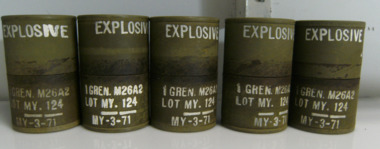
... Colin developed best practice engineering and fund-raising programs for a volunteer group, the Phillip Island Aquatic Centre. ...Colin developed best practice engineering and fund-raising programs for a volunteer group, the Phillip Island Aquatic Centre. ...This item was donated by Colin Laurence Grey OAM. Colin was the driving force behind many of the displays at the National Vietnam Veterans Museum. He will be remembered for his expertise, and boundless enthusiasm for all things Australian. Colin organised teams of like-minded souls to bring home and restore many important historical aircraft. His success has been recognised and rewarded with an Order of Australian Medal 2000, and he is named in the Worldwide Who’s Who 2014-2015. Colin’s skills as an engineer, tool maker, boiler maker and organiser enabled him to restore steam trains, trucks, tanks, infantry weapons, various aircraft including a MIG-15 jet fighter and his largest project the Consolidated B-24 Liberator bomber. He even replicated two dinosaur skeletons for Museum Victoria. In 1989 Colin joined the fledgling B-24 Liberator Memorial Fund as Project Manager/Restoration Co-Ordinator with the task to build a volunteer organisation that could find the AUD$10m required, source parts and materials for the largest aircraft restoration in Australia. The B-24 program had 10 volunteers, 60 sponsors and an international support network that provided parts, tooling, aviation equipment and political support. Colin’s combined engineering, academic and logistical skills provided the basis for advancing the skills of a very disparate group of volunteers form all walks of life. Colin established links with Centrelink, Corrections Victoria, RMT Uni and the ADF to develop the skills base of many less fortunate individuals of all ages and backgrounds. Colin’s work in this area gained him an AOM (2000). He featured in an ABC Australian Stories program and was awarded a life membership of the organisation. Colin was a founding member and President of the Oceania Aviation Museum Inc. which was instrumental in the historic listing of the joint WW2 USAAC/RAAF facility at Werribee and the Preserve Point Cook Aerodrome Group. Colin developed best practice engineering and fund-raising programs for a volunteer group, the Phillip Island Aquatic Centre. Colin’s constant learning, curiosity, passion and contribution to all things Australian have been an inspiration and a great example to all of us. He will be sorely missed and fondly remembered.Five green metal cannisters with EXPLOSIVE written in white on the top section of cannister. Bottom section one green M26A2 LOT MY 124, which is underlined MY-3-71On lid Container M289A2weapons, cannisters, explosives, colin grey, medal of the order of australia -
 Merri-bek City Council
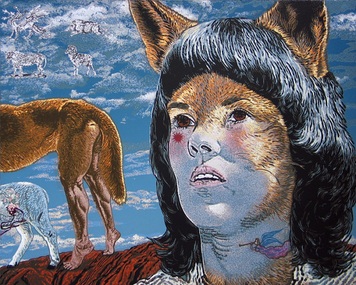
Reduction linocut, Jazmina Cininas, A two-legged dingo stole Lindy’s tears, 2008
... Jazmina Cininas’ printmaking practice is best known for its technically demanding reduction linocuts. ...Jazmina Cininas’ printmaking practice is best known for its technically demanding reduction linocuts. ...Jazmina Cininas’ printmaking practice is best known for its technically demanding reduction linocuts. A two-legged dingo stole Lindy’s tears draws on the complex mythologies and rhetoric that have become embedded in the protracted Lindy Chamberlain saga. The work is a critique of the media’s unfair treatment of Chamberlain when the case broke in the 1980s. This is a key work from Cininas' Girlie Werewolf Project, which explores how female 'otherness' has been depicted through history. Donation by the artist -
 National Vietnam Veterans Museum (NVVM)
Newspaper - Recruitment advertisement
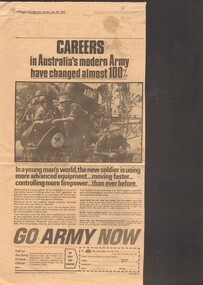
... Colin developed best practice engineering and fund-raising programs for a volunteer group, the Phillip Island Aquatic Centre. ...Colin developed best practice engineering and fund-raising programs for a volunteer group, the Phillip Island Aquatic Centre. ...This item contributes to an understanding of the experience of Australian society and attitudes to the war in Vietnam. This item was donated by Colin Laurence Grey OAM. Colin was the driving force behind many of the displays at the National Vietnam Veterans Museum. He will be remembered for his expertise, and boundless enthusiasm for all things Australian. Colin organised teams of like-minded souls to bring home and restore many important historical aircraft. His success has been recognised and rewarded with an Order of Australian Medal 2000, and he is named in the Worldwide Who’s Who 2014-2015. Colin’s skills as an engineer, tool maker, boiler maker and organiser enabled him to restore steam trains, trucks, tanks, infantry weapons, various aircraft including a MIG-15 jet fighter and his largest project the Consolidated B-24 Liberator bomber. He even replicated two dinosaur skeletons for Museum Victoria. In 1989 Colin joined the fledgling B-24 Liberator Memorial Fund as Project Manager/Restoration Co-Ordinator with the task to build a volunteer organisation that could find the AUD$10m required, source parts and materials for the largest aircraft restoration in Australia. The B-24 program had 10 volunteers, 60 sponsors and an international support network that provided parts, tooling, aviation equipment and political support. Colin’s combined engineering, academic and logistical skills provided the basis for advancing the skills of a very disparate group of volunteers form all walks of life. Colin established links with Centrelink, Corrections Victoria, RMT Uni and the ADF to develop the skills base of many less fortunate individuals of all ages and backgrounds. Colin’s work in this area gained him an AOM (2000). He featured in an ABC Australian Stories program and was awarded a life membership of the organisation. Colin was a founding member and President of the Oceania Aviation Museum Inc. which was instrumental in the historic listing of the joint WW2 USAAC/RAAF facility at Werribee and the Preserve Point Cook Aerodrome Group. Colin developed best practice engineering and fund-raising programs for a volunteer group, the Phillip Island Aquatic Centre. Colin’s constant learning, curiosity, passion and contribution to all things Australian have been an inspiration and a great example to all of us. He will be sorely missed and fondly remembered. Yellowed newspaper Army recruitment article from The Sun 20/01/1969. Photo of 3 young men in Australian Army uniform a Sioux helicopter with a kangaroo emblem. Beneahan article are the words 'Go Army Now" and a coupon to be detached, filled and posted.The Sun newspaper Jan 20 1969. Careers/in Australia's modern army/changed almost 100%. Picture of Australian helicopter with pilot inside and two soldiers beside the helicopter. Flying kangaroo on the side of the helicopter.careers, army, recruitment, vietnam, newspaper article, medal of the order of australia -
 Bendigo Historical Society Inc.
Administrative record - Ex-Fortuna Survey Association Collection: Conservation Management Plans, 1994-96
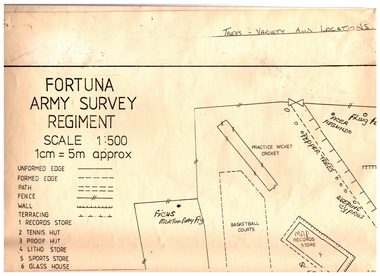
... Implementation Provides guidelines and specific recommendations for development and ongoing management. 9. Details best practices for tree, shrub, rose, and lawn care, as well as maintenance of paths and structures....Implementation Provides guidelines and specific recommendations for development and ongoing management. 9. Details best practices for tree, shrub, rose, and lawn care, as well as maintenance of paths and structures. bendigo fortuna villa history army survey regiment gardens conservation management Fortuna Villa Conservation Management Plans This Document Contains the following Items: 11231.4a This document is a draft brief by the army, 1994. ...'Fortuna' was developed by George Lansell, the 'Quartz King', from the 1870s to 1906. The estate features a mansion, a notable Italian water garden with imported elements, and a large lake originally used for mining. The property covers 6.7 hectares and contains many mature trees, including palms, poplars, pepper trees, Norfolk Island pines, and various specimen trees. Since 1942 to the 1980s, the Department of Defence has owned and maintained the property. General Considerations are to: 1 Preserve and restore the heritage value and history of the gardens to complement historic buildings. Maintain plant health and species diversity to enhance the area's character. 2 Address financial constraints, human use, military requirements, and stakeholder engagement. 3 Employ qualified experts to prepare the plan. 4 Address historical significance, plant health, heritage value, remedial works, and visual character (including maintaining views and screening modern structures). 5 Restore garden design to its original character where possible. 6 Recommend measures for future works to protect garden health and significant trees. 7 Identify and map significant plants and recommend suitable species for replanting. Consultant to start in September 1994 and complete by December 1994 with Regular meetings with a steering committee and encourage public involvement. The plan aims to ensure the long-term preservation, enhancement, and appropriate use of the heritage gardens, balancing historical, ecological, recreational, and military needs. In 1996 Fancine Gilfedder and Associates produced the Garden Conservation Management Plan for the Department of Defence: This Conservation Management Plan for the historic Fortuna Bendigo Garden outlines its historical development, significance, and strategies for preservation and management. 1. The plan was commissioned by the Department of Defence and prepared by Francine Gilfedder & Associates in 1996. It covers the Fortuna Garden site, its heritage status, and the methodology used for assessment. 2. Historical OverviewProvides a detailed chronology of the garden's development and its phases. Identifies significant materials, features, and architectural elements. 3. Site AssessmentSurveys existing site conditions, including plant and tree inventories.Documents architectural features and general landscape conditions. 4. Assesses the garden's heritage value using established criteria (e.g., Burra Charter, AHC criteria). Identifies elements of significance and provides comparative analysis with similar sites. 5. Summarizes the heritage value and unique aspects of the Fortuna Garden. 6. Outlines statutory and non-statutory requirements, user needs, and physical constraints affecting management. 7. Recommends general and component-specific policies for conservation. 8. Implementation Provides guidelines and specific recommendations for development and ongoing management. 9. Details best practices for tree, shrub, rose, and lawn care, as well as maintenance of paths and structures.Fortuna Villa Conservation Management Plans This Document Contains the following Items: 11231.4a This document is a draft brief by the army, 1994. It outlines the brief for a conservation management plan for the heritage gardens and surrounds of Fortuna Villa in Bendigo. It's three pages outlines Purpose, Background History and General Considerations, requirements and a summary. Seven first pages reproduced here. 11231.4b This Conservation Management Plan for the historic Fortuna Bendigo Garden outlines its historical development, significance, and strategies for preservation and management. Black Fabric Binding of approximately 110 pages (printed on both sides), photocopy with photos and plans. The first four pages showing the cover and index are shown here. 11231.4c Undated. This document is a horticultural report providing suggestions for improving the grounds and gardens at 'Fortuna', a historic estate now used by the Army Survey Regiment in Bendigo. The black and white report of approx 100 pages is "Spiralex" bound. It contains - it is compiled for the army by Karl Liffman (TAFE horticulture department) and Ian Huxley (experienced horticulturist and garden designer), with input from gardening apprentices. It contains many photos with new suggestions overlyared on top of them. The report addresses only the grounds and gardens visible to visitors: main drive, car parks, front garden, and areas around the lake. Recommendations are from a horticultural perspective, emphasizing plant variety and practical maintenance over formal landscape architecture.PurposeAims to guide the Army in developing and maintaining Fortuna’s gardens, recognizing the property's heritage and its value for public relations. 11231.4d An unbound copy of the above 11231.4e A letter to Range Control, Department of Defence, Puckapunyal, from Francine Gilfedder and Associates, Landscape Architect and Horticulturist, 15 Dover St Richmond; and a 18 page management plan. The plan aims to guide the conservation and management of the Fortuna Villa gardens, focusing on heritage values and preservation needs. May 1995. 11231.4f March 1996 five page document which outlines a conservation and restoration proposal for the Pompeii Fountain and adjacent heritage structures at Fortuna, Golden Square, Victoria. The fountain's steel column was severely rusted; rendered surfaces and marble font were deteriorating; adjacent garden walls and staircases were failing. 11231.4g Copy of above 11231.4h A five page document which contains key points from the conservation and restoration plan for Fortuna Villa. 1990s. 11231.4i A 30 page document. Part of the conservation policy and management plan for the Fortuna estate: 11231.4j A six page document is a conservation management plan and tree health report for Fortuna Villa in Bendigo, focusing on diagnosing tree diseases, assessing tree conditions, and recommending removal or treatment actions. Prepared by Francine Gilfedder and Associates, Landscape Architect and Horticulturist, 15 Dover St Richmond for the army. 11231.4k The one page document is a tree inspection report for a Sierra Redwood at Fortuna Villa, Bendigo, prepared in response to concerns about the tree's stability after the removal of a nearby specimen. Prepared by Trevor Lawrence Tree Surgeon, 830 Barkley St Ballarat. July 1995 11231.4l A 15 page document which provides an interpretive plan and historical overview for Fortuna Villa, a heritage site in Bendigo, focusing on its history, significance, and strategies for visitor engagement. 1995 prepared by Dianne Bish, Eaglehawk 11231.4m A large army plan of the Fortuna Grounds with prominent trees marked.bendigo, fortuna villa, history, army survey regiment, gardens, conservation management -
 National Vietnam Veterans Museum (NVVM)
Equipment - Torch, angle-head
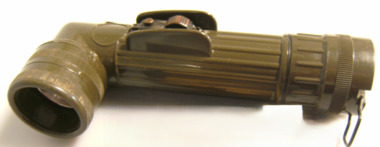
... Colin developed best practice engineering and fund-raising programs for a volunteer group, the Phillip Island Aquatic Centre. ...Colin developed best practice engineering and fund-raising programs for a volunteer group, the Phillip Island Aquatic Centre. ...Made in USA in the 1960s, the standard issue angle-head field torch was widely used by Australian servicemen in Vietnam. The base of the torch unscrews to contain coloured lenses for use at night, particularly for map reading. This item was donated by Colin Laurence Grey OAM. Colin was the driving force behind many of the displays at the National Vietnam Veterans Museum. He will be remembered for his expertise, and boundless enthusiasm for all things Australian. Colin organised teams of like-minded souls to bring home and restore many important historical aircraft. His success has been recognised and rewarded with an Order of Australian Medal 2000, and he is named in the Worldwide Who’s Who 2014-2015. Colin’s skills as an engineer, tool maker, boiler maker and organiser enabled him to restore steam trains, trucks, tanks, infantry weapons, various aircraft including a MIG-15 jet fighter and his largest project the Consolidated B-24 Liberator bomber. He even replicated two dinosaur skeletons for Museum Victoria. In 1989 Colin joined the fledgling B-24 Liberator Memorial Fund as Project Manager/Restoration Co-Ordinator with the task to build a volunteer organisation that could find the AUD$10m required, source parts and materials for the largest aircraft restoration in Australia. The B-24 program had 10 volunteers, 60 sponsors and an international support network that provided parts, tooling, aviation equipment and political support. Colin’s combined engineering, academic and logistical skills provided the basis for advancing the skills of a very disparate group of volunteers form all walks of life. Colin established links with Centrelink, Corrections Victoria, RMT Uni and the ADF to develop the skills base of many less fortunate individuals of all ages and backgrounds. Colin’s work in this area gained him an AOM (2000). He featured in an ABC Australian Stories program and was awarded a life membership of the organisation. Colin was a founding member and President of the Oceania Aviation Museum Inc. which was instrumental in the historic listing of the joint WW2 USAAC/RAAF facility at Werribee and the Preserve Point Cook Aerodrome Group. Colin developed best practice engineering and fund-raising programs for a volunteer group, the Phillip Island Aquatic Centre. Colin’s constant learning, curiosity, passion and contribution to all things Australian have been an inspiration and a great example to all of us. He will be sorely missed and fondly remembered.Dark green coloured ribbed tube/handle with globe in right-angled section at top of torch. Can be unscrewed at both ends and has metal clip to attach to webbing or uniform.OT-109/Ftorch, flashlight, vietnam war, angle head torch, flield torch, australian servicemen, colin grey, medal of the order of australia -
 Federation University Historical Collection
Poster, Fed Pride Poster, 2022
... FedPride 2021-2024 is a comprehensive strategy, aimed at achieving best inclusive practice in every area of university life: from recruitment and enrolment, to our culture, campuses, how we engage with the communities where our campuses are located and importantly through our curriculum and research. ...FedPride 2021-2024 is a comprehensive strategy, aimed at achieving best inclusive practice in every area of university life: from recruitment and enrolment, to our culture, campuses, how we engage with the communities where our campuses are located and importantly through our curriculum and research. ...FedPride 2021-2024 is a comprehensive strategy, aimed at achieving best inclusive practice in every area of university life: from recruitment and enrolment, to our culture, campuses, how we engage with the communities where our campuses are located and importantly through our curriculum and research. We know that diversity – having access to and embracing difference in backgrounds, perspectives, knowledge and skills – gives our university a breadth that supports innovation and the highest quality of thinking. It enriches us as individuals and as a community. FedPride has a particular focus on our staff and students being able to bring their whole selves to university life. When we feel safe, included and celebrated, we contribute freely and with enthusiasm and bring the best of ourselves to work and study. FedPride is an intersectional strategy, in that the rights, inclusion and access of people from diverse cultural backgrounds, people with disability and Aboriginal and Torres Strait Islander Peoples are held as core to every impact area. FedPride 2021–2024 has been developed with consultation across the University. The strategy is led by the FedPride Steering Group and implemented and monitored by the Implementation Group. Reports to measure progress will be provided annually for the Vice-Chancellor’s Senior Team. FedPride is endorsed by the Vice-Chancellor and the Vice-Chancellor’s Senior Team.A3 poster publicising Fed Pride. This poster was displayed at all Federation University posters in 2022.fed pride, equity -
 Flagstaff Hill Maritime Museum and Village
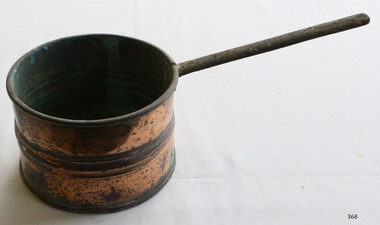
Domestic object - Saucepan
... practice is becoming increasingly rare, as are the craftsmen who perform it. Despite this, there are still manufactures producing tin-lined copper cookware who also offer a re-lining service. Perhaps the best...practice is becoming increasingly rare, as are the craftsmen who perform it. Despite this, there are still manufactures producing tin-lined copper cookware who also offer a re-lining service. Perhaps the best ...It is no secret that copper is currently experiencing a huge upsurge in popularity. This is mainly thanks to its beautiful colour featuring heavily in the ranges of countless homeware retailers. There is, however, far more to this lustrous metal than just its appearance. For example, it has a greater level of thermal conductivity than any other metal (except silver); roughly 60% higher than aluminium and 3000% higher than stainless steel. This means copper is capable of heating up very quickly when compared to other metals. Perhaps a less commonly known property of copper is it being inherently antimicrobial. A wide range of harmful microbes are unable to survive for more than a couple of hours when in contact with a surface made of copper or one of its alloys (brass and bronze). This has led to it often being used for frequently touched surfaces such as door knobs, push plates and taps. A seemingly perfect material for cooking, it is therefore no surprise that it has been used in kitchens for millennia. But exactly when did we learn to utilise copper and its valuable assets? Origins It is hard to pin down an exact date when copper cookware was first introduced. Pieces discovered in regions of the middle east were dated as far back as 9000BC, suggesting cooking with copper began during the Neolithic period (≈10000-2000BC). As civilisations became increasingly capable in metallurgical techniques, metals such as copper became more widely used. It would have been around this time that copper replaced stone as the material used for making tools and cooking vessels. The use of copper is also well documented in Ancient Egypt. Not only was it used to produce water and oil containers, but it was also used to in medical practices. The antimicrobial nature of copper was exploited long before the concept of microorganisms was fully understood. The Smith Papyrus, a medical text written between 2600 and 2200BC records the use of copper in sterilising wounds and drinking water. Tin Lining Although copper is essential to many processes within the human body, it can become toxic if consumed in excess. It was this knowledge that gave rise to lining cookware with tin, a technique used for hundreds of years to prevent copper leaching in to food. These tin linings would eventually wear out and during the 18th and 19th century, it was common for people to send pans away to be re-tinned. This practice is becoming increasingly rare, as are the craftsmen who perform it. Despite this, there are still manufactures producing tin-lined copper cookware who also offer a re-lining service. Perhaps the best known of these is Mauviel, a French manufacturer who have been making this type of cookware since 1830. Tin has now largely been replaced by stainless steel as an interior cooking surface. Not only is it more cost effective, but the high grade of stainless steel used in premium cookware (typically 18/10) is highly resistant to corrosion and more durable than tin.Copper saucepans are still used in many kitchens.Small copper saucepan with long handle and three ridges around the circumference. Extensive corrosion.None.flagstaff hill, warrnambool, shipwrecked-coast, flagstaff-hill, flagstaff-hill-maritime-museum, maritime-museum, shipwreck-coast, flagstaff-hill-maritime-village, copper, saucepans, kitchen equipment -
 Federation University Historical Collection
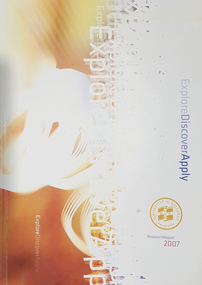
Booklet, Eugene Kneebone, Explore Discover Apply: University of Ballarat Research Report, 2007, 2007
... It includes information on: * Institute for Regional and Rural Research and Innovation * Centre for Regional Innovation and Competitiveness * Teaching to Global Citizenship * Older BLokes and Their Sheds: Community based Men's Sheds in Australia * Education and Re-education in Child Sexual Abuse * Water Demand Management and Climate Change * An Indigenous History of Stonington * Key Drivers of Change in Adult and Community Education * Benchmaking Research * Training for Child Protection * Grabbing a Lifeline to Better Health * Enhancing Nurse Preparation for health care practice * ACT for depression in adolescence * FRom Pokies to Peremptory PErsonal Pleasures * Worksafe Awards * Mineral Sands that are not sinking * Rising Generation Inspired by Trace Elements * Environmental Research from Namibia to Ballarat * Evaluation of VicHealth Sport & Physical Activity Programs * A good Hard Look at Sports Grounds * Preventing Knee Injuries inn Community Australian Football * WIDCORP Beyond the Pipelines *Woodside Energy Ltd Optimizes its Production * Australian Defence Force Seeks Best Fit * Mapping Augmentation Structures Images include: David Battersby, Wayne Robinson, Joel Epstein, Georgina Tsolidis, Barry Golding, Caroline Taylor, Julian Lowe, Laura Kostanski, Ian D. ...It includes information on: * Institute for Regional and Rural Research and Innovation * Centre for Regional Innovation and Competitiveness * Teaching to Global Citizenship * Older BLokes and Their Sheds: Community based Men's Sheds in Australia * Education and Re-education in Child Sexual Abuse * Water Demand Management and Climate Change * An Indigenous History of Stonington * Key Drivers of Change in Adult and Community Education * Benchmaking Research * Training for Child Protection * Grabbing a Lifeline to Better Health * Enhancing Nurse Preparation for health care practice * ACT for depression in adolescence * FRom Pokies to Peremptory PErsonal Pleasures * Worksafe Awards * Mineral Sands that are not sinking * Rising Generation Inspired by Trace Elements * Environmental Research from Namibia to Ballarat * Evaluation of VicHealth Sport & Physical Activity Programs * A good Hard Look at Sports Grounds * Preventing Knee Injuries inn Community Australian Football * WIDCORP Beyond the Pipelines *Woodside Energy Ltd Optimizes its Production * Australian Defence Force Seeks Best Fit * Mapping Augmentation Structures Images include: David Battersby, Wayne Robinson, Joel Epstein, Georgina Tsolidis, Barry Golding, Caroline Taylor, Julian Lowe, Laura Kostanski, Ian D. ...University of Ballarat is a predecessor institution of Federation University AustraliaPredominantly white and gold soft covered book outlining Research at the University of Ballarat. It includes information on: * Institute for Regional and Rural Research and Innovation * Centre for Regional Innovation and Competitiveness * Teaching to Global Citizenship * Older BLokes and Their Sheds: Community based Men's Sheds in Australia * Education and Re-education in Child Sexual Abuse * Water Demand Management and Climate Change * An Indigenous History of Stonington * Key Drivers of Change in Adult and Community Education * Benchmaking Research * Training for Child Protection * Grabbing a Lifeline to Better Health * Enhancing Nurse Preparation for health care practice * ACT for depression in adolescence * FRom Pokies to Peremptory PErsonal Pleasures * Worksafe Awards * Mineral Sands that are not sinking * Rising Generation Inspired by Trace Elements * Environmental Research from Namibia to Ballarat * Evaluation of VicHealth Sport & Physical Activity Programs * A good Hard Look at Sports Grounds * Preventing Knee Injuries inn Community Australian Football * WIDCORP Beyond the Pipelines *Woodside Energy Ltd Optimizes its Production * Australian Defence Force Seeks Best Fit * Mapping Augmentation Structures Images include: David Battersby, Wayne Robinson, Joel Epstein, Georgina Tsolidis, Barry Golding, Caroline Taylor, Julian Lowe, Laura Kostanski, Ian D. Clark, Jessie Harman, Patrick White, Angela Murphy, Katrina Brown, John McDonald, Robert Watson, Sally Wellard, Louise Hayes, Stephen Cowley, Susan Leggett, Steve Hall, Stafford McKnight, Larissa Koroznikova, Patrick Graz, David Stratton, Andrew Stranieri, John Yearwood widcorp, water in drylands collaborative research project, eugene kneebone -
Federation University Historical Collection
Book, Tourism Destination Management (TDM) PL, Final Draft - Daylesford Regional Tourism Association Business & Tourism Plan, April 2005 - June 2008, 2005
... ...best practice...Final Draft - Daylesford Regional Tourism Association Business & Tourism Plan, April 2005 - June 2008 executive summary background situation analysis best practice gap analysis strategic priorities the rta structural considerations resources strategic action plan 2005/06-2007/08 16 month implementation plan daylesford daylesford regional tourism association creswick macedon producers group spa, therapy & health group trentham residents and traders association clunes tourism development association creswick district development association spa country chamber of commerce and tourism inc john ellis kylie lethbridge barbara nixon sue moses White bound book of 24 pages and includes two appendices. ...Final Draft - Daylesford Regional Tourism Association Business & Tourism Plan, April 2005 - June 2008White bound book of 24 pages and includes two appendices.executive summary, background, situation analysis, best practice, gap analysis, strategic priorities, the rta structural considerations, resources, strategic action plan 2005/06-2007/08, 16 month implementation plan, daylesford, daylesford regional tourism association, creswick, macedon producers group, spa, therapy & health group, trentham residents and traders association, clunes tourism development association, creswick district development association, spa country chamber of commerce and tourism inc, john ellis, kylie lethbridge, barbara nixon, sue moses -
Federation University Historical Collection
Booklet - Booklet - Prospectus, McCarron, Bird & Co, The Melbourne Junior Technical School, Prospectus, 1914, 1914
... It gives him that combination of theory and practice which is the best introduction to all trades" and so he can decide which path he will follow for further education....It gives him that combination of theory and practice which is the best introduction to all trades" and so he can decide which path he will follow for further education. melbourne melbourne junior technical school prospectus john lemmon t.j. greenway d. avery a.w. craig c. gray c.a. hack wilfrid.n. kernot a.h. merrin h. payne w.c. scurry p. mccormack principal w bruce r hudspeth c greenhill jrussell a watson r kinross c juncken a r lundy a dunstan e j lewis m samuel d j morris a j hauser g nicholas r a white w d wilson j e jones w gilmore e thompson trades mathematics english science art Cost changed on inside cover to 15/- Photo on p.2 has date added 1913 Photo on p.4 has date changed 1913 three crossed out 2 added instead of 3 Pale blue soft covered booklet with crest The Melbourne Junior Technical School, Prospectus, 1914 Booklet Booklet - Prospectus McCarron, Bird & Co. ...The Melbourne Junior Technical School "has been established by the Government with the view of giving boys a training which will prepare them for their future life's work." The aim of the school is to enable the boys to realise that knowledge can be applied to everyday life and so their interest is aroused and they start to learn things for themselves. "It should be clearly understood that the school does not teach a boy a trade. It gives him that combination of theory and practice which is the best introduction to all trades" and so he can decide which path he will follow for further education.Pale blue soft covered booklet with crestCost changed on inside cover to 15/- Photo on p.2 has date added 1913 Photo on p.4 has date changed 1913 three crossed out 2 added instead of 3melbourne, melbourne junior technical school, prospectus, john lemmon, t.j. greenway, d. avery, a.w. craig, c. gray, c.a. hack, wilfrid.n. kernot, a.h. merrin, h. payne, w.c. scurry, p. mccormack, principal, w bruce, r hudspeth, c greenhill, jrussell, a watson, r kinross, c juncken, a r lundy, a dunstan, e j lewis, m samuel, d j morris, a j hauser, g nicholas, r a white, w d wilson, j e jones, w gilmore, e thompson, trades, mathematics, english, science, art -
Federation University Historical Collection
Booklet - Booklet - Prospectus, McCarron, Bird & Co, The Melbourne Junior Technical School, Prospectus, 1913, 1913
... It gives him that combination of theory and practice which is the best introduction to all trades" and so he can decide which path he will follow for further education....It gives him that combination of theory and practice which is the best introduction to all trades" and so he can decide which path he will follow for further education. melbourne melbourne junior technical school prospectus john lemmon t.j. greenway d. avery a.w. craig c. gray c.a. hack wilfrid.n. kernot a.h. merrin h. payne w.c. scurry p. mccormack w bruce r hudspeth c greenhill jrussell a watson r kinross m samuel d j morris a j hauser r a white w d wilson trades mathematics english science art p r leslie w gilmore A.W. ...The Melbourne Junior Technical School "has been established by the Government with the view of giving boys a training which will prepare them for their future life's work." The aim of the school is to enable the boys to realise that knowledge can be applied to everyday life and so their interest is aroused and they start to learn things for themselves. "It should be clearly understood that the school does not teach a boy a trade. It gives him that combination of theory and practice which is the best introduction to all trades" and so he can decide which path he will follow for further education.White soft covered booklet with gold crest with photo of The Melbourne Junior Technical SchoolA.W. Steane written on front covermelbourne, melbourne junior technical school, prospectus, john lemmon, t.j. greenway, d. avery, a.w. craig, c. gray, c.a. hack, wilfrid.n. kernot, a.h. merrin, h. payne, w.c. scurry, p. mccormack, w bruce, r hudspeth, c greenhill, jrussell, a watson, r kinross, m samuel, d j morris, a j hauser, r a white, w d wilson, trades, mathematics, english, science, art, p r leslie, w gilmore -
Marysville & District Historical Society
THE TRIANGLE NEWS-VOL 5 NO 40-DECEMBER 12 1980
... best wishes...carols by candlelight...advertising payments in triangle...cricket...marysville bowling...junior cricket...tennis practice...marysville victoria australia annual dinner lions club football social club services church of england bingo fire restrictions christmas trees for sale welding wanted for sale swimming pool open photographer garden stakes christmas breakup s.e.s. marysville & district community care centre thanks & best wishes carols by candlelight advertising payments in triangle cricket marysville bowling junior cricket tennis practice marysville hotel earthquake door knock appeal supported generously marysville bowls club free kitten cricket club photos misplaced mary kay supper dance footy club lions club christmas treat uniting church doctors' clinics senior citizens marysville bowls new year at clubhouse THE TRIANGLE NEWS-VOL 5 NO 40-DECEMBER 12 1980 ...marysville, victoria, australia, annual dinner lions club, football social club, services church of england, bingo, fire restrictions, christmas trees for sale, welding, wanted, for sale, swimming pool open, photographer, garden stakes, christmas breakup s.e.s., marysville & district community care centre, thanks & best wishes, carols by candlelight, advertising payments in triangle, cricket, marysville bowling, junior cricket, tennis practice, marysville hotel, earthquake door knock appeal supported generously, marysville bowls club, free kitten, cricket club photos misplaced, mary kay, supper dance, footy club, lions club christmas treat, uniting church, doctors' clinics, senior citizens, marysville bowls new year at clubhouse -
Federation University Historical Collection
Image, Robert Malachy Serjeant
... Practice of Mining. He was regarded as an authority on alluvial and quartz mining and was a member of the Ballarat Local Court and mining board. In 1977 Robert, Joseph Flude and Henry Caselli donated the patent rights of a novel Pyrites furnace to the school. The R.M. Serjeant Scholarship at the Ballarat School of Mines resulted after a reward was offered for the first to produce the best...Practice of Mining. He was regarded as an authority on alluvial and quartz mining and was a member of the Ballarat Local Court and mining board. In 1977 Robert, Joseph Flude and Henry Caselli donated the patent rights of a novel Pyrites furnace to the school. The R.M. Serjeant Scholarship at the Ballarat School of Mines resulted after a reward was offered for the first to produce the best ...ROBERT MALACHY SERJEANT (1828-1902) Robert Malachy Serjeant was born on 21 December 1828 at Callington, Cornwall. He was the son of Philip Davey Serjeant, a surgeon in the Royal Marines, and Eliza Malachy. Philip Serjeant died in 1834. His mother, Eliza, remarried John Burgh in 1836. He died in 1837. In September 1848 Eliza, Robert and his two sisters, Caroline and Susan, departed Plymouth on the William Moneya for Port Adelaide and arrived in January 1849. Once gold was discovered in Victoria, Serjeant made his way to Forest Creek (near Castlemaine) and he and his mate Mr Victor, were the first party to sink through the basalt in search of a deep lead. In 1854 he moved to Ballarat to work as a miner and enjoyed some success. In 1855 he was with a group that discovered a 500 ounce nugget. With his share of the sale he set himself up with the latest mining equipment, as well as beginning a lifelong interest in the share market. He became the Manager of the Chryseis, Isis and Garibaldi claims and then the Manager of the Band and Albion Consol Company. He held the position for thirty years and only resigned when the company amalgamated with the Sir Henry Loch Mine. Robert Malachy Serjeant became interested in Politics. The first election for Parliament Representatives for Ballarat was in 1855. Robert stood for election for the first time in 1859, representing Ballarat West. He was also elected to represent Ballarat West in 1874 and 1880. Robert Serjeant’s community involvement extended to Education. Years of discussion eventually saw the development of the Ballarat School of Mines, the first school of mines in Australia. The inaugural School Council was formed in 1870 with Sir Redmond Barry, the Chief Justice, as President and Robert Malachy Serjeant as a member of the council. He held a position on the council until illness forced him to retire in 1889. He was elected a Life Governor in 1889. He was also a Life Governor of the Ballarat Hospital. Robert Serjeant showed Prince Albert and Prince George (later King George V) around the Band and Albion Mine. At the age of 42, Robert enrolled as a student at the School of Mines in 1871. He obtained a Certificate of Competency in Assaying (including Metallurgy) in 1875. The first certificate in “Geology as Applied to Mining” was awarded to Robert Serjeant in 1876. Robert Serjeant was an active and generous supporter of the School of Mines. As well as being a financial contributor, he lectured and examined in the Principles and Practice of Mining. He was regarded as an authority on alluvial and quartz mining and was a member of the Ballarat Local Court and mining board. In 1977 Robert, Joseph Flude and Henry Caselli donated the patent rights of a novel Pyrites furnace to the school. The R.M. Serjeant Scholarship at the Ballarat School of Mines resulted after a reward was offered for the first to produce the best method of treating auriferous ores – other than the smelting method. The offer was open for two years but not awarded. The money for this was donated by Robert Serjeant to the amount of 256 Pounds. It was then used to fund the School of Mines Scholarship in Engineering (1889). It was first awarded in 1922. Robert Malachy Serjeant died on 25 October 1902 and was buried at the Ballaarat Old Cemetery. (Sometimes Malachy is incorrectly written as Malachi)Two photographic portraits of mine manager Robert Malachy Serjeant. Both portraits were purchased by the donor from the State Library of Victoria. robert malachy serjeant, r.m. sergeant, robert malachi serjeant, band of hope and albion consols -
Federation University Historical Collection
Photograph - Image, Yarrowee Hall, Redan, c1883
... Practice of Mining. He was regarded as an authority on alluvial and quartz mining and was a member of the Ballarat Local Court and mining board. In 1977 Robert, Joseph Flude and Henry Caselli donated the patent rights of a novel Pyrites furnace to the school.
The R.M. Serjeant Scholarship at the Ballarat School of Mines resulted after a reward was offered for the first to produce the best...Practice of Mining. He was regarded as an authority on alluvial and quartz mining and was a member of the Ballarat Local Court and mining board. In 1977 Robert, Joseph Flude and Henry Caselli donated the patent rights of a novel Pyrites furnace to the school.
The R.M. Serjeant Scholarship at the Ballarat School of Mines resulted after a reward was offered for the first to produce the best ...ROBERT MALACHY SERJEANT (1828-1902) Robert Malachy Serjeant was born on 21 December 1828 at Callington, Cornwall. He was the son of Philip Davey Serjeant, a surgeon in the Royal Marines, and Eliza Malachy. Philip Serjeant died in 1834. His mother, Eliza, remarried John Burgh in 1836. He died in 1837. In September 1848 Eliza, Robert and his two sisters, Caroline and Susan, departed Plymouth on the William Moneya for Port Adelaide and arrived in January 1849. Once gold was discovered in Victoria, Serjeant made his way to Forest Creek (near Castlemaine) and he and his mate Mr Victor, were the first party to sink through the basalt in search of a deep lead. In 1854 he moved to Ballarat to work as a miner and enjoyed some success. In 1855 he was with a group that discovered a 500 ounce nugget. With his share of the sale he set himself up with the latest mining equipment, as well as beginning a lifelong interest in the share market. He became the Manager of the Chryseis, Isis and Garibaldi claims and then the Manager of the Band and Albion Consol Company. He held the position for thirty years and only resigned when the company amalgamated with the Sir Henry Loch Mine. Robert Malachy Serjeant became interested in Politics. The first election for Parliament Representatives for Ballarat was in 1855. Robert stood for election for the first time in 1859, representing Ballarat West. He was also elected to represent Ballarat West in 1874 and 1880. Robert Serjeant’s community involvement extended to Education. Years of discussion eventually saw the development of the Ballarat School of Mines, the first school of mines in Australia. The inaugural School Council was formed in 1870 with Sir Redmond Barry, the Chief Justice, as President and Robert Malachy Serjeant as a member of the council. He held a position on the council until illness forced him to retire in 1889. He was elected a Life Governor in 1889. He was also a Life Governor of the Ballarat Hospital. Robert Serjeant showed Prince Albert and Prince George (later King George V) around the Band and Albion Mine. At the age of 42, Robert enrolled as a student at the School of Mines in 1871. He obtained a Certificate of Competency in Assaying (including Metallurgy) in 1875. The first certificate in “Geology as Applied to Mining” was awarded to Robert Serjeant in 1876. Robert Serjeant was an active and generous supporter of the School of Mines. As well as being a financial contributor, he lectured and examined in the Principles and Practice of Mining. He was regarded as an authority on alluvial and quartz mining and was a member of the Ballarat Local Court and mining board. In 1977 Robert, Joseph Flude and Henry Caselli donated the patent rights of a novel Pyrites furnace to the school. The R.M. Serjeant Scholarship at the Ballarat School of Mines resulted after a reward was offered for the first to produce the best method of treating auriferous ores – other than the smelting method. The offer was open for two years but not awarded. The money for this was donated by Robert Serjeant to the amount of 256 Pounds. It was then used to fund the School of Mines Scholarship in Engineering (1889). It was first awarded in 1922. Robert Malachy Serjeant died on 25 October 1902 and was buried at the Ballaarat Old Cemetery. (Sometimes Malachy is incorrectly written as Malachi)An copy of a photo of Yarrowee Hall, the home of of mine manager Robert Malachy Serjeant. robert malachy serjeant, r.m. sergeant, robert malachi serjeant, band of hope and albion consols, yarrowee hall, redan
