
Showing 396 items matching "black sheep"
-
 Australian Nursing & Midwifery Federation
28-minute video documentary on nurse to patient ratios in Victoria, Battle : the road to ratios [legislation], 2016
... The documentary, produced by Black Sheep Films, was first shown at the 2016 Annual Delegates Conference to more than 700 ANMF Job Reps and Health and Safety Reps. ...Black Sheep Films...The documentary, produced by Black Sheep Films, was first shown at the 2016 Annual Delegates Conference to more than 700 ANMF Job Reps and Health and Safety Reps. ...Australian Nursing and Midwifery Branch (Vic Branch) members achieved staffing ratios in the Victorian public health system in 2000 and campaigned throughout 2001, 2004, 2007 and 2011-12 to keep them in workplace agreements. After strong campaigning, ratios were legislated for the public sector in Victoria with the passing of the Safe Patient Care (Nurse to Patient and Midwife to Patient) Bill in 2015. The short digital documentary, 'Battle: The Road to Ratios [Legislation]', tells the story of this campaigning, from the nurse shortage crisis in 2000 to ratio laws in 2015. The documentary, produced by Black Sheep Films, was first shown at the 2016 Annual Delegates Conference to more than 700 ANMF Job Reps and Health and Safety Reps. The documentary features interviews with current and former ANMF leadership and Job Reps, academics, and journalists.28 minute video file (.mp4 multimedia format). In colour, with sound. Original produced digitally.nursing, ratios, workforce, nursing workforce, staffing, nurses, unionism, documentaries, campaigning, labour history, safe patient care (nurse to patient and midwife to patient ratios) act 2015, victoria, australia -
 National Wool Museum
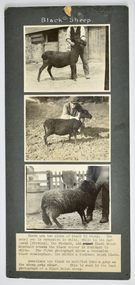
Photograph - Black Sheep, c.1928
... Black Sheep...Three black and white photographs and printed paper mounted on green display board. Photographs depict sheep and men. ...Front: [handwritten] Black Sheep. / [printed] There are two kinds of black in sheep. ...New South Wales Graziers Association World Tour England Sheep Farm Rural Agriculture Front: [handwritten] Black Sheep. / [printed] There are two kinds of black in sheep. ...This item is part of a group of five green display boards with photographs of sheep. This item is associated with the New South Wales Graziers Association world tour of merino sheep 1928/9.Three black and white photographs and printed paper mounted on green display board. Photographs depict sheep and men. The display board has pin holes in each corner.Front: [handwritten] Black Sheep. / [printed] There are two kinds of black in sheep. The / usual one is recessive to white, while in the Kar- / akul (Persian), the Piebald, and Black Welsh / Mountain breeds the black colour is dominant to / white. The first photograph shows a recessive / black Wensleydale, the middle a dominant Welsh black. / Sometimes the black is modified into a grey as / the sheep gets older. This is seen in the last / photograph of a Black Welsh Sheep. Back: [handwritten] Black / Sheep / [printed] PHOTOGRAPH COPYRIGHT / BY / THE ANIMAL BREEDING RESEARCH DEPT., / THE UNIVERSITY, EDINBURGH. / PLEASE RETURN TO :new south wales graziers association, world tour, england, sheep, farm, rural, agriculture -
 Bendigo Military Museum
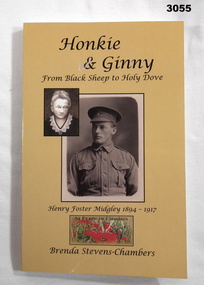
Book, Brenda Stevens - Chambers, Honkie & Ginny, From Black Sheep to Holy Dove, Henry Foster Midgley 1894 - 1917, 2013
... Honkie & Ginny, From Black Sheep to Holy Dove, Henry Foster Midgley 1894 - 1917...Honkie & Ginny, From Black Sheep to Holy Dove, Henry Foster Midgley 1894 - 1917 Book BOOK Brenda Stevens - Chambers Springfield & Hart Griffin Press Pty Ltd ...Biography, cardboard cover with black print on yellow background. Front cover has 2 black & white portrait photos, a male in uniform & a female in civilian clothing. Also a small photo of poppies with the words 'At Peace in Flanders'. Back cover has black print comments & a colour photograph of a wreath. 220 pages, cut, illustrated with black & white photos.Title page in handwritten blue ballpoint ink: To Shirley and David with best wishes Brenda S.C 2014books - biography, military history - army -
Tramways/East Melbourne RSL Sub Branch - RSL Victoria Listing id: 27511
Book, Col. Gregory Boyington et al, BAA BAA BLACK SHEEP, 1958
... BAA BAA BLACK SHEEP...ISBN: 0-553-010790-9 BAA BAA BLACK SHEEP Book Col. Gregory Boyington BANTOM BOOKS ...isbn: 0-553-010790-9 -
Thompson's Foundry Band Inc. (Castlemaine)
Sheet Music, Baa Baa Black Sheep
... Baa Baa Black Sheep...Baa Baa Black Sheep Sheet Music ... -
 Ballarat Heritage Services
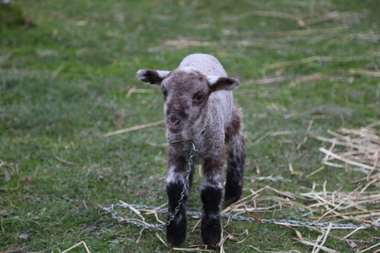
Photograph - Digital photographs, Lisa Gervasoni, Lamb, 2017
... ...black sheep...2017 farm animal lamb black sheep farm animal Colour photograph of a lamb in a green paddock. ...Colour photograph of a lamb in a green paddock.2017, farm, animal, lamb, black sheep, farm animal -
 Melbourne Royal
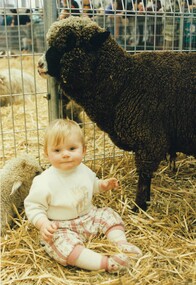
Photograph
... This photograph shows a baby with a black sheep in the Melbourne Royal Show Animal Nursery. ...This photograph shows a baby with a black sheep in the Melbourne Royal Show Animal Nursery. ...This photograph shows a baby with a black sheep in the Melbourne Royal Show Animal Nursery. The Animal Nursery, first set up in 1964, has been a place where Show-goers can get up close experiences with a variety of farm animals.Colour photograph, portrait, printed on glossy paper.children, kids at show, sheep, animal nursery -
 Glenelg Shire Council Cultural Collection
Print, Coca-Cola, 1983-1984
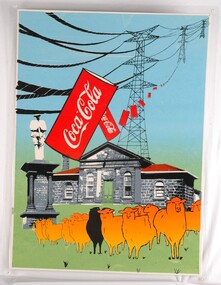
... The images from the top are: high tension wires and supports; numerous 'Coca-Cola' cans that descend in size; a war memorial statue; bluestone building; several orange sheep with one black sheep....The images from the top are: high tension wires and supports; numerous 'Coca-Cola' cans that descend in size; a war memorial statue; bluestone building; several orange sheep with one black sheep. Coca-Cola Print Print Rob Peagram Peagram, Rob ...CEMA Art Collection. Part of "A Community View" 150 years in Portland Screenprint Exhibition. Part of Angela Gee Residency 1983 and 1984.Laminated screenprint which features various images on a blue and green background. The images from the top are: high tension wires and supports; numerous 'Coca-Cola' cans that descend in size; a war memorial statue; bluestone building; several orange sheep with one black sheep.Front: (no inscriptions) Back: 30 -
Numurkah & District Historical Society
Photograph - Photo of animals
... Black & White photo of sheep dog and sheep...Black & White photo of sheep dog and sheep Photograph Photo of animals ...Black & White photo of sheep dog and sheep -
 Whitehorse Historical Society Inc.
Leisure object - Toy - sheep
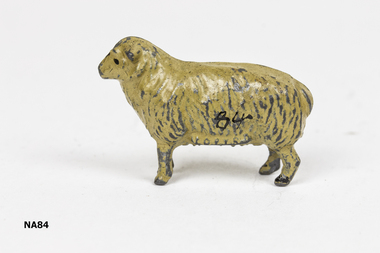
... Brown painted metal sheep with black feet....toys general England Brown painted metal sheep with black feet. Leisure object Toy - sheep ...Brown painted metal sheep with black feet.Englandtoys, general -
 Bendigo Historical Society Inc.
Book - HONKIE & GINNY
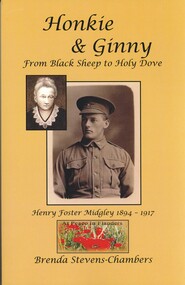
... Honkie & Ginny from black sheep to holy dove, the life of Henry Foster Midgley 1894 - 1917, a journey that travels from the cottages of Port Melbourne to Gallipoli, the battle fields of the Western front and the gold fields of Bendigo. ...GENEALOGY Family midgley Australia Australian & New Zealand army Brenda Stevens-Chambers Honkie & Ginny from black sheep to holy dove, the life of Henry Foster Midgley 1894 - 1917, a journey that travels from the cottages of Port Melbourne to Gallipoli, the battle fields of the Western front and the gold fields of Bendigo. ...Honkie & Ginny from black sheep to holy dove, the life of Henry Foster Midgley 1894 - 1917, a journey that travels from the cottages of Port Melbourne to Gallipoli, the battle fields of the Western front and the gold fields of Bendigo. Soft cover with 220 pages, black and white photographs publishes by Springfield and Hart Bendigo printed by Griffin Press. Donated by the author & signed inside cover.Brenda Stevens-Chambersgenealogy, family, midgley, australia, australian & new zealand army -
 Whitehorse Historical Society Inc.
Leisure object - Toy - Sheep
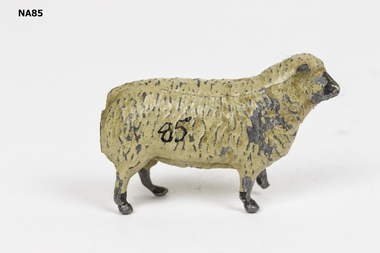
... Brown painted metal sheep with black nose and black feet....toys general Proprietary/Britains Ltd.,/Copyright/Made in England Brown painted metal sheep with black nose and black feet. Leisure object Toy - Sheep ...Brown painted metal sheep with black nose and black feet.Proprietary/Britains Ltd.,/Copyright/Made in Englandtoys, general -
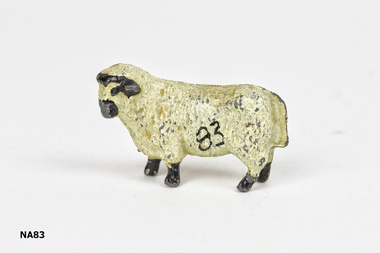 Whitehorse Historical Society Inc.
Leisure object - Toy - Sheep
... Metal cream painted sheep with black feet, black horns and nose....toys general Metal cream painted sheep with black feet, black horns and nose. Leisure object Toy - Sheep ...Metal cream painted sheep with black feet, black horns and nose.toys, general -
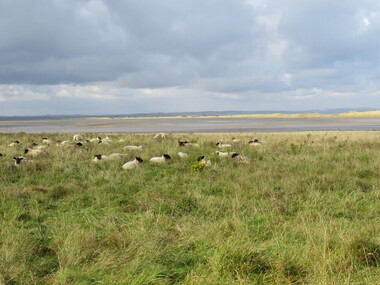 Ballarat Heritage Services
Digital photograph, Sheep, Lindisfarne Island, United Kingdom, 10/2016
... Colour photograph os sheep with black faces on Lindisfarne Island, United Kingdom...Lindisfarne Island Sheep Colour photograph os sheep with black faces on Lindisfarne Island, United Kingdom Sheep, Lindisfarne Island, United Kingdom Digital photograph ...Colour photograph os sheep with black faces on Lindisfarne Island, United Kingdomlindisfarne island, sheep -
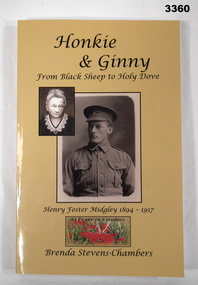 Bendigo Military Museum
Book - BOOK WW1, Brenda Stevens - Chambers, Honkie & Ginny, 2013
... Honkie & Ginny from Black Sheep to Holy Dove - Henry Foster Midgley 1894 - 1917. ...Honkie & Ginny from Black Sheep to Holy Dove - Henry Foster Midgley 1894 - 1917. ...Honkie & Ginny is a journey that travels from the cottages of Port Melbourne to Gallipoli, the battle fields of the Western Front and the gold fields of Bendigo. A personal tale from a grand niece.Biography. Honkie & Ginny from Black Sheep to Holy Dove - Henry Foster Midgley 1894 - 1917. Soft cardboard cover, black print on front, spine & back, yellow background. Front has 2 sepia portraits, smaller one of women superimposed over corner of soldier in uniform, small colour photo of At Peace in Flanders poppies below portraits. Back cover has colour photo of a wreath. 220 pages, cut plain paper. Illustrated in black & white photos, line drawings, posters & paintings. Handwritten in black ink on title page: "To Bendigo Memorial Museum with many thanks. Brenda S-C, August 2013" books, biography, western front -
 Bendigo Military Museum
Book - BOOK WW1, Brenda Stevens - Chambers, Honkie & Ginny, 2013
... Title: Honkie & Ginny From Black Sheep to Holy Dove, Henry Foster Midgley 1894 - 1917 At Peace in Flanders. ...A personal tale from a grand niece. books-biography military history Title: Honkie & Ginny From Black Sheep to Holy Dove, Henry Foster Midgley 1894 - 1917 At Peace in Flanders. ...Honkie & Ginny is a journey that travels from the cottagers of Port Melbourne to Gallipoli, the battle fields of the Western Front and the gold fields of Bendigo. A personal tale from a grand niece.Title: Honkie & Ginny From Black Sheep to Holy Dove, Henry Foster Midgley 1894 - 1917 At Peace in Flanders. Biography. Soft cardboard cover, black print on front, spine & back. 2 sepia portraits, smaller one of a woman superimposed over the left corner of a soldier in uniform, yellow coloured background. Below portraits is a small colour photo of At Peace in Flanders with poppies below these words Back cover has colour photos of a wreath. 220 pages, cut plain paper. Illustrated in black & white are photos, line drawings, posters & paintings.books-biography, military history -
Port Melbourne Historical & Preservation Society
Education kit, The Gay Way series Nursery Rhyme Pictures Sets 1 & 11, c.1963
... The nursery rhymes illustrated are from the Gateway Series 1 & 2 - Twinkle, Twinkle Little Star: Polly put the Kettle on; Baa Baa Black Sheep; Queen of Hearts; Humpty Dumpty; Jack & Jill; There was a Crooked Man; Sing a song of Sixpence; There was an old Woman who lived in a Shoe; Old Mother Hubbard; Hot Cross Buns; Do you Know the Muffin Man, Pat a Cake; There was an old Woman tossed up in a Basket; Ride a Cock Horse; I saw a Ship go Sailing By; Curly Locks; Higgeldy Piggeldy;Diddle Diddle Dumping; Monday's Child: Little Tommy Tucker; Oranges & Lemons; Ding Dong Bell; Wee Willie Winkie; Old King Cole; Please to remember the 5th of November; Georgie Porgie; Three Little Mice sat down to Spin; The Man in the Moon; A Farmer went a Trotting....The nursery rhymes illustrated are from the Gateway Series 1 & 2 - Twinkle, Twinkle Little Star: Polly put the Kettle on; Baa Baa Black Sheep; Queen of Hearts; Humpty Dumpty; Jack & Jill; There was a Crooked Man; Sing a song of Sixpence; There was an old Woman who lived in a Shoe; Old Mother Hubbard; Hot Cross Buns; Do you Know the Muffin Man, Pat a Cake; There was an old Woman tossed up in a Basket; Ride a Cock Horse; I saw a Ship go Sailing By; Curly Locks; Higgeldy Piggeldy;Diddle Diddle Dumping; Monday's Child: Little Tommy Tucker; Oranges & Lemons; Ding Dong Bell; Wee Willie Winkie; Old King Cole; Please to remember the 5th of November; Georgie Porgie; Three Little Mice sat down to Spin; The Man in the Moon; A Farmer went a Trotting. ...Used in infant grades to enhance the learning of nursery rhymes as well as to encourage children to examine a picture and talk about what they saw. The nursery rhymes illustrated are from the Gateway Series 1 & 2 - Twinkle, Twinkle Little Star: Polly put the Kettle on; Baa Baa Black Sheep; Queen of Hearts; Humpty Dumpty; Jack & Jill; There was a Crooked Man; Sing a song of Sixpence; There was an old Woman who lived in a Shoe; Old Mother Hubbard; Hot Cross Buns; Do you Know the Muffin Man, Pat a Cake; There was an old Woman tossed up in a Basket; Ride a Cock Horse; I saw a Ship go Sailing By; Curly Locks; Higgeldy Piggeldy;Diddle Diddle Dumping; Monday's Child: Little Tommy Tucker; Oranges & Lemons; Ding Dong Bell; Wee Willie Winkie; Old King Cole; Please to remember the 5th of November; Georgie Porgie; Three Little Mice sat down to Spin; The Man in the Moon; A Farmer went a Trotting..Large pale green folder containing 31 coloured nursery rhyme pictures.education - primary schools, gateway series nursery rhymes, nott street primary school, nott street state school -
 Cheese World Museum
Certificate, 1997
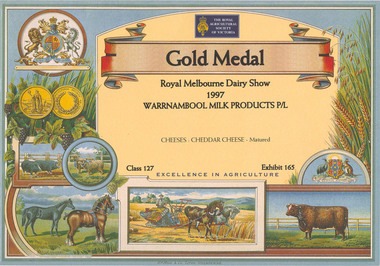
... The circular image on the top shows a Royal coat of arms; below are two gold medals featuring a female and a laurel wreath; underneath is an image of two black sheep and a blue ringed circle has two sheep with blue ribbons around their necks standing in front of a wooden fence. ...The circular image on the top shows a Royal coat of arms; below are two gold medals featuring a female and a laurel wreath; underneath is an image of two black sheep and a blue ringed circle has two sheep with blue ribbons around their necks standing in front of a wooden fence. ...Kraft-Walker Cheese Company commenced in Allansford in 1935 leasing the factory premises from Warrnambool Cheese and Butter Factory Company. Dairy companies entered competitions organised by the Dairy Industry Association and associated organisations and local agricultural societies to encourage improvement in products. Some of these awards are considered prestigious and highly regarded within the industry. The certificates were passed to Cheese World Museum by the factory management.A blue background full colour certificate and a cream cartouche with a darker banner across it and the insignia of the Royal Agricultural Society of Victoria; in the lower right hand corner of this section is the Australian coat of arms; around this are grasses, grapes and wheat. On the left hand side and across the bottom are images in various shapes. The circular image on the top shows a Royal coat of arms; below are two gold medals featuring a female and a laurel wreath; underneath is an image of two black sheep and a blue ringed circle has two sheep with blue ribbons around their necks standing in front of a wooden fence. Along the bottom are three images -first a black riding horse together with a brown shire horse in harness; second a horse drawn harvester; third a brown prize bull.THE ROYAL/AGRICULTURAL/SOCIETY/ OF VICTORIA Gold Medal/Royal Melbourne Dairy Show/1997/WARRNAMBOOL MILK PRODUCTS P/L/Class 127/Exhibit 165/EXCELLENCE IN AGRICULTURE allansford, dairy awards, product awards, warrnambool milk products, warrnambool cheese and butter factory company, royal melbourne dairy show, agricultural shows -
 Warrnambool and District Historical Society Inc.
Booklet, A band of gypsies: employees of Niel Black & Co in the pre-goldrush era: a work in progress
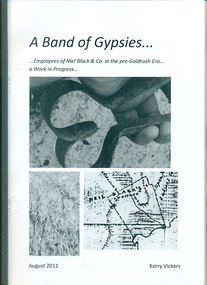
... In-house booklet with plastic sleeve outer cover, with black & white images of sheep shears, wool and a map of the Black property. ...This booklet documents those who came to the Western District to work for Niel Black prior to the goldrushes of the 1850s. emigration employment family history early victorian squatters niel black In-house booklet with plastic sleeve outer cover, with black & white images of sheep shears, wool and a map of the Black property. ...Niel Black was an early settler in the Western District of Victoria who held large tracts of land including Glenormiston and The Sisters estates. Black was responsible for bringing many employees to the area. The employees' names, birthplace, arrival date, marriage partner/s, other employers are tabulated. An overview of Black's properties and conditions of the time is also included.This booklet documents those who came to the Western District to work for Niel Black prior to the goldrushes of the 1850s.In-house booklet with plastic sleeve outer cover, with black & white images of sheep shears, wool and a map of the Black property. All text is in black.emigration, employment, family history, early victorian squatters, niel black -
 Bendigo Historical Society Inc.
Book - BOOK: THE CHILDREN'S NURSERY RHYMES
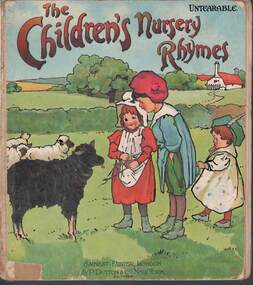
... . / front cover shows a painting of countryside with three children and some sheep - one black. / Inside cover written in ink -' From Grampa Hall to Florrie 31.3.1910 / black and white & coloured illustrations/ rhymes include 'Little Bo-peep.... / front cover shows a painting of countryside with three children and some sheep - one black. / Inside cover written in ink -' From Grampa Hall to Florrie 31.3.1910 / black and white & coloured illustrations/ rhymes include 'Little Bo-peep Book BOOK: THE CHILDREN'S NURSERY RHYMES ...'Untearable ', Hard covered Book - 'The Children's Nursery Rhymes -published by Ernest Nister London & E.P. Dutton & Co. New York E.N.No. 2026. / front cover shows a painting of countryside with three children and some sheep - one black. / Inside cover written in ink -' From Grampa Hall to Florrie 31.3.1910 / black and white & coloured illustrations/ rhymes include 'Little Bo-peepbooks, children's, nursery -
 National Wool Museum
Textile - Quilt, By Wagga Design, 2017
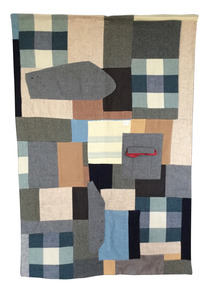
... Barbara wrote the poem below while thinking of the workers who used waggas while travelling: Black night campfire night sheep in the shadows dreams on the track a comforting wagga stitched with love for a homesick heart. ...Barbara wrote the poem below while thinking of the workers who used waggas while travelling: Black night campfire night sheep in the shadows dreams on the track a comforting wagga stitched with love for a homesick heart. ...‘By Wagga Design’ is the winner of the Art Quilt Australia 2019 Expressions: Wool Quilt Prize. Barbara Mellor, of St Helens in Tasmania, made this quilt after researching the history of waggas and was fascinated by this early form of recycling. ‘By Wagga Design’ is her contemporary take on the traditional wagga that was born out of hard times and limited resources. Barbara wrote the poem below while thinking of the workers who used waggas while travelling: Black night campfire night sheep in the shadows dreams on the track a comforting wagga stitched with love for a homesick heart. The wagga was made in 2017 and was first submitted into the Bay of Fires Art Prize. In 2018 the wagga was submitted into the Break O’Day Stitchers Quilting and Embroidery Exhibition, where it won the Hanger’s Prize. Barbara sourced the fabrics used from a variety of places. Some are from her personal collection while others were given to her. She purchased a woollen three-piece suit from a local op shop and decided to incorporate it into the design, making some unique and distinctive shapes. Another distinctive feature of the quilt is the patch labelled ‘Parkside’. Barbara noted that it was cut from a blanket she purchased from a garage sale from a property that had once been a caravan park titled ‘Parkside’ in the 1960s. The filling of the wagga contains the rest of the Parkside blanket.Quilt made from various woollen garments and bedding in cool tone colours. Patches mostly cut into square and rectangle shapes. Three patches made from a second-hand woollen suit, showcasing the arm with cuff buttons, pocket flap on a hip pocket containing a pocket square and front of vest with buttons. wagga, art quilt australia, expressions: wool quilt prize -
 Flagstaff Hill Maritime Museum and Village
Plaque - Insignia, Bank of Australasia, 16-10-1980
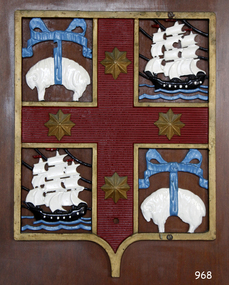
... black and white details. Decals in each corner; upper left and lower right have a white sheep suspended by a blue ribbon, upper right and lower left have a 3-masted, square-rigged sailing ship with a black hull and red flags flying on each mast, sailing on waves with storm clouds in the sky. ...sheep, stars Insignia of the Bank of Australasia. Cast metal coat of arms within a gold, shield-shaped border, painted gold and red, with blue, black and white details. ...This plaque displays the Bank of Australia's Coat of Arms and is significant because is ts the symbol printed on the Bank Notes of the Bank of Australasia. The bank of Australasia was incorporated by Royal Charter of England in March 1834. It had its Australian beginning on 14th December 1835, opening in Sydney. The Acting Superintendent of the bank at that time was David Charters McArthur. He was Superintendent from 1867-to 1876. The Melbourne branch opened on 28th August 1838 in a two-roomed brick cottage on the north side of Little Collins Street, where two huge mastiff dogs were used at night to guard the bank. The government also provided an armed military sentinel. Due to the bank's rapid growth, a new building for the Melbourne branch was opened in 1840 at 75 Collins Street West. By 1879 the bank had been upgraded to a magnificent two-storey building on the corners of Collins and Queens Streets, with the entry on Collins Street. In 1951 the Bank of Australasia amalgamated with the Union Bank to form the Australia and New Zealand Bank, now known as the ANZ. Then in 1970, the ANZ merged with both the ES&A and the London Bank of Australia to form the ANZ Banking Group Limited. The ANZ Banking Group Ltd kindly donated a variety of historic items from the Bank of Australasia. BANK of AUSTRALASIA, WARRNAMBOOL – In 1854 Warrnambool had two banks, the Union Bank and the Bank of Australasia. Later, completely different bank businesses opened; in 1867 the National Bank of Australasia, then in 1875 the Colonial Bank of Australasia. The original Warrnambool branch of the Bank of Australasia was established in July 1854, and operated from a leased cottage on Merri Street, close to Liebig Street. The bank next bought a stone building previously erected by drapers Cramond & Dickson on the corner of Timor and Gibson Streets. Samuel Hannaford was a teller and then Manager at the Warrnambool branch from 1855 to 1856 and the Warrnambool Council chose that bank for its dealings during 1856-57. In 1859 Roberts & Co. was awarded the contract to build the new Bank of Australasia branch for the sum of £3,000; the firm built the Warrnambool Post Office in 1856 and purchased land in Timor Street in 1858. The land was on a sand hill on the northeast corner of Timor and Kepler Streets and had been bought in 1855 from investor James Cust. The new building opened on May 21, 1860. The bank continued to operate there until 1951 when it merged with the Union Bank to form the ANZ Bank, which continued operating from its Liebig Street building. Warrnambool City Council purchased the former Bank of Australasia building in 1971 and renovated it, then on 3rd December 1973 it was officially opened as the Art Gallery by Cr. Harold Stephenson and Gallery Director John Welsh. The Gallery transferred to the purpose-built building in Liebig Street in 1986 and the old bank building is now the Gallery club. Staff at the Bank of Australasia in Warrnambool included the following men but others were also involved: Samuel Hannaford, Teller then Manager from 1855-1856; Hawkins, Manager in 1856, W H Palmer, Manager from January 1857 until November 1869 when the Teller Basil Spence was promoted to Manager; H B Chomley, Manager from April 1873 and still there in 1886; A Butt, Manager in 1895-1904; J R McCleary Accountant and Acting Manager for 12 months, until 1900; A Kirk, Manager 1904; J Moore, staff until his transfer to Bendigo in December 1908; J S Bath was Manager until 1915; C C Cox, Manager until April 1923; Richard C Stanley, Manager 1923 to April 1928. The plaque with the insignia has significance through its association with the Bank of Australasia. The early Australian bank was established in 1834 by Royal Charter and opened in Sydney, Australia, in Sydney in 1835. The bank had many Australian offices in November 1877, particularly on the east and south coasts. Victoria had 45 per cent of all Offices. The plaque is locally significant for its association with the Warrnambool Bank of Australasia, which was established in 1854. It was Warrnambool Council’s first bank. The bank continued to operate until the organisation's merger in 1951 when it became the ANZ Bank Group today. The Bank was an integral part of the growth of local commerce and the community.Insignia of the Bank of Australasia. Cast metal coat of arms within a gold, shield-shaped border, painted gold and red, with blue, black and white details. Decals in each corner; upper left and lower right have a white sheep suspended by a blue ribbon, upper right and lower left have a 3-masted, square-rigged sailing ship with a black hull and red flags flying on each mast, sailing on waves with storm clouds in the sky. Between the emblems are gold stars.Decals; ships, sheep, starsflagstaff hill, warrnambool, shipwrecked coast, flagstaff hill maritime museum, maritime museum, shipwreck coast, flagstaff hill maritime village, great ocean road, bank of australasia, boa, union bank, australia & new zealand bank, anz bank, david charters mcarthur, d c mcarthur, currency, banknote, commerce, banking, heraldic shield, insignia, samuel hannaford -
 Flagstaff Hill Maritime Museum and Village
Plaque - Insignia, Bank of Australasia, 19th Century
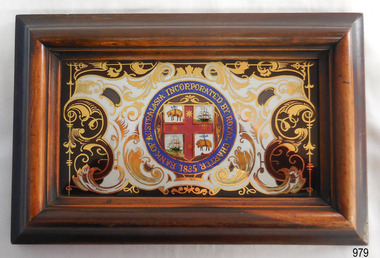
... black letters "AM1" Plaque with insignia on glass in a rectangular varnished wooden frame. Insignia of the Bank of Australasia has been painted onto the glass in a mirror-like fashion. Insignia depicts a heraldic shield with sheep ...This decorative plaque displays the insignia of the Bank of Australasia, which was incorporated by the Royal Charter of England in March 1834. The bank began in Australia on 14th December 1835, opening in Sydney. The Acting Superintendent of the bank at that time was David Charters McArthur. He was Superintendent from 1867-to 1876. The Melbourne branch opened on 28th August 1838 in a two-roomed brick cottage on the north side of Little Collins Street, where two huge mastiff dogs were used at night to guard the bank. The government also provided an armed military sentinel. Due to the bank's rapid growth, a new building for the Melbourne branch was opened in 1840 at 75 Collins Street West. By 1879 the bank had been upgraded to a magnificent two-storey building on the corners of Collins and Queens Streets, with the entry on Collins Street. In 1951 the Bank of Australasia amalgamated with the Union Bank to form the Australia and New Zealand Bank, now known as the ANZ. Then in 1970, the ANZ merged with both the ES&A and the London Bank of Australia to form the ANZ Banking Group Limited. The ANZ Banking Group Ltd kindly donated a variety of historic items from the Bank of Australasia. BANK of AUSTRALASIA, WARRNAMBOOL – In 1854 Warrnambool had two banks, the Union Bank and the Bank of Australasia. Later, completely different bank businesses opened; in 1867 the National Bank of Australasia, then in 1875 the Colonial Bank of Australasia. The original Warrnambool branch of the Bank of Australasia was established in July 1854, and operated from a leased cottage on Merri Street, close to Liebig Street. The bank later bought a stone building previously erected by drapers Cramond & Dickson on the corner of Timor and Gibson Streets. Samuel Hannaford was a teller and then Manager at the Warrnambool branch from 1855 to 1856 and the Warrnambool Council chose that bank for its dealings during 1856-57. In 1859 Roberts & Co. was awarded the contract to build the new Bank of Australasia branch for the sum of £3,000. The land was on a sand hill on the northeast corner of Timor and Kepler Streets and had been bought in 1855 from investor James Cust. The new building opened on May 21, 1860. The bank continued to operate there until 1951 when it merged with the Union Bank to form the ANZ Bank, which continued operating from its Liebig Street building. Warrnambool City Council purchased the former Bank of Australasia building in 1971 and renovated it, then on 3rd December 1973 it was officially opened as the Art Gallery by Cr. Harold Stephenson and Gallery Director John Welsh. The Gallery transferred to the purpose-built building in Liebig Street in 1986 and the old bank building is now the Gallery club. Staff at the Bank of Australasia in Warrnambool included the following men but others were also involved: Samuel Hannaford, Teller then Manager from 1855-1856; W H Palmer, Manager from January 1857 until November 1869 when the Teller Basil Spence was promoted to Manager; H B Chomley, Manager from April 1873 and still there in 1886; A Butt, Manager in 1895-1904; J R McCleary Accountant and Acting Manager for 12 months, until 1900; A Kirk, Manager 1904; J Moore, staff until his transfer to Bendigo in December 1908; J S Bath was Manager until 1915; C C Cox, Manager until April 1923; Richard C Stanley, Manager 1923 to April 1928. The plaque has historical significance as it belonged to the Bank of Australasia which was established in Australia in 1835 by Royal Charter. The plaque is significant for its association with the Bank of Australasia in Warrnambool, the first bank in Warrnambool, established in 1854. The bank continued to operate until its merger in 1951 when it became the ANZ Bank, which is still in operation today. The Bank was an integral part of the establishment and growth of commerce in Colonial Warrnambool and throughout Australia.Plaque with insignia on glass in a rectangular varnished wooden frame. Insignia of the Bank of Australasia has been painted onto the glass in a mirror-like fashion. Insignia depicts a heraldic shield with sheep hung up by their waists and ships in full sail. Inscription on insignia. Stamp and handwritten inscription on the rectangular label with a blue border on the reverse.Insignia: "BANK OF AUSTRALASIA INCORPORATED BY ROYAL CHARTER 1835" Label's red oval stamp with "AUSTRALIA AND NEW ZEALAND BANK UNITED ARCHIVES" Label's handwritten black letters "AM1" flagstaff hill, warrnambool, shipwrecked coast, flagstaff hill maritime museum, maritime museum, shipwreck coast, flagstaff hill maritime village, great ocean road, commerce, banking, plaque, insignia, bank of australasia, insignia on glass, union bank, australia & new zealand bank, anz bank, david charters mcarthur, d c mcarthur, sydney, new south wales, currency, banknote, legal tender -
 Flagstaff Hill Maritime Museum and Village
Currency - Bank cheque, Sands & McDougall Limited, 03-12-1885
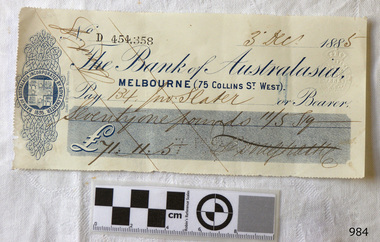
... It is printed in blue with bank's Insignia of a heraldic shield of sheep hung by their waists and ships in full sail. Embossed Stamp Duty mark. Embossed dots. Handwritten black ink details Dated 3rd Dec 1885. ...It is printed in blue with bank's Insignia of a heraldic shield of sheep hung by their waists and ships in full sail. Embossed Stamp Duty mark. Embossed dots. Handwritten black ink details Dated 3rd Dec 1885. ...This bank cheque originated from the Bank of Australasia, Melbourne branch. It was issued on 3rd December 1885 to a person surnamed Slater for £71.11.5 (seventy-one pounds, eleven shillings and five pence). The parallel lines are called Cheque Crossed and mean that only Slater and no one else could receive the payment and that it would have been paid into Slater's bank account, not exchanged for cash. The embossed dots signify that the cheque amount was also paid to be the bearer of the cheque. Slater would have visited the bank to deposit the money into his or her own account. The cheque was printed by Sands & McDougall, a long-standing Melbourne printing and stationery company. It was then Stamped at the bank with its own unique number before it was issued to the customer. From its previously perforated edges, it is presumed that the cheque was part of a page of cheques, likely to be contained within a book of similar cheques ready for use. The Bank of Australia was incorporated by Royal Charter of England in March 1834. It had its Australian beginnings on 14th December 1835, opening in Sydney. The Acting Superintendent of the bank at that time was David Charters McArthur. He was Superintendent from 1867-to 1876. The Melbourne branch opened on 28th August 1838 in a two-roomed brick cottage on the north side of Little Collins Street, where two huge mastiff dogs were used at night to guard the bank. The government also provided an armed military sentinel. Due to the bank's rapid growth, a new building for the Melbourne branch was opened in 1840 at 75 Collins Street West. By 1879 the bank had been upgraded to a magnificent two-storey building on the corners of Collins and Queens Streets, with the entry on Collins Street. In 1951 the Bank of Australasia amalgamated with the Union Bank to form the Australia and New Zealand Bank, now known as the ANZ. Then in 1970, the ANZ merged with both the ES&A and the London Bank of Australia to form the ANZ Banking Group Limited. The ANZ Banking Group Ltd kindly donated a variety of historic items from the Bank of Australasia. BANK of AUSTRALASIA, WARRNAMBOOL – In 1854 Warrnambool had two banks, the Union Bank and the Bank of Australasia. Later, completely different bank businesses opened; in 1867 the National Bank of Australasia, then in 1875 the Colonial Bank of Australasia. The original Warrnambool branch of the Bank of Australasia was established in July 1854, and operated from a leased cottage on Merri Street, close to Liebig Street. The bank next bought a stone building previously erected by drapers Cramond & Dickson on the corner of Timor and Gibson Streets. Samuel Hannaford was a teller and then Manager at the Warrnambool branch from 1855 to 1856 and the Warrnambool Council chose that bank for its dealings during 1856-57. In 1859 Roberts & Co. was awarded the contract to build the new Bank of Australasia branch for the sum of £3,000. The land was on a sand hill on the northeast corner of Timor and Kepler Streets and had been bought in 1855 from investor James Cust. The new building opened on May 21, 1860. The bank continued to operate there until 1951 when it merged with the Union Bank to form the ANZ Bank, which continued operating from its Liebig Street building. Warrnambool City Council purchased the former Bank of Australasia building in 1971 and renovated it, then on 3rd December 1973 it was officially opened as the Art Gallery by Cr. Harold Stephenson and Gallery Director John Welsh. The Gallery transferred to the purpose-built building in Liebig Street in 1986 and the old bank building is now the Gallery club. Staff at the Bank of Australasia in Warrnambool included the following men but others were also involved: Samuel Hannaford, Teller then Manager from 1855-1856; W H Palmer, Manager from January 1857 until November 1869 when the Teller Basil Spence was promoted to Manager; H B Chomley, Manager from April 1873 and still there in 1886; A Butt, Manager in 1895-1904; J R McCleary Accountant and Acting Manager for 12 months, until 1900; A Kirk, Manager 1904; J Moore, staff until his transfer to Bendigo in December 1908; J S Bath was Manager until 1915; C C Cox, Manager until April 1923; Richard C Stanley, Manager 1923 to April 1928. The bank cheque has significance through its association with the Bank of Australasia. The early Australian bank was established in 1834 by Royal Charter and opened in Sydney, Australia, in Sydney in 1835. The bank had many Australian offices in November 1877, particularly on the east and south coasts. Victoria had 45 percent of all Offices. The bank cheque is significant as an early example of financial management of money and money exchange or transfer.Bank cheque of the Bank of Australasia, Melbourne branch. The rectangular paper has three sides that have been perforated. It is printed in blue with bank's Insignia of a heraldic shield of sheep hung by their waists and ships in full sail. Embossed Stamp Duty mark. Embossed dots. Handwritten black ink details Dated 3rd Dec 1885. Printed in Melbourne by Sands & McDougall. Diagonal parallel lines are across the cheque. Printed: "Bank of Australasia, MELBOURNE (75 COLLINS ST. WEST)." "454,358" "Sands & McDougall, Melbourne" Embossed stamp: Symbol of Crown above double oval lines " - STAMP DUTY" "ONE PENNY" Embossed dots forming test "7 PAID T2" Handwritten: "3rd Dec. [188] 5" "134 - Slater" "Seventy one pounds 11/S 5p" "£71.11.5" Signature: (undecipherable) flagstaff hill, warrnambool, shipwrecked-coast, flagstaff-hill, flagstaff-hill-maritime-museum, maritime-museum, shipwreck-coast, flagstaff-hill-maritime-village, bank cheque, shipwrecked coast, flagstaff hill maritime museum, maritime museum, shipwreck coast, flagstaff hill maritime village, great ocean road, bank of australasia, boa, union bank, australia & new zealand bank, anz bank, bank note, melbourne, slater, sands & mcdougall, chrssed cheque, embossed dots, paid cheque, banknote -
 Flagstaff Hill Maritime Museum and Village
Functional object - Courier Bag, Government of Victoria, Late 19th to mid-20th centuries
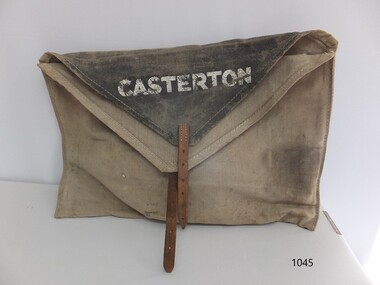
... It was likely used by Victoria's railway system that transported people, goods, documents and cash between the districts of western Victoria. warrnambool shipwreck coast flagstaff hill flagstaff hill maritime museum flagstaff hill maritime village bag pouch document pouch courier bag western district western victoria 19th century 20th century railway rural business rural trade Boronia Casterton Merino sheep farm sheep property canvas bag canvas courier bag government courier bag broad arrow White stencilled paint "CASTERTON" Black stencilled paint "BORONIA" [barely visible] White over-stamped stencilled paint "MERINO" Courier bag; beige canvas rectangular bag with triangular black canvas flaps and a leather strap and buckle closure. ...The courier bag was once government property, as indicated by the broad arrow symbol. The flap has the name 'Boronia' - an area near Melbourne - overstamped with the town name 'Merino', and on the other side of the flap is the town 'Casterton'. Merino and Casterton are renowned for large sheep farming properties in Victoria's western district. Perhaps the courier bag was originally used between Melbourne and Boronia. During the late 19th and early-to-mid 20th centuries, a government-operated railway service was active in in the western district of Victoria. It served remote properties, including a line between Merino and Casterton. The train delivered mail, cash, supplies documents, business records and people between the sheep farm properties and the township of Casterton.This courier bag is an example of the connections and business between people in the remote areas of western Victoria. It was likely used by Victoria's railway system that transported people, goods, documents and cash between the districts of western Victoria.Courier bag; beige canvas rectangular bag with triangular black canvas flaps and a leather strap and buckle closure. The bag has stencilled stamps of three towns - Casterton, Merino and Boronia. It also has the government property symbol of a broad arrow.White stencilled paint "CASTERTON" Black stencilled paint "BORONIA" [barely visible] White over-stamped stencilled paint "MERINO"warrnambool, shipwreck coast, flagstaff hill, flagstaff hill maritime museum, flagstaff hill maritime village, bag, pouch, document pouch, courier bag, western district, western victoria, 19th century, 20th century, railway, rural business, rural trade, boronia, casterton, merino, sheep farm, sheep property, canvas bag, canvas courier bag, government courier bag, broad arrow -
The Beechworth Burke Museum
Audio - Oral History, Linda Peacock, Ernie Warner, 2000
... While the township of Beechworth is known for its history as a gold rush town, these accounts provide a unique insight into the day-to-day life of the town's residents during the 20th century, many of which will have now been lost if they had not been preserved. zwar brothers tannery beechworth gold prospecting world war two hardware store sheep farming Ernie Warner This is a digital copy of a recording that was originally captured on a cassette tape. The cassette tape is black ...Ernie Warner was a local of Beechworth, a third generation inhabitant of the town. His grandfather arrived as a prospector, and his parents married there and established a sheep/wool farm, which passed to his brother. Ernie was the owner of the hardware store in Camp street, which was the former Post Office Hotel, from 1955 to 1979, having previously worked there as a teenager in the 1930s/1940s. He did not go to war due to injury, but during the wartime was employed in the hardware, at Zwar Bros. Tannery and by bookkeeping for his father. Ernie married in 1948 and had 6 children. This oral history recording was part of a project conducted by Jennifer Williams (and Linda Peacock) in the year 2000 to capture the everyday life and struggles in Beechworth during the twentieth century. This project involved recording seventy oral histories on cassette tapes of local Beechworth residents which were then published in a book titled: Listen to what they say: voices of twentieth century Beechworth. These cassette tapes were digitised in July 2021 with funds made available by the Friends of the Burke.Ernie Warner's oral history recording has social and interpretive significance due to his discussion on life in Beechworth during the Depression, War and post-war eras. He discusses his work in the hardware shop on Camp Street and his work in the Zwar Bros. tannery during the wartime, when it supplied leather to the army. His recording also has social significance because he discusses his family; his grandfather had arrived in Beechworth from England to prospect for gold and his father and brother were sheep farmers. This oral history account is socially and historically significant as it is a part of a broader collection of interviews conducted by Jennifer Williams which were published in the book 'Listen to what they say: voices of twentieth-century Beechworth.' While the township of Beechworth is known for its history as a gold rush town, these accounts provide a unique insight into the day-to-day life of the town's residents during the 20th century, many of which will have now been lost if they had not been preserved.This is a digital copy of a recording that was originally captured on a cassette tape. The cassette tape is black with a horizontal white strip and is currently stored in a clear flat plastic rectangular container. It holds up 40 minutes of recordings on each side.Ernie Warnerzwar brothers tannery, beechworth, gold prospecting, world war two, hardware store, sheep farming -
 The Beechworth Burke Museum
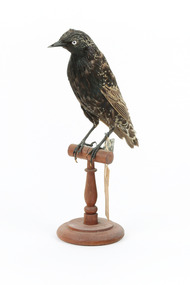
Animal specimen - Common Starling, Trustees of the Australian Museum, 1860-1880
... black bodies, white spots on their backs and wings, and a purple and green tinge to their underparts and wings. This species, when moving across the ground, has a distinctive 'walk' or 'run' rather than the traditional hopping of many other bird species. This bird is a noisy species, often becoming a nuisance to people. Starlings prefer to nest in holes in trees or buildings, yet there are at least two recorded cases of this species nesting on the backs of living sheep...This collection continues to be on display in the Museum and has become a key part to interpreting the collecting habits of the 19th century. taxidermy mount taxidermy animalia burke museum beechworth australian museum skin reynell eveleigh johns bird sheep common starling starling murmations pest australian bird Swing-tag: 139a. / Starling / Catalogue Page, 59 / Metal-tag: 1250 (?) This adult Common Starling has glossy-black ...The Common Starling is an introduced species to Australia (as well as widely throughout the world), and is considered a pest due to its attacks on fruits and seedlings, as well as competing with the native bird population. It was introduced to Victoria in 1861, and has since become abundant, whose sheer numbers cause many problems. These birds are a social species, which can mass in very large flocks (murmations), and show spectacular synchronised aerobatic displays. This species has a distinctive plumage, with glossy black bodies, white spots on their backs and wings, and a purple and green tinge to their underparts and wings. This species, when moving across the ground, has a distinctive 'walk' or 'run' rather than the traditional hopping of many other bird species. This bird is a noisy species, often becoming a nuisance to people. Starlings prefer to nest in holes in trees or buildings, yet there are at least two recorded cases of this species nesting on the backs of living sheep. This specimen is a good and intact example of this species. As the white spots are large and visible, as well as the purple and green shine, this specimen likely died close to Autumn and the breeding season, when these birds get their new bright plumage. This specimen is part of a collection of almost 200 animal specimens that were originally acquired as skins from various institutions across Australia, including the Australian Museum in Sydney and the National Museum of Victoria (known as Museums Victoria since 1983), as well as individuals such as amateur anthropologist Reynell Eveleigh Johns between 1860-1880. These skins were then mounted by members of the Burke Museum Committee and put-on display in the formal space of the Museum’s original exhibition hall where they continue to be on display. This display of taxidermy mounts initially served to instruct visitors to the Burke Museum of the natural world around them, today it serves as an insight into the collecting habits of the 19th century. This specimen is part of a significant and rare taxidermy mount collection in the Burke Museum. This collection is scientifically and culturally important for reminding us of how science continues to shape our understanding of the modern world. They demonstrate a capacity to hold evidence of how Australia’s fauna history existed in the past and are potentially important for future environmental research. This collection continues to be on display in the Museum and has become a key part to interpreting the collecting habits of the 19th century.This adult Common Starling has glossy-black plumage with a metallic sheen, and white speckles throughout. The plumage has a purple and green shine. The irises are white. Its beak is black and pointed. This specimen appears to be male, with less white spots on its underparts. This specimen stands upon a wooden platform and has an identification tag tied around its leg, and a metal tag tied around its foot.Swing-tag: 139a. / Starling / Catalogue Page, 59 / Metal-tag: 1250 (?)taxidermy mount, taxidermy, animalia, burke museum, beechworth, australian museum, skin, reynell eveleigh johns, bird, sheep, common starling, starling, murmations, pest, australian bird -
Federation University Historical Collection
Booklet, Ballarat School of Mines, Occupational Objectives: Farmer 12:79, 05/1979
... ballarat school of mines farmer farming occupations poulty farmrt dairy farmrt sheep farmer poultry farmer swineher creals grower oil seed grower viticulturalist markert gardener tabacco grower orchardist silviculturist biodynamics irrigationists permaculturists feedlotters hot-house White cardboard cover with black plastic spine Occupational Objectives: Farmer 12:79 Booklet Booklet Ballarat School of Mines J.L. ...White cardboard cover with black plastic spineballarat school of mines, farmer, farming, occupations, poulty farmrt, dairy farmrt, sheep farmer, poultry farmer, swineher, creals grower, oil seed grower, viticulturalist, markert gardener, tabacco grower, orchardist, silviculturist, biodynamics, irrigationists, permaculturists, feedlotters, hot-house -
 Federation University Historical Collection
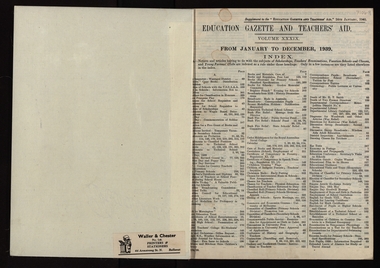
Book, Education Gazette, 1930s, 1930s
... black books with red spine. The books contain the bound Victoria Education Gazettes for the 1930s. .4) Handwork in rural schools, Young Farmers' Clubs, Domestic Arts, Arbour Day, LEague of Youth of Australia. Health Education, Metal Trades, Industrial Studies, HOrticulture, Hinkler Memoria Trees, Musical Appreciation, British Breeds of Sheep. ...black books with red spine. The books contain the bound Victoria Education Gazettes for the 1930s. .4) Handwork in rural schools, Young Farmers' Clubs, Domestic Arts, Arbour Day, LEague of Youth of Australia. Health Education, Metal Trades, Industrial Studies, HOrticulture, Hinkler Memoria Trees, Musical Appreciation, British Breeds of Sheep. ...10 hard covered, black books with red spine. The books contain the bound Victoria Education Gazettes for the 1930s. .4) Handwork in rural schools, Young Farmers' Clubs, Domestic Arts, Arbour Day, LEague of Youth of Australia. Health Education, Metal Trades, Industrial Studies, HOrticulture, Hinkler Memoria Trees, Musical Appreciation, British Breeds of Sheep. Train Journey Through Germany, History Handwork - Roman Times, Claude Seareby (photo), Norsemen, Techncical Schools Exhibition, Knots, Balllarat Junior Technical School Terraced Gardenseducation gazette, ballarat junior technical school terrace gardens -
Federation University Historical Collection
Photograph - Black and White Photograph, Ballarat School of Mines Shearing Sheep
... Ballarat SChool of Mines Shearing sheep alumni rural studies Two Ballrarat School of Mines students shearing sheep Ballarat School of Mines Shearing Sheep Photograph Black and White Photograph ...Two Ballrarat School of Mines students shearing sheepballarat school of mines, shearing, sheep, alumni, rural studies
