
Showing 18 items matching "blessed sacrament"
-
 St Patrick's College
Badge - Page of the Blessed Sacrament 1932, Pelegrini, c1932
... Badge - Page of the Blessed Sacrament 1932...Blessed Sacrament...This badge would be presented to members of the Blessed Sacrament....This badge would be presented to members of the Blessed Sacrament. Blessed Sacrament badge 1932 Small blue badge in the shape of a shield with a cross in the middle. ...This badge would be presented to members of the Blessed Sacrament.Small blue badge in the shape of a shield with a cross in the middle. On the cross are the letters B P S and a chalice with host in the middle.blessed sacrament, badge, 1932 -
St Patrick's College
Pin - Crusader of the Blessed Sacrament, 1937, c1937
... Pin - Crusader of the Blessed Sacrament, 1937...Crusader Blessed Sacrament...Pin worn by members of the Crusader of the Blessed Sacrament society at St Patrick's College....Pin worn by members of the Crusader of the Blessed Sacrament society at St Patrick's College. ...Pin worn by members of the Crusader of the Blessed Sacrament society at St Patrick's College.A tie or jacket pin with a red triangular shield at top. The shield has a gold cross and letters in the four segments made by the cross - J, T, A, A.crusader blessed sacrament, pin, 1937. -
 Friends of St Brigids Association
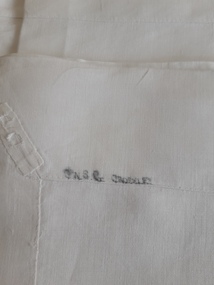
Ceremonial object - Humeral Veil, Humeral Veil - a liturgical vestment that covers the shoulders and hands of the minister to carry the Blessed Sacrament or give Benediction
... Humeral Veil - a liturgical vestment that covers the shoulders and hands of the minister to carry the Blessed Sacrament or give Benediction....Used at St Brigid's Church Crossley Ceremonial textiles "Benediction " : "CSNG Crossley" Rectangular cloth Humeral Veil - a liturgical vestment that covers the shoulders and hands of the minister to carry the Blessed Sacrament or give Benediction. Ceremonial object Humeral Veil ...Used at St Brigid's Church Crossley Rectangular cloth"Benediction " : "CSNG Crossley"ceremonial textiles -
 Eltham District Historical Society Inc
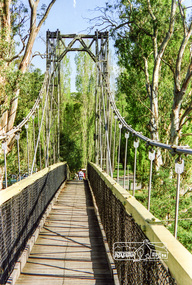
Photograph, Pedestrian suspension bridge over the Yarra River at Lower Plenty, 18 Apr 1998, 1998
... ...blessed sacrament fathers...Lower Plenty Heritage Excursion included the former monastery of the Blessed Sacrament Fathers, now Odyssey House, and its suspension footbridge across the Yarra River. ...Lower Plenty Heritage Excursion included the former monastery of the Blessed Sacrament Fathers, now Odyssey House, and its suspension footbridge across the Yarra River. ...Lower Plenty Heritage Excursion included the former monastery of the Blessed Sacrament Fathers, now Odyssey House, and its suspension footbridge across the Yarra River. Odyssey House drug rehabilitation centre in Bonds Road, Lower Plenty is a distinctive landmark, especially when viewed from across the Yarra at Templestowe. It was built in the 1950’s as a seminary for the Blessed Sacrament Fathers. Because of the poor and circuitous road access, a suspension footbridge was built across the river. As well as providing easy access for the priests residents of Templestowe could attend services at the seminary. The bridge is now part of the Yarra Trails system.Roll of 35mm colour negative film, 6 strips Also photographic prints 10 x 15 cmKodak Gold 200-6activities, blessed sacrament fathers, bonds road, bridge, foot bridge, lower plenty, odyssey house, seminary, yarra river -
 Eltham District Historical Society Inc
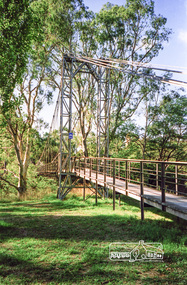
Photograph, Pedestrian suspension bridge over the Yarra River at Lower Plenty, 18 Apr 1998, 1998
... ...blessed sacrament fathers...Lower Plenty Heritage Excursion included the former monastery of the Blessed Sacrament Fathers, now Odyssey House, and its suspension footbridge across the Yarra River. ...Lower Plenty Heritage Excursion included the former monastery of the Blessed Sacrament Fathers, now Odyssey House, and its suspension footbridge across the Yarra River. ...Lower Plenty Heritage Excursion included the former monastery of the Blessed Sacrament Fathers, now Odyssey House, and its suspension footbridge across the Yarra River. Odyssey House drug rehabilitation centre in Bonds Road, Lower Plenty is a distinctive landmark, especially when viewed from across the Yarra at Templestowe. It was built in the 1950’s as a seminary for the Blessed Sacrament Fathers. Because of the poor and circuitous road access, a suspension footbridge was built across the river. As well as providing easy access for the priests residents of Templestowe could attend services at the seminary. The bridge is now part of the Yarra Trails system.Roll of 35mm colour negative film, 6 strips Also photographic prints 10 x 15 cmKodak Gold 200-6activities, blessed sacrament fathers, bonds road, bridge, foot bridge, lower plenty, odyssey house, seminary, yarra river -
 Eltham District Historical Society Inc
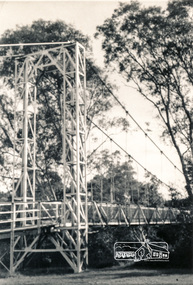
Photograph, Pedestrian suspension bridge over the Yarra River at Lower Plenty
... ...blessed sacrament fathers...It was built in the 1950’s as a seminary for the Blessed Sacrament Fathers. Because of the poor and circuitous road access, a suspension footbridge was built across the river. ...It was built in the 1950’s as a seminary for the Blessed Sacrament Fathers. Because of the poor and circuitous road access, a suspension footbridge was built across the river. ...Odyssey House drug rehabilitation centre in Bonds Road, Lower Plenty is a distinctive landmark, especially when viewed from across the Yarra at Templestowe. It was built in the 1950’s as a seminary for the Blessed Sacrament Fathers. Because of the poor and circuitous road access, a suspension footbridge was built across the river. As well as providing easy access for the priests residents of Templestowe could attend services at the seminary. The bridge is now part of the Yarra Trails system.Two black and white photographs of footbridge over Yarra River, part of the Ruffey Trail just off the Main Yarra Trail near the former seminary (now Odyssey House) Lower Plentybridges, yarra river, odyssey house, bonds road, lower plenty, seminary, blessed sacrament fathers -
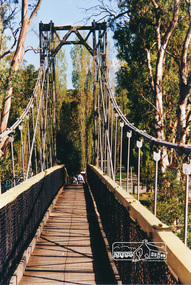 Eltham District Historical Society Inc
Photograph, Pedestrian suspension bridge over the Yarra River at Lower Plenty
... ...blessed sacrament fathers...It was built in the 1950’s as a seminary for the Blessed Sacrament Fathers. Because of the poor and circuitous road access, a suspension footbridge was built across the river. ...It was built in the 1950’s as a seminary for the Blessed Sacrament Fathers. Because of the poor and circuitous road access, a suspension footbridge was built across the river. ...Odyssey House drug rehabilitation centre in Bonds Road, Lower Plenty is a distinctive landmark, especially when viewed from across the Yarra at Templestowe. It was built in the 1950’s as a seminary for the Blessed Sacrament Fathers. Because of the poor and circuitous road access, a suspension footbridge was built across the river. As well as providing easy access for the priests residents of Templestowe could attend services at the seminary. The bridge is now part of the Yarra Trails system.Colour photograph of footbridge over Yarra River, part of the Ruffey Trail just off the Main Yarra Trail near the former seminary (now Odyssey House) Lower Plentybridges, yarra river, lower plenty, seminary, blessed sacrament fathers, odyssey house, bonds road -
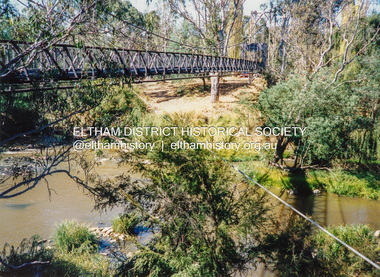 Eltham District Historical Society Inc
Photograph - Colour Print, Pedestrian suspension bridge over the Yarra River at Lower Plenty, c.1987
... Blessed Sacrament Fathers...Blessed Sacrament Fathers Bonds Road Bridge Footbridge Lower Plenty Odyssey House Seminary Yarra River Colour print on commercial photo paper Pedestrian suspension bridge over the Yarra River at Lower Plenty Photograph Colour Print ...blessed sacrament fathers, bonds road, bridge, footbridge, lower plenty, odyssey house, seminary, yarra river -
 Greensborough Historical Society
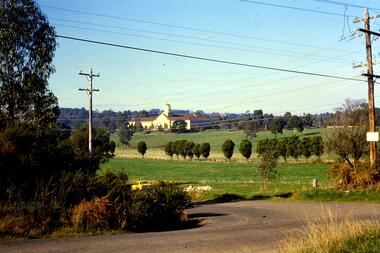
Slide - Photograph, John Ramsdale, Rural panorama: Slide 14
... At the time of the photograph was named 'Odyssey House' at Lower Plenty, Pre 1976 it was known as the Blessed Sacrament Fathers Seminary....At the time of the photograph was named 'Odyssey House' at Lower Plenty, Pre 1976 it was known as the Blessed Sacrament Fathers Seminary. Part of the John Ramsdale collection of slides and audio visual material. rural landscape lower plenty No maker's marks. ...Photograph shows view across a road and open land to large house in a rural setting. At the time of the photograph was named 'Odyssey House' at Lower Plenty, Pre 1976 it was known as the Blessed Sacrament Fathers Seminary.Part of the John Ramsdale collection of slides and audio visual material.Colour photograph scanned from slide.No maker's marks. No caption on slide.rural landscape, lower plenty -
 Hymettus Cottage & Garden Ballarat
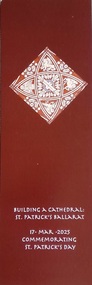
Work on paper - Bookmark, Building a Cathedral
... This image depicts a sanctuary tile by John Francis Bentley that together with the grand chancel window, the Lady Chapel and Blessed Sacrament stained glass windows are Bentley's only known work outside the UK. ...This image depicts a sanctuary tile by John Francis Bentley that together with the grand chancel window, the Lady Chapel and Blessed Sacrament stained glass windows are Bentley's only known work outside the UK. ...One of a series of bookmarks in support of the exhibition 'Building a Cathedral' at the Ballarat Catholic Archives in 2025. This image depicts a sanctuary tile by John Francis Bentley that together with the grand chancel window, the Lady Chapel and Blessed Sacrament stained glass windows are Bentley's only known work outside the UK. Bentley's greatest work was Westminster Cathedral.St Patrick's Cathedral Ballarat was the first Catholic Cathedral to be consecrated in Australia in 1891. The tiles as represented in this bookmark together with three John Francis Bentley windows were installed a year earlier for that occasion and are the only example of this artist/architect's work outside of the UK. This series of bookmarks in 2025 commemorate the significance of this cathedral and its art in Australia's material cultural heritage as well as to the Catholic community. bentley, ballarat, tile, bookmark -
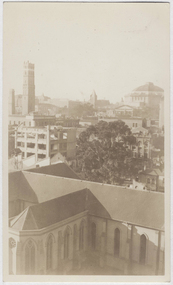 Congregation of the Blessed Sacrament and St. Francis’ Church, Heritage Centre
Photograph - Demolition of Advocate building and construction of Monastery, 1937
... A number of buildings were demolished along the south side of Little Lonsdale Street between St Francis Street and Elizabeth Street for the construction of the new Monastery for the Blessed Sacrament Congregation including a former school building and Advocate Press building. ...A number of buildings were demolished along the south side of Little Lonsdale Street between St Francis Street and Elizabeth Street for the construction of the new Monastery for the Blessed Sacrament Congregation including a former school building and Advocate Press building. ...A number of buildings were demolished along the south side of Little Lonsdale Street between St Francis Street and Elizabeth Street for the construction of the new Monastery for the Blessed Sacrament Congregation including a former school building and Advocate Press building. Demolition of the Advocate begun 6 July 1937 and was completed by mid-August. Construction works for the Monastery began soon after and was officially opened by Archbishop Mannix on 1 May 1938.Elevated view from south-west corner of St Francis Church, across roof top towards the partially demolished Advocate Press Building. In background, Coop's Shot Tower to the left, State Library to the right. Photographer unknown. Faded black and white photograph. Yellowing.church buildings, historic buildings, lost architecture, wrecking, melbourne, st francis' church -
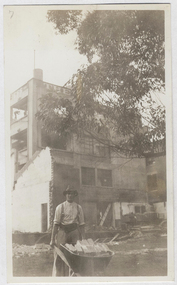 Congregation of the Blessed Sacrament and St. Francis’ Church, Heritage Centre
Photograph - Demolition of Advocate building and construction of Monastery, 1937
... A number of buildings were demolished along the south side of Little Lonsdale Street between St Francis Street and Elizabeth Street for the construction of the new Monastery for the Blessed Sacrament Congregation including a former school building and Advocate Press building. ...A number of buildings were demolished along the south side of Little Lonsdale Street between St Francis Street and Elizabeth Street for the construction of the new Monastery for the Blessed Sacrament Congregation including a former school building and Advocate Press building. ...A number of buildings were demolished along the south side of Little Lonsdale Street between St Francis Street and Elizabeth Street for the construction of the new Monastery for the Blessed Sacrament Congregation including a former school building and Advocate Press building. Demolition of the Advocate begun 6 July 1937 and was completed by mid-August. Construction works for the Monastery began soon after and was officially opened by Archbishop Mannix on 1 May 1938.Man pushing a wheelbarrow of rubble with the Advocate Press Building partially demolished in the background. Photographer unknown. Faded black and white photograph. Yellowing.church buildings, historic buildings, lost architecture, wrecking, melbourne, st francis' church -
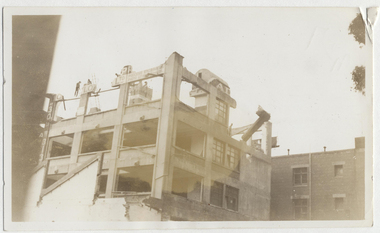 Congregation of the Blessed Sacrament and St. Francis’ Church, Heritage Centre
Photograph - Demolition of Advocate building and construction of Monastery, 1937
... A number of buildings were demolished along the south side of Little Lonsdale Street between St Francis Street and Elizabeth Street for the construction of the new Monastery for the Blessed Sacrament Congregation including a former school building and Advocate Press building. ...A number of buildings were demolished along the south side of Little Lonsdale Street between St Francis Street and Elizabeth Street for the construction of the new Monastery for the Blessed Sacrament Congregation including a former school building and Advocate Press building. ...A number of buildings were demolished along the south side of Little Lonsdale Street between St Francis Street and Elizabeth Street for the construction of the new Monastery for the Blessed Sacrament Congregation including a former school building and Advocate Press building. Demolition of the Advocate begun 6 July 1937 and was completed by mid-August. Construction works for the Monastery began soon after and was officially opened by Archbishop Mannix on 1 May 1938.Advocate Press Building being demolished by hand. Shows men on the upper storey, dismantling the building. Photographer unknown. Faded black and white photograph. Yellowing.church buildings, historic buildings, lost architecture, wrecking, melbourne, st francis' church -
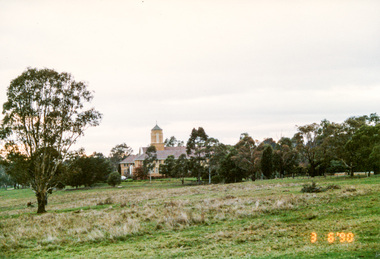 Eltham District Historical Society Inc
Photograph, Odyssey House Victoria, 28 Bonds Road, Lower Plenty, 6 March 1990
... It was built in the 1950’s as a seminary for the Blessed Sacrament Fathers. Because of the poor and circuitous road access, a suspension footbridge was built across the river. ...It was built in the 1950’s as a seminary for the Blessed Sacrament Fathers. Because of the poor and circuitous road access, a suspension footbridge was built across the river. ...Odyssey House drug rehabilitation centre in Bonds Road, Lower Plenty is a distinctive landmark, especially when viewed from across the Yarra at Templestowe. It was built in the 1950’s as a seminary for the Blessed Sacrament Fathers. Because of the poor and circuitous road access, a suspension footbridge was built across the river. As well as providing easy access for the priests residents of Templestowe could attend services at the seminary. The bridge is now part of the Yarra Trails system.Colour photographlower plenty, bonds road, odyssey house -
 Bendigo Historical Society Inc.
Medal - FOSTER AND WILSON COLLECTION: RELIGIOUS MEDALS
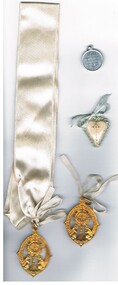
... The 2 gold coloured medals have 'Guard of Honour of the Most Blessed Sacrament' printed around the oval shaped edge. ...The 2 gold coloured medals have 'Guard of Honour of the Most Blessed Sacrament' printed around the oval shaped edge. ...Small beige & grey box with a black oval sticker on the front. On it is printed in gold: Jewellers & Silversmiths White's Pall Mall, Bendigo. The sticker also has a gold border. The box contains 2 gold coloured medals with Off white 33mm ribbons, a silver medal and a small heart shaped cushion with a cross on the front and light blue edging and ribbon. The 2 gold coloured medals have 'Guard of Honour of the Most Blessed Sacrament' printed around the oval shaped edge. In the centre is a chalice? With IHS on it and at lower sides are 2 angels. On the back it has 'Stokes & Sons MXL?' The small, round silver medal has a man & boy on the front and on the back asking in case of accident to notify a priest. Made in Germany.Stokes & Sonscottage, miners, foster & wilson collection, religious medals -
 Sunshine and District Historical Society Incorporated
Photograph - Buckfast Abbey Church
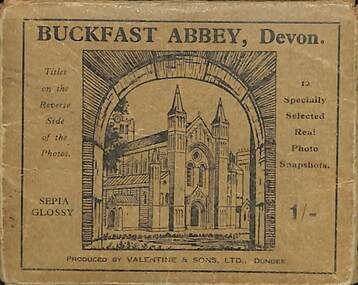
... 2066.00 - Buckfast Abbey Church Photographs 2066.01 - Buckfast Abbey Church - North West View 2066.02 - Buckfast Abbey Church - High Altar 2066.03 - Buckfast Abbey Church - East Cloister 2066.04 - Buckfast Abbey Church - Lady Chapel 2066.05 - Buckfast Abbey Church - Interior 2066.06 - Buckfast Abbey Church - Interior 2066.07 - Buckfast Abbey Church - North East 2066.08 - Buckfast Abbey Church - Buckfast Abbey And Dartmoor 2066.09 - Buckfast Abbey Church - The Refectory 2066.10 - Buckfast Abbey Church - The Font 2066.11 - Buckfast Abbey Church - North View 2066.12 - Buckfast Abbey Church - Altar Of The Blessed Sacrament...Buckfast Abbey Church Church 2066.00 - Buckfast Abbey Church Photographs 2066.01 - Buckfast Abbey Church - North West View 2066.02 - Buckfast Abbey Church - High Altar 2066.03 - Buckfast Abbey Church - East Cloister 2066.04 - Buckfast Abbey Church - Lady Chapel 2066.05 - Buckfast Abbey Church - Interior 2066.06 - Buckfast Abbey Church - Interior 2066.07 - Buckfast Abbey Church - North East 2066.08 - Buckfast Abbey Church - Buckfast Abbey And Dartmoor 2066.09 - Buckfast Abbey Church - The Refectory 2066.10 - Buckfast Abbey Church - The Font 2066.11 - Buckfast Abbey Church - North View 2066.12 - Buckfast Abbey Church - Altar Of The Blessed Sacrament Sepia photographs of Buckfast Abbey Church, people and surrounding area. ...2066.00 - Buckfast Abbey Church Photographs 2066.01 - Buckfast Abbey Church - North West View 2066.02 - Buckfast Abbey Church - High Altar 2066.03 - Buckfast Abbey Church - East Cloister 2066.04 - Buckfast Abbey Church - Lady Chapel 2066.05 - Buckfast Abbey Church - Interior 2066.06 - Buckfast Abbey Church - Interior 2066.07 - Buckfast Abbey Church - North East 2066.08 - Buckfast Abbey Church - Buckfast Abbey And Dartmoor 2066.09 - Buckfast Abbey Church - The Refectory 2066.10 - Buckfast Abbey Church - The Font 2066.11 - Buckfast Abbey Church - North View 2066.12 - Buckfast Abbey Church - Altar Of The Blessed Sacramentbuckfast abbey church, church -
 City of Melbourne Libraries
Photograph, Bull, Hugh Jones, 1897-1993, Eucharistic Congress Procession, Collins Street, Melbourne
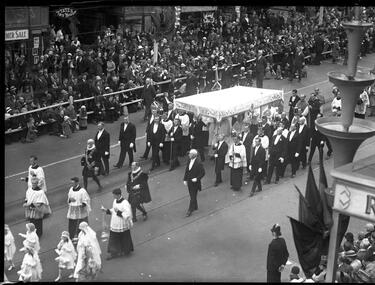
... The Procession of the Blessed Sacrament concluded the week-long Congress. ...The Procession of the Blessed Sacrament concluded the week-long Congress. ...Published: The Age 10 December 1934 Published title: RELIGIOUS PAGEANTRY AND FERVOR MARKED CLOSE OF EUCHARISTIC CONGRESS. Published caption: Thousands of men and women marched in the Eucharistic procession yesterday which brought the Congress to a close. The picture above shows the procession headed by the Children of Mary in Bourke-street and turning into Spring-street, in front of Parlia ment House. Right (top) — The procession leaving the starting point at St. Patrick's Cathedral and below, the Papal Legate carrying the Host under a canopy borne by a guard of laymen and preceded by white-clad girls scattering rose leaves, incense bearers and the Papal Chamberlains in their Spanish uniforms. The end of the procession in front of Mount St. Evin’s Hospital from which the final benediction was given by Cardi nal MacRory from an altar on the bal cony. The Papal Legate carrying the Host is passing through the assemblage of surpliced priests. On the left is an aerial picture taken just as the Children of Mary at the head of the procession are taking up their places for the final assembling. In the left top corner of the picture is St Patrick's Cathedral, from which the procession started, and in the right lower corner is Mount St. Evin’s Hospital. The space immediately in front of the hospital was reserved for the processionists while on either side is the crowd that assembled to take part in the final service. Trove article identifier: http://nla.gov.au/nla.news-article205067634 Religious pageantry and fervour The National Eucharistic Congress took place from Sunday 2 to Sunday 9 December 1934. An initiative of the Roman Catholic Church, it was their contribution to Melbourne’s Centenary Celebrations. 200,000 Catholics resided in Melbourne at this time – one quarter of the city’s population. While the Congress was aimed at Catholics, and acted as an opportunity to reinforce their living faith and homage, it contained a variety of events of splendour, solemnity and significance designed to appeal to Melbournians, and would additionally provide incentive for people to travel to Victoria, thereby creating an economic benefit to the state. The Procession of the Blessed Sacrament concluded the week-long Congress. Commencing at St Patrick’s Cathedral, it covered a two-mile route via Gisborne, Collins, Elizabeth and Bourke streets, then to Victoria Parade, where a final benediction was pronounced by Cardinal MacRory from the balcony of Mount St. Evin’s Hospital (today the site of St Vincent’s Private Hospital). An estimated 100,000 took part. Onlookers line Swanston Street, some standing at the entrance to Tate’s Tea House – a well-known Melbourne landmark located in the basement of the Manchester Unity Building. The white-veiled Children of Mary Sodalists strew rose petals in the path of the canopy, covering the jewelled Monstrance containing the Blessed Sacrament of consecrated Host (bread) and carried by the Cardinal. Church hierarchy in scarlet robes walk alongside, followed by incense bearers, the Papal Chamberlains in their Spanish uniforms, and a guard of honour of laymen of the city and country parishes. In the foreground is a tiered pole. This is one of 800 “Venetian Lights” specifically installed for the Centenary along all principal thoroughfares. “The poles are painted white, the superstructure resembling three trumpet lilies are made of durable fibro-cement, and their colour scheme deepens from clear yellow on the top cone to orange on the lowest, with slender rims of vermilion and white. Each cone is flooded with light externally from three lamps concealed in the one below it. There is also a painted coat of arms from which spring a trophy of flags.” – Australian Home Beautiful Featured in "Newsworthy: Melbourne in photographs 1933-1936" exhibition at East Melbourne Library, October to December 2023. Exhibition caption by project volunteer, Louise McKenzie. Research by project volunteer, Louise McKenzie: This photo was taken on Sunday 9 December 1934, looking from the Melbourne Town Hall (corner of Swanston and Collins streets) across the road to the Manchester Unity Building. This is the afternoon procession concluding the Catholic Church’s National Eucharistic Congress in Melbourne - a procession of the Blessed Eucharist through the Melbourne city. It commenced at St Patrick’s Cathedral, and covered a two mile route via Gisborne, Collins, Elizabeth and Bourke streets, then to Victoria Parade where a final benediction was pronounced by the Cardinal from the balcony of Mount St. Evin’s Hospital (present day St Vincent’s Private Hospital). An estimated 100,000 took part in the march. The people lining the streets a men in suits and hats, women in coats and hats, and children in their “Sunday best”, kneeling beside the road, many with their hands clasped in front of them. The small girls ahead of the canopy covering the Host are pale-blue clad, white veiled Children of Mary Sodalists, who strew rose petals to pave the way of the Cardinal carrying the jewelled Monstrance (Blessed Sacrament of consecrated Host (bread)), together with church heirarchy wearing scarlet robes. Behind came incense bearers and the Papal Chamberlains in their Spanish uniforms, followed by a guard of honour of laymen of the city and country parishes. The Children of Mary Sodalities was a religious body which aimed at fostering in its members an ardent devotion, reverence, and filial love towards the Blessed Virgin Mary, initially embracing the pupils and orphans of the schools and institutions of the Sisters of Charity of St Vincent de Paul. In 1847, Blessed Pius IX affiliated them to the Jesuit Roman Sodality. They were distinguished by a medal suspended from a blue ribbon, and once a fully-fledged a Child of Mary wore a distinctive blue cape. On the extreme right foreground of the photo can be seen an intriguing piece of artistic design – a tiered pole. This is one of the 800 “Venetian Lights” specifically installed for Melbourne’s Centenary along all principal thoroughfares. “The poles are painted white, the superstructure resembling three trumpet lilies are made of durable fibro-cement, and their colour scheme deepens from clear yellow on the top cone to orange on the lowest, with slender rims of vermilion and white. Each cone is flooded with light externally from three lamps concealed in the one below it. There is also a painted coat of arms from which spring a trophy of flags.” Note the sign for Tates Tea House - a well-known Melbourne landmark, located in the basement of the Manchester Unity Building. References: RELIGIOUS PAGEANTRY AND FERVOR MARKED CLOSE OF EUCHARISTIC CONGRESS. (1934, December 10). The Age (Melbourne, Vic. : 1854 - 1954), p. 11. Retrieved September 14, 2023, from http://nla.gov.au/nla.news-article205067634 Eucharistic Congress (1934, December 1). The Argus (Melbourne, Vic. : 1848 - 1957), p. 11. Retrieved January 23, 2024, from http://nla.gov.au/nla.news-article10997817 National Eucharistic Congress, Melbourne. (1934, December 6). The Catholic Press (Sydney, NSW : 1895 - 1942), p. 28. Retrieved January 23, 2024, from http://nla.gov.au/nla.news-article104371824 'The year of the Melbourne Eucharistic Congress: 1934.' The Campion Society, https://campion.australiancardijninstitute.org/ch-7-the-year-of-the-melbourne-eucharistic-congress-1934/ 'Melbourne Eucharistic Congress 1934.' Panoramic photograph, https://emhs.org.au/catalogue/emdf0123 The National Eucharistic Congress, Melbourne, Australia December 2nd-9th, 1934. Edited by Rev. J.M. Murphy and Rev. F. Moynihan, The Advocate Press, Melbourne. 'Children of Mary Sodalists', Wikipedia, https://en.wikipedia.org/wiki/Sodality_of_Our_Lady 'Dressing Melbourne for the Duke' (1934, October 1). The Australian home beautiful : a journal for the home builder, p. 21, 58. Retrieved September 14, 2023, from http://nla.gov.au/nla.obj-2950922209 Photographer notations on slide: "Eucharistic Congress Procession on Swanston St B61" [sic - actually Collins Street].events, religion, parades, catholic church -
 Eltham District Historical Society Inc
Photograph - Digital Photograph, Marguerite Marshall, Stations of the Cross, Clifton Pugh (1961); Our Lady Help of Christian's Church, Henry Street, Eltham, 11 October 2006
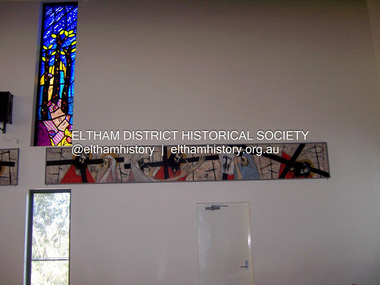
... Before 1864, according to local legend, a visiting priest administered sacraments in the parlour of former convict-turned-respected citizen Thomas Sweeney at Sweeneys Lane, Eltham.1 The first church was blessed in September, 1865, by the Archbishop of Melbourne, Dr Goold. ...Before 1864, according to local legend, a visiting priest administered sacraments in the parlour of former convict-turned-respected citizen Thomas Sweeney at Sweeneys Lane, Eltham.1 The first church was blessed in September, 1865, by the Archbishop of Melbourne, Dr Goold. ...Stations of the Cross by Clifton Pugh is a contempooray art piece in four sections making up 11 stations of the cross. It was commissioned by the Catholic parish in Eltham (Our Lady Help of Christians) in 1961 Published: Nillumbik Now and Then / Marguerite Marshall 2008; photographs Alan King with Marguerite Marshall.; p81 Art is an important means of nurturing faith at Our Lady Help of Christians Church, Henry Street, Eltham. The Stations of the Cross by Clifton Pugh and The Crucifix with the Ascending Jesus by sculptor Charles Rocco are two of the fine works that enhance the parishioners’ worship. These two inspiring works of art were added in 2001 – long after Roman Catholics began worshipping in Eltham around 1864. This beautiful worship centre was built following hardship and change – for parishioners have endured their church being destroyed by fire and have built four churches since they first worshipped together. Before 1864, according to local legend, a visiting priest administered sacraments in the parlour of former convict-turned-respected citizen Thomas Sweeney at Sweeneys Lane, Eltham.1 The first church was blessed in September, 1865, by the Archbishop of Melbourne, Dr Goold. It stood on an acre (0.4ha) of land in Little Eltham as that area was known then, near the present Fordhams and Main Roads and was part of the Heidelberg Church Parish. In 1912 the church was relocated to a new building on the present primary school site at 1 Henry Street. This was closer to the town centre, which had moved from Little Eltham after the railway line was extended to Eltham in 1902.2 In 1958 the church split from the Sacred Heart parish, Diamond Creek, to become a parish in its own right, with Father Tom Curran as inaugural priest. Not long after in 1961, a fire destroyed the church and huge working bees under the prominent Catholic builders, the Sibbel brothers, rebuilt and extended it, using the original altar from the first church. It was then that builder and parishioner Herman Sibbel asked his friend, artist Clifton Pugh, to paint the Stations of the Cross for the church. But the priest, Father Curran, neither approved of Pugh’s bohemian reputation nor liked the paintings, so they were hung in the corridor of Our Lady’s Primary School instead. The parishioners almost sold the paintings in 1989 to pay for major school renovations. However the paintings remained there for about 40 years, until 2001, when the church was extensively renovated by Father Barry Caldwell. Another change awaited the church, as it outgrew its building, later to be used as the school hall. So, in 1976, the present church was built across the road. Three beautiful stained-glass windows depicting the Passion, Death, Resurrection and the presence of Christ’s Spirit, link these with the church’s experiences. The first depicts a bushfire in Eltham, referring to their church damaged by fire. Another represents the Resurrection of Christ with new growth on a blackened stump and the Holy Spirit is represented by the Southern Cross. A window depicting Our Lady Help of Christians by parishioner Bill Peperkamp, was donated by parishioners to commemorate the Silver Jubilee of Father Desmond G Jenkins’ ordination to the priesthood on July 27, 1977. This, with the statue of Mary, creates a Marian shrine. In the 14 Stations of the Cross painted on four masonite panels Pugh captures the pathos of the suffering Christ and his disciples.3 The figures are stylised, except intriguingly, that of Pontias Pilate, who looks like Clifton Pugh. Charles Rocco’s sculpture is an extraordinary Jesus figure being raised from the Cross. The delicate stainless steel mesh of the figure creates a sense of the power of God over death. The organ, built in 1868 by George Fincham and Sons, was first installed in the All Saints’ Anglican Church, East St Kilda, then in the St Andrews Church, Clifton Hill. It was rebuilt into a modern instrument with a donation from parishioner Jim Murray, in memory of his wife Gwendolene Mary.4 Church members created their own work of art in front of the entrance, by painting designs and messages on 700 tiles. This work indicates the strong church family and faith expressed in art, that awaits the worshipper inside.This collection of almost 130 photos about places and people within the Shire of Nillumbik, an urban and rural municipality in Melbourne's north, contributes to an understanding of the history of the Shire. Published in 2008 immediately prior to the Black Saturday bushfires of February 7, 2009, it documents sites that were impacted, and in some cases destroyed by the fires. It includes photographs taken especially for the publication, creating a unique time capsule representing the Shire in the early 21st century. It remains the most recent comprehenesive publication devoted to the Shire's history connecting local residents to the past. nillumbik now and then (marshall-king) collection, art, clifton pugh, stations of the cross, our lady help of christans, installation
