
Showing 23 items matching "body politics"
-
 Wyndham Art Gallery (Wyndham City Council)
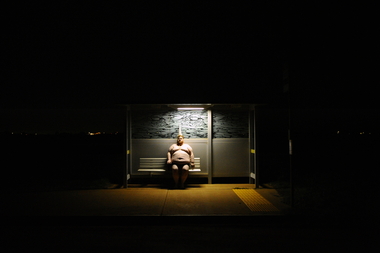
Photograph - Assigned Liminal At Birth, FOOT (Connor Ovenden-Shaw), 2025
... ...Body politics...Gender identity Queer identity Self-representation Liminality Body politics Social norms Photography Assigned Liminal At Birth Photograph Assigned Liminal At Birth FOOT (Connor Ovenden-Shaw) ...It is a strange queer magic to, however briefly, exist within another plane on an ordinary winter night. Much like a moth, I as a queer person am drawn to strange florescent lit transitional spaces, where gender, form and aesthetic is recognisably consistent, beautiful in its embrace of unconventional beauty.The artist known as FOOT is an award winning queer multidisciplinary artist working on unceded Wadawurrung land in Naarm’s outer west passionate about body liberation, sustainability and stupidity, their work is a rich tapestry of historical and cultural referencing that poses alternative questions to the ‘norms’ of this world through the use of colour, nostalgia and space. Winner of the 2026 Wyndham Art Prize LEAP Award.gender identity, queer identity, self-representation, liminality, body politics, social norms, photography -
 Robin Boyd Foundation
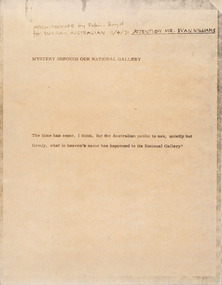
Document - Manuscript, Robin Boyd, Mystery Shrouds Our National Gallery, 1971
... A brief history of the National Gallery of Australia, including the design competition, designs, location, collaboration of the chosen architect (Colin Madigan of Edwards, Madigan and Torzillo) with the gallery director, James Sweeney, approval by relevant statutory bodies, and the political upheaval that stalled progress....A brief history of the National Gallery of Australia, including the design competition, designs, location, collaboration of the chosen architect (Colin Madigan of Edwards, Madigan and Torzillo) with the gallery director, James Sweeney, approval by relevant statutory bodies, and the political upheaval that stalled progress. ...A brief history of the National Gallery of Australia, including the design competition, designs, location, collaboration of the chosen architect (Colin Madigan of Edwards, Madigan and Torzillo) with the gallery director, James Sweeney, approval by relevant statutory bodies, and the political upheaval that stalled progress.Original manuscript of an article published as ‘What’s become of our new gallery?' in "The Sunday Australian", 11.04.1971.Typewritten, (p/copy), quarto, 9 pagesnational gallery of australia, colin madigan, edwards, madigan and torzillo, james sweeney, art gallery design, canberra, robin boyd, manuscript -
 Monbulk RSL Sub Branch
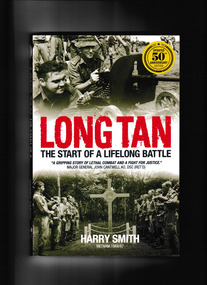
Book, Big Sky Publishing et al, Long Tan : the start of a lifelong battle, 2016
... bodies with captured documents later confirming the count at over 500 enemy killed and 800 wounded. These men were led by a gruff and gusty perfectionist, Major Harry Smith. Now, some 47 years after the battle, Harry tells his story for the first time. But Long Tan is more than just an account of a historic battle. Harry Smith takes his readers on an extraordinary journey - one that ultimately reveals a remarkable cover-up at the highest military and political ...On the afternoon of 18 August 1966, just five kilometres from the main Australian Task Force base at Nui Dat, a group of Viet Cong soldiers walked into the right flank of Delta Company, 6 RAR. Under a blanket of mist and heavy monsoon rain, amid the mud and shattered rubber trees, a dispersed Company of 108 men held its ground with courage and grim determination against a three-sided attack from a force of 2,500 Viet Cong and North Vietnamese Army troops. When the battle subsided, 18 Australian soldiers lay dead and 24 had been wounded. Battlefield clearance revealed 245 enemy bodies with captured documents later confirming the count at over 500 enemy killed and 800 wounded. These men were led by a gruff and gusty perfectionist, Major Harry Smith. Now, some 47 years after the battle, Harry tells his story for the first time. But Long Tan is more than just an account of a historic battle. Harry Smith takes his readers on an extraordinary journey - one that ultimately reveals a remarkable cover-up at the highest military and political echelons. Long Tan is also Harry's life story and portrays his many personal battles, from failed marriages to commando-style killing; from a horrific parachute accident through to his modern-day struggles with bureaucracy for recognition for his soldiers. Harry's battles are tempered by his love of sailing, where he has at last found some peace. Long Tan portrays the wrenching, visceral experience of a man who has fought lifelong battles, in a story that he is only now able to tell. Harry can still hear the gunfire and smell the blood spilt at Long Tan. For him, the fight continues. Collapse summaryIll, maps, p.336.non-fictionOn the afternoon of 18 August 1966, just five kilometres from the main Australian Task Force base at Nui Dat, a group of Viet Cong soldiers walked into the right flank of Delta Company, 6 RAR. Under a blanket of mist and heavy monsoon rain, amid the mud and shattered rubber trees, a dispersed Company of 108 men held its ground with courage and grim determination against a three-sided attack from a force of 2,500 Viet Cong and North Vietnamese Army troops. When the battle subsided, 18 Australian soldiers lay dead and 24 had been wounded. Battlefield clearance revealed 245 enemy bodies with captured documents later confirming the count at over 500 enemy killed and 800 wounded. These men were led by a gruff and gusty perfectionist, Major Harry Smith. Now, some 47 years after the battle, Harry tells his story for the first time. But Long Tan is more than just an account of a historic battle. Harry Smith takes his readers on an extraordinary journey - one that ultimately reveals a remarkable cover-up at the highest military and political echelons. Long Tan is also Harry's life story and portrays his many personal battles, from failed marriages to commando-style killing; from a horrific parachute accident through to his modern-day struggles with bureaucracy for recognition for his soldiers. Harry's battles are tempered by his love of sailing, where he has at last found some peace. Long Tan portrays the wrenching, visceral experience of a man who has fought lifelong battles, in a story that he is only now able to tell. Harry can still hear the gunfire and smell the blood spilt at Long Tan. For him, the fight continues. Collapse summary vietnam conflict - australian involvement, vietnam war 1961-1975 – battles – long tan -
 Monbulk RSL Sub Branch
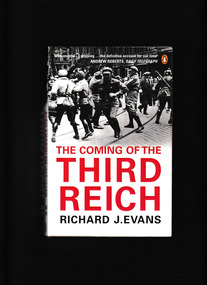
Book, Penguin Books, The coming of the Third Reich, 2004
... political movement he led, a movement that would lead Germany and then all of Europe into utter moral, physical, and cultural ruin?" "There is no story in twentieth-century history more important to understand, and Richard Evans has written the definitive account for our time. A masterful synthesis of a vast body ...n 1900, Germany was one of modernity's great success stories: The most progressive and dynamic nation in Europe, it was the only country whose rapid economic growth and innovation rivaled that of the United States. Its political culture was far less authoritarian than Russia's and less anti-Semitic than France's. Representative institutions thrived, and competing political parties and elections were a central part of life. How, then, could it be that in little more than a generation this stable modern country would fall into the hands of Adolf Hitler and the violent, racist, extremist political movement he led, a movement that would lead Germany and then all of Europe into utter moral, physical, and cultural ruin?" "There is no story in twentieth-century history more important to understand, and Richard Evans has written the definitive account for our time. A masterful synthesis of a vast body of scholarly work integrated with important new research and interpretations, Evans's history restores drama and contingency to the rise to power of Hitler and the Nazis, even as he shows how ready Germany was by the early 1930s for such a takeover to occur. Its citizens were angry and embittered by military defeat and economic ruin, and its young democracy undermined by a civil service, an army, and a law enforcement system deeply alienated from the new order. The electorate was beset by growing extremism and panic about communism; and the small but successful Jewish community was subject to wide-spread suspicion and resentment. In the end, though nothing about what happened was preordained, Germany proved to be fertile ground for Nazism's ideology of hatred.Index, bibliography, ill, maps, p.335.non-fictionn 1900, Germany was one of modernity's great success stories: The most progressive and dynamic nation in Europe, it was the only country whose rapid economic growth and innovation rivaled that of the United States. Its political culture was far less authoritarian than Russia's and less anti-Semitic than France's. Representative institutions thrived, and competing political parties and elections were a central part of life. How, then, could it be that in little more than a generation this stable modern country would fall into the hands of Adolf Hitler and the violent, racist, extremist political movement he led, a movement that would lead Germany and then all of Europe into utter moral, physical, and cultural ruin?" "There is no story in twentieth-century history more important to understand, and Richard Evans has written the definitive account for our time. A masterful synthesis of a vast body of scholarly work integrated with important new research and interpretations, Evans's history restores drama and contingency to the rise to power of Hitler and the Nazis, even as he shows how ready Germany was by the early 1930s for such a takeover to occur. Its citizens were angry and embittered by military defeat and economic ruin, and its young democracy undermined by a civil service, an army, and a law enforcement system deeply alienated from the new order. The electorate was beset by growing extremism and panic about communism; and the small but successful Jewish community was subject to wide-spread suspicion and resentment. In the end, though nothing about what happened was preordained, Germany proved to be fertile ground for Nazism's ideology of hatred.germany - politics and government 1933-1939, germany - nazi party -
 National Vietnam Veterans Museum (NVVM)
Booklet - Propaganda booklet, The Graves of Hue
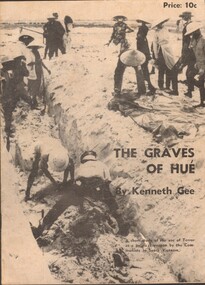
... bodies of civilians and South Vietnamese officials. They were executed by North Vietnamese forces in what is called the Hue Massacre, which lasted for 26 days from 31 January 1968. The graves were located in and around the city, Object collected by WO2 Robert Palmer Matthews (# 34974) of the Royal Australian Army Ordnance Corps. Booklet The Graves of Hue Kenneth Gee Vietnam Atrocities - Vietnam Vietcong Hue Hue Massacre Tet Offensive The Graves of Hue/ By Kenneth Gee/ A short story of the use of terror/ as a political ...Following a month of intense, bloody street fighting during the 1968 Tet Offensive, the city of Hue in Vietnam became the site of mass graves for approximately 2,800 bodies of civilians and South Vietnamese officials. They were executed by North Vietnamese forces in what is called the Hue Massacre, which lasted for 26 days from 31 January 1968. The graves were located in and around the city, Object collected by WO2 Robert Palmer Matthews (# 34974) of the Royal Australian Army Ordnance Corps.Booklet by Kenneth Gee. 10 pages of graphic black and white images of bodies and ugliness of war.The Graves of Hue/ By Kenneth Gee/ A short story of the use of terror/ as a political weapon by the/ communists in South Vietnam.booklet, the graves of hue, kenneth gee, vietnam, atrocities - vietnam, vietcong, hue, hue massacre, tet offensive -
 National Vietnam Veterans Museum (NVVM)
Book, Lancaster, Donald, The Emancipation of French Indochina
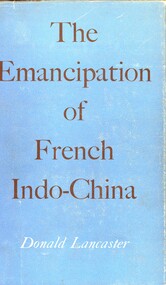
... Indochina - History -1945 Dien Bien Phu Battle of Vietnam 1954 North Vietnam Republic of Vietnam The Royal Institute of International Affairs in an unofficial and non-political body, founded in 1920 to encourage and facilitate the scientific study of international questions. ...The Royal Institute of International Affairs in an unofficial and non-political body, founded in 1920 to encourage and facilitate the scientific study of international questions. The Institute, as such, is precluded by the terms of its Royal Charter from expressing an opinion on any aspect of international affairs. Any opinions expressed in this publication are not, therefore, those of the Institute.The Royal Institute of International Affairs in an unofficial and non-political body, founded in 1920 to encourage and facilitate the scientific study of international questions. The Institute, as such, is precluded by the terms of its Royal Charter from expressing an opinion on any aspect of international affairs. Any opinions expressed in this publication are not, therefore, those of the Institute.indochina - history -1945, dien bien phu, battle of, vietnam, 1954, north vietnam, republic of vietnam -
 Glen Eira Historical Society
Book - CAULFIELD CENTENARY 1957
... Body J.H. Pritchard R.J. Guildford L.T.G. Lund L.M. Street H.C. Reynolds A.W. Elections Political processes Local government Springthorpe Reserve Greenmeadows Gardens Business and finance Roads and streets Caulfield Racecourse East Caulfield Reserve Mackinnon Reserve Hawthorn Road Balaclava Road Murrumbeena Road Lempriere Avenue Victoria Street Koornang Road Lord Reserve Lyons Street Murrumbeena Reserve Kangaroo Road Ormond Park Beatty Crescent Foch Street Packer Reserve Oakleigh Road Leila Road Prices Park Bambra Road Riley Reserve Playgrounds Town Hall Maternal and child health centres Truganini Road Grange Road Senior Citizens centre Barkley Sir Henry Moore David Handasyde Gilbert Caulfield School Room Harris G.W. ...This file contains four items 1/Two copies of a twenty-four page booklet titled CITY OF CAULFIELD CENTENARY 1857-1957, created by the Caulfield City Council and printed by Peter Isaacson Pty Limited, Melbourne. The booklet details important aspects of Caulfield’s history including council procedures, the Caulfield Road District Proclamation, the first election and a summary of 100 years of local government with a description of the present Caulfield in 1957. The booklet also includes several pictures of various Caulfield landmarks and people including one of Caulfield City Councillors (11 men and 1 woman). Also one photocopied version of this booklet. 2/Eleven pages of typed notes for the City of Caulfield Centenary booklet. All notes are undated and incomplete. Two pages titled NOTES on THE HISTORY and PROGRESS OF THE CITY OF CAULFIELD, author unknown. Three and a half pages titled THE STRUCTURE OF LOCAL GOVERNMENT IN VICTORIA, author unknown. Five pages titled 100 YEARS OF LOCAL GOVERNMENT – EARLY CAULFIELD, by Mrs A. P. Bell. 3/A typed letter to Miss V. Webb-Langdon from the Town Clerk H.G. Nelson, acknowledging her contribution to historical details for the Caulfield Council’s Centenary booklet, dated 24/12/1957. 4/A handwritten letter and a handwritten note regarding the acquisition of notes for the Caulfield Centenary booklet. The letter is dated 03/08/2006 and the note is dated 09/02/2007.city of caulfield centenary, caulfield road district, sinclair a.j.g., city hall, war memorials, gamble h.a., machin l.r., bunny f.c.d., caulfield park, koornang reserve, parton e.m., sims h.e., thomson w.r., gunn e.e., yorston j.s., wallace g.e. mrs, green w.c., jenner e.r., ward boundaries, dandenong road, queens avenue, normanby road, station street, bond street, glen eira road, orrong road, poath road, north road, booran road, nepean highway, glen huntly road, glenhuntly road, inkerman road, hotham street, nelson h.g., fullard w.r., mackley g.j., ellis k.i, crosbie m.r., nutting b.i., body j.h., pritchard r.j., guildford l.t.g., lund l.m., street h.c., reynolds a.w., elections , political processes, local government, springthorpe reserve, greenmeadows gardens, business and finance, roads and streets, caulfield racecourse, east caulfield reserve, mackinnon reserve, hawthorn road, balaclava road, murrumbeena road, lempriere avenue, victoria street, koornang road, lord reserve, lyons street, murrumbeena reserve, kangaroo road, ormond park, beatty crescent, foch street, packer reserve, oakleigh road, leila road, prices park, bambra road, riley reserve, playgrounds, town hall, maternal and child health centres, truganini road, grange road, senior citizens centre, barkley sir henry, moore david, handasyde gilbert, caulfield school room, harris g.w., semple john, dempsey william, brooks w.a., wilson thomas, lyall william, murrum murrumbeen lifestyle, ‘greenmeadows’ house, lempriere family, aboriginal culture, ‘rippon lea’ house, caulfield john, ‘slaney’s’ home, alma road, paddy’s swamp, racecourse hotel, caulfield technical college, bevan mr., ‘grosmont’, hart john, railways, mansions, ‘rosecraddock’, langdon h. j., caulfield cup, ‘crotonhurst’, webb judge, ‘kilwinning’, service james, ricketson henry, ‘glen eira’, house names, garden vale, ross william murray, ‘ross’s folly’, outer circle railway, caulfield grammar school, davies j. henry, lagdon william, grimwade f.s., loyd charles du plan, hope george, ‘airdrie’, kooyong hill, market gardens, dairies, lady talbot milk supply, jenner family, o’niell college, presentation sisters, glenferrie road, grimwade frederick sheppard, grimwade alice, ‘harlston’, grimwade house, ‘saint aubin’s’, ‘st. aubin’s’, ‘caulfield hall’, caulfield john p.t., st georges road, caulfield military hospital, nursing homes, health establishments, dover street, sports and recreations, rosanna street, ‘cantala’, health services, parks and reserves, community services, town planning, local government finance, local officials and employees -
 Bendigo Historical Society Inc.
Financial record - INVOICE COLLECTION: J. H. Curnow & Son
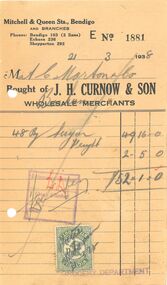
... body was being subjected to a great deal of criticism. He was an executive member of The Municipal Association of Victoria and president in 1919. Curnow was very interested in politics...body was being subjected to a great deal of criticism. He was an executive member of The Municipal Association of Victoria and president in 1919. Curnow was very interested in politics ...See below for an article by Jim Evans of the Bendigo Historical Society: From the Bendigo Miner Number 9 - 1 March 2007 Cock-eyed Curnow - James Henry Curnow Cornishman and famous Bendigonian By Jim Evans Five-time Mayor of Bendigo, James Henry Curnow of Eumana , was for fifty years associated with almost every progressive movement in the life of the city. He was born in Ludgvan, Cornwall, in 1861, the son of Sampson Curnow, tin-miner and later mine-manager. His parents brought him to Bendigo when he was two years old and settled at Long Gully. He was educated at the state school and St Andrew s College. In 1883, he married Jane Corbel in the Congregational Church. Curnow joined the Post-Master-General s Department in 1881. Taking leave in 1887, he acted as secretary of the Australian Natives Association (ANA) exhibition at Geelong. He became a clerk with Connelly and Tatchell's, Bendigo solicitors, leaving in 1894 to establish an accountancy and real estate business. Considered shrewd and hard-working, Curnow prospered; he later added an auctioneering section and formed the company J.H. Curnow & Son (now Curnow & Dyett). The ANA provided the grounding for Curnow s public life. He joined the Sandhurst branch in 1881 and was secretary in 1883-1891. He helped form new branches in northern Victoria. With (Sir) John Quick, he set up the first Federation League in the colony in 1893. Curnow was secretary of the League in that year and again in 1898-99. He was elected to the Bendigo City Council in 1901 and, apart from 1906-09 remained a very energetic councillor. He was Mayor in 1902-03, 1903-04, 1912-13, 1919-20 and 1927-28. It was during his second term as Mayor in 1904, that he had William Beebe design a home - Eumana in Flora Hill. (Local historian Betty Jackman informs me that Curnow s house at 75 Wills Street where he lived before moving to Flora Hill, was also called Eumana ). He took a leading role in the installation of sewerage and was later Chairman of the city s Sewerage authority when that body was being subjected to a great deal of criticism. He was an executive member of The Municipal Association of Victoria and president in 1919. Curnow was very interested in politics, but his four attempts to enter parliament failed. He was Justice of the Peace for the states of New South Wales and Victoria, deputy coroner for the city of Bendigo, a guardian of minors and registrar of marriages. Curnow was managing director of the Bendigo Pottery, director of the Bendigo Gas Co. and the Bendigo and Eaglehawk Star Building Society and chairman of directors of the Bendigo Boot and Shoe factory. He was a life member of both the Bendigo Base Hospital and the Benevolent Asylum (Anne Caudle Centre). Curnow s family affairs were marred by tragedy. His father was killed in a mining accident in 1881; his first wife and three of their five children died in the measles epidemic of 1893. His second wife Mary Jordan died in 1909 after spilling carbolic acid on her hip, leaving three young children. He married Amy McLean in 1911and they had one daughter. When the Prince Edward visited Bendigo in 1920, Curnow made a speech, telling his audience: I will now merely ask you to drink his health as the Prince of Wales and also as the Duke of Cornwall. In this district there are a tremendous number of Cornishmen and I need not tell His Royal Highness that it was the Cousin Jacks who made Bendigo, who found the gold and developed the mines. They have added more to the riches of the Commonwealth than any other class of people. When he visits the mines today, he will find that ninety per cent of the miners are Cornishmen and descendants of Cornishmen. His remarks were greeted by loud applause. J.H. Curnow was known locally as Cock-eyed because of an eye defect. He died on Anzac Day 1932 at his then home, The Knoll in Wattle Street. He was 71. He was cremated at the new Fawkner Cemetery and his ashes were buried in the Bendigo Cemetery. His grave is close to that of another famous Cornishman and Bendigonian, Sir John Quick, who died in the same year. The Curnow memorial drinking fountain in Rosalind Park was unveiled in 1938 by Mayor Taylor. The distinguished Bendigo born sculptress Ola Cohn designed the memorial and made the bust and other plaques of terracotta. The plaques were damaged in the 1950s and a restoration program was undertaken, with bronze plaques replacing the original terracotta ones.10934.33a: A small, aged sheet of yellow paper with two clean punch holes on the left side and a perforated edge. The paper is thin, but sturdy. Printed in black ink is the business name and details: Bought of J.H. Curnow & Son Wholesale Merchants. The address: Mitchell & Queen Sts. Bendigo and branches. Phones: Bendigo 103. The receipt is handwritten in grey lead pencil. Dated 21 March 1938. Below the header is neat, ruled lines for listing items with prices listed in British Pounds, totaling 52 pounds 1 shillings. Receipt number 1881. There is also a Victorian 3 pence stamp duty stamp printed in green ink. 10934.33b: A small, aged sheet of yellow paper with two clean punch holes on the left side and a perforated edge. The paper is thin, but sturdy. Printed in black ink is the business name and details: Bought of J.H. Curnow & Son Wholesale Merchants. The address: Mitchell & Queen Sts. Bendigo and branches. Phones: Bendigo 103. The receipt is handwritten in grey lead pencil. Dated 25 May 1938. Below the header is neat, ruled lines for listing items. Receipt number 14291. The Receipt is crossed out in blye pencil. The top left corner is folded and slightly torn. 10934.33c: A small, aged sheet of yellow paper with two clean punch holes on the left side and a perforated edge. The paper is thin, but sturdy. Printed in black ink is the business name and details: Bought of J.H. Curnow & Son Wholesale Merchants. The address: Mitchell & Queen Sts. Bendigo and branches. Phones: Bendigo 103. The receipt is handwritten in grey lead pencil. Dated 27 June 1938. Below the header is neat, ruled lines for listing items with prices listed in British Pounds, totaling 2 pounds. Receipt number 1466. The receipt is crossed out in blue pencil and indicates and credit. 10934.33d: A small, aged sheet of yellow paper with two clean punch holes on the left side and a perforated edge. The paper is thin, but sturdy. Printed in black ink is the business name and details: Bought of J.H. Curnow & Son Wholesale Merchants. The address: Mitchell & Queen Sts. Bendigo and branches. Phones: Bendigo 103. The receipt is handwritten in grey lead pencil. Dated 7 March 1938. Below the header is neat, ruled lines for listing items with prices listed in British Pounds, totaling 34 pounds 14 shillings. Receipt number 1627. There is also a Victorian 3 pence stamp duty stamp printed in green ink.ac morton, jh curnow & son -
 Ballarat and District Irish Association
Image, Isaac Butt, c1864, 1864
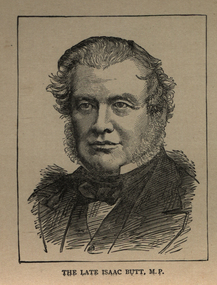
... In November 1873 Butt replaced the Association with a new body, the Home Rule League, which he regarded as a pressure-group, rather than a political party. ...In November 1873 Butt replaced the Association with a new body, the Home Rule League, which he regarded as a pressure-group, rather than a political party. ...An Irish barrister, politician, Member of Parliament (M.P.), and the founder and first leader of a number of Irish nationalist parties and organisations, including the Irish Metropolitan Conservative Society in 1836, the Home Government Association in 1870 and in 1873 the Home Rule League. (Wikipedia) After being called to the bar in 1838, Butt quickly established a name for himself as a brilliant barrister. He was known for his opposition to the Irish nationalist leader Daniel O'Connell's campaign for the repeal of the Act of Union.[4] He also lectured at Trinity College, Dublin, in political economy. His experiences during the Great Famine led him to move from being an Irish unionist and an Orangeman[5] to supporting a federal political system for the United Kingdom of Great Britain and Ireland that would give Ireland a greater degree of self-rule. This led to his involvement in Irish nationalist politics and the foundation of the Home Rule League. Butt was instrumental in fostering links between Constitutional and Revolutionary nationalism through his representation of members of the Fenians Society in court. (Wikipedia) He began his career as a Tory politician on Dublin Corporation. He was Member of Parliament for Youghal from 1852 to 1865, and for Limerick from 1871 to 1879 (at the 1852 general election he had also been elected for the English constituency of Harwich, but chose to sit for Youghal). The failed Fenian Rising in 1867 strengthened Butt's belief that a federal system was the only way to break the dreary cycle of inefficient administration punctuated by incompetent uprisings.[6] In 1870 he founded the Irish Home Government Association. This was in no sense a revolutionary organisation. It was designed to mobilise public opinion behind the demand for an Irish parliament, with, as he put it, "full control over our domestic affairs."[6] He believed that Home Rule would promote friendship between Ireland and her neighbour to the east. In November 1873 Butt replaced the Association with a new body, the Home Rule League, which he regarded as a pressure-group, rather than a political party. In the General Election the following year, 59 of its members were elected. However, most of those elected were men of property who were closer to the Liberal cause.[7] In the meantime Charles Stewart Parnell had joined the League, with more radical ideas than most of the incumbent Home Rulers, and was elected to Parliament in a by-election in County Meath in 1875.[8] Butt had failed to win substantial concessions at Westminster on the things that mattered to most Irish people: an amnesty for the Fenians of '67, fixity of tenure for tenant-farmers and Home Rule. Although they worked to get Home Rulers elected, many Fenians along with tenant farmers were dissatisfied with Butt's gentlemanly approach to have bills enacted, although they did not openly attack him, as his defence of the Fenian prisoners in '67 still stood in his favour.[9] However, soon a Belfast Home Ruler, Joseph Gillis Biggar (then a senior member of the IRB), began making extensive use of the ungentlemanly tactic of "obstructionism" to prevent bills being passed by the house. When Parnell entered Parliament he took his cue from John O'Connor Power and Joseph Biggar and allied himself with those Irish members who would support him in his obstructionist campaign. MPs at that time could stand up and talk for as long as they wished on any subject. This caused havoc in Parliament. In one case they talked for 45 hours non-stop, stopping any important bills from being passed. Butt, ageing, and in failing health, could not keep up with this tactic and considered it counter-productive. In July 1877 Butt threatened to resign from the party if obstruction continued, and a gulf developed between himself and Parnell, who was growing steadily in the estimation of both the Fenians and the Home Rulers.[10] The climax came in December 1878, when Parliament was recalled to discuss the war in Afghanistan. Butt considered this discussion too important to the British Empire to be interrupted by obstructionism and publicly warned the Irish members to refrain from this tactic. He was fiercely denounced by the young Nationalist John Dillon, who continued his attacks with considerable support from other Home Rulers at a meeting of the Home Rule League in February 1879. Although he defended himself with dignity, Butt, and all and sundry, knew that his role in the party was at an end.[11] Butt, who had been suffering from bronchitis, had a stroke the following May and died within a week. He was replaced by William Shaw, who in turn was replaced by Charles Stewart Parnell in 1880. (Wikipedia)Image of a man known as Isaac Butt. -
 Victorian Aboriginal Corporation for Languages
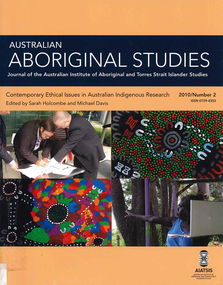
Periodical, Australian Institute of Aboriginal and Torres Strait Islander Studies, Australian Aboriginal studies : journal of the Australian Institute of Aboriginal and Torres Strait Islander Studies, 2010
... Bodies. Ethics or social justice? Heritage and the politics of recognition Laurajane Smith (ANU) Nancy Fraser?...Bodies. Ethics or social justice? Heritage and the politics of recognition Laurajane Smith (ANU) Nancy Fraser? ...'Whose Ethics?':Codifying and enacting ethics in research settings Bringing ethics up to date? A review of the AIATSIS ethical guidelines Michael Davis (Independent Academic) A revision of the AIATSIS Guidelines for Ethical Research in Indigenous Studies was carried out during 2009-10. The purpose of the revision was to bring the Guidelines up to date in light of a range of critical developments that have occurred in Indigenous rights, research and knowledge management since the previous version of the Guidelines was released in 2000. In this paper I present an outline of these developments, and briefly discuss the review process. I argue that the review, and the developments that it responded to, have highlighted that ethical research needs to be thought about more as a type of behaviour and practice between engaged participants, and less as an institutionalised, document-focused and prescriptive approach. The arrogance of ethnography: Managing anthropological research knowledge Sarah Holcombe (ANU) The ethnographic method is a core feature of anthropological practice. This locally intensive research enables insight into local praxis and culturally relative practices that would otherwise not be possible. Indeed, empathetic engagement is only possible in this close and intimate encounter. However, this paper argues that this method can also provide the practitioner with a false sense of his or her own knowing and expertise and, indeed, with arrogance. And the boundaries between the anthropologist as knowledge sink - cultural translator and interpreter - and the knowledge of the local knowledge owners can become opaque. Globalisation and the knowledge ?commons?, exemplified by Google, also highlight the increasing complexities in this area of the governance and ownership of knowledge. Our stronghold of working in remote areas and/or with marginalised groups places us at the forefront of negotiating the multiple new technological knowledge spaces that are opening up in the form of Indigenous websites and knowledge centres in these areas. Anthropology is not immune from the increasing awareness of the limitations and risks of the intellectual property regime for protecting or managing Indigenous knowledge. The relevance of the Declaration on the Rights of Indigenous Peoples in opening up a ?rights-based? discourse, especially in the area of knowledge ownership, brings these issues to the fore. For anthropology to remain relevant, we have to engage locally with these global discourses. This paper begins to traverse some of this ground. Protocols: Devices for translating moralities, controlling knowledge and defining actors in Indigenous research, and critical ethical reflection Margaret Raven (Institute for Sustainability and Technology Policy (ISTP), Murdoch University) Protocols are devices that act to assist with ethical research behaviour in Indigenous research contexts. Protocols also attempt to play a mediating role in the power and control inherent in research. While the development of bureaucratically derived protocols is on the increase, critiques and review of protocols have been undertaken in an ad hoc manner and in the absence of an overarching ethical framework or standard. Additionally, actors implicated in research networks are seldom theorised. This paper sketches out a typology of research characters and the different moral positioning that each of them plays in the research game. It argues that by understanding the ways actors enact research protocols we are better able to understand what protocols are, and how they seek to build ethical research practices. Ethics and research: Dilemmas raised in managing research collections of Aboriginal and Torres Strait Islander materials Grace Koch (AIATSIS) This paper examines some of the ethical dilemmas for the proper management of research collections of Indigenous cultural materials, concentrating upon the use of such material for Native Title purposes. It refers directly to a number of points in the draft of the revised AIATSIS Guidelines for Ethical Research in Indigenous Studies and draws upon both actual and hypothetical examples of issues that may arise when requests are made for Indigenous material. Specific concerns about ethical practices in collecting data and the subsequent control of access to both the data itself and to published works based upon it are raised within the context of several types of collections, including those held by AIATSIS and by Native Title Representative Bodies. Ethics or social justice? Heritage and the politics of recognition Laurajane Smith (ANU) Nancy Fraser?s model of the politics of recognition is used to examine how ethical practices are interconnected with wider struggles for recognition and social justice. This paper focuses on the concept of 'heritage' and the way it is often uncritically linked to 'identity' to illustrate how expert knowledge can become implicated in struggles for recognition. The consequences of this for ethical practice and for rethinking the role of expertise, professional discourses and disciplinary identity are discussed. The ethics of teaching from country Michael Christie (CDU), with the assistance of Yi?iya Guyula, Kathy Gotha and Dh�?gal Gurruwiwi The 'Teaching from Country' program provided the opportunity and the funding for Yol?u (north-east Arnhem Land Aboriginal) knowledge authorities to participate actively in the academic teaching of their languages and cultures from their remote homeland centres using new digital technologies. As two knowledge systems and their practices came to work together, so too did two divergent epistemologies and metaphysics, and challenges to our understandings of our ethical behaviour. This paper uses an examination of the philosophical and pedagogical work of the Yol?u Elders and their students to reflect upon ethical teaching and research in postcolonial knowledge practices. Closing the gaps in and through Indigenous health research: Guidelines, processes and practices Pat Dudgeon (UWA), Kerrie Kelly (Australian Indigenous Psychologists Association) and Roz Walker (UWA) Research in Aboriginal contexts remains a vexed issue given the ongoing inequities and injustices in Indigenous health. It is widely accepted that good research providing a sound evidence base is critical to closing the gap in Aboriginal health and wellbeing outcomes. However, key contemporary research issues still remain regarding how that research is prioritised, carried out, disseminated and translated so that Aboriginal people are the main beneficiaries of the research in every sense. It is widely acknowledged that, historically, research on Indigenous groups by non-Indigenous researchers has benefited the careers and reputations of researchers, often with little benefit and considerably more harm for Indigenous peoples in Australia and internationally. This paper argues that genuine collaborative and equal partnerships in Indigenous health research are critical to enable Aboriginal and Torres Islander people to determine the solutions to close the gap on many contemporary health issues. It suggests that greater recognition of research methodologies, such as community participatory action research, is necessary to ensure that Aboriginal people have control of, or significant input into, determining the Indigenous health research agenda at all levels. This can occur at a national level, such as through the National Health and Medical Research Council (NHMRC) Road Map on Indigenous research priorities (RAWG 2002), and at a local level through the development of structural mechanisms and processes, including research ethics committees? research protocols to hold researchers accountable to the NHMRC ethical guidelines and values which recognise Indigenous culture in all aspects of research. Researching on Ngarrindjeri Ruwe/Ruwar: Methodologies for positive transformation Steve Hemming (Flinders University) , Daryle Rigney (Flinders University) and Shaun Berg (Berg Lawyers) Ngarrindjeri engagement with cultural and natural resource management over the past decade provides a useful case study for examining the relationship between research, colonialism and improved Indigenous wellbeing. The Ngarrindjeri nation is located in south-eastern Australia, a ?white? space framed by Aboriginalist myths of cultural extinction recycled through burgeoning heritage, Native Title, natural resource management ?industries?. Research is a central element of this network of intrusive interests and colonising practices. Government management regimes such as natural resource management draw upon the research and business sectors to form complex alliances to access funds to support their research, monitoring, policy development, management and on-ground works programs. We argue that understanding the political and ethical location of research in this contemporary management landscape is crucial to any assessment of the potential positive contribution of research to 'Bridging the Gap' or improving Indigenous wellbeing. Recognition that research conducted on Ngarrindjeri Ruwe/Ruwar (country/body/spirit) has impacts on Ngarrindjeri and that Ngarrindjeri have a right and responsibility to care for their lands and waters are important platforms for any just or ethical research. Ngarrindjeri have linked these rights and responsibilities to long-term community development focused on Ngarrindjeri capacity building and shifts in Ngarrindjeri power in programs designed to research and manage Ngarrindjeri Ruwe/Ruwar. Research agreements that protect Ngarrindjeri interests, including cultural knowledge and intellectual property, are crucial elements in these shifts in power. A preliminary review of ethics resources, with particular focus on those available online from Indigenous organisations in WA, NT and Qld Sarah Holcombe (ANU) and Natalia Gould (La Trobe University) In light of a growing interest in Indigenous knowledge, this preliminary review maps the forms and contents of some existing resources and processes currently available and under development in the Northern Territory, Queensland and Western Australia, along with those enacted through several cross-jurisdictional initiatives. A significant majority of ethics resources have been developed in response to a growing interest in the application of Indigenous knowledge in land and natural resource management. The aim of these resources is to ?manage? (i.e. protect and maintain) Indigenous knowledge by ensuring ethical engagement with the knowledge holders. Case studies are drawn on from each jurisdiction to illustrate both the diversity and commonality in the approach to managing this intercultural engagement. Such resources include protocols, guidelines, memorandums of understanding, research agreements and strategic plans. In conducting this review we encourage greater awareness of the range of approaches in practice and under development today, while emphasising that systematic, localised processes for establishing these mechanisms is of fundamental importance to ensuring equitable collaboration. Likewise, making available a range of ethics tools and resources also enables the sharing of the local and regional initiatives in this very dynamic area of Indigenous knowledge rights.b&w photographs, colour photographsngarrindjeri, ethics, ethnography, indigenous research, social justice, indigenous health -
 Victorian Aboriginal Corporation for Languages
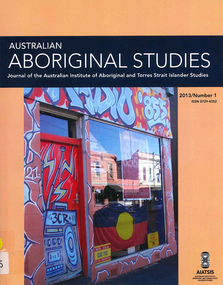
Periodical, Australian Institute of Aboriginal and Torres Strait Islander Studies, Australian Aboriginal studies : journal of the Australian Institute of Aboriginal and Torres Strait Islander Studies, 2013
... bodies were interred according to traditional rites. However, as these practices were increasingly at odds with some of the features of contemporary social, economic and political life, two men who had lost close family members initiated church funeral services and established a cemetery. ...bodies were interred according to traditional rites. However, as these practices were increasingly at odds with some of the features of contemporary social, economic and political life, two men who had lost close family members initiated church funeral services and established a cemetery. ...We don?t leave our identities at the city limits: Aboriginal and Torres Strait Islander people living in urban localities Bronwyn Fredericks Aboriginal and Torres Strait Islander people who live in cities and towns are often thought of as ?less Indigenous? than those who live ?in the bush?, as though they are ?fake? Aboriginal people ? while ?real? Aboriginal people live ?on communities? and ?real? Torres Strait Islander people live ?on islands?. Yet more than 70 percent of Australia?s Indigenous peoples live in urban locations (ABS 2007), and urban living is just as much part of a reality for Aboriginal and Torres Strait Islander people as living in remote discrete communities. This paper examines the contradictions and struggles that Aboriginal and Torres Strait Islander people experience when living in urban environments. It looks at the symbols of place and space on display in the Australian cities of Melbourne and Brisbane to demonstrate how prevailing social, political and economic values are displayed. Symbols of place and space are never neutral, and this paper argues that they can either marginalise and oppress urban Aboriginal and Torres Strait Islander people, or demonstrate that they are included and engaged. Juggling with pronouns: Racist discourse in spoken interaction on the radio Di Roy While the discourse of deficit with regard to Australian Indigenous health and wellbeing has been well documented in print media and through images on film and on television, radio talk concerning this discourse remains underresearched. This paper interrogates the power of an interactive news interview, aired on the Radio National Breakfast program on ABC Radio in 2011, to maintain and reproduce the discourse of deficit, despite the best intentions of the interview participants. Using a conversation-analytical approach, and membership categorisation analysis in particular, this paper interrogates the spoken interaction between a well-known radio interviewer and a respected medical researcher into Indigenous eye health. It demonstrates the recreation of a discourse emanating from longstanding hegemonies between mainstream and Indigenous Australians. Analysis of firstperson pronoun use shows the ongoing negotiation of social category boundaries and construction of moral identities through ascriptions to category members, upon which the intelligibility of the interview for the listening audience depended. The findings from analysis support claims in a considerable body of whiteness studies literature, the main themes of which include the pervasiveness of a racist discourse in Australian media and society, the power of invisible assumptions, and the importance of naming and exposing them. Changes in Pitjantjatjara mourning and burial practices Bill Edwards, University of South Australia This paper is based on observations over a period of more than five decades of changes in Pitjantjatjara burial practices from traditional practices to the introduction of Christian services and cemeteries. Missions have been criticised for enforcing such changes. However, in this instance, the changes were implemented by the Aboriginal people themselves. Following brief outlines of Pitjantjatjara traditional life, including burial practices, and of the establishment of Ernabella Mission in 1937 and its policy of respect for Pitjantjatjara cultural practices and language, the history of these changes which commenced in 1973 are recorded. Previously, deceased bodies were interred according to traditional rites. However, as these practices were increasingly at odds with some of the features of contemporary social, economic and political life, two men who had lost close family members initiated church funeral services and established a cemetery. These practices soon spread to most Pitjantjatjara communities in a manner which illustrates the model of change outlined by Everett Rogers (1962) in Diffusion of Innovations. Reference is made to four more recent funerals to show how these events have been elaborated and have become major social occasions. The world from Malarrak: Depictions of South-east Asian and European subjects in rock art from the Wellington Range, Australia Sally K May, Paul SC Ta�on, Alistair Paterson, Meg Travers This paper investigates contact histories in northern Australia through an analysis of recent rock paintings. Around Australia Aboriginal artists have produced a unique record of their experiences of contact since the earliest encounters with South-east Asian and, later, European visitors and settlers. This rock art archive provides irreplaceable contemporary accounts of Aboriginal attitudes towards, and engagement with, foreigners on their shores. Since 2008 our team has been working to document contact period rock art in north-western and western Arnhem Land. This paper focuses on findings from a site complex known as Malarrak. It includes the most thorough analysis of contact rock art yet undertaken in this area and questions previous interpretations of subject matter and the relationship of particular paintings to historic events. Contact period rock art from Malarrak presents us with an illustrated history of international relationships in this isolated part of the world. It not only reflects the material changes brought about by outside cultural groups but also highlights the active role Aboriginal communities took in responding to these circumstances. Addressing the Arrernte: FJ Gillen?s 1896 Engwura speech Jason Gibson, Australian National University This paper analyses a speech delivered by Francis James Gillen during the opening stages of what is now regarded as one of the most significant ethnographic recording events in Australian history. Gillen?s ?speech? at the 1896 Engwura festival provides a unique insight into the complex personal relationships that early anthropologists had with Aboriginal people. This recently unearthed text, recorded by Walter Baldwin Spencer in his field notebook, demonstrates how Gillen and Spencer sought to establish the parameters of their anthropological enquiry in ways that involved both Arrernte agency and kinship while at the same time invoking the hierarchies of colonial anthropology in Australia. By examining the content of the speech, as it was written down by Spencer, we are also able to reassesses the importance of Gillen to the ethnographic ambitions of the Spencer/Gillen collaboration. The incorporation of fundamental Arrernte concepts and the use of Arrernte words to convey the purpose of their 1896 fieldwork suggest a degree of Arrernte involvement and consent not revealed before. The paper concludes with a discussion of the outcomes of the Engwura festival and the subsequent publication of The Native Tribes of Central Australia within the context of a broader set of relationships that helped to define the emergent field of Australian anthropology at the close of the nineteenth century. One size doesn?t fit all: Experiences of family members of Indigenous gamblers Louise Holdsworth, Helen Breen, Nerilee Hing and Ashley Gordon Centre for Gambling Education and Research, Southern Cross University This study explores help-seeking and help-provision by family members of Indigenous people experiencing gambling problems, a topic that previously has been ignored. Data are analysed from face-to-face interviews with 11 family members of Indigenous Australians who gamble regularly. The results confirm that substantial barriers are faced by Indigenous Australians in accessing formal help services and programs, whether for themselves or a loved one. Informal help from family and friends appears more common. In this study, this informal help includes emotional care, practical support and various forms of ?tough love?. However, these measures are mostly in vain. Participants emphasise that ?one size doesn?t fit all? when it comes to avenues of gambling help for Indigenous peoples. Efforts are needed to identify how Indigenous families and extended families can best provide social and practical support to assist their loved ones to acknowledge and address gambling problems. Western Australia?s Aboriginal heritage regime: Critiques of culture, ethnography, procedure and political economy Nicholas Herriman, La Trobe University Western Australia?s Aboriginal Heritage Act 1972 (WA) and the de facto arrangements that have arisen from it constitute a large part of the Aboriginal ?heritage regime? in that state. Although designed ostensibly to protect Aboriginal heritage, the heritage regime has been subjected to various scholarly critiques. Indeed, there is a widespread perception of a need to reform the Act. But on what basis could this proceed? Here I offer an analysis of these critiques, grouped according to their focus on political economy, procedure, ethnography and culture. I outline problems surrounding the first three criticisms and then discuss two versions of the cultural critique. I argue that an extreme version of this criticism is weak and inconsistent with the other three critiques. I conclude that there is room for optimism by pointing to ways in which the heritage regime could provide more beneficial outcomes for Aboriginal people. Read With Me Everyday: Community engagement and English literacy outcomes at Erambie Mission (research report) Lawrence Bamblett Since 2009 Lawrie Bamblett has been working with his community at Erambie Mission on a literacy project called Read With Me. The programs - three have been carried out over the past four years - encourage parents to actively engage with their children?s learning through reading workshops, social media, and the writing and publication of their own stories. Lawrie attributes much of the project?s extraordinary success to the intrinsic character of the Erambie community, not least of which is their communal approach to living and sense of shared responsibility. The forgotten Yuendumu Men?s Museum murals: Shedding new light on the progenitors of the Western Desert Art Movement (research report) Bethune Carmichael and Apolline Kohen In the history of the Western Desert Art Movement, the Papunya School murals are widely acclaimed as the movement?s progenitors. However, in another community, Yuendumu, some 150 kilometres from Papunya, a seminal museum project took place prior to the completion of the Papunya School murals and the production of the first Papunya boards. The Warlpiri men at Yuendumu undertook a ground-breaking project between 1969 and 1971 to build a men?s museum that would not only house ceremonial and traditional artefacts but would also be adorned with murals depicting the Dreamings of each of the Warlpiri groups that had recently settled at Yuendumu. While the murals at Papunya are lost, those at Yuendumu have, against all odds, survived. Having been all but forgotten, this unprecedented cultural and artistic endeavour is only now being fully appreciated. Through the story of the genesis and construction of the Yuendumu Men?s Museum and its extensive murals, this paper demonstrates that the Yuendumu murals significantly contributed to the early development of the Western Desert Art Movement. It is time to acknowledge the role of Warlpiri artists in the history of the movement.b&w photographs, colour photographsracism, media, radio, pitjantjatjara, malarrak, wellington range, rock art, arrernte, fj gillen, engwura, indigenous gambling, ethnography, literacy, erambie mission, yuendumu mens museum, western desert art movement -
 Uniting Church Archives - Synod of Victoria
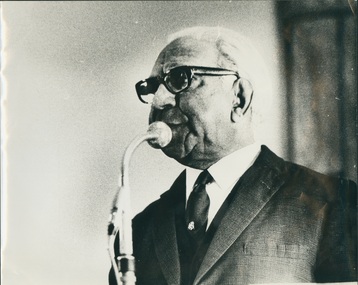
B&W photo of another photo or newspaper photograph of Pastor Sir Douglas Nicholls, Undated
... body to do so. He argued for new premises at 58 Cunningham Street, Northcote, opened in 1966 as the ‘Doug Nicholls Centre’. In 1958 Nicholls was a foundation member of the Federal Council for Aboriginal Advancement (Federal Council for the Advancement of Aboriginal and Torres Strait Islanders after 1964), which he served as national field officer (1961) and Victorian secretary (1962-63). While an innovator in tactics, he was alarmed by the influence of confrontational ‘black power’ politics...body to do so. He argued for new premises at 58 Cunningham Street, Northcote, opened in 1966 as the ‘Doug Nicholls Centre’. In 1958 Nicholls was a foundation member of the Federal Council for Aboriginal Advancement (Federal Council for the Advancement of Aboriginal and Torres Strait Islanders after 1964), which he served as national field officer (1961) and Victorian secretary (1962-63). While an innovator in tactics, he was alarmed by the influence of confrontational ‘black power’ politics ...Sir Douglas Ralph Nicholls (1906-1988), footballer, pastor, activist and governor, was born on 9 December 1906 at Cummeragunja Aboriginal mission, New South Wales, fifth child of Herbert Nicholls, seasonal worker, and his wife Florence, née Atkinson. Doug grew up at Cummeragunja, on the Murray River near Barmah, in its golden years of Aboriginal autonomy. Thomas Shadrach James gave him and other Yorta Yorta children a sound primary education, reinforcing the pride and self-assurance gained from their parents. As Doug grew, so too did the powers of the State’s Aboriginal Protection Board. Doug’s elder sister Hilda was removed about 1915. When Doug reached 14, he was moved off under the Aborigines Protection Act (1909) to find work. He took a job with dredging teams constructing levees on the Murray. Like other youths in the region Nicholls played Australian rules football, emulating kinsmen who had won local premierships since the 1890s. Doug and his brother Herbert (‘Dowie’) played with Tongala in the mid-1920s. Melbourne football beckoned, Doug trying out unsuccessfully for Carlton in 1927. He signed with the Northcote Victorian Football Association team, despite his nervousness about his Aboriginality, and was given a job with Northcote City Council. ‘Dowie’ joined him for a season. Doug was short at 5 ft 2 ins (158 cm), but muscular and lightning fast. He competed regularly during a boom in professional running, winning many heat and place prizes. In 1929 he won the Nyah and Warracknabeal gifts, earning a sash and £100 in each, together with a case of cutlery in the latter. Using his speed on the wing for Northcote, he produced great spring and agility from his compact body. The Sporting Globe reported in 1929 that ‘he flashes through packs of big men, whisks around small men . . . and attempts marks at the back of any six-footer’. In front-on clashes he was flattened only to rise again. The sole Aborigine in the VFA, he was known affectionately as the ‘flying Abo’ but called worse by his opponents’ barrackers. He competed for five seasons, being named ‘best and fairest’ twice, appearing in three association grand finals and winning in 1929. Keen to earn more than a seasonal wage, in 1931 Nicholls accepted a three-year contract with Jimmy Sharman’s travelling boxing show. The bouts matched opposites, local against tent boxer, white against black, and sometimes men of different sizes. He faced stiff competition from those who wanted to best the noted Melbourne black footballer, the crowd adding racial abuse. A far better footballer than boxer, he copped some punishment. Fighting in the Melbourne Stadium in December 1931, he was described by Truth as ‘slow and awkward’, but packing a ‘good wallop’. In 1932 Sharman, who treated his boxers fairly, released Nicholls to join the Fitzroy Victorian Football League team, which agreed to employ him as its groundsman. He played fifty-four games for Fitzroy over six seasons until knee trouble forced him out in 1937. Winning cups in 1934 and 1935, he played alongside Haydn Bunton and Wilfred (‘Chicken’) Smallhorn. Grand finals eluded him but he represented Victoria twice. Following his mother’s death, Nicholls revisited the Church of Christ chapel in Northcote, where they had worshipped together. On 17 July 1932 he experienced a conversion. He was soon baptised and witnessed openly, leading his fellow footballers to occasional church parades. Nicholls exhibited leadership qualities. William Cooper, founder of the Australian Aborigines’ League and Nicholls’ Yorta Yorta kinsman and fellow Christian, encouraged the young footballer. In February 1935 Cooper, Nicholls and others lobbied Thomas Paterson, the Commonwealth minister for the interior, over the need for Federal control of Aboriginal affairs. Nicholls attended the Day of Mourning protest for Aborigines held in Sydney on 26 January 1938, declaring: ‘after 150 years our people are still influenced and bossed by white people. I know we can proudly hold our own with others if given the chance’. When Cooper retired in November 1940 Nicholls became secretary of the AAL. On 2 June 1941 Nicholls enlisted in the Citizen Military Forces. He trained at Seymour and Bonegilla before being posted to the 29th Battalion. As Major Frank Corr’s batman, he was popular with other soldiers who tolerated his preaching and Bible reading. His army service was brief, however, and he was discharged in Melbourne on compassionate grounds on 22 January 1942. His biographer claimed that the Fitzroy police requested his return to mediate in the racial tensions developing between servicemen and the mostly respectable Aboriginal families living in crowded and dilapidated Fitzroy housing; Aboriginal people maintain that they requested his release. Nicholls began welfare work and religious services from an Aboriginal home in Gertrude Street, Fitzroy. In April 1942, ‘Dowie’ died of road accident trauma, leaving his wife, Gladys, née Bux, and three children. On 26 December 1942 at Moama Methodist Church, New South Wales, Nicholls married her, a caring gesture which developed into a loving partnership. In January 1943 he initiated ‘Aboriginal Sunday’, featuring a gum leaf orchestra and choir. By 1955 this service had moved to July and later evolved into National Aborigines and Islanders Day Observance Committee (NAIDOC) week. Ordained a Churches of Christ pastor in 1945, Nicholls conducted a vigorous ministry from a chapel in Gore Street, Fitzroy. His work survived on donations, a small honorarium, and his employment as team coach (1947) and curator at the Northcote Football Ground. In the 1950s Gladys established grocery and opportunity shops to earn income and provide services. Their house soon overflowed with people in need or visitors to Melbourne. Nicholls also hosted inspiring African American visitors such as the pianist Winifred Attwell and the singer Harry Belafonte. His ministry extended to Aboriginal country communities. Gladys taught Sunday school, undertook endless fund-raising and welfare work beside her husband, and became his greatest supporter and financial manager. They formed an Aboriginal Girls’ Hostel in 1956, for which they acted as house parents, and bought holiday units for Aborigines at Queenscliff. Persistently advocating Aboriginal rights, Nicholls protested about the impact of the Woomera rocket range on the people of the Warburton Ranges, co-ordinated the production of a concert, Out of the Dark, scripted by Jean Campbell, to rectify the omission of Aborigines from Victoria’s Commonwealth jubilee celebrations, and criticised the Victorian Aboriginal Protection Board. In 1957 when the board was transformed into the Aborigines’ Welfare Board, he and Harold Blair were appointed as Aboriginal representatives. Maintaining the stance of a political moderate, he did not bear grudges and sought to build bridges between black and white. He co-operated with any group that aided the cause, including the Council of Aboriginal Rights, whose executive were members of the Communist Party of Australia. This association attracted the attention of the Australian Security Intelligence Organization, which in 1957 began to keep a file on Nicholls. In May 1957 Nicholls formed the Victorian Aborigines Advancement League with Doris Blackburn and Gordon Bryant, a Federal parliamentarian. As its paid field officer and spokesman, Nicholls contested assimilation policies and used film to raise awareness of issues. When the Welfare Board attempted to close Lake Tyers reserve, Gippsland, he resigned in disgust and led a protest march on parliament in May 1963. The AAL also petitioned the United Nations on land rights in June, perhaps the first indigenous body to do so. He argued for new premises at 58 Cunningham Street, Northcote, opened in 1966 as the ‘Doug Nicholls Centre’. In 1958 Nicholls was a foundation member of the Federal Council for Aboriginal Advancement (Federal Council for the Advancement of Aboriginal and Torres Strait Islanders after 1964), which he served as national field officer (1961) and Victorian secretary (1962-63). While an innovator in tactics, he was alarmed by the influence of confrontational ‘black power’ politics in the AAL and resigned as a director amid turmoil on this issue in 1969, claiming the concept was a ‘bitter word’, not needed in Australia. Similar tensions in FCAATSI led him to join with Kath Walker (Oodgeroo Noonuccal) in establishing the short-lived National Tribal Council as an alternative forum. As the AAL leadership moderated their stance, he returned as president (1969-74) of the new all-Aboriginal organisation. He was also a keen patron of the National Aboriginal Sports Foundation, founded in 1969. Many honours were conferred on Nicholls: he was appointed MBE (1957) and OBE (1968) and knighted (1972). In 1962 he was named Victorian ‘Father of the Year’ and the State’s second Aboriginal justice of the peace. Crowned Melbourne’s 1973 King of Moomba, he was declared Bapu Mamus (a Torres Strait term for ‘headman’) by the NTC. On 1 December 1976 Sir Douglas was appointed Governor of South Australia, but his health deteriorated within weeks, making it difficult for him to perform his official duties. In March 1977 he hosted Queen Elizabeth during her royal tour and was appointed KCVO. He relinquished his governorship on 30 April 1977 following a stroke. Ill health continued to dog him during retirement, but he played his Nelson Eddy records, enjoyed his expanding family, and when able, ministered to the Aboriginal Church at the League’s premises. Sir Douglas Nicholls died on 4 June 1988 at Mooroopna, predeceased (1981) by his wife and survived by his five children. He was given a state funeral and buried in tribal ground at Cummeragunja cemetery. Among the many tributes to him are an oval at Northcote, handed to the AAL in 1982, a Canberra suburb gazetted in 1991, and a fellowship for Indigenous leadership established in 2003, all in his name, and a statue of Sir Doug and Lady Nicholls by Louis Laumen, unveiled in 2007 in Parliament Gardens, Melbourne. Sir Douglas Nicholls is shown speaking at a microphone; head and shoulders; dressed in a suit.Pastor Douglas Nicholls -
 Ballarat Tramway Museum
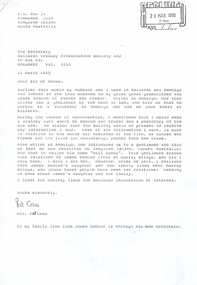
Document - Photocopy, "Duncan and Fraser", Mar. 1995
... Gives personal details and his political involvement. Trams tramways Duncan Fraser Coach Building Tramcar Bodies Adelaide Photocopy - 6 A4 pages of a letter to the BTPS dated 29-3-1995 concerning the history of James Duncan of Duncan and Fraser of Adelaide. ...Letter detailing the personal history of one of Australia's largest coach and tramcar builders - James Duncan. Information provided by a family member. Gives personal details and his political involvement.Photocopy - 6 A4 pages of a letter to the BTPS dated 29-3-1995 concerning the history of James Duncan of Duncan and Fraser of Adelaide. From Mrs. Pat Cass of Kangaroo Island, SA. Has a covering letter re Duncan and Fraser and mentions Len Millar in Bendigo and Ballarat. Gives information about James Duncan history in coach building, including some notes on tram building, the Ford agency and other work, his membership of Adelaide organisations and date of birth and death. Rear sheet has two oval photographs of Duncan and Fraser from a book. (is the original of this letter with the Secretary files?) - should be swapped around. Images of document added 27-08-12.trams, tramways, duncan fraser, coach building, tramcar bodies, adelaide -
Koorie Heritage Trust
Book, Barlow, Alex et al, Bosses ourselves : the story of Aboriginal self-government, 2001
... Politics and government -- Juvenile literature. Aboriginal self-government in the past and at present is related. A well presented book suitable for upper primary/early secondary students. In this book, the story of Aboriginal self-government, then and now, is told. Read about the traditional importance to Aboriginal people of their senior men and women and how the arrival of European settlers disrupted forever the way Aboriginal people organised their society and governed themselves. Learn about the struggle of Aboriginal people for the right to self-determination and about the role of bodies ...Aboriginal self-government in the past and at present is related. A well presented book suitable for upper primary/early secondary students. In this book, the story of Aboriginal self-government, then and now, is told. Read about the traditional importance to Aboriginal people of their senior men and women and how the arrival of European settlers disrupted forever the way Aboriginal people organised their society and governed themselves. Learn about the struggle of Aboriginal people for the right to self-determination and about the role of bodies such as ATSIC. -- Back cover.32 p. : col. ill., maps, ports. ; 28 cm.Aboriginal self-government in the past and at present is related. A well presented book suitable for upper primary/early secondary students. In this book, the story of Aboriginal self-government, then and now, is told. Read about the traditional importance to Aboriginal people of their senior men and women and how the arrival of European settlers disrupted forever the way Aboriginal people organised their society and governed themselves. Learn about the struggle of Aboriginal people for the right to self-determination and about the role of bodies such as ATSIC. -- Back cover.aboriginal australians -- history -- juvenile literature. | aboriginal australians -- politics and government -- juvenile literature. -
 Melbourne Tram Museum
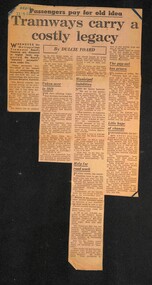
Newspaper, Dulcie Foard, "Tramways carry a costly legacy", 12/9/1950
... politics at the time of formation of by the MMTB in 1919. Gives the history of the MMTB formation, why these payments and other support that the MMTB provides and that there was little prospect of a change. Demonstrates an article about the MMTB statutory payments to other government bodies ...Newspaper clipping titled "Tramways carry a costly legacy" with a sub-heading of "Passengers pay for an old idea" written by Dulcie Ford about the annual statutory payment by the MMTB to the Fire Brigade, the Infectious Diseases Hospital as a result of the politics at the time of formation of by the MMTB in 1919. Gives the history of the MMTB formation, why these payments and other support that the MMTB provides and that there was little prospect of a change.Demonstrates an article about the MMTB statutory payments to other government bodies, which they long opposed.Newspaper item from The Arguds 12-9-1950, cut to the text size with blue marks in the corners.tramways, trams, mmtb, payments, statutory payments, mfbb, infectious diseases -
 Mrs Aeneas Gunn Memorial Library
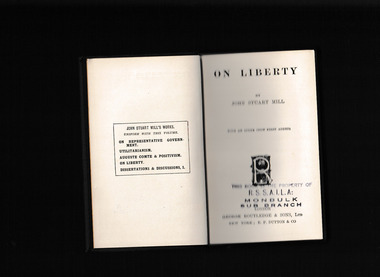
Book, John Stuart Mill, On liberty
... Political philosophy Individualism At the time it was published in 1859, John Stuart Mill's On Liberty was a radical and controversial work; it argued for the right of individuals to possess freedom from the state in moral and economic matters. Mill declares that ""Over himself, over his own body ...At the time it was published in 1859, John Stuart Mill's On Liberty was a radical and controversial work; it argued for the right of individuals to possess freedom from the state in moral and economic matters. Mill declares that ""Over himself, over his own body and mind, the individual is sovereign"", contrasting this with the ""tyranny of the majority."" He states that an individual can do anything they like as long as it doesn't harm another.Index, p.172.non-fictionAt the time it was published in 1859, John Stuart Mill's On Liberty was a radical and controversial work; it argued for the right of individuals to possess freedom from the state in moral and economic matters. Mill declares that ""Over himself, over his own body and mind, the individual is sovereign"", contrasting this with the ""tyranny of the majority."" He states that an individual can do anything they like as long as it doesn't harm another. political philosophy, individualism -
 Flagstaff Hill Maritime Museum and Village
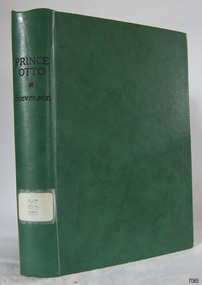
Book - A Fictional Story, Robert Louis Stevenson, Prince Otto, 1895
... body of work, rather than a major classic. When it was first published in 1885, reception was mixed: Andrew Lang, in the Pall Mall Gazette, praised it lavishly, while the Saturday Review dismissed it as 'an impossible prince ruling over an impossible territory at an indeterminate time'. The scholarly consensus today calls it 'a more complex but less successful work' than Treasure Island. The Encyclopaedia Britannica goes on to comment that the work has, however, drawn serious critical attention as a transitional, self-reflexive tale of politics ...Prince Otto is a romance set in the fictional Ruritania-style German statelet of Grünewald. Prince Otto slips away from his escort near the border while out hunting and wanders into the neighbouring country of Gerolstein. Otto is regarded by his own people as an incompetent fool, incapable of ruling. He hears rumours that his wife, Princess Amalia Seraphina, is having an affair with the ambitious minister Baron Gondremark, with whom she effectively runs the country, and the plot spirals through a plotted coup, an order to arrest Otto, and a growing political crisis. Unlike Stevenson's boys'-adventure books, this one is a romance in which the marriage of the hero and heroine is not the happy ending but the central problem that the plot must resolve. The theme explores the moral compromises required by marriage. Stevenson considered this work unusually difficult to write, working on it over a five-month period; he called it 'my hardest effort'. One chapter was rewritten eight times by Stevenson, and once by his wife.Hard cover book. Prince Otto Author: Robert Louis Stevenson Publisher: Chatto and Windus Date: 1895 Further Information: Green cloth, gilt-blocked spine with lettering and patterning to spine in black. The spine has a Library label with an inscription.fictionPrince Otto is a romance set in the fictional Ruritania-style German statelet of Grünewald. Prince Otto slips away from his escort near the border while out hunting and wanders into the neighbouring country of Gerolstein. Otto is regarded by his own people as an incompetent fool, incapable of ruling. He hears rumours that his wife, Princess Amalia Seraphina, is having an affair with the ambitious minister Baron Gondremark, with whom she effectively runs the country, and the plot spirals through a plotted coup, an order to arrest Otto, and a growing political crisis. Unlike Stevenson's boys'-adventure books, this one is a romance in which the marriage of the hero and heroine is not the happy ending but the central problem that the plot must resolve. The theme explores the moral compromises required by marriage. Stevenson considered this work unusually difficult to write, working on it over a five-month period; he called it 'my hardest effort'. One chapter was rewritten eight times by Stevenson, and once by his wife.warrnambool, shipwrecked-coast, flagstaff-hill, flagstaff-hill-maritime-museum, maritime-museum, shipwreck-coast, flagstaff-hill-maritime-village, shipwrecked-artefact, book, prince otto, robert louis stevenson -
 Merri-bek City Council
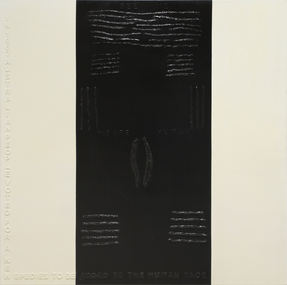
Painting - Liquid nails and spray enamel on canvas, Brian McKinnon, Scars, 2008
... political work that reflects on some of the ways in which Aboriginal people have historically been discriminated against and marginalised because of the colour of their skin and cultural practices. Originally exhibited with two other paintings, it was also made in honour of the artist’s children and their struggle to maintain positive self-esteem. Uncle Brian McKinnon said his children inherited keloids from their ancestors: ‘These keloids look like body...political work that reflects on some of the ways in which Aboriginal people have historically been discriminated against and marginalised because of the colour of their skin and cultural practices. Originally exhibited with two other paintings, it was also made in honour of the artist’s children and their struggle to maintain positive self-esteem. Uncle Brian McKinnon said his children inherited keloids from their ancestors: ‘These keloids look like body ...Uncle Brian McKinnon (b. 1957 – d. 2023) was a Geelong-based artist and descendent of the Amangu and Wongai people of Western Australia. He created powerful mixed media works that explore his campaign for Aboriginal rights and his childhood experiences growing up in Western Australia. Scars is a deeply personal and political work that reflects on some of the ways in which Aboriginal people have historically been discriminated against and marginalised because of the colour of their skin and cultural practices. Originally exhibited with two other paintings, it was also made in honour of the artist’s children and their struggle to maintain positive self-esteem. Uncle Brian McKinnon said his children inherited keloids from their ancestors: ‘These keloids look like body scars. In this work, I have placed them in the past and the presence of their ancestors through the act of beautifying the marks, which reflect the landscape and the identity of the person wearing the beautification marks. Although the marks on my children are not so beautiful and they are ostracised because of them, this made me think of racist policies and of course the referendum and when my people were seen for the first time as being human.’ -
 Merri-bek City Council
Archival pigment print, Hoda Afshar, Behrouz Boochani – Manus Island No.2, 2018
... Hoda Afshar's 2018 body of work, "Remain," offers a forthright and unapologetic political commentary on Australia's border protection policy, shedding light on its impact on human rights. ...Hoda Afshar's 2018 body of work, "Remain," offers a forthright and unapologetic political commentary on Australia's border protection policy, shedding light on its impact on human rights. ...Hoda Afshar's 2018 body of work, "Remain," offers a forthright and unapologetic political commentary on Australia's border protection policy, shedding light on its impact on human rights. This collection comprises a film and a series of photographic portraits that chronicle the stories of stateless men who chose to stay on Manus Island, Papua New Guinea, even after the closure of the immigration detention centre in October 2017. In the accompanying film, the experiences of these men are conveyed through episodic fragments, narrated with a mix of lyrical and brutal voiceovers. Some express themselves through poetry, others through song, while some recall the riots and suicides. Set against the backdrop of a picturesque landscape featuring lush foliage and crystal-clear water—a stark contrast to the harsh realities described—the emotional impact of the work is intensified. It creates a simultaneous sense of beauty and horror. The photographic portraits of the same individuals are equally compelling. Positioned prominently against a dark backdrop, these subjects assert their presence, emphasizing their right to be seen. The deliberate simplicity of these portraits serves as a powerful political statement, countering the invisibility imposed by the act of detention. Afshar metaphorically acknowledges the struggles faced by these men, depicting them contending with the elements—fire, water, and earth—yet never questioning their inherent humanity. Here we see Behrouz Boochani, the Kurdish Iranian writer whose memoir ‘No Friend but the Mountains: Writing from the Manus Prison’ won the Victorian Premier’s Prize for Literature and the Prize for Non-Fiction in 2019. Boochani was held in detention on Manus Island from 2013 until the centre’s closure in 2017 and was forced to remain on the island in a stateless condition. -
 Linton Mechanics Institute and Free Library Collection
Book - Novel, Lacy, Ed, Go for the body, 1959
... politics of boxing which he found to be equally as crooked and vicious in Paris as it had been in New York. Stamp 'Carfrae Library Preston' ; stamp '9d Hiring Fee' 192p. ; orange cover with original dust jacket cut and pasted onto front cover, featuring three men with shrouded body Go for the body Book Novel Lacy, Ed T. ...Ken Francine had stayed in the boxing world even after he had given up his career in the ring. He had come to Paris as the agent of a syndicate and he was to line up promising European fighters ... or so he thought, for he soon found out in his first meeting with his contact man in Paris that he was really intended to be a courier ... for heroin! Ken had been involved in many shady deals but he drew the line at this latest proposition and found himself in Paris with only a few dollars in his pocket and no way of getting back to the States. Luck was on his side however as, while wandering around the Left Bank, he met Bud Stewart, the Negro boxer who had put paid to Ken's championship prospects. From this chance meeting Ken turned to managing Stewart and soon found himself back in the chips, but back also in the underworld politics of boxing which he found to be equally as crooked and vicious in Paris as it had been in New York.192p. ; orange cover with original dust jacket cut and pasted onto front cover, featuring three men with shrouded bodyfictionKen Francine had stayed in the boxing world even after he had given up his career in the ring. He had come to Paris as the agent of a syndicate and he was to line up promising European fighters ... or so he thought, for he soon found out in his first meeting with his contact man in Paris that he was really intended to be a courier ... for heroin! Ken had been involved in many shady deals but he drew the line at this latest proposition and found himself in Paris with only a few dollars in his pocket and no way of getting back to the States. Luck was on his side however as, while wandering around the Left Bank, he met Bud Stewart, the Negro boxer who had put paid to Ken's championship prospects. From this chance meeting Ken turned to managing Stewart and soon found himself back in the chips, but back also in the underworld politics of boxing which he found to be equally as crooked and vicious in Paris as it had been in New York.fiction, mystery, crime, ed lacy -
 Flagstaff Hill Maritime Museum and Village
Book - Collection of Fictional Stories, Anatole France, Crainquebille Putois Riquet, 1915
... Within his body of work, it's a hinge text showing a major turning of his craft toward committed social criticism under the direct pressure of a real political crisis. ...The story "Crainquebille" is the title piece and the book's best-known story; it follows an elderly Parisian street peddler wrongly accused of insulting a policeman. The court examination is characterised by the accused's silence in the face of an intimidating judicial system, with the president answering his own questions. It's a sharp satire of French justice and how the poor are treated by the legal system arguably France's most famous piece of social criticism. "Putois" is a lighter, whimsical fable. It's about a family that invents a fictional handyman as a convenient excuse, and the lie takes on a life of its own, spreading through the town until it seems poised to become real a wry meditation on how rumours and convenient lies can calcify into truth. "Riquet" concerns the philosophical dog belonging to the character Monsieur Bergeret, who appears to be a recurring figure in France's fiction, presented here along with "The Meditations of Riquet" as connected pieces. The volume also gathers several shorter tales: "The Necktie," "The Montil Manœuvres," "Émile," "Adrienne Buquet," "The Intaglio," "La Signora Chiara," "Upright Judges," "The Ocean Christ," and the "Jean Marteau" sequence, among others.Hard cover book. Crainquebille Putois Riquet Author: Anatole France Editor: Frederic Chapman Publisher: The Bodley Head/John Lane Translation : Winifred Stephens Date: 1915 Further Information: Red Cloth hardcover with lettering and patterning to spine in gilt. The spine has a Library label with an inscription. fictionThe story "Crainquebille" is the title piece and the book's best-known story; it follows an elderly Parisian street peddler wrongly accused of insulting a policeman. The court examination is characterised by the accused's silence in the face of an intimidating judicial system, with the president answering his own questions. It's a sharp satire of French justice and how the poor are treated by the legal system arguably France's most famous piece of social criticism. "Putois" is a lighter, whimsical fable. It's about a family that invents a fictional handyman as a convenient excuse, and the lie takes on a life of its own, spreading through the town until it seems poised to become real a wry meditation on how rumours and convenient lies can calcify into truth. "Riquet" concerns the philosophical dog belonging to the character Monsieur Bergeret, who appears to be a recurring figure in France's fiction, presented here along with "The Meditations of Riquet" as connected pieces. The volume also gathers several shorter tales: "The Necktie," "The Montil Manœuvres," "Émile," "Adrienne Buquet," "The Intaglio," "La Signora Chiara," "Upright Judges," "The Ocean Christ," and the "Jean Marteau" sequence, among others.warrnambool, shipwrecked-coast, flagstaff-hill, flagstaff-hill-maritime-museum, maritime-museum, shipwreck-coast, flagstaff-hill-maritime-village, shipwrecked-artefact, book, crainquebille putois riquet, anatole france -
 Women's Art Register
Book - Anthology, Sneja Gunew & Anna Yeatman, Feminism and the Politics of Difference, 1993
... Complements other material held in The Women's Art Register addressing these themes. post-colonialism body postmodernism poststructuralism theory racism globaLIZATION Collection of essays written by feminist theorists from several disciplines in Australia, New Zealand, Canada and the US, challenging 'western ' feminism, examining identity politics and intersectionality. ...Collection of essays written by feminist theorists from several disciplines in Australia, New Zealand, Canada and the US, challenging 'western ' feminism, examining identity politics and intersectionality.Booknon-fictionCollection of essays written by feminist theorists from several disciplines in Australia, New Zealand, Canada and the US, challenging 'western ' feminism, examining identity politics and intersectionality.post-colonialism, body, postmodernism, poststructuralism, theory, racism, globalization -
 Women's Art Register
Book - Anthology, Nina Felshin, But is it Art? The Spirit of Art as Activism, 1995
... political activism which emerged in the mid-1970s,. Includes work by The Guerrilla Girls, The Women's Action Coalition and Gran Fury. Complements material held in The Women's Art Register. public art collective interdisciplinary body racism durational art social practice museology feminism collaboration A collection of essays by art critics, historians and journalists exploring 12 individual and group practices of activist art making. ...A collection of essays by art critics, historians and journalists exploring 12 individual and group practices of activist art making. An overview of the dynamic exhibitions, events, happenings and cultural practices engaged in creating social change.BookA collection of essays by art critics, historians and journalists exploring 12 individual and group practices of activist art making. An overview of the dynamic exhibitions, events, happenings and cultural practices engaged in creating social change.public art, collective, interdisciplinary, body, racism, durational art, social practice, museology, feminism, collaboration
