
Showing 24 items matching "boot and shoe building"
-
 NMIT (Northern Melbourne Institute of TAFE)
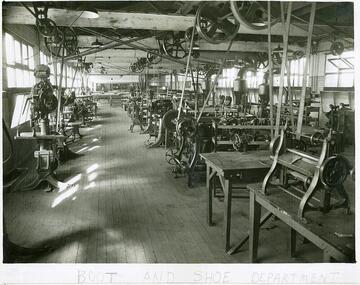
Photographs: CTS 1943-1946 Boot and Shoe - Footwear Building, Photographs: : CTS 1943-1946 Boot and Shoe - Footwear Building
... Photographs: CTS 1943-1946 Boot and Shoe - Footwear Building ...Photographs: : CTS 1943-1946 Boot and Shoe - Footwear Building ......Boot and Shoe Building...A number of black and white photographs recording the history of Collingwood Technical School's Boot and Shoe building. This building was burnt down in 1943. ...Collingwood Technical School Buildings Boot and Shoe Building Footwear Building Fires NMIT A number of black and white photographs recording the history of Collingwood Technical School's Boot and Shoe building. ...A number of black and white photographs recording the history of Collingwood Technical School's Boot and Shoe building. This building was burnt down in 1943. Machinery valued at £14,000 was lost. Total damage was estimated at £25,000. It was the only bootmaking school in Melbourne. (Scott p.48). It was replaced by the Footwear Trades building which was constructed between 1945 and 1947. The foundation stone for the new building was laid on 21st February 1945 by the Hon. T. T. Hollway, MLA, Minister of Education. The photographs include: The original Boot and Shoe classroom [1929]-1943; The Burnt out building 1943; Six photographs of the Laying of the Foundation Stone event on 21st February 1945 by the Hon. T. T. Hollway, MLA, Minister of Education (note the band on the roof in most of these six photos); Two photographs of the progressive construction of the new building. See Scott's history p.49.collingwood technical school, buildings, boot and shoe building, footwear building, fires, nmit -
 Flagstaff Hill Maritime Museum and Village
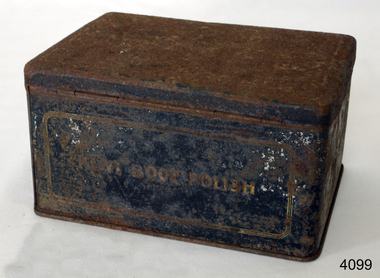
Container - Tin, Kiwi Shoe Polish Manufacture, 1940s
... building on Bath Road. A significant product as Kiwi is an Australian brand name of shoe polish, first launched and sold in Australia in 1906 and as of 2005 sold in almost 180 countries. ...The polish was developed in Australia by William Ramsay who named it Kiwi after the flightless bird endemic to New Zealand, the home country of his wife, Annie Elizabeth Meek Ramsay. Its success in Australia expanded overseas when it was adopted by both the British and American armies in World War I. In the UK, Kiwi was for many years manufactured at its British headquarters in Ealing (Brumwell Road, London W5 1DT). From here the factory manufactured for the UK market and exported the Kiwi brand too much of Europe and the Middle East. In the mid-1970s, as part of a major streamlining, the UK factory was closed with production switched to France. The UK operation moved to Surrey at Yately becoming, effectively, a sales and marketing office, with distribution contracted to a third party. In 1980, production for the UK market moved back to the UK and was housed in a factory near Huddersfield. The UK head office was relocated to Maidstone, Kent, where Kiwi had other product interests. Following the global merger with Nicholas Laboratories, the UK head office was again relocated to Slough at the Nicholas building on Bath Road.A significant product as Kiwi is an Australian brand name of shoe polish, first launched and sold in Australia in 1906 and as of 2005 sold in almost 180 countries. Previously owned by the Sara Lee Corporation since 1984, it was sold in 2011 to S. C. Johnson. It is the dominant shoe polish in some countries, including the United Kingdom and the United States, where it has about two thirds of the market. In Malaysia and Singapore, Kiwi has become such a household brand for a shoe polish that the word "kiwi" has been genericized into a verb in the Malay language, meaning "to polish one's shoes".Metal cleaning outfit of Kiwi boot polish brush, scraper, & polish missingKiwi Boot Polish to front of containerflagstaff hill, warrnambool, shipwrecked-coast, flagstaff-hill, flagstaff-hill-maritime-museum, maritime-museum, shipwreck-coast, flagstaff-hill-maritime-village -
 City of Moorabbin Historical Society (Operating the Box Cottage Museum)
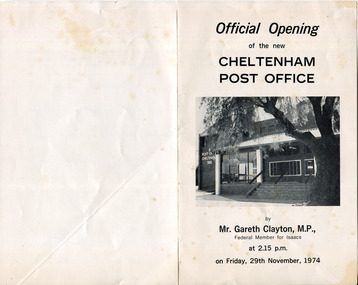
Document - Program Official Opening Cheltenham Post Office, Government Printer, 1974
... John Hitchen was the manager of the first Cheltenham Post Office that opened 1/8/1857 in a boot and shoe store. Mail was transported to and from St Kilda to Cheltenham by coach 6 days a week and an additional service twice weekly to Tootgarook via Frankston also by coach. 1868 Post office Savings Bank began operation and the Telegraph office was established at the Railway Station 1885. ...John Hitchen was the manager of the first Cheltenham Post Office that opened 1/8/1857 in a boot and shoe store. Mail was transported to and from St Kilda to Cheltenham by coach 6 days a week and an additional service twice weekly to Tootgarook via Frankston also by coach. 1868 Post office Savings Bank began operation and the Telegraph office was established at the Railway Station 1885. ...John Hitchen was the manager of the first Cheltenham Post Office that opened 1/8/1857 in a boot and shoe store. Mail was transported to and from St Kilda to Cheltenham by coach 6 days a week and an additional service twice weekly to Tootgarook via Frankston also by coach. 1868 Post office Savings Bank began operation and the Telegraph office was established at the Railway Station 1885. A new building was built 1891 in Point Nepean Road for the official Cheltenham Post Office and a new manual telephone exchange began 1899 with 24 subscribers. By 1909 100 subscribers, 1951 there were 1700 and in 1974 12,000 subscribers . Hence this new building was designed by Oscar A. T. Gimsey & Assoc. and built by T W Morris & Sons Mordialloc. Mr G Clayton Federal MP Isaacs, opened the Post Office with Moorabbin City Council Mayor C.R McHutchison, Mr WJB Pollock, Director Posts and Telegraphs, and hands the Key of the post Office to Mr L De Longville Postmaster.The Post Office was an integral part to the development and prosperity of the Cheltenham area as the area grew from pioneer settlers in the 1850's to flourishing market gardens c1900 and industrial diversity of 1974.Program for the 'Official Opening of the Cheltenham Post Office' November 29th 1974 with a black and white photo of the building.city of moorabbin, county of bourke, moorabbin roads board, parish of moorabbin, shire of moorabbin, henry dendy's special survey 1841, were j.b., bent thomas, o'shannassy john, king richard, charman s, highett william, ormond francis, maynard dennis, post office, telegraph, st kilda station, tootgarook, frankston, clayton g mhr, mchutchison r.p mayor, pollock w j b mp, market gardens, early settlers, horse coach, de longville l postmaster -
 NMIT (Northern Melbourne Institute of TAFE)
Folder: Bound folder of newspaper cuttings 1960-1979, and Invitations to ceremonies and exhibitions 1935 to 1979
... Invitation card to the laying of foundation stone of the Boot and Shoe Trade School of Collingwood Technical School on 21st February 1945. ...Invitation card to the laying of foundation stone of the Boot and Shoe Trade School of Collingwood Technical School on 21st February 1945. ...Large bound folder consisting of various items pasted into it. Includes: Invitation to the Exhibition of Prahran Technical School students work on 11 November 1930. Invitation card to the laying of foundation stone of the Boot and Shoe Trade School of Collingwood Technical School on 21st February 1945. Invitation card to the Collingwood Technical School Annual exhibition of students’ hobbies on 23rd May, 1935. Newspaper cuttings dating from 14 January 1960 to 26 July 1978 related to technical education and plans for Otter Street Collingwood building . Flyer for the Collingwood Technical School Golden Jubilee of on 20 July 1962. Program for Collingwood Technical College Annual Award Night 9 December 1970. Collingwood Technical School 1971 handbook. Program for Collingwood Technical College Apprentice Award Night 22 July 1971. Invitation card and program for Official Opening of Alex & Doris Cowmeadow Wings of Camp Westlake 14 November 1971 Collingwood Technical College. Invitation and program for Collingwood Technical College Annual Award night 8 December 1971 collingwood technical school, collingwood technical college, camp westlake, newspaper clippings, nmit -
NMIT (Northern Melbourne Institute of TAFE)
Folder: Of documents, forms and articles used for researching the history of CTS
... Folder of articles, documents and forms on the history of CTS including: Educational reform from the end of the 19th century; Appointment of M Richmond; Classes started; Enrolments – Student Numbers; Finance Support; First Council meeting; Buildings; Sports; Notes of speech at Laying of foundation stone of boot and shoe trade school on 21st February 1945 by the Hon. ...Collingwood Technical School History Paul Scofield NMIT Folder of articles, documents and forms on the history of CTS including: Educational reform from the end of the 19th century; Appointment of M Richmond; Classes started; Enrolments – Student Numbers; Finance Support; First Council meeting; Buildings; Sports; Notes of speech at Laying of foundation stone of boot and shoe trade school on 21st February 1945 by the Hon. ...Folder of articles, documents and forms on the history of CTS including: Educational reform from the end of the 19th century; Appointment of M Richmond; Classes started; Enrolments – Student Numbers; Finance Support; First Council meeting; Buildings; Sports; Notes of speech at Laying of foundation stone of boot and shoe trade school on 21st February 1945 by the Hon. T. T. Hollway, MLA, Minister of Education; Extra-curricular activities; Discipline; Certificates and Exams; Ethnic intake era 1950s, 60s, 70s; TAFE student statistics; Split with TAFE 1980s;collingwood technical school, history, paul scofield, nmit -
 NMIT (Northern Melbourne Institute of TAFE)
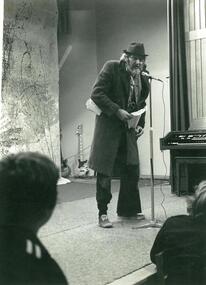
Photograph: CTC 1970s Teacher Ray Collier entertains students
... ...Boot and Shoe Building...Collingwood Technical College Buildings Boot and Shoe Building Staff Performing Arts NMIT Large black and white photograph of Collingwood Technical College teacher Ray Collier entertaining secondary school students, possibly drama class. ...Large black and white photograph of Collingwood Technical College teacher Ray Collier entertaining secondary school students, possibly drama class. Scott p.68collingwood technical college, buildings, boot and shoe building, staff, performing arts, nmit -
 Bendigo Historical Society Inc.
Newspaper - JENNY FOLEY COLLECTION: SNIPPETS OF BENDIGO
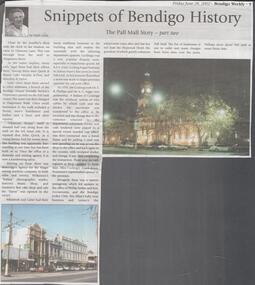
... Other small business in the walk included a florist, men's hairdresser and a boot and shoes repairer. Moving on there was Betteridge's Agency for the Singer sewing machine company, Wilkinson's photographic studio, Sutton's music shop and Favaloro's cake shop and café the ''Savoy'' was opened in the 1920's. ...Other small business in the walk included a florist, men's hairdresser and a boot and shoes repairer. Moving on there was Betteridge's Agency for the Singer sewing machine company, Wilkinson's photographic studio, Sutton's music shop and Favaloro's cake shop and café the ''Savoy'' was opened in the 1920's. ...BHS CollectionBendigo Weekly from Friday, June 28, 2002 - Snippets of Bendigo history, the Pall Mall story, part two - by Edith Lunn. Close to the jeweller's shop, we came to Chancery Lane. Many early legal firms had their offices there. Among them were: Quick&Rymer, Luke Murphy&Don and Macoboy&Taylor. A branch of the Bendigo united Friendly Society's Dispensary opened on the corner. Other small business in the walk included a florist, men's hairdresser and a boot and shoes repairer. Moving on there was Betteridge's Agency for the Singer sewing machine company, Wilkinson's photographic studio, Sutton's music shop and Favaloro's cake shop and café the ''Savoy'' was opened in the 1920's. Whitelock and Carter had their men outfitters business in the building, Cocking's was a very popular drapery store. After Cocking's closed down, Stoneman's supermarket opened in the premises. Alongside there was a passageway that led upstairs to the office of Phillip Secher and Son, Accountants and the Bendigo jockey club. Mrs Allan's baby wear business and Lenten's the tobacconist came after and last but not least the Shamrock Hotel enhances Pall Mall. The clip is in a folder.newspaper, bendigo, bendigo weekly -
 Bendigo Historical Society Inc.
Photograph - BLACK AND WHITE PHOTOGRAPH OF THE 'NEW TIMES' BUILDING OCCUPIED BY ABBOTTS BOOTS AN SHOES
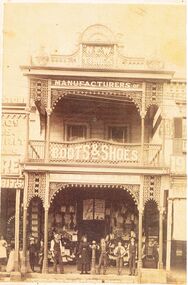
... BUILDINGS Commercial abbotts boot & shoe manufacturers Black and white photograph of the 'New Times' building in Pall Mall, next to myer. ...Black and white photograph of the 'New Times' building in Pall Mall, next to myer. The top has a rather ornate masonry design. The lower edge of the guttering of the top verandah and the lower edge of the guttering at floor level of the top floor is a very ornate lacework display.Centre bottom is hitching post for horses. Signage on the building reads Manufacturers of Boots and Shoes, Abbott & Co is also faintly displayed. An adult male, and female standing next to the hitching post. A young man has his right arm draped over the hitching post and two other young people to his right. Two other young boys are standing between two posts on the left side. The business to the left is using two posts to support bags that are ready for sale. A male in white is at the very left of the photo.buildings, commercial, abbotts boot & shoe manufacturers -
 Bendigo Historical Society Inc.
Photograph - ABBOTT & CO BOOT AND SHOE MANUFACTURERS, c.1900
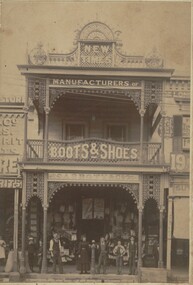
... building. Brick gutter. Wooden case on right. 'Abbott's & Co. Pall Mall Bendigo Boot and Shoe Store' . ...BUILDINGS Commercial abbotts boot & shoe manufacturers Sepia toned photograph of two story building. ...Sepia toned photograph of two story building. Cast iron supports to verandah and balcony. Ornate cast iron trim. New Times sign on parapet. Various sale signs on windows and front doors. Hitching post? In front of shop. Bags of grain, two males, 1 femal figures, four adolescents in front of building. Brick gutter. Wooden case on right. 'Abbott's & Co. Pall Mall Bendigo Boot and Shoe Store' . Check directories for dates of occupation. James Lerk 17/12/1999. History of object: The very flamboyant front for Abbott & Co Boot and Shoe Manufacturers. Abbotts conducted a tannery at Sheepwash - a wonderful example of an industry 'adding'. Photos. C1900. James Lerk caption.buildings, commercial, abbotts boot & shoe manufacturers -
 Port Melbourne Historical & Preservation Society
Photograph - Marshall & Co Manufacturing building
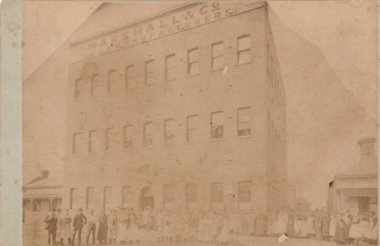
... By 1900 Marshall & Company was the largest shoe & boot manufacturer in Australia producing 12,000 pieces of footwear weekly. A fire in1901 gutted the building and the company moved to Richmond. ...By 1900 Marshall & Company was the largest shoe & boot manufacturer in Australia producing 12,000 pieces of footwear weekly. A fire in1901 gutted the building and the company moved to Richmond. ...By 1900 Marshall & Company was the largest shoe & boot manufacturer in Australia producing 12,000 pieces of footwear weekly. A fire in1901 gutted the building and the company moved to Richmond. Faded photograph of the three-story building belonging to the Marshall Manufacturing Company which was established in Port Melbourne in 1888. It employed some 300 workers until destroyed by fire in 1901.industry - manufacturing, marshall & co manufacturers -
 Bendigo Historical Society Inc.
Financial record - INVOICE COLLECTION: J. H. Curnow & Son
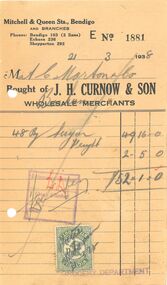
... Curnow was managing director of the Bendigo Pottery, director of the Bendigo Gas Co. and the Bendigo and Eaglehawk Star Building Society and chairman of directors of the Bendigo Boot and Shoe factory. ...Curnow was managing director of the Bendigo Pottery, director of the Bendigo Gas Co. and the Bendigo and Eaglehawk Star Building Society and chairman of directors of the Bendigo Boot and Shoe factory. ...See below for an article by Jim Evans of the Bendigo Historical Society: From the Bendigo Miner Number 9 - 1 March 2007 Cock-eyed Curnow - James Henry Curnow Cornishman and famous Bendigonian By Jim Evans Five-time Mayor of Bendigo, James Henry Curnow of Eumana , was for fifty years associated with almost every progressive movement in the life of the city. He was born in Ludgvan, Cornwall, in 1861, the son of Sampson Curnow, tin-miner and later mine-manager. His parents brought him to Bendigo when he was two years old and settled at Long Gully. He was educated at the state school and St Andrew s College. In 1883, he married Jane Corbel in the Congregational Church. Curnow joined the Post-Master-General s Department in 1881. Taking leave in 1887, he acted as secretary of the Australian Natives Association (ANA) exhibition at Geelong. He became a clerk with Connelly and Tatchell's, Bendigo solicitors, leaving in 1894 to establish an accountancy and real estate business. Considered shrewd and hard-working, Curnow prospered; he later added an auctioneering section and formed the company J.H. Curnow & Son (now Curnow & Dyett). The ANA provided the grounding for Curnow s public life. He joined the Sandhurst branch in 1881 and was secretary in 1883-1891. He helped form new branches in northern Victoria. With (Sir) John Quick, he set up the first Federation League in the colony in 1893. Curnow was secretary of the League in that year and again in 1898-99. He was elected to the Bendigo City Council in 1901 and, apart from 1906-09 remained a very energetic councillor. He was Mayor in 1902-03, 1903-04, 1912-13, 1919-20 and 1927-28. It was during his second term as Mayor in 1904, that he had William Beebe design a home - Eumana in Flora Hill. (Local historian Betty Jackman informs me that Curnow s house at 75 Wills Street where he lived before moving to Flora Hill, was also called Eumana ). He took a leading role in the installation of sewerage and was later Chairman of the city s Sewerage authority when that body was being subjected to a great deal of criticism. He was an executive member of The Municipal Association of Victoria and president in 1919. Curnow was very interested in politics, but his four attempts to enter parliament failed. He was Justice of the Peace for the states of New South Wales and Victoria, deputy coroner for the city of Bendigo, a guardian of minors and registrar of marriages. Curnow was managing director of the Bendigo Pottery, director of the Bendigo Gas Co. and the Bendigo and Eaglehawk Star Building Society and chairman of directors of the Bendigo Boot and Shoe factory. He was a life member of both the Bendigo Base Hospital and the Benevolent Asylum (Anne Caudle Centre). Curnow s family affairs were marred by tragedy. His father was killed in a mining accident in 1881; his first wife and three of their five children died in the measles epidemic of 1893. His second wife Mary Jordan died in 1909 after spilling carbolic acid on her hip, leaving three young children. He married Amy McLean in 1911and they had one daughter. When the Prince Edward visited Bendigo in 1920, Curnow made a speech, telling his audience: I will now merely ask you to drink his health as the Prince of Wales and also as the Duke of Cornwall. In this district there are a tremendous number of Cornishmen and I need not tell His Royal Highness that it was the Cousin Jacks who made Bendigo, who found the gold and developed the mines. They have added more to the riches of the Commonwealth than any other class of people. When he visits the mines today, he will find that ninety per cent of the miners are Cornishmen and descendants of Cornishmen. His remarks were greeted by loud applause. J.H. Curnow was known locally as Cock-eyed because of an eye defect. He died on Anzac Day 1932 at his then home, The Knoll in Wattle Street. He was 71. He was cremated at the new Fawkner Cemetery and his ashes were buried in the Bendigo Cemetery. His grave is close to that of another famous Cornishman and Bendigonian, Sir John Quick, who died in the same year. The Curnow memorial drinking fountain in Rosalind Park was unveiled in 1938 by Mayor Taylor. The distinguished Bendigo born sculptress Ola Cohn designed the memorial and made the bust and other plaques of terracotta. The plaques were damaged in the 1950s and a restoration program was undertaken, with bronze plaques replacing the original terracotta ones.10934.33a: A small, aged sheet of yellow paper with two clean punch holes on the left side and a perforated edge. The paper is thin, but sturdy. Printed in black ink is the business name and details: Bought of J.H. Curnow & Son Wholesale Merchants. The address: Mitchell & Queen Sts. Bendigo and branches. Phones: Bendigo 103. The receipt is handwritten in grey lead pencil. Dated 21 March 1938. Below the header is neat, ruled lines for listing items with prices listed in British Pounds, totaling 52 pounds 1 shillings. Receipt number 1881. There is also a Victorian 3 pence stamp duty stamp printed in green ink. 10934.33b: A small, aged sheet of yellow paper with two clean punch holes on the left side and a perforated edge. The paper is thin, but sturdy. Printed in black ink is the business name and details: Bought of J.H. Curnow & Son Wholesale Merchants. The address: Mitchell & Queen Sts. Bendigo and branches. Phones: Bendigo 103. The receipt is handwritten in grey lead pencil. Dated 25 May 1938. Below the header is neat, ruled lines for listing items. Receipt number 14291. The Receipt is crossed out in blye pencil. The top left corner is folded and slightly torn. 10934.33c: A small, aged sheet of yellow paper with two clean punch holes on the left side and a perforated edge. The paper is thin, but sturdy. Printed in black ink is the business name and details: Bought of J.H. Curnow & Son Wholesale Merchants. The address: Mitchell & Queen Sts. Bendigo and branches. Phones: Bendigo 103. The receipt is handwritten in grey lead pencil. Dated 27 June 1938. Below the header is neat, ruled lines for listing items with prices listed in British Pounds, totaling 2 pounds. Receipt number 1466. The receipt is crossed out in blue pencil and indicates and credit. 10934.33d: A small, aged sheet of yellow paper with two clean punch holes on the left side and a perforated edge. The paper is thin, but sturdy. Printed in black ink is the business name and details: Bought of J.H. Curnow & Son Wholesale Merchants. The address: Mitchell & Queen Sts. Bendigo and branches. Phones: Bendigo 103. The receipt is handwritten in grey lead pencil. Dated 7 March 1938. Below the header is neat, ruled lines for listing items with prices listed in British Pounds, totaling 34 pounds 14 shillings. Receipt number 1627. There is also a Victorian 3 pence stamp duty stamp printed in green ink.ac morton, jh curnow & son -
 Charlton Golden Grains Museum Inc
Photograph, Arundell's Shoe Shop, High St Charlton c. 1987, c.1987
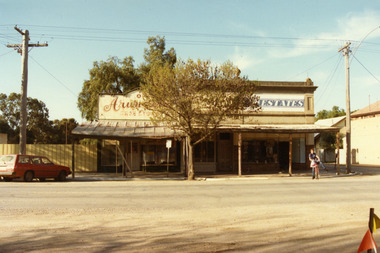
... Arundell's Shoe Shop and Dalgety's Agency , centre of High St Charlton, north side c. 1987. Corner of High St and Williams Ave (now John Curtin Drive). Right hand building...Arundell's Shoe Shop and Dalgety's Agency , centre of High St Charlton, north side c. 1987. Corner of High St and Williams Ave (now John Curtin Drive). Right hand building ...Arundell's Shoe Shop and Dalgety's Agency , centre of High St Charlton, north side c. 1987. Corner of High St and Williams Ave (now John Curtin Drive). Right hand building built by William Williams as a saddlery c. 1910. Arundell's Shoe Shop formerly ANA Boot and Shoe Shop established by John Arundell in 1901. The shop was sold by Vic Arundell in 1980 and closed. Next door was John Watson's Stock & Station Agents which later became Dalgety's. The end shop was the saddlery and then Bullock's grocery 1930's to 1970's. In 1957 became Charlton's first self service store. Became Australian Estates late 1970s. The shops were later demolished to make way for the Traveller's Rest. Part of a streetscape series taken in 1987 for the Charlton Shire.Colour photograph of three single-storey shops with corrugated tin verandahs. Signage on the buildings reads Arundell's SHOE STORE and ESTATES. Partially obscured by tree in front of the buildings. A red station wagon is parked on the LH side of the picture and a boy on a bicycle on the RH side. arundell, dalgety's, williams saddery, john watson stock & station agent, bullock's grocery, australian estates, arundell's shoe store, business, industry, charlton -
 Stawell Historical Society Inc
Photograph, 39 Main Street
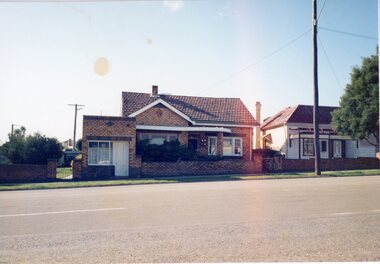
... 39 Main Street: Mr Tom Healy did boot & shoe repairs from shop at front of house. ...39 Main Street: Mr Tom Healy did boot & shoe repairs from shop at front of house.Colour Photgraph. Brick home with brick fence. Small brick building opening onto footpathOn reverse: Shop where Tom Healy worked in Lower Main Streetbusiness, tom healy -
 Box Hill Historical Society
Photograph - Box Hill railway station
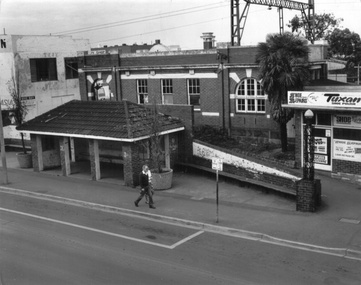
... Box Hill Railway Station in Main Street, showing shoe repair shop on right. 1960s-1970s Railway buildings Boot makers Box Hill railway station B&w photo Photograph Box Hill railway station ...Box Hill Railway Station in Main Street, showing shoe repair shop on right. 1960s-1970sB&w photorailway buildings, boot makers, box hill railway station -
 Stawell Historical Society Inc
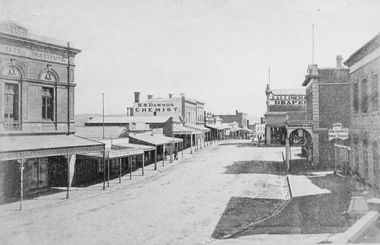
Photograph, Upper Main Street Stawell looking West with the Mechanics institute built in 1875 1878
... Mechanics Institute, Joseph Dawe Stawell Meat Market, D.B. O'Callaghan, Boot & Shoe Warehouse, Stawell Potato Depot, Ben S. ...Upper Main Street looking West from Mechanics Institute built in 1875. Mechanics Institute, Joseph Dawe Stawell Meat Market, D.B. O'Callaghan, Boot & Shoe Warehouse, Stawell Potato Depot, Ben S. Dawson Chemist, R.H. Wadsworth Jewler Watchmaker, English Scottish & Australian Bank, Bone Saddler, Hunter Bull & Mouth Hotel. On North side of street is J. Allingham Draper, Chadwick & Co Draper, D. Telford Farm Produce, Bank of Victoria. Photo taken 1878The "Top End" of Main Street. looking west. The Mechanics Insitute on the Left dates the photo about 1880. Some of the larger buildings have been restored.Victorian Views. C. Herbert, Photo. Stawell 1878stawell business streetscape -
 Williamstown Historical Society Inc
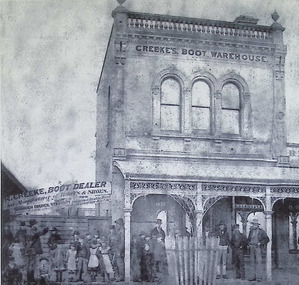
Photograph - Nelson Place, showing R. Creeke's Boot Warehouse - boot dealer and manufacturer of boots and shoes, c.1878
... Nelson Place R. Creeke's Boot Warehouse 133 Nelson Place c. 1878 Building address is 133 Nelson Place and currently resides Café Cirino (2026) Photograph Nelson Place, showing R. ...Building address is 133 Nelson Place and currently resides Café Cirino (2026) nelson place, r. creeke's boot warehouse, 133 nelson place, c. 1878 -
Tatura Irrigation & Wartime Camps Museum
Photograph - original, A. Gye Photographer, Hogans Commercial Hotel and Store, late 1880's
... Signs on building - Hogan's Commercial Hotel, Cash Drapery, cheap boot and shoe ware house. ...Signs on building - Hogan's Commercial Hotel, Cash Drapery, cheap boot and shoe ware house. ...Original sepia photograph of Thomas Hogan's Commercial Hotel and Cash Drapery Store. Signs on building - Hogan's Commercial Hotel, Cash Drapery, cheap boot and shoe ware house. London House, sign post made from gum tree.Sepia original photograph of many men, women, children, horses and buggies in front of Hogan's Commercial Hotel and store.on back: Thomas Hogan's Commercial Hotel and Cash Drapery Store, Ross Street, Tatura.hogans commercial hotel -
 Sunshine and District Historical Society Incorporated
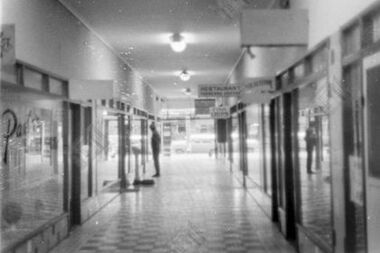
Photograph - 323 Main Rd East - St. Albans Arcade Photograph
... In 1970, the Arcade included: - T.A.B. of Victoria - Hampshire Real Estate Agency - Wittner’s Pty Ltd – Boot Retailer - Marta’s Beauty Saloon - Georgiou, P. – Hairdresser This marks the Arcade’s shift from purely retail to professional services, reflecting St Albans’ growing population and commercial maturity....In 1970, the Arcade included: - T.A.B. of Victoria - Hampshire Real Estate Agency - Wittner’s Pty Ltd – Boot Retailer - Marta’s Beauty Saloon - Georgiou, P. – Hairdresser This marks the Arcade’s shift from purely retail to professional services, reflecting St Albans’ growing population and commercial maturity. ...The St. Albans Arcade was one of first buildings in St. Albans that had various shops under one roof. The earliest listing of the Arcade appears in 1960, showing a lively mix of small migrant‑run businesses typical of early St Albans: - Arcade Fruit Supplies - Mrs Irena Leczycki – Delicatessen - St Albans Fish Shop - Kenroniee Café - Violet Gift & Hardware - Arcade Butcher - Brotherhood of St Laurence – Dealer - Kanizsay, A. – Dealer - Arcade Hairdresser - Arcade Trading Co – Shoes This reflects the post‑war migrant boom, when St Albans was rapidly expanding and small shopfronts were essential community hubs. In 1970, the Arcade included: - T.A.B. of Victoria - Hampshire Real Estate Agency - Wittner’s Pty Ltd – Boot Retailer - Marta’s Beauty Saloon - Georgiou, P. – Hairdresser This marks the Arcade’s shift from purely retail to professional services, reflecting St Albans’ growing population and commercial maturity.5666 - Main Rd East 323 - St. Albans Arcade 1970's Photo 01.jpgmain road east, st. albans, st. albans arcade -
 Linton and District Historical Society Inc
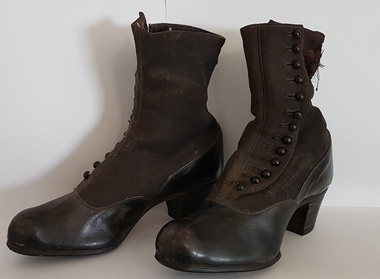
Shoes, "Solid Value". Words form part of manufacturer's mark, Ladies' Boots, Brown Leather
... Thirteen buttons on each boot. Ladies' Boots, Brown Leather Shoes "Solid Value". ...Found in cellar of building formerly Barr's drapery in Sussex St, Linton. Donated to society by building's owner Fiona Watson.Pair of leather and fabric ladies' button boots. Manufacturer's mark and size "3" on soles. Thirteen buttons on each boot.shoes, boots -
 Bacchus Marsh & District Historical Society
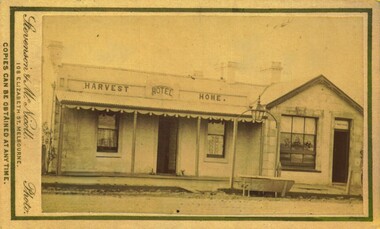
Photograph, Harvest Home Hotel 216 Main Street Bacchus Marsh 1883
... building appears to be of stone with decorative stonework corners. A verandah is inset to the left of a gabled front section which has its own door and window. On either side of the door beneath the verandah can be seen boot or shoe...building appears to be of stone with decorative stonework corners. A verandah is inset to the left of a gabled front section which has its own door and window. On either side of the door beneath the verandah can be seen boot or shoe ...The Harvest Home Hotel was licensed as a beer shop in 1866. Patrick Vallence was the licensee. On his death in 1874 his widow Mrs M. A. Vallence obtained the license. At the time this image was taken George Marshall was leasing the hotel. Following a decrease in the population of Bacchus Marsh, by 1911 the hotel had lost its licence.The Vallence family still owned the building after the loss of the hotel licence in 1911and it was used for some years after this as a private residence by some members of the Vallence family. Small sepia unframed photograph on card with gold border framing photograph. Housed in the album, 'Photographs of Bacchus Marsh and District in 1883 by Stevenson and McNicoll', the Jeremeas Family Album. The image depicts the Harvest Home Hotel situated in Main Street Bacchus Marsh. The name of the hotel can be seen above the verandah roof. The building appears to be of stone with decorative stonework corners. A verandah is inset to the left of a gabled front section which has its own door and window. On either side of the door beneath the verandah can be seen boot or shoe scrapers. A deep gutter runs along the front of the hotel, with a slab acting as a bridge to the road. Situated in the gutter at the front of the hotel is a water trough which has an arch above it with an ornate lantern, probably to light the front entry and to enable horses to be watered at night. A hitching post is nearby.On the front: Stevenson & McNicoll. Photo. 108 Elizabeth St. Melbourne. COPIES CAN BE OBTAINED AT ANY TIME. On the back: LIGHT & TRUTH inscribed on a banner surmounted by a representation of the rising sun. Copies of this Portrait can be had at any time by sending the Name and Post Office Money Order or Stamps for the amount of order to STEVENSON & McNICOLL LATE BENSON & STEVENSON, Photographers. 108 Elizabeth Street, MELBOURNE. hotels bacchus marsh, stevenson and mcnicoll 1883 photographs of bacchus marsh and district, vallence family bacchus marsh, harvest home hotel bacchus marsh -
 Bacchus Marsh & District Historical Society
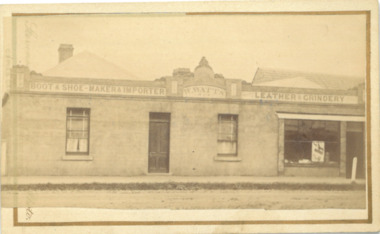
Photograph, William Watts Boot and Shoemaker Shop 194 Main Street Bacchus Marsh 1883
... William Watts arrived in Bacchus Marsh in 1862 and for many years conducted a boot and shoe makers business in Main Street. ...The image depicts the frontage of a boot and shoe makers premises.Signage on the upper part of the building reads 'Boot and Shoe Maker - Importer - Watts - Leather - Grindery'. ...The image depicts the frontage of a boot and shoe makers premises.Signage on the upper part of the building reads 'Boot and Shoe Maker - Importer - Watts - Leather - Grindery'. ...William Watts arrived in Bacchus Marsh in 1862 and for many years conducted a boot and shoe makers business in Main Street. This building, known as ‘Kentbury’ was built about 1858, and was formerly the premises of Bastings, cordwainer. The premises were enlarged in 1876 and occupied by Weaver. The building was demolished c.1960. Small sepia unframed photograph on card with gold border framing photograph. Housed in the album, 'Photographs of Bacchus Marsh and District in 1883 by Stevenson and McNicoll'. The image depicts the frontage of a boot and shoe makers premises.Signage on the upper part of the building reads 'Boot and Shoe Maker - Importer - Watts - Leather - Grindery'. The left hand side of the building appears to be a domestic dwelling, with a central door and two windows, one on either side. To the right there is a large shop display window and door. Both doors open directly onto the footpath. A post, probably a hitching post, stands on the footpath.On the front: Stevenson & McNicoll. Photo. 108 Elizabeth St. Melbourne. COPIES CAN BE OBTAINED AT ANY TIME. On the back: LIGHT & TRUTH inscribed on a banner surmounted by a representation of the rising sun. Copies of this Portrait can be had at any time by sending the Name and Post Office Money Order or Stamps for the amount of order to STEVENSON & McNICOLL LATE BENSON & STEVENSON, Photographers. 108 Elizabeth Street, MELBOURNE. stevenson and mcnicoll 1883 photographs of bacchus marsh and district, boot makers, shoe shops -
 Melbourne Tram Museum
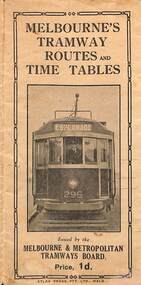
Map, Melbourne & Metropolitan Tramways Board (MMTB), Melbourne's tramway routes and timetables - MMTB, 1925
... Shows a number of buildings and locations by a numbered reference list, including the Federal Parliament house. The map has advertisements around the outside of the map for Kiwi Shoe or boot polish....Shows a number of buildings and locations by a numbered reference list, including the Federal Parliament house. The map has advertisements around the outside of the map for Kiwi Shoe or boot polish. ...Map of the MMTB Tramway routes 1925 with a list of first and last cars, along with photographs of Wattle Park, Luna Park, and Studley Park. Provides information for the Prahran and Malvern lines, Hawthorn, Footscray, Essendon, Coburg, Kew, St Kilda, cable tram routes, and buses. Also provides information for passengers. The cover photo is of the front of W 296, with the destination of Esplanade. The map is dated by the opening of the line to West Brunswick as far as Albion St, the City Road to St Kilda line via Sturt St lines, and the electric line in Flemington Road which were all opened during mid to late 1925. See Reference. Shows a number of buildings and locations by a numbered reference list, including the Federal Parliament house. The map has advertisements around the outside of the map for Kiwi Shoe or boot polish.Yields information about the Melbourne tramway system in 1925 and demonstrates the methodology the MMTB used to provide information to travellers. Shows both cable and electric tram lines and the development of the Melbourne system.Map book - 15 fold paper titled "Melbourne's tramway routes and timetables"trams, tramways, mmtb, tramway maps, wattle park, studley park, timetables, cable trams, w class tram, tram 296, kiwi shoe polish -
 City of Melbourne Libraries
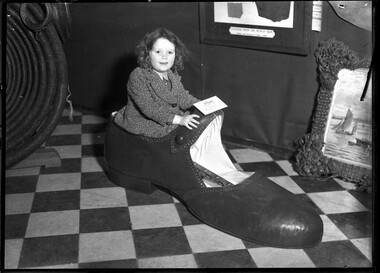
Photograph, Bull, Hugh Jones, 1897-1993, Leather Exhibition, Melbourne Town Hall
... It was built around 1912 for Puttifoot and Bloom, boot manufacturers, and today the building is apartments...It was built around 1912 for Puttifoot and Bloom, boot manufacturers, and today the building is apartments ...Photographer notations on slide: At the Leather Exhib. at T. Hall Melb 1933 Age Published: Age (Melbourne, Vic.: 1854- ), 1933 THE EXHIBITS. (1933, September 20). The Age (Melbourne, Vic. : 1854 - 1954), p. 16. Retrieved January 25, 2026, from http://nla.gov.au/nla.news-article205109730 Published title: THE EXHIBITS. A COMPREHENSIVE RANGE. Curios, Novelties, Working Displays Published Caption: ONE OF THE NOVELTIES – AN OUTSIZE IN SHOES Research by Project Volunteer, Louise McKenzie: Our photo is dated 20 September 1933, and shows a happy, chubby-faced young girl sitting in a very over-sized girl’s shoe. It is labelled – “Shoe, An Out Size, loaned by Messrs Blackman & Rose”. (1) It is an effective way to capture the attention of the readership and alert them to the Melbourne Leather Show 1933. This show was designed to be a drawcard of extraordinary proportion, and there is no doubt that this leather exhibition was a really big deal for Melbourne. It completely took over the Melbourne Town Hall, and was open from 10.30 am until 10.30 pm. It seemed to contain something for everyone – the military, the man about town, the home handyman, the housewife, the child, the sporting types, the domestic workers, the outdoor enthusiasts, the horseracing fans, car enthusiasts, those wishing to show off the latest fashion – both men and women - and those just intrigued by a lot of fascinating and wide ranging exhibits. One of the most comprehensive descriptions of the Exhibition accompanies the photograph, and is worth quoting in full: “PROMINENT among exhibits which first attract attention in the foyer of the Town Hall is a comprehensive display of leather articles used by the defence forces. A conspicuous legend states that leather plays an important part in national defence, being used for saddlery, tool containers, holdalls, range-finding, surveying and signalling equipment, explosives factories, harness accoutrement, bandsmen's equipment and clothing. Three models of horses and several figures of soldiers wearing leather equipment illustrate the lesson, and a great range of leather goods used in military training and work variegate the display. Nearby are Texas cowboy, buckjumping and breaking-in saddles; whips, a walking stick, made of leather and numerous other curios. The general exhibition occupies the whole floor space of the main Town Hall, and is subdivided by partitions running most of the length of the hall. A bewildering variety, of leather goods presses for close and leisured inspection. Here and there operatives in charge of working machinery give practical demonstrations of factory processes in the production of footwear. Polishing materials are well represented. One attractive exhibit includes two bush huts constructed of leather, with wattle bark for roofing. Opossums, rosellas and a kookaburra add touches of bush realism. Adjacent exhibits include bags, fishing boots, leggings, leather covers in all colours. Factory Processes. One exhibitor has installed an automatic cinema apparatus and screen, which projects various factory processes in making a shoe, the operator being shown at work. Elsewhere an interesting exhibit depicts the five stages in the manufacture of sole leather, and the tanning materials employed. "Very handsome effects are achieved in the interior appointments of motor cars, which are attended by figures of smart chauffeurs in leather coats. Motor-trimming leather is said to be more durable and hygienic than fabric materials, and cheaper. The neat finish of the material, its excellent appearance, certainly make a very favourable impression. It takes the hides of three beasts to cover the cushions, squabs and door panels of a full-sized sedan, while to finish the entire interior, including quarter-panels and head linings would take four or even five. Special Exhibits. Amongst the special sections the display arranged by the handicrafts and home industries- committee of the Country Women's Association of Victoria is a notable one. In all there are about 130 entries which are in four classifications, viz., hand-tooled or embossed leathers, suede, hand-made gloves and undecorated leather. The glove section attracted the most numerous entries, a number being the work of members and craft subscribers of the Country Women's Association. In the leathercraft competition, organised by the Country Women's Association, the judges yesterday awarded the first prize for bookbinding (the only prize given in this division) to Miss M. Alston, of South Yarra. There is also a creditable display of exhibits submitted by boys of the orthopaedic section of the Children's Hospital at Frankston. Amongst the novelties on view in other portions of the exhibition were the following: — Leather coats worn by Sir C. Kingsford Smith on his Atlantic flight. Model Wellington boot, Phar Lap's saddle. Melbourne Cup winner's saddle. Longest whip in world, 108 feet long. (33 metres) [See our photo, to left of Girl in Shoe] Diminutive shoes. Pair of shoes 65 years old. Pair of men's working boots 75 years old. Larwood's, Tate’s and Pataudi’s cricket boots. [Three internationally revered cricketers of the day] (2) Picture frame made of leather bought 63 years ago. [See our photo, to right of Girl in Shoe] Leather frame, powder bowl, &c. Saddle used by world's champion buckjumper in U.S.A. Mexican cowboy outfit. Miniature saddle and bridle. A fireman's helmet made of sole leather. (3) Sample of the leather hat worn by porters at the Billingsgate Fish Market, London. (4) From South Australia there have been obtained sets of harness for donkeys, goats and camels, the equipment being displayed to good advantage on stuffed representations of the animals mentioned. Close to the platform is a glass case containing snow shoes and coats which have been used in Antarctic exploration work. Trade Display. Amongst the trade exhibits may be seen in operation a slipper turn shoe sewing machine, with heeling and channelling facilities, and the various stages in the production of ladies' sandals are shown. There is a wide contrast between sole leather of varying degrees of thickness on view in one stall and the choice samples of ladies' footwear in another — footwear, by the way, which could almost be used as ornaments, so dainty in colour and production are they. Again, there are displays of upholstering leathers of such soft texture that they could he readily mistaken for some of the finest cloth. Those who may be particularly interested in the production of chamois leather may gain an insight into the materials and chemicals used in the "working up” of this variety of leather. Supplies of glace kid (5) are tastefully arranged, and there may also be seen bags of all shapes and sizes, including satchels, suit cases and "sporting" cases, and bags for tennis players and golfers. Further variety is given to the exhibition by the display of antique hides, brightly coloured, with punching balls, boxing gloves and batsman's pads. There are crocodile skins and snake skins so cleverly "Worked up" that one could be almost pardoned for betraying an affection for such unpopular creatures.” “ Another wonderful article on this Exhibition, published the same day in one of the opposition daily newspapers, The Argus, is in the weekly article “Women to Women”, entitled “A Great Victorian Industry: Many Uses for Leather”. This weekly column was penned by Vesta, and she writes, with much purpose: “Yesterday afternoon I paid a hurried visit to the Leather Exhibition now being held in the Melbourne Town Hall and I was disappointed to find that the early visitors to the main exhibition were almost all men. Women, I think, should make a point of seeing every exhibition of our great industries, for women are the buyers of household requisites and goods for their own use and their tastes, and opinion influence also, to a large extent, the purchases of men. So, the welfare of industries is more or less in their hands and it becomes a duty for them to inform themselves fully of the extent and the quality of the manufacturing that is done here. The value of the output of the Australian boot and shoe factories alone was in 1930-31, the latest year for which the figures are given, Stg 3,750,000. Fully two thirds of that amount must have been spent by women on boots and shoes for themselves and their children. In a host of other directions, in the purchase of handbags, travelling bags, belts and straps, cushions, furniture coverings, purses, notebooks, spectacle cases, their annual expenditure must be very high. Their interest, therefore, in this industry is practical, and their support of it should be governed by knowledge of comparable values and qualities of the goods they buy. From the point of view of women, however, the exhibition itself is rather disappointing. There is an amazing collection of good stuff on show, but most of it is not displayed in a fashion that attracts attention. I was surprised, for example, at the range and quality of the leathers displayed, the suppleness of the finer qualities, and the varied range of colours and designs. But they are shown in such a fashion that if one set out deliberately to look for them it would be quite easy to miss most of them.” …It was surprising, too, that no one seemed to have taken advantage of the present fashion of wearing coloured gloves, or the cult of glove making, which the Country Women’s Association has fostered so successfully. Outside the collection of chamois leathers I saw no skins which were suitable to glove making. (6) However, it is perhaps a little unfair to be highly critical of the exhibition, inasmuch as it is the first of its kind. The material is there, undoubtedly, for a splendid show of every phase of this enterprising industry, and I am confident that experience will prove to those concerned that it will be worth while next time to devote a great deal of attention of the method of display.” With further research, it transpires that “Vera” is in fact NZ born Stella May Allen (nee Henderson) (1871-1962), a journalist, the first woman in NZ to begin a law course, in 1890-91). She later worked at a law firm while she completed her degree. Study of the law had always been open to women in NZ, but its practice was still barred to them. Her case “…led to amending legislation in 1896 allowing women to practise as barristers or solicitors. However, on gaining her LL.B. in November 1897 she did not apply for admission to the Bar. Instead, she became the Wellington-based correspondent and leader-writer for the Lyttelton Times. Her appointment, the first for a woman, was not welcomed by the all-male Press Gallery, and special permission had to be obtained from a subcommittee of the House before her presence was accepted. In 1900 she married Edwin Allen, a senior leader-writer for the Wellington Evening Post, and they moved to Australia in 1903 when Edwin Allen took up the post of foreign affairs leader-writer and parliamentary man for the Melbourne Argus. As Patricia Keep notes in her excellent entry of Stella Allan in the Australian Dictionary of Biography: “In 1907 The Argus commissioned her to write a series of articles on the first Australian Women's Work Exhibition held in October. They aroused much interest and next year The Argus invited her to join its full-time staff and begin a weekly section on the particular interests of women. She adopted the nom de plume 'Vesta' and called the column 'Women to Women'. Her work was unique in an Australian daily paper at that time. Her pages extended to cover every aspect of women's affairs, children's interests and community welfare, and 'Vesta' became a household word for authoritative information and advice on such matters. An excellent needlewoman and first-rate cook herself, she thoroughly tutored her staff in the work and needs of women in both country and city, as well as providing the usual training for cadet journalists. She conducted interviews and also visited the country to see at first hand the results of bushfires, mouse plagues, droughts and floods. In 1910 she was one of three women foundation members of the Australian Journalists' Association. “…she found time to become deeply involved in community affairs. She was an original committee-member of the Victorian Association of Crèches and of the Free Kindergarten Union of Victoria, and had much to do with the early days of the Victorian Bush Nursing Association, the Baby Health Centres Association and the Queen Victoria Hospital. She was a member of the National Council of Women, first in New Zealand and then in Melbourne, and of the Country Women's Association from its inception. … in 1924 she was appointed substitute delegate for Australia to the fifth assembly of the League of Nations at Geneva and was a delegate to the second Pan Pacific Women's Conference in Hawaii in 1930. A meeting held in the Melbourne Town Hall in 1938 by representatives of all the main Victorian women's organizations paid special tribute to her work and influence. She retired next year to England where she continued to write for the Argus, contributing articles on the experiences of women and children in wartime.” It is little wonder that “Vesta” was unafraid to take to task both the women of Victoria, and those who created the exhibition! One item which appears to have gone unnoticed, or at least unreported, is a framed article in the background of the photo of the chubby girl in the shoe. The display frame is labelled “Leather from the Human Skin, Tanned and Dressed by French artists.” The exhibition was certainly a cabinet of curiosities! A charming article in The Argus is a nice note on which to end. It gives a quick history and overview of the Australian leather industry and its unprecedented, and possibly unexpected, development and success, and states with pride: “Though Victoria is the largest leather producer in the Commonwealth all tanners in the Commonwealth can look back with pride on the long march of progress.” Footnotes: (1) “Blackman and Rose”. Messrs Blackman and Rose were shoe manufacturers, from 1927 located at 200 Noone Street, Clifton Hill. The Melbourne Circle describes their building as a “fine-looking building in the Federation ‘blood and bandage’ style.” It was built around 1912 for Puttifoot and Bloom, boot manufacturers, and today the building is apartments. (2) These cricketers were household names in the day: Tate: Maurice Tate, “English cricketer of the 1920s and 1930s, and leader of England’s Test bowling attack for a long time during this period. The founder of modern seam bowling. “ Larwood: Harold Larwood, “English right-arm fast bowler and the main exponent of the bowling style known as “bodyline”. Used to considerable effect in the 1932-33 Test series in Australia. Pataudi: Iftikhar A K Pataudi, “an Indian prince who in the 1930s played Test cricket for England, and in the 1940s played Test cricket for India (as Captain) – the only test cricketer to have played for both India and England. (3) “sole” leather “… is the thickest and most resistant material existing in the tanning industry … made from vegetable tanned leathers, usually bovine butts, processed in a special way to make them the hardest type of leather in existence.” (4) The hats worn by porters at Billingsgate Fish Market were also known as a “Bobbin” and look quite squat and rather unsophisticated. They were made of wood and tarred leather, with a “flat, hardened top designed to support large rectangular boxes of fish. The upturned brim protected the porter’s head against fish juice draining from the boxes of fish which would be carried on top of the hat. Some hats featured a small drain hole at the rear to allow this collected juice to drain down the back of the carrier. The hats were made using the ‘cuir bouilli’ technique. The leather was immersed in water which was heated until the leather began to shrink. It was then removed and put on a wooden former. The leather was stitched together to make the hat while still wet, and then held in place until dry.” (See article and photo on the London Museum website) (5) Glace kid – described on the Boston Museum of Fine Arts’ Cameo database as “A smooth glossy leather originally prepared from goat or sheepskin. Early glace kid had a shiny surface that was originally prepared by tawing the skin in a mixture of alum, table salt, flour, and egg yolk. Today, glace kid is prepared from many types of vegetable or chrome tanned leathers. The smooth polished surface is obtained mechanically by shaving, glazing, ironing, and/or rolling the dry leather.” (6) In the 1930s, Melbourne’s glovemaking industry was characterised by local manufacturing, with key producers like Simpson’s Gloves Pty Ltd in Richmond and the Stagg Glove Company in Clifton Hill leading the market. These factories produced high-quality leather gloves, handbags, and specialty gear, often employing a clear gendered division of labour and training young, local women. Museum Victoria holds the Simpson’s Gloves Collection, comprising over 1200 items, and the University of Melbourne Archives holds the company’s business records. References: THE EXHIBITS. (1933, September 20). The Age (Melbourne, Vic. : 1854 - 1954), p. 16. Retrieved January 25, 2026, from http://nla.gov.au/nla.news-article205109730 EXPORT LEATHER. (1929, September 17). The Argus (Melbourne, Vic. : 1848 - 1957), p. 17. Retrieved January 19, 2026, from http://nla.gov.au/nla.news-article4037647 LEATHER EXHIBITION (1933, September 18). The Argus (Melbourne, Vic. : 1848 - 1957), p. 10. Retrieved January 19, 2026, from http://nla.gov.au/nla.news-article11693362 (1933, September 23). The Argus (Melbourne, Vic. : 1848 - 1957), p. 21. Retrieved January 19, 2026, from http://nla.gov.au/nla.news-page522766 WOMEN TO WOMEN (1933, September 20). The Argus (Melbourne, Vic. : 1848 - 1957), p. 13. Retrieved January 19, 2026, from http://nla.gov.au/nla.news-article11694034 Australian Dictionary of Biography, Stella May Allan (1871–1962) https://adb.anu.edu.au/biography/allan-stella-may-4998 WOMEN TO WOMEN (1930, January 22). The Argus (Melbourne, Vic. : 1848 - 1957), p. 13. Retrieved January 19, 2026, from http://nla.gov.au/nla.news-article4063888 Museums Victoria, Simpson’s Gloves, 486-496 Victoria Street, North Richmond, VIC, Australia https://collections.museumsvictoria.com.au/articles/2702 The Argus. (1927, October 31). The Argus (Melbourne, Vic. : 1848 - 1957), p. 20. Retrieved February 7, 2026, from http://nla.gov.au/nla.news-article3888451 Melbourne Circle: stories from the suburbs: “Boots and all in Clifton Hill” https://melbournecircle.net/2015/11/20/bootmakers-of-clifton-hill/ Wikipedia, Maurice Tate, https://en.wikipedia.org/wiki/Maurice_Tate Wikipedia, Harold Larwood, https://en.wikipedia.org/wiki/Harold_Larwood Wikipedia, Iftikhar Ali Khan Pataudi, https://en.wikipedia.org/wiki/Iftikhar_Ali_Khan_Pataudi Buy Leather Online Italy, Sole leather: https://buyleatheronline.com/en/blog/outsole-and-insole-leather-n7 London Museum, Porters hats, https://www.londonmuseum.org.uk/collections/v/object-731122/hat-porters-hat/ Cameo Database, Museum of Fine Arts, Boston, Glace Kid, https://cameo.mfa.org/wiki/Glac%C3%A9_kid VICTORIAN LEATHER HAS WON RENOWN (1937, September 22). The Argus (Melbourne, Vic. : 1848 - 1957), p. 31 (March of Progress Supplement). Retrieved February 7, 2026, from http://nla.gov.au/nla.news-article1108704 Photographer notations on slide: "At the Leather Exhib. at T. Hall Melb 1933 Age B5".displays, melbourne town hall, leather, children, shoes, 1930-1939, industry, hats, gloves -
 Allan Doney Collection, Bendigo Historical Society Inc.
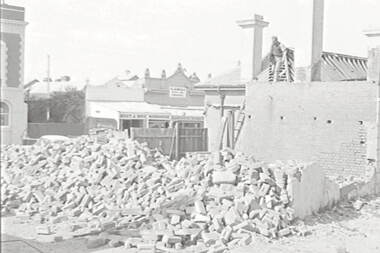
Negative - Maldon - Street - Building - Ruins - Boot and Shoe Warehouse, Allan Doney, 1950 -1970
... Maldon - Street - Building - Ruins - Boot and Shoe Warehouse...Negative Maldon - Street - Building - Ruins - Boot and Shoe Warehouse Allan Doney ...In the years of Allan Doney’s photography, landmark buildings succumbed to fire, neglect and redevelopment. He photographed the grey sand hills from Bendigo’s mining past, the streetscapes, poppet heads, miners’ cottages, gracious homes with ornate verandahs, trams and much more. Above all, his photographs show how much of the city has survived from the 19th century – and how much has not. Through two decades of great change, Allan Doney was there to capture ways people interacted with it. Although he travelled to many other places in Northern Victoria and beyond in search of subjects for his art, he seemed to always return to Bendigo for inspiration.
