
Showing 116 items matching "brass decoration"
-
 Flagstaff Hill Maritime Museum and Village
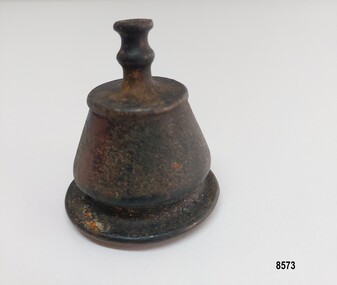
Decorative object - Brass Finial, Russell & Co, circa 1886
... ...brass decoration...The wreck is protected as a Historic Shipwreck under the Commonwealth Historic Shipwrecks Act (1976) Flagstaff Hill Flagstaff Hill Divers Flagstaff Hill Maritime Museum and Village Great Ocean Road Warrnambool Falls of Halladale Falls of Halladale Wreck Shipwreck artefact artefact Brass artefact Brass finial brass fitting Shipwreck coast diver John Laidlaw finial brass decoration handmade A brass, bell-shaped object with a body approximately 3 cm high. ...In the 19th century, the Industrial Revolution meant that shipbuilders could build ships using iron. These iron ships could be much larger, with more space for cargo, and they didn't need as much work to keep them in good condition. Isambard Kingdom Brunel's "Great Britain" built in 1843, was the first ship to be built entirely of wrought iron. In the 1880's steel began to be used instead of iron. Ships also began to be fitted with steam engines, although a great deal of coal was needed to travel even short distances. For this reason, ships continued to be fitted out with sails even though many came with engines. The iron-hulled, four-masted barque, the Falls of Halladale, was a bulk carrier of general cargo. She left New York in August 1908 on her way to Melbourne and Sydney. In her hold, along with 56,763 tiles of unusual, beautiful green American slates (roofing tiles), 5,673 coils of barbed wire, 600 stoves, 500 sewing machines, 6500 gallons of oil, 14400 gallons of benzene, and many other manufactured items, were 117 cases of crockery and glassware. Three months later and close to her destination, a navigational error caused the Falls of Halladale to be wrecked on a reef off the Peterborough headland at 3 am on the morning of the 15th of November, 1908. The captain and 29 crew members all survived, but her valuable cargo was largely lost, despite two salvage attempts in 1908-09 and 1910. ABOUT THE ‘FALLS OF HALLADALE’ (1886 - 1908): - Built: in1886 by Russell & Co., Greenock shipyards, River Clyde, Scotland, UK. The company was founded in 1870 (or 1873) as a partnership between Joseph Russell (1834-1917), Anderson Rodger and William Todd Lithgow. During the period 1882-92, Russell & Co. standardised designs, which sped up their building process so much that they were able to build 271 ships over that time. In 1886, they introduced a 3000-ton class of sailing vessel with auxiliary engines and brace halyard winches. In 1890, they broke the world output record. Owner: Falls Line, Wright, Breakenridge & Co, 111 Union Street, Glasgow, Scotland. Configuration: Four-masted sailing ship; iron-hulled barque; iron masts, wire rigging, fore & aft lifting bridges. Size: Length 83.87m x Breadth 12.6m x Depth 7.23m, Gross tonnage 2085 ton Wrecked: the night of 14th November 1908, Curdies Inlet, Peterborough, south west Victoria Crew: 29 The Falls of Halladale was a four-masted sailing ship built in 1886 in Glasgow, Scotland, for the long-distance cargo trade and was mostly used for Pacific grain trade. She was owned by Wright, Breakenridge & Co of Glasgow and was one of several Falls Line ships, all of which were named after waterfalls in Scotland. The lines flag was of red, blue and white vertical stripes. The Falls of Halladale had a sturdy construction built to carry maximum cargo and was able to maintain full sail in heavy gales, one of the last of the ‘windjammers’ that sailed the Trade Route. She and her sister ship, the Falls of Garry, were the first ships in the world to include fore and aft lifting bridges. Previous to this, heavily loaded vessels could have heavy seas break along the full length of the deck, causing serious injury or even death to those on deck. The new, raised catwalk-type decking allowed the crew to move above the deck in stormy conditions. This idea is still used today on the most modern tankers and cargo vessels and has proved to be an important step forward in the safety of men at sea. On 4th August 1908, with new sails, 29 crew, and 2800 tons of cargo, the Falls of Halladale left New York, bound for Melbourne and Sydney via the Cape of Good Hope. The cargo on board was valued at £35,000 and included 56,763 tiles of American slate roofing tiles (roof slates), 5,673 coils of barbed wire, 600 stoves, 500 sewing machines, 6,500 gallons of oil, 14,400 gallons of benzene, plumbing iron, 117 cases of crockery and glassware and many other manufactured items. The Falls of Halladale had been at sail for 102 days when, at 3 am on the night of 14th November 1908, under full sail in calm seas with a six knots breeze behind and misleading fog along the coast, the great vessel rose upon an ocean swell and settled on top of a submerged reef near Peterborough on the south-west Victoria’s coast. The ship was jammed on the rocks and began filling with water. The crew launched the two lifeboats and all 29 crew landed safely on the beach over 4 miles away at the Bay of Islands. The postmistress at Peterborough, who kept a watch for vessels in distress, saw the stranding and sent out an alert to the local people. A rescue party went to the aid of the sailors, and the Port Campbell rocket crew was dispatched, but the crew had all managed to reach shore safely by the time help arrived. The ship stayed in full sail on the rocky shelf for nearly two months, attracting hundreds of sightseers who watched her slowly disintegrate until the pounding seas and dynamiting by salvagers finally broke her back, and her remains disappeared back into deeper water. The valuable cargo was largely lost, despite two salvage attempts in 1908-09 and 1910. Further salvage operations were made from 1974-1986, during which time 22,000 slate tiles were recovered with the help of 14 oil drums to float them, plus personal artefacts, ship fittings, reams of paper and other items. The Court of Marine Inquiry in Melbourne ruled that the foundering of the ship was entirely due to Captain David Wood Thomson’s navigational error, not too technical failure of the Clyde-built ship. The shipwreck is a popular site for divers, about 300m offshore and in 3 – 15m of water. Some of the original cargo can be seen at the site, including pieces of roof slate and coils of barbed wire. This particular artefact was one of many found by John Laidlaw (a local Warrnambool diver) when diving on the Falls of Halladale in the 1960's. In August 1973, John Laidlaw and Stan McPhee went on to discover the underwater location of the Schomberg - a passenger ship that ran aground on December 26th 1855 near Peterborough and which now lies in almost 9 metres of water. When John Laidlaw died, his family donated a number of artefacts to Flagstaff Hill. The brass finial may have been part of a larger decorative item such as a lamp or clock bracket.This item is significant as it was taken from the Falls of Halladale shipwreck which is listed on the Victorian Heritage Register (No. S255). She was one of the last ships to sail the Trade Routes. She is one of the first vessels to have fore and aft lifting bridges. She is an example of the remains of an International Cargo Ship and also represents aspects of Victoria’s shipping industry. The wreck is protected as a Historic Shipwreck under the Commonwealth Historic Shipwrecks Act (1976)A brass, bell-shaped object with a body approximately 3 cm high. It has an outer lip, straight sides that taper in and a flat "cap". The inside of the object is plain with evidence of vertigris. It has a decorative topping almost 2 cm high, which has a double concave hollow neck.flagstaff hill, flagstaff hill divers, flagstaff hill maritime museum and village, great ocean road, warrnambool, falls of halladale, falls of halladale wreck, shipwreck artefact, artefact, brass artefact, brass finial, brass fitting, shipwreck coast, diver, john laidlaw, finial, brass decoration, handmade -
 Whitehorse Historical Society Inc.
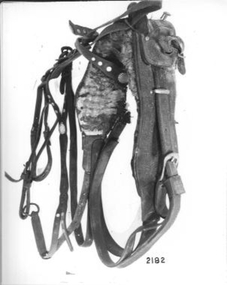
Buggy Harness
... Leather straps with brass decoration....Leather straps with brass decoration. Buggy Harness ...Buggy harness with collar. Leather straps with brass decoration.trades, saddlering -
 Dandenong/Cranbourne RSL Sub Branch
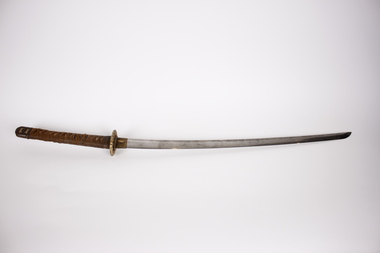
Weapon - Japanese Sword and Scabbard
... It also has brass decorations on each end of the hilt and a brass guard. ...It also has brass decorations on each end of the hilt and a brass guard. ...Japanese sword and scabbard. Sword hilt has what appears to be an ivory inlay then is wrapped in cotton? twine. It also has brass decorations on each end of the hilt and a brass guard. The scabbard is made of metal with a brass tip, brass decoration on the mouth and brass carrying ring.japanese, world war two, world war 2, ww2, ww11 -
 Queenscliffe Maritime Museum
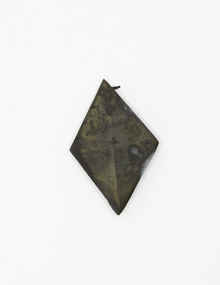
Clothing - Belt decoration
... A diamond shaped brass belt decoration...Schomberg Salvage Peterborough A diamond shaped brass belt decoration Clothing Belt decoration ...She was nearing the end of her voyage, close inshore off Cape Otway at Curdies Inlet (now called Schomberg Reef), east of Peterborough and 150 miles westward of Melbourne. When the wind suddenly dropped the ship drifted onto an uncharted reef and became stuck fast. There was no loss of life ans all the passengers, crew and mails were taken off by a passing coastal steamer, the Queen, out of Port Fairy the following morning. The passengers' luggage and some of the cargo was rescued, but the weather worsened and work was abandoned and cargo littered the beach. The wreck was sold for salvage to local merchants: two were drowned in attempts to reach her. It became a popular wreck site for diving and over 100 relics have been handed in. The bell of the ship is in the Warrnambool Museum, southern Victoria. Relics at Flagstaff Hill Maritime Museum include a cannon, a communion set, a brass candlestick, and a diamond ring.A diamond shaped brass belt decorationschomberg, salvage, peterborough -
 City of Moorabbin Historical Society (Operating the Box Cottage Museum)
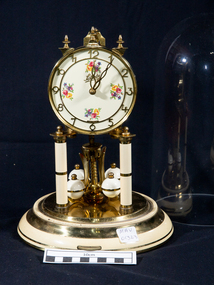
Clocks, August Shatz , Domed Standard No Name 400 Day Clock Ivory Shelf Clock, c1949
... An August Schatz (Jahresuhernfabrik) standard size, 400 day clock c 1949 with a glass dome, ivory, enamel and brass decoration and a porcelain dial .... & SOHN / GERMANY Square engraved : 10 JEWELS / UNADJUSTED An August Schatz (Jahresuhernfabrik) standard size, 400 day clock c 1949 with a glass dome, ivory, enamel and brass decoration and a porcelain dial Clocks, August Shatz , Domed Standard No Name 400 Day Clock Ivory Shelf Clock August Shatz ...August Shatz founded his clock making company in the mid-1850s in the Black Forest region of Triburg, Germany. It was registered in 1881 as Shatz & Wintermantel, and was re-structured in 1884 as Jahresuhrenfabrik A.G. They produced cuckoo clocks, barometers, and 400- day clocks. This clock was purchased and used by a resident of City of Moorabbin c1949This clock was purchased and used by a resident of City of Moorabbin c1949An August Schatz (Jahresuhernfabrik) standard size, 400 day clock c 1949 with a glass dome, ivory, enamel and brass decoration and a porcelain dial Circular engraved : AUG.SHATZ. & SOHN / GERMANY Square engraved : 10 JEWELS / UNADJUSTEDshatz, august , germany, clock makers, clocks, 400 day clocks, early settlers, city of moorabbin, bentleigh, cheltenham, -
 Port Fairy Historical Society Museum and Archives
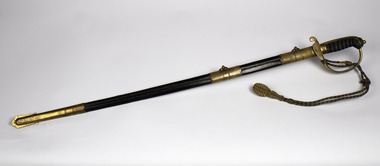
Weapon - Sword and Scabard, late 1800s
... Scabard of leather with brass decorations...Scabard of leather with brass decorations Weapon Sword and Scabard Owen Harries & Co. 15 Russell Street, Landport. ...Associated with Captain William Robertson, Captain of the S.S.Casino, Port Fairy Naval Reserve,Naval Dress Sword and scabard: Naval Dress Sword with brass handle with safety catch and gold thread tassle. Scabard of leather with brass decorationsSword and Crown E.R.VII- Owen Harries 15 Russell Street Landportlocal history, arms, edged weapons, captain william robertson, s.s.casino, port fairy naval reserve, belfast and koroit steam navigation co., boxer rebellion -
 Ballarat Diocesan Historical Commission
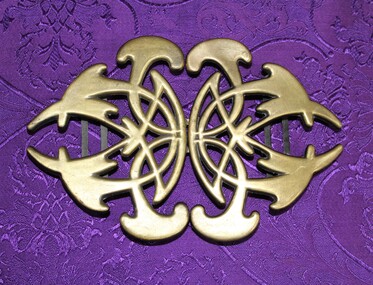
Morse, Brass Morse
... clasp, morse, art nouveau, decoration, brass....This clasp or morse shows the influence of the Art Nouveau style on liturgical decoration. clasp, morse, art nouveau, decoration, brass. Brass clasp, known as a morse for linking the front falls of a ecclesial cope. ...This clasp or morse shows the influence of the Art Nouveau style on liturgical decoration.Brass clasp, known as a morse for linking the front falls of a ecclesial cope.clasp, morse, art nouveau, decoration, brass. -
 Essendon Football Club
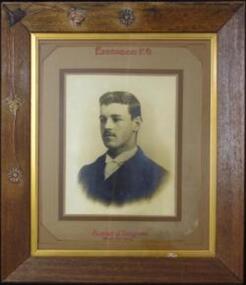
Albert Thurgood portrait, c. 1900
... A sepia photograph in a heavy wooden frame with brass floral decoration and gold slip under plain glass....A sepia photograph in a heavy wooden frame with brass floral decoration and gold slip under plain glass. ...Albert Thurgood's is one of football's greatest-ever players. Nicknamed 'Albert the Great' he was big, strong, and it was said he could play in any position. He was instrumental in Essendon's premiership wins in 1892, 1893, 1894 and 1901. He was also a phenomenal goalkicker in an era of low scores, leading the VFA/VFL goalkicking in 1892, 1893, 1894, and 1901. Thurgood also played in Western Australia from 1895 to 1899.The portrait is significant as Thurgood is one Of Essendon's greatest players.A sepia photograph in a heavy wooden frame with brass floral decoration and gold slip under plain glass. -
 Bendigo Historical Society Inc.
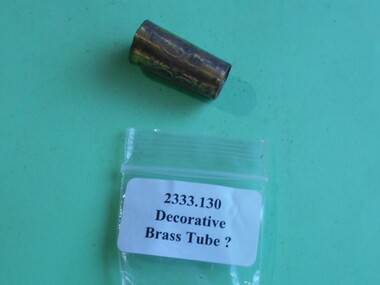
Functional object - QC BINKS COLLECTION: DECORATIVE BRASS TUBE?
... A decorative brass tube with floral decorations carved into the sides. ...A decorative brass tube with floral decorations carved into the sides. ...A decorative brass tube with floral decorations carved into the sides. This was discovered by QC Binks whilst he was out metal detecting for gold.bendigo, gold mining, qc binks, qc binks. -
 Embroiderers Guild, Victoria
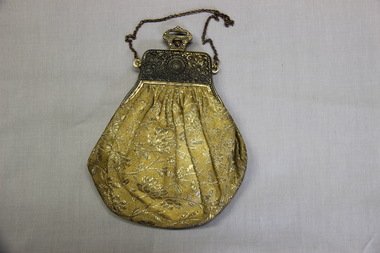
Accessory - Evening Purse, Early 20th Century
... Small evening purse made of gold brocade fabric with gold embroidered floral decoration. Brass top frame, embossed top opening and clasp. ...Purse Purses Small evening purse made of gold brocade fabric with gold embroidered floral decoration. Brass top frame, embossed top opening and clasp. ...Small evening purse made of gold brocade fabric with gold embroidered floral decoration. Brass top frame, embossed top opening and clasp. Silk lining and pocket in tear drop shape .purse, purses -
 Whitehorse Historical Society Inc.
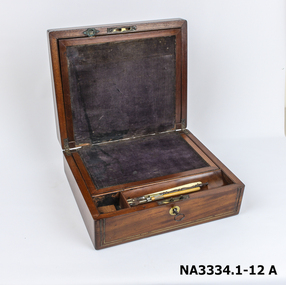
Functional object - Writing slope, c 1830
... A square wooden box with brass inlay decoration on lid and front around lock. ...Estimated that Agnes went to school about 1830's domestic items writing equipment handcrafts woodwork A square wooden box with brass inlay decoration on lid and front around lock. ...Mary Russell brought household items to Australia from England in 1934. Her mother, Elizabeth Russell used the writing desk that was originally given to her mother, Agnes Marian Byrne when she went to boarding school. Agnes used it all her life. Desk damaged by a visiting child who forced the desk closed/open at one point. Estimated that Agnes went to school about 1830'sA square wooden box with brass inlay decoration on lid and front around lock. Hinged lid opens to be a writing surface of velvet. At lock end, groove for pens and small well for ink bottle. Key (not to be used) is in the ink well. Base lined with green hessian glued on. Lid and base angled to give sloping writing surface. A total of 12 items including the box.domestic items, writing equipment, handcrafts, woodwork -
 Warrnambool and District Historical Society Inc.
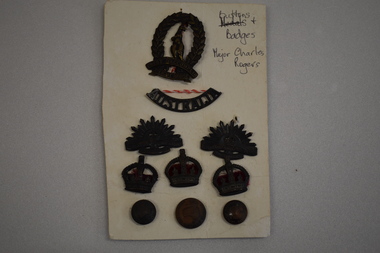
Buttons and Badges, Major Charles Rogers
... The wreath has an inverted arc with text at its base. 002261.2 An inverted brass arc with AUSTRALIA between two narrow bands 002261.3, .4 Brass rising sun badge with crown ,two scrolls with text, and inverted band 002261.5, .6, .7 Brass crown featuring raised decoration including fleur- de- lis and small small knobs. ...The wreath has an inverted arc with text at its base. 002261.2 An inverted brass arc with AUSTRALIA between two narrow bands 002261.3, .4 Brass rising sun badge with crown ,two scrolls with text, and inverted band 002261.5, .6, .7 Brass crown featuring raised decoration including fleur- de- lis and small small knobs. ...These badges and buttons belonged to Major Charles Rogers, a well known Warrnambool personality of the 1930s, 40s and 50s. He was a Light horseman who was in the Guard of Honour for the Duke of Gloucester in 1934 when he opened the Melbourne Shrine of Remembrance during the Victorian Centenary Celebrations. In Warrnambool he was a well known horseman leading parades and celebrations and judging equine events for the Warrnambool Agricultural Show. He died in 1961, These items are of interest as they belonged to Major Charles Rogers an important 20th century Army person. Rectangular piece of white cardboard through which the badges and buttons are secured with variously string and clear adhesive tape. 002261.1 Brass wreath of leaves and berries surrounding an upright kangaroo links to an arc shaped band with text . The wreath has an inverted arc with text at its base. 002261.2 An inverted brass arc with AUSTRALIA between two narrow bands 002261.3, .4 Brass rising sun badge with crown ,two scrolls with text, and inverted band 002261.5, .6, .7 Brass crown featuring raised decoration including fleur- de- lis and small small knobs. The crown has an open section through which red velvet like material is visible. 002261.8 Brass button featuring a raised map of Australia and crown with text 002261.9 As for .8 but larger 002261.10 Identical with .8 On cardboard in hand writing Buttons & Badges Major Charles Rogers .1 PREST D 'ACCOMPLIER LIGHT HORSE .2 AUSTRALIA .3 , .4 AUSTRALIAN COMMONWEALTH MILITARY FORCES .5,.6,.7 Nil .8, .9, .10 AUSTRALIAN MILITARY FORCES. major charles rogers, light horse, australian military forces -
 Flagstaff Hill Maritime Museum and Village
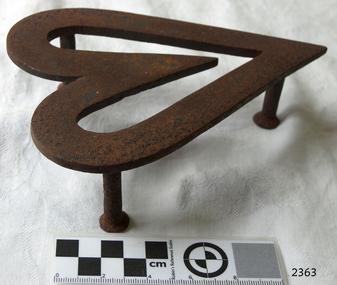
Domestic object - Stand
... decoration, often in the form of a date. Another early type, short-legged, stood in the fire to support a cast-iron pot. Later, in the second half of the 18th century, trivets designed to be hung from fire bars were made. These were of two types: an oblong, standing trivet with a handle at one end and projections to fit over the fire bars at the other, and a plate that could be attached to the fire bar. Some of the latter were hung inside the grate supporting a vessel over the fire. Large quantities of cast-brass...decoration, often in the form of a date. Another early type, short-legged, stood in the fire to support a cast-iron pot. Later, in the second half of the 18th century, trivets designed to be hung from fire bars were made. These were of two types: an oblong, standing trivet with a handle at one end and projections to fit over the fire bars at the other, and a plate that could be attached to the fire bar. Some of the latter were hung inside the grate supporting a vessel over the fire. Large quantities of cast-brass ...A stand or support for utensils near or on the fire. Usually made of wrought iron, the most common variety, from the 17th century, stands on three legs and has a circular plate with perforated decoration, often in the form of a date. Another early type, short-legged, stood in the fire to support a cast-iron pot. Later, in the second half of the 18th century, trivets designed to be hung from fire bars were made. These were of two types: an oblong, standing trivet with a handle at one end and projections to fit over the fire bars at the other, and a plate that could be attached to the fire bar. Some of the latter were hung inside the grate supporting a vessel over the fire. Large quantities of cast-brass fender trivets were manufactured at Birmingham, in England, in the last quarter of the 18th century; these were suspended from the top rails of the fender as muffin and kettle stands. Four-legged trivets that stood under the spit holding the dripping pan were made in the 18th and 19th centuries. The cat, an entirely different type of plate stand that was made in the 18th century, consisted of six spokes, three at the top and three at the bottom; it could be used either way up. The term trivet is also used in reference to a metal stand with short feet, used on a table to support a hot dish.Trivets have been used since the invention of iron and are essential for placing hot items on surfaces. This trivet is an example of a trivet used in the late 19th and early 20th centuries.Metal stand, heart-shaped, with three metal feet or supports. Made to rest and sppport hot items such as pots or irons. The wrought iron stand is painted black.flagstaff hill, flagstaff hill maritime museum and village, warrnambool, maritime museum, maritime village, great ocean road, shipwreck coast, wrought iron, pot stand, trivet, stand, kitchenalia, iron stand, heart shape, heart shaped trivet, cooking, ironing -
 Flagstaff Hill Maritime Museum and Village
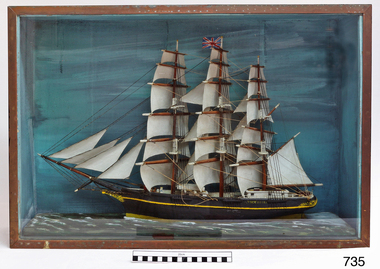
Craft - Ship Model, Victoria
... decoration. Mounted in case with painted backdrop and ocean. Timber case painted black, glass face and brass trim. ...decoration. Mounted in case with painted backdrop and ocean. Timber case painted black, glass face and brass trim. ...Ship model, Victoria with full ship rig. 3 masted, with 2 deck houses, 2 boats on top of forward house. Yellow hull decoration. Mounted in case with painted backdrop and ocean. Timber case painted black, glass face and brass trim. flagstaff hill, warrnambool, shipwrecked-coast, flagstaff-hill, flagstaff-hill-maritime-museum, maritime-museum, shipwreck-coast, flagstaff-hill-maritime-village, ship model -
 Flagstaff Hill Maritime Museum and Village
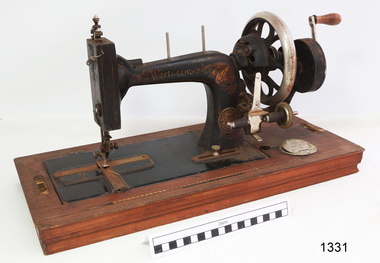
Domestic object - Sewing Machine, 1903
... Wertheim brass trademark badge riveted to the body of the machine of a crouching dwarf with a hammer with the name of the company Wertheim and Frankfurt. Gold filigree decoration...A sewing machine was a necessary part of each home and this item demonstrates how women of the time managed had to become self-reliant in the repair and making of their families clothes to make their household budgets go further. flagstaff hill warrnambool shipwrecked-coast flagstaff-hill flagstaff-hill-maritime-museum maritime-museum shipwreck-coast flagstaff-hill-maritime-village sewing machine hand operated sewing machine crank handle sewing machine wertheim dressmaking taylor domestic clothing hugo wertheim Joseph Wertheim Wertheim brass trademark badge riveted to the body of the machine of a crouching dwarf with a hammer with the name of the company Wertheim and Frankfurt. Gold filigree decoration ...Hugo Wertheim (1854-1919), was a merchant and manufacturer and was born on the 12th July 1854 at Lispenhausen, in the German electorate of Hesse-Kassel, son of Meyer Wertheim and his wife Minna, née Heinemann. Hugo reached Melbourne in October 1875. He soon began advertising, from premises at 39 Flinders Lane East, as agent for his father's cousin Joseph Wertheim, a well-established manufacturer of sewing machines. Hugo returned to Germany where he married Joseph Wertheim's daughter Sophie Emilie (1864-1953) on 30 August 1885 at Frankfurt. the couple then came to Melbourne. In a short time, with extensive advertising, Hugo established a substantial business, selling sewing machines, bicycles, pianos and other mechanical devices, under brands such as Wertheim, Electra, Planet, Griffin and Hapsburg. He also mounted elaborate displays at agricultural shows and in 1901 at the Pan American Exposition, Buffalo, United States of America. O. C. Beale worked with him before setting up his own piano business in New South Wales. Hugo continued to own 25 per cent of one of Beale's companies, which became Wertheim's Queensland business. In 1908 Wertheim opened a large, innovative piano factory at Richmond, Melbourne, intending to produce 2000 pianos and player pianos annually, predominantly using Australian materials. In laying the foundation stone, Prime Minister Alfred Deakin observed that “few men with such opportunities for a life of ease would have embarked on such an enterprise” Hugo died of chronic hepatitis on 11 July 1919 at his home at South Yarra, his wife, two daughters and three sons survived him; Herbert Joseph (1886-1972), the eldest, continued the business. Rupert became a share broker and went on to represent Victoria in inter-State tennis in 1913-27 and Australia in Davis Cup matches against Czechoslovakia in 1922. The piano factory closed in 1935, becoming a Heinz food processing plant and in 1955, GTV Channel 9 studios and offices.Early Australians had to be self-reliant in regards to making and mending their clothes and utensils. This sewing machine was one of many items used that exhibit the skill and craftsmanship of the women in these early families. A sewing machine was a necessary part of each home and this item demonstrates how women of the time managed had to become self-reliant in the repair and making of their families clothes to make their household budgets go further.Wertheim sewing machine in carry case, hand operated with two spindles, handle with locking pin, which turns lever between spokes of main handle, hand brake. The machine is table-mounted with a Turkish walnut base. The base can be attached to a cast iron table with a foot treadle as an optional extra. The walnut base has marquetry to the front set out as a measure for material. There is also an accessory box inside the carry case containing 20 additional items for use with the machine. Wertheim brass trademark badge riveted to the body of the machine of a crouching dwarf with a hammer with the name of the company Wertheim and Frankfurt. Gold filigree decoration in gold paint adorns the main body of the machine. flagstaff hill, warrnambool, shipwrecked-coast, flagstaff-hill, flagstaff-hill-maritime-museum, maritime-museum, shipwreck-coast, flagstaff-hill-maritime-village, sewing machine, hand operated sewing machine, crank handle sewing machine, wertheim, dressmaking, taylor, domestic, clothing, hugo wertheim, joseph wertheim -
 Flagstaff Hill Maritime Museum and Village
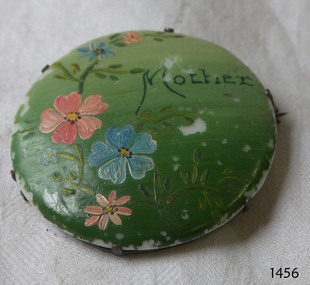
Brooch
... Brooch porcelain with hand painted decoration of flowers on a green background. Brass frame with pin attached to rear surface. ...flagstaff hill warrnambool shipwrecked-coast flagstaff-hill flagstaff-hill-maritime-museum maritime-museum shipwreck-coast flagstaff-hill-maritime-village brooch porcelain brooch The word 'Mother" is printed on the brooch Brooch porcelain with hand painted decoration of flowers on a green background. Brass frame with pin attached to rear surface. ...Brooch porcelain with hand painted decoration of flowers on a green background. Brass frame with pin attached to rear surface. Has the word "Mother" printed on it.The word 'Mother" is printed on the broochflagstaff hill, warrnambool, shipwrecked-coast, flagstaff-hill, flagstaff-hill-maritime-museum, maritime-museum, shipwreck-coast, flagstaff-hill-maritime-village, brooch, porcelain brooch -
 Flagstaff Hill Maritime Museum and Village
Decorative object - Flue Cover Art, 1890s to 1930s
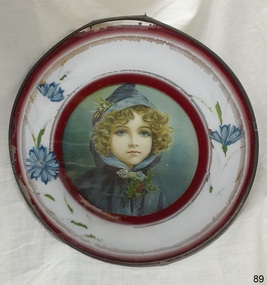
... brass or tin rim. The border was commonly gilt with a black stripe around the centre. There were numerous illustrations, many with a European appearance, and were easily bought through local merchants for a small price. This pretty flue cover is significant for representing a common domestic wall decoration ...In the late 19th and early-20th centuries household heaters burned wood and coal for heating. In winter the warm air from the fireplace would flow into the room through a round flue in the face of the chimney. In the warmer months the unnecessary heater and flue was removed and the chimney cleaned. Homemakers then covered the circular flue hole with a decorative and usually inexpensive wall hanging to prevent draughts and dust. The practice was especially popular in France and Germany where a lot of the artwork originated. The covers were no longer needed after households changed over to more modern designs of heaters. The flue covers were known as Wall Art or Flue Cover Art. They were usually round and illustrated with a lithograph or chromograph print. The picture was then mounted on card, covered with glass, and framed with a brass or tin rim. The border was commonly gilt with a black stripe around the centre. There were numerous illustrations, many with a European appearance, and were easily bought through local merchants for a small price.This pretty flue cover is significant for representing a common domestic wall decoration from the late Victorian to the Edwardian eras, when solid fuel heaters were used in low to high income homes. The picture is similar to many other flue cover images, apart from the holly clutched in the girl’s hand, which gives the cover a Christmas theme. This flue cover is the only one in our collection and appears to have a unique design; the hand painted floral decoration on the glass and the two crimson rings around the edges of the frame’s white border haven’t been seen on other flue covers. Flue cover, metal and glass. Print of a young girl with blue eyes and curly blonde hair, a hooded blue cape, a silver clasp with blue stones, and a sprig of holly in her hand. The round metal frame forms a deep, white-painted, crimson-edged border for the illustration. The hand-painted blue flowers on the glass front form add to the border and give a 3-dimensional effect. The picture is between the cardboard backing and the glass front, with the metal frame holding them together. There is a metal chain attached for hanging the cover.warrnambool, flagstaff hill maritime museum, picture, handpainted, portrait, girl in blue cape, metal frame, round picture, illustration, print, holly, christmas, child in blue cape, silver and blue clasp, holly sprig, late 19th century, early 20th century, 1890s-1930s, victorain, edwardian, flue cover, flue cover art, wall art, chimney flue cover, chimney hole cover, stove pipe cover, fireplace flue cover, antique, victorian, glass frame, chromograph, lithograph, tin, brass, lithograph print, chromo print, christmas girl, blue cape, blonde girl -
 Flagstaff Hill Maritime Museum and Village
Tool - Plane, Stanley Rule & Level Co, 18-05-1886
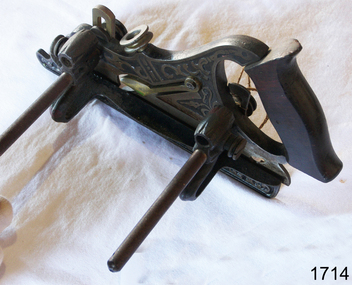
... The plane has an adjustable fence and depth stop and shows off fancy Japanned decoration. Cast steel with a wooden handle and brass fittings. 1/4 inch iron....The plane has an adjustable fence and depth stop and shows off fancy Japanned decoration. Cast steel with a wooden handle and brass fittings. 1/4 inch iron. ...Henry Stanley established Stanley Rule and Level Co. in 1857. In the following decade steel hand planes began to replace wooden planes. This decorative plane is an 1886 model, with several options to adjust the plane to suit the work. The antique plane displays quality workmanship of the 1880s. It was designed for hard work, replacing lighter wooden planes that were unsuitable for the big jobs. It was made by Stanley Rule and Level, a firm renowned for its good quality tools and now operating as Stanley Black and Decker.Plane; Beading type maker Stanley Rule & Level Co, patented in 1886. The plane has an adjustable fence and depth stop and shows off fancy Japanned decoration. Cast steel with a wooden handle and brass fittings. 1/4 inch iron.flagstaff hill, flagstaff hill maritime museum and village, warrnambool, maritime museum, maritime village, great ocean road, shipwreck coast, plane, beading plane, cast steel plane, 1880s plane, stanley rule & level co., hand plane, woodworking tool, woodworking plane, steel plane, carpentry tool, builder's tool -
 Flagstaff Hill Maritime Museum and Village
Functional object - Tap
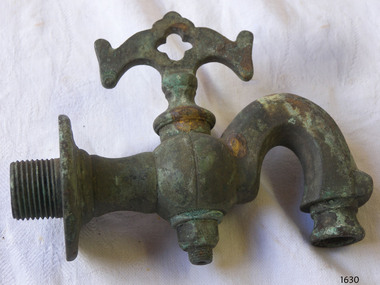
... Tap brass decorative with hooked barrel, cut away decoration on handle. Has thread for mounting. ...It is historically significant for representing aspects of Victoria’s shipping history and for its association with the shipwreck and the ship, which was designed to be fastest and most luxurious of its day Warrnambool Shipwrecked-coast Flagstaff-Hill Flagstaff-Hill-Maritime-Museum Maritime-Museum Shipwreck-coast Flagstaff-Hill-Maritime-Village Schomberg Shipwrecked-artefact Clipper ship Black Ball line 1855 shipwreck Aberdeen clipper ship Captain Forbes Peterborough shipwreck SS Queen tap brass gas tap Tap brass decorative with hooked barrel, cut away decoration on handle. Has thread for mounting. ...When the ship Schomberg was launched in 1855, she was considered the most perfect clipper ship ever to be built. James Blaine’s Black Ball Line had commissioned her to be built for their fleet of passenger liners. At a cost of £43,103, the Aberdeen builders designed her to sail faster than the quick clippers designed by North American Donald McKay. She was a three-masted wooden clipper ship, built with diagonal planking of British oak with layers of Scottish larch. This luxury vessel was designed to transport emigrants to Melbourne in superior comfort. She had ventilation ducts to provide air to the lower decks and a dining saloon, smoking room, library and bathrooms for the first-class passengers. At the launch of Schomberg’s maiden voyage, her master Captain ‘Bully’ Forbes, drunkenly predicted that he would make the journey between Liverpool and Melbourne in 60 days. Schomberg departed Liverpool on 6 October 1855 with 430 passengers and 3000 tons of cargo including iron rails and equipment intended the build the Geelong Railway and a bridge over the Yarra from Melbourne to Hawthorn. The winds were poor as Schomberg sailed across the equator, slowing her journey considerably. She was 78 days out of Liverpool when she ran aground on a sand spit near Peterborough, Victoria, on 27 December; the sand spit and the currents were not marked on Forbes’s map. Overnight, the crew launched a lifeboat to find a safe place to land the ship’s passengers. The scouting party returned to Schomberg and advised Forbes that it was best to wait until morning because the rough seas could easily overturn the small lifeboats. The ship’s Chief Officer spotted SS Queen at dawn and signalled the steamer. The master of the SS Queen approached the stranded vessel and all of Schomberg’s passengers were able to disembark safely. The Black Ball Line’s Melbourne agent sent a steamer to retrieve the passengers’ baggage from the Schomberg. Other steamers helped unload her cargo until the weather changed and prevented the salvage teams from accessing the ship. Local merchants Manifold & Bostock bought the wreck and cargo, but did not attempt to salvage the cargo still on board the ship. They eventually sold it on to a Melbourne businessman and two seafarers. After two of the men drowned when they tried to reach Schomberg, salvage efforts were abandoned.32 In 1975, divers from Flagstaff Hill, including Peter Ronald, found an ornate communion set at the wreck. The set comprised a jug, two chalices, a plate and a lid. The lid did not fit any of the other objects and in 1978 a piece of the lid broke off, revealing a glint of gold. As museum staff carefully examined the lid and removed marine growth, they found a diamond ring, which is currently on display in the Great Circle Gallery.33 Flagstaff Hill also holds ship fittings and equipment, personal effects, a lithograph, tickets and photograph from the Schomberg. Most of the artefacts were salvaged from the wreck by Peter Ronald, former director of Flagstaff Hill. The Schomberg, which is on the Victorian Heritage Register (VHR S612), has great historical significance as a rare example of a large, fast clipper ship on the England to Australia run, carrying emigrants at the time of the Victorian gold rush. She represents the technical advances made to break sailing records between Europe and Australia. Flagstaff Hill’s collection of artefacts from the Schomberg is significant for its association with the shipwreck, The collection is primarily significant because of the relationship between the objects, as together they have a high potential to interpret the story of the Schomberg. It is archaeologically significant as the remains of an international passenger Ship. It is historically significant for representing aspects of Victoria’s shipping history and for its association with the shipwreck and the ship, which was designed to be fastest and most luxurious of its day Tap brass decorative with hooked barrel, cut away decoration on handle. Has thread for mounting. Recovered from the wreck of the Schomberg.warrnambool, shipwrecked-coast, flagstaff-hill, flagstaff-hill-maritime-museum, maritime-museum, shipwreck-coast, flagstaff-hill-maritime-village, schomberg, shipwrecked-artefact, clipper ship, black ball line, 1855 shipwreck, aberdeen clipper ship, captain forbes, peterborough shipwreck, ss queen, tap, brass gas tap -
 Flagstaff Hill Maritime Museum and Village
Functional object - Lamp, circa 1878
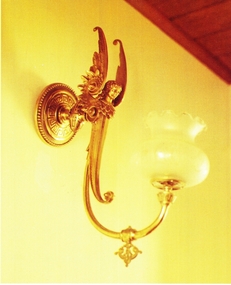
... Gas lamp, brass, single burner, wall-mounting bracket, delicately crafted. Ornate decoration features bust of an angel with up-swept wings, or 'flying angel'. ...The collection is also historically significant for its association with the LOCH ARD, which was one of the worst and best known shipwrecks in Victoria’s history. flagstaff hill warrnambool shipwrecked coast flagstaff hill maritime museum maritime museum shipwreck coast flagstaff hill maritime village great ocean road loch line loch ard captain gibbs eva carmichael tom pearce glenample station mutton bird island loch ard gorge lamp fitting shipwreck artifact 1878 shipwreck cargo household effects 19th century lighting angel lamp loch ard lamp angelic lamp lighting at sea marine technology ship's lighting flying angel gas lamp maritime archaeology port campbell None Gas lamp, brass, single burner, wall-mounting bracket, delicately crafted. Ornate decoration features bust of an angel with up-swept wings, or 'flying angel'. ...This Flying Angel lamp bracket was recovered from the wreck site of the steam sailing ship, "Loch Ard", which sank near Port Campbell, Victoria in 1878. It formed part of the ship's cargo. The 'flying angel' lamp was, for a time, displayed in the St Nicholas Seamen's Church at Flagstaff Hill. The design was very appropriate to the Missions to Seamen, being associated with the emblem of the 'flying angel' on the Missions' to Seamen's flag. Brief history of the Loch Ard: The vessel Loch Ard was constructed on the Clyde River in Scotland in 1873 for the prestigious Loch Line of colonial clipper ships, designed for the Australian run. She sailed from England on 1 March 1878 carrying 37 crew, 17 passengers and a diverse general cargo ranging from luxury items to bulk railway iron. On 1 June 1878, emerging from fog and hearing too late the sound of breakers against the tall limestone cliffs, the vessel struck the southern foot of Mutton Bird Island and sank in 23 metres of water. Of the fifty-four people on board only two survived, one young male crewman, Tom Pearce, and one young female passenger, Eva Carmichael. A century later, despite the pounding seas and the efforts of looters, the wreck site continued to provide ample evidence of the extraordinary range of goods being imported into the Colony of Victoria in the post-Gold Rush era. Flagstaff Hill divers in the 1970s reported finds of “Bottles of champagne, window panes, rolls of zinc, barrels of cement, iron rails, clocks, lead shot, corrugated iron, lead, marble, salad oil bottles, ink bottles, copper wire, gin bottles, rolls of carpet, floor tiles, copper rivets, gas light fittings, pocket knives, toys, crystal chandeliers, beer mugs, cutlery, candles sticks, wick scissors, cow bells, and sauce bottles.” The lamp bracket is significant for its connection with the wreck of the sailing ship, Loch Ard, in 1878. Flagstaff Hill’s collection of artefacts from LOCH ARD is significant for being one of the largest collections of artefacts from this shipwreck in Victoria. It is significant for its association with the shipwreck, which is on the Victorian Heritage Register (VHR S417). The collection is significant because of the relationship between the objects, as together they have a high potential to interpret the story of the LOCH ARD. The LOCH ARD collection is archaeologically significant as the remains of a large international passenger and cargo ship. The LOCH ARD collection is historically significant for representing aspects of Victoria’s shipping history and its potential to interpret sub-theme 1.5 of Victoria’s Framework of Historical Themes (living with natural processes). The collection is also historically significant for its association with the LOCH ARD, which was one of the worst and best known shipwrecks in Victoria’s history. Gas lamp, brass, single burner, wall-mounting bracket, delicately crafted. Ornate decoration features bust of an angel with up-swept wings, or 'flying angel'. Recovered from the wreck of the Loch Ard.Noneflagstaff hill, warrnambool, shipwrecked coast, flagstaff hill maritime museum, maritime museum, shipwreck coast, flagstaff hill maritime village, great ocean road, loch line, loch ard, captain gibbs, eva carmichael, tom pearce, glenample station, mutton bird island, loch ard gorge, lamp fitting, shipwreck artifact, 1878, shipwreck cargo, household effects, 19th century lighting, angel lamp, loch ard lamp, angelic lamp, lighting at sea, marine technology, ship's lighting, flying angel, gas lamp, maritime archaeology, port campbell -
 Flagstaff Hill Maritime Museum and Village
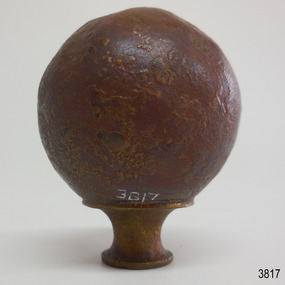
Decorative object - Sphere
... The Grange is an example of a mid-19th century vessel that carried a weapon of defence onboard. flagstaff hill warrnambool flagstaff hill maritime museum maritime museum shipwreck coast flagstaff hill maritime village great ocean road west coast trader apollo bay mid-19th century shipwreck the grange scottish barque little henty reef captain a alexander underwater explorers club of victoria 1840s carronade vhr 5297 coastal trader wooden shipwreck john chance wooden ship ship fitting sphere knob bed knob post decoration Sphere; thin hollow copper, various shades of brown, dimpled or hammered surface with a sheen, no joins. Base has a small hole and is fitted with a hollow, cylindrical brass collar. ...This metal sphere is part of the wooden barque, the Grange, built in 1840. The sphere was recovered from the shipwreck of the Grange in around 1968, 110 years after the Grange was wrecked (see below for further details on the Grange). It is part of the John Chance Collection. THE GRANGE, 1840-1858- The wooden barque ’Grange’ was a three-masted ship built in Scotland in 1840 for international and coastal trade. On March 22, 1858, the Grange set sail from Melbourne under Captain A. Alexander, carrying a cargo of ballast. The barque had left the Heads of Phillip Bay and was heading west along the Victorian coast towards Cape Otway. The ship struck Little Haley’s Reef at Apollo Bay due to a navigational error and was stuck on the rocks. The crew left the ship carrying whatever they could onto the beach. Eventually, the remains of the hull, sails and fittings were salvaged before the wreck of the Grange broke up about a month later. About 110 years later, in 1968, the wreck of the Grange was found by divers from the Underwater Explorers Club of Victoria. They were amazed to find a unique, six to nine pound carronade (type of small cannon) and a cannonball on the site. There have been no other similar carronades recorded. In that same year the anchor of the Grange was recovered by diver John Chance and Mal Brown. The sphere is significant historically as an example of hardware used when building wooden ships in the early to mid-19th century. The sphere is historically significant as an example of the work and trade of blacksmith. The sphere also has significant as it was recovered by John Chance, a diver from the wreck of the Grange in the 1968. Items that come from several wrecks along Victoria's coast have since been donated to the Flagstaff Hill Maritime Village’s museum collection by his family, illustrating this item’s level of historical value. The sphere is historically significant for its association with the 1840s wooden barque, the Grange. The Grange is an historical example of a Scottish built vessel used for international and coastal trader of both cargo and passengers in the mid-19th century. The Grange is an example of an early ship, designed with a wooden hull. It is significant as a ship still available to divers along the south coast of Victoria, for research and education purposes. The Grange is an example of a mid-19th century vessel that carried a weapon of defence onboard. Sphere; thin hollow copper, various shades of brown, dimpled or hammered surface with a sheen, no joins. Base has a small hole and is fitted with a hollow, cylindrical brass collar. The collar had a rim on top, inward curving sides and a narrower rim on the bottom. The sphere looks similar to a bed post knob.flagstaff hill, warrnambool, flagstaff hill maritime museum, maritime museum, shipwreck coast, flagstaff hill maritime village, great ocean road, west coast trader, apollo bay, mid-19th century shipwreck, the grange, scottish barque, little henty reef, captain a alexander, underwater explorers club of victoria, 1840s carronade, vhr 5297, coastal trader, wooden shipwreck, john chance, wooden ship, ship fitting, sphere, knob, bed knob, post decoration -
 Flagstaff Hill Maritime Museum and Village
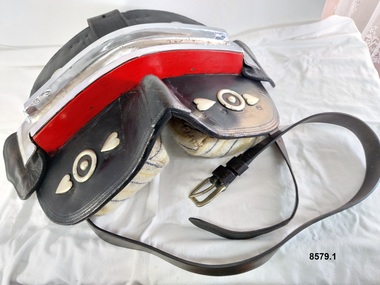
Equipment - Show Harness, R. Mitchell, Saddler, Early to mid-20th century
... brasses and fly terrets were fastened to various parts of a horse's harness. In the early days they probably began as amulets to ward off evil and to bring good luck and continued to be used as a festive decoration. ...brasses and fly terrets were fastened to various parts of a horse's harness. In the early days they probably began as amulets to ward off evil and to bring good luck and continued to be used as a festive decoration. ...The early settlers of Victoria depended on horse drawn vehicles to farm, make roads and railways, deliver produce and transport people. Horse harnesses were an important requisite for all drivers and could be found wherever there were working horses. Horse Harnesses have played an essential role in different cultures throughout history. Simple, utilitarian horse harnesses made of leather straps and iron rings were being used in early China before AD 500 as well as ancient Greece and Rome, allowing horses to pull chariots and ploughs. The Greeks and Romans were the first to use a "horse collar" which distributed the weight of the harness evenly across the horse's chest rather than relying on a "throat harness" that could damage a horse's throat or choke them. During the medieval period, European horse harnesses became more elaborate and decorative. Variations of different horse harnesses were also found in Native American and Middle Eastern cultures. Horse Harnesses usually have four basic components which include - 1. Communication - the bridle, bit and reins allows the driver to communicate instructions and commands to the horse, guiding its movement and direction. 2. Draft - the collar, hame straps, hames, traces and chains enables the horse to draw and pull the load efficiently by distributing the weight and transferring the pulling force to the vehicle. 3. Stopping - the breeching band, pole straps and breast strap helps to control or stabilise the horse and vehicle when moving downhill or stopping. 4. Support - the back pad, backband, belly band and back saddle keep the harness in the correct position and proper alignment. This show harness was used by Mr. Andy Bourke when showing his Clydesdales at shows or demonstrations. Although a more modern example with decorative embellishments, it still has many essential components traditionally found in an everyday working horse harness. The original purpose of the "housen" for example, was to run rain or drizzle off the horse's neck when they had to work in wet conditions - it was laid flat for this purpose on the top of the collar. Nowadays it is purely for show and is often used to advertise a business or stud. Horse brasses and fly terrets were fastened to various parts of a horse's harness. In the early days they probably began as amulets to ward off evil and to bring good luck and continued to be used as a festive decoration. The heyday of horse brasses was between the years 1851 and 1900. Horse brasses are fastened to various parts of the harness with many of their designs being symbolic. The ornamentation on this harness (although not authentic horse brasses) are based on the horse brasses that were popular in the 19th century. This horse harness is a significant example of the equipment that was needed wherever heavy horses were being used - particularly in the early years of Victoria's settlement by white settlers. Harnesses such as this example were used with stage coaches, drays, farming equipment, delivery carts and personal transportation.A leather and metal horse harness used when showing a Clydesdale (or other breed of heavy horse). It is made up of a number of components. 1. Decorative leather cart saddle with two large cloth pads underneath (which have a scalloped leather and stud border), a raised leather pommel and a silver and red coloured metal back strap holder across the top. It has two symmetrical sets of ornamentation (silver hearts and circles) in the front and a wide strap or girth (with a maker's stamp reading "R. Mitchell Saddler") and buckle which attaches the saddle to the horse. 2. Pair of steel hames which are gently curved (to fit on a horse collar) and are topped with steel knobs. They have several steel rings and lugs (to hold straps and chains) and a "Made in England Warranted Steel" stamp. 3. Breeching harness which consists of a number of leather straps, chains and metal rings including a wide padded leather strap with a scalloped edge that sits on the back of the horse and a thick leather strap that goes around the hind quarters of a horse which is joined to the back strap with four shorter vertical straps and buckles. These straps feature silver and red patent leather trim and silver heart shaped ornamentation. The strap also features the maker's stamp of "R. Mitchell". 4. Decorative leather bridle with blinkers featuring the same silver and red patent leather trim on the cheek piece, brow band and throatlatch. It has a stainless steel "Liverpool Driving Bit" with a curb chain, a variety of decorative silver ornaments (rosettes, diamonds plus a heart and two circles) on each end of the forehead band, dropper and strap as well as a silver metal bell (sometimes known as a "fly terret" or "swinger") that sits on the headpiece of the bridle. 5. Leather "violin shaped" dropper (or hanger) with two silver rosette shaped ornaments and a stainless steel clip on the top 6. Stainless steel "Liverpool Driving Bit" with a straight mouthpiece which is ribbed on one side. It has three rein spots (spaces) and a curb chain. 7. Leather arch shaped "Housen" covered in black and red patent leather and decorated with silver studs (some spelling out F H) and bordered with a red fringe. It has a leather strap at the back and two leather loops on the front. 8. Leather padded backband (Australian style "Stallion Draught Roller") decorated with two groups of nine metal "horse brasses" or harness ornaments displaying horseshoe, starburst and horse head designs on blue, red and white striped webbing. The backband has three notched straps at each end, a buckle near the centre and the initial B stamped in two places underneath. 9. Bellyband made of leather and red, white and blue striped webbing. It has a set of three buckles at each end (which correspond with the notched straps of the backband). 10. Wide, thick leather strap which has a buckle and notches at each end. It also has the maker's stamp of "R. Mitchell Saddler". 11.One pair of long leather traces - each with a buckle and notched loop at one end, decorated with a small silver diamond shaped harness ornament. 12. Length of stainless steel heavy duty chain with two swivel connectors.Saddle - "R.MITCHELL / SADDLER" Hames - "MADE IN ENGLAND / WARRANTED / STEEL" "MADE IN ENGLAND / WARRANTED / unclear" Breeching Straps - "R. MITCHELL / MAKER / R. MITCHELL MAKER" Housen - "F H" Backband "B / B' Wide leather strap - "R. MITCHELL / SADDLER"flagstaff hill maritime museum and village, warrnambool, great ocean road, shipwreck coast, harness, horse harness, show harness, clydesdale horses, andy bourke, horse drawn cart, housen, bridle, hames, breeching straps, dropper, bit, liverpool bit, backband, harness ornamentation, bellyband, back saddle, fly terret -
 City of Moorabbin Historical Society (Operating the Box Cottage Museum)
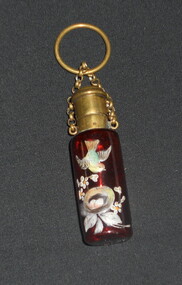
Container - Toiletries, perfume bottle c1800, Mid 19th Century
... This small, ruby glass, hand-painted lady's perfume bottle would have been one of a few small items, (such as small scissors, a pencil and note-pad, keys to the pantry) that Victorian women wore hanging from a Chatelaine attached to a belt around their waist.. glassware toiletries early settlers chatelaine pioneers moorabbin brighton bentleigh perfume manufactured glass Hand-painted decoration of a bird and flowers. c1800s a small, ruby glass, hand-painted ladies perfume bottle with a brass hinged lid, small glass stopper and a brass chain attached to a Chatelaine ring. ...This small, ruby glass, hand-painted lady's perfume bottle would have been one of a few small items, (such as small scissors, a pencil and note-pad, keys to the pantry) that Victorian women wore hanging from a Chatelaine attached to a belt around their waist..c1800s a small, ruby glass, hand-painted ladies perfume bottle with a brass hinged lid, small glass stopper and a brass chain attached to a Chatelaine ring. This would have been one of a few small items, (such as small scissors, a pencil and note-pad, keys to the pantry) that Victorian women wore hanging from a Chatelaine attached to a belt around their waist..Hand-painted decoration of a bird and flowers.glassware, toiletries, early settlers, chatelaine, pioneers, moorabbin, brighton, bentleigh, perfume, manufactured glass -
 Glenelg Shire Council Cultural Collection
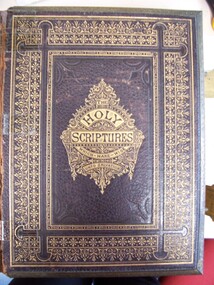
Book - Bible, Reverend John Brown, Brown's Self-Interpreting Family Bible, n.d
... Leather bound with brass clasps engraved with a decorative pattern. Gold decorations on front cover, on spine, and a gold decorative border on back cover with embossed pattern in centre. ...Leather bound with brass clasps engraved with a decorative pattern. Gold decorations on front cover, on spine, and a gold decorative border on back cover with embossed pattern in centre. ...Large bible. Leather bound with brass clasps engraved with a decorative pattern. Gold decorations on front cover, on spine, and a gold decorative border on back cover with embossed pattern in centre. Cover bears words "THE HOLY SCRIPTURES WHICH-MAKE-WISE UNTO SALVATION", within a decorative pattern. Incised brass edges to front and back cover. Gold paint and hand-coloured decorative title page. (see Object File).bible, religion -
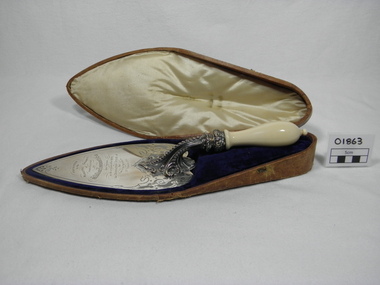 Glenelg Shire Council Cultural Collection
Ceremonial object - Ceremonial Trowel, c. 1863
... decoration and inscription. Bone handle. In leather case, lined on the inner base with blue velvet, and inside the lid with cream silk. The leather case has two brass...decoration and inscription. Bone handle. In leather case, lined on the inner base with blue velvet, and inside the lid with cream silk. The leather case has two brass ...Used by William Learmonth Esq., Chairman, Portland Municipal Council, to lay the foundation stone for the Portland Town Hall, 21st September 1863Silver Towel, engraved with decoration and inscription. Bone handle. In leather case, lined on the inner base with blue velvet, and inside the lid with cream silk. The leather case has two brass hinges and a small brass clasp.Engraved on face of trowel "PRESENTED / by the / MUNICIPAL COUNCIL / of / PORTLAND/ To / William Learmonth, Esq / their Chairman / on the occasion of his laying / the FOUNDATION STONE of / the / COUNCIL CHAMBER / 21st September, 1863". On reverse - 4 hallmarks, letter "BJ", number "551" and "(indeciperable maker's name) & Co / MELBOURNE"foundation stone, trowel, ceremonial, william learmonth, portland, town hall, municipal council -
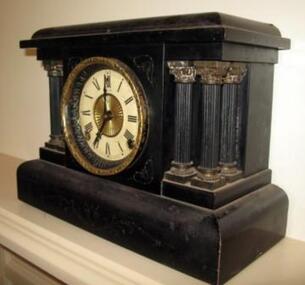 Learmonth and District Historical Society Inc.
Mantle Clock, "circa 1910"
... brass mechanicial movements.In 1956 Sessions was absorbed by another company while retaining the name and in 1969 the business went into liquidation. mantle clock the sessions clock company forestville conneticut united states of america THE SESSIONS CLOCK COMPANY. Successors to the E.N.WELCH MANUFACTURING COMPANY.Forestville.Conneticut.United States of America. Clock is made of black wood with Corinthian style columns,three set on each front corner. These are black metal, and show remains of gilt paint on top of columns.On the base of the clock is carved decoration ...Founded in1903 when William E.Sessions and some of his family took over E.N.Welch Co. in Forestville. E.N.Welch Manufacturing Company used a local foundry to produce their castings. The foundry owner's son,William E.Sessions, took an interest in horology and ,along with other Sessions family members, bought controlling interest in the E.N.Welch Company., which was a joint stock corporation formed July 6th 1864 to succeed an older private firm who made clocks under the name of E.N.Welch. Elisha N. Welch (1809-1887),had been making clocks at a factory on East Main Street Forestville Conneticut after taking over J.C.Browns bankrupt business around 1856.Under William Sessions management the firm produced all components of their clocks including movements,cases,dials,artworks and castings.In 1930 the company expanded to produce electric clocks,timers for radios,televisions and other devices as well as their traditional brass mechanicial movements.In 1956 Sessions was absorbed by another company while retaining the name and in 1969 the business went into liquidation.Clock is made of black wood with Corinthian style columns,three set on each front corner. These are black metal, and show remains of gilt paint on top of columns.On the base of the clock is carved decoration with similar carvings on each of the four corners of square around clock face.Dial is cream with Roman numerals. the hands are set in gilt centre piece.Below the 12 is the name WELCH.The glass dial cover is edged in gilt. It is spring wound and has settings-day/night,1/2 hour strike(hour on gong -1/2 0n bell), Cathederal Gong, turn back hands. THE SESSIONS CLOCK COMPANY. Successors to the E.N.WELCH MANUFACTURING COMPANY.Forestville.Conneticut.United States of America.mantle clock, the sessions clock company, forestville conneticut united states of america -
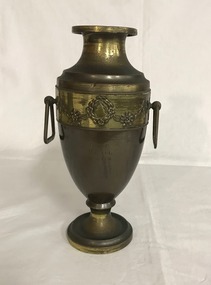 Orbost & District Historical Society
Award - Orbost Rifle Club trophy, 1931
... Brass trophy in the shape of an urn. Item has a gold coloured painted band with raised decorations across the wider part of the urn. ...Brass trophy in the shape of an urn. Item has a gold coloured painted band with raised decorations across the wider part of the urn. ...This trophy was won by Robert Call in 1931 for his excellent marksmanship shooter at the Orbost Rifle Club. Mr Gall won a number of trophies and was a crack shooter. Robert Gall married Annie Miller and they had 5 children. Unfortunately, Annie died from complications of childbirth. Later, Robert (Bob) married Amy Richardson of Bonang and they both contributed to many groups in Orbost including Bowls, Rotary, CWA, Croquet, Rifle Club, Masons and Fire Brigade. Bob won a coveted KING's Junior competing against contestants from all over Australia. Bob also did farming. This item is significant because it represents an important era of Orbost history (1900 to 1980's) when rifle shooting was an important sport.Brass trophy in the shape of an urn. Item has a gold coloured painted band with raised decorations across the wider part of the urn. Top of urn is open and has two attached handles.O.R.C. R.GALL Won 1931, inscription. robert gall, orbost rifle club, trophy -
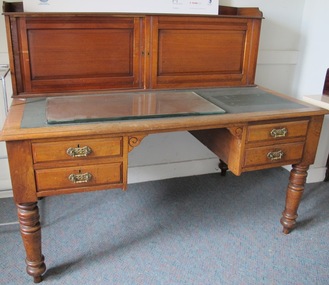 Mission to Seafarers Victoria
Furniture - Desk, unknown
... brass handles. The top cabinet features finer cabinetry and darker colour wood or stain which could be cedar.with simple narrow reeded decoration. ...brass handles. The top cabinet features finer cabinetry and darker colour wood or stain which could be cedar.with simple narrow reeded decoration. ...This desk was donated to the MTSV in 2017 by a descendant of Padre Oliver, Chaplain from 1930-1960.This desk belonged to Rodney Oliver and is believed to have been used by Padre Oliver and his wife while Chaplain, and the family resided at the MTS and thereafter in subsequent parish postings. The desk makes a link with one of the longest serving Chaplains who had a significant influence through the intense period of operations early - mid 20th C. The Padre's influence was substantial. The desk is also believed to have been used by son Rodney Oliver who also served the Mission as Chairman in the later 20th C.A four drawer leather topped desk with detachable unit comprising double sliding door lockable cabinet with small bookshelf backed with shallow pediment. Sorting / sectioned pigeonhole interiors to the top cabinets see images. The main table desk appears to be of a different wood with green leather inset to top surface and heavy legs. Drawers with heavily decorated brass handles. The top cabinet features finer cabinetry and darker colour wood or stain which could be cedar.with simple narrow reeded decoration. interior two pigeon holes with labelsfrank leslie oliver, padre oliver, chaplain, desk, mission to seafarers, melbourne, seamen's mission, flinders street, padre frank leslie oliver -
 Red Cliffs Military Museum
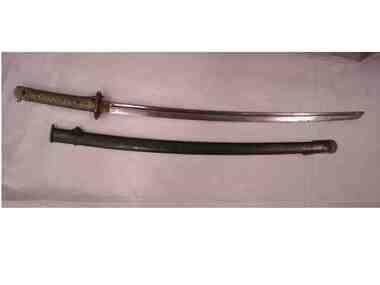
Japanese Sword, circa 1940's
... Brass very ornate with lotus. Scabbard is steel with ornate decorations. Steel blade....Brass very ornate with lotus. Scabbard is steel with ornate decorations. Steel blade. ...Noted with Sword. This Japanese sword was received by 2/8th Australian Field Regiment at the surrender at Miri, Borneo in 1945. The Regiment served in the Middle East (1940-43) as part of the 9th Australian Division. It's final action was in Boreo, once again with 9th Division. A Japanese Officer's sword. Hasornate inlay of shell covered with flat braided cord. Flat braided strap with tassles -brown and blue- Top end of hilt is leather with gold guilt scrolling. Brass very ornate with lotus. Scabbard is steel with ornate decorations. Steel blade. -
 The Cyril Kett Optometry Museum
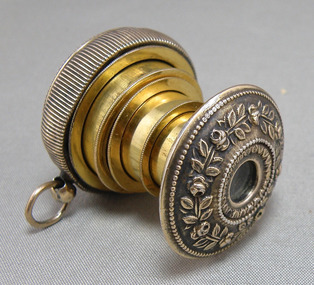
Instrument - Gilt brass spyglass, c1820
... Gilt brass 5 draw spyglass or small monocular telescope. Foliate and floral decoration around eyepiece, ribbed casing with suspension ring. 5 draw telescopic action extends the spyglass for use....Spyglasses were popular in the eighteenth and nineteenth century Vision Optical devices Fashion Gilt brass 5 draw spyglass or small monocular telescope. Foliate and floral decoration around eyepiece, ribbed casing with suspension ring. 5 draw telescopic action extends the spyglass for use. ...Spyglasses were popular in the eighteenth and nineteenth centuryGilt brass 5 draw spyglass or small monocular telescope. Foliate and floral decoration around eyepiece, ribbed casing with suspension ring. 5 draw telescopic action extends the spyglass for use.vision, optical devices, fashion
