
Showing 218 items matching "british regiments"
-
 4th/19th Prince of Wales's Light Horse Regiment Unit History Room
Leaflet, The Army Museum of New South Wales, The British Regiments in Australasia
... The British Regiments in Australasia...british regiments...An information leaflet from the Army Museum of New South Wales listing all the British Regiments that served in Australasia from 1788 to 1913...british regiments australia An information leaflet from the Army Museum of New South Wales listing all the British Regiments that served in Australasia from 1788 to 1913 The British Regiments in Australasia Leaflet The Army Museum of New South Wales ...An information leaflet from the Army Museum of New South Wales listing all the British Regiments that served in Australasia from 1788 to 1913british regiments, australia -
 8th/13th Victorian Mounted Rifles Regimental Collection
Drink coasters
... Set of five heavy card drink coasters with coloured scenes depicting British regiments while on garrison duty in Victoria. ...victoria barracks Set of five heavy card drink coasters with coloured scenes depicting British regiments while on garrison duty in Victoria. ...Set of five heavy card drink coasters with coloured scenes depicting British regiments while on garrison duty in Victoria. Brief details if each regiment on reverse of coaster. Regiments are victoria barracks -
 Whitehorse Historical Society Inc.
Accessory - British Royal Regiment Hat Badge
... Brass Coat of Arms on W.W.I British Royal Regiment Hat Badge...W.W.I British W.W.I Royal Regiment Badges Honi Soil Pui Maly Pense Brass Coat of Arms on W.W.I British Royal Regiment Hat Badge Accessory British Royal Regiment Hat Badge ...W.W.IBrass Coat of Arms on W.W.I British Royal Regiment Hat BadgeHoni Soil Pui Maly Pensebritish, w.w.i, royal regiment, badges -
4th/19th Prince of Wales's Light Horse Regiment Unit History Room
Book, LTCol Sir Richard Verdin, OBE TD, The Cheshire (Earl of Chester's) Yeomanry 1898-1967, 1971
... The last British regiment to fight on horses...The last British regiment to fight on horses In addition to the 4/19 Prince of Wale's Light Horse Regiment, the Cheshire's badge and motto was also that of the Prince of Wales To another feathers Regiment. ...The last British regiment to fight on horses In addition to the 4/19 Prince of Wale's Light Horse Regiment, the Cheshire's badge and motto was also that of the Prince of WalesRegimental history. Hard covered book 666 pagesTo another feathers Regiment. To the Sergeants' Mess of the 4/19 (PofW) Light Horse in appreciation. H V Norton. Superintendent Victoria Police Special Operations Group. 30-1-1980 -
 8th/13th Victorian Mounted Rifles Regimental Collection
Souvenir - Turkish belt
... Turkish Army belt collected in WW1 by a soldier serving in the Middle East and used to mount a collection of cap badges from various British regiments....Turkish Army belt collected in WW1 by a soldier serving in the Middle East and used to mount a collection of cap badges from various British regiments. badges Turkey World War one WWI Leather belt with Turkish Army buckle and a collection of British Army badges fixed along it. ...Turkish Army belt collected in WW1 by a soldier serving in the Middle East and used to mount a collection of cap badges from various British regiments.Leather belt with Turkish Army buckle and a collection of British Army badges fixed along it.badges, turkey, world war one, wwi -
 Dandenong/Cranbourne RSL Sub Branch
Memorabilia - Webbing belt, ca. 1940's
... Brown webbing belt with 14 brass shoulder badges mainly from British Territorial regiments, an Australian shoulder badge and three metal buttons pinned to it...Collected by a soldier during the First World War. ww1 world war 1 first world war british metal badges shoulder badges british regimental badges australian shoulder badges Various Brown webbing belt with 14 brass shoulder badges mainly from British Territorial regiments, an Australian shoulder badge and three metal buttons pinned to it Memorabilia Webbing belt ...Collected by a soldier during the First World War.Brown webbing belt with 14 brass shoulder badges mainly from British Territorial regiments, an Australian shoulder badge and three metal buttons pinned to itVariousww1, world war 1, first world war, british, metal badges, shoulder badges, british regimental badges, australian shoulder badges -
 Frankston RSL Sub Branch
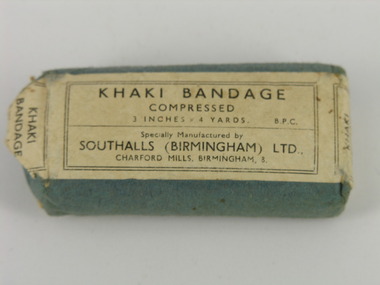
Dressing, Bandage
... A packaged compressed khaki bandage used by British RAF Regiment personnel training for airfield guard duties during the 1950s. ...A packaged compressed khaki bandage used by British RAF Regiment personnel training for airfield guard duties during the 1950s. ...A packaged compressed khaki bandage used by British RAF Regiment personnel training for airfield guard duties during the 1950s. The dressing is contained within a paper package. -
 Bendigo Military Museum
Award - MEDAL SET WW1, BRITISH, Post 1919
... Medals, court mounted, set of (2) Re Pte T. Darrie British Welsh Regiment. 1. War Medal 1914-18 (replica not inscribed). 2. ...Darrie Welsh Regiment" Medals, court mounted, set of (2) Re Pte T. Darrie British Welsh Regiment. 1. ...Medals, court mounted, set of (2) Re Pte T. Darrie British Welsh Regiment. 1. War Medal 1914-18 (replica not inscribed). 2. Victory Medal 1914-19"59331 Pte. T. Darrie Welsh Regiment" numismatic -medals - military, metalcraft -
 8th/13th Victorian Mounted Rifles Regimental Collection
Headwear - Busby, 1854 circa
... The busby was presented as a gift to 8th/13th Victorian Mounted Rifles by its affiliated British regiment, 8th Queen's Royal Irish Hussars in 1954....The busby was presented as a gift to 8th/13th Victorian Mounted Rifles by its affiliated British regiment, 8th Queen's Royal Irish Hussars in 1954. ...8th Hussars formed part of the Light Brigade which took part in the famous charge.Busby which belonged to C R Burn Esq 8th Hussars with metal box for hat and metal tube for plume. Busby was worn at Balaclava during the Crimean War 1854. Leather inner with brown fur outer covering; red cloth flap on right side; gold braid, white horsehair plume and red feathers at base or plume, gilt link chinstrap. The busby was presented as a gift to 8th/13th Victorian Mounted Rifles by its affiliated British regiment, 8th Queen's Royal Irish Hussars in 1954.On lid of hat box: " C R Burn Esq 8th Hussars" and "Hawkes and Co Piccadilly London"busby, hat, military, cavalry, hussars -
 Bendigo Military Museum
Award - MEDAL, BRITISH WAR, post WWI
... "LANC R", Lancaster Regiment, British...."LANC R", Lancaster Regiment, British. numismatics-medals-military Passchendaele barracks trust "34087 PTE A E HEIGHTON, R LANC R" British War Medal 1914-19, (1) court mounted re A E HEIGHTON. ..."LANC R", Lancaster Regiment, British.British War Medal 1914-19, (1) court mounted re A E HEIGHTON. "34087 PTE A E HEIGHTON, R LANC R"numismatics-medals-military, passchendaele barracks trust -
 Bendigo Military Museum
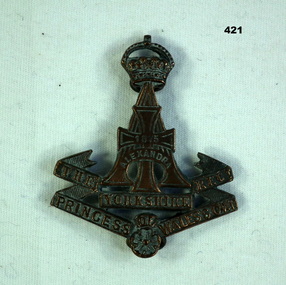
Badge - BADGE BRITISH, Pre WWI
... Badge, copper or brass, Yorkshire Regiment, British Crown over "A" with a cross centre. ...Badge, copper or brass, Yorkshire Regiment, British Crown over "A" with a cross centre. ...Relates to "The Cook Brothers" Collection. Refer 875 William Edwin Cook, 420 Sidney Cook (British)Badge, copper or brass, Yorkshire Regiment, British Crown over "A" with a cross centre. Scrolls at Bottom. Two lugs at rear for uniform attachments.1875, Alexandra, The Yorkshire Regt. Princess of Wales own.british regiment, badges yorkshire -
 Frankston RSL Sub Branch
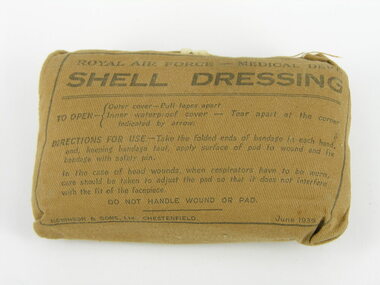
Dressing, Shell
... This example was used by British RAF Regiment personnel training for airfield guard duties during the 1950s. ...This example was used by British RAF Regiment personnel training for airfield guard duties during the 1950s. ...A packaged shell dressing carried by World War 2 service personnel. This example was used by British RAF Regiment personnel training for airfield guard duties during the 1950s. The dressing is contained within a waterproof cover, giving instructions to open and directions for use. -
 Frankston RSL Sub Branch
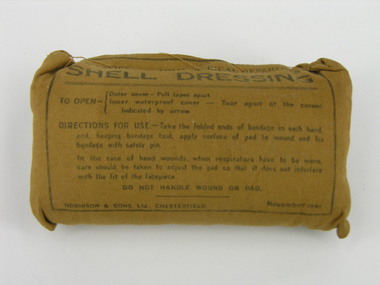
Dressing, Shell
... This example was used by British RAF Regiment personnel training for airfield guard duties during the 1950s. ...This example was used by British RAF Regiment personnel training for airfield guard duties during the 1950s. ...A packaged shell dressing carried by World War 2 service personnel. This example was used by British RAF Regiment personnel training for airfield guard duties during the 1950s. The dressing is contained within a waterproof cover, giving instructions to open and directions for use. -
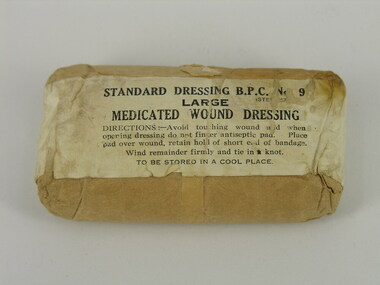 Frankston RSL Sub Branch
Dressing, Wound
... This example was used by British RAF Regiment personnel training for airfield guard duties during the 1950s. ...This example was used by British RAF Regiment personnel training for airfield guard duties during the 1950s. ...A packaged medicated wound dressing carried by World War 2 service personnel. This example was used by British RAF Regiment personnel training for airfield guard duties during the 1950s. The dressing is packaged in a brown paper cover, giving instructions to open and directions for use. -
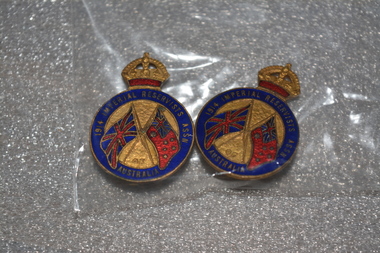 Wangaratta RSL Sub Branch
Badge - Badge - 1914 Imperial Reservists, c1914
... In 1914, approximately 6,000 Imperial Reservists—men who had previously served in British regiments, emigrated and were living in Australia. ...In 1914, approximately 6,000 Imperial Reservists—men who had previously served in British regiments, emigrated and were living in Australia. ...In 1914, approximately 6,000 Imperial Reservists—men who had previously served in British regiments, emigrated and were living in Australia. Upon the outbreak of war in August 1914, these men were recalled to serve with their old British units. Many of these reservists sailed in the first troop convoy to leave Australia in November 1914. These men were distinct from the newly formed Australian Imperial Force (AIF), which was raised in August 1914 for service under the Australian government, although many Australian citizens volunteered for service.British Imperial Reservists (IRs) who were living in Australia were recalled to the British Expeditionary Forces in World War One (WWI). Reservists sailed from Melbourne, Victoria on the HMAT Miltiades as part of the first convoy (Convoy 1) of troops leaving Australia in October 1914.Gold badge with crown on top, blue around outside, with Union Jack and Red Ensign in the middle. Has a horse shoe hook on back with a number.On front: 1914 Imperial reservists Assn, Australia. On back: One has 96, the other 69.wwi, world war 1, imperial reservists, australia -
 8th/13th Victorian Mounted Rifles Regimental Collection
Rosebowl, Subalterns Challenge Cup, 1893 circa
... Presented to the 8th/13th Victorian Mounted Rifles Regiment RAAC by its affiliated regiment the 8th Royal Irish Hussars as part of a gift of regimental property when a reorganisation of British cavalry regiments was being undertaken....Presented to the 8th/13th Victorian Mounted Rifles Regiment RAAC by its affiliated regiment the 8th Royal Irish Hussars as part of a gift of regimental property when a reorganisation of British cavalry regiments was being undertaken. 8th hussars rose bowl regimental silver horse racing subalterns challenge cup On side of bowl: "Subalterns Challenge Cup Presented to Lieut.Col. ...Presented to the 8th/13th Victorian Mounted Rifles Regiment RAAC by its affiliated regiment the 8th Royal Irish Hussars as part of a gift of regimental property when a reorganisation of British cavalry regiments was being undertaken.Silver rose bowl mounted on black shellacked wooden base. Bowl is oval in plan view and boat-shaped in elevation with human figurines as handles. Designation of the bowl as the Subalterns Challenge Cup inscribed on side of bowl while winners are inscribed on wooden base.On side of bowl: "Subalterns Challenge Cup Presented to Lieut.Col. Davidson and the Officers 8th Hussara by major C G Poley on leaving the Regiment May 1893" and on base: "Won at Wetherby 1896 Lt O'Brien br:g "Baccarat" Owner Won at Wetherby 1897 Lt F J C Howard's b.m Moonshine aged Owner 12st 3lb Won at Fethard 1898 Lt E A O'Brien br.g Baccarat Owner 12st 3lb Won at Mullaboden 1899 Lt E M Jennings b.g May Boy Owner 12st 3lb Won at Aldershot 1904 Lt H F Partridge's b.g Loch Lomond aged Owner 12st.3lb"8th hussars, rose bowl, regimental silver, horse racing, subalterns challenge cup -
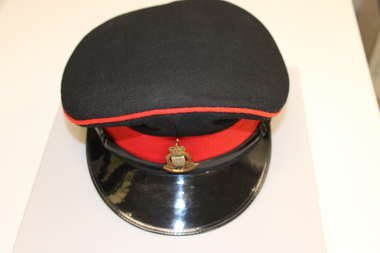 National Vietnam Veterans Museum (NVVM)
Headwear, Genuine British Army No. 1 dress uniform cap
... This is a ceremonial dress hat used by the Australian Armed Forces and the British Army regiments. The object belonged to Captain Kenneth G Anderson, Service No: 337727 Royal Australian Army Ordnance Corps June 1968 - July 1969. ...This is a ceremonial dress hat used by the Australian Armed Forces and the British Army regiments. The object belonged to Captain Kenneth G Anderson, Service No: 337727 Royal Australian Army Ordnance Corps June 1968 - July 1969. ...This is a black military peaked cap which features a distinctive red band and a polished visor. This is a ceremonial dress hat used by the Australian Armed Forces and the British Army regiments. The object belonged to Captain Kenneth G Anderson, Service No: 337727 Royal Australian Army Ordnance Corps June 1968 - July 1969. Royal Australian Army Ordnance Corps badge features the Kings Crown. The badge displays the Corps insignia, consisting of a garter enclosing a shield emblazoned with three cannons on cannonballs. Similar badges originating from the 50's and 60's. captain, 337727, anderson, ceremonial dress hat, peaked cap -
 Mont De Lancey
Clothing - Red Devils Beret and Belt, Kangol Wear Limited - Wartime textile and apparel contractors, WW2
... British paratroopers in July 1942. Initially it was adorned with an Army Air Corps badge. This was replaced with the Parachute Regiment badge in 1943. ...It has a silver coated British Parachute Regiment badge on the front, which features a winged parachute, surrounded by a King's crown. ...It has a silver coated British Parachute Regiment badge on the front, which features a winged parachute, surrounded by a King's crown. ...The maroon beret was adopted by the British paratroopers in July 1942. Initially it was adorned with an Army Air Corps badge. This was replaced with the Parachute Regiment badge in 1943. The maroon beret in a military configuration has been an international symbol of airborne forces since the Second World War. The beret was a practical headgear, for soldiers who needed a hat that could be worn in confined areas, slept in and could be stowed in a small space when they wore steel helmets. The "Red Devils" nickname and maroon beret were earned by the British 1st Parachute Brigade during World War II, though standard webbing belts rather than a specific "red devil belt" formed part of their gear. The Red Devils also flew into battle using military gliders rather than parachutes. This is a 'Red Devils' maroon felt beret and webbing belt worn by WW2 paratroopers. The beret has a black leather trim around the edges. It has a silver coated British Parachute Regiment badge on the front, which features a winged parachute, surrounded by a King's crown. The belt is made of red webbing with a closed sliver coated two piece clasp buckle, featuring the airborne parachute design. It has an adjustable slider.Inside the red beret is stitched a weathered marked plastic label holder with a piece of paper inserted - 'Hat size 7.1/8 0220. A/78/C.../DC...8(2) 'clothing, berets, headwear, ww2 paratroopers clothing -
4th/19th Prince of Wales's Light Horse Regiment Unit History Room
Uniform, about 1960
... The 4/7 Royal Dragoon Guards was formed in 1922 as a British Army cavalry regiment. In 1992 it was amalgamated with the 5th Royal Inniskilling Dragoon Guards to form the Royal Dragoon Guards...The 4/7 Royal Dragoon Guards was formed in 1922 as a British Army cavalry regiment. In 1992 it was amalgamated with the 5th Royal Inniskilling Dragoon Guards to form the Royal Dragoon Guards The 4/7 Royal Dragoon Guards is a British Army unit associated with the 4/19 Prince of Wales's Light Horse Regiment Uniform, 4/7 RDG On maker's label - "Baldwin" British Army Uniform No 2 Dress 1980 Pattern, 4/7 Royal Dragoon Guards. ...The 4/7 Royal Dragoon Guards was formed in 1922 as a British Army cavalry regiment. In 1992 it was amalgamated with the 5th Royal Inniskilling Dragoon Guards to form the Royal Dragoon GuardsThe 4/7 Royal Dragoon Guards is a British Army unit associated with the 4/19 Prince of Wales's Light Horse RegimentBritish Army Uniform No 2 Dress 1980 Pattern, 4/7 Royal Dragoon Guards. With Regimental badges and buttons, white lanyard and General Service Medal ribbon. No badges of rankOn maker's label - "Baldwin"uniform, 4/7 rdg -
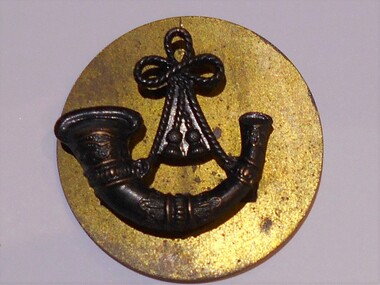 Bendigo Historical Society Inc.
Accessory - BADGE COLLECTION: LIGHT INFANTRY HAT BADGE, UK
... From the 1700's each British Foot Regiment had Light Companies (more mobile and loosely organized). ...From the 1700's each British Foot Regiment had Light Companies (more mobile and loosely organized). ...Object. Light Infantry Hat Badge, dark metal Bugle horn Badge with looped tassels above it, symbolizing the Rose of York. The badge is mounted on a brass disc (dia.4cm). Three lugs on the badge with two holding pins. The bugle horn badge was first introduced by the Germans in the 1700's. From the 1700's each British Foot Regiment had Light Companies (more mobile and loosely organized). These became Regiments in their own right, which were then called Light Infantry.numismatics, badges - military, light infantry hat badge -
 Wodonga & District Historical Society Inc
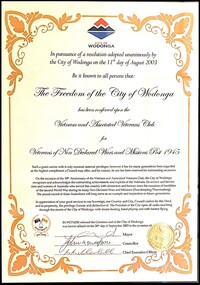
Certificate - Freedom of the City of Wodonga, August 2003
... The tradition of Freedom of Entry to a city stems from a custom observed by British Regiments in marching through the city of London. ...The tradition of Freedom of Entry to a city stems from a custom observed by British Regiments in marching through the city of London. ...The Right, Title, Privilege, Honour and Distinction of marching through the streets of a city on all ceremonial occasions with bayonets fixed, drums beating, bands playing and colours flying is one of the most interesting of the Military Traditions. The tradition of Freedom of Entry to a city stems from a custom observed by British Regiments in marching through the city of London. The fathers of the city of London claimed that they had the right to forbid bodies of Armed Forces from marching through the city precincts with bayonets fixed, colours flying and music playing, basing this claim on 'Ancient Privileges' which appear to have originated shortly after Charles Il became King in 1660. Military units were then only allowed to enter the city by invitation. The custom has been adopted by many Australian cities and shires. The privilege is usually only extended to Units which have a close association with the city and provides a means of honouring an Army Corps. The Freedom of the City of Wodonga has been conferred on different units based at Bandiana on several occasions. This Certificate commemorates the granting of Freedom of the City of Wodonga on the occasion of the 10th Anniversary of the Vietnam and Associated Veterans Club which was accompanied by a military parade on 11th August 2003. This Certificate is significant because it recognises the relationship between the City of Wodonga and the military forces which have served in the district.A framed certificate declaring the granting of Freedom of the City of Wodonga to Veterans, Ex-service and Service men and women of Australia who served Australia since the cessation of hostilities of the second World War. It bears the common seal of the City of Wodonga and was signed by Mayor Lisa Mahood, Councillor John Watson and Chief Executive Officer Peter Marshall.freedom of the city wodonga, military wodonga -
 National Wool Museum
Honor Board, Roll of Honor - Dennys Lascelles Ltd
... He served with a British regiment, the 42 Coy, Machine Gun Corps (Inf.) and has no know grave but is commemorated on the Tyne Cot Memorial in Belgium; Harold Thomas Burn was a 2nd Lieut. with the 58th Bn, Aust. ...He served with a British regiment, the 42 Coy, Machine Gun Corps (Inf.) and has no know grave but is commemorated on the Tyne Cot Memorial in Belgium; Harold Thomas Burn was a 2nd Lieut. with the 58th Bn, Aust. ...Honor board containing the names of the staff of Denny Lascelles Ltd. who served in WWI: Sergt. Wm Mathews, L. Cpl. N. McT. Evans, Lieut. Frank H. Lascelles, Lieut. H.T. Burn, C.J. Long, Captain H.H. Storrer, Lieut. Harvey Freeman, John Cameron, Allan Jenkins, S.E. Scott, R.D. Briers, Percy White. Four people on this list were killed in action: Lieut. Francis Hope Lascelles was killed on Weds, 22 Aug. 1917. He served with a British regiment, the 42 Coy, Machine Gun Corps (Inf.) and has no know grave but is commemorated on the Tyne Cot Memorial in Belgium; Harold Thomas Burn was a 2nd Lieut. with the 58th Bn, Aust. Inf., AIF and was killed on Sat. 23 Dec. 1916 aged 27. He is buried at St Sever Cemetery in Rouen. Henry Haigh Storrer was a Captain with the Australian Flying Corps and was killed on Sun. 2 Dec. 1917 aged 28. His brother died at Gallipoli in 1915. Henry Storrer is buried at Bailleul Communal Cemetery Extension, Nord. Lieut. Harvey Freeman served with the 11th Coy, Aust. Machine Gun Corps and was awarded a Military Cross. He was killed on Mon. 15th Oct. 1917 and is buried at Tyne Cot Cemetary in Belgium.Honor board; Dennys Lascelles Ltd staff who served in WWI.Roll of Honor. / DENNYS LASCELLES LTD. / SERGT. Wm. MATHEWS. / N. McT. EVANS. (L. CPL.) / * LIEUT. FRANK H. LASCELLES. / * H.T. BURN. (LIEUT.) / C.J. LONG. / * CAPTAIN H.H. STORER. / * HARVEY FREEMAN. (LIEUT.) / JOHN CAMERON. / ALLAN JENKINS. / S.E. SCOTT. / R.D. BRIERS. / PERCY WHITE. / * KILLED IN ACTION.world war i, dennys, lascelles limited -
 Warrnambool and District Historical Society Inc.
Household, Badges, Early 20th century
... Of the seventeen items on this board, most appear to be from British military units – Rifle Regiments, Despatch, etc. They appear to be shoulder and arm patches or badges. ...Of the seventeen items on this board, most appear to be from British military units – Rifle Regiments, Despatch, etc. They appear to be shoulder and arm patches or badges. ...Of the seventeen items on this board, most appear to be from British military units – Rifle Regiments, Despatch, etc. They appear to be shoulder and arm patches or badges. One appears to be of German origin and two come from Italy. This item is of great interest, firstly because it is a good example of the crude, but effective way, items were organized for display at the Warrnambool Historical Society in the 1960s and 70s. Secondly, the display contains an interesting variety of military insignia, many requiring further study.This is a piece of cardboard covered with black cloth which has been stitched to the board with black cotton. Attached to the cloth by metal clips are 17 metal and cloth badges and insignia from military units. The cloth material is red, white and green. ‘Gott Mit Uns’military insignia, history of warrnambool -
 Bendigo Military Museum
Book - BOOK, BRITAIN AND COLONIES, Michael P Garnett, Yeomanry Regiments of Great Britain and the Colonies, 2018
... Colour illustration on front cover - Regiments of British Yeomanry: Past and Present 1794 - 1914 from The Boy's Own Annual 1915 / 1915. 117 pages, cut, plain, glossy white illustrated, black / white & colour photos, posters, illustrations....Colour illustration on front cover - Regiments of British Yeomanry: Past and Present 1794 - 1914 from The Boy's Own Annual 1915 / 1915. 117 pages, cut, plain, glossy white illustrated, black / white & colour photos, posters, illustrations. ...Soft cardboard cover, black print on white background on front & spine. Colour illustration on front cover - Regiments of British Yeomanry: Past and Present 1794 - 1914 from The Boy's Own Annual 1915 / 1915. 117 pages, cut, plain, glossy white illustrated, black / white & colour photos, posters, illustrations.book, yeomanry, colonies -
 The 5th/6th Battalion Royal Victoria Regiment Historical Collection
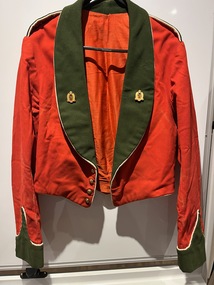
Uniform - 39th Battalion, The Hawthorn Kew Regiment Officer's Mess Dress Jacket c.1931
... The 39th Battalion, The Hawthorn Kew Regiment was allied with The Dorsetshire Regiment (British Army) in 1931. It is believed that as a token of friendship to commemorate the alliance, the officers of The Dorsets gifted the officers of the 39th Battalion with a number of their mess dress jackets which the 39th then adopted as a unit-specific mess dress; using their unit badges and Australian Army accoutrements. ...The 39th Battalion, The Hawthorn Kew Regiment was allied with The Dorsetshire Regiment (British Army) in 1931. It is believed that as a token of friendship to commemorate the alliance, the officers of The Dorsets gifted the officers of the 39th Battalion with a number of their mess dress jackets which the 39th then adopted as a unit-specific mess dress; using their unit badges and Australian Army accoutrements. ...The 39th Battalion, The Hawthorn Kew Regiment was allied with The Dorsetshire Regiment (British Army) in 1931. It is believed that as a token of friendship to commemorate the alliance, the officers of The Dorsets gifted the officers of the 39th Battalion with a number of their mess dress jackets which the 39th then adopted as a unit-specific mess dress; using their unit badges and Australian Army accoutrements. It is believed the jackets were worn throughout the 1930's until the start of WWII when it became harder to source the jackets. 39th Battalion, The Hawthorn Kew Regiment Officer's Mess Dress Jacket c.193139th battalion, 39th bn, 39th hawthorn kew regiment, mess dress, mess jacket, 5/6 rvr, 39th battalion hawthorn kew regiment, royal victoria regiment, 5th/6th battalion, victorian infantry, australian army, mess uniform, 1930s, militia period, kokoda -
 Bendigo Military Museum
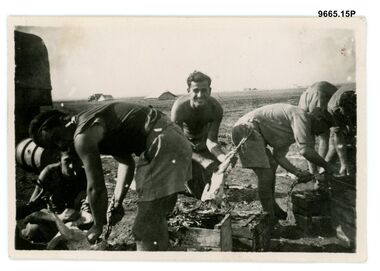
Photograph - 3 SQUADRON RAAF PHOTOGRAPHIC COLLECTION, Groundcrew, aircrew and other personnel
... The full set numbering and description is as follows: 9665.01P Africa 14-7 The end of a burnt out Kittyhawk.jpg 9665.02P Africa 16-2 Ikingi Maryat camp near Alexandria.jpg 9665.03P Africa 18-5 Benghazi.jpg 9665.04P Africa 22-1 Tripoli.jpg 9665.05P Africa 23-5 Cooks at Marble Arch Africa.jpg 9665.06P Africa17-3 Pongo Dan Hughes in underground hut El Hamma.jpg 9665.07P Airfield Italy.jpg 9665.08P Antiaircraft.jpg 9665.09P Bofors crew.jpg 9665.10P Bomb 1.jpg 9665.11P Bomb 2.jpg 9665.12P Bomb 3.jpg 9665.13P British regiment awaiting invasion embarkation.jpg 9665.14P Caption Cape Fil Ami.jpg 9665.15P Christmas dinner Foggia 2.jpg 9665.16P Christmas Dinner Foggia.jpg 9665.17P Crashed Italian aircraft.jpg 9665.18P DC 3.jpg 9665.19P Dead German artillery crew.jpg 9665.20P Goundcrew 3.jpg 9665.21P Graves desert.jpg 9665.22P Graves in Italy.jpg 9665.23P Groundcrew 1.jpg 9665.24P Groundcrew 2.jpg 9665.25P Italy Foggia 3.jpg 9665.26P Italy Foggia 4.jpg 9665.27P Italy 2.jpg 9665.28P Italy 21-3 Foggia.jpg 9665.29P Italy Foggia 10.jpg 9665.30P Italy Foggia 2.jpg 9665.31P Italy Foggia 5.jpg 9665.32P Italy Foggia 6.jpg 9665.33P Italy Foggia 7.jpg 9665.34P Italy Foggia 8.jpg 9665.35P Italy Foggia 9.jpg 9665.36P Italy Foggia.jpg 9665.37P Italy.jpg 9665.38P Jack Jones in a cargo bus DC3.jpg 9665.39P Jack Rourke and his uncle.jpg 9665.40P P40 Maintenance.jpg 9665.41P Sicily on the way to Sicily.jpg 9665.42P Sicily DC3.jpg 9665.43P Sicily Douglas DC3 .jpg 9665.44P Tripoli Kings Birthday Tripoli.jpg 9665.45P Unknown pilot.jpg...The full set numbering and description is as follows: 9665.01P Africa 14-7 The end of a burnt out Kittyhawk.jpg 9665.02P Africa 16-2 Ikingi Maryat camp near Alexandria.jpg 9665.03P Africa 18-5 Benghazi.jpg 9665.04P Africa 22-1 Tripoli.jpg 9665.05P Africa 23-5 Cooks at Marble Arch Africa.jpg 9665.06P Africa17-3 Pongo Dan Hughes in underground hut El Hamma.jpg 9665.07P Airfield Italy.jpg 9665.08P Antiaircraft.jpg 9665.09P Bofors crew.jpg 9665.10P Bomb 1.jpg 9665.11P Bomb 2.jpg 9665.12P Bomb 3.jpg 9665.13P British regiment awaiting invasion embarkation.jpg 9665.14P Caption Cape Fil Ami.jpg 9665.15P Christmas dinner Foggia 2.jpg 9665.16P Christmas Dinner Foggia.jpg 9665.17P Crashed Italian aircraft.jpg 9665.18P DC 3.jpg 9665.19P Dead German artillery crew.jpg 9665.20P Goundcrew 3.jpg 9665.21P Graves desert.jpg 9665.22P Graves in Italy.jpg 9665.23P Groundcrew 1.jpg 9665.24P Groundcrew 2.jpg 9665.25P Italy Foggia 3.jpg 9665.26P Italy Foggia 4.jpg 9665.27P Italy 2.jpg 9665.28P Italy 21-3 Foggia.jpg 9665.29P Italy Foggia 10.jpg 9665.30P Italy Foggia 2.jpg 9665.31P Italy Foggia 5.jpg 9665.32P Italy Foggia 6.jpg 9665.33P Italy Foggia 7.jpg 9665.34P Italy Foggia 8.jpg 9665.35P Italy Foggia 9.jpg 9665.36P Italy Foggia.jpg 9665.37P Italy.jpg 9665.38P Jack Jones in a cargo bus DC3.jpg 9665.39P Jack Rourke and his uncle.jpg 9665.40P P40 Maintenance.jpg 9665.41P Sicily on the way to Sicily.jpg 9665.42P Sicily DC3.jpg 9665.43P Sicily Douglas DC3 .jpg 9665.44P Tripoli Kings Birthday Tripoli.jpg 9665.45P Unknown pilot.jpg Groundcrew, aircrew and other personnel Photograph 3 SQUADRON RAAF PHOTOGRAPHIC COLLECTION ...The seven photographs shown above are part of an anonymous donation, by a relative, of the photographic collection of a former member of No. 3 Squadron RAAF 1939-1945. They cover the African, Sicily and Italian campaigns. The entire collection comprises 175 photographs. The collection has been divided into sets depicting various aspects of 3 Squadron operations. The above images are representative of this particular set of 45 photographs, featuring aircrew, groundcrew and other personnel. The museum has digitized the complete set.Set of 45 black and white photographs featuring groundcrew, aircrew and other personnel . The full set numbering and description is as follows: 9665.01P Africa 14-7 The end of a burnt out Kittyhawk.jpg 9665.02P Africa 16-2 Ikingi Maryat camp near Alexandria.jpg 9665.03P Africa 18-5 Benghazi.jpg 9665.04P Africa 22-1 Tripoli.jpg 9665.05P Africa 23-5 Cooks at Marble Arch Africa.jpg 9665.06P Africa17-3 Pongo Dan Hughes in underground hut El Hamma.jpg 9665.07P Airfield Italy.jpg 9665.08P Antiaircraft.jpg 9665.09P Bofors crew.jpg 9665.10P Bomb 1.jpg 9665.11P Bomb 2.jpg 9665.12P Bomb 3.jpg 9665.13P British regiment awaiting invasion embarkation.jpg 9665.14P Caption Cape Fil Ami.jpg 9665.15P Christmas dinner Foggia 2.jpg 9665.16P Christmas Dinner Foggia.jpg 9665.17P Crashed Italian aircraft.jpg 9665.18P DC 3.jpg 9665.19P Dead German artillery crew.jpg 9665.20P Goundcrew 3.jpg 9665.21P Graves desert.jpg 9665.22P Graves in Italy.jpg 9665.23P Groundcrew 1.jpg 9665.24P Groundcrew 2.jpg 9665.25P Italy Foggia 3.jpg 9665.26P Italy Foggia 4.jpg 9665.27P Italy 2.jpg 9665.28P Italy 21-3 Foggia.jpg 9665.29P Italy Foggia 10.jpg 9665.30P Italy Foggia 2.jpg 9665.31P Italy Foggia 5.jpg 9665.32P Italy Foggia 6.jpg 9665.33P Italy Foggia 7.jpg 9665.34P Italy Foggia 8.jpg 9665.35P Italy Foggia 9.jpg 9665.36P Italy Foggia.jpg 9665.37P Italy.jpg 9665.38P Jack Jones in a cargo bus DC3.jpg 9665.39P Jack Rourke and his uncle.jpg 9665.40P P40 Maintenance.jpg 9665.41P Sicily on the way to Sicily.jpg 9665.42P Sicily DC3.jpg 9665.43P Sicily Douglas DC3 .jpg 9665.44P Tripoli Kings Birthday Tripoli.jpg 9665.45P Unknown pilot.jpgno. 3 squadron raaf 1939-1945, african campaign ww2, italian campaign ww2 -
 Bendigo Military Museum
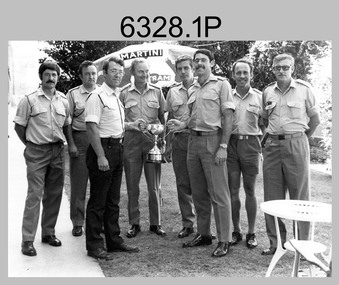
Photograph - Army Survey Regiment’s Rifle Shooting Team, Fortuna, Bendigo, c1979
... This set of 10 photographs of the Army Survey Regiment’s victorious rifle shooting team was taken outside the Tavern at Fortuna, Bendigo in c1979. The rifle shooting competition was the ‘Irwin Trophy for Shooting’, a contest with the British Army’s 42nd Engineer Regiment, the equivalent military geographic mapping unit at the time to the Army Survey Regiment. ...This set of 10 photographs of the Army Survey Regiment’s victorious rifle shooting team was taken outside the Tavern at Fortuna, Bendigo in c1979. The rifle shooting competition was the ‘Irwin Trophy for Shooting’, a contest with the British Army’s 42nd Engineer Regiment, the equivalent military geographic mapping unit at the time to the Army Survey Regiment. ...This set of 10 photographs of the Army Survey Regiment’s victorious rifle shooting team was taken outside the Tavern at Fortuna, Bendigo in c1979. The rifle shooting competition was the ‘Irwin Trophy for Shooting’, a contest with the British Army’s 42nd Engineer Regiment, the equivalent military geographic mapping unit at the time to the Army Survey Regiment. The bent .303 rifle seen in photo .3P was retrieved from the bottom of Fortuna’s lake when it was drained for restoration. It is believed an excavator drove over the rifle before it was retrieved.This set of 10 photographs of the Army Survey Regiment’s rifle shooting team was taken at Fortuna, Bendigo in c1979. The photographs were printed on photographic paper and are part of the Army Survey Regiment’s Collection. The 35mm positive photographic proofs were scanned at 600 dpi. Larger prints of .1P, .3P and .10P were scanned at 300 dpi. .1) & 2) - Photo, black & white, c1979, Rifle Shooting Team - L to R: Warren ‘Waldo’ Shirley, John Waight, Peter Searle UK Exchange, CO LTCOL Bob Skitch, Jim Macdonald, John Harrison, Max Neil, Stan Vote. .3) - Photo, black & white, c1979, Rifle Shooting Team - L to R: Stan Vote, John Harrison, Max Neil, Warren ‘Waldo’ Shirley, Jim Macdonald, John Waight. .4) - Photo, black & white, c1979, Rifle Shooting Team - L to R: CO LTCOL Bob Skitch, Jim Macdonald, Stan Vote. .5) - Photo, black & white, c1979, Rifle Shooting Team - L to R: John Waight, Warren ‘Waldo’ Shirley. .6) - Photo, black & white, c1979, Rifle Shooting Team - L to R: Warren ‘Waldo’ Shirley, CO LTCOL Bob Skitch. .7) - Photo, black & white, c1979, Rifle Shooting Team - L to R: CO LTCOL Bob Skitch, Warren ‘Waldo’ Shirley, Stan Vote, Jim Macdonald, Max Neil. .8) - Photo, black & white, c1979, Rifle Shooting Team - L to R: Jim Macdonald, Max Neil, Stan Vote. .9) - Photo, black & white, c1979, Rifle Shooting Team - L to R: CO LTCOL Bob Skitch, Peter Searle UK Exchange, Warren ‘Waldo’ Shirley. .10) - Photo, black & white, c1979, Irwin Trophy for Shooting..1P to .10P –No personnel are identified.royal australian survey corps, rasvy, army survey regiment, army svy regt, fortuna, asr -
 Red Cliffs Military Museum
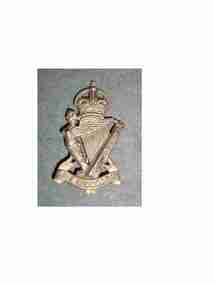
Hat Badge, Hat Badge Royal Irish Rifles WW1, (estimated); around 1900
... The Royal Irish Rifles was a British Army Infantry Regiment. It dates back to the reign of King George 111. ...The Royal Irish Rifles was a British Army Infantry Regiment. It dates back to the reign of King George 111. ...The Royal Irish Rifles was a British Army Infantry Regiment. It dates back to the reign of King George 111. In 1793 the British Army raised 2 new Regiments to meet the commitmentd of the war with the French First Republic. In 1881 under the Childers Reforms these 2 regiments were amalgamated to form the Royal Irish Rifles,it saw service in the Second Boer War, Great War. In 1921 it was renamed the Royal Ulster Rifles. Quis Separabit = "Who shall seperate us" (Latin) In 1968 under reforms of the army, was amalgamated with The Royal Inniskilling Fusiliers and the Royal Irish Fusiliers to form the Royal Irish Rangers. More information on this Regiment can be found on Wikipedia under Royal Ulster RiflesThis Royal Irish Rifles Hat badge appears to be a Pewter type alloy with brass clip. At top a Crown. Centre is harp shaped. Left side of harp has the figure of a siren her wings join to the right side of the harp which is a bar? adorned with raised decor. Bottom is a scroll with the lettering- Qius Separabit.Royal Crown Harp -Siren on left, wings joining to the right side with raised decor Scroll has - Quis Serarabithat, ww1, collection, royal, badge, a j, roddy, irish, rifles, pte2, james, ulster -
 Flagstaff Hill Maritime Museum and Village
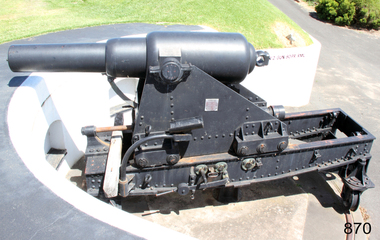
Weapon - Cannon, 1866
... British and Empire Governments. At the height of its operations during World War One the factory covered 1300 acres and employed very nearly 80,000 workers. Woolwich was the Headquarters of the Royal Artillery since the raising of that Regiment in 1716. ...British and Empire Governments. At the height of its operations during World War One the factory covered 1300 acres and employed very nearly 80,000 workers. Woolwich was the Headquarters of the Royal Artillery since the raising of that Regiment in 1716. ...In the years following the Crimean War (1854-1857J) there was a great concern in the Colony that Imperial Russia would attempt an invasion. Coastal defences in the colony of Victoria were greatly strengthened by the Government as a result. Warrnambool was originally protected by cannons at Cannon Hill, approximately 1 kilometer west of the Flagstaff Hill Fortifications. These cannons included two 1866 guns, both 80 Pound Rifled Muzzle Loaders (RML) purchased by Victoria’s Colonial Government. They were part of a shipment of 26 such guns sent from England in December 1866. They are registered as No. 23 (80cwt-2qr-0lbs) - Gun 1, and No.13 (81cwt-1qr-12lbs) - Gun 2. They were cast at the Royal Gun Factory, Woolwich Arsenal, in 1866 and have a 6.3 inch bore. Both barrels carry the Royal Cypher of Queen Victoria, Insignia of the Royal Engineers, within the Garter and Motto surmounted by the Crown, with the Royal Cypher of Queen Victoria within the Garter (letters in centre “VR”, motto “HONI SOIT QUI MAL Y PENSE”, "Shame be to him who thinks evil of it."). The guns were originally supplied with wooden carriages. (The Royal Arsenal at Woolwich, England, was established eleven years after the Restoration of King Charles II. It was the principal supplier of armaments to the British and Empire Governments. At the height of its operations during World War One the factory covered 1300 acres and employed very nearly 80,000 workers. Woolwich was the Headquarters of the Royal Artillery since the raising of that Regiment in 1716. The Arsenal was closed in the late 1960’s.) These two cannons were transferred to the Warrnambool Garrison Artillery Battery Fortifications erected at Flagstaff Hill in 1887 as part of Victoria’s Coastal Defences. The original wooden carriages were subsequently replaced with the present iron garrison carriages in 1888. They are a “C” pivot. The ‘racers’ or curved track set into the floor of the gun emplacement (which enabled the guns to be traversed more quickly) are as specified for guns up to 10 inch, being of wrought iron 2.78 inches wide. A temporary third gun, now no longer on Flagstaff Hill’s site, was a 5 inch Rifled Breech Loading (BL) Armstrong gun mounted on an Elswick hydro pneumatic disappearing carriage It was faster to load and fire than the 80 pound RMLs and its arrival spelt the end of the older 80 pound guns’ useful life, apart from being used for practice sessions. The 5 inch BL gun was the main defensive weapon of the Warrnambool Battery until the Battery was downgraded in importance and the gun was recalled to Melbourne in 1910. The State of Victoria took over the ownership of the guns at the time of Australian Federation in 1901. In about 1901/1902 the Garrison Battery was converted to the Warrnambool Battery of the Australian Field Artillery (No 4 Field Battery). It was equipped with 4.7 inch naval guns mounted on field carriages. They were now a mobile unit but continued to use the Warrnambool Garrison area at Flagstaff Hill for practice. When the Fortifications were declared obsolete, the two 80 Pounder RML were relocated to Cannon Hill in 1910. On the outbreak of World War One the 4.7 inch guns were recalled to Melbourne, and the Battery was disbanded. Most of the personnel probably re-enlisted in the local 4th Australian Light Horse Regiment. The two 80 Pounder RML were moved back to the Fortifications in 1973. They were both fully restored by Army First Year Apprentices at the Ordinance Factory in Bendigo in time for the centenary year of the fortifications in 1987. The guns are capable of firing 80 pound (32.3kg) armour piercing exploding shells 3.65kms out to sea. They were original manned by volunteers before a paid Garrison was established. Now the Guns are again fired by volunteers on Special Event days. Since restoration the Gun Number 1 had been fired on a regular basis but Gun Number 2 hadn’t been fired since the mid 1990’s. In April 2015 Gun Number 2 was serviced in preparation for the firing of both cannons on the ANZAC Centenary commemorations on April 25th 2015. Other guns from the original Cannon Hill location were obsolete by the time the 1887 Warrnambool Garrison Artillery Battery was built. These guns are (1) a 32 Pounder Muzzle Loading Smooth Bore (SB) cast in 1813 at the famous Carron Foundry, number 80837 and now located in the Warrnambool Botanic Gardens (2) a 68 Pounder Muzzle Loading Smooth Bore cast in 1861 at the equally august Low Moor Foundry, number 10310 and now located on the lawn area at the entrance to Flagstaff Hill Maritime Village. Both of these guns are mounted on their original wooden garrison carriages. There are only seven 32 Pounder SB made by Carron and fifteen 68 Pounder SB made at Low Moor known to exist in the State of Victoria. Funding was received to repair Cannon No.2 and its iron carriage. After completion, both Cannon No 1 and No. 2 were 'fired' in a public re-enactment on April 4th, 2026. (Conservation Management Plan for Victorian Guns and Cannon, South Western Victoria, May 2008, ref W/F/05)The Warrnambool Garrison has been added to the Victorian Heritage Register H1250 “for its intact battery and guns, a strong reminder of Victoria’s wealth and determination to protect itself from the perceived threat of invasion in the 1880’s.” The City of Warrnambool is one of several custodians of a collection of artillery pieces of heritage significance at a state, national and international level. These pieces are directly related to the defence of south-west Victoria in the 19th century. The care and preservation come under the Heritage Act 1995. Cannon. 80 Pound Rifled Muzzle Loading (RML) Gun on iron carriage and slide, installed in the Battery at Flagstaff Hill’s Fortifications. Made in 1866 at the Royal Gun Factory (R-G-F), Woolich, England. Gun Reg No 13. Flagstaff Hill Garrison Gun 2 (Gun No. 2). Insignia of the Royal Engineers, and the weight of the gun, stamped on top of the gun’s barrel. There is a brass plate on the side of the gun with the details of 1987 restoration.Stamped into the metal on top of the barrel, Insignia of the Royal Engineers; Garter and Motto “HONI SOIT QUI MAL Y PENSE”, surmounted by the Crown, with the Royal Cypher of Queen Victoria “VR” within the Garter. Also stamped on top of the gun are 2 inward pointing arrows above the weight ”81-1-12”. Brass plate “RESTORATION / BY / FIRST YEAR / APPRENTICES / ORDANANCE FACTORY / BENDIGO 1987”flagstaff hill, warrnambool, shipwrecked coast, flagstaff hill maritime museum, maritime museum, shipwreck coast, flagstaff hill maritime village, great ocean road, colonial defences, victoria’s coastal defences, warrnambool fortification, warrnambool garrison battery, warrnambool volunteer corps, ordinance, armaments, cannon hill fortifications, 4th australian light horse regiment, no 4 field battery, 80 pound cannon rifled muzzle loaders (rml), victorian colonial government, royal gun factory england, woolwich arsenal, royal cypher of queen victoria, garrison gun -
 Flagstaff Hill Maritime Museum and Village
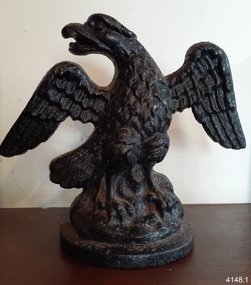
Decorative object - Bookends
... Regiments, mounted on a standard to represent the honour and pride of fighting French men. It is believed that the Napoleonic Eagle was chosen as a symbol for the Tamar Bank in Launceston, Tasmania, established in 1834. The bank was formed after the separation of one of the branches of the Bank of Van Diemen’s Land. The Managing Director in 1834 was Lewis Gilles, previously a naval officer. Other directors were T. Williams, M. Connolly, F. D. Wickham, and P. Oakden. The bank was dissolved in 1838 and became the basis of the Launceston branch of the British...Regiments, mounted on a standard to represent the honour and pride of fighting French men. It is believed that the Napoleonic Eagle was chosen as a symbol for the Tamar Bank in Launceston, Tasmania, established in 1834. The bank was formed after the separation of one of the branches of the Bank of Van Diemen’s Land. The Managing Director in 1834 was Lewis Gilles, previously a naval officer. Other directors were T. Williams, M. Connolly, F. D. Wickham, and P. Oakden. The bank was dissolved in 1838 and became the basis of the Launceston branch of the British ...The individual eagles in this pair of Napoleonic Eagle bookends are made so that each eagle faces the opposite direction to the other, one left and one right. The Napoleonic Eagle is the name given to the eagle symbol used by Napoleon Bonaparte 1799-1815 and the French Regiments, mounted on a standard to represent the honour and pride of fighting French men. It is believed that the Napoleonic Eagle was chosen as a symbol for the Tamar Bank in Launceston, Tasmania, established in 1834. The bank was formed after the separation of one of the branches of the Bank of Van Diemen’s Land. The Managing Director in 1834 was Lewis Gilles, previously a naval officer. Other directors were T. Williams, M. Connolly, F. D. Wickham, and P. Oakden. The bank was dissolved in 1838 and became the basis of the Launceston branch of the British-founded Union Bank of Australia Limited, established in 1837 and had its own emblem. The Union Bank of Australia merged with the Bank of Australasia in 1951 and went on to eventually become part of the Australia and New Zealand (ANZ) Banking Group. The Bank of Australasia was incorporated by Royal Charter of England in March 1834. It had its Australian beginning on 14th December 1835, opening in Sydney. The Acting Superintendent of the bank at that time was David Charters McArthur. He was Superintendent from 1867 to 1876. The Melbourne branch opened on 28th August 1838 in a two-roomed brick cottage on the north side of Little Collins Street. By 1879 the bank had been upgraded to a magnificent two-storey building on the corners of Collins and Queens Streets, with the entry on Collins Street. In 1951 the Bank of Australasia amalgamated with the Union Bank to form the Australia and New Zealand Bank, now known as the ANZ. Then in 1970, the ANZ merged with the ES&A and the London Bank of Australia to form the ANZ Banking Group Limited. The ANZ Banking Group Ltd kindly donated to Flagstaff Hill various historic items from the Bank of Australasia. BANK of AUSTRALASIA, WARRNAMBOOL – In 1854 Warrnambool had two banks, the Union Bank and the Bank of Australasia. Later, completely different bank businesses opened; in 1867 the National Bank of Australasia, then in 1875 the Colonial Bank of Australasia. The original Warrnambool branch of the Bank of Australasia was established in July 1854, and operated from a leased cottage on Merri Street, close to Liebig Street. The bank next bought a stone building previously erected by drapers Cramond & Dickson on the corner of Timor and Gibson Streets. Samuel Hannaford was a teller and then Manager at the Warrnambool branch from 1855 to 1856 and the Warrnambool Council chose that bank for its dealings during 1856-57. In 1859 Roberts & Co. was awarded the contract to build the new Bank of Australasia branch for the sum of £3,000; the firm built the Warrnambool Post Office in 1856 and purchased land in Timor Street in 1858. The land was on a sand hill on the northeast corner of Timor and Kepler Streets and had been bought in 1855 by investor James Cust. The new building opened on May 21, 1860. The bank continued to operate there until 1951 when it merged with the Union Bank to form the ANZ Bank, which continued operating from its Liebig Street building. Warrnambool City Council purchased the former Bank of Australasia building in 1971 and renovated it, then on 3rd December 1973 it was officially opened as the Art Gallery by Cr. Harold Stephenson and Gallery Director John Welsh. The Gallery transferred to the purpose-built building on Liebig Street in 1986 and the old bank building is now the Gallery Club. Staff at the Bank of Australasia in Warrnambool included the following men but others were also involved: Samuel Hannaford, Teller then Manager from 1855-1856; Hawkins, Manager in 1856, W H Palmer, Manager from January 1857 until November 1869 when the Teller Basil Spence was promoted to Manager; H B Chomley, Manager from April 1873 and still there in 1886; A Butt, Manager in 1895-1904; J R McCleary Accountant and Acting Manager for 12 months, until 1900; A Kirk, Manager 1904; J Moore, staff until his transfer to Bendigo in December 1908; J S Bath was Manager until 1915; C C Cox, Manager until April 1923; Richard C Stanley, Manager 1923 to April 1928. This pair of Napoleonic Eagle bookends represents the type of ornaments appropriate for 19th and 20th-century business associated with finance and commerce. They symbolise strength, reliability and power. It is believed that the Napoleonic Eagle was the seal of the Tamar Bank, established in 1834 in Launceston, Tasmania. The Tamar bank was taken over by the Australia-wide Union Bank in 1838, which later merged with the Bank of Australasia, which had a branch in Warrnambool. In 1851 it became the Australia and New Zealand Bank, which is still active in Warrnambool in 2023. Bookends; two (2) black metal eagles, standing, beaks open, tail to the side, wings spread, claws open. The black figures are cast metal and the backs are hollow, with flat even edges. The front is textured and shiny. The eagles are facing opposite directions; one left, one right. The figures are commonly known as Napoleonic eagles.flagstaff hill maritime museum and village, warrnambool, great ocean road, shipwreck coast, bookends, eagle bookends, napoleonic eagles, tamar bank, launceston bank, bank of australasia, eagle symbol, 1834-1838, commerce, financial institution, colonial bank, lewis gilles, m. connolly, f. d. wickham, and p. oakden., t. williams, anz bank, australia and new zealand bank, union bank of australia
