
Showing 107 items matching "buddhist"
-
 Duldig Studio museum + sculpture garden
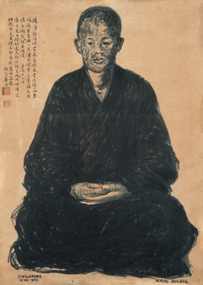
Drawing, Karl Duldig, The Buddhist Monk, Guangqia by Karl Duldig 1940, 1940
... The Buddhist Monk, Guangqia by Karl Duldig 1940...The Buddhist monk Guangqia visited Karl Duldig’s studio on two consecutive days, in the company of the noted Chinese writer, Professor Yu Dafu, a friend of Karl’s. ...Brush drawing in chinese ink on paper. Seated Buddhist Monk. Chinese calligraphy hand written in black ink. ...The Buddhist monk Guangqia visited Karl Duldig’s studio on two consecutive days, in the company of the noted Chinese writer, Professor Yu Dafu, a friend of Karl’s. ...The Buddhist monk Guangqia visited Karl Duldig’s studio on two consecutive days, in the company of the noted Chinese writer, Professor Yu Dafu, a friend of Karl’s. Karl made two portraits of the monk, the first depicting him sitting, and the second in a standing pose. The portraits were drawn using a Chinese brush and Indian ink. Surviving sketches in the Studio’s collection indicate that Karl thought about creating a life-size sculpture later on, but this was not realised. Guangqia added inscriptions in his own hand to both drawings and stamped them with a red seal. The seated drawing has an inscription in which he quoted from a Buddhist poem, ‘A Contented Mind’ by the scholar Lingfeng of Mt Tiantai. In the summer I went to visit the Austrian sculptor Duldig with Professor Yu Da Fu. My virtue is slight – I cannot accept your offerings and gifts; I am amply rewarded by the clouds and springs. Rather than a table laden with pearl-like rice, I prefer the wind and leaves falling on my bed. Sitting quietly on my meditation cushion Is sweeter than the wheat offered by a thousand families. The pity is that I am gradually growing old; My bitter journey is not worthy of your offerings. The second drawing has a quote from a Buddhist poem on the study of Chán (Zen) Buddhism, by the famed Chán master, Dàjiàn Huìnéng (638–713): The portrait, with its figure positioned on a scroll-like ground and inscription is reminiscent of traditional Zen Buddhist portraiture. In this school of portraiture, which stretched back to at least the thirteenth century, monks were depicted sitting or standing facing the viewer, and typically the monk added an autographic inscription to the portrait. The portraits were often passed from master to disciple, continuing the disciples’ journey of spiritual enlightenment and were revered for their association with remarkable or holy priests. The Buddhist monk, Guangqai who added his inscription and stamp to the drawings would most certainly have been aware of this tradition. It is likely that Karl was aware of this tradition, one of the points where the studio’s collections of art works from Singapore intersect with the earlier Viennese collections can be found in the Library where a catalogue of an exhibition, 'Ausstellung Ostasiatischer Malerie und Graphik' is held. The Viennese Friends of Asian Art and Culture and the Albertina Museum staged this exhibition of East Asian painting and graphic works in 1932. Such was the internationalism of Duldig’s education in Vienna, that adaption to a new environment and culture in the Straits Settlement was swift, and he was able to interpret the artistic traditions of the place, and make them his own. It is part of the strength of the collection, that in many cases contemporary supporting documentation for the works of art is available. In this case there is a photograph of the Monk with Yu Ta-fu, and Karl and Eva Duldig, outside the studio at the time the drawings were made. Ann Carew 2016The portraits of Guangqai have national and international aesthetic significance. The works of art demonstrate the artist’s skill in capturing the physical appearance and demeanour of his subject, and his ability to adapt his working methods to incorporate traditional Asian materials and cultural practices. The portrait is one of few examples in Melbourne of a central European modernist artists working in, and engaging with Asia, during this period and it is culturally and aesthetically significant for this reason. The portraits are also historically interesting in documenting the life and experiences of Karl Duldig in the Straits Settlement (Singapore). Ann Carew 2016Brush drawing in chinese ink on paper. Seated Buddhist Monk. Chinese calligraphy hand written in black ink. Two red stamps under calligraphy.Signed Karl Duldig in l.r. corner. Dated Singapore 1940 in l.l. corner. -
 Mrs Aeneas Gunn Memorial Library
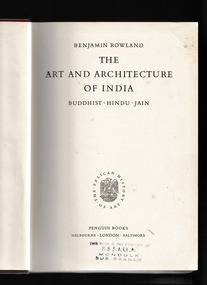
Book, Penguin Books, The art and architecture of India : Buddhist, Hindu, Jain, 1953
... The art and architecture of India : Buddhist, Hindu, Jain...Art - India Architecture - India The art and architecture of India Index, ill, p.288., 190p. of plates, 1 map The art and architecture of India : Buddhist, Hindu, Jain Book Penguin Books Benjamin Rowland. ...The art and architecture of IndiaIndex, ill, p.288., 190p. of plates, 1 mapnon-fictionThe art and architecture of Indiaart - india, architecture - india -
 Sunshine and District Historical Society Incorporated
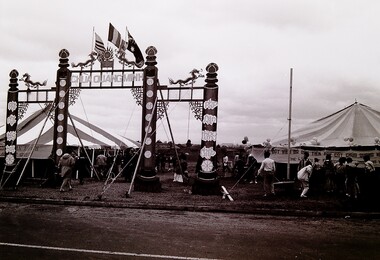
Photograph - Quang Minh Buddhist Temple 18 Burke Street Braybrook 1991 Photographs, The Sunshine Advocate, 21st September 1991
... Quang Minh Temple began in the early 1980s as a small Vietnamese Buddhist community in Richmond and Footscray. ...New Buddhist Community Centre 479.1...Quang Minh Temple began in the early 1980s as a small Vietnamese Buddhist community in Richmond and Footscray. ...Quang Minh Temple began in the early 1980s as a small Vietnamese Buddhist community in Richmond and Footscray. After several relocations, it settled permanently in Burke Street, Braybrook in 1989, with its main hall being completed in 1994. It is now the headquarters of the United Vietnamese Buddhist Congregation of Victoria and one of the largest Vietnamese Buddhist temples in Australia.These are very early photographs of the new Quang Minh Buddhist Temple after it relocated to this site in 1989.New Buddhist Community Centre 479.1quang minh buddhist temple, burke street, braybrook -
 National Vietnam Veterans Museum (NVVM)
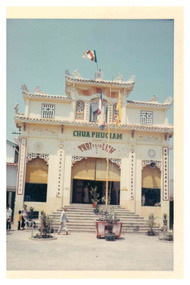
Photograph - Buddhist pagoda
... ...Buddhist...Coloured photo of a Buddhist pagoda. The building is white with coloured trims. ...The photo taken by Rosalind Marshall who volunteered as a civilian radiographer in Bien Hoa South Vietnam. Marshall Buddhist Pagoda Vietnam CHUA PHUCLAM/PHAT2510LNH Coloured photo of a Buddhist pagoda. ...The photo taken by Rosalind Marshall who volunteered as a civilian radiographer in Bien Hoa South Vietnam.Coloured photo of a Buddhist pagoda. The building is white with coloured trims. It has a Vietnamese flag flying at the top. CHUA PHUCLAM/PHAT2510LNHmarshall, buddhist, pagoda, vietnam -
 Great Stupa of Universal Compassion
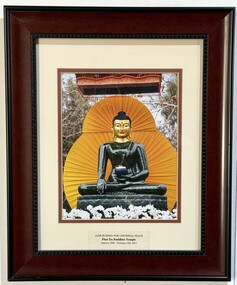
Photograph (item) - Photograph of the Jade Buddha displayed at Phat Da Buddhist Temple, San Diego, California, 06/02/2011
... Standing 2.5 meters tall and weighing 4 tones, this priceless Buddhist statue toured over 120 cities across 20 countries from 2009 to 2018, inspiring peace in families, schools, and communities worldwide. ...A framed photograph of the Jade Buddha displayed at Phat Da Buddhist Temple....Jade Buddha Memorabilia Great Stupa Archive A framed photograph of the Jade Buddha displayed at Phat Da Buddhist Temple. Photograph Photograph of the Jade Buddha displayed at Phat Da Buddhist Temple, San Diego, California Great Stupa of Universal Compassion ...The Jade Buddha for Universal Peace, the largest Buddha carved from gemstone-quality jade in the world, is the centerpiece of the Great Stupa of Universal Compassion in Bendigo, Australia. Standing 2.5 meters tall and weighing 4 tones, this priceless Buddhist statue toured over 120 cities across 20 countries from 2009 to 2018, inspiring peace in families, schools, and communities worldwide. After attracting an estimated 12 million visitors, it returned to the Great Stupa in May 2018, where it continues to be a potent symbol of peace.This framed photograph, presented on 06/02/2011 by Thich Nguyen Sieu of Phat Da Temple at the California Center for the Arts, Escondido (CA), commemorates the temple’s contribution to the Jade Buddha’s journey and its role in promoting peace and spiritual reflection.jade buddha, memorabilia, great stupa archive -
 Great Stupa of Universal Compassion
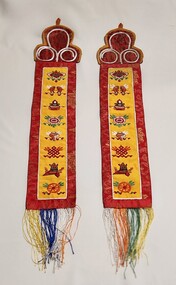
Artwork, other - Auspicious symbols hangings
... These types of wall hangings are commonly used in homes, temples and meditation spaces to bring blessings, good fortune and to remind practitioners of the Buddhist teachings....Two identical hangings feature the eight auspicious symbols of Buddhist iconography: the precious parasol, white conch shell, two golden fish, eternal knot, treasure vase, victory banner, lotus flower and dharma wheel....These types of wall hangings are commonly used in homes, temples and meditation spaces to bring blessings, good fortune and to remind practitioners of the Buddhist teachings. The eight auspicious symbols represent blessings, spiritual qualities and the path to enlightenment. ...These types of wall hangings are commonly used in homes, temples and meditation spaces to bring blessings, good fortune and to remind practitioners of the Buddhist teachings.The eight auspicious symbols represent blessings, spiritual qualities and the path to enlightenment. They symbolise the totality of the Buddha’s teachings and the harmony of the universe.Two identical hangings feature the eight auspicious symbols of Buddhist iconography: the precious parasol, white conch shell, two golden fish, eternal knot, treasure vase, victory banner, lotus flower and dharma wheel.holy objects, worship devices -
 Great Stupa of Universal Compassion
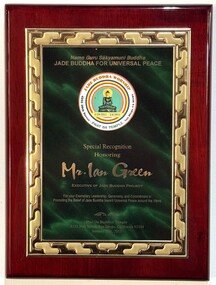
Plaque (item) - Plaque to Ian Green from Phat Da Buddhist Temple, California, USA, 29/01/2011
... Standing 2.5 meters tall and weighing 4 tones, this priceless Buddhist statue toured over 120 cities across 20 countries from 2009 to 2018, inspiring peace in families, schools, and communities worldwide. ...A plaque from Phat Da Buddhist Temple honoring Ian Green for exemplary leadership, generosity and commitment in touring the Jade Budda for Universal Peace around the world....Plaque Plaque to Ian Green from Phat Da Buddhist Temple, California, USA Great Stupa of Universal Compassion ...The Jade Buddha for Universal Peace, the largest Buddha carved from gemstone-quality jade in the world, is the centerpiece of the Great Stupa of Universal Compassion in Bendigo, Australia. Standing 2.5 meters tall and weighing 4 tones, this priceless Buddhist statue toured over 120 cities across 20 countries from 2009 to 2018, inspiring peace in families, schools, and communities worldwide. After attracting an estimated 12 million visitors, it returned to the Great Stupa in May 2018, where it continues to be a potent symbol of peace.This plaque, presented on 29/01/2011 at Phat Da Buddhist Temple in San Diego, California, honours Ian Green for his visionary leadership and dedication to sharing the Jade Buddha’s message of universal peace.jade buddha, memorabilia, great stupa archive -
 Great Stupa of Universal Compassion
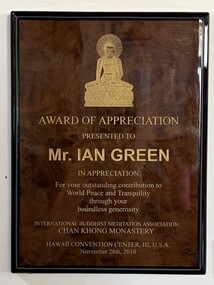
Plaque (item) - Plaque to Ian Green from International Buddhist Meditation Association Chan Khong Monastery, Hawaii, USA, 28/11/2010
... Standing 2.5 meters tall and weighing 4 tonnes, this priceless Buddhist statue toured over 120 cities across 20 countries from 2009 to 2018, inspiring peace in families, schools, and communities worldwide. ...Plaque to Ian Green from International Buddhist Meditation Association Chan Khong Monastery in appreciation for the outstanding contribution to world peace and tranquility through boundless generosity....Plaque Plaque to Ian Green from International Buddhist Meditation Association Chan Khong Monastery, Hawaii, USA Great Stupa of Universal Compassion ...The Jade Buddha for Universal Peace, the largest Buddha carved from gemstone-quality jade in the world, is the centerpiece of the Great Stupa of Universal Compassion in Bendigo, Australia. Standing 2.5 meters tall and weighing 4 tonnes, this priceless Buddhist statue toured over 120 cities across 20 countries from 2009 to 2018, inspiring peace in families, schools, and communities worldwide. After attracting an estimated 12 million visitors, it returned to the Great Stupa in May 2018, where it continues to be a potent symbol of peace.This wooden plaque, presented to Ian Green on 28/11/2010 by the International Buddhist Meditation Association Chan Khong Monastery, honours his dedication to fostering peace and spiritual enlightenment. It symbolises gratitude for his generosity and his role in promoting the Jade Buddha’s message of compassion and unity.jade buddha, memorabilia, great stupa archive -
 Great Stupa of Universal Compassion
Work on paper - A set of line drawings created by Gomchen Oleshey, Diamond Sow Publication, Deities, lamas and yogis of Tibet : a treasury of drawings, 1975
... A collection of traditional Tibetan Buddhist line drawings created by the Sherpa hermit and artist Gomchen Oleshey. ...A collection of traditional Tibetan Buddhist line drawings created by the Sherpa hermit and artist Gomchen Oleshey (1924–1983). ...A collection of traditional Tibetan Buddhist line drawings created by the Sherpa hermit and artist Gomchen Oleshey. ...The set consist of 1 envelope, 4 stapled pages, 94 loose sheets.A collection of traditional Tibetan Buddhist line drawings created by the Sherpa hermit and artist Gomchen Oleshey (1924–1983). The drawings are paired with traditional songs of homage and descriptive prayers collected by Lama Khempo Sangyay Tenzin (1904–1990), with English introductions and translations by scholar Keith Dowman. non-fictionThe set consist of 1 envelope, 4 stapled pages, 94 loose sheets."buddhist art, tibetan buddhism" -
 Great Stupa of Universal Compassion
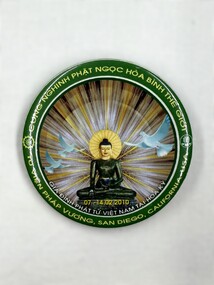
Accessory (item) - Badge of Jade Buddha, San Diego, California, 14/02/2010
... Standing 2.5 meters tall and weighing 4 tonnes, this priceless Buddhist statue toured over 120 cities across 20 countries from 2009 to 2018, inspiring peace in families, schools, and communities worldwide. ...WELCOME THE JADE BUDDHA FOR UNIVERSAL PEACE AT PHAP VUONG MONASTERY, SAN DIEGO, CALIFORNIA USA VIETNAMESE BUDDHIST FAMILIES IN THE USA 07-14.02.2010 ...Standing 2.5 meters tall and weighing 4 tonnes, this priceless Buddhist statue toured over 120 cities across 20 countries from 2009 to 2018, inspiring peace in families, schools, and communities worldwide. ...The Jade Buddha for Universal Peace, the largest Buddha carved from gemstone-quality jade in the world, is the centerpiece of the Great Stupa of Universal Compassion in Bendigo, Australia. Standing 2.5 meters tall and weighing 4 tonnes, this priceless Buddhist statue toured over 120 cities across 20 countries from 2009 to 2018, inspiring peace in families, schools, and communities worldwide. After attracting an estimated 12 million visitors, it returned to the Great Stupa in May 2018, where it continues to be a potent symbol of peace.This badge, presented to Mr Ian Green at Phap Vuong Monastery in San Diego, symbolises appreciation for his role in sharing the Jade Buddha’s message of peace and compassion during its international journey.WELCOME THE JADE BUDDHA FOR UNIVERSAL PEACE AT PHAP VUONG MONASTERY, SAN DIEGO, CALIFORNIA USA VIETNAMESE BUDDHIST FAMILIES IN THE USA 07-14.02.2010 jade buddha, memorabilia, great stupa archive -
 Great Stupa of Universal Compassion
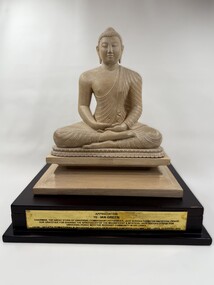
Decorative object (item) - A statue of the Buddha with engraved plaque, Colombo, Sri Lanka, 19/08/2012
... Standing 2.5 meters tall and weighing 4 tonnes, this priceless Buddhist statue toured over 120 cities across 20 countries from 2009 to 2018, inspiring peace in families, schools, and communities worldwide. ...APPRECIATION TO - IAN GREEN CHAIRMAN, THE GREAT STUPA OF UNIVERSAL COMPASSION LTD FOUNDER, JADE BUDDHA TEAM FOR UNIVERSAL PEACE OUR GRATITUDE FOR SHARING THE SPIRITUALITY OF THE MAGNIFICENT & MYSTICAL JADE BUDDHA STATUE FOR UNIVERSAL PEACE WITH THE BUDDHIST COMMUNITY IN SRI LANKA FROM - JAGATH SUMATHIPALA PRESIDENT ALL CEYLON BUDDHIST CONGRESS, COLOMBO, SRI LANKA, 10 AUGUST 2012...This carved wooden Buddha statue was presented to Ian Green by Jagath Sumathipala of the All-Ceylon Buddhist Congress during the Jade Buddha tour in Colombo (19 August 2012). ...The Jade Buddha for Universal Peace, the largest Buddha carved from gemstone-quality jade in the world, is the centerpiece of the Great Stupa of Universal Compassion in Bendigo, Australia. Standing 2.5 meters tall and weighing 4 tonnes, this priceless Buddhist statue toured over 120 cities across 20 countries from 2009 to 2018, inspiring peace in families, schools, and communities worldwide. After attracting an estimated 12 million visitors, it returned to the Great Stupa in May 2018, where it continues to be a potent symbol of peace.This carved wooden Buddha statue was presented to Ian Green by Jagath Sumathipala of the All-Ceylon Buddhist Congress during the Jade Buddha tour in Colombo (19 August 2012). It symbolises spiritual reverence, generosity, and the deep cultural connections fostered throughout this tour. It honours Ian Green’s role in sharing the Jade Buddha’s message of peace and compassion.APPRECIATION TO - IAN GREEN CHAIRMAN, THE GREAT STUPA OF UNIVERSAL COMPASSION LTD FOUNDER, JADE BUDDHA TEAM FOR UNIVERSAL PEACE OUR GRATITUDE FOR SHARING THE SPIRITUALITY OF THE MAGNIFICENT & MYSTICAL JADE BUDDHA STATUE FOR UNIVERSAL PEACE WITH THE BUDDHIST COMMUNITY IN SRI LANKA FROM - JAGATH SUMATHIPALA PRESIDENT ALL CEYLON BUDDHIST CONGRESS, COLOMBO, SRI LANKA, 10 AUGUST 2012jade buddha, memorabilia, great stupa archive -
 Flagstaff Hill Maritime Museum and Village
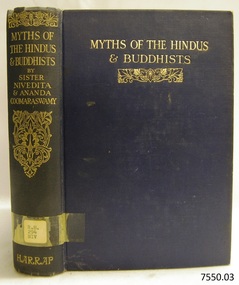
Book, Myths of The Hindus and Buddhists
... Myths of The Hindus and Buddhists Authors: Nivedita & Coomaraswamy Publisher: George G Harrap & Co Date: 1914 ...Warrnambool Shipwrecked-coast Flagstaff-Hill Flagstaff-Hill-Maritime-Museum Maritime-Museum Shipwreck-coast Flagstaff-Hill-Maritime-Village Shipwrecked-artefact Book Myths of The Hindus and Buddhists Nivedita & Coomaraswamy Label on spine cover with typed text RH 294 NIV Myths of The Hindus and Buddhists Authors: Nivedita & Coomaraswamy Publisher: George G Harrap & Co Date: 1914 Myths of The Hindus and Buddhists Book ...Myths of The Hindus and Buddhists Authors: Nivedita & Coomaraswamy Publisher: George G Harrap & Co Date: 1914 Label on spine cover with typed text RH 294 NIV warrnambool, shipwrecked-coast, flagstaff-hill, flagstaff-hill-maritime-museum, maritime-museum, shipwreck-coast, flagstaff-hill-maritime-village, shipwrecked-artefact, book, myths of the hindus and buddhists, nivedita & coomaraswamy -
 Sunshine and District Historical Society Incorporated
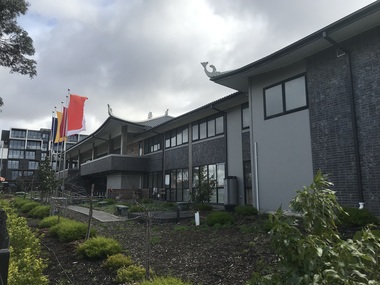
Photograph - Cairnlea Photographs 2022, John Alchin, 2022
... 5587.01 - Cairnlea Dr 159 - Australia Buddhist Centre 2022 Photo 01.JPG 5587.02 - Cairnlea Dr 159 - Australia Buddhist Centre 2022 Photo 02.JPG 5587.03 - Cairnlea Dr 159 - Australia Buddhist Centre 2022 Photo 03.JPG 5587.04 - Cairnlea Dr 159 - Australia Buddhist Centre 2022 Photo 04.JPG 5587.05 - Kevin Flint Rerserve Sign 2022 Photo 01.JPG 5587.06 - Black Powder Mill 2022 Photo 01.JPG ...Kevin Flint Reserve Cairnlea Drive Cairnlea Black Powder Mill Australia Buddhist Centre 5587.01 - Cairnlea Dr 159 - Australia Buddhist Centre 2022 Photo 01.JPG 5587.02 - Cairnlea Dr 159 - Australia Buddhist Centre 2022 Photo 02.JPG 5587.03 - Cairnlea Dr 159 - Australia Buddhist Centre 2022 Photo 03.JPG 5587.04 - Cairnlea Dr 159 - Australia Buddhist Centre 2022 Photo 04.JPG 5587.05 - Kevin Flint Rerserve Sign 2022 Photo 01.JPG 5587.06 - Black Powder Mill 2022 Photo 01.JPG Collection of digital photographs Photograph Cairnlea Photographs 2022 John Alchin ...The suburb Cairnlea was officially established in 1999. Cairnlea was built on the former Albion Explosive Factory site. These photographs provide a visual record of assorted buildings, street views, and notable locations throughout Cairnlea in 2022.These photographs provide a visual chronicle of assorted buildings, street views, and notable locations throughout Cairnlea in 2022.5587.01 - Cairnlea Dr 159 - Australia Buddhist Centre 2022 Photo 01.JPG 5587.02 - Cairnlea Dr 159 - Australia Buddhist Centre 2022 Photo 02.JPG 5587.03 - Cairnlea Dr 159 - Australia Buddhist Centre 2022 Photo 03.JPG 5587.04 - Cairnlea Dr 159 - Australia Buddhist Centre 2022 Photo 04.JPG 5587.05 - Kevin Flint Rerserve Sign 2022 Photo 01.JPG 5587.06 - Black Powder Mill 2022 Photo 01.JPG kevin flint reserve, cairnlea drive, cairnlea, black powder mill, australia buddhist centre -
 Great Stupa of Universal Compassion
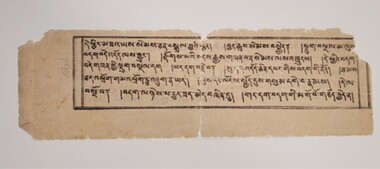
Work on paper - Buddhist scripture in Tibetan script
... A double-sided sheet of Buddhist scripture written in Tibetan script on hand-made paper. ...The ancient Tibetan art of printing was developed to reproduce Buddhist scriptures and images of the Buddha. ...This page is from a Tibetan prayer book. Such books are long, narrow, and printed horizontally. The pages are unbound and stored with wooden covers with silk brocade wrapped around them. The ancient Tibetan art of printing was developed to reproduce Buddhist scriptures and images of the Buddha. Monasteries or wealthy laypersons often commissioned books to gain spiritual merit. Books were printed using woodblock technique, still utilised today, on handmade paper. Scripture books are venerated by both monks and general population. A double-sided sheet of Buddhist scripture written in Tibetan script on hand-made paper. The sheet is torn in half and frying at the edges due to old age.Includes a Bodhicitta prayer and some dedication prayers.tibetan buddhism -
 Kensington Neighbourhood House
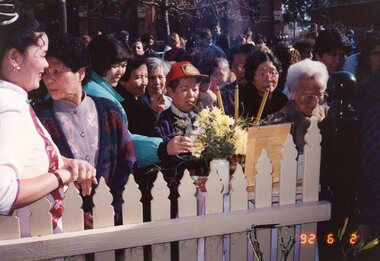
Photograph - KNH Item 5_4_014, Opening of KNH Upstairs Extension 1992 - Onlookers
... Colour photograph of onlookers in front of Buddhist candles and flowers used during the opening ceremony for 2nd story extension to 89 McCracken Street, Nov 1992...Colour photograph of onlookers in front of Buddhist candles and flowers used during the opening ceremony for 2nd story extension to 89 McCracken Street, Nov 1992 Opening of KNH Upstairs Extension 1992 - Onlookers Photograph KNH Item 5_4_014 ...Colour photograph of onlookers in front of Buddhist candles and flowers used during the opening ceremony for 2nd story extension to 89 McCracken Street, Nov 1992 -
 Kensington Neighbourhood House
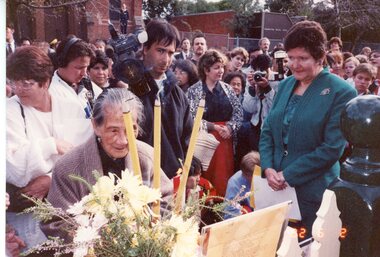
Photograph - KNH Item 5_4_004, Opening of KNH Upstairs Extension 1992 - Juan Huong lighting candles
... Colour photograph of Juan Huong lighting candles and saying a Buddhist prayer, watched by Victorian Premier, Joan Kirner, on the occasion of the official opening of the 2nd story extension of 89 McCracken Street, Kensington...Colour photograph of Juan Huong lighting candles and saying a Buddhist prayer, watched by Victorian Premier, Joan Kirner, on the occasion of the official opening of the 2nd story extension of 89 McCracken Street, Kensington Opening of KNH Upstairs Extension 1992 - Juan Huong lighting candles Photograph KNH Item 5_4_004 ...Colour photograph of Juan Huong lighting candles and saying a Buddhist prayer, watched by Victorian Premier, Joan Kirner, on the occasion of the official opening of the 2nd story extension of 89 McCracken Street, Kensington -
 Great Stupa of Universal Compassion
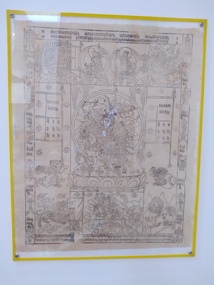
Print - Woodblock print featuring Gesar, Unknown
... Woodblock printing in Tibet began to flourish from the 10th century onwards, driven by the high demand for Buddhist scriptures and images. Monasteries saw woodblock printing as a means to preserve and propagate authentic Buddhist teachings. ...Woodblock printing in Tibet began to flourish from the 10th century onwards, driven by the high demand for Buddhist scriptures and images. Monasteries saw woodblock printing as a means to preserve and propagate authentic Buddhist teachings. ...Woodblock printing in Tibet began to flourish from the 10th century onwards, driven by the high demand for Buddhist scriptures and images. Monasteries saw woodblock printing as a means to preserve and propagate authentic Buddhist teachings. The durability of woodblocks made them ideal for creating lasting impressions of sacred texts, enabling mass production and wide dissemination.This woodblock print on hand-made paper depicts Gesar, a legendary Tibetan warrior king who is invoked as a protector of the Buddha's teachings and emanation of Padmasambhava. Gesar's image is surrounded by four magical animals - garuda (top left), makara (top right), tiger (bottom left) and snow lion (bottom right). The print is framed using acrylic sheets. padmasambhava, tibetan buddhism, woodblock printing -
 Great Stupa of Universal Compassion
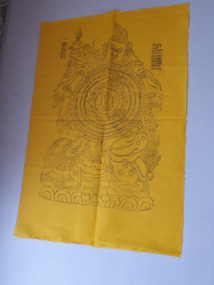
Print - Woodblock print of Jambhala, Tashilhunpo Monastery
... Woodblock printing in Tibet began to flourish from the 10th century onwards, driven by the high demand for Buddhist scriptures and images. Monasteries saw woodblock printing as a means to preserve and propagate authentic Buddhist teachings. ...Woodblock printing in Tibet began to flourish from the 10th century onwards, driven by the high demand for Buddhist scriptures and images. Monasteries saw woodblock printing as a means to preserve and propagate authentic Buddhist teachings. ...Woodblock printing in Tibet began to flourish from the 10th century onwards, driven by the high demand for Buddhist scriptures and images. Monasteries saw woodblock printing as a means to preserve and propagate authentic Buddhist teachings. The durability of woodblocks made them ideal for creating lasting impressions of sacred texts, enabling mass production and wide dissemination. Jambhala is a Bodhisattva of material and spiritual wealth often invoked by practitioners seeking to eliminate poverty and remove obstacles and misfortunes.Woodblock print of Jambhala on yellow cloth, created using an old wooden handcrafted printing board from Tashilhunpo Monastery in Tibet. woodblock printing, buddhist art -
 Great Stupa of Universal Compassion
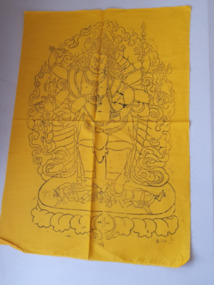
Print - Woodblock print of Vajrayogini, Tashilhunpo Monastery
... Woodblock printing in Tibet began to flourish from the 10th century onwards, driven by the high demand for Buddhist scriptures and images. Monasteries saw woodblock printing as a means to preserve and propagate authentic Buddhist teachings. ...Woodblock printing in Tibet began to flourish from the 10th century onwards, driven by the high demand for Buddhist scriptures and images. Monasteries saw woodblock printing as a means to preserve and propagate authentic Buddhist teachings. ...Woodblock printing in Tibet began to flourish from the 10th century onwards, driven by the high demand for Buddhist scriptures and images. Monasteries saw woodblock printing as a means to preserve and propagate authentic Buddhist teachings. The durability of woodblocks made them ideal for creating lasting impressions of sacred texts, enabling mass production and wide dissemination.Vajrayogini is considered a female Buddha, embodying the ultimate state of enlightenment. She represents the union of wisdom and compassion and is known for her ability to transform strong passions into enlightened virtues.Woodblock print of Vajrayogini on yellow cloth, created using an old wooden handcrafted printing board from Tashilhunpo Monastery in Tibet.woodblock printing, buddhist art -
 Great Stupa of Universal Compassion
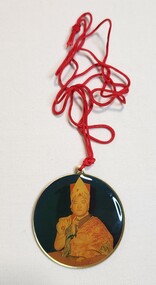
Memorabilia - Amulet pendant with a portrait of the 16th Karmapa
... Buddhist protection amulets are deeply rooted in spiritual traditions across Asia, especially in countries like Thailand, Tibet and Nepal. ...Buddhist protection amulets are deeply rooted in spiritual traditions across Asia, especially in countries like Thailand, Tibet and Nepal. ...Buddhist protection amulets are deeply rooted in spiritual traditions across Asia, especially in countries like Thailand, Tibet and Nepal. These sacred objects are believed to offer protection, attract good fortune and connect the wearer with enlightened energies.A two-sided amulet with a red cord for wearing. The front features a portrait of the 16th Karmapa, the spiritual leader of the Karma Kagyu lineage in Tibetan Buddhism, in ceremonial robes and a distinctive hat. The reverse side features the image of a wrathful deity Mahakala. The rim of the amulet is shaded in gold.worship device -
 Great Stupa of Universal Compassion
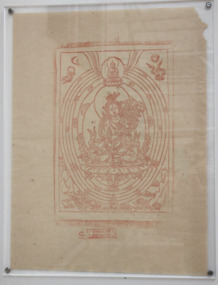
Print - White Tara print from a woodblock, Derge Sutra Printing House (Derge Parkhang)
... Woodblock printing in Tibet began to flourish from the 10th century onwards, driven by the high demand for Buddhist scriptures and images. Monasteries saw woodblock printing as a means to preserve and propagate authentic Buddhist teachings. ...Woodblock printing in Tibet began to flourish from the 10th century onwards, driven by the high demand for Buddhist scriptures and images. Monasteries saw woodblock printing as a means to preserve and propagate authentic Buddhist teachings. ...Woodblock printing in Tibet began to flourish from the 10th century onwards, driven by the high demand for Buddhist scriptures and images. Monasteries saw woodblock printing as a means to preserve and propagate authentic Buddhist teachings. The durability of woodblocks made them ideal for creating lasting impressions of sacred texts, enabling mass production and wide dissemination. Those involved in the printing process consider their work an offering to the Buddha.White Tara, revered as a compassionate and healing deity, is considered to provide protection, health, and longevity. She embodies the transcendent wisdom that helps practitioners overcome physical and mental suffering. White Tara woodblock print on paper in red ink, created using an old wooden handcrafted printing board from the Derge Sutra Printing House. Framed, sandwiched between acrylic sheets.woodblock printing, buddhist art -
 Embroiderers Guild, Victoria
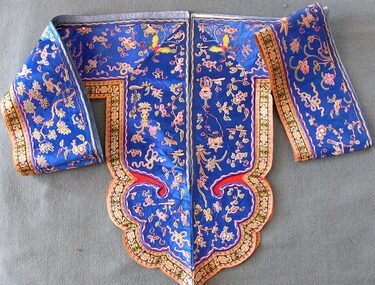
Accessory - Chinese Robe Band, Late 19th century
... Royal blue satin embroidered Taoist and Buddhist emblems with pekin knot stitch edged with couched gold and white or black thread. ...Royal blue satin embroidered Taoist and Buddhist emblems with pekin knot stitch edged with couched gold and white or black thread. ..."Doc" Rowe and his wife "Mora" were Australian entertainers who performed worldwide, including the Far East, during 1910-1930. The embroidered costumes were purchased in China and used in their performances in Australia and overseas.Front/band for a woman's robe. Royal blue satin embroidered Taoist and Buddhist emblems with pekin knot stitch edged with couched gold and white or black thread. Braids along inner edges. Reverse applique butterflies in four corners. Gold-cast button and roulette cords and loops on front. Lined with blue, woven patterned silk. embroidery, china, oriental, garments, late 19th century, silk embroidery -
 Dandenong/Cranbourne RSL Sub Branch
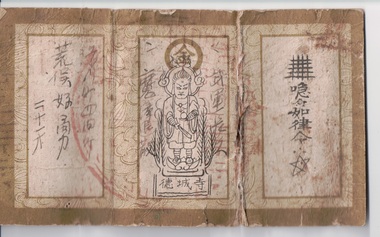
Work on paper - Japanese Religious Object
... (address) Second fold (middle) - "Tokujo- Temple" Right side fold - "Buddhist Chanting" (Charm)....(address) Second fold (middle) - "Tokujo- Temple" Right side fold - "Buddhist Chanting" (Charm). Tri-fold cardboard item with Japanese language inscriptions flanking a central image of a male figure wearing a robe and holding a round object and a sword. ...Tri-fold cardboard item with Japanese language inscriptions flanking a central image of a male figure wearing a robe and holding a round object and a sword. It is brown/gold and cream.Japanese handwritten and printed. Believe the inscriptions are- First fold - left side "21 years old" middle "Koyu Aramata" right side ? (address) Second fold (middle) - "Tokujo- Temple" Right side fold - "Buddhist Chanting" (Charm). -
 Bendigo Military Museum
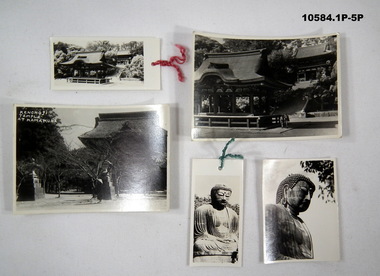
Photograph - KAMAKURA, JAPAN, BCOF ERA
... The great Buddha is a bronze figure of Amida, one of the Buddhist gods. It was cast in 1252. you can walk right up into the head of it. ...The great Buddha is a bronze figure of Amida, one of the Buddhist gods. It was cast in 1252. you can walk right up into the head of it. ...Photographs of Kamakura, Japan, collected by Alva Bennetts during a visit whilst on her BCOF deployment. Part of the Bennetts collection. See Catalogue No. 9726P for details of service for Alva Marie Bennetts VFX128835.1. Black and white photograph of a Japanese building. trees and a second building in the background. RH side has a piece of red cord attached. 2. Black and white close-up photograph of the buildings featured in 1. Two people in foreground. 3. Black and white photograph of a Japanese Temple with gate pillars in foreground. Trees surround building. 4. Black and white photograph of a statue of Buddha. Green cord tied through a hole at the top. 5. Black and white photograph of the head and shoulders of a statue of Buddha. 6. Black and white photograph of a statue of a sitting Buddha. Steps and large urns in foreground, trees in background. 7. Black and white photograph with details as per no. 6. 8. Black and white close-up of the statue of Buddha's head.2. Handwritten in black ink on back: “In September each year, Japanese girls dance on the platform of this shrine at Kamakura.” 3. Etched in white on top LHC of photograph: “KENCHOJI TEMPLE AT KAMAKURA.” 6. The great Buddha is a bronze figure of Amida, one of the Buddhist gods. It was cast in 1252. you can walk right up into the head of it. Note the position of the hands which are laid on the lap palms upwards and thumbs touching, the Buddhist sign for steadfast faith. 8. You can see where the Buddha was damaged during the 1923 earthquake. alva bennetts, bennetts collection, bcof, japan, kamakura, photographs, buddha -
 Great Stupa of Universal Compassion
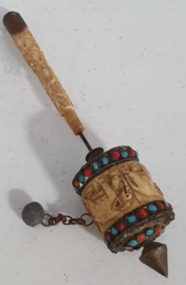
Ceremonial object - Prayer wheel, hand-held
... As Buddhism spread to Tibet in the 7th century, prayer wheels became an essential attribute of Tibetan Buddhist practice. This practice is linked to teachings attributed to Nagarjuna, who emphasized the power of mantra recitation and visualization....As Buddhism spread to Tibet in the 7th century, prayer wheels became an essential attribute of Tibetan Buddhist practice. This practice is linked to teachings attributed to Nagarjuna, who emphasized the power of mantra recitation and visualization. ...As Buddhism spread to Tibet in the 7th century, prayer wheels became an essential attribute of Tibetan Buddhist practice. This practice is linked to teachings attributed to Nagarjuna, who emphasized the power of mantra recitation and visualization.Tibetans believe that spinning the prayer wheel which has thousands or millions of mantras inside is equal to saying that many mantras, while being done in a fraction of the time. This helps accumulate merits, purify negative karma and obstacles on the path to enlightenment. This wheel has a hollow metal cylinder attached to a rod handle, made of ivory (with carved elephants), inlaid with coral and turquoise. Inside the cylinder is a tightly wound scroll printed with numerous mantras and wrapped around a spindle. The cylinder is embossed and decorated with inlaid coral and turquoise. A chain with a small weight at the end (made out of copper alloy) is affixed to the cylinder, allowing it to be spun by a slight rotation of the wrist. tibetan buddhism, holy objects, worship devices -
 Embroiderers Guild, Victoria
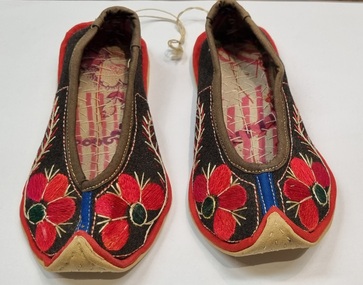
Footwear - Ladakh India Childs Slippers
... From Ladakh, Northern India, obtained by donor from a Nepalese Buddhist family in 1980's. Traditional Ladakhi children's slippers, known as Pabu, are wool-felted, often decorated with vibrant colors, and designed for warmth in cold climates....From Ladakh, Northern India, obtained by donor from a Nepalese Buddhist family in 1980's. Traditional Ladakhi children's slippers, known as Pabu, are wool-felted, often decorated with vibrant colors, and designed for warmth in cold climates. ...From Ladakh, Northern India, obtained by donor from a Nepalese Buddhist family in 1980's. Traditional Ladakhi children's slippers, known as Pabu, are wool-felted, often decorated with vibrant colors, and designed for warmth in cold climates.Machine and hand stitched childs slippers. flowers, baby shoes -
 Great Stupa of Universal Compassion
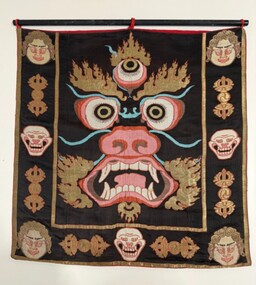
Artwork, other - Mahakhala dance apron
... A Mahakala dancing apron is a sacred garment used in Tibetan Buddhist ceremonial masked dances (Cham) to represent Mahakala, the fierce protector deity and emanation of compassion. ...A Mahakala dancing apron is a sacred garment used in Tibetan Buddhist ceremonial masked dances (Cham) to represent Mahakala, the fierce protector deity and emanation of compassion. ...A Mahakala dancing apron is a sacred garment used in Tibetan Buddhist ceremonial masked dances (Cham) to represent Mahakala, the fierce protector deity and emanation of compassion. The apron makes up part of a costume of a monastic dancer. It was worn either with a mask or as part of the ‘Black Hat Dance’. Mahakala is a primary Wisdom Dharmapala (protector) in Tibetan Buddhism, representing a wrathful manifestation of Chenrezig, that removes obstacles to enlightenment. Often appearing in black with multiple arms, he symbolizes the transformation of negative emotions into wisdom, protecting practitioners and the Buddha's teachings. Made of silk brocade this sacred apron features a wrathful face, bulging eyes, fangs, and skull motifs to ward off evil and destroy obstacles. The apron is mounted on a metal hanging rod.buddhist art, tibetan buddhism, holy objects -
 Bendigo Military Museum
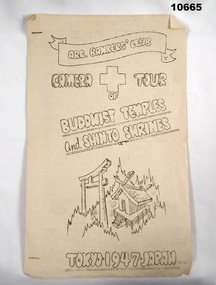
Programme - TOUR ITINERARY, ARC BANKERS CLUB, BCOF, American Red Cross, Bankers Club, 1947
... Tour itinerary for American Red Cross (ARC) Banker's Club Camera Tour of Buddhist Temples and Shinto Shrines, Tokyo 1947, Japan. ...Tour itinerary for American Red Cross (ARC) Banker's Club Camera Tour of Buddhist Temples and Shinto Shrines, Tokyo 1947, Japan. ...Tour itinerary for American Red Cross (ARC) Banker's Club Camera Tour of Buddhist Temples and Shinto Shrines, Tokyo 1947, Japan. See Cat No. 10584.8P for accompanying photographs. Part of the Bennetts Collection. See Cat No. 9726P for details of service for Alva Marie Bennetts VFX128835.Two foolscap size cream coloured pages with printing on one side of each page. Front cover features tour details and a line drawing of a temple. Letters and illustration in black. Second page has text in black type. Two pages fastened together with a staple on top LH Corner.alva bennetts, bennetts collection, american red cross, photographs, japan -
 Great Stupa of Universal Compassion
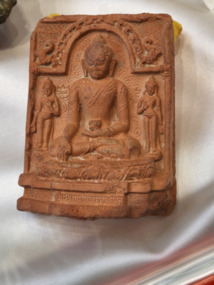
Sculpture - Tsatsa of Shakyamuni Buddha
... Tsatsas are small votive tablets shaped like deities, stupas, or sacred symbols. Buddhists may vow to create 100,000 tsatsas for purification and merit. ...Tsatsas are small votive tablets shaped like deities, stupas, or sacred symbols. Buddhists may vow to create 100,000 tsatsas for purification and merit. ...Tsatsas are small votive tablets shaped like deities, stupas, or sacred symbols. Buddhists may vow to create 100,000 tsatsas for purification and merit. These can be placed as an offering in holy sites, home altars, or gau boxes. Traditionally made of clay using moulds, tsatsas are dried, decorated, and blessed with mantras.Portable nature of tsatsas allows them to accompany practitioners on journeys, providing spiritual protection and serving as a focus for prayer and meditation. Due to their inexpensive production and portability, tsatsas made a great contribution to the spread of Buddhism in Tibet. This tsatsa is of the Buddha in a sitting position, accompanied by two standing figures. The Buddha is richly adorned with delicate carvings around it. The tsatsa features inscriptions in an ancient script.buddhist art, tibetan buddhism, holy objects -
 Sunshine and District Historical Society Incorporated
Administrative record - Braybrook State / Primary School Council books, 1963 - 1997
... 2060.01 - Committee 1963 - 1974|2060.02 - School Committee Minutes 1973 - 1976|2060.03 - School Committee Minutes 1968 - 1973|2060.04 - School Committee Minutes 1962 - 1967|2060.05 - Mothers Club Committee Minutes 1968 - 1973|2060.06 - School Committee Minutes 1973 - 1974|2060.07 - School Committee Minutes 1976 - 1979|2060.08 - The Dalai Lama Pan Buddhist Event|2060.09 - East Sunshine Scrapbook|2060.10 - Blank Exercise Book|2060.11 - A Philosophy Of Education...Braybrook Primary School Braybrook State School State School Primary School History Braybrook Ballarat Road 2060.01 - Committee 1963 - 1974|2060.02 - School Committee Minutes 1973 - 1976|2060.03 - School Committee Minutes 1968 - 1973|2060.04 - School Committee Minutes 1962 - 1967|2060.05 - Mothers Club Committee Minutes 1968 - 1973|2060.06 - School Committee Minutes 1973 - 1974|2060.07 - School Committee Minutes 1976 - 1979|2060.08 - The Dalai Lama Pan Buddhist Event|2060.09 - East Sunshine Scrapbook|2060.10 - Blank Exercise Book|2060.11 - A Philosophy Of Education Administrative record Braybrook State / Primary School Council books ...braybrook primary school , braybrook state school, state school, primary school, history, braybrook, ballarat road
