
Showing 13058 items matching "building beyond"
-
 Marysville & District Historical Society
THE TRIANGLE NEWS-VOL 41 NO 15-APRIL 25 2014
... murrindindi early years conference building beyond...marysville victoria australia lions donation to cystic fibrosis farmers need our help new contact details for triangle news what's on when in april/may 2014 seasonal influenza vaccine available the committee of management of the gallipoli park precinct marysville community market creative triangle marysville sub branch rsl adventurous cooks triangle community dinner buxton ridge vineyard wine tasting church notices heather jenkins wins the mavis hatfield trophy intrepid triangle bushwalkers marysville saddletramps inaugural ralph wait memorial ride burning continues despite high rainfall lions rich fruit cakes marysville & triangle community men's shed top end/central tour buxton recreation reserve committee meeting inviting public el kanah eat in eat out menu marysville road closure anzac day march amnesty peiod on open air burning in residential areas residential and rural real estate marysville triangle real estate lake mountain mountain mayhem marsyville midweek netball fire prevention irrigation systems alexandra district hospital heart week 2014 notice of special meetin of council buxton hotel parma night anzac day office closures season opener lunch anzac day services 2014 marysville preschool centre long day care & kindergarten buxton hall trivia night annual alexandra truck ute & rod show marysville cultural community 2 mime shows head of camp marysville vic the outdoor education group woodlands rainforest retreat position vacant murrindindi early years conference building beyond el kanah conference centre murrindindi shire council naming the community centre rooms and stadium advertisements THE TRIANGLE NEWS-VOL 41 NO 15-APRIL 25 2014 ...marysville, victoria, australia, lions donation to cystic fibrosis, farmers need our help, new contact details for triangle news, what's on when in april/may, 2014 seasonal influenza vaccine available, the committee of management of the gallipoli park precinct, marysville community market, creative triangle, marysville sub branch rsl, adventurous cooks, triangle community dinner, buxton ridge vineyard wine tasting, church notices, heather jenkins wins the mavis hatfield trophy, intrepid triangle bushwalkers, marysville saddletramps, inaugural ralph wait memorial ride, burning continues despite high rainfall, lions rich fruit cakes, marysville & triangle community men's shed, top end/central tour, buxton recreation reserve committee meeting inviting public, el kanah, eat in eat out menu, marysville road closure anzac day march, amnesty peiod on open air burning in residential areas, residential and rural real estate, marysville triangle real estate, lake mountain, mountain mayhem, marsyville midweek netball, fire prevention irrigation systems, alexandra district hospital heart week 2014, notice of special meetin of council, buxton hotel parma night, anzac day office closures, season opener lunch, anzac day services 2014, marysville preschool centre, long day care & kindergarten, buxton hall trivia night, annual alexandra truck ute & rod show, marysville cultural community, 2 mime shows, head of camp marysville vic, the outdoor education group, woodlands rainforest retreat position vacant, murrindindi early years conference building beyond, el kanah conference centre, murrindindi shire council, naming the community centre rooms and stadium, advertisements -
Marysville & District Historical Society
THE TRIANGLE NEWS-VOL 41 NO 16-MAY 2 2014
... ...building beyond...marysville victoria australia marysville history centre life members honoured mary & reg kenealy life membership certificates presented new contact details for triangle news what's on when in may 2014 sesonal influenza vaccine the committee of management of the gallipoli park precinct marysville community market creative triangle adventurous cooks triangle community dinner church notices marysville golf report mayor's chair by margaret rose marysville saddletramps inaugural ralph wait memorial ride gallipoli park marysville top end/central tour marysville triangle community men's shed advertisements modern life music school the next wave cabaret dinner show el kanah marysville eat in eat out menu buxton nursery residential and rural real estate marysville triangle real estate lake mountain mountain mayhem alexandra district hospital heart week 2014 cleaner needed for marysville villains pie night murrindindi shire council ceaca marysville midweek netball swimming pools made a splash this season mother's day black spur inn darryl hull entertainer tree changes tempted by shire marysville preschool centre long day care & kindergarten 1000 hands a great success emergence program marysville cultural community 2 mime shows buxton hall trivia night murrindindi early years conference building beyond naming the marysville community centre rooms and stadium THE TRIANGLE NEWS-VOL 41 NO 16-MAY 2 2014 ...marysville, victoria, australia, marysville history centre life members honoured, mary & reg kenealy, life membership certificates presented, new contact details for triangle news, what's on when in may, 2014 sesonal influenza vaccine, the committee of management of the gallipoli park precinct, marysville community market, creative triangle, adventurous cooks, triangle community dinner, church notices, marysville golf report, mayor's chair by margaret rose, marysville saddletramps, inaugural ralph wait memorial ride, gallipoli park marysville, top end/central tour, marysville triangle community men's shed, advertisements, modern life music school, the next wave cabaret dinner show, el kanah marysville, eat in eat out menu, buxton nursery, residential and rural real estate, marysville triangle real estate, lake mountain, mountain mayhem, alexandra district hospital heart week 2014, cleaner needed for marysville villains pie night, murrindindi shire council, ceaca, marysville midweek netball, swimming pools made a splash this season, mother's day black spur inn, darryl hull entertainer, tree changes tempted by shire, marysville preschool centre, long day care & kindergarten, 1000 hands a great success, emergence program, marysville cultural community, 2 mime shows, buxton hall trivia night, murrindindi early years conference, building beyond, naming the marysville community centre rooms and stadium -
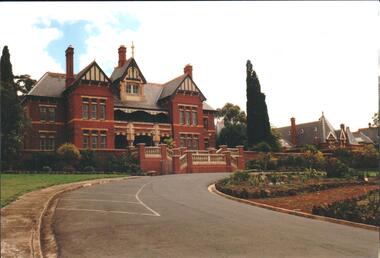 Hume City Civic Collection
Photograph, mid 1980s
... The photograph shows the two front wings and attic of the main administrative building and other buildings beyond the main building....The photograph shows the two front wings and attic of the main administrative building and other buildings beyond the main building. Photograph ...The building in the photograph was the main administrative building of the former Sunbury Asylum which was closed down in 1991. The buildings are now part of the Sunbury campus of the Victoria University of Technology.A coloured photograph taken from the eastern side of the curved approach to the main entrance of the former Sunbury Asylum. The photograph shows the two front wings and attic of the main administrative building and other buildings beyond the main building.sunbury asylum, victoria university of technology, george evans collection -
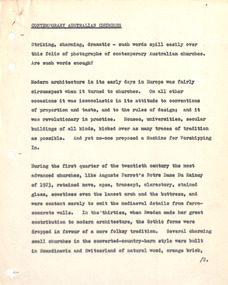 Robin Boyd Foundation
Document - Manuscript, Robin Boyd, Contemporary Australian Churches
... Boyd praises the attention to detail on the materials used in church architecture and the potential lessons that can be brought forth to other buildings beyond the design of modern churches....Boyd praises the attention to detail on the materials used in church architecture and the potential lessons that can be brought forth to other buildings beyond the design of modern churches. Churches Modern Architecture Photography robin boyd manuscript Typewritten (c copy), quarto, 5 pages Contemporary Australian Churches Document Manuscript Robin Boyd ...A discussion on the evolution of the contemporary churches in Australia. Boyd praises the attention to detail on the materials used in church architecture and the potential lessons that can be brought forth to other buildings beyond the design of modern churches.Typewritten (c copy), quarto, 5 pageschurches, modern architecture, photography, robin boyd, manuscript -
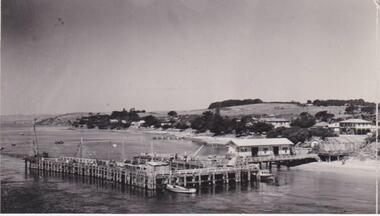 Phillip Island and District Historical Society Inc.
Photograph, San Remo
... "U" shaped pier, busy with fishing vessels, a large shed on the connecting Jetty to beach and the frame of a new building. Beyond is the Pier Hotel, more buildings to the extending left. ..."U" shaped pier, busy with fishing vessels, a large shed on the connecting Jetty to beach and the frame of a new building. Beyond is the Pier Hotel, more buildings to the extending left. ...View of San Remo and the Pier taken from Westernport Bay entrance. "U" shaped pier, busy with fishing vessels, a large shed on the connecting Jetty to beach and the frame of a new building. Beyond is the Pier Hotel, more buildings to the extending left. Behind the coastal trees to back of photo is a tree lined bare hill.The Pier, San Remolocal history, photographs, jetties, san remo, black & white photograph, mona condrick -
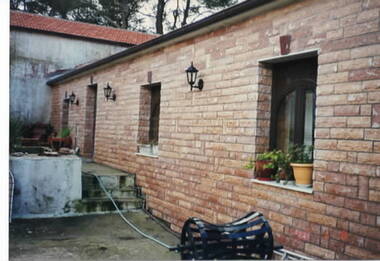 Ithacan Historical Society
Photograph, Panagias Monastery, Ithaca, Late
... A coloured photograph of a section of a cream brick building with the older section of the building in the background beyond the patio which is in need of repairs. ...A coloured photograph of a section of a cream brick building with the older section of the building in the background beyond the patio which is in need of repairs. ...The photo shows a section of the brick building where repairs have been done to the windows along the side of the building. The older and original section of the monastery is in the background.A coloured photograph of a section of a cream brick building with the older section of the building in the background beyond the patio which is in need of repairs. -
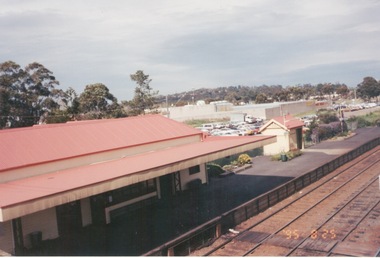 Sunbury Family History and Heritage Society Inc.
Photograph, Rosa McCall, 25 August 1995
... A non-digital coloured photograph overlooking a railway station platform, carpark, commercial buildings and the area beyond the railway precinct....Sunbury Railway precinct has undergone a number of changes to cope with increased train services since the 19809s. sunbury Sunbury railway station A non-digital coloured photograph overlooking a railway station platform, carpark, commercial buildings and the area beyond the railway precinct. Photograph Rosa McCall ...The photograph is a view of Platform 1 at Sunbury Station after the station underwent refurbishment and the platform was extended in 1993 as well as the carpark on the east side of the tracks. The rear view of one of the shopping complexes is also visible as well as a view of the wider town area.Sunbury Railway precinct has undergone a number of changes to cope with increased train services since the 19809s.A non-digital coloured photograph overlooking a railway station platform, carpark, commercial buildings and the area beyond the railway precinct.sunbury, sunbury railway station -
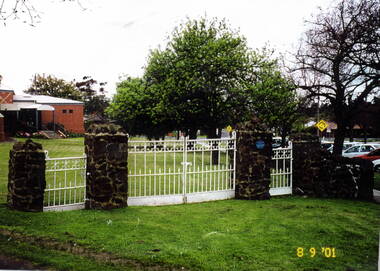 Hume City Civic Collection
Photograph, St. Andrews Uniting Church gates, 8th September 2001
... A church building is just beyond a grassed area....A church building is just beyond a grassed area. St. Andrews Uniting Church gates. ...These are the original wrought iron gates which served as the entrance to St. Andrews Uniting Church, formerly St.Andrews Presbyterian Church. They were erected there in 1922 and were made at H.V.McKay's Sunshine Harvester foundry, at Sunshine. H.V McKay was a member of the Presbyterian Church in Sunbury. Originally the gates opened onto Stawell Street, which ran at an angle between O'Shanassy and Barkly Streets. Apart from a small area leading to the Memorial Hall the rest of Stawell Street has been incorporated in the Village Green in Sunbury.The gates were restored and erected on their original site in 2000. A scanned coloured photograph of white painted wrought iron double gates with two smaller gates on either side and supported by stone pillars. A church building is just beyond a grassed area.st. andrews church, st. andrew's uniting church, wrought iron gates -
Tatura Irrigation & Wartime Camps Museum
Photograph, Goulburn Weir, 1890
... Trees on bank beyond beyond, buildings scattered amongst trees....Trees on bank beyond beyond, buildings scattered amongst trees. Goulburn Weir Photograph ...Taken by photographer for State Rivers and Water Supply Commission.Medium sized black and white photograph. View across weir - channel outlet left - earth and rubble wall separates two concrete and iron structures of weir. Trees on bank beyond beyond, buildings scattered amongst trees.victoria state rivers and water supply commission, goulburn weir -
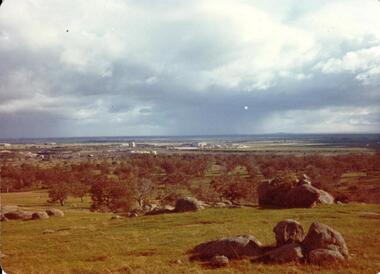 Hume City Civic Collection
Photograph, Sep-94
... The airport buildings are just beyond an outcrop of trees. Four rocky outcrops are spread around the foreground. ...The airport buildings are just beyond an outcrop of trees. Four rocky outcrops are spread around the foreground. ...Woodlands Park complex which includes 'Cumberland' and 'Dundonald' ruins and the Gellibrand Hill Quarries was acquired by the Victorian State Government in 1978 and is managed by Parks Victoria.A view taken from Gellibrand Hill looking towards the recently constructed Tullamarine (Melbourne) Airport. The airport buildings are just beyond an outcrop of trees. Four rocky outcrops are spread around the foreground. Coloured photograph with rounded corners and matt finish.woodlands park, gellibrand hill, greene, william pomeroy, anne, george evans collection -
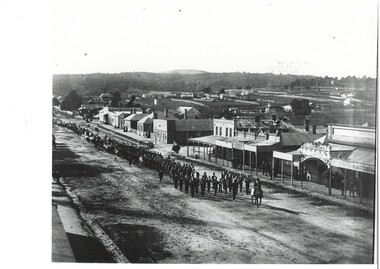 Buninyong & District Historical Society
Photograph - B/W photograph, Procession marching down Warrenheip St. towards Learmonth St, 1901, Original photo 1901
... B/W photo, Street view, from hotel balcony, procession led by man on horseback, then brass band and marchers extending beyond photograph, building along road, scattered houses and ridge beyond....B/W photo, Street view, from hotel balcony, procession led by man on horseback, then brass band and marchers extending beyond photograph, building along road, scattered houses and ridge beyond. ...Procession to celebrate opening of new rotunda in Buninyong Gardens, dedicated to Queen Victoria who had died January 1901.B/W photo, Street view, from hotel balcony, procession led by man on horseback, then brass band and marchers extending beyond photograph, building along road, scattered houses and ridge beyond.:Procession on Warrenheip St. for the opening of the Rotunda in the Buninyong Gardens, 1901. Arthur Coxal Mayor leading.buninyong, warrenheip st, procession, arthur coxal, brass band -
 Bendigo Historical Society Inc.
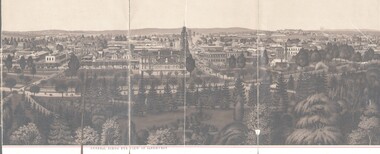
Photograph - HARRY BIGGS COLLECTION: GENERAL BIRDS EYE VIEW OF SANDHURST, c 1888
... Trees in foreground & the buildings of Bendigo City beyond....Trees in foreground & the buildings of Bendigo City beyond. Photograph HARRY BIGGS COLLECTION: GENERAL BIRDS EYE VIEW OF SANDHURST ...Photograph. Harry Biggs Collection. Taken from a tourist booklet called 'Views of Sandhurst'. Published by Schutz & Co. A coloured print taken from the Tower in the Gardens. Trees in foreground & the buildings of Bendigo City beyond.photograph, streetscape, sandburst, harry biggs collection, general birds eye view of sandhurst -
 Warrnambool and District Historical Society Inc.
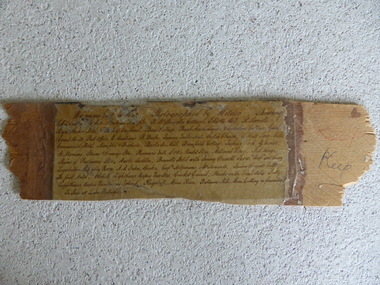
Frame Fragment, Frame Fragment from 1860 J Wilder, Late 19th century
... One was of the local Volunteer Corps and the other was a series of photographs taken from Cannon Hill showing Merri Street and the town and buildings beyond. It seems that copies of these last-mentioned photographs were framed to produce a large panoramic view of 1860 Warrnambool and one of these was given to the old Warrnambool Museum in the 1880s by James Astley Bromfield. ...One was of the local Volunteer Corps and the other was a series of photographs taken from Cannon Hill showing Merri Street and the town and buildings beyond. It seems that copies of these last-mentioned photographs were framed to produce a large panoramic view of 1860 Warrnambool and one of these was given to the old Warrnambool Museum in the 1880s by James Astley Bromfield. ...Joseph Wilder, a professional photographer, came to Warrnambool in 1860 and took a series of photographs, two of which survive today. One was of the local Volunteer Corps and the other was a series of photographs taken from Cannon Hill showing Merri Street and the town and buildings beyond. It seems that copies of these last-mentioned photographs were framed to produce a large panoramic view of 1860 Warrnambool and one of these was given to the old Warrnambool Museum in the 1880s by James Astley Bromfield. He had established a chemist’s shop in Warrnambool in 1854 and showed his interest in the history of the young town by producing a map in 1856 showing the first landowners, a seminal resource today for historians. He again demonstrated this interest when he included the names of the people and places in the 1860 photograph he gave to the museum in the 1880s. The frame fragment was found amongst the collection of items from the old Museum at Flagstaff Hill Maritime Museum and brought to the Historical Society to accompany the original series of photographs. Bromfield went to live in Melbourne in the 1880s. It is presumed that the plastic cover has been placed on the frame fragment at a much later date than the 1880s.This frame fragment is interesting and very important for several reasons:- 1. It is one demonstration of the interest that James Astley Bromfield had in local history 2. It came from the old Warrnambool Museum and shows how that institution kept items of historical interest 3. It gives us the names of the people and places in the Joseph Wilder photographs of 1860 that placed together form a panorama that reveals what a major section of Warrnambool looked like only 13 years after its foundation. The list enables us to correctly identify the early places and people and so is invaluable for research purposes 4. It links a Museum exhibit of the 1880s with the original 1860 photographs which are held by the Historical Society This is a piece of wood broken from a frame containing a photograph. It has jagged edges. It contains the list of people and places depicted in the Joseph Wilder panorama photograph of Warrnambool in 1860. The list is handwritten in ink on paper which has been attached to the frame with a piece of plastic. Warrnambool in 1860 Photographed by Wilder. Showing children of the late Andrew Semple etc In red pencil – ‘Keep’, in ink, ‘Keep’ On separate piece of paper - Presented to Warrnambool Mechanics’ Muzeum by James Astley Bromfield, August 3rd 1886 joseph wilder 1860, panorama of warrnambool -
 Kew Historical Society Inc
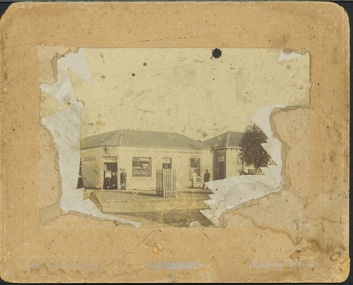
Photograph - Royal Hotel, Sunbury, C.H.R. Christianson, 1890s
... At least four figures can be identified in the photograph: a woman in the doorway, a man to her right, leaning against the wall, and two other men at the right hand side of the building. Beyond the boundary of the building is a sloping footpath to a bluestone edged gutter. ...At least four figures can be identified in the photograph: a woman in the doorway, a man to her right, leaning against the wall, and two other men at the right hand side of the building. Beyond the boundary of the building is a sloping footpath to a bluestone edged gutter. ...This item is part of a larger collection donated to the Kew Historical Society by Anna French. The collection includes personal items from the donor's family, as well as items given to the donor and her mother by a family friend, Lucy Merritt (Jean) Hornby. The item is from that part of the collection inherited or assembled by Jean Hornby. The collection is significant given Jean Hornby's mother's descent from Robert Hornby (1854-1935) and Eva Merritt (1865-1959); her mother the chid of a family who settled in Kew in the 1850s, this providing a chain of provenance for items dating to the mid-nineteenth century, when her maternal forebears arrived in Melbourne. Other items represent Jean Hornby's contribution to her local and wider community.This 19th century photograph includes significant architectural details of an important hotel in Sunbury, Victoria. Additionally, it was taken by a local photographer - CHR Christianson - who operated the Sunbury [photographic] Studio. Silver albumen print, mounted on board, of the original Royal Hotel on the corner of Brook and Evans Streets, Sunbury, Victoria.The single-storey, rendered brick building with a corrugated galvanised iron roof includes a number of pieces of information that may assist in dating the photograph. The licensee's name above the door appears to be M.A. Williams. To the left of the door on the external wall is a painted sign: 'BILLIARDS". Another painted sign on the front of the building reads "ROYAL HOTEL [illegible] BILLIARDS." An attached building at right may be the residence of the licensee. Specific architectural features of the building include a corner doorway with a lamp above, three sash windows and a larger square lead-light window to the right of the doorway. The latter identifies the space behind as the "BAR". On the footpath in front of this building is a grill set into the footpath to enable deliveries to a cellar. At least four figures can be identified in the photograph: a woman in the doorway, a man to her right, leaning against the wall, and two other men at the right hand side of the building. Beyond the boundary of the building is a sloping footpath to a bluestone edged gutter. An elm [sic] within a protective, picketed surround is in front of the building. C.H.R. Christianson is identified on the reverse as the photographer. Reverse in pencil: Royal Hotel Billards Sunbury / CHR Christianson photographerroyal hotel -- sunbury (vic.), chr christianson -- photographer, hotels -- sunbury (vic.), recreation -- billiards -
 Southern Sherbrooke Historical Society Inc.
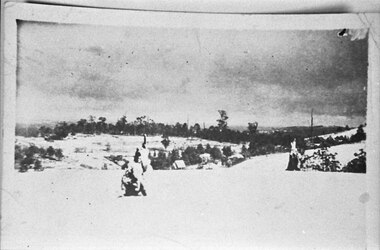
Photograph - A little bit of “Aura” snow
... In the centre of the photo St Cuthberts Church is visible in the distance, with houses beyond it. Buildings are also visible in the vicinity of the railway station. ...In the centre of the photo St Cuthberts Church is visible in the distance, with houses beyond it. Buildings are also visible in the vicinity of the railway station. ...Photograph taken from the hill to the north of Menzies Creek. There has been a heavy snowfall and dark clouds are in the sky. In the centre of the photo St Cuthberts Church is visible in the distance, with houses beyond it. Buildings are also visible in the vicinity of the railway station. An indistinct object in the foreground of the photo may be two children playing. -
 Tarnagulla History Archive
Photograph of Company's Hotel, Tarnagulla, Company's Hotel, Tarnagulla, c.1866-1970
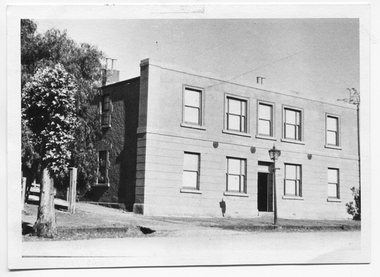
... The premises became the headquarters of the Bet Bet Roads Board, following which it became the Council Chambers for the Borough of Tarnagulla, until 1915. The building was beyond repair and was removed by pulling the place down and storing the material for use of the Public Hall Committee. ...The premises became the headquarters of the Bet Bet Roads Board, following which it became the Council Chambers for the Borough of Tarnagulla, until 1915. The building was beyond repair and was removed by pulling the place down and storing the material for use of the Public Hall Committee. ...Murray Comrie Collection. Information written by Donald Clark, (source Tarnagulla: A history of Tarnagulla and Districts website): The hotel was built on Commercial Road in 1859 and was opened on 26/12/1859. Festivities lasted for three days on opening. The building was of two storeys, built of brick and plastered throughout. It contained one bar, three parlors, billiard room, dining room, and four bedrooms with twelve others detached from the main building. Other out buildings consisted of kitchen etc. and stables to accommodate 30 horses. There was an underground tank capable of holding 3000 gallons of water. The licence was granted to Patrick McDermott at the Dunolly Court on 17/2/1860 and renewed on General Licensing Day on 12th June, 1860, and was transferred to William Hawkins in 1861. The premises became the headquarters of the Bet Bet Roads Board, following which it became the Council Chambers for the Borough of Tarnagulla, until 1915. The building was beyond repair and was removed by pulling the place down and storing the material for use of the Public Hall Committee. This took place on March 27th and 28th, 1981. This image must be after 1866, when the building was purchased for use as Council Chambers and the original heavy cornice was removed as that is not present in this image. This photograph is a reasonable copy created from an older original. Monochrome photograph depicting Company's Hotel in Tarnagulla. At the time of the photograph the old hotel is being used as the Mechanics' Institute. tarnagulla, hotels, company's hotel, companys hotel, burstall hall, businesses, commercial road -
 Wodonga & District Historical Society Inc
Photograph - Codling Collection 01 - Wodonga's Second Court House
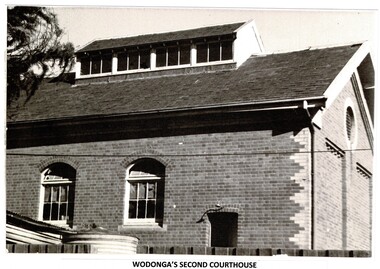
... In early 1964, the courthouse building was burnt beyond repair and furniture and other property destroyed. ...In early 1964, the courthouse building was burnt beyond repair and furniture and other property destroyed. ...Miss Olive Codling was a Foundation Member and a Life Member of the Wodonga Historical Society. Many of her prize-winning photos are held in the Society Collection. She also held a range of roles and committee positions in a wide range of Wodonga community organisations. WODONGA'S SECOND COURTHOUSE The Court House was situated in the Customs or Bond Store building alongside the Wodonga Police Station in 93 High Street. This was on the west side of High Street at its intersection with Bond Street. The building was converted to the courthouse in 1920. In early 1964, the courthouse building was burnt beyond repair and furniture and other property destroyed. The cause of the fire was never found. The Police Station was lucky to survive but only because of the efforts of the local Fire Brigade. After the fire, the court was held first at the old Fire Station premises near where the present Wodonga Post Office, then it moved to a vacant building in Mitchell Street which was later turned into a Child Care Centre. Foundations for the new courthouse in Elgin Street were laid in October 1965.This photo collection is significant as it documents how the businesses and buildings in Wodonga have evolved and contributed to community throughout the 20th century.2 black and white photos of the Court House, formerly used as a Bond Store for collection of customs.high st wodonga, wodonga court house -
 Wodonga & District Historical Society Inc
Functional object - Jurors' Selection Barrel, Wodonga Court House
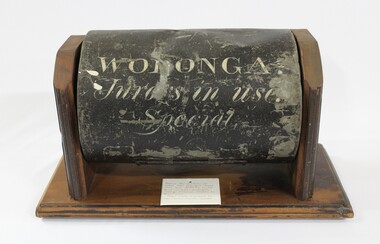
... In early 1964, the court house building was burnt beyond repair and furniture and other property destroyed. ...In early 1964, the court house building was burnt beyond repair and furniture and other property destroyed. ...The barrel was used in the Wodonga Court House as part of the selection process for jurors. It was a standard issue barrel used throughout Victoria. It was retrieved from the ruins of the court house which was destroyed by fire. It was then donated to the Wodonga Historical Society. The timber display stand was made and donated by Jake Tooley, a Wodonga Historical Society member, The Court House was situated in the Customs Store building alongside the Wodonga Police Station in 93 High Street. (The house where the Police Station was had originally been the home of the Customs Officer). In early 1964, the court house building was burnt beyond repair and furniture and other property destroyed. The cause of the fire was never found. The Police Station was lucky to survive but only because of the efforts of the local Fire Brigade. After the fire, the court was held first at the old Fire Station premises near where the Wodonga Post Office is near Woodland Grove, then it moved to a vacant building in Mitchell Street which was later turned into a Child Care Centre. Foundations for the new court house in Elgin Street were laid in October 1965 Local significance due to its use in the Wodonga Court House and its survival of a major fire. State significance as it documents a procedure used in the Victorian Court and Legal system Cylindrical metal-iron barrel painted black with writing stenciled on the front in white The timber mount was made for storage and display is not part of the original object,Inscription on Barrel "WODONGA./ Jurors in use./ Special"wodonga court, jurors, selection, legal system, fire -
 Royal District Nursing Service (now known as Bolton Clarke)
Photograph - Photograph, black and white, Barry Sutton, 02.08.1973
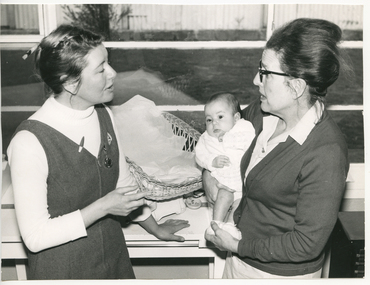
... Part of a dark filing cabinet is on the right of the photograph and behind the Sisters is a large window, then grass, small shrubs and part of a corrugated clad building can be seen beyond....Part of a dark filing cabinet is on the right of the photograph and behind the Sisters is a large window, then grass, small shrubs and part of a corrugated clad building can be seen beyond. Photograph Photograph, black and white Barry Sutton ...This photograph shows an RDNS Sister doing Liaison work at a Hospital. She will pass the information given about the babe to the RDNS Domiciliary Infant and Maternal Care (DIMC) Sister who will be visiting the baby and her family in their home. Sr. Schofield is wearing the RDNS winter uniform of a blue/grey skivvie under a V neck tunic style frock made of herringbone winter material.Liaison had occurred between Doctors and the Trained nurses (Nurses) of the Melbourne District Nursing Society (MDNS), from its inception in 1885. This increased when Midwifery was introduced in August 1893 with close liaising with the Women’s Hospital. As District nursing grew it was recognized that closer liaising between many Public Hospitals would be beneficial, for not only the MDNS, later called Royal District Nursing Service (RDNS) Trained nurses (Sisters), but also for the patients and the hospitals. In August 1964 a Liaison Officer commenced at the Alfred Hospital. This soon increased to Liaison Officers working full time at several Public Hospitals. They facilitated the smooth transition from hospital to home for many patients who required ongoing nursing care. Liaison Sisters regularly attended discharge planning meetings, interviewed prospective patients, co-ordinated discharge, and booked the first visit by the visiting RDNS Sister. At the time of a patient’s discharge, the Liaison Sister forwarded information on their diagnosis and instructions regarding the care required at home to the appropriate RDNS Centre, and in turn the attending District Sister wrote a report of progress and any queries to the Hospital Doctor, via the Liaison Sister, at the time the patient was attending outpatients. Any new instructions were then sent back to the District Sister. Liaising also occurred between District Sisters and Doctors when patients were referred by General Practitioners and did not attend a hospital. In August 1893 Melbourne District Nursing Society (MDNS), commenced a Midwifery Service with Nurse Fowler, who was trained in General nursing and Midwifery nursing, being the first Midwife employed. Mothers were assessed for suitability of a home birth or if they required delivery at the Women’s Hospital. The Midwife worked in conjunction with the Doctors at the Women’s Hospital and if a complication arose before or after birth the patient was transferred to their care. Following birth, the Midwife gave Post-Natal care to both the mother and babe commencing with visits twice a day. In 1898 the service ceased due to lack of funds but recommenced in 1906, and in the August 1925 Annual Report the number of MDNS home births was recorded at 478. MDNS built the After-Care Home and a pioneering Anti-Natal Clinic was opened in 1930. The last Ante-Natal clinic was held there in December 1951 and the MDNS Midwifery service ceased in February 1952. In 1964 MDNS commenced a Post-Natal service with General and Midwifery trained MDNS Sisters working from a room on the ground floor in the Footscray Hospital Nurses quarters, and visiting early discharged Footscray Hospital maternity cases at home. Later, as Royal District Nursing Service (RDNS), this service was extended and renamed as Domiciliary Infant and Maternal Care, (DIMC) service operating from most Centres and visiting early discharged, often 24 hours after birth, maternity cases from hospitals to give Post-natal care to the mother and babe. Many of the RDNS Sisters who worked in DIMC also had their triple Infant Welfare Certificate, though double certificate Midwifery trained Sisters also visited. On the left of this black and white photograph is Royal District Nursing Service (RDNS) Sister Margaret Schofield, who has her long dark hair drawn back, and is smiling as she looks down at a baby being held in the arms of a Hospital Sister. Sr. Schofield is wearing a light grey skivvie under a V neck dark tunic style frock. She has a pen in the V of her tunic, and has a watch hanging under the RDNS logo on its left hand side. Her left hand is resting on a white table which has baby scales with a wicker basket on it. To the right, is the Hospital Sister, who is side-on and facing Sr. Schofield. She is wearing dark rimmed glasses; has her long dark hair drawn back and is wearing a dark cardigan over her white uniform. She has her right arm under the baby with her hand on babe's right leg; her left hand is holding the baby's feet. The baby has sparse dark hair and is wearing a white patterned jacket. Part of a dark filing cabinet is on the right of the photograph and behind the Sisters is a large window, then grass, small shrubs and part of a corrugated clad building can be seen beyond.Barry Sutton LP 43royal district nursing service, rdns, rdns dimc, rdns uniform, sister margaret schofield -
 Mission to Seafarers Victoria
Drawing - Sketches, digital copy, Stuart Webber, 2005
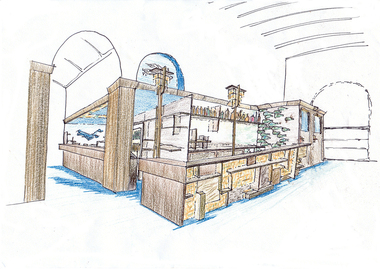
... Two students of architecture answered the call and provided pro bono design, building and installation services. Beyond the updated flooring, work surfaces and new hand-wash point their ethos of sustainable design presented a strategy of redressing the existing on a shoe-string; helping minimise trades and protect the heritage substrate. ...Two students of architecture answered the call and provided pro bono design, building and installation services. Beyond the updated flooring, work surfaces and new hand-wash point their ethos of sustainable design presented a strategy of redressing the existing on a shoe-string; helping minimise trades and protect the heritage substrate. ..."26th March 2019 In contribution to the historical account of the Mission to Seafarers, Melbourne. To whom it may concern, In 2005, the Mission to Seafarers’ Padre Bevil Lunson assigned an upgrade to the existing bar and gift shop. The brief outlined alignment with health code and liquor licence regulations, rethink of stock display and aesthetic upgrade of white peg-board and fluorescent-lit display-case. Two students of architecture answered the call and provided pro bono design, building and installation services. Beyond the updated flooring, work surfaces and new hand-wash point their ethos of sustainable design presented a strategy of redressing the existing on a shoe-string; helping minimise trades and protect the heritage substrate. A new standing-bar was proposed to envelope the display case and re-orient the hall back toward the stage. Punters were directed to the seated-bar for purchases. The chosen palette aimed to anchor the bar below the hall’s half-timbered dado-line utilising the muted tones of recycled materials. Glass bottles set in resin diffusing panels and timbers sourced from throw-outs were dressed and composed to suggest the multiple approaches to a calling of the sea. This flotsam and jetsam was intended to provide a shifting background that is representative of the many walks of life that support and are supported by the mission. Two uninstalled elements further accented the design: -the flying angel logo was to appear hovering within the bar’s archway and also inverted by the dado-line in the bar’s rear mirror (refer attached sketch), -and the two lampshades, referencing the inverted form of nautical beacons, were to shepherd clientele to the bar (refer attached sketch). Where are they now? Derek Stevenson – Turner Townsend Thinc Stuart Webber – ARM Architecture The bar was dismantled during the renovation mid 2019 and replace by another bar.These documents provide insight into an early 21st C refurbishment to the interior of the MTSV and Mission club operations in the early 21st Century and provides names and details of both the consideration of the need to: protect heritage components, provide a functional service point, incorporate recycled materials that related to aspects of the sea and environment, the flotsam and jetsam that is found where the sea, and those from the sea meets the land. Also provides an example of early career designs by two practising 21st C Australian architects and designers. During the renovations in winter 2019, the decision was made to demolish to make space to another more convenient one brought from a cafe, along with new chairs and tables for the club.Digital copy files sent in March 2019 by architect Stuart Webber after a visit to the Mission. Along with two sketches he submitted, he sent a document telling how the bar came to life in 2005.bar, stuart webber, derek stevenson, mts club, mts interior, bevil lunson -
 Royal District Nursing Service (now known as Bolton Clarke)
Photograph - Photograph, black and white, Barry Sutton, 13.07.1971
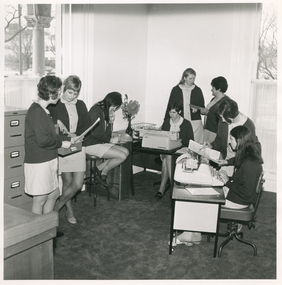
... Outside the left hand one, part of a fluted column on the building, and trees beyond it, can be seen. Bare trees can be seen outside the right hand window. ...Outside the left hand one, part of a fluted column on the building, and trees beyond it, can be seen. Bare trees can be seen outside the right hand window. ...The photograph of the RDNS Clerical staff is taken in the Finance Department at Royal District Nursing Service ( RDNS) Headquarters, 452 St. Kilda Road, MelbourneWhen the Melbourne District Nursing Society (MDNS) was founded in 1885, Mr. L.C. MacKinnon was elected the first Honorary Treasurer followed by Mr. Lush. In 1889, Mrs. Margaret Maine took over the role and held the position several times over the years along with various ladies elected each year from the Committee. Ladies continued to be elected as the Hon. Treasurer when MDNS built the After Care Home and it became the Melbourne District Nursing Society and After Care Home (later Hospital). This continued until the separation of the two Divisions in 1957 with Mrs. F.E. Shillabeer the last Hon. Treasurer. Now, with the District Division becoming Melbourne District Nursing Service, later Royal District Nursing Service (RDNS), A.F. Cameron Esq. J.P. became Hon. Treasurer and held this role until July 1968. As District expanded over the years so did the Finance Department with more Clerical staff employed as required.Black and white photograph showing Mrs Faye Marriett and seven lady Clerical staff who work at Royal District Nursing Service (RDNS). They are in a semi circle in a room. All are wearing their light coloured uniform dresses and dark cardigans.Two are standing to the left with the first, who has short curly dark hair, standing in front of a multi drawer filing cabinet. She is holding a sheet of white paper in her hands while the next lady, with short blonde hair and with her right arm on the cabinet, and with her left leg crossed over her right, is looking down at the piece of paper. To her right the staff member, who has long dark hair is sitting on a stool and has her ankles crossed. She is holding a grey coloured telephone hand piece to her left ear and has a pen in her right hand which is poised on a piece of paper on a table to her right on which stands the telephone, a vase of flowers and a wire "out basket". To the right of this another member, who has long dark hair, is standing behind a lady, with short dark hair, who is using a light coloured typewriter which is sitting on a dark table. The lady, who is standing, is looking down, and has her left hand on an oblong dark card which Mrs. Marriett, who is to her right, is holding in her right hand. Mrs. Marriett has short dark hair and is to the right rear in the photograph. In front of her another member, who has short dark hair, can partially be seen and is standing holding, and looking at, a folder she is showing to the lady in front of her, who has long dark hair, and is sitting on an office chair with her hands on the keys of a light coloured typewriter. The typewriter sits on a dark table top with light side panel table with square metal legs. A patterned carpet can be seen on the floor. Part of a wooden desk is in the front left of the photograph. Part of windows can be seen on either side of the room. Outside the left hand one, part of a fluted column on the building, and trees beyond it, can be seen. Bare trees can be seen outside the right hand window. Photographer stamp. Quote No. KJ 49royal district nursing service, rdns, rdns clerical staff, mrs faye marriett -
Federation University Historical Collection
Programme, Programme for the Official Opening of the Mt Helen Campus, 10/1970
... The School developed its courses beyond the initially intended range of studies related to mining, increased in enrolments, took over neighbouring properties and buildings and developed three levels of education - tertiary, trade and secondary. ...The School developed its courses beyond the initially intended range of studies related to mining, increased in enrolments, took over neighbouring properties and buildings and developed three levels of education - tertiary, trade and secondary. ...The first building at the Mt Helen Campus was opened in October 1970. Students first starting using the campus in the same year. The programme includes the following historical information: "On 26th October, 1870, Sir Redmond Barry officially opened the first venture into formal technical education in Australia - the Ballarat School of Mines. Over the preceding year a small group of Ballarat citizens interested in mining had conceived and brought into being the idea of creating such a school. They leased a derelict Court House next to the Ballarat Gaol in Lydiard St., at a nominal rental for15 years, and started classes with 4 students and an honorary lecturer. The School developed its courses beyond the initially intended range of studies related to mining, increased in enrolments, took over neighbouring properties and buildings and developed three levels of education - tertiary, trade and secondary. From the latter part of the 19th Century, even though remaining under the control of its own autonomous Council, it developed close links with the State Education Department. From the earliest times the School achieved widespread recognition and a particularly high reputation, and its graduates spread across Australia and the world. For several years it was affiliated with Melbourne University. In the last decade its scope has been further broadened by the introduction of new tertiary courses. During 1965 the State Government created the Victoria Institute of Colleges - a non-teaching body empowered to award degrees and directed towards the task of co-ordinating and developing tertiary education in Victorian in institutions other than universities. the tertiary division of the School became affiliated with the V.I.C. at the end of that same year. Subsequently the Council of the School decided that, whilst retaining for the whole establishment the time honoured title - The School of Mines and Industries, Ballarat - it should more distinctly sub-title the three divisions. the tertiary division then became known as the Ballarat Institute of Advanced Education. On receipt of substantial Commonwealth-State Grants, made to it as a college of advanced education, the Council was enabled at the start of 1967, to purchase for the Institute the 20 acre campus at Mt Helen. A master plan has been produced to develop this beautiful and spacious site as a tertiary institution enrolling, in due course, some 3000 full time students. the first sod was turned, to initiate this development, by the then Governor General of Australia, The Right Honourable Lord Casey, on 19th October, 1967. The first building group, now completed and occupied, has involved an expenditure approaching $1,000,000. It contains the departments of Mechanical, Civil and Mining Engineering, Metallurgy and Geology. it also contains the Computer Centre, a temporary Library and temporary student amenities. Over the next two years a further four buildings, costing about $2,500,000, will be erected, and a further major portion of the Institute will move to Mt Helen. these buildings, in addition to one for direct teaching work, will include a Library, a Union and the first stage of a Hall of Residence."White, folded, paper programme printed on the occasion of the official opening of the Ballarat Institute of Advanced Education (BIAE) Mount Helen Campus on the occasion of the centenary of the Ballarat School of Minesuniversity of ballarat, ballarat school of mines, biae, mount helen, mt helen campus, mb john, jack barker, e.j. barker, rolly parfenovics, parfenovics, nigel bown, campus. victorian institute of colleges, m.b. john -
 Federation University Historical Collection
Document, Creation of Ballarat University College, c1993
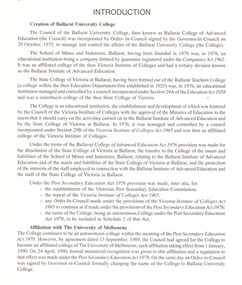
... beyond. The University’s commitment to educational and social equity, teaching excellence, research distinction, environmental sustainability and regional capacity building has enabled it to develop in a way that draws on its proud heritage to inform its future. ...beyond. The University’s commitment to educational and social equity, teaching excellence, research distinction, environmental sustainability and regional capacity building has enabled it to develop in a way that draws on its proud heritage to inform its future. ...Ballarat University College was a predecessor institution of Federation University Australia. Federation University Australia was established on 1 January 2014. Formerly known as the University of Ballarat, its enabling legislation was the University of Ballarat Amendment (Federation University Australia) Act 2013. Although formally created as a University in 1994, the University of Ballarat had a lineage back to 1870 with the establishment of the School of Mines Ballarat, making it the third institution of higher learning to be established in Australia and the first to be established in regional Australia. On 1 January 1994, Ballarat University College became the University of Ballarat and in 1998 the University merged with three TAFE Institutes to become a dual sector institution with multiple campuses. On 1 January 2014, the University of Ballarat amalgamated with the Monash University Gippsland Campus to form Federation University Australia. The Gippsland Campus also had a long lineage dating back to 1928 with the establishment of the Yallourn Technical School which became a predecessor institution to the Gippsland College of Advanced Education formed in 1968. In 1990, it was renamed the Monash University College and in 1993 became the Gippsland Campus of Monash University. Federation University Australia, or FedUni, is Australia’s newest public University. Headquartered in Ballarat, Victoria, the University offers programs in Higher Education and Vocational Education and Training to regional Victoria and beyond. The University’s commitment to educational and social equity, teaching excellence, research distinction, environmental sustainability and regional capacity building has enabled it to develop in a way that draws on its proud heritage to inform its future. Its regional character sets a framework for the University’s priorities but does not constrain it from serving wider community interests, nationally and internationally. With campuses from Horsham in the west of the state, to Churchill in the east, the name Federation University Australia was chosen to convey the scope and capacity of an expanded regional university with a federated network of campuses contributing to a new and different Australian university.A printed page from the 1993 Ballarat University College Handbook outlining the history and creation of the Ballarat University Collegeballarat university college, history, ballarat school of mines, establishment -
 Federation University Historical Collection
Booklet, Back to Bacchus Marsh, 1930, 1930
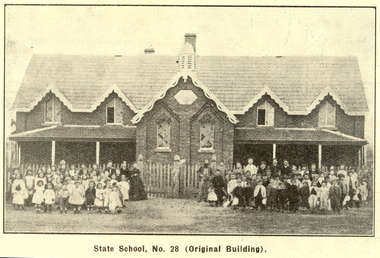
... Bacchus Marsh State School No. 28 was established in 1851 as a National School in a rented building on the right-hand side of Bacchus Marsh-Melbourne Road, just beyond Woolpack Inn. ...Bacchus Marsh State School No. 28 was established in 1851 as a National School in a rented building on the right-hand side of Bacchus Marsh-Melbourne Road, just beyond Woolpack Inn. ...The 1930 Back to Bacchus Marsh celebrations were held on 23 to 28 October 1930. The committee were Cr L.M. Gugdale (president), A.W. Bond (General secretary), W. Grant Morton, J.G. Wells, Dr E. McDonald, Charles Dickie, G.H. Anderson, F.M. Crisp, W.R. Vigor. Bacchus Marsh State School No. 28 was established in 1851 as a National School in a rented building on the right-hand side of Bacchus Marsh-Melbourne Road, just beyond Woolpack Inn. Several willow trees mark the site. H.G. Ball was the first Head Teacher of the school, and the enrolmen towas 34. In 1854 Governor Charles Hotham visited the school. In 1855 two new schools, East and West, were recommended. School No. 28 closed in 1862 and the sitre was sold. The present school site was purchased in 1865 for 67 pounds. The cost of the building was 782 pounds. (Visions and Realisations, Vol 3., 1973) A clock purchased by public subscription was placed in the front of the building to the memory of scholars who served during World War One. (Back to Bacchus Marsh, 1930)Brown covered book of 44 pages. Contents include Bacchus Marsh and its soldiers, Red Cross, Lerderderg Gorge, Werribee Gorge, Lerderderg Park, Coimadai, Darely Firebrick Co., Myrniong, Underbank, Balliang, Rowsley, Parwan, schoosl, churches, Shire Council, Federal Milk Pty Ltd, Bacchus Marsh Milk, Old Maddingley Bridge Images include: * Bacchus Marsh looking east, 1930 * Bacchus Marsh Looking West, 1872 * Bacchus Marsh Looking West, 1930 * Aerial View of Bacchus Marsh Township looking east * Aerial View of Bacchus Marsh Township looking south * Bacchus Marsh Agricultural Society & Pastoral Society, 1893 (named), * Original Bacchus Marsh State School No 28 * Holy Trinity Bacchus Marsh * Bacchus Marsh Baptist Church * St Bernard's Catholic Church * Bacchus Marsh Methodist Church * St Andrew's Presbyterian Church Bacchus Marsh * View of Maddingley Park, showing Original Courthouse, 1890 * Werribee Gorge * Underbank Stud Farm * Ballarat State School Number 28. Signed 'C. Hodgson'bacchus marsh, maddingley, maddingley park, underbank, lerderderg park, coimadai, darely firebrick co., myrniong, balliang, rowsley, parwan, schoosl, churches, shire council, federal milk pty ltd, bacchus marsh milk, old maddingley bridge, police, police paddock, maddingley gates, crisp, mccormack, cain, harkness, howe, bence, mcdonald, mcfarlane, cosgrave, flagg, burnip, scott, lodge, cameron, vallance, bacchus marsh state school, bacchus marsh state school no 28., geology, r.w. thompson, lederderg gorge, weribee gorge, comadai, darley firebrick company -
 Federation University Historical Collection
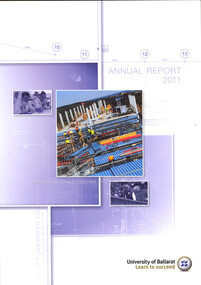
Book, University of Ballarat Annual Report, 2011, 2011
... beyond. The University’s commitment to educational and social equity, teaching excellence, research distinction, environmental sustainability and regional capacity building has enabled it to develop in a way that draws on its proud heritage to inform its future. ...beyond. The University’s commitment to educational and social equity, teaching excellence, research distinction, environmental sustainability and regional capacity building has enabled it to develop in a way that draws on its proud heritage to inform its future. ...Federation University Australia was established on 1 January 2014. Formerly known as the University of Ballarat, its enabling legislation was the University of Ballarat Amendment (Federation University Australia) Act 2013. Although formally created as a University in 1994, the University of Ballarat had a lineage back to 1870 with the establishment of the School of Mines Ballarat, making it the third institution of higher learning to be established in Australia and the first to be established in regional Australia. On 1 January 1994, Ballarat University College became the University of Ballarat and in 1998 the University merged with three TAFE Institutes to become a dual sector institution with multiple campuses. On 1 January 2014, the University of Ballarat amalgamated with the Monash University Gippsland Campus to form Federation University Australia. The Gippsland Campus also had a long lineage dating back to 1928 with the establishment of the Yallourn Technical School which became a predecessor institution to the Gippsland College of Advanced Education formed in 1968. In 1990, it was renamed the Monash University College and in 1993 became the Gippsland Campus of Monash University. Federation University Australia, or FedUni, is Australia’s newest public University. Headquartered in Ballarat, Victoria, the University offers programs in Higher Education and Vocational Education and Training to regional Victoria and beyond. The University’s commitment to educational and social equity, teaching excellence, research distinction, environmental sustainability and regional capacity building has enabled it to develop in a way that draws on its proud heritage to inform its future. Its regional character sets a framework for the University’s priorities but does not constrain it from serving wider community interests, nationally and internationally. With campuses from Horsham in the west of the state, to Churchill in the east, the name Federation University Australia was chosen to convey the scope and capacity of an expanded regional university with a federated network of campuses contributing to a new and different Australian university.Soft covered annual report of 152 pages with a photo of a building under construction on the cover. Photographs include Y Building (Science) under construction, University of Ballarat Pipe Band, Ted Ballieu, Julia Gillard, Honorary Doctorate to Jeremy Johnson; Grant Petch, Khoa Do, Sonia Tuner, Lisa Marshall, Danielle Button, Rana Stollery, Christopher Schliefort Inscriptions and Markings peter hall, robert smith, ebony place, michael thurston, roger donaldson, heather ridout, petch, khoa do, sonia turner, colin marshall, university of ballarat act, sizer, quigley, walker, wilson, mcquilton, simmons, doig, hobday, douglas, hemming, paul hemming, coutts, holmes, battersby, david battersby, reconciliation, reconciliation action plan, atkinson, fagan, balliue, gillard, prime minister, premier, pipe band, university of ballarat pipe band, pipe band championships, jeremy johnson, sovereign hill scholarships, foundation. chancellor's circle, robert h.t. smith, bonnie fagan, bonnie chew, ashlee rodgers, shanaya sheridan, alinta edwards, deanne gilson, ben atkinson, ted ballieu, julia gillard, nick maxwell, e.j. barker, jeanetta kerr-grant, grant petch, sonia tuner, lisa marshall, danielle button, rana stollery, mt rowan equine centre, christopher schliefort, honorary doctorate, university of ballarat -
 Federation University Historical Collection
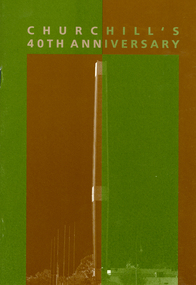
Booklet, Churchill & District Community Association, Churchill's 40th Anniversary, 2005
... beyond. The University’s commitment to educational and social equity, teaching excellence, research distinction, environmental sustainability and regional capacity building has enabled it to develop in a way that draws on its proud heritage to inform its future. ...beyond. The University’s commitment to educational and social equity, teaching excellence, research distinction, environmental sustainability and regional capacity building has enabled it to develop in a way that draws on its proud heritage to inform its future. ...Green and brown soft covered book of 16 pages.non-fictionchurchill, monash university, hazelwood, yallourn, eel hole, eel hole school, cigar, hare's house, binishell, gippsland, gippsland campus, gippsland campus collection -
Federation University Historical Collection
Booklet, Meredith Fletcher, Alumni 2002, 2002
... beyond. The University’s commitment to educational and social equity, teaching excellence, research distinction, environmental sustainability and regional capacity building has enabled it to develop in a way that draws on its proud heritage to inform its future. ...beyond. The University’s commitment to educational and social equity, teaching excellence, research distinction, environmental sustainability and regional capacity building has enabled it to develop in a way that draws on its proud heritage to inform its future. ...Federation University Australia was established on 1 January 2014. Formerly known as the University of Ballarat, its enabling legislation was the University of Ballarat Amendment (Federation University Australia) Act 2013. On 1 January 2014, the University of Ballarat amalgamated with the Monash University Gippsland Campus to form Federation University Australia. The Gippsland Campus also had a long lineage dating back to 1928 with the establishment of the Yallourn Technical School which became a predecessor institution to the Gippsland College of Advanced Education formed in 1968. In 1990, it was renamed the Monash University College and in 1993 became the Gippsland Campus of Monash University. In 2016, Federation University Australia announced plans to take possession, over a two-year period, of Monash’s Berwick Campus in the south-east corridor of Melbourne. Federation University Australia, or FedUni, is headquartered in Ballarat and offers programs in Higher Education and Vocational Education and Training to regional Victoria and beyond. The University’s commitment to educational and social equity, teaching excellence, research distinction, environmental sustainability and regional capacity building has enabled it to develop in a way that draws on its proud heritage to inform its future. Its regional character sets a framework for the University’s priorities but does not constrain it from serving wider community interests, nationally and internationally. The name Federation University Australia was chosen to convey the scope and capacity of an expanded regional university with a federated network of campuses. History of the Gippsland Campus of Federation University located at Churchill.gippsland history, yallourn technical school, brian mckenzie, latrobe valley, gippsland institute of advanced education, monash university gippsland campus, yallourn, sec, peter farago, churchill campus, gippsland campus, binishell, tom kennedy, meredith fletcher, loy yang power station, yallourn open cut, yallourn power station, r.d. dixon, howard beanland, yallourn w. power station, dante bini, bini shell, sculpture, churchill, gippsland campus collection -
 Federation University Historical Collection
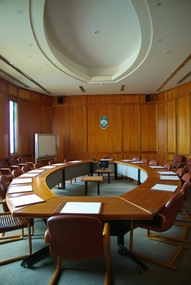
Photograph - Photograph - colour, Clare Kathleen Gervasoni, Federation University Gippsland Council Room, 2013, 29/10/2013
... beyond. The University’s commitment to educational and social equity, teaching excellence, research distinction, environmental sustainability and regional capacity building has enabled it to develop in a way that draws on its proud heritage to inform its future. ...beyond. The University’s commitment to educational and social equity, teaching excellence, research distinction, environmental sustainability and regional capacity building has enabled it to develop in a way that draws on its proud heritage to inform its future. ...The campus at Churchill became a part of Federation University Australia on 01 January 2014. Federation University Australia was established on 1 January 2014. Formerly known as the University of Ballarat, its enabling legislation was the University of Ballarat Amendment (Federation University Australia) Act 2013. Although formally created as a University in 1994, the University of Ballarat had a lineage back to 1870 with the establishment of the School of Mines Ballarat, making it the third institution of higher learning to be established in Australia and the first to be established in regional Australia. On 1 January 1994, Ballarat University College became the University of Ballarat and in 1998 the University merged with three TAFE Institutes to become a dual sector institution with multiple campuses. On 1 January 2014, the University of Ballarat amalgamated with the Monash University Gippsland Campus to form Federation University Australia. The Gippsland Campus also had a long lineage dating back to 1928 with the establishment of the Yallourn Technical School which became a predecessor institution to the Gippsland College of Advanced Education formed in 1968. In 1990, it was renamed the Monash University College and in 1993 became the Gippsland Campus of Monash University. Federation University Australia, or FedUni, is Australia’s newest public University. Headquartered in Ballarat, Victoria, the University offers programs in Higher Education and Vocational Education and Training to regional Victoria and beyond. The University’s commitment to educational and social equity, teaching excellence, research distinction, environmental sustainability and regional capacity building has enabled it to develop in a way that draws on its proud heritage to inform its future. Its regional character sets a framework for the University’s priorities but does not constrain it from serving wider community interests, nationally and internationally. With campuses from Horsham in the west of the state, to Churchill in the east, the name Federation University Australia was chosen to convey the scope and capacity of an expanded regional university with a federated network of campuses contributing to a new and different Australian university.Photograph of a timber lined Council Room at Federation University Gippsland campus. This campus was formerly a campus of Monash University, and their logo has not been removed from thr wall in this photograph.federation university, gippsland campus, monash university, churchill, gippsland, board room, council room, gippsland campus collection -
 Federation University Historical Collection
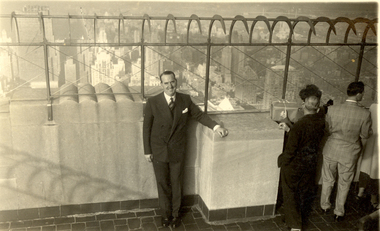
Photograph, Frank Wright at the Empire State Building, Mid 20th Century
... beyond is of a city skyline. The man is Frank Wright and the place is the viewing platform at the top of the Empire State Building in New York....The Frank Wright Medal at the Royal South Street competition is awarded to an individual recognized as making an outstanding contribution to brass music in Australia. frank wright brass bands conductor new york empire state building Black and white photograph of a man dressed in a suit standing in the centre of the picture with several other people facing away from the camera on the right. The man is leaning against a thick art deco style armpit high wall with an extending ironwork protective fence above. The view seen beyond ...Frank Wright was a renown resident of Smeaton, where he was born on 2 August 1901. He lived at Laura Villa, and attended Smeaton State School. His father William was a gold miner and his mother's name was Sarah. Their family won many singing and instrumental awards. Frank was tutored by Percy Code and was awarded a gold medal for the highest marks in the ALCM examinations in the British Colonies at the age of seventeen years. He became the Australian Open Cornet Champion by the age of eighteen. A year later, Frank conducted the City of Ballarat Band, and later the Ballarat Soldiers’ Memorial Band. He formed the Frank Wright Frisco Band and Frank Wright and his Coliseum Orchestra. These bands won many South Street awards, and Frank as conductor won many awards in the Australian Band Championship contest. In 1933 Frank Wright sailed to England to conduct the famous St Hilda’s Band and was later appointed Musical Director of the London County Council, where he organized many amazing concerts in parks, in and around the London district. He was made Professor of Brass and Military Band Scoring and conducted at the Guildhall of Music and Drama. Frank was often invited to adjudicate Brass Band Championships around Europe, in Australia, including South Street and in New Zealand. The Frank Wright Medal at the Royal South Street competition is awarded to an individual recognized as making an outstanding contribution to brass music in Australia.Black and white photograph of a man dressed in a suit standing in the centre of the picture with several other people facing away from the camera on the right. The man is leaning against a thick art deco style armpit high wall with an extending ironwork protective fence above. The view seen beyond is of a city skyline. The man is Frank Wright and the place is the viewing platform at the top of the Empire State Building in New York.frank wright, brass bands, conductor, new york, empire state building -
 Federation University Historical Collection
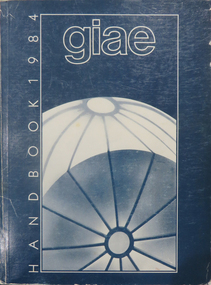
Book, Gippsland Institute of Advanced Education Handbooks, 1970-1985
... beyond. The University’s commitment to educational and social equity, teaching excellence, research distinction, environmental sustainability and regional capacity building has enabled it to develop in a way that draws on its proud heritage to inform its future. ...beyond. The University’s commitment to educational and social equity, teaching excellence, research distinction, environmental sustainability and regional capacity building has enabled it to develop in a way that draws on its proud heritage to inform its future. ....1) 1977 Gippsland Institute of Advanced Education Handbook with white cover .2) 1978 Gippsland Institute of Advanced Education Handbook with blue/black cover .3) 1979 Gippsland Institute of Advanced Education Handbook with orange cover .4) 1980 Gippsland Institute of Advanced Education Handbook with yellow/brown cover .5) 1981 Gippsland Institute of Advanced Education Handbook with grey/black cover .6 1984 Gippsland Institute of Advanced Education Handbook with blue cover .7) 1985 Gippsland Institute of Advanced Education Handbook with purple cover .8) 1989 Gippsland Institute of Advanced Education Handbook with white/purple/grey/red/blue cover .7) 1985 Gippsland Institute of Advanced Education Handbook with pale green cover. .9) 1974 Gippsland Institute of Advanced Education Handbook with orangeand white cover .10) 1975 Gippsland Institute of Advanced Education Handbook with green and white cover .11) 1976 Gippsland Institute of Advanced Education Handbook with white cover .12) 1986 Gippsland Institute of Advanced Education Handbook with mid-blue cover .13) 1987 Gippsland Institute of Advanced Education Handbook with red cover .14) 1988 Gippsland Institute of Advanced Education Handbook with red cover .15) 1973 Gippsland Institute of Advanced Education Handbook with brown cover .16) 1972 Gippsland Institute of Advanced Education Handbook with pale green cover .17) 1971 Gippsland Institute of Advanced Education Handbook with mid-blue cover non-fictiongippsland institute of advanced education, giae, gippsland, churchill, morwell, electricty, handbook, gippsland campus
