
Showing 162 items matching "button set"
-
 Tatura Irrigation & Wartime Camps Museum
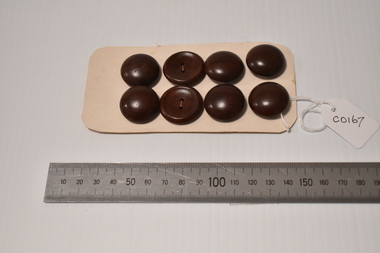
Functional object - Button Set, 1940's
... Button Set...button set...Functional object Button Set ...Believed to be made by Mr. Doster at Camp 3, TaturaSet of 8 dark brown wooden buttons mounted on a piece of card : 2 are round each with 2 holes in the centre, 6 have shanks. All 8 are threaded onto cardbacking.button set, glockeman b, beck b, doster, wood, camp3, tatura, ww2 camp 3, costume, accessory, clothes -
 Tatura Irrigation & Wartime Camps Museum
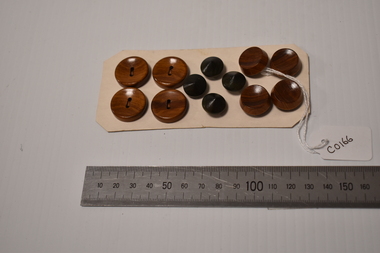
Functional object - Button - set, 1940's
... Button - set...button set...Doster at Camp 3, Tatura button set wood glockemann b beck b doster camp 3 tatura ww2 camp 3 costume accessory clothes Set of 12 wooden buttons mounted on a piece of card : 4 round light brown, with 2 holes in centre, 4 round brown shank, 4 green round rising to a centre peak and shanks Functional object Button - set ...Believed to be made by Mr. Doster at Camp 3, TaturaSet of 12 wooden buttons mounted on a piece of card : 4 round light brown, with 2 holes in centre, 4 round brown shank, 4 green round rising to a centre peak and shanksbutton set, wood, glockemann, b, beck b, doster, camp 3, tatura, ww2 camp 3, costume, accessory, clothes -
 Bendigo Military Museum
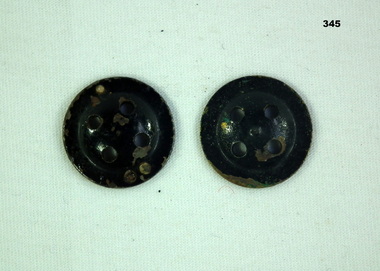
Equipment - BUTTON COMPASS
... Two Piece system. One Button is set into the other to form a Survival Compass...Refer Cat No 354.5 for his service details. compass accessory ww2 Two Piece system. One Button is set into the other to form a Survival Compass Equipment BUTTON COMPASS ...The compass belonged to Arthur COWLEY No 50704, RAAF. Refer Cat No 354.5 for his service details.Two Piece system. One Button is set into the other to form a Survival Compasscompass, accessory, ww2 -
 Whitehorse Historical Society Inc.
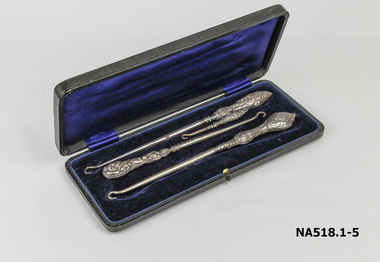
Accessory - Button Hook
... Button hook set - black oblong box lined with dark blue satin and velvet containing four button hooks of various sizes. ...Used to catch buttons and pull them through eyelets on button up boots and shoes. costume accessories footwear accessories Button hook set - black oblong box lined with dark blue satin and velvet containing four button hooks of various sizes. ...Used to catch buttons and pull them through eyelets on button up boots and shoes.Button hook set - black oblong box lined with dark blue satin and velvet containing four button hooks of various sizes. Hooks are silver plated with ornate handles.costume accessories, footwear accessories -
 Mont De Lancey
Manicure set
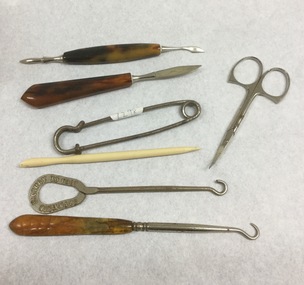
... Manicure set and button hooks - various items. Seven in total. 2 x Boot button hooks for lacing boots. 1. ...buttonhooks manicure equipment knitting equipment Manicure set and button hooks - various items. Seven in total. 2 x Boot button hooks for lacing boots. 1. ...Manicure set and button hooks - various items. Seven in total. 2 x Boot button hooks for lacing boots. 1. With steel inscribed on handle "Ezywalkin Factory to Foot". 2.With brown Bakelite handle. 2 x parts of Manicure set with tortoise shell handles. 1 x Pair of nail scissors. 1 x Bone cuticle tool. 1 x Knitting stitch holderbuttonhooks, manicure equipment, knitting equipment -
 Federation University Historical Collection
Calculator, Monroe High Speed Adding-Calculator
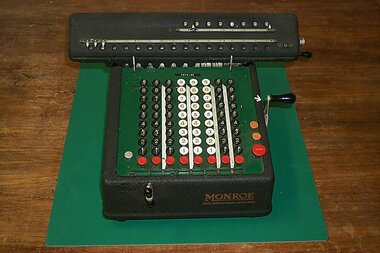
... Two buttons are provided to set the machine either to clear the number entry with each revolution of the crank or to repeat the entry. The largest button...Two buttons are provided to set the machine either to clear the number entry with each revolution of the crank or to repeat the entry. The largest button ...Used before the invention of electronic calculators, mechanical adding machines were most often used for long calculations. This calculator was used in the Ballarat School of Mines Physics Department. Addition and subtraction were perfomed by turning the larger side mounted crank forward or backward. the smaller crank lever zeros the two registers. Two buttons are provided to set the machine either to clear the number entry with each revolution of the crank or to repeat the entry. The largest button resets the keybord to all 0s.A calculator with shiftable carriage and digit separator rods between each row of keys.ballarat school of mines, calculator -
 Flagstaff Hill Maritime Museum and Village
Accessory - Grooming Set, T R Cadman, ca. 1924
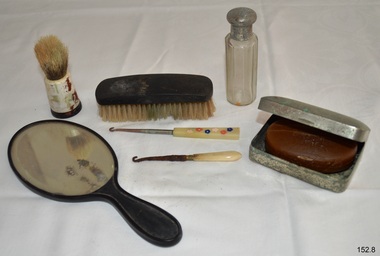
... set...personal care...soap box...soap container...cologne bottle...clothes brush...shaving brush...button...Men's grooming set; metal soap container with star decoration, oval soap cake, oval hand mirror in a black frame ten-sided clear glass cologne bottle with silver metal lid, yellow bristle clothes brush with brown wooden hand grip, yellow bristle shaving brush with black base and white body, and two button hooks with white handles; the larger one has floral motifs. ...Men's grooming set; metal soap container with star decoration, oval soap cake, oval hand mirror in a black frame ten-sided clear glass cologne bottle with silver metal lid, yellow bristle clothes brush with brown wooden hand grip, yellow bristle shaving brush with black base and white body, and two button hooks with white handles; the larger one has floral motifs. ...This men's grooming set of personal care equipment and toiletries is an example of items packaged in attractive cases and sold as gifts in Australian chemist outlets and department stores in the 1920s to 1940s. This set was originally packaged in a leather-covered, lined and fitted case, with a comb, hair brush, and razor included as well. as the items shown here. The razor, once included with the set, had the inscription "T.R. Cadman and Sons, Sheffield England". The family business began with Luke Cadman in 1748. Thomas Radley Cadmen (1833 - 1917) took over the business in 1871, by which time it was operating in Sheffield. The business became incorporated as T.R. Cadman & Sons in 1924 but shortly afterwards the straight razors manufactured by them were stamped T.R. Cadman & Sons Ltd. The company specialised in pocket knives and razors from 1933 and supplied the British Royal Navy with razors in WWII. Over 80 per cent of sales were for the overseas market including Australia. Some of their razors were sold in stores in Victoria. The business traded in 1965. This grooming set was donated for exhibit in Flagstaff Hill Maritime Museum and Village's exhibit of the vessel 'Reginald M', a two-masted coastal trading ketch built in Port Adelaide in 1922. These items are examples of personal objects sold in Victoria in the 1920s as gifts for men, cased or packaged for special occasions and sold in retail stores. The items are associated with the historic coastal trading ketch 'Reginald M', listed on the Australian Register of Historic Vessels; and active from 1922 until 1975. The items were displayed in the Master's Quarters of the Reginald M exhibit at Flagstaff Hill Maritime Museum and Village until 2016 when the ship was decommissioned from Flagstaff Hill's fleet.Men's grooming set; metal soap container with star decoration, oval soap cake, oval hand mirror in a black frame ten-sided clear glass cologne bottle with silver metal lid, yellow bristle clothes brush with brown wooden hand grip, yellow bristle shaving brush with black base and white body, and two button hooks with white handles; the larger one has floral motifs. Inscriptions were on the razor originally included in the grooming set.Soap container once had star motifs.flagstaff hill, warrnambool, shipwrecked coast, flagstaff hill maritime museum, maritime museum, shipwreck coast, flagstaff hill maritime village, great ocean road, grooming set, men's grooming set, personal grooming, toiletry set, personal care, soap box, soap container, cologne bottle, clothes brush, shaving brush, button hook, hand mirror, personal efects, toiletries, t.r. cadman & sons, reginald m, soap dish -
 Shepparton RSL Sub Branch
Uniform, Great Coat
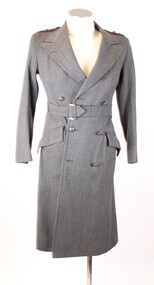
... The uniform set has social significance to the Shepparton area, being owned and worn by a serving community member who was born in Numurkah, enlisted in Shepparton and returned to the community in later life. second world war world war ii medical wwii nurse women Shoulder flashes read "AUSTRALIA" and "BRITISH COMMONWEALTH FORCES". Label reads "TAILORS & HABIT/MAKERS/J. RAVENSDALE/& SON/NICHOLAS BLDG./SWANSTON ST MELBOURNE/SISTER DANSON". Buttons read "AUSTRALIAN MILITARY FORCES" Shin length grey woollen double breasted coat fastened with three buttons on front centre. Interior bakelite or plastic button ...Coat worn by Sister Danson (VFX151507) during the British presence in Japan following the end of the Second World War. About 16,000 Australians served in the British Commonwealth Occupation Forces, including 130 from the Australian General Hospital with whom Sister Danson presumably served. Sister Danson was born in Numurkah and served as Leiutentant with the Heidelberg Military Hospital before embarking for Japan in 1947.This coat is part of a complete uniform set held by the Shepparton RSL. The uniform has representative and historic significance as an example of the style of uniform worn by nursing staff of the Australian General Hospital during the 1940s and into the 1950s. The uniform set has social significance to the Shepparton area, being owned and worn by a serving community member who was born in Numurkah, enlisted in Shepparton and returned to the community in later life.Shin length grey woollen double breasted coat fastened with three buttons on front centre. Interior bakelite or plastic button fastens panels on interior. Two hip-height pockets with folded flap on exterior. Grey fabric belt fastened with a metal buckle; belt is held in place with two fabric loops on either side of the waist. "AUSTRALIA" shoulder flashes on both left and right shoulders; on left arm a blue and brown rectangular colour patch and on the right arm, a blue square patch with embroidered crown and the words "BRITISH COMMONWEALTH FORCES." Epaulettes on either shoulder carry two metal badges signifying a senior Sister and fastened with a metal button. A pin is missing from the base of the epaulette. Interior lined with purple-grey lining; pocket on interior left chest and manufacturer's label at base of neck underneath loop.Shoulder flashes read "AUSTRALIA" and "BRITISH COMMONWEALTH FORCES". Label reads "TAILORS & HABIT/MAKERS/J. RAVENSDALE/& SON/NICHOLAS BLDG./SWANSTON ST MELBOURNE/SISTER DANSON". Buttons read "AUSTRALIAN MILITARY FORCES"second world war, world war ii, medical, wwii, nurse, women -
 Shepparton RSL Sub Branch
Uniform, trousers, Conway Bros. PTY. LTD, 1969
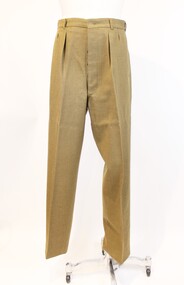
... set. Mending patch attached. (end of box containing words) NAME.....DOCKSEY (‘Docksey is in hand-written black ink) ARMY No.....216308 (numbers also hand-written in black ink) (the number 40 is also wrtten in faded black ink in the top right corner of the label) khaki coloured trousers which are composed of a heavy fabric. The trousers button ...These trousers are part of a Royal Australian Army Ordnance Corps uniform. The Royal Australian Army Ordnance Corps (RAAOC) is responsible for various logistics and organisational operations, such as maintenance of parachutes, fuel distribution, personnel administration, exlosive disposal and laundy operations. The trousers were manufactured in 1969 and were worn by an unknown RAAOC serviceman. The patches on the sleeves of the corresponding jacket denote that he had earned qualifications as a parachuter and a marksman and that he was a Warrant Officer 1. Due to the period of manufacture it can be presumed that the serviceman whom this uniform belonged to served in the Vietnam War.As historic military uniform trousers dating to 1968, it is presumed that this item would have been used in service during the Vietnam War. The wearer of the uniform is unknown, however the patches and flashes attached signify that the serviceman worked for the Royal Australian Army Ordnance Corps, earned qualifications as a parachuter and marksman and ranked highly as a Warrant Officer 1. The item is representative of a type of uniform worn by high ranking RAAOC servicemen during the 1960’s. It is also in very good condition for its age.khaki coloured trousers which are composed of a heavy fabric. The trousers button up at the front with 6 plastic buttons. There is an additional strip of fabric attached to the right-hand fly which can be fastened with an extra button on the interior of the left-hand fly. There are an additional 6 buttons along the interior waistband. There are also three buttons on the exterior waistband down the front and a buckle. The buttons are composed of brown plastic. There are two open hip pockets, one on either side, and another button-up pocket on the right-hand side of the back. There is a white label with inscriptions attached to the interior of the back pocket with an extra piece of fabric attached for mending patches.Printed in black inscriptions on the white label: CONWAY BROS. PTY. LTD ADELAIDE 1969 (a broad arrow) Class 8405-66-025-6183 A W M 7 (these characters are stamped in faded black ink) SIZE & WAIST 33R MATCHING JACKET 37-38R in a box are the words: DRY CLEAN ONLY. Re-press on original seams. Creases set by Si-ro-set. Mending patch attached. (end of box containing words) NAME.....DOCKSEY (‘Docksey is in hand-written black ink) ARMY No.....216308 (numbers also hand-written in black ink) (the number 40 is also wrtten in faded black ink in the top right corner of the label)military, army, raaoc, marksman, royal australian army ordnance corps, parachuting, warrant officer, uniform, trousers -
 Flagstaff Hill Maritime Museum and Village
Accessory - Grooming set, F.H. FAULDING & CO. LTD, 1930s to 1940s
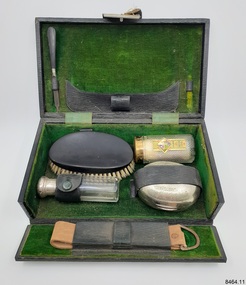
... Male grooming set; black leather-covered case with green velvet lining and strap with a metal button closure. ...Moulded in the soap; 'CHRISTY'S" Male grooming set; black leather-covered case with green velvet lining and strap with a metal button closure. ...This gift-boxed grooming set contains men's toiletry and grooming items in a lined and fitted case. The set was made by Fauldings from 193o to 1940 and sold by chemists and department stores throughout Australia. An advertisement promotes a variety of sets as 'Toilet Treasures by Faulding' and pictures several sets called 'caskets', and gives the different combinations a set number. Another advertisement promotes the sets as 'Gifts of Rare Discernment'. The items on offer include After-shave Lotion, a bottle of Brilliantine for hair, and an Old English Lavender shaving stick in a glass container. Some sets have Complexion Soap, a good quality sterilised Shaving Brush and Talcum Powder. A grooming set similar to the one in our collection was priced at 11 shillings in 1936 and would cost approximately AU $90 in 2022. This boxed grooming set is an example of men's toiletries sold from the 1920s to the 1940s in Australia. The supplier, Faulding, brand products have been available since 1845 when Francis Hardy Faulding opened a pharmacy in Adelaide, South Australia. The company has built a reputation for being a trustworthy supplier of pharmacy and healthcare needs for 175 years.Male grooming set; black leather-covered case with green velvet lining and strap with a metal button closure. The lid and front of the base fold out. The case is fitted with straps and a compartment to secure items inside. The set contains men's toiletries and grooming items; a nail file with ebonised handle, an oval bristle brush with shaped ebonised hand grip, and a twelve-sided textured glass bottle with a gold metal lid and a shave stick with silver foil around the base, wrapped in waxed paper. There is also a ten-sided plain glass bottle with silver metal lid, an oval metal soap container with hinged lid and an unused round cake of soap. A light brown leather stropping strap with a metal 'D' ring one end and a punched hole in the other end is fitted onto the folded down side of the case. The shaving stick is Old English Lavender by Faulding and the soap is Christy's. Inscriptions on the shaving stick wrapper, bottle base, label and lid. Shaving stick; "Faulding Old English Lavender Shaving Stick", "Faulding", "Faulding AUSTRALIA" and moulded inscriptions on the base [undecipherable]. Moulded in the soap; 'CHRISTY'S"flagstaff hill, flagstaff hill maritime museum and village, warrnambool, maritime museum, maritime village, great ocean road, shipwreck coast, male grooming set, male toiletries, male accessories, faulding, toilet treasures, gift box, casket, shaving toiletries, hair toiletries, christy's, complexion soap, ebonised handles -
 Flagstaff Hill Maritime Museum and Village
Clothing - Combination Undergarment, late 19th or early 20th century
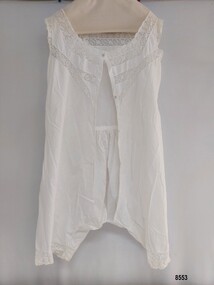
... set up in 2010 to support a range of charitable and not-for-profit causes by providing grant assistance. In 2021, she was awarded a Medal of the Order of Australia for services to the community. Combination undergarments combined the chemise and drawers into one garment. The combination is divided, or bifurcated, from the waist to the crotch for easier urinating. This one-piece type of underwear was worn by females from the 1860s and into the early 1900s. The 19th Century garments had front button...set up in 2010 to support a range of charitable and not-for-profit causes by providing grant assistance. In 2021, she was awarded a Medal of the Order of Australia for services to the community. Combination undergarments combined the chemise and drawers into one garment. The combination is divided, or bifurcated, from the waist to the crotch for easier urinating. This one-piece type of underwear was worn by females from the 1860s and into the early 1900s. The 19th Century garments had front button ...This item of underclothing, called a "combination" is one of several linen and clothing items belonging to the deceased estate of Susan Henry OAM (nee Vedmore 1944 - 2021) that was donated to Flagstaff Hill Maritime Museum and Village. Susan's family (Harold and Gladys Vedmore) immigrated to Australia from Wales in 1955 and settled in Warrnambool. Susan was well known in the Warrnambool community for her work supporting children and families across the district - particular those with disabilities, or those who were homeless, unemployed or isolated. Susan was the founding trustee of the "Vedmore Foundation" - a Warrnambool philanthropic trust set up in 2010 to support a range of charitable and not-for-profit causes by providing grant assistance. In 2021, she was awarded a Medal of the Order of Australia for services to the community. Combination undergarments combined the chemise and drawers into one garment. The combination is divided, or bifurcated, from the waist to the crotch for easier urinating. This one-piece type of underwear was worn by females from the 1860s and into the early 1900s. The 19th Century garments had front button closures like this one, and those made in the 1900s more often had back closures. Combination underwear was popular because the all-in-one design had far fewer gathers and bulk, making the other clothing look much smoother. Their primary use was to protect clothing from perspiration and because they were made with cotton or linen, were easy to wash. This particular item is made with lawn (a very lightweight fabric) and is sleeveless, making it suitable for hot weather. Although they were worn under the corset next to the skin (and therefore not meant to be seen), they were often decorated with lace or embroidery. This item is an example of the needlework skills of women in the late 19th century - using machine stitching and lace to personalise and embellish a practical item of clothing. It is also significant as an example of a practical solution to the difficulties that women of this era faced with regard to the washing of clothes and household linens.Lady’s white lawn and lace all-In-one combination undergarment. The handmade underwear is a combined chemise and bloomers. It has four buttons in the front and is trimmed with lace on the neckline, armholes, bodice (in a diagonal design) and legs. The left and right sides are divided from the waist to the crutch. The back of the garment is plain with a gathered section at the lower back.flagstaff hill maritime museum and village, great ocean road, combinations, lady's combinations, undergarment, lingerie, handsewn, underwear, clothing, victorian era undergarments, lady's garment, susan henry oam, vedmore foundation -
 Flagstaff Hill Maritime Museum and Village
Badge - ACF Australian Comforts Fund badge, P J King Pty Ltd, 1940
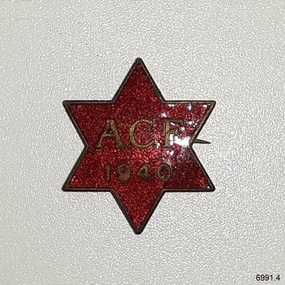
... set of badges that represents various organisations that he had interests in. The Australian Comforts Fund was a mostly female, volunteer-run organisation officially recognised by the Government. It began in 1916 as an amalgamation of groups of people who wanted to support the Australian troops abroad with Items of comfort to supplement the essential items provided by the Australian Military Forces. The ACF raised funds to purchase goods, pack them and send them overseas. One of their fund-raising activities was 'button...set of badges that represents various organisations that he had interests in. The Australian Comforts Fund was a mostly female, volunteer-run organisation officially recognised by the Government. It began in 1916 as an amalgamation of groups of people who wanted to support the Australian troops abroad with Items of comfort to supplement the essential items provided by the Australian Military Forces. The ACF raised funds to purchase goods, pack them and send them overseas. One of their fund-raising activities was 'button ...This Australian Comforts Fund badge is part of a set of eleven badges collected from the 1920s to the 1940s by Dr W. R. Angus. The badge was sold by the ACF in 1940 to raise funds for gifts to send to the Australian troops serving overseas. The badge is one of a set of badges that represents various organisations that he had interests in. The Australian Comforts Fund was a mostly female, volunteer-run organisation officially recognised by the Government. It began in 1916 as an amalgamation of groups of people who wanted to support the Australian troops abroad with Items of comfort to supplement the essential items provided by the Australian Military Forces. The ACF raised funds to purchase goods, pack them and send them overseas. One of their fund-raising activities was 'button days' where buttons such as this one were given to those who gave donations. The ACF closed down after World War I but was re-formed at the start of World War II. Items that the ACF sent to the troops included personal toiletry items such as toothbrushes and toothpaste, magazines, pyjamas, singlets and socks. They also provided sporting equipment, recreational music, writing materials and postcards. Special hampers were sent to the troops at Christmas time. The maker, P J King, (Percy John King), originally established his engraving and ie casting business in Russell Street, Melbourne in 1893 in partnership with Charles Walder Bridgland, continuing on his own from 1899. Percy and his son John Howard King set up a new business P J King Pty Ltd in 1928 making uniform buttons. In the late 1980s, it merged with two other companies that then became J J Cash, now known as Cash's Australia. The set of badges was donated to Flagstaff Hill Maritime Village by the family of Doctor Angus, Surgeon and Oculist. It is part of the “W.R. Angus Collection” which includes historical medical equipment, surgical instruments and material belonging to Dr Edward Ryan and Dr Thomas Francis Ryan, (both of Nhill, Victoria) and Dr Angus’ own belongings. The Collection’s history spans the medical practices of the two Doctors Ryan, from 1885-1926 plus that of Dr Angus, up until 1969. The W.R. Angus Collection: - The W.R. Angus Collection includes historical medical equipment, surgical instruments and material belonging to Dr Edward Ryan and Dr Thomas Francis Ryan, (both of Nhill, Victoria) and Dr Angus’ own belongings. The Collection’s history spans the medical practices of the two Doctors Ryan, from 1885-1926 plus that of Dr Angus, up until 1969. It includes historical medical and surgical equipment and instruments from the doctors Edward and Thomas Ryan of Nhill, Victoria. Dr Angus married Gladys in 1927 at Ballarat, the nearest big city to Nhill where he began as a Medical Assistant. He was also Acting House surgeon at the Nhill hospital where their two daughters were born. During World War II He served as a Military Doctor in the Australian Defence Force. Dr Angus and his family moved to Warrnambool in 1939, where Dr Angus operated his own medical practice. He later added the part-time Port Medical Officer responsibility and was the last person appointed to that position. Dr Angus and his wife were very involved in the local community, including the planning stages of the new Flagstaff Hill and the layout of the gardens there. Dr Angus passed away in March 1970.This badge represents the efforts of the women volunteers in Australia to support the Australian troops overseas in WWI and WWII. This badge is one of a set of significant badges that connects Doctor Angus with Australian organisations of the early-to-mid 20th century, including those relating to military service support. The W.R. Angus Collection is significant for still being located at the site it is connected with, Doctor Angus being the last Port Medical Officer in Warrnambool. The Collection includes historical medical objects that date back to the late 1800s.The ACF Badge is a star-shaped, gold, glittered red enamel and metal badge. The star has six points. The enamel surface is textured. The border and front inscription of the badge is gold. It is the badge of the Australian Comfort Fund, made by P.J. King and dated 1940. This badge is part of a set of badges collected by Dr W R Angus. the set represents organisations that he was involved in, and is part of the W.R. Angus Collection.Front: “ACF / 1940” Reverse embossed “P.J. KING”flagstaff hill, warrnambool, maritime museum, maritime village, great ocean road, shipwreck coast, metal badges, enamel badges, organisation badges, acf, presbyterian brotherhood, oikumene, w.r. angus, flagstaff hill maritime museum and village, australian comforts fund, button day, volunteer, australian military forces, christmas hamper, 1940 acf badge, fund-raising, p j king pty ltd, percy john king, donor's badge, world war ii, 1939-1945, australians at war, voluntary work, volunteers, home front, w.r. angus collection -
 Flagstaff Hill Maritime Museum and Village
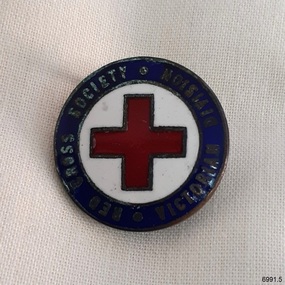
badge - Red Cross Society badge, Australian Red Cross Society, Victorian Division, 1914-1940s
... button. It was made by Stokes & Sons Pty. Ltd. in Melbourne. The maker, Thomas Stokes, migrated to Melbourne from Birmingham in 1854 and set up business in Mincer Lane as a die-sinker, producing medals, tokens, buttons and silverware, and offered an engraving service. ...button. It was made by Stokes & Sons Pty. Ltd. in Melbourne. The maker, Thomas Stokes, migrated to Melbourne from Birmingham in 1854 and set up business in Mincer Lane as a die-sinker, producing medals, tokens, buttons and silverware, and offered an engraving service. ...The badge represents the Victoria Division of the Australian Red Cross Society, which was formed on 21st August 1914 at the outbreak of the First World War. Stokes & Sons of Melbourne made the button. It was made by Stokes & Sons Pty. Ltd. in Melbourne. The maker, Thomas Stokes, migrated to Melbourne from Birmingham in 1854 and set up business in Mincer Lane as a die-sinker, producing medals, tokens, buttons and silverware, and offered an engraving service. He moved to Flinders Lane in 1856. After a time, in 1894, the business became Stokes & Sons Pty. Ltd, electroplates and badge makers at Post Office Place in Melbourne. The maker's mark 'Stokes & Sons' continued to be made on badges up until 1962. This badge is one of a set of badges collected by Dr W R Angus from the organisations in which he was involved. The set of badges is now part of Flagstaff Hill’s comprehensive W.R. Angus Collection, donated by the family of Dr W R Angus, surgeon and oculist. The W.R. Angus Collection: - The W.R. Angus Collection includes historical medical equipment, surgical instruments and material belonging to Dr Edward Ryan and Dr Thomas Francis Ryan, (both of Nhill, Victoria) and Dr Angus’ own belongings. The Collection’s history spans the medical practices of the two Doctors Ryan, from 1885-1926 plus that of Dr Angus, up until 1969. It includes historical medical and surgical equipment and instruments from the doctors Edward and Thomas Ryan of Nhill, Victoria. Dr Angus married Gladys in 1927 at Ballarat, the nearest big city to Nhill where he began as a Medical Assistant. He was also Acting House surgeon at the Nhill hospital where their two daughters were born. During World War II He served as a Military Doctor in the Australian Defence Forces. Dr Angus and his family moved to Warrnambool in 1939, where Dr Angus operated his own medical practice. He later added the part-time Port Medical Officer responsibility and was the last person appointed to that position. Both Dr Angus and his wife were very involved in the local community, including the planning stages of the new Flagstaff Hill and the layout of the gardens there. Dr Angus passed away in March 1970.This badge is significant for connecting Doctor Angus with organisations that he supported. The W.R. Angus Collection is significant for still being located at the site it is connected with, Doctor Angus being the last Port Medical Officer in Warrnambool. The Collection includes historical medical objects that date back to the late 1800s.Badge; a round metal and enamel badge with a blue band around the perimeter and a silver-edged red cross on a white background in the centre. The badge has a vertical pin on the back. It is the badge of the Victorian Division of the Red Cross Society. the maker was Stokes & Sons of Melbourne. This badge is part of a set of badges collected by Dr W R Angus. the set represents organisations that he was involved in, and is part of the W.R. Angus Collection.Printed within the blue band; “RED CROSS SOCIETY” “VICTORIAN DIVISION” Embossed on the reverse; “STOKES & SONS / MELB” flagstaff hill, warrnambool, maritime village, maritime museum, shipwreck coast, great ocean road, w.r. angus, badge, organisation badge, flagstaff hill maritime museum and village, australian red cross, victorian division, charity, volunteer organisation, w.r. angus collection -
 Flagstaff Hill Maritime Museum and Village
Functional object - Button, Ca. 1855
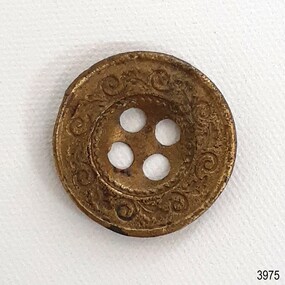
... set, which is currently on display. Former Director of Flagstaff Hill, Peter Ronald, had salvaged most of the artefacts from the wreck. This button ...The metal button was part of the cargo of the Schomberg vessel. Buttons are used for fastening two pieces of fabric together such as trousers, shirts, dresses and other similar items. ABOUT THE SCHOMBERG (October 6 to December 27, 1855)- When the ship Schomberg was launched in 1855, she was considered the most perfect clipper ship ever to be built. James Baine’s Black Ball Line had commissioned her for their fleet of passenger liners. The Aberdeen builders designed her to sail faster than the clippers designed the three-masted wooden clipper ship to be fast. The timber used for the diagonal planking was British oak with layers of Scottish larch. This luxury emigrant vessel was designed for superior comfort. She had ventilation ducts to provide air to the lower decks and a dining saloon, smoking room, library and bathrooms for the first-class passengers. The master for Schomberg’s maiden voyage was Captain ‘Bully’ Forbes. He drunkenly predicted at her launch that he would make the journey between Liverpool and Melbourne in 60 days. Schomberg departed Liverpool on 6 October 1855 with 430 passengers and 3000 tons of cargo including iron rails and equipment intended the build the Geelong Railway and a bridge over the Yarra from Melbourne to Hawthorn. The poor winds slowed Schomberg’s sail across the equator. She was 78 days out of Liverpool when she ran aground on a sand spit near Peterborough, Victoria, on 27 December; the sand spit and currents were not marked on Forbes’s map. The ship’s Chief Officer spotted the coastal steamer SS Queen at dawn and sent a signal. The master of the SS Queen approached the stranded vessel and all of Schomberg’s passengers safely disembarked. In 1975, 120 years after the Schomberg was wrecked, divers from Flagstaff Hill found an ornate communion set at the wreck site along with many other artefacts. In 1978 a diamond ring was discovered under the concretion in the lid of the communion set, which is currently on display. Former Director of Flagstaff Hill, Peter Ronald, had salvaged most of the artefacts from the wreck. This button s significant as an example of an item in common use in the mid-19th century and the items carried on ships as cargo. The Schomberg collection as a whole is of historical and archaeological significance at a State level. Flagstaff Hill’s collection of artefacts from the Schomberg is also significant for its association with the Victorian Heritage Registered shipwreck (VHR S 612). The collection is of prime significance because of the relationship between the objects salvaged, as together they help us to interpret the story of the Schomberg. The collection as a whole is historically significant for representing aspects of Victoria's maritime history and its potential to interpret social and historical themes. Button; round metal concave button with four holes. There is a decorative border on the edge and around the holes. The button was recovered from the wreck of the Schomberg.flagstaff hill, warrnambool, flagstaff hill maritime museum, maritime museum, shipwreck coast, flagstaff hill maritime village, great ocean road, shipwreck artefact, schomberg, fastener, button, clothing accessory, clothing fastener, haberdashery -
 Flagstaff Hill Maritime Museum and Village
Functional object - Button, Ca. 1855
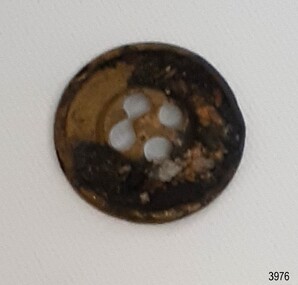
... set, which is currently on display. Former Director of Flagstaff Hill, Peter Ronald, had salvaged most of the artefacts from the wreck. This button ...The metal button was part of the cargo of the Schomberg vessel. Buttons are used for fastening two pieces of fabric together such as trousers, shirts, dresses and other similar items. ABOUT THE SCHOMBERG (October 6 to December 27, 1855)- When the ship Schomberg was launched in 1855, she was considered the most perfect clipper ship ever to be built. James Baine’s Black Ball Line had commissioned her for their fleet of passenger liners. The Aberdeen builders designed her to sail faster than the clippers designed the three-masted wooden clipper ship to be fast. The timber used for the diagonal planking was British oak with layers of Scottish larch. This luxury emigrant vessel was designed for superior comfort. She had ventilation ducts to provide air to the lower decks and a dining saloon, smoking room, library and bathrooms for the first-class passengers. The master for Schomberg’s maiden voyage was Captain ‘Bully’ Forbes. He drunkenly predicted at her launch that he would make the journey between Liverpool and Melbourne in 60 days. Schomberg departed Liverpool on 6 October 1855 with 430 passengers and 3000 tons of cargo including iron rails and equipment intended the build the Geelong Railway and a bridge over the Yarra from Melbourne to Hawthorn. The poor winds slowed Schomberg’s sail across the equator. She was 78 days out of Liverpool when she ran aground on a sand spit near Peterborough, Victoria, on 27 December; the sand spit and currents were not marked on Forbes’s map. The ship’s Chief Officer spotted the coastal steamer SS Queen at dawn and sent a signal. The master of the SS Queen approached the stranded vessel and all of Schomberg’s passengers safely disembarked. In 1975, 120 years after the Schomberg was wrecked, divers from Flagstaff Hill found an ornate communion set at the wreck site along with many other artefacts. In 1978 a diamond ring was discovered under the concretion in the lid of the communion set, which is currently on display. Former Director of Flagstaff Hill, Peter Ronald, had salvaged most of the artefacts from the wreck. This button s significant as an example of an item in common use in the mid-19th century and the items carried on ships as cargo. The Schomberg collection as a whole is of historical and archaeological significance at a State level. Flagstaff Hill’s collection of artefacts from the Schomberg is also significant for its association with the Victorian Heritage Registered shipwreck (VHR S 612). The collection is of prime significance because of the relationship between the objects salvaged, as together they help us to interpret the story of the Schomberg. The collection as a whole is historically significant for representing aspects of Victoria's maritime history and its potential to interpret social and historical themes. Button; round metal concave button with four holes. The outer edge and the holes each have a raised rim. The button was recovered from the wreck of the Schomberg.flagstaff hill, warrnambool, flagstaff hill maritime museum, maritime museum, shipwreck coast, flagstaff hill maritime village, great ocean road, shipwreck artefact, schomberg, fastener, button, clothing accessory, clothing fastener, haberdashery -
 Glenelg Shire Council Cultural Collection
Domestic object - Manicure set, Levi & Salamon, 1898
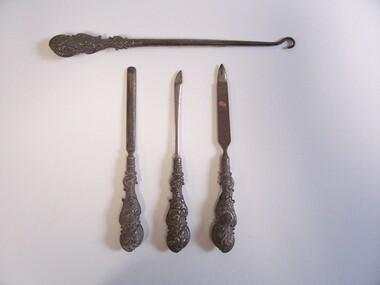
... Nail file, Cuticle knife, Cuticle press, button hook. (3724.1- 3724.4) Silver decorative handles. Domestic object Manicure set Levi & Salamon ...Part of Graham Collection, donated by the Family of Misses Mary and Edith Maude Graham, of 4 Blair Street, Portland. Displayed in History House.Nail file, Cuticle knife, Cuticle press, button hook. (3724.1- 3724.4) Silver decorative handles.Front: Hallmarks: Lion passant. Anchor - Birmingham. - "Y" - 1898. L & S - Levi & Salamon, Birmingham (only readable on button hook).graham collection, personal care, manicure -
 Ringwood and District Historical Society
Uniform - Jacket, A. Bowley & Co, Navy blue woollen material jacket, used by a girl member of Ringwood Primary School band before 1974 (possibly as early as 1930s), Pre 1974, possibly as early as 1930s
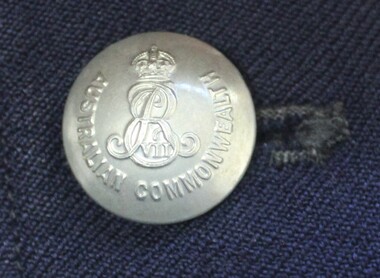
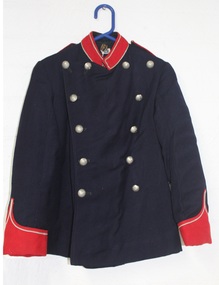
... Collar closed by 2 sets of hooks and eyes, 11 metal buttons down front and 1 inside flat brown button, red epaulettes fixed by silver buttons, 2 small red false gussets on back. ...Collar closed by 2 sets of hooks and eyes, 11 metal buttons down front and 1 inside flat brown button, red epaulettes fixed by silver buttons, 2 small red false gussets on back. ...Used by a girl member of the Ringwood Primary School band before 1974, possibly as early as 1930s. The silvered buttons have Edward VII marks. The style of the front fastenings is called plastron.Navy blue woollen material jacket with red collar and pointed cuffs decorated with thin band of bone coloured braid. Collar closed by 2 sets of hooks and eyes, 11 metal buttons down front and 1 inside flat brown button, red epaulettes fixed by silver buttons, 2 small red false gussets on back. +Additional Keywords: McDougall, Lawrence -
 Ringwood and District Historical Society
Uniform - Jacket, A. Bowley & Co, Navy blue woollen material jacket, used by a boy member of Ringwood Primary School band before 1974 (possibly as early as 1930s), Pre 1974, possibly 1930s
... Navy blue woollen material jacket with red collar and pointed cuffs associated with thin band of bone coloured braid collar closed by 2 sets hooks and eyes, 11 silver metal buttons down front and 1 inside brown flat button, red epaulettes fixed by silver buttons, 2 small false red gussets on lower edge back. ...Navy blue woollen material jacket with red collar and pointed cuffs associated with thin band of bone coloured braid collar closed by 2 sets hooks and eyes, 11 silver metal buttons down front and 1 inside brown flat button, red epaulettes fixed by silver buttons, 2 small false red gussets on lower edge back. ...Used by a boy member of the Ringwood Primary School band before 1974, possibly as early as 1930s as the silvered buttons have Edward VII marks. The style of the front fastenings is called plastron.Navy blue woollen material jacket with red collar and pointed cuffs associated with thin band of bone coloured braid collar closed by 2 sets hooks and eyes, 11 silver metal buttons down front and 1 inside brown flat button, red epaulettes fixed by silver buttons, 2 small false red gussets on lower edge back. +Additional Keywords: McDougall, Lawrence -
 Flagstaff Hill Maritime Museum and Village
Clothing - Baby Clothes, c. early 1900's
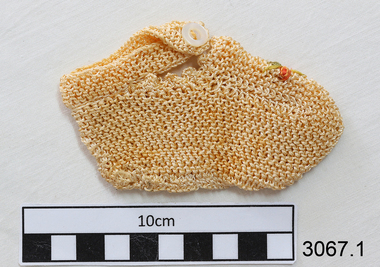
... Baby clothes, hand crocheted fine, fawn coloured silk thread. Set comprises booties (2) with button and small floral embroidery, round bib and round cap with chin tie....The clothes were possibly purchased from an opportunity shop as clothing for her daughter Eileen Mulready, 3.10.1968 - Jan 1991. flagstaff hill warrnambool shipwrecked coast flagstaff hill maritime museum maritime museum shipwreck coast flagstaff hill maritime village great ocean road handcraft baby clothes crocheted baby clothes home crafts Pat Mulready Baby clothes, hand crocheted fine, fawn coloured silk thread. Set comprises booties (2) with button and small floral embroidery, round bib and round cap with chin tie. ...These handmade baby clothes are a fine example of home crafts, showing attention to detail. The original owner and maker of these handmade silk baby clothes is unknown. They were previously owned by the mother of the donor. Her name was Mary Patricia (Pat) Mulready 21.4.1934 – 4.2.2007 who was born, died and died Warrnambool. The clothes were possibly purchased from an opportunity shop as clothing for her daughter Eileen Mulready, 3.10.1968 - Jan 1991.Baby clothes, hand crocheted fine, fawn coloured silk thread. Set comprises booties (2) with button and small floral embroidery, round bib and round cap with chin tie.flagstaff hill, warrnambool, shipwrecked coast, flagstaff hill maritime museum, maritime museum, shipwreck coast, flagstaff hill maritime village, great ocean road, handcraft, baby clothes, crocheted baby clothes, home crafts, pat mulready -
 Seaworks Maritime Museum
Gas Detector
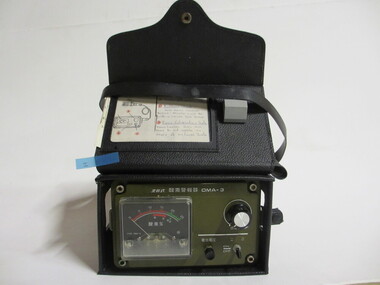
... Button. Needle must be / within lower red scale/ 3 Zero Calibration Scale/ Press Larger Dial and Turn to Set Needle on/ Green on Lower Scale" handwritten on case: "PWO 3076" Sticker on case: "GASTECH/CALIBRATED/ Date 31-8-93/ Next Due/ 31-2-94/ Initials MW/ Serial no. 6479" Card attached by string, written in pencil: " PWO 3076/ Gas Detector/ Model no. 6479 [From the Howard Smith Collection]" ...Button. Needle must be / within lower red scale/ 3 Zero Calibration Scale/ Press Larger Dial and Turn to Set Needle on/ Green on Lower Scale" handwritten on case: "PWO 3076" Sticker on case: "GASTECH/CALIBRATED/ Date 31-8-93/ Next Due/ 31-2-94/ Initials MW/ Serial no. 6479" Card attached by string, written in pencil: " PWO 3076/ Gas Detector/ Model no. 6479 [From the Howard Smith Collection]" One gas detector housed inside a black leather carry case, with a carry strap, and a pocket at back of carry case.1993 circa. ...1990 -24/04: To "Salvageman Ltd" at Douglas (IOM)One gas detector housed inside a black leather carry case, with a carry strap, and a pocket at back of carry case.1993 circa.on detector: "OMA-3/ON/OFF/ TYPE OMA-3/ KOMYO Paper card inserted in case, written with pen: "1) Turn on/off switch "ON"/ 2) Battery Check:/ Hold down smaller/ Button. Needle must be / within lower red scale/ 3 Zero Calibration Scale/ Press Larger Dial and Turn to Set Needle on/ Green on Lower Scale" handwritten on case: "PWO 3076" Sticker on case: "GASTECH/CALIBRATED/ Date 31-8-93/ Next Due/ 31-2-94/ Initials MW/ Serial no. 6479" Card attached by string, written in pencil: " PWO 3076/ Gas Detector/ Model no. 6479 [From the Howard Smith Collection]" -
 Cheese World Museum
Photograph, Jordan Studio, Ray and Joyce Uebergang c1929, c1929
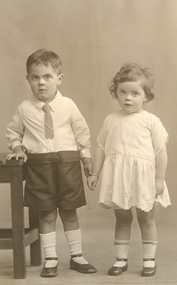
... set up the Ray and Joyce Uebergang Foundation which supports the local community. This photograph is part of the collection of items given into the care of the Cheese World Museum. Uebergang catalogue No.K14 allansford uebergang tooram park ray uebergang joyce uebergang jordan studio warrnambool liebig street photographs children's costume photography Photograph of twins Ray and Joyce Uebergang at approximately 3 years of age. Ray is standing beside a table and Joyce stands next to him. Ray is dressed in dark shorts and a light coloured shirt, tie and tiepin, long white socks and button ...The Percy Uebergang family lived at Tooram Park, Allansford from 1912 until 1992. Percy and Myrtle Uebergang's children were twins, Ray and Joyce born in 1926 who lived at Tooram Park until their deaths, Ray in 1986 and Joyce in 1992. Neither Ray nor Joyce married and following the death of her brother Joyce set up the Ray and Joyce Uebergang Foundation which supports the local community. This photograph is part of the collection of items given into the care of the Cheese World Museum. Uebergang catalogue No.K14Photograph of twins Ray and Joyce Uebergang at approximately 3 years of age. Ray is standing beside a table and Joyce stands next to him. Ray is dressed in dark shorts and a light coloured shirt, tie and tiepin, long white socks and button-up shoes. Joyce is wearing a white embroidered frock with a scalloped hemline and short sleeves. She has short socks with garters and button-up shoes.allansford, uebergang, tooram park, ray uebergang, joyce uebergang, jordan studio, warrnambool, liebig street, photographs, children's costume, photography -
 Bendigo Military Museum
Uniform - TROUSERS & BRACES, BATTLE DRESS, Oxford Clothing Company Pty Ltd, 1973
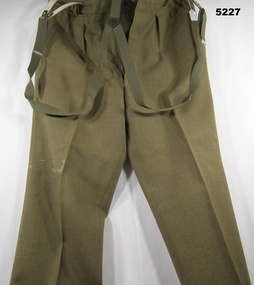
... button down flap. A light khaki heel protector is sewn into the hem of each trouser leg. .2) Set khaki elastic and leather braces are attached to the trousers via khaki coloured leather button attachments....button down flap. A light khaki heel protector is sewn into the hem of each trouser leg. .2) Set khaki elastic and leather braces are attached to the trousers via khaki coloured leather button attachments. ...Part of the Reverend Chaplain Major Thomas Bruce Williams, No 556101, Collection..1) Khaki battle dress trousers in wool fabric with pleated front. Waistband and pockets lined with light khaki cotton drill fabric. Wide waistband secured with three brown bakelite buttons Inside the waistband are six brown bakelite buttons used to secure braces. On each outer side of the waistband are two tabs with metal fasteners used to adjust the waistband. Extra buttons are sewn onto the outside of the waistband. A zipper fly is on the front of the trousers. Pockets consist of two hip with button down flaps, two lined side and one left leg cargo with button down flap. A light khaki heel protector is sewn into the hem of each trouser leg. .2) Set khaki elastic and leather braces are attached to the trousers via khaki coloured leather button attachments..1) On white calico manufacturer's label - stamped in black ink: 'YF 34". Handwritten on manufacturer's label in black ink: 'PADRE Tom, 556101'.un iform, battle dress, army chaplain, major thomas b. williams -
 Bendigo Military Museum
Award - FRAMED MEDALS, BADGES, PHOTO
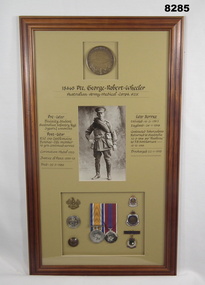
... Button. From an Army uniform. Badge. "Life Member of the RSL". Badge. "RSL membership badge with membership year clip 1920 on" Badge. "Super Veteran - Royal Victorian Bowls Association"' Medals. "British War medal 1914 - 1918" "Coronation medal 1953". George Wheeler, refer Cat No 8263 for his Military and RSL Service details. brsl smirsl gwheeler Main item is, "18465 Pte George. Robert. Wheeler - Australian Army Medical Corps AIF. Framed timber with a fawn colour back ground with a medallion at the top followed by a photo inset, at bottom inset are a set ...The item is a mixture of Military and RSL service. The Medallion at the top has around the edge, "Centenary of the Government of Victoria 1851 - 1951". In the centre of has, "Awarded to G.R. Wheeler Esq for 25 years service to the Returned Servicemen". The bottom inset has the following. Badge, "8th Australian Infantry Regiment". (George served in pre War) Badge, "For King and Empire - Services rendered". Button. From an Army uniform. Badge. "Life Member of the RSL". Badge. "RSL membership badge with membership year clip 1920 on" Badge. "Super Veteran - Royal Victorian Bowls Association"' Medals. "British War medal 1914 - 1918" "Coronation medal 1953". George Wheeler, refer Cat No 8263 for his Military and RSL Service details.Framed timber with a fawn colour back ground with a medallion at the top followed by a photo inset, at bottom inset are a set of medals and 6 various badges.Main item is, "18465 Pte George. Robert. Wheeler - Australian Army Medical Corps AIF.brsl, smirsl, gwheeler -
 Bendigo Military Museum
Uniform - REPLICA, LIGHTHORSE, WW1, Unknown
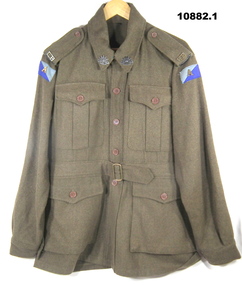
... button fly. 3. Shirt - grey wool flannel fabric with white cotton mandarin collar and 1/4 waistband. Half opening with three black plastic buttons. Long sleeves with cuff and three buttons. Shirt tails. 4. Braces - set...button fly. 3. Shirt - grey wool flannel fabric with white cotton mandarin collar and 1/4 waistband. Half opening with three black plastic buttons. Long sleeves with cuff and three buttons. Shirt tails. 4. Braces - set ...Replica 4th Light Horse AIF Uniform, WW1, used for Museum displays and Bendigo RSL Commemorative Services.Replica Uniform, Lighthorse WW1. Jacket, Breeches with braces, Shirt, Leggings and Light Horse leather accessories. 1. Jacket, khaki wool fabric. Collar with metal look plastic "Rising Sun" Badge. Shoulder epaulettes with buttons, two metal look plastic "AUSTRALIA" badges and two silver plastic Light Horse rectangular badge - an unofficial shoulder title. Front four patch pockets with button down flap. Sleeves with cuff and button colour patch. rectangular light blue/ mid blue on diagonal top left to bottom right. Brass metal look plastic "A" for ANZAC". No rank stripes - Private. Pleated back and attached half belt with metal slide buckle. Brown plastic buttons. 2. Breeches (fabric as above), ankle length close fitting trousers, snug fit below the knees with side opening and metal eyelets and ribbon laces. Five pockets - money pocket, two inset on an angle and back two inset. Numerous khaki plastic buttons at waist for braces, five button fly. 3. Shirt - grey wool flannel fabric with white cotton mandarin collar and 1/4 waistband. Half opening with three black plastic buttons. Long sleeves with cuff and three buttons. Shirt tails. 4. Braces - set of beige coloured cotton twill webbing with brown leatgher attachments for breeches. 5. Waist belt. 6. Bandolier, brown leather, brass studs and metal buckles. Waist belt with bayonet frog and four pouches and attached bandolier has nine pouches. 7. & 8. Leggings, one pair, L & R, brown leather with two leather straps and brass metal buckles.uniform, replica, light horse, ww1 -
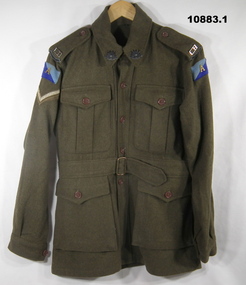 Bendigo Military Museum
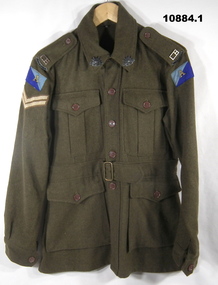
Uniform - REPLICA, LIGHTHORSE, WW1, Unknown
... button fly. 3. Shirt - grey wool flannel fabric with white cotton mandarin collar and 1/4 waistband. Half opening with three black plastic buttons. Long sleeves with cuff and three buttons. Shirt tails. 4. Braces - set...button fly. 3. Shirt - grey wool flannel fabric with white cotton mandarin collar and 1/4 waistband. Half opening with three black plastic buttons. Long sleeves with cuff and three buttons. Shirt tails. 4. Braces - set ...Replica 4th Light Horse AIF Uniform, WW1. Used for Museum displays and Bendigo RSL Commemorative Services.Replica Uniform, Lighthorse WW1. Jacket, Breeches with braces, Shirt, Leggings and Light Horse leather accessories. 1. Jacket, khaki wool fabric. Collar with metal look plastic "Rising Sun" Badge. Shoulder epaulettes with buttons, two metal look plastic "AUSTRALIA" badges and two silver plastic Light Horse rectangular badge - an unofficial shoulder title. Front four patch pockets with button down flap. Sleeves with cuff and button colour patch. rectangular light blue/ mid blue on diagonal top left to bottom right. Brass metal look plastic "A" for ANZAC". One rank stripe - Lance Corporal. Pleated back and attached half belt with metal slide buckle. Brown plastic buttons. 2. Breeches (fabric as above), ankle length close fitting trousers, snug fit below the knees with side opening and metal eyelets and ribbon laces. Five pockets - money pocket, two inset on an angle and back two inset. Numerous khaki plastic buttons at waist for braces, five button fly. 3. Shirt - grey wool flannel fabric with white cotton mandarin collar and 1/4 waistband. Half opening with three black plastic buttons. Long sleeves with cuff and three buttons. Shirt tails. 4. Braces - set of beige coloured cotton twill webbing with brown leatgher attachments for breeches. 5. Waist belt. 6. Bandolier, brown leather, brass studs and metal buckles. Waist belt with bayonet frog and four pouches and attached bandolier has nine pouches. 7. & 8. Leggings, one pair, L & R, brown leather with two leather straps and brass metal buckles.uniform, replica, light horse, ww1 -
 Bendigo Military Museum
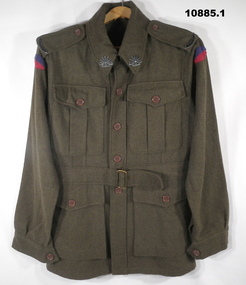
Uniform - REPLICA, LIGHTHORSE, WW1, Unknown
... button fly. 3. Shirt - grey wool flannel fabric with white cotton mandarin collar and 1/4 waistband. Half opening with three black plastic buttons. Long sleeves with cuff and three buttons. Shirt tails. 4. Braces - set...button fly. 3. Shirt - grey wool flannel fabric with white cotton mandarin collar and 1/4 waistband. Half opening with three black plastic buttons. Long sleeves with cuff and three buttons. Shirt tails. 4. Braces - set ...Replica 4th Light Horse AIF Uniform, WW1. Used for Museum Displays and Bendigo RSL Commemorative Services.Replica Uniform, Lighthorse WW1. Jacket, Breeches with braces, Shirt, Leggings and Light Horse leather accessories. 1. Jacket, khaki wool fabric. Collar with metal look plastic "Rising Sun" Badge. Shoulder epaulettes with buttons, two metal look plastic "AUSTRALIA" badges and two silver plastic Light Horse rectangular badge - an unofficial shoulder title. Front four patch pockets with button down flap. Sleeves with cuff and button colour patch. rectangular light blue/ mid blue on diagonal top left to bottom right. Brass metal look plastic "A" for ANZAC". Two rank stripes - Corporal. Pleated back and attached half belt with metal slide buckle. Brown plastic buttons. 2. Breeches (fabric as above), ankle length close fitting trousers, snug fit below the knees with side opening and metal eyelets and ribbon laces. Five pockets - money pocket, two inset on an angle and back two inset. Numerous khaki plastic buttons at waist for braces, five button fly. 3. Shirt - grey wool flannel fabric with white cotton mandarin collar and 1/4 waistband. Half opening with three black plastic buttons. Long sleeves with cuff and three buttons. Shirt tails. 4. Braces - set of beige coloured cotton twill webbing with brown leather attachments for breeches. 5. Waist belt. 6. Bandolier, brown leather, brass studs and metal buckles. Waist belt with bayonet frog and four pouches and attached bandolier has nine pouches. 7. & 8. Leggings, one pair, L & R, brown leather with two leather straps and brass metal buckles.uniform, replica, light horse, ww1 -
 Bendigo Military Museum
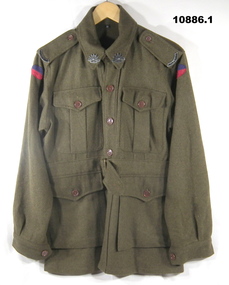
Uniform - REPLICA, ARMY, WW1, Unknown
... button fly. 3. Shirt - grey wool flannel fabric with white cotton mandarin collar and 1/4 waistband. Half opening with three black plastic buttons. Long sleeves with cuff and three buttons. Shirt tails. 4. Braces - set...button fly. 3. Shirt - grey wool flannel fabric with white cotton mandarin collar and 1/4 waistband. Half opening with three black plastic buttons. Long sleeves with cuff and three buttons. Shirt tails. 4. Braces - set ...Replica 38th Battalion AIF Uniform, WW1, used for Museum displays and Bendigo RSL Commemorative Services.Replica Uniform, Light Horse WW1. Jacket, Breeches with braces, Shirt, Puttees and Army leather accessories and boots. 1. Jacket, khaki wool fabric. Collar with metal look plastic "Rising Sun" Badge. Shoulder epaulettes with buttons, two metal look plastic "AUSTRALIA" badges and two silver plastic Light Horse rectangular badge - an unofficial shoulder title. Front four patch pockets with button down flap. Sleeves with cuff and button colour patch, oval shape , purple over maroon, 38th Battalion AIF. Five front buttons - brown coloured plastic. No rank stripes - Private. Pleated back and attached half belt with metal slide buckle. Brown plastic buttons. 2. Breeches (fabric as above), ankle length close fitting trousers, snug fit below the knees with side opening and metal eyelets and ribbon laces. Five pockets - money pocket, two inset on an angle and back two inset. Numerous khaki plastic buttons at waist for braces, five button fly. 3. Shirt - grey wool flannel fabric with white cotton mandarin collar and 1/4 waistband. Half opening with three black plastic buttons. Long sleeves with cuff and three buttons. Shirt tails. 4. Braces - set of beige and green coloured cotton twill webbing with brown leather attachments for breeches. 5. Waist belt. Brown coloured leather with brass studs and metal buckle. Bayonet frog on belt. 6. & 7. Puttees - pair of khaki coloured long strips of woven wool fabric which are wrapped spirally around the lowe leg, ankle to knee. Ribbon tape on end. 8. & 9. Boots - pair of brown/tan coloured leather, above ankle height, boots with eight metal eyelets per side and brown leather laces. No size on leather sole, heel with metal plate.uniform, replica, 38th battalion, aif, ww1 -
 Bendigo Military Museum
Uniform - REPLICA, ARMY, WW1, Unknown
... button fly. 3. Shirt - grey wool flannel fabric with white cotton mandarin collar and 1/4 waistband. Half opening with three black plastic buttons. Long sleeves with cuff and three buttons. Shirt tails. 4. Braces - set...button fly. 3. Shirt - grey wool flannel fabric with white cotton mandarin collar and 1/4 waistband. Half opening with three black plastic buttons. Long sleeves with cuff and three buttons. Shirt tails. 4. Braces - set ...Replica 38th Battalion AIF Uniform, WW1 used for Museum Displays and Bendigo RSL Commemorative Services.Replica Uniform, Army WW1. Jacket, Breeches with braces, Shirt, Puttees and Army leather accessories and boots. 1. Jacket, khaki wool fabric. Collar with metal look plastic "Rising Sun" Badge. Shoulder epaulettes with buttons, two metal look plastic "AUSTRALIA" badges and two silver plastic Light Horse rectangular badge - an unofficial shoulder title. Front four patch pockets with button down flap. Sleeves with cuff and button colour patch, oval shape , purple over maroon, 38th Battalion AIF. Five front buttons - brown coloured plastic. No rank stripes - Private. Pleated back and attached half belt with metal slide buckle. Brown plastic buttons. 2. Breeches (fabric as above), ankle length close fitting trousers, snug fit below the knees with side opening and metal eyelets and ribbon laces. Five pockets - money pocket, two inset on an angle and back two inset. Numerous khaki plastic buttons at waist for braces, five button fly. 3. Shirt - grey wool flannel fabric with white cotton mandarin collar and 1/4 waistband. Half opening with three black plastic buttons. Long sleeves with cuff and three buttons. Shirt tails. 4. Braces - set of beige and green coloured cotton twill webbing with brown leather attachments for breeches. 5. Waist belt. Brown coloured leather with brass studs and metal buckle. Bayonet frog on belt. 6. & 7. Puttees - pair of khaki coloured long strips of woven wool fabric which are wrapped spirally around the lowe leg, ankle to knee. Ribbon tape on end. 8. & 9. Boots - pair of brown/tan coloured leather, above ankle height, boots with eight metal eyelets per side and brown leather laces. No size on leather sole, heel with metal plate. Handwritten owner's name on sole.8. 9. Boots - handwritten - black ink pen. On sole "Walko".uniform, replica, 38th battalion, aif, ww1 -
 Bendigo Military Museum
Uniform - REPLICA, ARMY, WW1, Unknown
... button fly. 3. Shirt - grey wool flannel fabric with white cotton mandarin collar and 1/4 waistband. Half opening with three black plastic buttons. Long sleeves with cuff and three buttons. Shirt tails. 4. Braces - set...button fly. 3. Shirt - grey wool flannel fabric with white cotton mandarin collar and 1/4 waistband. Half opening with three black plastic buttons. Long sleeves with cuff and three buttons. Shirt tails. 4. Braces - set ...Replica 38th Battalion AIF uniform, WW1, used for Museum displays and Bendigo RSL Commemorative Services.Replica Uniform, Army WW1. Jacket, Breeches with braces, Shirt, Puttees and Army leather accessories and boots. 1. Jacket, khaki wool fabric. Collar with metal look plastic "Rising Sun" Badge. Shoulder epaulettes with buttons, two metal look plastic "AUSTRALIA" badges and two silver plastic Light Horse rectangular badge - an unofficial shoulder title. Front four patch pockets with button down flap. Sleeves with cuff and button colour patch, oval shape , purple over maroon, 38th Battalion AIF. Five front buttons - brown coloured plastic. One rank stripe - Lance Corporal. Pleated back and attached half belt with metal slide buckle. Brown plastic buttons. 2. Breeches (fabric as above), ankle length close fitting trousers, snug fit below the knees with side opening and metal eyelets and ribbon laces. Five pockets - money pocket, two inset on an angle and back two inset. Numerous khaki plastic buttons at waist for braces, five button fly. 3. Shirt - grey wool flannel fabric with white cotton mandarin collar and 1/4 waistband. Half opening with three black plastic buttons. Long sleeves with cuff and three buttons. Shirt tails. 4. Braces - set of beige and green coloured cotton twill webbing with brown leather attachments for breeches. 5. Waist belt. Brown coloured leather with brass studs and metal buckle. Bayonet frog on belt. 6. & 7. Puttees - pair of khaki coloured long strips of woven wool fabric which are wrapped spirally around the lowe leg, ankle to knee. Ribbon tape on end. 8. & 9. Boots - pair of brown/tan coloured leather, above ankle height, boots with eight metal eyelets per side and brown leather laces. Size 11 on leather sole, heel with metal plate. uniform, replica, 38th battalion, aif, ww1 -
 Bendigo Military Museum
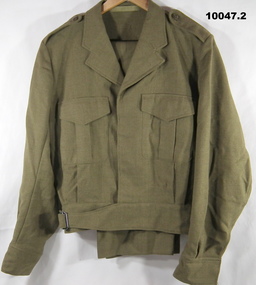
Uniform - BATTLE DRESS - ARMY, A.G.C.F. Australian Defence Industries, 1968, 1976
... SET/ MENDING PATCH ATTACHED". Battle dress jacket and trousers. 1. 2. Khaki colour wool serge fabric. Green colour plastic buttons. 1. Jacket - bomber jacket style with collar, shoulder epaulettes, long sleeves with cuffs, two front patch pockets with concealed button down flap. ...Battle dress jacket and trousers. 1. 2. Khaki colour wool serge fabric. Green colour plastic buttons. 1. Jacket - bomber jacket style with collar, shoulder epaulettes, long sleeves with cuffs, two front patch pockets with concealed button down flap. Attached waist band with metal slide buckle and strap closure. Front concealed button. Paper label on back waistband. Manufacturers information - white cotton fabric inside left side. 2. Trousers - battle dress style with fib pocket, two side pockets, one back pocket with button down flap. Green colour polyester fabric lining to pockets, cotton fabric lining to waistband. Metal zipper fly. White colour cotton manufacturers label - inside, lining back pocket.Manufacturers information on labels - black ink print. 1. "OXFORD CLOTHES PTY LTD/ SOUTH AUSTRALIA 1968/ ^/ CLASS 8405-66-025-6416/ Mill A.W.M. 9/69/ Size of Chest 36/37L/ Matching trouser 32 waist/ DRY CLEAN ONLY/ CREASE UPPER HALF OF LAPELS ONLY/ NAME "WINBERS" (Handwritten)/ ARMY NO. Paper label with black ink print "SIZE 4 CHEST 36/37L/ MATCHING TROUSERS/ 32 WAIST/ MILL A.W.M. 9/69/ BATCH 20". 2. "A.G.C.F./ VIC.1976/ ^/ 8405-66-025-6182/ McQUARIE/ BATCH 12.1969/ SIZE. WAIST 31R/ DRY CLEAN ONLY/ CREASES SET/ BY BIRO SET/ MENDING PATCH ATTACHED".uniforms, battle dress, army
