
Showing 6 items matching "cadman and sons ltd sheffield"
-
 Flagstaff Hill Maritime Museum and Village
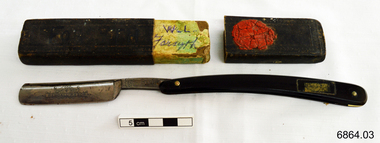
Razor, early 1900's
... ...cadman and sons ltd sheffield...The razor is a Full Concave Bengal design, made by Cadman & Sons Ltd. of Sheffield in the early 1900's....Impressed on steel blade "Full Concave / BENGALL RAZOR" and "CADMAN & SONS LTD. / SHEFFIELD"...The razor is a Full Concave Bengal design, made by Cadman & Sons Ltd. of Sheffield in the early 1900's. ...This cut-throat razor was originally owned by the father of Dr. W.R. Angus' wife Gladys. Her maternal father's name was William Lawrence Forsyth. The razor was inherited by Gladys and is now part of the W.R. Angus Collection, which was donated to Flagstaff Hill Maritime Village by the family of Doctor William Roy Angus, Surgeon and Oculist. The “W.R. Angus Collection” includes historical medical equipment, surgical instruments and material once belonging to Dr Edward Ryan and Dr Thomas Francis Ryan, (both of Nhill, Victoria) as well as Dr Angus’ own belongings. The Collection’s history spans the medical practices of the two Doctors Ryan, from 1885-1926 plus that of Dr Angus, up until 1969. ABOUT THE “W.R.ANGUS COLLECTION” Doctor William Roy Angus M.B., B.S., Adel., 1923, F.R.C.S. Edin.,1928 (also known as Dr Roy Angus) was born in Murrumbeena, Victoria in 1901 and lived until 1970. He qualified as a doctor in 1923 at University of Adelaide, was Resident Medical Officer at the Royal Adelaide Hospital in 1924 and for a period was house surgeon to Sir (then Mr.) Henry Simpson Newland. Dr Angus was briefly an Assistant to Dr Riddell of Kapunda, then commenced private practice at Curramulka, Yorke Peninsula, SA, where he was physician, surgeon and chemist. In 1926, he was appointed as new Medical Assistant to Dr Thomas Francis Ryan (T.F. Ryan, or Tom), in Nhill, Victoria, where his experiences included radiology and pharmacy. In 1927 he was Acting House Surgeon in Dr Tom Ryan’s absence. Dr Angus had become engaged to Gladys Forsyth and they decided he further his studies overseas in the UK in 1927. He studied at London University College Hospital and at Edinburgh Royal Infirmary and in 1928, was awarded FRCS (Fellow from the Royal College of Surgeons), Edinburgh. He worked his passage back to Australia as a Ship’s Surgeon on the on the Australian Commonwealth Line’s T.S.S. Largs Bay. Dr Angus married Gladys in 1929, in Ballarat. (They went on to have one son (Graham 1932, born in SA) and two daughters (Helen (died 12/07/1996) and Berenice (Berry), both born at Mira, Nhill ) According to Berry, her mother Gladys made a lot of their clothes. She was very talented and did some lovely embroidery including lingerie for her trousseau and beautifully handmade baby clothes. Dr Angus was a ‘flying doctor’ for the A.I.M. (Australian Inland Ministry) Aerial Medical Service in 1928 . Its first station was in the remote town of Oodnadatta, where Dr Angus was stationed. He was locum tenens there on North-South Railway at 21 Mile Camp. He took up this ‘flying doctor’ position in response to a call from Dr John Flynn; the organisation was later known as the Flying Doctor Service, then the Royal Flying Doctor Service. A lot of his work during this time involved dental surgery also. Between 1928-1932 he was surgeon at the Curramulka Hospital, Yorke Peninsula, South Australia. In 1933 Dr Angus returned to Nhill and purchased a share of the Nelson Street practice and Mira hospital (a 2 bed ward at the Nelson Street Practice) from Dr Les Middleton one of the Middleton Brothers, the current owners of what previously once Dr Tom Ryan’s practice. Dr Tom and his brother had worked as surgeons included eye surgery. Dr Tom Ryan performed many of his operations in the Mira private hospital on his premises. He had been House Surgeon at the Nhill Hospital 1902-1926. Dr Tom Ryan had one of the only two pieces of radiology equipment in Victoria during his practicing years – The Royal Melbourne Hospital had the other one. Over the years Dr Tom Ryan had gradually set up what was effectively a training school for country general-practitioner-surgeons. Each patient was carefully examined, including using the X-ray machine, and any surgery was discussed and planned with Dr Ryan’s assistants several days in advance. Dr Angus gained experience in using the X-ray machine there during his time as assistant to Dr Ryan. When Dr Angus bought into the Nelson Street premises in Nhill he was also appointed as the Nhill Hospital’s Honorary House Surgeon 1933-1938. His practitioner’s plate from his Nhill surgery is now mounted on the doorway to the Port Medical Office at Flagstaff Hill Maritime Village, Warrnambool. When Dr Angus took up practice in the Dr Edward and Dr Tom Ryan’s old premises he obtained their extensive collection of historical medical equipment and materials spanning 1884-1926. A large part of this collection is now on display at the Port Medical Office at Flagstaff Hill Maritime Village in Warrnambool. In 1939 Dr Angus and his family moved to Warrnambool where he purchased “Birchwood,” the 1852 home and medical practice of Dr John Hunter Henderson, at 214 Koroit Street. (This property was sold in1965 to the State Government and is now the site of the Warrnambool Police Station. and an ALDI sore is on the land that was once their tennis court). The Angus family was able to afford gardeners, cooks and maids; their home was a popular place for visiting dignitaries to stay whilst visiting Warrnambool. Dr Angus had his own silk worm farm at home in a Mulberry tree. His young daughter used his centrifuge for spinning the silk. Dr Angus was appointed on a part-time basis as Port Medical Officer (Health Officer) in Warrnambool and held this position until the 1940’s when the government no longer required the service of a Port Medical Officer in Warrnambool; he was thus Warrnambool’s last serving Port Medical Officer. (Masters of immigrant ships arriving in port reported incidents of diseases, illness and death and the Port Medical Officer made a decision on whether the ship required Quarantine and for how long, in this way preventing contagious illness from spreading from new immigrants to the residents already in the colony.) Dr Angus was a member of the Australian Medical Association, for 35 years and surgeon at the Warrnambool Base Hospital 1939-1942, He served as a Surgeon Captain during WWII1942-45, in Ballarat, Victoria, and in Bonegilla, N.S.W., completing his service just before the end of the war due to suffering from a heart attack. During his convalescence he carved an intricate and ‘most artistic’ chess set from the material that dentures were made from. He then studied ophthalmology at the Royal Melbourne Eye and Ear Hospital and created cosmetically superior artificial eyes by pioneering using the intrascleral cartilage. Angus received accolades from the Ophthalmological Society of Australasia for this work. He returned to Warrnambool to commence practice as an ophthalmologist, pioneering in artificial eye improvements. He was Honorary Consultant Ophthalmologist to Warrnambool Base Hospital for 31 years. He made monthly visits to Portland as a visiting surgeon, to perform eye surgery. He represented the Victorian South-West subdivision of the Australian Medical Association as its secretary between 1949 and 1956 and as chairman from 1956 to 1958. In 1968 Dr Angus was elected member of Spain’s Barraquer Institute of Barcelona after his research work in Intrasclearal cartilage grafting, becoming one of the few Australian ophthalmologists to receive this honour, and in the following year presented his final paper on Living Intrasclearal Cartilage Implants at the Inaugural Meeting of the Australian College of Ophthalmologists in Melbourne In his personal life Dr Angus was a Presbyterian and treated Sunday as a Sabbath, a day of rest. He would visit 3 or 4 country patients on a Sunday, taking his children along ‘for the ride’ and to visit with him. Sunday evenings he would play the pianola and sing Scottish songs to his family. One of Dr Angus’ patients was Margaret MacKenzie, author of a book on local shipwrecks that she’d seen as an eye witness from the late 1880’s in Peterborough, Victoria. In the early 1950’s Dr Angus, painted a picture of a shipwreck for the cover jacket of Margaret’s book, Shipwrecks and More Shipwrecks. She was blind in later life and her daughter wrote the actual book for her. Dr Angus and his wife Gladys were very involved in Warrnambool’s society with a strong interest in civic affairs. He had an interest in people and the community They were both involved in the creation of Flagstaff Hill, including the layout of the gardens. After his death (28th March 1970) his family requested his practitioner’s plate, medical instruments and some personal belongings be displayed in the Port Medical Office surgery at Flagstaff Hill Maritime Village, and be called the “W. R. Angus Collection”. The W.R. Angus Collection is significant for still being located at the site it is connected with, Doctor Angus being the last Port Medical Officer in Warrnambool. The collection of medical instruments and other equipment is culturally significant, being an historical example of medicine from late 19th to mid-20th century. Dr Angus assisted Dr Tom Ryan, a pioneer in the use of X-rays and in ocular surgery. Cut-throat razor, part of the W.R. Angus Collection. Razor in dark coloured cardboard box, has dark brown Bakelite handle with rounded end; blade swings inside the handle. The razor is a Full Concave Bengal design, made by Cadman & Sons Ltd. of Sheffield in the early 1900's.Written in pen on the lid: "W. L. Forsyth", written along front of box and on tape on the handle 'FORSYTH". Impressed on steel blade "Full Concave / BENGALL RAZOR" and "CADMAN & SONS LTD. / SHEFFIELD"flagstaff hill, warrnambool, shipwrecked coast, flagstaff hill maritime museum, maritime museum, shipwreck coast, flagstaff hill maritime village, great ocean road, dr w r angus, william lawrence forsyth, cadman and sons ltd sheffield, cut-throat razor, personal effects 1900's, grooming equipment 1900's, hair cutting equipment 1900's -
 Flagstaff Hill Maritime Museum and Village
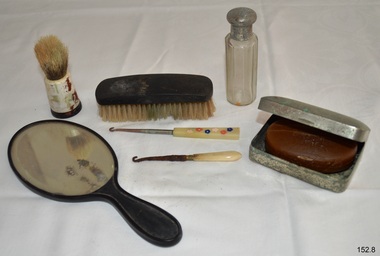
Accessory - Grooming Set, T R Cadman, ca. 1924
... The razor, once included with the set, had the inscription "T.R. Cadman and Sons, Sheffield England". The family business began with Luke Cadman in 1748. ...The razor, once included with the set, had the inscription "T.R. Cadman and Sons, Sheffield England". The family business began with Luke Cadman in 1748. ...This men's grooming set of personal care equipment and toiletries is an example of items packaged in attractive cases and sold as gifts in Australian chemist outlets and department stores in the 1920s to 1940s. This set was originally packaged in a leather-covered, lined and fitted case, with a comb, hair brush, and razor included as well. as the items shown here. The razor, once included with the set, had the inscription "T.R. Cadman and Sons, Sheffield England". The family business began with Luke Cadman in 1748. Thomas Radley Cadmen (1833 - 1917) took over the business in 1871, by which time it was operating in Sheffield. The business became incorporated as T.R. Cadman & Sons in 1924 but shortly afterwards the straight razors manufactured by them were stamped T.R. Cadman & Sons Ltd. The company specialised in pocket knives and razors from 1933 and supplied the British Royal Navy with razors in WWII. Over 80 per cent of sales were for the overseas market including Australia. Some of their razors were sold in stores in Victoria. The business traded in 1965. This grooming set was donated for exhibit in Flagstaff Hill Maritime Museum and Village's exhibit of the vessel 'Reginald M', a two-masted coastal trading ketch built in Port Adelaide in 1922. These items are examples of personal objects sold in Victoria in the 1920s as gifts for men, cased or packaged for special occasions and sold in retail stores. The items are associated with the historic coastal trading ketch 'Reginald M', listed on the Australian Register of Historic Vessels; and active from 1922 until 1975. The items were displayed in the Master's Quarters of the Reginald M exhibit at Flagstaff Hill Maritime Museum and Village until 2016 when the ship was decommissioned from Flagstaff Hill's fleet.Men's grooming set; metal soap container with star decoration, oval soap cake, oval hand mirror in a black frame ten-sided clear glass cologne bottle with silver metal lid, yellow bristle clothes brush with brown wooden hand grip, yellow bristle shaving brush with black base and white body, and two button hooks with white handles; the larger one has floral motifs. Inscriptions were on the razor originally included in the grooming set.Soap container once had star motifs.flagstaff hill, warrnambool, shipwrecked coast, flagstaff hill maritime museum, maritime museum, shipwreck coast, flagstaff hill maritime village, great ocean road, grooming set, men's grooming set, personal grooming, toiletry set, personal care, soap box, soap container, cologne bottle, clothes brush, shaving brush, button hook, hand mirror, personal efects, toiletries, t.r. cadman & sons, reginald m, soap dish -
 City of Moorabbin Historical Society (Operating the Box Cottage Museum)
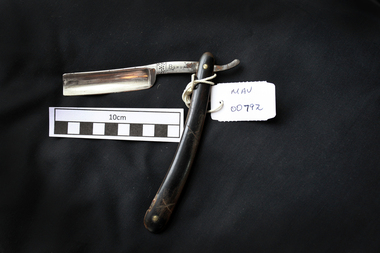
Personal Effects, Cut-throat razor ‘Bengal’, early 20thC
... The Cadmans' business was located at various addresses in Sheffield over the years. ...The Cadmans' business was located at various addresses in Sheffield over the years. ...Bengal’ THOMAS RADLEY CADMAN & SONS St. Mary's Road, Sheffield In business at least 1892-1919 Originally a trademark of Luke Cadman, Sheffield, England from ca. 1748-1906. From ca. 1906 - 1953, used by: Thomas Radley Cadman & Sons St. Mary's Road, Sheffield. In business at least between 1892 and 1965. The Cadman family originally came from Derbyshire and settled in the village of Eckington, to the south of Sheffield. Luke Cadman (1727-1788) moved to Sheffield in 1740 and became apprenticed into the cutlery trade. He became a freeman of the Cutlers' Company of Hallamshire in 1748 and was granted the trademark "BENGALL". (Another branch of the family was granted the trademark "SENEGALL"). Two of Cadman's sons followed him into the business. The Cadmans' business was located at various addresses in Sheffield over the years. In the early 1870s Thomas Radley Cadman (1833-1917) took over the firm. By 1933 the firm had diversified into safety razor and pocket knife manufacture. T.R.Cadman & Sons, Ltd. ceased trading in 1965. A man's cut-throat razor that folds to protect the blade inside the handle , 'Bengal'on blade 'BENGAL'cut-throat razors, straight razors, shaving equipment, steel blades, sheffield steel, england, thomas radley cadman & sons ltd., cutlers, steel manufacturers, ‘bengal’ trade mark, early settlers, market gardeners, moorabbin, bentleigh, cheltenham, -
 Orbost & District Historical Society
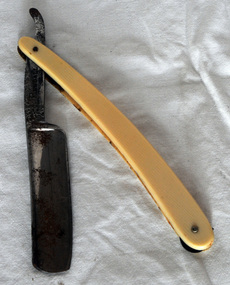
razor, Thomas R. cadman & Sons Ltd, Early -first half 20th century
... Cadman & Sons Sheffield England Cut Throat Razor by 'T R Cadman & Sons Sheffield England'. ...Straight razors were once the principal method of manual shaving but have been largely overshadowed by the safety razor, which incorporates a disposable blade.Straight razors were once the main method of shaving, This razor with the BENGALL mark was known for its quality on an international scale. During WW11 Cadmans supplied the defence forces with 250,999 razorsCut Throat Razor by 'T R Cadman & Sons Sheffield England'. It has a metal blade, a cream coloured bakelite handle, with a pin hinge for folding to cover blade.Bengall R. Cadman & Sons Sheffield Englandrazor grooming cut-throat-razor -
 Bendigo Historical Society Inc.
Tool - PITTOCK COLLECTION: THREE CUT-THROAT RAZORS
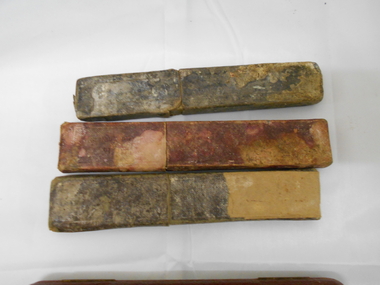
... Three cut-throat razors, boed units in deteriorated condition: 22b - box marked Pittock,blade marked Bengall, manufacturers name on reverse side T. R. Cadman & Sons, Sheffield England 22c - red box has remains of Sheffield England marked on the smaller end of box. ...Three cut-throat razors, boed units in deteriorated condition: 22b - box marked Pittock,blade marked Bengall, manufacturers name on reverse side T. R. Cadman & Sons, Sheffield England 22c - red box has remains of Sheffield England marked on the smaller end of box. ...Three cut-throat razors, boed units in deteriorated condition: 22b - box marked Pittock,blade marked Bengall, manufacturers name on reverse side T. R. Cadman & Sons, Sheffield England 22c - red box has remains of Sheffield England marked on the smaller end of box. Blade is damaged and rusted. Blade black handle is notated with Bengall, while blade itself is etched Made Specially for A. Edments Pty. Ltd.; reverse notes manufacturer as T. R. Cadman & Sons, Sheffield England 22d - box has no discernible markings, but has minor taped repair on larger section. Black handle is unmarked, blade is marked Bengall, the reverse notes manufacturer as T. R. Cadman & Sons, Sheffield England. Items stored in Pittock coach builders box, reference 13000. -
 Geelong Naval and Maritime Museum
Ditty Box, John Kidd's Ditty Box, c.1915-1930
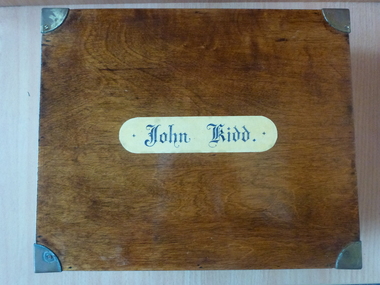
... Ltd B'HAM mark trade" "AUSTRALIA Stokes & Son Melbourne". Bullet casing "WEB WRA 45". Dog-Tag may read "L/Ford" written in ink? A wooden box with mortise and tenon joins, brass fittings, circular handles, silver hinges and a name plate on the front. The box has a lift out section creating compartments. On the inside lid of the box is a postcard of the HMAS Melbourne surrounded by small rope decoration. A number of keepsakes are inside including a fidd for splicing ropes, a Capstan Wills tobacco tin, 3 postcards, a "Bengall Imperial" cut throat razor (T.R. Cadman & Sons, Sheffield ...There is a single record with the RAN for a John Kidd, who commenced service in 1909 and left in 1912. Kidd was born in 1885 in Sydney and his mother lived in Queenscliff. He served on the HMAS Parramatta from 1911-1912. There is no evidence of him having served on the HMAS Melbourne. Kidd served from 1911-1912 on the HMAS Parramatta, the first ship launched for the Royal Australian Navy (RAN).A wooden box with mortise and tenon joins, brass fittings, circular handles, silver hinges and a name plate on the front. The box has a lift out section creating compartments. On the inside lid of the box is a postcard of the HMAS Melbourne surrounded by small rope decoration. A number of keepsakes are inside including a fidd for splicing ropes, a Capstan Wills tobacco tin, 3 postcards, a "Bengall Imperial" cut throat razor (T.R. Cadman & Sons, Sheffield England), black and white bakelite buttons with embossed crown and anchor and brass shank (either for war time or junior officers), gold naval buttons with embossed naval anchor and 2 piece shank (from a coat and cuffs), a bullet casing (Webley '45), a petty officers cloth badge (crossed anchors with a Crown), 4 shells, a good conduct badge (black with gold embroidery) and a red/brown vulcanized asbestos fibre fireproof dog- tag with rope attached."John Kidd" on front of box. "20171" stamped on edge of box. Tobacco tin: "Medium/"Capstan"/Registered/Ready Rubbed Fine Cut Tobacco/-1 oz net weight when packed/W.D. & H.O. Wills/(Australia) Ltd., Sydney. Postcard: Main Street, Samarai. Postcard: Sydney from Lavender Bay Kerry (Copyright) Sydney. Postcard: "Docks showing cathedral, Bristol BL 193. Copyright Lilywhite (1932) Ltd, Sowerby Bridge". Buttons: "AUSTRALIA/Y6-298", "Buttons Ltd B'HAM mark trade" "AUSTRALIA Stokes & Son Melbourne". Bullet casing "WEB WRA 45". Dog-Tag may read "L/Ford" written in ink?ditty box, john kidd, dog-tag, wwi identification tag, lilywhite ltd, w.d & h.o wills, stokes & son melbourne, naval buttons, hmas melbourne
