
Showing 68 items matching "cake tins"
-
 Orbost & District Historical Society
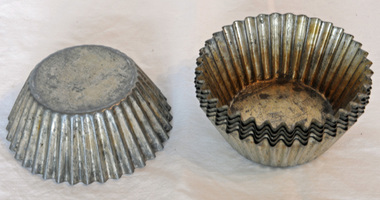
cake tins, C- 1920's - 1950's
... cake tins...cake-tins domestic food-preparation kitchen...Six small tin metal cake tins which have fluted edges....cake-tins domestic food-preparation kitchen Six small tin metal cake tins which have fluted edges. cake tins ...Six small tin metal cake tins which have fluted edges.cake-tins domestic food-preparation kitchen -
 Southern Sherbrooke Historical Society Inc.
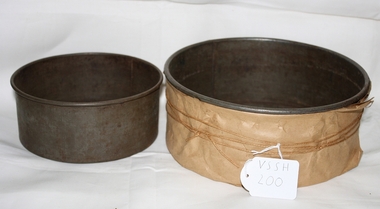
Two cake tins
... Two cake tins...Two cake tins, both round. One is smaller in size. ...Two cake tins, both round. One is smaller in size. ...Two cake tins, both round. One is smaller in size. The larger one is wrapped in brown paper and string. -
 Whitehorse Historical Society Inc.
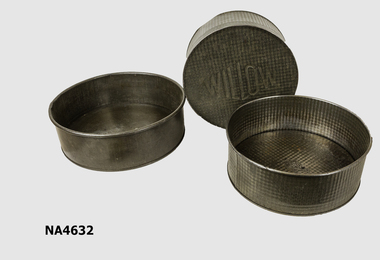
Domestic object - Cake Tins
... Cake Tins...Three cake baking tins from size 24cm to 20cm; the small one complete with lid....Domestic object Cake Tins ...Three cake baking tins from size 24cm to 20cm; the small one complete with lid.domestic items, cooking -
 Tatura Irrigation & Wartime Camps Museum
Cake Tin, 1940's
... Cake Tin...Cake tins...Metal round cake tin. Spring form type with slide on closures. ...Made and used by internees in Camp 3 for "torten". Cake tins camp cooking camp 3 handcrafts Metal round cake tin. ...Made and used by internees in Camp 3 for "torten".Metal round cake tin. Spring form type with slide on closures. Handmade. cake tins, camp cooking, camp 3 handcrafts -
 Mont De Lancey
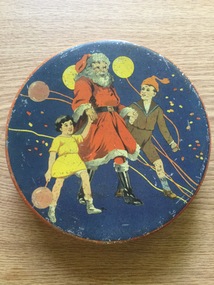
Tin
... tins, cake containers, food ....Circular red and black Willow cake tin with Santa and a boy and girl with balloons depicted on the lid..... tins, cake containers, food . Picture of Santa with a boy and a girl holding balloons on the lid. ....Circular red and black Willow cake tin with Santa and a boy and girl with balloons depicted on the lid.Picture of Santa with a boy and a girl holding balloons on the lid.tins, cake containers, food . -
 Linton and District Historical Society Inc
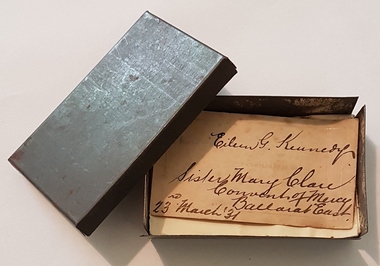
Container, Container for Slice of Wedding Cake
... Wedding cake tins...Small metal tin with lid, of the type used for distributing or keeping slices of wedding cake. ...Wedding cake tins Cake slice boxes Eileen Kennedy Sister Mary Clare Convent of the Sisters of Mercy Ballarat Small metal tin with lid, of the type used for distributing or keeping slices of wedding cake. ...Small metal tin with lid, of the type used for distributing or keeping slices of wedding cake. Inside the tin is a small card inscribed "Eileen G. Kennedy, Sister Mary Clare, Convent of Mercy Ballarat East, 23rd March '31". It is understood the container and card date from the time Linton resident Eileen Kennedy became a nun.wedding cake tins, cake slice boxes, eileen kennedy, sister mary clare, convent of the sisters of mercy ballarat -
 Mont De Lancey
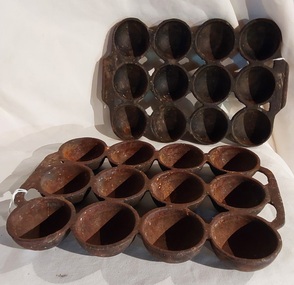
Domestic object - Gem Scone Tins, 1900's
... ...Cake tins...Two vintage heavy cast iron gem scone tins or trays, one slightly larger than the other. Each has 12 hemispherical indents for baking 12 small cakes....Cooking equipment Kitchen equipment Kitchenware Baking tins Cake tins Two vintage heavy cast iron gem scone tins or trays, one slightly larger than the other. ...This domestic kitchen baking tin is typical of the period when when most food was made at home. It would have been before the time of mass food processing factories.Two vintage heavy cast iron gem scone tins or trays, one slightly larger than the other. Each has 12 hemispherical indents for baking 12 small cakes.cooking equipment, kitchen equipment, kitchenware, baking tins, cake tins -
 Bendigo Military Museum
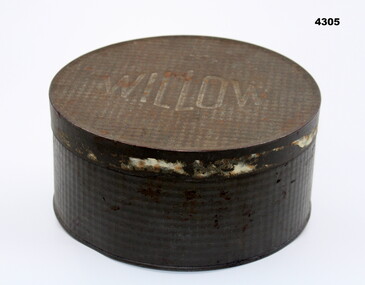
Container - CAKE TIN, Willow, made in Australia
... CAKE TIN...cake tin...Tin used to send cake to troops serving overseas, possibly WW1 or WW2...Round grey metal cake tin with lid...Tin used to send cake to troops serving overseas, possibly WW1 or WW2 cake tin willow “Willow” Round grey metal cake tin with lid Container CAKE TIN Willow, made in Australia ...Tin used to send cake to troops serving overseas, possibly WW1 or WW2Round grey metal cake tin with lid“Willow”cake tin, willow -
 Rutherglen Historical Society
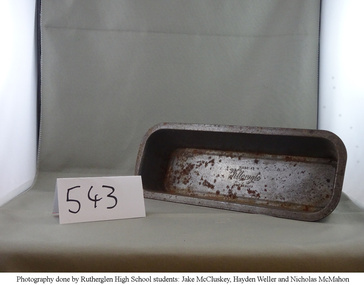
Cake tin, Willowglo, c1940
... Cake tin...Oblong cake tin,made in Australia by Willowglo...Owned and used by Mrs Daisy Parkin kitchenware Willowglo - Made in Australia Oblong cake tin,made in Australia by Willowglo Cake tin Willowglo ...Owned and used by Mrs Daisy ParkinOblong cake tin,made in Australia by WillowgloWillowglo - Made in Australiakitchenware -
Tatura Irrigation & Wartime Camps Museum
Cake Tin
... Cake Tin...Large round metal cake tin with spring form sides...Made for Von Oskar and Rosa Hahn henker e oskar v hahn r camp 3 tatura ww2 camp 3 domestic cooking Large round metal cake tin with spring form sides Cake Tin ...Made for Von Oskar and Rosa HahnLarge round metal cake tin with spring form sideshenker e, oskar v, hahn, r, camp 3, tatura, ww2 camp 3, domestic, cooking -
Tatura Irrigation & Wartime Camps Museum
Cake Tin, 1940's
... Cake Tin...cake tin...Large round cake tin with large round hollow insert in centre...Made and used by internees at Camp 3, Tatura cake tin hoefer family camp 3 tatura ww2 camp 3 domestic food preparation Large round cake tin with large round hollow insert in centre Cake Tin ...Made and used by internees at Camp 3, TaturaLarge round cake tin with large round hollow insert in centrecake tin, hoefer family, camp 3, tatura, ww2 camp 3, domestic, food, preparation -
 Bendigo Historical Society Inc.
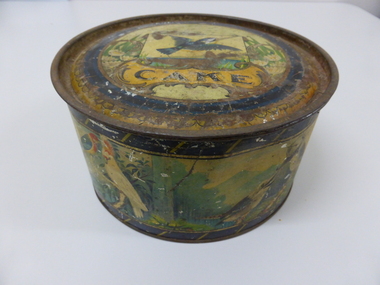
Container - CAKE TIN
... CAKE TIN......Cake tin...Circular cake tin with depictions of Australian birds aroud the sides and word cake on lid....Container CAKE TIN ...Circular cake tin with depictions of Australian birds aroud the sides and word cake on lid.domestic equipment, food storage & preservation, cake tin -
Tatura Irrigation & Wartime Camps Museum
Cake Tin, 1940's
... Cake Tin...cake tin...Large metal round cake tin. Spring form type with spring clip on the side. ...Used by internees at Camp 3. cake tin wied l camp 3 cooking Large metal round cake tin. ...Used by internees at Camp 3.Large metal round cake tin. Spring form type with spring clip on the side. Handmade.cake tin, wied l, camp 3, cooking -
Tatura Irrigation & Wartime Camps Museum
Cake Tin, 1940's
... Cake Tin...cake tin...Large round metal cake tin with spring-form sides. made from petrol can...Used by internees at Camp 3 cake tin weinmann e weinmann b camp 3 tatura ww2 camp 3 domestic cooking Large round metal cake tin with spring-form sides. made from petrol can Cake Tin ...Used by internees at Camp 3Large round metal cake tin with spring-form sides. made from petrol cancake tin, weinmann e, weinmann b, camp 3, tatura, ww2 camp 3, domestic, cooking -
 Embroiderers Guild, Victoria
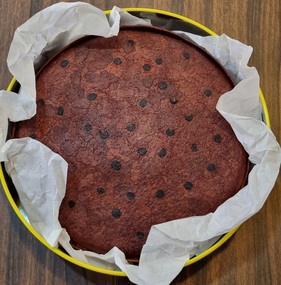
Textile - Embroidered Cake in Tin, Amanda (Mandy) Ginsberg
... Embroidered Cake in Tin...Imitation embroidered fruit cake in traditional cake tin. Made of textiles embellished with freestyle machine embroidery....Textile Embroidered Cake in Tin Amanda (Mandy) Ginsberg ...Imitation fruit cake made by Amanda Ginsberg for an exhibition at The Embroiderers Guild Victoria celebrating efforts made by women at home during World War 1Imitation embroidered fruit cake in traditional cake tin. Made of textiles embellished with freestyle machine embroidery.cake, anzac, war, women -
 Embroiderers Guild, Victoria
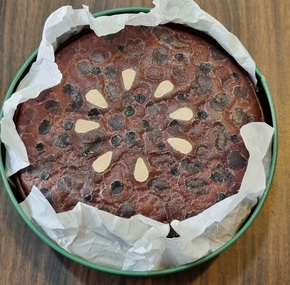
Textile - Embroidered Cake in Tin, Amanda (Mandy) Ginsberg
... Embroidered Cake in Tin...Imitation embroidered fruit cake in traditional cake tin. Made of textiles embellished with freestyle machine embroidery....Textile Embroidered Cake in Tin Amanda (Mandy) Ginsberg ...Imitation fruit cake made by Amanda Ginsberg for an exhibition at The Embroiderers Guild Victoria celebrating efforts made by women at home during World War 1Imitation embroidered fruit cake in traditional cake tin. Made of textiles embellished with freestyle machine embroidery.cake, anzac, war, women -
Tatura Irrigation & Wartime Camps Museum
Cake Tin, 1940's
... Cake Tin...cake tin...Large metal round cake tin. Spring Form type with slide on closures. ...Used by Internees at Camp 3. cake tin hornung g frank g camp 3 cooking Large metal round cake tin. ...Used by Internees at Camp 3.Large metal round cake tin. Spring Form type with slide on closures. Handmade. Well used.cake tin, hornung g, frank g, camp 3, cooking -
Tatura Irrigation & Wartime Camps Museum
Cake Tin, 1940's
... Cake Tin...cake tin...Large round cake tin with large round hollow insert in centre. ...Small loop on side of tin Cake Tin ...Made and used by Internees at Camp 3, TaturaLarge round cake tin with large round hollow insert in centre. Small loop on side of tincake tin, hoefer family, camp 3, tatura, ww2 camp 3, domestic, food, preparation -
 Flagstaff Hill Maritime Museum and Village
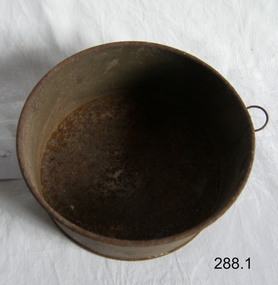
Container - Tin
... Tin metal round cake tin with turned lip, join line at side and metal ring. ...Flagstaff Hill Warrnambool Shipwrecked-coast Flagstaff-Hill Flagstaff-Hill-Maritime-Museum Maritime-Museum Shipwreck-coast Flagstaff-Hill-Maritime-Village Tin metal round cake tin with turned lip, join line at side and metal ring. ...Tin metal round cake tin with turned lip, join line at side and metal ring. One fits inside the other.flagstaff hill, warrnambool, shipwrecked-coast, flagstaff-hill, flagstaff-hill-maritime-museum, maritime-museum, shipwreck-coast, flagstaff-hill-maritime-village -
Tatura Irrigation & Wartime Camps Museum
Cake Tin, 1940's
... Cake Tin...cake tin...Large round cake tin with large round hollow insert in centre. 2 handles (one detached). ...The tin tapers to a smaller base Cake Tin ...Made and used by internees at Camp 3, TaturaLarge round cake tin with large round hollow insert in centre. 2 handles (one detached). The tin tapers to a smaller basecake tin, hoefer family, camp 3, tatura, ww 2 camp 3, domestic, food, preparation -
 Melbourne Legacy
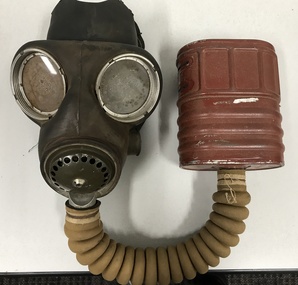
Functional object - Gas Mask, 1939
... They mainly made mess tins, rocket cylinder covers, small arms ammunition boxes, gas mask respirator cylinders and soldier’s cake tins."...They mainly made mess tins, rocket cylinder covers, small arms ammunition boxes, gas mask respirator cylinders and soldier’s cake tins." An example of war time equipment for personal protection. equipment world war two mask On the base of the metal cannister: "No. 4A / Willow / 1939 / WAD 8". ...Appears to be a gas mask made in 1939 for protection against possible gas attack in World War II. Unknown provenance. Willow, the manufacturer of the metal canister, is an Australian family owned and run business, since 1887 and based in Melbourne. From their website: "During the second World War the factories almost exclusively produced munitions, working two shifts. They mainly made mess tins, rocket cylinder covers, small arms ammunition boxes, gas mask respirator cylinders and soldier’s cake tins."An example of war time equipment for personal protection.Rubber face mask with hose to a metal cannister.On the base of the metal cannister: "No. 4A / Willow / 1939 / WAD 8". equipment, world war two, mask -
 Wodonga & District Historical Society Inc
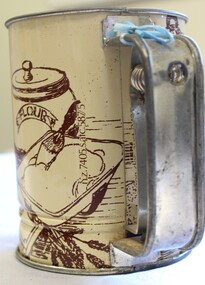
Domestic object - Flour Sifter made by KANDE Australia, Kande Kitchenware Ltd, 1920 - 1960
... They produced a wide range of utensils including cake tins, pastry cutters, pans and baking dishes. ...They produced a wide range of utensils including cake tins, pastry cutters, pans and baking dishes. ...Kande Kitchenware was established by Patrick Kavanagh and William English in 1922. The name Kande was formed from their initials, K and E. It had its Sydney factory in Little Collins Street, Surrey Hills. Kavanagh and English, a subsidiary of Kande Kitchenware, became a limited company in 1924, with both founders as directors. Another director was Test cricketer Jack Gregory, an all-rounder who slipped easily into the role of businessman. Gregory enjoyed success in business as on the cricket field, helping the company grow from a tiny operation to a major manufacturer and exporter that employed 80 people in 1931. They produced a wide range of utensils including cake tins, pastry cutters, pans and baking dishes. They managed to survive the difficulties of the Depression and were listed as a public company in 1949. Kande Kitchenware Ltd were taken over by Hackshalls Limited 6 July 1960.An appliance made by an early and successful Australian company which manufactured metal kitchen items during the first half of the 20th century. Th.ese utensils were widely used throughout AustraliaFlour sifter manufactured by KANDE Australia. The sifter / sieve is made of metal with a wire mesh and is decororated with images of other kitchen utensils and ingredients. It has a spring-loaded handle to which would be squeezed to operate the internal sifting mechanism.At botton of illustrations on one side "Kande AUSTRALIA"australian business, kande kitchenware, kitchen utensils, kitchenware early 20th century -
 Flagstaff Hill Maritime Museum and Village
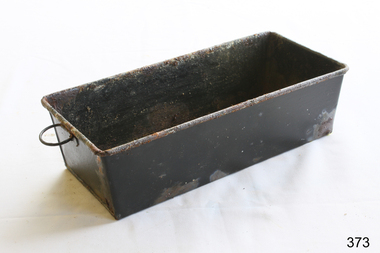
Domestic object - Bread Tin, ca. 19th century
... ...cake tin...The bread tin or cake would have been an everyday kitchen item, used in conjunction with a wood fired oven. ...Bread tin; a metal rectangular cake or bread mould, painted black, with a metal ring at one end, pitted and rusted...The bread tin or cake would have been an everyday kitchen item, used in conjunction with a wood fired oven. ...The bread tin or cake would have been an everyday kitchen item, used in conjunction with a wood fired oven. The ring is used to easily pull the tin out of an oven.The bread tin is an example of baking tins used in the 19th century, or earlier, for household cooking. It is a forerunner of today's lightweight tins, non-stick pans and silicone baking moulds.Bread tin; a metal rectangular cake or bread mould, painted black, with a metal ring at one end, pitted and rustedflagstaff hill, flagstaff hill maritime museum and village, warrnambool, maritime museum, maritime village, great ocean road, shipwreck coast, breat tin, cake tin, loaf tin, cooking, baking, kitchenalia, 19th century, bread making -
 Federation University Historical Collection
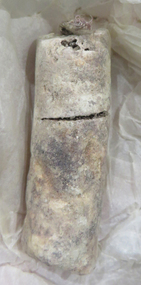
Object - Candle Remnant, Candle remnant from early Two Ballarat mines, c1860 ?
... tin with screw lid. (?) Found when removing for filling motor spaces Camp Street. .2) white candle remnant from the Britannia Mine at Cambrian Hill held in a 'Barker Cake Container; tin. ...tin with screw lid. (?) Found when removing for filling motor spaces Camp Street. .2) white candle remnant from the Britannia Mine at Cambrian Hill held in a 'Barker Cake Container; tin. ...From the Britannia Mine (Ballarat) Candle remnants from early Ballarat mines are quite rare..1) White/cream candle remnant. Candle mold seams are evident. Stored in green pharmaceutical tin with screw lid. (?) Found when removing for filling motor spaces Camp Street. .2) white candle remnant from the Britannia Mine at Cambrian Hill held in a 'Barker Cake Container; tin. A handwritten note inside the tin indicates 'Piece of Candle from Mullock's Britannia Mine. Ballarat. .2) Piece of Candle The Great Leviathan Quartz Mining CosMine at Cambrian Hill near Ballarat. Picked up by Donald Doyles Mather whilst cleaning out Ballarat South Goldfield Co's Leviathan Shaft when reopening "Great Leviathan in in the year 1948. The candle was last used by miners in the Great Leviathan in the drive where found Year G. Leviathan Closed down "______" mining, candle, lard, great leviathan, donald mather, cambrian hill, great leviathan quartz mining company -
 Whitehorse Historical Society Inc.
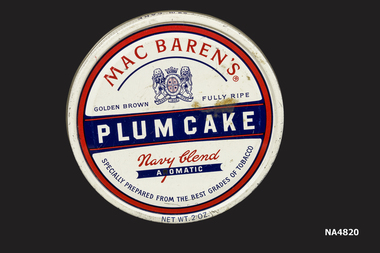
Tobacco Tin
... tin, white background with red border. 'Macbaren's(R)' in red printing below is a coat of arms with 'Golden Brown' and 'Fully Ripe' on either side in navy blue , 'Plum Cake' across middle of tin on dark blue background 'Navy Blend' in red below and 'Aromatic' in white below on navy background . ...tin, white background with red border. 'Macbaren's(R)' in red printing below is a coat of arms with 'Golden Brown' and 'Fully Ripe' on either side in navy blue , 'Plum Cake' across middle of tin on dark blue background 'Navy Blend' in red below and 'Aromatic' in white below on navy background . ...donated by Box Hill Historical SocietyRound tin, white background with red border. 'Macbaren's(R)' in red printing below is a coat of arms with 'Golden Brown' and 'Fully Ripe' on either side in navy blue , 'Plum Cake' across middle of tin on dark blue background 'Navy Blend' in red below and 'Aromatic' in white below on navy background . Specially prepared from the best grades of tobacco. Net WT 2ozs. Plum Cake printed on side of lid.as abovecontainers, domestic -
 Flagstaff Hill Maritime Museum and Village
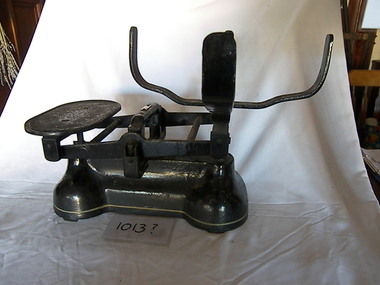
Instrument - Scale, 1900-1930
... tin pans of these scales were often oblong, some encircled at one end so bulk items could be easily poured into a bag. Seamless pans were typically stamped from brass and given style names like Snuff (the smallest) and Birmingham (the largest). Some counter scales were designed for measuring spices, others for weighing slices of cake...tin pans of these scales were often oblong, some encircled at one end so bulk items could be easily poured into a bag. Seamless pans were typically stamped from brass and given style names like Snuff (the smallest) and Birmingham (the largest). Some counter scales were designed for measuring spices, others for weighing slices of cake ...The basic balance scale has been around for thousands of years and its accuracy has improved dramatically over the last several centuries, the principle behind this tool remains unchanged. Its parts include a fulcrum, a beam that balances on it, a pan at the end of the beam to hold the materials to be weighed, and a flat platform at the other for the counter-balancing weights. Balance scales that require equal weights on each side of the fulcrum have been used by everyone from apothecaries and assayers to jewellers and postal workers. Known as an unequal arm balance scale, this variety builds the counterweight into the device. Counter scales used in dry-goods stores and domestic kitchens often featured Japanned or (blackened) cast iron with bronze trims. Made by companies such as Howe and Fairbanks, the footed tin pans of these scales were often oblong, some encircled at one end so bulk items could be easily poured into a bag. Seamless pans were typically stamped from brass and given style names like Snuff (the smallest) and Birmingham (the largest). Some counter scales were designed for measuring spices, others for weighing slices of cake. In the 18th century, spring scales began to appear and would use the resistance of spring to calculate weights, which are read automatically on the scale’s face. The ease of use of spring scales over balance scales. These scales are significant as they identify one of the basic preparation items for the weighing of foodstuff in the family kitchen to prepare everyday meals. This item is significant as it gives a snapshot into domestic life within the average home in Australia around the turn of the twentieth century and is, therefore, an item with social relevance. Black cast iron, medium weighing scales, with a fulcrum which the beam that balances on, there is a scoop or large bowl at one end for the material to be weighted and a flat platform at the other end that holds the weights. Around the cast iron base is an embossed strip weight and bowl missing.flagstaff hill, warrnambool, shipwrecked-coast, flagstaff-hill, flagstaff-hill-maritime-museum, maritime-museum, shipwreck-coast, flagstaff-hill-maritime-village -
 Flagstaff Hill Maritime Museum and Village
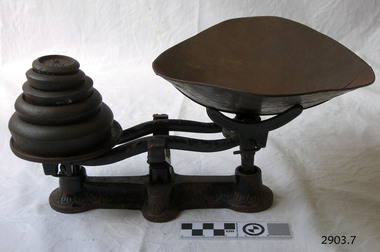
Instrument - Scale, Early 20th century
... tin pans of these scales were often oblong, some encircled at one end so bulk items could be easily poured into a bag. Seamless pans were typically stamped from brass and given style names like Snuff (the smallest) and Birmingham (the largest). Some counter scales were designed for measuring spices, others for weighing slices of cake...tin pans of these scales were often oblong, some encircled at one end so bulk items could be easily poured into a bag. Seamless pans were typically stamped from brass and given style names like Snuff (the smallest) and Birmingham (the largest). Some counter scales were designed for measuring spices, others for weighing slices of cake ...The basic balance scale has been around for thousands of years and its accuracy has improved dramatically over the last several centuries, the principle behind this tool remains unchanged. Its parts include a fulcrum, a beam that balances on it, a pan at the end of the beam to hold the materials to be weighed, and a flat platform at the other for the counter-balancing weights. Balance scales that require equal weights on each side of the fulcrum have been used by everyone from apothecaries and assayers to jewellers and postal workers. Known as an unequal arm balance scale, this variety builds the counterweight into the device. Counter scales used in dry-goods stores and domestic kitchens often featured Japanned or (blackened) cast iron with bronze trims. Made by companies such as Howe and Fairbanks, the footed tin pans of these scales were often oblong, some encircled at one end so bulk items could be easily poured into a bag. Seamless pans were typically stamped from brass and given style names like Snuff (the smallest) and Birmingham (the largest). Some counter scales were designed for measuring spices, others for weighing slices of cake. In the 18th century, spring scales began to appear and would use the resistance of spring to calculate weights, which are read automatically on the scale’s face. The ease of use of spring scales over balance scales. One of the most common types of spring scales was the kitchen scale also known as a family or dial scale. Designed for horizontal surfaces, these vintage kitchen scales used the weight of goods in a pan at the top of the scale to force the spring down rather than the balance system. Such scales were common in early 20th century households and were sold by many companies. Many had flat weighing surfaces but some were topped by shallow pans. Companies such as Salters, Chatillon, and Fairbanks were the most popular brands used. These scales are significant as they identify one of the basic preparation items for the weighing of foodstuff in the family kitchen to prepare everyday meals. This item is significant as it gives a snapshot into domestic life within the average home in Australia around the turn of the twentieth century and is, therefore, an item with social relevance. Black cast iron, medium weighing scales, with a fulcrum which the beam that balances on, there is as scoop at one end for the material to be weighted and a flat circular disc at the other end that holds the weights. Around the cast iron base is an embossed leaf pattern. All the weights have their weight embossed within the casting.There are 5 weights, marked 2 oz, 4 oz,8 oz,1 lb,2 lb, This scale does not have any visual markings on the arms to identify a maker or true balance. It is therefore assumed that these scales were made for domestic use only.flagstaff hill, warrnambool, shipwrecked-coast, flagstaff-hill, flagstaff-hill-maritime-museum, maritime-museum, shipwreck-coast, flagstaff-hill-maritime-village, spring scale, scale -
 Flagstaff Hill Maritime Museum and Village
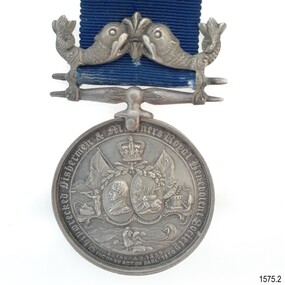
Award - Medal, Stokes, c 1882
... It is interesting that the medal and note were packaged in a small tin whose original purpose was to present a wedding cake gift to guests. ...It is interesting that the medal and note were packaged in a small tin whose original purpose was to present a wedding cake gift to guests. ...This medal was presented by the Shipwrecked Fishermen and Mariners' Royal Benevolent Society and was posthumously awarded to Captain John Coffey’s family for his efforts at saving life at sea, in 1882. Captain Coffey lost his life in this attempt. The shipwreck occurred between Australia and England. The included letter was written by the donor, who is the grandson of John Coffey. It is interesting that the medal and note were packaged in a small tin whose original purpose was to present a wedding cake gift to guests. The container is decorated with wedding bells pressed into the lid. Shipwrecked Fishermen and Mariners’ Royal Benevolent Society: - The Shipwrecked Mariners (Shipwrecked Fishermen and Mariners’ Royal Benevolent Society) is a national charity established in 1839. It is run by a network of volunteers in the UK and Ireland. The organisation assists former mariners, their dependants and their families. John Rye and his servant Charles-Gee Jones, of Bath, UK, encouraged its formation after a severe storm caused the loss of life from the ‘Clovelly’ fishing fleet in November 1838. The Society was incorporated by an Act of Parliament in 1850. The Society’s flag is the St George’s Cross, a red cross on a white background and a gold crown in the centre, with the letters S F M S displayed, one in each quadrant. Nominations are made by members each year of those who have performed outstanding acts of bravery in helping those in peril in the sea. The inscription on the reverse "PRESENTED FOR HEROIC EXERTIONS IN SAVING LIFE FROM DROWNING / JOB XXIX 13" refers to a verse in the Bible, which in the King James version reads "The blessing of him that was ready to perish came upon me; and I caused the widow's eart to sing for joy."This is the only medal in our collection awarded from the Shipwrecked Fishermen and Mariners' Royal Benevolent Society. Medal, silver with blue ribbon. The obverse of the medal has images of the British flag, a crown flag with "S.F.", a portrait of a man, a shipwreck, a cannon and anchor, a man with a telescope, and two people attending a body on the shore. The reverse of the medal has text. The medal clasp depicts a fleur de lies between two fish. The medal maker is Stokes. The metal was donated in a tin container and included a letter. The medal was presented posthumously to the family of Captain John Coffey for his efforts at saving life at sea, in 1882. It has an accompanying letter and container.On rim "CAPTAIN JOHN COFFEY - 1882" Obverse "SHIPWRECKED FISHERMEN AND MARINERS ROYAL BENEVOLENT SOCIETY" and "ESTAB AD 1839 INCOd BY ACT OF PARLt 1850" Reverse "PRESENTED FOR HEROIC EXERTIONS IN SAVING LIFE FROM DROWNING / JOB XXIX 13" and "ENGLAND EXPECTS EVERY MAN WILL DO HIS DUTY" The tin box has "MEDAL" handwritten in black.flagstaff hill, flagstaff hill maritime museum and village, warrnambool, maritime museum, maritime village, great ocean road, shipwreck coast, medal, captain john coffey, john coffey, numismatics, hero, saving lives, shipwrecked fishermen and mariners’ royal benevolent society, sfms, shipwrecked mariners' society -
 City of Moorabbin Historical Society (Operating the Box Cottage Museum)
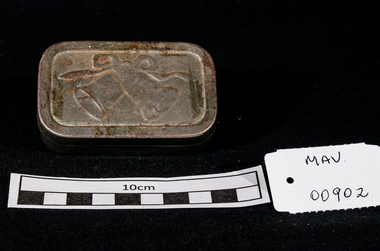
Containers, small tin wedding cake, 20thC
... Containers, small tin wedding cake...A small tin with a lift -off lid for a piece of Wedding Cake traditionally given to guests at the reception as a take home gift ....Containers, small tin wedding cake Novelty manufacturer ...It was and still is customary for a piece of Wedding Cake to be given to the guests on their departure from the reception. . Some customs suggest single women will find a husband if they put this piece of cake under their pillow at night. --- the man of their dreams will come calling …..!A small tin with a lift -off lid for a piece of Wedding Cake traditionally given to guests at the reception as a take home gift .2 wedding bells engraved on lidweddings, early settlers, tinsmiths, moorabbin, bentleigh, cheltenham, celebrations, souvenirs -
 City of Moorabbin Historical Society (Operating the Box Cottage Museum)
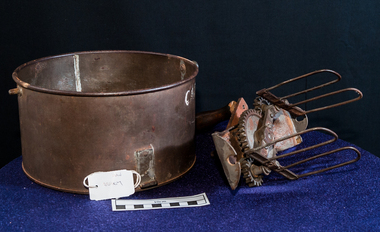
Kitchen Equipment, Mechanical Cake mixer c 1890, c1880
... This tin could be secured to a table by a clamp and screw. Kitchen Equipment, Mechanical Cake mixer c 1890 Unrecorded person ...A mixer is a kitchen utensil which uses a gear-driven mechanism to rotate a set of beaters in a bowl containing the food to be prepared. It automates the repetitive tasks of stirring, whisking or beating. Mixers for the kitchen first came into use midway through the nineteenth century; the earliest were mechanical devices. The mixer with rotating parts was patented in 1856 by Ralph Collier a tinsmith in Baltimore, Maryland .This was followed by E.P. Griffith's whisk patented in England in 1857. A circular tin used for mixing batters. The 2 beaters are of wire, with metal gears, suspended from a metal strip that fits over the tin bowl. and is clamped into place by a metal screw . A crank handle with a wooden black knob attached by a screw is turned by hand to mix the batter in the base. This tin could be secured to a table by a clamp and screw. cooking, kitchen equipment, dairy, cakes, housework, early settlers, pioneers, baking, nutrition, blacksmiths, market gardeners, cake mixers, moorabbin, cheltenham, bentleigh, brighton
