
Showing 80 items matching "camberwell city libraries"
-
 Camberwell Historical Society
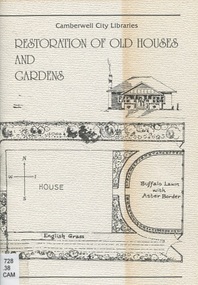
Book, Camberwell City Libraries, Restoration of Old Houses and Gardens, 1992
... 1992 selection of books on home restoration held in the Camberwell City Libraries, covering the history of Australian houses, house restoration and conservation, the history and details of interior decoration, furniture and contents, the history of Australian gardens, and garden restoration and design ...Camberwell City Libraries...camberwell city of camberwell 1992 selection of books on home restoration held in the Camberwell City Libraries, covering the history of Australian houses, house restoration and conservation, the history and details of interior decoration, furniture and contents, the history of Australian gardens, and garden restoration and design Restoration of Old Houses and Gardens Book Book Camberwell City Libraries ...1992 selection of books on home restoration held in the Camberwell City Libraries, covering the history of Australian houses, house restoration and conservation, the history and details of interior decoration, furniture and contents, the history of Australian gardens, and garden restoration and design camberwell, city of camberwell -
 Surrey Hills Historical Society Collection
Book, Camberwell City Libraries, Restoration of old houses and gardens, April 1992
... A booklist on home restoration held in Camberwell City Libraries, covering the history of Australian houses, house restoration and conservation, the history and details of interior decoration, furniture and contents, the history of Australian gardens, and garden restoration and design....Camberwell City Libraries...A booklist on home restoration held in Camberwell City Libraries, covering the history of Australian houses, house restoration and conservation, the history and details of interior decoration, furniture and contents, the history of Australian gardens, and garden restoration and design. buildings, structures and establishments restoration conservation garden restoration garden design interior decoration An A5 sized booklet Restoration of old houses and gardens Book Book Camberwell City Libraries ...A booklist on home restoration held in Camberwell City Libraries, covering the history of Australian houses, house restoration and conservation, the history and details of interior decoration, furniture and contents, the history of Australian gardens, and garden restoration and design.An A5 sized bookletbuildings, structures and establishments, restoration, conservation, garden restoration, garden design, interior decoration -
 Surrey Hills Historical Society Collection
Book, Early Canterbury, 1994
... Camberwell City Libraries...Early Canterbury Book Camberwell City Libraries Gwen McWiilliam ...This booklet gives a brief description of the local settlement in Canterbury giving the landholders names and name of the house (before street numbering was introduced) and street it was located in.This booklet gives a brief description of the local settlement in Canterbury giving the landholders names and name of the house (before street numbering was introduced) and street it was located in.canterbury, (ms) jane f portingale, postmistress, (mr) arundel wrighte, wood brothers, koonung creek, (mr) thomas power, (mr) oliver russell, (mr) frederick griffin, (mr) thomas payne, shrublands, w creek, (mr) john gardiner, (mr) james shanley, (mr)robert hoddle, (mr) michael logan, (mr) patrick moloney, (mr) hugh glass, r. larkins, t. hassett, e. sturt, d.s. campbell, (mr) joseph camm, riversdale road, w. logan, rochester road, 1843, trees, mont albert road, a. sikes, (mr) william smith, 1853, (mr) ernest carter, dentist, elgar's surrey, hindson family, (mr) george granville mercy, (mr) alfred golding, (mr)alexander patterson, (mr) thomas boanas, (mr) thomas hyde, builders, (mr) richard terrill, architects, (mr) thomas miles, drapers -
Canterbury History Group
Book, Gwen McWilliam, Early Canterbury, 1994
... ...Camberwell City Libraries...Canterbury Canterbury History Residential Development Shrublands Early history of Canterbury with a focus on the "Shrublands" property of Balwyn Road. 22, [2 leaves] pages : illustrations, maps, facsimiles Early Canterbury Book Gwen McWilliam Camberwell City Libraries ...Early history of Canterbury with a focus on the "Shrublands" property of Balwyn Road.22, [2 leaves] pages : illustrations, maps, facsimilesnon-fictionEarly history of Canterbury with a focus on the "Shrublands" property of Balwyn Road.canterbury, canterbury history, residential development, shrublands -
Camberwell Historical Society
Booklet (Item), Gwen McWilliam, Early Glen Iris, 1971
... ...Camberwell City Libraries...Glen Iris Booklet on the district of Glen Iris in the nineteenth century Early Glen Iris Booklet Booklet Gwen McWilliam Camberwell City Libraries ...glen iris -
Canterbury History Group
Ephemera - Balwyn Walks No. 1 and No. 2, Gwen McWilliam, 1992
... ...Camberwell City Libraries...Balwyn Walks No. 1 and No. 2 Balwyn Road Balwyn Shrublands Canterbury Mont Albert Tourmont St Barnabas Gwen McWilliam Camberwell City Libraries A3 black and white sheets folded into 3, includes maps and photos and subdivisions and drawings Ephemera Balwyn Walks No. 1 and No. 2 Gwen McWilliam ...Balwyn Walks No. 1 and No. 2 A3 black and white sheets folded into 3, includes maps and photos and subdivisions and drawings balwyn road, balwyn, shrublands, canterbury, mont albert, tourmont, st barnabas, gwen mcwilliam, camberwell city libraries -
 Tennis Australia
Book, Post 1960
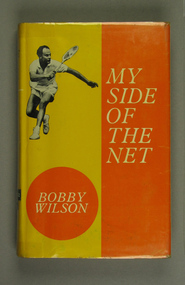
... Stamped: 'CAMBERWELL CITY LIBRARY' throughout. Materials: Paper, Ink, Cardboard...Stamped: 'CAMBERWELL CITY LIBRARY' throughout. Materials: Paper, Ink, Cardboard Book ...Book: 'My Side Of The Net'. 224 pages. Edition uncertain. Copyright 1960. Hardcover with dustjacket and plastic cover. Stamped: 'CAMBERWELL CITY LIBRARY' throughout. Materials: Paper, Ink, Cardboardtennis -
Moorabbin Air Museum
Book (item), Arthur J. Hughes, O.B.E, History of Air Navigation, 1946
... Owned by Camberwell City Library...Owned by Camberwell City Library Blue hard-cover A5-sized manual History of Air Navigation Book Arthur J. ...Owned by Camberwell City Library -
Kew Historical Society Inc
Archive (Sub-series) - Subject File, BONWICK, James (1817-1906), 1958
... The other is a publication called ‘Bonwick’s Boroondara: Annotations and Index to James Bonwick’s ‘A Sketch of Boroondara 1858’ by Gwen McWilliam (Camberwell City Libraries, 1989, 44pp, VII endpages) [The Bonwick-Judd Deed is in the Judd file]...The other is a publication called ‘Bonwick’s Boroondara: Annotations and Index to James Bonwick’s ‘A Sketch of Boroondara 1858’ by Gwen McWilliam (Camberwell City Libraries, 1989, 44pp, VII endpages) [The Bonwick-Judd Deed is in the Judd file] BONWICK, James (1817-1906) Archive Subject File ...Various partiesReference, Research, InformationKHS OrderSubject file containing information about James Bonwick (1817-1906). The file contains a newspaper article/clipping on the book collection of Dr. H. Boyd Graham (The Age, Jan 19, 1963), which refers to Dr. Graham owning 47 separate items by Bonwick. The other is a publication called ‘Bonwick’s Boroondara: Annotations and Index to James Bonwick’s ‘A Sketch of Boroondara 1858’ by Gwen McWilliam (Camberwell City Libraries, 1989, 44pp, VII endpages) [The Bonwick-Judd Deed is in the Judd file]james bonwick, kew - historiansjames bonwick, kew - historians -
Box Hill Historical Society
Book, McFarlane, Geraldine, Voices of Camberwell : Alamein to North Balwyn, 1999
... Voices of Camberwell : Alamein to North Balwyn Book McFarlane, Geraldine City of Boroondara Library Service ...This book is the result of an oral history project. Memories of elderly citizens were taped and edited. It recalls daily life in the past that is entertaining, instructive and reflective, covering topics such as housing, education, work religiion, politics, class, transport, commerce, landscape, changes in the neighbourhood, the effects of the Depression and the World Wars on the district.124p.This book is the result of an oral history project. Memories of elderly citizens were taped and edited. It recalls daily life in the past that is entertaining, instructive and reflective, covering topics such as housing, education, work religiion, politics, class, transport, commerce, landscape, changes in the neighbourhood, the effects of the Depression and the World Wars on the district.interviews, camberwell (vic.), social life and customs, history - twentieth century, history - anecdotes, oral history -
 Kew Historical Society Inc
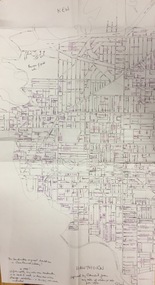
Plan, Gwen McWilliam, Annotated Plan of City of Boroondara, c.1995
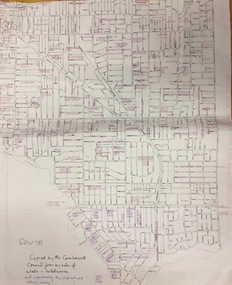
... City. She was awarded the medal of the Order of Australia in 2001 ‘for service to the community of Hawthorn and district, particularly through the research, documentation and publication of its history.’ subdivisions - hawthorn, subdivisions - kew, subdivisions - camberwell, subdivisions - balwyn, subdivisions - surrey hills, subdivisions - canterbury, gwen mcwilliam Council markings in pink Digitally annotated part plan of the City of Boroondara, created by Council (Library?) ...Gwen Barton McWilliam (nee: Nelson), OAM, BA (1933- ). Gwen McWilliam is well known as an authority on the history of Boroondara and the author of a large number of books and pamphlets about the City. She was awarded the medal of the Order of Australia in 2001 ‘for service to the community of Hawthorn and district, particularly through the research, documentation and publication of its history.’ Digitally annotated part plan of the City of Boroondara, created by Council (Library?) staff, based on annotated plans provided by the historian Gwen McWilliam, identifying significant landholdings, subdivisions and key dates. On the plan Gwen McWilliam noted that the attempt to copy her annotations had resulted in incorrect data being included, so the plans were never published. For plans including her original 1993 annotations, see 2017.0143 and 2017.0144.Council markings in pinksubdivisions - hawthorn, subdivisions - kew, subdivisions - camberwell, subdivisions - balwyn, subdivisions - surrey hills, subdivisions - canterbury, gwen mcwilliam -
 Kew Historical Society Inc
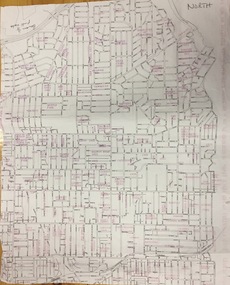
Plan, Gwen McWilliam, Annotated Plan of City of Boroondara, c.1995
... City. She was awarded the medal of the Order of Australia in 2001 ‘for service to the community of Hawthorn and district, particularly through the research, documentation and publication of its history.’ subdivisions - hawthorn, subdivisions - kew, subdivisions - camberwell, subdivisions - balwyn, subdivisions - surrey hills, subdivisions - canterbury, gwen mcwilliam Council additions in pink Digitally annotated part plan of the City of Boroondara, created by Council (Library?) ...Gwen Barton McWilliam (nee: Nelson), OAM, BA (1933- ). Gwen McWilliam is well known as an authority on the history of Boroondara and the author of a large number of books and pamphlets about the City. She was awarded the medal of the Order of Australia in 2001 ‘for service to the community of Hawthorn and district, particularly through the research, documentation and publication of its history.’ Digitally annotated part plan of the City of Boroondara, created by Council (Library?) staff, based on annotated plans provided by the historian Gwen McWilliam, identifying significant landholdings, subdivisions and key dates. On the plan Gwen McWilliam noted that the attempt to copy her annotations had resulted in incorrect data being included, so the plans were never published. For plans including her original 1993 annotations, see 2017.0143 and 2017.0144.Council additions in pinksubdivisions - hawthorn, subdivisions - kew, subdivisions - camberwell, subdivisions - balwyn, subdivisions - surrey hills, subdivisions - canterbury, gwen mcwilliam -
 Kew Historical Society Inc
Plan, Gwen McWilliam, Annotated Plan of City of Boroondara, c.1995
... City. She was awarded the medal of the Order of Australia in 2001 ‘for service to the community of Hawthorn and district, particularly through the research, documentation and publication of its history.’ subdivisions - hawthorn, subdivisions - kew, subdivisions - camberwell, subdivisions - balwyn, subdivisions - surrey hills, subdivisions - canterbury, gwen mcwilliam Additions in pink by City of Boroondara Digitally annotated part plan of the City of Boroondara, created by Council (Library?) ...Gwen Barton McWilliam (nee: Nelson), OAM, BA (1933- ). Gwen McWilliam is well known as an authority on the history of Boroondara and the author of a large number of books and pamphlets about the City. She was awarded the medal of the Order of Australia in 2001 ‘for service to the community of Hawthorn and district, particularly through the research, documentation and publication of its history.’ Digitally annotated part plan of the City of Boroondara, created by Council (Library?) staff, based on annotated plans provided by the historian Gwen McWilliam, identifying significant landholdings, subdivisions and key dates. On the plan Gwen McWilliam noted that the attempt to copy her annotations had resulted in incorrect data being included, so the plans were never published. For plans including her original 1993 annotations, see 2017.0143 and 2017.0144.Additions in pink by City of Boroondarasubdivisions - hawthorn, subdivisions - kew, subdivisions - camberwell, subdivisions - balwyn, subdivisions - surrey hills, subdivisions - canterbury, gwen mcwilliam -
 Kew Historical Society Inc
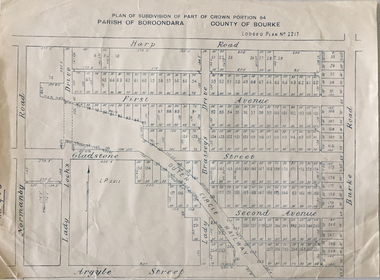
Plan - Subdivision Plan, Plan of Subdivision of Part of Crown Portion 84 / Parish of Boroondara / County of Bourke / Lodged Plan No. 2217, Twentieth Century
... Library Service. A number are however unique to the collection. The Kew Historical Society collection includes almost 100 subdivision plans pertaining to suburbs of the City of Melbourne. Most of these are of Kew, Kew East or Studley Park, although a smaller number are plans of Camberwell ...Pru Sanderson, in her groundbreaking ‘City of Kew Urban Conservation Study : Volume 2 - Development History’ (1988), summarised the periods of urban development and subdivisions of land in Kew. The periods that she identified included 1845-1880, 1880-1893, 1893-1921, 1921-1933, 1933-1943, and Post-War Development. These periods were selected as they represented periods of rapid growth or decline in urban development. An obvious starting point for Sanderson’s groupings involved population growth and the associated economic cycles. These cycles also highlighted urban expansion onto land that was predominantly rural, although in other cases it represented the decline and breakup of large estates. A number of the plans in the Kew Historical Society’s collection can also be found in other collections, such as those of the State Library of Victoria and the Boroondara Library Service. A number are however unique to the collection.The Kew Historical Society collection includes almost 100 subdivision plans pertaining to suburbs of the City of Melbourne. Most of these are of Kew, Kew East or Studley Park, although a smaller number are plans of Camberwell, Deepdene, Balwyn and Hawthorn. It is believed that the majority of the plans were gifted to the Society by persons connected with the real estate firm - J. R. Mathers and McMillan, 136 Cotham Road, Kew. The Plans in the collection are rarely in pristine form, being working plans on which the agent would write notes and record lots sold and the prices of these. The subdivision plans are historically significant examples of the growth of urban Melbourne from the beginning of the 20th Century up until the 1980s. A number of the plans are double-sided and often include a photograph on the reverse. A number of the latter are by noted photographers such as J.E. Barnes.Undated Plan of Subdivision of Crown Portion 84 in what is now Kew. The area shown is bordered by Burke Road, Harp Road, Arglye Road and Normanby Road.subdivision plans -- kew (vic), harp road, burke road, normanby road, lady loch's drive, gladstone street, second avenue, first avenue -
 Kew Historical Society Inc
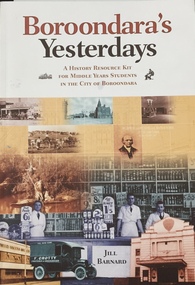
Book, Jill Barnard, Boroondara's Yesterdays, 2009
... A resource commissioned and published by the Boroondara Library Service boroondara - history - kew - hawthorn - canterbury - camberwell - surrey hills - ashburton An educational resource for Middle Years students about the history of the City of Boroondara Nil v, 89 p. : ill., facsims., maps, ports. ; 30 cm. ...An educational resource for Middle Years students about the history of the City of Boroondarav, 89 p. : ill., facsims., maps, ports. ; 30 cm. non-fictionAn educational resource for Middle Years students about the history of the City of Boroondaraboroondara - history - kew - hawthorn - canterbury - camberwell - surrey hills - ashburton -
Kew Historical Society Inc
Book, City of Boroondara, 15 to 21: the stuff that surrounds us, 2001
... library are used by members for research into aspects of local history and/or to support the Society's collections of pictures, maps, fashion and artefacts. Reference books have entered the collection through donation, presentation, collection and purchase. photography -- artistic -- victoria -- boroondara Fifteen to twenty-one, the stuff that surrounds us Millennium photographic project : 15 to 21, the stuff that surrounds us Camberwell, Vic. : City of Boroondara, 2001 1 v. ...Fifteen to twenty-one, the stuff that surrounds us Millennium photographic project : 15 to 21, the stuff that surrounds usCamberwell, Vic. : City of Boroondara, 2001 1 v. (unpaged) : ill. ; 22 x 26 cm non-fictionFifteen to twenty-one, the stuff that surrounds us Millennium photographic project : 15 to 21, the stuff that surrounds usphotography -- artistic -- victoria -- boroondara -
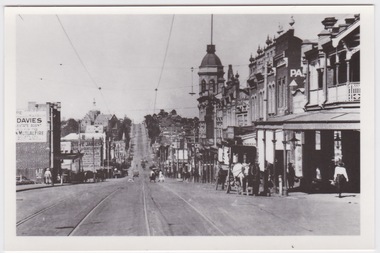 Camberwell Historical Society
Postcard - Photo postcard, 1989
... Camberwell, c. 1923. La Trobe Collection, State Library of Victoria. Glossy black and white photograph with white border on a postcard, depicting Burke Road dating around 1923. Photograph shows people crossing tram line surrounded by buildings, with horse and cart in the foreground. Postcard Photo postcard City ...Glossy black and white photograph with white border on a postcard, depicting Burke Road dating around 1923. Photograph shows people crossing tram line surrounded by buildings, with horse and cart in the foreground.Back of postcard: Burke Road, Camberwell, c. 1923. La Trobe Collection, State Library of Victoria. -
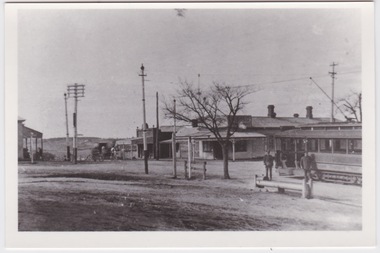 Camberwell Historical Society
Postcard - Photo postcard, 1989
... Camberwell Library. Glossy black and white photograph with white border on a postcard, depicting a Tram Terminus with power lines in Burwood dated 1917 Postcard Photo postcard City of Camberwell ...Glossy black and white photograph with white border on a postcard, depicting a Tram Terminus with power lines in Burwood dated 1917Back of postcard: Tram Terminus, Burwood, 1917. Local History Collection, Camberwell Library. -
Canterbury History Group
Document - Canterbury Gardens, Canterbury Road, Canterbury, City of Camberwell, 1991
... Camberwell Conservation Study, 1991 of the Canterbury Gardens. Includes sepia photographs of the gardens, an architect's drawing of the front of the old library (1907) and a list of the mature trees in the gardens in 1991. Canterbury Canterbury Gardens Canterbury Library Canterbury Progress Association Mercy> G.G. Guilfoyle> William Fountains Sundials Gardens Empire Day Rotundas A4 5 pages Document Canterbury Gardens, Canterbury Road, Canterbury City ...Camberwell Conservation Study, 1991 of the Canterbury Gardens. Includes sepia photographs of the gardens, an architect's drawing of the front of the old library (1907) and a list of the mature trees in the gardens in 1991.A4 5 pagescanterbury, canterbury gardens, canterbury library, canterbury progress association, mercy> g.g., guilfoyle> william, fountains, sundials, gardens, empire day, rotundas -
Canterbury History Group
Article, Junction Centre concerns are unfounded
... Canterbury Canterbury Road Camberwell Junction Camberwell Planning Scheme Pigot> Jan Street Trees Pioneers Town Planning Library Bicentennial Collection Sponsors Issue of the Camberwell City News mainly reporting on the opposition to the proposed redevelopment of the Camberwell Junction Shopping Centre Junction Centre concerns are unfounded Article ...Issue of the Camberwell City News mainly reporting on the opposition to the proposed redevelopment of the Camberwell Junction Shopping Centrecanterbury, canterbury road, camberwell junction, camberwell planning scheme, pigot> jan, street trees, pioneers, town planning, library bicentennial collection sponsors -
Kew Historical Society Inc
Archive (Sub-series) - Subject File, Boroondara Bulletin, 1994
... City Commissioners following the forced amalgamation of the suburbs of Kew, Camberwell, Hawthorn etc. into the new City in 1994. The early Bulletins were like local newspapers and reported on community activities as well as Council policy. Additional copies of the Boroondara Bulletin are stored in the Society’s Library...City Commissioners following the forced amalgamation of the suburbs of Kew, Camberwell, Hawthorn etc. into the new City in 1994. The early Bulletins were like local newspapers and reported on community activities as well as Council policy. Additional copies of the Boroondara Bulletin are stored in the Society’s Library ...City of BoroondaraReference, Research, InformationProvenance OrderSubject file containing various copies of the City of Boroondara’s ‘Boroondara Bulletin’ including Volumes 1/1, 1/4 (1994), 2/2 (1995), 4 (1997) and Nov 2010. The file also includes some other, later Ward updates. The Bulletin was first issued by the City Commissioners following the forced amalgamation of the suburbs of Kew, Camberwell, Hawthorn etc. into the new City in 1994. The early Bulletins were like local newspapers and reported on community activities as well as Council policy. Additional copies of the Boroondara Bulletin are stored in the Society’s Library.city of boroondara - boroondara bulletin, city of boroondara - publicationscity of boroondara - boroondara bulletin, city of boroondara - publications -
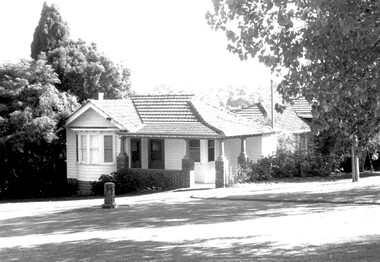 Surrey Hills Historical Society Collection
Photograph, Baby Health Centre in the Surrey Gardens, 1982, 1982
... The cairn commemorates the work of Cr Albert Ernest Vine who was a Camberwell Councillor from 1926-1934 and 1937-1944; he was also Mayor on 1940-41. There is a photo of him in Mayoral robes in the City of Boroondara Library Service collection....The cairn commemorates the work of Cr Albert Ernest Vine who was a Camberwell Councillor from 1926-1934 and 1937-1944; he was also Mayor on 1940-41. There is a photo of him in Mayoral robes in the City of Boroondara Library Service collection. surrey gardens baby health centres monuments and memorials surrey hills progress association cr albert ernest vine, sister d thompson, sister d. newnham, sister kelsell, sister barker, sister sharp and sister bolton, mrs a latham, ralph hayes, mrs d lancashire Black and white photo of a timber building with a tiled roof and a brick veranda supported by brick and concrete pillars. ...The Baby Health Centre opened in the Surrey Gardens in 1930 on the site previously occupied by the screen for outdoor pictures. Previously during the 1920s it had operated in the room underneath the rotunda in the Surrey Gardens. The room was also shared by other groups including the Surrey Hills Progress Association (SHPA). The SHPA raised 200 pounds to provide the materials for the building, which was built by voluntary labour under the leadership of Ralph Hayes, a local builder. The foundation stone was laid by Mrs A Latham, Mayoress of Camberwell on 31 March 1930. There is a bottle containing the names of the committee members sealed in the pillar behind the memorial stone. The centre was managed by a committee until 1975. Maternal health nurses associated with the centre included Sister D Thompson, Sister Newnham, Sister Kelsell, Sister Barker, Sister Sharp and Sister Bolton. Ref: Mrs D Lancashire - a long-serving member of the committee. The site of the Surrey Hills Maternal and Child Health Centre was moved to 18 Verdun Street, adjacent to the pre-school, in accord with Council policy to co-locate services and from a concern regarding solo staff working in relatively isolated locations. The building was included in the heritage overlay protecting the gardens and was refurbished by Council for community use. The cairn commemorates the work of Cr Albert Ernest Vine who was a Camberwell Councillor from 1926-1934 and 1937-1944; he was also Mayor on 1940-41. There is a photo of him in Mayoral robes in the City of Boroondara Library Service collection.Black and white photo of a timber building with a tiled roof and a brick veranda supported by brick and concrete pillars. In front of the baby health centre is a small cairn.surrey gardens, baby health centres, monuments and memorials, surrey hills progress association, cr albert ernest vine, sister d thompson, sister d. newnham, sister kelsell, sister barker, sister sharp and sister bolton, mrs a latham, ralph hayes, mrs d lancashire -
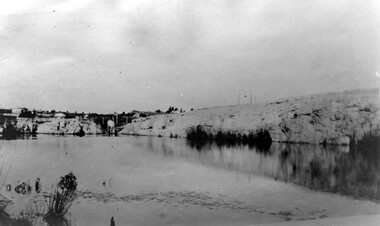 Surrey Hills Historical Society Collection
Photograph, Grovedale Road Quarry in the 1920s - looking south, c1920
... Library of Victoria's website. This shows that the Grovedale Park site had been acquired by Camberwell Council by this time. An attached newspaper clipping documents prices realised for a cross-section of blocks. The MMBW map of 1925, also on the SLV website, shows the outline of the clayhole / quarry. The quarry was filled in after several drownings or near drownings and the land is now occupied by a park and playground, known as Grovedale Road Park, maintained by the City...Library of Victoria's website. This shows that the Grovedale Park site had been acquired by Camberwell Council by this time. An attached newspaper clipping documents prices realised for a cross-section of blocks. The MMBW map of 1925, also on the SLV website, shows the outline of the clayhole / quarry. The quarry was filled in after several drownings or near drownings and the land is now occupied by a park and playground, known as Grovedale Road Park, maintained by the City ...The quarry was part of John Butler Maling's property. He was one of the original settlers of the area and farmed the area between Weybridge Street and Whitehorse Road. Clay was quarried from part of this area and used to make the bricks used in the construction of his home, known as 'Ancyra'. This is still extant at the corner of Weybridge and James Streets. Maling grazed cows and used the quarry as a water source. He was the uncle of John Butler Maling, Mayor of Camberwell. He was married to Kate Conlon in 1882. They had 3 children: Silas Young, Alick and Zillah. Maling was born in c1829 in Shepreth, Cambridgeshire; he died in Surrey Hills on 9 October 1912 and is buried in Box Hill Cemetery - CE-*-0586. Mrs Kate Maling (born c1859 in Co Meath, Ireland) died at the property on 8 March 1921. She is buried in Brighton General Cemetery. Probate was valued at over 10,000 pounds and included other properties in Sandringham, Hawthorn and Macedon. At the time of her death the Surrey Hills property was described as being 23 acres with 2 brick houses, 1 cow, 2 heifers and 40 fowls or chickens. The property was subdivided after her death. The property was subdivided into 110 house blocks in c1923 - see Maling's Estate subdivision flyer on the State Library of Victoria's website. This shows that the Grovedale Park site had been acquired by Camberwell Council by this time. An attached newspaper clipping documents prices realised for a cross-section of blocks. The MMBW map of 1925, also on the SLV website, shows the outline of the clayhole / quarry. The quarry was filled in after several drownings or near drownings and the land is now occupied by a park and playground, known as Grovedale Road Park, maintained by the City of Boroondara. Beckett Park is sited on horizon to the left beyond the trees. This documents the landscape prior to close settlement and is material to early building and farming in the Surrey Hills area.Black and white photo of the quarry between Grovedale Road and James Street taken in the 1920s and looking south. In the foreground is an area of water with reeds in the LH corner. Beyond on the high banks there are single storey houses in the background and (?) some light poles. An object that looks like a tank on posts is in a cutting on the far bank.quarries, grovedale road, james street, clay quarries, farming, kate conlon, kate maling, john butler maling, ancyra -
 Surrey Hills Historical Society Collection
Photograph, 'Hillsboro' or "Hillsborough' - 6a Thistle Street, Surrey Hills, pre-1890
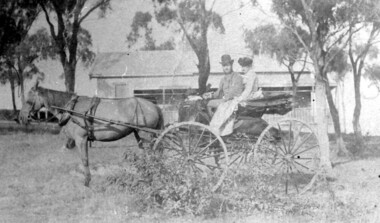
... Camberwell Gun Club from around 1890 – 91. In 1893 he relocated to Ferntree Gully, where he contested for the municipality’s North Riding council seat. Multiple references can be found on Trove. Note that the gentleman in this photo does bear a resemblance to Thomas Sweetman, President of Boroondara Shire in 1888-1889 found in the City of Boroondara Library Service mayoral portrait collection. ...Camberwell Gun Club from around 1890 – 91. In 1893 he relocated to Ferntree Gully, where he contested for the municipality’s North Riding council seat. Multiple references can be found on Trove. Note that the gentleman in this photo does bear a resemblance to Thomas Sweetman, President of Boroondara Shire in 1888-1889 found in the City of Boroondara Library Service mayoral portrait collection. ...The photo was found behind a mantelpiece in the house at 6A Thistle Street while it was being renovated. It is thought to be of the first owner, Mrs Rachel Sweetnam (nee Lewis) and her husband, Thomas Edward Sweetnam. They were married on 24 September 1884 at St John's Church, Camberwell. REF: THE ARGUS 4 Oct 1884 Thomas second eldest surviving son of Matthew Sweetnam married to Rachel (Ray) third eldest daughter of Captain T.D. Lewis, Culm Haven, Camberwell. Thomas was active in land sales and variously described as a land agent, real estate agent and auctioneer. The property - Hillsboro or Hillsborough - was originally a house on a farm of 10 acres owned by her. It became 6A Thistle Street. According to the Alan Holt property register Rachel Sweetnam owned the property prior to 1890 and a family tree on Ancestry.com has that it was owned by her in c1886. It is likely that it was an investment rather than a family residence. Thomas Sweetnam was President of the Boroondara Shire 1888/89 and a councillor from 1886-1891. During his time as Shire councillor in 1887 he was charged with assaulting Charles A. Chandler, a window blind manufacturer, in response to an ‘insulting note’ left at Sweetnam’s house. Sweetnam was fined two guineas and 31 shillings. Sweetnam was also President of the Camberwell Gun Club from around 1890 – 91. In 1893 he relocated to Ferntree Gully, where he contested for the municipality’s North Riding council seat. Multiple references can be found on Trove. Note that the gentleman in this photo does bear a resemblance to Thomas Sweetman, President of Boroondara Shire in 1888-1889 found in the City of Boroondara Library Service mayoral portrait collection. No known photo of Rachel Sweetnam. Other property owners or residents are: 1890 Selina Gaylor 1900 Stephen Pullen 1910 William Murray (draftsman) 1920 George C Hughes 1930 Arthur Leslie Austin (tram driver) 1980 Mrs Lillian Evelyn Austin Sold in 1983 for $87,000. The house is still extant (January 2025). Note that we also have material / photos regarding George Hughes and family.This photo is one of the earliest photos of residences of Surrey Hills.Black and white photo of a woman and man in a buggy behind which is a simple house with a verandah at one end, surrounded by eucalypt trees.hillsboro, house names, thistle street, horse-drawn vehicle, clothing and dress, hillsborough, rachel sweetnam, rachel lewis, thomas sweetnam, selina gaylor, stephen pullen, william murray, george hughes, arthur austin, lillian austin -
 Surrey Hills Historical Society Collection
Photograph, View of Surrey Gardens looking east from Union Road
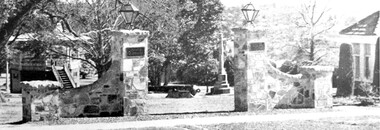
... The Dimmick Gateway was erected in 1950 by the citizens of Camberwell in memory of Cr William Dimmick, JP, Mayor of Camberwell, 1935-1936 and a Councillor from 1934-1947. There is a photo of him in Mayoral robes in the City of Boroondara Library Service collection. ...The Dimmick Gateway was erected in 1950 by the citizens of Camberwell in memory of Cr William Dimmick, JP, Mayor of Camberwell, 1935-1936 and a Councillor from 1934-1947. There is a photo of him in Mayoral robes in the City of Boroondara Library Service collection. ...The 2 cannons in the gardens were acquired by Mr Arthur Brookes, popularly known as 'Empire Brookes'. They were from a British vessel used during the Crimean War and were originally placed in the grounds of the Guildford Road Recreation Oval. The Dimmick Gateway was erected in 1950 by the citizens of Camberwell in memory of Cr William Dimmick, JP, Mayor of Camberwell, 1935-1936 and a Councillor from 1934-1947. There is a photo of him in Mayoral robes in the City of Boroondara Library Service collection. Cr Dimmick was commonly called Roy.Black and white photo of the Dimmick Gateway in Surrey Gardens. The gateway is built as if it was designed to have a fence attached but there is none. There are 2 tall central pillars and an arched bridge to 2 smaller pillars. It appears to be constructed from a variegated slate material. There is a light on the top of each of the tall pillars and also a plaque. To the RHS of the photo is part of the Surrey Shrine, skirted by 2 cypress trees. A canon and the Memorial Cross can be seen between the gateway pillars and to the LHS of the photo the wooden bandstand can be seen.dimmick gateway, surrey gardens, surrey shrine, boer war, bandstand, parks and reserves, cr william dimmick, roy dimmick -
 Kew Historical Society Inc
Photograph, C Stuart Tompkins, Junior Section, Kew Public Library, 15 May 1945
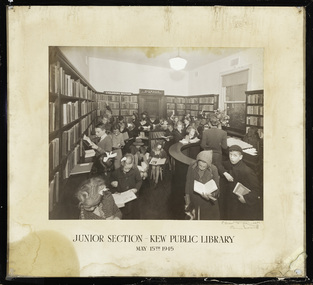
... Library moved to its current location in the converted city hall, overlooking the beautiful Alexandra Gardens. The library was officially opened at this site on Friday 23 October 1987 by the Mayor of Kew, Cr James Tutt. (Source: Boroondara Library Service) Early original photograph of a children's library service taken by a notable Melbourne photographer kew public library photographers - c. stuart tompkins - camberwell (vic) children's libraries "Junior Section, Kew Public Library, May 15th 1945" Original photograph, in original frame, of the Junior Section of the Kew Public Library in Walpole Street, Kew. ...1860: Kew's first library was the Kew Literary and Scientific Society, which opened on 6 August 1860. 1884: Kew Town Hall was extended and the library transferred to a room on the upper floor. This was not an ideal arrangement as the room was required for Council purposes. 1904: A cottage adjoining Kew Town Hall was purchased for use as a library. 1937: The library was closed for a major overhaul of stock and renovation of the building. It reopened in December 1937 and remained there for more than 35 years. 1973: When the Civic Centre opened in Charles Street, Kew, the library moved in. 1987: Kew Library moved to its current location in the converted city hall, overlooking the beautiful Alexandra Gardens. The library was officially opened at this site on Friday 23 October 1987 by the Mayor of Kew, Cr James Tutt. (Source: Boroondara Library Service)Early original photograph of a children's library service taken by a notable Melbourne photographerOriginal photograph, in original frame, of the Junior Section of the Kew Public Library in Walpole Street, Kew. The photograph was taken by Stuart Tompkins who was the photographer of choice by the City of Kew from the 1930s to the 1960s. The details of the photograph are inscribed on the water-damaged mount, with the photographers signature at lower right. . "Junior Section, Kew Public Library, May 15th 1945"kew public library, photographers - c. stuart tompkins - camberwell (vic), children's libraries -
 Kew Historical Society Inc
Plan, Studley Park Estate, 1910
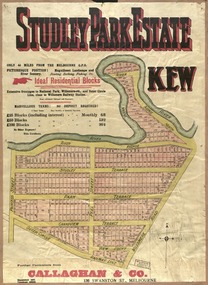
... Library Service. A number are however unique to the collection. The Kew Historical Society collection includes almost 100 subdivision plans pertaining to suburbs of the City of Melbourne. Most of these are of Kew, Kew East or Studley Park, although a smaller number are plans of Camberwell ...Prue Sanderson, in her groundbreaking ‘City of Kew Urban Conservation Study : Volume 2 - Development History’ (1988), summarised the periods of urban development and subdivisions of land in Kew. The periods that she identified included 1845-1880, 1880-1893, 1893-1921, 1921-1933, 1933-1943, and Post-War Development. These periods were selected as they represented periods of rapid growth or decline in urban development. An obvious starting point for Sanderson’s groupings involved population growth and the associated economic cycles. These cycles also highlighted urban expansion onto land that was predominantly rural, although in other cases it represented the decline and breakup of large estates. A number of the plans in the Kew Historical Society’s collection can also be found in other collections, such as those of the State Library of Victoria and the Boroondara Library Service. A number are however unique to the collection.The Kew Historical Society collection includes almost 100 subdivision plans pertaining to suburbs of the City of Melbourne. Most of these are of Kew, Kew East or Studley Park, although a smaller number are plans of Camberwell, Deepdene, Balwyn and Hawthorn. It is believed that the majority of the plans were gifted to the Society by persons connected with the real estate firm - J. R. Mathers and McMillan, 136 Cotham Road, Kew. The Plans in the collection are rarely in pristine form, being working plans on which the agent would write notes and record lots sold and the prices of these. The subdivision plans are historically significant examples of the growth of urban Melbourne from the beginning of the 20th Century up until the 1980s. A number of the plans are double-sided and often include a photograph on the reverse. A number of the latter are by noted photographers such as J.E. Barnes.Coloured lithograph of a subdivision plan of the Studley Park Estate, bordered by Yarra, Willsmere Road and the Outer Circle Railway line. The estate was listed in 1910 and was the subject of a planning dispute between the developer and the Town of Kew in relation to flood levels and the suitability of the land for housing. In many cases the names of streets were subsequently changed. The layout was also affected by the creation of the Eastern Freeway. A newspaper report of the day described the subdivision as a: "GOLDEN OPPORTUNITY. We are pleased to submit for PRIVATE SALE that magnificent ESTATE, situated only 4 1/2 miles from the Melbourne General Post Office, STUDLEY PARK ESTATE. KF/NV. Doubtless the CHEAPEST LAND EVER OFFERED having extensive frontages to the prettiest spot on the River Yarra and the National Park, commanding lovely river and landscape views, and acknowledged to be the finest land available so close to the city. The PRICES ARE EXTREMELY MODERATE; The TERMS ARE SIMPLY MARVELLOUS. NO DEPOSIT. NO DEPOSIT. NO DEPOSIT. Allotments and prices to suit everyone."subdivision plans - kew, studley park estate -
 Kew Historical Society Inc
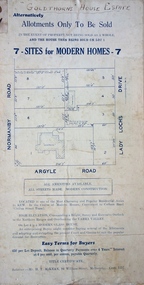
Plan - Subdivision Plan, Goldthorns House Estate, 1940
... Library Service. A number are however unique to the collection. The Kew Historical Society collection includes almost 100 subdivision plans pertaining to suburbs of the City of Melbourne. Most of these are of Kew, Kew East or Studley Park, although a smaller number are plans of Camberwell ...Pru Sanderson, in her groundbreaking ‘City of Kew Urban Conservation Study : Volume 2 - Development History’ (1988), summarised the periods of urban development and subdivisions of land in Kew. The periods that she identified included 1845-1880, 1880-1893, 1893-1921, 1921-1933, 1933-1943, and Post-War Development. These periods were selected as they represented periods of rapid growth or decline in urban development. An obvious starting point for Sanderson’s groupings involved population growth and the associated economic cycles. These cycles also highlighted urban expansion onto land that was predominantly rural, although in other cases it represented the decline and breakup of large estates. A number of the plans in the Kew Historical Society’s collection can also be found in other collections, such as those of the State Library of Victoria and the Boroondara Library Service. A number are however unique to the collection.The Kew Historical Society collection includes almost 100 subdivision plans pertaining to suburbs of the City of Melbourne. Most of these are of Kew, Kew East or Studley Park, although a smaller number are plans of Camberwell, Deepdene, Balwyn and Hawthorn. It is believed that the majority of the plans were gifted to the Society by persons connected with the real estate firm - J. R. Mathers and McMillan, 136 Cotham Road, Kew. The Plans in the collection are rarely in pristine form, being working plans on which the agent would write notes and record lots sold and the prices of these. The subdivision plans are historically significant examples of the growth of urban Melbourne from the beginning of the 20th Century up until the 1980s. A number of the plans are double-sided and often include a photograph on the reverse. A number of the latter are by noted photographers such as J.E. Barnes.The first subdivision of Goldthorns created the Goldthorns Hill Estate. Following that subdivision, seven additional lots were offered between Normanby Road, Argyle Road and Lady Loch’s Drive on the proviso that the estate, including Goldthorns was not sold as a single lot. The subdivision plan advises that the lots are situated in one of the most charming and popular residential areas in Kew and is surrounded by modern homes. Typically, the subdivision plan proposes the advantage of its proximity to Cotham Road and the tram to Collins Street. Because of the elevation of Goldthorns, much is made of the ‘bright, sunny and extensive outlook to the Northern Ranges’ and that it overlooks the Yarra Valley. One of the more interesting aspects of the plan is that it shows the outline of Goldthorns in the mid to late 1920s. Its profile today remains virtually the same."Goldthorns" House Estate at topsubdivision plans - kew, goldthorns house estate -
 Kew Historical Society Inc
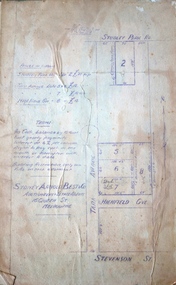
Plan, Sydney Arnold Best & Co, Field Place, Kew, c.1929
... Library Service. A number are however unique to the collection. The Kew Historical Society collection includes almost 100 subdivision plans pertaining to suburbs of the City of Melbourne. Most of these are of Kew, Kew East or Studley Park, although a smaller number are plans of Camberwell ...Pru Sanderson, in her groundbreaking ‘City of Kew Urban Conservation Study : Volume 2 - Development History’ (1988), summarised the periods of urban development and subdivisions of land in Kew. The periods that she identified included 1845-1880, 1880-1893, 1893-1921, 1921-1933, 1933-1943, and Post-War Development. These periods were selected as they represented periods of rapid growth or decline in urban development. An obvious starting point for Sanderson’s groupings involved population growth and the associated economic cycles. These cycles also highlighted urban expansion onto land that was predominantly rural, although in other cases it represented the decline and breakup of large estates. A number of the plans in the Kew Historical Society’s collection can also be found in other collections, such as those of the State Library of Victoria and the Boroondara Library Service. A number are however unique to the collection.The Kew Historical Society collection includes almost 100 subdivision plans pertaining to suburbs of the City of Melbourne. Most of these are of Kew, Kew East or Studley Park, although a smaller number are plans of Camberwell, Deepdene, Balwyn and Hawthorn. It is believed that the majority of the plans were gifted to the Society by persons connected with the real estate firm - J. R. Mathers and McMillan, 136 Cotham Road, Kew. The Plans in the collection are rarely in pristine form, being working plans on which the agent would write notes and record lots sold and the prices of these. The subdivision plans are historically significant examples of the growth of urban Melbourne from the beginning of the 20th Century up until the 1980s. A number of the plans are double-sided and often include a photograph on the reverse. A number of the latter are by noted photographers such as J.E. Barnes.An unnamed subdivision in Studley Park including five lots for sale in Studley Park Road, Highfield Grove and Tara Avenue. Unidentified on the plan, but clearly existing, are the Henty family mansion of Field Place and Tara Hall in Studley Park Road. The first attempted subdivision of Tara Hall was advertised in 1927 in which Lots 5, 6 and 7 in this plan were also advertised. Unusually, Lot 2 in Studley Park Road was created from the northern part of the Henty mansion, rather than Tara Hall. In the subdivision, lots were advertised at varying prices, with the highest price for land being Lot 2 in Studley Park Road. The plan notes that only one villa is to be allowed on each allotment.subdivision plans - kew, field place subdivision -- studley park – kew (vic.), highfield grove – kew (vic.), tara avenue – kew (vic.) -
 Kew Historical Society Inc
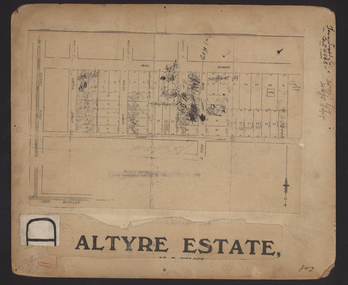
Plan - Subdivision Plan, Altyre Estate, 1920, 1920
... Library Service. A number are however unique to the collection. The Kew Historical Society collection includes almost 100 subdivision plans pertaining to suburbs of the City of Melbourne. Most of these are of Kew, Kew East or Studley Park, although a smaller number are plans of Camberwell ...Pru Sanderson, in her groundbreaking ‘City of Kew Urban Conservation Study : Volume 2 - Development History’ (1988), summarised the periods of urban development and subdivisions of land in Kew. The periods that she identified included 1845-1880, 1880-1893, 1893-1921, 1921-1933, 1933-1943, and Post-War Development. These periods were selected as they represented periods of rapid growth or decline in urban development. An obvious starting point for Sanderson’s groupings involved population growth and the associated economic cycles. These cycles also highlighted urban expansion onto land that was predominantly rural, although in other cases it represented the decline and breakup of large estates. A number of the plans in the Kew Historical Society’s collection can also be found in other collections, such as those of the State Library of Victoria and the Boroondara Library Service. A number are however unique to the collection.The Kew Historical Society collection includes almost 100 subdivision plans pertaining to suburbs of the City of Melbourne. Most of these are of Kew, Kew East or Studley Park, although a smaller number are plans of Camberwell, Deepdene, Balwyn and Hawthorn. It is believed that the majority of the plans were gifted to the Society by persons connected with the real estate firm - J. R. Mathers and McMillan, 136 Cotham Road, Kew. The Plans in the collection are rarely in pristine form, being working plans on which the agent would write notes and record lots sold and the prices of these. The subdivision plans are historically significant examples of the growth of urban Melbourne from the beginning of the 20th Century up until the 1980s. A number of the plans are double-sided and often include a photograph on the reverse. A number of the latter are by noted photographers such as J.E. Barnes.The Altyre Estate was advertised for sale by auction in 1920. A colour lithograph in the State Library of Victoria, in contrast to this monochrome version, notes the proximity of the subdivision to the Auburn Heights Bowling Club and to a range of transport options. The subdivision included fifty-one allotments as well as the original house ‘Altyre’ in Barkers Road. This version includes the amounts paid as deposit on a number of lots.subdivision plans - kew, altyre estate – kew (vic), barkers road – kew (vic), walsh street – kew (vic), ross street – kew (vic), loxton street – kew (vic), mount street – kew (vic), auburn heights bowling club, altyre
