
Showing 158 items matching "cambridge street"
-
 Hawthorn Historical Society
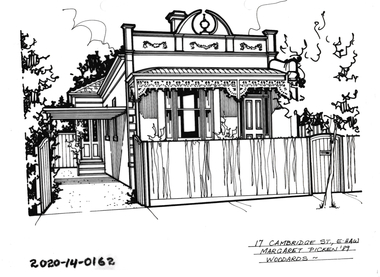
Drawing - Property Illustration, 17 Cambridge Street, Hawthorn East
... 17 Cambridge Street, Hawthorn East ...Pen and ink property illustration on drafting film of 17 Cambridge Street, Hawthorn East by Margaret Picken....17 Cambridge Street, E Haw, Margaret Picken '89, Woodards....Pen and ink property illustration on drafting film of 17 Cambridge Street, Hawthorn East by Margaret Picken. 17 Cambridge Street, Hawthorn East Drawing Property Illustration ...'After training as a Cartographic Draftsman within the mining industry, I worked as a property illustrator for real estate firms in the eastern suburbs of Melbourne for 23 years from 1983. I initially photographed houses with a Polaroid camera and made a 'thumbnail' sketch while there. The photos were used to scale off a sketch in pencil and then that sketch was overlaid with drafting film and the 'pen and ink' completed. The pens I used were the Rotring ‘Rapidigraph’ drafting pens. The ink was also made by Rotring (German).The film was ‘Rapidraw’, polyester drafting film, double matte. It takes a very fine line and doesn’t bleed. As well as house sketches, there were often floor plans and site plans ordered. Aerial sketches were ordered when the property needed an overall view.' (Margaret Picken, 2020)This property illustration is one of a series created by Margaret Picken for a range of real estate agents in Melbourne between c. 1983 and c. 2006. Each work is signed and dated by the artist.Gift of Margaret Picken, 2020Pen and ink property illustration on drafting film of 17 Cambridge Street, Hawthorn East by Margaret Picken.17 Cambridge Street, E Haw, Margaret Picken '89, Woodards.artist - margaret picken 1950- -
 Hawthorn Historical Society
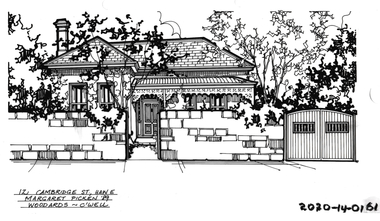
Drawing - Property Illustration, 12 Cambridge Street, Hawthorn East
... 12 Cambridge Street, Hawthorn East ...Pen and ink property illustration on drafting film of 12 Cambridge Street, Hawthorn East by Margaret Picken....12 Cambridge Street, Haw E, Margaret Picken '89, Woodards - Haw....Pen and ink property illustration on drafting film of 12 Cambridge Street, Hawthorn East by Margaret Picken. 12 Cambridge Street, Hawthorn East Drawing Property Illustration ...'After training as a Cartographic Draftsman within the mining industry, I worked as a property illustrator for real estate firms in the eastern suburbs of Melbourne for 23 years from 1983. I initially photographed houses with a Polaroid camera and made a 'thumbnail' sketch while there. The photos were used to scale off a sketch in pencil and then that sketch was overlaid with drafting film and the 'pen and ink' completed. The pens I used were the Rotring ‘Rapidigraph’ drafting pens. The ink was also made by Rotring (German).The film was ‘Rapidraw’, polyester drafting film, double matte. It takes a very fine line and doesn’t bleed. As well as house sketches, there were often floor plans and site plans ordered. Aerial sketches were ordered when the property needed an overall view.' (Margaret Picken, 2020)This property illustration is one of a series created by Margaret Picken for a range of real estate agents in Melbourne between c. 1983 and c. 2006. Each work is signed and dated by the artist.Gift of Margaret Picken, 2020Pen and ink property illustration on drafting film of 12 Cambridge Street, Hawthorn East by Margaret Picken.12 Cambridge Street, Haw E, Margaret Picken '89, Woodards - Haw.artist - margaret picken 1950- -
 Yarra City Council
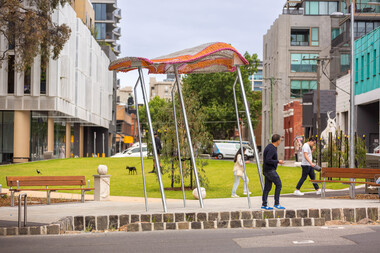
Artwork, other - Installation/Sculpture, William Eicholtz, Close Knit, 2023
... Yarra City Council delivered Cambridge Street Reserve in partnership with the Victorian Government, who have supported the project with $1.3m funding. ...Cambridge Street, Collingwood, Melbourne, VIC, Australia...Yarra City Council delivered Cambridge Street Reserve in partnership with the Victorian Government, who have supported the project with $1.3m funding. ...'Close Knit' was conceived based around providing the high density accommodation of the area with what many residents will never experience; the iconic ‘Aussie’ backyard, symbolised by washing on a Hills Hoist. This concept was transposed into several elements, including two large flying jumper sculptures. These stainless steel and fibreglass structures are supported on slanted poles, reminiscent of Hills Hoist arms. The jumpers appear to catch the breeze, and billow up, like washing on the clothesline on a sunny day, and cast lovely shadows across the paths and gardens. They are bright and joyful reminders of simple homespun joys. The handcraft theme is also featured in knitted concrete garden walls throughout the gardens. As if the wind is captured in the movement of the Hellenistic drapery, these panels echo the Lady of Justice, an earlier work of mine on the Victorian County Court. These feature walls bring a softness to the park and hark back to classic European garden design. There are 6 finial/balls of wool marking gateways and entrances to the park, as well as a couple randomly scattered throughout to be discovered. There is also a draped plinth at the Peel street entrance which has my signature. Again these elements echo traditional garden design and are a tactile and recognizable link to the hand knit themes of the park. Given the strong themes of domesticity and handcrafts, I have titled my work ‘Close Knit’, as it applies to the purpose of this public space as well as the works scattered throughout. Yarra City Council delivered Cambridge Street Reserve in partnership with the Victorian Government, who have supported the project with $1.3m funding. Yarra City Council has invested a further $731,130 towards the project. Urban Imitative Landscape Design worked with artist William Eicholtz at the beginning of the design process to consider the needs of a growing high-density population of the area. At double the size, with extensive park seating and a large lawn space which is shaded by native trees, Cambridge Street Reserve is now the largest park in Collingwood. 'Close Knit' by William EicholtzTwo knitted fibreglass 'jumpers' over stainless steel framework; six concrete balls of wool throughout the park; 25 metres of cast (drapery) concrete walls; concrete plinth at Peel street entry which is draped with a concrete knit and a ball of wool on top as finial; reverse rope reliefs on the front façade of eastern stairs. Artist name and date 'William Eicholtz 2023' inscribed on plinth with ball of wool on top as finial. handcrafts, domesticity, aussie icons, european garden design, public space, high density accomodation -
 Box Hill Historical Society
Photograph - Shops
... ...Cambridge Street...View of west side Station Street, showing Al Capone's Restaurant and Hoaths Cycles & Sports Centre on the corner of Cambridge Street...View of west side Station Street, showing Al Capone's Restaurant and Hoaths Cycles & Sports Centre on the corner of Cambridge Street Al Capone's Restaurant Restaurants Station Street Cambridge Street Hoath's Cycles Sport Shops Transport Photograph Shops ...View of west side Station Street, showing Al Capone's Restaurant and Hoaths Cycles & Sports Centre on the corner of Cambridge Streetal capone's restaurant, restaurants, station street, cambridge street, hoath's cycles, sport, shops, transport -
 Mont De Lancey
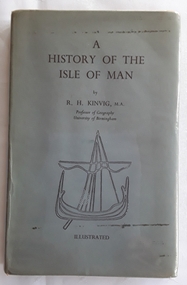
Book, R.H. Kinvig, M.A, A History of the Isle of Man, 1950
... 4 Cambridge Street, Liverpool, England, United Kingdom. ...The author, Professor of Geography at the University of Birmingham R.H. Kinvid, M.A. published this new edition of the history of The Isle of Man in 1950, six years after the first edition, to include fresh discoveries that have been made, particularly in the archaeological field, and of the important political developments that have taken place in recent years. Some changes have also been made in the maps and other illustrations.A navy blue hardcover book with a grey dust jacket covered in library style plastic sleeving.The title: A History of the Isle of man is printed in black lettering at the top of the front cover with the author, R.H. Kinvig, M.A. underneath. A black outline of an ancient vessel is illustrated too. On the spine is written the title, author and 7s 6p. Throughout the book there are black and white photographs and illustrations. On the back cover is a circle with three legs wearing trousers and boots with the words: ICERIS STABIT QUOCUNIQUE around the edges of the legs inside the circle. Pp. 180 non-fictionThe author, Professor of Geography at the University of Birmingham R.H. Kinvid, M.A. published this new edition of the history of The Isle of Man in 1950, six years after the first edition, to include fresh discoveries that have been made, particularly in the archaeological field, and of the important political developments that have taken place in recent years. Some changes have also been made in the maps and other illustrations.history, isle of man, ancient history -
 Allan Doney Collection, Bendigo Historical Society Inc.
Negative - Bendigo Advertiser - Cambridge Press - Hargreaves Street Bendigo, Allan Doney, 1950 -1970
... Bendigo Advertiser - Cambridge Press - Hargreaves Street Bendigo...Negative Bendigo Advertiser - Cambridge Press - Hargreaves Street Bendigo Allan Doney ...In the years of Allan Doney’s photography, landmark buildings succumbed to fire, neglect and redevelopment. He photographed the grey sand hills from Bendigo’s mining past, the streetscapes, poppet heads, miners’ cottages, gracious homes with ornate verandahs, trams and much more. Above all, his photographs show how much of the city has survived from the 19th century – and how much has not. Through two decades of great change, Allan Doney was there to capture ways people interacted with it. Although he travelled to many other places in Northern Victoria and beyond in search of subjects for his art, he seemed to always return to Bendigo for inspiration. -
 Allan Doney Collection, Bendigo Historical Society Inc.
Negative - Bendigo Advertiser - Cambridge Press - Hargreaves Street Bendigo, Allan Doney, 1950 -1970
... Bendigo Advertiser - Cambridge Press - Hargreaves Street Bendigo...Negative Bendigo Advertiser - Cambridge Press - Hargreaves Street Bendigo Allan Doney ...In the years of Allan Doney’s photography, landmark buildings succumbed to fire, neglect and redevelopment. He photographed the grey sand hills from Bendigo’s mining past, the streetscapes, poppet heads, miners’ cottages, gracious homes with ornate verandahs, trams and much more. Above all, his photographs show how much of the city has survived from the 19th century – and how much has not. Through two decades of great change, Allan Doney was there to capture ways people interacted with it. Although he travelled to many other places in Northern Victoria and beyond in search of subjects for his art, he seemed to always return to Bendigo for inspiration. -
 Allan Doney Collection, Bendigo Historical Society Inc.
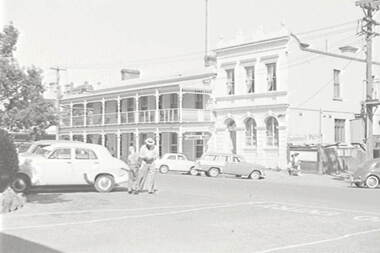
Negative - Metropolitan Hotel - Cambridge Press - Hargreaves Street Bendigo, Allan Doney, 1950 -1970
... Metropolitan Hotel - Cambridge Press - Hargreaves Street Bendigo...Negative Metropolitan Hotel - Cambridge Press - Hargreaves Street Bendigo Allan Doney ...In the years of Allan Doney’s photography, landmark buildings succumbed to fire, neglect and redevelopment. He photographed the grey sand hills from Bendigo’s mining past, the streetscapes, poppet heads, miners’ cottages, gracious homes with ornate verandahs, trams and much more. Above all, his photographs show how much of the city has survived from the 19th century – and how much has not. Through two decades of great change, Allan Doney was there to capture ways people interacted with it. Although he travelled to many other places in Northern Victoria and beyond in search of subjects for his art, he seemed to always return to Bendigo for inspiration. -
 Sunshine and District Historical Society Incorporated
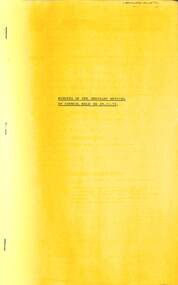
Administrative record - City of Sunshine - Commissioner Mr Alexander Alex George Gillon Collection 1976 - 1982 - Minutes of the ordinary meeting of council held on 28th Nov 1978, City of Sunshine, 28th November 1978
... ...Cambridge Street...Albans Building Over Easement 54 Angelique Grove Deer Park Fence Over 2.0m 9 Amelia Street Deer Park Sitting of Building Lot 598 Droitwich Crescent Deer Park Sitting of Building 3 Dundalk Street Sunshine Sitting of Building Lot 64 Tulloch Street Deer Park Sitting of Building 21 Cambridge Street Maidstone Extensions of Time for Building Permit Lots 923, 924 & 925 Fernhill Court Albanvale Breaches of Regulation Lots 3, 4 & 5 Ballarat Road Deer Park Building on Land Liable to Flooding Lot 9 Mernda Street Sunshine West Orders of the Day Accounts Submitted for Payment as a t 15th November 1978...Albans Building Over Easement 54 Angelique Grove Deer Park Fence Over 2.0m 9 Amelia Street Deer Park Sitting of Building Lot 598 Droitwich Crescent Deer Park Sitting of Building 3 Dundalk Street Sunshine Sitting of Building Lot 64 Tulloch Street Deer Park Sitting of Building 21 Cambridge Street Maidstone Extensions of Time for Building Permit Lots 923, 924 & 925 Fernhill Court Albanvale Breaches of Regulation Lots 3, 4 & 5 Ballarat Road Deer Park Building on Land Liable to Flooding Lot 9 Mernda Street Sunshine West Orders of the Day Accounts Submitted for Payment as a t 15th November 1978 Foolscap sized document. ...Minutes of the Ordinary Meeting of Council held on 28th Nov 1978 Report of the Town Clerk's Department Report of the Town Clerk Dempster Park Proposed Lease to Sunshine Cricket Club Issue of Title on former Devonshire Road between Railway Line and Anderson Road was Discontinued (H.V. McKay Memorial Gardens) Application for Title former Right of Way off Railway Parade Deer Park Christmas Recess The Hub Loan Borrowings Meals on Wheels Co-Ordinator of Welfare Services Deer Park Hall Pre-School Centre & Deer Park West Kindergarten Committee Northumberland Road Child Care Centre Settlement Committee Midway Hostel Maribyrnong Report of the Chief Health Inspector Issuing of Septic tank Approval Notices Application for Transfer of Proprietorship of Premises Under The Health Act Noise By-Law Nuisance Condition 403 Ballarat Road Sunshine Health Act Registration (Late Fee) Report of the Medical Officer of Health Report of the Chief By-Laws Officer Disposal of Derelict Vehicles Report of the City Librarian Library Hours Over the Christmas New Year Period Bookmobile Sites During Christmas School Holidays Report of the Municipal Recreation Officer Swimming Pool Sunshine Swimming & Life Saving Club use of the New Heated Pool Rent to be paid by Sunshine & District Table Tennis Association Report of the City Engineer Policy Advertising Procedures Under Section 18B of the Town and Country Planning Act 1961 as Amended Proposed Rezoning of Former Sunshine Post Office Corner of Dickson Street and Station Place Planning Permit Application Detached Houses Lots 26, 29 & 30 Chifley Drive Maribyrnong Planning Permit Application Factory Lot 19 McIntyre Road Planning Permit Application Amusement Parlour & Cafe 54A Station Place Planning Permit Application Food Premises and Caretaker's Residence Addition to Existing Retail Plant Nursery and Live Poutry Sales Lot 1 Emu Road South East Side of Hampstead Road Planning Permit Application New Offices and Showrooms Railway Lot 24 Berkshire Road North West Corner of Steers Street Planning Permit Application Sky Sign 240 Hampshire Road Planning Permit Application Sky Sign 152 Ballarat Road Planning Permit Application Garage Extension 64 - 66 Monash Street (Former Petrol Station Site) Planning Permit Application Service Premise & Caretaker's Dwelling and Associated Car Parking South East Corner of Aycliffe Drive and Tamar Drive Planning Permit Application 6 Lot Subdivision Camelot Drive South East Corner Main Road West Planning Permit Application Vicarage (Caretaker's Residence) Addition to Existing Place of Worship and Place of Assembly Church of England Darnley Street Planning Permit Application Subdivision & Detached Houses Lot 1001 Neale Road North Side Planning Permit Application Subdivision & Detached Houses Lot 1001 Oakwood Road North of Neale Road Planning Permit Application Subdivision & Detached Houses Lot 1000 Fairfax Circuit North of Neale Road Planning Permit Application Illuminated Sign 195 Hampshire Road Planning Permit Application Consulting Room Dental Clinic Lots 9, 10 & Part 11 Main Road West South East Corner Pennell Street Planning Permit Application Private Tip Lot 35 Reid Street Plan of Subdivision Fairfax Circuit & Oakwood Road Plan of Subdivision Neale Road, Fairfax Circuit & Antioch Court Plan of Subdivision R.D.C. Camelot Drive East Side Consolidation of Title Ballarat Road Deer Park Consolidation of Title Gee Street Sunshine North Consolidation of Title Comley Street Consolidation of Title Pineneedle Court Strata Subdivision 28 Sydney Street Drainage Works Robinsons Road Shire of Melton Intersection Ballarat Road / Station Road Statcon Signal Programme Deferred Payment of Costs Traffic Conditions Traffic Lights Versus Roundabouts Traffic Signal Maintenance State Highways Overseas Study Tour 1979 Local Government Engineers Association of Victoria Preference to Unionists Federated Municipal and Shire council Employees' Union of Australia Victoria Division Sewerage Facilities M.M.B.W. St. Albans and Sunshine West Areas Child Care Facility 24 Northumberland Road Sunshine North Planning Permits Furlong Road Infant Welfare Centre, Tallintyre Reserve Infant Welfare Centre, Beachley Reserve Infant Welfare Centre & Station Road Infant Welfare Centre Half Cost Fencing Dumfries Street Deer Park Albion Tennis Club Selwyn Park Lack of Toilet Facilities Report of the Building Surveyor Building Over Easement 13 Fairbairn Road Sunshine West Building Over Easement 6 Chestnut Drive St. Albans Building Over Easement 54 Angelique Grove Deer Park Fence Over 2.0m 9 Amelia Street Deer Park Sitting of Building Lot 598 Droitwich Crescent Deer Park Sitting of Building 3 Dundalk Street Sunshine Sitting of Building Lot 64 Tulloch Street Deer Park Sitting of Building 21 Cambridge Street Maidstone Extensions of Time for Building Permit Lots 923, 924 & 925 Fernhill Court Albanvale Breaches of Regulation Lots 3, 4 & 5 Ballarat Road Deer Park Building on Land Liable to Flooding Lot 9 Mernda Street Sunshine West Orders of the Day Accounts Submitted for Payment as a t 15th November 1978 city of sunshine, alexander "alex" george gillon, sunshine cricket club, dempster park, phoenix street, sunshine north, devonshire road, sunshine gardens, anderson road, sunshine, railway parade, deer park, h.v. mckay memorial gardens, the hub, sun crescent, deer park hall pre-school centre, station road, deer park west kindergarten committee, northumberland road child care centre, midway hostel, williamson road, maribyrnong, ballarat road, swimming pool sunshine swimming & life saving club, sunshine swimming pool, kennedy street, sunshine & district table tennis association, sunshine post office, dickson street, station place, chifley drive, mcintyre road, emu road, hampstead road, maidstone, berkshire road, steers street, hampshire road, monash street, aycliffe drive, tamar drive, camelot drive, main road west, albanvale, church of england, darnley street, braybrook, neale road, oakwood road, fairfax circuit, pennell street, st. albans, reid street, albion, antioch court, gee street, comley street, pineneedle court, sydney street, robinsons road, northumberland road, furlong road infant welfare centre, furlong road, tallintyre reserve infant welfare centre, kermeen street, beachley reserve infant welfare centre, ardoyne street, station road infant welfare centre, dumfries street, albion tennis club, selwyn park, selwyn street, fairbairn road, chestnut drive, angelique grove, amelia street, droitwich crescent, dundalk street, tulloch street, cambridge street, fernhill court, mernda street -
 Sunshine and District Historical Society Incorporated
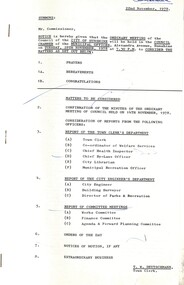
Administrative record - City of Sunshine - Commissioner Mr Alexander Alex George Gillon Collection 1976 - 1982 - Notice of ordinary meeting of the council 28th November 1978, City of Sunshine, 22nd November 1978
... ...Cambridge Street...Albans Building Over Easement 54 Angelique Grove Deer Park Fence Over 2.0m 9 Amelia Street Deer Park Sitting of Building Lot 598 Droitwich Crescent Deer Park Sitting of Building 3 Dundalk Street Sunshine Sitting of Building Lot 64 Tulloch Street Deer Park Sitting of Building 21 Cambridge Street Maidstone Extensions of Time for Building Permit Lots 923, 924 & 925 Fernhill Court Albanvale Breaches of Regulation Lots 3, 4 & 5 Ballarat Road Deer Park Building on Land Liable to Flooding Lot 9 Mernda Street Sunshine West Orders of the Day Accounts Submitted for Payment as a t 15th November 1978...Albans Reid Street Antioch Court Gee Street Comley Street Pineneedle Court Sydney Street Robinsons Road Furlong Road Infant Welfare Centre Tallintyre Reserve Infant Welfare Centre Beachley Reserve Infant Welfare Centre Station Road Infant Welfare Centre Dumfries Street Albion Tennis Club Selwyn Park Selwyn Street Fairbairn Road Ardoyne Street Furlong Road Kermeen Street Chestnut Drive Angelique Grove Amelia Street Droitwich Crescent Dundalk Street Tulloch Street Cambridge Street Fernhill Court Sunshine West Mernda Street H.V. ...Notice of Ordinary Meeting of the Council 28th November 1978 Report of the Town Clerk's Department Report of the Town Clerk Dempster Park Proposed Lease to Sunshine Cricket Club Issue of Title on former Devonshire Road between Railway Line and Anderson Road was Discontinued (H.V. McKay Memorial Gardens) Application for Title former Right of Way off Railway Parade Deer Park Christmas Recess The Hub Loan Borrowings Meals on Wheels Co-Ordinator of Welfare Services Deer Park Hall Pre-School Centre & Deer Park West Kindergarten Committee Northumberland Road Child Care Centre Settlement Committee Midway Hostel Maribyrnong Report of the Chief Health Inspector Issuing of Septic tank Approval Notices Application for Transfer of Proprietorship of Premises Under The Health Act Noise By-Law Nuisance Condition 403 Ballarat Road Sunshine Health Act Registration (Late Fee) Report of the Medical Officer of Health Report of the Chief By-Laws Officer Disposal of Derelict Vehicles Report of the City Librarian Library Hours Over the Christmas New Year Period Bookmobile Sites During Christmas School Holidays Report of the Municipal Recreation Officer Swimming Pool Sunshine Swimming & Life Saving Club use of the New Heated Pool Rent to be paid by Sunshine & District Table Tennis Association Report of the City Engineer Policy Advertising Procedures Under Section 18B of the Town and Country Planning Act 1961 as Amended Proposed Rezoning of Former Sunshine Post Office Corner of Dickson Street and Station Place Planning Permit Application Detached Houses Lots 26, 29 & 30 Chifley Drive Maribyrnong Planning Permit Application Factory Lot 19 McIntyre Road Planning Permit Application Amusement Parlour & Cafe 54A Station Place Planning Permit Application Food Premises and Caretaker's Residence Addition to Existing Retail Plant Nursery and Live Poutry Sales Lot 1 Emu Road South East Side of Hampstead Road Planning Permit Application New Offices and Showrooms Railway Lot 24 Berkshire Road North West Corner of Steers Street Planning Permit Application Sky Sign 240 Hampshire Road Planning Permit Application Sky Sign 152 Ballarat Road Planning Permit Application Garage Extension 64 - 66 Monash Street (Former Petrol Station Site) Planning Permit Application Service Premise & Caretaker's Dwelling and Associated Car Parking South East Corner of Aycliffe Drive and Tamar Drive Planning Permit Application 6 Lot Subdivision Camelot Drive South East Corner Main Road West Planning Permit Application Vicarage (Caretaker's Residence) Addition to Existing Place of Worship and Place of Assembly Church of England Darnley Street Planning Permit Application Subdivision & Detached Houses Lot 1001 Neale Road North Side Planning Permit Application Subdivision & Detached Houses Lot 1001 Oakwood Road North of Neale Road Planning Permit Application Subdivision & Detached Houses Lot 1000 Fairfax Circuit North of Neale Road Planning Permit Application Illuminated Sign 195 Hampshire Road Planning Permit Application Consulting Room Dental Clinic Lots 9, 10 & Part 11 Main Road West South East Corner Pennell Street Planning Permit Application Private Tip Lot 35 Reid Street Plan of Subdivision Fairfax Circuit & Oakwood Road Plan of Subdivision Neale Road, Fairfax Circuit & Antioch Court Plan of Subdivision R.D.C. Camelot Drive East Side Consolidation of Title Ballarat Road Deer Park Consolidation of Title Gee Street Sunshine North Consolidation of Title Comley Street Consolidation of Title Pineneedle Court Strata Subdivision 28 Sydney Street Drainage Works Robinsons Road Shire of Melton Intersection Ballarat Road / Station Road Statcon Signal Programme Deferred Payment of Costs Traffic Conditions Traffic Lights Versus Roundabouts Traffic Signal Maintenance State Highways Overseas Study Tour 1979 Local Government Engineers Association of Victoria Preference to Unionists Federated Municipal and Shire council Employees' Union of Australia Victoria Division Sewerage Facilities M.M.B.W. St. Albans and Sunshine West Areas Child Care Facility 24 Northumberland Road Sunshine North Planning Permits Furlong Road Infant Welfare Centre, Tallintyre Reserve Infant Welfare Centre, Beachley Reserve Infant Welfare Centre & Station Road Infant Welfare Centre Half Cost Fencing Dumfries Street Deer Park Albion Tennis Club Selwyn Park Lack of Toilet Facilities Report of the Building Surveyor Building Over Easement 13 Fairbairn Road Sunshine West Building Over Easement 6 Chestnut Drive St. Albans Building Over Easement 54 Angelique Grove Deer Park Fence Over 2.0m 9 Amelia Street Deer Park Sitting of Building Lot 598 Droitwich Crescent Deer Park Sitting of Building 3 Dundalk Street Sunshine Sitting of Building Lot 64 Tulloch Street Deer Park Sitting of Building 21 Cambridge Street Maidstone Extensions of Time for Building Permit Lots 923, 924 & 925 Fernhill Court Albanvale Breaches of Regulation Lots 3, 4 & 5 Ballarat Road Deer Park Building on Land Liable to Flooding Lot 9 Mernda Street Sunshine West Orders of the Day Accounts Submitted for Payment as a t 15th November 1978 city of sunshine, alexander "alex" george gillon, sunshine cricket club, dempster park, phoenix street, sunshine north, devonshire road, sunshine gardens, anderson road, albion, railway parade, deer park, deer park hall pre-school centre, station road, deer park west kindergarten committee, northumberland road child care centre, northumberland road, midway hostel, williamson road, maribyrnong, ballarat road, sunshine, swimming pool sunshine swimming & life saving club, sunshine swimming pool, kennedy street, sunshine & district table tennis association, sunshine post office, dickson street, station place, chifley drive, mcintyre road, emu road, hampstead road, maidstone, berkshire road, steers street, hampshire road, monash street, aycliffe drive, tamar driv, camelot drive, main road west, albanvale, church of england, darnley street, braybrook, neale road, oakwood road, fairfax circuit, pennell street, st. albans, reid street, antioch court, gee street, comley street, pineneedle court, sydney street, robinsons road, furlong road infant welfare centre, tallintyre reserve infant welfare centre, beachley reserve infant welfare centre, station road infant welfare centre, dumfries street, albion tennis club, selwyn park, selwyn street, fairbairn road, ardoyne street, furlong road, kermeen street, chestnut drive, angelique grove, amelia street, droitwich crescent, dundalk street, tulloch street, cambridge street, fernhill court, sunshine west, mernda street, h.v. mckay memorial gardens, the hub, sun crescent -
 Port Melbourne Historical & Preservation Society
Card - Hanneberry BridgE Business Card, c.1990
... ...Cambridge Street...Business and Traders - Plumbers Hanneberry Bridge Cambridge Street Grey business card with black text & HB logo. ...Business card advertising Hanneberry Bridge Licenced Plumbers & Gasfitters.Grey business card with black text & HB logo.business and traders - plumbers, hanneberry bridge, cambridge street -
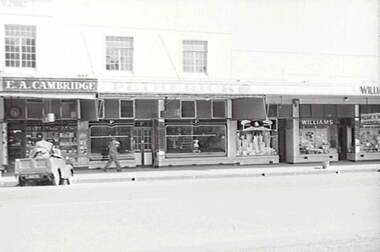 Allan Doney Collection, Bendigo Historical Society Inc.
Negative - Hargreaves Street Bendigo - Cambridge - Petherick’s, Allan Doney, 1950 -1970
... Hargreaves Street Bendigo - Cambridge - Petherick’s...Negative Hargreaves Street Bendigo - Cambridge - Petherick’s Allan Doney ...In the years of Allan Doney’s photography, landmark buildings succumbed to fire, neglect and redevelopment. He photographed the grey sand hills from Bendigo’s mining past, the streetscapes, poppet heads, miners’ cottages, gracious homes with ornate verandahs, trams and much more. Above all, his photographs show how much of the city has survived from the 19th century – and how much has not. Through two decades of great change, Allan Doney was there to capture ways people interacted with it. Although he travelled to many other places in Northern Victoria and beyond in search of subjects for his art, he seemed to always return to Bendigo for inspiration. -
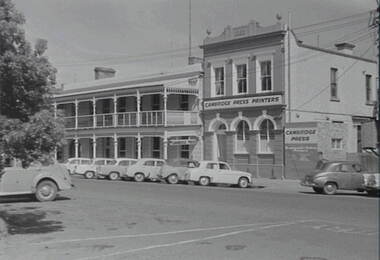 Allan Doney Collection, Bendigo Historical Society Inc.
Negative - Hargreaves Street Bendigo - Cambridge Press - Metropolitan Hotel, Allan Doney, 1950 -1970
... Hargreaves Street Bendigo - Cambridge Press - Metropolitan Hotel...Negative Hargreaves Street Bendigo - Cambridge Press - Metropolitan Hotel Allan Doney ...In the years of Allan Doney’s photography, landmark buildings succumbed to fire, neglect and redevelopment. He photographed the grey sand hills from Bendigo’s mining past, the streetscapes, poppet heads, miners’ cottages, gracious homes with ornate verandahs, trams and much more. Above all, his photographs show how much of the city has survived from the 19th century – and how much has not. Through two decades of great change, Allan Doney was there to capture ways people interacted with it. Although he travelled to many other places in Northern Victoria and beyond in search of subjects for his art, he seemed to always return to Bendigo for inspiration. -
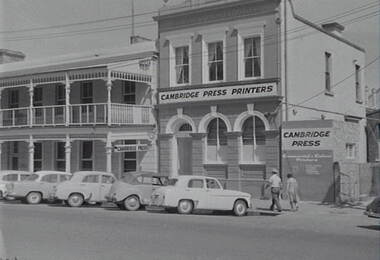 Allan Doney Collection, Bendigo Historical Society Inc.
Negative - Hargreaves Street Bendigo - Cambridge Press - Metropolitan Hotel, Allan Doney, 1950 -1970
... Hargreaves Street Bendigo - Cambridge Press - Metropolitan Hotel...Negative Hargreaves Street Bendigo - Cambridge Press - Metropolitan Hotel Allan Doney ...In the years of Allan Doney’s photography, landmark buildings succumbed to fire, neglect and redevelopment. He photographed the grey sand hills from Bendigo’s mining past, the streetscapes, poppet heads, miners’ cottages, gracious homes with ornate verandahs, trams and much more. Above all, his photographs show how much of the city has survived from the 19th century – and how much has not. Through two decades of great change, Allan Doney was there to capture ways people interacted with it. Although he travelled to many other places in Northern Victoria and beyond in search of subjects for his art, he seemed to always return to Bendigo for inspiration. -
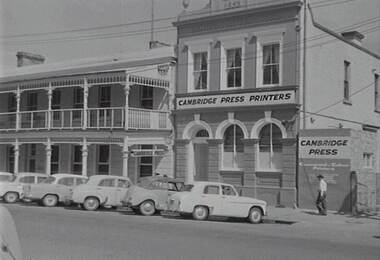 Allan Doney Collection, Bendigo Historical Society Inc.
Negative - Hargreaves Street Bendigo - Cambridge Press - Metropolitan Hotel, Allan Doney, 1950 -1970
... Hargreaves Street Bendigo - Cambridge Press - Metropolitan Hotel...Negative Hargreaves Street Bendigo - Cambridge Press - Metropolitan Hotel Allan Doney ...In the years of Allan Doney’s photography, landmark buildings succumbed to fire, neglect and redevelopment. He photographed the grey sand hills from Bendigo’s mining past, the streetscapes, poppet heads, miners’ cottages, gracious homes with ornate verandahs, trams and much more. Above all, his photographs show how much of the city has survived from the 19th century – and how much has not. Through two decades of great change, Allan Doney was there to capture ways people interacted with it. Although he travelled to many other places in Northern Victoria and beyond in search of subjects for his art, he seemed to always return to Bendigo for inspiration. -
Unions Ballarat
Alice Henry: The power of pen and voice, Kirkby, Diane, 1991
... Trumpington Street, Cambridge, London, England, United Kingdom ...Biography of Alice Henry, Australian suffragist, journalist and unionist. She also became prominent in the USA trade union movement. Relevance to trade unionism, women's suffrage and feminism. Biographical interest.Hardback; purple cover; pink, white and black lettering; 254 pages.Front cover: title and author's name.btlc, ballarat trades hall, ballarat regional trades and labour council, feminism, women's issues, trade unions, trade unions - history, biography -
 Whitehorse Historical Society Inc.
Equipment - Camera
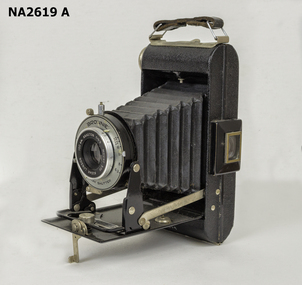
... He lived in 11 Maple Street Box Hill, 35 Cambridge Street Box Hill and Minna Street Blackburn....He lived in 11 Maple Street Box Hill, 35 Cambridge Street Box Hill and Minna Street Blackburn. photography cameras ANASTON F/6.3 mount 370 Kodak London 100mm|DAKON shutter Brownie. ...Owned by W.H.Arrowsmith, father of Ted Arrowsmith, and purchased by W.H Arrowsmith in the late 1940s and used by him until the late 1960s. He lived in 11 Maple Street Box Hill, 35 Cambridge Street Box Hill and Minna Street Blackburn.KODAK BROWNIE 620 Camera ANASTON black folding. Folds back into narrow case with handle. Box and instruction book included.ANASTON F/6.3 mount 370 Kodak London 100mm|DAKON shutter Brownie.photography, cameras -
 Whitehorse Historical Society Inc.
Equipment - Camera, C1939
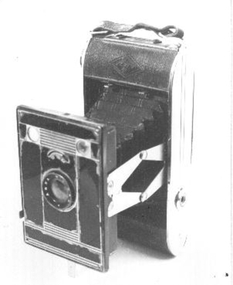
... Purchased by Ted Arrowsmith in 1940 from chemist at 596 Station Street Box Hill, when he lived at 35 Cambridge Street Box Hill. Used by him until the 1960s. ...Purchased by Ted Arrowsmith in 1940 from chemist at 596 Station Street Box Hill, when he lived at 35 Cambridge Street Box Hill. Used by him until the 1960s. ...Purchased by Ted Arrowsmith in 1940 from chemist at 596 Station Street Box Hill, when he lived at 35 Cambridge Street Box Hill. Used by him until the 1960s. Carried throughout Australia and the South West Pacific War Zone in the R.A.A.F between 1942 and 1946.Black folding bellows camera.AGFA 127. Folds back into a narrow case with handle. Instruction book included.|Agfa - Bilinar lens - aperture f11to f22. Two view finders one Portrait and other Landscape. Fixed speed of 1/30th second plus time exposure.AGFA - Bilinar. Made in germany.photography, cameras -
 Whitehorse Historical Society Inc.
Certificate - Certificate of Merit, 21/07/1999 12:00:00 AM
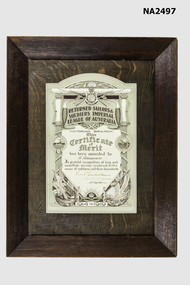
... He lived in Scotts Street, Mitcham ( now Lucknow Street ) and later at 35 Cambridge Street Box Hill. He worked at the Builders Trading and Roofing Co....He lived in Scotts Street, Mitcham ( now Lucknow Street ) and later at 35 Cambridge Street Box Hill. He worked at the Builders Trading and Roofing Co. ...H (Herbert) Arrowsmith, grandfather of Ted the Donor, was foundation Secretary of the Soldiers Sailors Fathers' Association in Mitcham and Secretary until he died in 1931. He lived in Scotts Street, Mitcham ( now Lucknow Street ) and later at 35 Cambridge Street Box Hill. He worked at the Builders Trading and Roofing Co.framed certificate of merit presented to H Arrowsmith by the Victorian Branch of the Returned Sailors + Soldiers Imperial League of Australia ( R.S.L.)civic mementoes, presentations -
 Federation University Historical Collection
Letter, Associated Board of Royal Schools of Music correspondence, 1936, 26th March, 1936
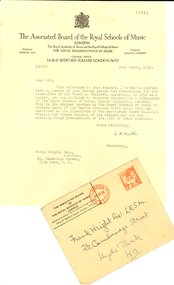
... The address is Frank Wright Esq LRSM. 226 Cambridge Street, Hyde Park W2 The letter is from the Associated Board of the Royal Schools of Music London, altering Frank Wright that he is entitled to describe himself as a Licentiate of The Royal Schools of Music, London (L.R.S.M., London)...The address is Frank Wright Esq LRSM. 226 Cambridge Street, Hyde Park W2 The letter is from the Associated Board of the Royal Schools of Music London, altering Frank Wright that he is entitled to describe himself as a Licentiate of The Royal Schools of Music, London (L.R.S.M., London) An addressed envelope which is addressed to Frank Wright and a sheet of paper which is a letter from The Associated Board of the Royal Schools of Music. ...Frank Wright was a renown resident of Smeaton, where he was born on 2 August 1901. He lived at Laura Villa, and attended Smeaton State School. His father William was a gold miner and his mother's name was Sarah. Their family won many singing and instrumental awards. Frank was tutored by Percy Code and was awarded a gold medal for the highest marks in the ALCM examinations in the British Colonies at the age of seventeen years. He became the Australian Open Cornet Champion by the age of eighteen. A year later, Frank conducted the City of Ballarat Band, and later the Ballarat Soldiers’ Memorial Band. He formed the Frank Wright Frisco Band and Frank Wright and his Coliseum Orchestra. These bands won many South Street awards, and Frank as conductor won many awards in the Australian Band Championship contest. In 1933 Frank Wright sailed to England to conduct the famous St Hilda’s Band and was later appointed Musical Director of the London County Council, where he organized many amazing concerts in parks, in and around the London district. He was made Professor of Brass and Military Band Scoring and conducted at the Guildhall of Music and Drama. Frank was often invited to adjudicate Brass Band Championships around Europe, in Australia, including South Street and in New Zealand. The Frank Wright Medal at the Royal South Street competition is awarded to an individual recognized as making an outstanding contribution to brass music in Australia.An addressed envelope which is addressed to Frank Wright and a sheet of paper which is a letter from The Associated Board of the Royal Schools of Music.On the top left hand corner of the envelope is "The Associated Board of The Royal Schools of Music, London (The Royal Academy of Music and Royal College of Music) 14 & 15, Bedford Square. London, W.C.I on the right hand side is an inked stamp in red with Great Britain a crown G v R Post Paid N 1/12d 99. The address is Frank Wright Esq LRSM. 226 Cambridge Street, Hyde Park W2 The letter is from the Associated Board of the Royal Schools of Music London, altering Frank Wright that he is entitled to describe himself as a Licentiate of The Royal Schools of Music, London (L.R.S.M., London)frank wright, royal school of music, l.r.s.m. -
 Bendigo Historical Society Inc.
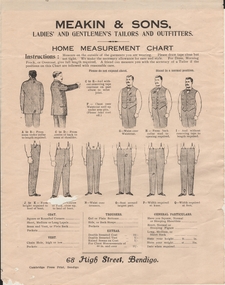
Document - GEORGE MEAKIN COLLECTION: TAILORS HOME MEASUREMENT CHART
... Meakin & Sons ladies and gentlemen tailors and outfitters - 66 high Street Bendigo. Cambridge press Bendigo....Meakin & Sons ladies and gentlemen tailors and outfitters - 66 high Street Bendigo. Cambridge press Bendigo. Document GEORGE MEAKIN COLLECTION: TAILORS HOME MEASUREMENT CHART ...Single page chart printed on one side of diagrams showing clothes dimensions (jacket, trousers,waistcoat) to be filled in by the customer. Meakin & Sons ladies and gentlemen tailors and outfitters - 66 high Street Bendigo. Cambridge press Bendigo.organization, retail, tailor -
 Flagstaff Hill Maritime Museum and Village
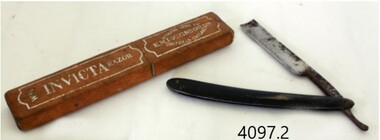
Functional object - Razor and case, E.M. Dickinson, 1895-1930
... Edwin Murray Dickinson started recruiting workers for his new cutlery firm at 11 Cambridge Street Sheffield England in 1870. The original premises consisting of warehouse, offices, cutlers shops fitted with the latest steam-powered equipment however this premises was offered for let in November 1887, and new premises were secured at 51 Division Street and were occupied by Dickinson's in early 1888. ...Edwin Murray Dickinson started recruiting workers for his new cutlery firm at 11 Cambridge Street Sheffield England in 1870. The original premises consisting of warehouse, offices, cutlers shops fitted with the latest steam-powered equipment however this premises was offered for let in November 1887, and new premises were secured at 51 Division Street and were occupied by Dickinson's in early 1888. ...E M Dickinson was a cutlery company in Sheffield that made all types of cutlery knives of all types and patterns, razors domestic electroplated cutlery etc. Edwin Murray Dickinson started recruiting workers for his new cutlery firm at 11 Cambridge Street Sheffield England in 1870. The original premises consisting of warehouse, offices, cutlers shops fitted with the latest steam-powered equipment however this premises was offered for let in November 1887, and new premises were secured at 51 Division Street and were occupied by Dickinson's in early 1888. By October 1890 Dickinson was advertising the Division Street premises to let and moved the company into other new works (still called Murray Works) at 122 Rockingham Street. On 12th October 1901, Dickinson gave notice that the firm was to be converted to a limited company and by March 1908 the Rockingham Street works had been advertised for sale. In 1909 the deeds for other new premises at 203 Arundel Street Sheffield were deposited to secure a £3,000 loan from the Sheffield Banking Company. Then on Christmas Eve 1926 several hundred pounds worth of damage was caused by a fire at the Arundel Street works. The founder, Edwin Dickinson died on 21st October 1930 aged 81 at his home at 449 Crookesmoor Road and on the 23rd May 1939 the firm went into voluntary liquidation.An item made by a company that made many different types and patterns of cutlery for domestic use and export.Straight razor with black celluloid handle and it’s boxBlade has marking, INVICTA" with decorative engraved design, on the other side engraved "E M DICKINSON SHEFFIELD ENGLAND"flagstaff hill, warrnambool, flagstaff-hill, flagstaff-hill-maritime-museum, shipwreck-coast, flagstaff-hill-maritime-village, razor, e m dickinson ltd, e m dickinson ltd sheffield england., cut throat razor, cutlery -
 Royal Australian and New Zealand College of Obstetricians & Gynaecologists (RANZCOG)
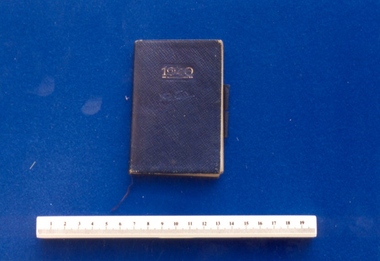
Document - Two Day Diary associated with F.J. Browne, 1940, John Walker & Co Ltd, Farrington House, Warwick Lane EC4, 1939
... Browne/ 8 Downing Street/ Cambridge". Pencil/loop holder attached to back cover. ...Browne/ 8 Downing Street/ Cambridge". Pencil/loop holder attached to back cover. ...Personal diary of Dr F.J Browne. Donated by Grace Cuthbert Browne, wife of Dr Browne. The original diary would have had a small pencil attached. Francis James Browne died in Sydney 1963. He had a long career in obstetrics and gynaecology. Summary of appointments include: General Practice in Wales, Maternity Department of the Edinburgh Royal Infirmary, 1st director of obstetric unit, University College Hospital London. Retired and continued postgraduate teaching in London and NSW. Married to Grace Cuthbert, who was director of Maternal and Baby Welfare in NSW. A collection of objects found amongst Professor FJ Browne's papers were transferred from the Archives to the Museum collections in January 1994.Personal diary. Small navy blue hard cover bound diary with "1940" in gold lettering on front cover. Inscription on front page, "F.J. Browne/ 8 Downing Street/ Cambridge". Pencil/loop holder attached to back cover. Entries in diary are written in pencil - only partially used as a diary. The diary entries finish on 6 June 1940. browne fj -
 Bendigo Historical Society Inc.
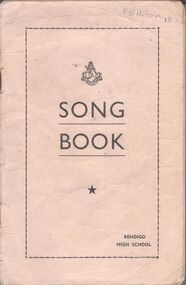
Book - Song book
... Published by Cambridge press, 214 Hargreaves Street, Bendigo in 1963. Aileen and john Ellison Collection....Published by Cambridge press, 214 Hargreaves Street, Bendigo in 1963. Aileen and john Ellison Collection. ...Small (thirty-five pages) book titled: song book. Bendigo High school. Cream colour cover with black writing. Logo of a lion above a scroll with the words: qui patitur vincit. Published by Cambridge press, 214 Hargreaves Street, Bendigo in 1963. Aileen and john Ellison Collection.P. Ellison 1b on the cover and P. Ellison 3E BHS on first page.songs, music, bendigo high school -
 Bendigo Historical Society Inc.
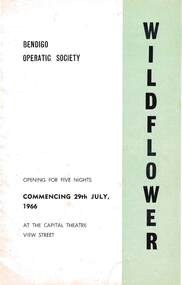
Document - THEATRE PROGRAM : WILDFLOWER PRODUCTION
... At the Capital Theatre , View Street. Cambridge Press. Gertrude Perry was 'Wildflower' ( see Gertrude Perry Collection for other items relating to this production)...Cambridge Press Theatre program: Bendigo Operatic Society presents by arrangement with J. C. Wiliamson Theatres Ltd 'Wildflower'. A Cid Ellwood Production. Books & Lyrics by Otto Harbach and Oscar Hammerstein 2nd. Music by Herbert Stothart & Vincent Youmans. Opening for five nights commencing 29th July 1966. At the Capital Theatre , View Street ...Theatre program: Bendigo Operatic Society presents by arrangement with J. C. Wiliamson Theatres Ltd 'Wildflower'. A Cid Ellwood Production. Books & Lyrics by Otto Harbach and Oscar Hammerstein 2nd. Music by Herbert Stothart & Vincent Youmans. Opening for five nights commencing 29th July 1966. At the Capital Theatre , View Street. Cambridge Press. Gertrude Perry was 'Wildflower' ( see Gertrude Perry Collection for other items relating to this production)event, entertainment, theatre, wildflower, bendigo operatic society, j c williamson theatres ltd, cid ellwood, otto harbach, oscar hammerstein 2nd, herbert stothard, vincent youmans, cambridge press -
 Bendigo Historical Society Inc.
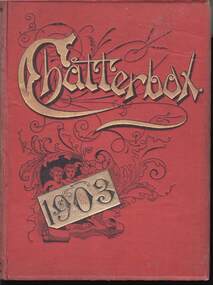
Book - CHATTER BOX 1903, 1903
... Inside Cover London: Printed by Strangeways & Sons Tower Street Cambridge Circus W.C. Orignal Authors of Pieces Various....Inside Cover London: Printed by Strangeways & Sons Tower Street Cambridge Circus W.C. Orignal Authors of Pieces Various. ...Red Hard Covered Book with Gold & Black Title & Illustration. 'Chatterbox' founded by J. Erskine Clarke EMA. London: Published for the Proprietors by Wells Gardner Darton, & Co; 3 Paternoster Buildings 1903. Contents include fiction and nonfiction; short stories, poetry, illustrations and puzzles. Pages 444. Markings & Inscriptions: Madge from Ruby January 1904. Inside Cover London: Printed by Strangeways & Sons Tower Street Cambridge Circus W.C. Orignal Authors of Pieces Various.Variousbook, childrens picture story -
 Bendigo Historical Society Inc.
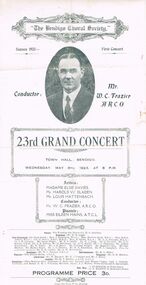
Document - LYDIA CHANCELLOR COLLECTION: ''THE BENDIGO CHORAL SOCIETY'' 23RD GRAND CONCERT
... Martin, 66 McKenzie Street. Cambridge Press Print, Bendigo. Programme price 3d. ...Martin, 66 McKenzie Street. Cambridge Press Print, Bendigo. Programme price 3d. ...A white souvenir programme with a photo of the Conductor Mr. W.C. Frazier A.R.C.O. on the front. Also on the front are the words, ' The Bendigo Choral Society.' Season 1923. First Concert. 23rd GRAND CONCERT Town Hall, Bendigo. Wednesday, May 9th. 1923, at 8 p.m. Hon. Secs. J. Hudspeth, 85 Wills Street, Z.S. Martin, 66 McKenzie Street. Cambridge Press Print, Bendigo. Programme price 3d. Inside the leaflet is the programme. 4 pages.Cambridge Press Print, Bendigoprogram, music, bendigo choral society, lydia chancellor, collection, ' bendigo choral society, ' entertainment, music, singing, choir, amusements, bendigo town hall, programme, buildings, concert -
 Bendigo Historical Society Inc.
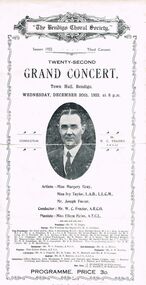
Document - LYDIA CHANCELLOR COLLECTION: ''THE BENDIGO CHORAL SOCIETY'' TWENTY SECOND GRAND CONCERT
... Martin, 66 McKenzie Street. Cambridge Press, Bendigo. Inside the cover is the programme of items.4 pages....Martin, 66 McKenzie Street. Cambridge Press, Bendigo. Inside the cover is the programme of items.4 pages. ...A cream programme with black print and photograph of Mr. W.C. Frazier A.R.C.O. the Conductor. Also on the front cover are the words, ' The Bendigo Choral Society. Season 1922. Third Concert. Twenty-second Grand Concert, Town Hall, Bendigo, Wednesday, December 20th., 1922, at 8 p.m. A list of artists follows. Programme, price 3d. Hon. Secs. J. Hudspeth, 85 Wills Street, Z.S. Martin, 66 McKenzie Street. Cambridge Press, Bendigo. Inside the cover is the programme of items.4 pages.Cambridge Press, Bendigo.program, music, bendigo choral society, lydia chancellor, collection, music, choir, singing, ' the bendigo choral society, ' programme, concert, bendigo town hall, buildings, entertainment, amusements -
 Melbourne Legacy
Film, Our Children Remember, 1959
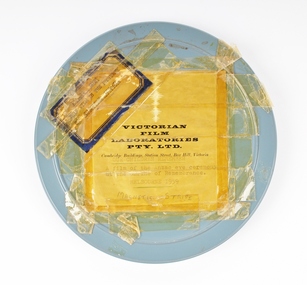
... LTD., Cambridge Buildings, Station Street, Box Hill, Victoria. Our Children Remember. ...LTD., Cambridge Buildings, Station Street, Box Hill, Victoria. Our Children Remember. ...Colour film that is 10 min 29 sec in duration, 16 mm sound. 28th Melbourne Legacy Children's commemoration ceremony on the eve of Anzac Day at the Shrine of Remembrance in Melbourne 1959, attended by the Governor, Sir Dallas Brooks, who gave an address. The President of Melbourne Legacy, Legatee McKeddie, conducted the wreath laying in the Inner Shrine. 2,500 children from 254 Melbourne Schools attended the ceremony, which was simultaneously broadcast by the ABC throughout Victoria, and over 200,000 children participated. Filmed by The Melbourne Repertory Film Unit, cameras Eric Aitken, David Corke, Ian Hanna and Jack Semmens, musical recording by Leo Fowler, music by Felix Werder, directed by Ian Hanna. This film has been digitised to preserve its content. Melbourne Legacy gratefully acknowledges the support of the Victorian Government and Public Record Office Victoria for making this possible.Film shows the public reverence and respect for those who died serving Australia in times of war. Displaying the Shrine environs and Melbourne skyline at that time adds further interest.Metal canister and spool with celluloid film labelled Our Children Remember.Circumference of spool MASPRO SYDNEY AUST. Spoke of spool calibrated in 50 feet units from 50 to 400 feet. Label x 2. Label 1 - Please note this film is the property of Melbourne Legacy. Label 2 - Victorian Film Laborities PTY. LTD., Cambridge Buildings, Station Street, Box Hill, Victoria. Our Children Remember. A film of the Anzac Eve ceremony at the Shrine of Remembrance. Melbourne 1959. Magnetic Stripe.anzac commemoration for students, wreath laying ceremony -
 Flagstaff Hill Maritime Museum and Village
Compass, 1947-1950
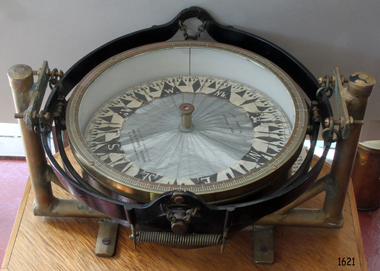
... Thomson, who became Sir William Thomson and then Baron Kelvin of Largs in 1892, continued to maintain his interest in the business after James White's death in 1884, raising most of the capital needed to construct and equip new workshops in Cambridge Street, Glasgow. At these premises, the company continued to make the compass Thomson had designed during the 1870s and to supply it in some quantity, especially to the Admiralty. ...Thomson, who became Sir William Thomson and then Baron Kelvin of Largs in 1892, continued to maintain his interest in the business after James White's death in 1884, raising most of the capital needed to construct and equip new workshops in Cambridge Street, Glasgow. At these premises, the company continued to make the compass Thomson had designed during the 1870s and to supply it in some quantity, especially to the Admiralty. ...Kelvin Company History: The origins of the company lie in the highly successful, if strictly informal, the relationship between William Thomson (1824-1907), Professor of Natural Philosophy at Glasgow University from 1846-1899 and James White, a Glasgow optical maker. James White (1824-1884) founded the firm of James White, who was an optical instrument maker in Glasgow in 1850. He was involved in supplying and mending apparatus for Thomson's university laboratory and working with him on experimental constructions. White was actually declared bankrupt in August 1861 and released several months later. In 1870, White was largely responsible for equipping William Thomson's laboratory in the new University premises at Gilmore hill. From 1876, he was producing accurate compasses for metal ships to Thomson's design during this period and this became an important part of his business in the last years of his life. He was also involved in the production of sophisticated sounding machinery that Thomson had designed to address problems encountered laying cables at sea, helping to make possible the first transatlantic cable connection. At the same time, he continued to make a whole range of more conventional instruments such as telescopes, microscopes and surveying equipment. White's association with Thomson continued until he died. After his death, his business continued under the same name, being administered by Matthew Edwards (until 1891 when he left to set up his own company). Thomson, who became Sir William Thomson and then Baron Kelvin of Largs in 1892, continued to maintain his interest in the business after James White's death in 1884, raising most of the capital needed to construct and equip new workshops in Cambridge Street, Glasgow. At these premises, the company continued to make the compass Thomson had designed during the 1870s and to supply it in some quantity, especially to the Admiralty. At the same time, the firm became increasingly involved in the design, production and sale of electrical apparatus. In 1899, Lord Kelvin resigned from his University chair and became, in 1900, a director in the newly formed limited liability company Kelvin & James White Ltd which had acquired the business of James White. At the same time Kelvin's nephew, James Thomson Bottomley (1845-1926), joined the firm. In 1904, a London branch office was opened which by 1915 had become known as Kelvin, White & Hutton Ltd . Kelvin & James White Ltd underwent a further change of name in 1913, becoming Kelvin Bottomley & Baird Ltd . Hughes Company History: Henry Hughes & Sons was founded in 1838 in London as a maker of chronographic and scientific instruments. The firm was incorporated as Henry Hughes & Sons Ltd in 1903. In 1923, the company produced its first recording echo sounder and in 1935, a controlling interest in the company was acquired by S Smith & Son Ltd resulting in the development and production of marine and aircraft instruments. Following the London office's destruction in the Blitz of 1941, a collaboration was entered into with Kelvin, Bottomley & Baird Ltd resulting in the establishing Marine Instruments Ltd. Following the formal amalgamation of Kelvin, Bottomley & Baird Ltd and Henry Hughes & Sons Ltd in 1947 to form Kelvin & Hughes Ltd., Marine Instruments Ltd then acted as regional agents in the UK for Kelvin & Hughes Ltd who were essentially now a part of Smith's Industries Ltd founded in 1944 and the successors of S Smith & Son Ltd. Kelvin & Hughes Ltd went on to develop various marine radar and echo sounders supplying the Ministry of Transport, and later the Ministry of Defence. The firm was liquidated in 1966 but the name was continued as Kelvin Hughes, a division of the Smiths Group. In 2002, Kelvin Hughes continues to produce and develop marine instruments for commercial and military use. This model compass is a good example of the commercial type of instruments made by Kelvin & Hughes after the world war 2, it was made in numbers for use on various types of shipping after the second world war and is not particularly rare or significant for it's type. Also it was made no earlier than 1947 as the firms of Kelvin, Bottomley & Baird Ltd and Henry Hughes & Sons Ltd who took over from Smith & Sons were not amalgamated until 1947. Given that Smith and Sons is engraved on the compass with Kelvin & Hughes it can be assumed that this compass was made during the company's transitional period to Kelvin & Hughes.Compass, marine or ship's card compass, gimble mounted, with inscriptions. Type is Lord Kelvin 10 inch compass card. Made in Great Britain by Kelvin Hughes Division of S. Smith & Sons (England) Ltd. "LORD KELVIN 10.", "COMPASS GRID", "MANUFACTURED IN GREAT BRITAIN BY", "KELVIN HUGHES DIVISION", "S. Smith & Sons (England) Ltd".flagstaff hill, warrnambool, shipwrecked-coast, flagstaff-hill, flagstaff-hill-maritime-museum, maritime-museum, shipwreck-coast, flagstaff-hill-maritime-village, marine compass, gimble compass, ship's compass, lord kelvin compass, smith and sons england ltd, henry hughes & son ltd london england, kelvin bottomley & baird ltd glasgow scotland, kelvin & hughes ltd, navigation instrument, scientific instrument, william thomson, james white, baron kelvin of largs
