
Showing 22 items matching "canadian case"
-
 University of Melbourne, Burnley Campus Archives
Work on paper (item) - Student Work, Joan Fitzgerald's student notebooks for Certificate of Competency in Horticulture 1953, 1952-53
... ...canadian case...Includes Department of Agriculture, Horticultural Division Cardboard Charts for: Packing Apples in the Australian Dump Case; Packing Packham's Triumph in the Long Bushel Case; Packing Josephine Pears in the Long Bushel Case; Packing Apples in the Canadian Case. 6. Applied Botany. Starts 25.02.1952. 7. ...Includes Department of Agriculture, Horticultural Division Cardboard Charts for: Packing Apples in the Australian Dump Case; Packing Packham's Triumph in the Long Bushel Case; Packing Josephine Pears in the Long Bushel Case; Packing Apples in the Canadian Case. 6. Applied Botany. Starts 25.02.1952. 7. ...joan fitzgerald, burnley college, students, student work, propagation, lecture notes, general science, exam paper, botany, plant pathology, apiculture, department of agriculture, apples, packam's triumph pears, josephine pears, australian dump case, long bushel case, canadian case, packing fruit, applied botany, entomology, floriculture, fruit culture, book keeping, citriculture, poultry keeping, viticulture, garden design -
 Flagstaff Hill Maritime Museum and Village
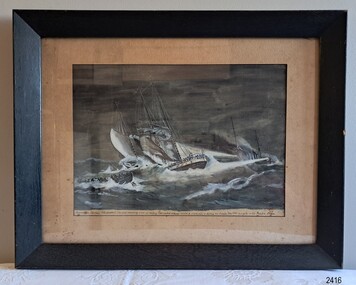
Print - Lithograph, sea rescue, R.N. Duffield, Australian cruiser “MELBOURNE” (Tons 5600) rescuing crew of sinking four-masted schooner “HELEN B. STERLING” of Halifax NS Canada, Tons 1343 in a gale in the Pacific Ocean, 19-11-1924
... Swanston heroes cigarette case Painted on the ship’s bow: “HELEN B. STERLING / HALIFAX N S” [Nova Scotia, Canada] Handwritten below the print: “AUSTRALIAN CRUISER “MEMBOURNE” (Tons 5600) rescuing crew of sinking four-masted schooner “HELEN B. ...This framed lithograph print in watercolour and gouache was produced on November 19th, 1924, by 20th-century marine artist, Mr R.N. Duffield. It depicts the event of a sea rescue that took place two years earlier. The framer was A.L. Frith of Footscray, Melbourne, who actively advertised from 1933 to 1935. The now disbanded Shiplovers' Society of Victoria (1930-2018) donated the print, and it seems likely that this print was framed for that organisation. This graphic image shows the conditions in which the rescue from the wrecked Helen B. Sterling happened. Captain George Harris was master of the American-owned, four-masted windjammer. His wife Edith and their ten-year-old son Leslie were on board, along with a crew of fifteen seamen. The ship set off from Newcastle, NSW, on January 5th, 1922, loaded with a cargo of coal to deliver to the Society Islands and on to San Francisco. Young Leslie later wrote a lively school composition for his teacher about his experiences on board the Helen B Sterling. He tells of a fire that broke out the day after they departed and burned a hole in a beam. Then another troublesome time on the 9th, when a strong gale blew a sail off the ship. Finally, he tells of the highlight of his voyage when, on the 18th January, the ship was right in the path of a strong cyclone, which broke the mainmast. Huge waves crashed over both sides of the deck, meeting in the middle, and the ship began to sink. The rescue from the wreck was an exciting time for the young boy, and even more so when one of his cats survived after being carefully wrapped in a pillowcase and thrown down from the ship for the boy. Reporters later wrote about Leslie’s comments, “... what had grieved him most was the thought that he might never see his two little sisters again”. Captain Harris said in a published statement, “… the gale was the worst he had met in his 12 years’ experience at sea. All went well for the first week. We then encountered a strong blow from the south-east. We tried the gasoline pump, but the engine broke down, and we had to do the pumping by hand. We at once shortened sail, but the sea increased in fury to such an extent that men were washed from the pumps. I was below at 5:30 on Sunday morning [January 22nd, 1922] when the main mast went over the side, … I at once sent out SOS signals, and got word that HMAS Melbourne was coming to our assistance. I had made a mistake with regard to our position, but did not know it until 11:30 o’clock, when I sent out the correct location. This was picked up by the Melbourne and I received the following reply: “We will reach you about 2 am. Keep a good heart. The Melbourne will do all she can.” Our ship was practically awash when we were taken off.” (Ref: the ‘Helen B. Sterling Disaster’, Maitland Weekly Mercury, NSW, 4-2-1922.) Officers from the Royal Australian Navy, Captain Henry J Feakes (later Rear-Admiral) and Commander Wilfrid Ward Hunt, were on board the light cruiser, HMAS Melbourne (1913-1928), when it left Sydney for New Zealand. After the SOS was received, the ship sped at full steam towards the sinking Helen B. Sterling. They found the vessel at about midnight and shone bright search lights on the distressed ship to illuminate the desperate scene. The Melbourne was unable to move close to the schooner, so sixteen seamen, including Commander Hunt, volunteered to man the Melbourne’s lifesaving 12-oared cutter. They rowed the sea boat with great urgency towards the victims of the sinking ship, keen to save lives no matter what the conditions. When the cutter was close to the Sterling, a line was secured between the Sterling and the cutter. The weary, waterlogged and anxious men on board could be rescued, one at a time, in the breeches buoy equipment, which looked like canvas shorts with a lifesaving ring in the waistband. The victims were hauled along the line and pulled aboard by many willing hands. All eighteen crew and passengers were saved, including Captain Harris and his family. The seamen of the Melbourne received a heroes’ welcome when they arrived in New Zealand. The grateful survivors were taken to Auckland, where they received the care and comfort they needed. Melbourne’s Lord Mayor, Cr. Swanston, on behalf of the citizens of Melbourne, formally recognised the heroic rescue efforts of the seamen of the HMAS Melbourne on March 2nd, 1922, at a special presentation. Two large flags, a White Ensign and an Australian “Jack" Flag, were presented to the Captain of HMAS Melbourne, and souvenirs were awarded to the sea boat’s crew and its Commander, Wilfred Ward Hunt. Commander Hunt was also presented with an original watercolour depicting the heroic rescue from the wreck of the Helen B. Sterling, painted just after the event by renowned marine artist Arthur V Gregory (1867-1957), and he received a silver cigarette case bearing the City’s coat of arms and the inscription, "To Commander Ward Hunt from the Citizens of Melbourne as a memento of the rescue of the crew of Helen B. Stirling by H.M.A.S. Melbourne, on 23.1.22". Both the painting and the cigarette case are now treasured items inherited by his grandson; a reminder of “… a very fine naval gentleman who believed in leading by example." R.N. DUFFIELD: - The Lithograph print in our collection by 20th-century English artist R.N. Duffield is dated Nov. 19, 1924. It is very similar to, and possibly created from, the original A V Gregory watercolour presented to Commander Hunt and dated 1922. Mr R.N. Duffield has art works in the Yarmouth Museums, Norfolk Museums Collection; “Orient Liner Otranto …,” and "Convoy of six ships at sea", both painted in watercolour and gouache during the 1940s. Some of his other works, also painted in watercolour and gouache, have been advertised for sale on Internet sites. Some details differ between the original A.V. Gregory and this Lithograph Print: - -the words on the bow on the original watercolour are “Helen B. Sterling, Blain”, which is in Washington, USA, where the Sterling Shipping Company was registered from around 1919; the words on the print are “Helen B. Sterling, Halifax, N S”, for Nova Scotia, Canada, which is the hometown of Sterling Shipping Company founder’s wife, Helen B Sterling. -The watercolour is coloured and has fine details; the print is monochrome - The A V Gregory signed the watercolour in 1922, on the lower left; the print is signed with the Lithographer’s name on the lower right; “R N Duffield, Nov. 19. 1924” ARTHUR VICTOR GREGORY (1867-1957): - A.V. Gregory is a renowned marine artist who worked in watercolour and gouache. He painted actively between 1899 and 1932, creating over 3o0 works. South Melbourne, Victoria, was where he lived and worked. This Lithograph print is significant in that it depicts the rescuing of the passengers and crew of the schooner “Helen B Stirling”. At the time this was a significant event that made most Australian and New Zealand papers because of the involvement of the Australian cruiser “Melbourne”. The image demonstrates the perilous conditions experienced by seafarers. It includes an example of the line and breeches buoy method used to save lives at sea from the 1860s and into the 20th century. It reflects a time in our history when sail and steam ships cruised the world’s seas together, the former trading with a cargo of coal from Newcastle, the latter defending our country in World War I. The print is part of Flagstaff Hill Maritime Museum’s Collection of maritime artworks that depict famous events, vessels and locations, showing the evolution of sea craft, and aiding the interpretation of our maritime history. The Lithograph print is behind glass in a black painted timber frame and mounted under a cream matte. The vivid image depicts a sea rescue in progress. The night scene is illuminated by a light beaming from a steamship, the Cruiser HMAS Melbourne. It reveals figures on the deck of a sinking sailing ship, the schooner Helen B. Sterling, as foaming waves roll across it. The stricken ship has a broken main mast, and a sail has been detached. A small figure is floating in the choppy sea, secured in a breeches buoy that is attached to a rescue line between a lifesaving cutter and the sailing ship. The crewmen in the cutter are ready to haul the shipwrecked victim aboard, while the figures on the foundering ‘Sterling’ watch them. The print’s paper-covered wooden backboard is attached to the frame with small tacks. A metal hanging wire is secured to two dissimilar eyelet screws. Inscriptions include text on the bow of the sinking vessel, a handwritten title below the picture, and a handwritten name in the print’s lower right corner. On the reverse are two oval, black ink stamps and a round cream label with printed text. The hand-painted print was reproduced from a lithograph, signed in the lower right, by R.N. Duffield of England, on November 19th, 1924. A Frith of Footscray, Melbourne framed it. Painted on the ship’s bow: “HELEN B. STERLING / HALIFAX N S” [Nova Scotia, Canada] Handwritten below the print: “AUSTRALIAN CRUISER “MEMBOURNE” (Tons 5600) rescuing crew of sinking four-masted schooner “HELEN B. STERLING” of Halifax NS Canada, Tons 1343 in a gale in the Pacific Ocean.” Handwritten on lower right: “R.N. DUFFIELD / Nov. 19. 1924” (underlined) On paper label: “Phone: / Footscray 398 [some of the text has torn off] / “A. FRITH / PICTURE FRAMER / Manufacturer / 17 Paisley Street / Footscray.“ On both oval stamps: “SHIPLOVERS SOCIETY OF VICTORIA / LIBRARY” flagstaff hill, flagstaff hill maritime museum and village, warrnambool, maritime museum, maritime village, great ocean road, shipwreck coast, lithograph, lithograph print, reproduction print, helen b. sterling, the sterling, american owned schooner, halifax, halifax n s, halifax nova scotia, nova scotia, halifax n s canada, schooner, windjammer, sailing ship, four-masted ship, captain george harris, george harris, edith harris, leslie harris, sterling shipping line, hmas melbourne, hmas melbourne (1), cruiser hmas melbourne, the melbourne, australian cruiser, captain henry j feakes, commander wilfred ward hunt, sinking ship, shipwreck, sea rescue, gale, cyclone, 1922 rescue, shipwreck rescue, breeches buoy, line rescue, rescue line, lifesaving, cutter, cutter melbourne, sea boat, lifesaving crew, 12-oar cutter, shipwreck victim, r.n. duffield, marine artist, nov. 19. 1924, 20th century artist, a frith, footscray picture framer, shiplovers’ society of victoria, shiplovers’ society library, watercolour, a v gregory, arthur victor gregory, melbourne artist, newcastle coal, newcastle nsw, society islands, san fracisco, aukland new zealand, school composition, ship’s cat, sos signal, lord mayor cr. swanston, heroes, cigarette case -
 Flagstaff Hill Maritime Museum and Village
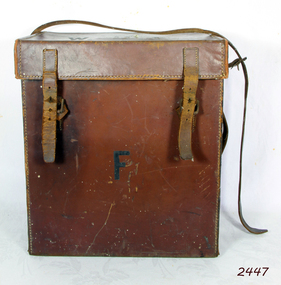
Case
... Case...Canada Pacific...Case, brown leather carrying case with securing straps and metal buckle, cloth lining. Label "Canada Pacific" and "B" and "F" on front. ...flagstaff hill warrnambool shipwrecked-coast flagstaff-hill flagstaff-hill-maritime-museum maritime-museum shipwreck-coast flagstaff-hill-maritime-village Case Canada Pacific Case, brown leather carrying case with securing straps and metal buckle, cloth lining. ...Case, brown leather carrying case with securing straps and metal buckle, cloth lining. Label "Canada Pacific" and "B" and "F" on front. "WHE" printed on lid. flagstaff hill, warrnambool, shipwrecked-coast, flagstaff-hill, flagstaff-hill-maritime-museum, maritime-museum, shipwreck-coast, flagstaff-hill-maritime-village, case, canada pacific -
 City of Moorabbin Historical Society (Operating the Box Cottage Museum)
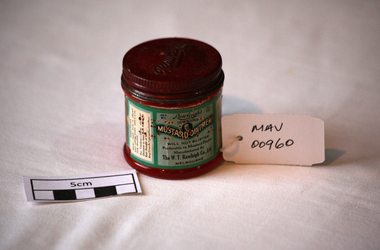
Manufactured Glass, jar of Mustard Ointment 'Rawleigh's;, mid 20thC
... Generations of Australians, Canadians and Americans grew up waiting for The Rawleigh Man to arrive at their front door with his sample case of goodies to add spice to their life and to heal their ailments. ...Generations of Australians, Canadians and Americans grew up waiting for The Rawleigh Man to arrive at their front door with his sample case of goodies to add spice to their life and to heal their ailments. ...WT Rawleigh (1870-1952) Freeport USA began in 1889 the direct selling method to sell his products, travelling around on horse and cart in the early days from house to house selling his medicines and other lines. Rawleigh's wide range of products includes: Medicinal, Nutritional, Gourmet, Homecare, Personal Care, Animal & Plant Care Since 1889, millions of families around the world have learned to rely upon and keep Rawleigh's reliable medicines and other products on hand ready for emergencies to relieve sickness, pains, injuries and for their daily needs. By 1920, young Rawleigh had built the biggest manufacturing organisation in the world. Mr Floyd George Rawleigh who was the son of David Rawleigh, W.T.Rawleigh's brother, came to Australia, with Mr Jackson, in 1931 and set up the Rawleighs Company Business . Generations of Australians, Canadians and Americans grew up waiting for The Rawleigh Man to arrive at their front door with his sample case of goodies to add spice to their life and to heal their ailments. In World War II, most Australian soldiers posted overseas carried a tin of Rawleigh Antiseptic Salve in their kits to treat wounds and ward off infection The Rawleigh Man brought to family front doors the best materials money could buy from around the world: spices from Sumatra, Java, China, India, Africa, the West Indies; black pepper from the island of Ponapai; lemon and orange oils from California and Sicily and Vanilla from Madagascar and Java; high grade coffee beans from the Andes. Most of the herbs, roots, barks and buds used in making cough medicines and tonics came from Europe, India, Ceylon, China, North America, the West Indies, Jamaica, Honduras and Asia. From Japan came camphor and menthol for making medicines. From Tavenui, the Garden Island of Fiji, came the food grade coconut oil for Rawleigh's gold medal winning Coconut Oil Soap. Rawleigh products are still only available from Rawleigh men and women who carry on the time-honoured tradition of the Rawleigh company to give individuals a go at developing their own business supplying products to people in their homes. Only now they are also doing it in cyberspace. A clear glass jar with a metal screw lid containing Mustard Ointment made by W.T. Rawleigh Co. Ltd. .Melbourne Lid ; Rawleigh’s Front ; Rawleigh’s / Net WT. / 1 ½ oz / COMPOUND / MUSTARD OINTMENT / WILL NOT BLISTER /preferable to Mustard Plaster / MNUFACTURED BY / The W, T. Rawleigh Co Ltd / MELBOURNE. / Left side ; DIRECTIONS …….. , / Right side ; Useful pharmacy, medicines, mustard ointment, w.t. rawleigh company ltd., hospitals, nursing, containers, moorabbin, bentleigh, cheltenham, melbourne, respiratory diseases -
 City of Moorabbin Historical Society (Operating the Box Cottage Museum)
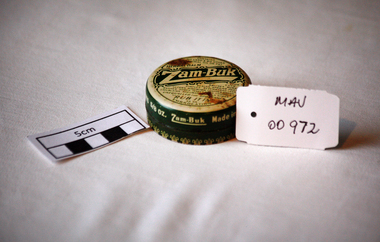
Containers, tin ‘Zam-Buk’ ointment, c1980
... Charles’ brother Frank Harris Fulford, and entrepreneur, came from Canada to Leeds in 1902 to manage the British division of Charles's manufacturing business, C. E. Fulford Limited The company had to face damaging adverse publicity in 1905 when the judge in a case over the Bile Beans name declared that the business was founded on ‘fraud, impudence and advertisement’. ...Charles’ brother Frank Harris Fulford, and entrepreneur, came from Canada to Leeds in 1902 to manage the British division of Charles's manufacturing business, C. E. Fulford Limited The company had to face damaging adverse publicity in 1905 when the judge in a case over the Bile Beans name declared that the business was founded on ‘fraud, impudence and advertisement’. ...Charles Edward Fulford, Ltd Leeds, England. The company founded in Australia in 1897 produced patent medicines, manufacturing products including Bile Beans and Zam-Buk ointment. Charles concocted ‘Bile Beans for Biliousness’, supposedly from a secret native recipe discovered by an eminent scientist – all a myth! Phenomenal sales were achieved through door-to-door leafleting, free gifts, and blanket advertising in the popular press, featuring emotive personal stories of miraculous, life-changing cures, presented as news items. The Company was first established in the UK in 1899 after achieving success in Australia. Charles’ brother Frank Harris Fulford, and entrepreneur, came from Canada to Leeds in 1902 to manage the British division of Charles's manufacturing business, C. E. Fulford Limited The company had to face damaging adverse publicity in 1905 when the judge in a case over the Bile Beans name declared that the business was founded on ‘fraud, impudence and advertisement’. But it survived, indeed flourished, expanding internationally. His other ‘secret’ remedy, Zambuk ointment was claimed to soothe and heal every kind of skin condition, an essential standby for all good mothers and wives. Both products lasted into the 1980s, after various company take-overs; interestingly, Zambuk has recently been revived. 1906 Charles Fulford, only 36, died at his home in Australia, apparently from exhaustion. He left a fortune, including a huge bequest to Dr Barnardo’s charity for homeless boys in London. A small round tin with a lift off lid containing 'Zam-Buk' antiseptic ointmentLid : CONTAINS / NO LARD & NO OTHER / ANIMAL OIL OR FAT / Zam-Buk' / FOR / Cuts/ Bruises, Burns / ..........UNEQUALLED FOR SPORTSMEN / "RUB IT IN "/ AS AN / EMBROCATION. Base :DIRECTIONS ................/ HEALING, SOOTHING, ANTISEPTIC. Around Lid : Zam-Buk Made in Australia by C.E.FULFORD (Australasia) Ltd SYDNEY / Incorporated in England / CONTENTS 5/8 OZ.pharmacy, medicines, early settlers, market gardeners, moorabbin, bentleigh, cheltenham, c.e.fulford pty ltd, ointments, zam-buk ointment, sydney, melbourne, fulford frank harris, antiseptic, leeds england, -
 Montmorency–Eltham RSL Sub Branch
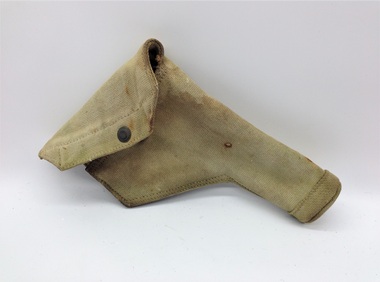
Weapon - Case, Pistol, Patt. '37 W.E, Pistol case ‘37 W.E, 1940
... Canada produced its own P37 webbing during WW2 and commenced production in 1940. Two companies produce the vast majority - Z L & T Ltd in Guelph, Ontario and M S & U Ltd (Montreal Suspender and Umbrella Manufacturing Company Limited) in Montreal, Quebec. A great deal of webbing was sent to Australia. These pistol cases...Canada produced its own P37 webbing during WW2 and commenced production in 1940. Two companies produce the vast majority - Z L & T Ltd in Guelph, Ontario and M S & U Ltd (Montreal Suspender and Umbrella Manufacturing Company Limited) in Montreal, Quebec. A great deal of webbing was sent to Australia. These pistol cases ...This holster was copied by the Canadians from the British Pattern 1937 web equipment designed to hold the British .38 Calibre Enfield No.2 Mk 1 Revolver. Canada produced its own P37 webbing during WW2 and commenced production in 1940. Two companies produce the vast majority - Z L & T Ltd in Guelph, Ontario and M S & U Ltd (Montreal Suspender and Umbrella Manufacturing Company Limited) in Montreal, Quebec. A great deal of webbing was sent to Australia. These pistol cases saw much use by our troops during WW2 and holstered US Smith & Wesson 'Victory' model and various British Webley .38 revolvers in addition to Enfields.Khaki cotton webbing holster with press studded flap for a .38 calibre revolver. Webbing sleeve on interior for the cleaning rod and three brass hooks on the rear, two to allow attachment to a P37 web belt plus a top hook to permit attachment of a P37 web ammunition pouch. Z L & T Ltd (holster) UNITED CARR CANADA (snap fastener) -
 The Beechworth Burke Museum
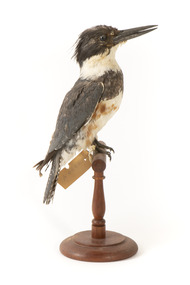
Animal specimen - Belted King Fisher, Trustees of the Australian Museum, 1860-1880
... Canada, Alaska and the United States. During migration periods these birds may stray far from their usual habitat. Interestingly, the female of this species, as is the case for this specimen, is often larger than the male. ...Canada, Alaska and the United States. During migration periods these birds may stray far from their usual habitat. Interestingly, the female of this species, as is the case for this specimen, is often larger than the male. ...The Belted Kingfisher is commonly seen near bodies of water or coasts in Canada, Alaska and the United States. During migration periods these birds may stray far from their usual habitat. Interestingly, the female of this species, as is the case for this specimen, is often larger than the male. They are also more brightly coloured. This species feed on amphibians, small crustaceans, insects, small mammals and reptiles. They lie await perched on a tree located close to water and remain there watching until they see their prey. When they have located their prey, the Belted Kingfisher plunges its head into the water and catches its food. This specimen is part of a collection of almost 200 animal specimens that were originally acquired as skins from various institutions across Australia, including the Australian Museum in Sydney and the National Museum of Victoria (known as Museums Victoria since 1983), as well as individuals such as amateur anthropologist Reynell Eveleigh Johns between 1860-1880. These skins were then mounted by members of the Burke Museum Committee and put-on display in the formal space of the Museum’s original exhibition hall where they continue to be on display. This display of taxidermy mounts initially served to instruct visitors to the Burke Museum of the natural world around them, today it serves as an insight into the collecting habits of the 19th century.This specimen is part of a significant and rare taxidermy mount collection in the Burke Museum. This collection is scientifically and culturally important for reminding us of how science continues to shape our understanding of the modern world. They demonstrate a capacity to hold evidence of how Australia’s fauna history existed in the past and are potentially important for future environmental research. This collection continues to be on display in the Museum and has become a key part to interpreting the collecting habits of the 19th century.The Belted Kingfisher stands upon a wooden perch with a light brown paper tag attached to leg. This specimen has pale cream/white and slate grey/blueplumage. The head and back are coloured the blue-grey while the neck and stomach are cream/white. The bird has a black ring around its upper chest. The stomach has a chestnut brown band which identifies this particular specimen as female. The bill is long and pointed and the eyes and legs black. The bird is small and stocky with a large head and a square-tipped tail.95.a / Belted / Kingfisher / Catalogue page, 25 /taxidermy mount, taxidermy, animalia, burke museum, beechworth, australian museum, skin, reynell eveleigh johns, bird, australian birds, kingfisher, small birds, belted kingfisher, king fisher, female bird -
 Cheese World Museum
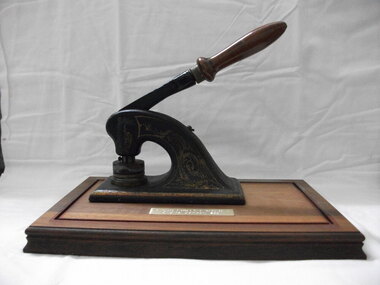
Company Seal, Warrnambool Cheese & Butter Factory Co.Ltd. Original Company Seal, c1890
... case for safekeeping. The Seal is historically significant as it relates to the formation of the WCBF in 1888 and used for legal documents. Until 2013 the Warrnambool Cheese & Butter Factory was the only remaining independently owned butter factory in Victoria. The company was taken over by Canadian ...The seal was used in the Warrnambool Cheese & Butter Factory Co Ltd office for stamping legal documents. It is not known when it became obsolete and housed in a glass case for safekeeping.The Seal is historically significant as it relates to the formation of the WCBF in 1888 and used for legal documents. Until 2013 the Warrnambool Cheese & Butter Factory was the only remaining independently owned butter factory in Victoria. The company was taken over by Canadian company Saputo in 2013. It is artistically significant as the surface of the arm of this functional cast iron Seal features a gold design. The seal is made of black painted cast iron. The flat base has a gold-painted border. The curved iron arm to which a wooden handle is attached has a swirling scroll pattern on the side. The seal component consists of a round base and a round iron stamp attached to the handle mechanism. The seal is housed in a glass case with a small name plate at the front.Name plate: Warrnambool Cheese & Butter Factory Co Ltd 'Original Company Seal'allansford, warrnambool cheese & butter factory company ltd, company seals, office equipment -
 Kiewa Valley Historical Society
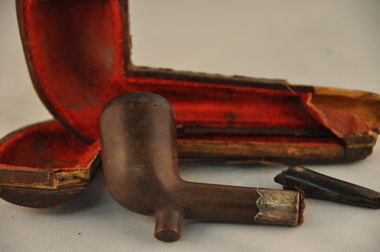
Pipe Tobacco Smoking, Circa 1889
... Canadian'. The pipe has a permanent filter and a stainless steel band with the initials of the Hudson Bay Tobacco Company and its seals stamped on it.. The bowl and shank are one piece of appropriate shaped wood. The bit and bore are made from bakelite (dark brown in colour). The pipe is fashioned in the form of the clay pipes used by trappers, in the late 1800s early 1900s. It has a "rest" lug at the bottom of the bowl similar to clay pipes. This pipe has its own pipe case...Canadian'. The pipe has a permanent filter and a stainless steel band with the initials of the Hudson Bay Tobacco Company and its seals stamped on it.. The bowl and shank are one piece of appropriate shaped wood. The bit and bore are made from bakelite (dark brown in colour). The pipe is fashioned in the form of the clay pipes used by trappers, in the late 1800s early 1900s. It has a "rest" lug at the bottom of the bowl similar to clay pipes. This pipe has its own pipe case ...Pipe smoking has been in vogue for centuries, and in Australia it was a symbol of the "discerning smoker" such as the landed gentry or men of professional status. This pipe, of the Standard Canadian style, would have emigrated to Australia with its owner, a reasonable young professional or executive of the Hudson Bay Tobacco Company in the late 1800s or early 1900s. It is the type of pipe well suited to a harsh rural backdrop and with its owner found the Kiewa Valley a more relaxed environment than the Canadian Indian locations. The value of this pipe to the original owner, who would have sealed many trade contracts during the Canadian Indian smoke rituals In the late 1800s, is indicated by the long voyage to Australia and the Kiewa Valley. However with the health related restrictions placed on public smoking in the early 2000s, these tobacco pipes were not immune from the legislation, and even though the pipe smoke was not as offensive as cigarette smoke it still came under the umbrella of smoking. Pipes were also used in the process of inhaling illicit drugs i.e. marijuana, but this use was limited to a very few and not with this pipe. Smoking in the second millennium is being phased out as a social habit in Australia but may affect the few "private" smoker and has, as the United States prohibition era (alcoholic drinks) did, spawn an illicit trade in cheap contraband tobacco. Pipes such as this item show that smoking was not only part of the lifestyle of the era but also that it was part of a ritual (especially to the Indians of the Canada Hudson Bay region) that sealed a brotherhood not only socially but also politically and economically.This type of pipe lends itself well to the rural setting of the Kiewa Valley and although it is a very exclusive pipe it blended into the tobacco industrial environment of the Kiewa Valley and its surrounding districts. The Kiewa Valley region was up until the late 1900s part of the Australian Tobacco industry and the levels of men smoking pipes was enhanced by the readily supply, "off the fields", of tobacco leaves and the attitude to city based smoking restrictions was one of resentment.This pipe has a straight shank and stem and its style is 'standard Canadian'. The pipe has a permanent filter and a stainless steel band with the initials of the Hudson Bay Tobacco Company and its seals stamped on it.. The bowl and shank are one piece of appropriate shaped wood. The bit and bore are made from bakelite (dark brown in colour). The pipe is fashioned in the form of the clay pipes used by trappers, in the late 1800s early 1900s. It has a "rest" lug at the bottom of the bowl similar to clay pipes. This pipe has its own pipe case with wood reinforcement running the entire pipe shaped contour.On the stainless steel at the mortise and tenon junction is stamped "HP" and below that are stamped symbols of a ship's anchor, a lion and a tobacco leaf.tobacco, pipe smoking, smoking accessories -
B-24 Liberator Memorial Restoration Australia Inc
Accessory - Cigarette Case
... This cigarette case was issued to the Australian Air force officers by the Australian Minister of State for Air during WWII The front has 3 metal badges attached from the Australian Air force and Canada. ...This cigarette case was issued to the Australian Air force officers by the Australian Minister of State for Air during WWIILeather covered, metal framed cigarette case.The front has 3 metal badges attached from the Australian Air force and Canada. -
 Royal Australian and New Zealand College of Obstetricians & Gynaecologists (RANZCOG)
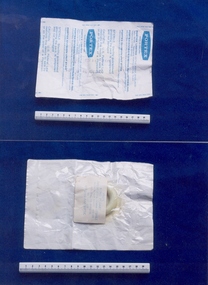
Ring pessary associated with Dr Geoff Bishop, c. 1977, Portex Ltd, England, c1977
... Canada. The pessary was originally regarded as an instrument and made from cork, ivory, hard rubber or gum-elastic. In later times, they were made from black vulcanite, flexible tin, soft copper wire covered with Indian rubber, and celluloid. The form of the pessary was and still is variable -either round, oval, or moulded in some cases...Canada. The pessary was originally regarded as an instrument and made from cork, ivory, hard rubber or gum-elastic. In later times, they were made from black vulcanite, flexible tin, soft copper wire covered with Indian rubber, and celluloid. The form of the pessary was and still is variable -either round, oval, or moulded in some cases ...This pessary came from Professor Geoff Bishop's rooms, Mollison House, 386 Albert Street, East Melbourne. As well as the UK, Portex had divisions in the USA and Canada. The pessary was originally regarded as an instrument and made from cork, ivory, hard rubber or gum-elastic. In later times, they were made from black vulcanite, flexible tin, soft copper wire covered with Indian rubber, and celluloid. The form of the pessary was and still is variable -either round, oval, or moulded in some cases combining three or four curves depending on the size of the pessary. In ancient times, medicated pessaries were made from emollient. astringent and aperient. Several of these are still used, but in more modem times are called vaginal suppositories. Anal suppositories are still used to suppress the pain of haemorrhoids. Portex brand ring pessary in original packaging. Consists of circular ring of cream vinyl, in sterile sealed pouch with transparent plastic at back. Stamped on pouch "PORTEX ENGLAND", and the text "USE BY FEB 77" and "CONTROL No F/1 505". The ring is size 700/300/056 - 56mm. A sticker on the back of pouch gives instruction for cleaning the pessary.pessary, intrauterine device -
 Royal Australian and New Zealand College of Obstetricians & Gynaecologists (RANZCOG)
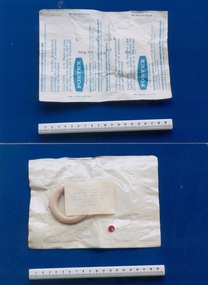
Ring pessary associated with Dr Geoff Bishop, c. 1977, Portex Ltd, England, before 1977
... Canada. The pessary was originally regarded as an instrument and made from cork, ivory, hard rubber or gum-elastic. In later times, they were made from black vulcanite, flexible tin, soft copper wire covered with Indian rubber, and celluloid. The form of the pessary was and still is variable -either round, oval, or moulded in some cases...Canada. The pessary was originally regarded as an instrument and made from cork, ivory, hard rubber or gum-elastic. In later times, they were made from black vulcanite, flexible tin, soft copper wire covered with Indian rubber, and celluloid. The form of the pessary was and still is variable -either round, oval, or moulded in some cases ...This pessary came from Professor Geoff Bishop's rooms, Mollison House, 386 Albert Street, East Melbourne. As well as the UK, Portex had divisions in the USA and Canada. The pessary was originally regarded as an instrument and made from cork, ivory, hard rubber or gum-elastic. In later times, they were made from black vulcanite, flexible tin, soft copper wire covered with Indian rubber, and celluloid. The form of the pessary was and still is variable -either round, oval, or moulded in some cases combining three or four curves depending on the size of the pessary. In ancient time, medicated pessaries were made from emollient. astringent and aperient. Several of these are still used, but in more modem times are called vaginal suppositories. Anal suppositories are still used to suppress the pain of haemorrhoids.Portex brand ring pessary in original packaging. Consists of circular ring of cream vinyl, in sterile sealed pouch with transparent plastic at back. Stamped on pouch "PORTEX/MADE IN ENGLAND", and the text "USE BY JAN 77" and "CONTROL No 06 88". The ring is size 700/300/065 - 65mm. A sticker on the back of pouch gives instruction for cleaning the pessary. A red dot is also stuck to the back of the pouch.pessary, intrauterine device -
 Bendigo Historical Society Inc.
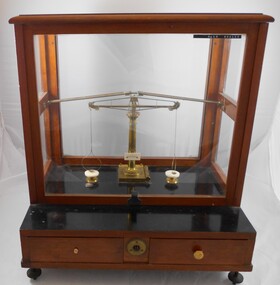
Tool - OERTLING SCALES IN GLASS CASE, 1898
... Canada, South Africa and India, to Europe and America." Reference: Powerhouse Collection - https://collection.powerhouse.com.au/object/550913 MINING Equipment Scales Ludwig Oertling beam balance assay Bendigo School of Mines and Industry 21736, J.W. 28.2.98, E.C., 3/98 Brass beam balance made by Oertling, London in 1898. The scale is mounted on a wooden base board with a mahogany case ...The Oertling beam balance scale was used in the Bendigo School of Mines assay laboratory. The manufacturer, Ludwig Oertling (1818-1893), was born near Hamburg and gained his apprenticeship in instrument-making with his brother Johann. He immigrated to London in 1840, where he joined instrument-maker and assayer George Makins (1815-1893). Oertling collaborated with Makins and built his first balance, which was "a twin-column assay type with a light lattice beam". By 1851, the year of the Great International Exhibition of the Works of All Nations, Oertling had established his own instrument-making business, employed five instrument-makers and by 1861, ten staff were engaged in designing and making instruments, principally analytical balances. Oertling's first twin-column beam balance was the prototype for all Oertling assay balances that were produced during the next century and exported to the British colonies: Australia, New Zealand, Canada, South Africa and India, to Europe and America." Reference: Powerhouse Collection - https://collection.powerhouse.com.au/object/550913 Brass beam balance made by Oertling, London in 1898. The scale is mounted on a wooden base board with a mahogany case, glass on four sides with two drawers underneath. On bottom of the left hand drawer, written in pencil, is the works number '21736'. A cursive 'L' on the same drawer bottom indicates 'left'. Also on bottom corner 'J.W. 28.2.98'. 'J.W' was John Wright, foreman and cabinet maker. He was Oertling’s longest working cabinet maker from1886-1928. In pencil underneath the right corner of the left drawer is '3/98'. Written in pencil inside the drawer cavity is 'E.C' in fancy script. This refers to 'Charlie Craig, employed as an instrument maker by the Oertling Company. The maker's name, "Oertling' is embossed on the base of the scale. There is a brass knob that fits in the front to make adjustments to the scales and also on either side of the exterior case to set the top of the scales. 21736, J.W. 28.2.98, E.C., 3/98mining, equipment, scales, ludwig oertling, beam balance, assay, bendigo school of mines and industry -
 Kyneton RSL Sub Branch
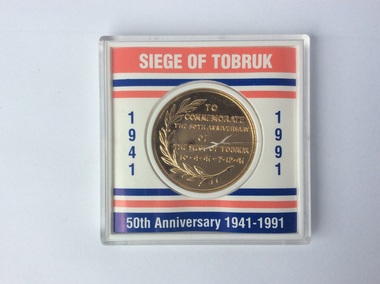
Medal, Commemorative medal Tobruk, 1991
... Some RAAF, Free French Air Force and Canadian personnel attached to the Royal Navy were included.This is not an official medal. tobruk rats of tobruk Commemorative medal issued on the 50th Anniversary of the Siege of Tobruk, in clear plastic presentation case. ...The Siege of Tobruk Medal was originally available to Australian, New Zealand, British, Indian and Polish troops who saw action during the Siege of Tobruk, between April and December 1941. The medal was commissioned and issued by the Rats of Tobruk Association in 1977. The medal was available to 18 BDE, 24 BDE, 26 BDE, 2/1 PIONEER's and other miscellaneous units. Some RAAF, Free French Air Force and Canadian personnel attached to the Royal Navy were included.This is not an official medal. Commemorative medal issued on the 50th Anniversary of the Siege of Tobruk, in clear plastic presentation case. Surround. Siege of Tobruk. 1941 - 1991 50th Anniversary 1941 - 1991tobruk, rats of tobruk -
 Warrnambool and District Historical Society Inc.
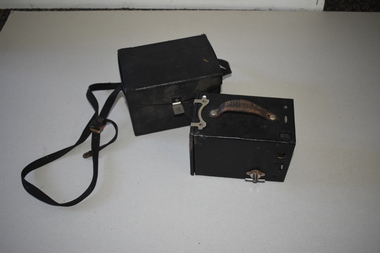
Camera, Canadian Kodak Co. Ltd, Box Brownie Camera and Case, c. 1940
... case. The Brownie camera was developed by Eastman Kodak in U.S.A. and named after cartoon characters popular in U.S.A in the 1930s. The Brownie camera had a menisculus lens and was simple, cheap and easy to use. Thus it was the choice of most household camera users in the mid 20th century. The Canadian...Box Brownie Camera and Case Camera Canadian Kodak Co. Ltd. ...This is a Box Brownie camera and case. The Brownie camera was developed by Eastman Kodak in U.S.A. and named after cartoon characters popular in U.S.A in the 1930s. The Brownie camera had a menisculus lens and was simple, cheap and easy to use. Thus it was the choice of most household camera users in the mid 20th century. The Canadian factory of Eastman Kodak was founded in 1899. This item is retained as an example of the Brownie camera so popular for family use in the mid 20th century. It will be useful for display..1 This is a box brownie camera made of cardboard with a synthetic leather covering. It has a leather handle, three apertures for viewing and silver-coloured metal mechanisms on the outside. .2 This is a camera case made of cardboard with a synthetic leather covering and a cord strap attached with metal studs. It also has a metal catch. .1 Use film No 120 No 2 Brownie Made in Canada by Canadian Kodak Co Ltd Toronto Canada .2 Premo No 2 Brownie Camera Made By Eastman Kodak Co Rochester N.Y. U.S.A. 20th century amateur photography, warrnambool, history of warrnambool -
Victorian Aboriginal Corporation for Languages
Conference proceedings, Joan Argenter, Endangered languages and linguistic rights on the margins of nations : proceedings of the Eighth FEL Conference : Barcelona (Catalonia) Spain 1-3 October 2004, 2005
... The Case of Norwegian Sign Language Eva Savelsberg Kurdish (Kurmanc�) as Minority Language in the Federal Republic of Germany Jos� Antonio Flores Farf�n Cultural and Linguistic Revitalization, Maintenance and Development in Mexico Mary Jane Norris Assessing the Status, Use and Accessibility of Canada?...The Case of Norwegian Sign Language Eva Savelsberg Kurdish (Kurmanc�) as Minority Language in the Federal Republic of Germany Jos� Antonio Flores Farf�n Cultural and Linguistic Revitalization, Maintenance and Development in Mexico Mary Jane Norris Assessing the Status, Use and Accessibility of Canada? ...Section 1: Grass-roots Efforts and Top-down Institutions Keynote Address: Leanne Hinton The Death and Rebirth of Native American Languages Patrick Marlow Bilingual Education, Legislative Intent, and Language Maintenance in Alaska Galina Dyrkheeva New Language Policy and Small Languages in Russia: the Buryat Example Zelealem Leyew The Fate of Endangered Languages in Ethiopia Gregory Hankoni Kamwendo Language Planning from Below: Chitumbuka as a Marginalised Language in Malawi John Hobson Learning to Speak Again: Towards the Provision of Appropriate Training for the Revitalization of Australian Languages in New South Wales Shelley Tulloch Grassroots Desires for Language Planning in Nunavut Amandina C�rdenas Demay Hacia la definici�n de una pol�tica del lenguaje & Alejandra Arellano Mart�nez expl�cita en M�xico Elena Benedicto, G. McLean, Linguistic Rights in the Nicaraguan Atlantic Coast: Grupo de Ling�istas Ind�genas Mayangna Actions on the Ground within the Legislative Framework of the Estatuto de Autonom�a Bartomeu Meli� Las lenguas ind�genas en el Paraguay. Una visi�n desde el Censo 2002 Monica Ward Building from the Bottom-up: Linguistic Rights for Extremely Endangered Languages Marta Moskal Language Policy and Protection of Endangered Languages in Poland Sue Wright What is a language? Some difficulties inherent in language rights Joan Ramon Sol� Obstacles in the Way of the Recovery of Catalan Section 2: The Global vs. the Local in Linguistic Rights Keynote Address: Patxi Goenaga Fronteras que dividen y fronteras que separan. Una mirada a Europa desde el Euskara Yun-Hsuan Kuo Languages, Identity, and Linguistic Rights in Taiwan Estibaliz Amorrortu, Andoni Barre�a, What Do Linguistic Communities Think about the Esti Izagirre, Itziar Idiazabal, Bel�n Uranga Official Recognition of their Languages? Alok Kumar Das Linguistic Practices and Not Just Linguistic Rights: Endangered Languages in New Europe Section 3: Languages crossing the Borders Keynote Address: Tjeerd de Graaf The Status of Endangered Languages in the Border Areas of Japan and Russia Mariana Bara Arm�n endangered language Ver�nica Grondona Language Policy, Linguistic Rights and Language Maintenance in Argentina Grup d?Estudi de Lleng�es Amena�ades Linguistic diversity in Catalonia: towards a model of linguistic revitalization Nataliya Belitser Endangered Languages in Crimea/Ukraine: The Cases of Crimean Tatar, Karait, and Krymchak Ivelina Kazakova & Maria Miteva The Future of Bulgarian: The Road to Extinction or Paradise Regained Luke O?Callaghan War of Words: Language Policy in Post Independence Kazakhstan Eden Naby From Lingua Franca to Endangered Language: The Legal Aspects of the Preservation of Aramaic in Iraq Poster presentations Akim Elnazarov Endangered languages and Education. A Case of Badakhshan Province of Tajikistan Arnfinn Muruvik Vonen & Oddvar Hjulstad Linguistic Rights Paving the Way Towards Language Endangerment? The Case of Norwegian Sign Language Eva Savelsberg Kurdish (Kurmanc�) as Minority Language in the Federal Republic of Germany Jos� Antonio Flores Farf�n Cultural and Linguistic Revitalization, Maintenance and Development in Mexico Mary Jane Norris Assessing the Status, Use and Accessibility of Canada?s Aboriginal Languages within Communities and Cities: Some Proposed Indicators Michael Prosser van der Riet Promotion of Minority Language Scripts in Southwest China. A Relative Success or Complete Failure? Mikael Grut The Endangered Celtic Languages: A Wake-up Call Nariyo Kono Developing Partnerships Between Universities and Language Communities: Top-down and Bottom-up Integration Richard J. Hawkins Probit Modeling Language Attrition Rudy Osiel Camposeco El idioma maya Popti? y la Declaraci�n Universal de los Derechos Ling��sticos Victorio N. Sugbo The literary Response: Claiming Rights in Three Philippin Languages Ya-ling Chang Language Policies in an Aboriginal Primary School in Taiwanmaps, tables, graphsnsw, endangered languages, linguistic rights -
 Victorian Aboriginal Corporation for Languages
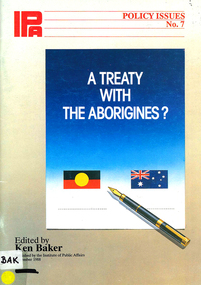
Book, Ken Baker, A treaty with the Aborigines?, 1988
... / Galarrwuy Yunupingu -- Aborigines are Australian, too / Bob Liddle -- Fallacies weaken the case for a treaty / Geoffrey Blainey -- Why whites also need an Aboriginal treaty / Roberta Sykes -- The quest for Aboriginal sovereignty / Hugh Morgan -- Legal and constitutional considerations / Mark Cooray -- Australia as terra nullius / Peter van Hattem -- Canada: towards Aboriginal self-government? .../ Galarrwuy Yunupingu -- Aborigines are Australian, too / Bob Liddle -- Fallacies weaken the case for a treaty / Geoffrey Blainey -- Why whites also need an Aboriginal treaty / Roberta Sykes -- The quest for Aboriginal sovereignty / Hugh Morgan -- Legal and constitutional considerations / Mark Cooray -- Australia as terra nullius / Peter van Hattem -- Canada: towards Aboriginal self-government? ...A time for reconciliation / Bob Hawke -- Treaty is a recipe for separatism / John Howard -- A treaty for land justice and self-determination / Janine Haines -- Why a treaty? / Galarrwuy Yunupingu -- Aborigines are Australian, too / Bob Liddle -- Fallacies weaken the case for a treaty / Geoffrey Blainey -- Why whites also need an Aboriginal treaty / Roberta Sykes -- The quest for Aboriginal sovereignty / Hugh Morgan -- Legal and constitutional considerations / Mark Cooray -- Australia as terra nullius / Peter van Hattem -- Canada: towards Aboriginal self-government? / Jean Chretien -- American Indian treaties: historic relics / Peter Samuel -- The long aftermath of Waitangi / Antomy C. Turner -- Appendix 1: The Barunga statement -- Appendix 2: Preamble to the ATSIC Bill -- Appendix 3: Press attitudes to a treaty -- Appendix 4: Aboriginal population and landmaps, b&w photographsrace relations, racism, government relations, treaties -
 Jewish Museum of Australia
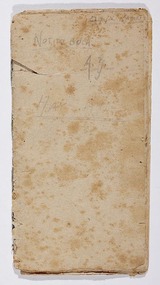
Diary of Alfred Broch, 10/7/1940 - 17/12/1940
... cases. Own people steal. Purloined objects even include toothbrushes and toothpaste. Much to eat. Small convoy with one cruiser. In the same convoy a women’s transport which soon leaves us as it is bound for Canada and we are quite surprised. ...cases. Own people steal. Purloined objects even include toothbrushes and toothpaste. Much to eat. Small convoy with one cruiser. In the same convoy a women’s transport which soon leaves us as it is bound for Canada and we are quite surprised. ...This diary was handwritten by Alfred Broch over the course of four months in 1940. It was kept while Alfred Broch was travelling on the HMT Dunera and then during his detainment in the Hay internment camp.Bound with cotton and handwritten in pencil. Bound with cotton and handwritten in pencil.[selected passage translation from German, further translation available] : “Dunera” 10.VII – 6.IX.1940 First impression very depressing. Fears. Confusion with prisoners of war. Never mind. Corrected. Continuing further bad treatment. Boarding the ship assisted by rifle butts. Robbed as soon as we reached the deck. Impression of a death ship. Complete helplessness. No sleeping facilities. All sleep on the floor, on tables etc. Intended accommodation taken up by luggage cases. (barbed wire). Food good but only spoons. Next day: robbery from the cases. Own people steal. Purloined objects even include toothbrushes and toothpaste. Much to eat. Small convoy with one cruiser. In the same convoy a women’s transport which soon leaves us as it is bound for Canada and we are quite surprised. The English soldiers and officers have another side. While in the danger zone they only had a webbing belt and slippers. In case of torpedoes – expecting certain death. Bad air as all vents are closed. Other Inscriptions: Front page, upper right, underlined: "Alfred Broch" Front page, upper, underlined: "Notitz Buch" Front page, centre, underlined: "Hay 1941" Page 1, upper right: "Mittwoch 10. VII." Page 3, upper right: "10. VII. - 6. IX. 1940 Page 4, centre: "[...] ARANDORA STAR" Page 11, upper, underlined: "Von Liverpool Nach Hay / Mittwoch 10 VII" dunera, wwii, internment, jewish history & people -
Moorabbin Air Museum
Manual - Pratt & Whitney engines, PW125B Training Guide Build Spec 647 Pratt & Whitney Canada
... Pratt & Whitney engines Engine cross section Stations & flanges Bearings Inlet & compressor Gas generator case Cabin bleed system Combustion chamber Electrical system Indicating system Bearing compartment sealing & turbine cooling Inlet airflows Assorted components & systems. Overview of Pratt & Whitney PW125B turboprop engine . Spiral bound book style manual PW125B Training Guide Build Spec 647 Pratt & Whitney Canada ...Overview of Pratt & Whitney PW125B turboprop engine .Spiral bound book style manualnon-fictionOverview of Pratt & Whitney PW125B turboprop engine . engine cross section, stations & flanges, bearings, inlet & compressor, gas generator case, cabin bleed system, combustion chamber, electrical system, indicating system, bearing compartment sealing & turbine cooling, inlet airflows, assorted components & systems. -
 Whitehorse Historical Society Inc.
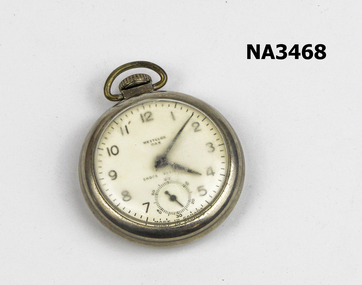
Domestic object - Pocket watch, c 1930
... case with a white face and black hands and numbers. It has an additional seconds clock and hand inset at the 6 mark. Markings: Westclox DAX, shock resistant. Made in Canada...case with a white face and black hands and numbers. It has an additional seconds clock and hand inset at the 6 mark. Markings: Westclox DAX, shock resistant. Made in Canada ...Watch used by W.R. Cruickshank from 1920-1970's in Albury when at Nicholson and Smith, Watchmakers & JewellersA silver pocket watch case with a white face and black hands and numbers. It has an additional seconds clock and hand inset at the 6 mark. Markings: Westclox DAX, shock resistant. Made in Canada. Winder and handle at top of case.Westclox DAXhorology, watches -
 Woodend RSL
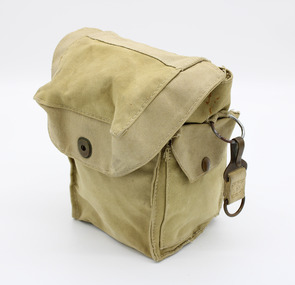
Patern 37 utility pouch
... On the inside of the press button stud (closing mechanism) is inscribed 'United xxxxx Canada" (second word is not readable) There is evidence of writing on the internal face of the back flap (just under the connection with the top cover) but it is not readable. Utility Pouch of rectangular web case ...The item is representative of utility pouches in use in the Commonwealth forces in the mid 20th century.Utility Pouch of rectangular web case. Of rectangular parallelepipped shape made of thick and sturdy fabric (canvas). The pouch is of faded olive colour.. Front view - Rectangular shape with overlapping closing flap with a press-stud fastener to maintain closed. Left and right views - Both sides are identical. Made of a one piece of fabric forming the base as well ("U" shape) Back view - Rectangular with metal hooks on the middle part for attachment to a belt. There is a Twigg buckle on the top part of the pouch mounted on another piece of canvass ending in a triangular shape. . Bottom view - ‘the fabric forming the base is also forming the sides of the pouch. Top view - closing flap overlapping on 3 sides and forming part of the back of the pouch. Inside view - The inside of the closing flap contains 3 small inserts (for special ammunition used in the firing of certain rifle grenade). There is excess fabric from the back panel that forms an additional layer at the base of the pouch..Inside of closing flap: has a circular (round) stamp with the arrow symbol. On the inside of the press button stud (closing mechanism) is inscribed 'United xxxxx Canada" (second word is not readable) There is evidence of writing on the internal face of the back flap (just under the connection with the top cover) but it is not readable. pattern 37, webbing -
 Falls Creek Historical Society
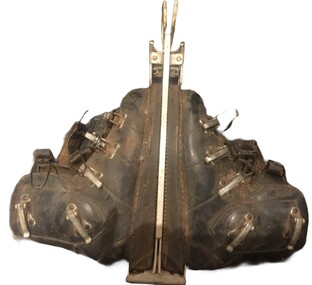
Equipment - Tyrol Leather Ski Boots
... Canadian ski team were equipped with plastic boots for the Alpine World Championships. Since then manufacturers have competed to further refine designs to meet a range of needs from the weekend skier to elite athletes. These boots were donated by Mt. Beauty Rotary Club President Bob Flower. These boots are significant because they demonstrate a stage in the evolving technology of designs for the ski sport industry. Ski equipment Ski boot design vintage ski boots TYROL is imprinted on the carry case ...These boots show an early design of ski boots. The design of boots, materials and closures have changed dramatically as technology has evolved. Early ski boots were little more than lace-up work boots. in 1928, the Swiss ski racer Guido Reuge invented a cable binding designed to hold the heel down for alpine skiing. He named the binding after the Kandahar series of alpine ski races. After World War II, custom bootmakers developed the double boot, with a soft and comfy lace-up inner boot protected and stiffened by a thick bull-hide outer casing laced with heavy-duty corset hooks. A solution towards making boots stiffer and more durable arrived in 1954, when Swiss bike racer and stunt pilot Hans Martin patented the ski boot buckle as shown on this pair of boots. The real revolution in boot design occurred in 1966, when the Canadian ski team were equipped with plastic boots for the Alpine World Championships. Since then manufacturers have competed to further refine designs to meet a range of needs from the weekend skier to elite athletes. These boots were donated by Mt. Beauty Rotary Club President Bob Flower.These boots are significant because they demonstrate a stage in the evolving technology of designs for the ski sport industry.Black leather ski boots with five metal clips on each boot and black lining. A carry case is included. Tyrol is a family owned specialty outdoor store selling quality gear. It was started in 1965 by Jerry and Barb Schliep in Rochester, Minnesota, USA. In 2003 the store was purchased by their daughter and son-in-law, Kristin & Robb Welch.TYROL is imprinted on the carry case.ski equipment, ski boot design, vintage ski boots
