
Showing 146 items matching "card cases"
-
 Kew Historical Society Inc
Accessory - Woman's Visiting Card Case, 19th century
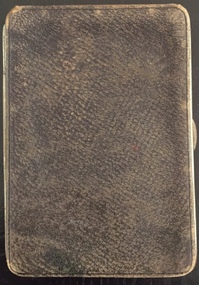
... Woman's Visiting Card Case......card cases...Nineteenth century silver, leather and silk woman's visiting card case, donated by M. Swanston MacDowell. ...Accessory Woman's Visiting Card Case ...Calling cards, also called visiting cards, visiting tickets, or compliments cards, originated in their paper and ink form in France in the 18th century and their popularity quickly spread across Europe and the United Kingdom. Victorian calling cards were large and could be extremely ornate, with the names usually printed instead of handwritten. Women's cards were squarish and fairly large, usually about 2.5 x 3 inches. Men's cards were smaller and more rectangular, meant to fit in a breast pocket, while women often carried their cards in specially made cases of silver, tortoiseshell, ivory, or mother-of-pearl. (Source: Claire Green: Calling Cards and Visiting Cards: A Brief History)Nineteenth century silver, leather and silk woman's visiting card case, donated by M. Swanston MacDowell. The case has a tooled brown leather cover attached to a silver frame. The interior of the card case, used for visiting cards, is lined with maroon silk with brown leather pockets. The pocket on the left is embroidered in silk with a spray of flowers.On one of the interior leather pockets "Kew Historical Society" has been crudely inscribed in biro. A card placed in the item includes the words "Visiting Cards. M. Swanston MacDowell".visiting card case, card cases -
 The Beechworth Burke Museum
Functional object - Silver Visiting Card Case, Williams Birmingham Ltd, 1904
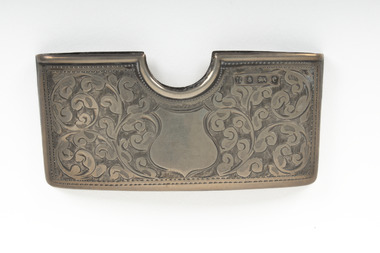
... Silver Visiting Card Case...Calling Card Cases were used by the aristocracy in 18th Century Europe as it was requirement in genteel society to leave a calling card when visiting a household. ...A small rectangular silver calling card case that has an ornate pattern etched into its front....Functional object Silver Visiting Card Case Williams Birmingham Ltd. ...Calling Card Cases were used by the aristocracy in 18th Century Europe as it was requirement in genteel society to leave a calling card when visiting a household. According to the Hallmarks on the case it was made in 1904 by the Williams Birmingham Ltd. in Birmingham, England.The social history objects held in the Burke Museum's collection help to tell the stories of Beechworth's past by showing the social, cultural, and economic aspects of the town's history.A small rectangular silver calling card case that has an ornate pattern etched into its front.FRONT: WB LD/ Anchor symbol/ Lion symbol/ e (Hallmark)early 20th century -
 City of Moorabbin Historical Society (Operating the Box Cottage Museum)
Craftwork, heavily carved calling card case, c1900
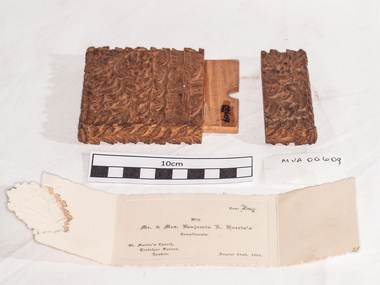
... Craftwork, heavily carved calling card case...Visiting cards were kept in highly decorated card cases....A timber calling card case, heavily carved with flowers, leaves and huts....Craftwork, heavily carved calling card case ...A visiting card, also known as a calling card, is a small paper card with one's name printed on it, and often bearing an artistic design. Visiting cards became an indispensable tool of etiquette, with sophisticated rules governing their use. The essential convention was that one person would not expect to see another person in his own home (unless invited or introduced) without first leaving his visiting card for the person at his home. Upon leaving the card, he would not expect to be admitted at first, but might receive a card at his own home in response. This would serve as a signal that a personal visit and meeting at home would be welcome. On the other hand, if no card were forthcoming, or if a card were sent in an envelope, a personal visit was thereby discouraged. As an adoption from French and English etiquette, visiting cards became common amongst the aristocracy of Europe, and also in the United States. The whole procedure depended upon there being servants to open the door and receive the cards and it was, therefore, confined to the social classes which employed servants. Some visiting cards included refined engraved ornaments, embossed lettering, and fantastic coats of arms. However, the standard form visiting card in the 19th century in the United Kingdom was a plain card with nothing more than the bearer's name on it. Sometimes the name of a gentlemen's club might be added, but addresses were not otherwise included. If a card was left with a turned corner it indicated that the card had been left in person rather than by a servant. Visiting cards were kept in highly decorated card cases.A timber calling card case, heavily carved with flowers, leaves and huts.craftwork, woodwork, visiting cards, early settlers, moorabbin, bentleigh, cheltenham, market gardeners -
 Warrnambool and District Historical Society Inc.
Case, Silver card case, Mid 19th century
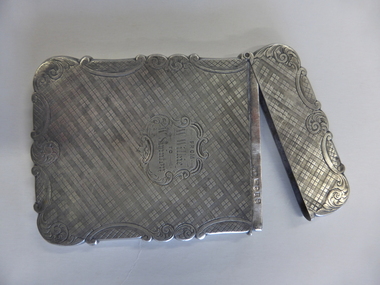
... Silver card case...Card cases were common items used mainly by men in the 19th century. ...This is a silver card case with a hinged lid. The silver is patterned in geometric shapes and the edges are highly ornamented with scrolls. ...The silver is somewhat tarnished. Silver card case Case ...Card cases were common items used mainly by men in the 19th century. A silver card case indicated that the owner was a man of means. ‘W.Swinton’ is presumed to be William Swinton who came to Australia in 1854 and established a drapery and grocery store in Timor Street in 1865. William Swinton died in 1901 and his son, also William was Mayor of Warrnambool from 1917 to 1919. A Swinton business still exists in Timor Street today. ‘W.Wilkie’ was obviously a friend or a business acquaintance of William Swinton and may have been related to James Wilkie who came to Warrnambool in 1854 and opened a drapery shop in 1855 in Timor Street with James Butters as a partner. This is a most significant item as one that belonged to William Swinton, a prominent Warrnambool business man and a pioneer settler in the town. It also has social significance as an example of an item used by businessmen and others in the 19th centuryThis is a silver card case with a hinged lid. The silver is patterned in geometric shapes and the edges are highly ornamented with scrolls. Inside the case are five pieces of white paper which are obviously not original. The case has five hallmarks indicating it is a quality object. The silver is somewhat tarnished. Scroll frame on front of case: ‘From W.Wilkie to W. Swinton’butters and wilkie drapery store, william swinton, warrnambool -
 Whitehorse Historical Society Inc.
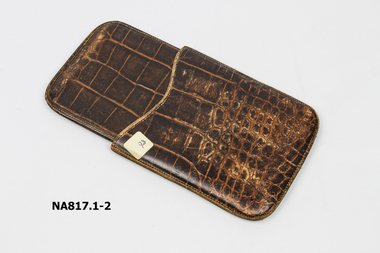
Functional object - Wallet
... Brown leather card case with two pockets...personal effects containers Brown leather card case with two pockets Functional object Wallet ...Brown leather card case with two pocketspersonal effects, containers -
 Warrnambool and District Historical Society Inc.
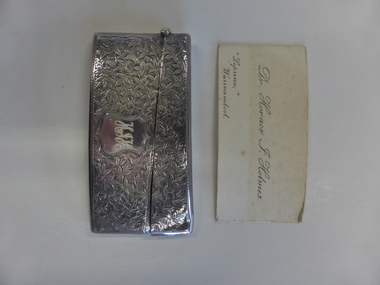
Functional object - Silver Card Case (Holmes), Mid 20th century
... Silver Card Case (Holmes)...Card case...The owner of this card case was Dr Horace Holmes who was a doctor in Warrnambool for over 40 years. ...This is a silver card case, heavily embossed, with a slightly curved shape and a hinged lid. ...Functional object Silver Card Case (Holmes) ...The owner of this card case was Dr Horace Holmes who was a doctor in Warrnambool for over 40 years. Dr Holmes (1877-1959) was born in Tasmania and completed a medical course at Melbourne University. He came to Warrnambool in 1905, taking over the practice of Dr Fleetwood at ‘Ierne’, at the corner of Spence and Kepler Streets. In 1906 he built a new home at the corner of Liebig Street and Raglan Parade and moved his practice there in 1912 (today this building is the Warrnambool Medical Clinic). Dr Holmes was an honorary Medical Officer at the Warrnambool Hospital. He retired in 1939 selling his practice to Dr Berryman but came out of retirement and practised as a locum until 1944. His interests included rowing golf, bowls and fishing. In the 1950s he lived at ‘Leprena’ in Canterbury Road. He was a foundation member of the Warrnambool Rotary Club. This is a most significant item as it belonged to a prominent local doctor, Dr Horace Holmes. It also has considerable social significance as it is an example of the practice of past times of carrying calling cards and the silver case is a sign of the affluence of the owner. This is a silver card case, heavily embossed, with a slightly curved shape and a hinged lid. It has the initials ‘HIH’ engraved in a shield on the front of the case. It contains nine calling cards (Dr Horace Holmes, Warrnambool). These are made of light card with printing in black on a white background. The cards are somewhat marked and discoloured. Case: ‘HIH’ Cards: ‘Dr. Horace I. Holmes, Leprena, Warrnambool’card case, dr horace holmes, warrnambool -
 Linton and District Historical Society Inc
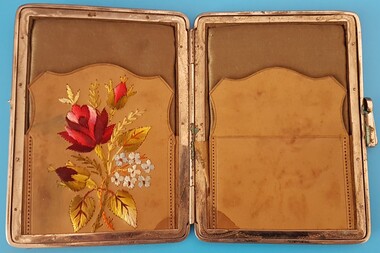
Card wallet, Visiting Card Wallet, circa 1900
... Thought to be a visiting card case c1900....Thought to be a visiting card case c1900. Visiting cards Wallets Costume accessories Brown leather case with metal clasp, with bright embroidered flowers on interior pocket to contain cards. ...Left to Christopher Grigg by his great aunt Nellie Grigg. Donated by him to L.D.H.S. Thought to be a visiting card case c1900.Brown leather case with metal clasp, with bright embroidered flowers on interior pocket to contain cards.visiting cards, wallets, costume accessories -
 Bendigo Military Museum
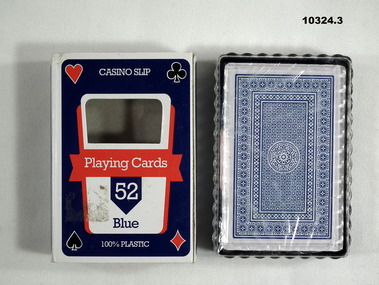
Leisure object - CARDS, PLAYING, www.yatsal.com.au
... Cardboard sleeve to hold card case....Cardboard sleeve to hold card case. Leisure object CARDS, PLAYING www.yatsal.com.au ...Lee Palfrey collection, refer Cat No 10263. The cards were received by "Lee Palfrey" as a care package during Operation Catalyst - Iraq.1. New pack of cards, blue motif - wrapped in cellophane. 2. Plastic case, 2 pcs, to hold cards. 3. Cardboard sleeve to hold card case.The outer sleeve is printed in red, white and blue ink. Titled “Casino Slip. Playing cards, 52 blue”leisure, cards -
 Glenelg Shire Council Cultural Collection
Award - Card Case - Syd Cuffe, Town Crier, c. 1997
... Card Case - Syd Cuffe, Town Crier...Brass business card case, inscribed '1997 Ontario Provincial Town Crier Championship, Ingersoll, ONT,' Business cards. ...Cuffe, Town Crier, Glenelg Shire' Award Card Case - Syd Cuffe, Town Crier ...Brass business card case, inscribed '1997 Ontario Provincial Town Crier Championship, Ingersoll, ONT,' Business cards. 'Sydney J. Cuffe, Town Crier, Glenelg Shire' -
Glenelg Shire Council Cultural Collection
Award - Card Case - Syd Cuffe, Town Crier, 1997
... Card Case - Syd Cuffe, Town Crier...Brass business card case, inscribed '1997 Ontario Provincial Town Crier Championship Ingersoll, ONT.' ...Brass business card case, inscribed '1997 Ontario Provincial Town Crier Championship Ingersoll, ONT.' ...Brass business card case, inscribed '1997 Ontario Provincial Town Crier Championship Ingersoll, ONT.' Business cards: 'Sydney J Cuffe, Town Crier, Glenelg Shire' -
 National Wool Museum
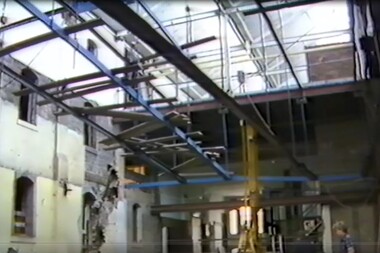
Film - Building Renovation Works, National Wool Centre, 1987-1988
... Tape is housed in a silver and black card case. Film includes colour footage and audio. ...Tape is housed in a silver and black card case. Film includes colour footage and audio. ...Film shows the renovation works, both the interior and exterior, of the National Wool Centre being constructed in 1987-1988 in the Dennys Lascelles building on Moorabool Street, Geelong. On 1 August 1872 the CJ Dennys & Co Woolstore opened, adorning the corner of Moorabool and Brougham Streets, Geelong. At the time of opening, the basalt bluestone woolstore was the second largest store in Victoria. In 1988 the National Wool Centre was opened in the same building.Black VHS tape with white stickers and printed text. Tape is housed in a silver and black card case. Film includes colour footage and audio. Film runs for 02:40:24Label on tape: National Wool Centre. 87 / Progression Tape / Unedited Wild Footage / National Wool Centre. 1987 / GRC Developmental Progression Wild.film, national wool centre, national wool museum, bicentennial, building, construction, renovation, moorabool street, dennys lascelles wool store, museum history, labourers, working life -
 Whitehorse Historical Society Inc.
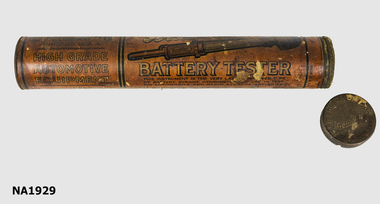
Functional object - Battery Tester, c1918
... Automotive battery tester in cylindrical card board case with a screw on lid....Automotive battery tester in cylindrical card board case with a screw on lid. Functional object Battery Tester ...Used by Mechanics for battery testing at least until 1940Automotive battery tester in cylindrical card board case with a screw on lid.High Grade Automotive Equipment Battery Tester.Patented 1918.trades, mechanics, transport, motor vehicles -
 The Beechworth Burke Museum
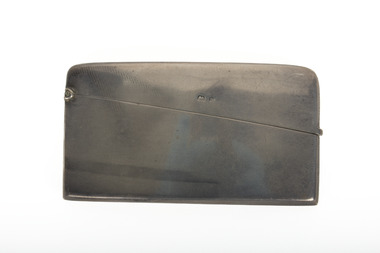
Functional object - Silver Calling Card Case, Adie Brothers Ltd, 1775
... Silver Calling Card Case...Calling Card Cases were used by the aristocracy in 18th Century Europe as it was requirement in genteel society to leave a calling card when visiting a household. ...Functional object Silver Calling Card Case Adie Brothers Ltd. ...Calling Card Cases were used by the aristocracy in 18th Century Europe as it was requirement in genteel society to leave a calling card when visiting a household. According to the Hallmarks on the case it was made in 1774 by the Adie Brothers Ltd. in Birmingham, England.The social history objects held in the Burke Museum's collection help to tell the stories of Beechworth's past by showing the social, cultural, and economic aspects of the town's history.A silver rectangular case that features an angled hinged lid.LID: Lion symbol / B (Hallmarks) LIP: A BROS LTD/ Anchor symbol / Lion symbol / B (Hallmarks) CASE BACK: A157418th century, european -
 Uniting Church Archives - Synod of Victoria
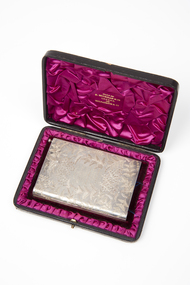
Card Case, c1889
... Card Case...Silver card case and notebook, etched and decorated with fern leaves and an engraved inscription. ...The box is black with a cerise lining. Card Case ...Winnifred Gardiner Davies, 1875-1973, married Mr Jones.Silver card case and notebook, etched and decorated with fern leaves and an engraved inscription. The case has royal blue pockets with gold edging, celluloid index pages with a list of handwritten names and a silver propelling pencil is secured at the side. The box is black with a cerise lining.Engraving: "PRESEMTED TO Miss Gardner BY THE CONGREGATION of the Mentone Memorial PRESBYTERIAN CHURCH as token of esteem Aug 17th 1889."Card insert: "Presbyterian Church Mentone Membership card for Winifred Gardner Davies 30 Sept 1894." Handwritten slip of paper: "To my dear Winnie with much love from ??? May 2 1931."mentone memorial presbyterian church -
 Bendigo Historical Society Inc.
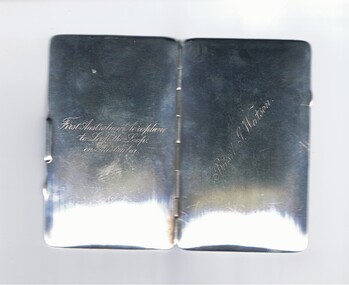
Memorabilia - BASIL WATSON COLLECTION: STERLING SILVER CARD CASE, 1917
... BASIL WATSON COLLECTION: STERLING SILVER CARD CASE...Sterling silver card case (B Watson) - hinged with single brass leaf insider engraved with details of Watson's flights and achievements in Australia - destinations,distance, time, date inscribed on inside of case.. ...Watson''; on back ''First Australian to Loop the Loop in Australia'' (engraved inscriptions) Memorabilia BASIL WATSON COLLECTION: STERLING SILVER CARD CASE ...Sterling silver card case (B Watson) - hinged with single brass leaf insider engraved with details of Watson's flights and achievements in Australia - destinations,distance, time, date inscribed on inside of case.. On front ''Basil G. Watson''; on back ''First Australian to Loop the Loop in Australia'' (engraved inscriptions)person, individual, basil watson -
Glenelg Shire Council Cultural Collection
Medal - Medallion - Halley's Comet, 1986
... Halley's Comet 1986 appears once in a lifetime (card in case). Back: Halley's Commet 1986 (medal)...Halley's Comet 1986 appears once in a lifetime (card in case). Back: Halley's Commet 1986 (medal) Gold coloured medallion commemorating Halley's comet. ...Gold coloured medallion commemorating Halley's comet. Encased in clear plastic case with sliding lid.Front: Identified by E. Halley, 1682, appears every 76 years (medal). Halley's Comet 1986 appears once in a lifetime (card in case). Back: Halley's Commet 1986 (medal)medal, medallion, commemorative, halleys comet, 1986 -
 City of Moorabbin Historical Society (Operating the Box Cottage Museum)
Functional object - Sewing Equipment, needles
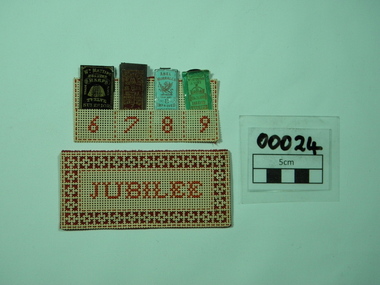
... Over the following decades embroidering of punched-card grew enormously in popularity and a variety of articles from Christmas decorations to birthday cards, and in this case a Neele case to celebrate Queen Victoria's golden Jubilee in 1887. ...In red cot tonCross stitch on one side of the card needle case the word "NEEDLES" is embroidered, and on the other side the word "JUBILEE". ...This is one of many items used to exhibit the skill and craftsmanship of the women in these families. 1887 queen victorias golden jubilee victorian punched card work hand embroidery different packets different gauge sharp needles wm shrimpton and sons william mattins abel morrals copestakes cross stitch In red cot tonCross stitch on one side of the card needle case the word "NEEDLES" is embroidered, and on the other side the word "JUBILEE". ...In the 1820s perforated cardboard first became available. Then, with the invention of the printing press, designs such as sentimental or religious mottos were pre-printed on the card and a Victorian craze began as it provided a simpler and cheaper method of embroidering for the masses compared to the previously far more expensive linen embroidery. Over the following decades embroidering of punched-card grew enormously in popularity and a variety of articles from Christmas decorations to birthday cards, and in this case a Neele case to celebrate Queen Victoria's golden Jubilee in 1887. The pioneer settlers and market gardeners of Moorabbin Shire had to be self reliant and made their own clothing and utensils. This is one of many items used to exhibit the skill and craftsmanship of the women in these families. Small cream coloured Punched-Cardboard needle case,with red satin lining and red cross-stitch decoration. The case contains four paper packets each containing sewing needles of a different gauge. Each packet of needles is 3 1/2 cms long and 1 cm wide. The size of the needles In red cot tonCross stitch on one side of the card needle case the word "NEEDLES" is embroidered, and on the other side the word "JUBILEE". Inside the needle case is four packets of different sized needles, by Wm Mattins1887, queen victorias golden jubilee, victorian punched card work, hand embroidery, different packets, different gauge sharp needles, wm shrimpton and sons, william mattins, abel morrals, copestakes, cross stitch -
 Ruyton Girls' School
Souvenir - Souvenir teaspoon, 1978
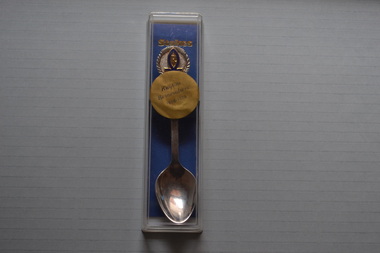
... The tea spoon is presented in a clear plastic rectangular presentation case lined with blue card. The case has a circular gold sticky label with text; "Ruyton Remembers 1878-1978"....The tea spoon is presented in a clear plastic rectangular presentation case lined with blue card. The case has a circular gold sticky label with text; "Ruyton Remembers 1878-1978". ...Ruyton Girls' School was founded in 1878 and celebrated it's centenary in 1978. The souvenir tea spoon was part of a range of celebration merchandise offered to the school community.Souvenir teaspoon with a decorative circular medallion at the end of the handle. The medallion features the Ruyton Girls' School 'Old English' R crest in gold and blue enamel. The tea spoon is presented in a clear plastic rectangular presentation case lined with blue card. The case has a circular gold sticky label with text; "Ruyton Remembers 1878-1978".Tea spoon: 'R'; 1978 Case lining: Stokes Sticker: Ruyton Remembers 1878-1978 ruyton girls' school, kew, centenary, old ruytonians' association, 1970s, 1978, spoon, souvenir, private school, selbourne road -
 Bendigo Historical Society Inc.
Domestic Object - NEEDLE CASE
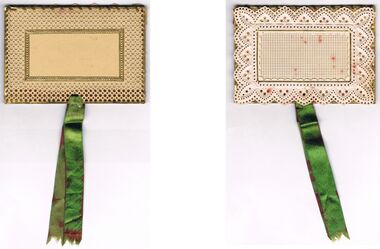
... Needle Case: Card material with gold border. Embossed paper front which has become detached, Green ribbon for closing and khaki ribbon binding the seam. ...HANDCRAFTS Needlework containers sewing needles Needle Case Needle Case: Card material with gold border. Embossed paper front which has become detached, Green ribbon for closing and khaki ribbon binding the seam. ...Needle Case: Card material with gold border. Embossed paper front which has become detached, Green ribbon for closing and khaki ribbon binding the seam. Inside has material for needles. Has red stains. Box 625handcrafts, needlework containers, sewing needles, needle case -
 Melbourne Tram Museum
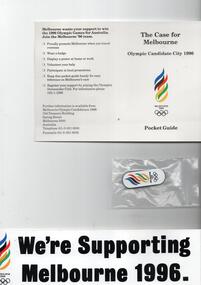
Document - Memento, Melbourne Olympic candidature group, "Melbourne Olympic City bid 1996", c1988
... Memento - set of three items that were given out to support the bid of Melbourne to hold the 1996 Olympics. .1 - lapel badge with spring clip inside a plastic envelope .2 - bumper sticker with an adhesive backing and peel strip .3 - card promoting the case for the bid with supporting facts....Trams tramways Melbourne Olympics Memento - set of three items that were given out to support the bid of Melbourne to hold the 1996 Olympics. .1 - lapel badge with spring clip inside a plastic envelope .2 - bumper sticker with an adhesive backing and peel strip .3 - card promoting the case for the bid with supporting facts. ...Memento - set of three items that were given out to support the bid of Melbourne to hold the 1996 Olympics. .1 - lapel badge with spring clip inside a plastic envelope .2 - bumper sticker with an adhesive backing and peel strip .3 - card promoting the case for the bid with supporting facts.trams, tramways, melbourne, olympics -
 Melbourne Tram Museum
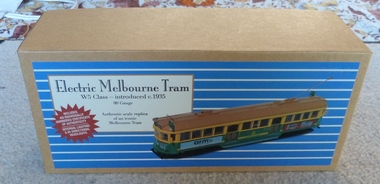
Leisure object - Model tram and presentation case, Cooee Concepts Pty Ltd, Model of Melbourne tram W5 (actually a SW5) No. 812, 2008
... Model packaged in a wooden packing case with a red felt base, contained within a card board outer case. ...Model packaged in a wooden packing case with a red felt base, contained within a card board outer case. ...Model of Melbourne tram W5 (actually a SW5) No. 812, electric model, made by Cooee Concepts Pty Ltd in China. Model packaged in a wooden packing case with a red felt base, contained within a card board outer case. The card board cover or case has a printed sheet giving details of the model and the history of the W5 Class tramcar. The wooden case has a brass plate detailing the contents. Scale 00 or 1:76. Model made from plastic and metal, with operable lights and motors with operable trolley poles, swivelling bogies, destination of St Kilda, showing route 16. Headlights function in the direction of travel. Package has manufacturing date of 2008 printed on it. Contains a plastic cover strip, plastic holder for the tram, plastic lift out strip, a printed Certificate of Authenticity, No. 335 of 700 and a folded sheet giving instructions for the use of the tram on a model tramway - up to 15V DC.trams, tramways, models, w5 class, the met, cooee models, tram 812 -
 Bendigo Historical Society Inc.
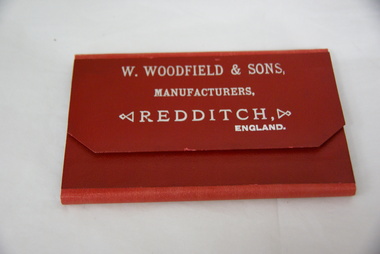
Clothing - SEWING MACHINE NEEDLE SAMPLE CASE
... Folded sample case with Card A, Card B, and Card C with samples of needles attached with sizes and recommended sewing machines and specialized usage for each needle. ...Folded sample case with Card A, Card B, and Card C with samples of needles attached with sizes and recommended sewing machines and specialized usage for each needle. ...Red coloured covered case with three panels with covers, silver lettering on front cover. Folded sample case with Card A, Card B, and Card C with samples of needles attached with sizes and recommended sewing machines and specialized usage for each needle. Needles manufactured by Woodfield and Sons Patentees and Manufacturers of sewing machine needles. Old Box 85.''W.Woodfield & Sons, Manufactures Redditch, England'' Easemore Works.domestic equipment -
 Melbourne Tram Museum
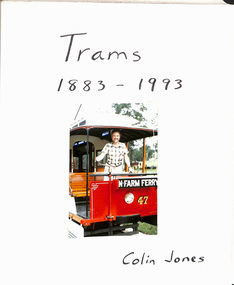
Album - Photo Album, Colin Jones, "Trams 1883 - 1993", 1990's
... Photo Album, grey decorative front cover with a grey heavy card slip case, 30 leaves of heavy paper, each separated by a semi clear protective sheet. ...Trams tramways Melbourne Album Japan Indonesia Australian tramways Photo Album, grey decorative front cover with a grey heavy card slip case, 30 leaves of heavy paper, each separated by a semi clear protective sheet. ...Photo Album, grey decorative front cover with a grey heavy card slip case, 30 leaves of heavy paper, each separated by a semi clear protective sheet. Compiled by Colin Jones with a title sheet "Trams 1883 - 1993" with Colin standing in the front of Brisbane Tramway Co. No. 47 at the Ferny Grove Museum. Bound with end papers. Photos retained by clear photo corners. Features photos by Colin of: Victor Harbor Surabaya Indonesia Melbourne cable trams, Sydney Steam tram in the UK Ballarat Bangkok Semarang Indonesia Adelaide Brisbane Melbourne Sydney Bendigo Launceston Osaka Japan Perth Kyoto Dalian Japan Fukuoka Japan Kanazawa Japan Hong Kong Sendai Kita Kyushu Hobart Lopburi Kobe Hiroshima Tokyo Matsuyama Japan Nagaski Various Museums in Australia. Sample pages only scanned.trams, tramways, melbourne, album, japan, indonesia, australian tramways -
 Seaworks Maritime Museum
Gas Detector
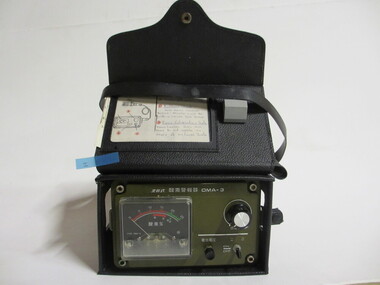
... on detector: "OMA-3/ON/OFF/ TYPE OMA-3/ KOMYO Paper card inserted in case, written with pen: "1) Turn on/off switch "ON"/ 2) Battery Check:/ Hold down smaller/ Button. ...1990 -24/04: To "Salvageman Ltd" at Douglas (IOM) on detector: "OMA-3/ON/OFF/ TYPE OMA-3/ KOMYO Paper card inserted in case, written with pen: "1) Turn on/off switch "ON"/ 2) Battery Check:/ Hold down smaller/ Button. ...1990 -24/04: To "Salvageman Ltd" at Douglas (IOM)One gas detector housed inside a black leather carry case, with a carry strap, and a pocket at back of carry case.1993 circa.on detector: "OMA-3/ON/OFF/ TYPE OMA-3/ KOMYO Paper card inserted in case, written with pen: "1) Turn on/off switch "ON"/ 2) Battery Check:/ Hold down smaller/ Button. Needle must be / within lower red scale/ 3 Zero Calibration Scale/ Press Larger Dial and Turn to Set Needle on/ Green on Lower Scale" handwritten on case: "PWO 3076" Sticker on case: "GASTECH/CALIBRATED/ Date 31-8-93/ Next Due/ 31-2-94/ Initials MW/ Serial no. 6479" Card attached by string, written in pencil: " PWO 3076/ Gas Detector/ Model no. 6479 [From the Howard Smith Collection]" -
 Orbost & District Historical Society
memorial card, 1912
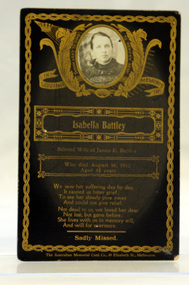
... Many of the card companies, in this case ‘The Memorial Card Co.,’ located at 143 King St, Sydney, published standardised plates which had areas for customisation. ...Many of the card companies, in this case ‘The Memorial Card Co.,’ located at 143 King St, Sydney, published standardised plates which had areas for customisation. ...This memorial card follows a style that was commonly used in the 1890s. The size of the card make it useful for presentation and handing out. There was a remarkably large production of memorial and funeral cards in Australia during the latter 19th and early 20th centuries and the style did not change (and many of the styles are still in effect today). Many of the card companies, in this case ‘The Memorial Card Co.,’ located at 143 King St, Sydney, published standardised plates which had areas for customisation. The card has the area for name, photograph, date of death and age. Poetry was often standardised, but could be requested at the behest of the person who commissioned the card Isabella Battley (nee Goad) was born in 1867, in Smythesdale, Victoria, Australia. She was married to James E. Battley when she died aged 45. James E. Battley was a director of the butter Factory in Orbost in 1915. Their son Ernest Albert Battley enlisted in the AIF from Orbost in 1916. His father is listed as Next of Kin and his mother as deceased. James was remarried to Eda May Battley (born Sargent) in 1914. He passed away in 1925, at age 57 Memorial cards are often treasured for a long time, and often become part of family history. The Battley family was an earlyn Orbost family.A black memorial card printed in memory of Isabella Battley. It has gold printed writing, a gold etched border and wreath. There is a photo of Isabella Battley and a memorial poem.memorial battley mourning -
 Halls Gap & Grampians Historical Society
Newspaper - Photocopy, C 1922
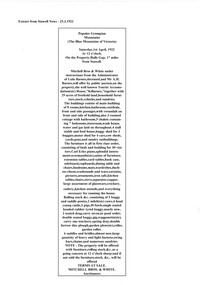
... Carl Ecko piano, splendid instrument; overmantle (sic) suites of furniture, extension tables, card tables, book case, sideboard, cupboards, dining table and chairs, linoleums, mats, wardrobes, duchess-chests, washstands and ware, curtains, pictures, ornaments, iron safe, kitchen tables, chairs, stove, separator, copper, large assortment of glassware, crockery, cutlery, kitchen utensils, and everything necessary for running the house. ...Carl Ecko piano, splendid instrument; overmantle (sic) suites of furniture, extension tables, card tables, book case, sideboard, cupboards, dining table and chairs, linoleums, mats, wardrobes, duchess-chests, washstands and ware, curtains, pictures, ornaments, iron safe, kitchen tables, chairs, stove, separator, copper, large assortment of glassware, crockery, cutlery, kitchen utensils, and everything necessary for running the house. ...Popular Grampian Mountains (The Blue Mountains of Victoria) Saturday, 1st April, 1922 at 12 o'clock On the property Halls Gap, 17 miles from Stawell Mitchell Bros & White under instructions from the Administrator of Lulu Barnes, deceased, and Mr A. H. Barnes, will offer by public auction on the property, the well known Tourist Accomodation (sic) House, "Killarney" together with 29 acres of freehold land, household furniture, stock, vehicles and sundries. The buildings consist main building of 8 rooms, kitchen, bathroom, vestibule, front and side passages, with verandah on front and side of building, also 3 roomed cottage with bathroom, 5 chalets containing 7 bedrooms, storeroom. wash house, water and gas laid on throughout. 4 cars, cow sheds, yards, pens, and sundry outbuildings. The furniture is all in first class order, consisting of beds and bedding for 30 visitors. Carl Ecko piano, splendid instrument; overmantle (sic) suites of furniture, extension tables, card tables, book case, sideboard, cupboards, dining table and chairs, linoleums, mats, wardrobes, duchess-chests, washstands and ware, curtains, pictures, ornaments, iron safe, kitchen tables, chairs, stove, separator, copper, large assortment of glassware, crockery, cutlery, kitchen utensils, and everything necessary for running the house. Rolling stock and C, consisting of 5 buggy and saddle ponies, 2 milch (sic) cows, 4 head young cattle, 3 pigs, 30 fowls, single seated hooded rubber tyred buggy, nearly new, 2 seated drag, carry seven, in good order; double seated buggy, gig, waggonette (sic), carry one ton; lorry, spring dray, double furrow disc plough, garden plow (sic), roller, garden roller. 6 saddles and bridles, almost new, large quantity of heavy and light harness, swing bars, chains, and numerous sundries. NOTE - The property will be offered with furniture, rolling stock & c., as a going concern at 12 o'clock sharp; and if not sold the furniture, stock, & C., will be offered TERMS AT SALE. MITCHELL BROS. & WHITE. AuctioneersTyped extract of advertisement for auction of Killarney from Stawell News 25-3-1922 later known as Grampians Housemedia, newspaper articles, guesthouses, killarney -
 Melbourne Tram Museum
Album - Photo Album, Brian Weedon, Tramway photos, 1970 to 1980's
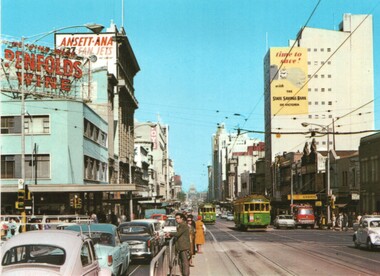
... Photo Album - green card slip case containing heavy grey card covers front and rear, front protective page and 12 photo pages with adhesive surface and clear plastic sheet cover - on cardboard sheet bound by a heavy white comb binder marked "Photo Album" on the front inside cover. ...Trams tramways Melbourne Geelong Ballarat Bendigo Postcards L class Interiors New Trams MMTB T Class W Class W1 class W3 class W4 class SW6 class Y Class X2 class Princes Bridge Batman Ave Swanston St St Kilda Rd Bourke St Collins St Macarthur St St Kilda Junction W7 class Buses SECV tram 27 tram 2 tram 8 tram 1026 tram 4 tram 1 tram 11 tram 105 tram 308 tram 419 tram 665 tram 670 tram 850 tram 469 tram 674 tram 611 tram 23 tram 29 tram 17 tram 3 tram 6 tram 28 tram 405 tram 29 tram 432 tram 1017 tram 512 tram 303 tram 965 tram 671 tram 1035 tram 637 Photo Album - green card slip case containing heavy grey card covers front and rear, front protective page and 12 photo pages with adhesive surface and clear plastic sheet cover - on cardboard sheet bound by a heavy white comb binder marked "Photo Album" on the front inside cover. ...Photo Album - green card slip case containing heavy grey card covers front and rear, front protective page and 12 photo pages with adhesive surface and clear plastic sheet cover - on cardboard sheet bound by a heavy white comb binder marked "Photo Album" on the front inside cover. Each page has scanned to a pdf file. Page 1 - newspaper cutting and two photos of Ballarat No. 27 completing 1,000,000 miles. Item from "A Place in the Sun" written by Keith Dunstan. Photo of tram 27 by the Ballarat Courier. Date of Photo. 29/6/1968, taken prior to the TMSV Tour of that date. Black and white photograph of a group of the passengers on No. 27 during the celebration of the tram reaching 1,000,000 (million) miles in Ballarat. Glenys George, Brian Weedon, John Fitzsimons, Graeme Turnball, Paul Nicholson, Barry George and Kevin Clark. Page 2 - black and white photograph of Geelong Nos 2, 8, 4, 1 and another 4 wheel tramcar and a open cab motor bus photographed within the interior of Geelong depot, prior to 1924. From notes provided by David O'Neill, 12/2003, advises that bus driver is either Bill Hamaling or Charles Stafford. Gentlemen next to No. 8 could be Vic Phipps. Page 3 - Black and White photograph of Geelong No. 7 - c1912, soon after opening with driver, conductor and passengers. Shows the magnetic brake shoe. Page 4 - Black and White photograph of Geelong Cross bench tram No. 11 in Corio Tce, now Brougham St outside Marks Hotel. Tram has the destination of Newtown. Page 5 - Black and White photograph - T 180, showing "Pyrotechnic Fty" possibly on No. 9 Road at Malvern Depot Page 6 - Black and White photograph of L 105 prior to any modifications - see also Reg Item 2498 for another print. - ditto - interior view show off centre seats in the drop centre. Page 7 - Black and White photographs of W308 and W1 419 - - see also Reg Item 3422 for another print. Page 8 - Black and White photograph of W3 665 Page 9 - Black and White photograph of W4 670 - - see also Reg Item 3154 for another print. - ditto Interior view. Page 10 - Black and White photograph of SW6 850 with the dash canopy lighting - as built. - ditto Interior view - - see also Reg Item 674 and 3426 for another prints. Page 11 - not used. Page 12 - Black and White photographs of Y469 and X2 674 (This tram was later renumbered 680 - see page 30 of Destination City 5th Edition). - - see also Reg Item 3161 an d 3427 respectively for another prints. Page 13 - Black and White photographs of Y1 611 and an interior view - - see also Reg Item 3160 for another print. Page 14 - Set of 6 colour prints of Bendigo 28 decorated as the 1968 Myer Christmas tram, Birney 23 and 29. Page 15 - Set of 4 colour prints of Bendigo 3, 17, 6 and 17, Page 16 - Colour print of traffic and trams on Princes Bridge with Batman Ave terminus in the view. - Postcard of Swanston St looking south just north of Lonsdale St with W2 432 and another W2. See 3558.1 for a loose copy of the postcard - NuColorVue No. BP 1060-1 - titled on rear "A view towards the Shrine during peak traffic" Has signs advertising Penfolds Wines, Ansett-ANA, State Savings Bank and Foys. Page 17 - Set of two colour postcards - W2 405 and another tram southbound in St Kilda Road with the Prince Henry hospital in the background and Bourke St with W7 1026 and other trams in the view. Page 18 - Set of two photographs of W2's in Collins St at Spring St, with No. 512 in the view. Page 19 - View looking across the Gardens with two W2 class trams in Macarthur St. - W2 637 at corner of Collins and Exhibition St - see also Reg Item 1999 for another print. Page 20 - set of three colour photographs - W2 303 in bound on St Kilda Road, destination City, Route 4D, see also Reg Item 324 - W7 965 turning from Queens Road into St Kilda Road at St Kilda Junction. - W4 671 at South Melbourne Depot. Page 21 - not used Page 22 - MMTB Bus 702 Mark VI MMTB Freighter body and W7 1035 Page 23 - not used Page 24 - SEC coal locomotive 108 at night. Most photographs are MMTB Official. Listed 22-5-2019trams, tramways, melbourne, geelong, ballarat, bendigo, postcards, l class, interiors, new trams, mmtb, t class, w class, w1 class, w3 class, w4 class, sw6 class, y class, x2 class, princes bridge, batman ave, swanston st, st kilda rd, bourke st, collins st, macarthur st, st kilda junction, w7 class, buses, secv, tram 27, tram 2, tram 8, tram 1026, tram 4, tram 1, tram 11, tram 105, tram 308, tram 419, tram 665, tram 670, tram 850, tram 469, tram 674, tram 611, tram 23, tram 29, tram 17, tram 3, tram 6, tram 28, tram 405, tram 29, tram 432, tram 1017, tram 512, tram 303, tram 965, tram 671, tram 1035, tram 637 -
 Flagstaff Hill Maritime Museum and Village
Instrument - Foghorn, Late 19th century
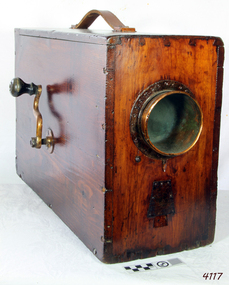
... English Rotary Norwegian Pattern nautical foghorn within a boxed pine varnished case with exposed corner dovetailing, original leather carrying strap, brass side crank, and original copper trumped horn. Card...Therefore the item has a historical connection with sailing and maritime pursuits from our past. flagstaff hill warrnambool shipwrecked coast flagstaff hill maritime museum maritime museum shipwreck coast flagstaff hill maritime village great ocean road foghorn maritime technology maritime communication marine warning signal portable foghorn bellows foghorn crank handle Robert Hope-Jones John Northey None English Rotary Norwegian Pattern nautical foghorn within a boxed pine varnished case with exposed corner dovetailing, original leather carrying strap, brass side crank, and original copper trumped horn. Card ...A foghorn is a device that uses sound to warn of navigational hazards like rocky coastlines, or boats of the presence of other vessels, in foggy conditions. The term is most often used with marine transport. When visual navigation aids such as lighthouses are obscured, foghorns provide an audible warning of rocky outcrops, shoals, headlands, or other dangers to shipping. An early form of fog signal was to use a bell, gong, explosive signal or firing a cannon to alert shipping. From the early 20th century an improved device called the diaphone was used in place of these other devices, The diaphone horn was based directly on the organ stop of the same name invented by Robert Hope-Jones, creator of the Wurlitzer organ. Hope-Jones' design was based on a piston that was closed only at its bottom end and had slots, perpendicular to its axis, cut through its sides, the slotted piston moved within a similarly slotted cylinder. Outside of the cylinder was a reservoir of high-pressure air. Initially, this air would be admitted behind the piston, pushing it forward. When the slots of the piston aligned with those of the cylinder, air passed into the piston, making a sound and pushing the piston back to its starting position, whence the cycle would be repeated. This method of producing a low audible sound was further developed as a fog signal by John Northey of Toronto and these diaphones were powered by compressed air produced by an electric motor or other mechanical means that admitted extremely powerful low-frequency notes. The example in the Flagstaff collection is an early cased and portable diaphone used on pleasure or sailing craft. By manually turning the crank handle air is produced and fed into valves that direct air across vibrating metal reeds to produce the required sound. in foggy weather, fog horns are used to pinpoint a vessels position and to indicate how the vessel is sailing in foggy conditions. One blast, when sailing on starboard tack and two blasts, when sailing on a port tack and three dots, when with wind is behind the vessel. Since the automation of lighthouses became common in the 1960s and 1970s, most older foghorn marine installations have been removed to avoid the need to run the complex machinery associated with them, and have been replaced with an electrically powered diaphragm or compressed air horns. The example in the collection is significant as it was used in the early 19th century for sailing vessels was important but these portable crank fog horns have also been superseded by modern electric varieties. Therefore the item has a historical connection with sailing and maritime pursuits from our past.English Rotary Norwegian Pattern nautical foghorn within a boxed pine varnished case with exposed corner dovetailing, original leather carrying strap, brass side crank, and original copper trumped horn. Card accessory with Directions for Use in both English and French.Noneflagstaff hill, warrnambool, shipwrecked coast, flagstaff hill maritime museum, maritime museum, shipwreck coast, flagstaff hill maritime village, great ocean road, foghorn, maritime technology, maritime communication, marine warning signal, portable foghorn, bellows foghorn, crank handle, robert hope-jones, john northey -
 Flagstaff Hill Maritime Museum and Village
Photograph - Vessel, Sailing Ship, Original image recorded between 14 Nov 1908 and early Jan 1909
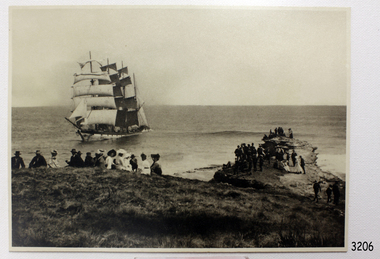
... case and white contrast stretching across the grassed foreground of photograph have been smudged over by development process and are largely indecipherable. However rear of backing board of identical but reduced image Reg. No. 3207 bears pencilled words “Mrs Francis” and “Wreck of ‘Falls of Halladale’ Peterborough 1908”, which accords with what remains of the initial inscription. Black and white photograph on cream-coloured backing card ...The photograph represents the original complete landscape (southerly) view of the FALLS OF HALLADALE shipwreck which occurred at 3 am on the 14th of November 1908. This image includes three groups of well-dressed Edwardian sightseers on the clifftop and a rocky headland. Subsequent reproductions of this well-known image have been cropped to a striking portrait view, emphasising the vertical line of the masts and sails of the sailing ship, and excluding the groups of sightseers on the adjoining headland. The small girl in the foreground and the loose topsail on the foremast are common to both the landscape and the cropped portrait images of this memorable scene. The photograph was taken at an early stage of the ship’s final days, somewhere between the date of her grounding in mid-November 1908 and early January 1909, when salvagers began dynamiting her masts to get to the cargo in her holds. The heavily laden FALLS OF HALLADALE was 102 days out of New York when the swell of the Southern Ocean lifted her onto the rocks near Peterborough. At the time she was sailing at six knots in a light breeze, her sails fully set and on an ENE tack. Mist over the land created an optical illusion of a distant horizon and the crew believed they were at least ten miles off the coast. When high cliffs loomed up out of the darkness it was too late in the light conditions to change tack or let go the anchors. Within minutes of running aground, her decks were awash and the holds filling with water. Captain Thomson and his 29 crew took to the boats, leaving the vessel stranded on the reef, looking awkwardly graceful in her predicament, firmly wedged between two parts of the reef and with all her square-rigged sails still set, FALLS OF HALLADALE provided a landmark visible for miles. Over the following two months, she attracted hundreds of sightseers, including contemporary photographers. A Court of Marine Inquiry at Melbourne on 30 November 1908 found Captain Thomson guilty of a gross act of misconduct ― in that he carelessly navigated the ship, neglecting to take proper soundings and failing to place the ship on the port tack before it was too late to do so. His Master’s Certificate of Competency was suspended for six months and he was ordered to pay £15/15/- toward the costs of the inquiry. It was an expensive outcome for the captain but his error provided many weeks of inexpensive entertainment for coastal residents and visitors to Peterborough. To judge from the standard of formal dress in this photograph, visiting the wreck was considered a special occasion as well as a popular one. Falls of Halladale: - The iron-hulled, four-masted barque, the Falls of Halladale, was a bulk carrier of general cargo. She left New York in August 1908 on her way to Melbourne and Sydney. In her hold, along with 56,763 tiles of unusual beautiful green American slates (roofing tiles), 5,673 coils of barbed wire, 600 stoves, 500 sewing machines, 6500 gallons of oil, 14400 gallons of benzene, and many other manufactured items, were 117 cases of crockery and glassware. Three months later and close to her destination, a navigational error caused the Falls of Halladale to be wrecked on a reef off the Peterborough headland at 3 am on the morning of the 15th of November, 1908. The captain and 29 crew members all survived, but her valuable cargo was largely lost, despite two salvage attempts in 1908-09 and 1910. ABOUT THE ‘FALLS OF HALLADALE’ (1886 - 1908) Built: in1886 by Russell & Co., Greenock shipyards, River Clyde, Scotland, UK. The company was founded in 1870 (or 1873) as a partnership between Joseph Russell (1834-1917), Anderson Rodger and William Todd Lithgow. During the period 1882-92 Russell & Co. they standardised designs, which sped up their building process so much that they were able to build 271 ships over that time. In 1886 they introduced a 3000 ton class of sailing vessel with auxiliary engines and brace halyard winches. In 1890 they broke the world output record. Owner: Falls Line, Wright, Breakenridge & Co, 111 Union Street, Glasgow, Scotland. Configuration: Four masted sailing ship; iron-hulled barque; iron masts, wire rigging, fore & aft lifting bridges. Size: Length 83.87m x Breadth 12.6m x Depth 7.23m, Gross tonnage 2085 ton Wrecked: the night of 14th November 1908, Curdies Inlet, Peterborough south west Victoria Crew: 29The shipwreck of the FALLS OF HALLADALE is of state significance: Victorian Heritage Register No. S255. The Falls of Halladale shipwreck is listed on the Victorian Heritage Register (No. S255). She was one of the last ships to sail the Trade Routes. She is one of the first vessels to have fore and aft lifting bridges. She is an example of the remains of an International Cargo Ship and also represents aspects of Victoria’s shipping industry. The wreck is protected as a Historic Shipwreck under the Commonwealth Historic Shipwrecks Act (1976).Black and white photograph on cream-coloured backing card and in good condition. Description of Image: Quadrant 01, vessel with full set of sails perched on reef with stern submerged; Quadrant 02, predominantly clear sky over flat calm sea; Quadrant 03, two groups of standing sightseers on rocky promontory with three individuals approaching from far left foreground; Quadrant 04, fifteen well dressed sightseers seated on grassed cliff top including one child and six women. There is a deliberately obscured inscription in white ink along lower border or foreground of photograph.Letters in upper case and white contrast stretching across the grassed foreground of photograph have been smudged over by development process and are largely indecipherable. However rear of backing board of identical but reduced image Reg. No. 3207 bears pencilled words “Mrs Francis” and “Wreck of ‘Falls of Halladale’ Peterborough 1908”, which accords with what remains of the initial inscription.flagstaff hill, warrnambool, shipwrecked-coast, flagstaff-hill-maritime-museum, maritime-museum, shipwreck-coast, flagstaff-hill-maritime-village, falls of halladale, shipwreck spectacle, shipwreck photograph, peterborough reef, edwardian sightseers, russell & co. -
 Flagstaff Hill Maritime Museum and Village
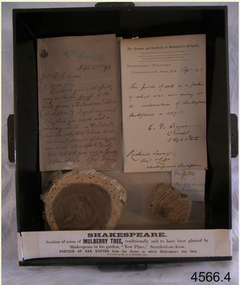
Wood Samples, 1891
... A card label with a printed number and a round adhesive label are attached on the back of the case. ...A card label with a printed number and a round adhesive label are attached on the back of the case. ...The timber display case was presented to Mr Richard Standcombe Harris of Warrnambool (1831-1923). He was a councillor (1875-1891) and predominant businessman. Mr C F Loggin had met Mr Harris while on a trip to Stratford upon Avon in the United Kingdom. Upon his return to Warrnambool, Mr Harris donated the item to the Warrnambool Museum and Art Gallery, (established 1886) where Joseph Archibald was Curator: he catalogued the case in 1894. THE LETTERS IN THE CASE The two letters contained within the display case confirm the authenticity of the oak wood sample. The first letter in the case includes the text; "[Stamped Header on banner] High Street, Stratford on Avon [Hand written] Sept. 22nd / 91. Mr. R. S. Harris, Dear Sir, Enclosed you will find [underlined next 3 words] every authentic proof of the Oak from Shakespeare's House (Birth place). I regret very much Sir, that you made a short-day at S. on A. I should have been delighted to have had the honour, & pleasure, of showing you around our Beautiful Country. You did not give [next 3 words underlined] me or yourself a fair chance. But however I hope that we may again some day have more time to go quietly around. With kind regards, and wishing you, Sir, a pleasant voyage, I remain, Dear Sir, Yours very truly, C.F. Loggin. P.S. A paper will be always acceptable to be as how you Jolly Warrnamboolites are desporting yourselves. “ The second letter includes text; “[Printed Letterhead with stamped impression] The Trustees and Guardians of Shakespeare’s Birthplace Incorporated by Act of 54 and 55, Vict. 1891 Secretary and Librarian - Richard Savage Shakespeare’s Birthplace Stratford-upon-Avon [handwritten] 22 Sept 1891 This piece of oak is a portion of what was cut away at at the restoration of Shakespeare’s Birthplace in 1857-58. C. F. Loggins Chemist 3 High Street Richard Savage Sec. – Shakespeare’s Birthplace Mr C F Loggin was connected with the Shakespeare Trust as the person who had originally donated a scion of Shakespeare's mulberry tree to the "Shakespearean Birthday Committee" in 1842. (The scion that was given to the Shakespearean Birthday Committee, from which the Mulberry sample is derived, still grows today in "New Place" garden.) Mr Richard Savage was the Secretary and Liberian of the then renamed “Trustees and Guardians of Shakespeare’s Birthplace when the display case was given to Mr Harris in 1891 by Mr Loggin. WILLIAM SHAKESPEARE Shakespeare was born in 1564 in Stratford-upon-Avon, where he also grew up. He married at 18 years and he and his wife, Anne Hathaway, had three children: They moved to London where he became successful as an actor, writer, and part-owner of a playing company. He later returned to Stratford and purchased his last home, which he called "New Place" in 1602 where he later died in 1616. For the next 150 years, it was known that there existed a black mulberry tree in the garden. At the time there was a fashion for planting mulberry trees. It was the early 17th century after King James had come to the throne, and he imported tens of thousands of saplings in an attempt to get landowners to start a silk industry in England. Unfortunately for posterity, Shakespeare's mulberry was felled around 1756, by the then owner of “New Place" the Reverend Francis Gastrell, who was apparently tired of continual visits by pilgrims asking to see the tree, so he chopped it down. Gastrell had applied for local permission to extend the garden but the application was rejected and his tax was increased. Gastrell retaliated by demolishing the house in 1759, this greatly outraged the local inhabitants. Gastrell was eventually forced to leave town having provoked the wrath of Stratford residents for committing such an act. Today only the garden remains where “New House" used to stand with a scion from the original mulberry tree still growing there. The wood from the felled mulberry tree at “New House" was purchased by an enterprising local clock-maker Thomas Sharp and he spent the next 40 years or so years making souvenirs from the wood. These became early tourist souvenirs and subsequently developed into a profitable sideline for various other makers, including George Cooper and John Marshall. These objects range from relatively small domestic wooden objects, such as snuff boxes and weight scales to large tea caddies and even tables. C. F. Loggin donated a scion or cutting from Shakespeare's mulberry tree to the Shakespeare Birthplace Trust in 1862, he was a chemist who lived and worked in Stratford. There is a note on the frame of the donation that the mulberry sample is from this scion, research shows that from Richard Savage's diary notes that there must have been a lot of wood taken from that scion over the years which was planted in the garden of “New Place” and is still growing there today. The "Trustees and Guardians of Shakespeare’s Birthplace" (1847 -1964) was formed after the house where Shakespeare is believed to have been born fell into disrepair. Subsequently in 1846 after the death of Thomas Court's widow the last owner. Interest in the house was revived when PT Barnum, the American showman, wanted to buy it and ship the house back to America. In response to this, the Shakespeare Birthday Committee was established (by a private Act of Parliament) with the help of such luminaries as Charles Dickens, the Committee of Trustees raised the necessary £3,000 and purchased the house the following year. Once the Committee had acquired the building, restoration work began. Originally the Birthplace formed part of a terrace with later houses built either side. The first stage in its conservation was their destruction. At the time it was thought necessary to avoid the risk of fire spreading to Shakespeare's birthplace. Reconstruction was carried out by the Shakespeare Trust between 1857 and 1864 that restored the outside of the building to its original 16th-century state. It is from this restoration that the donated piece of oak is derived, originally from a beam that was in the house. Communication from The Shakespeare Birthplace Trust, dated April 11th, 2019, confirms that the pieces displayed in this case have good provenance. The wood samples are significant for their association with the history of William Shakespeare. The display case and its content is significant to Warrnambool local history for its association with the establishment in 1886 of the Warrnambool Museum and Art Gallery. However, it should be noted that the letters of authentication that accompany the wood samples are only applicable to the oak sample. None the less, all the pieces have very good provenance, with Richard Savage's certificate of authenticity for the oak, and the mulberry sample with the letter to Mr Harris from Mr CF Loggin having also been the donor of the scion of mulberry in 1862 to the Shakespeare Birthplace Trust. This scion was then established at Shakespeare's garden at "New Home" that had been demolished by Rev Francis Gastrell in 1759. Two wood samples associated with William Shakespeare, presented in a hanging, timber and glass display case with metal trim around the frame. The case also contains two letters and a label printed on a card that refers to the contents, their origins and the donor. A card label with a printed number and a round adhesive label are attached on the back of the case. The left round section of wood is from a donated scion (or shoot) derived from the original mulberry tree planted by William Shakespeare at his last home "New Place", Stratford-upon-Avon. The outer section is light brown coloured while the centre is dark grain. The right wood sample in the case is a section of oak rafter from the house where Shakespeare was born in 1564. The wood is mid brown with a distinct grain. The included letters, each dated 22/9/1891, refer to only the oak sample. - The letter on the left comprises two handwritten pages from Mr CF Loggin to Mr Richard Standcombe Harris. The paper has the printed letterhead address of High Street, Stratford on Avon. - The letter on the right is a handwritten certificate of authenticity signed by Mr CF Loggin and counter signed by Mr Richard Savage, Secretary and Liberian of the Shakespeare Trust. It is on the printed letterhead of The Trustees and Guardians of Shakespeare’s Birthplace Cardboard label inside the glass case “Shakespeare Section of Mulberry Tree, traditionally said to have been planted by Shakespeare in his garden, “New Place,” Stratford-on-Avon. PORTION OF OAK RAFTER from the house in which Shakespeare was born. (Presented by R S Harris 1891.) Printed label on the back of the case “3 2 “ The handwritten adhesive label “0566” flagstaff hill, warrnambool, shipwrecked coast, flagstaff hill maritime museum, maritime museum, shipwreck coast, flagstaff hill maritime village, great ocean road, shakespeare display case, wood samples, oak from shakespeare's birthplace, mulberry from shakespeare's home "new place", stratford-upon-avon, shakespeare's birthplace, the trustees and guardians of shakespeare's birthplace &c., shakespeare trust, shakespeare birthday committee, r.s. harris, brunswick, victoria, richard s harris, brunswick, victoria, c.f. loggins, chemist, 3 high street stratford-on-avon, richard savage, warrnambool museum and art gallery, thomas court, pt barnum, charles dickins, anne hathaway, black mulberry tree, reverend francis gastrell
