
Showing 142 items matching "card parties"
-
 Tatura Irrigation & Wartime Camps Museum
Bell
... ...card parties...Used for card parties in Tatura Mechanics Hall by George Dowell to indicate commencement and end of play...Used for card parties in Tatura Mechanics Hall by George Dowell to indicate commencement and end of play bell card parties greenwood l timing recreation metalcraft brassware Brass bell with wooden handle, painted black. ...Used for card parties in Tatura Mechanics Hall by George Dowell to indicate commencement and end of playBrass bell with wooden handle, painted black. Donor card attached.bell, card parties, greenwood l, timing, recreation, metalcraft, brassware -
Port Melbourne Historical & Preservation Society
Card - Council electoral campaign, Perce WHITE, c. 1987
... Perce WHITE Council electoral campaign card, Labor Party, 1980s. Green and black...Thought to be 1987 as this was the first year in a long time that elections were contested Local Government - City of Port Melbourne Politics Perce McGuire WHITE Perce WHITE Elections Perce WHITE Council electoral campaign card, Labor Party, 1980s. Green and black Card Council electoral campaign, Perce WHITE Ausralian Labor Party (ALP) ...Thought to be 1987 as this was the first year in a long time that elections were contestedPerce WHITE Council electoral campaign card, Labor Party, 1980s. Green and blacklocal government - city of port melbourne, politics, perce mcguire white, perce white, elections -
 Emerald Museum & Nobelius Heritage Park
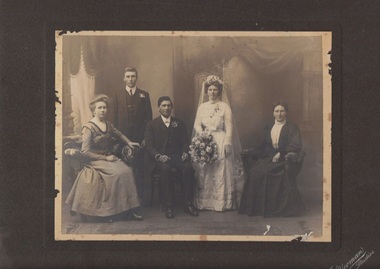
Photograph, Nightingale/Thompson Collection, c 1880 - 1919
... Sepia photograph on dark grey card of wedding party...party; groom, bride, older woman (possibly mother of the bride) plus couple on groom's L/H side. As Ethel is mentioned on inscription the bride could be Ethel Georgina Nightingale(b.1885 - 1946) currently do not have spouse's name. Older seated woman possibly mother of the bride could be Emma Augusta Thompson (1859 - 1949) (Needs further research for confirmation) Thompson Collection Nightingale Makers mark: The Yeoman Studios Inscription on back: To Dear Ethel with best wishes Sepia photograph on dark grey card of wedding party Nightingale/Thompson Collection Photograph The Yeoman Studios ...Wedding party; groom, bride, older woman (possibly mother of the bride) plus couple on groom's L/H side. As Ethel is mentioned on inscription the bride could be Ethel Georgina Nightingale(b.1885 - 1946) currently do not have spouse's name. Older seated woman possibly mother of the bride could be Emma Augusta Thompson (1859 - 1949) (Needs further research for confirmation)Sepia photograph on dark grey card of wedding partyMakers mark: The Yeoman Studios Inscription on back: To Dear Ethel with best wishesthompson collection, nightingale -
Emerald Museum & Nobelius Heritage Park
Photograph - Wedding photograph - Nightingale/Thompson Collection, E. Strawbridge, 1/04/2009 12:00:00 AM
... B/W Photograph on dark brown card of wedding party....Thompson April 1909 B/W Photograph on dark brown card of wedding party. Photograph Wedding photograph - Nightingale/Thompson Collection E. ...Wedding photograph of William John Seymour THOMPSON to Agnes Helen TELFERFrom collection of Emma NIGHTINGALE. Agnes's father Joseph was an orchardist in Vermont. These THOMPSONS not related to Emma Nightingale. Bridesmaid - Sophie THOMPSON (sister to William), Groomsman - Robert Charles VALEB/W Photograph on dark brown card of wedding party.Makers Mark: E Strawbridge, 129 Park Street, Parkville. Inscription on back: To Mrs Nightingale with compliments from Mr. & Mrs. W. Thompson April 1909thompson, nightingale, telfer, vale -
 Emerald Museum & Nobelius Heritage Park
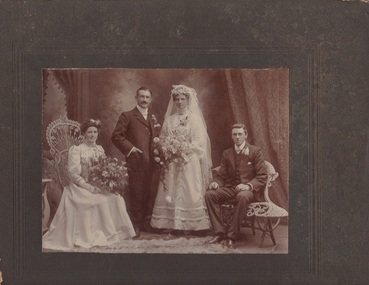
Photograph, E. Strawbridge, Nightingale/Thompson Collection, April 1909
... B/W Photograph on dark brown card of wedding party...Thompson April 1909 B/W Photograph on dark brown card of wedding party Nightingale/Thompson Collection Photograph E. ...Wedding photograph of William John Seymour THOMPSON to Agnes Helen TELFERFrom collection of Emma NIGHTINGALE. Agnes's father Joseph was an orchardist in Vermont. These THOMPSONS not related to Emma Nightingale. Bridesmaid - Sophie THOMPSON (sister to William) Groomsman - Robert Charles VALEB/W Photograph on dark brown card of wedding partyMakers Mark: E Strawbridge, 129 Park Street, Parkville. Inscription on back: To Mrs Nightingale with compliments from Mr. & Mrs. W. Thompson April 1909thompson, nightingale, telfer, vale -
Tatura Irrigation & Wartime Camps Museum
Entry Ticket, Shire Chambers Opening, 1968
... Municipal office and council chambers. 12 December 1968. Entree card cocktail party. Shire Presidents Suite 4.30 pm. ...Municipal office and council chambers. 12 December 1968. Entree card cocktail party. Shire Presidents Suite 4.30 pm. ...In 1968 the very old council chambers and offices in Casey Street were replaced on the same site by new buildings. The card admitted its holder to the Official Opening.small card with string attached acted as entry ticket to function - official opening of new Shire Chambers in 1968. Blue still cardboard.Shire of Rodney Official Opening. Municipal office and council chambers. 12 December 1968. Entree card cocktail party. Shire Presidents Suite 4.30 pm. This card must be presented.shire of rodney -
Surrey Hills Historical Society Collection
Work on paper - Vertical File, Victorian Election General
... How to Vote card for Sustainable Australia Party – 26 November 2022 ...How to Vote card for Sustainable Australia Party – 26 November 2022 Victorian Election General Work on paper Vertical File ...Victorian Elections General 1. How to Vote card for Sustainable Australia Party – 26 November 2022 victorian general election -
 Melbourne Legacy
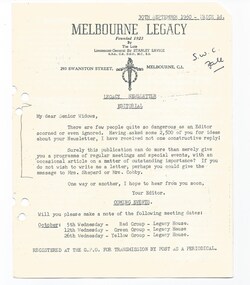
Journal - Document, newsletter, Legacy Newsletter 1960, 1960
... On the free Wednesday there was a card party for anyone to attend (fee 1/-). There is a letter for October and November 1960, each of 4 pages, with details of meetings and activities such as the Christmas party. ...On the free Wednesday there was a card party for anyone to attend (fee 1/-). There is a letter for October and November 1960, each of 4 pages, with details of meetings and activities such as the Christmas party. ...In 1960 the format of newsletters to widows was changing. The editor sent a notice to widows asking for their suggestions. The first newsletter in the new format (30/9/60) contains his editorial expressing disappointment that he had received no replies. There is also a letter stored with the newsletters from a widow sending her observation that the editor had sounded rejected and sends her best wishes. There is also a list of meeting dates for 1960 from 29/3/60. There were so many widows that the meetings were spread over three groups - yellow, green and red - each meeting on a different Wednesday of the month at the Melbourne Town Hall. On the free Wednesday there was a card party for anyone to attend (fee 1/-). There is a letter for October and November 1960, each of 4 pages, with details of meetings and activities such as the Christmas party. In November there were calls for nominations for the committee members in 1962. Committee comprised of a President, 2 Vice presidents, Hon. Secretary, Hon. Treasurer, Hon. Assistant Secretary and 14 members of the committee. The first edition in the new format was in 1960, previously there had been a quarterly magazine but the distribution was limited, they changed to a 4 page newsletter format to reach more of the widows. The newsletter was priced at 2c a copy. The price of theatre tickets was $3. Various pages of interest have been added to show different news items. Other editions haven't been scanned.Brings to life the activities provided for the widows and the work of Melbourne Legacy in the 1960s.Black typed newsletter x 3 editions from 1960 and associated notices from 1960. 1960 editions: 30 Sep ; 30 Oct ; 30 Novnewsletter, activities -
 Melbourne Legacy
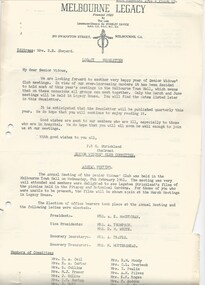
Journal - Document, newsletter, Legacy Newsletter 1961, 1961 and 1962
... On the free Wednesday a Card party was open to all widows and their friends to play cards (entry fee of 1/-). ...On the free Wednesday a Card party was open to all widows and their friends to play cards (entry fee of 1/-). ...Copies of newsletters to Legacy widows in 1960s. There were usually 4 editions per year (February, May, July and November - plus two special one pages editions in October and November 1961). Newsletters include a notice from the Senior Widows Club coordinator F R G Strickland and information about events and meetings. The editor was Mrs B E Shephard. There were so many widows that the meetings were spread over three groups - yellow, green and red - each meeting on a different Wednesday of the month at Legacy House. On the free Wednesday a Card party was open to all widows and their friends to play cards (entry fee of 1/-). Some months all groups met on the same day and the meeting had to be held at the Melbourne Town Hall to accomodate the numbers. November's meeting as a picnic in the Botanical Gardens and January the widows met in Fitzroy Gardens. In November there were calls for nominations for the committee members for the following year. Committee comprised of a President, 2 Vice presidents, Hon. Secretary, Hon. Treasurer, Hon. Assistant Secretary and 14 members of the committee. The first edition in the new format was in 1960, previously there had been a quarterly magazine but the distribution was limited, they changed to a 4 page newsletter format to reach more of the widows. The newsletter was priced at 1D a copy. Various pages of interest have been added to show different news items. Not all editions have been scanned.Brings to life the activities provided for the widows and the work of Melbourne Legacy in the 1960s.Black typed newsletter x 10 editions from 1961 and 1962. 1961 editions: 28 Feb ; 31 May ; 21 Jul ; 10 Oct ; 30 Nov 1962 editions: 23 Feb ; 11 May ; 20 Jul ; 30 Novnewsletter, activities -
 Vision Australia
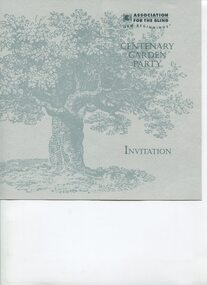
Card - Text, Centenary Garden Party
... Invitation card for Neil and Elizabeth Maxwell to the Centenary Garden Party. The card includes both the invitation itself and the programme of events during the party and served as an entry card. ...Invitation card for Mr and Mrs Maxwell to Centenary Garden party...Invitation card for Neil and Elizabeth Maxwell to the Centenary Garden Party. The card includes both the invitation itself and the programme of events during the party and served as an entry card. ...Invitation card for Neil and Elizabeth Maxwell to the Centenary Garden Party. The card includes both the invitation itself and the programme of events during the party and served as an entry card. Held at Government House, the Garden Party was designed to recognise the 100 years of volunteering that has been undertaken by those present and in the past.Invitation card for Mr and Mrs Maxwell to Centenary Garden partynon-fictionelizabeth maxwell, neil maxwell, association for the blind -
 Melbourne Legacy
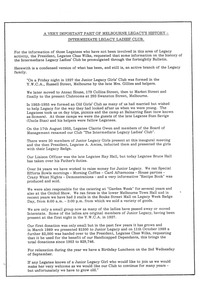
Document, Intermediate Legacy Ladies Club, 1990s
... They ran Special Efforts Bowls mornings, card afternoons, house parties, crazy whist nights, and produced a recipe book. ...They ran Special Efforts Bowls mornings, card afternoons, house parties, crazy whist nights, and produced a recipe book. ...A document recording the history of the Intermediate Legacy Ladies Club (ILLC). It was put together by Legatee Chas Wilks for publication in the Bulletin for the information of Legatees. It starts with the formation of the early girls' classes in 1927. Then the older girls formed the 'Old Girls Club' which then was renamed 'Intermediate Legacy Ladies Club' (ILLC) in 1955. At the time it was printed, they had been meeting for 34 years and fundraising for Legacy. They ran Special Efforts Bowls mornings, card afternoons, house parties, crazy whist nights, and produced a recipe book. They had fetes in the Melbourne Town Hall and even a couple of stalls in Bourke St Mall on Badge day.A first hand account of the early classes by a junior legatee.White A4 photocopy of an article about Intermediate Ladies Legacy Club.illc, girls classes -
Kew Historical Society Inc
Archive (series) - Subject File, Masonic Lodges
... It specifically includes an invitation card to a birthday party at the Masonic Lodge, an article criticising the City of Kew's decision to demolish the Masonic Temple in Walpole Street, and an image of the Temple. ...It specifically includes an invitation card to a birthday party at the Masonic Lodge, an article criticising the City of Kew's decision to demolish the Masonic Temple in Walpole Street, and an image of the Temple. ...Kew Historical SocietySince its foundation in 1958, members of the Kew Historical Society have been compiling and storing information about subjects relating to the history of Kew and its environs, of which this file is an example. Arranged by Secondary Values (value of records to users)Subject file created by researchers of the Kew Historical Society containing information about former Masonic Lodges in Kew (Vic.). The main Lodge was located in Walpole Street, Kew, next to the former Municipal Library and former Kew Town Hall (now the site of a Woolworths supermarket). The file contains information and images. It specifically includes an invitation card to a birthday party at the Masonic Lodge, an article criticising the City of Kew's decision to demolish the Masonic Temple in Walpole Street, and an image of the Temple. masonic lodges -- kew (vic), masonic temple -- walpole street --- kew (vic.), copy shop -- walpole street -- kew (vic.), walpole street (kew), marshall slatterymasonic lodges -- kew (vic), masonic temple -- walpole street --- kew (vic.), copy shop -- walpole street -- kew (vic.), walpole street (kew), marshall slattery -
 Sunshine and District Historical Society Incorporated
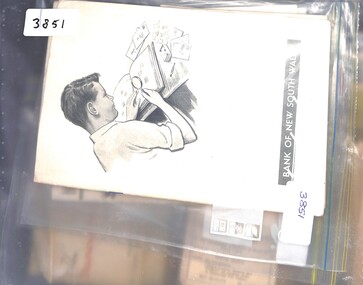
Education kit - Teaching aides for primary school students
... 3851.01 - Teaching Aides For Primary School Students - Card 01 John McDonald Stuart 1815 - 1866 3851.01 - Teaching Aides For Primary School Students - Card 02 Before Them Lay A Vast Silent Land 3851.01 - Teaching Aides For Primary School Students - Card 03 The First Man To Reach The Centre 3851.01 - Teaching Aides For Primary School Students - Card 04 Three Cheers For The Flag 3851.01 - Teaching Aides For Primary School Students - Card 05 The Desert Drove Them Back 3851.01 - Teaching Aides For Primary School Students - Card 06 A Savage Attack By Aborgines 3851.01 - Teaching Aides For Primary School Students - Card 07 They Discovered Newcastle Waters 3851.01 - Teaching Aides For Primary School Students - Card 08 The Thick Scrub Was Impassable 3851.01 - Teaching Aides For Primary School Students - Card 09 They Were Forced To Return 3851.01 - Teaching Aides For Primary School Students - Card 10 Stuart Set Out For A Third Time 3851.01 - Teaching Aides For Primary School Students - Card 11 Beyond The Ropers Was Beauttiful Country 3851.01 - Teaching Aides For Primary School Students - Card 12 Then At Last They Reached The Sra 3851.01 - Teaching Aides For Primary School Students - Card 13 Hostile Natives attacked Again And Again 3851.01 - Teaching Aides For Primary School Students - Card 14 Sick And Exhausted They Struggled On 3851.01 - Teaching Aides For Primary School Students - Card 15 Week And Weary He Had Won Through 3851.02 - Teaching Aides For Primary School Students - Card 01 Captain Charles Stuart Plans To Solve The Riddle Of The Rivers 3851.02 - Teaching Aides For Primary School Students - Card 02 Stuart's Expedition Sets Out From Sydney In 1829 3851.02 - Teaching Aides For Primary School Students - Card 03 An Upturned Dray In Devil's Pass 3851.02 - Teaching Aides For Primary School Students - Card 04 Stuart's Party Follows The Murrumbridgee 3851.02 - Teaching Aides For Primary School Students - Card 05 First Stage Of The River Journey 3851.02 - Teaching Aides For Primary School Students - Card 06 Building The Whaleboat On The Banks Of The Murrumbidgee 3851.02 - Teaching Aides For Primary School Students - Card 07 The Lachlan Enters The Murrumbidgee River 3851.02 - Teaching Aides For Primary School Students - Card 08 Stuart Discovers The Murray River 3851.02 - Teaching Aides For Primary School Students - Card 09 A Narrow Escape From Hostile Natives 3851.02 - Teaching Aides For Primary School Students - Card 10 Hoisting The Union Jack On The Banks Of The Darling 3851.02 - Teaching Aides For Primary School Students - Card 11 Stuart Discovers Lake Alexandrina 3851.02 - Teaching Aides For Primary School Students - Card 12 Across The Sandhills To Encounter Bay 3851.02 - Teaching Aides For Primary School Students - Card 13 A Disappointment 3851.02 - Teaching Aides For Primary School Students - Card 14 The Nightmare Return 3851.02 - Teaching Aides For Primary School Students - Card 15 Relief 3851.03 - Teaching Aides For Primary School Students - Fourteen Explorers Of Australia 3851.04 - Teaching Aides For Primary School Students - Sixteen Explorers Of Australia 3851.05 - Teaching Aides For Primary School Students - Australian Commorative Stamps Published 1955 3851.05 - Teaching Aides For Primary School Students - Australian Commorative Stamps Published 1961 3851.06 - Teaching Aides For Primary School Students - Carded Roving Wool Sample 3851.06 - Teaching Aides For Primary School Students - Carded Silver Wool Sample 3851.06 - Teaching Aides For Primary School Students - Davies Coop & Co Limited Raw Cotton Sample 3851.06 - Teaching Aides For Primary School Students - Davies Coop & Co Limited Sized Cotton Yard Sample 3851.06 - Teaching Aides For Primary School Students - Finished Cloth Wool Sample 3851.06 - Teaching Aides For Primary School Students - Greasy Cloth Wool Sample 3851.06 - Teaching Aides For Primary School Students - Greasy Wool Sample 3851.06 - Teaching Aides For Primary School Students - Scoured And Carbonized Wool Sample 3851.06 - Teaching Aides For Primary School Students - Scoured And Milled Cloth Wool Sample 3851.07 - Teaching Aides For Primary School Students - From The Sheep's Back To You Book 01 3851.07 - Teaching Aides For Primary School Students - From The Sheep's Back To You Book 02 3851.08 - Teaching Aides For Primary School Students - How To Wash Physician Blankets 3851.09 - Teaching Aides For Primary School Students - What Members Of The A.I.F. ...Primary School State School 3851.01 - Teaching Aides For Primary School Students - Card 01 John McDonald Stuart 1815 - 1866 3851.01 - Teaching Aides For Primary School Students - Card 02 Before Them Lay A Vast Silent Land 3851.01 - Teaching Aides For Primary School Students - Card 03 The First Man To Reach The Centre 3851.01 - Teaching Aides For Primary School Students - Card 04 Three Cheers For The Flag 3851.01 - Teaching Aides For Primary School Students - Card 05 The Desert Drove Them Back 3851.01 - Teaching Aides For Primary School Students - Card 06 A Savage Attack By Aborgines 3851.01 - Teaching Aides For Primary School Students - Card 07 They Discovered Newcastle Waters 3851.01 - Teaching Aides For Primary School Students - Card 08 The Thick Scrub Was Impassable 3851.01 - Teaching Aides For Primary School Students - Card 09 They Were Forced To Return 3851.01 - Teaching Aides For Primary School Students - Card 10 Stuart Set Out For A Third Time 3851.01 - Teaching Aides For Primary School Students - Card 11 Beyond The Ropers Was Beauttiful Country 3851.01 - Teaching Aides For Primary School Students - Card 12 Then At Last They Reached The Sra 3851.01 - Teaching Aides For Primary School Students - Card 13 Hostile Natives attacked Again And Again 3851.01 - Teaching Aides For Primary School Students - Card 14 Sick And Exhausted They Struggled On 3851.01 - Teaching Aides For Primary School Students - Card 15 Week And Weary He Had Won Through 3851.02 - Teaching Aides For Primary School Students - Card 01 Captain Charles Stuart Plans To Solve The Riddle Of The Rivers 3851.02 - Teaching Aides For Primary School Students - Card 02 Stuart's Expedition Sets Out From Sydney In 1829 3851.02 - Teaching Aides For Primary School Students - Card 03 An Upturned Dray In Devil's Pass 3851.02 - Teaching Aides For Primary School Students - Card 04 Stuart's Party Follows The Murrumbridgee 3851.02 - Teaching Aides For Primary School Students - Card 05 First Stage Of The River Journey 3851.02 - Teaching Aides For Primary School Students - Card 06 Building The Whaleboat On The Banks Of The Murrumbidgee 3851.02 - Teaching Aides For Primary School Students - Card 07 The Lachlan Enters The Murrumbidgee River 3851.02 - Teaching Aides For Primary School Students - Card 08 Stuart Discovers The Murray River 3851.02 - Teaching Aides For Primary School Students - Card 09 A Narrow Escape From Hostile Natives 3851.02 - Teaching Aides For Primary School Students - Card 10 Hoisting The Union Jack On The Banks Of The Darling 3851.02 - Teaching Aides For Primary School Students - Card 11 Stuart Discovers Lake Alexandrina 3851.02 - Teaching Aides For Primary School Students - Card 12 Across The Sandhills To Encounter Bay 3851.02 - Teaching Aides For Primary School Students - Card 13 A Disappointment 3851.02 - Teaching Aides For Primary School Students - Card 14 The Nightmare Return 3851.02 - Teaching Aides For Primary School Students - Card 15 Relief 3851.03 - Teaching Aides For Primary School Students - Fourteen Explorers Of Australia 3851.04 - Teaching Aides For Primary School Students - Sixteen Explorers Of Australia 3851.05 - Teaching Aides For Primary School Students - Australian Commorative Stamps Published 1955 3851.05 - Teaching Aides For Primary School Students - Australian Commorative Stamps Published 1961 3851.06 - Teaching Aides For Primary School Students - Carded Roving Wool Sample 3851.06 - Teaching Aides For Primary School Students - Carded Silver Wool Sample 3851.06 - Teaching Aides For Primary School Students - Davies Coop & Co Limited Raw Cotton Sample 3851.06 - Teaching Aides For Primary School Students - Davies Coop & Co Limited Sized Cotton Yard Sample 3851.06 - Teaching Aides For Primary School Students - Finished Cloth Wool Sample 3851.06 - Teaching Aides For Primary School Students - Greasy Cloth Wool Sample 3851.06 - Teaching Aides For Primary School Students - Greasy Wool Sample 3851.06 - Teaching Aides For Primary School Students - Scoured And Carbonized Wool Sample 3851.06 - Teaching Aides For Primary School Students - Scoured And Milled Cloth Wool Sample 3851.07 - Teaching Aides For Primary School Students - From The Sheep's Back To You Book 01 3851.07 - Teaching Aides For Primary School Students - From The Sheep's Back To You Book 02 3851.08 - Teaching Aides For Primary School Students - How To Wash Physician Blankets 3851.09 - Teaching Aides For Primary School Students - What Members Of The A.I.F. ...3851.01 - Teaching Aides For Primary School Students - Card 01 John McDonald Stuart 1815 - 1866 3851.01 - Teaching Aides For Primary School Students - Card 02 Before Them Lay A Vast Silent Land 3851.01 - Teaching Aides For Primary School Students - Card 03 The First Man To Reach The Centre 3851.01 - Teaching Aides For Primary School Students - Card 04 Three Cheers For The Flag 3851.01 - Teaching Aides For Primary School Students - Card 05 The Desert Drove Them Back 3851.01 - Teaching Aides For Primary School Students - Card 06 A Savage Attack By Aborgines 3851.01 - Teaching Aides For Primary School Students - Card 07 They Discovered Newcastle Waters 3851.01 - Teaching Aides For Primary School Students - Card 08 The Thick Scrub Was Impassable 3851.01 - Teaching Aides For Primary School Students - Card 09 They Were Forced To Return 3851.01 - Teaching Aides For Primary School Students - Card 10 Stuart Set Out For A Third Time 3851.01 - Teaching Aides For Primary School Students - Card 11 Beyond The Ropers Was Beauttiful Country 3851.01 - Teaching Aides For Primary School Students - Card 12 Then At Last They Reached The Sra 3851.01 - Teaching Aides For Primary School Students - Card 13 Hostile Natives attacked Again And Again 3851.01 - Teaching Aides For Primary School Students - Card 14 Sick And Exhausted They Struggled On 3851.01 - Teaching Aides For Primary School Students - Card 15 Week And Weary He Had Won Through 3851.02 - Teaching Aides For Primary School Students - Card 01 Captain Charles Stuart Plans To Solve The Riddle Of The Rivers 3851.02 - Teaching Aides For Primary School Students - Card 02 Stuart's Expedition Sets Out From Sydney In 1829 3851.02 - Teaching Aides For Primary School Students - Card 03 An Upturned Dray In Devil's Pass 3851.02 - Teaching Aides For Primary School Students - Card 04 Stuart's Party Follows The Murrumbridgee 3851.02 - Teaching Aides For Primary School Students - Card 05 First Stage Of The River Journey 3851.02 - Teaching Aides For Primary School Students - Card 06 Building The Whaleboat On The Banks Of The Murrumbidgee 3851.02 - Teaching Aides For Primary School Students - Card 07 The Lachlan Enters The Murrumbidgee River 3851.02 - Teaching Aides For Primary School Students - Card 08 Stuart Discovers The Murray River 3851.02 - Teaching Aides For Primary School Students - Card 09 A Narrow Escape From Hostile Natives 3851.02 - Teaching Aides For Primary School Students - Card 10 Hoisting The Union Jack On The Banks Of The Darling 3851.02 - Teaching Aides For Primary School Students - Card 11 Stuart Discovers Lake Alexandrina 3851.02 - Teaching Aides For Primary School Students - Card 12 Across The Sandhills To Encounter Bay 3851.02 - Teaching Aides For Primary School Students - Card 13 A Disappointment 3851.02 - Teaching Aides For Primary School Students - Card 14 The Nightmare Return 3851.02 - Teaching Aides For Primary School Students - Card 15 Relief 3851.03 - Teaching Aides For Primary School Students - Fourteen Explorers Of Australia 3851.04 - Teaching Aides For Primary School Students - Sixteen Explorers Of Australia 3851.05 - Teaching Aides For Primary School Students - Australian Commorative Stamps Published 1955 3851.05 - Teaching Aides For Primary School Students - Australian Commorative Stamps Published 1961 3851.06 - Teaching Aides For Primary School Students - Carded Roving Wool Sample 3851.06 - Teaching Aides For Primary School Students - Carded Silver Wool Sample 3851.06 - Teaching Aides For Primary School Students - Davies Coop & Co Limited Raw Cotton Sample 3851.06 - Teaching Aides For Primary School Students - Davies Coop & Co Limited Sized Cotton Yard Sample 3851.06 - Teaching Aides For Primary School Students - Finished Cloth Wool Sample 3851.06 - Teaching Aides For Primary School Students - Greasy Cloth Wool Sample 3851.06 - Teaching Aides For Primary School Students - Greasy Wool Sample 3851.06 - Teaching Aides For Primary School Students - Scoured And Carbonized Wool Sample 3851.06 - Teaching Aides For Primary School Students - Scoured And Milled Cloth Wool Sample 3851.07 - Teaching Aides For Primary School Students - From The Sheep's Back To You Book 01 3851.07 - Teaching Aides For Primary School Students - From The Sheep's Back To You Book 02 3851.08 - Teaching Aides For Primary School Students - How To Wash Physician Blankets 3851.09 - Teaching Aides For Primary School Students - What Members Of The A.I.F. Thought Of Physician Chillproof Blackets Leter By Lieut W. Martin 3851.10 - Teaching Aides For Primary School Students - Card 01 The Beginning Of The Story Of Crusader Cloth 3851.10 - Teaching Aides For Primary School Students - Card 02 Shearing Merinos For The Crusader Mills 3851.10 - Teaching Aides For Primary School Students - Card 03 Buying The Golden Fleece For The Crusader Mills 3851.10 - Teaching Aides For Primary School Students - Card 04 Wool Sorting At The Crusader Mills 3851.10 - Teaching Aides For Primary School Students - Card 05 Wool Scouring At The Crusader Mills 3851.10 - Teaching Aides For Primary School Students - Card 06 Carding The Scoured Wool At The Crusader Mills 3851.10 - Teaching Aides For Primary School Students - Card 07 Combing The Carded Slivers At The Crusader Mills 3851.10 - Teaching Aides For Primary School Students - Card 08 Top Making At The Crusader Mills 3851.10 - Teaching Aides For Primary School Students - Card 09 Drawing Out The Top Prior To Spinning At The Crusader Mills 3851.10 - Teaching Aides For Primary School Students - Card 10 Spinning The Rovings Into Yard At The Crusader Mills 3851.10 - Teaching Aides For Primary School Students - Card 11 Warping The Tow Fold Yard At The Crusader Mills 3851.10 - Teaching Aides For Primary School Students - Card 12 Weaving The Famous Crusader Cloth 3851.10 - Teaching Aides For Primary School Students - Card 13 Inpsecting And Mendings Any Slight Imprefections 3851.10 - Teaching Aides For Primary School Students - Card 14 Dyeing The Famous Crusader Blues That Never Fade 3851.10 - Teaching Aides For Primary School Students - Card 15 Dry Blowing At The Crusader Mills 3851.10 - Teaching Aides For Primary School Students - Card 16 An Experience Tailor Proudly Displays The Crusader Trade Make 3851.11 - Teaching Aides For Primary School Students - Card 01 Sewing Machine Inverted By Elias Howe 3851.11 - Teaching Aides For Primary School Students - Card 02 Experts Cutting Out Stamina Trousers 3851.11 - Teaching Aides For Primary School Students - Card 03 Serging The Seams To Make Fraying Impossible 3851.11 - Teaching Aides For Primary School Students - Card 04 Making The Side Straps By Precision Machinery 3851.11 - Teaching Aides For Primary School Students - Card 05 Attaching The Chromium Planted Buckles To Side Straps 3851.11 - Teaching Aides For Primary School Students - Card 06 The Wonder Machine That Makes Five Buttonholes In 19 Seconds 3851.11 - Teaching Aides For Primary School Students - Card 07 A Pocket That Won't Wear Out 3851.11 - Teaching Aides For Primary School Students - Card 08 Putting The Pcokets Into The Trousers 3851.11 - Teaching Aides For Primary School Students - Card 09 Assembling Stamina Trousers 3851.11 - Teaching Aides For Primary School Students - Card 10 A Generous Roomy Hip Pocket Is Made 3851.11 - Teaching Aides For Primary School Students - Card 11 Joining The Waistband To The Trouser 3851.11 - Teaching Aides For Primary School Students - Card 12 Reinforcing The End Of Every Pocket 3851.11 - Teaching Aides For Primary School Students - Card 13 Millions Of Buttons That Don't Come Off 3851.11 - Teaching Aides For Primary School Students - Card 14 Hemming Up The Cuffs Of Stamina Trousers 3851.11 - Teaching Aides For Primary School Students - Card 15 Pressing Stamina Trousers 3851.11 - Teaching Aides For Primary School Students - Card 16 Inspecting The Completed Works 3851.11 - Teaching Aides For Primary School Students - Card 17 look For The Label On The Pocket Stamina Clothes 3851.11 - Teaching Aides For Primary School Students - Card 18 The Story Of Cloth Making 3851.12 - Teaching Aides For Primary School Students - Davies Coop & Co Limited Knitted & Woven Materials After Dyeing Sample 3851.13 - Teaching Aides For Primary School Students - ACTIL Sample No 2 Cotton After First Cleaning 3851.13 - Teaching Aides For Primary School Students - ACTIL Sample No 3 Carded Silver 3851.13 - Teaching Aides For Primary School Students - ACTIL Sample No 4 Drawing Silver 3851.13 - Teaching Aides For Primary School Students - ACTIL Sample No 6 Spun Yarn 3851.13 - Teaching Aides For Primary School Students - ACTIL Sample No 7 Woven Cloth 3851.13 - Teaching Aides For Primary School Students - ACTIL Sample No 8 Cloth After Bleaching 3851.13 - Teaching Aides For Primary School Students - ACTIL Sample No 9 Cloth After Dyeing 3851.14 - Teaching Aides For Primary School Students - Card Tricks With A Borrowed Pack By Weirdo 3851.15 - Teaching Aides For Primary School Students - Fifty One Impromtu Conjuring Tricks That You Can Do 3851.16 - Teaching Aides For Primary School Students - Mirco sCope Sunshine Inspectorate Science Bulletin Number 5 September 3851.17 - Teaching Aides For Primary School Students - Digit Sunshine Inspectorate Mathematics Bulletin September 1970 3851.18 - Teaching Aides For Primary School Students - Scouring Yarra Falls Limitedprimary school, state school -
 Flagstaff Hill Maritime Museum and Village
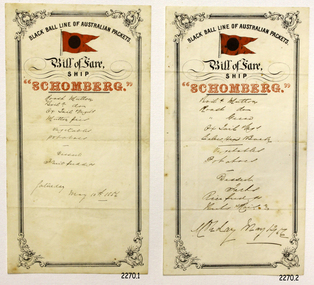
Document - Menu, Bill of Fare ship Schomberg, circa 1855 - May 12 1856
... Due in large part to Forbes regarding a card game as more important than his ship, SCHOMBERG eventually ran aground on a sand spit near Curdie's Inlet (about 56 km west of Cape Otway) on 26 December 1855, 78 days after leaving Liverpool. The sand spit and the currents were not marked on Forbes’s map. Overnight, the crew launched a lifeboat to find a safe place to land the ship’s passengers. The scouting party...Due in large part to Forbes regarding a card game as more important than his ship, SCHOMBERG eventually ran aground on a sand spit near Curdie's Inlet (about 56 km west of Cape Otway) on 26 December 1855, 78 days after leaving Liverpool. The sand spit and the currents were not marked on Forbes’s map. Overnight, the crew launched a lifeboat to find a safe place to land the ship’s passengers. The scouting party ...A “Bill of Fare” is a menu or list of food offered for a meal. This Bill of Fare from the sailing ship Schomberg is handwritten in pen in hard-to-read script on the printed pages specifically for the Schomberg ship, of the Black Ball Line of Australian Packets. (‘Packets’ were vessels that had a regular trade run of cargo, passengers and mail; the sailing ship Schomberg was designed for long voyages between England and Australia.) These menus posed a puzzle as they have the handwritten dates of, May 10 and 12, 1856, by which time the Schomberg had sunk (she sunk on December 26, 1855). The donor of these pages of Bill of Fare is a stamp collector from Melbourne. He came across the menus in a package that he bought in 1980 at a stamp auction in Tasmania. He decided to give the menus to Flagstaff Hill this year during his annual family holiday in Warrnambool. A 1981 newspaper article about this donation included an interview with Flagstaff Hill’s curator Mr Peter Ronald, who said that the stationery of these menus is genuine. He went on to say that there would have been much stationery printed for use on the Schomberg although she sank on her maiden voyage. These menus could have been written at a dated late because the surplus Schomberg stationery could have been used for menus on other ships. We will probably never be sure of the answer but none-the-less the pages are still connected to the Schomberg. Below is what we believe the menu consists of although some of the writing is indecipherable - - - - - - - - - - - - - - - - - - - - - - - - - - - - - - - - - - - - - (first menu) Roast Mutton Boiled Mutton? Ox Tail Mulligatawny? Or possibly Ox Tail Vegetables? Mutton Pies? ------------------------------- Vegetables Potatoes ---------------------------------- Dessert Fruit Puddings? Saturday May 10, 1856 - - - - - - - - - - - - - - - - - - - - - - - - - - - - - - - - - - - - AND - - - - - - - - - - - - - - - - - - - - - - - - - - - - - - - - - - - - (second menu) Boiled Mutton Roast Mutton? Roast Geese? Ox Tail?? Calves Head Broth? ------------------------------- Vegetables Potatoes ------------------------------- Dessert Tarts? Rice Pudding? ?...Maids?? Monday May 12, 1856 - - - - - - - - - - - - - - - - - - - - - - - - - - - - - - - - - - - - Background of “SCHOMBERG” When SCHOMBERG was launched in July, 1855, she was considered the “Noblest ship that ever floated on water.” SCHOMBERG’s owners, the Black Ball Line (one of three companies by that name), commissioned the ship for their fleet of passenger liners. She was built by Alexander Hall of Aberdeen, UK at a cost of £43,103. She was constructed with 3 skins: one planked fore and aft, and two diagonally planked, fastened together with screw threaded trunnels (wooden rails). Her first class accommodation was luxurious: velvet pile carpets; large mirrors; rosewood; birds-eye maple; mahogany; soft furnishings of gold satin damask; an oak-lined library; and a piano. Overall she had accommodation for 1000 passengers. SCHOMBERG’s 34 year old master, Captain James ‘Bully’ Forbes, had promised Melbourne in 60 days at the launch, "with or without the help of God." James Nicol Forbes was born in Aberdeen in 1821 and rose to fame with his record-breaking voyages on the famous Black Ball Line ships MARCO POLO and LIGHTNING. In 1852 in the MARCO POLO he made the record passage from London to Melbourne in 68 days. There were 53 deaths on the voyage but the great news was of the record passage by the master. In 1954 Captain Forbes took the clipper LIGHTNING to Melbourne in 76 days and back in 63 days, this was never beaten by a sailing ship. He often drove his crew and ship to breaking point to beat his own records. He cared little for the comfort of the passengers. On this, the SCHOMBERG’s maiden voyage, he was going to break records. SCHOMBERG departed Liverpool on her maiden voyage on 6 October 1855 flying the sign “Sixty Days to Melbourne”. She departed with 430 passengers and 3000 tons cargo including iron rails and equipment intended to build the Melbourne to Geelong Railway as well as a bridge over the Yarra from Melbourne to Hawthorn. She also carried a cow for fresh milk, pens for fowls and pigs, and 90,000 gallons of water for washing and drinking. SCHOMBERG also carried 17,000 letters and 31,800 newspapers. The ship and cargo was insured for $300,000, a fortune for the time. The winds were poor as she sailed across the equator, slowing SCHOMBERG’s journey considerably. Land was first sighted on Christmas Day, at Cape Bridgewater near Portland, and Captain Forbes followed the coastline towards Melbourne. Forbes was said to be playing cards when called by the Third Mate Henry Keen, who reported land about 3 miles off. Due in large part to Forbes regarding a card game as more important than his ship, SCHOMBERG eventually ran aground on a sand spit near Curdie's Inlet (about 56 km west of Cape Otway) on 26 December 1855, 78 days after leaving Liverpool. The sand spit and the currents were not marked on Forbes’s map. Overnight, the crew launched a lifeboat to find a safe place to land the ship’s passengers. The scouting party returned to SCHOMBERG and advised Forbes that it was best to wait until morning because the rough seas could easily overturn the small lifeboats. The ship’s Chief Officer spotted the steamer SS QUEEN at dawn and signalled it. The master of the SS QUEEN approached the stranded vessel and all of SCHOMBERG’s passengers and crew were able to disembark safely. The SCHOMBERG was lost and with her, Forbes’ reputation. The Black Ball Line’s Melbourne agent sent a steamer to retrieve the passengers’ baggage from the SCHOMBERG. Other steamers helped unload her cargo until the weather changed and prevented the salvage teams from accessing the ship. Later one plunderer found a case of Wellington boots, but alas, all were for the left foot! Local merchants Manifold & Bostock bought the wreck and cargo, but did not attempt to salvage the cargo still on board the ship. They eventually sold it on to a Melbourne businessman and two seafarers. In 1864 salvage efforts were abandoned after two men drowned when they tried to reach SCHOMBERG. Parts of the SCHOMBERG were washed ashore on the south island of New Zealand in 1870, nearly 15 years after the wreck. The wreck of the SCHOMBERG lies in almost 9 metres of water. Although the woodwork is mostly disintegrated, the shape of the ship can still be seen due to the remaining railway irons, girders and the ship’s frame. A variety of goods and materials can be seen surrounding the wreck, by divers. Flagstaff Hill holds many items salvaged from the SCHOMBERG including a ciborium (in which a diamond ring was concealed in concretion), communion set, ship fittings and equipment, personal effects, a lithograph, tickets and photograph from the SCHOMBERG. These Bills of Fare are significant due to their connection to Flagstaff Hill’s collection of artefacts from the Schomberg, which is significant for its association with the Victorian Heritage Registered shipwreck S612. The collection is primarily significant because of the relationship between the objects, as together they have a high potential to interpret the story of the Schomberg. The Schomberg collection is archaeologically significant as the remains of an international passenger ship. The shipwreck collection is historically significant for representing aspects of Victoria’s shipping history and its potential to interpret sub-theme 1.5 of Victoria’s Framework of Historical Themes (living with natural processes). The collection is also historically significant for its association with the shipwreck and the ship, which was designed to be fastest and most luxurious of its day. The Schomberg collection meets the following criteria for assessment: Criterion A: Importance to the course, or pattern, of Victoria’s cultural history. Criterion B: Possession of uncommon, rare or endangered aspects of Victoria’s cultural history. Criterion C: Potential to yield information that will contribute to an understanding of Victoria’s cultural history. Menu, or Bill of Fare, on cream coloured stationery from the sailing vessel “Schomberg”. Two rectangular pieces of paper, each bears the printed words “Black Ball Line of Australian Packets, Bill of Fare, Ship, Schomberg”, a printed symbol of the Black Ball line (a black ball on a red flag) and a decorative border. Both pages are handwritten, in similar but different sized writing, with a Bill of Fare and a date, Page (1) dated May 10th 1856 and (2) dated May 12th ’56, (Both dates are AFTER the Schomberg sank in December 26th 1855.) Both pages have three fold lines spaced across their width. To be used for the return voyage.Printed on the pages ““BLACK BALL LINE OF AUSTRALIAN PACKETS.” “Bill of Fare, / SHIP / “SCHOMBERG”.” Handwritten list of food, and on one page “Saturday May 10 1856” and on the other page “Monday May 12” warrnambool, peterborough, shipwrecked coast, shipwreck coast, flagstaff hill maritime museum, flagstaff hill maritime village, maritime museum, great ocean road, flagstaff hill, sailing ship schomberg, shipwreck schomberg, black ball line of australian packets, bill of fare schomberg, menu schomberg 1856, food mid-1800’s, food on ships mid-1800’s, menu, may 10, 1856, may 12, 1856 -
 Flagstaff Hill Maritime Museum and Village
Weapon - Cannon, Alexander Hall and Son, c. 1855
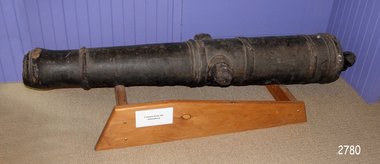
... Forbes was said to be playing cards when called by the Third Mate Henry Keen, who reported land about 3 miles off, Due in large part to the captain's regarding a card game as more important than his ship, it eventually ran aground on a sand spit near Curdie's Inlet (about 56 km west of Cape Otway) on 26 December 1855, 78 days after leaving Liverpool. The sand spit and the currents were not marked on Forbes’s map. Overnight, the crew launched a lifeboat to find a safe place to land the ship’s passengers. The scouting party...Forbes was said to be playing cards when called by the Third Mate Henry Keen, who reported land about 3 miles off, Due in large part to the captain's regarding a card game as more important than his ship, it eventually ran aground on a sand spit near Curdie's Inlet (about 56 km west of Cape Otway) on 26 December 1855, 78 days after leaving Liverpool. The sand spit and the currents were not marked on Forbes’s map. Overnight, the crew launched a lifeboat to find a safe place to land the ship’s passengers. The scouting party ...The Schomberg Cannon was recovered from the 1855 wreck of the SCHOMBERG in 1974 by Flagstaff Hill divers Peter Ronald, Colin Goodall and Gary Hayden. The wreck site was discovered in August 1973 by Stan McPhee and John Laidlaw. ABOUT THE SCHOMBERG When SCHOMBERG was launched in 1855, she was considered the “Noblest ship that ever floated on water.” SCHOMBERG’s owners, the Black Ball Line, commissioned the ship for their fleet of passenger liners. The ship was built by Alexander Hall of Aberdeen at a cost of £43,103. It was constructed with three skins: one planked fore and aft and two diagonally planked, fastened together with screw-threaded trunnels (wooden rails). Its first-class accommodation was simply luxurious; velvet pile carpets, large mirrors, rosewood, birds-eye maple, mahogany, soft furnishings of satin damask; an oak-lined library and a piano. Overall she had accommodation for 1000 passengers. At the launch, the SCHOMBERG’s 34-year-old master, Captain ‘Bully’ Forbes, had promised Melbourne in 60 days, "with or without the help of God." James Nicol Forbes was born in Aberdeen in 1821 and rose to fame with his record-breaking voyages on the famous Black Ball Line ships; MARCO POLO and LIGHTNING. In 1852 in the MARCO POLO he made the record passage from London to Melbourne in 68 days. There were 53 deaths on the voyage but the great news was of the record passage by the master. In 1954 Captain Forbes took the clipper LIGHTNING to Melbourne in 76 days and back in 63 days, this was never beaten by a sailing ship. He often drove his crew and ship to breaking point to beat his own records. He cared little for the comfort of the passengers. On this, the SCHOMBERG’s maiden voyage, he was going to break records. SCHOMBERG departed Liverpool on her maiden voyage on 6 October 1855 flying the sign “Sixty Days to Melbourne”. The ship departed with 430 passengers and 3000 tons of cargo including iron rails and equipment intended to build the Melbourne to Geelong Railway and a bridge over the Yarra from Melbourne to Hawthorn. She also carried a cow for fresh milk, pens for fowls and pigs, and 90,000 gallons of water for washing and drinking. It also carried 17,000 letters and 31,800 newspapers. The ship and the cargo was insured for $300,000, a fortune in those times. The winds were poor as she sailed across the equator, slowing SCHOMBERG’s journey considerably. Land was first sighted on Christmas Day, at Cape Bridgewater near Portland, and Captain Forbes followed the coastline towards Melbourne. Forbes was said to be playing cards when called by the Third Mate Henry Keen, who reported land about 3 miles off, Due in large part to the captain's regarding a card game as more important than his ship, it eventually ran aground on a sand spit near Curdie's Inlet (about 56 km west of Cape Otway) on 26 December 1855, 78 days after leaving Liverpool. The sand spit and the currents were not marked on Forbes’s map. Overnight, the crew launched a lifeboat to find a safe place to land the ship’s passengers. The scouting party returned to SCHOMBERG and advised Forbes that it was best to wait until morning because the rough seas could easily overturn the small lifeboats. The ship’s Chief Officer spotted SS QUEEN at dawn and signalled the steamer. The master of the SS QUEEN approached the stranded vessel and all of SCHOMBERG’s passengers and crew were able to disembark safely. The SCHOMBERG was lost and with her, Forbes’ reputation. The Black Ball Line’s Melbourne agent sent a steamer to retrieve the passengers’ baggage from the SCHOMBERG. Other steamers helped unload her cargo until the weather changed and prevented the salvage teams from accessing the ship. Later one plunderer found a case of Wellington boots, but alas, all were for the left foot! Local merchants Manifold & Bostock bought the wreck and cargo, but did not attempt to salvage the cargo still on board the ship. They eventually sold it on to a Melbourne businessman and two seafarers. In 1864 after two of the men drowned when they tried to reach SCHOMBERG, salvage efforts were abandoned. Parts of the SCHOMBERG were washed ashore on the south island of New Zealand in 1870, nearly 15 years after the wreck. The wreck now lies in almost 9 metres of water. Although the woodwork is mostly disintegrated the shape of the ship can still be seen due to the remaining railway irons, girders and the ship’s frame. A variety of goods and materials can be seen scattered about nearby. Flagstaff Hill holds many items salvaged from the SCHOMBERG including a ciborium (in which a diamond ring was concealed), communion set, ship fittings and equipment, personal effects, a lithograph, tickets and a photograph from the SCHOMBERG. One of the SCHOMBERG bells was in the old Warrnambool Library. The Schomberg cannon is currently on loan to the Port Campbell Visitor Information Centre.The SCHOMBERG collection is of historical and archaeological significance at a State level, listed on the Victorian Heritage Register VHR S612. Flagstaff Hill’s collection of artefacts from the SCHOMBERG is significant for its association with the Victorian Heritage Registered shipwreck. The collection is primarily significant because of the relationship between the objects, as together they have a high potential to interpret the story of the SCHOMBERG. The SCHOMBERG collection is archaeologically significant as the remains of an international passenger ship. The shipwreck collection is historically significant for representing aspects of Victoria’s shipping history and its potential to interpret sub-theme 1.5 of Victoria’s Framework of Historical Themes (living with natural processes). The collection is also historically significant for its association with the shipwreck and the ship, which was designed to be the fastest and most luxurious of its day. The SCHOMBERG collection meets the following criteria for assessment: Criterion A: Importance to the course, or pattern, of Victoria’s cultural history. Criterion B: Possession of uncommon, rare or endangered aspects of Victoria’s cultural history. Criterion C: Potential to yield information that will contribute to an understanding of Victoria’s cultural history.Cannon; 6-POUNDER (6pdr) smooth bore cannon, mounted on a wooden frame. The cannon has a metal lug on each side. It is commonly known as the Schomberg cannon. It was recovered from the wreck of the Schomberg in 1974.warrnambool, flagstaff-hill, flagstaff-hill-maritime-museum, maritime-museum, shipwreck-coast, flagstaff-hill-maritime-village, schomberg, shipwrecked-artefact, clipper ship, black ball line, 1855 shipwreck, aberdeen clipper ship, captain forbes, peterborough shipwreck, ss queen, cannon, the schomberg cannon, schomberg cannon, peterborough, 1855, sailing ship -
 Flagstaff Hill Maritime Museum and Village
Functional object - Keg Spigot/Tap, Circa 1855
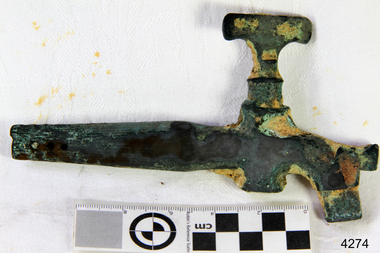
... Due in large part to the captain's regarding a card game as more important than his ship, it eventually ran aground on a sand spit near Curdie's Inlet (about 56 km west of Cape Otway) on 26th December 1855, 78 days after leaving Liverpool. The sand spit and the currents were not marked on Forbes's map. Overnight, the crew launched a lifeboat to find a safe place to land the ship’s passengers. The scouting party...Due in large part to the captain's regarding a card game as more important than his ship, it eventually ran aground on a sand spit near Curdie's Inlet (about 56 km west of Cape Otway) on 26th December 1855, 78 days after leaving Liverpool. The sand spit and the currents were not marked on Forbes's map. Overnight, the crew launched a lifeboat to find a safe place to land the ship’s passengers. The scouting party ...When the Schomberg was launched in 1855, she was considered the "Noblest” ship that ever floated on the water. Schomberg's owners, the Black Ball Line had commissioned the ship for their fleet of passenger liners. She was built by Alexander Hall of Aberdeen for £43,103 and constructed with 3 skins. One planked fore and aft and two diagonally planked, fastened together with screw-threaded trunnels (wooden rails). Her First Class accommodation was simply luxurious with velvet pile carpets, large mirrors, rosewood, birds-eye maple and mahogany timbers throughout, soft furnishings of satin damask, and oak-lined library with a piano. Overall she had accommodation for 1000 passengers. At the launch, the Schomberg's 34-year-old master, Captain 'Bully' Forbes, had promised to reach Melbourne in sixty days stating, "with or without the help of God." Captain James Nicol Forbes was born in Aberdeen in 1821 and rose to fame with his record-breaking voyages on the famous Black Ball Line ships; Marco Polo and Lightning. In 1852 in the Marco Polo, he made the record passage from London to Melbourne in 68 days. Unfortunately, there were 53 deaths on the voyage, but the great news was off the record passage by Captain Forbes. In 1854 he took the clipper “Lighting” to Melbourne in 76 days and back in 63 days, this record was never beaten by a sailing ship. He often drove his crew and ship to breaking point to beat his previous records. He cared little for the comfort of the passengers. On this, the Schomberg's maiden voyage, he was determined to break existing records. Schomberg departed Liverpool on her maiden voyage on 6th October 1855 flying a sign that read "Sixty Days to Melbourne". She departed with 430 passengers and 3000 tons cargo including iron rails and equipment intended to build the Melbourne to Geelong Railway and a bridge over the Yarra from Melbourne to Hawthorn. She also carried a cow for fresh milk, pens for fowls and pigs, 90,000 gallons of water for washing and drinking. She also carried 17,000 letters and 31,800 newspapers. The ship and cargo were insured for $300,000 a fortune for the time. The winds were poor as she sailed across the equator, slowing Schomberg's journey considerably. The land was first sighted on Christmas Day, at Cape Bridgewater near Portland, Captain Forbes followed the coastline towards Melbourne. Forbes was said to be playing cards when called by the third mate Henry Keen, who reported land about 3 miles off. Due in large part to the captain's regarding a card game as more important than his ship, it eventually ran aground on a sand spit near Curdie's Inlet (about 56 km west of Cape Otway) on 26th December 1855, 78 days after leaving Liverpool. The sand spit and the currents were not marked on Forbes's map. Overnight, the crew launched a lifeboat to find a safe place to land the ship’s passengers. The scouting party returned to Schomberg and advised Forbes that it was best to wait until morning because the rough seas could easily overturn the small lifeboats. The ship’s Chief Officer spotted the SS Queen at dawn and signalled the steamer. The master of the Queen approached the stranded vessel and all of Schomberg’s passengers and crew disembarked safely. The Black Ball Line's Melbourne agent sent a steamer to retrieve the passengers' baggage from the Schomberg. Other steamers helped unload her cargo until the weather changed and prevented the salvage teams from accessing the ship. Later one plunderer found a case of Wellington boots, but alas, all were for the left foot. Local merchants Manifold & Bostock bought the wreck and cargo but did not attempt to salvage the cargo still on board the ship. They eventually sold it on to a Melbourne businessman and two seafarers. In 1864 after two of the men drowned when they tried to reach Schomberg, salvage efforts were abandoned. In 1870, nearly 15 years after the wreck parts of the Schomberg had washed ashore on the south island of New Zealand. The wreck now lies in almost 9 metres of water and although the woodwork is mostly disintegrated the shape of the ship can still be determined due to the remaining railway irons, girders and the ship’s frame. A variety of goods and materials can be seen scattered about nearby. There have been many other artefacts salvaged from the wreck include ship fittings and equipment, personal effects, a lithograph, tickets and photographs from the Schomberg. This item was retrieved from the shipwreck site during early salvage efforts on the vessel. And was donated to the Flagstaff Hill collection of Schomberg shipwreck artefacts.This artifact is particularly significant in that along with other items salvaged from the wreck have helped in part to having legislation changed to protect shipwrecks, with far tighter controls being employed to oversee the salvaging of wreck sites. This item forms part of the Schomberg collection at Flagstaff Hill maritime museum. The collection as a whole is of historical and archaeological significance at a State level. Flagstaff Hill’s collection of artefacts from the Schomberg is also significant for its association with the Victorian Heritage Registered Schomberg shipwreck (VHR S 612). The collection is of additional significance because of the relationship between the objects salvaged, as together they help us to interpret the story of the Schomberg. The collection as a whole is historically significant for representing aspects of Victoria's maritime history and its potential to interpret social and historical themes from society at the time of the wreck. Brass keg spigot valve/tap, Schomberg Artifact Reg No S/94.Nonewarrnambool, flagstaff-hill, flagstaff-hill-maritime-museum, maritime-museum, shipwreck-coast, flagstaff-hill-maritime-village, schomberg, shipwrecked-artefact, clipper ship, black ball line, 1855 shipwreck, aberdeen clipper ship, captain forbes, peterborough shipwreck, ss queen, keg tap, brass keg tap -
 Federation University Historical Collection
Newspaper - Newsclippings, Tantanoola Tiger Newsclippings
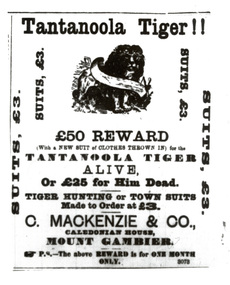
... (From a card produced by the Tantanoola Tiger Hotel, where the 'tiger' is on display.) australian animal folklore collection tantanoola tiger tom donovan herbert allchurch charles edmunson sheep charlie edmunson mythical myth folklore A collection of Newsclippings from 1892 - 1895 photocopied onto A4 white paper. The clippings relate to the Tantanoola Tiger. Clippings include: * Border Watch 1892 - Tantanoola Tiger Reward * Sydney Morning Herald, 04/07/1857 - Animals in Zoological Gardens, including a number of large cats. * Claims the Tantanoola Tiger was an escaped circus animal (ie The Advertiser [Adelaide], 31 October 1893) * Search parties for the Tantanoola Tiger (ie Barrier Miner 19/05/1893; Barrier Miner 03/1081893) * Thylacine claim (ie Morning Bulletin [Rockhampton] 11/03/1895 * Afghan and Indian Hunters (ie Barrier Miner 07/02/1895) * Sighting by John Bird of Scarsdale - Wanganui Herald 15/12/1900. " ... ...In the early 1880s a small circus travelled between Millicent and Mt Gambier, South Australia. After camping overnight they discovered their Bengal Tiger at escaped and disappeared into dense scrub. After searching for hours they continued to Mt Gambier and reported the loss of the tiger to police. Police and local volunteers continued the search for the escaped tiger, but no sighting were made. In the early 1890s sheep in the Tantanoola area started to disappear with the still unsighted tiger being blamed. In 1893 reports of an unusual animal in the Tantanoola area started, with many describing the animal as the missing tiger, or a large dog. One eye witness claimed to have seen the animal carrying a full grown sheep in its mouth. The reports grew in number and exaggeration with sightings from Robe to Bendigo. In the Tantanoola district children were escorted with shotgun guards to and from school, with many homes keeping guns at the ready in case the tiger suddenly appeared. In August 1895 Tom Donovan shot the "Tantanoola Tiger" on Mt Salt Station, around 20 kms south of Tantanoola. The corpse was taken to Marks, a Mount Gambier taxidermist, at which time the animal was identified as an Assyrian or Northern Russian Wolf. Donovan displayed the animal far and wide. Despite the animal's death sheep continued to disappear from properties in the district over many years. It was of particular concern between 1909 and 1910. At that time Herbert Allchurch, an Adelaide detective, was sent to solve the mystery. A few days after his arrival Allchruch went to the front bar of the Tiger Hotel and arrested local rabbit shooter and trapper, Charlie Edmunson, with sheep stealing. After his 1911 trial Edmunson admitted to stealing over 4,000 sheep during the previous 20 years. He was gaoled for six years with hard-labour in January 1911. Edmunson had been selling the skins of the stolen sheep, leaving the carcusses to rot. He earned around five pounds per week during the 1990s and early 1900s, a time when the economy was depressed. It is not known had the animal known as the Tantanoola Tiger came to Australia, but it is believed it survived one of three ships wrecked of the coast between 1890 and 1893, making it to shore along with some of the shipwrecked passengers. (From a card produced by the Tantanoola Tiger Hotel, where the 'tiger' is on display.)A collection of Newsclippings from 1892 - 1895 photocopied onto A4 white paper. The clippings relate to the Tantanoola Tiger. Clippings include: * Border Watch 1892 - Tantanoola Tiger Reward * Sydney Morning Herald, 04/07/1857 - Animals in Zoological Gardens, including a number of large cats. * Claims the Tantanoola Tiger was an escaped circus animal (ie The Advertiser [Adelaide], 31 October 1893) * Search parties for the Tantanoola Tiger (ie Barrier Miner 19/05/1893; Barrier Miner 03/1081893) * Thylacine claim (ie Morning Bulletin [Rockhampton] 11/03/1895 * Afghan and Indian Hunters (ie Barrier Miner 07/02/1895) * Sighting by John Bird of Scarsdale - Wanganui Herald 15/12/1900. " ... Mr Bird was travelling on foot along a lonely track through very dense scrub, when he was stricken with amazement to see a full-grown tiger standing in a small dam about 30ft away, and holding in its jaws the carcass of a newly-killed lamb. He remained long enough to thoroughly take in the animals appearance, and then beat a hasty retreat unmolested. His description of the animal is as follows: A tawny-coloured creature, with a dirty mottled skin; in general appearance like an immense cat; body 4ft long, and of a uniform thickness from shoulder to hindquarters; in bulk equal to a very large pig. The legs were hidden in the water. A similar animal is reported to gave been seen near Canico, some miles away. ..." * Victorian country sightings # Bullarto - Argus 06/05/1905 # Dean - Launceston Examiner 28/01/1895 # Bendigo - Hobart Mercury 15/03/1895 # Ballan - Launceston Examiner 03/08/1895 * South Australian register 17/06/1885 " There is a tiger or panther wandering at large in Victoria, according to a rumour. It has taken the place of the Bunyip, whom hundreds have seen but none captured. This tiger is supposed to have broken loose from a travelling menagerie in the North-eastern district. At the beginning we should like it roved that such an escape ever took place. Perhaps the showmen were afraid to report the fact to the police; at any rate they did not do so. The first story about the tiger being seen came from the neighborhood of Wangaratta, 60 miles from the place where it is said to have commenced business on its own account. He was followed, but vanished among trees. Next we hear of a strange animal, bigger than a St Bernard's dog, but shorter legged, having appeared at least 150 miles from Wangaratta. Between Lilydale and Wangaratta there is a dividing range 2,000 feet high in the lowest past, besides several large rivers. An finally, the tiger - changed from a panther - is reported as having been seen within the suburban circle, about 8 miles from the general Post Office. They show you footprints, and point to the carcasses of mangled cows and calves. Casts have been taken of the footprints for examination by scientific men, who pronounce them doglike, and yet not doglike, but panther-like, which gives a nervous turn, for the panther may take up killing children and grown-up people. One tiger will not account for so many apparitions. There must have been a general strike among the menageries, and a breaking-up companies. ... * Research article by Philip A. Clarke "Indigenous Spirit and Ghost Folklore of 'Settled' Australia. australian animal folklore collection, tantanoola tiger, tom donovan, herbert allchurch, charles edmunson, sheep, charlie edmunson, mythical, myth, folklore -
 Federation University Historical Collection
Letter - Correspondence, Walter M. Hitchcock, Letters from Walter M. Hitchcock concerning a model of a Ballarat tent (and more), 1911, 1911 (exact)
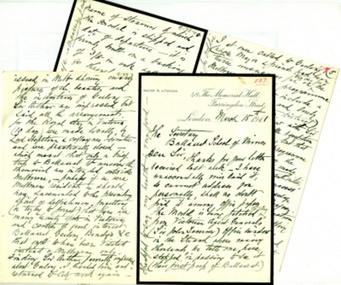
... Hitchcock regarding the death of James Oddie and early gold mining at Ballarat, 1910 and 1911 48 The Memorial Hall Farringdon St London Dec1/10 The Secretary Ballarat Museum Dear Sir, I am just now sending you this line, i anticipation of further correspondence later on, simply to forward you a Post Card of the 1st mining tent erected 1851 on the site of he then newly proclaimed Township of Ballarat, which, as the sole survivor of the party who built the original, I have had the pleasure in making, and have decided to present it to your museum, Sir Jno Lasenor out Agent General for Victoria came to a Bazaar recently held in London. where I had it on view in the museum from 3 days, - and desired I would allow its [ ? ...Hitchcock regarding the death of James Oddie and early gold mining at Ballarat, 1910 and 1911 48 The Memorial Hall Farringdon St London Dec1/10 The Secretary Ballarat Museum Dear Sir, I am just now sending you this line, i anticipation of further correspondence later on, simply to forward you a Post Card of the 1st mining tent erected 1851 on the site of he then newly proclaimed Township of Ballarat, which, as the sole survivor of the party who built the original, I have had the pleasure in making, and have decided to present it to your museum, Sir Jno Lasenor out Agent General for Victoria came to a Bazaar recently held in London. where I had it on view in the museum from 3 days, - and desired I would allow its [ ? ...The tent model mentioned in the letters was displayed in the Ballarat School of Mines Museum. During the 1960s it was transferred to the Ballarat Historical Society. Two handwritten letters on paper with black mourning edge written by Walter M. Hitchcock to the Ballarat School of Mines, and another written by Walter's brother George M. Hitchcock.Letter transcription follow: Letter from Walter M. Hitchcock regarding the death of James Oddie and early gold mining at Ballarat, 1910 and 1911 48 The Memorial Hall Farringdon St London Dec1/10 The Secretary Ballarat Museum Dear Sir, I am just now sending you this line, i anticipation of further correspondence later on, simply to forward you a Post Card of the 1st mining tent erected 1851 on the site of he then newly proclaimed Township of Ballarat, which, as the sole survivor of the party who built the original, I have had the pleasure in making, and have decided to present it to your museum, Sir Jno Lasenor out Agent General for Victoria came to a Bazaar recently held in London. where I had it on view in the museum from 3 days, - and desired I would allow its [ ? ] exhibited in the first large window of the beautiful new building of the Victoria Agency situate in the Strand. It is there for the past few days and he may wish it to remain a week or two longer, I know of no other exhibition of it to delay it being packed and shipped to my relatives in Geelong (Mr [?] Bright of Hitchock's Firm) who may wish to show it in one of their windows before forwarding it to your museum - I have had an itemised pane glass case made for it with drop down end and [?} it stands on a plateau of moss, to represent grass 32 x 13 x 13 high and chimney 14 1/2 - the case is made 34 x 26 x 20 high inside - I shall have it very carefully packed - tent emptied tools, beds, &c &c in separate packing and insured for 50 pounds - I will send you full details later on. I hope and believe your President will accept it in due time Meantime believe me to be very truly Cat Walter Hitchcock G.F.B. 48 The Memorial Hall Farringdon St London March 15th 1911 The Secretary Ballarat School of Mines Dear Sir, Thanks for your letter received last week – I have unaccountably mislaid it, so cannot address you personally, shall no doubt find it among office papers. The model is being fetched today from Victorian Agent General’s (Sir John [Lavernor?] office window in the Strand where many thousands, he tells me, have stopped in passing to see it (their first peep of Ballaarat). It will be on view at Blackheath (Kent) for a week, then packed and shipped without further delay. I shall enclose in the glass case (which is 26 x 34 x 16 in high) some spare minced moss and gas (smoke) in case in transit the plateau suffers by shaking (though it is well glued down). All the tools, mining appliances, cradle, windlass, &c will be separately packed enclosed – which you can easily place in respective positions. HRH Prince of Wales has graciously accepted a photo of it – and in my letter to him when sending it for his acceptance I said – as he would probably ere long visit Australia as did his grandfather and father, which ought to (and certainly will) include at least a day or two in seeing your beautiful City, and also something of your mines &c instead of the hurried visit of his father (2 hours) when he, as Duke of York, unveiled a statue to the memory of those slain in the sad Boer War, which now is admitted by almost everybody to have been a big political mistake, - though in the future with England’s present wise policy towards that country it will prove for Africa’s welfare. It may interest you to know that when I ascertained that Geelong was not to be visited by the Royal Pair – I went up to St James’s Palace by appointed time the Duke’s private Secy Sir Arthur Bigge – taking with me a specially illustrated paper issued in Melb. showing many pictures of the beauties and industries of Geelong – Sir Arthur was impressed but said all the arrangements for the Royal stay in Victoria (10 days) were made locally, by Lord Hopetoun and collegues and committee, and were practically closed – which meant that only a brief trip to Ballarat to uncover the memorial was intended outside Melbourne. Perhaps if we were Melbourne residents we should have succumbed to the prevailing spirit of selfishness – forgetting (or trying to forget) that there are many beauty spots in Victoria and centres of great interest - Ballarat, Geelong, Bendigo, &c that ought to have been visited instead of Melbourne only. Finding Sir Arthur favorably impressed about Geelong I thanked him and returned to City work again. I at once called to Geelong whose mayor and friends had been twice unsuccessful in trying for the Melbourne functions programme being altered to include a visit to Geelong and lovely spots in the Western District, reporting my interview with Sir A B and his favourable reception of my representations, but that any alteration to the programme of engagements during the Royal visit must be made locally and by the local authorities. This had the desired success for on receipt of my message the Geelong mayor and colleagues again reopened the question and went to Melbourne, resulting in a concession (but what an altogether inadequate one) and they graciously ? consented to the train, on its way with the Duke and Duchess to your city, to stop at the Geelong stn (15 minutes) and so it came about that by a hasty local effort, 3,000 school children, and not a few of the leading people including the Mayor &c were gathered to welcome them in Geelong. The National anthem being sung, an Address read and presented and kindly replied to. Now Ballarat should doubtless has influence. See to it when our P. Of Wales visits Victoria – an unselfish ¬ programme is fixed up – and HRH afforded ample opportunity of visiting leisurely your city, Geelong, Bendigo and other centres of beauty and importance. The Prince himself will be the gainer by such an equitable and enlightened programme, - and come back with all the more favourable views of the marvellous development ever since our family first settled in Geelong in 1850. A far preferable result of such a visit than night after night having Melbourne Banquets and the visiting of its undoubted attractions - whilst all the rest of the State remained unvisited. Such an official mistake must not be made again. I will write you again, stating name of steamer of which the model is shipped and date of departure – it is firmly built on a backing of 3/8 in oak tall uprights so through the 7/8 in plateau and am entrusting the packing be very careful. I expressed firm – so that except possibly any breakage in glass case – it should reach you in due time all right. The top of case will be screwed so that it can be readily removed temporarily to enable my [ ? ] firm to show it in one of their windows. Believe me Yours very truly Captn Walter M. Hitchcock My brother will deliver it on my a/c – all carriage paid. Mt very kind regards to my friend since 1850 Jas Oddie. University of Ballarat Historical Collection Cat. No. 8133.3 & .4 Letter from Walter M. Hitchcock regarding the death of James Oddie and early gold mining at Ballarat, 1911 48 The Memorial Hall Farringdon St London April 20th 1911 My Dear Sir, It is with no ordinary feeling of regret that I received the tidings of the death of my good friend, your fellow citizen for many years, Mr James Oddie. Living at Geelong from March 1850 I came to know him there as carrying on a foundry business in Ashby. With the discovery of gold at Ballarat started off almost of the working people, as well as of all other classes of the male population. Mr Oddie arrived in Ballarat I believe on or about September 1st 1851. My three comrades and I arrived October 1st 1851 – among the many thousands soon gathered within a mile or so of Golden Point – my friend Oddie and I often met. I returning to Geelong after a year mining – my friend on the other hand remaining at Ballarat ever since – a marvellous record, and I am sure his life has been one of unique value to your City in many ways, - his age (87) naturally prepared me for his call home – and only two mails before the news came I received from him on of his kindly chatty letters in which amongst other things – he referred with pleasure to having received from me two 10 x 12 photos – one being of my model and that he was arranging to have it placed in a shop window in your city. I am interested in the fact of your having known each of my three comrades of 1851/52. It was J.M. Garrett and I who got permission to conduct public Sunday morning service in their large Marquee – used all the week for issue of Licenses in the absence of any church buildings, and it being on wet Sundays impossible to have services as usual under the trees – Ballarat then was more like a Gentleman’s Park – than bush country – but the axe soon did its work – and all were felled for our cooking, and hencewith to make our kindling etc. Shafting of holes not being at first done because too shallow – our deepest (at Eureka) was only 115 ft. Bendigo I hear had now mines of 4,000 ft in depth (deeper than our tin or coal mines here). I fortunately have, in excellent state of preservation, my last of 12 licenses dated October 1 1852 and have recently purchased here a Miner’s Right dated 1864, to that when explaining on matters re Gold Licensing I can show sample of each. With kind regards Believe me Yours sincerely Walter M. Hitchcock Geelong June 20/11 Dear Sir, By rail to day through Messrs Bannister I send the model of miner’s tent packed in a case 50 donated by my brother Captain Walter M. Hitchcock of London. This model was made by my brother and represents the tent he worked in on the Ballarat Gold Fields in the year 1851 or 2. In a separate parcel a few extras omitted from the case. Please send me receipts in duplicate, one for my brother, the other for the Customs, Geelong, as being donated to your institution, after some little correspondence it was admitted [??] any payment for duty. You probably have my brother’s address and would like to acknowledge its arrival, direct. I hope it is in good order. I did not open it for show in Geelong, as there would be less risk of breakage on repacking. With kind remembrances. I am Yours Faithfully Geo. M. Hitchcock. A Mr G. F. B. Sharick who is living near my home called in to see my model – he said he knew FM [Fred Martell] and was lately at Ballaratballarat school of mines, frederick martell, fred martell, james oddie, walter m hitchcock, walter hitchcock, f m garratt, george hitchcock, hitchcock, golden point, gold discovery, j m garrett, gold license, j.m. garrett, t.m. hall, george m. hitchcock, f.m. garratt, walter m. hitchcock -
 Federation University Historical Collection
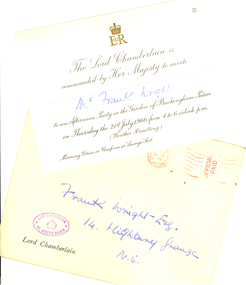
Invitation, Frank Wright's invitation to a garden party at Buckingham Palace, 1960, 1960
... Party in the Garden of Buckingham Palace on Thursday the 21st July 1960, from 4 to 6 o'clock p.m. (Weather Permitting) Morning Dress or Uniform or Lounge Suit. Written in blue ink- Mr. Frank Wright 2). Written in blue ink on front - Frank Wright Esq, 14. Highbury Grange, N.S Stamped on front - Lord Chamberlain's insignature, St James's Palace on bottom corner 1). Card ...Frank Wright was a renown resident of Smeaton, where he was born on 2 August 1901. He lived at Laura Villa, and attended Smeaton State School. His father William was a gold miner and his mother's name was Sarah. Their family won many singing and instrumental awards. Frank was tutored by Percy Code and was awarded a gold medal for the highest marks in the ALCM examinations in the British Colonies at the age of seventeen years. He became the Australian Open Cornet Champion by the age of eighteen. A year later, Frank conducted the City of Ballarat Band, and later the Ballarat Soldiers’ Memorial Band. He formed the Frank Wright Frisco Band and Frank Wright and his Coliseum Orchestra. These bands won many South Street awards, and Frank as conductor won many awards in the Australian Band Championship contest. In 1933 Frank Wright sailed to England to conduct the famous St Hilda’s Band and was later appointed Musical Director of the London County Council, where he organized many amazing concerts in parks, in and around the London district. He was made Professor of Brass and Military Band Scoring and conducted at the Guildhall of Music and Drama. Frank was often invited to adjudicate Brass Band Championships around Europe, in Australia, including South Street and in New Zealand. The Frank Wright Medal at the Royal South Street competition is awarded to an individual recognized as making an outstanding contribution to brass music in Australia.1). Card invitation printed in black script with the royal insignature in gold. 2). Envelope with the Lord Chamberlain's insignature stamped on bottom corner and an address written in blue ink.1). Printed - The Lord Chamberlain is commanded by Her Magesty to invite ...to an Afternoon Party in the Garden of Buckingham Palace on Thursday the 21st July 1960, from 4 to 6 o'clock p.m. (Weather Permitting) Morning Dress or Uniform or Lounge Suit. Written in blue ink- Mr. Frank Wright 2). Written in blue ink on front - Frank Wright Esq, 14. Highbury Grange, N.S Stamped on front - Lord Chamberlain's insignature, St James's Palace on bottom corner frank wright, invitation, lord chamberlain, envelope -
 Federation University Historical Collection
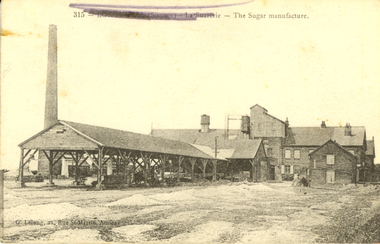
Postcard, G. Lelong, The Sugar Manufacture, Somme, France, c1917, c1917
... card: Dear Violet, received photos and letters and thank you for forwarding same. Are we having lovely spell of weather. This morning is quite warm and pleasant. The photo of you all standing in front of your house is a good one and you all look to be getting enough to eat. Mother looks as if she it getting stronger after her severe illness. Your concert party...card: Dear Violet, received photos and letters and thank you for forwarding same. Are we having lovely spell of weather. This morning is quite warm and pleasant. The photo of you all standing in front of your house is a good one and you all look to be getting enough to eat. Mother looks as if she it getting stronger after her severe illness. Your concert party ...This postcard was sent from France during World War One WW1 to Violet Holmes [mother and aunty of other WW1 soldiers], by the son of a neighbouring Ascot Tourello District Family, the Wrigley Family. Violet inherited "Sauchieburn" an Ascot property on the death of her husband William Holmes in 1914. On her death this property was to be left to their 4 children and administered by a relative till the youngest child turned 27. As young boys, Violet's husband William, and his brother Henry, lived with their Aunt Catherine Coghill and Uncle William Coghill at ‘Sauchieburn’ Ascot. The Coghills had no children of their own. He and his brother Edward started a stock and station business at Clunes. Henry and Violet Holmes subsequently inherited "Sauchieburn" from Catherine (nee Holmes) and William Coghill, direct descendants of the Coghills Creek, Ascot, Tourello pioneer settler Captain William Coghill [Jane Dyer, May 2024] Catherine and her brother Edward Carter Holmes drowned at sea.This is an extract from the Korumburra Times, Wednesday June 6, 1956: The fated travellers wrecked off N.S.W. ‘On May 29th, 1886 in bright moonlight the Ly-e-Moon, the pride of the Australian coastal fleet, broke her back on the treacherous rocks of Green Cape, off the NSW coast. Eighty souls perished within range of the beacon rays of the lighthouse, including representatives of the earliest families ever to settle in Poowong. The passengers. On the main deck, Mr Edward Holmes, a Poowong grazier and former owner of ‘Wombalano’. He had sold this property with the object of going to Queensland and settling there. The proceeds of sale amounting to 1,200 pounds in gold sovereigns were under lock and key in the Purser's Office. Mr Holmes, although advanced in years, had unformed plans to invest his money in some Queensland enterprise. In the meantime he would visit his married daughter and [his] two sons, who had previously settled in Queensland. With him on board was his widowed sister Mrs Coghill who had also accepted an invitation to go north. News of the shipwreck, means of communication being slow, did not reach Korumburra for nearly a week. By then all hope had been abandoned for the missing. Relations and friends thronged the Melbourne shipping office, but the answer was always the same - All passengers unaccounted for were presumed drowned. Black and white postcard of a sugar refinery in The Somme, France. The name of the town has been scrubbed out in purple pencil by a censor during World War One. The back of the card is written on in pencil,Written on back of card: Dear Violet, received photos and letters and thank you for forwarding same. Are we having lovely spell of weather. This morning is quite warm and pleasant. The photo of you all standing in front of your house is a good one and you all look to be getting enough to eat. Mother looks as if she it getting stronger after her severe illness. Your concert party will be broken up through the Vale girls leaving but you should have no difficulty in finding volunteers to fill the ranks. By all of your letters you are all looking forward to the day we return 9as we are). I wouldn't like to bet too much that we would be home by this time next year [ ? ] by the way fritz is fighting lately he would very much like to get [peace?] I think we will give him all he wants this summer. J. Waller was here last night is looking well. With best wished to you all. I am sincerely. [W.Wrigbee? Wrigley]somme, la suererie, chatham family collection, amiens, france, world war 1, postcard, ly-ee-moon, william coghill junior, ascot victoria, pioneers of ascot, shipwreck -
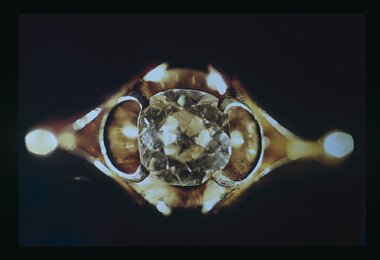 Flagstaff Hill Maritime Museum and Village
Accessory - Diamond ring, about 1855
... Due in large part to the captain's regarding a card game as more important than his ship, it eventually ran aground on a sand spit near Curdie's Inlet (about 56 km west of Cape Otway) on 26th December 1855, 78 days after leaving Liverpool. The sand spit and the currents were not marked on Forbes's map. Overnight, the crew launched a lifeboat to find a safe place to land the ship’s passengers. The scouting party...Due in large part to the captain's regarding a card game as more important than his ship, it eventually ran aground on a sand spit near Curdie's Inlet (about 56 km west of Cape Otway) on 26th December 1855, 78 days after leaving Liverpool. The sand spit and the currents were not marked on Forbes's map. Overnight, the crew launched a lifeboat to find a safe place to land the ship’s passengers. The scouting party ...In 1975, 120 years after the sailing ship Schomberg was wrecked, Flagstaff Hill divers (Peter Ronald, Colin Goodall and Gary Hayden) found an ornate communion set amongst the wreckage. The set comprised a jug, ciborium, lid, chalice and plate. The items, apart from the lid, were then displayed at Flagstaff Hill Maritime Village. The lid had etchings that did not match the chalice and sat in storage for several years. Then in 1978, while the marine concretion inside the lid was being examined, a surface layer came loose and revealed a glint of gold that was assumed to be a piece of brass. The layers of concretion were carefully removed and a ring-like band emerged. Further treatment exposed a 'large faceted stone in an intricate gold setting. Weeks later a detailed examination estimated the value of the ring, known as the Schomberg Diamond, to be $7000. When the Schomberg was launched in 1855, she was considered the "Noblest” ship that ever floated on the water. Schomberg's owners, the Black Ball Line had commissioned the ship for their fleet of passenger liners. She was built by Alexander Hall of Aberdeen at a cost of £43,103 and constructed with 3 skins. One planked fore and aft and two diagonally planked, fastened together with screw-threaded trunnels (wooden rails). Her First Class accommodation was simply luxurious with velvet pile carpets, large mirrors, rosewood, birds-eye maple and mahogany timbers throughout, soft furnishings of satin damask, an oak-lined library with a piano. Overall she had accommodation for 1000 passengers. At the launch, the Schomberg's 34-year-old master, Captain 'Bully' Forbes, had promised to reach Melbourne in sixty days stating, "with or without the help of God." Captain James Nicol Forbes was born in Aberdeen in 1821 and rose to fame with his record-breaking voyages on the famous Black Ball Line ships; Marco Polo and Lightning. In 1852 in the Marco Polo, he made the record passage from London to Melbourne in 68 days. Unfortunately there were 53 deaths on the voyage, but the great news was off the record passage by Captain Forbes. In 1854 he took the clipper “Lighting” to Melbourne in 76 days and back in 63 days, this record was never beaten by a sailing ship. He often drove his crew and ship to breaking point to beat his previous records. He cared little for the comfort of the passengers. On this, the Schomberg's maiden voyage, he was determined to break existing records. Schomberg departed Liverpool on her maiden voyage on 6th October 1855 flying a sign that read "Sixty Days to Melbourne". She departed with 430 passengers and 3000 tons cargo including iron rails and equipment intended to build the Melbourne to Geelong Railway and a bridge over the Yarra from Melbourne to Hawthorn. She also carried a cow for fresh milk, pens for fowls and pigs, 90,000 gallons of water for washing and drinking. She also carried 17,000 letters and 31,800 newspapers. The ship and cargo were insured for $300,000 a fortune for the time. The winds were poor as she sailed across the equator, slowing Schomberg's journey considerably. Land was first sighted on Christmas Day, at Cape Bridgewater near Portland, Captain Forbes followed the coastline towards Melbourne. Forbes was said to be playing cards when called by the third mate Henry Keen, who reported land about 3 miles off. Due in large part to the captain's regarding a card game as more important than his ship, it eventually ran aground on a sand spit near Curdie's Inlet (about 56 km west of Cape Otway) on 26th December 1855, 78 days after leaving Liverpool. The sand spit and the currents were not marked on Forbes's map. Overnight, the crew launched a lifeboat to find a safe place to land the ship’s passengers. The scouting party returned to Schomberg and advised Forbes that it was best to wait until morning because the rough seas could easily overturn the small lifeboats. The ship’s Chief Officer spotted the SS Queen at dawn and signaled the steamer. The master of the Queen approached the stranded vessel and all of Schomberg’s passengers and crew disembarked safely. The Black Ball Line's Melbourne agent sent a steamer to retrieve the passengers' baggage from the Schomberg. Other steamers helped unload her cargo until the weather changed and prevented the salvage teams from accessing the ship. Later one plunderer found a case of Wellington boots, but alas, all were for the left foot. Local merchants Manifold & Bostock bought the wreck and cargo but did not attempt to salvage the cargo still on board the ship. They eventually sold it on to a Melbourne businessman and two seafarers. In 1864 after two of the men drowned when they tried to reach Schomberg, salvage efforts were abandoned. In 1870, nearly 15 years after the wreck parts of the Schomberg had washed ashore on the south island of New Zealand. The wreck now lies in almost 9 meters of water and although the woodwork is mostly disintegrated the shape of the ship can still be determined due to the remaining railway irons, girders and the ship’s frame. A variety of goods and materials can be seen scattered about nearby. The actual lid in which the ring was found has not yet been completely identified and could belong to a coffee pot, sugar bowl or maybe a jug or something similar. Although all survived the wreck no-one came forward to claim the valuable diamond. The Schomberg Diamond is currently on display in the Great Circle Gallery. Flagstaff Hill Maritime Village along with the rest of the communion set. Other artefacts salvaged from the wreck include ship fittings and equipment, personal effects, a lithograph, tickets and photographs from the Schomberg. One of the Schomberg bells is in the Warrnambool Library.The Schomberg Diamond is particularly significant in that it played a crucial part in having the legislation changed to protect shipwrecks, with far tighter control over the salvaging of items from wreck sites. This ring is registered as Artefact S/105 in the Schomberg collection, the Schomberg collection as a whole is of historical and archaeological significance at a State level. Flagstaff Hill’s collection of artefacts from the Schomberg is also significant for its association with the Victorian Heritage Registered shipwreck (VHR S 612). The collection is of prime significant because of the relationship between the objects salvaged, as together they help us to interpret the story of the Schomberg. The collection as a whole is historically significant for representing aspects of Victoria's maritime history and its potential to interpret social and historical themes. A mid-Victorian gentleman's solitaire diamond dress ring with a Brazilian cut diamond (cushion cut), one and one-third carat set within an 18 carat yellow gold ring consisting of four claws within an open scroll setting and a divided scroll shank. Colour is classified as 'J', clarity SII. The setting is handmade. warrnambool, shipwrecked-coast, flagstaff-hill, flagstaff-hill-maritime-museum, maritime-museum, shipwreck-coast, flagstaff-hill-maritime-village, schomberg, shipwrecked-artefact, clipper ship, black ball line, 1855 shipwreck, aberdeen clipper ship, captain forbes, peterborough shipwreck, ss queen, ciborium, ring, schomberg-diamond, schomberg-ring, gentleman's ring, dress ring -
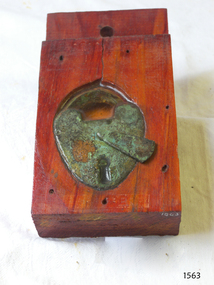 Flagstaff Hill Maritime Museum and Village
Functional object - Padlock, c. 1855
... Forbes was said to be playing cards when called by the Third Mate Henry Keen, who reported land about 3 miles off, Due in large part to the captain's regarding a card game as more important than his ship, it eventually ran aground on a sand spit near Curdie's Inlet (about 56 km west of Cape Otway) on 26 December 1855, 78 days after leaving Liverpool. The sand spit and the currents were not marked on Forbes’s map. The crew from the scouting party...Forbes was said to be playing cards when called by the Third Mate Henry Keen, who reported land about 3 miles off, Due in large part to the captain's regarding a card game as more important than his ship, it eventually ran aground on a sand spit near Curdie's Inlet (about 56 km west of Cape Otway) on 26 December 1855, 78 days after leaving Liverpool. The sand spit and the currents were not marked on Forbes’s map. The crew from the scouting party ...This padlock has been salvaged from the wrecked sailing ship SCHOMBERG. It is not known whether the padlock was a part of the ship’s equipment or if it was among personal effects or cargo. At some point in time the padlock has been mounted and sealed in resin, perhaps for both display and preservation purposes. ABOUT THE SCHOMBERG When SCHOMBERG was launched in 1855, she was considered the “Noblest ship that ever floated on water.” SCHOMBERG’s owners, the Black Ball Line, commissioned the ship for their fleet of passenger liners. She was built by Alexander Hall of Aberdeen. Overall, she had accommodation for 1000 passengers. SCHOMBERG’s 34-year-old master, Captain ‘Bully’ Forbes (James Nicol Forbes) was born in Aberdeen in 1821 and rose to fame with his record-breaking voyages on the famous Black Ball Line ships, MARCO POLO and LIGHTNING. On this, the SCHOMBERG’s maiden voyage, he was going to break records. SCHOMBERG departed Liverpool on 6 October 1855, flying the sign “Sixty Days to Melbourne”. She carried 430 passengers and 3000 tons of cargo, including iron rails and equipment intended to build the Melbourne to Geelong Railway and a bridge over the Yarra from Melbourne to Hawthorn. She also carried a cow for fresh milk, pens for fowls and pigs, 90,000 gallons of water for washing and drinking, 17,000 letters and 31,800 newspapers. The ship and cargo were insured for $300,000, a fortune for the time. The winds were poor as she sailed across the equator, slowing SCHOMBERG’s journey considerably. Land was first sighted on Christmas Day, at Cape Bridgewater near Portland, and Captain Forbes followed the coastline towards Melbourne. Forbes was said to be playing cards when called by the Third Mate Henry Keen, who reported land about 3 miles off, Due in large part to the captain's regarding a card game as more important than his ship, it eventually ran aground on a sand spit near Curdie's Inlet (about 56 km west of Cape Otway) on 26 December 1855, 78 days after leaving Liverpool. The sand spit and the currents were not marked on Forbes’s map. The crew from the scouting party advised Forbes to wait until morning before trying to take the passengers to safety in the lifeboats because the rough seas could easily overturn the small vessels. The ship’s Chief Officer spotted SS QUEEN at dawn and signalled the steamer. The master of the SS QUEEN approached the stranded vessel, and all of SCHOMBERG’s passengers and crew were able to disembark safely. The SCHOMBERG was lost and with her, Forbes’ reputation. The Black Ball Line’s Melbourne agent sent a steamer to retrieve the passengers’ baggage from the SCHOMBERG. Other steamers helped unload her cargo until the weather changed and prevented the salvage teams from accessing the ship. Later, one plunderer found a case of Wellington boots, but alas, all were for the left foot! Local merchants Manifold & Bostock bought the wreck and cargo, but did not attempt to salvage the cargo that was still on board the ship. They eventually sold it on to a Melbourne businessman and two seafarers. In 1864, after two of the men drowned when they tried to reach SCHOMBERG, salvage efforts were abandoned. Parts of the SCHOMBERG were washed ashore on the South Island of New Zealand in 1870, nearly 15 years after the wreck. The wreck now lies in almost 9 metres of water, and the shape of the ship can still be seen due to the remaining railway irons, girders and the ship’s frame. A variety of goods and materials can be seen scattered about nearby. Flagstaff Hill holds many items salvaged from the SCHOMBERG, including a ciborium (in which a diamond ring was concealed), communion set, ship fittings and equipment, personal effects, a lithograph, tickets, a menu and a photograph from the SCHOMBERG. This brass padlock is registered as an artefact in the SCHOMBERG collection. The SCHOMBERG collection as a whole is of historical and archaeological significance at a State level, listed on the Victorian Hertage Register VHR S612. Flagstaff Hill’s collection of artefacts from the SCHOMBERG is significant for its association with the Victorian Heritage Registered shipwreck. The collection is primarily significant because of the relationship between the objects, as together they have a high potential to interpret the story of the SCHOMBERG. The SCHOMBERG collection is archaeologically significant as the remains of an international passenger ship. The shipwreck collection is historically significant for representing aspects of Victoria’s shipping history and its potential to interpret sub-theme 1.5 of Victoria’s Framework of Historical Themes (living with natural processes). The collection is also historically significant for its association with the shipwreck and the ship, which was designed to be fastest and most luxurious of its day. The SCHOMBERG collection meets the following criteria for assessment: Criterion A: Importance to the course, or pattern, of Victoria’s cultural history. Criterion B: Possession of uncommon, rare or endangered aspects of Victoria’s cultural history. Criterion C: Potential to yield information that will contribute to an understanding of Victoria’s cultural Brass Padlock lying in a wooden block and encased in resin. The wood encasing the padlock has seven man-made holes in it, perhaps used to hand as a display. There was a paper label with an inscription on the top and bottom of the wood immediately surrounding the padlock. the brass has tarnished. Recovered from the wreck of the Schomberg in 1974.Marked on block - "Recovered 1974 'Schomberg'"flagstaff hill, warrnambool, shipwrecked-coast, flagstaff-hill, flagstaff-hill-maritime-museum, maritime-museum, shipwreck-coast, flagstaff-hill-maritime-village, padlock, schomberg shipwreck, brass padlock circa 1855, object salvaged from shipwreck, captain bully forbes, 19th century security hardware, sjouvenir, security, brass padlock -
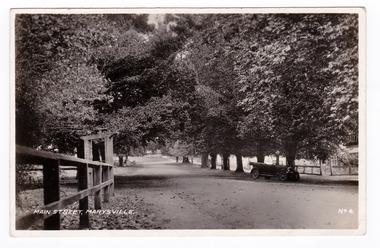 Marysville & District Historical Society
Postcard (item) - Black and white postcard, Valentine Publishing Co. Pty. Ltd, Main Street, Marysville. No.4, 1923-1963
... Dear Joan Just a card to wish all/ you girls a Merry Xmas/ I hope you all have a good time/ & suppose the Matron will/ throw a Big party/ Yours A Burgess....Dear Joan Just a card to wish all/ you girls a Merry Xmas/ I hope you all have a good time/ & suppose the Matron will/ throw a Big party/ Yours A Burgess. ...An early black and white photograph of the main street in Marysville in Victoria. An early black and white photograph of the main street in Marysville in Victoria. That street is now known as Murchison Street. This postcard was published by the Valentine Publishing Co. Pty. Ltd. as a souvenir of Marysville.VALENTINE'S/ POST CARD/ FOR CORRESPONDENCE/ FOR ADDRESS ONLY PRINTED IN GREAT BRITAIN The Valentine Publishing Co. Pty. Ltd., Melbourne. Dear Joan Just a card to wish all/ you girls a Merry Xmas/ I hope you all have a good time/ & suppose the Matron will/ throw a Big party/ Yours A Burgess.marysville, victoria, murchison street, postcard, souvenir, valentine publishing co -
Federation University Historical Collection
Card - Document, Victoria Cross and George Cross Association Christmas Card, 1981, 1981
... Dick Richards died in 1985. dick richards richard w. richards ballarat school of mines antarctica ross sea party george cross victoria cross and george cross association queen elizabeth prince charles Signed "With Love Dick and Joyce" A Christmas card which included a photograph of Queen Elizabeth 11 and the silver jubilee Reunion Dinner of the Victoria Cross and George Cross Association at the Savoy Hotel, London. ...Richard W. Richards was Principal of the Ballarat School of Mines, and was a member of the Shackleton Antarctic Expedition. He was one of seven survivors of the Ross Sea Party who were stranded in Antarctical during Ernest Shackletyon's ill-fated 1914 expedition. Dick Richards died in 1985.A Christmas card which included a photograph of Queen Elizabeth 11 and the silver jubilee Reunion Dinner of the Victoria Cross and George Cross Association at the Savoy Hotel, London. Signed "With Love Dick and Joyce"dick richards, richard w. richards, ballarat school of mines, antarctica, ross sea party, george cross, victoria cross and george cross association, queen elizabeth, prince charles -
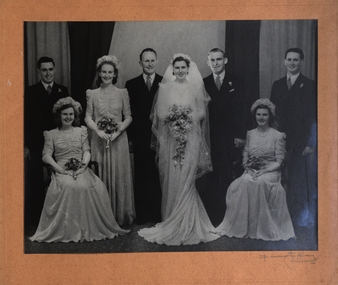 Federation University Historical Collection
Photograph - Photograph - Black and White, M Jefferey, Chatham-Holmes Collection: Wedding in Holmes family, c1930s
... chatham-holmes collection holmes david holmes mary elizabeth holmes wedding party c1930s ascot shirley lorraine dean bill holmes noreen dean jack holmes shirley holmes bill dean Signed by photographers at bottom right. Photograph mounted on beige card ...Photograph mounted on beige card showing the wedding of Henry John (Jack) Holmes from Ascot and Shirley Lorraine Dean of Lismore, Victoria. Front L - R: Seated Margaret Dean, Elizabeth Holmes. Back row L - R: Bill Holmes, Noreen Dean, Jack Holmes, Shirley Holmes, Bill Dean, David HolmesSigned by photographers at bottom right.chatham-holmes collection, holmes, david holmes, mary elizabeth holmes, wedding party, c1930s, ascot, shirley lorraine dean, bill holmes, noreen dean, jack holmes, shirley holmes, bill dean -
Glenelg Shire Council Cultural Collection
Photograph - Photograph - Wedding Party of Ted and Frances Henzell, n.d
... Black and white photo of wedding party including Ted Henzell and his bride, Frances Thomson. Photo is in buff coloured light card folder, with sailing ship embossed on front....SELWOOD, 12 SOUTHMOOR ROAD, OXFORD' Black and white photo of wedding party including Ted Henzell and his bride, Frances Thomson. Photo is in buff coloured light card folder, with sailing ship embossed on front. ...Black and white photo of wedding party including Ted Henzell and his bride, Frances Thomson. Photo is in buff coloured light card folder, with sailing ship embossed on front.Back: (photo) Purple photographer's stamp: 'Photographs by P. SELWOOD, 12 SOUTHMOOR ROAD, OXFORD' -
 Greensborough Historical Society
Business card and leaflet, Hairvens Above, 13/12/2014
... Coloured business card and coloured invitation to closing party for patrons 13/12/2014....Coloured business card and coloured invitation to closing party for patrons 13/12/2014. hairvens above grand boulevard montmorency Coloured business card and coloured invitation leaflet. ...Coloured business card and coloured invitation to closing party for patrons 13/12/2014.Coloured business card and coloured invitation leaflet.hairvens above, grand boulevard montmorency -
Glenelg Shire Council Cultural Collection
Document - Invitation - Maretimo Cocktail Party, n.d
... Invitation to Cocktail Party at 'Maretimo', on Friday 12th December year unknown, for official opening by Hon. Digby Crozier M.L.C. White card...Invitation to Cocktail Party at 'Maretimo', on Friday 12th December year unknown, for official opening by Hon. Digby Crozier M.L.C. White card ... -
Glenelg Shire Council Cultural Collection
Document - Ticket - Municipal Government Garden Party, 1955, Dec-55
... Ticket to centenary of Municipal Government Garden Party, 17th Dec. 1955. Peach coloured card, navy print....celebration centenary 1955 party Ticket to centenary of Municipal Government Garden Party, 17th Dec. 1955. Peach coloured card, navy print. Document Ticket - Municipal Government Garden Party, 1955 ...Ticket to centenary of Municipal Government Garden Party, 17th Dec. 1955. Peach coloured card, navy print.celebration, centenary, 1955, party -
Glenelg Shire Council Cultural Collection
Letter - Invitation - Cr & Mrs. AJ Thomas, c. 1953
... Invitation to Cr and Mrs A J Thomas to a Garden Party at Government House on Thurs. 5th March 1953. Cream card, blue crown, black script, hand written names...Invitation to Cr and Mrs A J Thomas to a Garden Party at Government House on Thurs. 5th March 1953. Cream card, blue crown, black script, hand written names Letter Invitation - Cr & Mrs. ...Invitation to Cr and Mrs A J Thomas to a Garden Party at Government House on Thurs. 5th March 1953. Cream card, blue crown, black script, hand written names
